Pursuing Pike
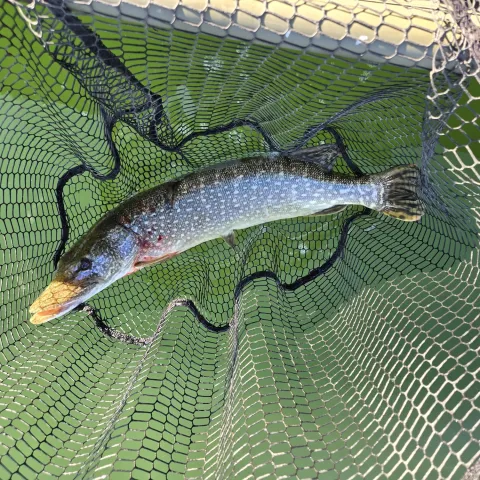
The sun was dipping low on the horizon as I cast my #3 Mepps spinner into my favorite country pond. As soon as it hit the water, I gave the rod tip a jerk, activating the spinner blade, and began a steady retrieve. Suddenly, my rod pulled away from me with the strike of a hammerhead pike. I excitedly reel in the small pike, landing the 15” fish after a brief battle. Carefully removing the hook, I released the fierce-looking pike back to the pond, taking in the evening's quiet, golden red and yellow sunset illuminating the shoreline trees and fields. Having moved the past year from the city of Madison to the small country town of Waunakee, this had become my solace as I struggled with the challenges of trying to fit into a farming community, having little in common with my freshman high school classmates. This pond became my solace on many an evening and quenched my inner need for solitude.
Pike hold a special place in my heart for angling adventures. They remind me of freshwater barracudas, with fierce features and vise-like jaws with a full set of razor-sharp teeth. Pike are the kings of their abode, and if I were a perch swimming around, I would be looking over my shoulder!
Knowing your adversary’s tendencies is an important key to successful angling. When it comes to pike, there is a keyword you should always remember – ambush. Pike are masters at ambush hunting skills, using their fins to stay suspended and motionless, waiting for a feeding opportunity to go by. They love cover. In rivers, look for downed trees and logs along the shoreline or cast to undercut banks. Slow backwaters and eddies are ideal locations to explore. If you see weeds under the surface, be sure to target those as well, using weedless baits like buzz baits or surface lures – frogs and poppers can be deadly effective, and hooking a pike on a surface lure is a blast – literally – as the pike comes up and slams your presentation.
Lake fishing presents a few more challenges, but again, target shoreline cover or find shallow bays with weed growth. In deeper lakes, pike will likely drop into cooler waters on hot days, making a deep diving crank bait a good option, casting along weedy drop-offs. More than one angler has been surprised by Montana’s Ft. Peck, jigging deeper waters for lakers and hooking into a pike!
Other popular casting lures include spinners, plastic paddle tail jigs, and spoons. These are all lures that pike will pursue and strike. Your retrieve should be steady and not too fast. A pike depends on sight, sound, and vibration. Often, that first splash of the lure hitting the water is what will alert the pike to a feeding opportunity, and strikes may come soon after your lure hits the water, so be ready to retrieve. Especially with buzz baits, the trick is to immediately close your bail, keep your rod tip up, and reel. You’ll find the sweet spot for retrieval speed that keeps the lure skimming the surface and making a big splashing commotion – so much fun!
Pike will hit just about any lure that moves, and they will also hit bait, including live or dead bait under a float. My personal preference is casting and moving locations. To each their own…
Rods and reels should match the lure you’re tossing, and both level and spinning reels work just fine. A medium/heavy rod will help pull those fish out of cover easier. Braid in a 20-30-pound weight is a good option.
As mentioned earlier, pike are predators, and one look at their mouth full of razor-sharp teeth will confirm that! Most pike anglers will use a metal leader to save those expensive lures. The pike aren’t leader shy, so no worries about scaring them off. When you catch your pike, if you plan to catch and release, handle them with care. Pike are surprisingly fragile. Barbless hooks, needle-nose pliers, and jaw pliers will help get that fish back into the water for others to enjoy.
The best time to fish for pike is the morning and the evening hours, although they will bite all day long, and all season long, making them a good choice when other fish aren’t cooperating.
If you decide to keep a few, save the larger ones and keep the smaller fish. Pike are good eating, but a bit of a hassle to clean. The accursed “Y” bone can present an issue when cleaning. I recommend checking out some YouTube videos on how to filet your catch. Meanwhile, releasing those bigger fish will allow other anglers to pursue the pike of their dreams!

/articles/pursuing-pike
The Sport Reward Fishery
By Hannah Pennebaker
What’s better than fishing? Getting paid to go fishing! Every year, WDFW pays anglers for every northern pikeminnow they catch. Why? These fish eat millions of baby salmon and steelhead every year. The goal of the program, called the Pikeminnow Sport-Reward Program, is to reduce the average size of the fish and remove the larger, older fish that eat the most salmon and steelhead. With this program, not only can you get paid to catch these fish, but you can also help out salmon and steelhead!
This program takes place on the Snake River and Columbia River every year, from about May to September. According to WDFW, “In 2022, rewards begin at $6 each for the first 25 Northern Pikeminnow caught during the season. Anglers are paid $8 for each fish they catch from 26-200, and $10 for every fish caught over 200 cumulatively. Anglers are also paid $500 for each specially tagged Northern Pikeminnow!” Every pikeminnow 9 inches or longer is eligible for the program. Dedicated pikeminnow anglers can make thousands of dollars every year, and feel good about helping salmon and steelhead out.
WDFW says that anglers “averaged reward payments of $27,836 each for the five-month season. The highest-paid angler in 2020 caught 5,579 fish and earned $48,501, while the all-time record harvest is 14,109 Northern Pikeminnow worth $119,341!” Not bad, and don’t forget that it’s all for a good cause: each pikeminnow can eat up to 15 salmon/steelhead smolts in a day. Interested in trying out the fishery? Let’s go over how the program works, and how you can get involved.
The Pikeminnow Sport-Reward Program is designed to be as easy and straightforward as possible. There are stations set up near the Columbia and Snake Rivers where you can turn in your catch for the day. You must register at the station before you fish, and a valid fishing license is required. Registration forms are available 24/7 at each station. If the station is unmanned when you arrive, you can pick up your form from their night box.
Fish must be returned to the registered station during its hours of operation in order to qualify for a reward. Frozen fish are not allowed, they must be live or fresh. Any fish 9 inches or above will qualify. You may register for the next day when you return your fish for the day. If you return fish to the station without registering in advance, you won’t be able to get your reward. Rewards aren’t issued at the station, instead, you’ll get a voucher. You’ll get reward vouchers every time you turn in eligible fish, and you can mail them to WDFW for a reward, issued in the form of a check.
Remember, WDFW must receive your vouchers by November 15th of every year. If you’re lucky enough to get a specially tagged fish worth $500, the station will give you an envelope to mail the tag to. The first time you receive a voucher, you need to include an IRS W-9 form when you mail the voucher out to receive payment.
Interested in trying out the fishery? Thankfully, it can be very productive, and there is a lot of information out there to help get you started. Shore anglers can do just as well as boaters. Every week, WDFW posts catch numbers collected at each station, and catch reports dating back to 2014 are available on their website. You can figure out where anglers are having good success and try fishing in those areas.
Pikeminnow can be caught from shore or boat. You can use bait, artificial plastics, or lures. Diving crankbaits work well, and you can troll them or cast them out. Pikeminnow tend to congregate near the bottom of the river. Drift fishing can be very effective! Many seasoned pikeminnow fishermen drift tubes or grubs on a ¼ oz jighead. Bring a variety of different colors; pikeminnow can be surprisingly picky! Use just enough weight to tick the bottom and not drag on it, or you will likely snag up and lose your lure. If plunking is your bag, you’re in luck.
Many anglers have had success plunking worms, chicken liver, and shrimp. Just make sure to use enough weight to stay on the bottom. Small spinners and other bass lures can also work well. If you’re on a boat, you can “back bounce” your bait by lifting up your rod, letting out some line, and repeating once your weight hits the bottom. Just make sure to keep your line as tight as possible, as pikeminnow have surprisingly light bites.
Like most fish, pikeminnow tend to hang out around structure. They also like faster currents, so avoid frogwater. They tend to school up, so if you don’t catch one within 10 or 15 minutes, move and/or change bait/lures.
The Pikeminnow Sport-Reward Program has been a huge success, and is still going strong every year. According to WDFW, “over the past ten years (2011-20), the top 20 anglers caught an average of 3,353 fish per angler. Results indicate that the Pikeminnow Program has been successful, with over T5.2 million predatory Northern Pikeminnow removed to date by anglers participating in the Sport-Reward Fishery, and a decrease of predation on juvenile salmonids of up to 40 percent from pre-program levels”.
This is a great way to help salmon and steelhead, and make money doing it! As a bonus, pikeminnow are scrappy fighters and are great fun to catch on light tackle. Remember to register at the monitoring station before fishing, and have fun out there!
If you’re looking for more information about the Pikeminnow Sport-Reward Program, WDFW holds free fishing clinics during the season, and they often have a booth at sports shows where you can learn more. You can check out their website for a free, one-time $10 coupon to turn in with your first pikeminnow! Good luck out there!
/articles/sport-reward-fishery