Hoodsport Chum
For salmon anglers in the Pacific Northwest, November heralds the final transition from targeting open saltwater to focusing on tidewaters and rivers. Yes, there are some saltwater opportunities (for example, blackmouth, when open), but the vast majority of anglers have put away their boats and are pursuing salmon in the rivers. That said, there are some prime opportunities to target and catch salmon out of your fishing boats, so don’t button them up just yet!
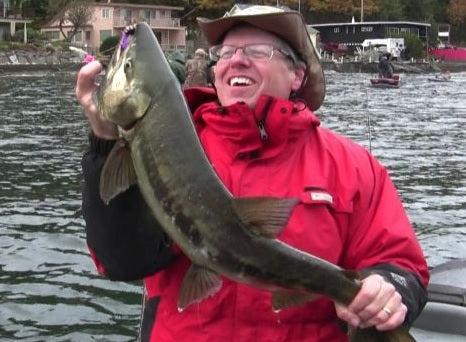
One of my favorite fisheries out of my boat in November has to be the Hoodsport chum fishery. The fight of a 10-15 pound chum ranks up there as one of the hardest fighting salmon you can catch. Taking on a chum with steelhead gear will give you all the battle you could ask for as these brutes slash and pull with every ounce of energy they have. One look at their fighting canine teeth and you’ll know this is a fish that is serious, very serious, about its reproducing goal.
All up and down Hood Canal you’ll find chum as they work their way toward their spawning grounds. The state hatchery at Hoodsport and three miles south of there at Potlatch (a smaller, Native American hatchery) are the destination for many of these chum as they work their way down Hood Canal.
I have caught fish in both locations, and each spot has reason to recommend it. Potlatch, being smaller, has limited shore angling and parking, which is roadside only. That said, there are also fewer anglers there. Hoodsport, meanwhile, is the Fishing Mecca that chum anglers are drawn to. Fishing right out in front of the hatchery and watching hundreds of fish jockey for position as the tide sweeps them into the small feeder creek leading to the hatchery is truly a sight to behold. Of course, along with the fish comes combat fishing in all its glory. As the tide comes in and fishing space decreases, getting to know your neighbor takes on a whole new meaning.
If you’re a fortunate one you’ll be fishing out of a boat – or some type of floating device. The waters around Hoodsport are open and the wind can come up and blow hard, plus fast running tides can make it a challenge to get an anchor to set. Be sure to bring an anchor with some bite, and terminal chain so you’ll stick in the rocky bottom. I’ve seen anglers fishing out of all manner of floating devices on calm days, including single person pontoons and float tubes. Be sure to have your life jackets on and just don’t venture too far off shore. If you are feeling anxious that’s your inner voice telling you a fish isn’t worth your life – pay attention to it!
For boaters, the launch is two miles south of Hoodsport at the Skokomish Park at Potlatch. The launch has two concrete lanes which are in varying state of repair (read that as back down with caution!). There is ample parking, and a restroom. Once launched it’s a quick run to either terminal hatchery, faster to the small Potlatch facility.
When you arrive, survey the already anchor boats, taking into account the amount of anchor line you’ll need to get a solid grip on the bottom, as well as the shore anglers. Anchoring too close to the shore bound anglers will earn you a steady rain of lures and weights at your boat. Stay outside their casting zone - you’ll have plenty of water to work over and opportunities to catch fish the shore anglers don’t have.
As to the type of gear you should bring… you’re going to enjoy a variety of methods to catch these Hoodsport chum. Like chum everywhere, chartreuse and green are always great colors to choose. Pink or cerise is also good color choices. For rod/reel setups I use my steelhead gear, both spinning reels and casting will get the job done. I like an 8 ½ foot medium action rod. Line should be strong enough to turn these big brutes so as to avoid massive tangle ups with your fellow anglers. I like 18-20 pound test. Chums are not leader shy in my experience so keep things hefty.
What technique you use is up to you but here are a few tried and true methods:
Floats and jigs , or floats and corkies with yarn can be deadly. A ¼ or 3/8-ounce pink, black or purple marabou jig fished under a float is deadly. Tipped with a piece of shrimp meat or coon shrimp tail is even better. The yarn is a nice trick as it helps by getting caught up in the chums teeth, allow you to drive the hook home. Other bait you can put under a float includes the ever popular anchovy or herring, whole or plug cut.
Think of the tide as the river current. Set your depth for the lure so it’s running a foot or so off the bottom. Vary the depth if you aren’t getting bites. These fish will hit suspended jigs. Cast “upstream”, i.e. up into the tide, and let your gear drift down with the tide to the end of the “drift”. If the coast is clear, free spool your line, keeping the float straight up and down to extend the drift. When the float goes under set the hook and be ready to do battle!
Twitching jigs – ditch the float and cast the jig on its own. Another effective technique, but be prepared for a lot of foul-hooked chum. Dragging a chum in by the tail is not fun, nor is it sporting to be snagging fish. If you find yourself foul hooking too many fish move on to a different method…
Casting spinners. Again, it’s a solid technique to try if the action is slow. I personally would remove the treble hook and use a single si-wash hook. A number 3 or 4 blade fished with a slow retrieve is just the ticket.
Corkie, yarn, and slinky. I personally have caught a lot of fish using this method and seldom snag fish. Again, think of the tide as a river. Cast out and let your gear drift. You’ll know you have a bite because your rod will be about ripped out of your hands. I use a 3-4 foot leader length.
Regarding the above technique, I’m sure I’m going to get comments about flossing – I personally think it’s a bunch of malarkey. Why do I say that? Because I remember a day years ago fishing Hoodsport when the chum were in thick, jumping all around us, swimming by in schools of 10-20 fish. I had my corkie/yarn/slinky set up going, casting, retrieving, and not getting a bump for a good hour. Suddenly, the bite magically turned on and my gear started getting bit. In came fish after fish, hooked in the jaw. Explain to me how one can have a steady procession of fish go by with mouths open for a good hour and not “floss” one fish, then suddenly start catching one jaw hooked fish after another? And trust me when I say this, those hook-ups were solid strikes, not to be mistaken with a snagging sensation. Anyway, the flossing debate is one we anglers love to engage in every year and likely will do so as long as we fish corkies.
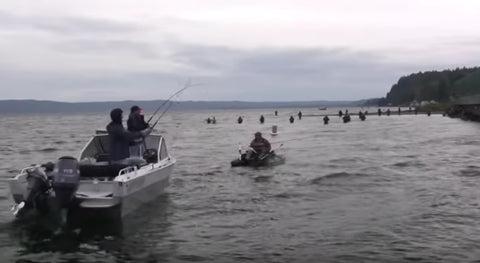
The fly fishermen do quite well at Hoodsport as well, fishing sinking tips and flies of various styles and colors. I’m not a fly guy but it sure does look like fun. Maybe on my next trip I’ll give it a try.
Before you set out, be sure to check the Hoodsport netting line at 360-877-5222. Typically the nets go in on Tuesdays and Thursdays, but this is not set in stone. There’s nothing worse than driving a hundred miles only to find nets spread in every direction. So save yourself that aggravation before you set out.
Fishing for hard fighting chum is a blast. Get in on the action this November!
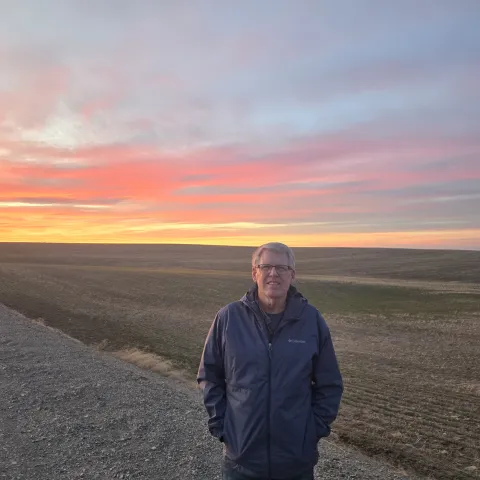
/articles/hoodsport-chum
Hanford Reach Fall Chinook Bounty
My reel was peeling line at a dizzying rate and it felt like I had a freight train attached on the other end. Without thinking I applied my thumb to the level line spool and pulled back with a loud “ouch!” “That’ll leave a mark” our guide Dave deadpanned. The fish was a good fifty yards behind our boat before I was able to slowly start to regain line. Foot by foot the strong chinook and I battled back and forth, each of us gaining, and then losing line to the other.
The most popular location anglers congregate is Vernita Bridge. There is a large open area to the north of the bridge on the east side of the river. Every year a small town of anglers set up their base camp here. All variety of tents, RVs, and sleeping in the back of trucks can be seen. At night the cries of the coyotes remind you that this is wild country. Camping is free, but a Discovery pass is required. The launch here is rough and rocky and four-wheel drive is a must. Plan on your boat getting scraped up on the rocky shoreline and be sure to bring waders to help during the launch and retrieval process. Launching, by the way, starts at o-dark hundred. Alarm clocks are optional – unless you’re a deep sleeper, you will be awakened by the lights and sounds of anglers starting to launch around 3am.
Closer and closer the powerful fish came, each run a little less intense. Now a giant tail could be seen, trailing a large V wake behind it. Finally, the fish, exhausted came to the side of the boat and I saw the reassuring sign of fatigue as the fish laid on its side, telling us we were getting closer to that critical moment. Net sliding under the fish Dave skillfully scooped him up and into our boat. But not before the big fish gave one final flip of his tail, giving all of us an early morning soaking. Wow! This upriver fall bright was twenty plus pounds of pure power and beauty, not to mention great eating. The smiles and high fives of my friends were the icing on the cake and the day was just beginning!
A perfect morning, the sun just breaking over the shoreline and catching a hot Hanford Reach fall chinook - it’s the stuff dreams are made of, and it was living up to be everything I had heard about the Reach.
Washington’s Hanford Reach is synonymous with some of the state’s best fall chinook fishing to be found – and not coincidentally, the last of the chinook fishing to be found for the season. It’s the icing on the cake, and what icing it is! The Reach is the perfect setting and the perfect fish to end the year’s salmon fishing on the Columbia River. These are the brutes that dreams are made of. A fish worth dreaming about during the long off season and savoring the brief weeks they are available to catch. Battle plans must be made, so let’s talk about what you need to know to get into this fishery and have a chance at one of these amazing fish.
They call “The Reach” the last free-flowing stretch of the Columbia. With dams seemingly from one end of the Columbia to the other, this stretch of water has no dams to impede it. Here, from Priest Rapids dam down to Richland anglers have 63 miles of productive water to fish. Ideal spawning grounds make this a natural holding location for big chinook to do their reproducing thing. For the boat angler, you’ll find a variety of deep holes, shallow runs, and everything in between. A prop boat can be used – with extreme caution, however, downriver in the area known as Coyote Rapids a jet is the way to go.

Just upstream from the rough launch at Vernita you’ll run into the first hole, the Hog Hole. This spot will hold fish early and throughout the season. It’s in the middle of the river and runs a couple hundred yards in length and has a depth of 15-40 feet. Fish will be both suspended and hugging the bottom here. The hole is deep enough to require a way to get your gear down to the fish. This can include divers, dropper weights, and, yes, downriggers. A word of caution – the Columbia is a big, strong, and powerful river. Snagging a downrigger ball on the bottom of the Columbia has the potential for some seriously bad consequences and requires the boat captain and crew to be ready to deal with them. The times I’ve used downriggers I always have a wire cutter at the ready and a good dose of “always pay attention” to go along with it. It goes without saying if another boat hooks up to be ready to pull those riggers up. Backtrolling this hole works well and as you push the fish ever shallower by ready for that take down.
A variety of salmon catching gear can be used for Hanford chinook depending on the depth and speed of the spot you are fishing. Among the most popular setups are flashers with super baits (packed with tuna), plugs, flatfish (wrapped with a sardine or herring strip), and the ever-effective spin-n-glo with eggs, or eggs and shrimp. Anglers that are flexible and willing to adapt techniques to river flow and time of day will be most successful. Backtrolling your gear down the hole can be very effective, pushing fish back down the hole and triggering them to bite out of aggression is a tried-and-true technique.
Farther upriver as you head to toward the dam, you’ll find the King Hole about a mile and a half above the bridge, then the China Bar and Midway Drifts. One of my personal favorite spots is the deep hole just down from the dam. As well as being great holding water, it’s a stunningly beautiful spot. The deep hole off the rocks is great for downrigger fishing. You may even want to try running a diver twenty feet behind your release and bringing the ball up ten feet off the bottom, letting the diver do the work of bring your bait down to the bottom. Be sure to pay attention to the regulations and know the areas that are closed, downriver from the dam and on the west shoreline where the hatchery is located.

Below the Vernita Bridge you will find several more popular spots, including those famous old reactors. It’s about a three-mile run down to the B/C hole, and another four miles to reactor number one, and then number two. Beyond a large bend you’ll find the famous White Bluffs with a nice sixty-foot-deep hole. There’s a concrete launch located here, however; this is the area where running a prop boat becomes a dicey proposition. Be mindful that water levels can go up and down five to six feet in a day, leaving riffles where clear passage had been. It would be best to learn this water by first going with a guide before venturing out on your own.
Finally, farther downstream around the areas of the mouth of the Yakima down to the mouth of the Snake you’ll find slower water, more suited for prop boats. With several launches located around Richland, Pasco, and Kennewick, smaller boats will have a safer time of it than at the fast-flowing upper Reach spots.
As to timing, these up-river brights can be targeted from mid-September well into late October. Don’t be fooled by the dark coloring on these fish – they cut just fine and taste great!

The Reach is truly an amazing place to fish with the very real opportunity of hooking into large chinook. Multi-fish days are not unusual. As a bonus, while fishing you’ll be treated to amazing scenery. Besides moth-balled nuclear reactors, it’s very possible to see coyote, mule deer, several varieties of waterfowl, and even herds of elk on the shoreline. Some of the best weather in the Pacific Northwest can be had with temperatures moderating from the scorching hot summer days. You’ll find cool nights and a sky full of stars to gaze at as the coyotes sing you to sleep. And most likely you’ll be rewarded with some tasty chinook to take home.
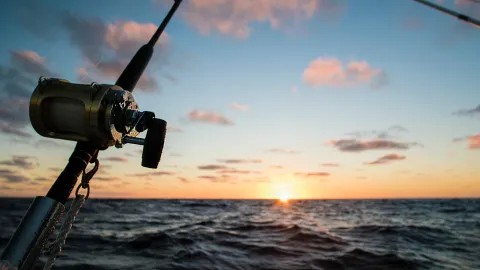
/articles/hanford-reach-fall-chinook-bounty
Generational Fishing
I’m a new father. My daughter turns 2 at the end of July. It amazes me how fast time goes. My phone is fancy enough that it will create a collage of pictures and ask me “do you remember this day?” It’ll compile similar photos and quotes together with a caption along the lines of “outdoor adventures” or whatever else is sure to draw me in. I have to say, I like the features of the phone and sometimes I don’t remember the day or taking the photo.
Other times, the memory is clear and will get my brain churning to the before and after events of that photo. It’ll also lead to a great talking point with my family, or remind me to reach out to a friend who I was with during that time. It’s basically my generation’s photo album: a compilation of memories that elicit the sights and sounds of the past.
Seeing these photos and videos pop up on my phone makes me reflect on the journey I’ve been on. It makes me reflect and think about the life that was and the life I have now. The timestamped dates and pinpointed locations on the photos give me a clear reminder of when and where I was as I snapped those photos. Some photos I’ve kept in the camera roll for 10 or more years, other photos happening just yesterday or the day before. Each with a level of happiness and appreciation from the time. There clearly had to have been a reason I felt like the photo needed to be taken.
Even those photos of some random arrangement of letters and numbers for a code or a stall number in the parking garage so I wouldn’t get lost after a trip shopping. Although, that example probably has more to do with my wife than my own shopping adventures. Other photos are those milestones we will always remember but may not quite recall the details. Holidays with family, vacations around the world, a collage of our hobbies, or additions to the family. It’s those last two areas that inspire me to think about how thankful I am to be at this stage in my life.
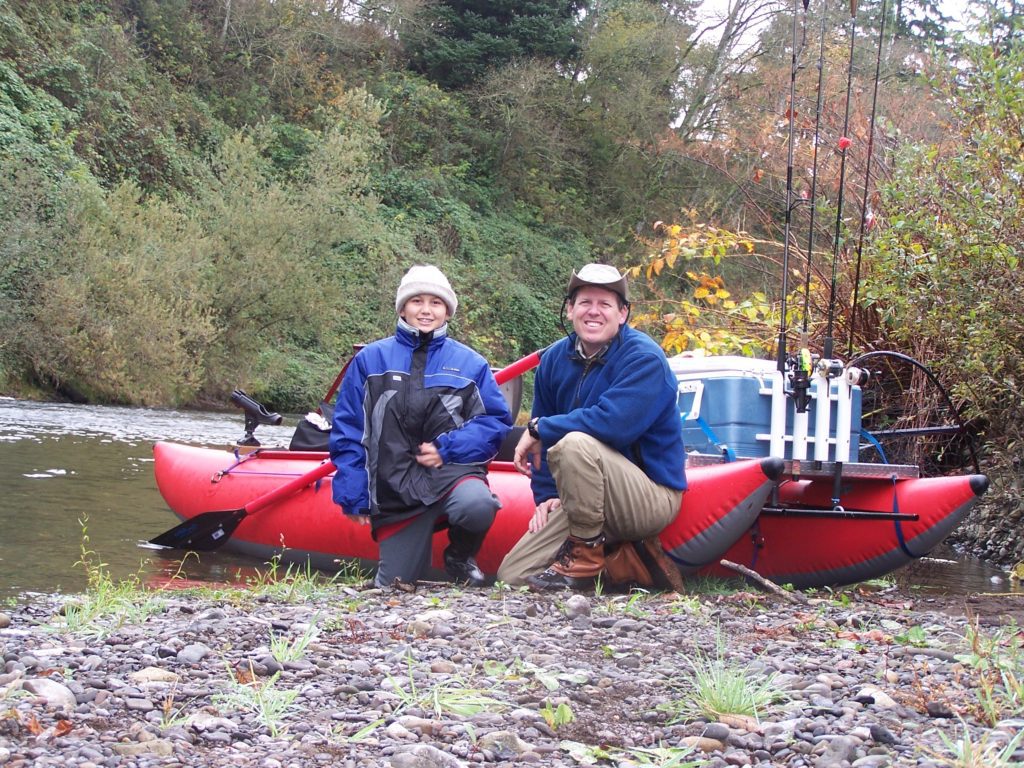
Adulthood
Something about life before kids and life after kids is a pivotal point. The stage of “adulthood” that has a clear separation between life that was and now life that is. Those late nights I could go out and do whatever I wanted are no longer. There is now a little human who depends on me and my ability to have some foothold on my life. To use a baseball analogy, I wouldn’t say I need to be hitting home runs in all areas of life as a dad, although I’d certainly take them as they come, but there’s nothing wrong with taking the day-to-day with solid doubles to right center field.
I might even strike out a time or two, or if I’m having a particularly hard time navigating whatever the challenge of the moment is ground into a few double plays. The goal I think as a parent is to limit those outcomes as much as possible. To be a constant source of support, happiness, and guidance for your kid as best as you know how. It’s cliche to say, but my wife and I didn’t get an instruction manual when we left the hospital with our child.
It’s my hope that I can inspire my daughter to enjoy many of the same hobbies I have while also encouraging her to find her own. I’m into fishing, sports, and good TV shows. She might enjoy music, writing, or computers. Whatever the case may be, there are areas in our lives that will overlap and find common interests. I surely hope that enjoying the outdoors, and fishing specifically, are among the shared hobbies.
The patience and independence we learn with fishing is invaluable. Soft skills such as being able to hold a conversation during down time or to celebrate someone else’s success are also an important area we learn as fishermen. I hope to share the many hours on the road traveling to different bodies of water with her as I did with my dad. I know my growth as a man is in large part to his teachings when I was younger. I am also excited to see how he can impart his wisdom to her and influence her in a positive way. That kind of generational guidance goes far beyond fishing. Tying a knot, being able to read the water. Those are great, but the time spent together, and memories built are what is truly important. The three of us out on the water fishing? That sounds like a memory with lots of photos.
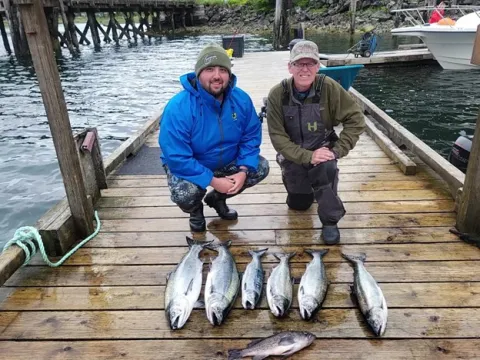
/articles/generational-fishing
Fall Trout Strategies
Tired of the salmon fishing crowds?
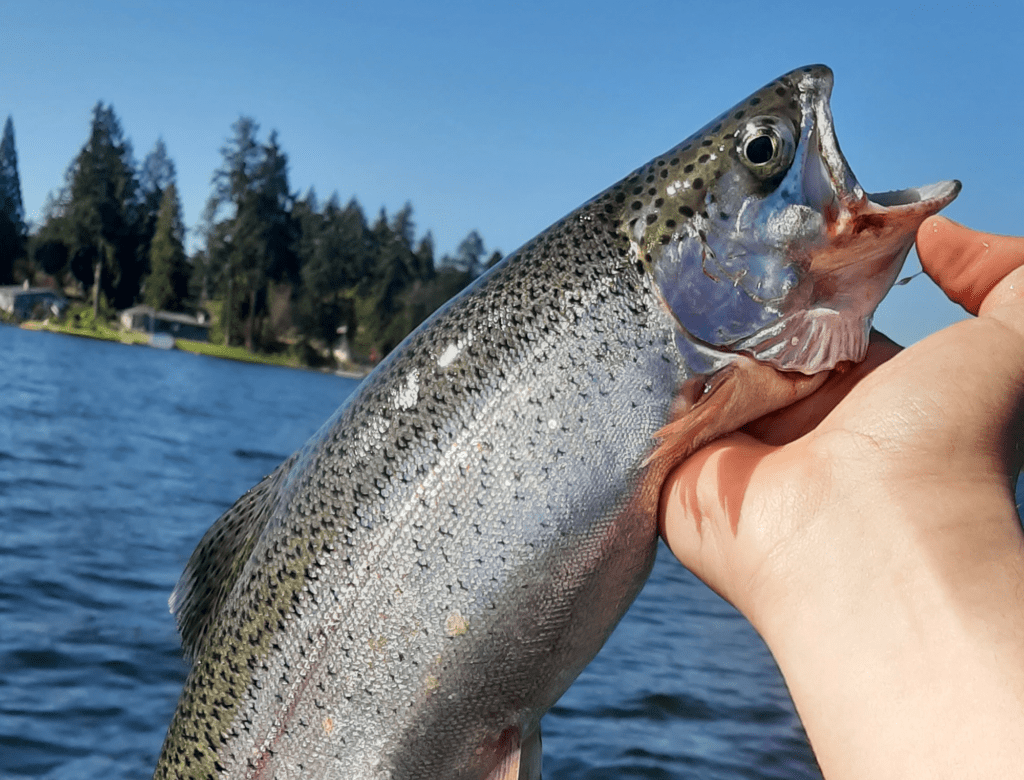
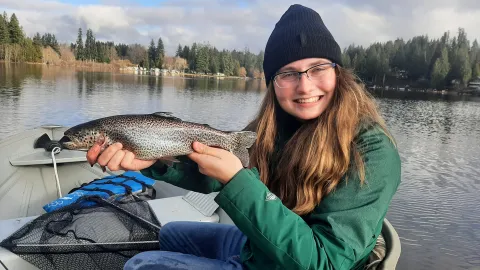
Tired of the salmon fishing crowds? Looking for one last hurrah before winter? Look no further than fall trout! Fall is one of my favorite times of year to fish for rainbow trout. The majority of other fishermen have either put the boat away for the year or are off targeting salmon, so most days you’ll have the lake to yourself.
Most pleasure boaters have also put their boats away for the season, so those of us with small boats don’t have to deal with their huge wakes! Another benefit of fishing for trout in the fall is that they once again start to patrol the shallows looking for a quick meal, putting them within reach of shore anglers. Those small planter trout from earlier in the year have also gotten much larger by this time, making for big, tasty fish. Not to mention they are also more aggressive during this time of year because they want to pack on the pounds before winter.
Though they do most of their trout stocking in the spring, WDFW also plants several lakes on both the east and west side throughout the fall. Check the stocking reports on their website, sometimes they stock jumbo trout! Fishing for fall trout is one of the best ways to spend a lazy fall day. You can enjoy the cooler weather and a break from the crowds. Whether you want to fish from shore or a boat, you can find success by following these tips.
No boat?
No boat? No problem! Dust off those ultralight rods and hit the lake. You can fish with a bobber, soak dough bait, or throw hardware. Spinners and spoons work very well for fall trout, but traditional dough baits and worms will also catch fish. On lakes where two-pole fishing is allowed, I like to put some dough bait on a hook, toss it out, and put the rod in a rod holder. I’ll grab a second rod and cast spinners while the dough bait soaks. Black/gold spinners are my favorite! It’s a good idea to bring several different colors and flavors of dough baits.
Take a look at reports or try to remember what you used in the spring. Worms, salad shrimp, corn, and maggots are all tried and true trout baits. If you don’t have luck fishing in one location, it pays to move around until you figure out where the fish are at. You’ll often see fall trout jumping and feeding on the surface. Fishing is best in the mornings and evenings, but trout are always hungry during the fall and will bite any time of day.

Shore anglers
Although shore anglers can easily get limits of trout in the fall, don’t be afraid to take out your boat and try trolling for them. There are fewer pleasure boaters in the fall, thanks to the cooling temperatures. It’s a great time of year to take out your kayak or small aluminum boat. Try a faster troll than you would in the summer. These trout are feisty and will chase down a meal willingly. You can use larger presentations than you would in the spring and summer, since the fish are bigger. I’d highly recommend using a fish finder. Do you miss trolling with leaded line?
This is a great opportunity to troll with leaded line or divers, since the fish are running much shallower than in the heat of the summer, making downriggers unnecessary. I often have good success trolling plugs in the fall, but spinners can work well too. For attractors, you can use dodgers or gang trolls. I lean towards dodgers, but maybe that’s because I’m also a kokanee fisherman.I already have a book of 20-30 dodgers in different colors, shapes, and sizes. Gang trolls have definitely put caught many a trout, but I find dodgers easier and more convenient to use. I can quickly put globs of scent on them, tune them, and change them to suit the conditions or try something new. Whichever method you use, you’re sure to get many fall trout on your hook!
Don’t hesitate to give fall trout fishing a try! The fish are big, aggressive, and tasty. Your chances of scoring a trophy holdover are much higher this time of year. I would recommend trying Potholes Reservoir, the seep lakes, Mineral Lake, Clear Lake, American Lake, and Harts Lake, for starters. There’s no need to put up with crowds or drive all day to the coast. Give your favorite local lake a try! It’s also a great way to put kids on fish. Some kids just don’t have the patience to troll or cast all day for salmon, but they’ll love seeing those trout takedowns! Don’t forget to bring the net, the size of these trout can surprise you.
Hope to see you out there this fall!
/articles/fall-trout-strategies
Ode to the changing seasons!
I’ve always been a fan of the changing seasons, for the blustering chill in the air, and the transforming colors in majestic trees. Shorter days and longer nights. And who of us can ever forget, the hatcheries unleashing their beasts!
The Cowlitz River
The Cowlitz River is my favorite river by far. Every year we spend October 31st on the river for “Cowloween”. Catching monsters on the Cowlitz can be done in a variety of ways such as side-drifting, twitching jigs, back-trolling, hover-fishing, and casting hardware. The Cowlitz River Salmon Hatchery produces nearly 13 million fish each year, including about 1.3 million spring Chinook, 5.0 million fall Chinook, and 3.2 million coho salmon. This hatchery is located near Barrier Dam and the Barrier Dam boat launch.
It is no secret that the Cowlitz River is known for some of the best Salmon and Steelhead fishing in the state of Washington. Anglers swarm from around the country to get a chance to catch Chinook Salmon, Coho, and Steelhead. Don’t let its popularity dissuade you, there is still plenty of elbow room. If you don’t have a boat of your own, plenty of seasoned experts offer fun guided trips.
I have been fortunate enough to catch a regular ride with Sather Guide Service. Jared is a skilled captain and fisherman. He has the ability to drive his boat backward with a foot while casting. You are guaranteed to pull in a whopper between Jared and his deckhand. These guys will set the hook if you like and hand it off. This makes for an exciting and fun experience for less seasoned anglers.
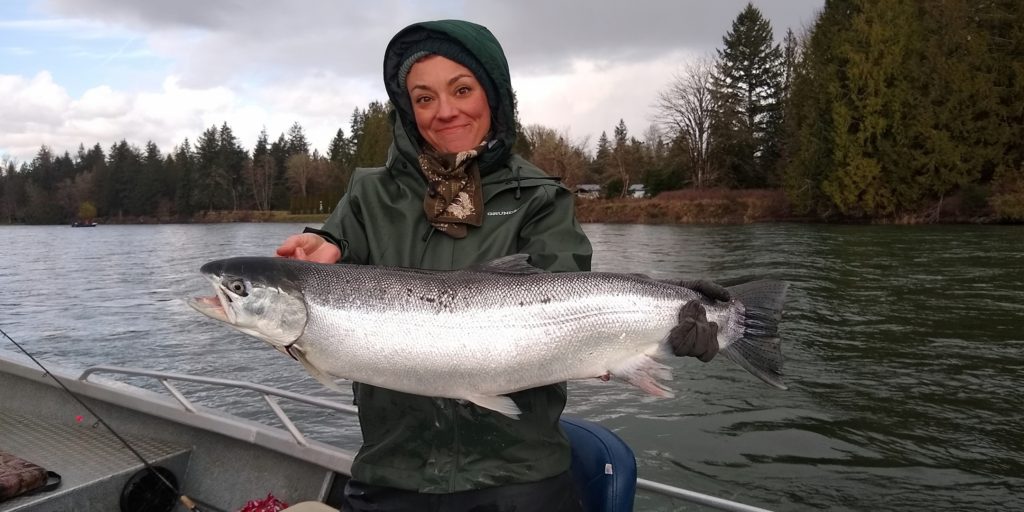
I set my own hook and landed these beauties. It is a team adventure, with jokes and snacks too! Jared has the stamina to fish dawn to dusk but is very conscientious of all guests should the need to go to shore arise. There are a few options for overnight stays near the Cowlitz. A few of my favorites would be Toutle River RV resort. We opt to stay in the “Love Shack”, a quaint little studio apartment. It’s affordable. Though proximity to the train tracks might annoy some, we enjoyed the entire experience.
The Castle Rock
The Castle Rock “Sky Cabin” is a fun experience. Like an adult tree house with all the amenities. Off the beaten path, but only around 20 minutes to the boat launch. If you opt to take just a day trip, there are plenty of great dining options, though I personally prefer renting a space with accommodations for making your own food.
In a pinch, you can find quality dining at El Compadre off Highway 504, The Oasis in Castle Rock or Papa Bears. We love to combine adventures, such as hunting for rocks, covered bridges, quiet trails and breathtaking sunsets. Into bridges? Try visiting the Cedar Mill Grist in Woodland, The fall colors and rambling waters are a sight to see. A quiet and awe-inspiring peek into the past. If you like beautiful rocks, you can find a variety of agates along the rocky creeks that amble the backroads along Highway 12.
If you are a fan of just fishing, the Cowlitz River is a great destination that is hard to beat. Launch early and stay late! It will be a wild ride full of catching and keeping!
/articles/ode-changing-seasons
The S&P 500
Most folks think of the S &P 500 as a stock market index, but on a recent trip to the Columbia River Gorge, I realized it had a fishing meaning as well. Namely, the opportunity to catch 500 shad and pikeminnow over the course of a week! My friend Rusty Johnston and I spent a couple of days fishing on the Columbia River between Rufus and The Dalles. Our first goal was to catch a bunch of shad, not just for fun, but also to use for crab bait this summer. Our second goal was to catch some pikeminnow and turn them in for money through the Northern Pikeminnow Sport Reward Fishery Program.
This program is administered by the Bonneville Power Administration along with both the Washington and Oregon Department of Fish and Wildlife. The northern pikeminnow is a native fish, but fish nine inches and longer feed on outgoing salmon and steelhead smolt, impacting the survival of both species.
In this program, anglers are paid anywhere from $6 to $10 a fish for any pikeminnow turned into a designated station along the Columbia or Snake River. The more fish you catch, the more they are worth and if you catch a tagged fish, it is worth $500. You can find out more about this program, designed not to eliminate, but control the population of pikeminnow, at www.pikeminnow.org.
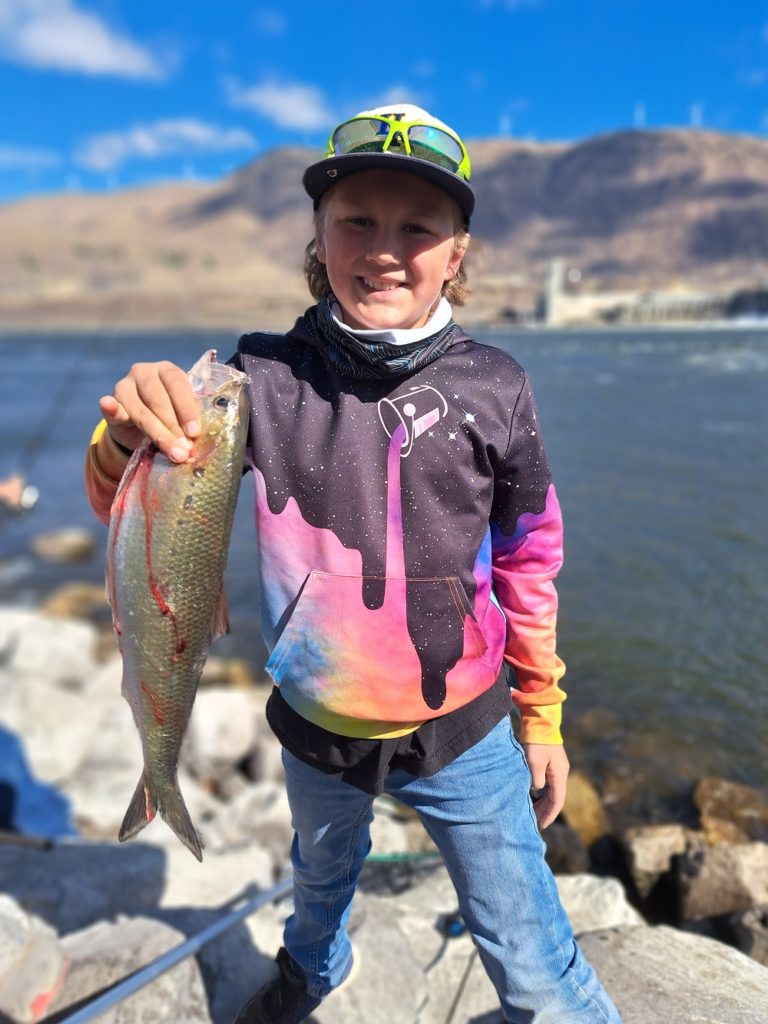
Rusty and I decided to start our trip fishing for shad below the John Day Dam. You can fish below the dam on both the Washington and Oregon side of the river, but we decided to buy a non-resident license at Gorge Outfitters Supply in Rufus and fish the Oregon side at Giles French Park.
Shad Killers
We were using Shad Killers, a local jig sold at Gorge Outfitters Supply, and the hot color for us was red and white. The Shad Killer is a 1/16-ounce jig with a bit of flashabou on it. We tied the jig onto a two-to-three-foot leader which we tied to a barrel swivel. Above the swivel we had another swivel which held a ½ ounce lead weight. Other lures that work well with this set up are shad darts and Dick Nite spoons.
We cast our offering from the bank, let it sink a few seconds, and the reeled in with a slow to moderate retrieve as the lure drifted downstream. We were soon rewarded by hook ups with a whole bunch of shad. The American Shad averages one to three pounds in size. They are scrappy fighters and up to six million of them make their way over Bonneville Dam between the end of May and mid-July, all heading up the Columbia to spawn. I have enjoyed good days on the water catching shad before, but this day was epic! Rusty and I hooked into some 50 shad in just two hours of fishing. We lost a few (they have a nasty habit of throwing the hook) but reeled in some three-dozen fish, getting more than enough crab bait for the summer.
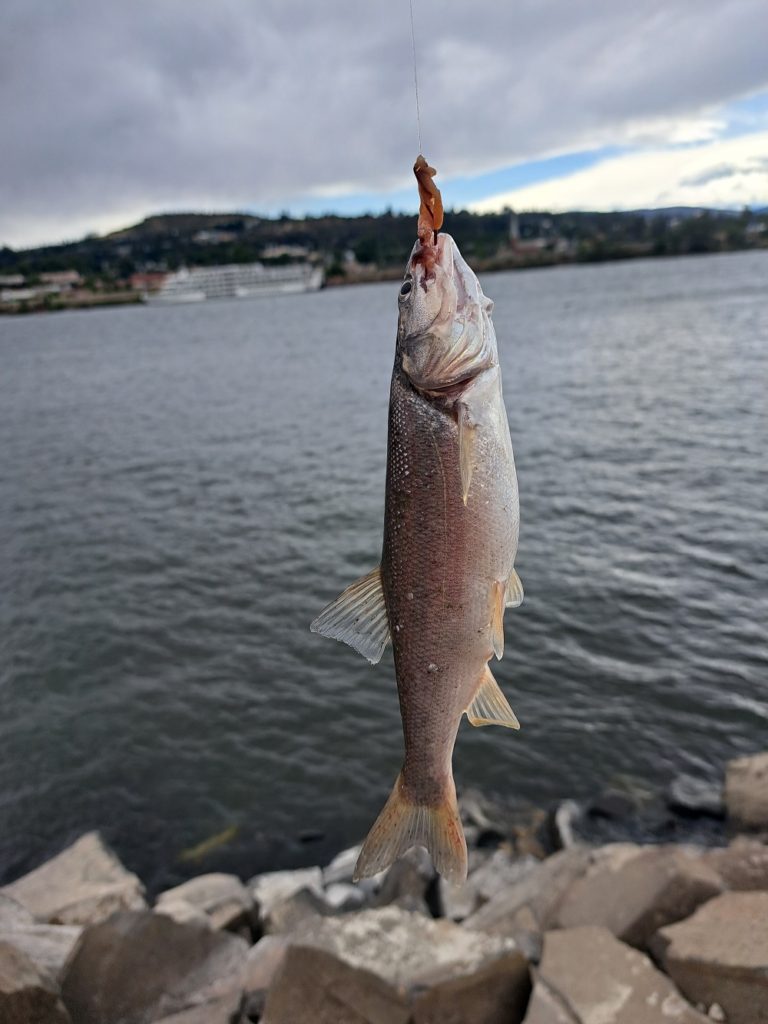
Speaking of uses for shad, the oily fish is also a favorite bait for sturgeon, and some even cut them up into chunks to use for catfish bait. Still others will eat them. We met one angler at a cleaning station at Maryhill State Park who carefully filleted out the shad he caught. He told me he brines them and puts them in a pressure cooker (which gets rid of the bones) before canning them. He said the fish taste very good. I will have to give him the benefit of the doubt.
Finished with shad, we next registered at a check station and fished around The Dalles for pikeminnow. We only caught four keeper pikeminnow (worth $6 each) but since this was our first time participating, we also each got to turn in a coupon worth $10 each after checking in our first fish. Better still, three anglers from Idaho were desperate for sturgeon bait and paid us $20 for a single shad which they promptly put to use, casting their lines out at The Dalles marina, hoping to hook into a monster fish. Altogether, we made $64. That covered a good portion of our gas money getting back home.
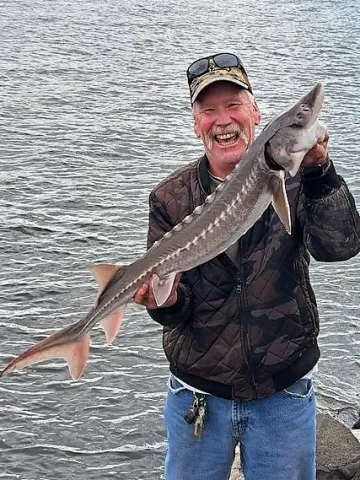
One other fun thing about fishing for pikeminnow are the other fish you catch. I ended up catching eight perch, and we both also caught smallmouth bass on the nightcrawlers we were using for pikeminnow bait, fished just off the bottom of the river with a two-ounce sliding weight. Rusty caught the most interesting bycatch of the day though, a 30-to-33-inch sturgeon on a bass rod that was spooled with braided line and just a 10-lb leader. It took him 15 minutes to get that prehistoric looking fish to shore, at which point I snapped a photo of the fish and he released it. It made for the end of a perfect day of fishing!
John Kruse – www.northwesternoutdoors.com and www.americaoutdoorsradio.com
/articles/sp-500
Ocean Coho Tips and Techniques
Coho are one of the most sought-after salmon in the Pacific Northwest. For the saltwater angler, the coho bite can be a bit chaotic, with the fish running in large schools and being active biters when the conditions are right. They can also be a bit frustrating if you are not using the right gear or fishing the right presentation. By keying in on techniques that work the topwater and get the coho to bite, you can increase your catch rate and fill the coolers with great eating, hard fighting silver salmon.
Silver Salmon
Silver salmon like to swim fast and attack their prey. Known for their topwater action, coho tend to be close to the surface. This makes for a great fishery because you are not constantly trying to work the bottom and worrying about losing a downrigger ball like you are when chasing after chinook that are on a sandlance bite. When it comes to catching coho, there are few things you can do to increase your catch rates.
Lose the bait to catch more fish. It might seem like using a fresh anchovy or a perfectly plug cut herring would lead to more fish but rigging these baits takes time. When you get into the schools of coho, the action can be fast, which means you will catch more fish if you can keep your gear in the water longer. Same with getting it back into the water faster, and anyone who has rigged an anchovy hood knows that you need to set it correctly and that takes valuable time.
Spoons
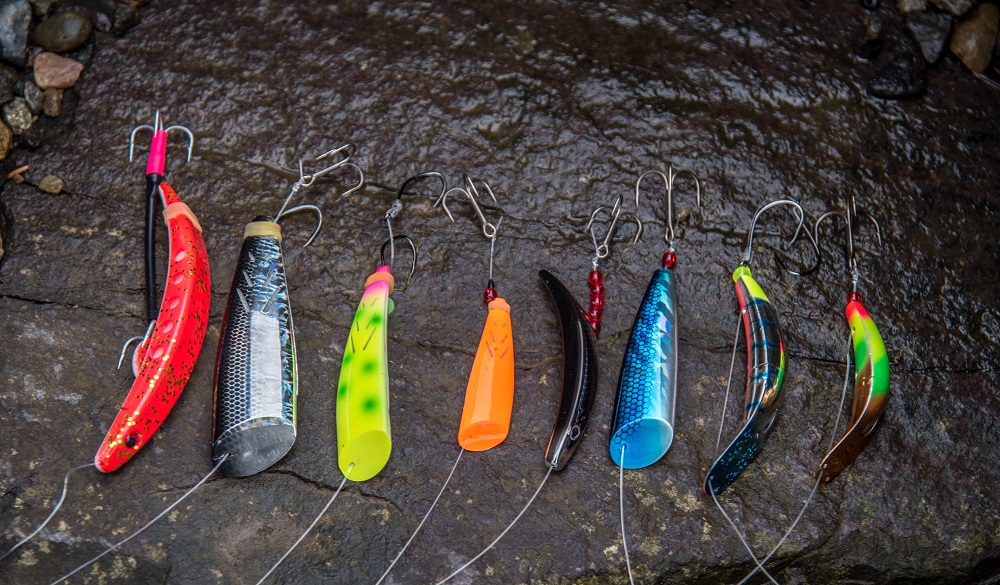
Spoons are one of the more popular lures because they are simple and are always working even if you miss a bite. Keep the spoons small such as the Coho Killer or a 3.0 or 3.5 Coyote spoon in sardine or rainbow trout patterns. The rainbow trout spoon looks more like a herring or mackerel and it has a glow back to it for low light such as cloudy days. Another spoon that is popular with coho fishing is the Skinny Gee in Herring Aide color. When running a spoon behind a flasher, it is best to go a bit longer on the leader such as 42” as this allows the spoon to flutter.
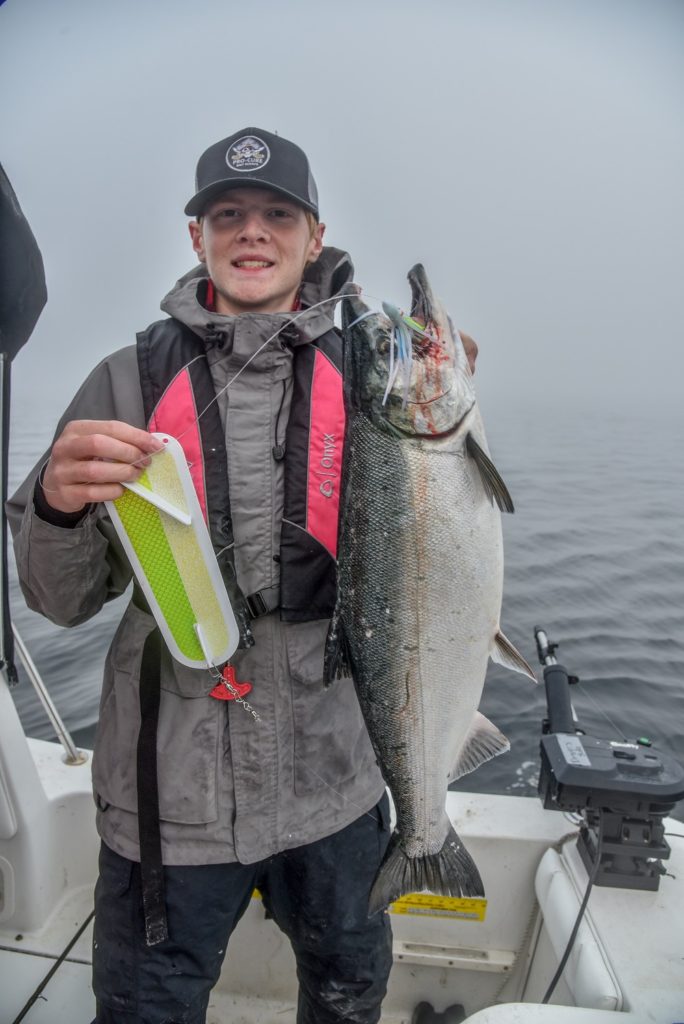
Sometimes spoons don’t draw the fish to strike. Give tube flies a try. This is a technique often used in the Great Lakes by salmon fishermen and by fly anglers chasing after fall coho along the shoreline. The ocean angler can take advantage of these lightweight lures that mimic baitfish. One of the best things about a tube fly is that they can be fished behind a dodger or a flasher or all alone, since they have low drag and are lightweight. Tube flies tend to have an erratic action that coho can’t resist, especially if you put a Mack’s wiggle bill in front of them. Bechhold and Son’s make a unique flasher with offset holes to add extra action. They have teamed up with Rapture Trolling Flies, a Great Lakes company, and offer a combo set matched together and ready to fish. If you already tie your own flies, you can pick up a tube fly adapter and tie your own easily.
Tricking The Salmon
Add flash and movement to your squids. When rigging a squid skirt with an insert or a tube fly, such as the Luhr Jensen Flash Fly (unrigged version, as they are smaller than the pre-rigged Flash Fly) to be fished behind a dodger or flasher, be sure to use a short and stout leader. Try using 30 or even 40-pound test as the stiff leader will give the lure more action. The idea is to get the lure to move in an erratic motion and make the dodger look like a feeding salmon with the lure being a wounded baitfish. It creates the “bite now” instinct of the feeding coho and tricks it into thinking the other salmon, which is the dodger, missed the baitfish and now it’s there for a free meal.
Using an insert into a hoochie or squid skirt adds attraction and can turn on a bite. The past few years we have been using the Luhr Jensen Flash Fly inserts and putting them into a squid skirt. By doing this you can make several different combinations of colors to attract the fish or add some extra UV flash for those cloudy days. You can also add a Mack’s Lure Wiggle Bill to the front to add extra movement.
Artificial Bait
Try using an artificial wounded baitfish lure. Lures that mimic a wounded baitfish are the SpinFish by Yakima Bait Company, Brad’s Super Bait Cut Plug, and the new Spin Dawg by Simon, who also makes a Spin Cut Plug that has a hole at the tip of the lure making rigging much easier with no rubber bands or chance of it coming apart. The Simon products are solid and have a scent chamber. Each of these lures is made of hard plastic and has a hollow cavity inside where you can stuff them with scent or minced-up baitfish such as anchovies or herring. For these lures, use a longer leader with a bead chain swivel in the middle since the lure provides the action that creates that need to bite reaction by rotating and spinning.
When using artificial lures such as spoons, squid skirts, and the hollow cavity lures, scent is crucial. Unlike when you use a real baitfish that has oils being released and the fish know it is an actual herring, the use of artificial lures is only a visual attraction unless you scent it up. The cavity lures like the SpinFish offer a way to fill them with various baits to create a scent trail. One common bait is to mix canned tuna fish with your favorite scents. Because the lure holds the minced-up bait, one of the better scent mediums to use is one of the many water-soluble scents from Pro-Cure. When the scent leaks out of the lure, it mixes with the water and stays at the same depth as the lure, creating a large scent trail for the fish.
Oil Based Scents
Oil-based scents such as Pro-Cure's super sauces, gels, and oils hold a scent well and last a long time, but the scent will not mix well with water. This means when it is washed off the scent trail starts to float. Water-soluble oils wash off lures and squid skirts too quickly which is why you should use oil-based scents for these lures, but it will not gum up or ruin the action of a tube fly, just be sure to apply frequently. Knowing which scent to use is more than just the baitfish it is made from, but also which ones are best to stay on the lures you are fishing.
Downsize the dodgers and flashers. The idea behind using a dodger or flasher is to create a feeding salmon scenario as well as add action to your lure. Since you are fishing for coho, be sure to match the dodger and flasher to the size of the fish. Most use the standard 11-inch flasher but the 8-inch flasher is a better choice. Instead of the attacking salmon looking like a chinook with the 11-inch, the 8-inch reflects light more to the natural size of a coho. It is also less drag and that means you can fight the fish better. The smaller dodgers and flashers also work well at faster trolling speeds. The Sling Blade dodger from Mack’s lure is a very universal dodger that is designed to work well at fast speeds. Since it is a long teardrop design you can bend it to create a more dramatic dodge or side-to-side action, or you can keep it straight and troll it fast. This design also cuts through the water well and allows you to fight the fish and not the dodger, even when using the larger 9-inch version. The dodger comes with UV-treated colors and is offered in many sizes, which allows you to change it up to the varied sizes of lures you are using.
Coho
Since coho are often found actively feeding near the surface, you do not always need to use downriggers. Instead, trolling with a mooching weight that cuts through the water easily and a simple lure behind can be a way to either add an extra rod out of the back of the boat or not deal with the downriggers altogether. Again, the more you can keep your lines in the water, the more fish you will catch. When rigging this outfit, use a longer leader around 48 inches with a bead chain swivel in the middle and a lure that imparts action such as the SpinFish, Brad’s Cut Plug, or Simon Spin Dawg. But do not overlook the tube fly or even the squid skirt with the addition of a Wiggle Hoochie Bill. These small plastic bills from Mack’s Lure are simple to use, just slide it down the leader to the head of the squid skirt and push it into the collar. If using a tube fly then adding a bobber stop knot or rubber bobber stop to the front of the bill will keep it tight to the fly. The Wiggle Hoochie Bill act much like the bill on a plug, but instead of creating a diving motion, it moves the lure in side to side in and erratic motion. They also come in an assortment of colors and are UV treated to add even more visual attraction.
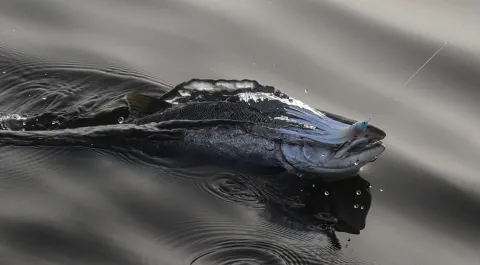
Coho are known for their acrobatic fights, often coming right up to the surface and jumping, but a dodger or flasher can take away from the fight and even become a problem when the fish jumps. The attractor breaks the surface of the water pulling in an opposite direction and taking the hooks with it. When using downriggers, you can rig in a way that the dodger or flasher stays with the downrigger ball and you get to fight the fish without any extra drag on the line. To do this, either use one of the lures with action or the added Wiggle Hoochie Bill and then a downrigger clip that is above the ball. Use a short section of cord or very stout mono line such as 50-pound test from the flasher or dodger attached to the downrigger ball, and then set the downrigger clip twice the length of the cord above the ball.
Furthermore, If you run the dodger or flasher behind the downrigger ball 36-inches, then set the downrigger clip 72-inches, or 6 feet, above the downrigger ball. Then run your lure back just a few feet from the clip. This will keep your lure from tangling with the flasher or dodger, and yet when the salmon sees the attractor, it will look like the baitfish got away and they will grab the lure. This works really well with plug cut herring or an anchovy with a bait hood, as well as lures that don’t need the imparted action of a dodger or flasher. One other great trick when using this way of fishing is to use the Scent Flash triangle flasher from Mack’s Lure, as these flashers are designed to hold scents inside of them. As the triangle flasher spins, it creates a very large scent cone out of it as it disperses the scent. When using these, you don’t need to use a leader or cord, but instead you can attach it directly to the downrigger ball, which means you can also keep your lure a lot closer to it as well.
Run timing and knowing which fish you are targeting will lead to more fish. Ocean coho are found all along the coastlines from Oregon to Alaska, and the feeding fish will often work along the shoreline, feeding on herring, candlefish, anchovies, and various other prey in the kelp beds and protected waters around islands. Look to the rocky breaks often found just offshore and find the coho. Even when out in the open ocean, where the fish will form large schools to travel from their feeding grounds to the rivers each fall, the fish will still be “shallow”. Not the depth of the water but where they are in the water column, meaning closer to the top.
When it becomes prime time for ocean coho but weather and fishing seasons keep you away from the open seas, resident coho fishing can produce a fishery for the avid angler. Puget Sound and the various inlets around Vancouver Island offer coho that do not head out too far away feeding grounds but instead live “inside”. Starting in May and all through the summer, resident coho fishing is good. Using the same techniques as fall fish, the angler can perfect their coho set-ups. Look for points along the shoreline as silvers tend to use them as tide breaks that will harbor baitfish. Where you find resident coho you will also find ocean-bound fish once they return. This is where you want to be when the runs start to show up in August and continue to flood through October.
/articles/ocean-coho-tips-and-techniques
Reel Time in Cabo
In the previous year, Rob and I had the chance to connect with Toby Wyatt, the Northwest Guide from Reel Time Fishing, along with his wife Cindy, while we were in Cabo San Lucas. We eagerly seized the opportunity to escape the chilly season and head down to Mexico to explore the exciting developments of Reel Time Fishing in Cabo.
Toby, an experienced PNW guide renowned for fishing from Buoy 10 to the Clearwater River, has devoted several years to developing his Mexico venture. He has fine-tuned the guest experience down to a science, curating everything from local captains and upscale resorts to luxurious transportation and diverse vacation possibilities beyond fishing. Upon our arrival, his team was readily available to steer us in the right direction and acquaint us with the intricacies of Cabo. Having Toby's steadfast support provided us with a reassuring sense of security and tranquility as we ventured abroad.
Planning Ahead
In early December, we strategically planned our journey to Cabo, a prime period for sport fishing, especially with favorable Marlin-catching opportunities (which both Rob and I were enthusiastic about). Our airfare was secured, and our dates with Reel Time were locked in, thanks to arrangements made half a year prior with a cohort of industry friends from Spokane. We also ensured our passports were up to date. Accompanying us on this adventure were the renowned Chef and Restaurateur Adam Hegsted, Chef Aaron Fish and his wife Miranda, Creative Director Jason Olsen and his wife Heather, as well as Rob and myself. Embarking on this expedition as a group added an enjoyable dimension, and thanks to Toby's recommendations, we were able to shape the ideal trip we had envisioned.
As a united group, we touched down in Cabo and navigated customs, proceeding to the transportation meticulously coordinated by Reel Time Fishing. Awaiting us was a sleek black Escalade, and our designated driver, "Eddie," who could only be likened to our personal guide – Toby's trusted on-site emissary. Our airport pickup was characterized by sophistication, and we were subsequently transported to our lavish all-inclusive abode, the Hotel Riu Palace Cabo San Lucas. Throughout our journey, Eddie remained at the wheel, chauffeuring us to the docks, an exciting ATV escapade, and any destination of our choosing, ensuring a seamless and convenient experience.
Our Stay
The resort proved to be an absolute marvel. Our desires were not only met but effortlessly anticipated. Our all-inclusive package encompassed both beverages and cuisine, with a plethora of restaurants, entertainment options, and pools that catered to every whim. Our refrigerator remained abundantly stocked, and a continuous flow of tequila was readily available, satisfying our every indulgence.
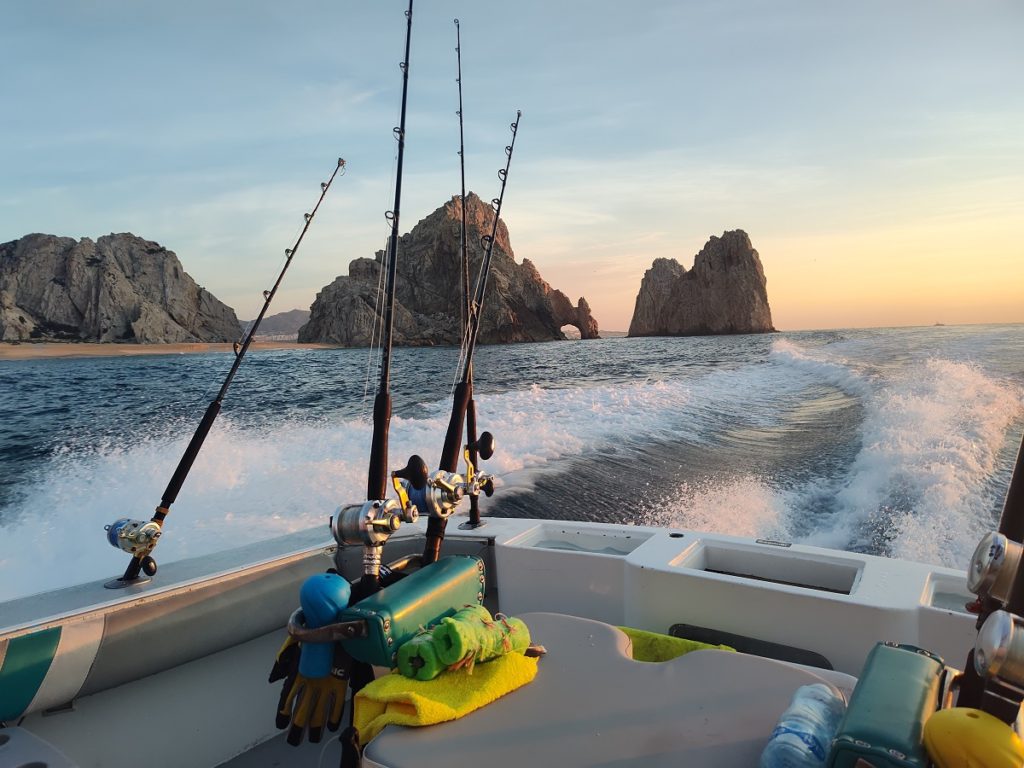
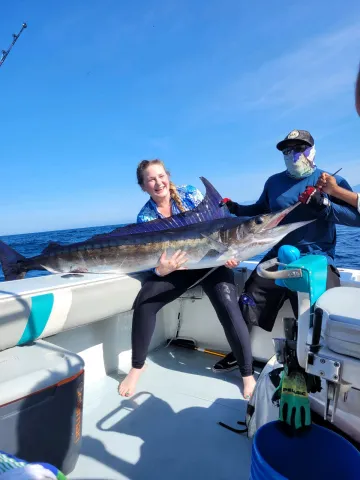
The primary motivation behind our trip revolved around the fishing prospects, and we were not disappointed – they were exceptional! Rob and I both achieved the thrilling feat of reeling in our first Marlin, an experience that will forever stand out in our memories. Across two days of deep-sea angling, we hauled in Ahi Tuna and Mahi Mahi as well. The intense battles Rob and I waged against our Marlin catches surged with an adrenaline rush unparalleled in the waters of the Northwest. The sensation was beyond expectation; truly an extraordinary encounter worthy of being on anyone's bucket list. Our cooler brimmed with the bounties of Mahi Mahi and Tuna, all set to journey home with us. Following the local custom, we released the Marlin back to the sea. The crew adeptly managed the cleaning process and even connected us with a processor to ensure our catch was expertly prepared for transport on our flight back.
Crave TV
We embarked on a Crave TV episode alongside Chef Adam Hegsted and Chef Aaron Fish, capturing the awe-inspiring sight of Northwest culinary experts skillfully crafting fish dishes infused with the vibrant flavors of Cabo's ingredients. Our poolside relaxation day proved refreshing, and we delved into the local shopping scene, exploring charming boutiques. A leisurely boat taxi ride across the bay allowed us to embrace the coastal charm. Venturing into the countryside, we engaged in an exhilarating desert off-road adventure, navigating the terrain with four-wheelers.
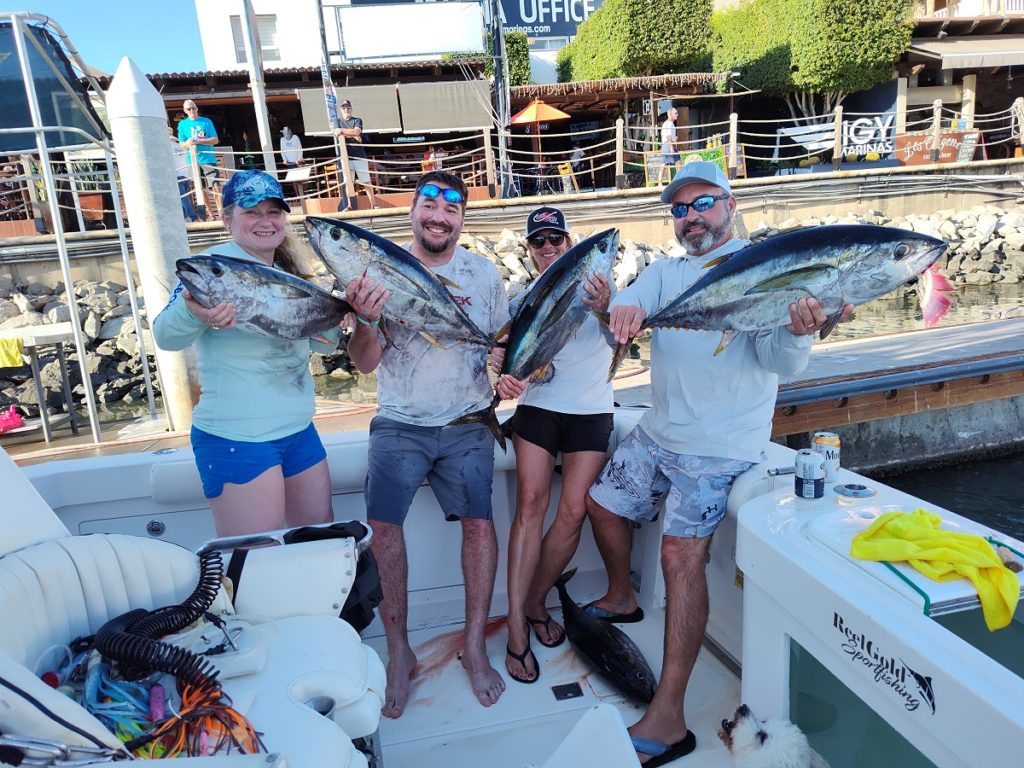
"It's an incredible way to punctuate the time spent on the water. There's something invigorating about cruising through the Mexican desert that truly makes you feel alive." - Jason Olsen
I had the opportunity to sit down with Jason Olsen and discuss his firsthand experience in Cabo with Reel Time Fishing.
Jason:
How was your fishing experience with Toby's team?
"Second to none! Nothing compares to that whole trip. It’s a lot of buildup. And it doesn’t disappoint. As far as going out on the boat with Pepe, knowing he was linked to Toby, I felt comfortable and safe knowing I was in good hands. Toby has seasoned dudes, and he has a standard for bringing people on. I would definitely go again at the drop of a dime. I was impressed with Pepe. He knew exactly what to do and where to go. He had an innate instinct on where to go to catch the fish and had electronics to get us on the fish. Also, having someone to show us around and be our wheels on the ground, saved us money and we did it in style."
What kinds of fish did you reel in?
"Yellow Tin Tuna, mostly. We went out from about 5 am and by 11 am we caught 10 Tuna."
What was the battle like?
"A lot harder than freshwater fish. High energy. At one point I had to strap myself into the chair."
Can you tell me about the flags?
"So the whole experience coming back to the dock was pretty great. After we caught the fish, Pepe had me hang up these flags I wasn’t sure what for. The minute we pulled into the marina, It was a bit of a parade. A bragging parade. Everyone could see what kind of fish we caught and how many from the amount of flags that were flying on our boat. It was pretty great to showboat our way into the Marina."
How was the dining experience?
"The resort accommodations and restaurants were amazing! The experience of going out in the morning and coming back and having my fish prepared by a local chef, was like no other. My liver hurt when I came home."
Jason's Wise Words:
"Take the seasickness patch, don’t be a hero! Go with a guide that is credible. Toby’s network takes the worry out of travel. Listen to Toby and you will do just fine. Use his knowledge and connections. The culture and being able to start my fishing endeavors at such a high caliber was an amazing opportunity."
Toby:
"One thing we do is we babysit our guests. We transport them from the airport to the resort to fishing and back. “We are like a coach in your corner.”
"We have a full service-all Baja Peninsula tour company that specializes in sport fishing. We help keep you safe and save you money. We have 4 captains in Cabo and packages with many of the Cabo Resorts. We can accommodate Groups of up to 40 people and have access to a 45 ft boat and 90 ft yacht. "
/articles/reel-time-cabo
Leave It Better Than You Found It
As outdoorsmen, we have a duty to continue to cultivate the resources that are our land and water. How many times have you pulled into a boat launch and seen it torn to shreds? Concrete half off the ramp, rope handrails cut and laying lifeless, no longer serving their purpose. What about the campsite with half ripped apart beer cases, food scattered around, and dog poop on walking paths? One of my personal favorites is seeing trash thrown in the firepit. It’s one thing if the stuff thrown into the firepit can burn up (I’m plenty guilty of that), it’s another when the material should’ve been disposed of properly. The old adage of “pack it in and pack it out” is simple in speech and at times aggravating in action. My college football coach had a saying, “do what you are supposed to do, when you are supposed to do it, and do it that way every time”. The lens in which that quote was said was more along the lines of eat right, study your playbook, and lift hard, but the message applies across the board. Leave it better than you found it.
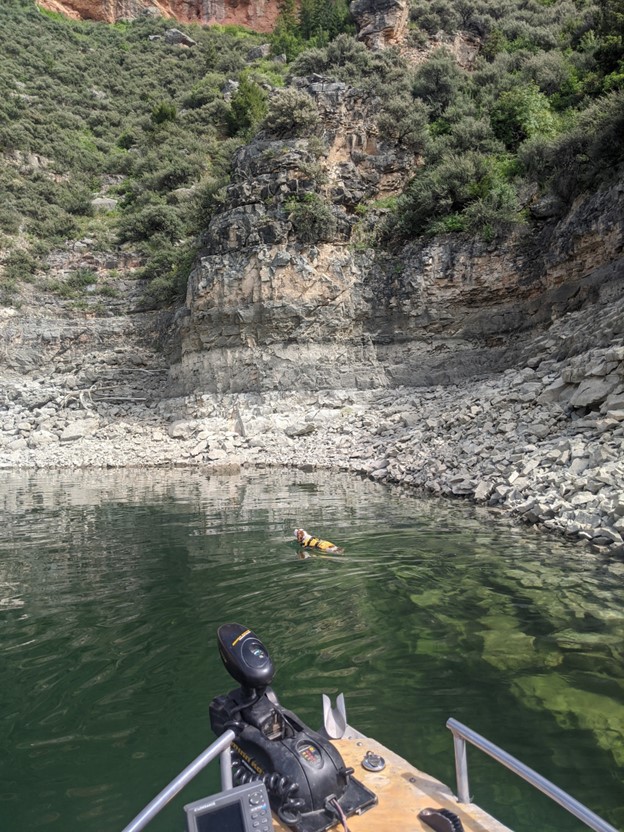
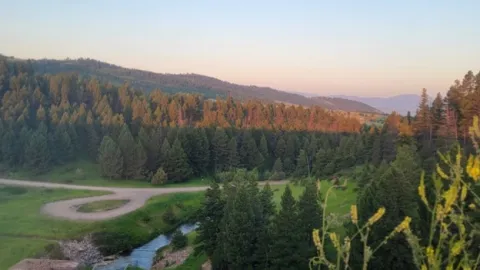
This isn’t meant to be a tirade against littering (not that I’m pro-littering - there is a Seinfeld skit somewhere about this I’m sure) or some kind of political statement. Rather, just an observation from a summer that I’m sure many of you shared. Time with friends and family outside. Some of us are lucky enough to have boats to get out on the water. Others may hike up into the mountains for some serenity and isolation. Then, for a brief moment, you realize the person there before didn’t care enough to keep the place clean. It probably doesn’t consume much of your brainpower or ruin the weekend, but it’s enough to make you roll your eyes and sigh. Those are the kind of simple things we can all do to help one another continue to enjoy these shared spaces.
Hunting Season
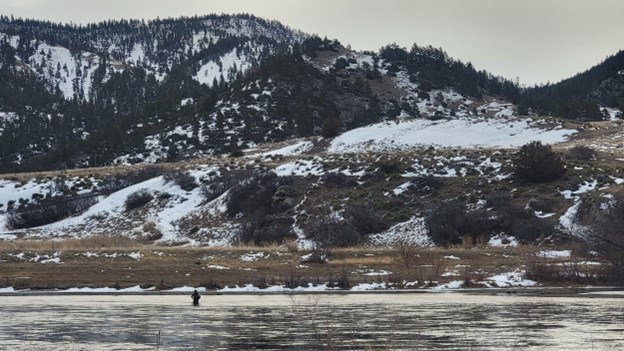
Another element that should be considered, particularly for those hunters among us, is the consideration of land water access. Familiarizing yourself with the public vs private land, access points, and limits on how many people can utilize certain access points are all equally important and part of our duty as conservationists. I remember during the last hunting season being continuously peppered by advertisements from Montana Fish Wildlife and Parks (FWP) about the importance of seeking permission for type II block management access (BMA). It certainly didn’t hurt that the advertisement featured a cameo from MeatEater star Ryan Callaghan. A quick sidebar for those who aren’t in the know - Block Management in the state of Montana is a partnership between private land owners and FWP to grant access to hunters on private land, sometimes adjacent to public land.
Type I BMA allows hunters to sign in on a card for hunting permission on private lands; you simply show up, fill out a card, and go hunt. Type II BMA often requires a reservation and is subject to availability from the land owner. Examples might be limiting the number of hunters in a day, hunting parties in a day, or what type of game is being hunted. The word partnership isn’t used by mistake. It takes action on all parties involved to maintain access to these hunting areas. The land owner to continue to be willing to allow hunters on the land, MT FWP to facilitate the opportunity for hunters, and hunters to respect the land and do their part to make sure their presence is continually welcomed. Leaving behind shell casings, wrappers from eaten protein bars, or other garbage is a quick way to find our access to otherwise great areas suddenly restricted. Maybe you don’t own 1,500 acres of land but instead a 1,500 square foot home. Would you be willing to invite back a stranger who tracked mud all along your carpets? Even worse, how about a buddy watching some football at your place who stains your couch with buffalo chicken wing fingers rather than wiping his hands. Why would we expect those land owners to welcome us back if we’re doing the equivalent?
Let’s continue to work together to make sure we can enjoy the outdoors we all know and love. It doesn’t take much to clean up that last bit of trash, keep debris and clutter out of the community that should be enjoyed by all and keep shared areas like boat launches in working condition. If not for you and I, how about for our kids who hopefully enjoy these hobbies, and sometimes obsessions, as much as us.
/articles/leave-it-better-you-found-it
First water on the Rogue
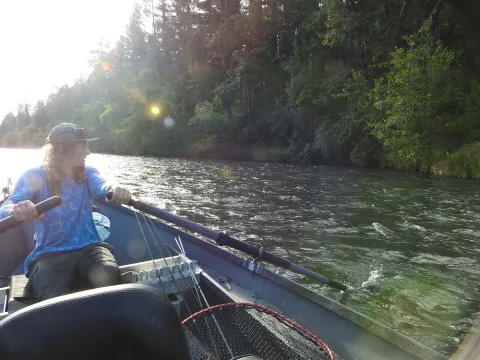
We slid down out of a tail-out and into the next riffle. I was in the bow, tilted into the front brace, rod up. "Cast left, this side has the fast water." Twenty-three-year-old Cole McAuliffe, of Chrome Tales Guide Service, was on the sticks, his curly hair around his shoulders. McAuliffe flicked the right oar and lifted the left. Water ran down off the blade and the boat caught in the current. I flopped an inelegant short cast, looped an upstream mend, and watched the two-fly rig catch the foam line past a jagged submerged rock. Sloppy but perfect. The float plunged and I lifted the rod into a summer steelhead that rocketed out of the shallow slot and into the air, twisting three feet above the water.
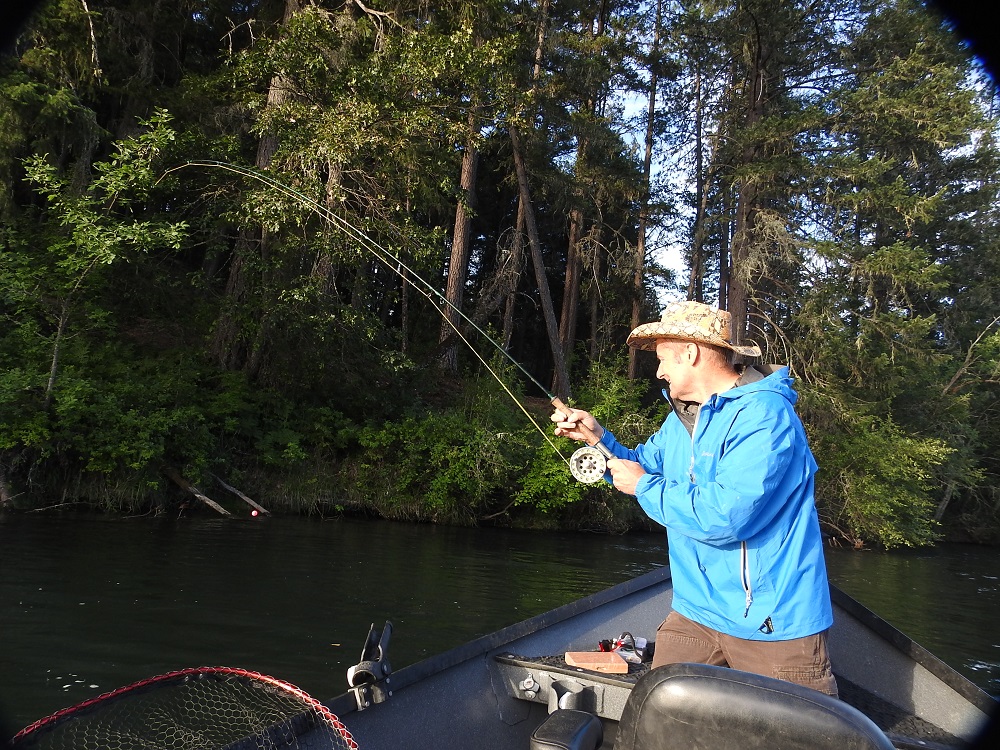
Oh, there is something about hooking a summer steelhead on a fly when you know the leader is 10-pound test and you have a lot of river!
We were only 20 minutes off the launch and no one on the water ahead of us or behind us. Is this not the great Rogue River? Where is everybody? But then I remembered, it was the hottest week of the summer and the rafts and tubes would hit the river about 11 in the morning. And I would be with them, except I'm older and smarter. We met each other earlier this summer when I helped McAuliffe find a highly efficient German shorthair chukar dog, and after the deal was done we both saw a drift-boat shaped hole in our August calendars.
Out of the launch with the sun just breaking over the Cascades, McAuliffe charged the boat straight across the river to a favorite run where a fat sea-run cutthroat waited for us. Now, barely ten minutes later, we had a steelhead on the line, on 10-pound Maxima, charging downstream.
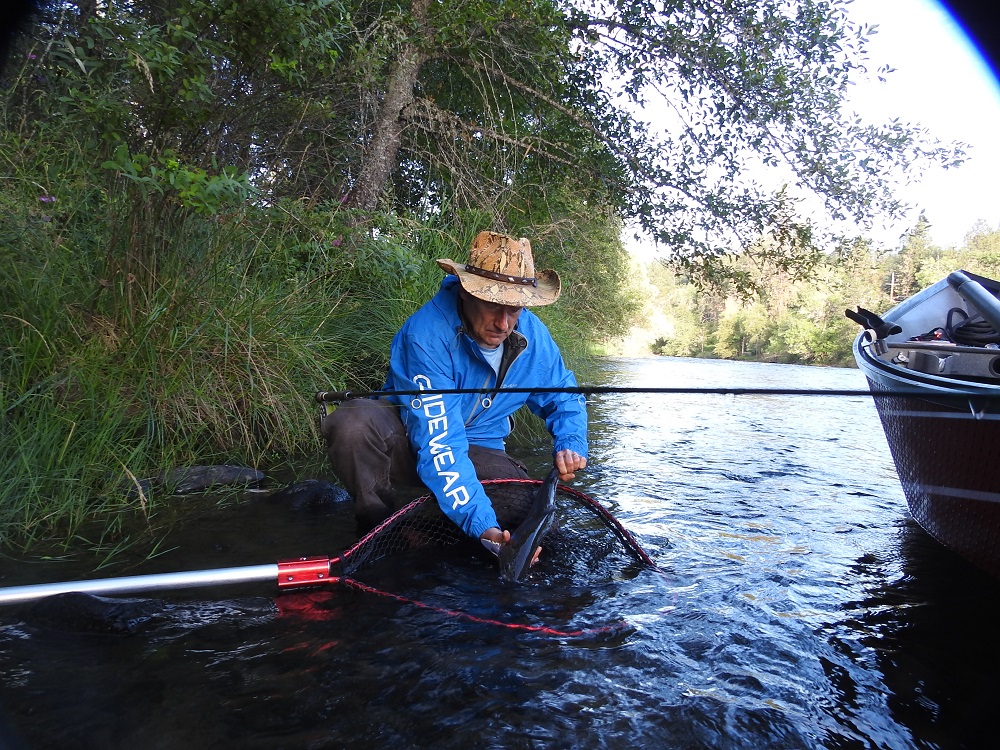
Down through the tailout of the next riffle we followed it, and before I could get the fish's head up, it tail-walked again. Moments later, McAuliffe grabbed the net and made one stab for it when the fish was close, as if we had been fishing together for years instead of just the last 20 minutes. I jumped over the side into the shallows and lifted the wild fish out of the net and showed it to the young guide with the Wild Bill Hickock haircut, shooting my camera. But the fish was done with handshakes and flipped out of my grasp. Five pounds of shiny summer steel, back into the water from whence she came.
There are not as many good summer run rivers in Oregon as there used to be, as hatchery managers have ratcheted back on the good times we enjoyed in the '80s and '90s. Did we have too much fun then and now we have to work harder for our fish? Guess so. McAuliffe, by my calculations, was born at the end of that era and, as fishing guide is his chosen profession in the 2020’s, he is probably going to hear from a lot of middle-aged clients about how it used to be. Today a fishing guide has to work harder. And get up earlier in the morning.
Now I had steelhead lenses on, reading water left and right, with Cole sliding the boat from one good slot to the other. Depending on the water, I used my fiberglass 5-weight to swing a fly or his 6-weight TFO with the float and two-fly rig. McAuliffe said the summer run steelhead season has started stronger than last year and while a lot of guides are using spinning gear, he prefers to stick with the fly rod.
At the business end is a No. 10 beadhead with a heavily weighted stonefly nymph to get to the bottom fast. We adjusted the float to run about 2X the depth of each run. We looked back upstream. Still no one behind us. Still no one ahead. We had first water all the way to the takeout. And trout in every drift. A few were hatchery rainbows and a few were smolts, and they beat the steelhead to the fly.
Trout chased the float, they chased the stonefly out of the water on the retrieves and swiped at the point fly, and I expected a fish on every drift. Get up early in the morning to beat the floaters and the cone-lickers. Go for the trout fishing and let the steelhead surprise you.
/articles/first-water-rogue