A Mothers Day Fishing
By Hillary Holman
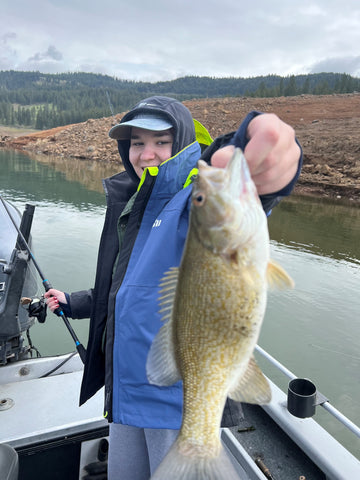
Last year for Mother’s Day I met up with my two daughters to fish Dworshak Reservoir in the Clearwater Valley for Monster Bass.
My eldest daughter Cameron had recently returned home from Temple University in Tokyo to attend WSU in Pullman, and Sarah had came back from PLU to attend Whitworth University in Spokane, both due to unforeseen complications associated with the pandemic.
Paul “the Bait Boy” Hamilton, and Sarah carpooled down from Spokane to Lewiston and Cameron scooted over from Pullman to meet Rob and I at the Clearwater Casino. It was the final leg of a spring fishing road trip with Rob.
We traveled the back roads through Waittsburg from the Tri Cities area, and found some great smoked cheese and meat at Mr C’s. We stocked up on snacks and hit the road to meet up with our posse in Lewiston by dinner time. It was a good 6 hour drive from The Dalles to Lewison, taking the scenic route, aka the shortcut.
Lenore Lodge, operated by Toby Wyatt, is situated on the way to Dworshak and was our lodging in the area. We often stay here when fishing with Reel Time Fishing on the Clearwater. The girls were impressed upon arrival. There was plenty of room, a great kitchen and a game room. The view of the river is nice. It was easy for the girls to unwind, unplug and relax. Cameron prepared a charcuterie board of the many meats and cheeses from Mr. C’s, that we bought along the way.
The next morning brought much excitement. There were winding roads and beautiful scenery. To see the wonder in my girls’ eyes again, as if they were little, gave me the greatest joy. Their curiosity and willingness to explore with us was wonderful. We looked out the windows and snapped pictures at the scenery. The Dam was a marvel. Hidden back in the Valley of the Clearwater, the monolithic dam is a sight to behold.
Arriving at the reservoir, we were greeted by Travis Wendt, of Reel Time Fishing. We were on the hunt for Jumbo Bass that are said to inhabit the huge lake created behind the huge Dworshak Dam. It was a beautiful clear day and not another boat was in sight. Travis knows this water well. “The reservoir is deep and steep,” as he says, and letting your leaded soft plastic baits sink to the bottom is paramount for success. Casting was right up our alley. Sitting on the bow of the boat tossing out lines on a clear spring day with my kids was exactly what I needed.
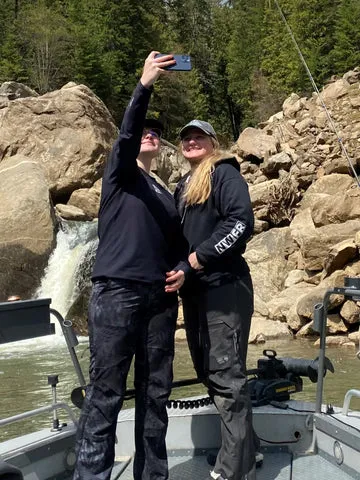
We took a lunch break and hit the shore, a hidden cove with a stream pouring from the rocky bank. Travis fired up the BBQ and us gals hit the shore for some much needed exploring. The hills were draped in green from the spring rain and runoff. We sat on top of a hill and looked down at the men doing their manly banter on the boat with the roaring smoke from BBQ as Travis prepared for lunch. The girls hopped up and set out to the creek to watch and listen to the streaming water down the rocks on the hillside. I watched and they jumped from one side of the falls to the other. Each was snapping pictures of the other. Capturing each moment as it came.
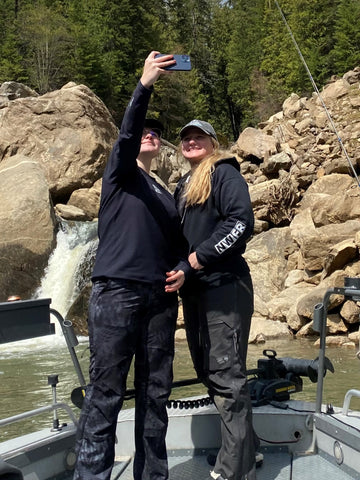
After lunch, we got to work. Paul, Rob and Travis were machines in procedure. They sent their plastics out at just the right spot, waiting for the right angle for the lead to hit the bottom. Cameron had enough time fishing and was ready for Mom to pass her the Camera to film the rest of the bass episode. She was ready to take the reins. The rest of the afternoon I spent fishing. Not worrying about getting the camera shot. Not worrying about the camera at all. Sarah would take turns with Cameron, but for the most part, she fished right alongside me. We hammered ‘em. We gave it everything we had and stayed as long as we could, even with the rain setting in. The girls were troopers. They came prepared with the right gear to withstand the spring day with unpredictable weather.
In the end, we caught some great sized bass and perch. We didn’t catch a monster, but we had fun. We saw a waterfall, beautiful scenery, the dam, and I got to reconnect with my girls after 2 long years apart. The boys were gracious and patient. The lunch was perfect. I could not have asked for a better day for Mother’s Day. Ok, maybe next time to have my son along for the trip is my only ask.
So, if you are wondering what your mom, wife or daughter may enjoy for Mother’s Day, consider taking them fishing. A trip we don’t have to plan and a meal we don’t have to cook or cleanup is all we hope for! The fishing, now that’s a bonus!
This article is dedicated to my Loving Mother Jerri Lee Cole.
/articles/mothers-day-fishing
If A River Runs Thru It
By Gary Lewis
If the days spent fishing do not count against our allotted time on this earth, as we have been told, then we should fish more often. Because we spend a lot of our time in towns, we should be fishing in towns. It's more efficient.
When the family wanted to go to Disneyworld, I fished. When we went to Hawaii, I dabbled a line in a king's bathing pool. I have fished off hotel balconies and out the windows of cars all over the country.
There are a lot of great fishing towns in Oregon; Shady Cove, Maupin, and Grass Pants, to name a few. If a river runs through it, it's a fishing town.
Portland is, of course, the ultimate fishing town, with the Willamette running right through it and salmon, sturgeon, shad, and smallmouth on tap. One of the best smallmouth of my life came from under the Sellwood Bridge.
What I like is going to a town and catching fish right out from under the noses of the local anglers. Here are some great fishing opportunities coming up in May and June.
SHAD FISHING AT OREGON CITY
One of the best fisheries in May and June is for shad - on the Umpqua, the Columbia, and the Willamette. American shad were introduced to the American west in 1871 when fish were released in major rivers up and down the Pacific coast. Today, millions of shad return to spawn in the spring. Plankton eaters, our American shad is the biggest of the herring species and averages three to five pounds. They bite and fight with abandon.
One great place to catch them is below the falls on the Willamette at Oregon City.
They take small spoons like Dick Nites and Mack's Lure Sonic Baitfish, and red, yellow, or chartreuse jigs. Fly-rodders can get them on small shad flies and darts. They are a blast to catch.
The action starts in May, right about the time the pink dogwood blooms. A fisherman can have 50-plus fish days in June, and contrary to popular opinion, shad are good to eat. Hint: learn how to debone them. Shad roe is good to eat too. Fast fishing continues through mid-July.
SMALLMOUTH BASS FISHING AT THE DALLES
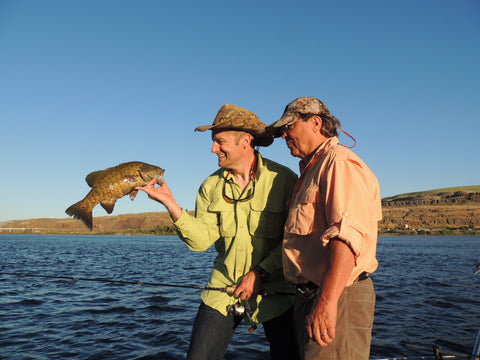
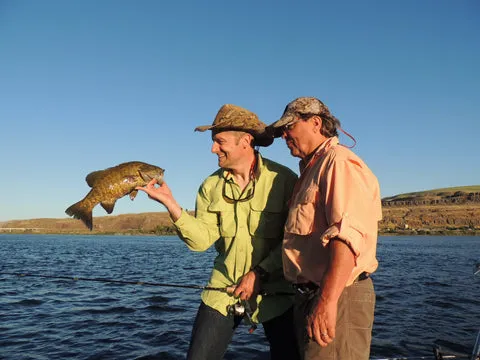
Smallmouth bass will probably spawn a bit later this year, as the waters are running cold with snow melt, but June is always great for smallies. When the water is running fast, they are likely to be in the eddies along the rip-rapped banks of the Columbia, from Mosier up to Boardman and beyond.
There is a lot of bank access in this section of the river. Some of it requires parking off the highway. Backwater fisheries are an overlooked resource with bass and panfish.
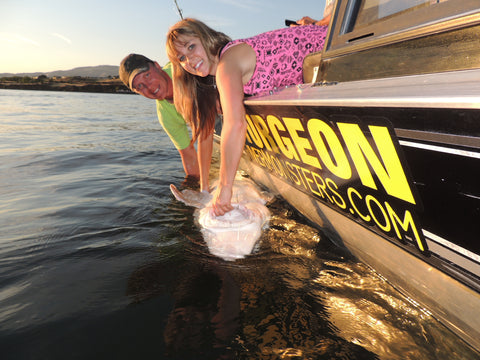
When towing a boat to the Columbia for the first time, keep in mind this is big, tricky water with heavy currents. That said, the river is accessible and the best fishing is along the banks next to the riprap and around jetties in softer water.
If the wind is blowing, there are always backwaters, side channels, and turns in the river where an angler can get out of the wind.
Another option is trout fishing. Taylor Lake, right on the edge of city limits of The Dalles, has been stocked three times already this spring.
TROUT FISHING AT JUNCTION CITY
A few miles north of Eugene on old Highway 99, the angler has to start slowing down at the edge of city limits at Junction City. This town with a population of 6,700 people has its own eponymous body of water, the 8-acre Junction City Pond. Stocked and fishable year-round, this pond gets legals, trophies, brood stock, and sometimes surprise surplus steelhead that will rock your world. By the time this issue went to press, JC Pond, as the locals know it, had been blessed with a reported 13,450 legals. That's a lot of fish, folks. It's worth a stop along the highway to soak some bait or cast a fly or spinner this spring.
PIKEMINNOW AT PDX
I caught my first pikeminnow across from the Portland airport. We caught a lot of them in those days, toothy critters that averaged 11 inches and ran up to 17 inches or so.
Northern pikeminnow thrive in the tailwaters below the dams and eat tons of baby salmon and steelhead. And for this, they have a bounty on their heads.
For a true city fishing experience, register at the check-in station early in the morning at M. James Gleason Boat Ramp on Marine Drive, then prowl upriver and downriver for northern pikeminnow - nightcrawlers are a good bait - and take your fish to the check-out station at the end of the day. Click on http://www.pikeminnow.org/ for more information. A fisherman can make $6 a fish these days.
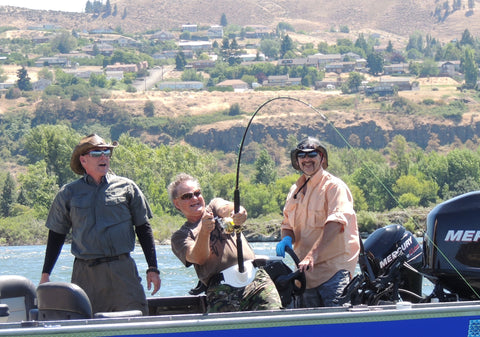
Think about making this one a last stop on a spring fishing swing through western Oregon. It's not a bad way to cover some fuel expenses and do something for salmon and steelhead at the same time.
The days spent fishing don't count against your life, but the miles on the truck do go against my wallet.
For me, PDX is a 360-mile round trip. According to my calculations, I'll need to catch 11 pikeminnow to break even on the fuel. Once I catch fish number 12, I'm making a profit!
/articles/if-river-runs-thru-it
Nymphing for Trout
Chad Bryson
In the glamorously romanticized world of social media, there is nothing short of a plethora of fly fishing techniques and methodology. So many opinions, and it seems that everyone thinks they are right. Even though I am never one to be short on opinion, I prefer to stick to facts and truth. That’s where I try to form my opinion.
Watching Fish
Fact- every single person that is an angler loves to watch a fish of any species come to the surface to eat something presented to them. The surface bite is a visual interaction we as humans get to experience with an animal that we would hardly ever see otherwise. It’s cool beyond belief. Truth- that bite doesn’t happen every day. It doesn’t even happen every month.
Okay, sure, if you have your own jet with an unlimited amount of expendable income, you can travel all over four continents and two hemispheres chasing every bug hatch or mouse migration known to man to satisfy your craving for surface action. If you are that person, I want you to know that I am interviewing for new friends, and you could just be a candidate.
However, if you are like the rest of us who can't afford the financial commitment of owning our own jet, you are probably trying to enjoy the fishing that’s close to home and might be wondering what all the complicated fuss is about. I’m going to simplify it.
Fly Fishing
Fly fishing for trout is broken down into basically three methods - streamer fishing, nymph fishing and dry fly fishing. Dry fly fishing is by far the most celebrated and commonly recognizable. It’s the gentleman’s preferred fishing method. Streamer fishing is regarded as a viable means of catching but, like dry fly fishing, isn't always the most productive.
Then there is nymph fishing bringing up the rear in open popularity. I call it open popularity only because you never hear guys in a fly shop talking about how awesome the nymph bite was the past weekend that they went fishing. Everyone just wants to discuss how many bugs hatched or how many trout chased a streamer. Nymphing for trout is easily the most effective way to catch them, but this technique is often only regarded as a last-ditch effort to save a day of fishing.
Why
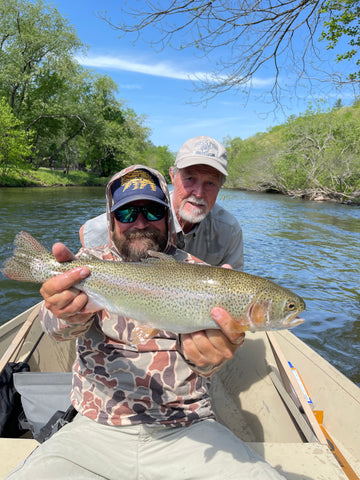
The most important question to answer is: why? Why is nymphing for trout the most productive way to catch them? First, let’s identify what a nymph is. A nymph is the juvenile form of aquatic insect that is born below the river’s surface and makes its way to the surface either by crawling or swimming so that it may hatch into an adult and fly away.
Once the nymph reaches the water’s surface and begins to shed its exoskeleton, it is at the mercy of wind, rain or anything above the surface that could potentially keep it from flying away. Hence, keeping a trout from being able to eat it from the surface like so many of us want. Every river, creek, and waterway anywhere that holds trout will have aquatic insects of some species. In that watershed is the nymph form of that aquatic insect.
They live there 24/7, 52 weeks a year beneath rocks, logs, stumps, and anything else that could be considered hold area. Nymphs are always in the river for trout to feed on. Every single day. They may not always be hatching, swimming or crawling, but no doubt, nymphs are around, and they comprise 90% of a trout’s diet. We just rarely see them eat one because it’s all done subsurface.
Nymphs
Fact- nymphs are 90% of a trout’s primary diet because it is a food source that is the most readily available in every creek, river, and water shed that holds trout. Also, a trout doesn’t have to expose itself to the surface to eat a nymph like it does a dry fly. It can remain relatively hidden from predators while feeding on nymphs. Imagine you are sitting on your couch watching baseball. You get hungry and need a snack.
Next to the couch within arm’s reach is a bag of beef jerky and a sack of Doritos. Cool Ranch Doritos at that. Now you could just sit there comfortably and feast on those Doritos and beef jerky until your heart’s content, or you could get up and go to the kitchen and make yourself some proper food such as a ribeye steak. Even though the ribeye steak sounds really good, it’s gonna take some time to prepare and cook.
You also run the risk of being caught away from your safety zone of anonymity. If you are in the kitchen, the dog is gonna see you and demand attention. Your wife or husband may realize that you are mobile instead of semi-comatose on the couch. God forbid you may have to fix a ribeye for them too. Next thing you know, the baseball game is over, and you are doing the dishes. Truth- dry flies are ribeye steaks while Doritos and beef jerky are nymphs.
Bobbers vs Strike Indicators
No discussion about nymph fishing for trout would be complete without the controversial subject of bobbers vs strike indicators. In the world of fly fishing, someone that wanted to make themselves dissimilar from gear fishermen decided to call the thing we use to make the flies float at a specific depth below the surface a “strike indicator”.
I suppose that is a more refined and highbrowed form of language that some fly anglers are known to have. My opinion is quite simple. If it floats and is made of a synthetic material such as foam or plastic, it’s a bobber. If it floats and is made of natural material, such as wool, it’s an indicator. Trust me when I say that both have their place in the game. Just call it what it is.
High Sticked
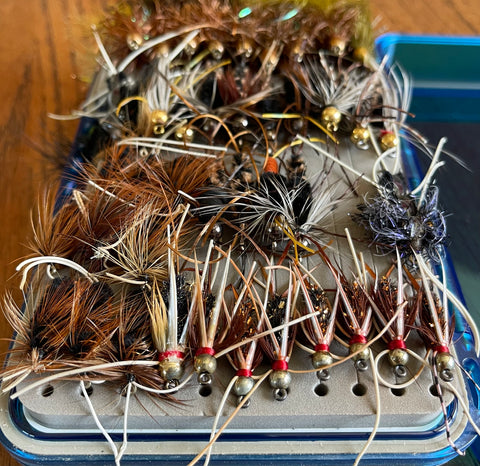
I learned to fly fish before the invention of indicators and bobbers. We “high sticked” when nymph fishing. This was basically using a rod that was about a foot longer than the rod I used for dry flies paired with a little stronger leader and a heavy nymph at the end of it. The idea was to “roll” the nymph along the bottom of the riverbed imitating a nymph that had been dislodged from its safety zone.
As long as the line was tight, you could feel the trout take. I caught so many big trout using this method, my grandfather finally limited me to using it only on rainy days. “Just to keep things even”, he said. If you can learn to highstick nymph, it will crush fish. Just don’t confuse it with this new thing the kids are doing called euro nymphing, that’s not fly fishing. Any good fly-fishing guide will agree with me.
So, watch a YouTube video about high stick nymphing, hire a guide, and find out what a trout eats 90% of the time. Don’t forget the Doritos and beef jerky.
/articles/nymphing-trout
How to fish for Columbia River Walleye
How to fish for Columbia River Walleye: The Easy Way!
By Kyle Jones
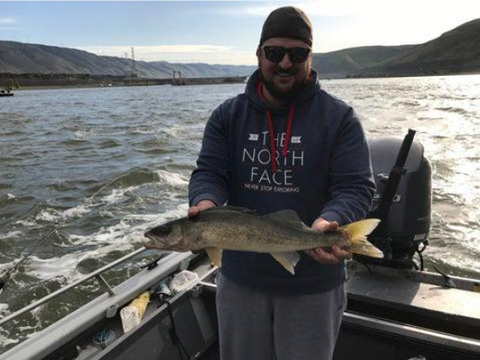
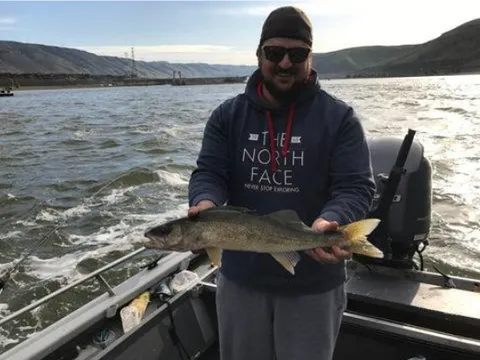
The Columbia River in Washington State and Oregon is one of the premier destination walleye fisheries in the United States. Anglers come from all around to target Walleye in the mighty Columbia River. The Columbia River is known, not only as a possible location for the next World Record Walleye, but also as a great place to catch unbelievable numbers of great eating size fish.
The point of this article is to be a starting point for people looking to take advantage of this great fishery. This is not an end all be all on Columbia River Walleye, just a simple article to get people catching fish fast. Catching good numbers of 14 – 20 inch Walleye on the Columbia River is easy, and with a little knowledge under your belt, you too will be putting lots of these tasty buggers in the boat.
How to Find Columbia River Walleye
It goes without saying that you need to “find fish to catch fish,” and when it comes to a beginner staring at the mighty Columbia River it’s easy to get overwhelmed. Walleye are an ultra-predator and they will always position themselves in the best possible locations to find food. The Columbia River is a literal conveyor belt of food for foraging walleye and positioning yourself in the correct locations can make or break your trip.
During the spring and summer there are millions of out migrating juvenile salmon, steelhead, and shad making the downstream migration to the ocean. Walleye take every advantage of this and position themselves to make the most of these easy meals. During this out migration period there is often a lot of current in the Columbia. Walleye are not particularly strong swimmers and so they gravitate to the slower moving parts of the river. What we do is locate the areas of the river that are moving slower than the main flow and concentrate our efforts there. Large points, islands, inside bends, rip rap, and other natural structures can create these current breaks. Walleye will use these areas to ambush whatever can fit in their mouth.
As a general rule of thumb for most of the areas below dams that we fish in the spring and early summer we are looking for water 20-50 feet deep in areas with very little current, or just out of the main flow, adjacent to shallow water. The adjacent to shallow water is key, as walleye will move up into the shallows to feed on bait fish at night, and like to position themselves close to their nightly food source. By targeting the deep slow moving water near shallow feeding flats we put ourselves on large numbers of feeding walleye during daylight hours.
How to Catch Columbia River Walleye: Easy rigging for immediate success
By far the quickest and easiest way to get into Columbia River walleye is to use bottom bouncers and worm harnesses. This method makes it easy for beginners to not only make and maintain contact with the bottom, but also insure that their gear is in the walleye zone all the time. Columbia River walleye in current are tight to the bottom. These fish live and feed within the bottom foot of the water column so maintaining constant bottom contact is a must

Bottom bouncers (also called Bottom Walkers) come in all sorts of different sizes ranging from as small as a quarter ounce to as large as four ounces. Even larger bottom bouncers are available, but they often need to be ordered from custom manufactures. Generally speaking for almost all the situations we fish during spring and early summer we find that the three and four ounce bottom bouncers to be our go to size. Typically when fishing four anglers the rods near the bow are rigged with four ounces and the rods out the stern are rigged with three ounces.

When it comes to the worm harness the options are unlimited. If you go to a tackle shop that sells walleye gear you will notice the many pre tied rigs from companies such as Mack’s Lure and other in house pre tied gear. All of this stuff works, but for our purpose we like to keep things simple and tie our own. We basically use three different styles of rigs and below we have listed and pictured some of our favorites. We fish all these rigs on leaders lengths of three to four feet.
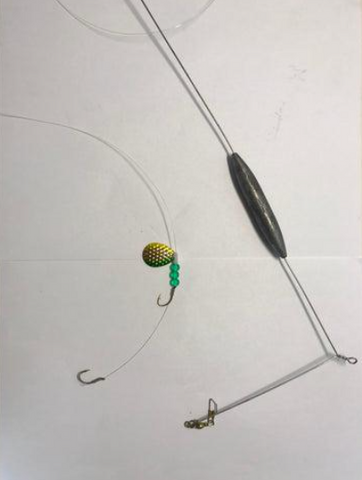
Spinner Blade rigs: These rigs are very simple and consist of a quick change clevis, size 1-4 colorado spinner blade, a few beads, and two #4 octopus style hooks tied four inches apart.
Smile Blade Rigs: This is again a very simple rig and consists of a size .8, 1.1, or 1.5 smile blade, a few beads, and the same two #4 octopus hooks tied four inches apart.
Corky Rig: This is by far the most simple rig we fish and seems to produce the best as the water starts to warm in late spring through early summer. It is simply one size #10 corky slid down the line on top of the two #4 octopus hooks.
How to catch Columbia River Walleye: Presentation
In general my favorite way to present a bottom bouncer and worm harness is to “troll” them down stream with the current. I put the quotations on the word troll because this is trolling in a very loose sense of the term. What we are actually doing is moving just fast enough to maintain the ability to steer the boat downstream. Enough emphasis cannot be placed on the need to go slow! When using bottom bouncers in this scenario I am often in and out of forward and neutral on my kicker motor and will often times spend a lot of the drift in neutral. Remember that you are already fishing in current that is pushing you downstream, so think of this more as a controlled drift.
The key to this presentation is to keep your gear on the bottom. The best way to do this is to fish with the rod in your hand. We see a lot of guys act like they are fishing for salmon and let their bottom bouncer and worm harness out, then let the rod rot in a rod holder. Don’t be that guy! This is active fishing and when you hold the rod in your hand you can make sure that you are always very near the bottom. When starting your troll slowly let out your gear so that it doesn’t get tangled, by slowly dropping your tackle you will ensure that you are actually fishing. Feel for the arm of the bottom bouncer to touch bottom, once you feel it bump bottom put your thumb on the spool and quit letting out line. Now you are fishing. To make sure you stay in the strike zone you need to actively fish your rod. At this point I start to lift the rod tip a few inches, I am intentionally trying to lift the arm of the bouncer off the bottom, and then drop my rod toward the water. If you do not feel it touch bottom you need to feed more line. You should be able to maintain contact with the bottom with every small lift and drop. I almost always fish the run with my thumb on the spool and prepared to feed more line. If you begin to feel the bouncer dredging bottom you need to reel in a few feet, remember that you just want the arm of the bouncer hitting bottom, as this will make sure your gear is at the correct level and minimize the inevitable hang ups on the bottom.
The second thing that the short lift and drop of the rod will help with is detecting bites. The bite from even a very large walleye is very subtle with this method. If at any time, while doing your lift and drop for the bottom you feel any extra weight or pressure on the rig you are getting a bite. When I feel the added pressure on my lift I continue a nice steady lift through the weight. There is no need for a hard hook set. You will miss fish if you try to give a big rip. Simply just lift through the weight and start reeling in your fish. Often times these fish are just barely hooked so bring them in nice and slow and have the net ready!
How to Catch Columbia river Walleye: Rods and Reel For Bottom Bouncing
The ideal rod and reel for this method of fishing can be debated for decades, but the bottom line is that it needs to be able to handle 3-4 ounce bottom bouncers, while still having a soft tip to detect the subtle take of a walleye.
Our favorite rod for bottom bouncing is a Gloomis E6X 7’1” 8-17 pound line rating in a medium heavy power. The model number is E6X 853C WBBR. While this rod is designed specifically for this use we also have used and really like an 8’6” 8-17 line rated medium heavy steelhead casting rod. This line rating seems to handle the weight of the rig nicely, but still lets you feel the subtle take.
For a reel we like a quality low profile casting reel such as the Shimano Curado. The reason we like a casting reel in this situation is that we are always adjusting how much line we have out and the ability to release line so easily and maintain feel of the bottom is much easier with the casting reel. We spool the reel with 30# power pro in either the high vis yellow or the low vis green. This is just personal preference here so go with the one you like.
In closing I hope that this article is of help to anyone who is trying to get into the wonderful walleye fishing the Columbia River has to offer. We love seeing new walleye anglers and if you decide to get a crash lesson on walleye fishing with us we will be happy to show you just how we do it and get you started off on the right foot. If you want more information on the walleye fishing trips we offer or to book a trip with us click here .
I just wanted to end on a small note of conservation. Even though these fish are not native to the Columbia River we want this exciting fishery to continue well into the future. I encourage anyone targeting walleye to please release the larger 25 plus inch fish. These larger fish are our brood stock, and their survival is key to having this fishery forever. The smaller fish are absolutely fantastic to eat and with the ability to catch them by the bucket load there is no real need to kill the larger fish.
Jones Sport Fishing is owned and operated by Kyle and Dani Jones. Kyle’s passion for the outdoors has driven him to commit to making his living as a professional fishing guide. Kyle prides himself in his commitment to make sure that your fishing trip meets and exceeds expectations, and is dedicated to serving his clients. You can follow Kyle on Northwest Fishing Reports and his web site JonesSportfishing.com
*This article was originally published March 2018.
/articles/how-fish-columbia-river-walleye
Telling the Truth about Surplus Steelhead
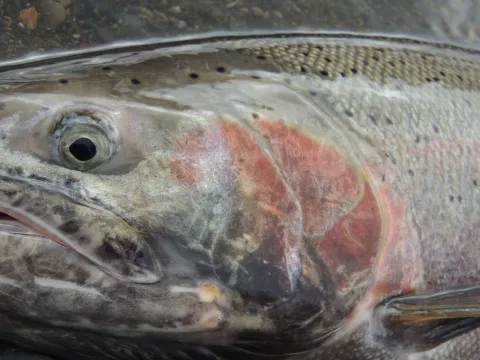
"Recycled" ocean-going rainbows breathe big fish bounty into Oregon's small lakes and ponds.
I didn't want to tell a lie in front of the pastor. But I had a ten-pound hatchery steelhead and I didn't feel like blabbing to this guy about where it came from. My pastor wanted to go steelhead fishing and we picked a Monday morning. To get to one of my favorite pieces of river, I had to walk past a trout lake. This lake was stocked a half a dozen times in spring and summer, and sometimes ODFW would put surplus summer-runs in it.
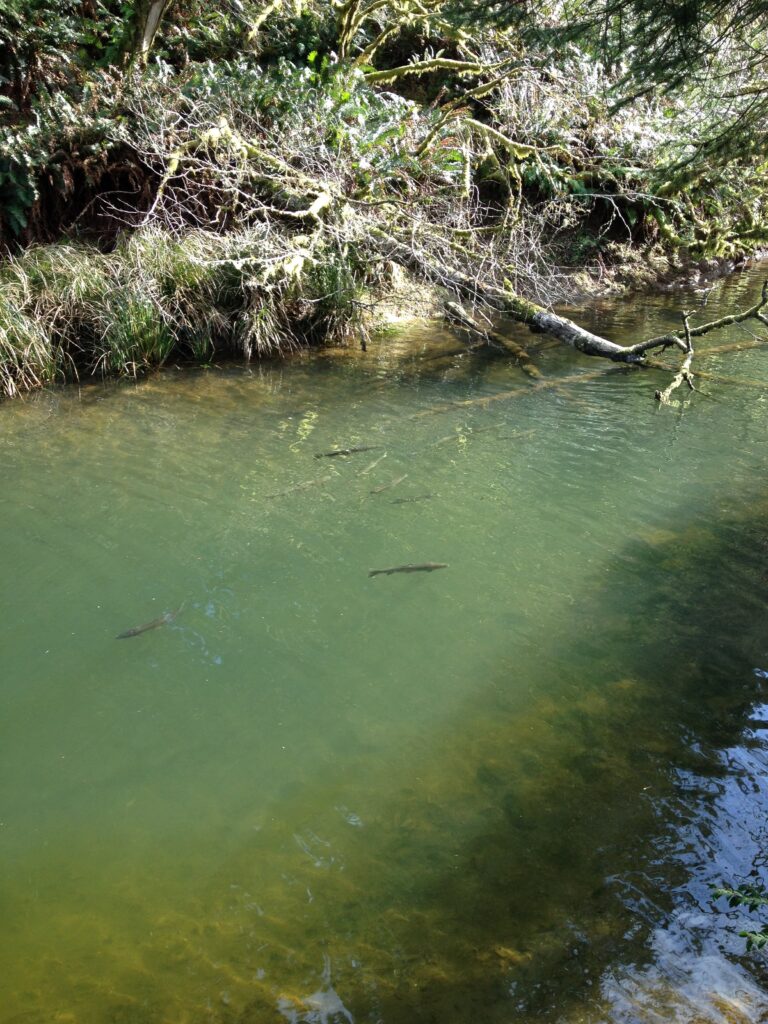
Coming back from the river, I carried my ten-pound spinner-caught prize past the end of the lake. At that moment, a fisherman, spinning rod and worm carton in hand, appeared in our path.
"That's a huge trout," the angler gaped. "Did you get THAT in the lake?"
"Yep." Bald-faced lie.
"Where did you catch it?"
"Right there at the end of the lake," I said. Bald-faced lie Number Two.
We walked on, the pastor and I, and after a suitable space had been put between us and the fisherman, he said, "I guess sometimes you have to lie." Truth.
In fact, I could have caught that steelhead in the lake because that lake was, and still is, one of the spots where the Oregon Department of Fish and Wildlife deposits surplus fish they don't need for spawning purposes. On any given day, a trout fisherman with a jar bait or a worm could luck into a steelhead. Wherever fish and wildlife agencies artificially spawn steelhead, there is likely to be a surplus of sea-run rainbows. And when that happens, the fish have to go somewhere.
In some cases, steelhead are picked up and trucked back downriver for another trip past the fishermen. Another option are local food banks. Sometimes surplus fish end up going into a big hole in the ground to feed the worms. The highest use might be to give anglers one more chance. That's why ocean-going steelhead (and sometimes salmon) end up in lakes and ponds.
WHERE & WHEN
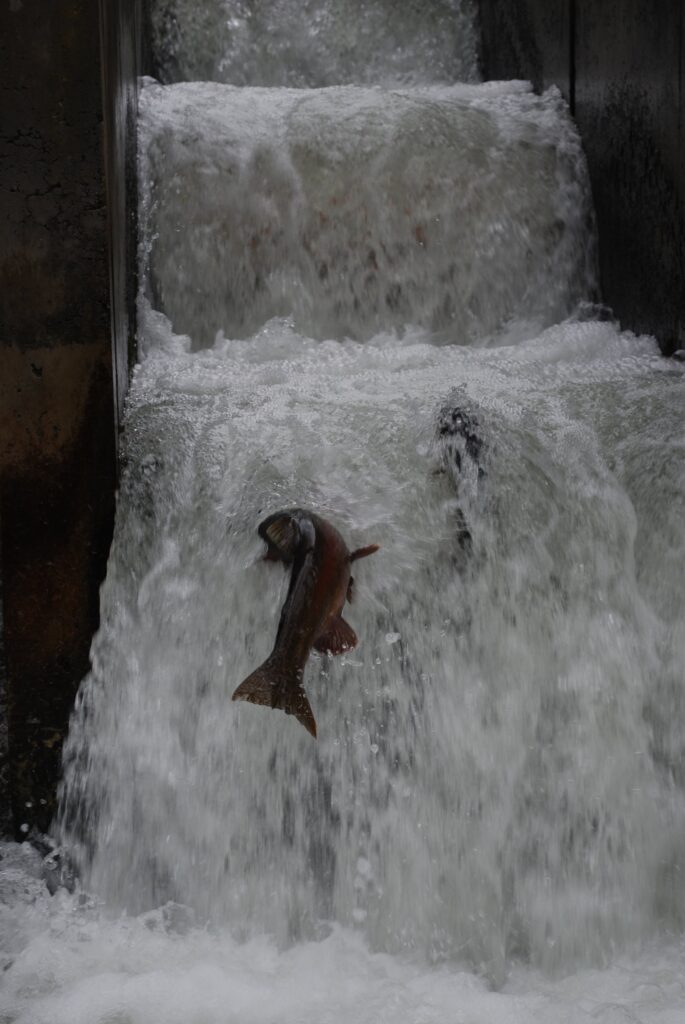
Decisions on whether or not to stock lakes and ponds are based on the numbers of fish and the run timing. Most of the summer steelhead in the surplus program on the North Coast come out of the Cedar Creek Hatchery. In most cases, the steelhead at the end of the line is likely to be a buck. The policy on the north coast is for female steelhead to be stripped of eggs, then put back into the river, while the males are separated to spend the rest of their days in a lake.
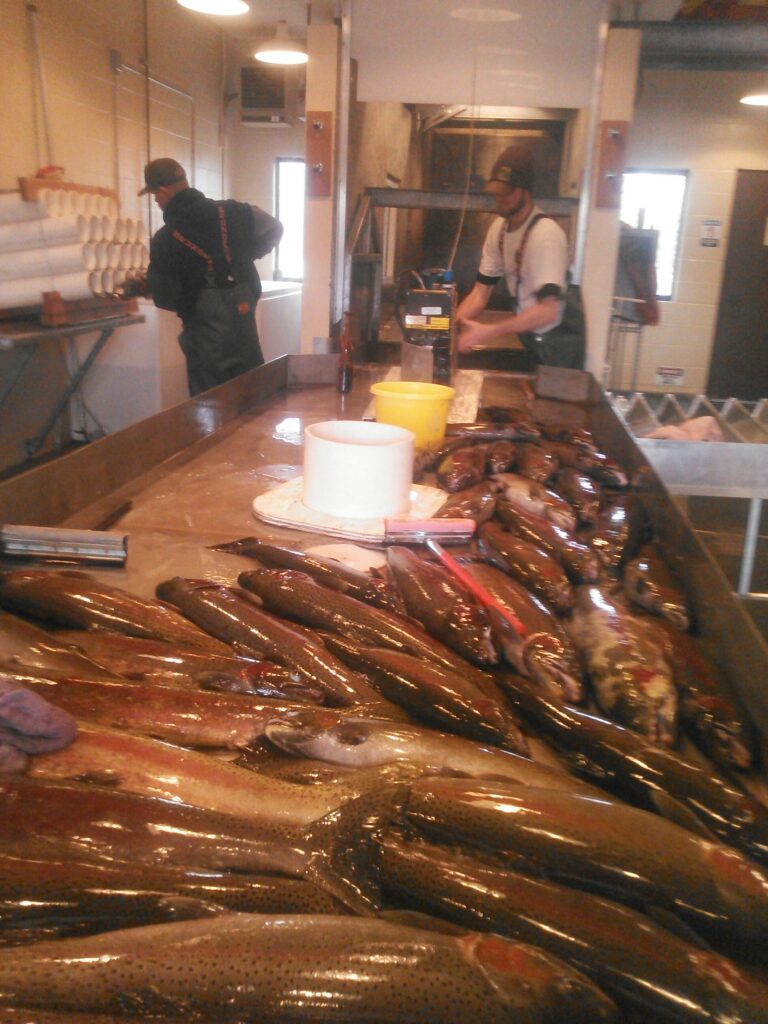
On the Oregon Coast, the Cedar Creek Hatchery at Hebo raises fish that end up in the Nestucca and nearby streams. Both summer-run and winter fish can end up in the recycling program, but summer fish, when they are stocked in a lake, usually hit the water in November, while winter-runs might be available in February and later. In any case, the steelhead don't seem to last in the lakes past mid-summer.
- Coffenbury Lake, near Astoria, is one of the beneficiaries when there are surplus steelhead in nearby hatcheries.
- Town Lake, near Pacific City, is one of the first to be stocked with steelhead when there is a surplus (summers or winters) from the Cedar Creek and Nehalem hatcheries. Vernonia Pond, Lost Lake (in the Nehalem drainage), Lake Lytle, and Sunset Lake are also stocked with steelhead.
- Cape Meares Lake, north of Tillamook, and Loren's Pond, east of Tillamook, are the other candidates for stocking if there are enough fish to go around.
- On the mid-coast, 120-acre Olalla Reservoir occasionally gets steelhead when there is an excess in the Siletz River trap.
- South along the coast, inside the city limits of Port Orford, an angler can sit on the shores of Garrison Lake and have a pretty good chance at tangling with a big steelhead at the right time of year.
- Middle Empire Lake in Coos County is another place where surplus steelies are deposited in late winter.
- In the Willamette region, Faraday Lake, east of Estacada, is one of the first waters to get steelhead if there are too many for the hatchery to handle. Walling Pond in Salem and Junction City Pond are also on the surplus stocking schedule.
- In Eastern Oregon, surplus fish from the Big Canyon hatchery often end up in Roulet Pond near Elgin and also in Weaver Pond (a.k.a. Wallowa Wildlife Pond). Surplus steelhead that return back to Enterprise are recycled to Marr Pond.
- Peach Pond in Ladd Marsh is another potential steelhead fishery if surplus numbers are high. March and April are the best timing for these eastern Oregon waters.
# # #
Gary Lewis is the host of Frontier Unlimited TV and author of Fishing Central Oregon, Fishing Mount Hood Country, Hunting Oregon and other titles. Contact Gary at www.GaryLewisOutdoors.com
The End
/articles/telling-truth-about-surplus-steelhead
Early Ice Fishing Tactics for Trout
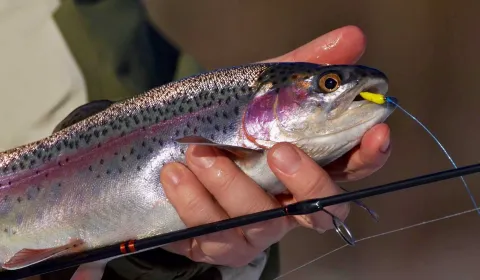
While frigid temperatures and dustings of snow mark the end of the open water fishing season for some, it signals the beginning of another exciting ice fishing season for others.
Previously a sport dominated by anglers in the Midwest and Canada, ice fishing in the inland Pacific Northwest has boomed in recent years thanks to its reputation as a fun winter activity for the entire family, as well as the vast number of accessible lakes in the region.
Northwest lakes offer plenty of hard water game fish opportunities, including yellow perch, walleye, and other schooling fish, but there’s also plenty of trout species ripe for the catching — and these salmonids should be at the top of any ice anglers’ target list. Ice fishing for trout, however, is different than other species, but it can be just as plentiful.
Using the correct gear when ice fishing for trout
While not impossible to use when ice fishing, a typical 6- to 8-foot trout rod is likely to be a nuisance relatively quickly on the ice, as you’ll be sitting on a bucket most of the day. Instead, an affordable, 30- to 36-inch ice fishing rod with light- to medium-action is plenty sufficient for nearly any type of ice fishing adventure.
Spool your spinning reel with 4-pound fluorocarbon line and you’ll be in good shape for anything that bites, but especially trout. If you’re concerned about your line, there’s many fluorocarbon options that are designed for ice fishing that will handle the conditions better, but that’s simply personal preference.
In addition to your rod, reel, and line, you’ll want all the ice fishing staples, including an ice auger, as well as a bucket, a rope, ice scoop, warm, layered clothing, and a sled to tow it all onto the ice with you — or, even better, a snow machine.
Locating trout through the ice in early winter
To catch the fish, you first need to find the fish. On ice, that can be tricky, but trout, including rainbow, cutthroat, and browns, all cold-water species, are predictable in the winter months.
Trout crave cool, highly oxygenated water. Thus, as the lake turns over, they move into cold, shallow water, while panfish, including yellow perch, evacuate the shallows and head into deeper drop-offs. The trout’s migration into shallow water is ideal for ice anglers, as you can target them in flats as shallow as 4- to 8-feet. This is ideal for early season ice fishing, as it’s just short walk from the shoreline, an area that typically features the safest ice on the lake.
Experienced ice anglers will troll during the open water season to scout areas on the lake that will inhabit trout in the winter months. To locate these trout-rich areas, use electronic depth finders to look for areas with large, shallow flats, between 4- and 20-feet, and drop-offs adjacent to weed lines. It’s common for trout to cruise these drop-off edges and seek forage along the weed lines.
Once you’ve settled on a spot to fish for the day, it’s time to start drilling. Trout, though, are easily spooked, therefore moving around and drilling holes throughout the day can be counterproductive. Instead, pre-drill your holes early in the morning. Using your ice auger, begin drilling holes close to shore in 3- to 6-feet of water, drilling into deeper water every 5- to 10-feet until you see weeds. Once you’ve found the weed line, begin pre-drilling holes from the weed line into deeper water in a Z-pattern to cover more ice.
If the lake you’re fishing doesn’t feature many weeds, you’ll instead look for large, flat regions with muddy lake floors. Use the same technique, drilling in a Z-pattern, into deeper water, as later in the day, the trout will become less active and move into these areas, suspending themselves in the middle of the water column chasing small prey.
Selecting the best tackle for targeting trout through the ice
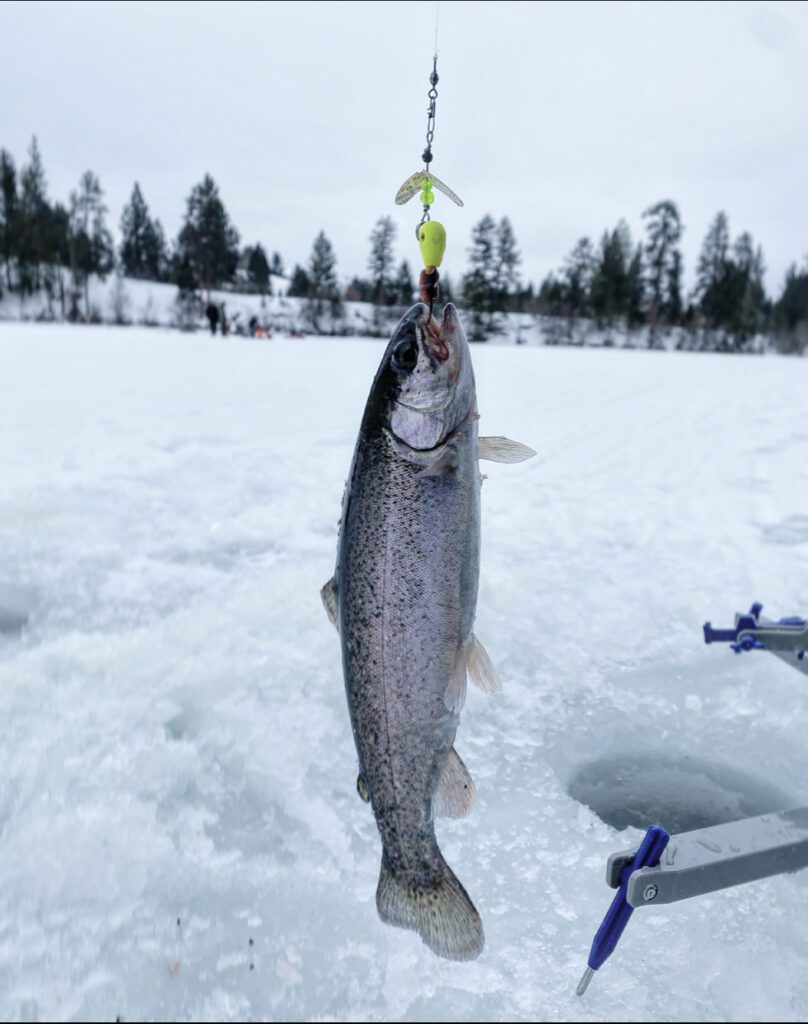
Trout, being the apex predator in most lakes, will cruise the weed lines looking to aggressively find any snack available to them, thus it’s imperative that you have reactionary type baits that emulate a dying baitfish to entice them to bite.
Small spoons, such as the Mack’s Lure Sonic BaitFish (1/16 oz. to 1/6 oz.) and the Mack’s Lure Hum Dinger (1/8 oz.), tipped with artificial pink maggots, meal worms, or corn will do the trick — and don’t be afraid to add scent to the lures and bait as well. When aggressively jigged, these spoons will create flutter and vibration, attracting trout from further distances.
If you’re not having luck with spoons, it likely means the trout aren’t as aggressive. Instead, use the smallest bait possible to reach your target depth. Try a Mack’s Lure Glo Hook (#6), tipped with maggots, corn, or meal worms, and a little split shot to get your presentation to the bottom.
Don’t be afraid to mix up your colors often. Begin with natural colors, including silvers and whites, but be quick to shift to brighter colors, including chartreuses, reds, and oranges if they’re not taking your offering. The trout will tell you what they want, so be versatile in your tackle selection and change often if they’re simply not biting.
Effective jigging techniques for targeting trout through the ice
When fishing closest to the weed line, make sure your presentation is hugging the bottom, typically 8- to 12-inches from the lake floor. Drop to the bottom, then a couple cranks up and you’re in the strike zone.
There’s no jigging cadence that’s tried and true. Really, it’s whatever you feel comfortable with. One thing that is for certain, however, is that your jigging cadence needs to be consistent and in rhythm. If you’re erratic, the trout will have a tough time attacking your presentation — and we’re in the business of making it easier for trout to bite your lure, not harder.
The only exception to rhythmic jigging is, occasionally, dropping your presentation to the bottom to drum up some silt and create a disturbance. Trout, in shallower water, are constantly feeding on prey that burrow in the sand, thus anything out of the ordinary is sure to catch their eye, especially from further distances. Alternatively, on really slow days, you can try dead sticking, just a few inches off the bottom, meaning you’re doing nothing with your presentation (tipped with a worm or bait) except holding it still.
Later in the day, when the trout move deeper, you’re going to follow them, as you’ve already pre-drilled holes in this deeper water. Fish to these suspended trout, at least six feet from the top of the water column, using the same, rhythmic jigging cadence as before.
Practice safety at all times when ice fishing
While ice fishing is a perfect activity for the entire family, it can quickly go badly if you’re not prepared. Use common sense, dress warm and, especially early in the season, always check the ice conditions before venturing out. To do so, drill your first hole, then measure its thickness. Ice 4-inches and thicker is safe for small groups, but be sure to spread out.
At the end of the day, just being out on the ice with friends and family is a blast. Hooking into some trout on super light gear, however, is the prize. Hopefully, by using the tips here, you’ll be well on your way to a successful ice fishing season targeting trout.
/articles/early-ice-fishing-tactics-trout
A Beginner’s Guide to Winter Steelheading
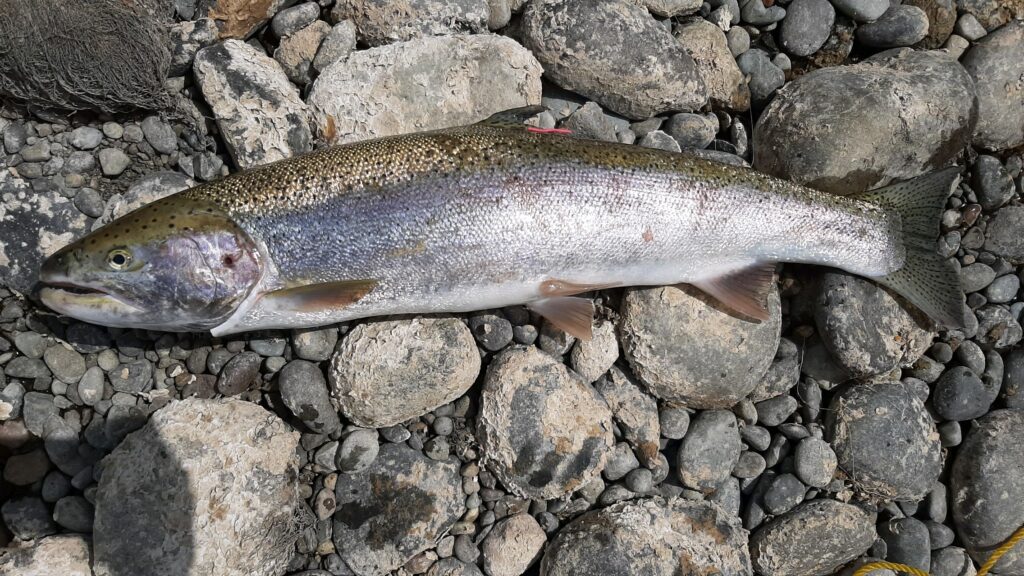
Slap on your earmuffs and grab that tacklebox, it’s winter steelhead season here in the Pacific Northwest! Steelhead, which are sea-run rainbow trout, call out to devoted anglers like a siren’s call. There’s just something special about these fish. They are elusive and wary. Some fishermen go their entire lives without landing one. These silver bullets are well worth pursuing, however. They make delicious table fare and put up terrific fights. Winter weather can create extra challenges, but it just makes netting these beautiful fish even more rewarding. Many anglers are tight lipped about their steelhead tips, which can make steelhead fishing intimidating to beginners. Let’s go over some tackle ideas, clothing tips, and hot spots to help make your first winter steelheading trip as productive and safe as it can be.
Tackle
In order to understand how to catch winter steelhead, you must know that there are some differences between summer and winter steelhead. Summer run fish head into the rivers early, and mature in the river over several weeks or months. Winter runs go into the river mature and ready to spawn. In general, winter steelhead are less aggressive. The cold water slows down their metabolism and makes them less willing to grab your offering. If you’re able to entice one into striking, hang on! Steelhead are famous for their long, athletic runs. Winter steelhead are often a bit bigger and fatter than their summer-run cousins as well.
One of the most convenient things about winter steelheading is that they are perfectly willing to bite cured salmon eggs! Around this time, I always have a fresh supply of eggs leftover from the previous salmon season. They are one of the best baits for winter steelhead! However, you’ll generally want to use a different strategy for curing them. Steelhead generally like a sweeter cure than salmon do. Most egg brines meant for steelhead create a harder, more durable egg, while salmon cures will make a softer, “milkier” egg. You can either drift your eggs or float them with a bobber. If you’re all out of salmon eggs, don’t fret. Winter steelhead absolutely love sand shrimp and coon shrimp! Make sure to tie a good egg loop knot and tuck your bait inside the loop. You can use stretchy thread for extra security. You can use a combination of eggs and shrimp to make your bait even more enticing.
If you’re fishing on a river where bait isn’t allowed, or you don’t feel like covering your winter gloves with shrimp and dye, spinners, spoons, and jigs are deadly effective on steelhead. Just remember that the fish will be holding near the bottom, and let your lure sink before reeling it in. Bring a variety of different colors and weights: river flows and depths change constantly, and you may need a heavier lure than you were using the other day just to reach the bottom. Steelhead can be surprisingly light biters despite their size, so make sure you are attentive and ready for the strike. One of the most popular ways to catch steelhead is to float a 1/4 oz jig under a bobber. Make sure to adjust your bobber stopper so that your jig is floating just above the bottom, however. You can tip your jig with a bit of prawn if bait is legal where you’re fishing. There are a wide variety of jigs out there, and many anglers even tie their own! Experiment with a variety of colors and jig materials until you find what the fish are keying into.

Clothing
Nothing can ruin a fishing trip like the cold. Layers are the winter steelheader’s secret weapon! The fish don’t wait for good weather before moving in, and you may not be willing to wait weeks or days for a clear day. Check the forecast, but we prepared for sudden inclement weather too. Neoprene waders offer good insulation from cold water, but a good base layer and loose, warm pants can also work. Wool socks are a must! Gloves can make a huge difference. Even on relatively mild days, my hands can get cold, making it difficult to switch lures or apply scent. Hand warmers have come a long way these days. In addition to disposable, shake to activate handwarmers, there are also reusable ones. Many sporting goods stores in the area offer lighter fluid powered and battery powered hand warmers. Test out your options and figure out what you like best. Propane space heaters are also great options. My friend recently put a diesel heater in his Thunderjet, and it makes a world of difference. I’d recommend pre-tying your leaders, to minimize the amount of tying you have to do while fishing. It’s a good idea to bring a change of socks too, just in case. Nothing will make you feel more cold and miserable than wet socks. Earmuffs, hats, or head bands will help, but partnering them with a warm scarf will make all the difference on those frigid winter days. Be prepared! I would recommend gearing up the day before and spending some time outside. If you’re already cold, pack on a few more layers and try again until you’re comfortable.

Locations
More so than any others, steelhead fishermen tend to be the most tight-lipped about their secret spots. While it’s not my intention to “blow up” anyone’s honey hole, I do want to at least steer beginner anglers in the right direction. I’ll always remember the euphoric rush from landing my first steelhead, and I wouldn’t have known where to go without guidance. As previously mentioned, summer steelhead enter the rivers sooner in their life cycle, and spend months maturing and moving upriver. By contrast, winter steelhead don’t travel nearly as far upriver, and some spawn within a few days of going in the river. Check the WDFW hatchery escapement report daily for updated numbers. The Skykomish River, Cowlitz River, Humptulips River, and Wynoochie River all boast good returns of winter steelhead every year. The Cowlitz River is usually open every year, but the Humptulips and Wynoochie River may be closed if they do not reach their escapement goals. You can try coastal rivers such as the Hoh, Sol Duc, and Calawah if you are willing to make the drive. Make sure to check the regulations though, several of these rivers do not allow fishing from a boat. Be respectful of private property and tribal land. Drift boating is always hazardous, but the frigid waters during winter create extra danger. It’s never a bad idea to go out with a guide on your first winter steelhead trip. They can show you the right way to drift the river safely. Remember that rivers change every year, and always be on the lookout for submerged rocks and trees.
While looking up popular locations for steelheading can be a good way to get started on your journey, you should also be able to recognize water that fish are likely to be holding in. In case your desired location is already full of anglers, or you just want to try a new spot, familiarize yourself with “steelhead water”. These fish are looking to spend the least amount of energy to get upriver and will take the path of least resistance. Sometimes the path of least resistance is right next to the shore, so make sure you fish your lures all the way to the bank. Look for calm waters near tailouts where fish are likely to be resting. Also check behind boulders and logs, but be careful of snags. I’d recommend thoroughly fishing one hole before moving on. Try both bait and lures, you never know what the fish will want that day. Winter steelheading can be a bit of a grind, but you’ll forget all about the cold and your numb hands and ears when you’re fighting a 15 pound silver bullet!
Wherever you decide to fish for winter steelhead, make sure you check your rules and regulations. Familiarize yourself with catch and release best practices. All wild steelhead in Washington State must be released. Make sure to check for an adipose fin before removing your fish from the net or pulling it into the boat- it’s illegal to remove wild steelhead from the water. Never grab a fish you intend to release by its jaw or gill plate. Wet your hands before touching the fish, to avoid damaging its protective slimy layer. Rather than just throwing the fish back, it’s a good idea to gently put the fish back in the water, facing it into the current so that water can flow over their gills. Let it swim off when it’s ready. If you must take pictures, take them quickly, and prioritize getting the fish released as soon as possible. Wild steelhead are beautiful, rare creatures that should be treated with the utmost respect and care.
Good luck on your winter steelheading adventure! Bundle up and stay warm out there!
/articles/beginners-guide-winter-steelheading
Angler-Based Psychotherapy
“Welcome back to the 'Winter Doldrums’”, read the message on the marquis in front of the local fly shop. My buddy and I just glanced at each other and went inside anyway. I was hosting a bonefish trip to Mexico in less than a month. I had chosen a local fly shop to meet with everyone on the trip to assist with gear prep, clothing needs, travel details, etc. You know, all those things that a good host should do instead of just sending a pack list/itinerary and hoping for the best. Once we were inside the shop, it didn’t take long for me to realize the twelve inches of newly fallen snow and more than 60 days of frigid temperatures had won the battle for “chipper attitude of the month.” Hence the marquis message.
Notice I said “a local fly shop”, not “my local fly shop.” The majority of the guests on that particular trip were from the upper Midwest, so I chose a fly shop most convenient to them to meet. Plane tickets were cheap for me back then. Alas, the old days of AirTran. I had spoken with the shop owner in great detail about our trip meeting. I had hoped it would generate some revenue for the shop as well as help him get into the travel fishing business. It seemed like a grand idea to use his shop, and it was. As the group started filing in one by one, the vibe in the room went from mass melancholia to downright elation in just a few minutes. It’s funny how just a little bit of talk about planning a fishing trip can change the mood.
Nowadays, I plan all my fishing trips in January/February. It is a superb time to have a get together with my buddies and plan a trip. My family calls it angler-based group psychotherapy. Either way, the timing works. Over the years, we have put together so many trips. Some turned out beyond great, others not so much. Through all the group therapy down in the fly-tying shop, I have learned that following a particular planning protocol will lead to a more successful trip, no matter if I am booking a lodge or going full DIY. In addition, the amount of flexibility I am willing to bestow makes a difference as well. The following is the way I plan not only for myself but for anyone who asks me to help them plan their fishing trip. Since the last two decades of my guiding career have been based in Alaska, we will work with that planning protocol. However, you will find that using this protocol will work for just about anywhere you want to go, third world countries included.
1) Decide what species of fish you want to target.
This seems simple, doesn’t it? One would think so. Put 10 anglers in a room and start the discussion and you will find out that 6 of them are like minded when it comes to what species they want to target on any particular trip. Singling out a particular species to target for this fishing trip is the very most important part. Everything else will fall into place after that. Once this obstacle is overcome, move to step 2. Don't jump ahead in line. Trust the protocol.
2) Decide where you want to travel to target the chosen species.
This is the part where you get to control the financial commitment towards your fishing trip. For example; I have decided that I really want to catch giant, clowned up, sea run Dolly Varden. I would love to travel to some remote portion of Siberia to cast to a Dolly that has absolutely never seen a human, much less been fished to. Without a doubt, it would be the trip of a lifetime, right up until I see that it’s gonna cost a second, third, and fourth mortgage. So that gives me the opportunity to reevaluate my financial commitment to another location. Once you've got this nailed down, move to step 3.
3) Deciding when you go is pretty easy after steps one and two are done, especially with Alaska trips.
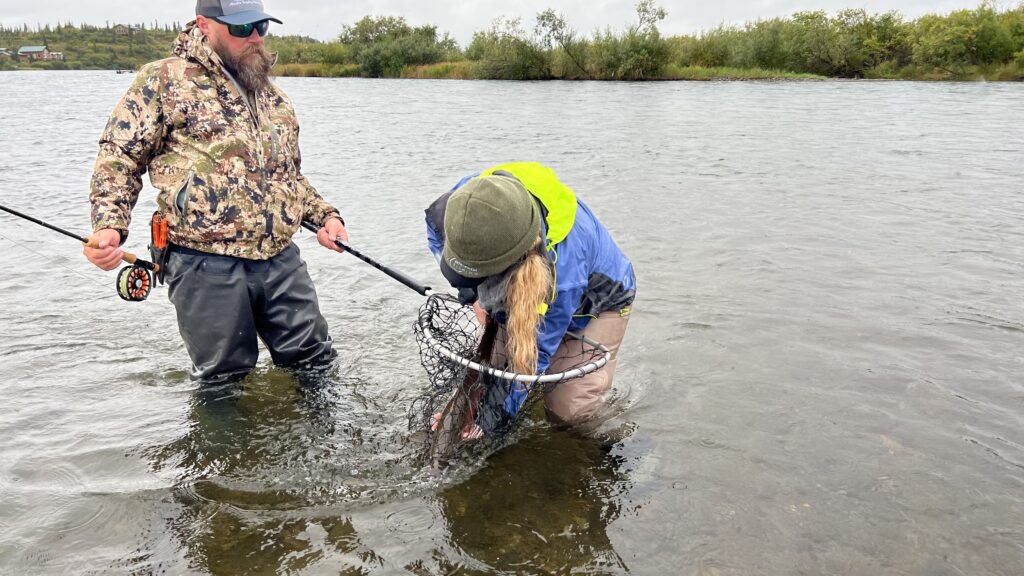
Most of the fishing is based around the migration of Pacific salmon and their lifecycle as a target species, or a food source for another species of fish that capitalizes on salmon eggs and flesh. So, if I wanted to target king salmon during the peak of the run on the Nushagak River, I would plan to be there in late June. But, if I wanted to target leopard rainbows behind spawning sockeye in a creek, I would go mid-August. Now we have that established, go to step 4.
4) Last, and certainly far from least, is how to go.
How you go encompasses everything left about your trip. Are you going to DIY or book a lodge? Maybe you want to do a combination of DIY and day trips with a guide. I look at every option available, how much it costs, and figure out the bang for the buck. In some cases, a DIY trip turned into a fully guided lodge booked trip, only because the lodge had a special price that coincided with my species and timing. The lodge price wasn't much more than the DIY price estimate, and all the guess work was taken out of the program. Therefore, it was easily worth doing the lodge deal. This doesn't always happen, but it’s worth doing the research.
If you are like most of us self-taught anglers and wouldn't dream of doing a guided lodge trip even if budget wasn't a concern, I implore you to do your research. Make sure that where you are going and what you are targeting is still a viable thing. If you are doing a DIY raft trip for trout, make sure the river you chose has a good trout population in it. Alaska seems like a dreamy wonderland for all cold-water salmonids, but everything is cyclical. Just make sure. Don’t trust social media. Not all lodge owners and booking agents are telling the truth, some are just selling empty beds and boat seats. Probably the most valued asset you can find is a trip consultant. A trip consultant doesn't have any allegiance to a lodge or travel company, and for a couple hundred dollars, you will gain more information than you bargain for.
So, call your friends over, smoke a brisket, and plan a trip. It will do wonders for your mental state and seasonal affective disorder.
/articles/angler-based-psychotherapy
The Outdoors Roundup
August 05 - August 11, 2022
Wallowa County Fun
Bordering Washington and Idaho, Northeast Oregon’s Wallowa County offers all sorts of outdoors fun. I visited there this week and had a fulfilling day and a half of outdoors recreation. I started off visiting with Brad Snook at the Sports Corral in Joseph to get a fishing report for Wallowa Lake, a beautiful body of water that sits in a glacial moraine.
Snook reported the trout fishing was going well. Rainbow trout are stocked on a regular basis and anglers were catching a good number of 12 to 13-inch trout along with the occasional 17 to 19-inch fish. Wallowa Lake is also a well-known kokanee salmon fishery. In fact, the world record kokanee, a 9.67-pound land-locked salmon, was caught here in 2010. Not long after that the population of large kokanee crashed, replaced by a huge number of small fish. Over time though, the kokanee have been getting bigger and Snook reported that a seven-pound salmon had been caught earlier this year. Snook cautioned August is generally a tough month to fish for kokanee, but the fact there are a few giants swimming in the water bodes well for another potential record fish in the future.
I also spoke with Rob Lamb at the Joseph Fly Shoppe. He confirmed Snook’s reports about the trout fishing at Wallowa Lake and said dry fly anglers were having some magnificent days, catching and releasing up to 30 trout per outing, at the south end of the lake where the Wallowa River flows in.
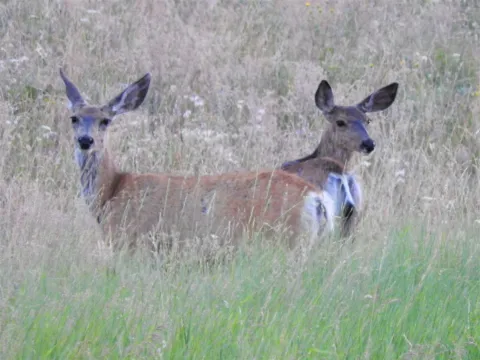
After dinner in town, I drove some 30 miles to the Zumwalt Prairie Preserve. Managed by the Nature Conservancy, this 33,000-acre property is known for the native prairie grasses as well as the wildlife that live here. In addition to deer and elk, there are also coyotes, badgers, and other animals along with a wide variety of bird species. I enjoyed a serene hike amongst the prairie grass, not hearing any man-made sound at all, just crickets and a gentle breeze blowing through the bunchgrass. As for the wildlife, they didn’t come out until sunset, but when they did, I got to see deer and a small group of elk, including a spike bull that was only a hundred yards away.
After a restful night’s sleep, I went on a pleasant hike at the State Heritage Site just south of town. The trail meandered through a meadow and around a scenic pond with the Wallowa Mountains serving as a backdrop. After eating fresh fruit and a flank steak breakfast burrito at the Kokanee Inn, it was off to the Wallowa Lake Tramway to meet with the General Manager and co-owner, Mike Lockhart. The two of us entered an enclosed gondola car and traveled close to two miles in 15 minutes, gaining 3700 feet in elevation until we reached the top of 8200-foot-tall Mount Howard. We took a seat at The Summit Grill, which Mike says is the highest elevation café in the Northwest, next to the tramway. It’s an open-air restaurant styled after European cafés in the Alps, and the offerings on the menu are surprisingly affordable. The two of us chatted about the many upgrades made to the tramway in recent years and how popular this tramway is, with some 30,000 visitors a year. The reason for the popularity, besides the unique way to get to the summit, becomes obvious upon your arrival. On a clear day you can see well into the three states of Oregon, Idaho, and Washington, enjoying views of Wallowa Lake below, and the magnificent Wallowa Mountains and Eagle Cap Wilderness to the south and west. A well maintained 2.5-mile-long trail system with interpretive signage looping around the summit allows you to enjoy the views from different viewpoints. It’s definitely a bucket list experience! You can find out more details about the tramway at www.wallowalaketramway.com
As for where to stay, I would highly recommend the Kokanee Inn. Located on Main Street in Joseph, the well-appointed inn has eight rooms and lots of sitting and dining areas both indoors and outdoors. The breakfasts are amazing, the beds are comfortable, and the amenities include the free use of a cruiser bike for guests to cycle around town or down to the lake. The owners have lots of knowledge about where to bicycle and hike and will help you find the perfect outing. In addition to this great bed & breakfast, there are a number of other lodging and camping options in the area, including the very popular Wallowa Lake State Park. Find out more details at www.wallowacountychamber.com and www.kokaneeinn.com.
John Kruse – www.northwesternoutdoors.com and www.americaoutdoorsradio.com
/articles/outdoors-roundup-0
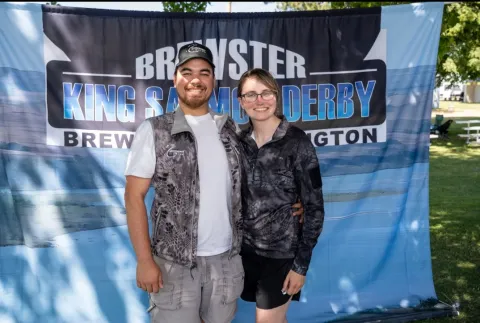
Brewster Salmon Derby Adventures
In all my years of fishing, I have heard many legends and stories about fishing at the infamous Brewster Pool. Articles on the Internet caution readers about hostile fishermen and hundreds of inexperienced boaters creating chaos. My own experience couldn’t have been further from these stories. This year, I was lucky enough to get the opportunity to film and participate in the derby on behalf of Northwest Fishing.
From the moment I got to Brewster, I was blown away by the friendly locals and energetic atmosphere of the derby. Other fishermen were giving each other high fives and complementing one another on their catches. This was far from the stories of combat fishing and fishermen yelling at one another that I had heard. Although there were hundreds of other boats out there, everyone was very patient and gave one another plenty of space. Guides and recreational fishermen alike were joking with one another and having a great time doing the sport we all love. I saw hundreds of beautiful fish caught and weighed in over the 3 days of the derby, and even got to reel in some of my own. Here’s the story of my experience at this year’s Brewster Salmon Derby.
Cori Kogan: Interview with Mike Mauk
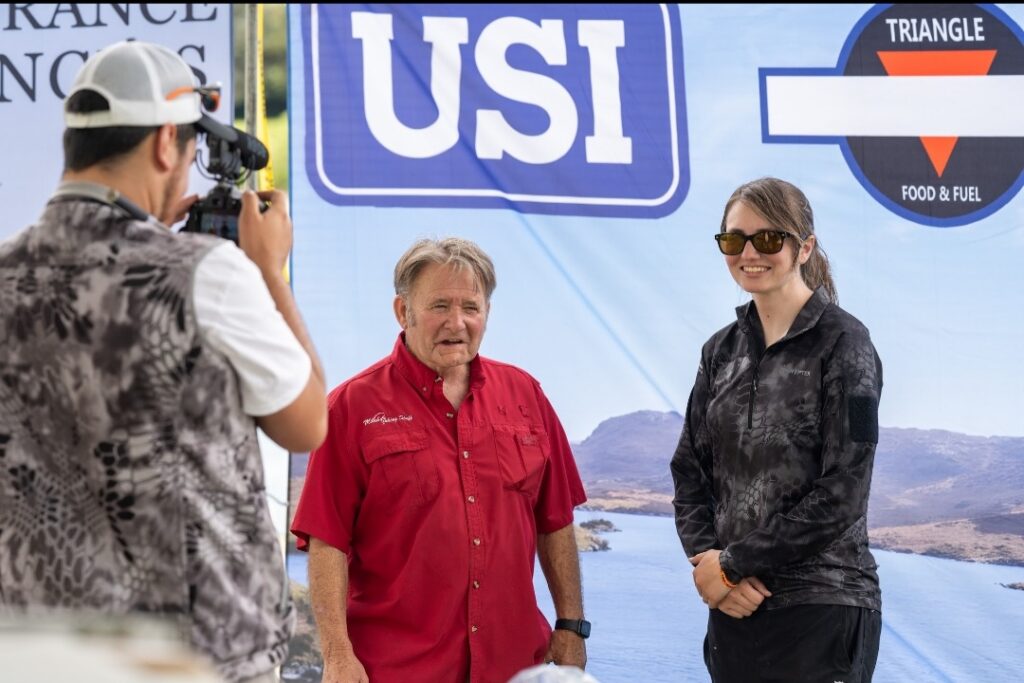
On day 1, Mike Mauk, the president of the Brewster Chamber of Commerce, greeted me with a warm handshake and a big smile. Mike organized this year’s derby, bringing together dozens of sponsors and coordinating prizes and staffing for the event. He gladly took some time from his busy schedule to chat, and I interviewed him about the history of the derby and the town of Brewster. He told me that the proceeds from ticket sales go towards helping the community of Brewster and enabling them to run the derby year after year. The Brewster Salmon Derby is the largest derby on the Columbia River, and up to $20,000 in cash and prizes are given out every year. Next, I interviewed the derby weigh master, Ernie Mauk. Ernie brought incredible energy to the weigh station, high fiving each kid that brought a fish to him. He showed me how he weighs each fish, taking the girth and length measurements and calling them out to be recorded and put on the board. He said that even though he weighs hundreds of fish every year, he still admires the beauty of each and every fish he weighs. WDFW also had a presence at the weigh station, scanning the fish for tags. When they found a tagged fish, they cut the nose of the fish off to remove the tag (after making sure the fisherman had gotten all the pictures they wanted). They let me know that the information they get from the tag helps WDFW determine the health and abundance of salmon populations. Not only does the derby help the small community of Brewster, it also aids WDFW’s research and provides valuable insights into this amazing fishery.
Bree, Waylon, and Hannah with a nice sockeye
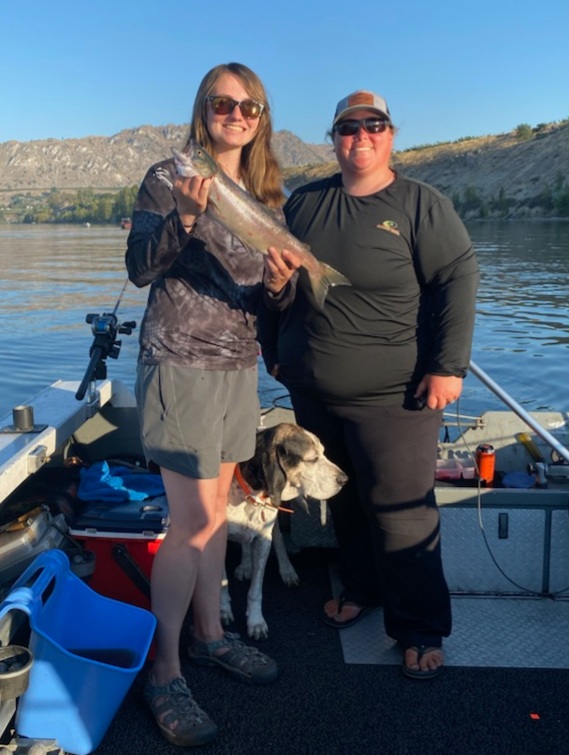
While getting to see the ins and outs of the weigh station was certainly a fascinating experience, fishing is truly my passion, and my experience participating in the derby was absolutely unforgettable. Brianna Bruce of Livin’ Life Adventures was our guide during our 3-day adventure. My friend Michael Francisco, my fiancé Chris Decker, and Northwest Fishing regulars Andrew and Joe Czapla were on board. Brianna (Bree) kept us entertained with dozens of fishing stories from her 11 years of guiding. She told us all about the fishery and what makes it so productive and popular. Every year, thousands of sockeye and chinook salmon stage in Lake Pateros, also known as the Brewster Pool, between the dam and the mouth of the Okanogan River. The mouth of the Okanogan River heats up and creates a thermal barrier, and the fish wait in the pool for it to cool down so they can enter and reach their spawning grounds. This year, Bree said there were over 100,000 sockeye in the pool! Good numbers of chinook are caught every year, some reaching over 30 pounds. Some fishermen got their limits of sockeye and headed back to town for breakfast before the heat of the day began. Others stayed out until 6PM, braving the heat for a chance at a derby winning chinook. There was a 4 fish limit for sockeye, and a 2 fish limit for chinook. The bite seemed best in the early hours of the morning, but there were fish caught all day. Bree’s dog, Waylon, was our bite alarm throughout the weekend. Every other fisherman in the pool knew when we hooked onto a fish! Bree alternated between steering around other boats, netting fish, baiting hooks, and swapping fishing stories, making it all look easy. Her natural talent, great humor, and mastery of the fishery made for an unforgettable experience. On day 2, one of our cameramen had a big, feisty sockeye on the end of his line. As he brought it up to the boat, he lifted the fish out of the water and the hooks popped out. Our hearts sank, but Bree effortlessly scooped the fish into the net and saved the day!

Some early morning sockeye action!
We started off fishing for chinook the first day, armed with spinners and chrome flashers. Bree is an expert in this fishery, and told us that sockeye often hit chinook gear, and vice versa. The second day, we fished sockeye gear, and were rewarded with many nice fish. For her sockeye gear, Bree ran homemade pink spinners and smaller flashers. On the third day of the derby, we fished a combination of sockeye and chinook gear. She ran 2 spinners, 2 sockeye setups, and 2 tuna stuffed Brad’s Super Baits. It was tough to find the right speed to get the different gear to fish right, but like a true pro, Bree made it work. We trolled slowly, between .8 and 1.2 MPH, and kept an eye on the depth. To avoid tangling our 6 lines, Bree used a variety of different cannonball weights, which also allowed us to fish throughout the water column.
No matter how tired and hot we were after fishing all day, we always looked forward to lunch at one of Brewster’s amazing, locally owned restaurants. Mike Mauk and the Brewster Chamber of Commerce treated us to lunch and dinner each day. The sizzling, fragrant fajitas at Campreros were absolutely delicious! Later in the afternoons, we usually got some time to explore the area each day. I was surprised by just how much the town of Brewster has to offer. There are numerous family-owned stores that offer cool refreshments and homemade snacks. If you’re fishing the Brewster Pool, it’s definitely worth it to take the time to sample some of the local cuisine and explore the town.
Cori Kogan: Filming the derby winners!
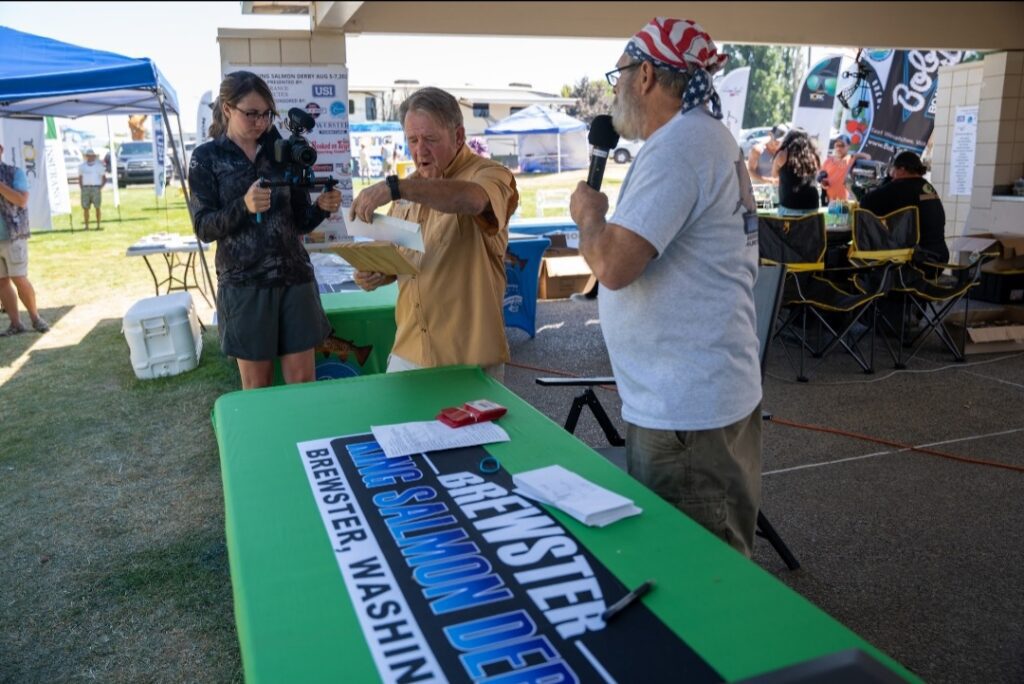
On day 3 of our adventure, we got to see the winners of the derby take home their prizes and win their bragging rights. The winning fish, the “king of the pool”, was a tank of a chinook weighing in at 29 pounds and 10 ounces that got the winning angler a nice check for $2,000. The top 10 winners got a beautiful wooden plaque to commemorate their win. One of the most memorable parts of the weekend was when a young girl weighed in a 26-pound chinook. She ended up winning the youth category of the derby! Besides the competition for the top 25 biggest chinook, there were also side pots and a raffle to take part in. There were many raffle prizes, such as free fishing trips for 4 people, a bow, and a downrigger. The grand prize for the raffle was a 9.9 HP Mercury outboard motor. Weigh master Ernie announced the winners, and photographer Cori Kogan snapped photos of them holding their prize next to Mike Mauk.
All 3 days of my experience at the Brewster Salmon Derby culminated into an unforgettable adventure. From Mike Mauk’s warm welcome to Bree’s terrific netting skills and incredible sense of humor, I’ll always tell stories about the derby with a smile. I know I’ll be back next year for another shot at winning the derby!
/articles/brewster-salmon-derby-adventures