Steelhead are biters, dude!
The solunar tables said the first day of spring would be poor for fishing, but there was a window in the morning when fish would bite best. The forecast called for one low-pressure cell after another, but between storms, there would be a bump in the pressure. I always think back to what a friend of mine told me on a day not unlike this one.
When the river is high, green and dropping, when the pressure rises, when the moon is waxing, when there are fish in the river. That's when I want to fish.
My grandpa used to point me to the barometer and tell me when the fishing was good and when it wasn't. It didn't make a lot of sense then, but I watch the barometer before every trip now. We picked the day months before, hoping to maximize our chances of tangling with big steelhead.
"Steelhead are biters, dude!" I remind myself when the rainwater is dripping around the brim of my hat.
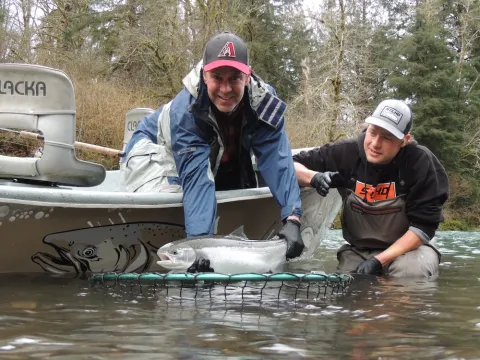
Dan Cardot and I made the drive the night before, ate too much fried food too late, and checked into one of those classic Highway 101 motel rooms with paper-thin walls, moldy carpets, and dirty blankets. We saved three bucks over the next more expensive motel. I would have paid $50 more to stay a mile away if I'd had any inkling of what an active pair our motel room neighbors were. That fresh ocean air can be invigorating.
After an hour of sleep and a Denny's breakfast, Brad Hanson met us in a pool of metal halogen light in the parking lot at Tillamook Sporting Goods. Only one river was in decent condition. The night was still in full Stygian blackness as we drove up the narrow road. I parked the Ford at the lower end of the first float and we drove five miles upstream, sipping at our coffees. In the dark, we pushed Hanson's Clackacraft off the trailer, tugged on waders, and, as the first sliver of light broke over the tops of the cedars, Hanson sat down at the sticks. We floated into the current. With a couple of other drift boats in the river, we traded first water for a few runs, then turned a corner with one boat in front of us. They pulled anchor to stay ahead.
Here, the river made a right turn, broke across a gravel bar on river right, and frothed over a ledge with a pocket behind a moss-covered boulder. On the far side, the bank ran jagged into the current. A nice riffle of broken water tumbled through aquamarine, then the river browned out over a gravel tail.
At the business end, our baits were steelhead roe with a small yarnie, sweetened up with Pro-Cure Winter Chrome. Cardot pitched a cast upriver; his bait and float splashed down along the seam, and the float tipped up, caught in the current. Cardot's bobber zagged upstream, and he set the hook into a silver streak of fury. It cartwheeled and tailwalked from the top of the run all the way to the tailout and flashed in the sun. Bright as a new-minted nickel.
For a few tense minutes, we thought we'd have to follow it through the rapids. We didn't care about first water anymore. We wanted this water. When Cardot took the pressure off, the fish nosed back into the current and came back into the pool. Hanson dropped the anchor and jumped over the side to net the fish over the gravel bar. Cardot cradled it a moment and let it kick into the green water. Five casts later, my float plunged, and we were fast into another, this one seven pounds, a rainbow-colored male.
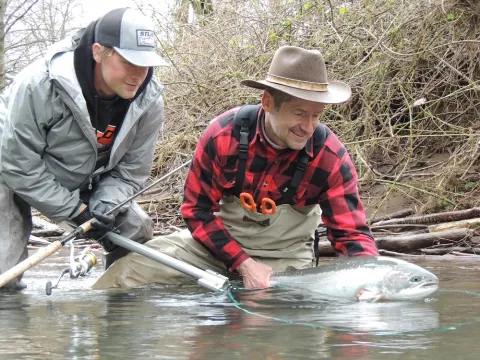
Beneath us, the river was clearing, and the fish, fresh from the salt, kept eating our baits. Cardot's third fish ran the last 400 yards of our float, and Hanson netted it at the takeout. We drove back upstream to get Hanson's rig and then parked it at the next takeout down, breathing deep of that Tillamook dairy air.
When the rain started, we picked up a 12-pound wild hen, just four miles up from the salt. As wild as the morning of creation, as bright and fueled with the ocean's bounty as any fish I've ever caught. This one I wanted to keep, but I couldn’t and turned it back to make more wild steelhead.
The rivers begin to swell with winter steelhead in late December, and each tide brings in new fish through January and February. Pick a day. Put it on the calendar. Tie leaders, sharpen hooks, and fill spools with fresh line. March is prime for winter runs, but there are still fresh fish on every tide well into April.
If there is rain in the forecast, if the water is high, if a low-pressure system is coming in over the beach, it doesn't matter much. Soak the baits. Thump the hardware. Swing those flies deep and slow. Steelhead are biters, dude.
/articles/steelhead-are-biters-dude
Telling the Truth about Surplus Steelhead
"Recycled" ocean-going rainbows breathe big fish bounty into Oregon's small lakes and ponds.
I didn't want to tell a lie in front of the pastor. But I had a ten-pound hatchery steelhead and I didn't feel like blabbing to this guy about where it came from. My pastor wanted to go steelhead fishing and we picked a Monday morning. To get to one of my favorite pieces of river, I had to walk past a trout lake. This lake was stocked a half a dozen times in spring and summer, and sometimes ODFW would put surplus summer-runs in it.
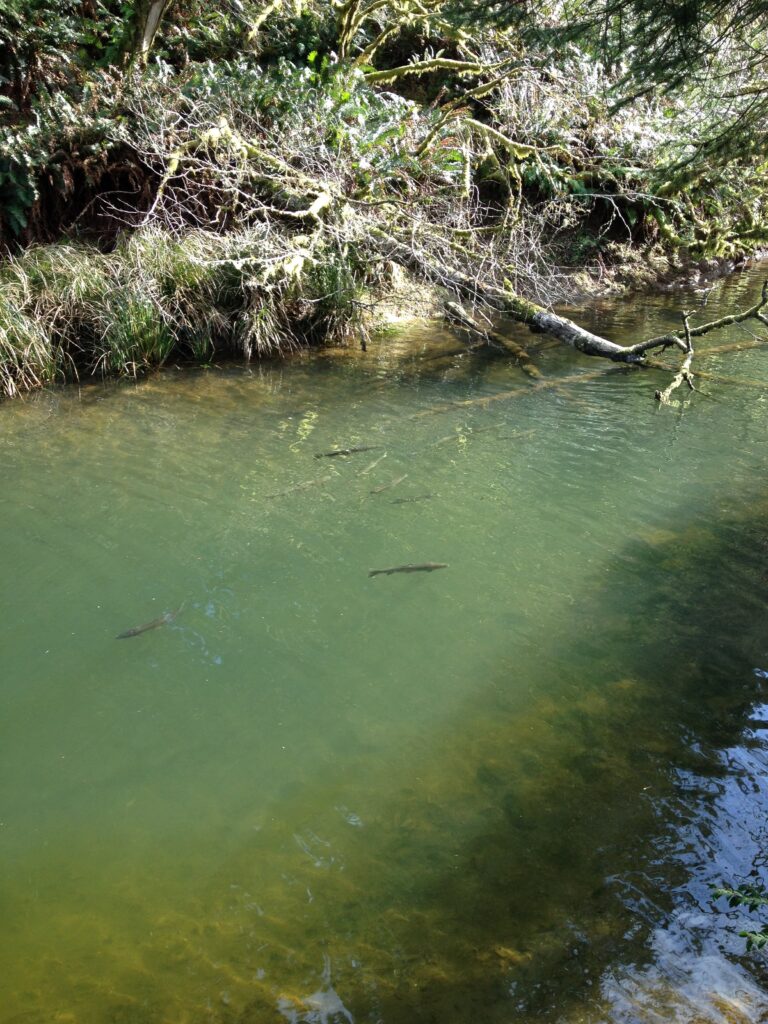
Coming back from the river, I carried my ten-pound spinner-caught prize past the end of the lake. At that moment, a fisherman, spinning rod and worm carton in hand, appeared in our path.
"That's a huge trout," the angler gaped. "Did you get THAT in the lake?"
"Yep." Bald-faced lie.
"Where did you catch it?"
"Right there at the end of the lake," I said. Bald-faced lie Number Two.
We walked on, the pastor and I, and after a suitable space had been put between us and the fisherman, he said, "I guess sometimes you have to lie." Truth.
In fact, I could have caught that steelhead in the lake because that lake was, and still is, one of the spots where the Oregon Department of Fish and Wildlife deposits surplus fish they don't need for spawning purposes. On any given day, a trout fisherman with a jar bait or a worm could luck into a steelhead. Wherever fish and wildlife agencies artificially spawn steelhead, there is likely to be a surplus of sea-run rainbows. And when that happens, the fish have to go somewhere.
In some cases, steelhead are picked up and trucked back downriver for another trip past the fishermen. Another option are local food banks. Sometimes surplus fish end up going into a big hole in the ground to feed the worms. The highest use might be to give anglers one more chance. That's why ocean-going steelhead (and sometimes salmon) end up in lakes and ponds.
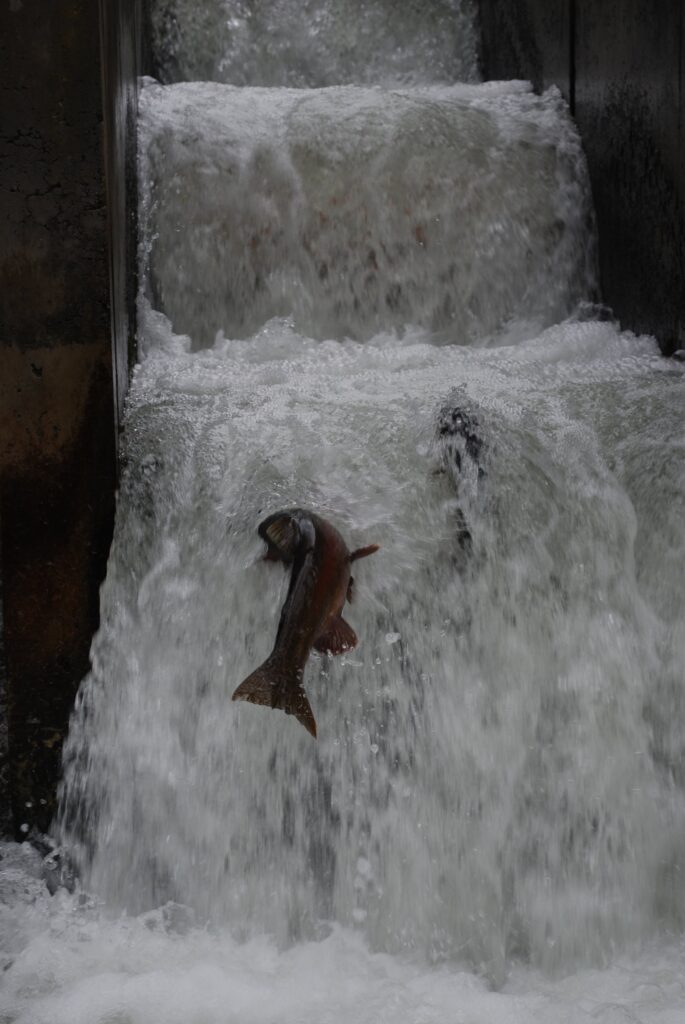
WHERE & WHEN
Decisions on whether or not to stock lakes and ponds are based on the numbers of fish and the run timing. Most of the summer steelhead in the surplus program on the North Coast come out of the Cedar Creek Hatchery. In most cases, the steelhead at the end of the line is likely to be a buck. The policy on the north coast is for female steelhead to be stripped of eggs, then put back into the river, while the males are separated to spend the rest of their days in a lake.
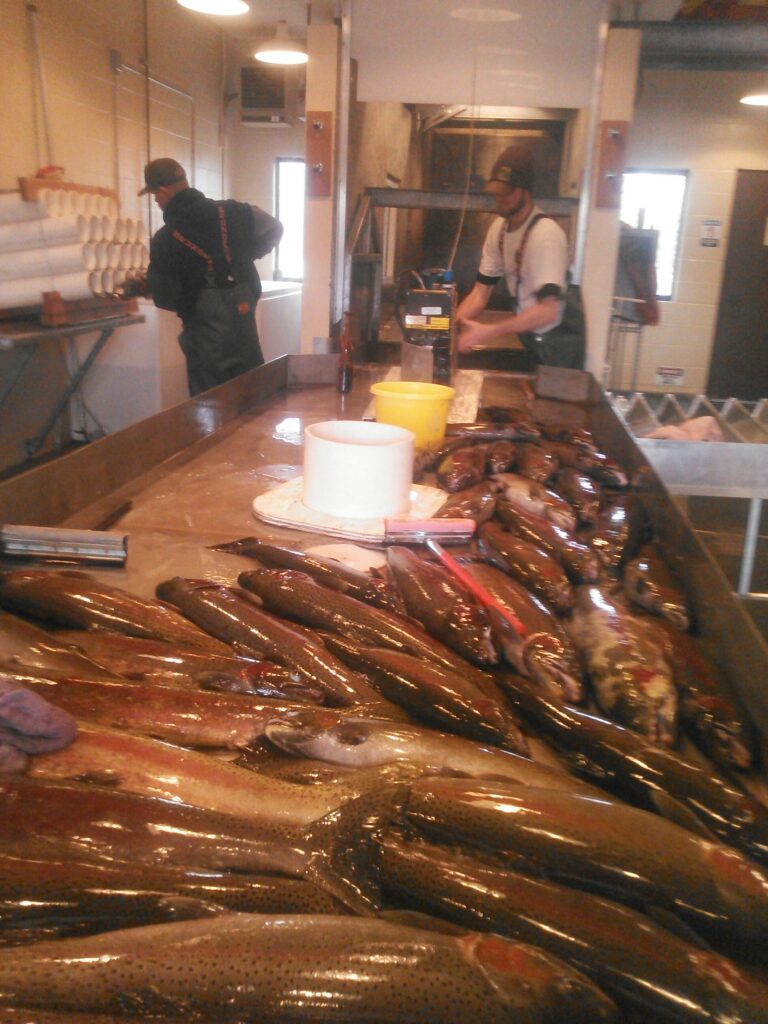
On the Oregon Coast, the Cedar Creek Hatchery at Hebo raises fish that end up in the Nestucca and nearby streams. Both summer-run and winter fish can end up in the recycling program, but summer fish, when they are stocked in a lake, usually hit the water in November, while winter-runs might be available in February and later. In any case, the steelhead don't seem to last in the lakes past mid-summer.
- Coffenbury Lake, near Astoria, is one of the beneficiaries when there are surplus steelhead in nearby hatcheries.
- Town Lake, near Pacific City, is one of the first to be stocked with steelhead when there is a surplus (summers or winters) from the Cedar Creek and Nehalem hatcheries. Vernonia Pond, Lost Lake (in the Nehalem drainage), Lake Lytle, and Sunset Lake are also stocked with steelhead.
- Cape Meares Lake, north of Tillamook, and Loren's Pond, east of Tillamook, are the other candidates for stocking if there are enough fish to go around.
- On the mid-coast, 120-acre Olalla Reservoir occasionally gets steelhead when there is an excess in the Siletz River trap.
- South along the coast, inside the city limits of Port Orford, an angler can sit on the shores of Garrison Lake and have a pretty good chance at tangling with a big steelhead at the right time of year.
- Middle Empire Lake in Coos County is another place where surplus steelies are deposited in late winter.
- In the Willamette region, Faraday Lake, east of Estacada, is one of the first waters to get steelhead if there are too many for the hatchery to handle. Walling Pond in Salem and Junction City Pond are also on the surplus stocking schedule.
- In Eastern Oregon, surplus fish from the Big Canyon hatchery often end up in Roulet Pond near Elgin and also in Weaver Pond (a.k.a. Wallowa Wildlife Pond). Surplus steelhead that return back to Enterprise are recycled to Marr Pond.
- Peach Pond in Ladd Marsh is another potential steelhead fishery if surplus numbers are high. March and April are the best timing for these eastern Oregon waters.
# # #
Gary Lewis is the host of Frontier Unlimited TV and author of Fishing Central Oregon, Fishing Mount Hood Country, Hunting Oregon and other titles. Contact Gary at www.GaryLewisOutdoors.com
The End
/articles/telling-truth-about-surplus-steelhead
A Beginner’s Guide to Winter Steelheading
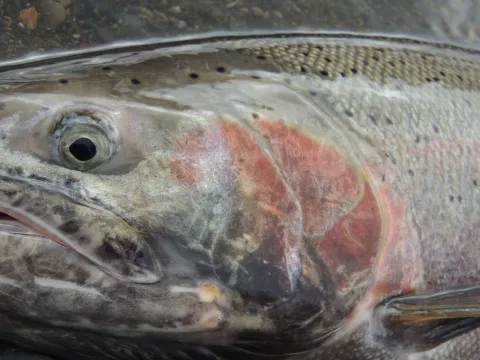
Slap on your earmuffs and grab that tacklebox, it’s winter steelhead season here in the Pacific Northwest! Steelhead, which are sea-run rainbow trout, call out to devoted anglers like a siren’s call. There’s just something special about these fish. They are elusive and wary. Some fishermen go their entire lives without landing one. These silver bullets are well worth pursuing, however. They make delicious table fare and put up terrific fights. Winter weather can create extra challenges, but it just makes netting these beautiful fish even more rewarding. Many anglers are tight lipped about their steelhead tips, which can make steelhead fishing intimidating to beginners. Let’s go over some tackle ideas, clothing tips, and hot spots to help make your first winter steelheading trip as productive and safe as it can be.
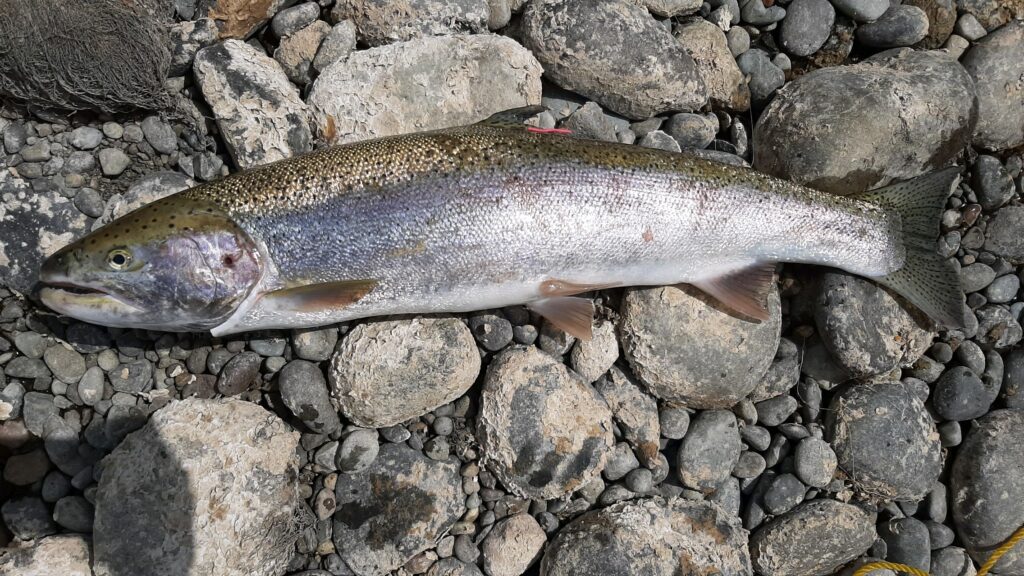
Tackle
In order to understand how to catch winter steelhead, you must know that there are some differences between summer and winter steelhead. Summer run fish head into the rivers early, and mature in the river over several weeks or months. Winter runs go into the river mature and ready to spawn. In general, winter steelhead are less aggressive. The cold water slows down their metabolism and makes them less willing to grab your offering. If you’re able to entice one into striking, hang on! Steelhead are famous for their long, athletic runs. Winter steelhead are often a bit bigger and fatter than their summer-run cousins as well.
One of the most convenient things about winter steelheading is that they are perfectly willing to bite cured salmon eggs! Around this time, I always have a fresh supply of eggs leftover from the previous salmon season. They are one of the best baits for winter steelhead! However, you’ll generally want to use a different strategy for curing them. Steelhead generally like a sweeter cure than salmon do. Most egg brines meant for steelhead create a harder, more durable egg, while salmon cures will make a softer, “milkier” egg. You can either drift your eggs or float them with a bobber. If you’re all out of salmon eggs, don’t fret. Winter steelhead absolutely love sand shrimp and coon shrimp! Make sure to tie a good egg loop knot and tuck your bait inside the loop. You can use stretchy thread for extra security. You can use a combination of eggs and shrimp to make your bait even more enticing.
If you’re fishing on a river where bait isn’t allowed, or you don’t feel like covering your winter gloves with shrimp and dye, spinners, spoons, and jigs are deadly effective on steelhead. Just remember that the fish will be holding near the bottom, and let your lure sink before reeling it in. Bring a variety of different colors and weights: river flows and depths change constantly, and you may need a heavier lure than you were using the other day just to reach the bottom. Steelhead can be surprisingly light biters despite their size, so make sure you are attentive and ready for the strike. One of the most popular ways to catch steelhead is to float a 1/4 oz jig under a bobber. Make sure to adjust your bobber stopper so that your jig is floating just above the bottom, however. You can tip your jig with a bit of prawn if bait is legal where you’re fishing. There are a wide variety of jigs out there, and many anglers even tie their own! Experiment with a variety of colors and jig materials until you find what the fish are keying into.

Clothing
Nothing can ruin a fishing trip like the cold. Layers are the winter steelheader’s secret weapon! The fish don’t wait for good weather before moving in, and you may not be willing to wait weeks or days for a clear day. Check the forecast, but we prepared for sudden inclement weather too. Neoprene waders offer good insulation from cold water, but a good base layer and loose, warm pants can also work. Wool socks are a must! Gloves can make a huge difference. Even on relatively mild days, my hands can get cold, making it difficult to switch lures or apply scent. Hand warmers have come a long way these days. In addition to disposable, shake to activate handwarmers, there are also reusable ones. Many sporting goods stores in the area offer lighter fluid powered and battery powered hand warmers. Test out your options and figure out what you like best. Propane space heaters are also great options. My friend recently put a diesel heater in his Thunderjet, and it makes a world of difference. I’d recommend pre-tying your leaders, to minimize the amount of tying you have to do while fishing. It’s a good idea to bring a change of socks too, just in case. Nothing will make you feel more cold and miserable than wet socks. Earmuffs, hats, or head bands will help, but partnering them with a warm scarf will make all the difference on those frigid winter days. Be prepared! I would recommend gearing up the day before and spending some time outside. If you’re already cold, pack on a few more layers and try again until you’re comfortable.

Locations
More so than any others, steelhead fishermen tend to be the most tight-lipped about their secret spots. While it’s not my intention to “blow up” anyone’s honey hole, I do want to at least steer beginner anglers in the right direction. I’ll always remember the euphoric rush from landing my first steelhead, and I wouldn’t have known where to go without guidance. As previously mentioned, summer steelhead enter the rivers sooner in their life cycle, and spend months maturing and moving upriver. By contrast, winter steelhead don’t travel nearly as far upriver, and some spawn within a few days of going in the river. Check the WDFW hatchery escapement report daily for updated numbers. The Skykomish River, Cowlitz River, Humptulips River, and Wynoochie River all boast good returns of winter steelhead every year. The Cowlitz River is usually open every year, but the Humptulips and Wynoochie River may be closed if they do not reach their escapement goals. You can try coastal rivers such as the Hoh, Sol Duc, and Calawah if you are willing to make the drive. Make sure to check the regulations though, several of these rivers do not allow fishing from a boat. Be respectful of private property and tribal land. Drift boating is always hazardous, but the frigid waters during winter create extra danger. It’s never a bad idea to go out with a guide on your first winter steelhead trip. They can show you the right way to drift the river safely. Remember that rivers change every year, and always be on the lookout for submerged rocks and trees.
While looking up popular locations for steelheading can be a good way to get started on your journey, you should also be able to recognize water that fish are likely to be holding in. In case your desired location is already full of anglers, or you just want to try a new spot, familiarize yourself with “steelhead water”. These fish are looking to spend the least amount of energy to get upriver and will take the path of least resistance. Sometimes the path of least resistance is right next to the shore, so make sure you fish your lures all the way to the bank. Look for calm waters near tailouts where fish are likely to be resting. Also check behind boulders and logs, but be careful of snags. I’d recommend thoroughly fishing one hole before moving on. Try both bait and lures, you never know what the fish will want that day. Winter steelheading can be a bit of a grind, but you’ll forget all about the cold and your numb hands and ears when you’re fighting a 15 pound silver bullet!
Wherever you decide to fish for winter steelhead, make sure you check your rules and regulations. Familiarize yourself with catch and release best practices. All wild steelhead in Washington State must be released. Make sure to check for an adipose fin before removing your fish from the net or pulling it into the boat- it’s illegal to remove wild steelhead from the water. Never grab a fish you intend to release by its jaw or gill plate. Wet your hands before touching the fish, to avoid damaging its protective slimy layer. Rather than just throwing the fish back, it’s a good idea to gently put the fish back in the water, facing it into the current so that water can flow over their gills. Let it swim off when it’s ready. If you must take pictures, take them quickly, and prioritize getting the fish released as soon as possible. Wild steelhead are beautiful, rare creatures that should be treated with the utmost respect and care.
Good luck on your winter steelheading adventure! Bundle up and stay warm out there!
/articles/beginners-guide-winter-steelheading