/articles/categories/fishing
Coho Craziness
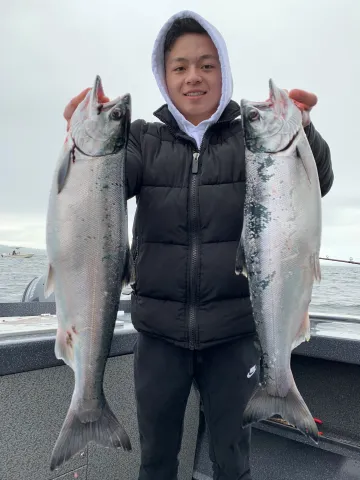
As we head into September, the color of salmon switches from pink to silver around Puget Sound.
The front end of the migratory coho run – also known as silvers for their shiny silvery-colored body – began to filter into the western Strait of Juan de Fuca and Puget Sound in August, and are expected to peak throughout September and early October.
Coho aren’t large – usually averaging 4 to 15 pounds, with some exceeding the 20-plus pounds – but they often put up a good tussle. Young coho spend a year in rivers and estuaries and then migrate out to the Pacific Ocean to feed and grow. They spend about 1½ years in the ocean, then return to spawn as three and four-year-old fish, generally in fall or early winter.
Puget Sound coho returns have gradually made a comeback from a downtrend that began in 2015 and 2016. This was due to negative environmental factors like drought, flooding, and warm water temperatures in their freshwater habitat as juveniles and then in the Ocean from a condition known as El Niño, when surface water becomes warmer than average.
The combined 2025 Puget Sound hatchery and wild coho forecast is 727,490 compared to 722,134 in 2024; 760,029 in 2023; 666,317 in 2022; 614,948 in 2021; and 504,604 in 2020.
Coho fill the air with enthusiasm for their leaping abilities when hooked, and unpredictable movements across the water’s surface.
A positive signal of 2025 expectations began with the good fishing for resident coho, who mainly spend their entire life feeding and growing in local waters –
caught in Marine Area 10 (Seattle and Bremerton Area) from June to early August. Many of these coho have grown since then and will join their larger migratory coho relatives during the late summer and fall marine fisheries.
Knowing when it is “go fishing time” for migrating coho in Puget Sound is to monitor catch rates in the Strait of Juan de Fuca at Marine Area 5 (Sekiu and Pillar Point) and Marine Area 6 (East Strait of Juan de Fuca).
The Marine Area 5 salmon fishery is open daily through Sept. 26 with a two salmon daily limit, plus two additional pink may be retained, and release Chinook, chum, sockeye, and wild coho. The area is then open daily for coho from Sept. 27 to Oct. 9 with a two salmon daily limit, release Chinook, chum, and sockeye.
The Marine Area 6 salmon fishery is open daily through Sept. 26 with a two salmon daily limit, plus two additional pink may be retained, and release Chinook, chum, sockeye, and wild coho. The area is then open daily for coho from Sept. 27 to Oct. 15 with a two salmon daily limit, release Chinook, chum, and sockeye.
Oftentimes, the best coho fishing in the Strait of Juan de Fuca occurs offshore in the shipping lanes, which is the main migration path. These deep-water areas are about one to 10 miles out in 200 to 500 feet of water and sometimes even deeper off the edge of the main shipping channels. Remember to stay within the U.S. side of the shipping lane. Look for tide rips and current breaks where krill and schools of baitfish attract coho, and watch for coho jumping and rolling on the surface.
In the eastern Strait of Juan de Fuca, the Dungeness Bay hatchery coho fishery is open from Oct. 1 to 31. The 2025 Dungeness River coho forecast is 13,328, down slightly from 14,305 in 2024 and 14,654 in 2023.
The Marine Area 7 (San Juan Islands) coho season is open daily through Sept. 6 with a two salmon daily limit, plus two additional pink may be retained, and release Chinook, chum, sockeye, and wild coho. The area is then open daily for coho from Sept. 7 to 30 with a two salmon daily limit, plus two additional pink may be retained, and release Chinook, chum, and sockeye. In Marine Area 7, look for coho staging along the western and southern portions of the island chain.
Coho fishing in Marine Area 8–1 (Deception Pass, Hope Island, and Skagit Bay) is open daily, Sept. 30, with a two salmon daily limit, plus two additional pink may be retained, and release Chinook and chum. Coho fishing is then open daily Oct. 1 to 12 with a daily two salmon catch limit, and release Chinook and chum.
In Marine Area 8–2 (Port Susan and Port Gardner), coho fishing is open daily through Sept. 24 with a two salmon daily limit, and release Chinook, chum, and pink. The Tulalip Bay Terminal Area Fishery has rules that differ from Marine Area 8-2. For details, check the Washington Department of Fish and Wildlife (WDFW) fishing regulations webpage at https://wdfw.wa.gov/.
In Marine Areas 8-1 and 8-2, anglers should find coho along the entire eastern side of Whidbey Island, Possession Point, off the Clinton Ferry Terminal, the Langley/Sandy Point area, Shipwreck to Mukilteo, Hat Island, Camano Head, the entire west side of Camano Island, and outside of Oak Harbor. West Beach at Deception Pass State Park, located north of Oak Harbor on Whidbey Island, provides excellent shore fishing access.
Moving further into Puget Sound, Marine Area 9 (Admiralty Inlet) is another decent fishing location for hatchery-marked coho, which is open daily through Sept. 30. It has a two salmon daily limit, plus two additional pink may be retained, and release Chinook, chum, and wild coho.
In Marine Area 9, focus your fishing time in the unmarked shipping lanes where tide rips and current breaks are commonly found. Try Midchannel Bank off Port Townsend; Point Wilson north of Port Townsend (good public shore access); east side of Marrowstone Island (some shore access); Fort Casey to Bush Point and Lagoon Point (some public shore access); Double Bluff off the west side of Whidbey Island; Point No Point (excellent public shore spot); Possession Bar; Scatchet Head; and Pilot Point.
In Marine Area 10 (Seattle and Bremerton Area), coho fishing is open daily through Sept. 30 with a two salmon daily limit, plus two additional pink may be retained, and release Chinook and chum. Fishing is also open daily from Oct. 1 to Nov. 15 with a two salmon daily limit, and release Chinook.
In Marine Area 11 (Tacoma and Vashon Island), coho fishing is open daily through Sept. 30 with a two salmon daily limit, plus two additional pink may be retained, and release chum and wild Chinook (note, the Chinook fishery may close sooner so check the WDFW fishing regulations webpage for updates. Fishing is also open daily from Oct. 1 to Nov. 15 with a two salmon daily limit, and release Chinook.
Look for coho in the deep-water shipping lanes off Jefferson Head to Kingston, Richmond Beach to Meadow Point near Shilshole Bay, Point Monroe, Shilshole Bay south to West Point, Elliott Bay, the Fauntleroy Ferry area southeast to Dolphin Point, both sides of Vashon Island, Redondo Beach to Dash Point and the Tacoma area of Commencement Bay, Browns Point, and Point Defiance Park from the Slag Pile to the Clay Banks.
Two popular events tied to the arrival of coho are the Edmonds Coho Derby on Sept. 6. For details, go to http://edmondscohoderby.com/. That will be followed by the Everett Coho Derby on Sept. 20-21. For details, go to https://everettcohoderby.com/.
Marine Area 13 (South Puget Sound) is open daily for hatchery-marked coho through Sept. 30 with a two salmon daily limit, plus two additional pink may be retained, and release chum, wild coho, and wild Chinook. Fishing remains open daily beginning Oct. 1 with a two salmon daily limit, and release chum, wild coho and wild Chinook.
In Marine Area 13, look for coho from the Narrows Bridge south to Anderson Island. The Squaxin Island area has become popular area for those targeting coho. The 2024 Squaxin Island net pens coho forecast is 59,596 up from 48,081 in 2024 and 45,417 in 2023.
If you’re looking for a Chinook and coho option try the Bellingham Bay Terminal Fishery open daily through Sept. 30 with a daily limit of four salmon.
Sinclair Inlet and Port Orchard are open daily through Sept. 30 with a three salmon daily limit, plus two additional pink may be retained, and release chum and wild Chinook. Fishing is then open daily from Oct. 1 to Nov. 15 with a two salmon daily limit, and release Chinook.
Lastly, a freshwater coho fishing option in Seattle’s backyard is Lake Washington north of the Highway 520 Bridge, which is open daily from Sept. 16 to Oct. 31 with a daily limit of four coho only, and release all other salmon species. The Lake Washington coho forecast is 28,112 up from 24,090 in 2024 and 21,554 in 2023.
In the October issue, we’ll switch gears and take a look at proposed fall and winter coastal razor clam digging opportunities.
I’ll see you on the water very soon!
/articles/coho-craziness
Mountain Trout As Art
We are captivated by trout. And we wonder why. Trout don't love us, they don't love each other, and they don't do anything for their fellow trout, except by accident or by instinct.
But the same could be said of art. We appreciate art for maybe the same reason we love trout. Let's see if the words — art and trout — are interchangeable.
Wynetka Ann Reynolds might have said,
“Anyone who says you can't see a thought simply doesn't know trout.”
For two summers, I spent afternoons and weekends exploring back roads, backcountry, and backwaters in streams and lakes down the flanks of Wy'East for a book we called Fishing Mount Hood Country. My co-author, Robert Campbell, covered most of the western water, and I fished more of the east side.
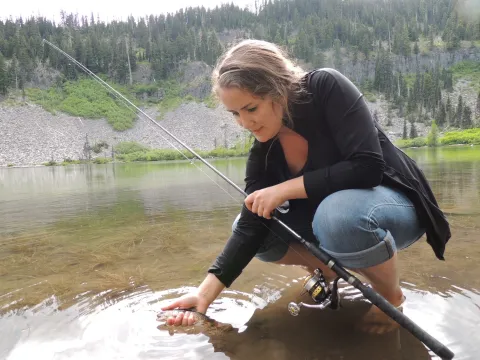
Early in the project, Campbell began to send close-ups of trout — Veda Lake cutthroats, Timothy Lake brookies, Salmon River rainbows — in hand, going back into the water. The imagery seeped into my consciousness, and when I brought East Fork Hood River cutts, or Boulder Lake brooks, or Badger Creek rainbows to the bank, I began to look at each one as a piece of art, at each scale as a stroke of a brush.
We seldom fished the same water twice during the two summers on and off the mountain. We caught bass, sturgeon, steelhead, and salmon, but the fish that defined the effort was the coastal cutthroat. There are many variations. The Clackamas watershed fish were different in coloration from Zigzag River fish, and in bigger lakes, trout coloration varied due to the micro-environments they frequented.
We might put the distinct differences down to genetics, habitat, food sources, and light penetration.
Hood River wild fish, where there are fewer trees above the water and the bottom is light, are bright and shiny. Fish in west-sloping rivers with darker streambeds are often tinted, an adaptation that helps them survive.
While there are a few resident rainbows near the mouth, Campbell's exploration of the upper Clackamas turned up big rainbows, part of a remnant strain that can grow to several pounds in that mountain water. I plan to research that water again soon.
If Goethe had been born to a fly-fishing family rather than to German drama, he might have written:
“There is no surer method of evading the world than by following trout, and no surer method of linking oneself to it than by trout.”
We caught hatchery planters, of course, and the further they were removed from the raceways, the better they looked. Holdovers — fish that had made it through a winter and gained inches and pounds — were the prettiest. We might call them modern trout and appreciate them in that regard.
John Anthony Ciardi could have said:
“Modern trout is what happens when fishermen stop looking at girls and persuade themselves they have a better idea.”
For me, one stream and one fish defined the project. A Still Creek cutthroat, about nine inches long, took a dry fly and threw the hook. The next fish was a bit smaller, but it shone in hand like treasure. I sent a picture to my friend Tye Krueger, and he drew it in every detail — a wild cutt with white tips on its fins and parr marks still visible on its sides.
Kojiro Tomita might have written it thus:
“It has been said that trout is a tryst, for in the joy of it, maker and beholder meet.”
Conditions seem to force beauty to the surface. Up toward the timberline, an angler finds the most striking examples — wild trout that in other environs would grow to be measured in pounds, not inches. Here, an eight-inch rainbow is mature, with white tips on the edges of his fins and a tint of rose in his gill plates, dark spots all the way to the tail.
G.K. Chesterton might have put it this way:
“Trout consists of limitation. The most beautiful part of every picture is the frame.”
Here in the Northwest, we have the run of an ancient gallery. The price of admission is a fishing license and the will to seek it.
“All trout requires courage,”
with apologies to Anne Tucker.
In the passage of time, we become collectors of art, the images stored in digital files and memories. And sometimes we make that beauty part of ourselves with brook trout grilled over a campfire.
If Scott Adams had been consulted, he might have offered:
“Creativity is allowing yourself to make mistakes. Trout is knowing which ones to keep.”
/articles/mountain-trout-art
The Alaska Experience
Alaska – it conjures up many images, and well it should. Our largest state is home to vast mountains, forests, and tundra. Rugged coastlines and salmon-filled rivers call to both casual and hardcore anglers. The opportunities seem almost endless.
It was my third trip to our 49th state. The previous trips to the Alagnack River and Thorn Bay were beautiful experiences, and yet there was something “missing”. Granted, imagining a single trip to Alaska could capture its essence was a fool’s errand. Be that as it may, I had high expectations for our latest trip.
Northwest Fishing TV had been invited by Alaska Kenai Adventures to stay for several days and get a taste of the Kenai Peninsula. I, Eric Magnuson, and Rob and Hillary Holman travelled to Seattle on June 19th for the flight to Anchorage. Our trip started off ominously as the flight was cancelled at 3am. Fortunately for us, Keith, owner of Alaska Kenai Adventures (which I’ll sometimes refer to as AKA) received a phone alert and promptly found us an alternate flight via Juno. A quick 3-hour flight to Alaska had turned into a delayed departure and 4 4-hour layover.
The flight from Juno to Anchorage was nothing short of breathtaking. Looking out the window, I watched as a seemingly endless vista of snow-covered mountaintops passed underneath us, glaciers glistening in the evening sun. Finally, below us was Anchorage, looking much larger than I had imagined it would be. We landed around 5 pm, loaded up our belongings into our rental cars, and started the three-hour drive to the lodge.
The route to the Kenai Peninsula is one of the most scenic drives I have ever been on in my life. Mountains rose all around us, and a mixture of conifer forests and tundra greeted us at every turn. Purple lupins were in full bloom and dotted the roadside. This was the Alaska that I had been dreaming of. 150 miles later, we turned down a gravel road and arrived at the Alaska Kenai Adventures Lodge. Waiting for us were Keith, the owner, and Pierce, the General Manager of the lodge. After giving us a quick tour, we were shown our rooms. It was 10 pm and still broad daylight.
“Our summer days have twenty hours of daylight,” Keith explained, “And night is more like dusk. Blackout curtains are very popular around here”. I had brought a sleep mask, so no worries there – plus a twenty-hour travel day had our group ready to hit the hay. Pierce let us know we would be leaving at 5 am for a day of trout fishing on the Kenai River. Our comfortable beds awaited, and I quickly fell asleep in anticipation of the coming days of fishing adventures.
Alaska Kenai Adventures provides lodging and meals, and they have partnerships with guides and charters throughout the Kenai Peninsula. As a facilitator for trips, they have built up a cadre of outstanding businesses they work with to provide their clientele with fishing, hunting, bear watching, fly-in trips, and more. If you have a trip on your bucket list, they can likely help you, or if you’re overwhelmed by all the options, Keith and Pierce can help you there as well.
Our first day featured fly fishing for rainbow trout on the Kenai River. We met our guides from Chasing Tails Guide Service and got the rundown on gear and techniques. The plan was to side drift with egg and flesh imitations. A strike indicator was attached to the leader, and our 7/8 weight rods would be up to the task of handling the larger rainbows. Our guide, Captain Alex, explained that the rainbows would follow the salmon and gorge themselves on eggs and decomposing salmon carcasses. Rainbows up to ten pounds were a distinct possibility.
The Kenai in this location reminded me a little of the Cowlitz River, size-wise, but with a beautiful turquoise hue to it. Side-drifting using this method is ideal for those who don’t have a lot of experience with fly rods, as much of the positioning can be done by a skillful guide maneuvering the boat downstream, similar to side drifting for steelhead.
The day was filled with catching; however, we were unable to find the big ones, instead landing fish in the 14-20” range. I’ll take that any day of the week! We returned after a full day of fishing to enjoy a culinary delight by lodge chef Stephan. King salmon in a teriyaki glaze, rice, fresh vegetables, and not a crumb left on my plate. Local wines and beers were a nice touch, finished off by a tasty tiramisu dessert, perfect.
Our second day was another river trip, this time on the Kasilof River, which was open for hatchery kings and native sockeye. We were only a few miles inland from the saltwater bay so the sockeye in particular were chrome bright. We fished with Hook Line Land Em guide service. Starting the day backtrolling spinners off river divers, we soon settled into the rhythmic vibration of our rod tips, until we heard an excited commotion coming from Rob and Hillary’s drift boat. Rob had a nice king on the line. We watched him battle the strong king from the top to the bottom of the run, and saw his guide swoop the fish into the net and the boat. A keeper! As we drifted by, Rob held up a beautiful king we guessed was in the 16-18 pound range, chrome bright.
Back to the task at hand, we backed slowly down the next drift, taking in the sights of bald eagles feeding and the occasional moose walking the shoreline.
Suddenly, my rod doubled over to the pulls of a big king. “Wait for it…” our guide instructed. “Now!” he called out. Pulling the rod out of the rod holder, it was obvious this was not a hatchery king. Line began peeling off my reel, and about thirty yards behind the boat, a massive tail broke the surface, followed by what looked to be at least a twenty-five-pound king, bright red flank glistening in the sun. The back-and-forth battle was on! I worked the powerful fish slowly back to the boat, alternately gaining and losing line until the line counter on the reel read twenty feet. At the same time, we had reached the end of the drift and the fish had a choice to make – go through the fast water to the next section or run upriver into the pool we had just backed down. Taking a sudden run upriver, the big king passed our boat on the right, and as he came even with my rod, I felt the sickening pop of the hook pulling out of whatever corner of the mouth he was hooked in.
A communal sigh of disappointment for the fish just lost, our guide commented, “That was a nice native. You would’ve had to release him. What an amazing fish.” Indeed, it was, and my disappointment was tempered by the opportunity to even hook and play it for as long as I did.
Back to fishing, we had drifted by various groups of shore anglers that were fishing for sockeye. Seeing these chrome-bright, hard-fighting fish was too hard to resist. After a group conference, we decided it was time to get some sockeye.
Sockeye fishing in Alaska is a different technique from Washington State. There are a couple of reasons for this. First, the fish entering the river have a very short run to their spawning grounds, and as such, Washington angling techniques of trolling are out. Second, the runs are massive. On the Kasilof, for example, the return was estimated to be over 500,000 fish. On the Kenai River, Alaska is looking to have almost a million sockeye return. With that kind of numbers, the biomass can easily handle what Alaskans call subsistence harvesting. Which means there are more than enough fish to keep the runs strong and healthy. That said, Alaska does monitor the run, and our current limit would be three fish (this was bumped up to six on the day we left). Residents in some communities are given another twenty-five fish later in the season for subsistence.
The technique Alaskans use is what we in Washington call flossing. The process is simple – swing a one-ounce weight with a six-foot leader straight out in front of you. The sockeye travel within ten feet of shore, so long casts are not needed. Drift for five seconds and give a good rip at the end of that five-second drift. The single barbed hook slides through the sockeye’s open mouth, and it’s fish on with six to ten pounds of chrome, angry sockeye ten feet away. Remarkably, the number of foul-hooked fish is quite low. The hook must be in the mouth, or the fish is to be released. There is a certain level of skill required, and we watched many anglers who just didn’t get it. But for us, a frantic half-hour later, our group’s limits were on the shore.
I know that many of you reading this are shaking your head and saying how unsporting this is. I mulled it over and decided that I was in this fishing culture, and here in Alaska, it was an accepted way to fish for sockeye. According to our guide, this is the only possible way to catch them, as they had tried other methods over the years and nothing had worked. That said, I did find myself daydreaming about fishing one of the lakes these fish return to and seeing if they would strike bare hooks behind a dodger off of a downrigger. It would be lights-out fishing for sure if they did!
Day Two came to an end, and we returned to the lodge; this time treated to perfectly cooked ribeye steak. The gang at Alaska Kenai Adventures sure know how to treat their guests!
Saltwater fishing in Alaska is a given. With thousands of miles of coastline and offshore locations to fish, AKA hooked us up with Alaskan Adventure Guides & Outfitters out of Homer to fish in the Gulf of Alaska. We would be targeting halibut and groundfish, fishing anywhere from 200-480 feet deep.
Our luck had held up as we experienced a third day of pleasant temps in the 60s and mostly clear skies, affording us spectacular views of the surrounding mountains. The wind was light, making for calm seas and an easy ride. En route to our fishing locations, we were entertained by porpoise and killer whale pods. The majesty of Alaska was in full display!
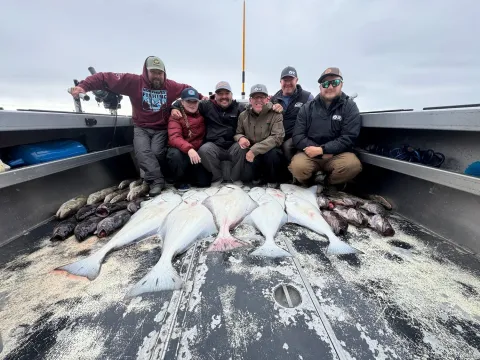
Pulling up to our first drift, deckhand Savana had our group baited up and ready to go. Gear down, we soon were feeling the tap-taps of fish. In quick order, we caught our boat limits of 4-5 pound black sea bass. That out of the way, Captain Corey moved us to the next location, which he informed us would be a good spot to get our “unders”. The regs for halibut where we were fishing called for one fish under 27”, and one fish of any size. In a twist of irony, Captain Corey told us it was actually easier to get the over-sized halibut than the under-sized ones. He turned out to be right, as we took the next hour to grind out the small fish. Mission accomplished, Corey called out, “Bring 'em up, we’re moving to a spot that we have had good luck on for bigger fish!”
Our final location had us fishing in 480 feet of water, offshore of a group of islands that I swore were right out of the casting department for Jurassic Park. Sheer rocky cliffs with crashing waves along the shoreline and wooded peaks and valleys made it hard to pay attention to our rods. Soon enough, cries of “Fish on!” rang out, as did the gaff. These halibut were indeed bigger, too big to net. At around 30-50 pounds, they were the perfect eating size. Those 100-pound halibut are amazing to see, but as they get past 70 pounds, many are older females that have tougher meat, and, more importantly, produce thousands of eggs with each spawning, making them essential for maintaining the fishery. The hold steadily filled up with halibut, and before we knew it was time to head back to the harbor. But not before one last stop…
Our final adventure on this “Experiencing Alaska” trip was low-tide clam-digging. What is unique about this experience is that you get on the boat while it’s on a trailer, and are then backed down by a tractor into the surf. The captain then drives the boat off the trailer, and away you go!
We were clamming with Cook Inlet Clamming, owner and Captain, Sarah Brooks, and her daughter Savannah. Savannah was in the process of obtaining her captain’s license. At 19 years of age, she had been working with her mom from an early age, deckhanding and boats, fishing, and clamming were in her DNA.
Crossing the inlet, we arrived at the secluded beach where we would be digging clams. There were already a couple of boats that were high and dry on the beach, and around a dozen people were digging away. We had anchored in 1 foot of water and waited for 15 minutes for the tide to recede, then it was off with our clam guns and buckets. This section of Cook Inlet had a generous limit of two 5-gallon buckets, substantially more than Washington’s 15-clam limit.
Clam shows were everywhere, and I started using the clam gun, easy to learn, but tiring to use. After pulling up half a bucket of clams, my back and legs were getting sore. About then, the tide began to turn, and we were called back to the boat – saved by the tide!
With that, our Alaska Experience trip had come to an end. Four days of fishing and clamming, getting to truly experience all that Alaska has to offer. Each member of our group came home with over forty pounds of vacuum-sealed Alaska bounty.
If you want to experience all Alaska has to offer, and then some, check out Alaska Kenai Adventures and get your taste of Alaska, The Last Frontier.
/articles/alaska-experience
C.A.S.T. for Kids
I got to participate in something special in June. It was a C.A.S.T. for Kids Foundation event, put on for nine special needs youth anglers at Potholes State Park in Eastern Washington. The foundation, born in 1991, had its first event at Banks Lake in Washington. Today, the organization is on pace to host 100 or more fishing events all over the nation.
C.A.S.T. for Kids was founded by Jim Owens, a retired Bureau of Reclamation worker who wanted to get kids with special needs and disadvantages out for a fun, mentored day of fishing.
Melissa McCalmant, who was present at the Potholes event, is the Western Operations Manager for C.A.S.T. for Kids. She said volunteers are a key part of their operation. That includes a volunteer coordinator who does the bulk of the work putting each event together. The coordinator gets with the venue owner and, in some cases, with their state fish and wildlife agency to arrange for fish stocking. In lakes or ponds that already have well-established fish populations, this is not necessary. The coordinator also seeks cash donations to purchase rods, reels, and tackle boxes at a discounted rate from Lews and Flambeau for each participant.
McCalmant also told me they go to great lengths to get special needs kids out fishing. She recalled one instance where a parent said their child could not participate because he was in a wheelchair. McCalmant procured a volunteer with a pontoon boat that was ADA accessible so that the young man could indeed enjoy a day out on the water. In fact, for many of the kids participating, it’s their first time fishing.
Melissa went on to tell me that while many events take place with anglers fishing from shore, they also offer events where anglers will fish with volunteer boaters on bass boats or on pontoon boats.
Summing things up, McCalmant said, “This is a free event for the participant and their family, and it’s a day that allows them to forget about their special needs and that they are too, just like one of us, and can fish and participate.’
As for the Potholes event, Levi Rodelo, a local fishing and hunting guide with Ross Outdoor Adventures, has a special needs daughter. He took on the role of Event Coordinator. Nixon’s Marine in Pasco, Washington, donated $500 so he could purchase the rods, reels, and tackle boxes for each kid.
Levi coordinated with Potholes State Park and the Washington Department of Fish and Wildlife (WDFW), who both readily agreed to partner in the event. Levi obtained a net pen that he put next to the boat launch in the park. WDFW stocked the net pen with 250 rainbow trout, the majority being catchable size, but some were much larger.
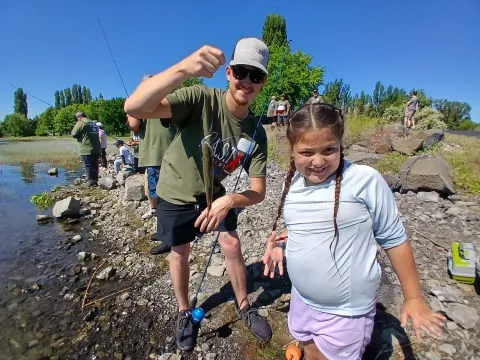
On the morning of the event, 15 volunteers met Rodelo and McCalmant. They assigned roles to all of us, and then the kids showed up with their families at 8 AM. The special needs of the children varied. One teenager had high-functioning autism, and one child had Down syndrome. Two other kids were non-verbal and couldn’t speak.
Each child (and volunteer) was given a t-shirt to wear from C.A.S.T. for Kids, as well as their fishing rods, reels, and tackle box. Each kid was paired up with a volunteer fishing buddy/coach. Hooks were baited under bobbers, and it was time to go fishing!
The fishing wasn’t fast and furious, but everybody got to reel in one or more trout in two hours of shore fishing. With the temperature heating up, the fishing wrapped up around 10 AM.
After that, everyone involved went to a food truck brought there by Blacky’s Smokin Sweet from Othello. The owners heard about the event and wanted to participate. They refused all payment, accepted no tips, and served everyone their choice of hamburger or hot dog with fries.
The event wrapped up with every kid getting a picture with their fishing buddy, and every coach and participant received a plaque to commemorate the event. The kids absolutely loved the whole thing. Not just fishing, but being made to feel like they were the center of attention, doing something very fun.
If you want to find out more about the C.A.S.T. for Kids non-profit Foundation, go to www.castforkids.org. Once there, you can look for events near you and sign up your special needs kid. If you want to volunteer or donate, you can do that through the website as well. C.A.S.T. for Kids…They are doing some great things for some very special kids out there.
/articles/cast-kids
Pinks are HERE!
A barrage of pink salmon are now beelining into Puget Sound, and the next couple of months should provide ample opportunities in many marine and freshwater areas. The hype about an expected Puget Sound pink salmon forecast of nearly 7.8 million — up 70% from the 10-year cycle average — began when the Washington Department of Fish and Wildlife (WDFW) unveiled the 2025 salmon forecasts on Feb. 28.
If the prediction pans out, it will be the third-largest total return on record, up from a 2023 forecast of 3.95 million and an actual return of 7.22 million. In southern British Columbia, the Fraser River pink salmon forecast is an epic 27 million and will contribute to fisheries in northern marine areas like the San Juan Islands.
A breakdown of the pink salmon forecasts are:
Green River, 1,835,366; Hood Canal, 2,420,610; Nisqually River, 1,503,704; Nooksack River, 97,370; Skagit River, 468,073; Snohomish River, 315,942; Puyallup River, 709,292; Strait of Juan de Fuca, 294,503; and South Puget Sound areas, 503,000.
The Stillaguamish River, pink forecast of 117,322 is a low forecast compared to past years and won’t allow for pink fishing opportunities in Marine Area 8-2 (Port Susan and Port Gardner) and the river itself.
There will be a two-bonus pink salmon daily limit for Marine Areas 5, 6, 7, 8–1, 9, 10, 11, 12, and 13 during the August to September timeframe. Opening and closure dates vary for each area. Refer to the WDFW fishing regulations webpage at https://wdfw.wa.gov/fishing/regulations or the Washington Sport Fishing Rules pamphlet at https://www.eregulations.com/washington/fishing/ for specific dates of when the two-bonus pink salmon daily limit applies to each marine area.
Recognizing a pink versus a Chinook
It is vital for anglers to be able to know the difference between a pink and a young Chinook. Especially when fishing in marine areas.
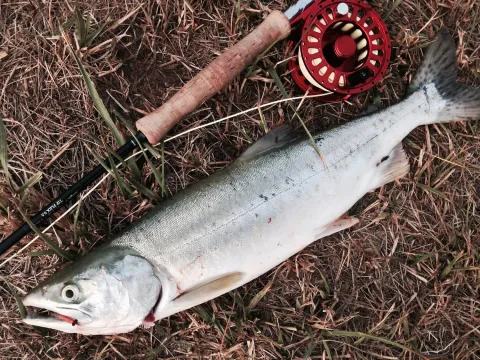
A pink has very large black spots on the caudal fin and back, and heavy oval-shaped black splotches on the upper and lower lobes of the tail. They also have a white mouth, a few teeth (if any), with a black gum line and tongue. Their scales are very small with no silver pigment on the tail.
Their nickname “humpies” or “humpy” comes from the dramatic hump that forms on the back of male pink salmon as they return to rivers and approach spawning time. Males also develop gnarly hooked upper jaw during spawning season.
In the marine environment, a Chinook has large black spots on back, dorsal fin, and both the upper and lower lobes of the tail. They have a dark mouth and black gum line and large prominent teeth, and a silver pigment on the tail.
A pink salmon averages 3 to 5 pounds but can grow up to 15 pounds or larger. They are the fastest growing of the five Pacific salmon species and mainly return in large numbers during odd-numbered years after spending two years in the ocean before migrating to local rivers.
The Washington state saltwater record for a pink salmon was caught on Aug. 25, 2001, by Jeff Bergman at Possession Point and weighed 11.56 pounds. The freshwater state record was caught on Oct. 11, 2007, by Adam Stewart in the Stillaguamish River (closed in 2025) and weighed 15.40 pounds.
The Puget Sound pink return usually begin to arrive in July, and the run peaks in mid-August. In South Puget Sound, the bulk returns during the last week of August and early September. Pink fishing in the Strait of Juan de Fuca and Puget Sound was very productive in 2021 and 2019 during late summer.
Tips and tactics
A pink likes pink and will chase just about any lure, spoon, jig, or fly as long as the color is hot pink. Part of the reason why they’re attracted to anything pink is that the color resembles plankton or krill, which is part of their main diet. While I direct your attention to that specific color scheme, be sure to keep red, chartreuse, and orange-colored presentations in your tackle box as well.
Smaller-size presentations seem to work best like a pink mini plastic squid (aka a hoochie) or spoons tied behind a 13- to 16-inch leader to a 1/0 white colored or silver dodger.
You can also toss a pink colored jig and let it sink about a foot per second from the surface down to about 80 feet. Once you feel the jig go slack, reel up and don’t set the jig hard because a pink has a soft jawline. You can also cast and retrieve a pink mini hoochie jig with a single or tandem 1/0 pink- or red-colored hooks.
Other lures include a pink Rotator trailed behind a small pink plastic “hoochie” squid with a single or tandem 1/0 pink- or red-colored hooks. Let it flutter down to the desired depth and then slowly retrieve from shore or a boat.
Fly anglers can also get in on the pink fishing action by casting a pink clouser fly with a 7 or 8-weight fly rod and a sinking line. When fishing from a boat, it is absolutely necessary to troll really slow, anywhere from 1.3 to 1.8 mph at most, depending on current, tide, and wind. Many prefer to troll with the tide or current instead of battling against it. Look for pink schools on your depth finder and also watch the surface for fish rolling and jumping. Around an hour before and right after a flood tide or a slack tide is the peak time to catch a pink. The bite can be fairly good throughout the day, but early morning, just before and right after first light is best. The evening bite just before sunset can also be productive.
By the time you read this magazine, the front end of the pink run should have arrived in the Strait of Juan de Fuca at Neah Bay, and from Sekiu to Port Angeles. In Puget Sound, their peak arrival is August off Midchannel Bank at Port Townsend, Possession Bar, the west side of Whidbey Island, Pilot Point, and Point No Point, Jefferson Head, Richmond Beach, the east side of Bainbridge Island, West Point south of Shilshole Bay, Alki Point to Lincoln Park in West Seattle. By mid- to late-August, look for pink salmon in southern Puget Sound south of the Narrows Bridge. The San Juan Islands will also be pink central as the expected huge return to the Fraser River in southern B.C., and fish turning south into Puget Sound should all contribute to the island chain fishery.
Prime shoreline locations are Deception Pass; Fort Casey, Keystone, Bush Point and Lagoon Point off the west side of Whidbey Island; Point Wilson and Fort Casey State Park near Port Townsend; Point No Point; Edmonds Pier; Alki Point and Lincoln Park in West Seattle; Richmond Beach; Redondo Beach; Dash Point State Park; Seacrest Pier in West Seattle; Browns Point Lighthouse; and Point Defiance Park Boathouse or Les Davis piers in Tacoma. By late August and into September, most of the pink salmon will begin to arrive in Puget Sound rivers and streams. Anglers should check fishing regulations for which rivers and streams are open or closed.
/articles/pinks-are-here
Summer Saltwater Salmon
Sockeye are arguably the best-eating salmon in the world, and as the summer rolls in, so do they. In Washington State, we are lucky enough to have several great sockeye fisheries to enjoy, both in the river and the lakes. No matter where you end up chasing them, there are a lot of basic building blocks to being a successful sockeye fisherman. Take those fundamentals and with a few location-specific tweaks, you can be successful just about anywhere you choose to target these tasty, feisty fish.
To start, let's talk about some basic sockeye fundamentals and what makes them tick. Unlike other salmon, sockeye are filter feeders, which means their diets mostly consist of krill and zooplankton. They are schooling fish who like to travel in numbers, which can make fishing for them more hunting and waiting that turns into a flurry of chaos. They also have the largest eyes of any salmon species, making them more light sensitive, but they can also see your gear from further away, bonus! We need to keep all these little quirks in mind while targeting sockeye to be successful.
Because sockeye are schooling fish, we need to focus our fishing time where they are most likely to travel. In the rivers, we’re looking for soft seams and slower water, or places that will hold them like thermal barriers, as is the case at Brewster. In the lakes, sockeye will cruise around in pods, looking for more of their kind to join as they get closer and closer to spawning. We can use this to our advantage by using dodgers and flash to mimic a school of fish and pull them into our gear from a distance. My favorite way to do this is trolling with dodgers, with my go-tos being the Mack's Sling Blade in 9” or 6” or the good ole standby 0 Les Davis. Metallic finishes like just a plain chrome will work for sockeye in any water, but I do love having a mix of metallics and colored dodgers. Sockeye are pretty lazy fish, so our troll speed is pretty slow, fluctuating between 0.8-1.5mph. Once we have them joined and following our gear, it's time for our lures and bait (where allowed) to do their job.
Since sockeye are filter feeders, and we target them in the freshwater, they aren’t attacking our lures as a feeding response. This means that they are grabbing our hooks out of reaction. Although the Lake Washington classic of bare red hooks still works, we can improve this reaction bite by using hoochies or flys, UV, flash or glow depending on time of day, and wings or blades that add even more flash and vibration. It’s pretty fun to have what my friends and I call “craft time” and build different lures and see what works best. My top color choices for sockeye, no matter where I go, are pink, orange, and red. I tie my sockeye leaders on heavy fluorocarbon, 25-40lb, with number 2 to 2/0 hooks. Not because they are big fish that are going to break your line, but because the heavier the line, the more action the dodger will impart to your lure.
Sockeye are also hard-hitting, aerobatic, and chaotic. They will take off and tangle up multiple rods or wrap around downrigger cable or anything else they can find. You’ll be glad for the heavier leader when (not if) this happens. My basic sockeye leader is 12” overall, and always has no less than 2 hooks. Once you have your leaders tied up, if you’re fishing where bait is allowed, it's sure to help your odds of hooking dinner. Cured coonshrimp, in pink or red, is a pretty universal sockeye bait; however, chunks of cured prawns work great too. In the fisheries closer to the salt, like Baker Lake, the Skagit, and the lower Columbia, live sand shrimp work very well. Scents can help you as well, and maybe even more so than other salmon; sockeye have a real sweet tooth. Slammin’ Sam’s XXX is one of my favorite sockeye scents, and I will even go as far as sprinkling my baits with pure granulated sugar. Aside from those, the regular standbys work great, like anise, garlic, and krill. Keep in mind that if you are fishing somewhere like Lake Wenatchee, which doesn’t allow bait, you also are not allowed to use scent.
These basics will get you started on the right foot when it comes to sockeye fishing, but each fishery has its own nuances. I approach each fishery differently, whether it’s a lake or river, how far from the saltwater I am, and water and weather conditions all play a role. We covered a little bit of this already, but let's get into a little more depth with some of my favorite fisheries.
Baker Lake is what I consider my “home lake” and where I do most of my sockeye fishing, spending as much as 50 days a year there. Baker Lake is a big, crystal clear lake that tends to stay on the colder side. It has a lot of structure, being a reservoir, with a few original lakes being big deep spots, lots of shelves, shallows, and some sunken forests/stumps. We generally focus our attention on the deeper water areas and along the edges of shelves, with most of our fish coming in the top 40’ of water. This allows me to leave my downriggers at home and just fish “droppers,” which is using lead cannon balls ranging from 4-10 ounces on sliders, followed by a 24-30” bumper line and then my dodger and leader. My heaviest lead is on my rods closest to the bow, with my lightest leads being out the back of the boat, and my line out is the opposite (shortest at the bow and longest at the stern).
An example of this, while running 6 rods, would be my bow rods having 10oz out 30’, my middle rods having 8oz out 40’, and my stern rods having 6oz out 50’. This gives me a good spread while keeping the rods from getting tangled with each other while trolling and turning, yet still keeping them pretty close in depth to give the illusion of a school of fish swimming together. This technique also allows us to get the gear out and fishing quicker, covers more water, and moves more in the water column during turns and speed changes. Baker Lake is also the place I troll the slowest for sockeye, with my target speed being around 0.8-1 mph.
I take this same technique to Brewster Pool, and really, any excuse I have to leave the downriggers off the boat, I will take! Our biggest differences here are that there’s much more current to take into consideration, and we are fishing in shallower water. Those currents are something to watch too, with how busy this fishery gets, you have the main current of the Columbia River as well as the incoming current from the Okanogan River. This Okanogan current will slow you down and can push you sideways into passing boats, so be extra aware of your surroundings. Here’s another reason I love fishing “droppers” because you can really see the action of your dodger, and in changing currents, I watch the thump of my rod to tell me I’m going the right speed instead of my speed over ground on my electronics.
Here at Brewster, I tend to use lighter leads than at Baker, more 3-6 ounces and target 20-35’ deep on average. Although as the day progresses and the sun gets higher, if the heat doesn’t get me off the water, I will start fishing deeper as those big eyes balls will start to drive the sockeye down to escape the sun. My go-to bait here is coonies, and pink is definitely my top color. Some fish will take a detour before getting all the way to Brewster and end up in Lake Wenatchee. Although the one single lane launch can make this fishery a little difficult to access, the fishing here is usually great and the fish tend to be bittier than at Baker.
This fishery is the most unique of all my sockeye fisheries, and I even have a Wenatchee-specific tackle box with all my tools of sockeye destruction. This is the one sockeye fishery I always bring my downriggers to, although I do still fish some droppers. I definitely have more success on the downriggers. Even though this lake is cold, deep, and clear like Baker, these Wenatchee fish seem to travel and be active deeper, and I catch most of my fish from 40-80’ deep. This fishery also doesn’t allow bait or scent, and to make up for this, we do some crazy stuff with our tackle.
Barbless hooks are also required here, which means a lot of lost fish. I always fish with at least two hooks and often three to up the odds of landing a fish. I still tie heavy fluorocarbon leaders but keep them on the short side, 8-10” overall. I don’t use a whole bunch of extra stuff on my leaders here, usually opting for one bead above each hook and sometimes a Mack’s Smile Blade on top of that bead. If I’m feeling really crazy I’ll throw a little LP plankton hoochie on there too, but I like to keep my profiles small here. The crazy part comes when you start checking out my dodgers. Here again, I use 0 dodgers or large Slingblades, but I get really crazy with the bends and accentuate them by increasing the bends on each end. By the time I’m done with them, they resemble an “S” more than a dodger. All this gives my gear a really erratic action, and my troll speed is a little faster here, where I try to keep it around 1-1.4mph.
So you can see that there are a lot of similarities from one fishery to another, and if you take the basic sockeye building blocks to any of these places, you’ll probably catch fish. But if you can tweak your program a little bit to really fit where you're fishing, your success will increase, and space in your freezer will decrease!
/articles/summer-saltwater-salmon
Successful Bottom Fishing Strategy in the Pacific Northwest
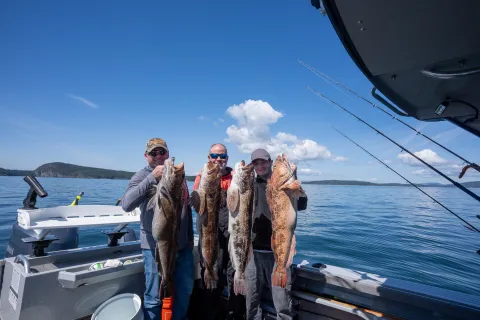
Halibut, lingcod, and rockfish are the top three species of bottom fish here in the Pacific Northwest.
There are three main methods for targeting bottom fish, and the cool thing is that the tactic you use is more dependent on the depth and environment you’re fishing in, rather than the species itself. All species can be found in virtually any depth in the ocean. In fact, many of the biggest lingcod I have ever caught have been in less than 50 feet of water. This means that if you know your water, you can choose a tactic that will give you the best chance at success.
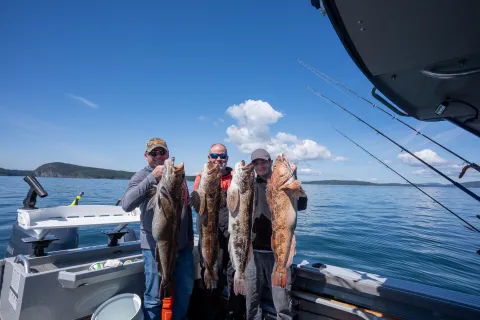
Tactic number one: Live bait rigs. Live bait is the most natural presentation to a fish. As the name implies, you need an actual prey item connected to your hook, and this often elicits the most aggressive feeding response. The flip side is that you have to spend considerable time catching bait. Additionally, it can be difficult to keep your bait alive throughout the day. I have found that live bait rigs work best when targeting ling cod on reefs that are under 150’ deep.
Ling cod will readily take live bait of nearly any size, and often do not even need to be hooked to bring them to the boat. To decide between large and small bait, know your area. If you are fishing a particularly busy reef with lots of rockfish, and you are not allowed to keep them, try to use larger baits such as greenling or other sculpin to keep bycatch to a minimum.
The best live bait rig I have ever seen, I learned from John Kerrigan of Seeking Limits Guide Service out of Everett, WA. John’s rig is devilishly simple. It consists of a sliding weight system where the plastic slide is connected to the weight with a rubber band, and it is stopped by a swivel to a leader (photo below). The rubber band keeps you from losing an entire rig if your weight gets stuck, and the swivel will keep the live bait tangle-free. Give it a try with surf perch on a single hook rig, or sand dabs and greenling on a double hook rig.
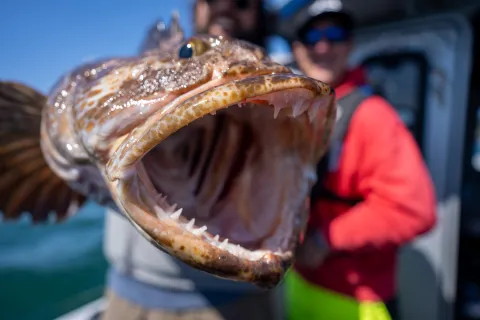
The second bottom fishing method is jigging with soft plastics. This method allows you to go right out to the fishing grounds. Oftentimes, the soft plastic jigs come pre-rigged, so all you have to do is tie them onto a 50-pound mono leader and drop it near the bottom. My absolute favorite for jigging soft plastic is a Fisherman’s Gold Electric Eel jig. (photo below). It has caught absolutely everything from giant 50-pound lingcod to limit after limit of rockfish. The only consideration is how heavy and how big you want your plastic. Obviously, using a 32 ounce 12 inch eel won’t be the right choice for rockfish, but if you’re shallow, there is little better than catching black rocks on a 1 or 2 ounce eel. Fishing soft plastics is the most versatile of the 3 methods. You can fish them light or heavy, large or small, shallow or deep. Soft plastics can struggle in areas of intense pressure and is most difficult in areas where there are lots of toothy bycatch, such as arrowtooth flounder or dogfish that can tear up your bait.
The last method is a combination of pipe jigs and unweighted soft plastics on a ganoin type rig. This method is great for deep drop fishing, particularly for halibut. The pipe jig not only allows enough weight for a rig in 500 feet of water, but it also can get chewed on for hours and not lose its efficacy. By running some unweighted plastics above the pipe jig, you can also take advantage of the extra color and action to bring fish to your rig. However, this method is really prone to snags, and can be expensive to lose if you are fishing the more shallow rocky reefs.
I typically pair this method with electric reels in deep water and on flatter bars in the open ocean. You can build a ganoin by using a 3-way swivel connecting the main braided line to one end, a 6 foot ganoin of heavy mono (80 pound or heavier) to one of the other sides, and lastly a short heavy mono leader connected to a large 12/0 J hook that you hook your eel or flounder plastic to.
Making a game plan for your specific environment is the best way to set yourself up for success. Always consider the time you have to fish, the depth at which you want to target, and the overall fishing pressure to help you decide between durable baits like pipe jigs or if a natural live bait is the right choice. Get out there and try it for yourself!
/articles/successful-bottom-fishing-strategy-pacific-northwest
Sockeye Summer in Washington
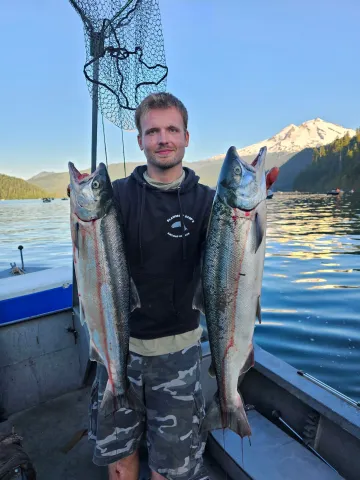
The temperature and the sunshine won't be the only things that're hot this summer. Every year in July and August, Sockeye fever hits Washington. I'm sure you've scrolled through social media this time of year and seen glory shots of the delicious red-meat salmon limited out on your feed. While some of us make it look easy, there is definitely a learning curve that leaves many anglers scratching their heads.
For those who don't know what a Sockeye is, I'll give a brief biology lesson. Sockeye are one of the 5 species of Pacific salmon we have here on the West Coast. They start their lives in cool, clear waters, often adjacent to a large lake. What makes Sockeye unique is that they use a nursery lake to rear for about 2 years before heading to the ocean.
These Sockeye make up the majority of their diet of shrimp, krill, and plankton, which give them that delicious sought-after meat. After 3 to 5 years (most Sockeye return at 4 years old), they return to the rivers where they were born. While there are a handful of naturally occurring Sockeye populations in Washington, the main ones that I will focus on are the Columbia River, Baker Lake, and Lake Wenatchee. Most of these fisheries target Sockeye trolling from a boat. However, bank anglers do have success plunking spinning glows and shrimp close to shore in certain areas of the Columbia and Skagit Rivers.
The Columbia River:
These fish start crossing over Bonneville Dam in Late May and early June, with the run peaking there around the 1st of July. Most of the fish are destined for the Okanogan River, Lake Wenatchee and Redfish Lake on the Snake River, with a handful going up Yakima and Deschutes rivers.
As they make their way upriver, they can be targeted at several different areas, including below Wanipum Dam, Wells Dam, and the ever-popular Brewster pool. The Brewster pool is where the fleet will fish for the majority of the season and for good reason. All the fish in this upper reach of the river are headed up the Okanogan River and into lakes in Canada.
The Thermal barrier:
Sockeye do not like to slow down for anything. The only times they really stop are when they make it to their home lake, have to cross a dam, or encounter some type of obstacle. In this case, it's what we call the thermal barrier. You see, when the Okanogan gets above 70 degrees, the sockeye will stay down in the cooler Columbia, making them sitting ducks until cooler waters prevail. Most years, the thermal barrier will set in by mid to late July, but varies depending on snowmelt and weather temperatures. The last couple of years, the thermal barrier was set right from the get-go, and this year looks no different. You can find the Okanogan River temperature on the USGS river flows site.
The Brewster 500:
You will not get solitude up in Brewster, but you will find great fishing. Most of the boats will fish right at the mouth of the Okanogan, but if you want fewer boats, you can fish down by the pump house. There is a nice shelf there, and the fish will sit all throughout there up to just above the Okanogan.
To target these fish, I like to run a size 0 dodger in either chrome, chrome/ silverscale, or moon jelly. Followed by a Mack's Lure smile blade, 3 red beads, and a coon shrimp. I will run anywhere between a 12 and 16-inch leader, with 14 being my sweet spot. I recommend either a 2 or 3 single hook setup tied with 2/0 hook or 1 single and a size 4 to 6 treble for a trailer.
These will generally be 10 to 25 feet deep and can be targeted with either lead balls or with downriggers. You'll want to troll slowly for these fish, often 1 mph or less going up river. Remember to speed up a bit going downstream. Levels and flows change throughout the day, so pay attention to the action of your gear. You want a side-to-side action on your dodger. If it starts to turn over and do a figure 8, then you are going too fast.
Here are a few things to note here fishing Brewster. It gets HOT! Temperatures are normally in the 90s and triple digits. Drink plenty of water and wear appropriate sun attire. When fishing the Brewster pool, keep your head on a swivel. It's literally combat fishing with boats. Know your limits. If you're not comfortable with the main pool, don't be afraid to fall back to less crowded areas. Be mindful when parking your boat on shore. The Columbia River is dam-controlled, and water levels fluctuate rapidly, sometimes within minutes. Every year, boats get left high and dry.
Baker Lake:
Ah, the Westside's beautiful Baker Lake. I remember the days of plunking for sockeye on the Baker River. Back then, a Sockeye fishery in Baker Lake was just a wishful thought. Finally, in 2010, after some hatchery and smolt collection improvements, the Baker Lake Sockeye fishery was born and has been an absolute hit ever since. This year, there are 60,000 sockeye forecast to the Baker River, and as of the time of writing this article, there have already been a bunch trucked up to the Whatcom County lake. The Sockeye here are big, bright, and fight hard!
As I talked about with Brewster, you'll be slow trolling with dodgers for these guys. Here is a rundown on the gear I use to consistently put Socks in the boat. I like to run either a size 0 or 00 dodger in Chrome, chrome/ silver scale, purple haze, 50/50, or moon jelly.
Sometimes, I will put a slight bend in the dodger for a little more thump. Hoochies work very well at Baker, with orange, purple, and pink being my go-to's. I run a Macks Lure Smile Blade above them and tip my hooks with pink coon shrimp soaked in Slammin Sams XXX. Sometimes I will also run just a smile blade and beads, as well as just bare red hooks.
I tie all my leaders with 8 to 10 inches of 20 to 30lb fluorocarbon. Any lighter and these crazy fish snap it like it's nothing. There are 2 main areas where people fish here. Down near the dam and up lake in the old Baker Lake bed. Don't be afraid to move around and hunt for these fish, as they will move around to get away from pressure. Troll .7 to 1.2 mph and watch your fishfinder for cruising sockeye. Typically the fish will hang anywhere from 20 to 60 feet down and are best targeted with downriggers or 6 to 12 oz of lead. There are 5 boat launches to choose from. Starting at the dam with Kulshan, Horseshoe Cove, Panama Point, Swift Creek, and Shannon Creek at the far end. In past years, Shannon Creek has been restricted to campers only. This is a fun fishery and should be good right from the get-go on July 12th when it opens.
Lake Wenatchee Sockeye:
Last but not least, my personal favorite fishery: Lake Wenatchee Sockeye! Watch the counts at Tumwater Dam. Once we've reached our escapement goal of 23,000 fish plus several thousand for harvest, WDFW will open the lake by emergency rule. This will usually be in either late July or early August. For gear, keep it stupid simple. 2 or 3 bare red hooks behind your dodger on a short leader, 8 to 10 inches. Shorter is always best at Lake Wenatchee. Check the regulations, as here it is no bait and single barbless hooks. The wardens are normally out in force. For depth, the fish here are much deeper. I usually catch them at 30 to 50 feet early on, and later in the season, I'll fish as deep as 115 feet down. Trust your electronics! Also, be mindful of the wind out here. It blows more often than not and gets extremely rough!
Good luck out there, and if you're feeling ambitious, I recommend hitting all 3 fisheries!
/articles/sockeye-summer-washington
Interview With A Well-Schooled Kokanee Part One
This may or may not have taken place on one of my favorite kokanee lakes… but the advice is good whether it really happened or was just in my head…
KOKANEE: Ok, I'll admit it. I'm moody. But that does not mean I'm impossible. But being moody is as much fun for me as it is for the fisherman.
DUDE: You know, that might not be the case for all kokanee fishermen. Some can spend all day chasing you with no results. That is not fun.
KOKANEE: I suppose it is all in your perspective.
DUDE: So tell me why some days you cannot resist one particular color, and then the very next day you shun it.
KOKANEE: Well, it is a little more complicated. I hope you get it. If your readers had really carefully read and understood Kokanee University, Part 1, then the answer would be easy. But alas, you can lead some fish to water, but you can't make them swim.
So here goes.
Humans live in their world, and I live in mine. Most everything is different in my world from the human world. If a kokanee fisherman wants to become a whole lot better, he had better stop thinking about the material world and start thinking about what life is like in my water world.
I wonder how humans would like it if their favorite views were seen in contrasts of shades of gray, and light and dark. It might change their perspective a bit. Or suppose humans could only see color a distance of about 21 inches, and then only right in front of their nose. Or, how would humans react if they could not focus their eyes? Limited color vision and no ability to focus. For humans, limited color vision and no ability to focus would likely change a few things in your material world.
DUDE: You sound, maybe a little bitter. Only a guess, of course.
KOKANEE: I can do things in my world that humans only dream they could do. That kinda makes up for any human deficiency in my water world. Balance is achieved. It helps comfort me that my brain is the size of a pea, while the human brain…
DUDE: Please don't go there.
KOKANEE: As I was saying, my color vision is quite limited. And although I can see in shades of gray and black, the clarity of the water becomes a major issue for me. If the water clarity is limited, then that governs how far I can see contrast. Sometimes, the lack of water clarity makes it almost impossible for me to even see color within that 21-inch window.
DUDE: And the effect of light at depth?
KOKANEE: For sure, things get darker at depth. Go deep enoug,h and there is no light. Water literally eats light. Water gobbles light. Depending on the time of year, as much as 40-50% of the light that hits the water is reflected back and away from the water. That means there is less light under the water. Always. No exception.
DUDE: You said that water eats light?
KOKANEE: So I did. You are paying attention. When you go down the water column, things get darker. But not darker red or darker orange. As you descend the water column, it gets a reducing combination of darker green, blue, and indigo and purple before it goes completely black.
DUDE: So what happened to red, orange, and yellow?
KOKANEE: Dude, the water ate it.
DUDE: When?
KOKANEE: Up front. First the red, then the orange, and then the yellow. Gone. And this happens very quickly in fresh water. Except for early season, most of the fishing for us kokanee takes place in water that contains only green, blue, indigo, and violet light.
DUDE: Ok. I know that visible light can be put through a prism, and it then breaks down into the colors of the rainbow. In fact, as I recall, the colors of the rainbow are always displayed in the same sequence. Freaky?
KOKANEE: This is where you could benefit from having a pea-sized brain. When I am talking about color, I am really talking about wavelengths. Most colors that are visible are a blend of other visible colors.
DUDE: Let me stop you right there. You used the term "visible." Are there colors that are invisible?
KOKANEE: No. And I guess I have to make an admission that you humans and we fish actually have something in common. We are both vertebrates, and we have vertebrate eyes. Within our eyes are structures that connect our eyes to our brain. We both have corneas, and attached to these corneas are both rods and cones. Although we have them in different proportions, these rods and cones operate the same way. Simply stated, rods help us differentiate between light and dark, while cones take care of visible color detection.
Color is only a visible concept. If you put all of the visible colors together, you get white. White light is what daylight is all about. Run that white light through a prism, and you get a display of the rainbow.
When you look at that rainbow, the colors are always displayed the same way. That is because visible colors have specific wavelengths. Wavelengths are measured by frequency. Frequency can be thought of as a way to measure how long or how short the wavelength is. In the visible spectrum, red has the longest wavelength, whereas violet has the shortest. All of the other visible colors are in between.
DUDE: OK. But how does water eat light?
KOKANEE: It eats light by wavelength frequency. As you descend the water column, the longest wavelengths are eaten first. That would be the visible color red. Go a bit deeper, and you also lose the visible color orange. Go deeper, and you also lose the visible color yellow. The very last visible color to get eaten is violet. After that, the water is black.
DUDE: I guess that black is the absence of light.
KOKANEE: Technically, black is the absence of visible light. There are other wavelengths out there that you might understand and feel the effects of, but their wavelengths are outside of the visible color spectrum.
DUDE: I hear so much about UV light. All of the manufacturers want me to buy their stuff because it is "UV."
KOKANEE: Here is where I get to "see" how much you have been paying attention. "UV" is short for ultraviolet. It is called ultraviolet because it is in that part of the spectrum that is beyond violet. It has shorter wavelengths than violet.
DUDE: But if UV light has a shorter wavelength than violet, then that means that it is not part of the visible spectrum.
KOKANEE: Exactly.
DUDE: So what about the claims that fish can see UV light?
KOKANEE: That claim is nonsense. Go back to our discussion of the vertebrate eye. We have rods and cones. There are no rods or cones that can detect UV light. There is a study that attributes UV detection to the Japanese Dace and some goldfish. It has never been shown that salmonids can detect UV light.
DUDE: But the fishing tackle makers would never lie to us, would they?
KOKANEE: Decide that for yourself. I can tell you this: their terminology is incorrect, and the reasons they give for their product's effectiveness are incorrect. However, the products are effective.
DUDE: Now you are really confusing me.
KOKANEE: I specialize in confusing fishermen.
DUDE: Well then, what is the correct terminology for "UV?"
KOKANEE: The correct terminology is the term "fluorescent."
DUDE: Then why don't the tackle makers call it "fluorescent?"
KOKANEE: I suppose because it is a lot harder to spell than "UV." And "UV" is a lot easier to text.
DUDE: Is that black light charging the material, you know, to make it glow?
KOKANEE: No. Glow is phosphorescence. It gives off light energy (glow) regardless of whether there is light present, provided that it has been "charged. Fluorescent materials do not need to be charged. All that is required is for some available light to act on it. Fluorescent materials retain their color all the way down the water column. There is no color fade.
DUDE: Color fade?
KOKANEE: Ordinary colors can fade as you go down the water column. Ordinary red will turn black in just a few feet of water. But a fluorescent red will remain red all the way down the water column, provided there is some light to act on it. Even if there is only one percent light way down deep.
Fluorescent red will remain red in the absence of the red wavelength in the water column. And you will recall that red is the first wavelength to be eaten by the water as you descend the water column. Because I have cones in my eyes, I can see a fluorescent red at 50 feet - if there is some light - even just blue/purple light at that depth.
DUDE: So no fading. Does this work the same for all fluorescent colors?
KOKANEE: Yes. In fact, some fluorescent colors are so effective, they get brighter in the water as you go down the water column. In any event, no fade.
DUDE: You said that the stuff marketed as "UV" is mislabeled.
KOKANEE: All of the stuff marketed as "UV" is really fluorescent. So all of the stuff you bought as UV is still good stuff, but call it UV as much as you like, it is not a dragonfly - it is fluorescent. Remember, since that stuff is in fact fluorescent, there is no color fade as you descend the water column and likely gets brighter as well.
DUDE: Would using UV/fluorescent materials increase the visibility of my presentation?
KOKANEE: That is exactly what it does.
DUDE: But you earlier told me that you can only see color about 21 inches in front of your snoot.
KOKANEE: True. But you forgot that I can see contrast in shades of dark, light, and grey at a farther distance. Fluorescent material can still be detected outside that 21 inches because they do provide good contrast.
DUDE: Fluorescent colors retain their color all the way down the water column, independent of your ability to detect them at distance, correct?
KOKANEE: Correct. Color is not the way I get attracted to your lure. What makes me want to investigate is not color, but vibration.
DUDE: Vibration?
KOKANEE: Yep. I'm thinking about good vibrations.
DUDE: Is there a difference between the way sound acts in water than it does in the air?
KOKANEE: Yes, and very much yes. For one thing, sound travels in air at about 1,000 feet per second. You humans see a flash of lightning, then count off one/one-thousand, two/one-thousand, three/one-thousand to determine how far away that lightning struck.
But sound travels way faster in water than in air. Sound travels in water at 5,000 feet per second. And I'm not just talking about sounds that you humans can hear. I'm talking about sounds that are beyond human ability to detect. I assure you that I can detect sounds that you cannot. Just because you cannot hear such a sound does not mean that such sounds do not exist.
DUDE: My head is starting to reel.
KOKANEE: It is fine with me if you would like to take a break. A few minutes to stretch, perhaps?
DUDE: Yes, that would be fine. Catch you then.
KOKANEE: Not likely.
To be continued....
/articles/interview-well-schooled-kokanee-part-one
Destination Ochoco Reservoir
It was a windier day than we had hoped for, but the waves were not white-topped, and we had a 40-horse Merc and a trolling motor to fight the wind with. It was my first trip to Ochoco for the season, but my dad had been fishing it since March and knew right where we wanted to start. It didn't hurt that the wind was blowing us that way, too.
We started at the top of the lake where the creeks come in, around the flooded willows.
For my main rod, I had selected a rust-colored, sparsely tied mohair leech and was using a floating line with a 4X tippet.
My young dog Pepper was with me for her first time fishing. She thought she was expected to work and was watching tweety birds while we unlimbered the fly rods. I tried to keep her from tangling in the expensive tackle. Once she got so excited, she jumped into the lake. After she realized this was just supposed to be a pleasure trip for her, she settled down and was just irritated for the rest of the day.
A big trout took my fly on the first pass but was able to throw the hook after a brief battle. Dad was also using a rust-colored fly, and our friend Keith Gran, fly-fishing for the first time in his misspent life, was using a fly called the Autumn Splendor, which might have reminded Keith of someone he used to know because he kept whispering to it, saying her name.
Whatever he was whispering to the Autumn Splendor was working because soon he hooked and landed a trout. And then caught another.
For my part, I began catching bass. And dad, running the trolling motor and a 4-weight rod, began catching bass too, and a crappie.
OCHOCO AT FULL POOL
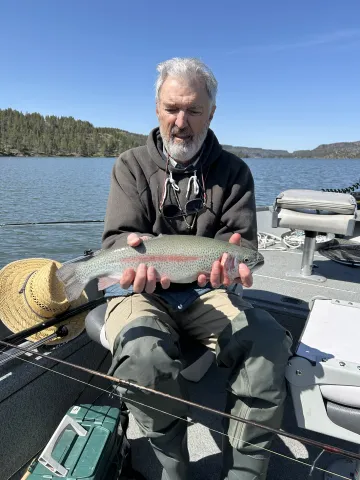
After three winters of better-than-average snowpack, a lot of central Oregon waters that were very low, even dry in some cases, are back and better than ever. Ochoco Reservoir has always been a bit of a local's secret. It is only six miles outside of Prineville, and when conditions are good, the trout grow fat, putting on an inch a month. Better yet, this reservoir has good wintering conditions, meaning that holdover trout are common, going 16 to 17 inches in late spring and early summer.
With water in it, Ochoco Reservoir is three miles long. Because it is an irrigation reservoir, water levels can change over the year. Surface acreage at low pool can go as low as 120 acres, but filled to full pool by early spring this year, the reservoir is full at approximately 1,100 acres.
At full pool, Ochoco averages 30 feet in depth with a maximum of 100 feet near the dam. A few lava outcroppings fortify the banks but because of up-and-down water levels, shorelines are composed of exposed silty bottom and muddy flats. Mill Creek and Ochoco Creek form channels in the reservoir. In the spring and summer, afternoon winds can be substantial.
When targeting rainbows with a fly rod, try trolling from a float tube, canoe, or a pontoon boat. Fish along the riprap near the dam or on the east end of the lake near the inlets. Use an intermediate sinking line and troll leech patterns like the Woolly Bugger, Lake Bugger and Mohair Leech or a soft hackle wet fly like the Carey Special.
Crappie are often in large schools and may hold at specific depths around sunken structures. The challenge lies in locating them and plumbing the precise depth where the school is holding.
Because of the abundance of water, the trout fishing is going to continue excellently through July. But this is a great time of year to target smallmouth. And there are some surprisingly heavy bass in the lake. If fly-fishing is the game, use "bass nymphs" which are generally on No. 4 hooks tied like Woolly Buggers but with a heavy bead and black or yellow or orange rubber legs. These can be presented on floating lines under indicators or cast tight against the rocks or other structures. Bass will often take the fly on the drop. And you might be surprised by a big rainbow.
When fishing with spinning gear, use spinner baits and crankbaits, or curly-tail grubs.
Ochoco Reservoir has been overlooked for the last ten years because it has been hard to fish. But those days are behind us. This Central Oregon fishery is running full pool, and the trout and bass fishing is full tilt.
/articles/destination-ochoco-reservoir