Late Season on Alaska’s Kenai Peninsula
By Chad Bryson
Alaska’s Kenai Peninsula and its spectacular sport fishing opportunities are a far cry from being a worldly secret. Every summer, thousands of visitors travel to the Great Land in the pursuit of filling fish boxes with some of the cleanest and tastiest sockeye, king, and silver salmon on the planet. \
This occurrence has been happening for decades. In most fishing circles, going to the Kenai during the summer migratory runs of salmon would even almost be considered “old hat.” In fact, I myself even turned a cold shoulder to it.
As a veteran Bristol Bay guide, I couldn't imagine any good reason at all to punish myself, or anyone else for that matter, by enduring the crowds of summer on the Kenai Peninsula. It just didn't seem worth it.
Sure, the fishing was incredible, but it was at the price of standing in line either by boat or by foot next to hundreds of my “brothers in arms”, none of which I knew well enough to be comfortable in those proximities.
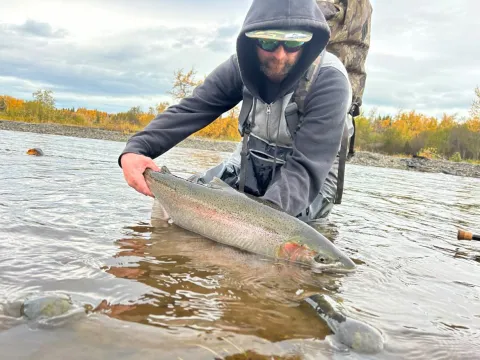
That was until at the suggestion of a friend to give the late fall steelhead fishing a try. In an effort to make my re-entry to society easier, I gave it a shot. I figured the worst thing that could happen is that I wouldn't have fun and I would hate the crowds. After the first day, I knew the worst wasn't going to happen, and that I had found a new place/time to fish steelhead.
That first trip was in early October. I fished the Anchor and Kasilof rivers. There were plenty of steelhead willing to eat dead drifted beads as well as swung flies. The weather was equally as pleasant as the number of anglers was few. It was almost too good to be true.
How could it be that this Shangri-La of Alaska steelheading could still exist? Furthermore, how long into fall would the fishing sustain? AKA- How long could I stay and do this every single day until the rivers froze or I spent every dollar I had earned over the summer? Whichever came first, I was hell-bent to find out.
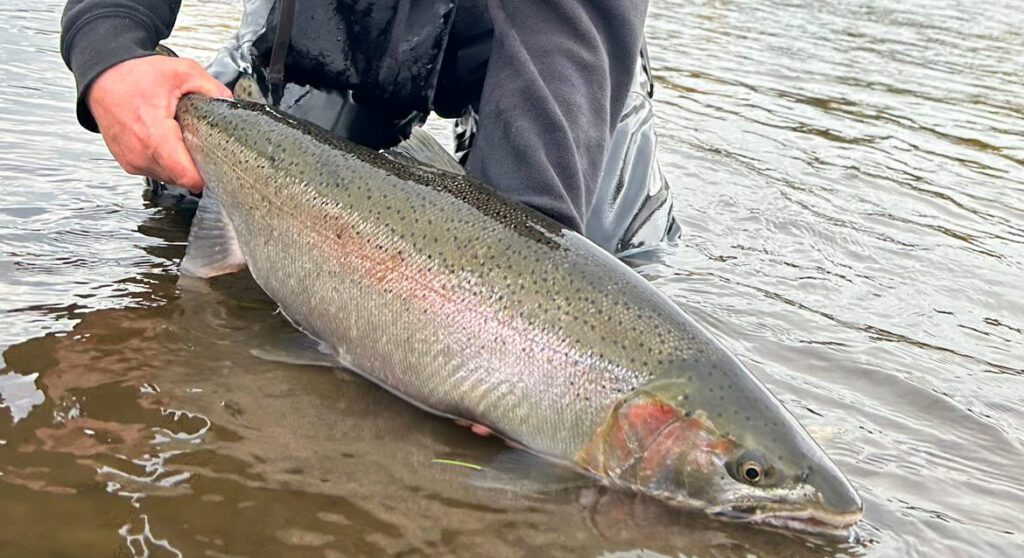
That year, I think I stayed until the third week of October. It was all I could afford both financially and personally. Kids, dogs, and girlfriends have this thing about me being away from home for extended periods of time. Especially the dogs. I was kicking and screaming the whole way to the airport. Fishing at that time was nothing short of remarkable and I didn't want to leave.
Some of the locals I met during my abode on the peninsula encouraged me to not even come back the following year until November 1, as long as the temps held out. At first, I wasn't sure if this was a carefully plotted ruse just so I wouldn't be there to “fish their water” or if it was a genuine act of rare angling kindness. After all, anglers are known for their sometimes harmlessly nefarious actions to keep the local water local.
That wasn't the case here. This was a genuine act of kindness and sharing amongst steelheaders in pursuit of one common goal. I shouldn't have been surprised. After all, that is the Alaska way.
In the years that followed, I fished the Kenai Peninsula later and later. As long as the weather and temps held out, the steelhead were there but, without the crowds of anglers. November/December in Alaska can be very, very cold, with potential of more cold brutality at any given moment. This keeps most fair-weather steelheaders away.
Fellow Bristol Bay guide and lifelong Kenai guide Matt Duncan fishes easily into November and some years well into December, with an occasional January boat launch. Growing up in Anchorage gives him, and other local resident guides, the hands down advantage when it comes to Kenai conditions.
Mike Brown at Mossy’s Fly Shop in Anchorage is also a great source of information regarding Kenai fisheries.

When I’m planning a late-season Kenai Steelhead trip, either for myself or others, I try to take into consideration that on a five-day trip, at least one of those days is going to be a cribbage day. Maybe even two days. Weather can blow in and blow out just that fast.
As long as you know the potential is there, it won't be that big a deal. There are numerous Airbnb, VRBO, and local cabin rentals on the lower Kenai Peninsula that will accommodate a world championship cribbage tournament should the need arise. While you are fishing, plan accordingly on how you dress. I wear boot foot waders and full synthetic layers no matter if I am in a boat or walking in to wade fish.
And don’t even think about wearing anything but a quality rain jacket. A friend joined me on a November Kenai steelhead adventure that only brought a “brand x” windbreaker that was water resistant. After about 90 minutes our fishing day morphed into an excursion into Homer for the purchase of a brand new Grundens product. Don't be that guy. Ever.
In regards to fishing tackle, you will see a myriad of techniques being used on the Kenai Peninsula. Everything from conventional float rods and beads to spey rods and swung flies tied with the rarest of materials. All of it works and has its own place in the system.
I have stood next to center pin anglers, float anglers and single hand fly anglers in a parking lot while I rig my spey rod for the day. Nobody cares what you fish with and nobody cares where you are from. Its Alaska, most people are from somewhere else anyway. Everyone just wants to fish. I find it refreshing.
If you are up for a unique steelhead experience at a time of year when most everyone has forgotten the Great Land exists, check flights to Anchorage. Winter flights are sometimes ridiculously cheap, especially from the PNW.
The local guides are still working every last day they can before the unforgiving arctic freeze sets in. You could be on the verge of discovering your new Thanksgiving family fishing vacation.......
/articles/late-season-alaskas-kenai-peninsula
Top Chum Tactics
When it comes to salmon fishing, there are often two thoughts on the subject. The first is table fare, always trying to catch the freshest salmon that will eat the best, regardless of the recipe. Of course, sockeye are at the top of this list, along with bright coho, and ocean-caught chinook.
Last on that list is probably chum, with the exception of river run pinks, but since chums are an every-year fish, unlike the smaller but also low river system spawner the pink, the chum salmon is not always considered good eating quality. Even those in the commercial market change the name of the ocean-caught chum to entice the chef and are called by their scientific nomenclature, the Keta salmon.
There is no disguising a chum once it hits the barbecue. Even the ocean fish, which is very edible but lacking oils, tastes bland. The second list for the salmon angler, and one that is just important, is catchability, or how easy it is to catch the fish, along with their fight. This is where the chum shines, and it is at the top of my list of salmon I like to catch and release in the fall.

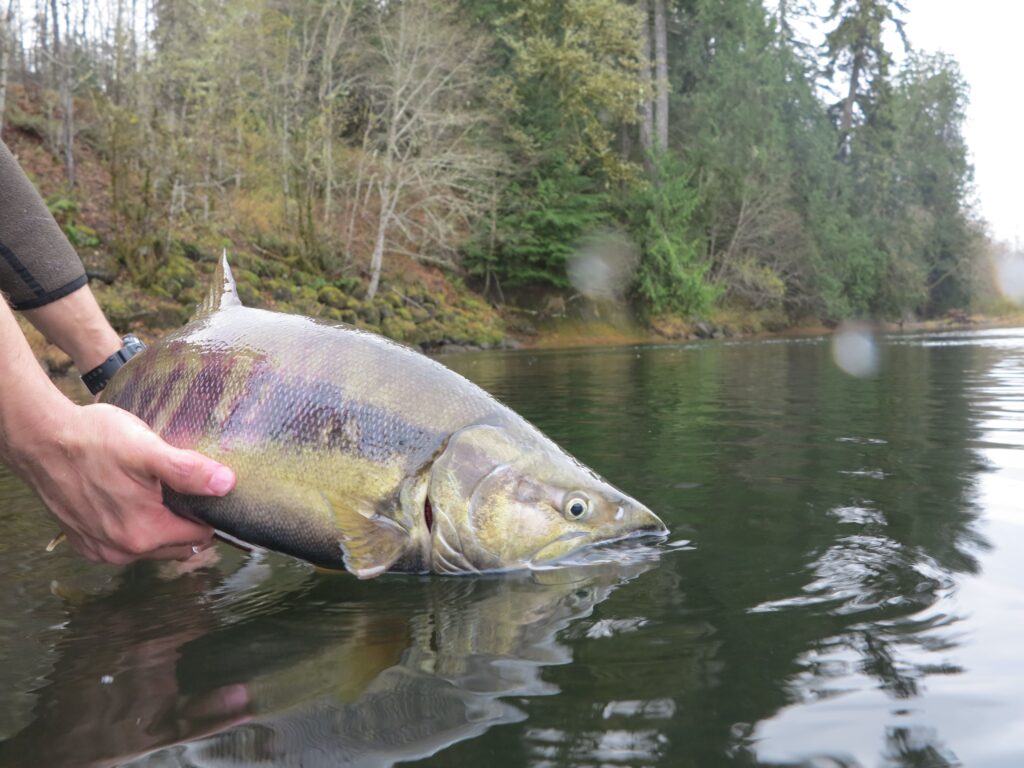
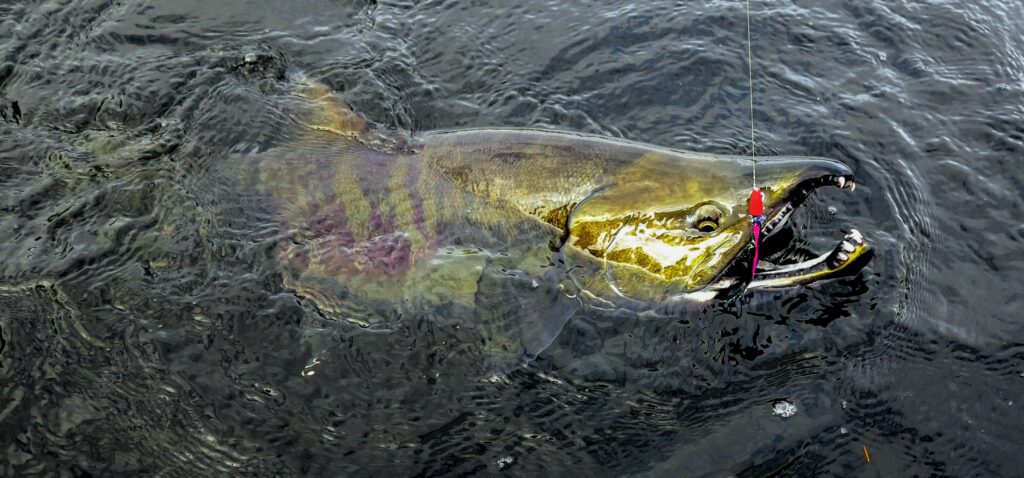
I don’t think there is a fish on the planet that is as aggressive as the chum salmon- well, okay, maybe a barracuda or northern pike, but for the Pacific salmon species, chums are at the top of the “get in my way and I will kill you” list.
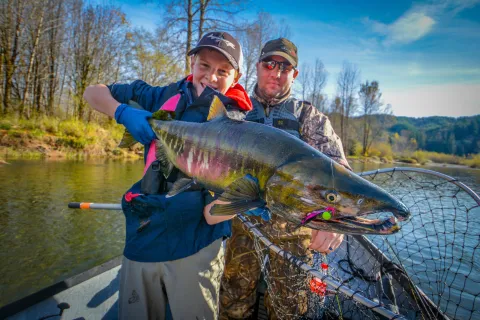
This makes for a fun day of catching chums, and the fact that they are the second largest salmon species means a hard-fought battle once you hook into these “dog” salmon. This means using stout gear, so before we start talking tactics, let’s take a look at what rods, reels, and line you should use.
Chum fishing in the rivers often means catch and release, so it is best to use gear that can handle these fish as well as get them back to the river quickly. You don’t want to stress the fish so much that it dies after the fight, as that would defeat the purpose of allowing the fish to go back into the river to make more fish.
Starting with the rod, think like a chinook angler and use a stout, medium-heavy to heavy action rod, often rated for 20 to 30-pound fish, or up to 5-ounce lures. If using a casting reel then you will be well equipped, as those reels have heavy drag systems, but for anglers who can’t cast them without creating backlash, then a 4000 series or larger spinning reel is best.
You can get away with a smaller reel like a 300 or 3000 series (depending on the manufacturer, as each uses a different numbering system) but be sure to be ready to crank down the drag a bit. Mainline isn’t much of an issue now that braid has become standard practice, but even still you will want to run a minimum of 30-pound line, with 40 and even 50 being preferred.
Depending on which technique you use, if a monofilament line is involved it is best to use 20-pound for leaders, as a minimum due to the teeth these dog salmon have once they start to enter the spawning phase of their lifecycle.
Now that you have an idea of what kind of gear is needed, the technique or tactics used to catch these fish vary by type of water you will be fishing and even the crowds around you, as you don’t want to be that one angler who decides to swing spoons when others around are float fishing.
Regardless of which technique you do use, be sure to use one that will not only hook the fish legally (in the mouth) but also allow you to reel it in quickly, snap a photo, and then send the fish on its way.
Floating Jigs
Floating jigs tipped with a piece of prawn is one of the best techniques to catch chums. Not only is this an easy way to fish, but watching a float sink into the river while you set the hook is an adrenaline rush. What can seem like a mundane way to fish quickly turns into a frenzy of excitement.
Best of all, it is simple, works anywhere fish are found, and not just chums, but coho and early winter steelhead or late summer steelhead are also caught in this technique. Several years ago, while fishing the Green River near Seattle, we were drifting down the river in my drift boat and floating bright-colored jigs tipped with a piece of raw prawn.
The float went under, and to our surprise, a late summer steelhead jumped out of the water. A bonus fish that was also released to swim and spawn another day.
When it comes to floating jigs, it is best to downsize them to a ¼ ounce as they fish a bit better under the bobber than heavier jigs. But if you do want to keep things simple, the 3/8-ounce twitching jig does work under a float.
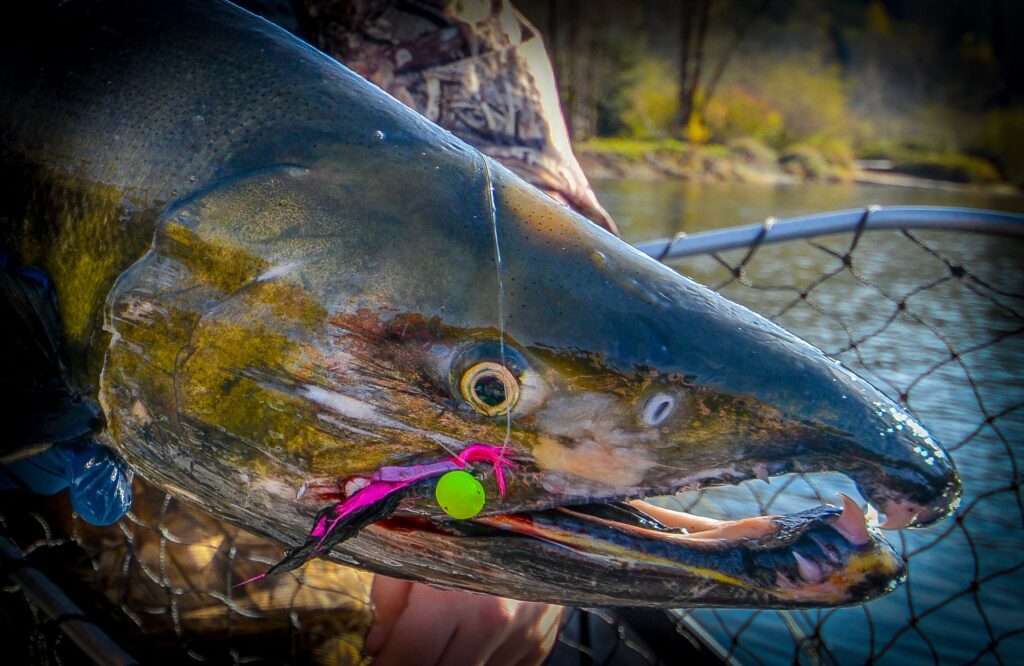
Regardless of twitching or float fishing, the jigs chums prefer bright colors. A white head with a cerise body is a good “go-to”, but so is chartreuse and black, as well as cerise and black, as the contrasting of bright and dark seems to entice the bite. Purple and pink are other top colors.
As for that piece of prawn on the jig- if you don’t have prawns, or just forgot to grab some from the grocery store, jigs take on scent really well. If using a marabou jig, then realize that the gels will ruin the action of the jig.
Instead, use Pro-Cures water-soluble products, with bloody tuna and sand shrimp being very popular for chum anglers. It is hard to beat prawns, and they are cheap bait to buy. A handful of prawns cost a few dollars at the seafood counter at the local grocery store.
You can fish them raw but another way to add contrast is to dye them with Bad Azz bait dye in purple, cerise, pink, or chartreuse. Keep in mind this dye will stain everything, so it is best to use a small amount and use disposable containers.
Twitching Jigs
Twitching jigs is another technique that will catch a lot of chums, as well as a coho or two that are still lingering in the river system. Here again, there are two schools of thought, the first being twitching to holding fish in deep holes and structure.
There is one spot on the Satsop river in Southwest Washington that is consistent each year. My son and I try to venture to this river every November when the coho are still in the system and the chums are just arriving. This one spot is a deep water slough that sits just off of a bend in the river with strong current. Fish, both chums and coho, stack up here, and we break out the twitching rods.
On one trip, we invited a friend who had just moved from Texas and had never caught a salmon before. Chums are a great fish for these types of trips. My son Ryan cast a twitching jig into this backwater and showed our friend Chris how to twitch. Then Chris cast the line, and on the second twitch of his first ever cast for salmon, he hooked a huge buck.
As the fish dove deep back into the hole, he looked at us and yelled, “this ain’t trout fishing!”. We hooked and landed several more fish that day, all on jigs, either floated or twitched.
Spinners
Spinners need to be ranked as one of the top techniques for chums, as they catch a lot of fish. It is hard to describe to an angler who has never used spinners before what it is like to hook a chum on one.
Casting out into a run and letting the spinner flutter and work its way across as you reel in, feeling the telltale “thump-thump” of the blade working, then, all of a sudden, the rod almost gets ripped out of your hands as a chums grabs the spinner and takes off.
Again, use bright colors, such as a size 5 Blue Fox Vibrax with a chartreuse body and silver blade. Hot orange and pink also work really well.
Spoons
Like spinners, the spoon bite can be a lot of fun. In Alaska, I don’t think you will find an angler’s tacklebox without a few pixie spoons in it. Gold body with a pink or red center work well.
Of course, Dardevle is synonymous with spoons, and the trusty red and white striped Dardevle works well, but so do bright greens, pinks, and reds. Spoon fishing is much like spinner fishing, except you do want some current with the spoons, where spinners can be cast out into deep holes and reeled in.
Swinging spoons is just that- cast out and take up the slack, and then let the spoon swing across the river to holding or moving fish.
P-Lugs
Lastly, big, gnarly chums like big, gnarly p lugs. A MagLip 5.0, or a K15-Kwikfish in bright colors either being back bounced or just simply plunked will catch chums. You can elect to wrap the plugs or just use some Pro-Cure Super Gel in herring, anchovy, or garlic, as it will stick to the plugs very well.
Back bouncing them down a deep hole is a log of fun and a great way to catch fish. If there is enough current, then pulling them in a traditional way also works well. It is a great technique for the newer angler if the person on the helm or oars knows how to pull plugs.
Simply put them out, place the rod into the holder, and then put your hands in your pockets. Wait until the rod loads up with a fish, and then put that drag on the reel to work.
Regardless of which technique you use, just remember that these fish need to go upriver to make more fish. Try to get the fish in quickly and then release it after you let it rest and rejuvenate. Some will argue with me that chums are good to eat, and to that I will remind readers; “to each their own”.
For me personally, I would rather stock my freezer with coho for the barbecue and catch chums for the fun. They are big, aggressive, and put up a heck of a fight, and that is all I need to put them at the top of the list as one of the most fun salmon to catch.
/articles/top-chum-tactics
Washington Winter Kokanee Observations
As we say goodbye to our summer boating weather you may find yourself wondering, “Do I winterize or do I find something to fish for?” Either way, you should probably winterize your boat, motor, and trailer, but let’s talk trolling for winter kokanee.
Winter kokanee in Washington State? Sure, so go ahead and winterize, but keep the keys handy. Find your gloves and earmuffs and make a thermos of steaming hot coffee because there are kokanee opportunities to be had. Both Western Washington and the Eastside have winter kokanee lakes.
Kokanee are the non-anadromous form of sockeye salmon. Basically, by choice or otherwise, kokanee are landlocked sockeye salmon. Kokanee are native to many Pacific Northwest lakes and have been introduced to a number of lakes across the United States.
The life cycle is of particular interest to winter kokanee anglers. Although there are exceptions, kokanee typically live 3-4 years before they spawn and die. For the dedicated winter kokanee angler that means that there are 2-3, maybe even 4-year kokanee available during the chilly months.
Winter kokanee fishing is a little different than our spring and summer fisheries. Most winter kokanee fishing is done in deeper water. Kokanee prefer water that is 50-56 degrees. In part, they are more active in this zone because it is rich in oxygen boosting energy to chase down their next meal. Each lake varies, but finding “the zone’” is important during winter kokanee fishing.
One way is to keep your eyes glued to your fish finder and look for fish. This is where the best fish finder/chart plotter you can afford is your friend. When you find fish, mark the spot, and pretty soon you’ll have a winter kokanee map.
With it you can amaze your guest fishermen and go right to where they are. They’ll think you are the “Koke-Wisperer”, maybe a kokanee-shaman or something… You can also use a Fish Hawk Digital Gauge or the Vexilar Deptherm to graph out the water temperature at depth.

Winter kokanee fishing is more of a love thing, there is rarely a hot bite. Each lake has a winter fishery sweet spot depth. Generally, in Western Washington it is 30-60’, and in Eastern Washington 40-200’ deep. Each lake, especially on the westside, seems to have a brief period each day where the kokanee will put on the feed bag and go on the bite outside of your usual grind it out depth.
Kokanee are filter feeders, and the bulk of their calories come from plankton blooms. There are windows any given day where there is a bloom or hatch, and the kokanee will briefly leave their comfort zone to feed. Because the bite may be 2:06-2:23 at 43’ it is best to choose your winter kokanee lake close to home and learn it. Especially when winter kokanee fishing, keep a detailed fishing log.
Both summer and winter fish are a noble opponent. They often make short runs, jump, and go bonkers at the net. Summer fish are more aggressive, but winter kokanee take more finesse to get them in the net. After plating, smoking, or chowder-izing hundreds of kokanee, both the summer and the winter fish are excellent table fare, but the winter fish are outstanding for whole or fillet pan-frys and grilling.
The following list includes winter kokanee lakes that I am familiar with, and is focused on trolling. I am sure there are other winter kokanee lakes available. My westside lakes were originally selected because they are open all year and they have deeper basins that may hold fish. Both the westside and the eastside winter kokanee lakes are listed by my preference. My preference is based on success, proximity to home, and the potential for a trophy fish.
Eastern Washington
Lake Roosevelt – Nothing in Eastern Washington is close to home, and to be honest, as I get older, I don’t like hauling the boat over the pass in the winter anymore. That said, I love fishing Lake Roosevelt, so with the right forecast we may head that direction.
I’m sure kokanee are available throughout the lake, but we usually fish out of Spring Canyon and focus on the dam area, but we also fish the lower 5 or 6 miles. I typically start at about 40’, but may fish 100+ deep as required. Because there is the potential to hook a 3+ pounder, I typically up my leader to 20-pound fluorocarbon.
Lake Chelan – It is a great winter kokanee lake, offering pretty consistent fishing. The winter kokanee fishery is concentrated between Manson, maybe the Narrows, up to 25 Mile Creek. There is enough kokanee in the Wapato Point area to keep you on the water if, or should I say when, the weather kicks up. The winter fishery at Chelan is a deep fishery, you can expect to run your gear 80-200’ deep. Watch the weather!
Before I get to the westside lakes, let’s discuss winter boating safety/etiquette. Carry chains for both your tow vehicle and for at least 1 axle on the trailer. Bring a couple sand bags and a shovel. A liberal application of sand can be a lifesaver.
At the ramp, assess the situation before you back down a long icy ramp. Take the time to chain up your tow vehicle if required. Thought being; although once your tires hit the water you’ll have traction, the area between the top of the ramp and the water could be icy. You don’t want to jackknife ½ way down the ramp. It would put a damper on your kokanee plans.
Once the trailer is wet you may have to let the rig sit in the water for a bit to thaw and let the boat float free. Be safe on the boat, you don’t want to slip and end up sharing the lake with your aquatic rival.
Finally, and as a courtesy; at the end of your time on the lake load your boat and slowly pull out of the water just enough to clear the water. Stop and let the rig drain or drip-dry, this will minimize ice buildup on the lower 1/3 of the ramp.
Western Washington
Lake Washington – Although not exactly close to home, Lake Washington is my favorite westside winter kokanee lake. Our largest westside kokanee was a 3.13# 18” fish. We have caught many 1# plus and a few 2# kokanee in Lake Washington. To protect juvenile and migrating sockeye salmon there is an 8 – 18” slot limit for kokanee on in Lake Washington. A standard sockeye drill works, but consider stepping up your speed and gear selection. Most of our larger Lake Washington kokanee were taken on hoochies and 8” flashers. The eyes have it; what am I talking about? Who knows why but most of our large Lake Washington kokanee were bamboozled by a lure with eyes. If Lake Washington were closer to home, I’d be fishing it every day that I possibly could.
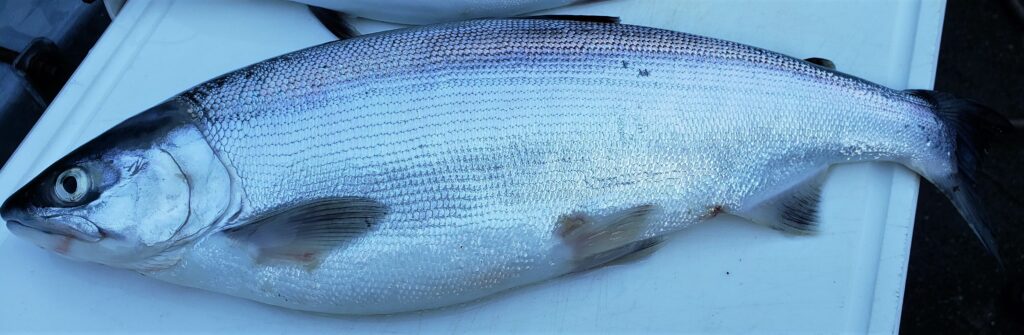
The large Lake Washington kokanee that left a mark on my fish finder.
Lake Cavanaugh – Lake Cavanaugh is an odd duck, easy kokanee limits for fish 10 – 18” kokanee during the spring, summer and fall, but when winter comes around it seems that every kokanee you catch is a chrome 8 – 12” fish. My nonscientific guess is that the majority of the kokanee in Cavanaugh spawn at 4 years and the winter sport catch are primarily 3-year kokanee. Most winter kokanee in Lake Cavanaugh will be caught over the deep pocket just east of the islands.
Lake Samish - Samish is really close to home with the typical winter kokanee bite being later in the day. It is a great lake for “breakfast and chores are done, let’s go fishing”. The lake includes a large basin with a smaller connected lake at the north end. When fishing winter kokanee on Lake Samish, most of our fish are caught in one of two areas. The first is along the west shoreline just west of the WDFW launch.
The second is generally in the center, maybe favoring the north shore/center of the small lake. Your trolling speed is critical, plan on fishing .8-1.0 mph with lots of “S” turns. Oddly, we have caught a fair number of Samish winter kokanee pulling small minnow type baits for cutthroat, but standard kokanee gear is a better starting point.
Lake Stevens – We don’t fish winter kokanee on Lake Stevens often, but it does host a winter fishery. There may be local secrets, but in our experience Lake Stevens winter kokanee are a hit or a miss. Most of our winter kokanee were caught along the bay at the northwest side of the lake. Typical kokanee gear with a pinch of nightcrawler or worm seems to have an edge over tuna corn.
Yale Lake – Yale is a great kokanee lake and is open year-round. There are winter challenges if you decide to make the trip. The wind can produce some crazy short chop, so make sure that you check the forecast before you hitch up the trailer.
We haven’t had a problem but I’m pretty sure that the reservoir water levels are down November-February. The Yale Park launch should be open but other ramps may have restrictions.
Finally, there could be hazardous floating debris/flotsam. Boat with caution, and if it’s choppy, slow way down. The winter kokanee fishery should be concentrated by the dam or across the lake from Speelya Creek. In my experience, if fishing less than 30-40’, run really long setbacks or use lead line rigs.
OK, you have some idea which way you’re headed in your kokanee quest, now what? I don’t really change overall tactics when fishing winter kokanee. The usual kokanee drill; a small dodger, lure with tuna corn is a great place to start.
Make sure you have your favorite scents, maybe a container of worms, and additional leader onboard. Not always, but occasionally, you will need to increase your leader length.
When trolling for winter kokanee, you will want to stay under 1.0 MPH. I probably do more “S” turns or engage the “Hunt” mode on my iTroll more often during our winter kokanee adventures. Our dodger box has more dodgers in it than most, but during the winter kokanee fishery my go to dodgers are painted, copper, or even dark metalflake.
Using either double spinner rigs or flies behind the dodger seem to consistently produce kokanee during the winter fishery. After you hook your cold weather prize, gently fight the fish, and, as with any kokanee fishery, a long handle net will increase your actual catch verses hook up statistics.

I know that it will be cooler out, maybe even freezing, and the lake temperature should be down as well. But make sure you still care for your catch. Bleed them and keep them on ice, or, even better, in a slurry in your cooler; you’ll want to preserve the quality of your hard-earned prize.
Winterize or not, keep your kokanee gear handy. The above is just a starting point. Choose a lake, learn it, and you’ll soon be the local expert! Trolling for Washington State winter kokanee can be frustrating.
With the closure of most of our winter salmon fisheries, a bit of frustration will quickly become an addiction. Enjoy your winter kokanee adventure, but with the potential for rainy, slick roads, be sure to use extra caution towing your boat to and from your new favorite winter activity.
/articles/washington-winter-kokanee-observations
Winter Fishing – Stocked Trout Extravaganza
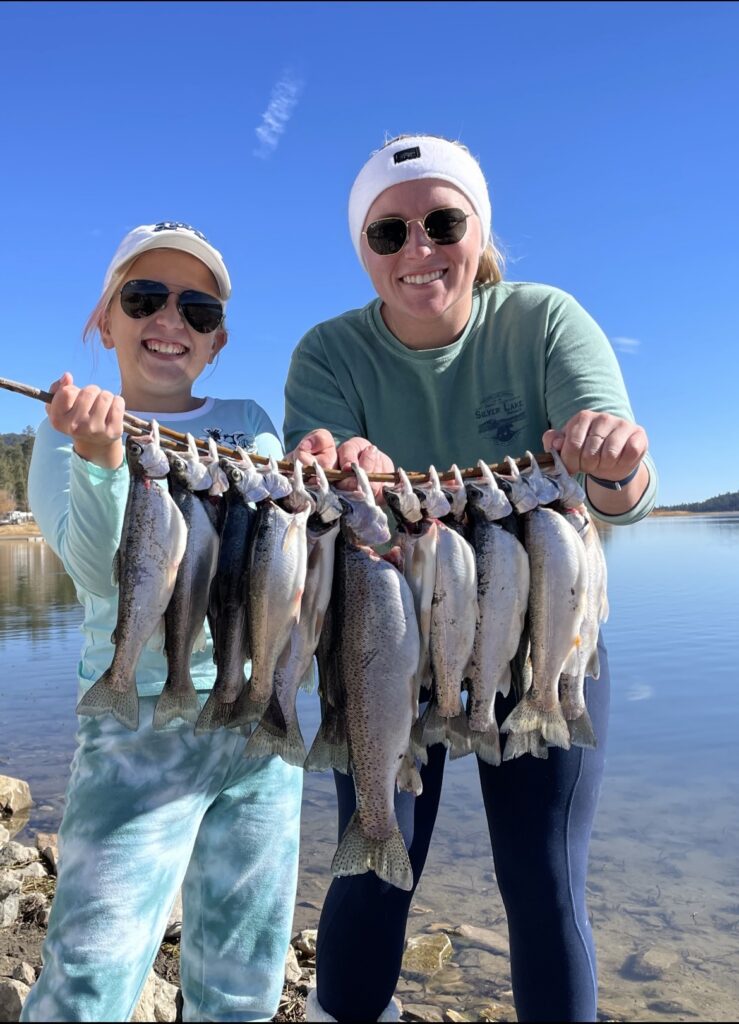
Well, winter is around the corner and it’s time to put the rods away and winterize the boat, right? NOT QUITE YET! Salmon season is indeed winding down, aside from some late season river opportunities, and winter steelhead is often a mystery, so many anglers don’t know where to look for the next bite. If this is you, look no further than some fantastic winter trout fishing at multiple stocked lakes! Winter trout fishing is incredibly rewarding, and in many cases, produces some large trout that cut beautifully. There are many ways to chase these fish from shore or from the boat, and with a little research and timing, you are sure to be on the fish!
How to prepare
To begin, let’s look at the setups to use. Cold water temps have a lot of effect on fish, as they are a cold-blooded species. During this time, they are in energy consumption mode, with not a ton of energy to be spent moving around. Additionally, cold temps slow down fish metabolism. All this together means that when the fish feed, they are looking for an easy meal that does not require too much energy wasted in chasing it down. For this reason, small profile lures and stationary baits are often the best choice.
When fishing from shore, it is hard to beat the “stocked-trout standby”, the Carolina rig! An egg sinker on the mainline with a 2–3-foot leader to a small hook, with an inflated nightcrawler or chunk of Powerbait, is an easy meal for a meandering trout to engulf. Another good option is a small spoon or spinner with a slim profile and wounded look. Lighter casting spinners and spoons can be worked slow through the water column and produce a very crippled look. They are a great way to cover water in new spots and find the fish.
From a boat, these methods work great as well, but trolling can be added to the mix. Small spoons and spinners tipped with a worm are always a good option. Trolling allows the angler to go to the fish. Compared to spring and summer, trolling a little slower can be very effective. Many rainbow trout will sit low below the thermocline. Trolling past them just fast enough to get their attention but slow enough have them commit is the target.
Where to go
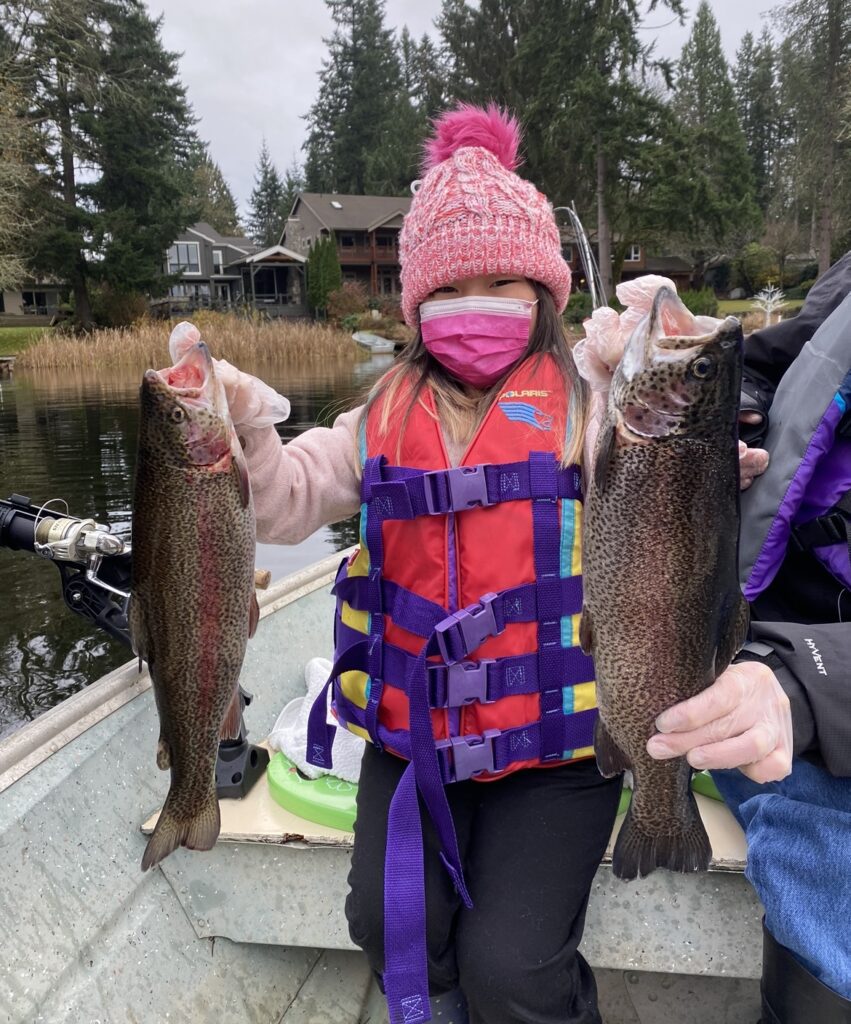
As with any fishing trip, the first thing to do is check the regulations. Many stocked trout lakes are seasonal, meaning they close at the end of October. If your lake is open, you are set to legally fish, but there may not be great fishing. Luckily for the angler, the WDFW publishes a list of recently stocked lakes that is updated weekly. Checking lakes in your area will give you the best idea of where and when to wet a line. The best time to catch stocked trout in the winter is directly after the stock. This is when the trout aren’t quite acclimated to the new area, and they are the most aggressive. After a couple of weeks in the lake, the fish will hunker down and be far less active compared to their first little bit in the new water. Knowing when the trout are stocked can be the difference in a couple bites and a nice limit on the stringer! During most of the winter months, the state stocks their “jumbo’s”, which are trout over 1lb, which usually cut fantastically.
Finishing Touches
As a local Western Washington Angler, I know a couple of great lakes in my surrounding counties that are stocked in November, which gives me just enough time to make some smoked trout dip for the Thanksgiving table. Nothing warms a day like a tight line on a cool river bank, sipping hot coffee, and enjoying some bank lunch.
With a little research, a simple setup, and a couple of free hours, you can be knee-deep in some delicious trout! Just like the spring, ultralight trout setups, light monofilament line, some extra hooks, and a couple of weights, and you are set on terminal tackle. Then add some jars of Powerbait, a few lures, and a stringer, and you will be ready to hit the water. As always, be prepared for the weather!
/articles/winter-fishing-stocked-trout-extravaganza
Enhance Your Ice Fishing Experience
Ice fishing is a unique and exhilarating activity that requires a combination of skill, patience, and the right equipment. While many anglers are accustomed to traditional techniques, incorporating modern technology like fish finders and electronics can significantly enhance your success on the ice.
In this article, we’ll delve into how and why you should utilize fish finders, and electronics while ice fishing.

MAXIMIZE EFFICIENCY
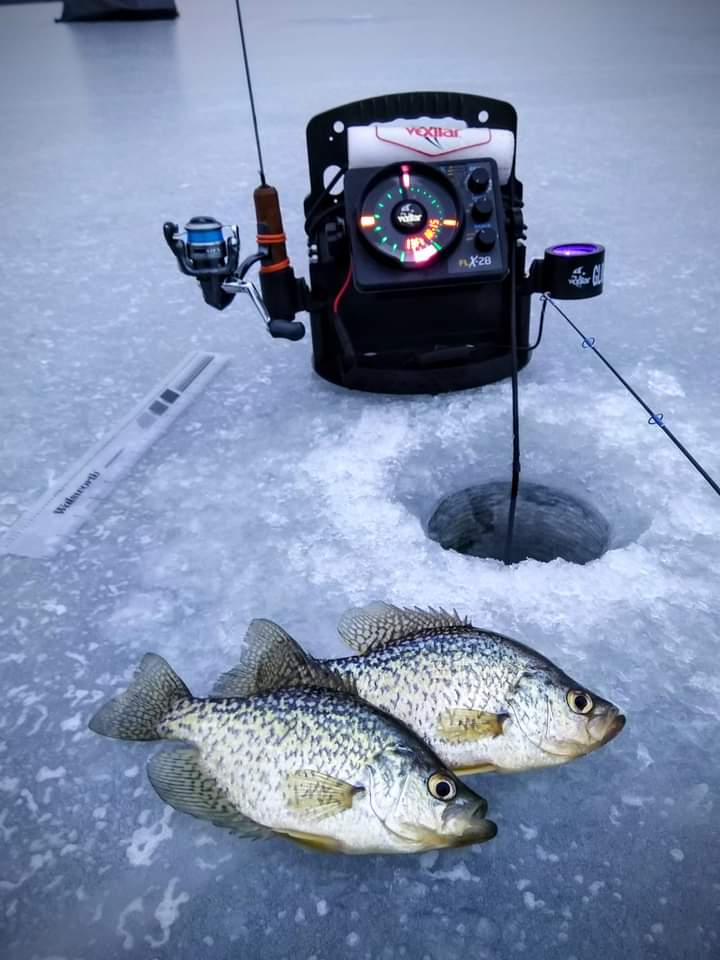
Ice fishing often involves drilling many holes in the ice and patiently waiting for a bite. However, with a fish finder, you locate fish faster and more accurately. These devices use sonar technology to send out sound waves, which bounce off objects in the water and return to the transducer, providing a visual representation of the underwater terrain and fish. This allows you to identify the most promising spots quickly, saving you time and energy.
UNDERSTANDING UNDERWATER TOPOGRAPHY
Fish finders not only reveal the presence of fish but also help you understand the underwater topography. They can detect depth changes, underwater structures, and vegetation, which are crucial factors in determining where fish are likely to congregate. Armed with this information, you can strategically position yourself for a successful ice fishing season.
ACCURATE DEPTH READINGS
One of the most significant advantages of using fish finders is their ability to provide accurate depth readings. This is crucial for ice fishing, as different species prefer different depths. By knowing the exact depth of water, you can adjust your bait and technique accordingly, increasing your chances of more catches.
LOCATING SCHOOLS OF FISH
Fish finders excel at finding schools of fish and of course that lonely straggler. Instead of relying on guesswork or trial and error, you can pinpoint where the fish are congregating. This allows you to make precise adjustments to your bait and presentation to entice more bites.
MONITORING FISH ACTIVITY
Most fish finders are equipped to allow you to monitor fish activity in real-time. Real-time means there's no delay in the transfer from the transducer to the screen, so when the fish or lure moves you can see it move accurately. These devices can display fish movements, indicating whether they are actively feeding or just passing through. This invaluable information helps you adapt your strategy on the fly, ensuring a more productive outing.
STAYING SAFE ON THE ICE
Apart from enhancing your fishing success, fish finders also contribute to safety on the ice. Not only do they read and provide accurate depth information, but some units with GPS can also have up-to-date warnings for hazard areas, thin ice, closed boat launches, etc. while using lake map cards. This knowledge is especially crucial during early and late seasons when ice conditions can be unpredictable.
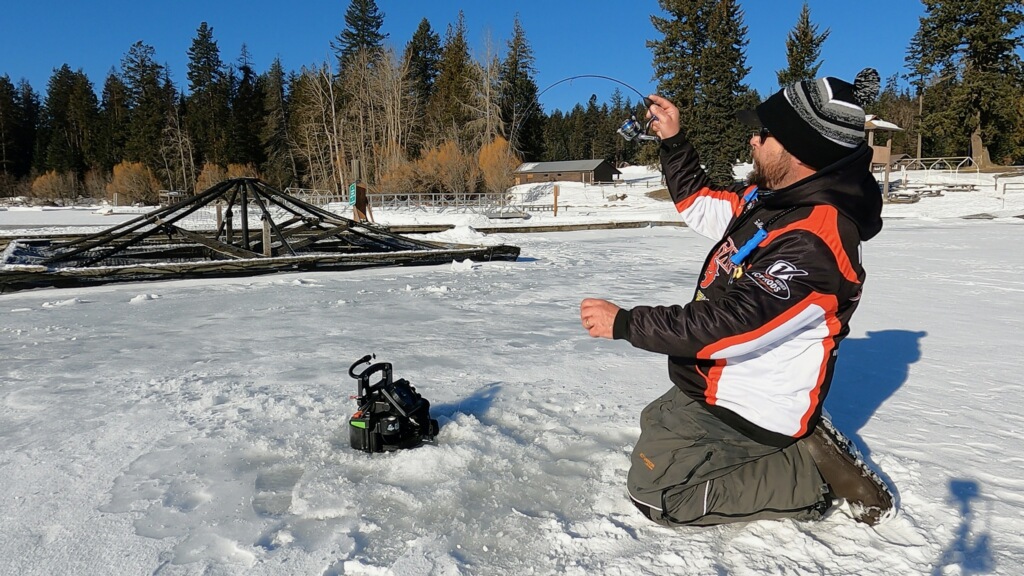
IMPROVING YOUR OVERALL FISHING EXPERIENCE
Incorporating electronics like a GPS unit, or an underwater camera alongside a fish finder flasher can further amplify your ice fishing experience. GPS is a nice option in some units, allowing you to mark productive spots for future reference, or a unit that is usable from the boat to the ice. Underwater cameras offer a fascinating glimpse into the underwater world, helping you understand fish behavior and habitat. This can also help you fine-tune your approach each time you chase fish under the ice.
Embracing fish finders and electronics in your ice fishing endeavors is a game changer. By providing valuable insights into the underwater terrain, fish behavior, and safety conditions, these tools significantly increase your chances of a successful and enjoyable ice fishing experience. So, equip yourself with the right gear and technology, venture out to the frozen lakes, and let the fish finding begin!
/articles/enhance-your-ice-fishing-experience
My Favorite Fall Coho Techniques
Even though the end of the year is approaching, don’t put away your salmon fishing gear just yet. There are still plenty of rivers teeming with coho salmon right now! These days, there are many different techniques you can use to catch fish on any river. Versatility is important, and river conditions change day by day. I recently went on a guided trip with Brianna Bruce of Livin’ Life Adventures. When we got to our spot, she told us that we would each be fishing a different method. The fish had been hitting different things every day. One day, they only wanted spinners. Another day, they wanted spoons. She began distributing rods- one of us fishing plugs, the other spinners, and so on until we were all casting and hoping to get lucky.
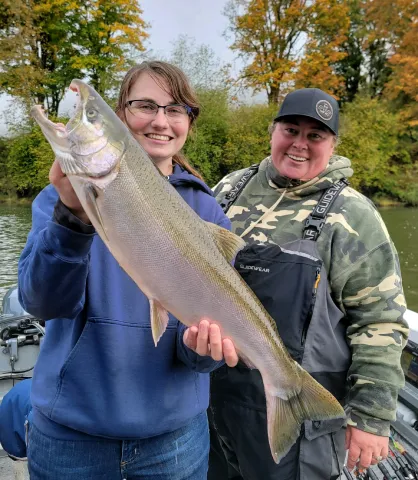
After about 20 minutes of this, another guide motored by on the way back to the launch with their limits. He told Bree that he had gotten all of his fish on eggs! She quickly began switching all of our rods to egg setups. Another hour later, we were back at the boat ramp with huge smiles and limits of dime-bright coho. If she hadn’t brought eggs along, we may have all ended up skunked! Versatility is crucial! Most days when I go river fishing, I carry 3 rods: a twitching rod, a float rod, and a spinner rod. I spent a lot of time getting familiar with each technique and when and how to deploy them. Let’s dive into how and why I use these techniques.
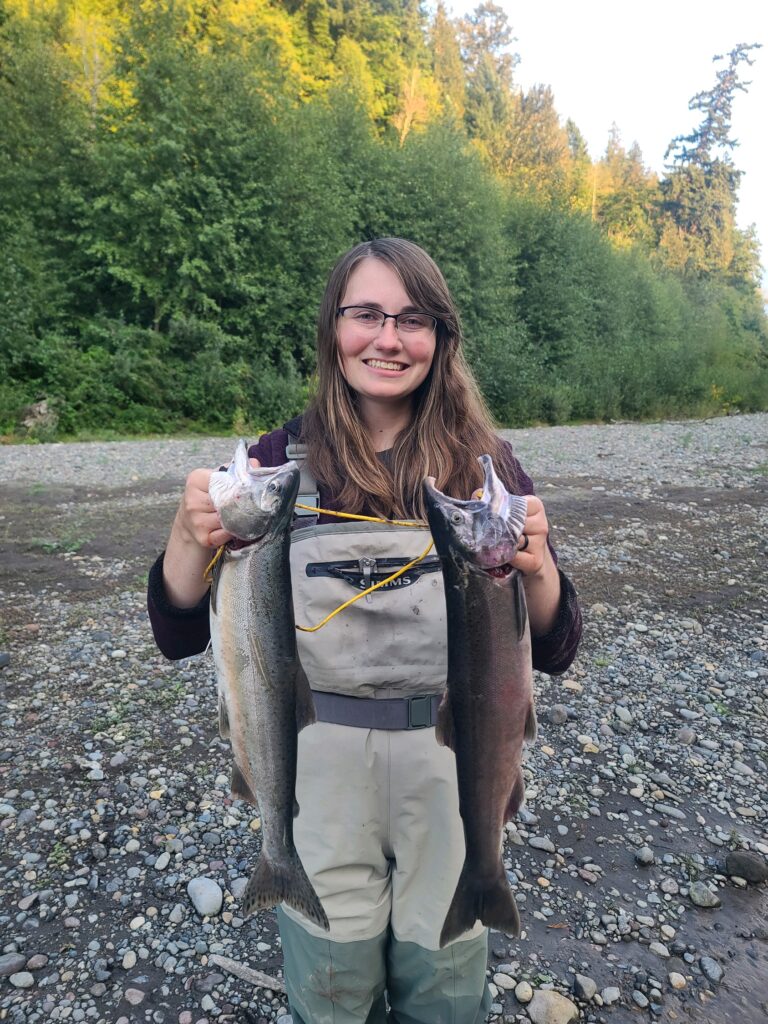
Technique 1: Twitching Jigs
If I had to pick one way to fish for coho, I would have to go with twitching jigs. They are extremely adaptable- I can fish any type of water with a twitching jig. There’s something so satisfying about seeing a big fish dart out of cover to grab your jig. Make sure to vary your jigging speed and length depending on the structure, depth, and speed of the water. Some days, you can let the jig sink to the bottom of a deep hole before you start jigging. Other times, you’ll want to do short jigs as soon as your lure hits the water. There’s no one way to twitch a jig. Color matters! I’ve had days where I fished one color for 30 minutes with no luck, and then hooked a fish on the first cast after switching colors. Most of the time, I use a 3/8 or 1/2 oz jig. My favorite colors are blue/black and pink/green. My twitching rod is a stout 7’6 rod with fast action. It has an extremely sensitive tip so I can feel those subtle bites, and the backbone to back up my hook sets. I pair it up with a size 3000 spinning reel. I use light reels to help avoid wrist fatigue. You can twitch jigs with longer, heavier rods, but I like my 7’6 rod because it translates even the smallest flicks of my wrist to the jig. I never hit the river without my twitching rod! There is a bit of a learning curve, as most fish will pick up your jig on the drop. You might feel the line tighten, or you may feel nothing at all. Most fish won’t simply grab the jig and take off. The majority of bites are subtle. Watch your line and pay attention to how it moves. It pays to fish high visibility braid so you can see exactly where your line is and what it’s doing in the water. Give twitching jigs a try, you’ll be hooked!
Technique 2: Spinner Rods
If I can’t get a fish to bite on twitching jigs, I’ll switch to my spinner rod. This is my 9ft, fast-action, moderate power rod, rated to throw up to an ounce of lead. It has the springiness to be able to launch spinners across long rivers, but the backbone to bring a monster coho to the shore. I often start off beginner river fishermen with spinners because bites are hard to miss. There are two types of spinners, and they both fish differently. Heavy-bodied spinners sink right away and can be cast perpendicular to the opposite shore. Light-bodied or unweighted spinners don’t sink as quickly and are better for shallow rivers. You can cast them out and swing them into the current like a spoon. Keep your rod tip low and reel slowly. Make sure to do 1 or 2 solid hook sets to really drive that barbless hook into the fish’s mouth. In murky water like the Carbon or Puyallup River, I’ll go with a bright-colored spinner, like chartreuse or pink. On clear, coastal rivers, I’ll fish a silver or copper-colored spinner. It never hurts to try something different, though! Don’t forget to pinch your barbs and switch out the treble hook to a single hook if required.
Technique 3: Floating Eggs
My third go-to technique for fall coho fishing is floating eggs. This technique isn’t very well suited for combat fishing, but if you can find a patch of slow-moving water all to yourself, this is a great way to get finicky coho to bite. Floating eggs is a relaxing way to spend the day. You tend to lose a lot less gear, and watching your bobber is therapeutic. You’ll want a 10ft to 11ft rod and 3000/4000 size spinning reel. Don’t use gear you don’t mind getting egg dye on! You can either use store-bought eggs or experiment with curing your own. I usually bring along 2 or 3 different recipes when I fish eggs. Sometimes the fish want pink eggs, other days they like red. You can experiment with adding different scents to your eggs, like tuna or herring. No matter how good your eggs are, you want to make sure you’re fishing them correctly, however. Experiment with your leader length by moving your bobber stopper until you’re hitting the bottom. Then, move it up 6 to 12 inches. That’s where the fish will see it, and, hopefully, bite it. Don’t forget to mend your line by lifting it up off the water and behind your float. This is where a long rod can come in handy, but it can make it difficult to fish in water with lots of overhanging trees and bushes. Float fishing is a highly situational technique, but it can be very deadly.

There you have my top three favorite fall coho techniques. When getting to my spot, I like to sit and watch the water for a few minutes to determine which technique to use. Floating eggs isn’t always possible if the river is flowing quickly. Similarly, when I’m fishing frog water, using a spinner can be difficult. The deep and slow water makes it difficult to reach the fish hugging the bottom. I find that it’s extremely important to be able to adapt to any condition. However, there are days when I want to challenge myself or get better at a technique and I’ll only bring out one pole. This is how I taught myself to be able to use twitching jigs in any situation. If you haven’t tried any of these techniques, hit the water and give it a shot. Make sure to read your rules and regulations, especially emergency ones. Hope to see you all out there!
/articles/my-favorite-fall-coho-techniques
Fiberglass Rods
These fly rods party like it's 1971
I skipped school on a May morning to fish with my uncle Jon and his bride. That was 1985. You might say they were a bad influence on a teenager, but if I had it to do over again, I'd skip my whole senior year and go steelhead fishing. Wouldn't you?
I took two rods to the lake and when, at the end of the day, I put the gear away, I realized I had left the fly rod leaning against a tree. Someone else ended up with my 7-weight Wallace fiberglass and a Pflueger Medalist.
That Wallace rod was equal to or superior to the more popular Fenwicks of the day and looked like a Fenwick, except in a medium brown color.
That was 1985 and my next fly rod was a custom 5-weight graphite my uncle built. In the 1980s, graphite rods were lighter and a bit more responsive, but there were qualities glass rods had the graphite rods lacked.
Summers back
A couple of summers back, I floated the Williamson with Craig Schuhmann and our friend Larry Zeilstra. I brought a custom 5-weight McFarland fiberglass built by Uncle Jon. Before I had even wedged my knees into the casting brace of Craig Schumann's sweet Clackacraft, he was ribbing me about bringing an "old" fiberglass rod on a serious big trout trip. I pointed out this fiberglass rod was more modern than his attitude as well as the graphite rod he was fishing; also, his boat was made out of fiberglass.
I try to keep a small stable of fly rods, seven or eight in rotation. If I'm not using a rod, I give it to a kid. Over the last couple of years, I've given half a dozen rods to teenagers. Fly rods don't do anyone any good unless they are fishing.
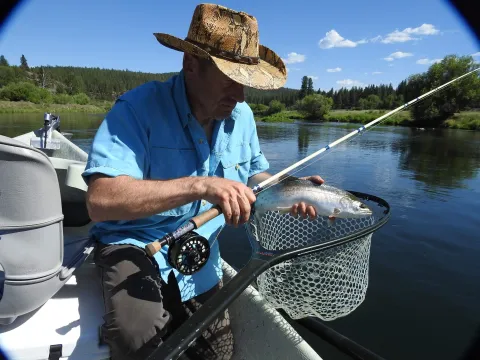
Truth be told, I own two fiberglass fly rods. The other one is an 8-1/2-foot tobacco-brown Wright & McGill 3-A Champion I bummed off a friend for zero dollars. I gave the same amount of no money for the reel and bought a new Cortland floating line off eBay for $13. Thirteen bucks. That's all the money I have into this rig. It parties like it's 1971. Whenever a new acquaintance talks me into taking them fishing and they want to use one of my rods, they get the old-school glass. You want me to take you fishing? You want to use one of my thousand-dollar graphite rods because you're too cheap to buy your own? Nope. You get the Wright & McGill treatment. You don't even get to touch my Orvis magic wand Helios, the Cabela's Rogue rod, or my custom-antlered mule deer Loomis IMX.
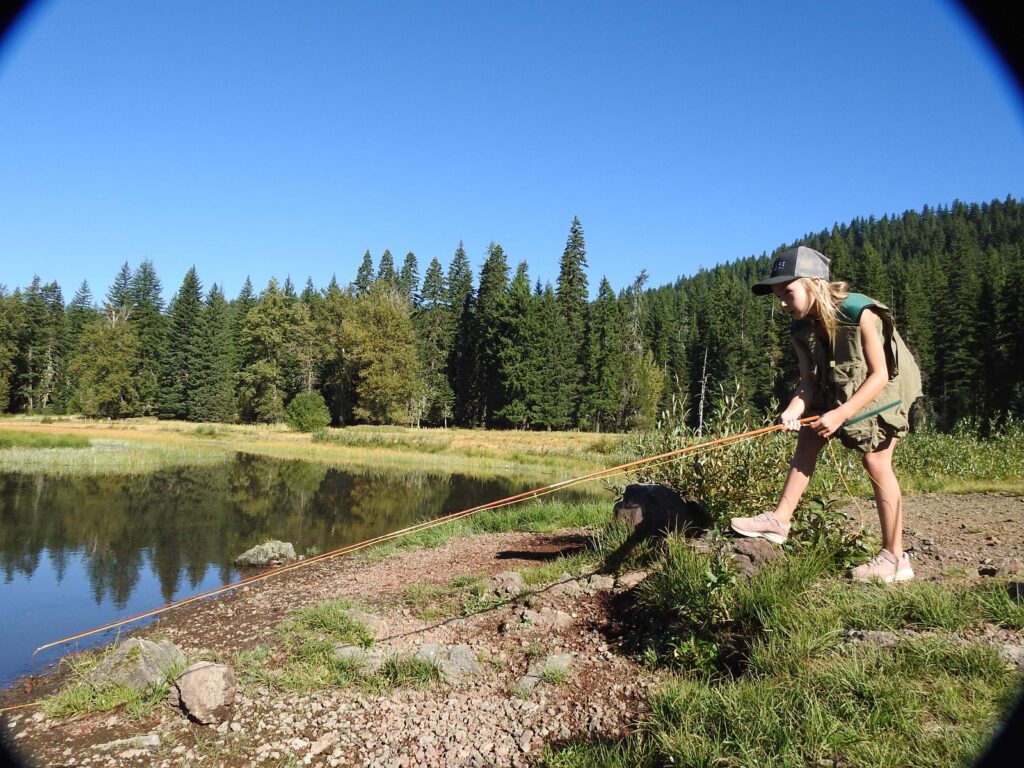
Using a 7-weight Wright & McGill, seven-year-old Little Smokey fishes a wet fly to small brook trout in the Cascades.
This Wright & McGill has bested a boatload of rainbows in the last few years in the hands of grandchildren and other mooches. I even fish it from time to time. It's a pretty good rod, and rugged too.
Glass rods are heavier, which is not a disadvantage. My granddaughter who is 8-years-old has never complained, Grandpa, this rod is too heavy! The heft of a glass rod, along with its to-the-cork action, allows the angler to sense the weight of the line as it shoots through the guides. Weight and slower action tend to slow the casting stroke, which contributes to faster casting competency for a novice.
Advantage
Another advantage is the forgiving nature of glass. Opt for a glass rod when fishing still waters where trout will be girthier. With a fiberglass rod in hand, the rod absorbs hard strikes better than graphite, which translates to fewer fish lost to broken tippets.
Fiberglass is durable too, which means fewer broken tips. That's why, if you want to use my tackle, you get to fish my $13 wonder.
What my collection lacks is a bamboo option. I have owned and fished bamboo and know what I'm missing. Fiberglass rods rival bamboo for liveliness, power, and balance in hand.
If I had it to do over again, I would not lean that Wallace against that fir tree. If you picked up a medium-brown 7-weight at Battleground Lake in the spring of '85, you got a nice rod. I hope you fished it hard.
# # #
For a copy of the Fishing Central Oregon book, send $29.99 to Gary Lewis Outdoors, PO Box 1364, Bend, OR 97709 To contact Gary Lewis, visit www.GaryLewisOutdoors.com
/articles/fiberglass-rods
Ice Fishing Season is Coming
I’ve been watching Ice Cold Catch on TV lately. For those of you who aren’t in the know, it’s a reality TV documentary series that follows two greenhorns as they learn the ins and outs of operating a commercial fishing boat in Iceland. It’s a week at sea in some of the harshest conditions imaginable, and then they return to the port and do it all over again. Some of the catches can yield multiple hundreds of thousands of dollars for the boat and $5,000 for crew members. Other times, they make fractions of that amount. It’s the embodiment of a hard way to make an easy living. Watching the boat and crew lay mile after mile of baited line to circle back, pull it up, and see what was caught is entertaining TV from the warmth of my living room. The blend of passion for the sea with the business acumen needed is something I think anyone who enjoys fishing and also works a “regular” job can appreciate. I don’t plan on heading 50 miles outside of the Icelandic coast to commercial fish for cod anytime soon, so I guess I’ll stick to something closer to home.

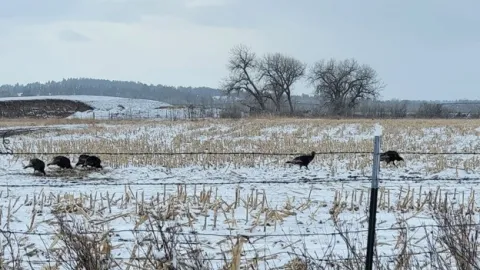
With the winter season approaching, many of us are stowing away the outboard engines on our boats and getting out the ice houses and augers. Maybe if you’re brave enough, and have invested in a decent winter jacket, all you’re checking to see is if you have your trusty plastic bucket to flip upside down as your seat when you jig away for what fish lay below. I’m referencing another way to get your fishing fix during the cold winter months - ice fishing. When the weather gets cold, many of us shift gears and turn our attention to hunting season. Big game, waterfowl, upland bird, or otherwise, it’s the thrill of being outdoors that does it for many of us. I’ve been known to pull off to the side of the road and look at a few turkeys walking around or admire an elk or two coming down from the mountains. For those interested in braving the elements but not quite ready for the physical exertion of hunting outdoors, ice fishing offers continued sporting opportunities. Whether fishing for perch, kokanee, walleye, or burbot, it never hurts to remind yourself of the respect needed on the ice when fishing these glorious winter months.
Gear matters
I joked about the winter coat, but seriously, having an insulated jacket does wonders on those days when the temperature is below freezing. What else might you need before hitting the ice? While a gaiter is always helpful, you’ll need a beanie at a minimum to keep your head warm. Some gloves and boots that are ideally waterproof with disposable hand warmers are a great idea. Ice picks are also a very smart accessory to have should disaster strike and you need to crawl out of the frigid water. They are every bit the equivalent of having life jackets and first aid kits on your boat: the classic “you’d rather have it and not need it than need it and not have it” item. One other item you might not think about but will be glad to have with you is a good pair of sunglasses. It might be December or January and 15 degrees outside, but on a clear day with the sun reflecting off the ice, it can be nearly blinding. The sunglasses/beanie combo is the personification of ice fishing in my mind. It’s a cool look, what can I say?

The gear on your body is important, but you want to make sure the gear you bring to set yourself up to fish is adequate and check that conditions are safe. It is generally advised that ice fishing should be done on ice that is at least 4 inches thick- the thicker the better, especially if you are considering heavy equipment like an ATV or snowmobile to travel to different parts of the lake. 7 inches is recommended when using an ATV. A ruler is an easy tool to measure the thickness of the ice. Another indicator that it is safe to fish is a visual inspection of the ice - it should be clear. Cloudy or cracked ice are indicators it may have been melting and refreezing and not as strong as it should be. After you’ve drilled your hole with an auger (or found an abandoned hole), a scoop is extremely helpful to clear ice out of your fishing hole and to prevent your line from freezing. Besides the obvious fishing pole and lure, the last item to consider bringing along would be a fish finder. Relatively small, briefcase or guitar amp-sized, they can often give you an edge to find the bottom of the water and determine the movement of the fish below the ice.
Got the list? Excellent! You’re ready to hit the water…sorry, ice, to continue this obsession we share that is fishing. It’s always exciting to catch fish on a boat or from shore during the warmer climates and summer months, but it’s a whole other experience to brave the cold and reel up your catch of the day through the ice.
/articles/ice-fishing-season-coming
No Kill Kalama
Sometimes we don’t get the fish, sometimes we don’t get the shot. And sometimes we don’t even think about it because there is just too much going on.
You are not going to get a slick fish picture, but I am going to let you in on a little secret called “License to Chill” on the Kalama River in Washington State. This underdog tributary of the Columbia River is often overlooked, but why? Well, it's hard to get to, and access is limited, but there are substantial year-long opportunities for salmon and steelhead runs. It's a sweet spot, roughly 45 miles long, and narrow enough to cast across to the opposite bank.
It may be relatively small, but when you're there you feel the pulse. It’s a mainline to the Pacific Northwest heartbeat. The swift mossy green waters amble through the Cascades from Mt St Helens to the Columbia.
License to Chill hosts 19 private acres of preserved forest, easy access to the riverbank, and multiple runs every year. Spring chinook get a lot of attention, followed by summer steelhead, coho in the fall, and the almighty winter steelhead running well into the spring.
Can you keep them? No. This is a strictly managed catch-and-release barbless fly-fishing stretch.
Should you pull them out of the water, take a picture, and admire your fish? No, what's the point of that? You're causing stress, suffocation, and possible internal injury. This river isn't for the eating fish, it's for the experience. No Kill Kalama is just the place to go if you want to unwind and wet your line.
I am one of those people who believes that all humans should have the right to forage, hunt, and fish for our own sustenance. And, why not fun? However, I also think we should absolutely look outside of ourselves at the natural world, sustainability, and what we are leaving for each other and our children.
This isn't a debate, but a few words to share what a great time I had on the Kalama River. If other like-minded folks appreciate the suggestion, then I'm pleased about that!
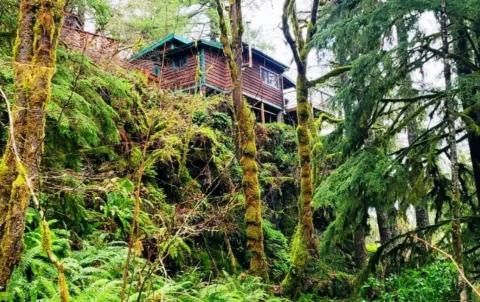
So much love and history has gone into this cabin and property. It is really one of a kind. At 90 feet above the river, you can feel it roar under you as you drift to sleep. If you like eagles, how about taking a shower outdoors while they fly above giant Red Cedars? It is epic!
/articles/no-kill-kalama
Ultimate Kayak Set-ups
In the 2023 March issue of NW Reel Life, I laid out some key items and concepts to help anglers enter the world of kayak fishing. And while weather predictions, condition assessment, and kayak types are all important, in this article I want to focus a bit more on the actual setup of your kayak and how that can determine your level of success out on the water.
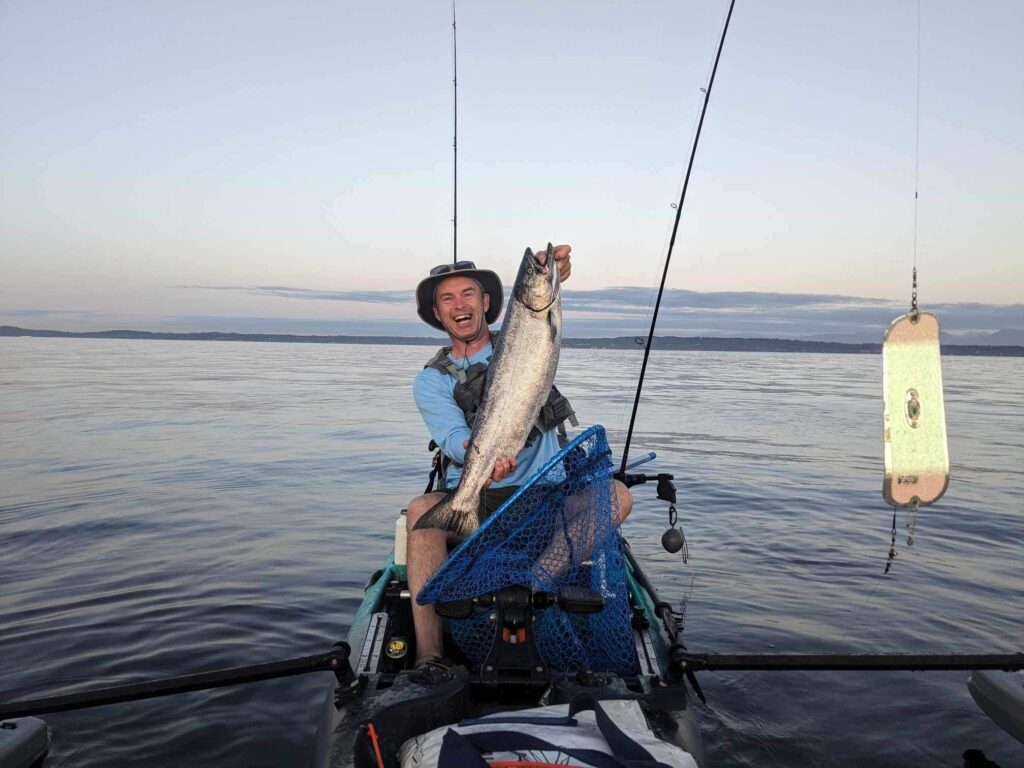
Track mounts
Let’s talk track mounts! Track mount systems are the starting point for your rod holders, fish finders, and other accessories. A track mount is a slotted track that you bolt to the side rails of your kayak and then slide your other accessories onto. They all have fairly similar styles with some small variations amongst different brands. The most important thing to keep in mind is that your track should be strong enough to support whatever type of load you are putting on it. A good track mount system should be metal, corrosion resistant, and come with a backing plate. If the track holds rod holders, it should be large enough and secure enough to do so. Smaller accessories like cell phones, fish finders, and camera mounts won’t require as beefy of a track.
Downriggers
Trolling on a kayak can be straightforward. You drag a lure behind you to target rainbows, or you can utilize a cannonball weight to get you down to chinook salmon territory.
Now, if you want to have more than just an idea of the depth your gear is at in the water column, you need something more surefire. Enter the downrigger.
Because most of my kayak fishing is in the ocean or the Strait of Juan De Fuca, I’ve opted to leave the downrigger trolling to my aluminum boat. The constant attention to equipment while on the water and the inherent risks associated with snags make it an option easier to perform on a vessel of larger size. With that said, a downrigger is not only doable on a kayak, but it’s a technique that can increase your chances severalfold, and if you’re fishing lakes where currents and large waves are less of an issue, a downrigger might be the exact thing that puts you on the fish.
The most common spots to mount a downrigger are just past the midline of your kayak somewhere out of the way of your peddling or paddling, but also close enough to you so that you can operate it without too much struggle. Most kayakers opt for smaller downriggers like a Scotty lake troller or the Cannon mini troll downrigger. When mounting your downrigger, you’ll want to add a backing plate in the hull of the kayak where your bolts will attach. This is essential for the kayak to be able to handle the added weight and pressure. Fish finder and rod holders should be mounted in close enough proximity to the DR so that you can monitor your rod tip, fish finder, and DR at the same time. Instead of using the steel cable that comes with most downriggers, it’s wise to swap the cable for 250 # - 300# braided line. This will lessen drag and it will also allow you to cut your line in case of an emergency. With that in mind, you should always have a knife attached to your person in a place that is easily accessible in case that emergency were to happen.
Stringers
For the longest time, I struggled to find an effective place to connect my stringer to my Hobie Revolution 13’. I would typically have my stringer attached to a carabiner and then the carabiner attached to a strap that was a part of my seat’s recline system. Eventually, the rubbing from the constant motion and tension of the fish that were hanging off the side of my boat would fray the webbing around the strap. I now have a stringer cleat attached to one of my track systems that holds and secures that line out of my way. Metal clip stringers are a top-rated option for kayaks due to their ease of use, though rope stringers and chain stringers will certainly get you by as well.
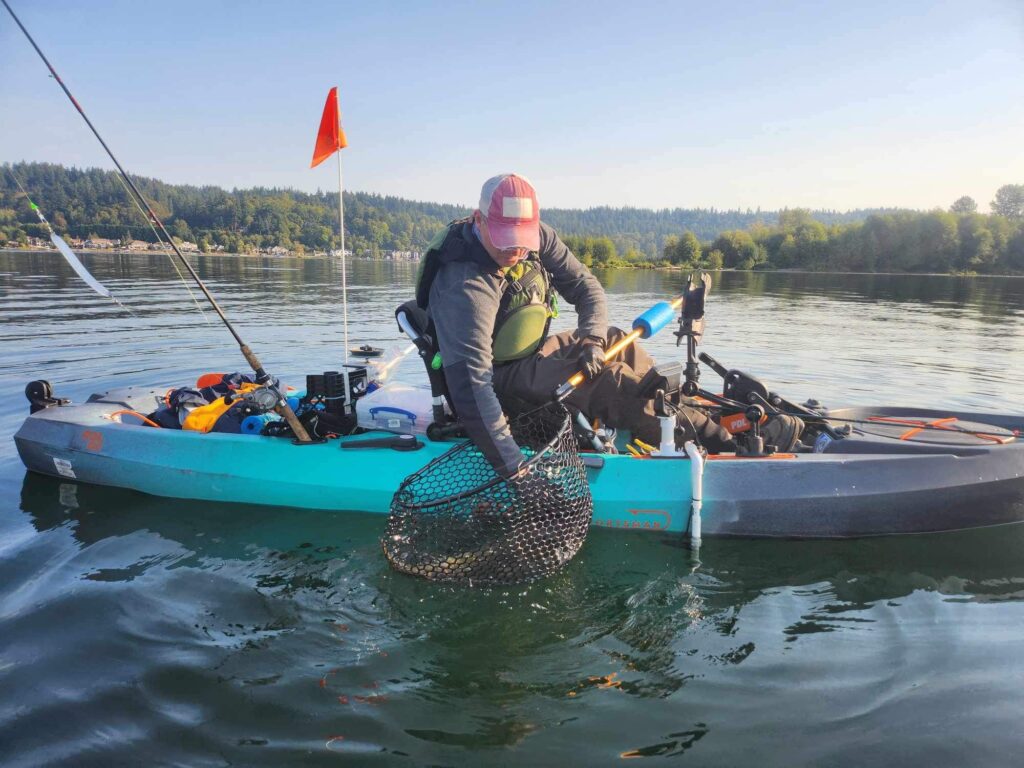
Fish finders
The process of setting up a fish finder on your kayak is going to differ depending on what type of kayak you have. Mounting the screen is simple- it can go on a track or be permanently installed on the boat. The trickiest part of the process will be mounting your transducer. Many fishing kayaks come equipped with a transducer mount directly underneath the hull. This allows the transducer to sit in the water while also being protected from the sand and gravel if the boat were to drag along the bottom. For most kayaks out there, transducer mounts are not built in. If you don't have a transducer mount you will need to mount it either off the side of your boat or better yet, inside the hull. This gets tricky and typically involves using some plumber putty for the transducer to both stick to the kayak and to also create a sealed surface without air bubbles. The solid putty allows for the transducer to transmit through the putty, through the kayak material, and into the water. YouTube is a valuable tool for these types of setups.
Bilge pump and BP storage
If the hull of your kayak fills with water due to crashing waves or due to a capsize, you don't want to be bailing water out of the boat with an empty tackle box. A manual bilge pump is your strongest line of defense against a sinking boat. Some kayakers will stow their bilge pumps inside a hull compartment underneath a hatch. This could seem like a sensible home for your bilge pump, but if you are in a situation where you’ve taken on a lot of water and you’ve lost half your buoyancy, and on top of that, you’re being battered by oncoming waves, leaning over to open a hatch might be just the thing the kayak needs to capsize once again. Instead, stow the pump somewhere within arm’s reach and have it fastened down with a bungee and secured to a lanyard so that it has no chance of going overboard.
Cell phone mounts
Having your cell phone mounted on your fishing kayak might seem like an over-the-top luxury, but if you consider the vast number of apps that can be utilized to help improve your fishing trip, you will find that having your cellphone on the ready and in view at all times is a must. When I’m on the water, I use Navionics to navigate and to get a good sense of underwater topography. I also use weather and wind apps to keep me safe and informed on changing conditions. Using a cellphone mount along with a waterproof cell phone case gives ease of access to all of these things. Phone mounts can be installed directly on the kayak or on your track system.
Bungees and straps
Bungees, straps, webbing, all these small investments will protect your larger investments in the event of a capsize. Strap everything down as if capsizing was just a normal part of your program. This is particularly important if you plan to do any surf launches into the ocean.
Rod holders
Rod holders are an essential part of your fishing kayak set-up. Your kayak likely comes equipped with flush mount rod holders, these are almost standard on most kayaks these days. However, the position of the standard flush mounts is generally aft of the kayak seat, and this isn’t always the best location when you want to have eyes on your rod tip. Additional flush mount holders can be installed in various locations of your boat.
Fixed and elevated rod holders. These will be installed directly to the boat or to a track. Fixed rod holders tend to be one of the sturdier options.
Adjustable rod holders. Adjustable rod holders can move from horizontal to vertical and can be found in various styles that are suited for whatever type of fishing you plan to do.
When installing your rod holder, be sure to place it somewhere where it won’t be in the way of your peddling or paddling.
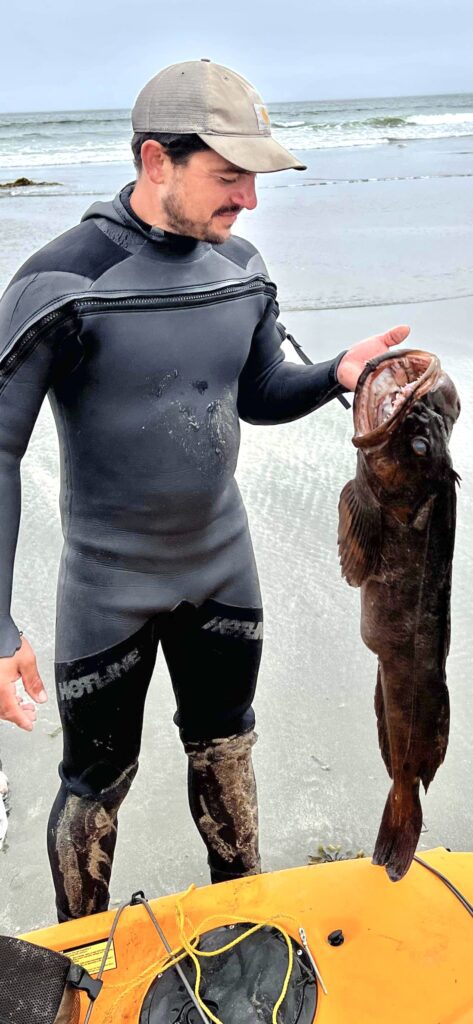
Fish Storage
There are quite a few options when it comes to fish storage. Some folks will carry a small cooler on board. This is a good option when fishing for smaller fish on hot days and if you can afford the room on your kayak.
Fish bag. Insulated fish bags are great options for larger fish and are easy to secure on your kayak. If you’re fishing for spiny fish, be sure that your cooler bag is puncture-proof.
In-hull storage. Some anglers have rigged fish bags inside their hull, and if you can make that work, you are ahead of the curve on the fish storage problem that plagues many kayak anglers. If in-hull fish storage is a possibility, be sure that your fish are well insulated as the inside of a kayak can get quite toasty on a hot day. Also keep in mind that if your fish bag leaks inside of the hull, you will have the difficult task of cleaning a stinky mess that gets more stinky the longer it sits unattended. Finally, having the hull open frequently presents the danger of water from crashing waves getting inside your kayak. So, if you choose this method, be wary of the risks associated.
Kayaks offer endless amounts of angling opportunities without some of the drawbacks of larger boats. I hope these tips give you some direction in planning your next outdoor adventure on the open water.
/articles/ultimate-kayak-set-ups