/articles/categories/fishing
Estuary Sturgeon by Jerad Sorber
Known for hiding the shipwrecks of the Graveyard of the Pacific, the sands near the mouth of the Columbia also hold a secret lair of North America’s largest freshwater fish. White Sturgeon in the Columbia River Estuary regularly reach enormous sizes. These secretive giants provide a fight that compares with billfish, both in ferocity and acrobatics.
Just after Father’s Day, I invited my friend Jamie to join my son and me for a scouting trip. I wanted to add some more spots to my list of options for my clients the next day. I was looking for deeper channels running next to broad shoals. Ideally, I would find a submerged cove.
I anchored the boat up-current from a group of fish that I had spotted using my side-scan sonar and hung drift socks to keep the boat as steady as possible. Sturgeon are shy biters, and any movement of the bait before they commit can throw them off. I also use extra-long leaders, at least 3 feet, to give a little extra wiggle room. The current helps carry the bait scent towards the fish and draws them into our gear. The bite will often slow or completely stop during slack tide.
Like all fish, sturgeon follow their food. Upriver, that means deep pools. In the estuary, the sand flats grow a carpet of small creatures, including shrimp, worms, mussels, and clams. The sturgeon wait for the incoming tide and cruise up onto the flats for this buffet. Sometimes we’ll spot them feeding in as little as a foot of water with their backs and the tops of their tails visible. When the tide moves out, they shift into the deeper channels and ditches.
I tied on a 3-foot Dacron leader in 120-pound test. In addition to strength, the Dacron provides abrasion resistance. Sturgeons have sharp plates along their sides and spines. A hooked sturgeon will use an alligator-style death roll to wrap the line around itself and cut the line. Despite their strong sense of smell, their eyesight is poor. Where other species might ignore something with a thick visible line, the sturgeon don’t seem to notice it.
I had pre-baited several leaders that morning with live sand shrimp. The local bait shops stock them, but you generally need to order ahead of time to guarantee that you’ll have them. Once in the estuary, the sturgeon prefer shrimp, even over traditional favorites like smelt and squid. I half-hitch two shrimp onto each leader, with the bottom one also being caught in the hook’s bait loop. I know some folks who use bait threading needles, and I do prefer that method for durability when I have a needle available.
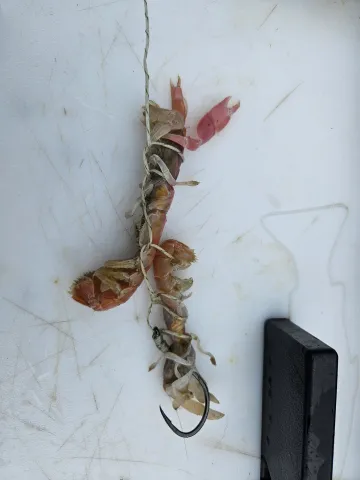
For the hooks, I use Gamakatsu Big River Bait Hooks in a 6/0 size. We are required to pinch the barbs and are only allowed to use one hook. The hard-angle bend at the bottom of the hook does a better job of staying in if the line goes slack. While I grumble about barbless hooks for salmon, with sturgeon I wouldn’t want to have to get one out of their mouth anyway. Their tough skin would require a lot of work to extract one.
For a quick swap after a missed swing, the tops of my leaders are tied into a surgeon’s loop. I slide the loop into a McMahon-style snap hanging from a bead chain swivel. These snaps are strong, generally don’t tangle with my leader, and are fast to swap out once you get used to them. My main line is a 60 lb braid with a heavy swivel sandwiched between two beads ahead. Hanging from the sliding swivel is my lead. I usually use 6 oz pyramid-style weights to help hold the gear out in a wide spread in the current. In heavy current I’ll run up to 10 oz, but that’s rare.
After I attached the leader, I looked around for a spot. I generally try to cover as many different areas of water as possible, and the spot I chose had a good mix of super shallow flats alongside a 15-foot-deep channel. My plan was to spread the gear out and see where the fish were concentrating at that moment. Whenever possible, I always like to hedge my bets.
I swung the rod carefully while thumbing the reel to prevent backlash. I typically use a casting-type reel. I caught my first sturgeon on a spinning reel, and it’s not a bad choice, though. The casting reels just take up less space in the boat. Getting used to them also means I can change plans on the fly if the Spring Chinook bite is slow. The lead and bait landed in the shallows about 100 feet away. Based on the timing between when the lead hit the water and when I felt it hit the bottom, I’d say I was in about 2 feet.
I use the same mix of Lamiglas Battle Glass and Daiwa Beef Stick rods for bottom fish, and it also saves me from having to buy a whole additional setup. Sturgeon don’t care how much you paid for the rod. They just need something strong. To catch them, you just need a tip soft enough to detect a bite and a backbone strong enough to set the hook through their catcher’s mitt of a mouth. The rod also needs to not snap when a 500 lb fish decides it wants to start peeling 200 feet of line off your reel!
A few of my rods, especially the softer Lamiglas rods, show signs of being repaired from when the tips came up against the boat while fighting a particularly devious fish. I have used my heavy salmon trolling rods, but the ones that have found use as sturgeon rods have become sources of spare parts after a few trips.
Usually, when a sturgeon bites, the tip of the rod will twitch slightly. The hardest part of sturgeon fishing is lifting the rod out of the holder without tipping off the fish. I told Jamie, “When you feel it pull, set the hook as hard as possible.” A few minutes later, the rod tip twitched - first softly, then harder. Jamie grabbed the rod, pressed his thumb against the spool like I taught him, and pulled back. The rod stopped in mid-swing and then pulled down hard. Fishing rods make a distinct angle when hooked with a big fish - the backbone of the rod usually goes straight up from the angler’s hands. The mid-range forms a perfect 90-degree curve over about 12-14 inches, while the softer top section will end up pointing directly at the fish. For those who live in more metropolitan areas, the feel in your hands is about the same as hooking into a city bus.
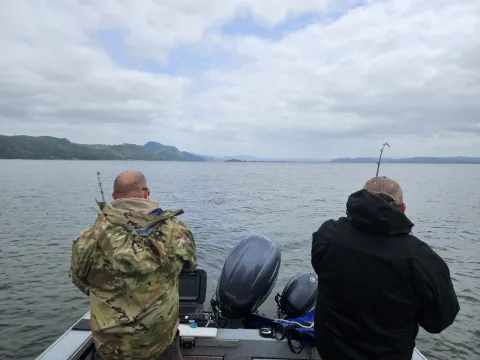
Bobby and I scrambled to pull in the other gear while Jamie held on for dear life. The reel’s drag was probably close to combustion, and the fish had only been on for a few seconds. I looked up just in time to see a massive prehistoric beast jump fully into the air behind the boat. When you have to look up to see your fish, you know it’s big. This sturgeon had decided to remind us that it comes from a time when dinosaurs caused the earth to shake. Over eight feet and nearly 300 pounds of angry, armor-plated fish hit the water and began making a big run. Before we could throw the anchor buoy overboard, the line counter was already at 400 feet.
I used the motor to follow the fish and ease the load on Jamie. The tradeoff in this strategy is that the fish doesn’t get tired as quickly. Once we had gotten back to less than 200 feet of line, I restricted myself to just keeping the boat angled so that the fish wasn’t underneath us or on the opposite side. I wanted to use the boat to help tire out the fish.
Jamie is an experienced fisherman. He’s fought plenty of large salmon in his time and knows that when the fish is running, you keep the tip up a bit so that the rod does the work. He was perfect at waiting for the fish to start to turn before reeling so that he didn’t tire himself out. Despite this, I could tell that the long fight was wearing him out.
Over the next 70 minutes, Jamie brought it to the boat three times - each time the fish would blow bubbles and roll onto its back. This is usually a sign that the fight is about over, but this one did this each time and was not done. Every time I tried to grab the base of its tail so that we could hold it still for pictures, it would wake up and take another run.
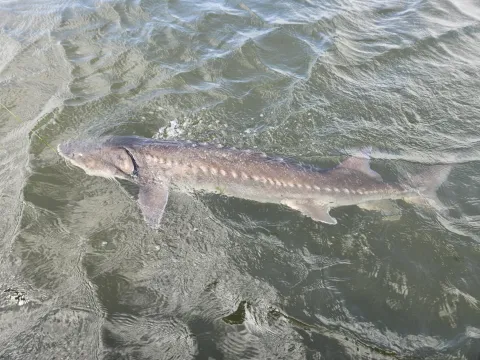
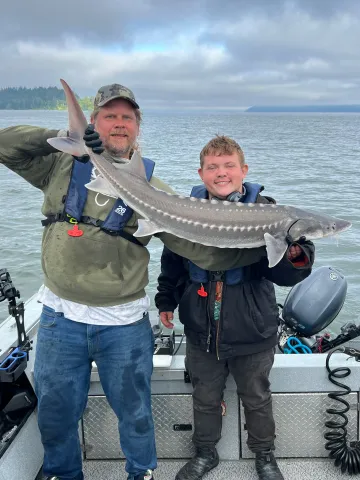
After drifting for approximately 2 miles, we made one last attempt to get the fish to the boat for a picture. This time, instead of taking off and away from the boat, it ran underneath. The mainline rubbed against the boat chine, found a nick, and the beast was gone. We were exhausted. Jamie’s arms were rubber, and we all agreed it was time to head home. Somewhere - maybe still in the shoals of the Columbia - that sturgeon is out there, growing even larger.
/articles/estuary-sturgeon-jerad-sorber
Everett Coho Derby: Supporting our Fisheries by Brent Knight
Here we are, mid-summer. And for many of us sportsmen, waiting patiently for the fall salmon runs to begin. With very limited Chinook opportunities in Western Washington, most of us are looking forward to our coveted coho fishery. I know that I am organizing my gear, tying leaders, prepping bait, and doing anything that I can to pass the time. I get in a day or two of kokanee or trout fishing here and there, but it is just not the same. Coho are hard-fighting fish and arguably among the best-tasting salmon, either on the BBQ or in the smoker. The 2026 forecasted return of coho salmon to the Puget Sound projects a strong, healthy return overall, ranking as one of the best seasons in recent memory for total forecasted abundance. This means that we should be both optimistic and excited for what is to come.
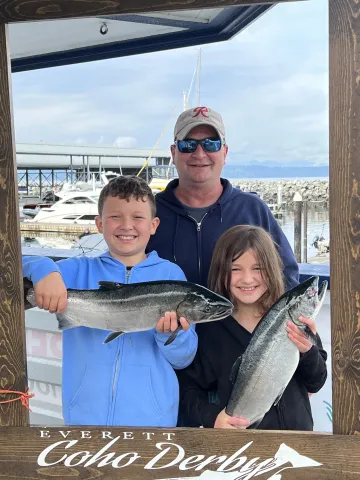
Along with the returning salmon come numerous derbies, all up and down the West Coast. Every September, there is a salmon derby unlike any other on the West Coast: The Everett Coho Derby, taking place in September when the Coho are stacking up in the Puget Sound on their way to their natal rivers and spawning grounds. This great event celebrated its 32nd year in 2025 and has become the largest fishing derby on the West Coast, with around 2000 adults and 300 kids registering annually. That’s a lot of sportsmen (and women) and anglers on the water!
I have been fortunate to be a volunteer for the past five years. For me, it’s easy. I just show up at the Edmonds Marina and meet and greet people as they bring their catch in for weighing. We laugh and talk to all the smiling kids, proud to weigh in their fish and compete for prizes. Outside of all the fun that we have over the two days of the derby, many others spend the year planning the event, and it is a lot of hard work.
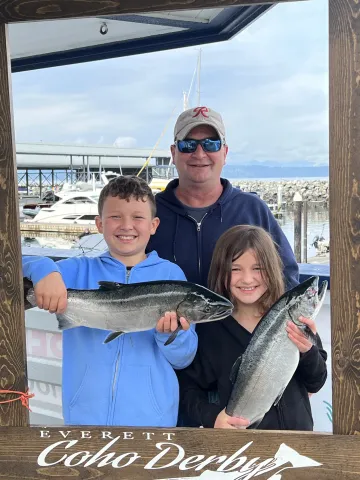
The Everett Coho Derby is sponsored by the Everett Steelhead and Salmon Club/Everett Chapter of the Puget Sound Anglers and the Snohomish Sportsmen’s Club. These two groups work together to plan the event. The money made in this derby goes to support the many fish enhancement projects of the clubs.
Coho can be caught in any of the open marine areas or the open rivers in Snohomish and Skagit Counties. First, second, and third prizes fetch $10K, $5K, and $2.5K, respectively. Gary Hanson from Puyallup won the 2025 Everett Coho Derby with a 12.62 lb coho salmon. The annual derby concluded on September 21, 2025, with Betty Wood (Snohomish) taking second place with a 12.11 lb fish, and David Taylor (Tulalip) in third place with an 11.57 lb fish. The event saw a highly competitive weekend for the top spots.
A little history about the derby: In 1993, the local recreational fishing industry was in a quandary. To protect many of the threatened runs of coho salmon, the State of Washington declared much of the saltwater off limits to salmon fishing, as well as closing most of the local rivers. The only area available was the Snohomish River system and a small “Bubble” right outside the mouth of the Snohomish River called the Tulalip Bubble. Interest in salmon fishing was waning, and the sporting goods stores were worried about their livelihoods - the sale of fishing gear.
One of the local store managers, Fabian Loomas from Jerry’s Surplus in Everett, approached Jim Brauch of the Everett Steelhead and Salmon Club and Mark Spada of the Snohomish Sportsmen’s Club with a proposal. If a salmon derby was created, targeting the small area that was open, Fabian would try to solicit prizes from the various distributors. In addition, if not enough tickets were sold to cover the prize money, Fabian would guarantee that the prize money would be paid. This was a win-win scenario for the two clubs, and the decision was made quickly to create and organize the derby!
That first year, the derby was called the Snohomish River Coho Derby, and it made about $400-$500 per club. Not a lot by today’s standards, but in those days, most of the club’s income came from small raffles and coffee rest-stop donations. Four hundred dollars was significant for both clubs, and they were overjoyed at the additional revenue. Those guiding the effort muddled along for the next few years, happy to have a derby and happy to make a little money from it. A Humpy Derby was attempted one year, and two things were discovered: humpy (pink salmon) anglers don’t buy derby tickets, and most humpies entered in the derby weighed about the same (10th through about 50th differed by less than 2 oz). In about the year 2000, Mac McReynolds - a representative from Olympic Boats, a local retail boat sales operation - approached the group to see if they could help sponsor the derby. McReynolds arranged for a boat, motor, and trailer to be awarded as the grand prize, at no cost to the derby. Ticket sales surged that year, furnishing money for the many enhancement projects carried out by both clubs. Up until a couple of years ago, the boat, motor, and trailer package was a mainstay of the raffle portion of the derby and helped it to continue to grow to what it is today. Other past prizes have included trips to fish in Alaska and cash as alternatives to the raffle.
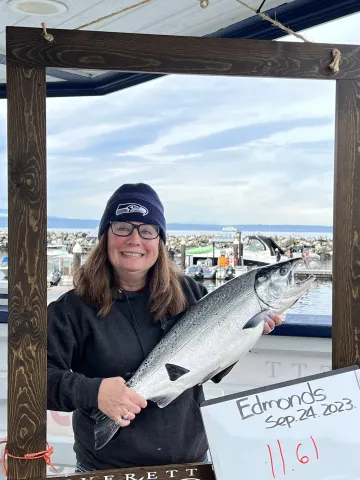
From these humble beginnings, the derby, now called the Everett Coho Derby, has become the largest derby on the West Coast of North America based upon the number of participants. Ticket sales have soared from 900 tickets sold in 2001 to 2527 sold in 2004, a year of inclement weather, along with over 300 free youth tickets. Over 2800 participants in total. The derby now averages 2000 adult paid tickets, and 270 free kids (12 and under) tickets each year. The prize money has also improved with cash for the five largest fish, from $500 for 5th place up to $10,000 for 1st place, along with many added cash prize categories. This derby has surely become a destination event on the West Coast.
The money made each year in the Everett Coho Derby goes towards the support of the many fish enhancement and propagation projects of the clubs - including stocking of the local lakes with trout, a salmon hatchery raising 60,000 coho smolt each year for release in the Skykomish River (Eagle Creek Hatchery), carcass planting in the upper Pilchuck River and Snohomish System, many different youth activities including trout clinics/fishing events, high school/college scholarships, sending kids to Youth Conservation Camp, as well as many other activities too numerous to mention. The money goes to good causes, and anglers have a chance to win prizes at the same time. What could be better?
These events take a ton of work to organize and coordinate, but the proceeds help more than most people realize. Also, many of the people who donate their time and energy to events like this are getting older, so there is a call for new blood. It is time for the next younger generation to get involved and start to take over so that we can keep these events going.
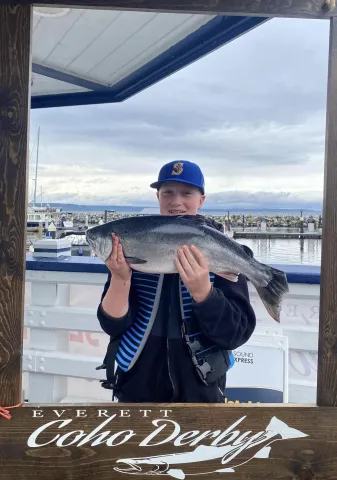
So, what does it take to get involved? There is nothing to it. Just volunteer, and they will be grateful for your help. If you are not the volunteering type, that is okay. Pay your entry fee and come try to win some prizes next year while filling your freezer with chrome bright coho salmon.
To learn more, you can visit https://everettcohoderby.com/. The 2026 derby will be held on Saturday and Sunday, September 26-27. Tickets will go on sale on July 1st. We hope to see you there.
/articles/everett-coho-derby-supporting-our-fisheries-brent-knight
Battle the Fish Not the Weather by Matt Carey
Fishing in the Northwest has a way of reminding us that the outdoors rarely hands us the same day twice. One morning you’re greeted with a warm sunrise that paints the water gold, and the next you’re staring down a wall of wind that makes you question every life choice that led you to the boat ramp. Weather is part of the adventure, part of the challenge, and part of the story we tell later. It shapes how we fish, where we fish, and sometimes whether we fish at all. Over the years, I’ve learned that preparing for the elements - and adapting to them - can make the difference between a memorable day and a miserable one. And sometimes, the best decision is simply calling it quits and trying again tomorrow.
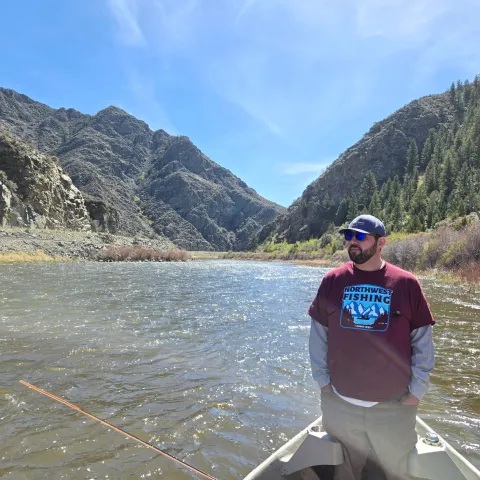
For those sunny days: There’s nothing quite like stepping out into the water under a clear sky. Sunlight dances across the surface, the mountains stand crisp and proud, and you feel like you’ve been handed a postcard-perfect day. But sunny conditions come with their own quirks. From a boat, bright sun often pushes fish deeper. You might find yourself adjusting your gear, switching to heavier weights, or trolling at depths you didn’t need the week before. On shore, the sun can make shallow water feel barren, pushing fish toward shade lines, drop-offs, or submerged structures. And if you’re wading, sunny days can be a blessing - clear visibility helps you read the water, spot fish movement, and pick your path with confidence. Preparation is simple but essential. Sunscreen, polarized sunglasses, a hat, and layers you can shed as the day warms. Hydration becomes as important as lure selection. While it’s nice to enjoy a frosty one, keep in mind H20 will help fight off fatigue and a headache later in the warm afternoon. Don’t underestimate how quickly a calm sunny morning can turn into a scorcher by noon. I’ve had days where the fishing was great, but the sunburn was legendary.
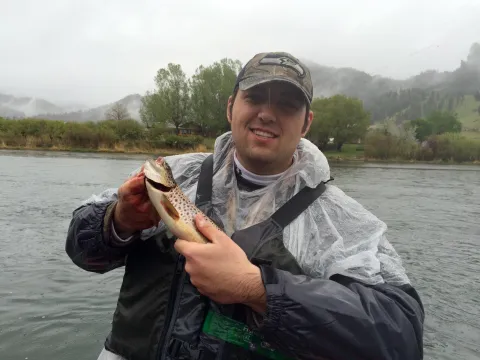
Not that it ever rains around our parts, but for those who’ve experienced rainy days, it really can be magical. There’s something about the sound of droplets hitting the water, the smell of wet pine, and the way fish seem to wake up under cloud cover. But rain changes the game. From the boat, rain can make everything slick - decks, gear, even your footing. It’s a day where bracing yourself becomes second nature. Fish often move shallower, feeding more aggressively under the softened light. When fishing from the land out into a lake or river, rain can be a gift. The surface disturbance hides your presence, and fish feel more comfortable cruising close. It can be enjoyable, quite peaceful, but only if you’re prepared. Cold rain on warm water creates fog, and fog can turn a familiar river into a maze. Preparation is all about staying dry. A good rain jacket, waterproof boots, and dry bags for gear. I’ve learned the hard way that soggy socks can ruin even the best bite. And while rain can improve fishing, it can also make conditions unpredictable. Rising water, muddy runoffs, and slippery banks demand attention.
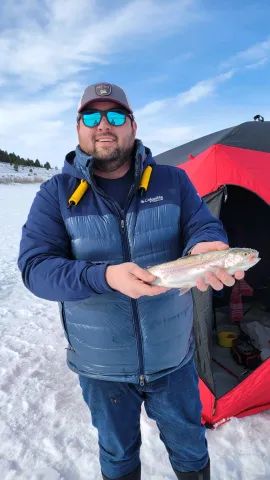
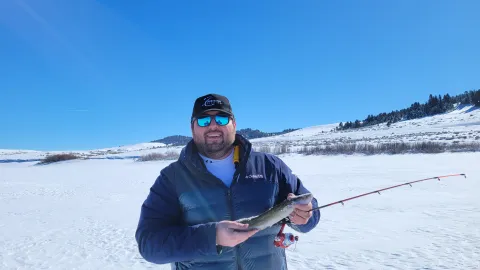
Of course, we need to highlight ice fishing for those diehards who want to fish 365 days of the year. Fishing in the cold is a different beast entirely. Ice fishing brings its own charm - quiet mornings, the crunch of snow under boots, and the anticipation of watching a rod tip bounce in a frozen world. But cold weather affects every style of fishing. On ice, preparation is everything. Safety first: checking thickness, watching for pressure ridges, and carrying ice picks. Cold affects gear too - line stiffens, reels freeze, and bait loses its appeal faster. The cold weather often means slower fish metabolism. You might need to downsize your presentation or slow your retrieval. Cold weather demands patience. Fish move slower, bites can be subtle, and comfort becomes a balancing act. But there’s something special about those crisp winter days, the kind where your breath hangs in the air and the world feels still. And remember those cold ones during the sunny days? Well, a warm hot chocolate with a little extra kick might help you relax and enjoy the sights and sounds of the winter cold.
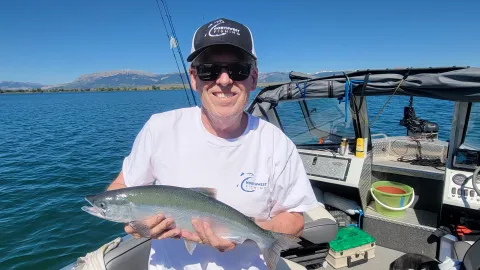
I must save my favorite element for last - the wind. Wind is the great disruptor. It can turn a calm lake into a washing machine and a peaceful river into a challenge. But wind isn’t always the enemy. On a boat, wind can push baitfish into certain areas, creating feeding zones. It can also make boat control a full-time job. You’ll find yourself adjusting speed, angle, and even lure weight to compensate. From shore, wind can be your friend or foe. Casting becomes a battle, but a wind-driven current can bring fish closer. Wading in wind requires caution - waves can distort your footing, and gusts can make casting unpredictable. Preparation is about stability. Heavier lures, stronger lines, and layers that block wind chill are key. To be frank, the wind really annoys me. If there’s ever a day to skip fishing, it might be when those windy days come blowing in. For those wanting to battle this element, I wish you good luck - you probably won’t find me out there!
Fishing in varied weather teaches you to be flexible. You learn to change lures, adjust depth, switch techniques, and rethink your approach. You learn to read the sky as much as the water. And you learn that every condition offers opportunity - if you’re willing to adapt. Some of my favorite memories come from days when the weather shifted dramatically. A sunny morning turning into a windy afternoon. A cold front is rolling in unexpectedly. A rain shower that brought the bite alive. Those moments force you to think, to adjust, and to appreciate the challenge. But here’s the part we don’t talk about enough: sometimes it’s okay to call it quits. There are days where the wind is too strong, the cold too biting, the rain too relentless. Days where safety becomes a concern - slick rocks, unstable ice, or unpredictable waves. Days when the fish simply aren’t cooperating, and you’re fighting the elements more than enjoying the experience. Walking away doesn’t mean failure. It means respect - for the water, for the weather, and for yourself. Fishing is supposed to be enjoyable. It’s supposed to bring peace, challenge, camaraderie, and connection. If the elements take that away, there’s no shame in packing up, heading home, and trying again tomorrow.
Whether you’re fishing under a blazing sun, steady rain, biting cold, or stubborn wind, each condition shapes the experience. Each demands preparation, awareness, and adaptability. And each offers its own rewards. Fishing in varied weather isn’t just about catching fish - it’s about embracing the unpredictability of the outdoors. It’s about learning, adjusting, laughing, and sometimes shaking your head at the sky. It’s about the stories we tell later, the memories we build, and the appreciation we gain for the places we love. And at the end of the day, whether you’ve caught a monster, limited out for the day, or simply caught a moment of peace, you can be proud that you spent your time outside doing something you love.
/articles/battle-fish-not-weather-matt-carey
Destination: Oxbow Reservoir for Smallmouth Bass by Gary Lewis
An angler can catch bass in the Snake River reservoirs year-round, but the fishing really starts to get good in July.
Cousin Neil turned the North River sled in a tight arc out of the narrow launch and pointed the bow downstream. We would fish both sides of the lake, looking for the seams and breaks in the current where bass tend to stack to ambush bait coming downriver. The kids' rods were rigged with jig heads and plastic Keitech baits. I started with crankbaits and the Realis spybait, which is one of my favorites, but I could not help but notice that the other guys were catching more fish.
Oxbow Reservoir is part of a complex of three reservoirs, all built and maintained by the Idaho Power Company. At the top of Hells Canyon on the Snake River, bounded by Oregon on one side and Idaho on the other, Oxbow Reservoir is thirteen miles long and only a couple of hundred yards wide at its widest point. The dam itself is 175 feet tall. Hells Canyon Reservoir is directly downstream, and Brownlee Reservoir is directly above. To get to Oxbow out of Oregon, we head to Richland, turn at Halfway, then drop down Pine Creek to Copperfield. Oxbow Reservoir can be accessed either through Richland and Copperfield on the Oregon side or via Cambridge on a long and windy road leading north out of Boise and Fruitland.
Fishing in any of these reservoirs, a person can expect to catch smallmouth bass, crappie, sturgeon, trout, and catfish. These waters are rich in nutrients, and the fish grow fast. My cousin's kids are growing fast, too. Tabor and Steyr have been fishing since before they could walk, and their dad, my cousin Neil, will drop everything to get them on the water in the summer. And there is nothing I like better than going fishing with my family.
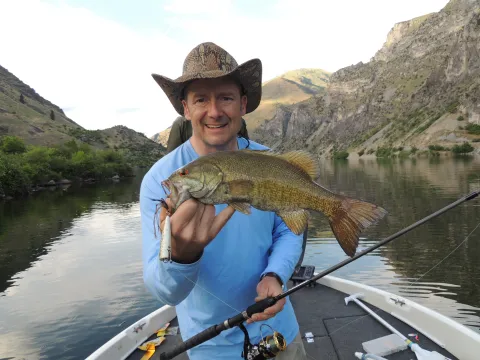
A nice bass taken on a surface lure in an evening's fishing on Hells Canyon Reservoir. Crankbaits and minnow imitations work very well in these Snake River reservoirs, especially along the ledges and around submerged structure.
A FOOD-RICH FISHERY
Smallmouth bass prefer warmer, flowing water and can be found in great numbers around weed beds, grassy banks, along the seams of riffles, deep along rock walls, and in gravel flats. On clear summer days when the sun is high, the biggest fish will be found in deeper water. On overcast days or when the sun is low on the horizon, smallmouth can be caught on or closer to the surface. They are aggressive predators, feeding on smaller fish, insects, leeches, snails, and crayfish.
Crankbaits and minnow imitations work very well, especially along ledges or around submerged structures. We try to use patterns and colors that imitate local baitfish. Chub, perch, and rainbow pattern crankbaits work well for minnow imitations. Orange and olive crayfish patterns are good crankbait options, too. Another good tactic is to dead-drift a plastic swim bait, allowing it to tumble through the best bass-holding water.
A person can catch fish all day long on these Snake River reservoirs, but it makes sense to take a break midday and rest and refuel.
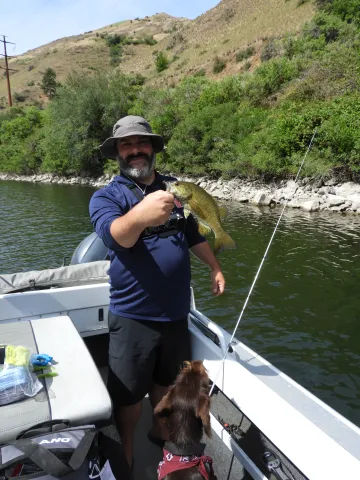
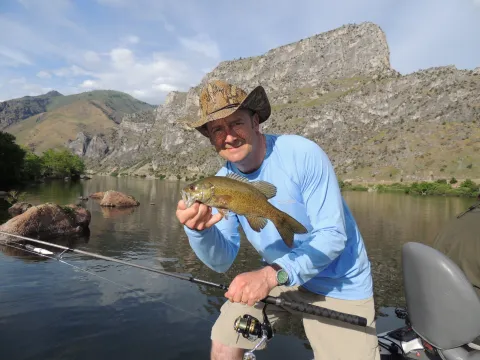
Trevor Barclay with a nice smallmouth on a jighead and a motor oil pattern curlytail grub.
THE SNAKES
The Snake River was not named for the snakes along its banks. It was named for the Snakes, the Shoshone speaking people that Lewis and Clark found and traded with. They were called the Snakes by their neighbors for the way they signed about who they were - the willow weavers.
But there are snakes, too. Rattlesnakes and bullsnakes - and it helps to know the difference. Although bull snakes don't act friendly, they are a much better neighbor than a rattler. You can tell them apart by looking at the heads. The bullsnake's head is narrower, while a rattlesnake's head is shaped like a wedge.
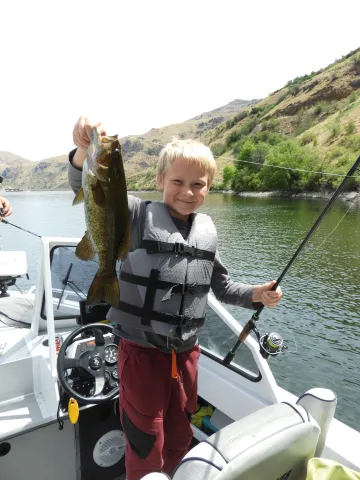
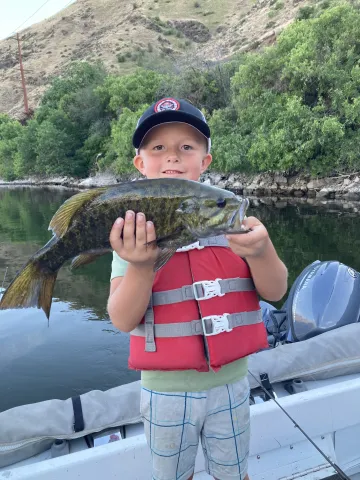
Steyr Lewis, of Fruitland, Idaho, shows off a chunk of a smallmouth caught on a Keitech plastic bait.
TIMING
So when should you go? An angler can catch bass in the Snake River year-round, but the fishing peaks in summer. In a lot of years, there can be heavy flows in the Snake, which tend to keep the reservoir banks full in June. Most years, by the second week of July, the rivers are in good bass fishing shape, and conditions are prime in August, September, and October.
WHERE TO STAY AND PLAY
Huntington, Richland, and Halfway, Oregon, are all within striking distance of Brownlee, Oxbow, and Hells Canyon reservoirs. One of my favorite places to stay is Pine Valley Lodge (pvlodge.com) in Halfway - an old stagecoach stop with all the Old West flavor intact.
Richland, Oregon, is a great little city of 156 people where a fisherman can get a burger or a cup of coffee. Best of all, it is just moments away from the Powder River arm of Brownlee Reservoir.
Huntington is an out-of-the-way stop where you can get a good meal if the restaurant is open. Check the hours before you make the drive.
The traveling angler is going to want either an Idaho or an Oregon fishing license. Or both.
Tabor Lewis was touching up his baits with Pro-Cure's smallmouth magic gel.
BACK ON THE WATER
In the evening, we launched the boat again. Shadows were lengthening in the narrow canyon, and the fish began to rise in the water column.
This is tricky water. It may not look like it, but there are wicked currents. Make sure the children have life vests, and make sure the adults do, too. Especially the boat captain. Who falls out of boats more than any other person? It's the boat captain. And then the people who are not as good at running the boat have to try to rescue him. Think about it, people.
I switched over to the jig head and Keitech system and touched up my baits with smallmouth magic from Pro-Cure. That was the magic touch. A cast on the seam, well up-current, and then tighten up on the reel and feel the bait touch the bottom. If the line seemed to tighten up, it was a matter of cranking the reel fast. The hooks were sharp, and I caught fish fast for about half an hour. But while I was quickly bringing fish to the boat, I didn't catch the big ones. That honor was reserved for the rest of the Lewis clan, who each managed to boat three-pound smallies.
I had a four-pound smallmouth on for a minute. I know I did.
# # #
To watch bass fishing on Oxbow, click this link
https://www.youtube.com/watch?v=A1RdxZ1rkik&t=207s
or search Gary Lewis Outdoors Frontier Unlimited.
/articles/destination-oxbow-reservoir-smallmouth-bass-gary-lewis
Worms, Worms, and More Worms by Mike Carey
Worms – it’s what’s for dinner. If you’re a walleye, that is. Ever since the invention of cane poles, worms have been considered one of the go-to baits for a shore angler. They are portable, easy to obtain, and fish love them. Most of us likely have early childhood memories of going fishing with our Zebco reel, the one that always seemed to get tangled up. A hook, a worm, a couple of split shots, and a round red and white bobber were all that were needed for a day’s adventure at the local pond.
Back in my youth (and that’s a long way back), the nightcrawler was the king of bait. We didn’t buy them, though; we caught them. After planning a fishing trip for the next day, we would wait for darkness to descend. As the streetlights came on, my brothers and I knew it was time to go worm catching! Into the backyard we would go, flashlights in hand. Because, like vampires, nightcrawlers only came out at night. For some reason, I never asked my dad why that was so; I just figured that’s what they did.
Our backyard had a nice-sized garden and several pine trees, and lots of nightcrawlers. There was a trick to catching crawlers that only boys could appreciate. Walking slowly along, guided by our flashlights, we would come upon a big, plump crawler, poking out of its hole, stretched out in the dirt and grass. The next steps at this point were critical. Nightcrawlers don’t like light, so it was vital to move the flashlight beam away from the crawler but still shining enough to be able to see him/her (worms are asexual, a fact we did learn with keen interest). The trick was to hold the flashlight with one hand and slowly reach down with the other to grab said crawler.
Most importantly, you had to grab the crawler at the point where he was coming out of his hole because the instant your fingers touched that crawler, he was crawling back down. As we got good at catching crawlers, it was a matter of gently pulling the frantic worm away from Mother Earth and into our waiting bucket. Now, sometimes the worm would win, and sometimes we would come away with half a crawler, which I guess was a draw, but I never did catch any half-broken worms. We did, however, come across two crawlers in a romantic embrace. If you got both, that was bragging rights for best crawler catcher.
At the ripe age of 67, I have no interest in staying up after dark to catch nightcrawlers that I can easily buy. My sleep time is well worth the $3.50 for a dozen crawlers at the local bait shop. That said, I hate wasting bait. If I come home with nightcrawlers left, I put them in the fridge for another day. Sometimes they last, sometimes they don’t.
Last fall, I started a new hobby, which solved the dying crawler dilemma. Worm composting! Yes, you can have your bait and save it too.
Now I want to say here and now that I did not stumble on this new adventure for any “green” purposes. That said, I am happy to see that a byproduct of worm composting is some highly nutritious soil/fluids for my garden.
More importantly, I can bring home my unused nightcrawlers and add them to my bin of little friends. Now I always have “worms to go” if I want to go after some walleyes (or catfish). No more wasted nightcrawlers, and bait is always available.
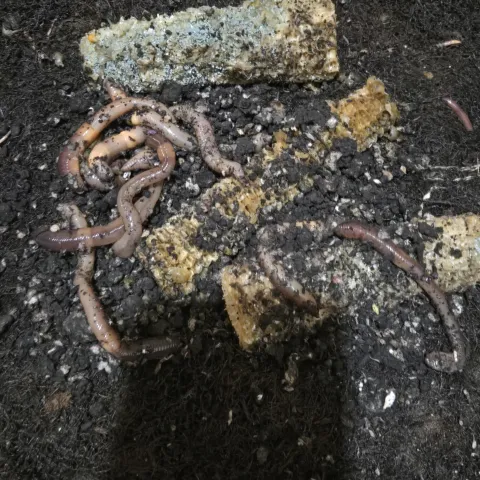
Worm composting is quite easy, and there is a wealth of information on the web and YouTube. You can use very simple setups or spend a lot of money on them. I decided to start with a four-tray system and 100 European Red Wigglers, “starter worms”. These worms are not the larger nightcrawlers anglers are familiar with. They are smaller, perfect for panfish. They are also eating machines, turning fruit and vegetable scraps into nutrient-rich compost and “worm juice,” which will go into my garden this spring. As a bonus, these worms will rapidly reproduce to the capacity of your system, but no more. So, in addition to worm compost for the garden, I will also have excess worms that I can add to my garden to further increase my vegetable yields.
“What about those nightcrawlers?” you ask. To be specific, what you are buying for bait are Canadian Nightcrawlers. With the rich environment the Red Wiggler worms produce, the nightcrawlers I come back with after a fishing trip have a new home to live in until the next time they join me for a trip on the water. The two types of worms do fine together, and my nightcrawlers stay healthy and get even bigger and plumper than when I bought them. Unfortunately, Canadian nightcrawlers are not fast reproducers, and I do end up buying more crawlers, but I no longer toss my remaining bait in the water at the end of a fishing day. Instead, they return home with me to fish another day.
If this sounds like something you’d like to try, there is a wealth of information online and on YouTube that will tell you everything you need to get started. Depending on how fancy you want to proceed, you can go from very inexpensive DIY projects to spending a couple of hundred dollars for everything. Amazon has all types of composting/worm bins for sale. An excellent resource I found to purchase worms and learn more about this fun hobby is Uncle Jim’s Worm Farm.
Raising worms is fun! It’s educational! And it might just get you “hooked” as it did me.
/articles/worms-worms-and-more-worms-mike-carey
Destination Prineville by Gary Lewis
Two reservoirs within striking distance of Prineville offer great fishing for smallmouth bass, crappie, and rainbow trout.
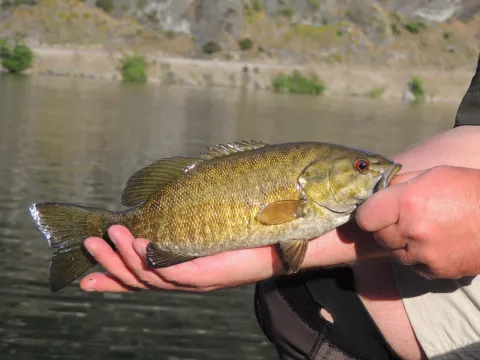
That angry red eye says it all. This fish doesn't like you, nor do the rest of his kind. Looking for a fight? You don't need to go any farther than right here. Two reservoirs in Central Oregon offer good fishing for smallmouth bass, and the top months for smallies are June, July, August, and September. The Central Oregon Bass Club regularly meets for tournaments on Prineville Reservoir. Once, I got a chance to fish in one of those tournaments, and our team had a shot at the trophy if one of us was able to get a big fish in the boat. As luck would have it, I hooked the money fish.
We fished Senko plastics that day, rigged "wacky-style," and bounced our baits off the rock walls and twitched them down deep. We battled the red-eyed brawlers all morning long with an eye on the clock for the weigh-in at 1:30 in the afternoon. Along a steep vertical wall, I cast to a broken fragment of boulder, watched the bait fall out of sight, twitched it once, and felt the 'tick' as a bass sucked it in. This one put a good bend in the rod, and just before I had a visual on it, she threw the hook. So went my dreams of getting the biggest bass of the tournament.
Any soft plastic worm can be rigged wacky. Simply run a worm hook through the middle of the worm such that both ends of the worm wiggle as it falls on its way to the bottom. Twitch it a little bit on the way down to entice a strike on the fall. When it hits bottom, hold the bait in place and impart a twitch through the rod tip and down the line to make the ends of the worm wiggle again.
Prineville Reservoir was created with the completion of the 245-foot Arthur R. Bowman dam in 1961. The Crooked River began to backfill the side canyons and rimrocks. A ranch, its buildings, and roads were claimed by the water. The new earthen structure backed up 150,000 acre-feet of water for a total of 3,136 surface acres and a depth of 130 feet.
As the water filled the arroyos of the Crooked River and engulfed the rocky outcroppings above the channel, a classic smallmouth bass habitat began to take shape. As soon as the water levels stabilized, smallmouth bass were planted and began to colonize the rocky points throughout the lake.
Six boat ramps are sited around the lake to provide access to the water. Powder Cove, at Bowman Dam, offers the closest launch from Bend, accessed from Highway 27. Closer to Prineville, there are launches at County Ramp No. 1, Prineville Reservoir State Park, Prineville Resort, and Jasper Point. Roberts Bay East offers access on the south side of the lake across from Prineville Resort. Smaller crafts can be launched in various places besides the developed and primitive ramps.
Although it takes a boat to cover the most water at Prineville Reservoir, the best fishing is right at the bank. Look for rockslides where smallies stage to pounce on schools of baitfish that stray too close. In the spring, search out the patches of small-diameter gravel close to woody or rocky structures where smallmouth spawn. Offshore, use electronics and polarized glasses to scout submerged spires and underwater humps that will hold fish throughout the year.
Some of the easiest structures to find are the cliffs where smallmouths stack in the post-spawn. Here they move up and down in the water column, vertically along the rock - shallow in low light and deeper at midday.
While smallmouth bass fishing takes center stage in the summer, the trout fishing and the crappie fishing are just as good. Best bets for trout are to troll in deeper water or present baits off the ledges where trout find cool water. Garlic marshmallows (green or pink) and nightcrawlers fished together are a great bait when employed with a sliding sinker. For crappie, try wind-drifting across the upper lake using red and white jigs tipped with Crappie Nibbles.
OCHOCO RESERVOIR
At full pool, Ochoco Reservoir is 3 miles long and about 5 miles wide and is open to fishing year-round. Fishing is excellent for stocked (and wild) rainbow trout, smallmouth bass, and crappie. The average trout catch is 12 to 14 inches, with bigger fish up to 6 pounds. Illegally introduced black crappie and a small number of brown bullhead are found in Ochoco. Rooster Tails, Mepps, and flashers are good choices on Ochoco. Fly fishing is very popular, but bait fishermen make up the highest percentage of fishermen. Trout move into deeper water as the water warms. In June, July, and August, anglers will have better success fishing nearer the dam with flashers and bright lures close to the bottom. Some people jig for trout, crappie, and bass in the deepest areas of the reservoir near the dam.
The trout limit is 5 per day, 8-inch minimum, and of these, no more than 1 over 20 inches.
Because it is an irrigation reservoir, water levels at Ochoco change dramatically over the year, and surface acreages vary from 120 to 1,100 acres. At full pool, Ochoco averages 30 feet in depth with a maximum of 100 feet near the dam. A few lava outcroppings occupy the banks. Because of the lowering water levels, shorelines will usually be composed of exposed silty bottom and muddy flats. Mill Creek and Ochoco Creek form channels in the reservoir.
# # #
For a copy of the Fishing Central Oregon book, send $30 to Gary Lewis Outdoors, PO Box 1364, Bend, OR 97709 To contact Gary Lewis, visit www.GaryLewisOutdoors.com
/articles/destination-prineville-gary-lewis
Alpine Kokanee Trifecta By Mike Carey
There’s an Alpine Kokanee Trifecta that is often overlooked compared to the more well-known and popular kokanee fisheries. What if I told you that within an hour and a quarter of traffic-free driving from Seattle, you could enjoy pristine Alpine lake fishing with little to no other boats on the water and have the chance to catch generous limits of kokanee every time out? No way, you say? It’s true and waiting for you. But a little planning and tempering of expectations is required. These fisheries won’t yield 18-20” Lake Roosevelt kokanee, but they do have an abundance of under-fished kokanee that will still give you a nice bounty to bring home. Have I got your attention yet?
The Alpine Kokanee Trifecta I speak of is familiar to many, but passed by with a reputation of having small kokanee. I’m here to tell you that it is a myth. While it’s true you won’t find those 20” kokanee, you will find fish that range from 10” up to 14”. The lakes I’m referring to?
Keechelus, Kachess, and Cle Elum. Yup, that first big reservoir as you crest Snoqualmie Pass going east is one of three Alpine Kokanee Lakes that I think you should make plans to visit. Let’s look at them one by one, going from west to east.
Keechelus Reservoir
This lake is the one that we all gaze at as we are driving somewhere else. It’s also the one that, come August, turns into a giant stump field. At 2,408 acres, it’s the smallest of the three lakes. At 2,521 feet of elevation, it’s also the highest of the three lakes. The lake holds rainbow, cutthroat, whitefish, bull trout (which are endangered and are to be carefully released), burbot, and kokanee. Of the three lakes we will look at, this lake probably has the smallest kokanee in it. But check this out – the 2016 stocking numbers for this lake were a whopping 256,892 kokanee! In 2015, it was 265,000, and in 2014, it was 238,000 kokanee. So, bottom line, that’s a lot of kokanee swimming around waiting to be caught!
Here’s the catch (there’s always a catch, right?). This reservoir gets drawn down as the summer progresses. Seriously drawn down, as in not able to launch a boat drawn down. So if you want to fish the Trifecta next year, you’d best plan on hitting this lake first. The primary boat launch is found on the west end of the lake. The earthen dam is on the far east end of the lake. Be aware that this lake, perhaps the worst of the three, is prone to heavier winds and whitecaps. Be prepared to get back to the launch if the wind picks up. The lake is also the least serene of the three lakes, as the constant hum of the freeway and view of semis roaring past are a sharp contrast to the beautiful surrounding mountains. This lake is a one-pole-only lake.
Kachess Reservoir
If you’re looking for a beautiful camping location with stunning scenery, this is your lake. The Kachess Forest Service Campground is one of the nicer ones around. Plenty of camping spots and some larger pull-through sites make it “boat friendly”. The restrooms are - surprise – running water and flush toilets! The boat launch is a two-lane concrete ramp with a nice grade and plenty of surrounding shoreline to pull your boat up on. Winds can be an issue as it’s not in a sheltered location. Parking is good.
Like Keechelus, Kachess holds a nice variety of fish. Rainbow, cutthroat, bull trout (protected), whitefish, and burbot can all be found in addition to the kokanee. As to kokanee stocking, in 2014, WDFW stocked 365,000 fish, 2015 490,000, and for 2016 413,098. You’ll get into the kokanee as soon as you launch the boat. Motor out a hundred yards and watch as your depth finder shows the bottom dropping to 180 feet and deeper. And then you’ll see your fish finder light up with kokanee arches 35 to 80 feet deep. You’ll find fish all the way the length of the lake down to the dam end, over four miles away. But beware: if you head north, the lake shallows up at a choke point north of the launch, and you’ll find yourself in ten feet of water.
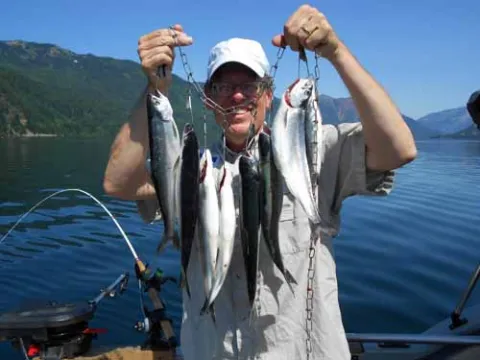
On our most recent trip, we found a great early morning bite that turned off at 8:30am. After an hour of fruitless trolling, we ran all the way down to the dam and were rewarded with good action the rest of the morning. Don’t be afraid to leave non-biting fish in search of the biters! On this trip, we also caught and safely released a powerful 16” bull trout. What a thrilling fight on kokanee gear. We hooked him at 55 feet deep on the downrigger. To help protect these beautiful fish, bring a knotless net.
Kachess is 4,377 acres and has an elevation of 2,258 feet.
Cle Elum Reservoir
The final gem of our trifecta is Cle Elum Reservoir. Although the farthest of the three lakes, it’s still a day trip for the Seattle-area angler. Cle Elum also has a Forest Service campsite and a nice paved launch (an old road, actually). Not as nice as Kachess, but the scenery is again spectacular, and there is no freeway sound to ruin the experience. Cle Elum also has the nearby town of Roslyn to grab provisions and a nice dinner at the end of your day of fishing.
Cle Elum is the largest of the three reservoirs at 4,566 acres. It’s the lowest lake, at 2,227 acres. As the summer water drawdown lowers the lake, the ramp becomes high and dry. Boaters will then launch among the stumps on the southeast side of the lake by the dam. Watch your props and winds out of the north, as this can be a risky proposition.
The lake holds the same species as our other two lakes, with a notable and significant difference. First, there is Mackinaw trout in the lake.
These fish are on WDFW and the Yakima Tribe’s radar screen to remove from the lake. Why, you may ask, when some dandy lakers up to 15 pounds and more have been caught? Well, in the (hopefully) not too distant future, Cle Elum may join Baker and Wenatchee lakes as a destination sockeye fishery. That’s right; the Yakima Tribe has been working since 2009 to restore a sockeye run to Lake Cle Elum. It works like this: the sockeye are captured at Priest Rapids Dam and transferred to the lake. They then run up the Cle Elum River and spawn. When the fish hatch, they spend 1-2 years in the lake and then leave the lake via a flume around an earthen dam to the Yakima River. From the Yakima River, they will swim to the Columbia, and traveling on another 330 miles, around four Columbia River dams, to the Pacific Ocean.
Here’s more information from the Yakima Nation Fisheries website:
“One thousand adult sockeye were transplanted in the summer of 2009, 2,500 in 2010, 4,500 in 2011, 10,000 in 2012, and 4,000 in 2013. The sockeye successfully spawned in tributaries above the Lake in all years, becoming the first sockeye to spawn in the Yakima Basin in over 100 years. Juveniles from the 2009 brood were observed migrating downstream at Roza and Prosser Dams in 2011. Preliminary data from trapping operations at Prosser indicated a 2011 smolt outmigration of approximately 80,000 sockeye. From July to October 2013, 701 Sockeye migrated to the Yakima River Basin (numbers reported on October 17, 2013). So far, 211 sockeye have migrated back home to the Yakima River Basin (updated July 1, 2014). Once these fish move north to Roza Dam they will be transported into Lake Cle Elum or the Cle Elum River. So far, we have trapped and hauled 4,500 sockeye from Priest Rapids to Lake Cle Elum. We will continue to monitor fish run numbers and trap and haul accordingly (updated July 1, 2014).”
So where are the kokanee, you may ask? Well, WDFW has stopped stocking Lake Cle Elum since this recovery process started. But that doesn’t mean you can’t catch kokanee.
According to a fisheries biologist I spoke with on the subject, some of the kokanee you catch are actually sockeye that have decided to not migrate back to the ocean. Instead, they spend their adult lives in Lake Cle Elum, and then spawn as well in the Cle Elum River. In order to protect the sockeye in Cle Elum, WDFW has placed a slot limit of 9” to 15” on kokanee in Cle Elum. The limits are different in Cle Elum as well. As of 2016, Keechelus and Kachess had ten kokanee limits, not including trout. Cle Elum has a five-fish limit, including trout. Cle Elum is also the only lake of the three to allow the two-pole endorsement. Finally, there is NO limit on lakers, brown, and eastern brook trout. WDFW wants these non-native species out of the lake to benefit juvenile sockeye salmon and encourages anglers to help in that effort. As always, be sure to check current regs for any updates.
There you have it. Three Alpine Lake Kokanee gems, all day trips from the greater Seattle region offer the angler spectacular scenery and fisheries that produce abundant (if not huge) kokanee. With gas prices at historical lows, now is the time to plan a trip to these great destinations and leave the masses behind.
I will offer a couple of words of caution for boating anglers. First, the winds blowing down the mountainsides on these three lakes can kick up and blow whitecaps, especially in the afternoon. So, keep an eye on the weather and be ready to head back in if things start blowing. Second, if you troll with downriggers, be aware that these reservoirs may have trees sticking up from the bottom that didn't get clear-cut. So be ready to bring those downrigger balls up fast!
See you on the water catching some tasty kokanee on these Alpine Lake Gems!
/articles/alpine-kokanee-trifecta-mike-carey
How to Introduce Kids to Outdoor Adventure by Eric Magnuson
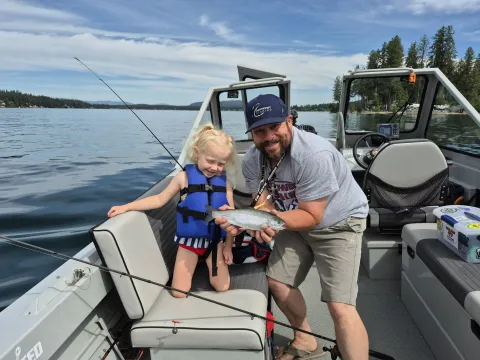
Taking a kid fishing. The first fish a kid catches rarely breaks records. It may be a hand-sized Sunfish, or a fired-up little Bass that barely bends the rod. But if you've ever stepped back and watched a child reel one in, eyes wide, hands shaking, heart pounding, you know it might as well be a trophy. When I take my kids fishing, it's not about the fish; it's about everything that happens around it. The quiet moments, the lessons that sneak in unnoticed, and the "Spark" that can last a lifetime. Whether it's launching a boat at sunrise or walking down a beaten trail to the water's edge. The adventure starts long before the first cast.
Kids don't measure success the same way we adults do. They don't care about the barometric pressure or follow seasonal patterns. For them, it's all anticipation, the smell of the bait, the sound of the motor leaving the dock, or the familiar crunch of gravel under the boots on the way to the water. From a boat, everything feels like an expedition. Something special about pushing off the dock, venturing into the unknown. Kids like to explore, heading into uncharted territory. Let them help where they can, holding ropes, watching the depth finder, or even navigating. From the shore, the adventure becomes more grounded but no less meaningful. Skipping rocks, flipping over logs, and watching bobbers float along in the shallows create a slower, more tactile connection to nature. It's simpler and often perfect for younger kids or first-timers.
Fishing has a way of teaching patience without ever feeling like a lesson. In a world of instant gratification, waiting for a bite becomes a rare and valuable skill. Kids learn that good things take time, and that silence isn't something to fear, but something to settle into. But of course, patience has limits, and that's where we come in.
Tips To Keep Kids Engaged
● Keep it simple; skip complicated rigs and techniques. A basic bobber and worm, or bottom setup, is more than enough. The goal is action, not perfection.
● Target Easy Fish, like Bluegills and Perch. They're abundant and aggressive. Perfect for building that confidence.
● Short trips are key. Don't plan all-day trips; a couple of hours is plenty. Leave them wanting more, rather than them being exhausted and burned out.
● Bring Snacks (Lots of Them). Hunger can derail even the best day of fishing. Snacks double as fuel and morale boosters.
● Celebrating everything from a missed bite to a tangled line becomes a learning moment. A tiny fish? Celebrate it as the biggest catch of the day.
● Let them lead; if they want to cast in a different direction, reel too fast, let them. Discovery matters more than precision early on.
I've always said, fishing teaches more than how to tie a knot or bait hooks. It quietly introduces responsibility and respect. Respect for wildlife, respect for the environment, and for the tools they're using. When a child learns how to handle a fish carefully or release it properly, they begin to understand stewardship of the sport. They start to see the importance of nature and become part of it. And then there's resilience. Lines will tangle, Fish will get away, Weather will change. Fishing teaches kids how to handle disappointment and to try again. A lesson that carries far beyond the water.
Going back to fishing from a boat or shore. A boat, of course, offers the opportunity to cover more water and to fish several different ways while doing so. Can turn into a relaxing boat ride, venturing around the lake, taking in the scenery. But shore fishing has its own fun involved. It's accessible, can be low-pressure, and is a little more interactive for the kids. They have a chance to move around, explore, and stay engaged with the outdoors even when the fish aren't biting. To be honest, it really doesn't matter where or how you fish. What matters is that You Make It Happen!
You can ask any avid angler about their earliest fishing memory, and chances are it involves a parent, grandparent, or mentor. As I said before, it's not about the fish. It's about the time, the people who were present, what was said, and most importantly, how it felt. Trust me, these moments stick. Maybe it was the way the sun looked, rising over the water, or the sound of the birds being busy about the trees, or maybe the sound of laughter after a wild cast. Or maybe it’s the quiet pride of holding that first fish.
When you take a kid fishing, you're teaching them a hobby, giving them a memory they'll carry forever, and maybe one day pass it on themselves. In an age dominated by screens and schedules, fishing offers something rare, and that's unplugged time. It seems to slow everything down and create that space for conversation, curiosity, and connection. While learning about fishing, they will also learn about you and themselves. That kind of connection is hard to replicate anywhere else.
And with my Final Cast before I go.... You don't need fancy gear, a big boat, or perfect conditions. You just need a little time, a bit of patience, and the willingness to share the experience. Because, in the end, it's not about teaching them how to catch fish. But about teaching them to love the water, respect the outdoors, and find joy in the nature given to us. Catching fish? That's just a bonus.
Reel In the Memories!
/articles/how-introduce-kids-outdoor-adventure-eric-magnuson
Summer Salmon are Coming! by Mark Yuasa
That means it’s time to get all the salmon fishing gear in order and begin thinking about the kickoff to several salmon fisheries planned to open in June.
While the tentatively proposed 2026-2027 salmon fishing season package was finalized in mid-April, they won’t be officially adopted until sometime in mid-June.
The rules set by the Washington Department of Fish and Wildlife (WDFW) were submitted to the National Marine Fisheries Service within the National Oceanic and Atmospheric Administration (NOAA) Fisheries in early May.
NOAA Fisheries implements the actions through its regulatory channels under the Endangered Species Act and the Magnuson-Stevens Fishery Conservation and Management Act. Proposed fisheries are not finalized for the 2026-2027 salmon season until NOAA Fisheries approves them.
As part of the North of Falcon process, WDFW is hosting a virtual public hearing on Tuesday, June 9, from 10 a.m. to 12 p.m., and will take additional public comments. Go to this link https://wdfw.wa.gov/events/north-falcon-public-hearing-20260609 to register for the public hearing. Pre-registration is required. Final regulations will be adopted subsequent to that hearing and signed off by the WDFW Director by around mid-June. For a list of the proposed fisheries, go to https://wdfw.wa.gov/fishing/management/north-falcon/summaries. The 2026-2027 fishing regulation pamphlet will come out online around June 18. Printed copies should arrive at license dealers and at WDFW offices by June 26.
In the meantime, before rushing out the door, salmon anglers should check on any early-season summer fishery openers by going to the WDFW website (https://wdfw.wa.gov/) to see what areas are scheduled to open and for any possible emergency fishing rule changes or closures.
Where to Go in June
A much-anticipated early-summer salmon fishery occurs in Marine Area 10 (Seattle-Bremerton Area), which is scheduled to be open daily for a coho beginning June 1. Look for coho averaging 2 to 4 pounds in the shipping lanes off Jefferson Head, from the westernmost Kingston boundary line south to Presidents Point, from the Edmonds oil docks south to Richmond Beach, West Point south of Shilshole Bay, along the east side of Bainbridge Island, and the tide rips off Blake Island, Restoration Point, and the northside of Vashon Island west to Southworth.
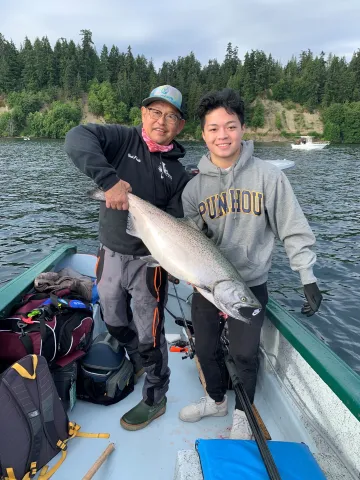
If your preference is a chance at catching an early-summer hatchery Chinook, then look no further than Marine Area 11 (Tacoma-Vashon Island). Fishing is scheduled to be open beginning June 1. These fish usually consist of a mix of resident and mature migrating Chinook averaging 7- to 15-pounds with some in the 20-plus pound category.
WDFW will monitor the June Marine Area 11 Chinook fishery, and it could close sooner in order to stay within the quota and/or other guidelines. The Chinook catch quota for the June fishery is 1,423, with a total unmarked encounter of 820 and a total sublegal encounter (Chinook under the 22-inch minimum size limit) of 2,186. The Marine Area 11 Chinook fishery is managed under two separate summer quotas, and a second window of opportunity is tentatively proposed to begin on July 23.
Look for salmon off Point Defiance Park in Tacoma from the Clay Banks to Owen Beach; Slag Pile off the Tacoma Yacht Club, outside of Gig Harbor on the “flats” area; northeast side of Vashon Island; Colvos Passage; outside of Quartermaster Harbor; and the southwest side of Vashon Island at Point Dalco. In the northern sections of Marine Area 11, try Dolphin Point and Point Robinson on the east side of Vashon Island, south of the Southworth Ferry Landing, and Apple Tree Cove to Redondo Beach.
If Marine Area 11 is slow or closes sooner than expected, another option is south of the Narrows Bridge in Marine Area 13 (South Puget Sound). Locating schools to baitfish is key to raising the bar on success for salmon at Gibson Point, Fox Island Fishing Pier, Hale Passage, Johnson Point, Anderson Island’s east side, and Point Fosdick. Marine Area 13 is scheduled to be open year-round for salmon. Anglers should check the WDFW website or the 2026-2027 regulation pamphlet for details.
Another good Chinook option is the Tulalip Terminal Area Fishery (Marine Area 8-2), which is open Fridays through Saturdays of each week and has a harvest quota of 600 Chinook. The popularity of this fishery has generated some decent action in the past few summers. The WDFW will monitor the Tulalip fishery, and it may close sooner to stay within the harvest quota.
For saltwater anglers without a boat, there are a good number of viable year-round fishing piers to catch salmon. They include the Edmonds, Fox Island, Mukilteo Ferry Landing, Seacrest in West Seattle, Dash Point Dock, Point Defiance Park Boathouse, Les Davis, and Des Moines piers.
If you prefer a freshwater salmon fishery, then make plans to head to the Skagit River (areas open vary depending on the species, hatchery Chinook or sockeye); Cascade River from the mouth to the Rockport-Cascade Road Bridge (opens beginning June 3 on Wednesdays through Saturdays only); and Nooksack River North Fork from Highway 9 Bridge to yellow marker at upstream end of the Kendall Hatchery property open through June 30. Anglers are advised to check the WDFW website for river sections open to salmon fishing and for any possible emergency fishing rule changes or closures.
Ocean Salmon Fisheries on Tap
Later this month – June 20 to be exact, which also coincides with the official first day of summer – many salmon anglers will head to the coast for the Chinook and hatchery coho ocean fishery. The recreational Chinook quota is 54,000 (up a tad from 53,750 in 2025) and a hatchery-marked coho quota of 102,900 (up from 99,720 in 2025).
Marine Area 1 (Ilwaco): Open daily beginning June 20 through Sept. 30, all salmon. The daily limit is two salmon and one Chinook only. The subarea guideline is 16,780 Chinook (16,600 in 2025), and the subarea quota is 51,450 marked coho (49,860 in 2025). Columbia Control Zone closed.
Marine Area 2 (Westport-Ocean Shores): Open daily beginning June 20 through June 28 for all salmon except coho, and the daily limit is one salmon; release all coho. Fishing is then open seven days per week from June 29 through Sept. 30, for all salmon. Beginning June 29, the daily limit is two salmon, and only one may be a Chinook. The subarea guideline is 21,910 Chinook (22,270 in 2025), with a subarea quota of 38,070 marked coho (36,900 in 2025).
Marine Area 3 (La Push): Open daily beginning June 20 through June 30, all salmon except coho, and the daily limit is one salmon; release all coho. Open seven days per week from July 1 through Sept. 30, all salmon. The subarea guideline is 2,200 Chinook (2,280 in 2025), with 2,680 marked coho subarea quota (2,590 in 2025). Beginning July 1, the daily limit is two salmon. Beginning Aug. 1, no chum retention.
Marine Area 4 (Neah Bay): Open daily beginning June 20 through June 30, all salmon except coho, and the daily limit is one salmon; release all coho. Open seven days per week from July 1 through Sept. 30, all salmon. Beginning July 1, the daily limit is two salmon. The subarea guideline is 13,110 Chinook (12,600 in 2025), with a subarea quota of 10,700 marked coho (10,370 in 2025). Beginning Aug. 1, no Chinook retention east of the Bonilla-Tatoosh line and no chum retention.
Species and size restrictions are dependent on the marine area. WDFW fishery managers will monitor the number of salmon caught in-season and may close areas earlier than scheduled if quotas or guidelines are met. In-season management may be used to sustain season length and keep harvest within the overall Chinook and coho total allowable catch.
Looking Ahead
While this column is focused on June fisheries, those looking ahead to July can look at the Strait of Juan de Fuca Marine Area 5 (Sekiu and Pillar Point) and Marine Area 6 (East Strait of Juan de Fuca) west of a true north/south line through the #2 Buoy immediately east of Ediz Hook, which are both planned to open beginning July 1 for hatchery Chinook and hatchery coho. Marine Area 7 (San Juan Islands) and Marine Area 9 (Admiralty Inlet) are planned to open July 16-18 for hatchery Chinook and hatchery coho. Marine Area 10 (Seattle and Bremerton Area) is scheduled to open on July 23-25 for a hatchery Chinook directed fishery and is also open daily for coho through Nov. 15. Marine Area 12 (Hood Canal) south of Ayock Point is proposed to open on July 1 for coho and hatchery Chinook.
Each marine area could close sooner for Chinook fishing if specific catch quotas or guidelines are met. Check the WDFW website or the 2026-2027 regulation pamphlet for areas where Chinook must be released or are closed to salmon fishing, and for other specific rules.
(Mark Yuasa is a Washington Department of Fish and Wildlife Communications Manager and longtime local fishing and outdoor writer. Contributed by Mark Yuasa, WDFW.)
/articles/summer-salmon-are-coming-mark-yuasa
Fishing Small Streams with Traditional Tackle for Salmon, Trout and Steelhead by Brent Knight
I recently had the chance to fish for hatchery winter steelhead in a small tributary stream leading up to and past a state hatchery. This is not a secret spot, but I will not mention the name of this specific location. What I found was that the techniques and practices that I use on larger rivers were no good at this place, and I needed to refine my approach. This took me back at least 30 years to a time when I fished for trout in small mountain streams with spinners and bait rigs.
To start, let's discuss the differences between creeks, streams, and rivers. Rivers, streams, and creeks are all natural, flowing, ribbon-like bodies of water constrained by banks and a bed, with the primary differences being size, flow volume, and their role in the watershed hierarchy. Rivers are generally the largest, acting as main channels, while creeks are smaller, often shallower, and frequently serve as tributaries to larger streams and rivers.
Some key differences include:
Size and Volume: Rivers are larger, deeper, and wide enough for some navigation, whereas creeks are small, narrow, and shallow (sometimes 5-15 feet wide). Streams fit in between, typically 15-30 feet wide.
Hierarchy/Tributaries: Creeks are usually small watercourses that feed into streams, which then feed into larger rivers.
Permanence: Rivers are typically perennial (flow year-round), while smaller creeks might be intermittent or seasonal, sometimes drying up.
Flow Velocity: Creeks are often faster, shallower, and may have more turbulent, steep paths, while rivers have higher volume and move more slowly in wider, flatter channels.
Naming Conventions: Often, the distinction is based on local, regional, or historical terminology rather than strict, universal scientific definitions.
When we think of a stream, we often picture fast-moving water that flows downhill on a typically steeper descent than a river. They are generally full of rocks and gravel, have steep banks and cutouts, and sometimes flow through gulleys or canyons. The water is generally shallow throughout, containing pockets of water behind large rocks, against cutout banks, and in the slower, flatter sections of the stream.
For those of us accustomed to drift fishing, bobber dogging, and floating jigs, worms, and bait - we are a bit out of our element in this environment. Everything must be downsized and simplified as we have very limited water to work with, and the stream topography is very grabby, resulting in lots of snags and lost gear.
For my winter steelhead trip, I came prepared with small stick weights, Dave’s Tangle Free weights, and two shot slinkies to get my gear down. For the terminal end of my gear, I used a single #2 hook with an egg loop and a small piece of yarn. Despite this downsized presentation, my weights were still getting caught in the rocks and I was forced to wade to retrieve my gear or just break it off and start fresh.
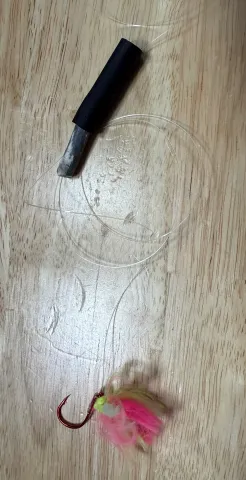
I noticed that other anglers who have been fishing this location for years were employing a different technique, one that I had not seen before. To avoid getting caught in the rocks, they slid a piece of ¼” ID surgical tubing over their mainline and inserted a piece of solid core pencil lead in varying lengths, based on the depth of the water they were fishing and the flow rate. They also employed a single hook with either a cheater/corky or a piece of yarn above the hook. To adjust the leader length, all you have to do is slide the tube up or down the mainline, moving your presentation closer or further from the lead. What I found is that this method of applying weight to the rig was not only simple, but practically eliminated the snags as the gear flowed over the rocks and other snaggy stuff in the stream. When they did get snagged, the lead would pull out, and the fishermen would get their gear back. I know that we want to avoid depositing lead in our streams and rivers as much as possible - and I can attest that during the day that I fished, I only saw one angler lose his piece of lead. This is quite incidental, and the method is very effective in reducing the amount of gear deposited into the stream.
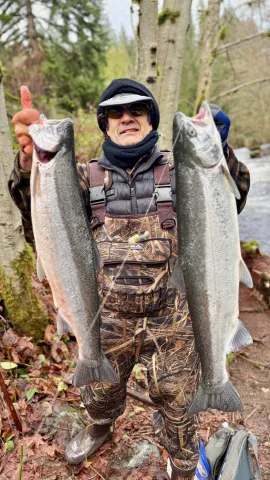
In the deeper pools, more traditional methods may be used, but the weighting system can remain the same. Since the pieces of water are small, the gear must get down quickly to have a chance at holding fish. In the deeper water - beads, bait where allowed, small worms, and other presentations can work. Small spinners can also produce fish when there is enough water.
Keep a couple of things in mind: First, there is very limited space to cast, so you’re really tossing, flipping, or lobbing your gear to the top of a drift. Casting will generally put you in the wood on the other side of the stream. Second, since the water is generally shallow and often very clear, you can sight fish, but keep in mind that if you can see them, the fish can probably see you. It is best to be very stealthy and, when possible, try to get above the fish and let them settle down for a few minutes before you target them. Once they see you, they will be unlikely to strike your presentation until the threat is gone and they feel comfortable again.
One more thing to consider: If you are fishing the lower section of a stream, near the mouth, plan for several techniques. You can often walk the stretch of stream that you are considering fishing to see if there are any fish holding. If you don’t see any conditions, suggest that the fish would move back downstream for cover. The mouth of the stream, where it joins with the river, can be a great place to find fish. Fish will always seek cover, whether it be shade, wood, behind rocks, or in deep pools. At times, they will seek cover in faster-moving water that is broken or riffled on top, offering a layer of protection. When they cannot find these things, they will turn around and head back downstream. Generally, at the confluence, there will be some deeper water, and the fish may stage and hold there until they feel inclined to head upstream again. I love to fish these areas with beads and worms, either under a float or along the bottom. Jigs and worms can be options as well, jigs being one of my favorite techniques to employ in lower, clearer water conditions. Bring out the bigger worms, even in brighter colors, when the water is high or has good color.
As anglers, I think that we all like to be challenged. Streams will challenge you and force you into a different approach. I found it very satisfying and a reminder of my childhood years chasing trout in streams. Give it a shot and have fun.
/articles/fishing-small-streams-traditional-tackle-salmon-trout-and-steelhead-brent-knight