/articles/categories/destination
Five Ice Fishing Destinations in Montana
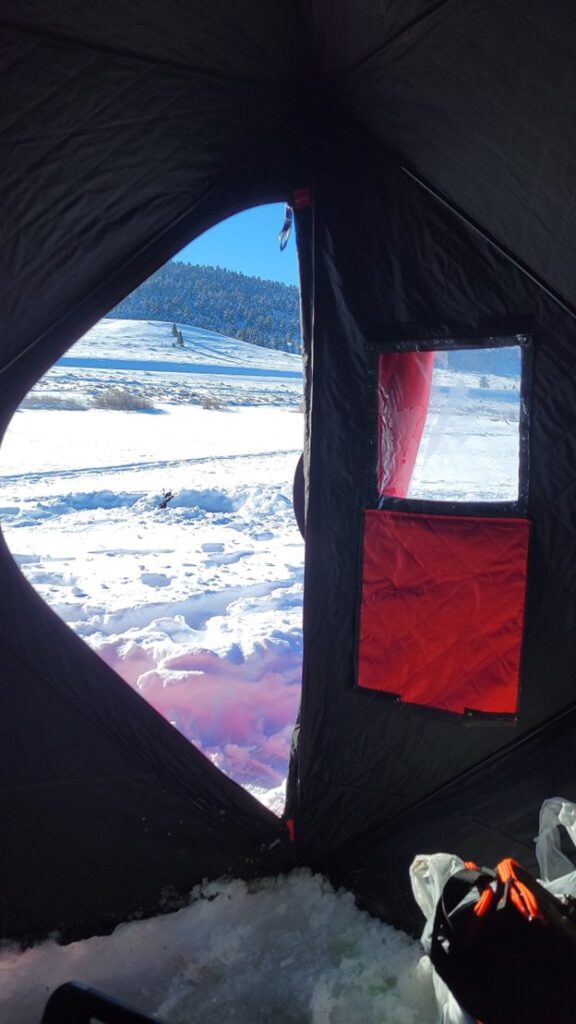
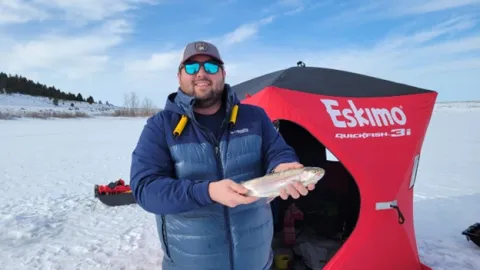
Why stop fishing just because it’s not flip-flops and t-shirt weather? The seasons may change, and the boat may be winterized and put away for storage, but that doesn’t mean we have to stop our fishing adventures. On the contrary, there is something to say about the hard water fishing experience when the temperatures drop. Here in Montana, ice fishing is just another part of the ebb and flow of the outdoor lifestyle many residents share and love. Candidly, I have not ice-fished on these bodies of water, yet. I have, however, fished most of them and we even have several episodes at a few of the mentioned locations with future plans to highlight the other fisheries! Without further ado, here's a detailed exploration of five fantastic ice-fishing spots in Montana. Let's dive into each location to understand why they're great choices for ice fishing enthusiasts.
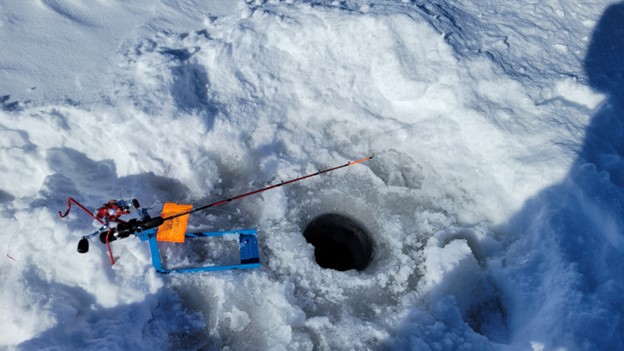
1. Fort Peck Reservoir
Fort Peck Reservoir is a premier destination for ice fishing in Montana. This massive reservoir stretches across more than 245,000 acres, making it one of the largest bodies of water in the state. The reservoir's vast size provides a diverse habitat that supports a variety of fish species, including northern pike, walleye, lake trout, and smallmouth bass. You may recall a chinook salmon episode filmed in the late summer with the NWF crew and Shelby Ross of Ross Outdoor Adventures. While the chinook are certainly appealing, the ice fishing appears to be in its own class as well!
The reservoir's northern pike population is particularly noteworthy, with anglers regularly catching specimens of over 20 pounds. During the winter months, these fish are more accessible as they move into shallower waters under the ice. Ice fishing at Fort Peck requires careful planning due to its size and the potential for rapidly changing weather conditions. However, for those willing to brave the elements and the drive, the rewards can be substantial.
Local guides and outfitters offer ice fishing tours and equipment rentals, which can be particularly helpful for those unfamiliar with the area. The reservoir's remote location also means that anglers can enjoy a relatively undisturbed experience, surrounded by the stark beauty of Montana's winter landscape. The isolation is perhaps one of the major draws to the area - Circle, MT, just southeast of Fort Peck, is the farthest location away from a Starbucks in the contiguous United States.
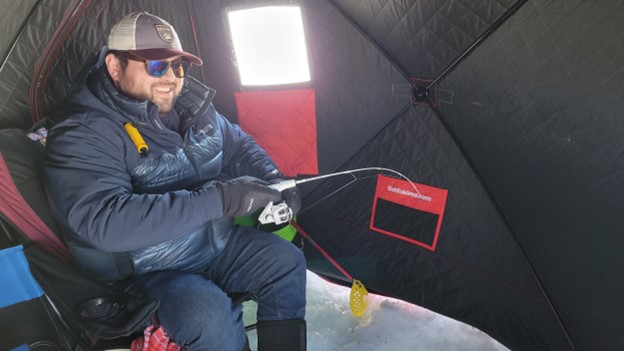
2. Georgetown Lake
Georgetown Lake, located in the picturesque Anaconda-Pintler Range, is a popular ice fishing destination known for its abundant kokanee, rainbow, and brook trout populations. The lake sits at an elevation of over 6,000 feet, and its high altitude ensures solid ice cover during the winter months. Georgetown has been on my radar as a location to fish since picking up ice fishing - and for great reason.
One of the appealing aspects of Georgetown Lake is its accessibility. The lake is located near major highways, and there are several public access points with ample parking. This ease of access makes it a convenient option for both day trips and longer stays.
Rainbow trout are the primary target for ice anglers at Georgetown Lake. These fish can be found throughout the lake, but they often concentrate around the mouths of tributary streams where they feed on insects and other small organisms. Anglers typically use a combination of jigging and tip-ups to entice the trout, with small jigs tipped with worms or maggots being particularly effective.
In addition to rainbow trout, Georgetown Lake also hosts a healthy population of brook trout. These fish are often found in shallower waters and can be caught using similar techniques to those used for rainbow trout.
Outside of trout, the kokanee salmon bite makes Georgetown an attractive ice fishing location. There is no limit on kokanee and seeing some of the photos others have taken, they do not appear to be in short supply. The lake's consistent ice conditions and reliable fish populations make it a favorite among local anglers.
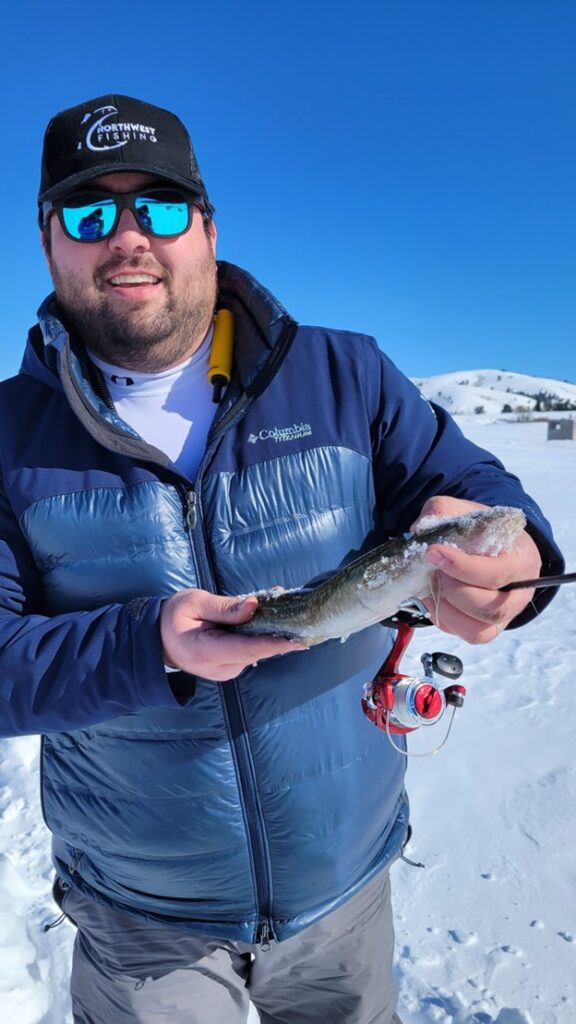
3. Canyon Ferry Lake
Canyon Ferry Lake, located just outside of Helena, is another top-notch ice fishing destination in Montana. This large reservoir spans over 33,000 acres and is known for its healthy populations of walleye, yellow perch, and rainbow trout.
One of the unique features of Canyon Ferry Lake is its relatively shallow depth, which helps maintain stable ice conditions throughout the winter. The lake's shallow waters also make it an ideal habitat for walleye and yellow perch, which are the primary targets for ice anglers.
Walleye can be found throughout the lake, but they often concentrate around submerged structures such as rock piles and drop-offs. Anglers typically use jigging techniques with lures that mimic small fish or insects to attract walleye. Tip-ups baited with live minnows are also effective for targeting these predatory fish. A recent walleye fishing trip with Mackenzie River Pizza Co. saw us bottom-bouncing for several nice eater-sized fish. It’s reasonable to assume that ice fishing would produce a similar yield.
Yellow perch are another popular target at Canyon Ferry Lake. These fish are known for their schooling behavior, and once a school is located, anglers can often catch multiple fish in quick succession. Small jigs tipped with worms or maggots are the preferred method for catching yellow perch, and the use of electronic fish finders can help locate schools of fish under the ice.
Canyon Ferry Lake's proximity to Helena makes it a convenient destination for both local anglers and visitors. The lake's abundant fish populations and reliable ice conditions ensure a productive and enjoyable ice fishing experience.
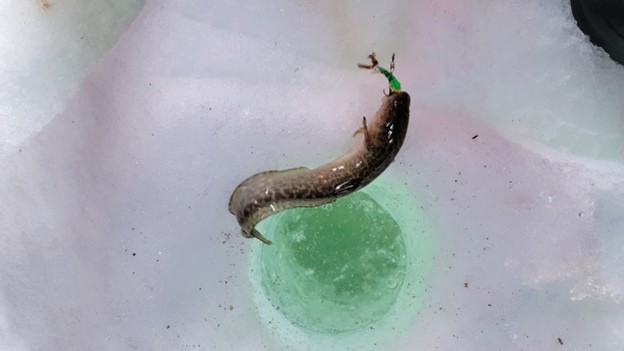
4. Lake Mary Ronan
For those seeking a quieter and more secluded ice fishing experience, Lake Mary Ronan is an excellent choice. Located west of Flathead Lake, just outside of Glacier National Park, this smaller body of water offers a peaceful setting. The lake is known for its healthy populations of kokanee salmon and yellow perch.
Kokanee salmon are the primary target for ice anglers at Lake Mary Ronan. These landlocked sockeye salmon are prized for their fighting ability and, of course, delicious flavor. Kokanee can be found throughout the lake, but they often concentrate in deeper waters during the winter months. Anglers typically use small jigs or spoons tipped with maggots or corn to attract kokanee. Electronics such as fish finders can be particularly useful for locating schools of these fish under the ice.
Yellow perch are another popular target. These fish can be found in shallower waters and are often caught using small jigs tipped with worms or maggots. The lake's clear waters and abundant vegetation provide an ideal habitat for yellow perch, and anglers can expect consistent action throughout the winter.
Lake Mary Ronan's scenic surroundings and peaceful atmosphere make it a great destination for those looking to escape the hustle and bustle of more popular ice fishing spots. The lake's relatively small size also makes it easy to navigate, ensuring a productive and enjoyable experience. An opportunity to combine ice fishing, a scenic view and a historic area make Lake Mary Ronan an ice fishing paradise.
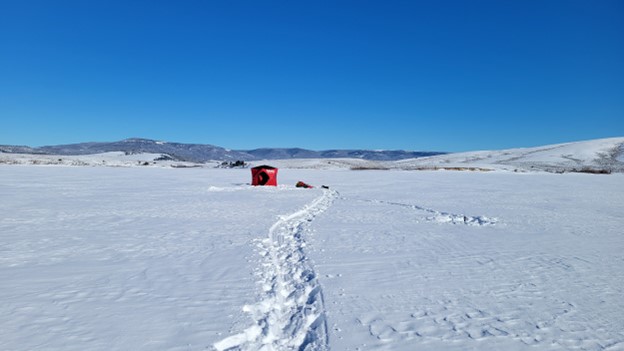
5. Hebgen Lake
Sticking with the “lakes close to national parks” theme, Hebgen Lake, located near West Yellowstone, is a renowned ice fishing destination known for its populations of rainbow and brown trout. The lake's proximity to Yellowstone National Park adds to its appeal, offering stunning views and a unique winter fishing experience.
Hebgen Lake is one of the first bodies of water in the region to freeze over each winter, providing early ice fishing opportunities. The lake's large size and diverse habitat support healthy populations of both rainbow and brown trout, making it a favorite among local anglers.
Rainbow trout are the primary target for ice anglers at Hebgen Lake. These fish can be found throughout the lake, but they often concentrate around the mouths of tributary streams and areas with submerged vegetation. Anglers typically use jigging techniques with lures that mimic small fish or insects to attract rainbow trout. Tip-ups baited with live minnows or worms are also effective.
Brown trout are another popular target at Hebgen Lake. These fish are often found in deeper waters and can be caught using similar techniques to those used for rainbow trout. The use of electronics such as fish finders can help locate schools of brown trout under the ice.
Hebgen Lake's stunning winter scenery and reliable ice conditions make it a must-visit destination for ice fishing enthusiasts. The lake's proximity to Yellowstone National Park also provides opportunities for wildlife viewing and other winter recreational activities. The Madison River Fly Fishing episode with The Rainbow Valley Lodge from this past season was filmed just a few miles north of Hebgen Lake. Imagining those picturesque mountains in the winter season with fresh snow would instill a sense of the rugged west in anyone.
/articles/five-ice-fishing-destinations-montana
Fishing Destination Zeballos
The scream of the reel as the broad shouldered king salmon took another run was music to my ears. The single action reel handles spun dangerously around as I got my hand out of the way just in time. They don’t call them knuckle busters for nothing and I had learned that painful lesson earlier in the day.
That said, it was a lesson gladly accepted because it meant the fishing action was hot – and indeed it was. Our boat’s fish hold was steadily filling up with the bounty of the ocean in this remote location off Zeballos, on Vancouver Island, British Columbia, Canada.
Ever since I moved to the Pacific Northwest and started going to Sportsman’s Shows, I had the dream of someday fishing a true “destination” fishing location. Wandering up and down the booths, looking at pictures of giant halibut, ling cod, and Chinook salmon, it just got me thinking how much I wanted to try something like this out.
All the maps of far away, exotic places to fish – I wanted to go! But I had other priorities and needs, not the least of which was raising my two boys. They are grown now and moved out of the house, and with a wife encouraging my dreams, my opportunity final came.
We were on the road north to the border crossing as my friends Aaron Borg, Rob Holman and myself began our journey to Zeballos, B.C. Aaron and Rob had driven over the evening before from Spokane and then stayed at my home.
We talked excitedly of the trip and fishing to come. None of us had been out of the country on a fishing adventure quite like this. We had been invited by Northwest Fishing Reports sponsor Adrian O’Connor to come up for a few days and enjoy the fishing and stay at his fishing lodge, Reel Adventures Sportfishing. What can I say? My jaw dropped when Rob had told me we would be traveling to this fishing Mecca in B.C.
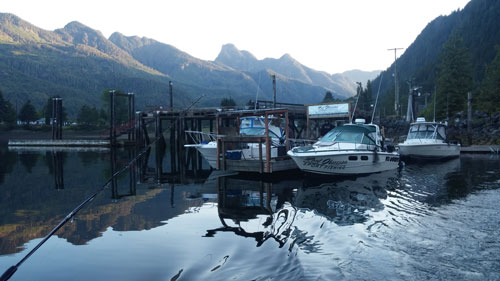
Zeballos is a small, remote town located at the end of Zeballos Inlet on the west side of north Vancouver Island, a little more than halfway along the large island. In days past it had been a vibrant town of a couple thousand. A gold rush between 1938 and 1942 produced a boom town, which quickly faded post World War II when the price of gold collapsed.
The town turned to forestry and fish processing. It’s the tourist and sport anglers that come now to visit now, at least, those in the know.
Our crossing at the border was uneventful. Although, I must admit to being taken aback when we told the border officer our destination was Zeballos, and his response was “Are you making that up?” No officer, and please don’t pull us over and empty our vehicle! But he smiled and waved us on. Next stop, was the ferry crossing at Tsawwassen, due south of Richmond (nearby Vancouver). It’s a two hour crossing from Vancouver to Nainmo. The B.C. ferry system is pretty impressive. Large, comfortable ferries, reservations systems (recommended) and good food on board made the crossing a breeze. Not to mention the beautiful scenery and ever closer Vancouver Island in the distance growing our anticipation with every kilometer travelled (hey, we’re in Canada now, eh?).
I had looked at the map of Vancouver Island many times, and in my mind I imagined winding, narrow, gravel, two lane roads, taking forever to reach our final destination. Imagine my surprise when we unloaded in Nanimo and promptly got on a smooth, four lane freeway.
The road to Campbell River was smooth sailing and the miles, er, kilometers flew by. We gassed up Aaron’s truck and had to do some quick and dirty conversions – let’s see, there are about 4 liters per gallon of gas… but the exchange rate is 22% in our favor… so the cost of gas here is – more. But not that much more, so relax, you won’t go broke filling up your vehicle.
From Campbell River the road did reduce to a two lane road, but it was still a nice road to drive and we made good time. Wooded hills stretched out in all directions and signs of civilization were few and far between. Towns composed of a half dozen buildings became the norm.
Finally, there it was, the turn off for Zeballos! Now things began getting interesting. Our paved road became a gravel logging road. Hills gave way to snowcapped mountains as we first climbed, and then descended through the Haihte Costal Range of the Vancouver Island Ranges, a mountain range that extends along the length of Vancouver Island. Creeks and small rivers worked deep and narrow canyons into the hillsides.
The landscape is likely very little changed from a hundred years ago. There are clear cuts here and there, but nothing like what one sees in Washington. Finally, the descent smoothed out, and a few small, worn houses began to appear. Then more, and final we had arrive, destination, Zeballos. We had a scenic nine and a half hour trip from Seattle by car, two hours of which was a ferry ride. Very do-able and not near as strenuous as I had imagined it would be.
Once we arrived, we met Adrian and his staff, and other guests. This was a Northwest Fishing Reports “Get-Together” of sorts as Adrian had given a special discount to our members and had filled up the lodge with them. We enjoyed meeting fellow NWFR members and sharing stories of fishing past and to come. To cap things off, everyone graciously held up dinner for us. We sat down and Chef Jason promptly appeared to introduce our first dish.
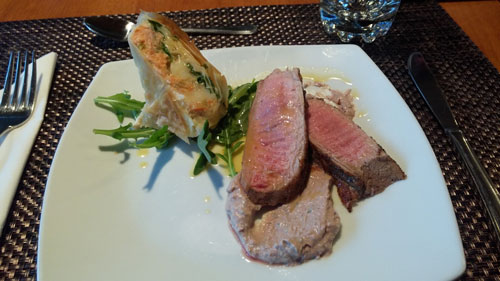
What can I say about Chef Jason? A smile seems to be a permanent part of his personality. Always open to conversation and playing the most cool, eclectic music in the background, he truly made coming to dinner an experience in its own right. Not to mention, Jason has his cooking chops down! Our meals were five star affairs every day. From a quick morning breakfast before fishing, to abundant lunch packs, to afternoon snacks, to appetizers and main courses that had us eating ever last bite off my plate, we ate like kings!
We had the luxury of fishing three days with owner/operator Adrian O’Connor. Adrian has fished these waters for a lifetime and knows the best off-shore reefs and underwater humps to fish, not to mention the migratory habits of the Chinook salmon as they flood into this region every year. With four boats in his fleet we learned that hot bites are shared and his boats get on the fish right away.
The waters leading away from Zeballos, Esperanza Inlet, are breathing-taking in its scenery. First explored by the Spanish in 1774, and then Captain James Cook in 1778, it is the traditional territory of the Nuu-chah-nulth First Nation, who inhabited these lands for thousands of years. The inlet was formed by glaciers during the last ice age, and now attracts anglers, kayakers, divers, and hikers to the wilderness area.
Wildlife is everywhere to be seen, including otters, sea lions, bear, cougar, and bald eagles. As we departed the inlet for open waters we scanned the horizon for killer whales (Orca), migrating gray whales, seals, and porpoises. To Adrian’s surprise, however, we instead got to see a pilot whale leisurely swimming along, its large tail fully revealed as it sunned itself.
Once on the open ocean we tolerated the swells and moderate chop until a short time later we reached our anchoring locations. Even though it’s about a thirty mile run to this spot, because most of it is in sheltered waters it’s an easy trip. Adrian quickly set us up on anchor in two hundred feet of water. The plan was to start with halibut, and then after getting our limits troll for salmon.
I believe the term is “easy limits”, and that’s just what we experienced. Within minutes of lowering our bait (salmon bellies), Aaron had the first fish, a giant dogfish. Not what we wanted, but no worries, because in the next hour we pulled up our limits of halibut ranging from 15 to 60 pounds, perfect eating size!
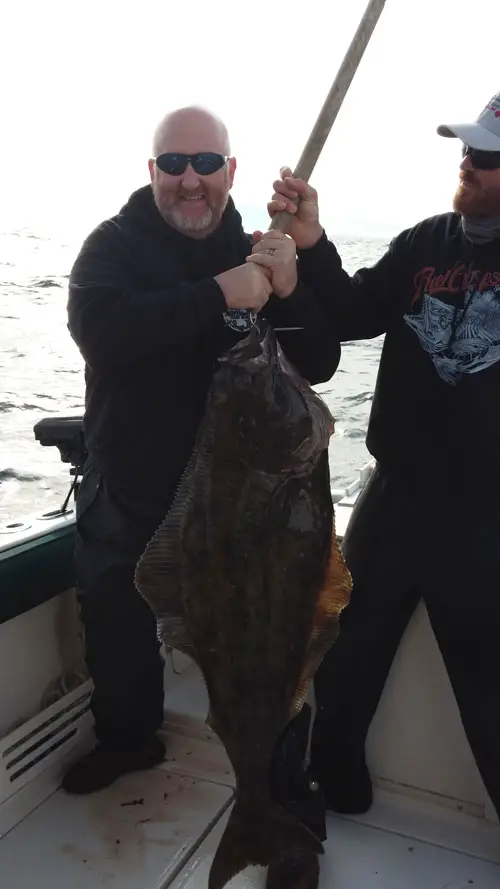
Bigger fish can and will be caught. Adrian reported just the previous week customers having caught one hundred pound-plus sized halibut. They, however, have to go back, as there is a slot limit on these tasty fish. Personally, I was perfectly happy getting my “big” and not having to haul up a hundred pounds of muscular fish only to let it back down. Maybe another time fish…
Adrian pulled anchor and set up gear from trolling Chinook. In Canada the preferred gear is a single action “knuckle buster” reel with a ten foot rod. “These are traditional rod set ups in Canada, you won’t find too many anglers using level winds for salmon”, Adrian explained.
Over the course of the next three days I grew to love this set up – the sporting nature of catching a salmon is greatly enhanced with this gear. With no gear advantage you have to be fast on the retrieve when the fish runs at the boat, and be always ready to remove your hands when they run (or you will have your knuckles “busted”).
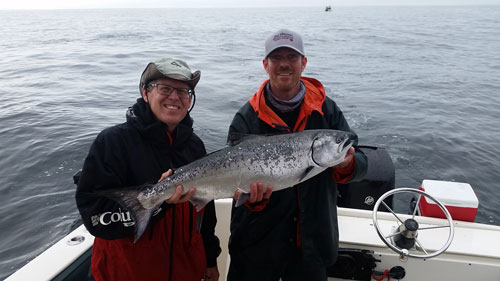
Just like the halibut, we managed to catch our daily limits without too much difficulty. The hot gear was a large flasher with either a 5” spoon or a whole anchovy fished “off the deck”. The bite that deep is kind of subdued, but once off and running these kings put up great fights, running at the boat, taking out line, but ultimately joining our halibut for dinner. The big king of the trip fell to Rob, 25 pounds of delicious springer.
“And now for something completely different”. That’s what came to my mind when Adrian informed us Wednesday he was going to take us to some locations to troll for ling cod and bottomfish. “This should be interesting” I thought. He explained “we’ll be fishing a large underwater reef that has a rocky bottom surrounding a sandy bottom. This rocky bottom is habit to smaller fish and octopus, and it draws in the larger fish. It can produce well for ling cod”.
Before we went trolling for bottomfish, we trolled some near-shore, shallow water locations for chinook salmon. What spectacular scenery! The waves crashing into the rocky shoreline and reefs made for some amazing pictures. Not to mention, a huge sea lion standing watch over his domain and eagles flying overhead. Our port rod exploded in short order and I grabbed the rod. This was a nice king! Multiple strong runs gave me a great challenge on the knuckle buster reel and 10 foot rod - I love this set up! The fish eventually weakened and I was able to slide him into the awaiting net. Wow, what a beautiful fish to start the day!
The salmon bite was slow so it was time to head to our next spot and troll up some lings. We used flashers and bait, using downriggers to get the gear down to the bottom, a few feet off the deck in 120 feet of water. Trolling speed was fairly slow, we were going fast enough to keep the flashers wobbling back and forth, but not rotating.
I’d never trolled for ling cod, nor had Aaron or Rob. It didn’t take too long before we were able to recognize the sometimes light tap tap of a bottomfish. Of course, the lings had a more forceful tap tap. And on release from the downrigger clip it was pretty obvious when we had a ling. We worked this productive location for a couple hours, and caught a lot of fish.
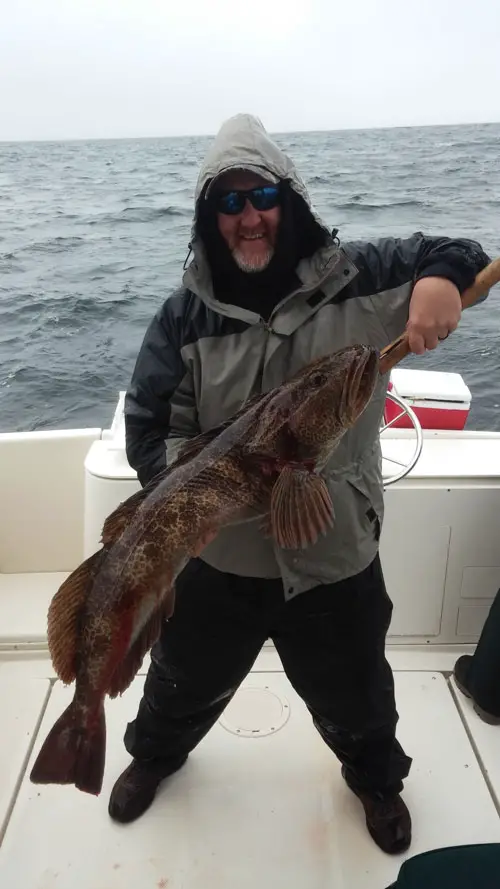
A limit for each of us, in fact. But it wasn’t ling cod we were mainly catching. Nope, instead, time after time huge, brightly colored yellow eyes and vermillion came to Adrian’s sharp gaff. As we hit our limit for vermillion, we could have kept fishing this area for lings, however, rather than stress and kill bottomfish that likely would not recover being caught from 120 feet deep, he decided to move us to another, smaller reef location.
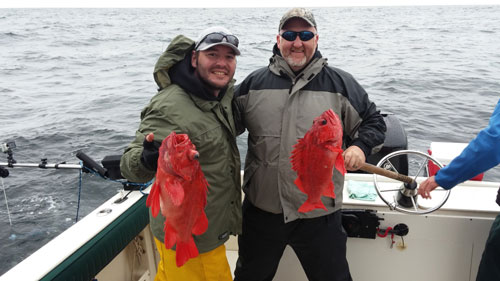
It was a good location change! Within seconds of lowering our first rig the rod doubled over. Aaron grabbed the rod and battled in a beautiful 20 pound ling in to the boat. Shortly after, Rob and I got nice lings. Another pass yielded some smaller lings and with that we were done for the day.
Back at the lodge, Chef Jason had prepared another five star meal. We visited with the other Northwest Fishing Reports guests who reported good fishing and bountiful catches. Just another day in paradise!
Traveling to Zeballos from the Seattle area is not nearly the ordeal I had in my mind prior to the trip. The drive is easy and Canada couldn’t be a nicer place to visit. People are so friendly and polite, and we were welcomed everywhere we stopped. As to the fishing, I’d rate it a slam dunk “10”. And not that I like to think in these terms when I fish, but the amount of fish we brought back at the prices you’d pay in the grocery store amounted to easily a couple thousand dollars’ worth of fresh fish, far superior to anything you’d find in a store. Plus, it’s all processed, vacuum sealed, and flash-frozen at the lodge. My family and friends will be eating like kings for the next year, until we get a chance to do it again!
To book a trip with Reel Obsession Sportfishing give them a call at 1-888-855-7335 or check them out on Facebook, or their web site.
/articles/fishing-destination-zeballos
Conconully Kokanee
Some new products are truly unique, for example, Wiggle Fins. These products create and define new methods and fishing techniques. Other products take a great idea, refine it and make it better. In this category falls a new kokanee fly produced by Arctic Fox Trolling Flies. I had the opportunity to recently tackle test this product on Lake Conconully and came away very impressed. It’s going to be a “go to” lure in my kokanee arsenal.
Denis Peirce, the owner of Arctic Fox Trolling Flies, sent me some flies to try out. He told me they were based on an eighties steelhead fly pattern, the Krystal Bullet. Of course, just making a copy of an old fly is not going to cut it in today’s world of new and innovative kokanee products. Denis knows that, having been in the trolling fly business since 1993.
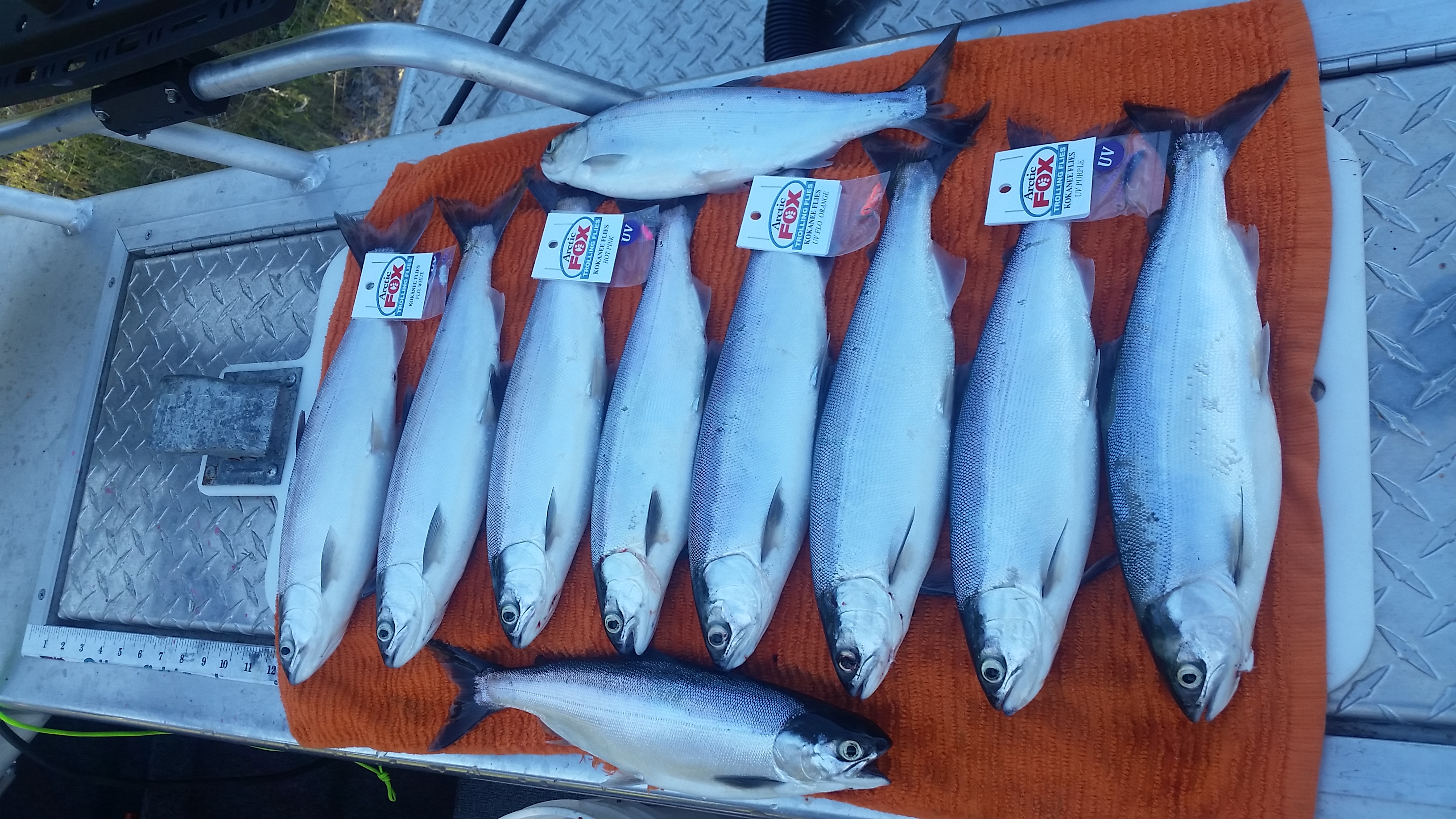
He knows the industry and, more importantly, he has a wealth of knowledge and information about trolling for game fish. Thus far his focus has been on salmon and trout and he has teamed up with Wiggle Fins to make a phenomenal line up of larger trolling flies. It was a natural evolution with the recent explosion in interest for kokanee that Denis turned his knowledge and expertise to kokanee flies. Hence, his new series of kokanee trolling flies.
My wife JoAnn and I took our annual trip to Conconully to try the flies out. We stayed at our favorite resort, Liar’s Cove on the lower lake. The ambiance is family-friendly and the fishing in Conconully around Memorial Day is off the charts! Both the upper and the lower lakes have excellent trout and kokanee action. The upper lake the past few years has produced the larger kokanee so we decided to start our test there.
We ran four lines, two off downriggers and two off leaded core long lines. Each rig had an Artic Fox Trolling Fly and a dodger in front of it. Leader length ran 8-10”. The flies come without leaders. This is actually something I appreciated. If you’re like me, over time a successful lure gets bit a lot and the leader becomes frayed and needs to be replaced.
Unlike hoochie or spinner rigs, single flies are quite easy to quickly replace the leader. Another option I like is the ability to adjust the leader to conditions. For Conconully we ran 12 pound fluocarbon leader. We ran some flies with no attractor, some with a small spinner blade, and some with a Mack’s smile blade. All rigs had a piece of corn on both the primary fly hook and the trailing treble hook.
We started fishing at a leisurely 8am. The action began slow but gradually began to build. At the start, we caught a fish here, a fish there. I can’t say that there was a significant difference between the flies that had attractors and the flies that were “naked”. We ran the downriggers at 35 and 45 feet deep, chasing meter marks. Last year, the downriggers performed well for us. This year, it was a leaded line show. We eventually reached the point where the action was fast enough that the downriggers got put away and we just ran two rods with leaded lines. We trolled with three colors out, and 60 feet of mono leader, trolling at 1.1 to 1.4, using an itroll from ifish solutions to vary the trolling speeds automatically.
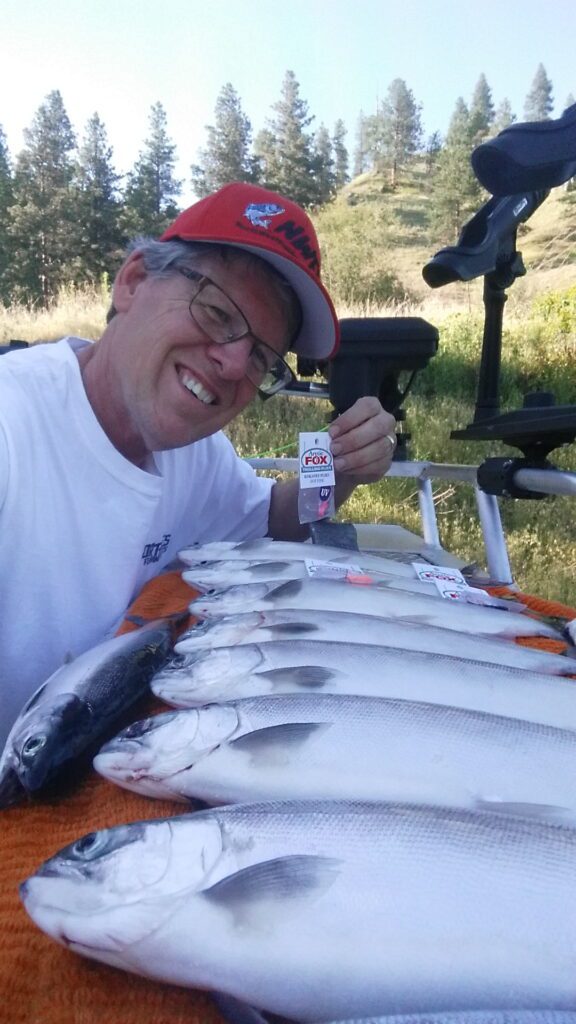
The fish at the upper lake were a plump 14-15” fish, shiny bright. Much to my surprise, later after cleaning the fish I had one hen that spilled mature eggs out. Other than that it was mostly bucks in our bucket. The hotspots for us were up lake of the houses to the narrow north end of the lake. Close to shore, middle of the lake – the kokanee are everywhere right now. Watch out for floating logs and debris. The lake has received more runoff than in past years so there is a lot of debris to avoid.
The Arctic Fox Trolling Flies were an obvious hit with the kokanee. Denis has definitely created an effective series of flies for kokanee.
The Arctic Fox Trolling Flies Kokanee series come in seven different colors. Five are fluorescent chenille and mylar. Denis reports that under UV light these flies are very “hot”, meaning they have excellent underwater color reflection. The two non-fluorescent flies are fire red and purple with silver core chenille. Purple remains visible at depth, while red is one of the first colors to be filtered out by water depth, meaning it turns grey-black at depth. The mylar, however, gives it a nice contrasting UV orange that continues to reflect available light at depth.
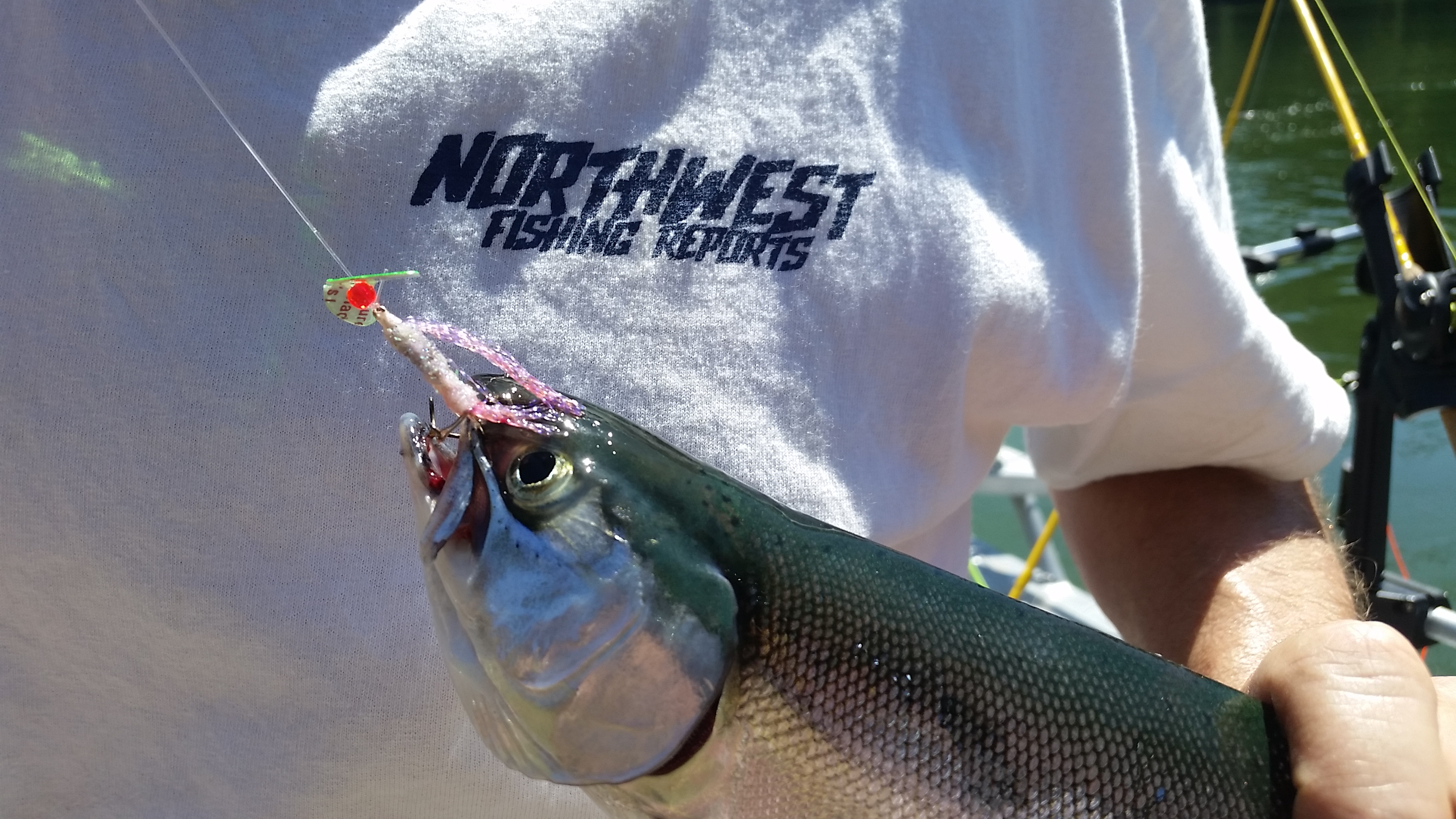
With seven color choices you’ll be able to fish whatever conditions you’re presented with, from cloudy Pacific Northwest to bright Central Washington days. You’ll also have a sufficient variety of colors to find what the finicky kokanee want on any given day.
For us the hot set up was without a doubt the orange with 10” of leader and an orange crush wobbler run at three colors out. The fish were just slamming this set up!
One concern I had when first checking out these flies was the size of the hooks. The main fly is tied on a #8 long hook, and the trailing hook is a #10 treble hook. Denis uses gamakatsu hooks and I will be the first to attest that these hooks are sticky sharp! Our experience was that the combination of these two hooks was incredibly effective.
We had few lost fish and noted several that missed the main body hook but were secured by the treble hook. Remember when I started this article and mentioned “refining” the pattern? Well, Denis has taken the treble hook and secured it using a loop of stainless steel leader that creates an articulation for the treble hook that the fish have a hard time throwing. Put another way, the treble hook is free to move around meaning the fish can’t get leverage on it to pull the hook free. I’ve reviewed underwater footage of kokanee and one thing that struck me was that once a kokanee is hooked it does incredible body shakes and spins in a desperate attempt to get away. It’s amazing we catch any of these acrobatic fish at all! Any small edge an angler can have against these wild gyrations will help land more fish. I would say our hook to catch ratio was higher than trips using standard kokanee lures.
JoAnn and I continued to pull in plump, healthy 14-15” kokanee and over the two days of fishing and easily got our limits. I came away very impressed with the Artic Fox Trolling Fly kokanee series. I’m definitely moving it into my first tier of kokanee lures. I like the smaller size profile compared to the majority of the kokanee lures on the market. It gives kokanee anglers an option to downsize when the fish are looking for a smaller presentation. With the articulated treble hook I don’t have any concerns about losing fish due to the smaller hooks.
Give these flies a look see! You can order them online at Arctic Fox Trolling Flies.
/articles/conconully-kokanee
Five Winter Fishing Options in Central Washington
Central Washington offers some great opportunities for anglers this year including river fishing, open water fishing in big lakes or reservoirs, and ice fishing in smaller lakes. Here are five solid bets for you this winter.
LAKE CHELAN
This 50-mile-long lake in North Central Washington is known for its lake trout, the largest often caught during the winter months. One person who knows this for a fact is Wenatchee resident Phil Colyar, who hauled a 35-pound, 10-ounce Mackinaw out of this lake in 2013. It’s a state record that stands to this day.
While lake trout fishing gets a lot of attention, there are other fish that can be caught during the winter months as well. Brad Wagner, owner of Bobber Down Guide Service out of Wenatchee (www.fishwenatchee.com) reported one of his guides took a couple of clients out on a trip and they came back with not only lake trout, but several kokanee and burbot.
Wagner says the kokanee last year were averaging 14 to 15 inches long. So far post-spawn, the kokanee are running around 12-inches long and most of them are being caught up the lake.
As for the burbot, they were a common sight at the lake until about 15 years ago when a virus nearly wiped them out. Wagner says the burbot population has bounced back though and if you jig for them in rocky areas about 150-feet below the surface, there is a good chance you will tie into one.
RUFUS WOODS RESERVOIR
The record lake trout may have been taken at Lake Chelan but the record resident rainbow trout was caught out of Rufus Woods Reservoir. Norm Butler accomplished that feat on Veteran’s Day of 2002 when he reeled in a 29.6-pound triploid rainbow trout from the 51-mile-long impoundment of the Columbia River above Chief Joseph Dam at Bridgeport.
Many anglers will jig for these trout out of boats near the net pens operated by the Colville Tribe. You can fish from shore on the Colville Reservation side of the reservoir, but you will need a tribal fishing permit to do so. You can also fish from shore on Washington State land just above Chief Joseph Dam or from a federal site called Brandt’s Landing on the Douglas County (east side) of the reservoir a few miles above Chief Joseph Dam.
Many anglers will still fish for their trout here sitting by a campfire. Rick Graybill, a local expert, likes to fish a shrimp and a marshmallow just off the bottom from shore. Others fish worms and marshmallows or even powerbait. If fishing from a boat near the net pens, Graybill will cast spinners, drift Corkies, cast flies, or jig for the trout with either a small piece of worm or shrimp on the jig.
If you have an RV, you can take it to the net pens where a campground has been developed with hook-ups. There is also a boat launch there, but a day or annual pass is required. You can find out more details at https://www.colvilletribes.com/lake-rufus-woods.
ROSES LAKE
Located near Manson, this small lake was stocked heavily in early November with over 10,500 rainbow trout. There is a public access and launch at the south end of the lake and if you don’t have a boat, you can have some success fishing from there before the lake freezes. After the lake freezes, this fishery really shines as an ice-fishing destination. Not only for trout, but also for warmwater species like bass, perch, crappie and bluegill. Better yet, you are allowed to use two rods here as long as you have your two-rod endorsement.
BONAPARTE LAKE
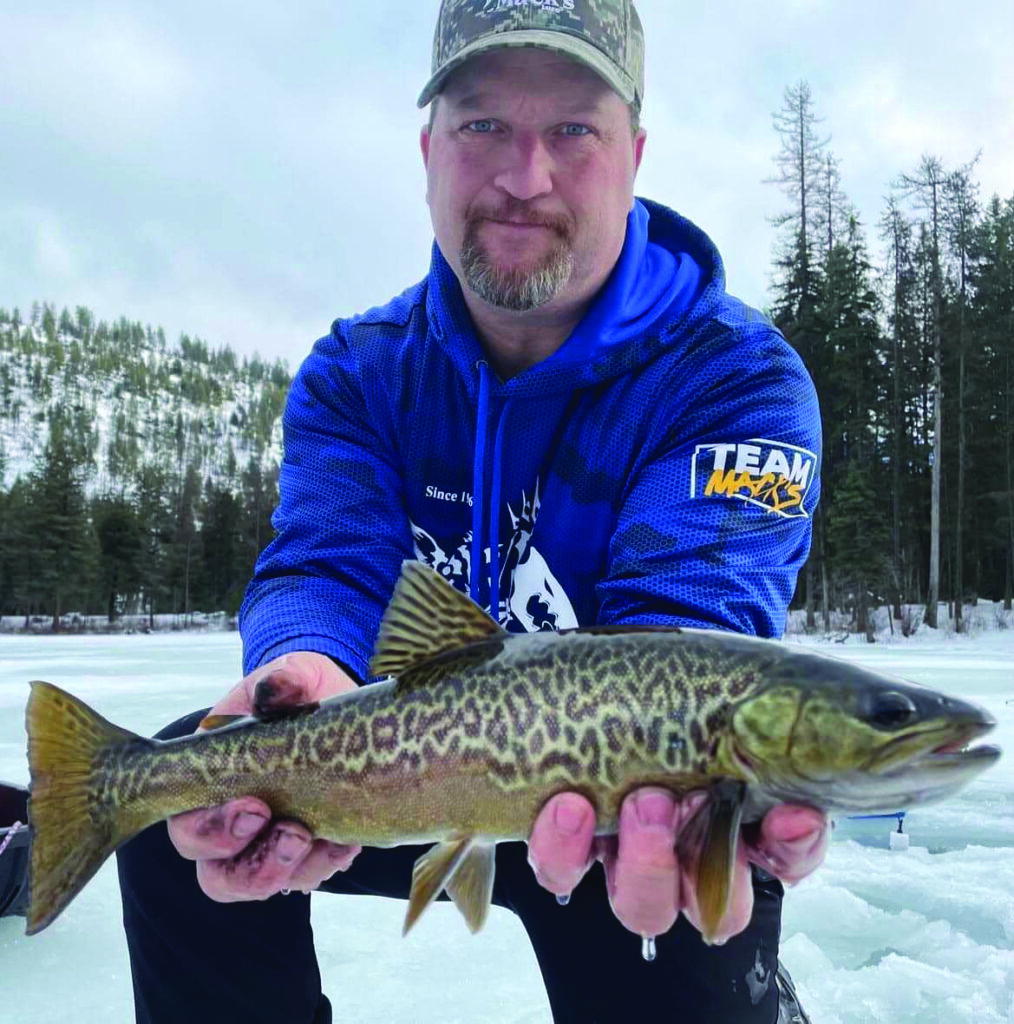
Chris Marcolin, a pro-staffer for Mack’s Lure, told me Bonaparte Lake offers opportunities for a variety of trout, including tiger, brook and rainbow trout that can be caught under the ice. Anglers can also reel in kokanee, smallmouth bass and if they’re lucky, catch one of the lake trout there.
The Third Annual Bonaparte Lake Ice Fishing Derby will take place on January 25th, 2025 with Ground Zero being Bonaparte Lake Resort. Last year, over 400 people attended the event and close to 350 adults and youth contestants fished in it. Stay tuned for details about this through the Bonaparte Lake Resort Facebook Page at www.facebook.com/bonapartelakeresort.
RIVER WHITEFISH
Another option this winter is to head to South Central Washington for mountain whitefish. The season opened for them on December 1st and runs through the end of February on the Yakima, Naches and Klickitat Rivers.
Rob Phillips is the long-time outdoors columnist for the Yakima Herald-Republic and has spent some time wading the cold waters of these streams hunting for whitefish. While you can catch these scrappy fighters with small spinners during the summer it’s a different technique that works in the winter.
Phillips recommends fishing a small nymph close to the bottom with a maximum size hook of #14. Black, brown, and yellow are all good colors, but the important thing is to tip the hook with a live maggot because the whitefish really like that bait.
So, there you have it. You can catch everything from whitefish to lake trout to kokanee to burbot to rainbows, tiger or brook trout as well as bass and panfish. Bundle up and head to one of these destinations and go fishing this winter!
John Kruse
www.northwesternoutdoors.com and www.americaoutdoorsradio.com
PHOTO CREDIT:
Chris Marcolin with a tiger trout caught while ice fishing at Bonaparte Lake – Courtesy Chris Marcolin
Phil Colyar’s state record lake trout – Courtesy Phil Colyar
/articles/five-winter-fishing-options-central-washington
Hoodsport Chum
Editor’s Note – this article was first published in November 2019.
For salmon anglers in the Pacific Northwest, November heralds the final transition from targeting open saltwater to focusing on tidewaters and rivers. Yes, there are some saltwater opportunities (for example, blackmouth, when open), but the vast majority of anglers have put away their boats and are pursuing salmon in the rivers. That said, there are some prime opportunities to target and catch salmon out of your fishing boats, so don’t button them up just yet!
One of my favorite fisheries out of my boat in November has to be the Hoodsport chum fishery. The fight of a 10-15 pound chum ranks up there as one of the hardest fighting salmon you can catch. Taking on a chum with steelhead gear will give you all the battle you could ask for as these brutes slash and pull with every ounce of energy they have. One look at their fighting canine teeth and you’ll know this is a fish that is serious, very serious, about its reproducing goal.
All up and down Hood Canal you’ll find chum as they work their way toward their spawning grounds. The state hatchery at Hoodsport and three miles south of there at Potlatch (a smaller, Native American hatchery) are the destination for many of these chum as they work their way down Hood Canal.
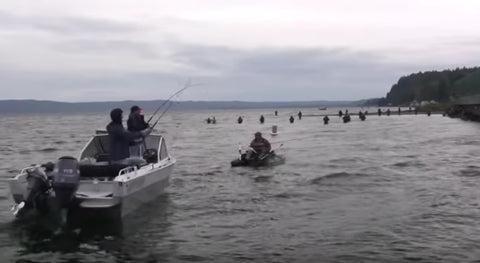
I have caught fish in both locations, and each spot has reason to recommend it. Potlatch, being smaller, has limited shore angling and parking, which is roadside only. That said, there are also fewer anglers there. Hoodsport, meanwhile, is the Fishing Mecca that chum anglers are drawn to. Fishing right out in front of the hatchery and watching hundreds of fish jockey for position as the tide sweeps them into the small feeder creek leading to the hatchery is truly a sight to behold. Of course, along with the fish comes combat fishing in all its glory. As the tide comes in and fishing space decreases getting to know your neighbor takes on a whole new meaning.
If you’re a fortunate one you’ll be fishing out of a boat – or some type of floating device. The waters around Hoodsport are open and the wind can come up and blow hard, plus fast running tides can make it a challenge to get an anchor to set. Be sure to bring an anchor with some bite, and terminal chain so you’ll stick in the rocky bottom. I’ve seen anglers fishing out of all manner of floating devices on calm days, including single person pontoons and float tubes.
Be sure to have your life jackets on and just don’t venture too far off shore. If you are feeling anxious that’s your inner voice telling you a fish isn’t worth your life – pay attention to it!
For boaters, the launch is two miles south of Hoodsport at the Skokomish Park at Potlatch. The launch has two concrete lanes which are in varying state of repair (read that as back down with caution!). There is ample parking, and a restroom. Once launched it’s a quick run to either terminal hatchery, faster to the small Potlatch facility.
When you arrive, survey the already anchor boats, taking into account the amount of anchor line you’ll need to get a solid grip on the bottom, as well as the shore anglers. Anchoring too close to the shore bound anglers will earn you a steady rain of lures and weights at your boat. Stay outside their casting zone - you’ll have plenty of water to work over and opportunities to catch fish the shore anglers don’t have.
As to the type of gear you should bring… you’re going to enjoy a variety of methods to catch these Hoodsport chum. Like chum everywhere, chartreuse and green are always great colors to choose. Pink or cerise is also good color choices.
For rod/reel setups I use my steelhead gear, both spinning reels and casting will get the job done. I like an 8 ½ foot medium action rod. Line should be strong enough to turn these big brutes so as to avoid massive tangle ups with your fellow anglers. I like 18-20 pound test. Chums are not leader shy in my experience so keep things hefty.
What technique you use is up to you but here are a few tried and true methods:
Floats and jigs , or floats and corkies with yarn can be deadly. A ¼ or 3/8-ounce pink, black or purple marabou jig fished under a float is deadly. Tipped with a piece of shrimp meat or coon shrimp tail is even better. The yarn is a nice trick as it helps by getting caught up in the chums teeth, allow you to drive the hook home. Other bait you can put under a float includes the ever popular anchovy or herring, whole or plug cut.
Think of the tide as the river current. Set your depth for the lure so it’s running a foot or so off the bottom. Vary the depth if you aren’t getting bites. These fish will hit suspended jigs. Cast “upstream”, i.e. up into the tide, and let your gear drift down with the tide to the end of the “drift”. If the coast is clear, free spool your line, keeping the float straight up and down to extend the drift. When the float goes under set the hook and be ready to do battle!
Twitching jigs – ditch the float and cast the jig on its own. Another effective technique, but be prepared for a lot of foul-hooked chum. Dragging a chum in by the tail is not fun, nor is it sporting to be snagging fish. If you find yourself foul hooking too many fish move on to a different method…
Casting spinners. Again, it’s a solid technique to try if the action is slow. I personally would remove the treble hook and use a single si-wash hook. A number 3 or 4 blade fished with a slow retrieve is just the ticket.
Corkie, yarn, and slinky. I personally have caught a lot of fish using this method and seldom snag fish. Again, think of the tide as a river. Cast out and let your gear drift. You’ll know you have a bite because your rod will be about ripped out of your hands. I use a 3-4 foot leader length.
Regarding the above technique, I’m sure I’m going to get comments about flossing – I personally think it’s a bunch of malarkey. Why do I say that? Because I remember a day years ago fishing Hoodsport when the chum were in thick, jumping all around us, swimming by in schools of 10-20 fish. I had my corkie/yarn/slinky set up going, casting, retrieving, and not getting a bump for a good hour.
Suddenly, the bite magically turned on and my gear started getting bit. In came fish after fish, hooked in the jaw. Explain to me how one can have a steady procession of fish go by with mouths open for a good hour and not “floss” one fish, then suddenly start catching one jaw hooked fish after another? And trust me when I say this, those hook-ups were solid strikes, not to be mistaken with a snagging sensation. Anyway, the flossing debate is one we anglers love to engage in every year and likely will do so as long as we fish corkies.
The fly fishermen do quite well at Hoodsport as well, fishing sinking tips and flies of various styles and colors. I’m not a fly guy but it sure does look like fun. Maybe my next trip I’ll give it a try.
Before you set out, be sure to check the Hoodsport netting line at 360-877-5222. Typically the nets go in on Tuesdays and Thursdays, but this is not set in stone. There’s nothing worse than driving a hundred miles only to find nets spread in every direction. So save yourself that aggravation before you set out.
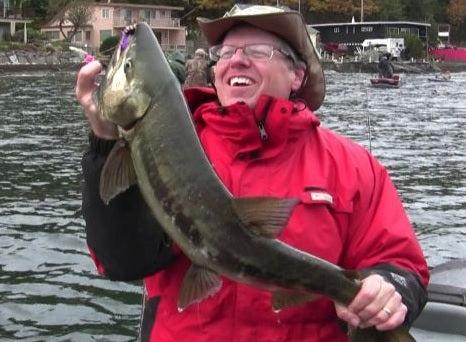
Fishing for hard fighting chum is a blast. Get in on the action this November!
/articles/hoodsport-chum-0
Lake Roosevelt Walleye and Turkey Bonanza
Looking out over the field, darkness still obscured our vision. Out there beyond the field we set up in we could hear the rapid gurgling, gobbling sound made by male turkeys in their tree roosts. Daylight would be coming soon, but meanwhile, I couldn’t get the image from The Blair Witch Project out of my head. I subconsciously swiped at my nose, suppressing a cough, desperate to not make a sound.
Daylight would be coming soon and I didn’t want to be “the new guy” blowing our cover and scaring away our target. It was my first ever turkey hunt. Joining me, were Dave Mason of Toyota and Dan Gabriel of The General Store. Our host, Rick Wakefield, owner of Buck Canyon Lodge, had invited us on this Opening Day of turkey hunting to check out the fine hunting he offers guests on his lodge properties. It was part of a “Cast and Blast” adventure Northwest Fishing Reports were enjoying. The “cast” part of the trip were upper Lake Roosevelt walleyes with Lake Roosevelt Charters.
I had arrived late Friday evening after driving across the state from Redmond to the lodge, located near the town of Gifford. In normal conditions it would have been a not-too-bad five-hour drive, however, a traffic accident going over the pass had set me back a good hour and a half. I arrived tired but excited for what the weekend had in store. Meeting up with the NWFR crew Aaron Borg and Rob Holman, I crashed into my comfortable fleece-covered bed in anticipation of a leisurely 6:30 start time with guides Scott and Todd of Lake Roosevelt Charters. I was excited because of reports they had been posted about deep water jigging for walleye. The pictures of healthy catches of nice-sized eating walleye had my hopes up for bringing home plenty of one of the Pacific Northwest’s tastiest fish, the walleye.
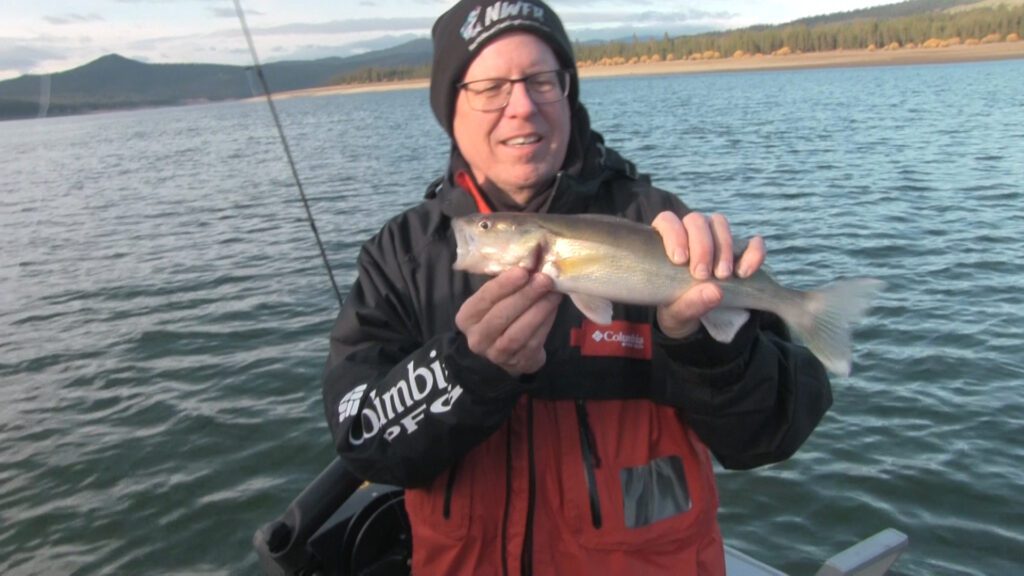
We met at the Hunters boat launch, which was high and dry, but still useable, if a little muddy. No matter, in short order we were off and cruising to a few preferred locations that Scott and Todd had been having success at.
I don’t know that Lake Roosevelt Charters were the first to deep jig for walleye, but I can say they were the first charter I’d ever seen promoting the fishery. I remember being instantly intrigued – jigging up walleye from 121-50 foot depths was so foreign to any other walleye technique I was familiar with that I just had to see and experience it for myself.
We pulled up to our first location and Todd handed out rods loaded with 20-pound Power Pro and one ounce, round jigs, To the jig he added a 4-5” curly tail plastic, and then a half a night crawler threaded several times with just a one inch tail sticking out. Again, very different from the traditional nightcrawler set up of a bottom walker and worm harness. Todd instructed us to let out our line until we made contact with the bottom.
“The trick to this fishery is you have to feel the “tap tap” of the jig as it bounces off the bottom. If you don’t feel that contact you aren’t fishing. Also, don’t make big jigging motions – 5-6” is plenty. The fish are deep and cold, they aren’t chasing after bait.”
I let my line out and at 120 feet could see the braid go slack. I closed the bale and reeled up the slack, starting gently upward motions of my rod tip, raising and lowering and being sure to keep in contact with the bottom. If I felt nothing I let out a little line until again making contact. I continued this technique for a few minutes and then felt the distinct tug and heaviness of a fish on the other end of my rod. Setting the hook, I reeled with steady pressure and soon enough brought up my first ever deep-water jigged walleye, a nice 15” “eater”.
Over the next two days the NWFR gang would catch a lot of these “eaters”. Looking over the vastness of this stretch of the upper Lake Roosevelt and seeing the low angling pressure, I was not surprised at the steady numbers we caught over the next two days. This fishery, while not untapped, is definitely under-utilized. The bites came pretty steadily throughout the day. As with most fishing, we had periods of fast fishing and then slow, but over-all it was pretty consistent. Along with the good numbers of fish we noted they are definitely smaller than what we have caught on the lower stretches of the Columbia River.
Our fish averaged mostly 13-15” with a few fish on either side of those sizes. Todd noted that there are big walleye to be had, but yes, the vast majority were these eater class fish. I’m OK with that – nice stringers of white-fleshed walleye are always welcome at my table! I did notice that the flesh of these upper Lake Roosevelt walleye are a whiter shade than fish we had been catching in the lower reaches of the Columbia.
When it comes to deep water jigging for walleye, wind is your enemy. Current is not an issue on this stretch of the Columbia, but wind will cause the boat to get pushed too fast and, just like salt water jigging, you’ll lose contact with the bottom. When this happens you’ll find yourself letting out more and more line in an attempt to maintain bottom contact. It’s time like this where a good captain knows ways to increase your chance for success.
Captain Scott deployed two large sea anchors, instantly slowing our drift down to a manageable speed. Another strategy is to find shallower water to jig in. Having a bow mounted trolling motor will also serve you well when the wind starts up. Finally, although there aren’t a lot of spots to get entirely out of the wind, guys who fish these waters a lot know the winds and places to move to when the winds do come up. Just one more reason for considering a guide the first time you fish these waters.
We fished until around noon, at which points the winds from the front blowing through made it too tough to fish effectively anymore. It was a decent enough morning. We were looking at around a dozen fish in the boat, and many lost as well. When you’re fishing at 120 feet deep it’s essential to keep a steady pressure on the fish, even with barbed hooks. Fortunately there is another common trait of the winds in this area – they tend to die off later in the afternoon. Scott and Todd were more than happy to bring us in and take us out after a couple hours siesta time. So after getting a power nap we were back out again, fishing from 4-7pm. This bite was actually better than the morning bite – don’t put your gear away! In short, there are fish to be had throughout the day if you’re willing to be flexible.
Darkness slowly gave way to dawn and the gobbling reached ever higher intensities. Soon we heard the first “whoosh” of a bird flying over our blind. Rick quietly announced – "the birds are starting to come off the trees where they roost. It won’t be long now. Get ready!”
I was anxiously anticipating my first opportunity at a turkey. Dave and Dan were old hands at tom hunting and they had given me a primer on Tom Hunting 101 Essentials. I knew the shot I needed to make was a head or neck shot. Hitting the body of a turkey is a low proposition shot. The feathers are thick and hard and act like armor making a “head shot” almost essential. My hunting skills thus far had been limited to pheasants and ducks – which in my experience were fairly easy to knock down, assuming I could hit them! But turkeys – head shots on a bobbing head? I was little intimidated…
“Toms coming from the right”. Rick’s whispered warning had me turning my head to the right and seeing – nothing. I turned and looked straight in front of me and there were three large toms strutting around the decoy Rick had set up. How did those large birds get there so quickly without me even seeing them?!?!?
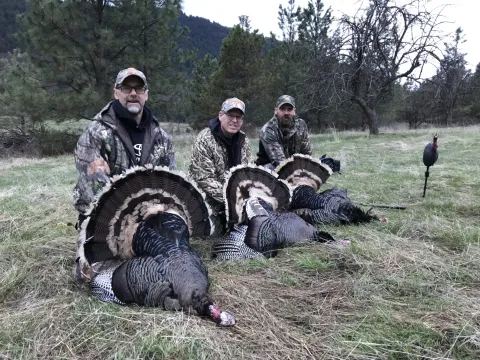
We three hunters slowly raised our guns to level, waiting for the three toms to separate enough that each of us had a clean shot at one bird. It seemed like forever as I hoped the birds wouldn’t startle and run off. Just then Rick gave the single to fire and in unison the three hunters let loose a booming volley of number 4 shot at each bird. It took a fraction of a second to travel the 15 yards to our targets and instantly two birds went down, and the third staggered, then rose into the air, flying over our blind. Three hunters, three shots, three birds! We came out of the blind and tracked down the third bird in the field behind us, around 30 yards away. Claiming this last bird we returned to the other two toms and admired our kills. The birds were all in the 25 pound range, gorgeous feathers and long beards. It was 6:30am and we were done for the day, with plenty of time to go back to the launch and get in more walleye fishing!
If you’re looking for a unique “Cast and Blast” adventure the spring turkey hunting and walleye fishing on Lake Roosevelt are not to be missed. Buck Canyon Lodge is the perfect base camp to take off on your adventures. Hosts Rick and Wendy Wakefield have a beautiful lodge and offer full amenities including provided meals. Rick does guided turkey hunts for guests, or, if you’re not a hunter, stay at the Lodge and get in on the great walleye fishing with Lake Roosevelt Charters. Either way (or both) way you go you’re guaranteed to have a wonderful adventure. The countryside is spectacular, wooded hills and breathtaking vistas great you at every bend in the road. It’s truly a unique experience you’ll remember for the rest of your life!
Visit Buck Canyon Lodge at Buck Canyon Lodge LLC or call 509-722-3949. Lake Roosevelt Charters web site is Lake Roosevelt Charters or call 509-722-3880.
/articles/lake-roosevelt-walleye-and-turkey-bonanza
British Columbia Tuna Time
Timing is everything, especially in fishing. As fishers, we do our best to utilize our logarithmic skills to factor bait, tackle, gear, equipment, safety, weather, time, and environment. Sprinkle on a little bit of hope and you may have a recipe to catch the infamous Canadian Tuna like we did last August in Zeballos, BC in Zeballos, BC with Reel Obsession Sport Fishing.
Nearly a year in the making, last August, we headed out of Spokane to Vancouver Island. Me, Rob, and our two daughters, Cameron and Sarah, headed out on the 700 mile-2 day trip to Zeballos. We had our passports, bibs, maps, lodging itinerary, ferry tickets, snacks, coolers and a navigation plan. We set out to BC hoping to catch the infamous BC Tuna.
Our hopes multiplied as we left Spokane. Rob had been on the horn with Adrian of Reel Obsession and the scuttlebutt was that our timing was right for Tuna. We planned on fishing for Salmon, Halibut, and Bottom fish and the idea of Tuna was a BONUS. All factors were adding up to ideal conditions. The water temperature was right, and the weather was cooperating. Adrian and his fleet were in the Tuna between 20 and 40 miles out when we left Spokane. Our imaginations ran wild as we drove. Would we get there in time?
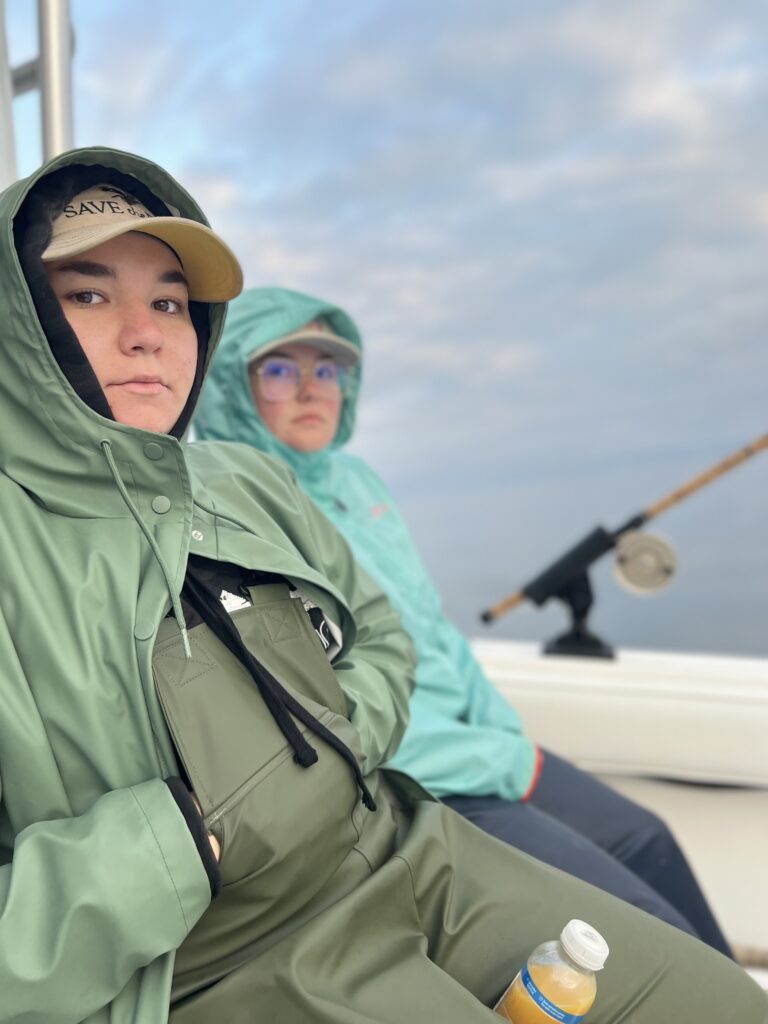
Now, our girls are seasoned on the Salt, and they can travel independently abroad. They were ready for this trip. Their skills would be put to use and pushed. Their mental toughness was developed. They had their own gear, and their stamina was up. The time was right for them to go 40 miles out to sea for a long grinding day of hauling in up to 20 tuna per person as the limit.
It took a while at the border. We were the last truck that loaded the ferry on the last boat of the night. (Planning for this is key. Any delays may affect your ferry sailing)
We got into Nanaimo late and grabbed a hotel. We set out early for Zeballos on the 4-hour drive. We hit a few stores on the way. Zeballos has one small store that is open with limited hours and limited supply, grab your niceties on the way.
Angie, Adrian's wife and Operations Manager, had everything dialed for us upon arrival. Our rooms were great. The main lodge was bustling. Folks gathered around the firepit with a glass of wine to soak up the views while being contentful waiting for dinner. Sitting down for dinner, the buzz was in, the Tuna were still here! We would be getting our shot at the Tuna Dance!
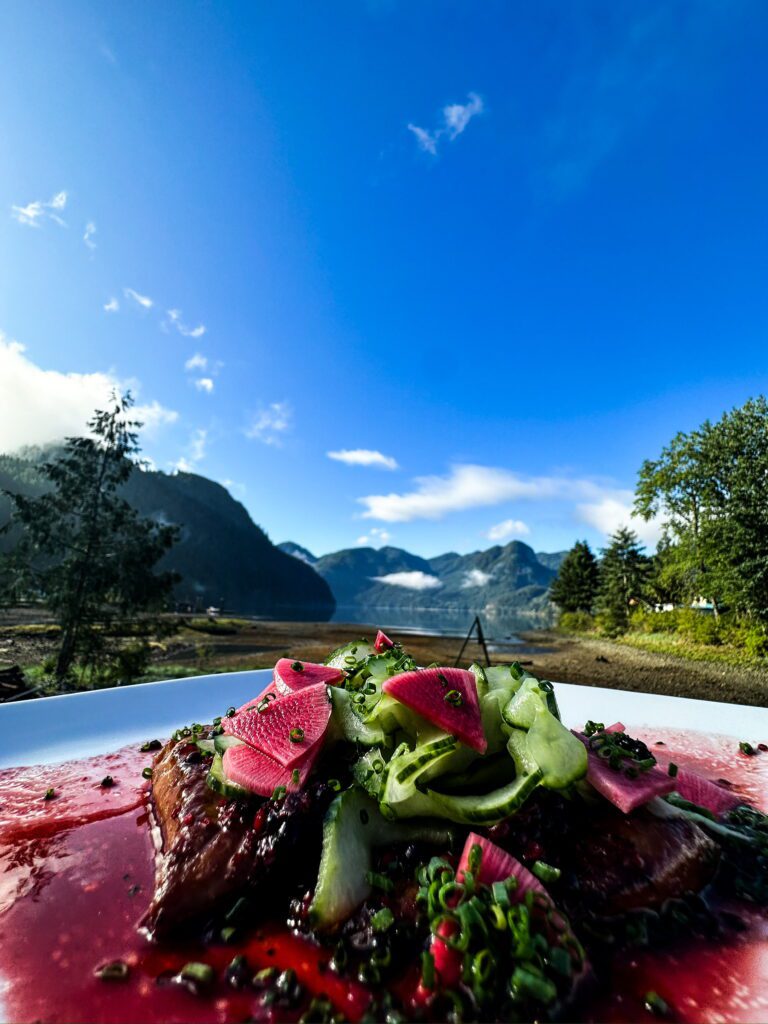
The morning was met with a communal breakfast and lunch coolers to tote. The scene of the fleet of boats heading out together was a sight to revel in. My girls soaked in the scenery as they gazed with wonder at the open sea. We went 40 miles out. Not all the fleet, but a handful of us Reel Obsession boats were working together over the horn. The radio chimed pleasantries rarely heard over the com in Washington waters. Like, “Lookin’ good aye?” and “Great job, aye!” BC fishers are some of the nicest, hardworking folks I’ve met.
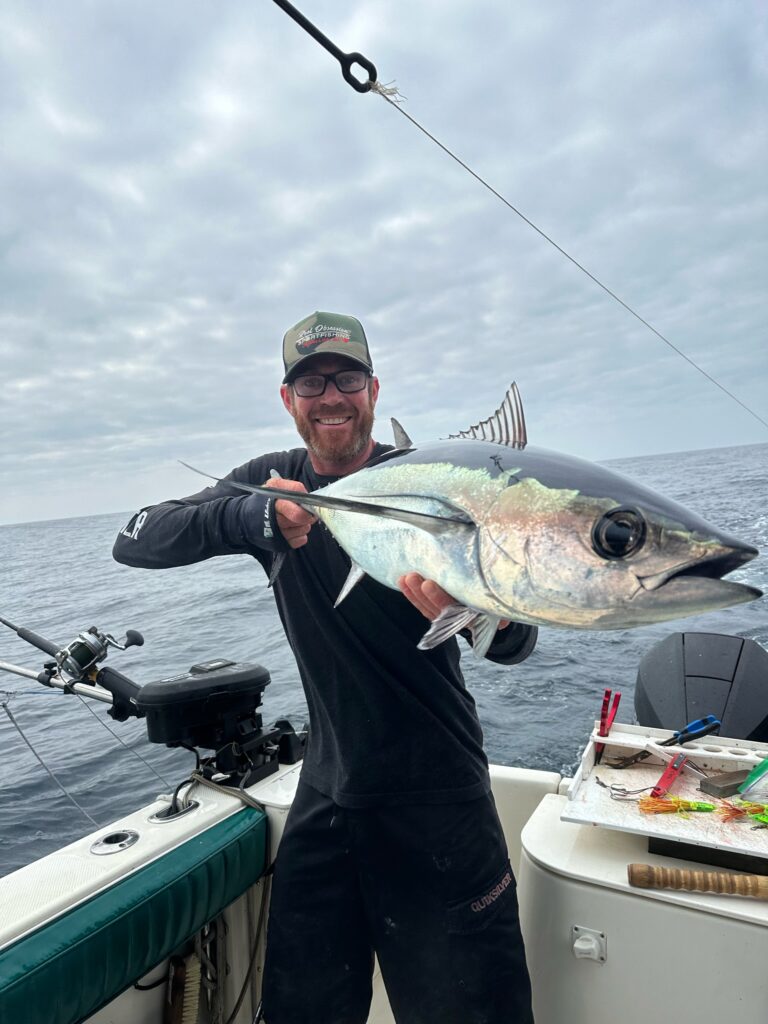
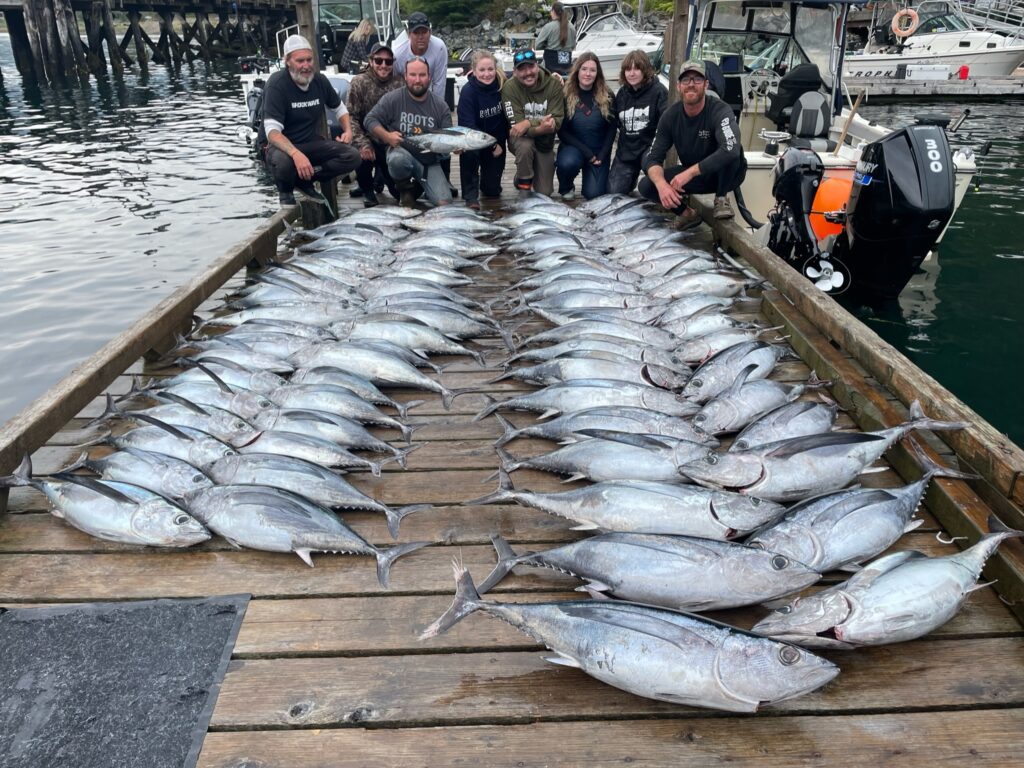
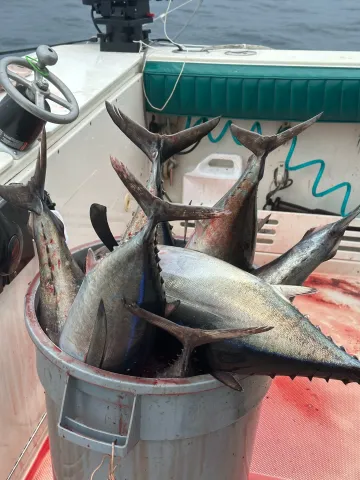
We get to the grounds and Adrian shows the girls the ropes. Essentially, he shows them how to dance for Tuna in a brief 2-minute tutorial. We started to move as a team. We were trolling at about 7 knots fishing with rods and reels and hand lines. Level lines and hand lines are productive and fast; and less awkward than a rod and reel when trolling. “The hand lines help keep the trolling speed up.” Adrian had said. The girls got into it. The handlines helped keep their stamina up. We grinded all day, with not a moment to spare. Adrian was incredible at teaching the girls new techniques, picking up slack when the girls felt a wave of fatigue. Rob and Adrian pulled in the extra slack that day. Mentors are good like that. We grabbed snacks as our energy slowed. Angie and the staff had prepared a delicious lunch for fuel and endurance. We brought in around 40 Tuna! It was incredible! It was rigorous, it was hard, it was fun and It was the time of our lives!
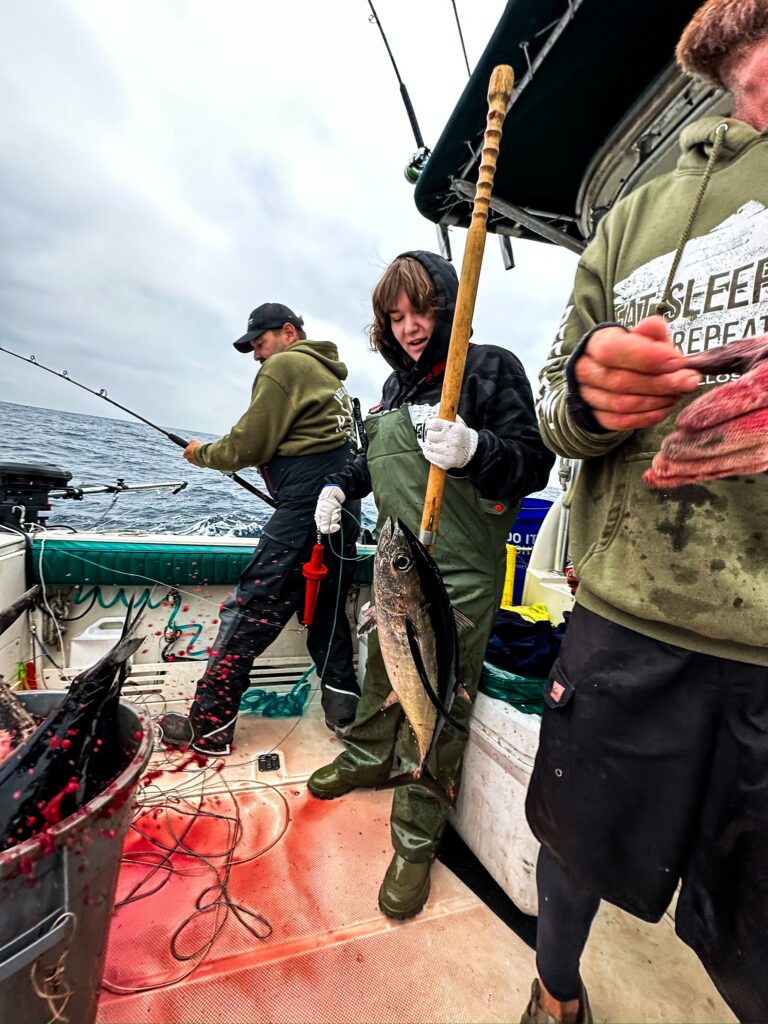
We headed in with the other “Reel” boat that was out. We got to the dock, exhausted. Ange and her team were waiting for us to offload and begin processing. They laid out all the tuna from both boats for some pictures. It was glorious! We headed up to the lodge to get cleaned up and ready ourselves for dinner while the Reel Obsession Crew got to work.
We fished for 3 more days. The fishing was great. The girls wanted to fish for halibut, so we fished in the rain at 300 ft and let them do most of the reeling. We caught our fair share of salmon and some bottom fish. Each day the crew would do the same and offload our catch and get to work while we sat reminiscing about the day in comfort as we soaked in the company and scenery.
We headed out early in the morning with our fish packaged and ready to go for the border. We spent an extra day in Vancouver to play around. We headed home the next day in a straight 8-hour shot. Looking back, Sarah recalls, “The food, scenery, and the people are extraordinary! Zeballos is Awesome!” I agree with her. It was the time of our lives!
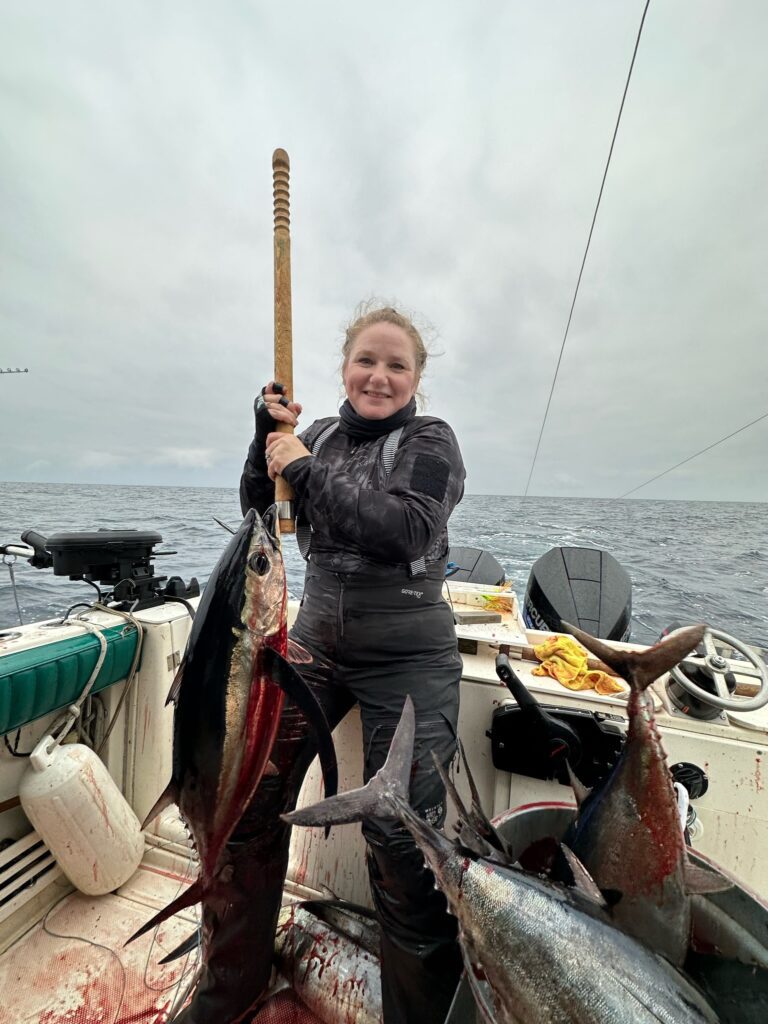
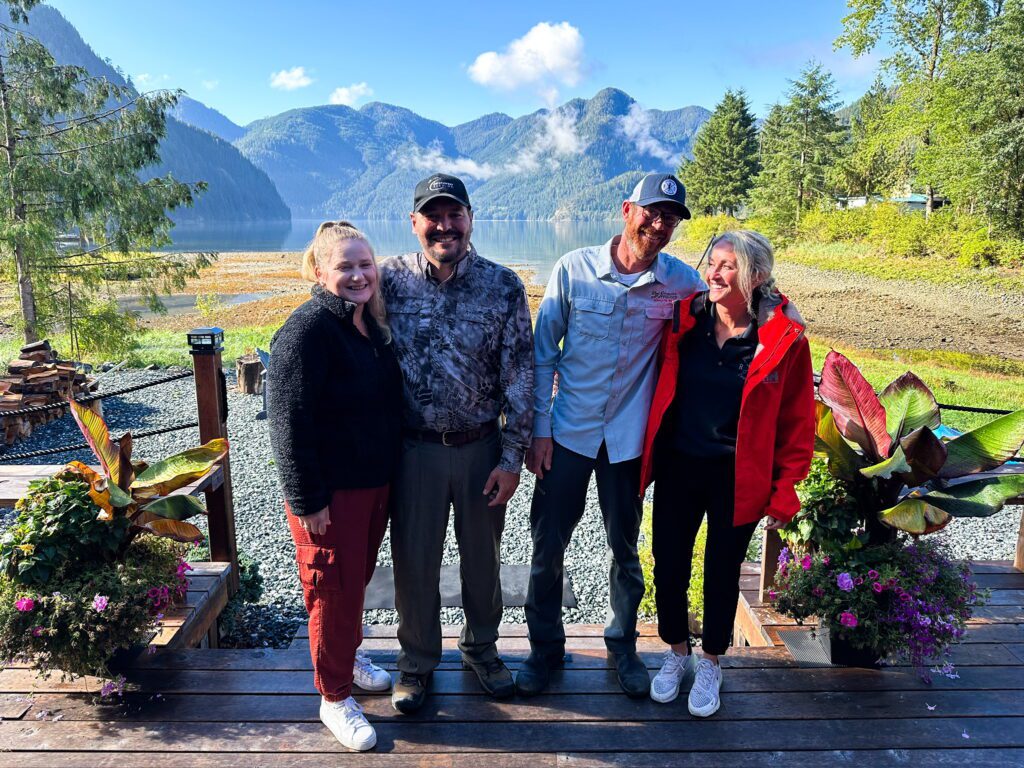
*Reel Obsession is a Family Operation. Adrian, and his wife Angie, own and operate the Lodge alongside their two children. Angie runs the land part as the Operation Manager and Adrian runs the Marine side as Operations Manager. Keegan, their son works on the docks and in processing and Kenzie helps serve and operations in the Lodge.
*Reel Obsession is an All-inclusive Fishing Vacation Lodge. Packages include lodging, all meals, snacks, beverages, and guided fishing. They are a licensed processing facility and process and vacuum seal all our fish.
“It’s always a halibut and salmon trip but if the water temps are right, then we can get out for tuna!“ -Adrian O’Connell
/articles/british-columbia-tuna-time
Fall Fishing At Potholes Reservoir
September and October are my favorite times of year and one of my favorite places to recreate is at Potholes Reservoir, located between Moses Lake and Othello in Eastern Washington. This is a large irrigation reservoir fed by Crab Creek, Lind Coulee as well as Winchester and Frenchman’s Wasteway. At full pool, the lake has 28,000 surface acres of water but after a long summer of dropping water the lake definitely “fishes smaller”.
While there is not as much water to fish, particularly back in the sand dunes area and Crab Creek, there is still plenty of lake to fish and at this time of year, the fish are biting as they beef up for the long winter ahead. Let’s run through some of the species you can fish for here and some effective ways to catch them:
BASS:
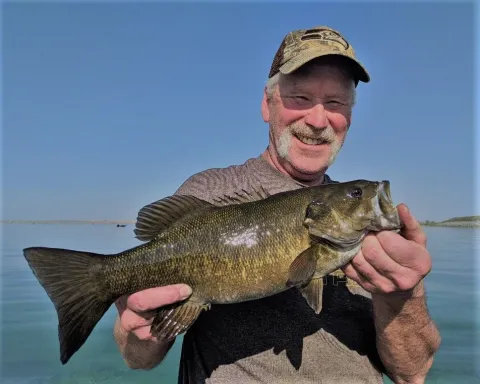
Bassmaster Magazine ranked Potholes Reservoir as the ninth-best bass fishing destination in the Western United States this year and for good reason. There is a healthy population of both largemouth and smallmouth bass in several age classes. The largemouth tend to be bigger, averaging two pounds and getting up to 7-plus pounds. At a typical bass tournament, you’ll need to have a five-fish bag weighing over twenty pounds for a chance to win. The smallmouth run a bit smaller, with one-pound fish being abundant. But I caught a 5.4-pound smallmouth here during September so big smallmouth are around.
At this time of year, the baitfish have moved out into the main lake, and so have the gamefish that are after them. Pete Fisher at the MarDon Resort Tackle Shop and the owner of Fisher Brothers Baits says fishing in front of the dunes on the main lake is the best place to go. The fish will be suspended around sandy humps and Pete says fishing a football head jig with a hula grub trailer is an effective way to catch these fish, which are primarily largemouth bass.
If you want to go after smallmouth bass head towards the face of O’Sullivan Dam or into Lind Coulee at the south end of the lake. Personally, I enjoy using deep diving crankbaits here this time of year which are effective for both bass and walleye. One of my favorite lures is a Berkley Digger crankbait, which dives to depths of 14 feet. When it comes to fishing near the dam, Pete Fisher likes to use perch colored ¾ ounce swimbaits or topwater plugs with white being a preferred color.
WALLEYE:
The walleye bite can be spectacular in the autumn months. These tasty fish tend to be found off the face of the sand dunes or the mouth of Crab Creek. As Nathan Lafrance says, “If you aren’t sure where to go, just look for the line of boats out there, easy to find.” As for how to catch them, Nathan recommends trolling diving crankbaits at a depth of 10 to 12 feet. Nathan says other lures to try are a jointed Berkley Flicker Shad #7 or a Bill Lewis Walleye Precise Walleye Lite crankbait.
PANFISH:
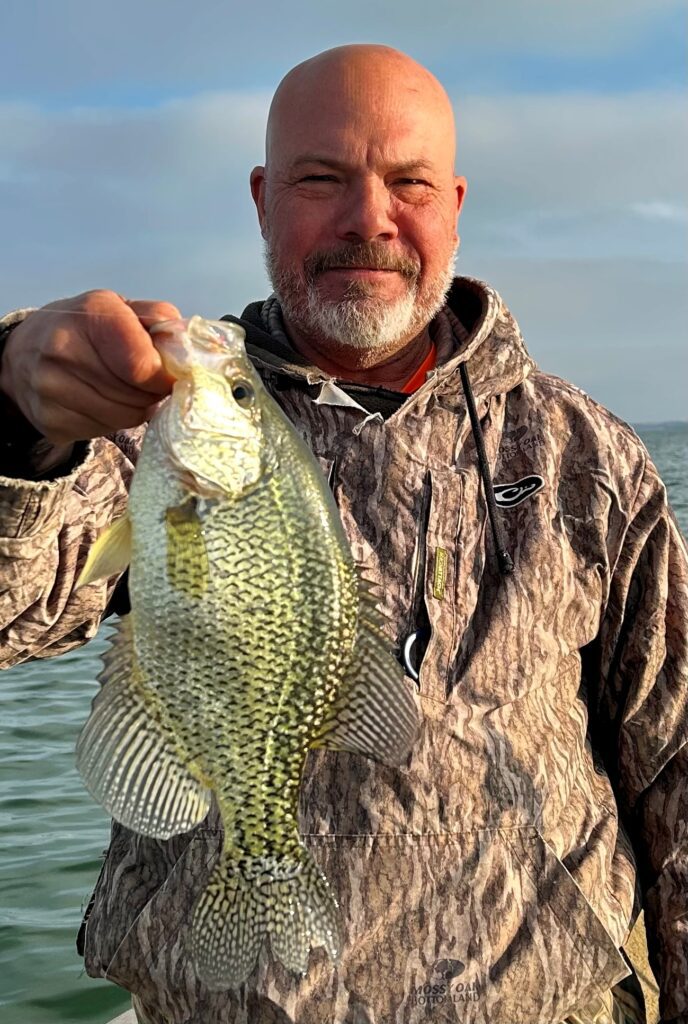
The autumn bite for panfish is excellent and sometimes overlooked by anglers targeting trout, bass and walleye. There is a combined limit for bluegill and crappie of 25 fish, and the crappie have to be at least nine inches long to keep. This regulation has helped turn the reservoir into a quality fishery and 15-inch crappie are relatively common. Last year, an angler reeled in a bluegill that weighed over 2.2 pounds, nearly beating the state record. The perch can also be sizeable here, reaching north of 14-inches in length.
One person who really enjoys fishing for crappie is Pete Fisher. He has a couple of suggestions about where to find them and catch them. Pete says the crappie, like the bass, migrate out of the sand dunes in the late summer. During the autumn months they will be found at the face (or in front of) the sand dunes on the main lake. Fisher says you can cast or troll Berkley #5 Flicker Shads, especially in a Chrome Clown color pattern. Another way to catch crappie is to fish a small jig under a slip bobber after you find a school of these fish. Fisher prefers a white Bobby Garland shad or DS Fry soft plastic lure paired with a small 1/32 or 1/64th ounce jig head. If you do catch a bunch of panfish, you’ll be happy to know there is a fish cleaning station at both MarDon Resort and at Potholes State Park near the boat ramp.
TROUT:
The rainbow bite really turns on in the fall and the size of these fish are impressive. One to three-pound rainbows are commonplace and sometimes you’ll get them bigger than that. Nathan LaFrance suggests trolling Berkley Flicker Shads or longer minnow shaped crankbaits. As to where to find the trout, a couple of good places are off the mouth of Frenchman’s Wasteway or in the northeast corner of the lake near the mouth of Crab Creek.
RESOURCES:
If you are looking for a place to stay you can camp at Potholes State Park or MarDon Resort, which also has cabins and cottages for rent. The resort also has a tackle shop and The Beach House bar and restaurant. The Potholes Bar and Grill is another nearby restaurant that is close to the entrance of the state park.
If you have never fished or hunted Potholes Reservoir before, consider booking a “Cast & Blast” trip with Ross Outdoor Adventures. These trips are only offered in October. Shelby Ross and his guides know how to navigate the tricky channels leading into the sand dunes like the back of their hands. They will take you in before dawn, treat you to a fun duck hunt, and finish the hunt with duck poppers cooked up in the blind. After that you put away the shotguns and go trolling for walleye, usually picking up several other fish species along the way. It makes for a fun day and a great introduction to the fall hunting and fishing scene at this spectacular destination.
WEBSITES:
By John Kruse, host of Northwestern Outdoors and America Outdoors Radio
/articles/fall-fishing-potholes-reservoir
Five Coastal Salmon Rivers to Check Out
Summer is upon us and for many of us, that means that our home rivers are closed to fishing to protect ESA-listed wild Chinook. As a result, we are looking forward to fall when we begin to see runs of Coho and Chum salmon flooding into our rivers with increasing opportunities to catch them. Fingers crossed!
It is anyone’s guess what WDFW will do and many of us are eagerly awaiting news concerning our seasons, emergency closures, and changes in general. Keeping this in mind, let’s look at five coastal river systems to check out that could present great opportunities.
Let’s start on the Northern Coast and work our way South. For the sake of this article, the focus will be from Forks in the North to Grays Harbor in the South. There are other coastal river systems South of Grays Harbor, but we are going to focus on the most popular systems.
Quillayute River System
The Quillayute empties into the Pacific Ocean at La Push, Washington. The Quillayute River is formed by the confluence of the Bogachiel River, Calawah River , and the Sol Duc River near the town of Forks, WA. The Dickey River joins the Quillayute from the north, just above the river's mouth at the Pacific Ocean. Though it is world-renowned as a winter Steelhead mecca, this system also receives returns of all five species of salmon. With spring and summer Chinook salmon returning in lower numbers than expected, the Quillayute river system, including the Bogachiel, Calawah, Dickey, Sitkum, and Sol Duc rivers, as well as Thunder Creek closed to all fishing on July 15. Historically this system produced great returns of spring and summer chinook, but like so many of our rivers, the runs are now endangered. The Coho and Chum will return in September and hopefully, there will be opportunities to catch and retain hatchery fish.
Hoh River
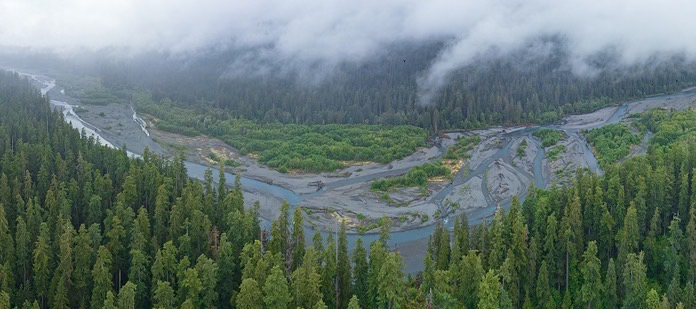
At 56 miles long, the Hoh River originates at the snout of Hoh Glacier on Mount Olympus and flows westward through the Olympic Mountains of Olympic National Park and Olympic National Forest, then through foothills in a broad valley, emptying into the Pacific Ocean at the Hoh Indian Reservation. The final portion of the Hoh River's course marks the boundary between the south coastal segment of Olympic National Park and the Hoh Indian Reservation.
Returns of Steelhead and Salmon make the Hoh River a fishing destination worth exploring. While there are fish in the Hoh River year-round, Steelhead are mostly targeted in the Winter, Chinook, and Coho are mostly targeted in August through November, and Dolly Varden and Cutthroat Trout are targeted anytime the water is in shape.
According to the 2024-2025 regulations, parts of the Hoh will open for Salmon fishing on September 16th, presenting some great opportunities to target Coho.
Queets and Quinault Rivers
The Queets and Quinault Rivers and their tributaries flow from the Olympic National Park into tribal lands. While opportunities exist in the upper reaches of these systems and within the park, they are most noted for their tribally guided lower sections. Note that the rivers are governed by WDFW, the Federal Government, and the Tribes, depending on where you are, so pay close attention to the rules.
The Quinault and Queets Nations have built some very robust hatchery programs, and they control the lower stretches of the rivers. Anglers can fish for all five species of Salmon as well as Steelhead and Trout. Fall Coho on the lower Quinault is a very fun fishery and can result in a freezer full of fish to last the winter. Note that you must book a trip with a tribal guide to fish the waters that lay within the reservations.
Humptulips River
The Humptulips River is located in Grays Harbor County, just North of Aberdeen and Hoquiam. Its main tributaries are the East Fork Humptulips River, about 20 miles long, and West Fork Humptulips River, about 30 miles long. After the forks join, the main river is approximately 20 miles long and provides some of the best salmon habitat in Washington. This river is not a secret and is often very congested, when open.
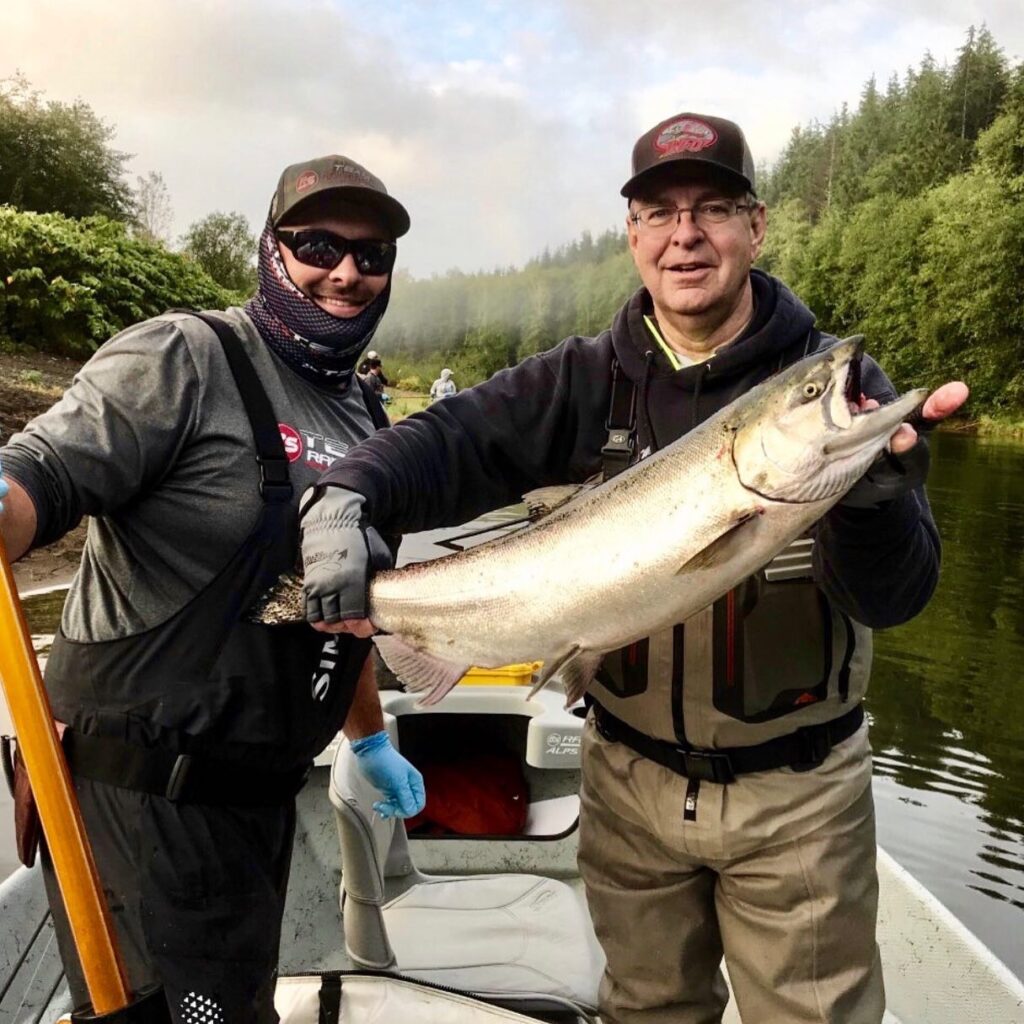
I will say that the “Hump” as it is called is one of my favorite rivers for fall Salmon fishing. It is renowned for its runs of Chinook, Coho, Chum, and Steelhead. As with other coastal rivers and due to low returns of wild Chinook, opportunities are limited. According to the current regulations, parts of the river should open in early September for hatchery Chinook and Coho. As this river can get very congested, it is best to know what you are doing and even better, book a trip with a guide.
Chehalis River System
The Chehalis River originates in several forks in southwestern Washington, flows east, then north, then west, in a large curve, before emptying into Grays Harbor, an estuary of the Pacific Ocean. The river is the largest solely contained drainage basin in the state. Both the Wynoochee and Satsop Rivers flow into the Chehalis between the towns of Elma and Montesano. While the Chehalis has many other tributaries, the Satsop and Wynoochee are likely the most popular and offer fantastic fall Coho fisheries. The mainstem Chehalis, near the mouth of these rivers, can be epic when conditions are favorable and some of the largest Coho in the state can be caught here. This system is also known for large limits of Coho allowed but check the most up-to-date regulations for specific details and don’t forget to look for emergency closures.
With all these rivers, please remember to check the regulations before you make plans or head out to fish. Things change often and it is very important to make sure that a river is open to avoid disappointment. Also, do yourself a favor and book a trip with a guide. I just cannot emphasize this enough. Your opportunities for success will greatly improve if you learn from a local guide and you are more likely to take fish home to eat later.
In closing, you are welcome to message me if you need to be connected to a guide. I am easy to find on Facebook (https://www.facebook.com/brent.knight.148) and am happy to help. Good fishing!!!
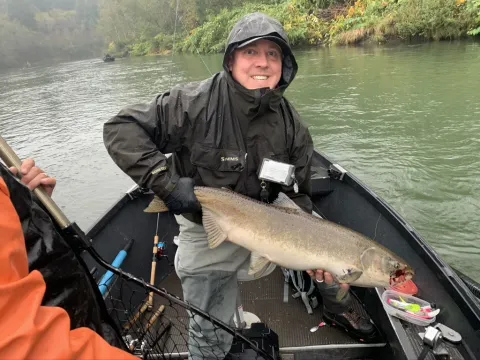
/articles/five-coastal-salmon-rivers-check-out
A Pizza The Fishing Action
It’s great when strangers become friends, those who are passionate about something can share that passion with others and the feeling of joyfulness can be had by all. That was certainly the case on one of our recent fishing adventures here in the great state of Montana. I’m in the not-so-unique position of being an avid fisherman and also someone who enjoys a good slice of pizza. I am in the unique position of having been able to fish with some fine folks from Mackenzie River Pizza Co. and blend the two joys. Amanda Thompson, the general manager of the Helena, MT location, and Allison Collins, out of the Bozeman, MT location with some regional supervision duties, spent the day with Mike Carey and me on the picturesque Canyon Ferry Reservoir just south of Helena, MT.
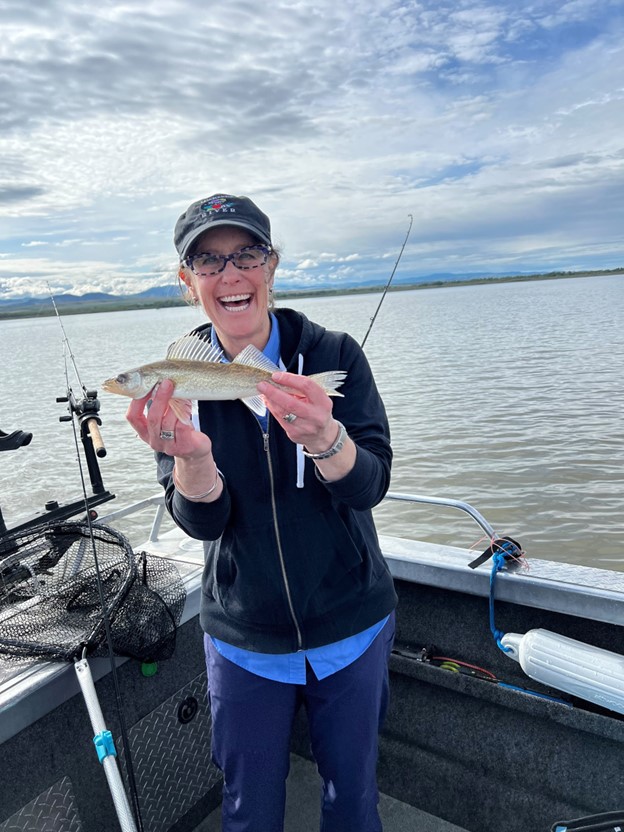
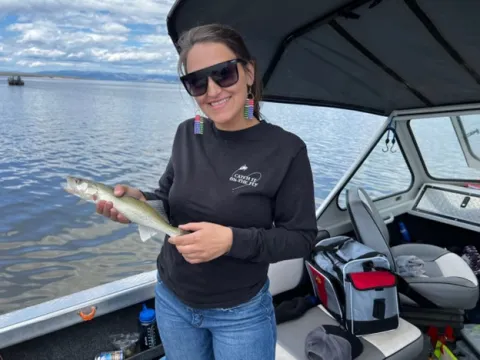
What I really enjoyed about the experience was the ability to share something I am passionate about with these two ladies who had never fished using the techniques we employed for the day. Allison had some experience with fly fishing (who hasn’t in Montana?) while Amanda was a little more green to the whole fishing experience. Both caught on tremendously quickly! Changing gear when needed or putting new bait on a hook quickly became an old hat for all of us. We trolled the southern portion of the reservoir for walleye using a combination of crankbaits and bottom bouncers. Each person picks out their lure of choice, which colors and patterns would hopefully work the best, and of course, goading the others for their poor choice of lure. After a little explanation and demonstration on how to ensure the weight had hit the bottom and the gear was set up properly, we were off and fishing.
The bite was steady all day. No huge fish, the regulations actually state only one fish over 15 inches can be retained, but the anticipation of the catch with the thrill of the familiar walleye “tug, tug” on the other side of a bottom bouncing set up more than made up for any lull. That, in combination with an abundance of beautiful weather, gorgeous scenery, and light-hearted conversation made for a really great fishing experience. It was one of those days with the perfect blend of sun and shade from the clouds overhead. Just as you felt maybe it was getting a little warm, a cloud would provide just enough coverage to keep you comfortable.
To the east, the mountains within the Helena National Forest loomed over Canyon Ferry, a reminder of just how imposing but welcoming the mountains can be. And of course, the friendly banter amongst everyone on the boat helped pass the time when we would have a period of little to no fish. We talked about everything from of course fishing and pizza, to getting our own young children interested in fishing, and hockey, our backgrounds that led us to Big Sky country, our jobs and the people we work with, and too many other topics to mention. We spent the morning and early afternoon on the water catching fish, even with a bonus rainbow trout thrown in, and decided to call it a day with preparation for a delicious meal in the restaurant.
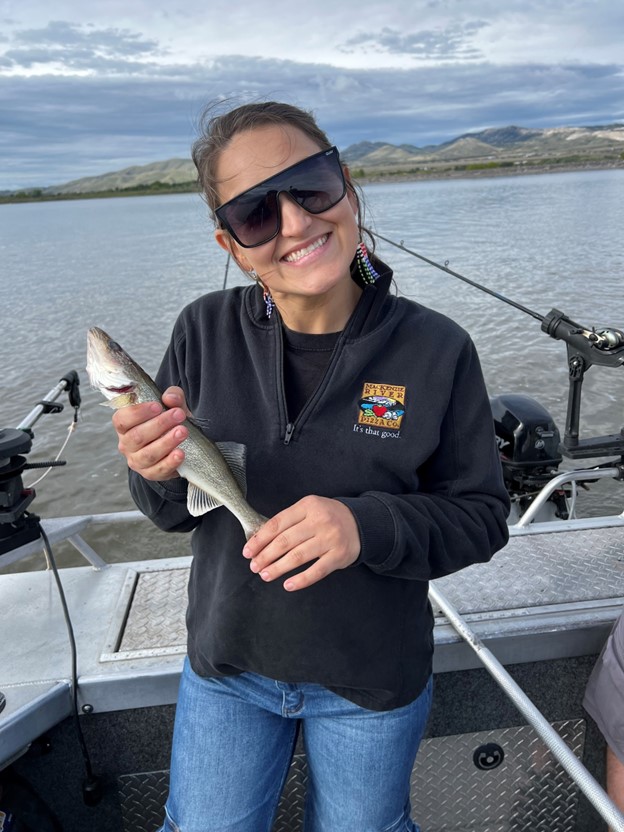
One last note on the trout (you couldn’t expect an article based in Montana without a reference to a nice rainbow, right?) - it was fortunate enough to escape what was presumably an attack by an eagle or osprey at some point. It had two noticeable gashes on the left side of its body. A reminder that nature is always moving and present even if we are locked into the towns and cities with which we live.
Our time in the restaurant was as enjoyable as the fishing. I’ve been to the Helena location plenty of times and really appreciate the atmosphere and fishing themes in the restaurant. Something I had not known before talking with Amanda and Allison, is that each restaurant has its own driftboat as a decorative piece in the building. It’s hard to miss a hanging boat in a restaurant and even harder to not appreciate the craftsmanship it took to build it. Fly fishing and Montana-themed decor are abundant in the dining room and bar area.
From the lodgepole-style wooden tables and chairs to the dry fly engraved decorative glass that separates the booths. The restaurant has a warm and welcoming feeling with a carved wooden bear greeting you and asking you to wait for your hostess to seat you. An immersive dining experience to all things adventure. And of course, how could I not highlight the food?
The offerings are right on point with the Montana and fishing themes you’d expect. I had to order my all-time favorite pizza, the Madison, named after the Madison River in southwest Montana. Bacon, mushrooms, and ricotta cheese? I should’ve ordered two. And to wash down the pizza, exclusive to Mackenzie River, the Drift Boat Amber Ale. A little earthy, a little sweet, it’s just a great-tasting beverage to sip on while you’re enjoying some food and maybe watching a game, taking in the scenery, or chatting with friends. My other go-to menu offerings include the lodgepoles with pesto, trout dip with crostini, the stockman pizza, their version of a meat lover’s pizza (with steak strips!), or the Flathead pizza, named after of course Flathead Lake near Glacier National Park. Perhaps I’ll get some of that on my next visit.
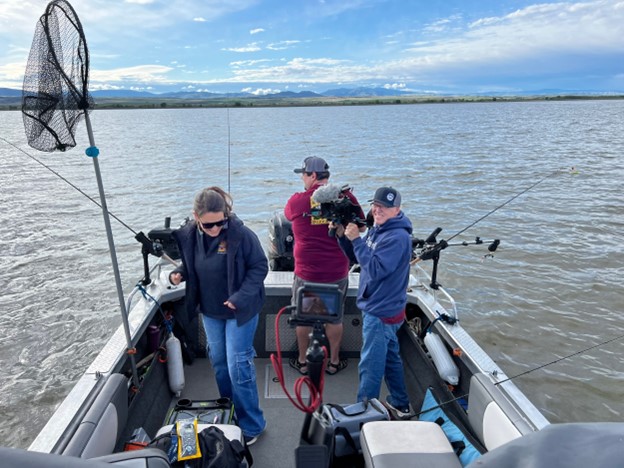
The fishing adventure concluded with new friends sitting around the table breaking bread, sorry, pizza, with one another. I am grateful for the experience out on the water and in the restaurant. It’s something I hope you get to share with people in your life on a regular basis - a blend of recreation and comradery. When you get the opportunity, I can’t recommend enough a day of fishing with others concluding with some quality food at one of the great restaurants in our area. Interested in experiencing it for yourself? Mackenzie River Pizza Co. has locations throughout the northwest and beyond, check them out and taste for yourself. Did I mention you should order the Madison?
https://www.mackenzieriverpizza.com/
/articles/pizza-fishing-action