/articles/categories/fishing
Stocked Trout Extravaganza
By Paul Lewis
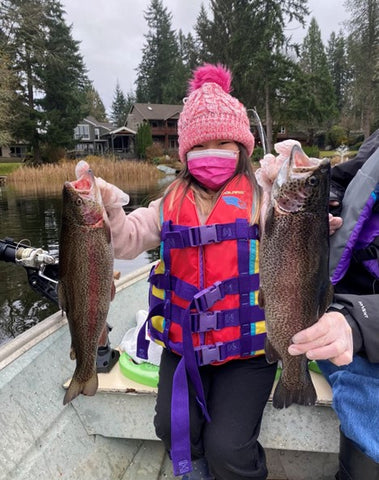
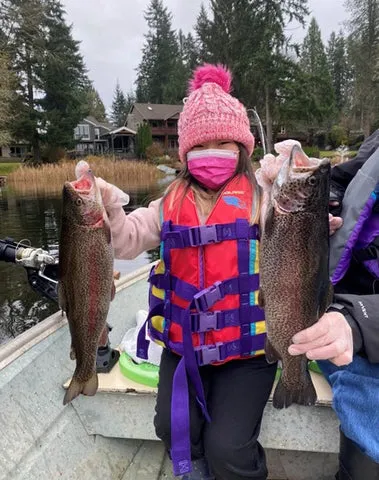
Well, winter is around the corner and it’s time to put the rods away and winterize the boat, right? NOT QUITE YET! Salmon season is indeed winding down, aside from some late season river opportunities, and winter steelhead is often a mystery, so many anglers don’t know where to look for the next bite. If this is you, look no further than some fantastic winter trout fishing at multiple stocked lakes! Winter trout fishing is incredibly rewarding, and in many cases, produces some large trout that cut beautifully. There are many ways to chase these fish from shore or from the boat, and with a little research and timing, you are sure to be on the fish!
HOW TO PREPARE
To begin, let’s look at the setups to use. Cold water temps have a lot of effect on fish, as they are a cold-blooded species. During this time, they are in energy consumption mode, with not a ton of energy to be spent moving around.
Additionally, cold temps slow down fish metabolism. All this together means that when the fish feed, they are looking for an easy meal that does not require too much energy wasted in chasing it down. For this reason, small profile lures and stationary baits are often the best choice.
When fishing from shore, it is hard to beat the “stocked-trout standby”, the Carolina rig! An egg sinker on the mainline with a 2–3-foot leader to a small hook, with an inflated nightcrawler or chunk of Powerbait, is an easy meal for a meandering trout to engulf. Another good option is a small spoon or spinner with a slim profile and wounded look.
Lighter casting spinners and spoons can be worked slow through the water column and produce a very crippled look. They are a great way to cover water in new spots and find the fish.
From a boat, these methods work great as well, but trolling can be added to the mix. Small spoons and spinners tipped with a worm are always a good option. Trolling allows the angler to go to the fish. Compared to spring and summer, trolling a little slower can be very effective. Many rainbow trout will sit low below the thermocline. Trolling past them just fast enough to get their attention but slow enough have them commit is the target.
WHERE TO GO
As with any fishing trip, the first thing to do is check the regulations. Many stocked trout lakes are seasonal, meaning they close at the end of October. If your lake is open, you are set to legally fish, but there may not be great fishing. Luckily for the angler, the WDFW publishes a list of recently stocked lakes that is updated weekly. Checking lakes in your area will give you the best idea of where and when to wet a line.
The best time to catch stocked trout in the winter is directly after the stock. This is when the trout aren’t quite acclimated to the new area, and they are the most aggressive. After a couple weeks in the lake, the fish will hunker down and be far less active compared to their first little bit in the new water. Knowing when the trout are stocked can be the difference in a couple bites and a nice limit on the stringer! During most of the winter months, the state stocks their “jumbo’s”, which are trout over 1lb, which usually cut fantastically.
FINISHING TOUCHES
As a local Western Washington Angler, I know a couple great lakes in my surrounding counties that are stocked in November, which give me just enough time to make some smoked trout dip for the Thanksgiving table. Nothing warms a day like a tight line on a cool river bank, sipping hot coffee, and enjoying some bank lunch.
With a little research, a simple setup, and a couple of free hours, you can be knee deep in some delicious trout! Just like the spring, ultralight trout setups, light monofilament line, some extra hooks, and a couple of weights, and you are set on terminal tackle. Then add some jars of Powerbait, a few lures, and a stringer, and you will be ready to hit the water. As always, be prepared for the weather!
/articles/stocked-trout-extravaganza
The Washington Outdoors Report
HUMPIES, LAWSUITS AND TROUT
PINK SALMON NUMBERS ARE LOOKING GOOD
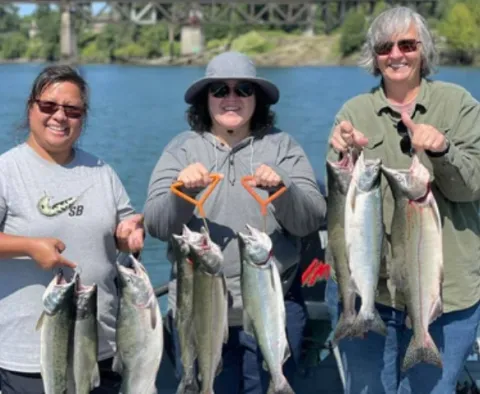
Odd numbered years are pink salmon years here in Washington State and 2023 is lining up to be a good one for anglers fishing for them in Puget Sound and its tributary streams. The Washington Department of Fish and Wildlife is forecasting a return of nearly four million of these smaller salmon, nicknamed “humpies”, for the hump the males develop on their back after entering fresh water to spawn.
The pinks show up in the Strait of Juan De Fuca as early as June and can be caught by both boat and shore anglers in Puget Sound throughout the month of August. By September, most of the pink salmon are entering tributary streams like the Skagit, Snohomish, Skykomish, Green and Puyallup Rivers, providing additional opportunities for anglers who target them with Buzz Bomb lures, jigs with squid bodies and spoons, the key to all of them is that they must be pink in color if you want to catch pinks with them!
Humpies are a fun fish to cut your teeth on as a first-time salmon angler and it’s not uncommon to catch a good number of them in a day of fishing. While many anglers save them for the smoker, they do taste very good when fresh, especially when grilled over a BBQ or pellet smoker.
LAWSUIT FILED AGAINST WDFW COMMISSIONER
On March 6th the Sportsmen’s Alliance Foundation, which is a pro-hunting and fishing organization, filed a lawsuit in Thurston County to prohibit WDFW Commissioner Lorna Smith from participating as a member of the Commission.
The basis for the lawsuit is that state law prohibits anyone from holding an additional elected or appointed office while serving on the commission. Smith currently serves on the Jefferson County Planning Commission which the Sportsman’s Alliance says is in direct violation of Washington Law.
Todd Adkins with the Sportsman’s Alliance says, "We view this lawsuit as the initial step of a long but important process to bring sanity and decency back to wildlife decision-making in Washington. It all starts here, but trust me, it won’t end here. The animal extremists are going to see a lot of the same in the coming weeks and months."
Lorna Smith is a controversial appointee to the Fish and Wildlife Commission. Since being appointed in 2021 by Governor Jay Inslee she was an instrumental voice in shutting down Washington’s long running spring bear hunt, despite the recommendation of WDFW staff members that it be allowed to take place.
When the Blue Mountain elk heard declined (primarily due to cougar predation), Smith suggested managing the herd as a smaller one instead of addressing the predation issues. She has also introduced the framework of a plan that would limit hunting as a management tool by the agency.
It is worth noting that Smith is not the only commissioner serving in another appointed or elected position. Commissioner Molly Linville (who generally sides with hunters in her decision making), serves on her local school board in Douglas County.
Eli Francovich, writing for the Spokesman Review, contacted both commissioners. Linville told Francovich that she was advised by legal counsel that serving on the school board was not a conflict of interest. Commissioner Smith told Francovich she was serving on the Jefferson County Planning Commission on a volunteer basis and in an advisory role when appointed to the Fish and Wildlife Commission. Smith continued stating she does not believe the statute does not preclude individuals serving in a volunteer position like she has been in Jefferson County.
LAKE LENORE FISHING TRIP
Last but not least, I made it up to Lake Lenore this past week after WDFW fisheries biologist Mike Schmuck told me the fishing there was very good last year and he expected similar results this season. I picked a cold, cloudy day to visit the north end of the lake which is where many of the Lahontan cutthroat trout tend to mill around in the spring prior to spawning.
Unfortunately, the trout were not yet in this part of the lake in good numbers. Two anglers who were leaving as I arrived said they each only caught one fish that day. While fishing, I did see one angler catch one trout and while I did get one good strike, I was unable to hook up and didn’t have any more bites that afternoon.
Lake Lenore is a selective regulation fishery and is primarily a catch and release destination where the trout average two to three pounds and can get up to six pound in size. Fly anglers in pontoon boats favor fishing chironomids under strike indicators while spin anglers can do well fishing spoons with single, barbless hooks.
The fishing at this scenic, desert lake north of Soap Lake should get better towards the end of March and peak in April. I plan to return to try again and will let you know how I do.
John Kruse – www.northwesternoutdoors.com and www.americaoutdoorsradio.com
PHOTO CREDITS:
Pink salmon caught on the Snohomish River – Courtesy Brianna Bruce, Livin’ Life Adventures
/articles/washington-outdoors-report
Elemental Telepathy
By Gary Lewis
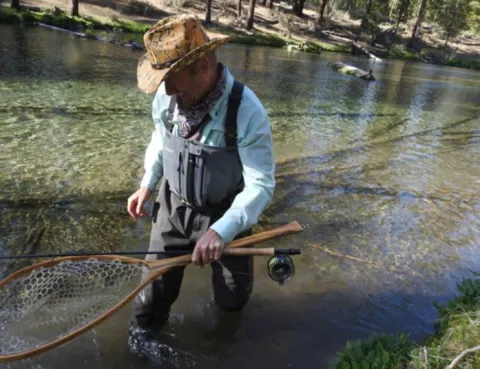
After 26 rainbows brought to hand and released, I reeled up the loose coils at my feet and clipped the Muddler Minnow off the line. Rain had been steady for the last hour and, soaked, I looked forward to climbing back in the Mustang and turning up the heater.
Upstream from a two-lane bridge, the river cut a channel through rock leaving a pool deeper than a man’s head. In the winter, an angler might catch a steelhead here; in the spring it was chinook, but the river offered a trout fishery too.
Today’s lipstick was a Muddler Minnow tied on a No. 8 long-shank hook, unweighted, with a turkey feather for the dorsal.
With no one else for company, it was easy to start at the top of the run, shake out a bit of line and stack-mend to get the fly to work into the seam this side of the riffle.
Lengthening the line, making micro-mends, the diminutive sculpin imitation presented to the trout below, and rainbows streaked up from the bottom to follow the Muddler across its arcs. And the longer the arc, the more likely the trout would grab.
After several trout I was startled to realize I did not feel a single bite. Instead, at best, it was a movement of the line, a two-inch indication, not even a tick that I responded to. Now and then a trout would give itself away with a flash below the surface. Trout after trout bit. Almost every cast they grabbed, but I only counted them when I could fight them all the way to the bank.
As time passed, I stepped downstream, roll-cast the same length of line each time and teased trout out from beneath the shadow of the bridge. When, properly soaked from the rain, I saw another angler headed toward me. He cast a glance toward the fly I had just removed from my line.
“Take this,” I said. “It’s working.” And before I walked up to the bridge, I pointed out where I supposed the trout were lying in the tea-colored water.
But I couldn’t leave. I had to watch from the bridge to see what the trout were doing. Taking care to not cast my shadow over the fish, I leant both elbows on the rail and watched the angler work out line and swing the Muddler across.
A trout streaked up from the middle of the water column, followed a couple of feet and then closed its mouth over the deer hair streamer. There was no reaction from the fisherman. He let the fly continue to swing while the trout moved with the Muddler then opened its mouth and spit it out.
Surprised, I said nothing and continued to watch. In twenty casts, ten trout grabbed and the guy did not a single time sense the bite. I could not stand it. I walked back down.
He was ready to change flies.
“You’re getting bit on almost every cast,” I said. He didn’t believe me but he consented to cast again. When the fish bit, I called the strike. And he caught a fish. And I left him to it.
What was the difference, I wondered then, and I still wonder today when I fish alongside someone who clearly catches more fish than me. If the fly is the same and the presentation is the same, why does one angler catch fish and another does not? How many fish bite and we do not know it?
Line control and sensitivity is hard to teach and even harder to learn.
Let’s call it electricity, an impulse in a conductor. Cast out a dead thing; the conductor swings out in the void. And then, out of the void comes a live thing and closes the circuit. For a moment, the line tingles and energy pulses from the muscles of the trout on the other end. In tune with the lightning rod that is the graphite in your hand, you sense it. Exchange of energy. Reaction making contact.
Let the fish take a bit of line, lift the rod or turn the tip toward the bank. Let the trout hook itself. It’s electric.
# # #
Gary Lewis is the host of Frontier Unlimited TV and author of Fishing Central Oregon, Fishing Mount Hood Country, Hunting Oregon and other titles. Contact Gary at www.GaryLewisOutdoors.com
The End
/articles/elemental-telepathy
The Outdoors Roundup
By John Kruse
SOMETHING FISHY FOR DINNER
TJ’s Bar and Grill in Kettle Falls is in hot water after serving seafood they should not have been selling to their patrons. According to Captain Brad Rhoden with the Washington Department of Fish and Wildlife, during the summer of 2019 the owner of the restaurant, Terry Baxter, went on a recreational fishing trip near Bamfield, British Columbia. Baxter then brought the Chinook and coho salmon, as well as the halibut he caught, back home, and proceeded to serve these fish to customers at his restaurant.
Captain Rhoden states, “By law, a business selling fish to a consumer, such as a restaurant, is required to state the species of the salmon and whether the fish was farmed or wild caught. The Legislature created these laws so consumers can be confident the fish they are about to eat is what it says.”
As for selling recreationally caught fish in a restaurant, Captain Rhoden explained, “Washington law does not allow the edible portions of wild animals, game birds and game fish to be sold. Food fish such as salmon and halibut can be commercially sold in Washington as long as the fish were lawfully harvested during on open season/area by commercially licensed fishers. So, no recreationally caught fish can be sold, bartered or traded lawfully in Washington.”
The multi-year investigation by the Washington Department of Fish and Wildlife was prosecuted by the Washington State Attorney General’s Public Lands and Conservation Division last summer. On January 17th, Baxter’s business plead guilty to the crime of First-Degree Unlawful Fish Catch in Stevens County Superior Court. He received no jail time but will have to pay a $10,000 fine.
STATE PARKS HIRING PARK AIDES
Looking for a fulfilling, seasonal job working in a great outdoors location? If so, apply for a job as a park aide with Washington State Parks. They are hiring 305 seasonal workers to work from April through September at their parks throughout the state.
Duties include everything from registering campers to cleaning campgrounds and maintaining facilities and trails. Aides may also be helping out with interpretive and educational programs at parks around the state. You may be assigned to one specific park, or rotate your daily duties amongst several parks in close proximity to one another.
My son David worked as a park aide for two years in college, and really enjoyed his time during the summer months at Lincoln Rock and Daroga State Parks in North Central Washington. However, this isn’t just a job for college students trying to make money during the summer. It’s also a great opportunity for retired or semi-retired individuals who enjoy meeting people and spending time outdoors in the beautiful settings our state parks are set in.
Park aides earn anywhere from $16.61 to $19.09, depending on qualifications and experience. Senior Park Aides (with previous experience) earn more. You can fill out an application at www.governmentjobs.com. Simply type in “Park Aide” in the search bar, along with “Washington” for the location, and you’ll see what’s available.
FISHING REPORTS
COLUMBIA RIVER GORGE
Autumn Lawyer at Gorge Outfitters Supply in Rufus says they are doing pretty well catching walleye below John Day Dam. Most of the walleye have been caught using spinner worm harnesses tipped with nightcrawlers. A bright orange and black combo-colored spinner worm harness is the hot ticket. Several large walleye (up to ten pounds) have been caught in the last week.
Autumn says sturgeon fishing was also pretty good last week. Catch and keep sturgeon fishing remains open (for now) in both The Dalles and John Day pools. Be sure to check the WDFW and ODFW websites before going out, to make sure harvest quotas have not been met.
RUFUS WOODS RESERVOIR
Austin Moser with Austin’s Northwest Adventures has been catching triploid rainbow trout near the net pens at Rufus Woods Reservoir over the last several weeks. Austin says they have been catching limits of these hefty rainbow trout, averaging 4 to 8 pounds and going all the way up to 15 pounds in size. Moser’s clients have been jigging 3/8-ounce Maxi jigs made by Yakima Bait Company. While many anglers use bright colors, Moser has found natural colors such as black, brown and olive work best.
Bank anglers are having success as well, though it can be hit and miss. Most anglers fishing from shore are using Powerbait to catch their trout. It is worth noting that there is a $20 access fee to use the park near the net pens and also a $10 launch fee. Shore anglers also need to have a Colville Tribal fishing permit. To book a trip go to www.austinsnorthwestadventures.com. If you want to find out more about fishing or camping at Lake Rufus Woods Park, which is operated by the Colville Tribe, go to www.colvilletribes.com/lake-rufus-woods.
John Kruse – www.northwesternoutdoors.com and www.americaoutdoorsradio.com
/articles/outdoors-roundup-2
Spring Chinook Time
By Jason Brooks
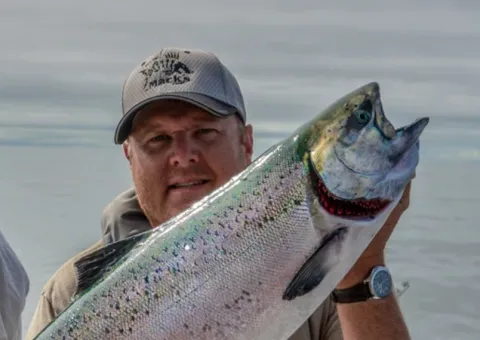
One of the most sought after and tasty salmon in all of the Pacific Northwest is the spring chinook. This run of salmon draws thousands of anglers who will first head to the Columbia, as well as a few coastal rivers for a chance to catch a “springer”.
The fish start to arrive in January and will run until May, with the height of the runs occurring in April. Once the fish make their way up the Columbia to the many tributaries, the anglers will spread out to focus on terminal fisheries. Run estimates and seasons yet to be set will determine where you can go to catch a spring chinook.
Looking at the projected runs, the Columbia total run is expected to be 307,800 wild and hatchery combined. This is good news as it is well over last year's projected run of 197,000 fish and even over the actual return from last year of 274,495. This means anglers should have fisheries in the lower Columbia area as well as the Vancouver-Portland fishery between I-5 and I-205 in early spring.
The Kalama fishery is near the Port of Kalama on the Columbia River, where there is good boat access with a protected harbor and multi-lane boat launch. Run straight across the channel, and you are at the fishery. Some anglers will use a small boat to cross and then beach fish off Sand Island by plunking a Spin-n-Glo with a gob of cured salmon eggs. Other bank plunking options are wobblers on a dropper, or a banana plug such as a MagLip or K15 Kwikfish, both with a herring or sardine wrap.
The boat angler has two options here depending on the tide. Most will troll using a triangle flasher, such as the Mack’s Lure UV Triangle Scent Flash or a Yakima Bait Company Big Al’s Fish Flash, then a long leader from 36 to 48 inches, with a 6-bead chain swivel in the middle, to a plug cut herring. When it comes to bait, the most productive herring are dyed with Bad Azz bait dye in either chartreuse or blue, or brined with Brine-n-Brite, which also comes in chartreuse and blue.
Single point barbless hooks must be used, but to increase the chance at a hook-up, set back the farthest hook and downsize it to a size 4 Gamakatsu Big River. These hooks are strong even in the small size 4- which tends to grab onto the chinook's face or jaw when they swipe at the bait- and will increase your hook to landing ratio.
The second option is to anchor up during the outgoing tide and let out the plugs and wobblers. This is known as “sitting on the hook”, and boats will form lines, often using wing dams to tie up to and to help break up the strong outflowing current. My first time fishing this part of the river was fishing on anchor with a friend in his boat. We sat in the protected covered cabin and played card games until a rod started to bounce, running out into the rain and reeling in the fish.
Then we let out the line, making sure it landed in a travel lane (which are often shallow depressions in the sandy bottom), and then resumed the card game again. It might not sound like much of a fishing experience, but this is springer fishing, and it is all about putting the best-eating salmon in the freezer.
The Cowlitz
The Cowlitz is the second largest lower Columbia tributary, only to be surpassed by the Willamette. With a predicted return of 9,000 springers to the Cowlitz, we can hope there will be a fishery that often coincides with the late returning winter steelhead. The “Cow” is one of the few rivers where anglers can catch a double bag of good eating fish in the same day. Depending on where you go on the Cowlitz will dictate how you fish.
In the lower river, anglers often pull plugs or use bait divers and baits such as cured salmon eggs or prawns. The prawns will have sat a few days in Pro-Cure’s Shrimp and Prawn Cure in magenta or red, and some anglers will use both baits at the same time, making a “cocktail” of sorts. Further upriver, anglers will float fish gobs of eggs or even plunk them. The Cowlitz offers both bank and boat access and is within a few hours’ drive of several cities, which means it gets crowded, but it can be a great place to catch fish.
Willamette
If you are looking for a lower Columbia powerhouse, then look at the Willamette. Anglers will start in early spring, hoping to be one of the first to catch one of the 71,000 projected spring chinook expected back this year. That is nearly 20,000 more than projected last year (51,200) and almost 16,000 more than the 55,391 that returned. The early springtime anglers will target the Multnomah channel which starts at St. Helen’s, Oregon, right across from Ridgefield, Washington. This can be protected waters, often calm and out of the wind, unlike the mainstem Columbia in spring.
I was fishing here several years ago with Buzz Ramsey, and as we crossed the Columbia, I noted that the wind was starting to kick up. After fishing the day in the Multnomah channel, we started back towards Ridgefield, where we had launched from. Making the corner around the island, we were met with gale force winds and whitecaps, and later learned that a boat capsized on the Columbia that day, costing two people their lives.
Be sure to check the wind forecast if you plan to cross the Columbia to fish the Multnomah channel, otherwise, drive around to the Oregon side and launch from there. An Oregon fishing license is needed to fish in the Multnomah channel, as this is considered Oregon waters and is part of the Willamette River and not the Columbia.
Bonneville Dam
Further upriver and above the Bonneville Dam, anglers start to target terminal fisheries. The first being the Wind River, which will have both a run of Wind River bound fish as well as fish stopping to rest near the deadline of the Wind River outlet, as marked by large white buoys in the Columbia. The Wind River is expected to get back 4,400 fish, which is only 200 fish more than last year's projection of 4,200, but last year the run exceeded the estimate by over 2,000 fish, with an actual return of 6,530.
Here, trolling plugs such as MagLips, Kwikfish, and even going “old school” with an orange Mag Wart by Storm is commonplace. In the late 90’s and early 2000’s, about everyone flat lined the hot orange Mag Wart and then started fishing them on droppers to keep from tangling with other boats. This still works, but also anglers will be trolling triangle flashers and Brad’s Super Baits and Super Cut Plugs often in the Hot Lava color and stuffed with tuna.
Drano Lake
Drano Lake is the most popular spring chinook terminal fishery in the entire Columbia system. Here hundreds of boats will try to choke into the “toilet bowl”, which is the entrance to the impoundment at the highway 14 bridge. Be aware of the deadline and do not cross it as you will get cited and be sure to be courteous. Here, boats will slow down and make a turn, trolling in a counterclockwise direction.
Do not try to go against the current of boats, as it will only lead to a mess. Here, anglers primarily slowly troll prawn spinners with a triangle flasher. Again, the Pro-Cure cured prawns are effective, with magenta being the most popular color. For prawn spinners, you can use the tried-and-true Eric’s Prawn Rig by Lugh Jensen with the “backdraft” color, a combination of orange, chartreuse, and green with green beads.
Macks Lure also has a prawn rig which uses their Smile Blade, a Mylar blade that works at extremely low speeds which are needed at Drano. Again, the most popular color is green and chartreuse, with a magenta cured prawn.
For anglers hoping to get some spring chinook further upriver, then 2023 might be your year. The Snake River and Idaho bound fish are estimated to be 85,900, which means there could be a season, but do not expect any announcements until in-run estimates are updated with fish counted at the dams. Icicle River anglers up near Wenatchee, some 500 river miles from the ocean, also have some great news, along with Yakima River anglers, as 41,400 spring chinook are expected in the “Upriver Columbia” run.
Seasons on both rivers are not usually announced until dam counts show there are enough fish above the mid-Columbia pools. If this estimate is like the others and last years, all of which came in above projections, then spring chinook anglers in the upper Columbia and even into Idaho will hopefully have a season. With springers already showing up and passing over Bonneville dam, with one climbing the fish ladder on January 2nd, it looks to be a momentous year. The best eating fish are on their way here, and anglers will have plenty of places to go.
Let us hope the winds do not kick up too much and we can all get along in Drano’s toilet bowl. Start curing up the prawns and soaking the herring, it is springer time!
/articles/spring-chinook-time
Get on the Water Now!
by Randy Castello
With football season recently behind us, baseball opening day is months away and they’re just dropping the checkered flag at either our local or at sanctioned tracks nationwide, how are we supposed to burn off our nervous energy? Assuming that you have already completed your winter maintenance regiment for your boat and gear, made all the lures that you and your neighbors can use in the foreseeable future, and read every issue of NW Reel Life for the third time, it’s time to go fishing.
The decision to wet a line is always the easy part, sorting through seasonal closures and winter accessibility can be a challenge. As with any PNW fishery, double check the regulations and Emergency Changes before you head out to participate in the many solid fishing opportunities available this time of the year. The following are a few ideas to get you started, and may your fish box need frequent cleaning.
Lakes
Lake Washington is an urban gem. Cutthroat trout, kokanee, perch, and various warm water fish are available year-round. There is great trailer boat access as well as a number of fishing piers. During the winter months it is primarily a cutthroat, kokanee, and smallmouth show but there are also large schools of perch available along deeper drop-offs.
The primary winter cutthroat and kokanee fishery is at the south end of Mercer Island. But if you are willing to go on the hunt, there are other areas that hold fish; some real trophies. Make sure to quickly release any chinook that take interest in your offerings.
Lake Merwin is a local go-to for winter kokanee. If you are traveling to get there, make sure you check the wind forecast before you head out the door. The lake can get very windy and choppy, make sure that you have all your safety gear in order.
When fishing Lake Merwin during the winter, try to troll at 1.0 MPH, and the smaller your presentation, the better. You will see multiple schools of fish on your electronics, but not all will be in a playful mood. When you do find a snappy lot, mark it on your electronics or take a visual bearing and keep after it.
Lake Cavanaugh and Lake Samish both host a winter kokanee fishery. They are kind of fickle during the winter and the bite may be during a brief afternoon hatch. We have limited at either lake during the winter but that’s not the norm.
Persistence is the name of the game. Troll 1.0-1.3 MPH. Small micro hoochies, flies, and spinners seem to have the edge. In addition to your secret corn recipe, a small tidbit of nightcrawler, worm, or a live maggot will greatly enhance your allure. You may even want to add them to your hooks, it will drive the kokanee wild!
Lake Roosevelt; as the weather permits, if you’re looking for lunker kokanee, Roosevelt is the place to be. Although I don’t like hauling the boat over the pass in the winter anymore, I love fishing Lake Roosevelt, so with the right weather forecast we may head that direction. I’m sure kokanee are available throughout the lake, but we usually fish out of Spring Canyon.
We tend to focus on the dam area but we also fish the lower 5 or 6 miles. I typically start at 10-40’ with a 60’ setback, but may fish deeper as required. Because there is the potential to hook a 3+ pounder, I typically up my leader to 20-pound fluorocarbon.
Winter road conditions are still a possibility. I addressed this in a previous article but it’s worthy of a mention. Again, pay attention to winter boating safety/etiquette. If the road conditions are questionable, carry chains for both your tow vehicle and for at least 1 axle on the trailer. Bring a couple sand bags and shovel. A liberal application of sand can be a lifesaver.
At the ramp, assess the situation before you back down a long, icy ramp. Take the time to chain up your tow vehicle if required. The area between the top of the ramp and the water could be icy. If you lose traction, don’t panic, it is likely that once your tires hit the water, you’ll regain traction. Just keep your cool, you don’t want to jackknife ½ way down the ramp.
It would put a damper on your plans. Once the trailer is wet, you may have to let the rig sit in the water for a bit to thaw before the boat will boat float free. No kokanee shuffle or celebratory dancing while onboard or at the dock, you don’t want to slip and end up sharing the lake with your aquatic rival. The fish won’t bite when they’re laughing their tails off.
Finally, and as a courtesy; at the end of your time on the lake load your boat and slowly pull out of the water just enough to clear the water. Stop and let the rig drain or drip-dry, this will minimize ice buildup on the lower 1/3 of the ramp.
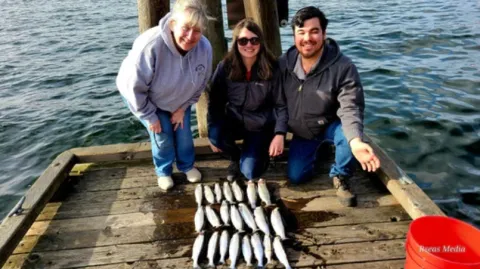
In addition to winter lake opportunities, a trip on the salt can be very productive. Both Marine Area 10 and 13 should be open. MA 10 is scheduled to be open February 1, 2023 through March 31st, but check the WDFW Emergency Regulations for early closures or seasonal schedule adjustments. MA 13 is open year-round, but again, check the WDFW Emergency Regulations before you leave the driveway.
When open for winter chinook, MA 10 is one of the most consistent salmon fisheries in the state. The minimum size limit is 22” and the fish need to be clipped. 4-10# fish are common, with possibility of a trophy fish any time you hook up all makes for a very exciting fishery. I believe that pound for pound, blackmouth are one of the hardest fighting fish in the PNW.
Although many fish are caught mooching cut plug herring or jigging, the fishery is primarily a downrigger show. You want to be fishing right on the bottom. Often you will notice that your fish is all scraped up and find gravel in the fish’s belly when you clean them. Flies or small spoons paired with 11” flashers, plugs and helmeted anchovies all catch fish.
We fished the MA 10 opener this year. My boatmates and I had agreed to make it a C &R day. We hadn’t fished salmon in the salt since September, and didn’t want to go 3 and out in the first hour. We had a stellar trip. From the moment we went gear down, we had fish on. We had to wade through a lot of 20-22” fish and cycled through probably 10 or 12 legal fish before keeping one. I pulled the hook on the big fish of the day and the estimated 10 pounder swam off before we were able to slide the net under it.
I took full responsibility for the lost fish and had to wear the “farmer” overalls. We had already decided to finish the pass and pull the plug for the ride back to Everett. The meter showed a cloud of bait with a few salmon holding just off the bottom. 1, 2, 3, BAM! The port downrigger goes off, and we are on a very solid fish. Hoping to hook the second meter mark, I decided to keep the boat at speed and put the screws to the fish. It was up on top but way off to the side when it got sideways to the flasher, and it swam off. We rarely lose a fish, and I got too big for my farmer britches.
Although we had plugs and an assortment of both trolling flies and spoons on board, we started with Skinny-G spoons and never looked back. We did determine that the lighted flashers had an edge over our regular flashers. We fished the bottom in 80-120’ of water and tried to stay on the down current face of any underwater structure, or along underwater points. It was an incredible day of fishing and an excellent option for a winter fishery.
There are a number of winter steelhead opportunities in the PNW. Many coastal streams are open and occasionally Puget Sound rivers open under WDFW Emergency Rules. I considered breaking the February, April steelhead fisheries down, but I think that that is a whole different article and best written by a coastal steelhead expert. The point in mentioning winter steelhead is that when many of our fisheries are closed, we have a steelhead fishery available. A theme here; again, as with any PNW fishery, double check the regulations and Emergency Changes before you head out.
Fishing withdrawals, cold sweats, and general heebie-jeebies? There don’t have to be, with a little research you have multiple options to treat your fishless disorder. Whether you’re a freshwater, salt angler, or bankie, there are many opportunities to soothe what ails you.
/articles/get-water-now
Catfishing in Washington
By Josh DeBruler
It was November 6th of 1902 at the confluence of the Ohio and Mississippi Rivers, where the great explorer, Meriwether Lewis, recorded in his journal that a prominent fisherman within their expedition had brought in a Goliath of a catfish that measured over 4 ft long and weighed in at 128 lbs.
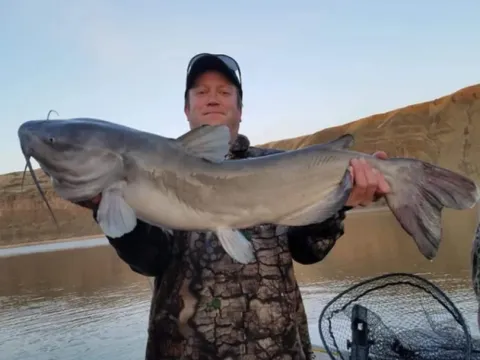
Whether this accounting is of historical fact, or just generally accepted as American lore, the fact remains that Catfish get BIG. The record size catfish for the same river that Lewis and Clark’s men were dropping their lines in is currently a 104 lb.
blue catfish, and though we wont likely see those types of numbers coming out of our Pacific Northwest waterways anytime soon, we certainly do see some formidable sized cats here in Washington State. In 2019 a 15 year old boy hauled a 37 lb. state-record channel catfish out of Lake Terrell in northwest Washington, beating the previous record by 1.5 lbs.
If you’re looking to hook into a big catfish here in Washington State, chances are you’ll be fishing for channel catfish. Channel catfish are native to much of North America, but they didn’t make their debut here in Washington till 1892, when a load of them were dropped off in Skagit county’s clear lake.
From that point forward, these fish were distributed throughout Washington State for both recreational angling opportunities, and more recently, for management of problematic forage fish. Although, they can be found throughout the state, most anglers familiar with the fishery would agree, your best bet for harvesting some of these fish would be to head to the Columbia river to fish it and its tributaries that head north from the Bonneville Damn, and meander up and across the eastern portions of the state.
Rivers like the Columbia, Yakima, Snake, and Walla Walla, all provide reasonably suitable habitat for these fish to spawn and maintain self sustaining populations. Conversely, lowland lakes that are stocked with channel cats, will only provide anglers with fishing opportunities that reflect both the frequency of the WDFW stocking programs and the pressure the lake receives from anglers. Channel catfish are not known to reproduce in most Washington lakes.
Where to fish in Eastern Washington (Eastside of cascades )
-Lake Umatilla
-Lake Wallula
-Lower Yakima River
-Lower Walla Walla
-Lake Sacajawea
-Lyons Ferry State Park (confluence of Snake and Palouse rivers)
-Roses Lake
Where to Fish in Western Washington
- Green Lake
- Clear Lake
- Silver Lake
- Lake Terrace
- Swofford Pond
- Lake St. Claire
When to fish
Fishing is most productive when catfish are spawning. This typically peaks around June and you can expect the bite to taper off as we move into fall. The spawning season also causes catfish to move out of the larger Columbia river and into its tributaries where the shallow waters provide better spawning grounds. Take advantage of this time to target catfish in these smaller waters, and if you can fish the confluences of the Columbia and said tributaries at this time, a bottleneck opportunity occurs, and this is where the fishing can become excellent.
How to fish them
Being that most techniques are fairly straight forward, fishing for channel catfish should be suitable for anglers of all different experience levels. You’ll likely find that the most challenging part will be getting on top of the fish in the first place. If you are fishing at night, you’ll find catfish feeding in the shallow waters near the shore, and though night fishing is excellent for channel cats, it’s also not a very suitable time for the typical angler.
For this reason, many anglers fish throughout the day, and do-so successfully. During the day, you’ll find most of your channel catfish in deeper waters beneath the column of warm water known as the thermocline. Typically, 15-20 ft down will get you past the thermocline and into the cooler waters.
Since these fish are bottom feeders, the goal should be to get your bait at the bottom where it can be detected by the catfish’s keen since of smell. There’s a wide variety of baits you can use. Many anglers opt for chicken livers, oily cut baits, earthworms, chicken skins, hot dogs, shrimp, corn, or dough balls made specifically for catfish. These fish don’t seem to be extremely particular about their food as long as it’s in front of them.
As far as rigging goes: a slip sinker rig is both simple and productive. From your main line, add your preferred slip sinker, a stop bead, barrel swivel, about 5-20” of leader, and a 2/0 to 3/0 hook. You can get the hook suspended a bit off the bottom by adding a poly ball or foam peg float a few inches back from the hook if desired (note this becomes ineffective if a substantial amount of current is present)
A slip bobber rig is also a popular and effective method to get your bait suspended off the bottom while being able to detect bites visually. Just add a stop knot to your mainline, then a bead, a slip bobber, slide sinker, barrel swivel, and 10-20 inches of leader before your hook.
There are plenty of other methods available for catching channel cats, but these should be all you need to get started.
/articles/catfishing-washington
Icefishing a School Bus Away
by Matt Carey
It’s human nature to think that we need to go to great lengths to find happiness, joy, fulfillment or satisfaction. It makes sense at first glance – the more time invested, the higher the payoff. In reality, we can find value in a lot of things that are right in front of us. A quick jaunt, a stone’s throw away, right around the corner.
Maybe the same can be said for fishing.
In my day job, I work as a principal for an alternative high school. Much of my day is dedicated to helping these kids realize the opportunities they have in front of them and how to access those people who can offer help when needed. To my students, a career, graduation, just getting to Friday, are all unknown hurdles in their lives. Imposing forces that take away from the goal of just getting through the day. With the multitude of stressors on their minds, recreation and leisure are often a fading thought.
One of these recent lessons presented itself with a school fishing trip to the Helena Regulating Reservoir not too far from town, maybe 20 minutes. When I go fishing personally, I’ll opt to fish at Holter Lake, about an hour’s drive or Pishkun Reservoir, nearly two hours away, when I feel the need to fish. Coming into the day, I had low expectations. I’m not using my own gear. I’ll need to supervise these kids and keep everybody engaged.
It’s just down the road, not much adventure there. I’ll probably get called back to the building for something. We went, as a school, on this same fishing field trip last year – with no success. Not a bite. Windy conditions. On the metaphorical pendulum that is fishing, that outing swung strongly towards the forgettable side.
Furthermore, this fishing “trip” isn’t anything like those days where we need to wake up at 4am to drive to the dock at first light or prepare a few different set ups if we decide to target different fish. How could I possibly have the same level of excitement and anticipation as a fishing trip out with my buddies?
The afternoon started off unassuming. The folks from Montana Fish and Wildlife talked to our students and staff about some general ice fishing information. How to bait a hook. How to open the fishing bail. How to know if you have a bite. Trivial information you and I take for granted. To kids who have never gone fishing, this information was captivating.
One student even asked to come closer to see the line drop to the ground when the instructor opened the bale demonstrating how the bait would fall through the water. The seemingly innocuous presentation had captivated at least one of my students. We made our way on the ice and walked for a good 15 minutes. Many of the kids, and the guy in charge of supervising everyone, didn’t have the appropriate footwear.
This made the icy trek all the more cautious. The freeze was still in full effect, and our guide for the day reported the ice was about 18 inches thick. More than enough to comfortably fish without danger. After a few hundred yards we had made our way to our fishing holes. A previous school was there in the morning, with no luck of course, and the gear was ready for immediate fishing. We were given primarily Swedish Pimple jigs with a maggot as our bait for the afternoon.
Kids and teachers wandering around finding what they’d hope to be their lucky spot. Remember how I mentioned last year’s conditions? Well, now picture a complete 180* (you couldn’t really expect to not get a lesson from a guy in education, right?). The sun shining with a few clouds painted across the skyline.
A calm breeze that was never overbearing, but enough to remind you that you are outside during a Montana winter. Mid to high 30-degree weather, necessitating a jacket or sweatshirt, but no need for snowpants or a full facemask gaiter. My Reel Obsession Sport Fishing sweater and Montana Grizzly hat combination was the perfect balance of “drip” (swagger or style to those of you not up to date on the newest slang) and functionality.
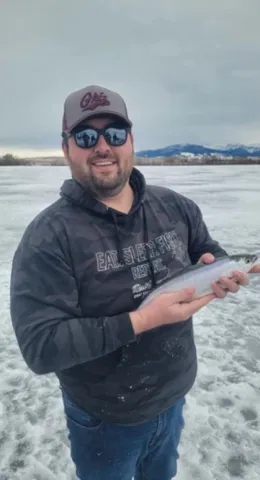
In a similar fashion to the weather, our fishing experience was nothing like last year’s. Within 5 minutes two different kids are pulling up perch. No state records, but a fun experience. Kids goading each other to kiss the fish, being caught off guard by the fish slime and calling over their friends and teachers. Some kids catching multiple fish, one girl catching 3 in our outing. After seeing such a lively bite, I figured why not, I’m here anyway, I might as well wet a line.
A silver and blue jig with a maggot ended up being my lure of choice. More so because it was the only one open at the time. Engaged kids, minimum screwing around, it was a winning combination. I dropped the lure beneath the ice, hit the bottom, reeled up a few feet and started jigging around 18 feet of water.
A few other members of Fish and Wildlife were with us, and I struck up a conversation about anything and everything you’d expect – what set ups have been working well, other lakes or reservoirs in the area, that kind of thing. Caught off guard, my rod tip gets absolutely slammed. My FWP counterpart exclaiming “that ain’t no perch! You’ve got a koke on there!”. As I’m reeling, he asks if I saw the fish on the fish finder.
Sheepishly, I told him I wasn’t really paying attention and I was looking at everyone else catching fish. As I pull the fish out of the water, I see a solid 16 inch kokanee come out of the hole. This is a great fish and certainly not what I was expecting coming into the day. I ask for a picture and release my catch back into the reservoir for someone else to find.
I realized in that moment that even the mundane or trivial, we can find great joy and satisfaction. Are weeklong fishing adventures great? Of course. Can adventure and happiness be a school bus ride away?
Without a doubt.
/articles/icefishing-school-bus-away
The Sport Reward Fishery
By Hannah Pennebaker
What’s better than fishing? Getting paid to go fishing! Every year, WDFW pays anglers for every northern pikeminnow they catch. Why? These fish eat millions of baby salmon and steelhead every year. The goal of the program, called the Pikeminnow Sport-Reward Program, is to reduce the average size of the fish and remove the larger, older fish that eat the most salmon and steelhead. With this program, not only can you get paid to catch these fish, but you can also help out salmon and steelhead!
This program takes place on the Snake River and Columbia River every year, from about May to September. According to WDFW, “In 2022, rewards begin at $6 each for the first 25 Northern Pikeminnow caught during the season. Anglers are paid $8 for each fish they catch from 26-200, and $10 for every fish caught over 200 cumulatively. Anglers are also paid $500 for each specially tagged Northern Pikeminnow!” Every pikeminnow 9 inches or longer is eligible for the program. Dedicated pikeminnow anglers can make thousands of dollars every year, and feel good about helping salmon and steelhead out.
WDFW says that anglers “averaged reward payments of $27,836 each for the five-month season. The highest-paid angler in 2020 caught 5,579 fish and earned $48,501, while the all-time record harvest is 14,109 Northern Pikeminnow worth $119,341!” Not bad, and don’t forget that it’s all for a good cause: each pikeminnow can eat up to 15 salmon/steelhead smolts in a day. Interested in trying out the fishery? Let’s go over how the program works, and how you can get involved.
The Pikeminnow Sport-Reward Program is designed to be as easy and straightforward as possible. There are stations set up near the Columbia and Snake Rivers where you can turn in your catch for the day. You must register at the station before you fish, and a valid fishing license is required. Registration forms are available 24/7 at each station. If the station is unmanned when you arrive, you can pick up your form from their night box.
Fish must be returned to the registered station during its hours of operation in order to qualify for a reward. Frozen fish are not allowed, they must be live or fresh. Any fish 9 inches or above will qualify. You may register for the next day when you return your fish for the day. If you return fish to the station without registering in advance, you won’t be able to get your reward. Rewards aren’t issued at the station, instead, you’ll get a voucher. You’ll get reward vouchers every time you turn in eligible fish, and you can mail them to WDFW for a reward, issued in the form of a check.
Remember, WDFW must receive your vouchers by November 15th of every year. If you’re lucky enough to get a specially tagged fish worth $500, the station will give you an envelope to mail the tag to. The first time you receive a voucher, you need to include an IRS W-9 form when you mail the voucher out to receive payment.
Interested in trying out the fishery? Thankfully, it can be very productive, and there is a lot of information out there to help get you started. Shore anglers can do just as well as boaters. Every week, WDFW posts catch numbers collected at each station, and catch reports dating back to 2014 are available on their website. You can figure out where anglers are having good success and try fishing in those areas.
Pikeminnow can be caught from shore or boat. You can use bait, artificial plastics, or lures. Diving crankbaits work well, and you can troll them or cast them out. Pikeminnow tend to congregate near the bottom of the river. Drift fishing can be very effective! Many seasoned pikeminnow fishermen drift tubes or grubs on a ¼ oz jighead. Bring a variety of different colors; pikeminnow can be surprisingly picky! Use just enough weight to tick the bottom and not drag on it, or you will likely snag up and lose your lure. If plunking is your bag, you’re in luck.
Many anglers have had success plunking worms, chicken liver, and shrimp. Just make sure to use enough weight to stay on the bottom. Small spinners and other bass lures can also work well. If you’re on a boat, you can “back bounce” your bait by lifting up your rod, letting out some line, and repeating once your weight hits the bottom. Just make sure to keep your line as tight as possible, as pikeminnow have surprisingly light bites.
Like most fish, pikeminnow tend to hang out around structure. They also like faster currents, so avoid frogwater. They tend to school up, so if you don’t catch one within 10 or 15 minutes, move and/or change bait/lures.
The Pikeminnow Sport-Reward Program has been a huge success, and is still going strong every year. According to WDFW, “over the past ten years (2011-20), the top 20 anglers caught an average of 3,353 fish per angler. Results indicate that the Pikeminnow Program has been successful, with over T5.2 million predatory Northern Pikeminnow removed to date by anglers participating in the Sport-Reward Fishery, and a decrease of predation on juvenile salmonids of up to 40 percent from pre-program levels”.
This is a great way to help salmon and steelhead, and make money doing it! As a bonus, pikeminnow are scrappy fighters and are great fun to catch on light tackle. Remember to register at the monitoring station before fishing, and have fun out there!
If you’re looking for more information about the Pikeminnow Sport-Reward Program, WDFW holds free fishing clinics during the season, and they often have a booth at sports shows where you can learn more. You can check out their website for a free, one-time $10 coupon to turn in with your first pikeminnow! Good luck out there!
/articles/sport-reward-fishery
How to Catch Bass in the Winter
By Rick Lawrence
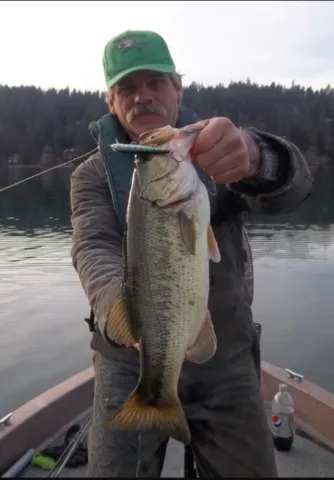
Let’s talk about winter bass fishing. Whether you choose to fish out of a boat in open water, or venture out on a frozen lake to drill a hole in the ice, you can catch bass in the winter. This time of year can be challenging for bass anglers, but with the right techniques you can master it. Here are the top 8 most important steps to follow when fishing for bass in the winter.
Choose the Right Lure Type
The first thing you’ll need to think about is grabbing the correct lure for the season. You can’t use the same strategy you use when the water is warm, no matter what way you look at it. Winter fishing techniques require finesse, but they also require a bit of preparation. Fast-moving lures and excessively noisy ones won’t work when the water temperatures drop. You’re going to want to use bottom feeders and slower moving lures like jigging raps, flutter spoons, or, if you are fishing open water, suspending jerkbaits, if you work them slowly, with long pauses.
Stay away from lipped and lipless crankbaits, spinnerbaits, and other fast-moving lures during the winter months. Even switching from lures to live bait when legal is sometimes the key to landing winter bass.
Always choose the most natural color you can, and try to imitate the fish’s color in the water you’re fishing.
Slow it Down
You need to slow down your presentation when the water temperatures drop. Winter largemouth bass fishing requires you to think like a fish. The water is cold, their metabolism is slow, and they’re not feeding much, so they will never chase a fast-moving bait halfway across the pond. It won’t work.
You need to drop something right in front of their face, make the bass think it’s almost dead, and move it slowly and erratically, so they think they’ve got an easy meal on their hand. Once you do that, you’ll have no problem retrieving them because they won’t put up much of a fight. In less than 40-degree water, you’re in for a challenge. At that temperature, the bass are incredibly inactive, and their metabolism is super slow, so they’re not feeding much, and they’re preserving all their energy by taking on the simplest of meals.
For you to have success fishing during this time, you need to throw your lure right in their face and present it slowly enough for them to get it.
The 40-to-50-degree temperature range is prime fishing in the north, so expect to find bass in this temperature range most frequently during early and late winter months. Bass in this temperature will slow down quite a bit, but they’ll still have feeding periods each day, and this is when you need to capitalize by using the right lures and offering a slow but calculated presentation.
Size it Down
In addition to presenting more slowly, you’ll also want to present a smaller lure. Small bait fish imitations can trigger strikes, or you can go with a small nedhead jig or spoon with some red on it.
The bottom line is, your strategy needs to stay in line with the conditions. If it’s cold and the water temperature is near freezing, use a small ned, or the smallest swimbait you have, nose hooked on a drop-shot jig. Doing so will present less of a threat to the bass, and they’ll think they stumbled upon an easy opportunity for a meal.
Go Neutral
Color is also an important factor in the winter. If you can find baitfish in the water, see what color they are, and mimic them. If not, go neutral whenever possible.
Know Where to Look
The best tip someone ever told me is to use a good fish finder and search the area for fish before you try fishing for them. Water clarity is also a huge factor in the winter. If the water is murky, the baitfish will run deeper. If you have clear water, the baitfish will come closer to shore and into the weed lines. Look for green weeds, rocky drop-offs, submerged islands, or any structure that might be a good spot bass would use, then scout the area for fish with your electronics.
Time it Right
As previously mentioned, you need to change your mindset when it comes to fishing in the winter. When the water temperatures are warm, we know that the best times to fish for bass is first thing in the morning and right at dusk.
When you’re fishing in the winter, you’ll want to fish the middle of the day because this is when the water will be the warmest. Once the sun has hit the water for a while, the baitfish will start to move around, and this is when you stand the best chance of catching more bass.
Don’t Forget the Basics
One of the most important winter bass fishing tactics to learn revolves around understanding structure and baitfish. You can sometimes find bass without any structure around if there are baitfish there, and sometimes you can find bass on structure without any baitfish, but you will never find them where neither are present. You need to understand these two points and why they’re critical for winter fishing. Baitfish will sometimes hug the shore near creeks because this is where the most oxygen is, and the temperature tends to be a bit warmer. As we all should know, bass follow the baitfish, so this is where you’re likely to find more bass. Offshore green weed lines can also hold bait fish and provide bass with ambush points to catch an easy meal, making them prime spots as well.
Bring the Right Gear
While this isn’t a direct tip per se, I wanted to talk briefly about safety and gear. Depending on your location, fishing in the winter can be dangerous because of frigid temperatures and dangerously cold water. You need to make sure you have enough layers to keep yourself warm, and plenty of backup gear in case you fall in or get wet. Wear multiple layers with socks, ice fishing boots, and fingerless gloves so you can maintain full movement of your fingers. If you're on the ice, make sure you have all the proper safety gear you need in case you should fall through the ice, and don't ever fish on the ice alone.
/articles/how-catch-bass-winter