/articles/categories/fishing
Grant County Fishing Opportunities
By Mike Schmuck
Martha Lake and Upper Caliche Lake: These lakes, near the town of George, WA, should produce well in spring 2020. In addition to fingerling Rainbow Trout, both lakes received 1,000 11–13-inch Rainbow Trout in fall 2019 and these fish should be in the 14–15-inch range this spring. These lakes also received 1,000 (Martha) and 500 (Upper Caliche) catchable Rainbow Trout in April 2020.
Quincy Lake: Over the years this rather popular lake, located on the Quincy Wildlife Area, has provided anglers with good catches of 11–13-inch trout as well as the occasional carry-over fish that can often be in excess of 14 inches. Quincy Lake fished well in early March 2020 with several fish caught in the 18-20-inch range. WDFW hatchery staff will be stocking nearly 1,000 Rainbow Trout into Quincy Lake in preparation for the May 5th re-opening. These fish are just over a pound each and will provide excellent opportunities for anglers.
Burke Lake: Burke Lake, a next-door neighbor to Quincy Lake, underwent a chemical rehabilitation in the fall of 2019 in order to remove nuisance Yellow Perch and Pumpkinseed Sunfish. WDFW Hatchery staff stocked 3,000 9–11-inch Rainbow Trout into Burke Lake in late-February. Burke Lake will be receiving 1,000 Rainbow Trout in preparation for the May 5th re-opening. These fish are just over a pound each and will provide excellent opportunities for anglers. Burke Lake received very little fishing pressure in early March and should provide excellent fishing for the remainder of the season.
Quincy Wildlife Area walk-in-lakes: While Quincy and Burke Lake get the lion’s share of fishing pressure, there are several small walk-in lakes just west of these two popular fisheries. Crystal, Spring, Cup, Lloyd and Scout Lakes are not on many anglers’ radar—but they should be. These lakes receive annual stockings of fingerling Rainbow Trout from Columbia Basin Hatchery and often provide anglers with solitude and big fish.
In early March I talked to one angler who caught two 21-inch Rainbows from one of these lakes—I promised not to tell which lake they came from. Scout Lake is a mile north of the remaining lakes on this list and is 530 yards west of the H-Lake parking lot. Those looking to social distance should keep these lakes in mind.
Ping Pond (aka Oasis Park Pond): This 2+ acre pond located at the south end of Ephrata is open to Juvenile Anglers (under 15 yrs. old), Senior Anglers (at least 70 yrs. old) and Anglers with a Disability who possess a designated harvester companion card. WDFW hatchery staff stocked 30–40 Jumbo (3 lb.) Rainbow trout and 200 12–14-inch Rainbow Trout into Ping Pond on May 1 in order to give kids a fun opportunity to catch some nice fish.
Park and Blue Lakes: These lakes are two of Grant County’s top trout waters and both should fish well this spring. Catch rates were lower than anticipated on opening day 2019; however, this was likely due to high winds that kept many anglers off the water. Despite relentless winds, catch rates averaged 3 trout per angler on both lakes. Anglers should expect good catches of rainbow trout in the 12–14-inch range as well as some 2+ year-old ‘carry-over fish’, in the 15–17-inch range. Brown Trout and Tiger Trout are also stocked in both lakes.
Vic Meyers Lake: This 12-acre lake located in Sun Lakes State Park receives a fair amount of fishing pressure and produces Rainbow Trout to 17-18 inches. The lake has excellent shore access and is a good choice for anglers looking to get away from crowds.
Perch Lake: Another lake in Sun Lakes State Park, Perch Lake has limited shore fishing but is ideal for someone with a small boat or float tube. I visited Perch Lake numerous times in 2019 and never encountered an angler. I did, however, see a lot of trout rising in the evenings and believe this lake should fish well. Perch Lake receives 9,200 fingerling Rainbow Trout each year.
However, in 2020 we reduced this significantly due to low angler effort. Low harvest on these fish will increase food competition and limit growth for remaining fish. A lack of large fish in this population will further limit the popularity of this fishery.
Deep Lake: Deep Lake is a good choice for anglers looking for great scenery and good fishing. While not known for an abundance of large fish, Deep Lake produces Rainbow Trout in the 11–13-inch range, and a few carry-over fish close to 16 inches. Anglers wishing to troll, or simply fish a little deeper, can also catch Kokanee. Each year, WDFW hatchery staff stock Deep Lake with 13,500 spring fingerling Kokanee. In addition, Deep Lake also receives 15,000, 11–13-inch Rainbow Trout from Trout Lodge Fish Hatchery.
Warden Lake: Warden Lake is a popular trout lake, but in recent years it has been producing excellent catches of Yellow Perch and bass. Warden Lake receives 65,000 spring fingerling Rainbow Trout, 7,000 spring fingerling Tiger Trout and 15,000 6–9-inch Rainbow Trout each year. In early spring 2020, Warden Lake was stocked with 3,300 12–13-inch Rainbow Trout from Trout Lodge in late March. To provide more opportunity, WDFW hatchery staff stocked an additional 2,200 Rainbow Trout into Warden in late-April. Anglers should expect excellent trout fishing once lakes reopen.
Potholes Seep Lakes: Several lakes south of Potholes Reservoir can produce good catches of Rainbow Trout as well as Bass, Bluegill, Black Crappie and Yellow Perch.
Corral Lake: This lake is located near the southwestern end of O’Sullivan Dam just across the road from the MarDon Resort. Corral is a good choice for anglers that don’t mind a mixed bag of good size Rainbow Trout, Largemouth Bass or Black Crappie. Bring your boat to explore this lake fully—shore access is limited.
Pillar-Widgeon Chain: These walk-in lakes on the Columbia National Wildlife Refuge are consistent producers of quality Rainbow Trout. This chain of lakes receives spring fingerling Rainbow Trout and are a popular destination for anglers looking for a quiet day on the water.
Hampton Lakes: The Hampton Lakes have fished well over recent years. Lower Hampton Lake receives more angler effort and while catch rates are somewhat lower than on Upper Hampton, the fish caught there are larger. Since the 2014 rotenone treatment of the Hampton Lakes, Pumpkinseed Sunfish have recovered to a point where they are negatively affecting growth of fingerling rainbow trout.
Teal Lakes: The Teal Lakes, located along the Seep Lakes Road on the Columbia National Wildlife Refuge, are a popular fishery for anglers looking to catch good sized trout. Both lakes, while managed for trout, have carp, bass and sunfish as well. Consequently, fingerling growth and survival have suffered. South Teal Lake receives little fishing pressure, likely due to abundant aquatic weed growth and limited access to most of the shoreline.
Most of North Teal’s shoreline is accessible and anglers commonly catch very nice 13–15-inch rainbow trout all around the lake. Catch rates, on average, are lower here than on other more productive waters such as Blue and Park Lake; however, anglers can find they often have the lake to themselves, especially during the week.
Hutchinson and Shiner Lakes: Located on the Columbia National Wildlife Refuge in Adams County, are connected lakes with quality Largemouth Bass, Bluegill and Crappie. They are both best fished from a small boat, canoe, or float tube/pontoon boat. Anglers willing to put in a bit of extra work can row or paddle to the east end of Shiner Lake to target more naïve bass.
Katey & Janet Lakes: These two trout lakes can provide solitude and good catches of Rainbow Trout. Katey Lake was treated with rotenone in fall 2019 to remove Carp. In early April, WDFW hatchery staff stocked 200 11–13-inch Rainbow Trout into this six-acre lake. Janet Lake is a short hike west from Katey and can provide anglers with some larger Rainbow Trout. Most of the shoreline is accessible to anglers on both lakes.
East and West Sage Lakes: Similar to Katey, these two lakes were treated with rotenone in fall 2019 in order to remove Carp. The Sage Lakes produce large Rainbow Trout, although for the remainder of 2020 anglers will have to rely on slightly smaller hatchery fish that were stocked in early April. WDFW hatchery staff stocked each lake with 500 11–13-inch Rainbow Trout which should reach 14–15 inches by spring 2021.
Windmill, North Windmill, North-North Windmill, June, Virgin, Lois: Anglers need several days to explore these lakes located south of Warden Lake. This chain of lakes, managed for Rainbow Trout fishing and popular with fly angers, can produce some large fish.
/articles/grant-county-fishing-opportunities
Kokanee Fishing Color Choice Confidence
By Gary Gordon
It is the single most important thing to grasp: kokanee are kokanee and have the same whims, growth, hormone, and feeding issues wherever they are found. So these kokanee issues are the same in Washington, Oregon, Colorado, Idaho, Wyoming, Montana, Utah, California, North Carolina, New Mexico, and British Columbia.
It turns out that before getting to the point of deciding what colors are the answers to today’s fishing mysteries, selecting color is the last component of a successful outing. Since color makes no sound and has no scent, its single role is to stimulate a biting response.
The next thing to grasp is a consistent presentation strategy. What you are trying to do is make your presentation as 100% efficient as possible. This means that all of your equipment from your boat, trolling motors, fishfinder, GPS, rods, reels, downriggers, and releases must be working together so that your presentation can be as efficient as possible. Having the “right” colors means nothing if you are not placing your tackle where the fish are.
Correct presentation strategy means also that your attractor and the lure have to work together. You have to troll the dodger at a speed that allows it to attract. That means that each attracting dodger has a minimum speed that allows it to work correctly. What that speed is depends on the size and shape of the attracting dodger.
One of the best ways to check the correct speed is to simply put the dodger into the water on your fishing line right next to the boat, and look at the action. Speed up or slow down the boat until you feel the action is what you are looking for. Recognize that the dodger and lure are working together, so look for movement in the lure behind the dodger. You simply do not want the lure to just sit there in a straight line behind the dodger; you want some movement. Keep the lure in tight behind the dodger for the best movement. I advocate 6 to 8 inches of leader, even if your lure comes with a long leader.
For early season, that movement does not need to be great. As the season progresses, speed up your presentation to get more movement on your lure. Also, as your target depth gets deeper, increase your trolling speed, and increase the size of your dodger.
I carry three different size selections of dodgers for these very reasons.
For all except the Apex type lures, it is critical to have a short leader behind the dodger for the lure. This gives the maximum movement to the lure from the movement of the attracting dodger. I prefer only about 6 inches behind the attracting dodger regardless of the size of the dodger.
Next would be to match the dodger colors with the lure colors. Although color is not an initial attractor, it is vital to stimulate the biting response. You want what is making the attracting vibration (the dodger) and the following matching lure work together. The following chart shows relative penetration of visible colors in the water column. We all know there is less light at depth.
Go deep enough and there is no light. Water absorbs light in sequence of the visible spectrum. Light enters the water as white light. Then very shortly the red drops out, leaving the balance of colors to continue together down the water column. The next to drop out are the oranges, then the yellows, then the green, then the blues and then the indigo and then finally the violet.
But use fluorescent colors and the color you see in your hand will be the same color at depth. So, a fluorescent yellow will still be fluorescent yellow when only violet light can act on it. If it is not fluorescent, it will be black when violet light strikes it. All tackle marketed as “UV” is really fluorescent. There is no “UV” colorCOL, and “UV” light does not penetrate the water column more than just a few inches. Most tackle marketed today is fluorescent even if it is not marked “UV.” Fluorescent colors penetrate the water column to far greater depths than do ordinary colors.
So, can kokanee see color? Kokanee are vertebrates and as such they have eyes that contain rods and cones. Cones are the part of the eye for color. Salmonids have a distribution of about 10% cones and 90% rods. So, color vision is basically limited to an area directly in front of the snout and extending out about 20 inches or so in clear water.
This is actually a good thing. Stay with me now. You have this awesome hot pink squid properly trailing your dodger. The fish is going to be attracted to the dodger vibrating, but that will be at some distance to your lure. Once that lure become visible to the fish, it is still only seen by the fish’s eye rods in shades of gray and black and white tones. But as the fish approaches that 20-inch mark, there’s an explosion of color – just like turning on a light bulb. The fish backs off to 21 inches and it is back to black and white and gray. Come in closer, and bam! Hot color – just the way you planned it topside, but not exactly the way you planned it topside. This color shift works for you as a bite stimulant.
Here are some helpful suggestions about color.
• The first suggestion is that the color of the day, or even of the hour, is up to the kokanee.
• Early season stuff: pink, red, orange, green, natural glow, blue
• Mid-season – absolutely wide open, but add copper and gold to the mix. Run copper and gold setups a bit faster than the nickel. Don’t forget the black and white stuff.
• Later season – kokanee love the blue, pink, and watermelon.
• All seasons: White and glow.
/articles/kokanee-fishing-color-choice-confidence
A Bounty On Water Wolves
From the late 1800’s until the middle of the 20th century, there was a bounty on wolves in the Midwest and Western United States. Both individual and government hunters used any means necessary to kill these animals, deemed a dangerous nuisance to livestock. By the time this program ended, wolves were essentially exterminated from the lower 48 states. It wasn’t until 1995, when wolves were reintroduced to Yellowstone National Park, that their numbers began to come back, and today, we are seeing healthy populations of these animals in several states.
The relationship between humans and northern pike is a bit more complicated. These torpedo shaped fish are green in color with white spots and a white belly. They can grow to over 50 inches long and weigh over 45 pounds, though an average sized pike measures between 16 and 22 inches in length. Pike are ambush predators and feed on other fish as well as frogs and even ducklings, waiting in weeds or behind rocks and logs, and then lunging forward to attack their prey. With a mouthful of long, sharp teeth, they have garnered themselves the nickname, “water wolves”.
Land Wolf
Unlike the land-based wolf, there was no historical dislike for these fish, which are found in the northern tier of the United States as well as in Canada and Alaska. They are a sought-after catch because of their size and good fighting ability. They also taste good, though a y-bone in their body makes them more difficult to clean and fillet than walleye or trout. In the winter, anglers will target these fish through the ice, while in the spring they are often caught in places like Lake Coeur d’ Alene, fishing bait under a slip bobber. They can also be caught from spring through fall throughout their native range, using large spoons. Red and white Dardevle spoons and yellow spoons with red diamonds on them (known as a Five of Diamonds) are traditional offerings.
In Washington State, northern pike are found in Long Lake, the Pend Oreille River, and Lake Roosevelt, having migrated there from Lake Coeur d’ Alene in Idaho and Montana’s Clark Fork River. The fish are not welcome in the Evergreen State. Both the Washington Department of Fish and Wildlife as well as the Colville Tribes are extremely concerned about their impact to native populations in these waterways such as redband trout, sturgeon, burbot, and kokanee salmon. Fisheries managers also want to ensure northern pike do not get into the mainstem Columbia River below Grand Coulee Dam, where they could wreak havoc with native salmon and steelhead populations.
Pike
Since 2015, the Colville Tribes, Spokane Tribe, and Washington Department of Fish and Wildlife have been working hard to eradicate pike from these waterways. They have had good success in reducing a burgeoning population of these fish in the Pend Oreille River, and since 2015 have removed over 19,100 fish from Lake Roosevelt. The primary method the Colville Tribes use to catch these pike is with gill nets, but they have found this method alone is not enough.
That’s why a bounty program has been introduced at Lake Roosevelt for recreational anglers. Anglers who catch northern pike (of any size) can turn in the head of the fish at designated drop off sites around Lake Roosevelt and be paid $10 for each fish head turned in.
Anglers can drop off their pike heads at Noisy Waters Gas Station, Kettle Falls boat launch, Hunters boat launch, Fort Spokane boat launch, or at the Inchelium Fish and Wildlife office.
In 2022, anglers turned in 125 heads and were paid $1,250.
Increased Efforts
In an effort to increase the number of fish caught by recreational anglers for this program, the Colville Tribes Fish and Wildlife Department has published a map showing pike hot spots around the lake. Some of these hotspots are found at the mouth of the Kettle River, near Evans, on the eastern end of the lake near Noisy Waters, and at the mouth of the Colville River, south of Kettle Falls. Additional places worth fishing can be found south of Gifford and on either side of the reservoir near Hunters.
Here are the rules if you want to participate in the Northern Pike Bounty Program:
- You must be 17 years of age or older to participate in the program.
- Anglers must completely fill out the tag information at the designated drop off area. Fish heads must be placed in a freezer bag with the label and dropped into the freezer or brought to the Inchelium Fish and Wildlife office.
- Fish heads must be in good condition and clearly identifiable. Unidentifiable heads will not be accepted or awarded.
- Fish must be caught in the main stem Columbia River from Wells Dam upstream to the Canadian border, the Spokane River upstream to Little Falls, the Kettle River, or the Okanogan River.
- There are no size restrictions on northern pike.
- Anglers must adhere to all applicable state/tribal fishing regulations for the area in which you fish. Contact your local state or tribal agency for license requirements and current fishing regulations.
- Please allow 2 to 3 weeks to receive your reward.
Additional information about the program can be found at www.cct-fnw.com/northern-pike
John Kruse – www.northwesternoutdoors.com and www.americaoutdoorsradio.com
/articles/bounty-water-wolves
How to Survive Opening Day
April is unofficially the start of spring and often linked to mythical tales of rebirth, resurrection, and fertility. Throughout history, spring has been celebrated via a diverse lineup of traditions. It is a time of rebirth that can be tracked back for centuries. Where many of the ancient festivals can be directly linked to some sort of bloodshed and brutality, fortunately for the Western Washington angler, we see April as opening day of lowland lakes season.
Where hopefully our participation does not result in bloodshed, opening day can either be a bodacious good time or a stressful one. As a small child I remember anticipating opening day for months, any given year it was probably the highlight of the year for me. My opening day experiences have always been memorable. To this day, fishing or not, I eagerly await opening day each year. In a sense, opening day marks my renaissance each year. Unfortunately, not everybody feels the same way, and opening day can be an overwhelming source of frustration.
So, how does one survive opening day crowds?
Opening day frustrations come in many forms and we all have different tolerances for things that are generally out of our control. Your mindset should be that most things associated with opening day will be out of your control. The list is long, but some things to think about are tackle/gear availability, where to go, gear failure, and crowds.
Planning and preparation will go a long way in smoothing over any pre-opening day jitters. Don’t go to your local tackle shop on the Friday before opening day and expect to find your favorite lure, a kiddie setup, a jar of Ball-O-Fire eggs, or buy your license. Even well stocked tackle stops can run low in the days leading up to opening day. Shop early and remember that in our post pandemic world, the tackle shops are dealing with supply chain issues.
If they don’t have something it’s likely not their fault, and they are doing everything they can to anticipate your needs. Locally, Kevin Johns with Holiday Sports is a both the tackle buyer and lifelong local fishing expert. They are well stocked for opening day. If they don’t have what you’re looking for, look up Kevin and he will steer you in the right direction. SportCo/Outdoor Emporium, Johns Sporting Goods, Yeager’s, and even some local hardware stores have a fishing expert. As a hidden gem, the fishing department manager at Ace Hardware in Anacortes knows her stuff and is very devout in her pursuit of our local fisheries.
Before opening day take the time to go through your gear and, if you’re using them, your boat and trailer. Did the battery survive the winter, trailer lights work, and are your winch and/or tiedown straps functional? Check the line on your reels, replace as required. Check your rods for damage and cracked guides. How does your tackle bag or box look, are they adequately stocked? Make sure you have serviceable PFDs for everyone that may be on your boat, and it’s a good idea to have life vests for any children and non-swimmers when fishing from shore.
As part of your planning activities, maybe visit the area you plan to fish ahead of time. Check ramp conditions, look at the boat trailer parking options, shoreline access points, and hazards. Make sure there are not any surprise road or access closures. Over the winter, some of our access points may have been updated, and parking or access could be different.
Hopefully your upfront planning and preparation will help to soothe and your opening day anxiety, but you’re not out of the woods just yet. You still have to survive opening day!
I kind of look at opening day as maybe attending Mardi Gras in New Orleans. All the individual components and food may be a little odd or even uncomfortable, but the combined experience is an absolute hoot. A big thing to remember about opening day is that it is typically a family event. Strive to make it a positive experience for everyone involved.
Children are very perceptive and are constantly learning from our behavior. If they get tangled with your prize stocked rainbow or one of the grandkids hooks your favorite fishing hat when casting just laugh it off. In the event of a tangle or other calamity, no matter who is at fault don’t be afraid to say that you are sorry to your fellow angler. Use the time to teach good sportsmanship and etiquette.
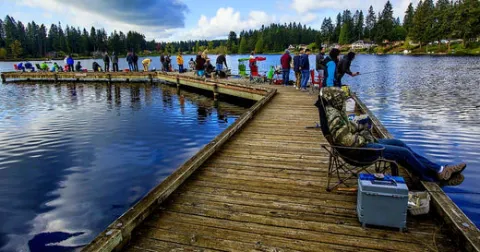
You will have no control of the crowds and know that going in. That said, you can do a few things going in to improve the experience. First and foremost is to arrive early. Not just early but hours early. Your favorite spot at the corner of the dock or bulrushes is more likely to be available, and if you’re boating, you may find trailer parking within a reasonable distance to the ramp. On that note; if fishing from the shore, don’t impede the boat ramp access. Boaters need room to maneuver their rig, a place to beach their boat, and a line free path to and from the boat ramp while on the water.
As an alternative, if early doesn’t work, sleep in. Get up, have a cup of joe or three, and maybe even breakfast before heading off the lake. There is a thought here; opening day is all about voracious, planted trout. These fish will have the feed bag on all day. Years ago, I hatched an opening day plan to fish Lake McMurry in Skagit County. We had a guest from Alaska, she was an avid angler but had never fished an opening day.
The plan was for me to launch at o-dark thirty, then wait for them to arrive around daybreak. In accordance with the plan, I launched hours before daylight and was the second rig in the parking area. After launching I motored out, dropped the anchor, and waited for the crew. It was cold, raining and breezy, and in short order I was soaked the bone. With dawn came a renewed hope that I wasn’t going to die of hypothermia just off the Lake McMurry boat ramp, but my wait continued. There was a lot of activity, and I enjoyed watching all the happenings. My waterlogged condition was improving and almost bearable.
It was a little later, the rain had turned to mostly a mist and the sun was trying to show itself. I was eager to join the other opening day participants but somehow, I was still waiting. A few of the boats that had already launched and headed out fishing were now coming back in with easy limits. I was getting a bit anxious and at that point I had full on gold (I mean, fish) fever.
Eventually the gang showed up, they had overslept and ended up parking somewhere way down the road. I considered expressing my displeasure with the situation, but here came one of the kids, little legs going as fast as they could, carrying a McDonald’s bag. She was over the top excited that they had stopped and gotten me breakfast and coffee. Although they were both cold, her enthusiasm was infectious and the wait was forgotten. We got loaded up and cast off on our adventure. We had an absolute blast, lots of joking around, lost fish, and full stringers. We started out just doing catch and release, and then quickly filled out our limits. I don’t know how many fish we caught that day, but it was one for the books. As applicable to opening day survival, there were a few lessons learned moments in our adventure.
Although a bit frustrated with the wait, I stayed positive and we had a great time. The kids and our guest thoroughly enjoyed our adventure and never saw my tribulations. The second lesson was in the opening day bite. Even though people were coming in with early limits, I think the bite improved as the day progressed. I believe that with the unsettled weather, the surface temperatures were lower early on. The bite really got going as the lake warmed up. I’m sure if we had waited until 1:00 or so to launch, we still would have limited and not had to worry about parking. Maybe off subject, but regarding lessons learned, always carry a big thermos of hot tea or coffee!
If you just can’t get into the opening day hocus pocus no worries, you still have options. Remember that almost everyone that owns a fishing rod will be fishing an opening day lake. What that means to you is that, for the most part, our other fisheries will be deserted. The year-round lakes will be just hitting their spring stride. We have enjoyed kokanee limits from Lake Stevens, Lake Cavanaugh, and Lake Samish on opening day.
There are other fisheries to explore as well. You’ll want to check the WDFW regs before you hitch up your rig, but for 2023 it is likely that both halibut (MA 6-10) and spring chinook in SE Washington will be open. Both have their own crowds and challenges but are solid alternatives to our Western Washington Lowland Lake opener. You may also consider shallow water fishing in the salt. Both surf perch and bottom fish such as the Irish lord family, sanddabs, sole, flounder, and greenling are all available year round. Check the WDFW regulations and bottom fish definitions for the area you plan to fish.
Your ability to survive opening day may be a crapshoot, but with a little advanced planning you adventure should be mostly painless with bloodshed limited to a skinned knee, sliver, or the rare hook in the finger. Again, opening day is a huge family event, so patience and understanding will be your friend. At all costs, make opening day fun for all and be a teacher.
Assure your gear, boat, and trailer are up for the task before you head to your favorite lake. Get your tackle and licenses as early as possible. Make sure the kidlets are wearing properly fitting lifejackets and, as appropriate, bundled up for the weather. Opening day is not the time to cut back on snacks, a full tummy is a happy tummy. A little attention to details and you will not only survive opening day, but the gang will eagerly look forward to next year’s festivities.
/articles/how-survive-opening-day
Swinging Streamers for Trout
To me, there is absolutely no better feeling than a fresh, chrome anadromous fish hammering a properly swung fly. Life goes from less than zero to over 200mph in a split second. Typically, when it happens to me, I’m standing there going through the motions thinking about everything but fishing. Chaos comes and then goes just as quickly. The quick rush is addictive and leads some anglers into facing a maddening depression when there is a distinct lack of fresh chrome fish in the rivers. Years ago, while battling my own steelhead sickness, I discovered that some resident trout do in fact eat swung flies and that it was fun way to fulfill an angling need when a steelhead isn't in the same time zone.
If you are a dyed in the wool steelhead aficionado living within a stone’s throw of the fabled PNW steelhead rivers, stop reading now. Nothing I have to say here will be helpful or beneficial to your quality of life. Your geographic angling superiority is to be congratulated and celebrated. The rest of us that deal with a slight pilgrimage to steelhead water might find solace knowing that a temporary fix might just be a little closer to home than originally thought.
One fall/winter between Alaska and Patagonia guide seasons, I found myself in Western North Carolina. Appalachia. It’s beautiful there. Big mountains, trout streams, elk, bears, deer, and even musky, but not a single anadromous chrome fish anywhere at all. Nothing to swing flies to. I ended up there because of a girl. Although I can’t remember her name, I am sure that’s why I was there. We’ll just say her name was Alice. Alice lived on a big lake fed by three large trout rivers and several creeks. The lake was about 20 miles across and over 400 feet deep at the dam.
The largest river flowing into it averaged about 3000cfs (cubic feet per second) annually. The other two rivers had slightly less flow. Most people around regarded it as “tough fishing” mostly because of the depth and its ability to create nasty waves. Not your typical southern sparkle boat bass lake. I didn't care, it seemed normal to me. After spending a few seasons on Naknek Lake and Illimani Lake in Bristol Bay, I saw this as an opportunity to fish alone in water that rarely saw pressure. So, off I went in Alice’s boat, without Alice. She was terrified of the lake, and she didn't like fishing. Maybe that’s why I can’t remember her name. Either way, I was going armed with a new 6 weight spey rod and my trusted 10’ 7 weight single hand rod. The 6 weight spey was a gift from a buddy that built custom rods and I was itching to dial it in for an upcoming trip. I didn't really think it would be a useful tool for where I was.
As I pulled the boat into the mouth of the river, looking for a safe spot to anchor, I saw what could only be described as textbook holding water for migrating fish. Feeling like that was just a pipe dream fallacy, I lazily anchored the boat and trudged up to the pool above the shoal. As nonchalantly as could be, I made a cast. The rod was an absolute cannon for a 6 weight and still is. While basking in the glory of my new gift, my fly got slammed. The fish darn near ripped the rod right out of my hand. I wasn’t planning for this. I was just tuning a new rod.
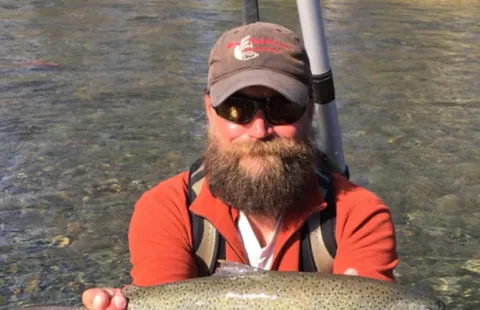
The fish pulled a couple of runs and then gave up. As the fish headed towards the shallows, I tailed it and just knelt there with it for a minute. Holding in my hand was a perfect specimen of rainbow trout that probably measured 26-27”. It wasn’t chrome, but it wasn’t full of color either. Just a perfect species specimen with all its fins and mandibles. Not a steelhead, but darned nice. I figured it to be a fluke but kept fishing anyway. I caught 4 just like it that day and 6 the next day. The day after that, I didn’t count the fish I caught. I just enjoyed the fact that I was successfully fishing the way I wanted to in a place where that should not be working.
Soon after that, It was time for me to leave for Patagonia, where I honed the swing method for trout even more. Three months of guiding the tributaries of Lake General Carrera proved to sort out my theories well. Trout that live in rivers without a lake system don't take swung flies as well as trout that live in rivers with a lake system. Maybe it’s because the lake provides a semblance of oceanic feeling to the trout, nurturing its true migratory genetics. Whereas a trout living in a creek or stream that tribs into a larger river is more resident homebody completely ignoring its DNA. Maybe that DNA is bred right out of those fish. I’m not a biologist, so I really don’t know the answer to why they do or don’t. People much smarter than me will be able to answer that.
Here is what I know - everywhere I have tested my theory on swinging flies for trout, it works. Every single time. In Alaska, PNW, Rockies, Sierras, Appalachia, and Patagonia. A trout river feeding a lake of any substantial size and depth will support an angler trying to get a fix by swinging flies to trout. It’s become a game of sorts for me now. Every steelhead trip, I pack my 6 weight spey rod and a 6 weight switch rod.
It’s been a lifesaver at times when the steelhead water is blown out. I don't get too crazy with the flies; everything is a stinger hook fly scaled down in size somewhat. I try to use more natural looking patterns. Any smaller stinger hook sculpin or leech pattern is great and there are several very good sources for trout swing flies out there. Start at your local fly shop. Those guys will know what’s up.
If your steelhead pilgrimage is a little too far to take a chance of being blown out, grab a 6 weight two hander or 10’ 6/7 weight single hander and test my theory. I am sure there is a river near you that fits the description. You might save some time, gas money, and get to fish alone. Who knows, you might even get Alice to tag along.
/articles/swinging-streamers-trout
Washington State Record Whitefish
From the Washington Dept. of Fish and Wildlife, we learn a Davenport angler who attends Gonzaga University reeled in an unexpected catch while fishing for walleye at Lake Roosevelt on February 11th. Gavin Boggs was fishing with a college friend near the Lincoln boat launch that afternoon when he hooked into something very big.
Boggs said, “I was targeting walleye at a depth of around 75 feet using a four-inch swim bait and it was a pretty tough day on the water. We did mark a lot of fish on the fish-finder but had only caught one walleye before this big fish took my lure.”
Boggs, whose family has a place at Seven Bays toward the southern end of Lake Roosevelt, continued his story, saying, “As soon as I hooked it, I thought it was a big walleye. I carefully let the fish do its thing down below the boat and then when it came to the surface and we netted the fish, I was totally surprised. I’ve never targeted whitefish in Lake Roosevelt. It is my favorite place to fish for smallmouth bass and walleye, and this has changed my mind about fishing for lake whitefish.”
Gavin caught the fish in the late afternoon and he texted his father about the catch. Gavin’s dad, Tony Boggs, did some research and told his son he might have a new state record on his hands.
According to WDFW, Boggs immediately iced the fish in a cooler and drove from Seven Bays to Davenport Family Foods, where an official scale verified the weight as 7.86 pounds. The store owner, a friend of the Boggs family, stayed late just so Gavin could have it officially weighed.
Gavin then took the fish to the WDFW Spokane regional office on February 14th, where biologist Danny Garrett measured this new state-record lake whitefish at 26.25 inches long, with a girth of 16 inches.
.
The old state record weighed 7.50 pounds and was caught Feb. 19, 2021, by Jacob White at Cox Lake in Franklin County. Gavin said Jacob actually reached out to him on Facebook to congratulate him and “pass the torch”.
Will this record be broken again soon? Possibly. WDFW conducted a netting survey at Lake Roosevelt last fall and caught quite a few lake whitefish, including one that weighed 9.5 pounds.
/articles/washington-state-record-whitefish
Trout Fishing Treasures
Eastern Washington State
Eastern Washington State is a paradise for trout anglers during the Fall, with its picturesque lakes and rivers offering some of the finest trout fishing experiences in the Pacific Northwest. In this article, we invite you to embark on a journey through some of my favorite bountiful trout waters of Lake Roosevelt, Waitts Lake, Bonaparte Lake, Rock Lake, and that little urban oasis, Liberty Lake. These 5 distinct fishing destinations in Eastern Washington promise anglers of all skill levels unforgettable moments, breathtaking scenery, and a chance to reel in some of the most sought-after trout species. So, grab your fishing gear, pack your camping supplies, and let's explore these trout fishing wonders of Eastern Washington.
Our adventure begins at Lake Roosevelt, a sprawling reservoir created by the Grand Coulee Dam on the mighty Columbia River. Stretching over 130 miles, this massive body of water provides abundant opportunities for trout fishing. Lake Roosevelt is renowned for its healthy population of Rainbow trout, which can grow to impressive sizes. Anglers flock here in search of trophy Rainbows, and Kokanee.
Springtime and Fall are the golden seasons at Lake Roosevelt. During spring, as temperatures rise, trout move closer to the surface, making them more accessible to both trolling fly’s and even bait rigs. As fall brings in cooler temperatures, rejuvenating the bite and luring trout closer to the shallows, welcoming the excellent opportunities for bank fishing. Camping facilities, beach camping, and boat launches are readily available along the lake’s shores, ensuring a convenient and memorable fishing experience.
Moving over to the Northeast side of the state, we discover Waitts Lake. Just tucked into the hills of the small-town Valley, just off of HWY 395, this lake beckons trout fisherman from all over. This lake has been known for its healthy population of Brown Trout, where they are abundant and can be caught many ways. This pristine, spring-fed lake is also stocked with Rainbow trout, making it an ideal spot for anglers seeking a peaceful escape.
Spring and early summer
Spring and early summer are prime time to fish Waitts Lake as waters warm. But in the Fall, Rainbow and Brown Trout become increasingly active, providing ample opportunities for a successful day on the water. Drifting fly’s, such as a Wooly Bugger, on a casting bubble has always been lights out, as for trolling the familiar setups from spinners to dodgers can also fill the cooler. Don't be afraid to bang the bottom with a simple quarter ounce jig tipped with a worm, very effective for the Brown Trout cruising the bottom for food. Shore anglers have access to 3 different resorts, and docks available to fish from, and can be just as productive as fishing from a boat. Some productive spots to pay attention to are the Southern portion of the lake near the launch, and the Western shoreline.
Onward to almost central of the state, we take a ride to one of my favorite winter lakes to fish. Nestled high in the Okanogan Highlands, Bonaparte Lake offers an alpine fishing experience that's nothing short of magical. Surrounded by lush coniferous forests, this tranquil lake is a sanctuary for both trout and those anglers who seek them. This lake has a campground and a very nice resort that caters to anglers year-round. My favorite time to visit is the winter with the snow and ice, it's just a beautiful place to chase trout.
Bonaparte Lake really comes to life in late spring and late summer into Fall. As the snow recedes and temperatures rise, the lake's trout species become more active, creating a feeding frenzy. Rainbow cutthroat can be the target for many, but there's those who are in search of a big Tiger Trout, or the beautiful Brook Trout, prized for its vibrant colors and feisty nature. The Southern portion of the lake near the creek mouth has always been a go to spot, especially in the winter months. Targeting deep holes adjacent to shelves and breaks can produce large fish year-round. But targeting the southern end near the creek mouth, where submerged rocks and logs create perfect ambush points for trout. A must visit for any avid angler who's seeking an adventure.
Head South to the largest natural lake in Eastern Washington, with an open fishing season all year, we launch into Rock Lake in Whitman County. This lake has a reputation for providing an excellent fishery for Rainbows, and large Brown Trout. The boat ramp is a rough one, and takes some experience to navigate, as shore fishing is limited to the launch area. With the launch being unimproved, you may only see a handful of boats out there, but be aware of underwater hazards, as submerged rocks can sneak up on you quickly. Scenery is like a slice of the wild west, with basalt cliffs and sagebrush hills, offering a unique angling experience.
Brown Trout
Since Brown Trout are the primary target, fishing from a boat is the most popular choice. Trolling plugs and large spoons are effective, and Jointed Rapalas work amazingly trolled at slow speeds. Casting larger lures near the rock walls with slow retrieves can produce limits quickly if you're not a troller. I tend to notice from October, when the Browns spawn to spring, is the hottest bites from shore or boat. Enjoy this lake with caution, as the wind can play a big part in how you fish at this lake.
Now time to head back to town, where our trout journey concludes at Liberty Lake. An urban oasis located just minutes from the city of Spokane Valley, this lake offers convenience and a diverse range of angling experiences. Liberty is home to Rainbow, and Brown Trout, making it accessible for a variety of fishing methods. From trolling dodgers and spinners, to drifting flies, and my personal favorite, casting large jerk baits in the early spring when ice is melting off. Jerk baits really get those large Browns fired up. With a dock for shore fishing and a boat launch, it makes fishing for all anglers accessible. With the amenities of Spokane Valley within reach, anglers can combine their fishing adventures with a bit of urban exploration.
Eastern Washington State is a haven for trout fishing enthusiasts, and the lakes of Lake Roosevelt, Waitts Lake, Bonaparte Lake, Rock Lake, and Liberty Lake offer a diverse range of experiences. Whether you're seeking trophy trout, serene solitude, a hidden fishing haven, a journey back in time, or an urban oasis, Eastern Washington's trout-filled waters have something for everyone. So, grab your gear, explore these scenic destinations, and immerse yourself in the natural beauty and bountiful trout fisheries of this remarkable region.
/articles/trout-fishing-treasures
How to Have a Blast At Brewster
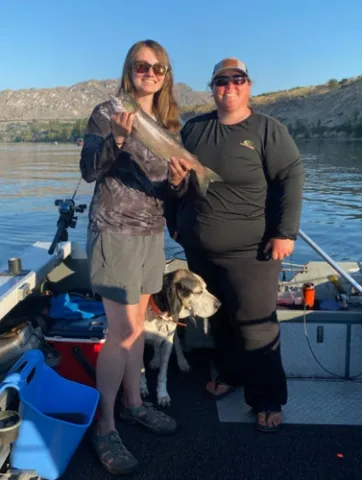
You’ve probably heard stories about the Brewster pool, if you haven’t fished it before. It’s one of the most productive and legendary fisheries in the state, and many fishermen look forward to fishing it every year. Thousands of chinook and sockeye salmon make their way up the Columbia River and stage in the cool waters of Lake Pateros (also known as the Brewster pool) before heading up the Okanagan River. The fishery typically opens up in July and can be extremely productive for both species of fish. Despite their long journey, the fish are willing biters and taste great on the grill or smoker. 20-pound chinook are regularly caught, and the sockeye are great eating quality.
It’s a fun fishery for a summer day, but learning how to fish it isn’t always easy. Brewster is about an hour north of Wenatchee, so it’s quite a drive. It can also be intimidating because there are so many other boats in the water. As long as you do some research and have patience, you’ll have a great time and catch some fish. Here’s some tips and tricks to help give you a successful day at the Brewster pool.

Chinook
The chinook fishery at Brewster tends to be a first light fishery, so grab the coffee and headlamps so you can launch in the dark. It’s a short run from the boat ramp to the pool, just stop when you see all the other boats! The most important thing to know about the Brewster pool is that it’s a trolling game. Some anglers jig or anchor up, but they are few and far between. There are just too many boats for anyone to anchor up. Most fishermen in the pool use cannon ball droppers and skip the downriggers. You can run anywhere between 4 to 12 ounces of lead, depending on the current and the stoutness of your rods. Brad’s Super Baits trolled behind 360 style flashers are the go-to, but many anglers have good success with spinners too.
Wrap or stuff your plug with tuna, herring, or shrimp to give it extra pizazz. If you run spinners, you can put some gel scent on them or hook on a coon shrimp. Don’t be afraid to swap out the hooks on your lures. Chinook have thick, tough jaws, so you want your hooks to stick. Troll between 1.5 to 2mph if you can, but you may have to match your speed with other boats if the pool is crowded enough. When fighting the fish, keep the pressure on. These fish will spit the hook if there’s any slack in the line, and they really tend to explode when they see the net. Adjust your drag and be patient.
Sockeye
If the chinook aren’t biting or you have bored kids in your boat, Brewster pool sockeye are plentiful and hungry! They are a bit smaller than Baker Lake sockeye, but they taste good and are much more numerous than the chinook. Like the chinook fishery, sockeye here are caught by trolling. There are usually two groups of boats in the pool, one that trolls faster for chinook on the current break between the Okanagan and the Columbia, and one that targets chinook closer to the mouth of the Okanagan. Chinook and sockeye do sometimes bite on the same gear, especially when the sockeye really start to stack up in the pool.
If you catch a chinook on sockeye gear, hang on! If you’re targeting sockeye, the same concepts you use when kokanee fishing apply. Use short leaders and lots of scent! Mack’s Lures offer a variety of sockeye lures that are all killer in the Brewster pool. Pink lures work best for sockeye. Pair them up with a dodger or smaller flasher, and you’re in business. Don’t forget to tip your lure with a piece of coon shrimp. You can cure your own or buy some pre-cured ones. No need to use the whole shrimp like you did for chinook that morning, you can just use a small tail piece. Thankfully, the sockeye bite all day, but the fish are more active in the early morning. Use lighter cannonballs than the ones that you used for chinook earlier in the morning. It’s worth using different weights to make sure your lines don’t tangle, particularly if you’re running 4 or more rods. The sockeye move deeper as the day heats up.
There’s a deep river channel somewhat near the shore that the sockeye like to hang out in, but definitely don’t be afraid to fish away from the crowd and try new areas. The sockeye in the Brewster pool are higher up in the water column than the chinook, so a good fish finder can really help you out. Just like their freshwater dwelling cousins, sockeye prefer a slow troll. Again, if you’re fishing in the crowd, you will probably have to match their general speed. Make sure your gear looks good before dropping it down. You’ll want your dodger to give your lure plenty of action to attract the sockeye, so shorten your leader if you need to.
Here’s a few words to the wise about the Brewster pool. Wear sunscreen! The sun can really beat down on those hot days between bites, you’ll be glad to have it on board. It’s a good idea to start fishing at first light and run back before noon, before the heat becomes too unbearable. Also, make sure to pay attention to your surroundings. The Brewster pool isn’t exactly a secret, so you can expect to have company. Sometimes there are hundreds of other boats out there, especially on weekends. Paying attention to the helm and giving other boats some space will help avoid flared tempers.
If you’d rather not deal with the potential stress, there are dozens of guides that you can book to fish the Brewster pool. You can kick back and enjoy the beautiful scenery, and come home with a cooler full of filets. Speaking of coolers, they are a must-have- both for cold drinks and for keeping fish. You’ll want to bleed and ice your fish ASAP for the best meat quality. Lastly, get to the boat ramp early and bring a good book. The boat ramp can get very crowded, especially when the sockeye are in. It’s a good idea to use the time spent waiting to prep your boat. This is another instance when having patience and a level head will help you out. If you’d rather not spend an hour or two waiting to launch, again, hiring a guide might not be a bad idea. Some of them actually launch the night before, anchor up, and sleep on the boat before they pick you up.
Once you’re done fishing for the day, head into the town of Brewster for lunch. There are several excellent restaurants, and downtown Brewster is worth exploring for the afternoon. It’s a great way to cap off your day of sockeye and chinook fishing! Fishing the Brewster pool is an unforgettable experience. Head out there and have fun!
/articles/how-have-blast-brewster
Pink Salmon Everywhere!
Introducing the unique Pink salmon: distinguished by their distinct life cycle, these fish follow a two-year journey, returning to their spawning rivers as two-year-olds. Adding to their allure is the intriguing fact that they exclusively run during odd years within Washington State. This year, an estimated 4 million Pink salmon are projected to traverse the Sound. Despite their classification as the smallest Pacific salmon, their tenacity in battle and delightful flavor remain unyielding. Their culinary versatility shines as they excel on the grill, particularly atop a cedar plank, and find their way into many anglers' smokers. For numerous enthusiasts, Pink salmon mark their initiation into the world of Washington State salmon fishing, thanks to their abundant presence and approachable nature compared to their larger counterparts.
Around this time of year, pinks flood the Sound and begin to stage near their home rivers. One of the best things about pink salmon is that you don’t need a boat to catch them from the shore or pier. They tend to swim within casting distance most of the time, and at this point in their life cycle they are still actively feeding, so they aggressively attack most offerings they see. With millions of pink salmon cruising by the shoreline looking for a meal, this is the perfect time to head to your local saltwater pier or beach and bring home some pinks for the grill.
Presenting A Jig
By and large, most shore anglers fish for pink salmon with jigs. There’s no need to use bait because pink salmon will aggressively bite a well-presented jig. Buzz Bombs and Rotators are the most commonly used jigs. They are easy to use and thousands of pink salmon readily gobble them up every year. They are designed to resemble a wounded baitfish, and they flutter erratically as they fall. Rigging them up is pretty simple: put on your buzz bomb, then thread on a bead and a bumper. Then tie directly to your hook (don’t forget to pinch the barb if it’s required). I usually use a 1/0 or 2/0 hook for pinks. To use jigs, cast out to where you think the fish are at, let your jig sink for a few seconds, then reel in and lift your rod tip up. Next, quickly lower your rod tip and let the jig fall. Repeat this until you reach the shore or catch a fish. Make sure to jig all the way until shore- sometimes the fish will follow your lure and strike at the last second.
Most of your strikes will be as the jig is falling. If you get a bite, quickly set the hook and keep up the pressure, especially if you’re using barbless hooks. As their name suggests, pink salmon love the color pink! It’s a good idea to start with that color, then switch it up if you aren’t getting fish. Buzz Bombs come in a variety of different weights. For pinks, I’d suggest using the lightest weight that you can cast well. If the bite is slow, try rubbing on some shrimp, anise, or herring scent. Gel based scent will cling to the jig longer. You can also thread on a small pink hoochie for extra action. If switching lures doesn’t work, you can switch locations as well. Sometimes just walking down for a few minutes on the beach can make all the difference.
Spinners
Another viable option if fish don’t seem to be hitting your jig is to use spinners. Vibrax spinners tend to be light, so it’s a good idea to thread on some bullet weights above a swivel to help get them down to where the fish are at. Several other brands such as Mepps make heavier spinners that will get to the proper depth without additional weight. Bring several options, and don’t be afraid to add scent or thread a hoochie on.
For your rod and reel, I’d recommend using a rod that can handle ½ to 1 ½ oz. weights, probably around 8 to 10 feet in length. I highly recommend using braided line because you can feel those sensitive bites easier, but mono will definitely do the job. A size 3000 to 4000 reel will have plenty of backbone to handle the fish. Remember to rinse your reel after fishing, saltwater is very corrosive and can cause damage if not washed off.
Where To Start?
Wondering where to start? Les Davis Pier, Edmonds Pier, Des Moines Pier, Browns Point, and Point No Point are all popular locations that reliably produce pinks every year. Any beach with a point and a good drop-off will most likely hold fish. Expect to have some company, though. Just be patient and try to avoid tangling your line with other anglers, especially if the current is strong. If you go to a pier, have a plan for netting your catch. Most piers are too far from the water to be able to use traditional nets. Pier anglers have taken to using crab rings. Just lower them down to the water and scoop up your fish. It takes some practice though! Beach anglers need not use a net, simply back up and swing your fish onto the beach.
As always, be sure to check the rules and regulations before going fishing. Don’t forget to swap those treble hooks for barbless single-point hooks, if required. You can buy barbless hooks or simply pinch the barb yourself with pliers. If you’re new to salmon fishing, WDFW offers salmon identification guides. It’s important to be able to tell the difference between salmon species, because they are regulated differently. You may be able to keep pinks but not chinook, for example.
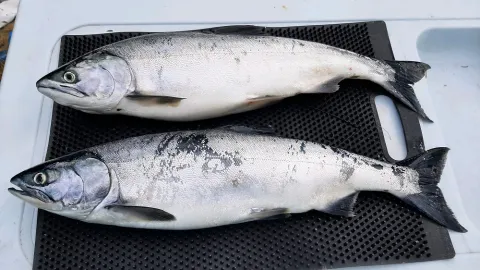
In general, hatcheries do not clip pink salmon fins, so don’t worry about checking if they’re hatchery or wild. The way to identify pink salmon is by checking the gums and the spots on the tail. Pink salmon have large spots on the tail and a white mouth with black gum line and tongue. For optimum meat quality, don’t forget to bleed and gut your catch before going home. Despite what some anglers say, pink salmon tastes great on the smoker or grill. Since they don’t have as much fat as their cousins, they have a milder taste than other salmon, which some people actually enjoy more. My favorite way to eat them is to season them with some of my favorite rub and then grill them on cedar or alder planks. They’re a great summertime treat that the entire family will love!
/articles/pink-salmon-everywhere
Fishing With Your 4-Legged Friend
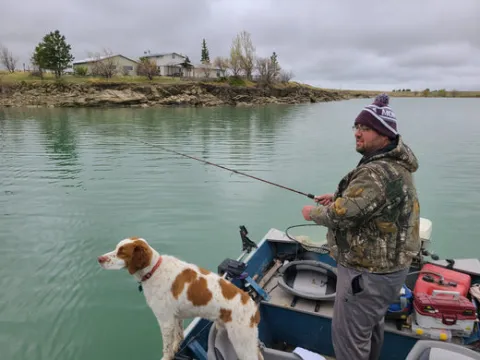
Duke tentatively jumped up to the bow of my Thunderbird, looking intently at the water passing by as we trolled along. “Oh boy,” I said to my wife Joann, “he looks like he is thinking about going for a swim.” Muscles tensing, Duke fulfilled my prediction and splashed into the cool spring waters of Lake Washington. As the boat traveled forward, I went to the side, leaned over, and grabbed the handle on the back of his life jacket, pulling him safely back into our boat. He gave me a look as if to say, “what did you do that for, I was just starting to have some fun!” Such is the life of going fishing with a dog. JoAnn had always wanted me to have a dog that I could take fishing, and Duke, our one-year-old Springer Spaniel, was just that dog. Trained for upland bird hunting, I’d introduced him to water early and he took to it. That said, hunting with a dog on dry ground versus having a dog on a moving boat are two very different things. While fishing with your four-legged best friend can be a wonderful experience, it does present some unique challenges that anglers should be aware of.
What To Know
When you decide to bring your dog along with you on your boat for the first time, it’s important to think through what is entailed (pun intended) for your fishing trip. First and foremost is – know your dog! What kind of training has he had? Has he been introduced to water? Can he swim? Does he obey your commands? Will he be a good partner at the boat launch, or a distraction and irritation to those around you? These are all important questions to consider before you bring your dog along for a day of fishing. Having your best friend along for a day of fishing can make the day that much special, or, it can be a huge headache, and possibly put your dog in danger. Let’s look at some basics to think about before you take your dog out on your boat.

You’ve arrived at the boat launch and there’s a couple of boats in line waiting to launch. It’s just you and your best friend and your expensive boat waiting to launch. Now what do you do? In my opinion, Fido needs to stay safe and secure in your rig. Letting your dog out to run around is a big no-no. Other anglers looking to launch are not going to be happy with a dog running around, no matter how well-behaved you may think he is. Dogs can be unpredictable, so keep him in the truck as you go through your routine prep for launching your boat. Or, if there is a place you can leash him up to stay and watch, out of the way of others, that would be OK. For me, I keep Duke in the truck where there are others around. If it’s just the two of us, I’m ok with letting him out. That’s because I know him and he is well-trained to commands and, most importantly, he obeys.
Launch completed and boat secured, your truck is parked. It’s time to go fishing with your buddy! The next critical question to ask is this – life jacket or no life jacket? For Duke, I treat him like a kid. Just because he can swim doesn’t mean he’s safe to be in a boat without a life jacket. Especially when we are about to put the pedal to the meddle and blast off at thirty miles an hour to our favorite fishing location. So, the life jacket goes before we get up on a plane. It’s one less thing for me as a boat operator to worry about. This way I know that he will be safe if something happens and he does go in.
Water Conditions
What about fishing all day, either anchored up or slow trolling? Our Lake Washington trip was the first time I took Duke on the water, and he decided he wanted to see what the water was like. Since then, he has never jumped into the lake on his own. I find that very interesting, and I now am OK with taking the jacket off if we are anchored or trolling. Of course, weather and conditions are also a consideration in this equation. I try to never take Duke on the boat if it’s not going to be a pleasant day. A puking dog is no fun and it’s not fair to the dog to be put through rough water conditions.

While you're out on the boat there’s a couple doggy essentials to keep in mind. Dogs need a few things to be comfortable: shade on a sunny day, water, a comfy place to lay down, and maybe a treat or two (especially when you try to eat your own lunch!). They also need potty breaks. Finding a place to pull your boat up on shore gives you a chance to stretch your legs and let the doggy stretch his. Not to mention relieve himself. Of course, being a dog means some sniffing time is important. Just like fishing with kids, I think it’s important to not be hard-core when fishing with a dog. Give your Best Friend some “dog time”. I think it will make him more excited the next time you pull out your boat – yay! Another fishing adventure!
One word of caution when fishing with a dog. Expect the unexpected. I remember a trip on the Snake River doing a Cast and Blast Adventure. We had dogs on the boat for our chukar hunt, but first we were fishing for chinook salmon, side drifting eggs. I think you know where I’m going with this… at the end of a drift we brought in our gear to run back to the top of the hole. One of the anglers’ dogs decided that he might like the taste of fresh salmon eggs for breakfast. Before we knew it, this angler’s dog had scarfed down a baited hook of salmon eggs, all the way beyond reach. Unfortunately for the angler his day of fishing was cut short as we took him back to the boat launch for a trip to the vet for x-rays. The vet informed the owner of the dog to watch to see if the hook passed (not the most pleasant job by the way). While no harm came to the dog, it was an expensive reminder of what I mentioned early – dogs can be unpredictable.
So, by all means, take your dog fishing – you’ll love it and so will the dog – but be ever mindful and keep a close eye on your Four Legged-Friend!

/articles/fishing-your-4-legged-friend