Spring Means Rockfish
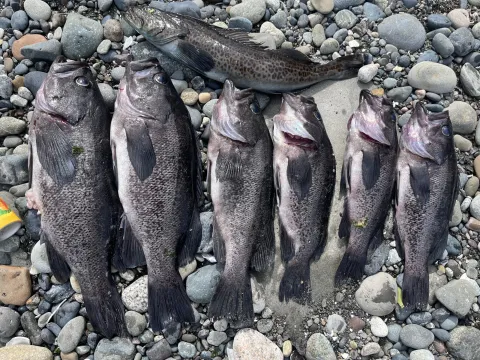
If you’ve fished anywhere off the coast of Washington state, chances are at some point you’ve landed a rockfish, or depending on who you talk to, a black seabass. While rockfish are often seen as only a bonus catch during the pursuit of something larger, like lingcod, they are, in my opinion, some of the best-eating fish that swim along our coastline. The name “Rockfish” is an umbrella term that encompasses over 100 different species of fish, but the ones we most commonly fish for here in the northwest are the canary rockfish, black rockfish, blue rockfish, and deacon rockfish.
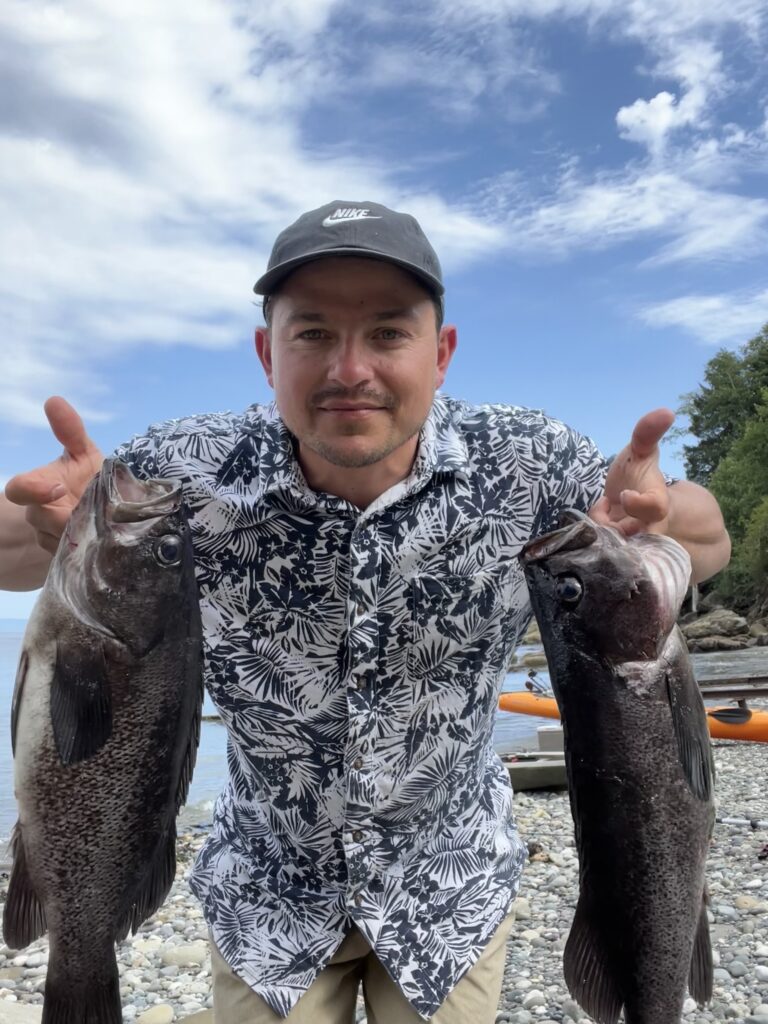
Where to fish
Though Rockfish do inhabit the waters of the Puget Sound, it is illegal to retain or target them here due to conservation concerns. As you move northwest into the straights of Juan De Fuca, you’ll find that the populations of rockfish become healthier and fishing opportunity increases the closer you get to the Pacific Ocean. Marine Area 5 (Sekiu) is where allowable rockfish retention begins, though as of 2025, in MA 5, you can only retain 1 rockfish per day. Moving further west to MA 4 (Neah Bay) the possession limit increases to 7 and the season is year-round.
Aside from Neah Bay and Sekiu in Clallam Bay, you can also target rockfish southward along the Washington coast around Westport, Ocean Shores, and Pacific County near the mouth of the Columbia River. Boat fishing Rockfish tend to prefer deeper waters near rocky structures, reefs, kelp beds, or even shipwrecks, which in general makes fishing from shore not a viable option (though there are some exceptions). Fishing from boats, kayaks, or canoes, are generally the most effective method. And because rockfish are such aggressive feeders, it makes them a great species to target when bringing the family along on a boating trip, as these fish aren’t terribly difficult to catch.
Most soft plastic grubs on a 1-3 oz lead jig-head can entice a bite. Use lighter-weight jigs-heads when the current is mild, and heavier jig-heads during strong currents. The amount of sunlight should influence your choice of jig colors. I try to stick with darker color soft plastics during overcast days and brighter colors on sunny days. Flashy metal jigs anywhere from 2-4 oz can prove phenomenal for catching rockfish as well.
My favorite jig as of lately has been a 2.5 oz blue and silver laser minnow, and I seem to catch rockfish on this regardless of weather conditions and current strength. Most of the rockfish you catch will likely be around 2-3 lbs (though they can get much larger), considering this, they are a blast to catch on lightweight gear. However, larger fish like lingcod and cabezon will bite at the same jigs and lures as rockfish, so anglers should be prepared for this potential. I almost always run 25 lb braided mainline with a 20 lb monofilament leader off of a 6-7 ft medium light rod and find this to be a good middle of the road setup.
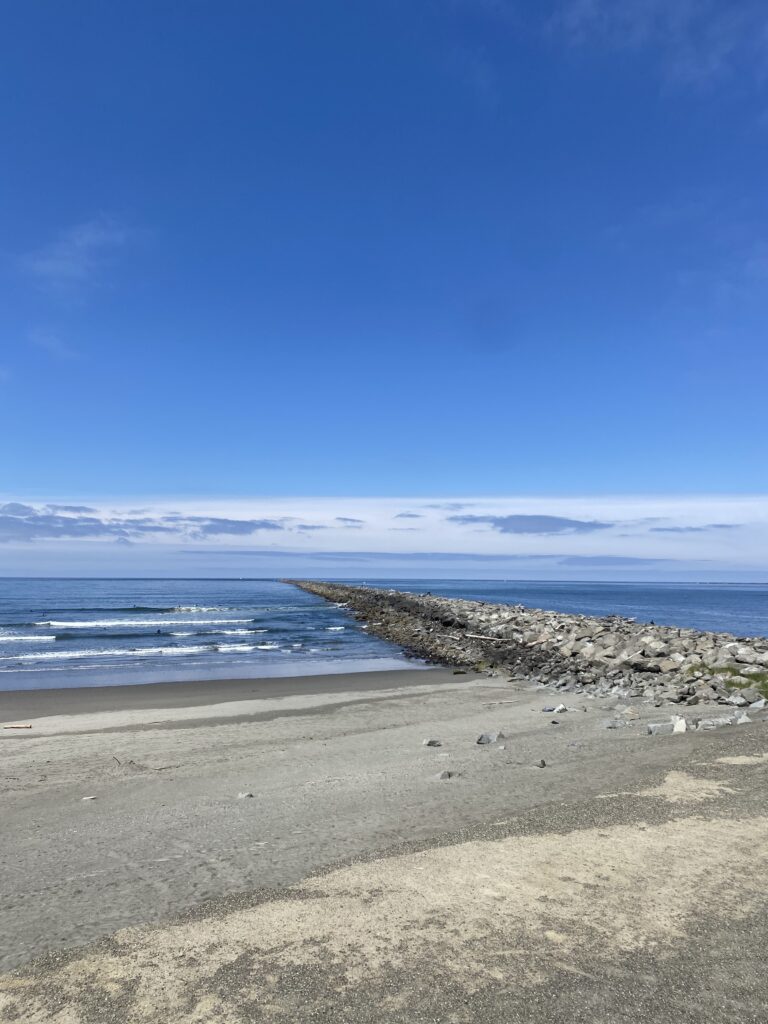
Jetty fishing
Though boat fishing may be the most effective method for catching rockfish, land dwellers should not fret because there are options for folks who prefer to stay off the water! Jetties or rocky outcroppings that extend into deep water offer ample opportunity for a limit of rockfish. The Westport jetty, the north jetty in Ocean Shores, and the Columbia River north jetty all allow somewhat easy access to this fishery. Furthermore, if you normally fish out of a boat for rockfish, and have had plenty of success over the years, you might find that the process, though fun, can eventually become a bit repetitive.
Jetty fishing offers a welcome change of pace as it provides an altogether different experience and requires different techniques and tackle to land the fish. When fishing from a jetty, netting the fish off the rocks isn’t always an option. This means you will have to lift the fish out of the water with your rod and line. That process can put an excessive amount of strain on your line, thus, jetty anglers should stick with a 25-40 lb mainline and 20-25 lb leader.
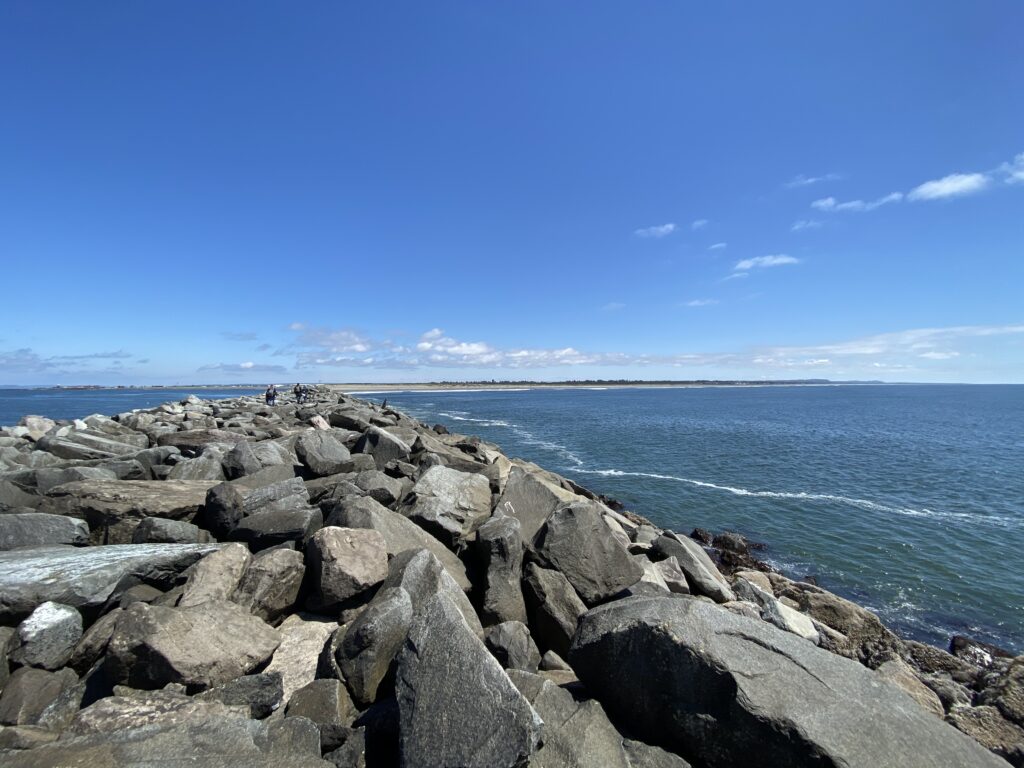
A soft plastic swim bait lure with a weight of 1/2 - 1 oz weight between your mainline and leader will allow your gear to fall deep enough into the water column while also remaining high enough to avoid snagging on the rocks. If you run a soft plastic jig, you can retrieve, jig and repeat. For a swim bait, anglers can find success by either doing a steady retrieve or by doing a steady retrieve with an occasional jig or twitch. Safety is a major concern while fishing on jetties. With this in mind, anglers should monitor weather, tides, and swell activity. During extreme conditions, waves can crash onto the jetties and pose a risk for anyone who’s on the rocks. Refer to NOAA for weather conditions and surf reports for swell and wave activity. Hiking boots, felt-soled boots, or even toe-shoes are favored by jetty anglers for walking around on wet rocks.
The rockfish fishery is a great way to get back out onto the water and get the sun back on your face as we crawl out of our long Pacific Northwest winter. Whether you're launching a kayak at Hobuck beach in Neah Bay, motoring out onto the straights, or climbing around on some rocks at the Westport jetty, there’s nothing better than introducing the upcoming summer season with a cooler full of rockfish and a fish taco dinner at home with the family.
/articles/spring-means-rockfish
Catch and Release Fishing
As many anglers know, our fishing opportunities in Washington are dwindling, specifically when we are talking about salmon and steelhead. With retention opportunities waning, we are often fishing in catch-and-release fisheries, which are very misunderstood.
I was recently reminded by someone from the State of Washington that as outdoor writers, we have a responsibility to educate readers about topics such as the ethical handling of fish that we will release. We all want a picture or two of our trophy catch, but we should always place the mortality of the fish ahead of ourselves.
Please note that I took much of the information below from an Oregon Department of Fish and Wildlife article written in 2019 and titled, Catch-and-release: Tips to reduce fish mortality. One very important note to share. ODFW will allow anglers to take a fish out of the water before releasing it. In Washington, it is illegal to remove a fish from the water that must be released.
One way anglers can help maintain and restore native fish populations is to learn how to catch and release wild fish properly. Before fishing, anglers should always consult WDFW fishing regulations for any harvest restrictions.
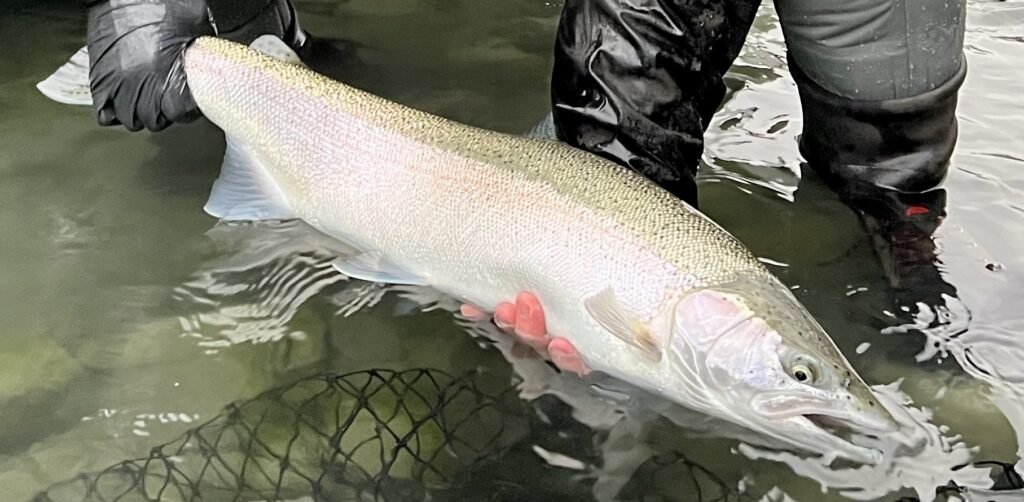
Here are some tips for the safe and ethical release of a wild fish or a hatchery fish that is caught out of season.
Land the fish quickly.
A fish on the end of the line is under stress, so don't play the fish to utter exhaustion. Severe exhaustion reduces the fish’s odds of surviving.
Support the fish when bringing it in.
Support the fish underwater in a natural position, handling it as little as possible. Give it time to recover and keep it in the water, it needs all the oxygen it can get from the water passing over its gills.
Use barbless hooks.
Bring the fish quickly within reach. Leave the fish in the water and, without squeezing it, remove the hook carefully with long-nosed pliers or thumb and forefinger. If necessary, cut the leader near the hook, which will dissolve over time.
Revive the fish before releasing.
Point the fish into the current or in standing water, gently move the fish forward until its gills are moving and it maintains its balance on its own. Let the fish swim freely from your hands.
Use appropriate gear.
Use tackle, including line and rod, that are strong enough to bring your fish in quickly and gently.
Safe handling.
Note that fish have a natural slime on them, which is a coating that prevents disease and protects them. Though the slime makes the fish slippery and hard to hold onto, avoid using any material, such as a cloth glove or towel that will remove the slime from the fish. This will increase the odds or chances that the fish survives.

Getting a photograph
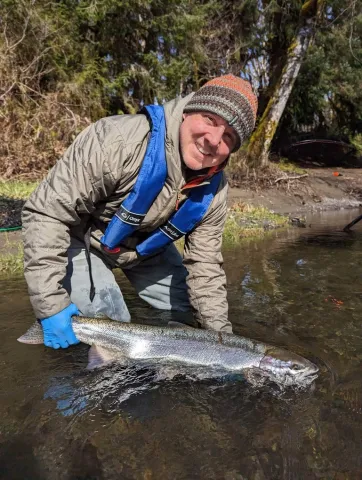
Taking a photograph with your fish can be a lovely way to capture the moment. But try to minimize handling and keep the fish in the water as much as possible with these tips:
- Have help. If someone is helping you with the photo, make sure they’ve composed the shot and adjusted the camera settings before you position the fish. Remember, the fish must remain in the water, so the head and gills should always be submerged, never leaving the water.
- Get your hands wet before handling the fish. This will help protect the delicate membrane on the fish’s skin.
- Support the fish properly. Put one hand under the forward part of its body and the other at the base of its tail. Keep the fish in the water. Do not place fingers or objects into or under the gill plates.
- When you’re ready, cradle the fish at or just above water level and snap a quick picture, again, keeping the head and gills submerged in the water. Note that most pull the head quickly up for the shot with the mouth still submerged and then immediately place the fish back into the water, fully submerged, to revive the fish and begin the release process.
- Return the fish to the water quickly. Then revive it gently before letting it swim away. It is very important to revive the fish and let it swim off under its own power to ensure that it is ready to go.
Many anglers may not agree with these rules and may have heartache with our regulatory agencies, but I feel strongly that we need to be bigger than our frustration. We must do what is best for the fish to preserve them and ensure that future generations will have the opportunity to experience what we get to today. Things may not be what they were 20-30 years ago, but at least we still get to fish and experience that feeling of the tug on the other end of the rod.
/articles/catch-and-release-fishing
Five Winter Fishing Options in Central Washington
Central Washington offers some great opportunities for anglers this year including river fishing, open water fishing in big lakes or reservoirs, and ice fishing in smaller lakes. Here are five solid bets for you this winter.
LAKE CHELAN
This 50-mile-long lake in North Central Washington is known for its lake trout, the largest often caught during the winter months. One person who knows this for a fact is Wenatchee resident Phil Colyar, who hauled a 35-pound, 10-ounce Mackinaw out of this lake in 2013. It’s a state record that stands to this day.
While lake trout fishing gets a lot of attention, there are other fish that can be caught during the winter months as well. Brad Wagner, owner of Bobber Down Guide Service out of Wenatchee (www.fishwenatchee.com) reported one of his guides took a couple of clients out on a trip and they came back with not only lake trout, but several kokanee and burbot.
Wagner says the kokanee last year were averaging 14 to 15 inches long. So far post-spawn, the kokanee are running around 12-inches long and most of them are being caught up the lake.
As for the burbot, they were a common sight at the lake until about 15 years ago when a virus nearly wiped them out. Wagner says the burbot population has bounced back though and if you jig for them in rocky areas about 150-feet below the surface, there is a good chance you will tie into one.
RUFUS WOODS RESERVOIR
The record lake trout may have been taken at Lake Chelan but the record resident rainbow trout was caught out of Rufus Woods Reservoir. Norm Butler accomplished that feat on Veteran’s Day of 2002 when he reeled in a 29.6-pound triploid rainbow trout from the 51-mile-long impoundment of the Columbia River above Chief Joseph Dam at Bridgeport.
Many anglers will jig for these trout out of boats near the net pens operated by the Colville Tribe. You can fish from shore on the Colville Reservation side of the reservoir, but you will need a tribal fishing permit to do so. You can also fish from shore on Washington State land just above Chief Joseph Dam or from a federal site called Brandt’s Landing on the Douglas County (east side) of the reservoir a few miles above Chief Joseph Dam.
Many anglers will still fish for their trout here sitting by a campfire. Rick Graybill, a local expert, likes to fish a shrimp and a marshmallow just off the bottom from shore. Others fish worms and marshmallows or even powerbait. If fishing from a boat near the net pens, Graybill will cast spinners, drift Corkies, cast flies, or jig for the trout with either a small piece of worm or shrimp on the jig.
If you have an RV, you can take it to the net pens where a campground has been developed with hook-ups. There is also a boat launch there, but a day or annual pass is required. You can find out more details at https://www.colvilletribes.com/lake-rufus-woods.
ROSES LAKE
Located near Manson, this small lake was stocked heavily in early November with over 10,500 rainbow trout. There is a public access and launch at the south end of the lake and if you don’t have a boat, you can have some success fishing from there before the lake freezes. After the lake freezes, this fishery really shines as an ice-fishing destination. Not only for trout, but also for warmwater species like bass, perch, crappie and bluegill. Better yet, you are allowed to use two rods here as long as you have your two-rod endorsement.
BONAPARTE LAKE
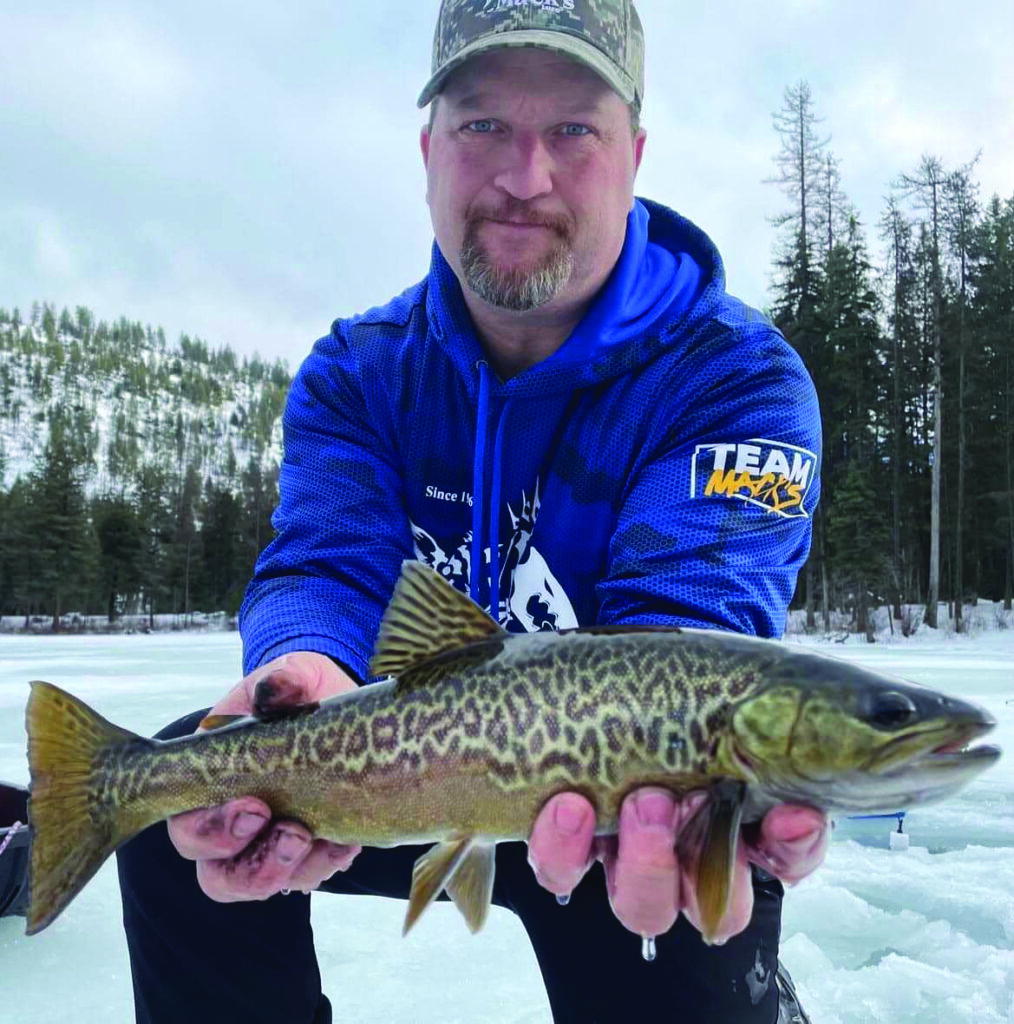
Chris Marcolin, a pro-staffer for Mack’s Lure, told me Bonaparte Lake offers opportunities for a variety of trout, including tiger, brook and rainbow trout that can be caught under the ice. Anglers can also reel in kokanee, smallmouth bass and if they’re lucky, catch one of the lake trout there.
The Third Annual Bonaparte Lake Ice Fishing Derby will take place on January 25th, 2025 with Ground Zero being Bonaparte Lake Resort. Last year, over 400 people attended the event and close to 350 adults and youth contestants fished in it. Stay tuned for details about this through the Bonaparte Lake Resort Facebook Page at www.facebook.com/bonapartelakeresort.
RIVER WHITEFISH
Another option this winter is to head to South Central Washington for mountain whitefish. The season opened for them on December 1st and runs through the end of February on the Yakima, Naches and Klickitat Rivers.
Rob Phillips is the long-time outdoors columnist for the Yakima Herald-Republic and has spent some time wading the cold waters of these streams hunting for whitefish. While you can catch these scrappy fighters with small spinners during the summer it’s a different technique that works in the winter.
Phillips recommends fishing a small nymph close to the bottom with a maximum size hook of #14. Black, brown, and yellow are all good colors, but the important thing is to tip the hook with a live maggot because the whitefish really like that bait.
So, there you have it. You can catch everything from whitefish to lake trout to kokanee to burbot to rainbows, tiger or brook trout as well as bass and panfish. Bundle up and head to one of these destinations and go fishing this winter!
John Kruse
www.northwesternoutdoors.com and www.americaoutdoorsradio.com
PHOTO CREDIT:
Chris Marcolin with a tiger trout caught while ice fishing at Bonaparte Lake – Courtesy Chris Marcolin
Phil Colyar’s state record lake trout – Courtesy Phil Colyar
/articles/five-winter-fishing-options-central-washington
Fall Panfishing in Eastern Washington
A treasure awaiting eager anglers
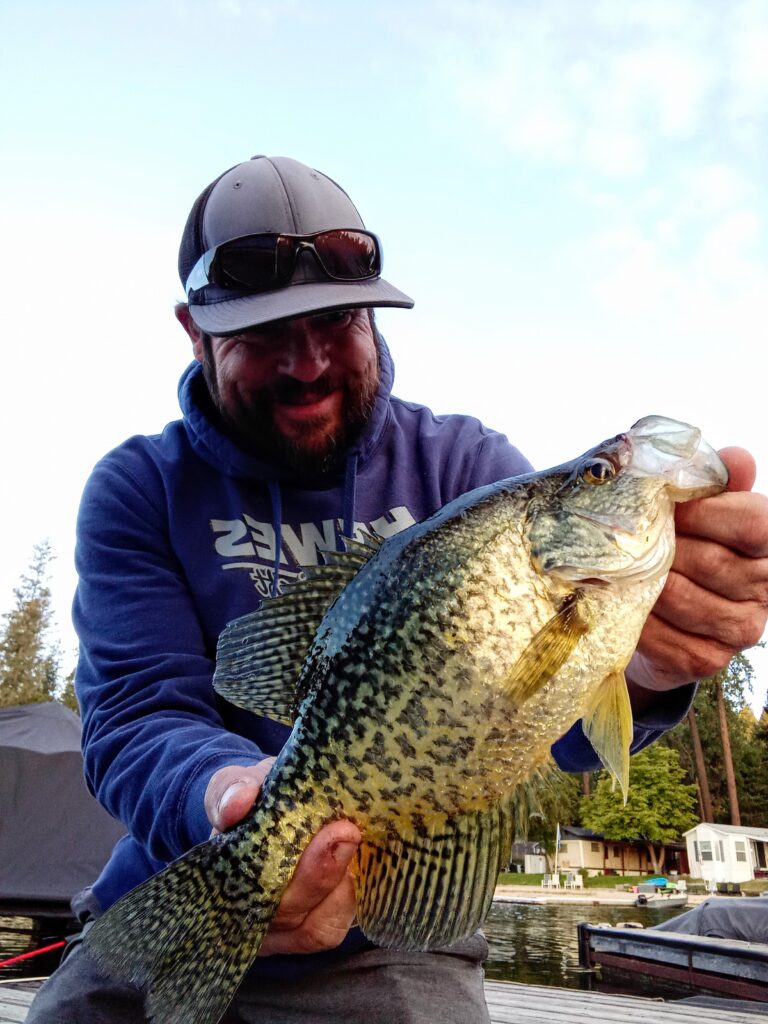
As the vibrant hues of summer give way to the crisp, golden tones of fall, Eastern Washington transforms into a paradise for outdoor enthusiasts. For many, this time of year means hunting or hiking through the scenic landscapes. However, for anglers in the know, fall represents one of the best opportunities for panfishing in this region. Panfish, including species such as bluegill, crappie, and perch, become particularly active as the temps begin to drop, offering a fantastic fishing experience.
The appeal of fall Panfishing
Fall is a transitional season, and for many fish species, it signals the need to feed aggressively, putting the feed bug on for the winter months ahead. For panfish like crappie and bluegill, this means moving from the deeper waters they inhabited during the hot summer months to shallower, more accessible areas where they can feast on minnows, insects, and other aquatic creatures. Anglers targeting panfish in the fall can enjoy several advantages:
Reduced fishing pressure
As fall arrives, many anglers turn their attention to hunting, leaving lakes and rivers quieter, and less crowded. The reduced fishing pressure can make panfish less warry and more likely to bite.
Ideal weather conditions
The mild temperature of fall provides a comfortable environment for fishing. The oppressive heat of summer is gone, and the cold chill of winter has yet to set in, creating the perfect conditions for a day on the water.
Spectacular scenery
There's nothing quite like spending a day on the water surrounded by the stunning fall foliage of Eastern Washington. The golden leaves of cottonwoods, aspens, and maples reflect off the glassy surface of the lakes, creating a breathtaking backdrop for any fishing trip.
Active fish
As water temps cool, panfish metabolism remains relatively high, encouraging aggressive feeding behavior. This is a stark contrast to the lethargic bites often experienced in the summer.
Best Panfish species to target in Eastern Washington
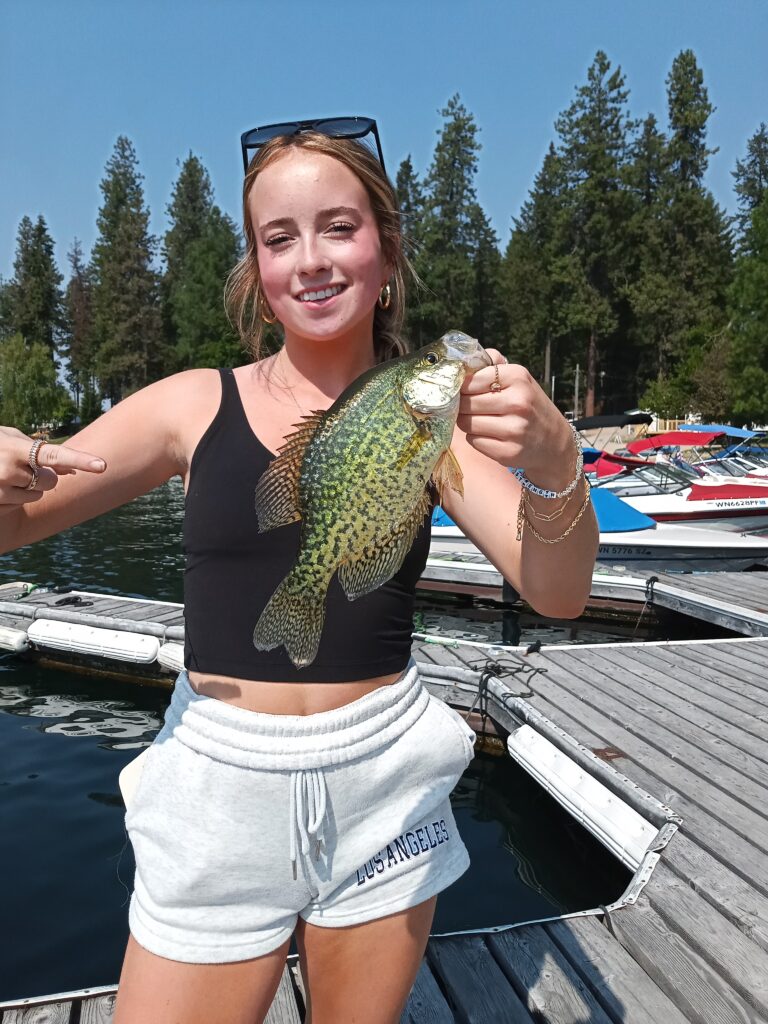
Crappie
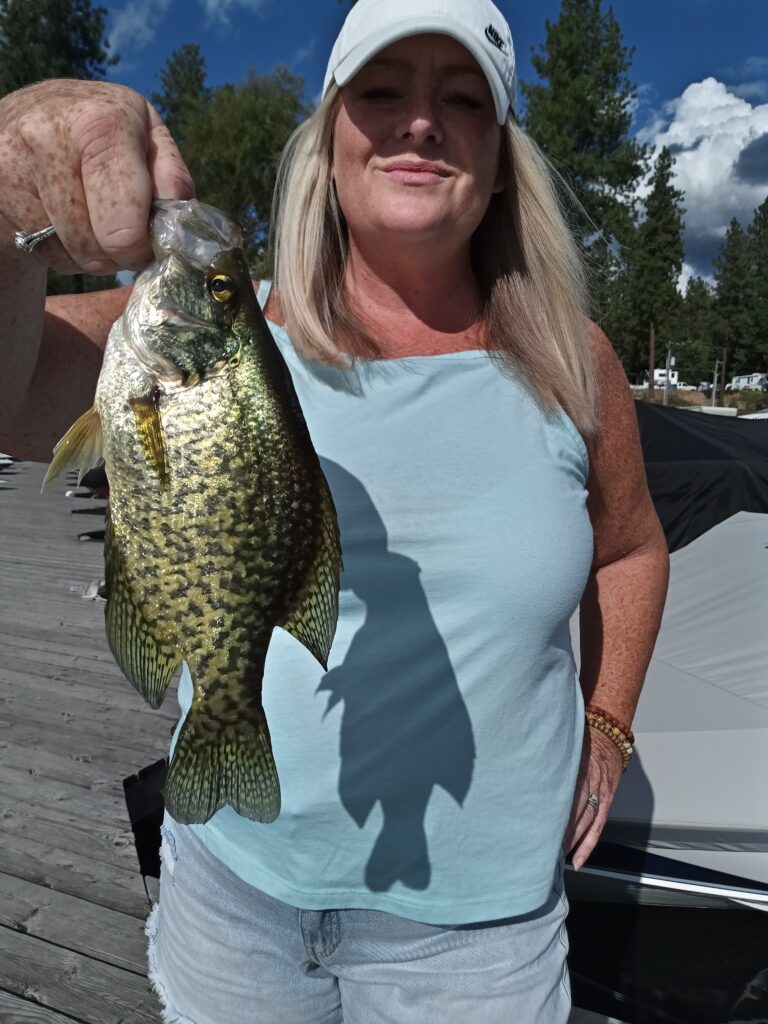
Crappie is a favorite among panfish enthusiasts due to its delicious, flaky meat and relative abundance in Eastern Washington waters. Two species, black crappie and white crappie can be found, though black crappie tends to be more common. During the fall, crappie often schools up in large numbers, making them easier to locate and catch.
Best spots
Moses Lake, Eloika Lake, Newman Lake, and Sacheen Lake are well known for their healthy abundance of populations. Look for crappies in areas with submerged structures such as fallen trees, docks, or rocky points where they seek shelter and forage.
Techniques
Casting small jigs with plastics, or bait, is highly effective for fall crappie. A slow steady retrieve near submerged structures often entices strikes. Night fishing can also be productive especially when using lights or lanterns to attract the crappie.
Bluegill & Sunfish
Bluegill and other sunfish species, such as pumpkin seeds, are abundant in Eastern Washington and provide great action for anglers of all skill levels. They are often found in shallow waters, especially around weed beds, submerged vegetation, and docks.
Best spots
Eloika Lake, Newman Lake, Sacheen Lake, and Loon Lake to name a few, are excellent choices for targeting bluegill and sunfish. These lakes offer plenty of fishing availability, making them perfect for both boat and shore anglers.
Techniques
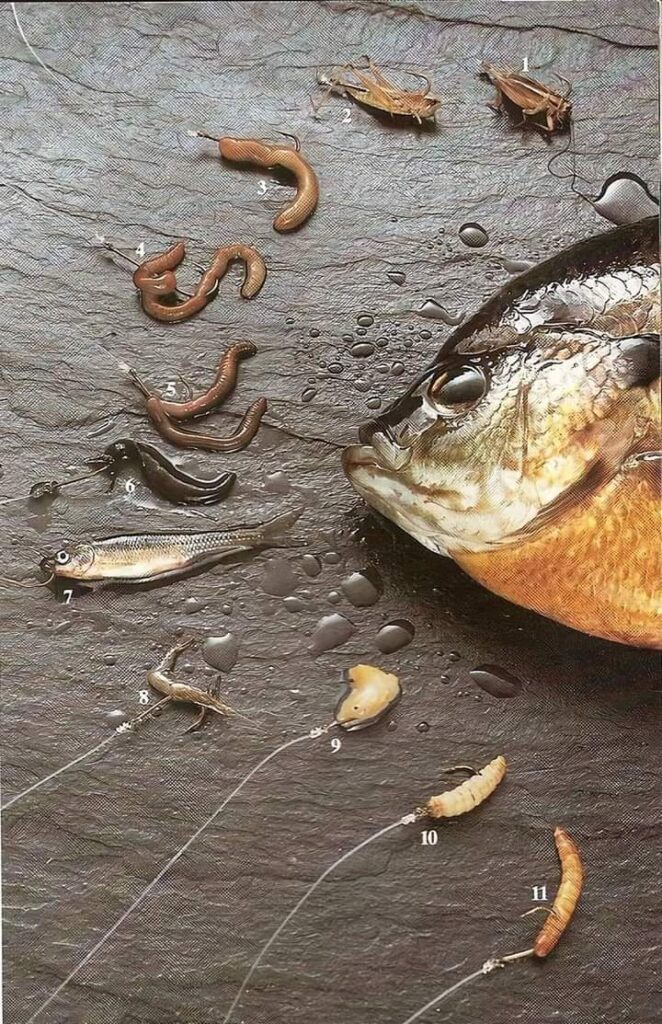
Bluegills are notorious for their lake of small, natural baits. Worms, crickets, and small jigs work wonders, particularly when fished below a bobber. Small flies, in the nymph patterns, can also be effective and add an extra way to approach these fish.
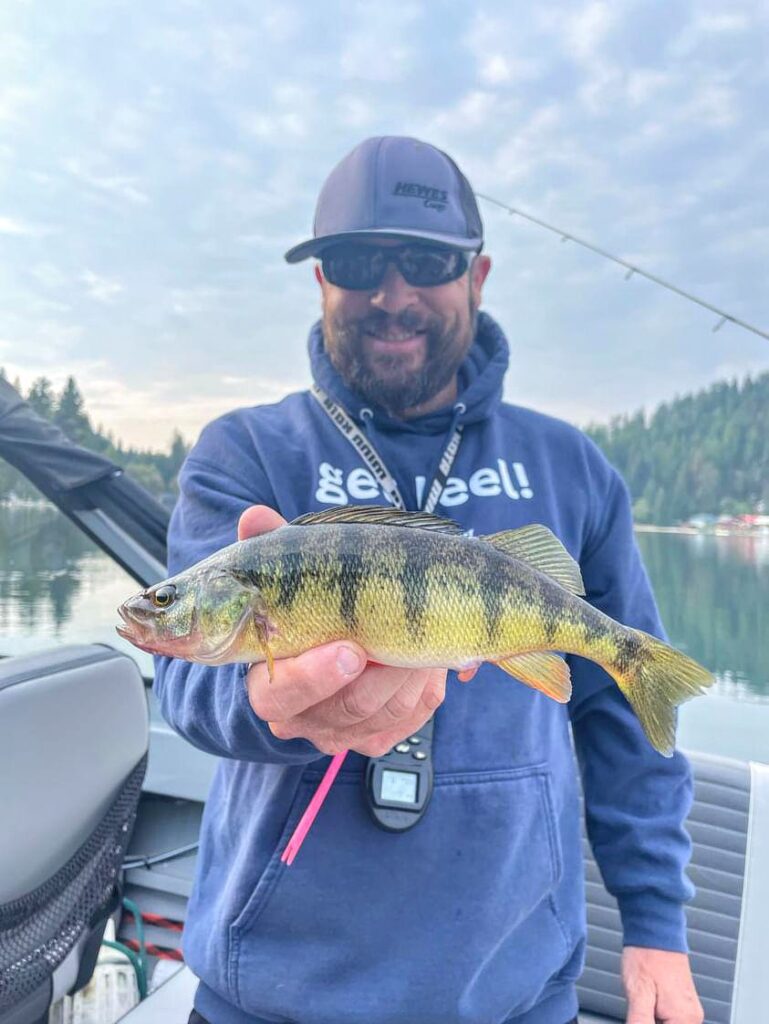
Yellow Perch
Yellow Perch are another panfish targeted by fall anglers in Eastern Washington. Known for their aggressive nature, and flakey tasty filets, perch are often found schooling up in deeper water, usually inhabiting a large mud flat looking for bloodworms, but don't overlook the shallows as temps drop and baitfish move toward the shore.
Best spots
Silver Lake, Moses Lake, Sacheen Lake, and Eloika Lake rank among prime locations for yellow perch. These waters provide plenty of food and cabbage where these perch can hide, and hunt. (Don't forget Long Lake.)
Techniques
Perch can be caught using a variety of methods, but jigging small spoons tipped with small plastics, or bait tends to be the most effective way. Vertical jigging from a boat can be best, especially when you locate a school of perch on your fish finder.
Tips for successful fall Panfishing in Eastern Washington:
Use light tackle
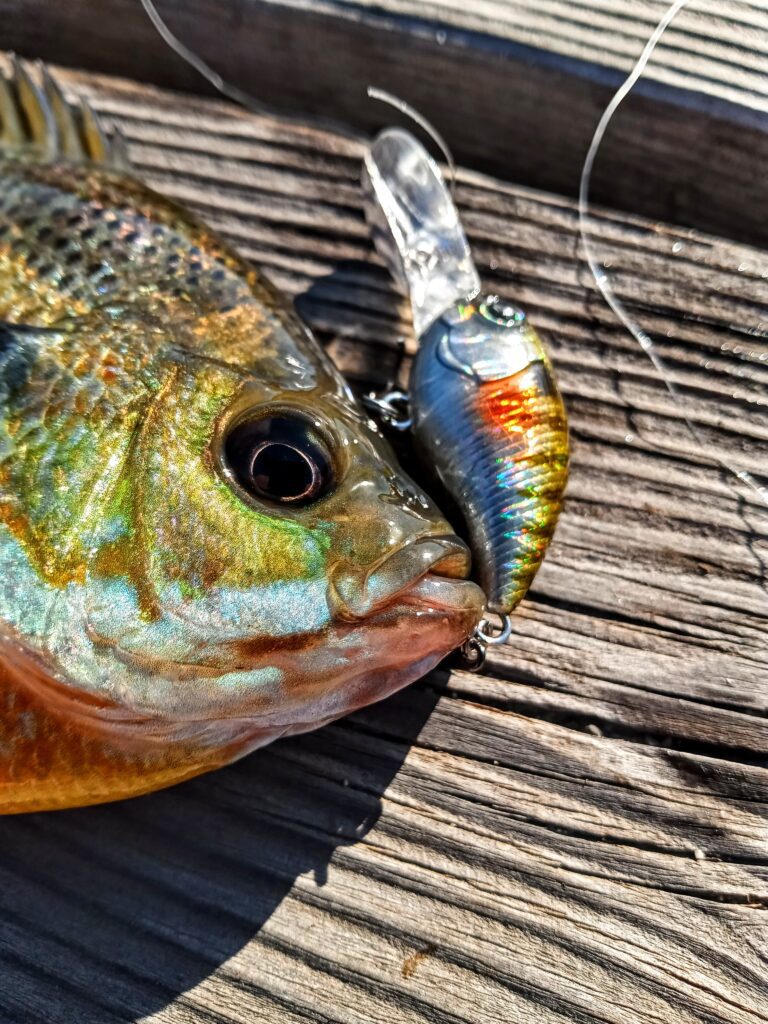
Panfish have small, soft mouths and are easily spooked by heavy tackle. Light spinning rods, small reels, and 4-6lb test lines are ideal for detecting subtle bites and presenting small baits effectively.
Look for structure
Panfish are actually drawn to structures that provide cover from predators and access to food. Fallen trees, weed beds, rock piles, and boat docks are all excellent places to find schools of panfish. Use a fish finder to locate submerged structures that aren't visible from the surface.
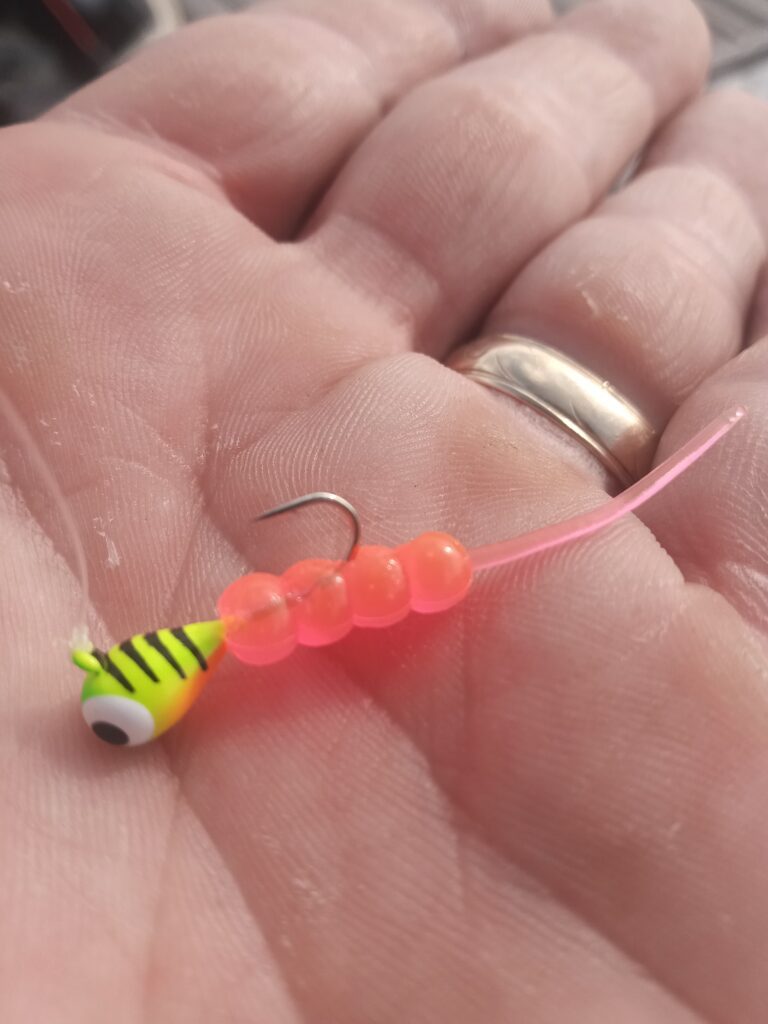
Experiment with lure colors and sizes
Different panfish species and even individual fish can have a unique preference, so it's good to experiment with variations of lures, with different colors and sizes. Or even trying to figure out what they are feeding on, and match the hatch.
Stay Mobile
If you're not getting any bites in one spot, don't be afraid to move around. Panfish schools can be highly mobile, especially in the fall, so covering more water can increase your chances of finding active fish.
Adjust your depth
Panfish can often be found at varying depths depending on water temperature during the day. Start shallow and gradually move deeper as the day warms up. Fish can sometimes be found surprisingly deep even in cool months - and don't overlook the suspended fish in the middle column.
The fall Panfishing experience
Fall panfishing in Eastern Washington offers a unique blend of excitement and tranquility. The crisp air, vibrant fall foliage, and the serenity of the lakes make for a peaceful escape from the everyday hustle and bustle. For those who enjoy the challenges of light tackle and the reward of a well-earned catch, there's no better time to get out on the water.
Whether you're a seasoned angler or a beginner looking to experience the thrill of fishing, Eastern Washington lakes and reservoirs offer plenty of opportunities to reel in some of the best and most enjoyable fish the region has to offer. With a bit of patience, and the right gear, and a sense of adventure, you'll find that fall panfishing in Eastern Washington is more than just a past time - it's a cherished tradition waiting to be discovered. So grab your fishing rod, pack your tackle box, and head out to the waters of Eastern Washington this fall. The panfish are biting, and the experience is one you won't want to miss.
![{"capture_mode":"AutoModule","faces":["-1482_-1552_-546_-616"]}](https://cdn.northwestfishing.net/sites/default/files/styles/large/public/images/IMG_20240907_122136_1-scaled.jpg.webp?itok=1nO2jnuv "{\"capture_mode\":\"AutoModule\",\"faces\":[\"-1482_-1552_-546_-616\"]}")
/articles/fall-panfishing-eastern-washington
Kelp Greenling
Spanning from the Aleutian Island that make up the Alaskan archipelago, all the way down to the coastal waters of San Diego California, there is a small predatory fish that patrols the kelp beds and rocky structures that make up much of the US west coast. Unlike its close relative, the lingcod, this petite little predator enjoys a life that’s largely void of the constant bombardment from sports anglers. This small saltwater fish is the Kelp greenling. And though it’s not targeted by anglers the same way many other bottom fish along the West Coast are; due to its small size and lack of spiny armor, the kelp greenling is constantly being pursued and preyed upon by lingcod and even halibut.

Description and lifecycle.
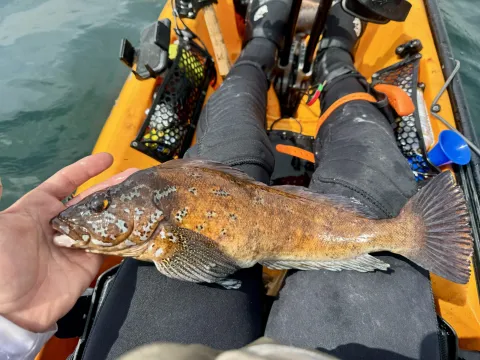
Adult greenlings range from 10-21 inches and rarely grow to be more than 4.5 lbs. Both males and females tend to have colorful markings, with the females typically having a brown to orange body with black and grey spots, while the males typically have a dark grey body with blue spots around the head. The females can lay up to 12,000 eggs between November and January. This occurs three times throughout the spawning season and the deposited eggs will stick together in large clumps which the males will guard till the larvae stage. Kelp greenling can live up to 25 years of age.
Kelp Greenling as a fishery and as a food fish.
In general, Kelp Greenling are caught as by-catch by sport fisherman that are seeking lingcod, rockfish, and other popular bottom fish species. While some are retained for food, many anglers simply throw them back or utilize the fish as live bait for trophy-sized lingcod. Historically in Oregon and California, near-shore commercial vessels retained bycatch kelp greenling to sell in local fresh seafood markets, yet a thriving market never developed for this greenling, so commercial pressure has remained low.
Although Kelp greenling likely hasn’t been the star of the show on most people’s fishing trips, they do provide a good fishery for a number of reasons: They are commonly found in Washington’s nearshore waters and their numbers are thought to be healthy; for a small fish they put up a decent fight (remember, they are relatives to the lingcod); and finally, they are a delicious food- fish. I would put the flavor as something comparable to lingcod, yet the flesh, once cooked, is slightly less firm than these larger relatives.
Where to fish.
In Washington, the best areas to target greenling are on the straights of Juan de Fuca, and in coastal waters such as La Push and Makah Bay, though they can be caught to a lesser extent in the Puget Sound. Look for areas where healthy kelp beds meet rocky underwater structures and aim to fish at about 15-50 ft deep. A boat or a kayak will give you easy access to greenling habitat, but boats are not required for this fishery as you can fish for kelp greenling off of jetties or rock outcroppings.
How to catch them.
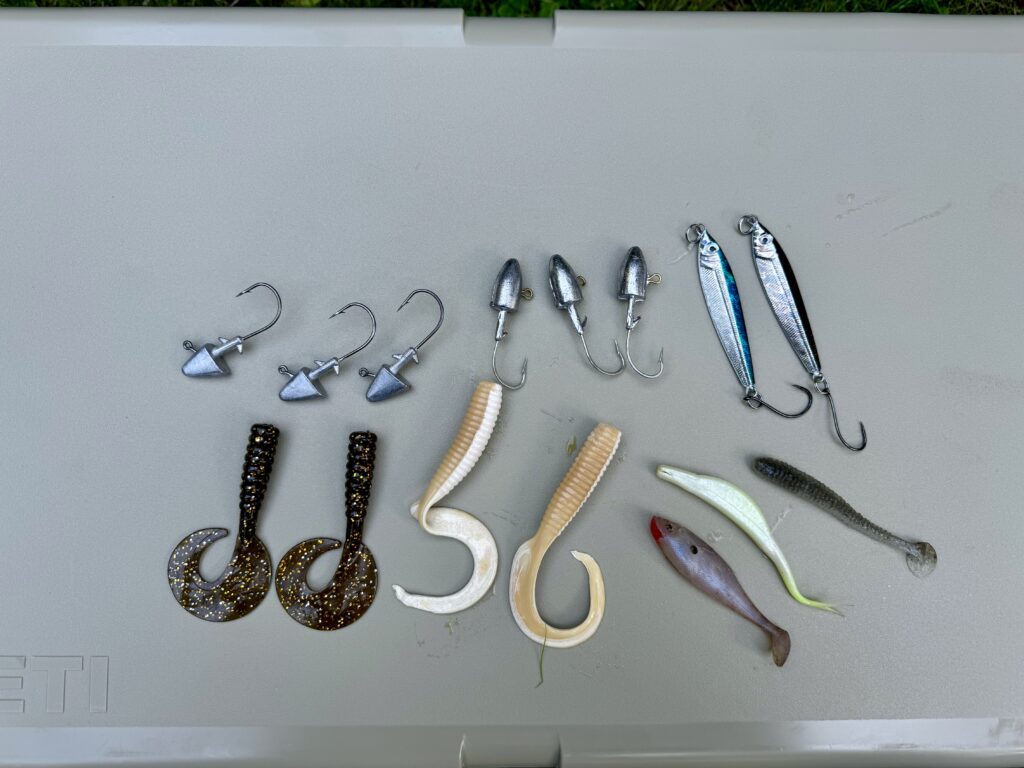
If you’ve fished for Cabezon, rockfish, or lingcod, you’ve likely already used gear that will entice a bite from kelp greenling. I prefer using a 1-2 oz laser minnow or a 1-2 oz lead jig head with a soft plastic grub. A variety of colors will work depending on what the fish are feeding on at the time. If fishing from a boat, dropping your lure to the bottom and vertically jigging will typically produce good results. While fishing from a jetty, you can cast, jig, and retrieve the same way you would work a buzz bomb from shore while targeting salmon.
Swim baits are also effective while fishing from a jetty or rock formations, and a weedless swim-bait setup will serve you well while trying to avoid hooking into the kelp. Since there’s a high likelihood of landing a larger fish like a lingcod or cabezon while targeting Kelp greenling, it’s a good idea to have a set-up that can handle larger fish. With that being said, you’ll still want to keep your gear light enough to make some fun out of bringing in the smaller kelp greenling. My go-to set-up is a 7 ft medium light action rod, with 25 lb braided as my main line, swivel, then 2-3 ft of 20 lb mono or fluorocarbon for my leader.
With fall in full swing and many people wrapping up their summer bottom fishing season, I find October to be a good time to utilize some of the cooler weather for late-season saltwater fishing. If you’d like to add some variety to your catch and want to take advantage of the slower boat launches, go ahead and give Kelp Greenling a try. Just keep an eye on those tides and weather forecasts!
/articles/kelp-greenling
Catfishing in Washington
By Josh DeBruler
It was November 6th of 1902 at the confluence of the Ohio and Mississippi Rivers, where the great explorer, Meriwether Lewis, recorded in his journal that a prominent fisherman within their expedition had brought in a Goliath of a catfish that measured over 4 ft long and weighed in at 128 lbs.
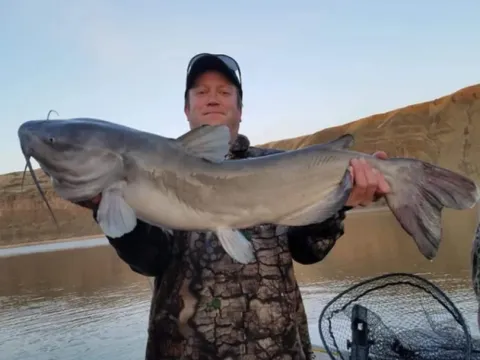
Whether this accounting is of historical fact, or just generally accepted as American lore, the fact remains that Catfish get BIG. The record size catfish for the same river that Lewis and Clark’s men were dropping their lines in is currently a 104 lb.
blue catfish, and though we wont likely see those types of numbers coming out of our Pacific Northwest waterways anytime soon, we certainly do see some formidable sized cats here in Washington State. In 2019 a 15 year old boy hauled a 37 lb. state-record channel catfish out of Lake Terrell in northwest Washington, beating the previous record by 1.5 lbs.
If you’re looking to hook into a big catfish here in Washington State, chances are you’ll be fishing for channel catfish. Channel catfish are native to much of North America, but they didn’t make their debut here in Washington till 1892, when a load of them were dropped off in Skagit county’s clear lake.
From that point forward, these fish were distributed throughout Washington State for both recreational angling opportunities, and more recently, for management of problematic forage fish. Although, they can be found throughout the state, most anglers familiar with the fishery would agree, your best bet for harvesting some of these fish would be to head to the Columbia river to fish it and its tributaries that head north from the Bonneville Damn, and meander up and across the eastern portions of the state.
Rivers like the Columbia, Yakima, Snake, and Walla Walla, all provide reasonably suitable habitat for these fish to spawn and maintain self sustaining populations. Conversely, lowland lakes that are stocked with channel cats, will only provide anglers with fishing opportunities that reflect both the frequency of the WDFW stocking programs and the pressure the lake receives from anglers. Channel catfish are not known to reproduce in most Washington lakes.
Where to fish in Eastern Washington (Eastside of cascades )
-Lake Umatilla
-Lake Wallula
-Lower Yakima River
-Lower Walla Walla
-Lake Sacajawea
-Lyons Ferry State Park (confluence of Snake and Palouse rivers)
-Roses Lake
Where to Fish in Western Washington
- Green Lake
- Clear Lake
- Silver Lake
- Lake Terrace
- Swofford Pond
- Lake St. Claire
When to fish
Fishing is most productive when catfish are spawning. This typically peaks around June and you can expect the bite to taper off as we move into fall. The spawning season also causes catfish to move out of the larger Columbia river and into its tributaries where the shallow waters provide better spawning grounds. Take advantage of this time to target catfish in these smaller waters, and if you can fish the confluences of the Columbia and said tributaries at this time, a bottleneck opportunity occurs, and this is where the fishing can become excellent.
How to fish them
Being that most techniques are fairly straight forward, fishing for channel catfish should be suitable for anglers of all different experience levels. You’ll likely find that the most challenging part will be getting on top of the fish in the first place. If you are fishing at night, you’ll find catfish feeding in the shallow waters near the shore, and though night fishing is excellent for channel cats, it’s also not a very suitable time for the typical angler.
For this reason, many anglers fish throughout the day, and do-so successfully. During the day, you’ll find most of your channel catfish in deeper waters beneath the column of warm water known as the thermocline. Typically, 15-20 ft down will get you past the thermocline and into the cooler waters.
Since these fish are bottom feeders, the goal should be to get your bait at the bottom where it can be detected by the catfish’s keen since of smell. There’s a wide variety of baits you can use. Many anglers opt for chicken livers, oily cut baits, earthworms, chicken skins, hot dogs, shrimp, corn, or dough balls made specifically for catfish. These fish don’t seem to be extremely particular about their food as long as it’s in front of them.
As far as rigging goes: a slip sinker rig is both simple and productive. From your main line, add your preferred slip sinker, a stop bead, barrel swivel, about 5-20” of leader, and a 2/0 to 3/0 hook. You can get the hook suspended a bit off the bottom by adding a poly ball or foam peg float a few inches back from the hook if desired (note this becomes ineffective if a substantial amount of current is present)
A slip bobber rig is also a popular and effective method to get your bait suspended off the bottom while being able to detect bites visually. Just add a stop knot to your mainline, then a bead, a slip bobber, slide sinker, barrel swivel, and 10-20 inches of leader before your hook.
There are plenty of other methods available for catching channel cats, but these should be all you need to get started.
/articles/catfishing-washington
Washington State Record Whitefish
From the Washington Dept. of Fish and Wildlife, we learn a Davenport angler who attends Gonzaga University reeled in an unexpected catch while fishing for walleye at Lake Roosevelt on February 11th. Gavin Boggs was fishing with a college friend near the Lincoln boat launch that afternoon when he hooked into something very big.
Boggs said, “I was targeting walleye at a depth of around 75 feet using a four-inch swim bait and it was a pretty tough day on the water. We did mark a lot of fish on the fish-finder but had only caught one walleye before this big fish took my lure.”
Boggs, whose family has a place at Seven Bays toward the southern end of Lake Roosevelt, continued his story, saying, “As soon as I hooked it, I thought it was a big walleye. I carefully let the fish do its thing down below the boat and then when it came to the surface and we netted the fish, I was totally surprised. I’ve never targeted whitefish in Lake Roosevelt. It is my favorite place to fish for smallmouth bass and walleye, and this has changed my mind about fishing for lake whitefish.”
Gavin caught the fish in the late afternoon and he texted his father about the catch. Gavin’s dad, Tony Boggs, did some research and told his son he might have a new state record on his hands.
According to WDFW, Boggs immediately iced the fish in a cooler and drove from Seven Bays to Davenport Family Foods, where an official scale verified the weight as 7.86 pounds. The store owner, a friend of the Boggs family, stayed late just so Gavin could have it officially weighed.
Gavin then took the fish to the WDFW Spokane regional office on February 14th, where biologist Danny Garrett measured this new state-record lake whitefish at 26.25 inches long, with a girth of 16 inches.
.
The old state record weighed 7.50 pounds and was caught Feb. 19, 2021, by Jacob White at Cox Lake in Franklin County. Gavin said Jacob actually reached out to him on Facebook to congratulate him and “pass the torch”.
Will this record be broken again soon? Possibly. WDFW conducted a netting survey at Lake Roosevelt last fall and caught quite a few lake whitefish, including one that weighed 9.5 pounds.
/articles/washington-state-record-whitefish
Razor Clam Forecast
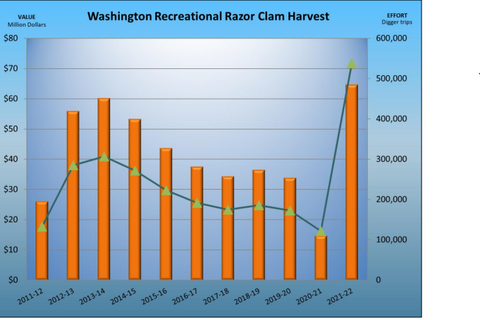
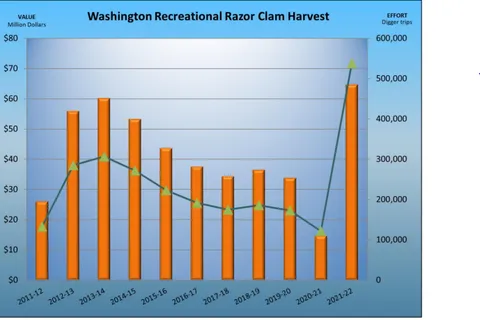
It’s no secret that last year’s razor clam season was a banner year. Record number of clam diggers swarmed beaches, working hard to get their limits. 484,388 diggers showed up, harvesting 8,352,279 clams, over 120 total harvest days. That’s a lot of razor clams! This was a welcome success after the 2019-2020 and 2020-2021 seasons closed early due to COVID-19 and domoic acid, respectively. Thousands of eager razor clam diggers are wondering if this season will be as successful as the last.
Dust off those razor clam guns and get your hip boots ready, because the forecast is looking promising! WDFW assessed razor clam populations throughout the summer and all had strong, harvestable populations except for at Kalaloch, which will be closed this year to allow recovery. Let’s take a closer look at this year’s forecast, and how WDFW determines annual razor clam harvests.
Razor clams have been enjoyed by millions of people over thousands of years. They are a valuable resource to hungry fishermen and local economies. WDFW estimated the fishery value to be $71,689 last year. So how are these crucial resources managed? Since 1929, WDFW has managed the coastal razor clam harvest. It’s a difficult job- they have to balance the demands of recreational fishermen with the rights of the tribes, all while keeping public safety in mind. Management strategies have been ever evolving.
From 1929 to 1942, there was a year-round season, and a 36-clam limit. In 1943, WDFW limited the season from March 1st to September 30th, and in 1960, the clam limit was reduced to 18. In 1973, the seasons were further reduced, and in 1974, the 15 clam limit we are familiar with today was implemented. In 2000, the seasons became much less set in stone and varied from October to May, depending on counts conducted through the “pumped area” method. In 2004, WDFW switched to the system still in use today, the “adjusted exploitation rate” method. Management strategies are ever evolving based on the increasing amounts of clam diggers every year, and changing oceanic conditions.
There are 3 pieces to the puzzle that WDFW must take into account before announcing razor clam digs: population counts, domoic acid levels, and tribal rights. The first piece of the puzzle is population counts. Each summer, WDFW conducts population counts at every beach: Long Beach, Twin Harbors, Copalis, Mocrocks, and Kalaloch. Based on these counts, they estimate the total number of clams measuring under 3 inches, and the total number of clams measuring over 3 inches.
They allow a certain percentage of razor clam population over 3 inches to be harvested each year, in order to make sure the population stays sustainable for years to come. Up to 40% of razor clams 3 inches and above may be harvested every year for the population to remain sustainable. After every harvest, WDFW calculates the remaining TAC (total allowable harvest), and sets further days based on that number. This way, poor tidal conditions and weather don’t mean we get shorter seasons. Alternatively, if conditions are great and there are more harvesters than predicted, the season may close early on that beach. Population counts are closely monitored throughout the year to make sure this popular fishery will remain for years to come.
Before WDFW opens recreational harvesting, they must also determine whether the clams are safe to eat. WDFW’s goals are not only to keep the resource around for years to come, but also to protect public health and safety. Unfortunately, clams are subject to accumulating marine toxins in their bodies which can make harvesters sick. Harmful algae blooms are naturally occurring, but concentrate in razor clam tissue. The most prevalent toxin is domoic acid, caused by consumption of marine plankton, called diatoms.
Eating a razor clam that has high levels of domoic acid can cause nausea, dizziness, memory loss, and stroke-like symptoms. There is no antidote, and the toxin is not destroyed by cooking/freezing. WDFW carefully tests razor clam populations for domoic acid throughout the year, and will close seasons accordingly, even if TAC (total allowable catch) hasn’t been met.
The final piece which WDFW must take into account is tribal fishing rights. Each year in August, WDFW discusses population estimates and domoic acid levels with the coastal tribes that have fishing rights on razor clam beaches, and comes up with the total allowable catch (TAC). 50% of the TAC goes to recreational fishermen and 50% goes to the tribes.
The coastal tribes work with WDFW staff to come up with joint population assessments, and share their data together. Tribal seasons take place on different days than non-tribal seasons, and each group makes their own harvest estimates and enforces the rules themselves. Razor clams are a co-managed resource that tribal and non-tribal stakeholders take very seriously.
Beach has by far the largest TAC (total allowable catch) share at 5,865,490 clams, and Mocrocks has the smallest, at 1,964,732. Interestingly, the average size of clams is slightly smaller this year. Last year, they were 4.4 inches long, and this year they were 4.22 inches on average. Although the clams are a little smaller, there are plenty of them! Overall, the forecast looks promising. WDFW always tries to schedule razor clam digs on weekends at least once a month during the months of October through May. The WDFW director checks marine toxin levels and looks at the remaining TAC for the year before announcing that the harvest dates can proceed. Clam digs have been tentatively approved throughout November and December.
In an unprecedented move, WDFW increased the limits from 15 to 20 razor clams last year. Will it happen again this year? For now, keep an ear to the ground and always check your rules and regulations before heading out. Speaking of rules and regulations, it’s always a good idea to brush up.
Make sure each harvester has their own container to put clams in. Many sporting goods stores sell clam nets, which readily tie to your wading belt to keep your hands free for digging and holding flashlights. Remember that the first 15 clams dug must be kept, no matter the size or condition. We’ve all accidentally crunched clams while digging them, or dug up a tiny one, but they still must be retained as part of your 15-clam limit. That being said, there are plenty of clams out there to be had. It’s shaping up to be a good year, so go out and get those razor clams!
/articles/razor-clam-forecast
Washington Winter Kokanee Observations
By Randy Castello

As we say good bye to our summer boating weather you may find yourself wondering, “do I winterize or do I find something to fish for?” Either way, you should probably winterize your boat, motor, and trailer, but let’s talk trolling for winter kokanee.
Winter kokanee
Winter kokanee in Washington State? Sure, so go ahead and winterize, but keep the keys handy. Find your gloves and earmuffs and make a thermos of steaming hot coffee because there are kokanee opportunities to be had. Both Western Washington and the Eastside have winter kokanee lakes.
Kokanee are the non-anadromous form of sockeye salmon. Basically, by choice or otherwise, kokanee are landlocked sockeye salmon. Kokanee are native to many Pacific Northwest lakes and have been introduced to a number of lakes across the United States.
The life cycle is of particular interest to winter kokanee anglers. Although there are exceptions, kokanee typically live 3-4 years before they spawn and die. For the dedicated winter kokanee angler that means that there are 2-3, maybe even 4-year kokanee available during the chilly months.
Winter kokanee fishing is a little different than our spring and summer fisheries. Most winter kokanee fishing is done in deeper water. Kokanee prefer water that is 50-56 degrees. In part, they are more active in this zone because it is rich in oxygen boosting energy to chase down their next meal. Each lake varies, but finding “the zone’” is important during winter kokanee fishing. One way is to keep your eyes glued to your fish finder and look for fish.
This is where the best fish finder/chart plotter you can afford is your friend. When you find fish, mark the spot, and pretty soon you’ll have a winter kokanee map. With it you can amaze your guest fishermen and go right to where they are. They’ll think you are the “Koke-Wisperer”, maybe a kokanee-shaman or something… You can also use a Fish Hawk Digital Gauge or the Vexilar Deptherm to graph out the water temperature at depth.
Winter kokanee fishing is more of a love thing, there is rarely a hot bite. Each lake has a winter fishery sweet spot depth. Generally, in Western Washington it is 30-60’, and Eastern Washington 40-200’ deep. Each lake, especially on the westside, seems to have a brief period each day where the kokanee will put on the feed bag and go on the bite outside of your usual grind it out depth.
Kokanee are filter feeders, and the bulk of their calories come from plankton blooms. There are windows any given day where there is a bloom or hatch, and the kokanee will briefly leave their comfort zone to feed.
Because the bite may be 2:06-2:23 at 43’ it is best to choose your winter kokanee lake close to home and learn it. Especially when winter kokanee fishing, keep a detailed fishing log.
Both summer and winter fish are a noble opponent. They often make short runs, jump, and go bonkers at the net. Summer fish are more aggressive, but winter kokanee take more finesse to get them in the net. After plating, smoking, or chowder-izing hundreds of kokanee, both the summer and the winter fish are excellent table fare, but the winter fish are outstanding for whole or fillet pan-frys and grilling.
The following list includes winter kokanee lakes that I am familiar with, and is focused on trolling. I am sure there are other winter kokanee lakes available. My westside lakes were originally selected because they are open all year and they have deeper basins that may hold fish. Both the westside and the eastside winter kokanee lakes are listed by my preference. My preference is based on success, proximity to home, and the potential for a trophy fish.
Eastern Washington
Lake Roosevelt
Nothing in Eastern Washington is close to home, and to be honest, as I get older, I don’t like hauling the boat over the pass in the winter anymore. That said, I love fishing Lake Roosevelt, so with the right forecast we may head that direction. I’m sure kokanee are available throughout the lake, but we usually fish out of Spring Canyon and focus on the dam area, but we also fish the lower 5 or 6 miles. I typically start at about 40’, but may fish 100+ deep as required. Because there is the potential to hook a 3+ pounder, I typically up my leader to 20-pound fluorocarbon.
Lake Chelan
It is a great winter kokanee lake, offering pretty consistent fishing. The winter kokanee fishery is concentrated between Manson, maybe the Narrows, up to 25 Mile Creek. There is enough kokanee in the Wapato Point area to keep you on the water if, or should I say when, the weather kicks up. The winter fishery at Chelan is a deep fishery, you can expect to run your gear 80-200’ deep. Watch the weather!
Before I get to the westside lakes, let’s discuss winter boating safety/etiquette. Carry chains for both your tow vehicle and for at least 1 axle on the trailer. Bring a couple sand bags and a shovel. A liberal application of sand can be a lifesaver. At the ramp, assess the situation before you back down a long icy ramp. Take the time to chain up your tow vehicle if required.
Thought being; although once your tires hit the water you’ll have traction, the area between the top of the ramp and the water could be icy. You don’t want to jackknife ½ way down the ramp. It would put a damper on your kokanee plans. Once the trailer is wet you may have to let the rig sit in the water for a bit to thaw and let the boat float free. Be safe on the boat, you don’t want to slip and end up sharing the lake with your aquatic rival.
Finally, and as a courtesy; at the end of your time on the lake load your boat and slowly pull out of the water just enough to clear the water. Stop and let the rig drain or drip-dry, this will minimize ice buildup on the lower 1/3 of the ramp.
Western Washington Winter Kokanee Lakes
Lake Washington
Although not exactly close to home, Lake Washington is my favorite westside winter kokanee lake. Our largest westside kokanee was a 3.13# 18” fish. We have caught many 1# plus and a few 2# kokanee in Lake Washington. To protect juvenile and migrating sockeye salmon there is an 8 – 18” slot limit for kokanee on in Lake Washington. A standard sockeye drill works, but consider stepping up your speed and gear selection. Most of our larger Lake Washington kokanee were taken on hoochies and 8” flashers.
The eyes have it; what am I talking about? Who knows why but most of our large Lake Washington kokanee were bamboozled by a lure with eyes. If Lake Washington were closer to home, I’d be fishing it every day that I possibly could.
Lake Cavanaugh
Lake Cavanaugh is an odd duck, easy kokanee limits for fish 10 – 18” kokanee during the spring, summer and fall, but when winter comes around it seems that every kokanee you catch is a chrome 8 – 12” fish. My nonscientific guess is that the majority of the kokanee in Cavanaugh spawn at 4 years and the winter sport catch are primarily 3-year kokanee. Most winter kokanee in Lake Cavanaugh will be caught over the deep pocket just east of the islands.
Lake Samish
Samish is really close to home with the typical winter kokanee bite being later in the day. It is a great lake for “breakfast and chores are done, let’s go fishing”. The lake includes a large basin with a smaller connected lake at the north end. When fishing winter kokanee on Lake Samish, most of our fish are caught in one of two areas. The first is along the west shoreline just west of the WDFW launch.
The second is generally in the center, maybe favoring the north shore/center of the small lake. Your trolling speed is critical, plan on fishing .8-1.0 mph with lots of “S” turns. Oddly, we have caught a fair number of Samish winter kokanee pulling small minnow type baits for cutthroat, but standard kokanee gear is a better starting point.

Lake Stevens
We don’t fish winter kokanee on Lake Stevens often, but it does host a winter fishery. There may be local secrets, but in our experience Lake Stevens winter kokanee are a hit or a miss. Most of our winter kokanee were caught along the bay at the northwest side of the lake. Typical kokanee gear with a pinch of nightcrawler or worm seems to have an edge over tuna corn.
Yale Lake
Yale is a great kokanee lake and is open year-round. There are winter challenges if you decide to make the trip. The wind can produce some crazy short chop, so make sure that you check the forecast before you hitch up the trailer. We haven’t had a problem but I’m pretty sure that the reservoir water levels are down November-February. The Yale Park launch should be open but other ramps may have restrictions.
Finally, there could be hazardous floating debris/flotsam. Boat with caution, and if it’s choppy, slow way down. The winter kokanee fishery should be concentrated by the dam or across the lake from Speelya Creek. In my experience, if fishing less than 30-40’, run really long setbacks or use lead line rigs.
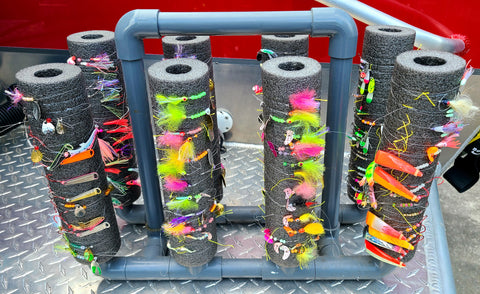
OK, you have some idea which way you’re headed in your kokanee quest, now what? I don’t really change overall tactics when fishing winter kokanee. The usual kokanee drill; a small dodger, lure with tuna corn is a great place to start. Make sure you have your favorite scents, maybe a container of worms, and additional leader onboard. Not always, but occasionally, you will need to increase your leader length.
When trolling for winter kokanee, you will want to stay under 1.0 MPH. I probably do more “S” turns or engage the “Hunt” mode on my iTroll more often during our winter kokanee adventures. Our dodger box has more dodgers in it than most, but during the winter kokanee fishery my go to dodgers are painted, copper, or even dark metalflake.
Using either double spinner rigs or flies behind the dodger seem to consistently produce kokanee during the winter fishery. After you hook your cold weather prize, gently fight the fish, and, as with any kokanee fishery, a long handle net will increase your actual catch verses hook up statistics.
I know that it will be cooler out, maybe even freezing, and the lake temperature should be down as well. But make sure you still care for your catch. Bleed them and keep them on ice, or, even better, in a slurry in your cooler; you’ll want to preserve the quality of your hard-earned prize.
Winterize or not, keep your kokanee gear handy. The above is just a starting point. Choose a lake, learn it, and you’ll soon be the local expert! Trolling for Washington State winter kokanee can be frustrating. With the closure of most of our winter salmon fisheries, a bit of frustration will quickly become an addiction. Enjoy your winter kokanee adventure, but with the potential for rainy, slick roads, be sure to use extra caution towing your boat to and from your new favorite winter activity.
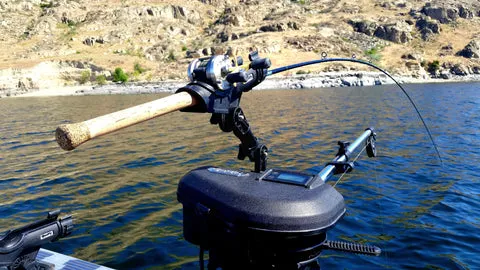
/articles/washington-winter-kokanee-observations-0