Too Big To Ignore
By Gary Lewis
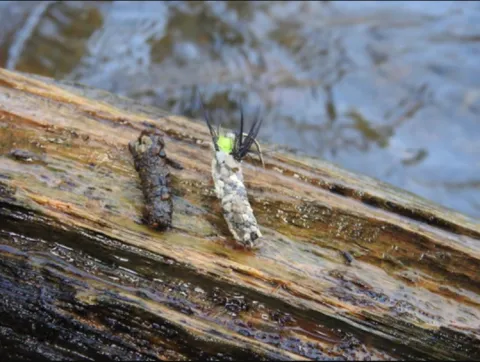
With this giant of western river caddis, what the angler sees on the surface is just a hint of what goes on beneath.
Across the West, the October caddis hatch begins in September and hits its stride in the first weeks of October. Even into November, the big bugs can still be found above the river.
Separate a caddis larva from its shell and what you have is a pale yellow rock worm with jet black head and legs. Trout eat them shell and all, but the larva itself can be compared to trout candy.
Sometime in August, the caddis begin their final transitional stage, similar to the process of a caterpillar enclosing itself in a cocoon. The caddis attaches itself to a rock and seals itself inside its case, where it transitions from the larval stage into a pupa. When the time is right, the pupa breaks out of the case and begins to migrate to the edge of the stream, where it crawls out upon a branch or a rock and dries its wings.
Trout feed on caddis throughout the year, but they are suddenly more available in August, September, and October.
Hatch timing is not as easy to mark as a stonefly hatch. Much of the hatch can come off during night hours. In fact, it is safe to say that if a single orange-bodied, tent-winged bug can be seen above the river, the hatch is on. To the trout's way of looking at the world, the party has started, and it's mostly below the surface.
LARVAL
The larval stage is imitated in both cased and uncased versions. Artificials can be tied on scud-style on English bait hooks, or on straight hooks sized No. 10 to 6 and 2X to 4X long. The fly should be heavy. Beads, lead wire, and copper ripping can all be used to make sure it sinks fast. To tie a passable cased caddis imitation, peacock herl works as a good body base and may be overlaid with a rooster hackle to add depth to the body. The body of the worm can be tied to represent it partially out of the case, or not.
To be ready in the event of an October caddis feeding frenzy, tie or buy John Hazel's Deschutes Cased Caddis, Oswald's BH Rock Roller, Peeking Caddis.
Now picture the worm free from its case. This is a really good fly to fish by itself anytime between the middle of July and end of September. My favorite representations are tied in off-white, yellow, and orange overlaid with clear latex. Heads and legs are completed with dark rabbit or muskrat with the guard hairs picked out. Some other good caseless larva patterns include Tan Caddis Larva, Rip Caddis (Hafele and Morris).
For all intents and purposes, these flies should be fished dead-drift. I learned to fish them with the rod in the high-stick position, but they can also be fished with a strike indicator. Trout tend to suck them in and spit them out just as fast, so it pays to set the hook at the slightest suggestion of a grab.
EMERGENT
Peak caddis hatch activity will probably take place on cloudy days from late afternoon until dark. Anticipating this can precipitate what I think is the most important and exciting stage of the hatch.
Exploit the "pre-hatch" phase with a tandem rig that includes a pupal imitation up top and a larva imitation down deep.
Fish the two-fly rig on a dead-drift, then let the flies swing at the end of the drift.
If a few naturals begin to hatch, it might pay off to tie on a dry with a pupa imitation on a 24-inch trailing dropper. Cast, dead-drift, swing, lift the rod, twitch.
Some of the better pupa imitations include the Tungsten Dirty Bird, Mercer's Tungsten October Caddis, Morrish October BH Caddis Pupa.
ON THE SURFACE - HATCHING
Fishing the dry is a lot like fishing in hopper season. October caddis are not typically all across the surface with trout attacking them. But the flies are big and some trout are looking for them. The fly is trying to break free from the surface, get its wings dry, and fly off. Some accomplish this with ease, while others struggle.
After the natural has left the surface, it will not be available to trout again unless a strong wind drives it back to the river. At such times, the fly may be wind-smacked and a dead-drift is the preferable presentation.
Some of the great October Caddis dry imitations include Morrish October Caddis Dry Fly, Improved Orange Sofa Pillow, and Orange Stimulator.
This is a good time to stay with the time-honored dry and dropper routine with a small Rubber Leg Pheasant Tail, Emergent Sparkle Pupa (brown and yellow) or a yellow X Caddis in tow. Run the dropper about 24 inches back.
ON THE SURFACE - MATING
The next opportunity for the trout to eat the big bug is when the female returns for the egg laying dance.
When the adult female drops eggs atop the water, she touches down, lifts off, and touches down again. Sometimes the current pulls her under and she beats her wings to get back to the air, only to touch down again. This most often takes place from late afternoon until after dark, and the process will assuredly bring trout up off the bottom. Some trout get so engrossed in the ritual they will chase caddis out of the water and try to take them in the air.
Add skitter to the end of a dead-drift dry fly presentation with a quick mend to get the line up, and then turn a small circle with the rod tip. If the fly lifts off the water and touches back down, creating a bit of drag, it is okay. It is one of those moments in a dry fly fisherman's career when drag is a good thing.
Trout seem to materialize in the clear water and chase the bug for two, three, four, five feet across the surface.
Look at the "hatch" of the October caddis not as a single event, but as a process. It's October, what are we waiting for?
# # #
To contact Gary Lewis, visit www.GaryLewisOutdoors.com
The End
/articles/too-big-ignore
Stocked Trout Extravaganza
By Paul Lewis
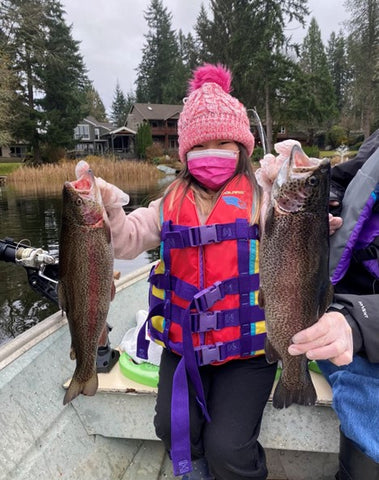
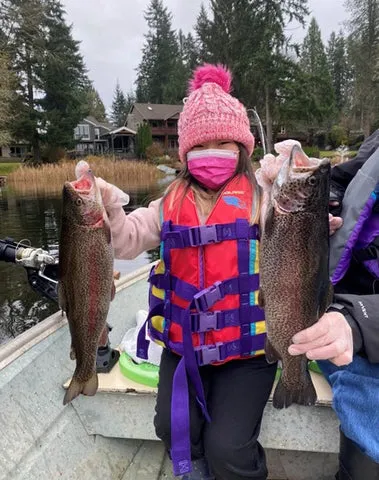
Well, winter is around the corner and it’s time to put the rods away and winterize the boat, right? NOT QUITE YET! Salmon season is indeed winding down, aside from some late season river opportunities, and winter steelhead is often a mystery, so many anglers don’t know where to look for the next bite. If this is you, look no further than some fantastic winter trout fishing at multiple stocked lakes! Winter trout fishing is incredibly rewarding, and in many cases, produces some large trout that cut beautifully. There are many ways to chase these fish from shore or from the boat, and with a little research and timing, you are sure to be on the fish!
HOW TO PREPARE
To begin, let’s look at the setups to use. Cold water temps have a lot of effect on fish, as they are a cold-blooded species. During this time, they are in energy consumption mode, with not a ton of energy to be spent moving around.
Additionally, cold temps slow down fish metabolism. All this together means that when the fish feed, they are looking for an easy meal that does not require too much energy wasted in chasing it down. For this reason, small profile lures and stationary baits are often the best choice.
When fishing from shore, it is hard to beat the “stocked-trout standby”, the Carolina rig! An egg sinker on the mainline with a 2–3-foot leader to a small hook, with an inflated nightcrawler or chunk of Powerbait, is an easy meal for a meandering trout to engulf. Another good option is a small spoon or spinner with a slim profile and wounded look.
Lighter casting spinners and spoons can be worked slow through the water column and produce a very crippled look. They are a great way to cover water in new spots and find the fish.
From a boat, these methods work great as well, but trolling can be added to the mix. Small spoons and spinners tipped with a worm are always a good option. Trolling allows the angler to go to the fish. Compared to spring and summer, trolling a little slower can be very effective. Many rainbow trout will sit low below the thermocline. Trolling past them just fast enough to get their attention but slow enough have them commit is the target.
WHERE TO GO
As with any fishing trip, the first thing to do is check the regulations. Many stocked trout lakes are seasonal, meaning they close at the end of October. If your lake is open, you are set to legally fish, but there may not be great fishing. Luckily for the angler, the WDFW publishes a list of recently stocked lakes that is updated weekly. Checking lakes in your area will give you the best idea of where and when to wet a line.
The best time to catch stocked trout in the winter is directly after the stock. This is when the trout aren’t quite acclimated to the new area, and they are the most aggressive. After a couple weeks in the lake, the fish will hunker down and be far less active compared to their first little bit in the new water. Knowing when the trout are stocked can be the difference in a couple bites and a nice limit on the stringer! During most of the winter months, the state stocks their “jumbo’s”, which are trout over 1lb, which usually cut fantastically.
FINISHING TOUCHES
As a local Western Washington Angler, I know a couple great lakes in my surrounding counties that are stocked in November, which give me just enough time to make some smoked trout dip for the Thanksgiving table. Nothing warms a day like a tight line on a cool river bank, sipping hot coffee, and enjoying some bank lunch.
With a little research, a simple setup, and a couple of free hours, you can be knee deep in some delicious trout! Just like the spring, ultralight trout setups, light monofilament line, some extra hooks, and a couple of weights, and you are set on terminal tackle. Then add some jars of Powerbait, a few lures, and a stringer, and you will be ready to hit the water. As always, be prepared for the weather!
/articles/stocked-trout-extravaganza
The Washington Outdoors Report
HUMPIES, LAWSUITS AND TROUT
PINK SALMON NUMBERS ARE LOOKING GOOD
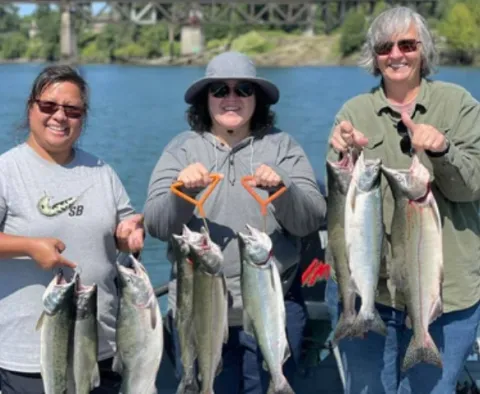
Odd numbered years are pink salmon years here in Washington State and 2023 is lining up to be a good one for anglers fishing for them in Puget Sound and its tributary streams. The Washington Department of Fish and Wildlife is forecasting a return of nearly four million of these smaller salmon, nicknamed “humpies”, for the hump the males develop on their back after entering fresh water to spawn.
The pinks show up in the Strait of Juan De Fuca as early as June and can be caught by both boat and shore anglers in Puget Sound throughout the month of August. By September, most of the pink salmon are entering tributary streams like the Skagit, Snohomish, Skykomish, Green and Puyallup Rivers, providing additional opportunities for anglers who target them with Buzz Bomb lures, jigs with squid bodies and spoons, the key to all of them is that they must be pink in color if you want to catch pinks with them!
Humpies are a fun fish to cut your teeth on as a first-time salmon angler and it’s not uncommon to catch a good number of them in a day of fishing. While many anglers save them for the smoker, they do taste very good when fresh, especially when grilled over a BBQ or pellet smoker.
LAWSUIT FILED AGAINST WDFW COMMISSIONER
On March 6th the Sportsmen’s Alliance Foundation, which is a pro-hunting and fishing organization, filed a lawsuit in Thurston County to prohibit WDFW Commissioner Lorna Smith from participating as a member of the Commission.
The basis for the lawsuit is that state law prohibits anyone from holding an additional elected or appointed office while serving on the commission. Smith currently serves on the Jefferson County Planning Commission which the Sportsman’s Alliance says is in direct violation of Washington Law.
Todd Adkins with the Sportsman’s Alliance says, "We view this lawsuit as the initial step of a long but important process to bring sanity and decency back to wildlife decision-making in Washington. It all starts here, but trust me, it won’t end here. The animal extremists are going to see a lot of the same in the coming weeks and months."
Lorna Smith is a controversial appointee to the Fish and Wildlife Commission. Since being appointed in 2021 by Governor Jay Inslee she was an instrumental voice in shutting down Washington’s long running spring bear hunt, despite the recommendation of WDFW staff members that it be allowed to take place.
When the Blue Mountain elk heard declined (primarily due to cougar predation), Smith suggested managing the herd as a smaller one instead of addressing the predation issues. She has also introduced the framework of a plan that would limit hunting as a management tool by the agency.
It is worth noting that Smith is not the only commissioner serving in another appointed or elected position. Commissioner Molly Linville (who generally sides with hunters in her decision making), serves on her local school board in Douglas County.
Eli Francovich, writing for the Spokesman Review, contacted both commissioners. Linville told Francovich that she was advised by legal counsel that serving on the school board was not a conflict of interest. Commissioner Smith told Francovich she was serving on the Jefferson County Planning Commission on a volunteer basis and in an advisory role when appointed to the Fish and Wildlife Commission. Smith continued stating she does not believe the statute does not preclude individuals serving in a volunteer position like she has been in Jefferson County.
LAKE LENORE FISHING TRIP
Last but not least, I made it up to Lake Lenore this past week after WDFW fisheries biologist Mike Schmuck told me the fishing there was very good last year and he expected similar results this season. I picked a cold, cloudy day to visit the north end of the lake which is where many of the Lahontan cutthroat trout tend to mill around in the spring prior to spawning.
Unfortunately, the trout were not yet in this part of the lake in good numbers. Two anglers who were leaving as I arrived said they each only caught one fish that day. While fishing, I did see one angler catch one trout and while I did get one good strike, I was unable to hook up and didn’t have any more bites that afternoon.
Lake Lenore is a selective regulation fishery and is primarily a catch and release destination where the trout average two to three pounds and can get up to six pound in size. Fly anglers in pontoon boats favor fishing chironomids under strike indicators while spin anglers can do well fishing spoons with single, barbless hooks.
The fishing at this scenic, desert lake north of Soap Lake should get better towards the end of March and peak in April. I plan to return to try again and will let you know how I do.
John Kruse – www.northwesternoutdoors.com and www.americaoutdoorsradio.com
PHOTO CREDITS:
Pink salmon caught on the Snohomish River – Courtesy Brianna Bruce, Livin’ Life Adventures
/articles/washington-outdoors-report
Elemental Telepathy
By Gary Lewis
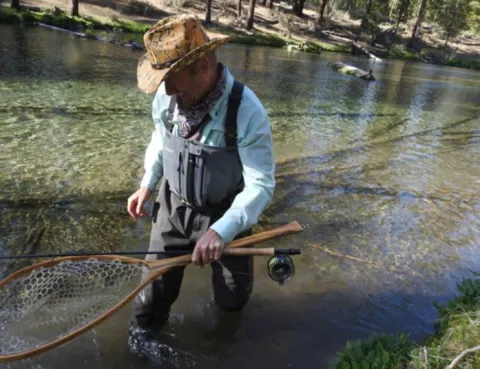
After 26 rainbows brought to hand and released, I reeled up the loose coils at my feet and clipped the Muddler Minnow off the line. Rain had been steady for the last hour and, soaked, I looked forward to climbing back in the Mustang and turning up the heater.
Upstream from a two-lane bridge, the river cut a channel through rock leaving a pool deeper than a man’s head. In the winter, an angler might catch a steelhead here; in the spring it was chinook, but the river offered a trout fishery too.
Today’s lipstick was a Muddler Minnow tied on a No. 8 long-shank hook, unweighted, with a turkey feather for the dorsal.
With no one else for company, it was easy to start at the top of the run, shake out a bit of line and stack-mend to get the fly to work into the seam this side of the riffle.
Lengthening the line, making micro-mends, the diminutive sculpin imitation presented to the trout below, and rainbows streaked up from the bottom to follow the Muddler across its arcs. And the longer the arc, the more likely the trout would grab.
After several trout I was startled to realize I did not feel a single bite. Instead, at best, it was a movement of the line, a two-inch indication, not even a tick that I responded to. Now and then a trout would give itself away with a flash below the surface. Trout after trout bit. Almost every cast they grabbed, but I only counted them when I could fight them all the way to the bank.
As time passed, I stepped downstream, roll-cast the same length of line each time and teased trout out from beneath the shadow of the bridge. When, properly soaked from the rain, I saw another angler headed toward me. He cast a glance toward the fly I had just removed from my line.
“Take this,” I said. “It’s working.” And before I walked up to the bridge, I pointed out where I supposed the trout were lying in the tea-colored water.
But I couldn’t leave. I had to watch from the bridge to see what the trout were doing. Taking care to not cast my shadow over the fish, I leant both elbows on the rail and watched the angler work out line and swing the Muddler across.
A trout streaked up from the middle of the water column, followed a couple of feet and then closed its mouth over the deer hair streamer. There was no reaction from the fisherman. He let the fly continue to swing while the trout moved with the Muddler then opened its mouth and spit it out.
Surprised, I said nothing and continued to watch. In twenty casts, ten trout grabbed and the guy did not a single time sense the bite. I could not stand it. I walked back down.
He was ready to change flies.
“You’re getting bit on almost every cast,” I said. He didn’t believe me but he consented to cast again. When the fish bit, I called the strike. And he caught a fish. And I left him to it.
What was the difference, I wondered then, and I still wonder today when I fish alongside someone who clearly catches more fish than me. If the fly is the same and the presentation is the same, why does one angler catch fish and another does not? How many fish bite and we do not know it?
Line control and sensitivity is hard to teach and even harder to learn.
Let’s call it electricity, an impulse in a conductor. Cast out a dead thing; the conductor swings out in the void. And then, out of the void comes a live thing and closes the circuit. For a moment, the line tingles and energy pulses from the muscles of the trout on the other end. In tune with the lightning rod that is the graphite in your hand, you sense it. Exchange of energy. Reaction making contact.
Let the fish take a bit of line, lift the rod or turn the tip toward the bank. Let the trout hook itself. It’s electric.
# # #
Gary Lewis is the host of Frontier Unlimited TV and author of Fishing Central Oregon, Fishing Mount Hood Country, Hunting Oregon and other titles. Contact Gary at www.GaryLewisOutdoors.com
The End
/articles/elemental-telepathy
Road trip options for ice-out trout
Remember that opening day of trout season tradition? It's a thing of the past. Most of our best trout fishing lakes and reservoirs are open year-round. In Oregon, you can go fishing when you feel like it or when the ice thaws, whichever comes first. Here are some of the best ice-out trout fishing destinations for early April.
Central Oregon
In Central Oregon, and west of Tygh Valley, Pine Hollow Reservoir is a 240-acre irrigation impoundment set in mixed pines and oak trees. Less than an hour's drive from The Dalles, it is a popular summer fishery, but can be pretty quiet early in the spring. And that's when this fishery kicks off. The Oregon Department of Fish and Wildlife stocks legal trout and big brood stock rainbows here, starting the third week of March if ice allows. When the ice first begins to thaw, the fishing should be excellent. A boat is a good idea for this lake, although there is good bank angling at the east shore boat ramp and on the east shore. My favorite trolling pattern touches at the buoys in front of the resort.
Nearby, and west of Wamic, Rock Creek Reservoir shows off best early in the season when ODFW stocks approximately 12,000 legal rainbows between early March and the end of May. Plan it for the third week of March and beyond. This is a good spot for bank angling, but a car-topper boat is a definite advantage. Bait is allowed and bank anglers do best when using jar baits with a sliding sinker and a long leader. This is not a place to use a light leader. The Department often plants brood stock trout that can run up to 30 inches long.
Summer Lake
Near the town of Summer Lake, 60-acre Ana Reservoir is one that does not ice over, but the best timing is going to be after the third week of March when ODFW typically plants 3,000 legal rainbows. The community of Summer Lake has been paying for additional trophy rainbows to be stocked in this lake, creating a destination fishery that is still relatively unknown. Trust me, if you catch one of the big ones and want to keep it for a barbecue, it may be one of the best tasting trout you have had in a long time. Or let it go for the next guy to tangle with. Your call. Best place to start is at the boat ramp and along the dam. Bank fishing is good here. Fly anglers will want a boat or float tube.
If you plan a trip to Ana, there is a good RV park, nearby hot springs with cabins, and the Lodge at Summer Lake. Tell them you're there for the fishing and they will keep this trophy program going.
In early April, Krumbo Reservoir is one of the best things going when ODFW plants the first legal rainbows of the year. Krumbo, a shallow desert lake on the west side of the Steens, is 150 acres and fishes best in spring and fall. Because the lake is so food-rich, the trout can winter over and 20-inchers are common. Bank anglers can do well here, although bank access is tricky, scrambling over lava rocks. A better bet is to bring a float tube or a small boat.
Between Sumpter and Baker City, 2,235-acre Phillips Reservoir was a formerly great rainbow trout fishery which was overrun by yellow perch and has since been rehabilitated with the help of the tiger muskie. That is all you need to know. But since you want more, I'll give it to you. Phillips is a better-than-good ice fishing destination. Perch can be easy to catch through the ice and are every bit as good to eat as walleye. And the perch, because there are fewer of them now, are bigger. As this issue goes to press, Phillips Reservoir has about 12 inches of ice, so depending on the spring conditions, it could still be iced over well into April. Another item to consider is that Phillips is refilling after being drained last year so boat ramps might be out of the water.
At full pool, trolling is a real treat on this lake. An angler should plan to troll for rainbows and spend a little time targeting tiger muskie, which is a catch-and-release fishery. On a steady diet of six-inch perch and 10-inch rainbows, these fish grow to four feet long and weigh as much as 30 pounds. I hooked one once and lost it when it plowed through the weeds next to the boat, jumped as high as my shoulder and broke my line. Use a steel leader and a six-inch swim bait or large spinner bait to target tiger muskies.
Lake Simtustus
One of my favorite lakes right now is Lake Simtustus, located seven miles west of Madras in the deep, narrow Deschutes canyon. Simtustus was formed by Pelton Dam, backing up to Round Butte Dam below Lake Billy Chinook. The reservoir was named after a Warm Springs warrior who served as an Army scout in the Paiute wars of the 1860’s and lived on the Warm Springs Reservation. The reservoir receives about 25,000 trout each season; a hard-fighting summer steelhead strain that run a fat 12 to 14 inches in April.
To fish Simtustus, an angler must not only have an Oregon fishing license, but also a tribal fishing permit. The annual price is up to $60 to fish Simtustus, and that keeps a lot of anglers away. Simtustus has been kicking out limits of rainbows already this year, but not for me. When I fished it in February, I only caught one, but I'm seeking rainbow redemption with several trips on the calendar for April and May.
For the trout fisherman, at the end of a long, cold winter, it's time to plan some road trips and do battle with trout.
# # #
Gary Lewis is the author of the Fishing Central Oregon book. For a signed copy, send $29.99 (free shipping) to PO Box 1364, Bend, OR 97709. Contact Gary at www.GaryLewisOutdoors.com
The End
/articles/road-trip-options-ice-out-trout
Swinging Streamers for Trout
To me, there is absolutely no better feeling than a fresh, chrome anadromous fish hammering a properly swung fly. Life goes from less than zero to over 200mph in a split second. Typically, when it happens to me, I’m standing there going through the motions thinking about everything but fishing. Chaos comes and then goes just as quickly. The quick rush is addictive and leads some anglers into facing a maddening depression when there is a distinct lack of fresh chrome fish in the rivers. Years ago, while battling my own steelhead sickness, I discovered that some resident trout do in fact eat swung flies and that it was fun way to fulfill an angling need when a steelhead isn't in the same time zone.
If you are a dyed in the wool steelhead aficionado living within a stone’s throw of the fabled PNW steelhead rivers, stop reading now. Nothing I have to say here will be helpful or beneficial to your quality of life. Your geographic angling superiority is to be congratulated and celebrated. The rest of us that deal with a slight pilgrimage to steelhead water might find solace knowing that a temporary fix might just be a little closer to home than originally thought.
One fall/winter between Alaska and Patagonia guide seasons, I found myself in Western North Carolina. Appalachia. It’s beautiful there. Big mountains, trout streams, elk, bears, deer, and even musky, but not a single anadromous chrome fish anywhere at all. Nothing to swing flies to. I ended up there because of a girl. Although I can’t remember her name, I am sure that’s why I was there. We’ll just say her name was Alice. Alice lived on a big lake fed by three large trout rivers and several creeks. The lake was about 20 miles across and over 400 feet deep at the dam.
The largest river flowing into it averaged about 3000cfs (cubic feet per second) annually. The other two rivers had slightly less flow. Most people around regarded it as “tough fishing” mostly because of the depth and its ability to create nasty waves. Not your typical southern sparkle boat bass lake. I didn't care, it seemed normal to me. After spending a few seasons on Naknek Lake and Illimani Lake in Bristol Bay, I saw this as an opportunity to fish alone in water that rarely saw pressure. So, off I went in Alice’s boat, without Alice. She was terrified of the lake, and she didn't like fishing. Maybe that’s why I can’t remember her name. Either way, I was going armed with a new 6 weight spey rod and my trusted 10’ 7 weight single hand rod. The 6 weight spey was a gift from a buddy that built custom rods and I was itching to dial it in for an upcoming trip. I didn't really think it would be a useful tool for where I was.
As I pulled the boat into the mouth of the river, looking for a safe spot to anchor, I saw what could only be described as textbook holding water for migrating fish. Feeling like that was just a pipe dream fallacy, I lazily anchored the boat and trudged up to the pool above the shoal. As nonchalantly as could be, I made a cast. The rod was an absolute cannon for a 6 weight and still is. While basking in the glory of my new gift, my fly got slammed. The fish darn near ripped the rod right out of my hand. I wasn’t planning for this. I was just tuning a new rod.
The fish pulled a couple of runs and then gave up. As the fish headed towards the shallows, I tailed it and just knelt there with it for a minute. Holding in my hand was a perfect specimen of rainbow trout that probably measured 26-27”. It wasn’t chrome, but it wasn’t full of color either. Just a perfect species specimen with all its fins and mandibles. Not a steelhead, but darned nice. I figured it to be a fluke but kept fishing anyway. I caught 4 just like it that day and 6 the next day. The day after that, I didn’t count the fish I caught. I just enjoyed the fact that I was successfully fishing the way I wanted to in a place where that should not be working.
Soon after that, It was time for me to leave for Patagonia, where I honed the swing method for trout even more. Three months of guiding the tributaries of Lake General Carrera proved to sort out my theories well. Trout that live in rivers without a lake system don't take swung flies as well as trout that live in rivers with a lake system. Maybe it’s because the lake provides a semblance of oceanic feeling to the trout, nurturing its true migratory genetics. Whereas a trout living in a creek or stream that tribs into a larger river is more resident homebody completely ignoring its DNA. Maybe that DNA is bred right out of those fish. I’m not a biologist, so I really don’t know the answer to why they do or don’t. People much smarter than me will be able to answer that.
Here is what I know - everywhere I have tested my theory on swinging flies for trout, it works. Every single time. In Alaska, PNW, Rockies, Sierras, Appalachia, and Patagonia. A trout river feeding a lake of any substantial size and depth will support an angler trying to get a fix by swinging flies to trout. It’s become a game of sorts for me now. Every steelhead trip, I pack my 6 weight spey rod and a 6 weight switch rod.
It’s been a lifesaver at times when the steelhead water is blown out. I don't get too crazy with the flies; everything is a stinger hook fly scaled down in size somewhat. I try to use more natural looking patterns. Any smaller stinger hook sculpin or leech pattern is great and there are several very good sources for trout swing flies out there. Start at your local fly shop. Those guys will know what’s up.
If your steelhead pilgrimage is a little too far to take a chance of being blown out, grab a 6 weight two hander or 10’ 6/7 weight single hander and test my theory. I am sure there is a river near you that fits the description. You might save some time, gas money, and get to fish alone. Who knows, you might even get Alice to tag along.
/articles/swinging-streamers-trout
Dry Fly Fishing 101
The image of a trout rising to eat an aquatic insect, usually a mayfly of sorts, is the encapsulation of what drives most anglers to pursue fly fishing. I remember as a young boy seeing it happen for the very first time. What seemed like a gargantuan brown trout rose from an abyss to chase, crush, and inhale a grasshopper. I think I was 7 years old. So in reality, that fish was probably only about 17-18 inches long, and the abyss it rose from was more than likely just a plunge pool that was as deep as I was tall. Nonetheless, it impacted my angling future by putting me on a path to learn fly fishing at a very young age.
Almost as quickly as I started, I found out just how difficult enticing a trout to eat a fake fly could be. My grandfather and my dad were kind enough to allow my pursuit of relentless frustration just to the breaking point before they insisted I fish with bait. At 8 years old, my patience wasn't virtuous at all. However, I did have the persistence and drive to succeed, just not the patience to figure out what I was doing wrong. God bless my grandfather and my dad for tolerating me during that time.

Fast forward 43 years and I have a much better idea of how to help new fly anglers get started. There are a couple of key ingredients that reduce the learning curve. First, buy some equipment that works. Notice I didn't say buy some expensive equipment, I said buy some equipment that works. For example, a 9’ 5 weight fly rod is the most universal of all rods. It is the perfect trout rod as well as panfish, and my favorite dry fly fish, the Arctic grayling. Just make sure your 5 weight rod has a 5 weight fly line on it, matched up with a 5 weight size fly reel.
Putting this together accordingly is literally the difference in casting and flailing. There will be some flailing, but not nearly as much if you match everything accordingly. If you are not sure if your set up is right, visit a fly shop for assistance. Any reputable fly shop will be more than willing to help you fuel this latest version of insanity.
So, you have visited the local fly shop, you have everything matched up. You probably bought some leaders, tippet, and a few flies. If it was a really super reputable fly shop, you probably got loaded up on a healthy dose of sarcasm and ridicule. The best shops always seem to have that air about them, but they will steer you in the right direction. It comes from a good place. Armed with your newfound knowledge and gear you need to proceed to step two: find some dumb fish. Really dumb. The dumbest. Find an entire village of idiot fish to cast to. Panfish make some of the best beginning dry fly fish to cast to. They aren't spooky, they eat willingly, and they taste delicious.
There is also absolutely no shame in following the local trout hatchery stocking schedule. Trout raised in a concrete raceway seem to fit the description “village of idiots.” They are used to looking up to eat the food served to them twice a day in the very pleasant, controlled environment of the hatchery. In addition, hatchery trout aren’t typically too spooky. What we are looking for here is bang for the buck on opportunities. In the beginning of your dry fly fishing pursuits, you need a lot of opportunities to fail without punishment. The more times you can make a cast and get results, the more you learn. The more learning opportunities you get, the faster you become a better fly angler. Don’t be bashful about fishing to the village idiots. We can all learn something from them.
Once you have found your village to fish in, you need to consider what exactly you are trying to do. You are attempting to imitate an aquatic insect that is resting on the surface of the water above the meniscus. If you are lucky enough to live somewhere that has legitimate bug hatches on the trout creeks, stop and watch the bugs float downstream. Watch the trout that rise to eat them. Also watch the trout that rise for the intent of eating an insect but refuse at the last second. That’s just as important. The bugs that are floating downstream with trout eating them are the ones you want to imitate.
Invariably someone out there is currently saying “match the hatch.” It is a catch phrase that I have come to detest and loathe but it does bear some legitimacy. We can worry about the catch phrases later. For now, you just need to focus on making a cast so that your fly looks right to the fish. Ultimately, that is the most important part of the equation. Casting your fly with it splashing the water upon impact has the same impact as the brute squad knocking your front door down with a battering ram. If that happened at your house, you probably aren’t gonna want to hangout, hold hands, and sing kumbaya. Try to be soft on approach. A live insect doesn't even weigh fraction of an ounce. No way it can make a giant splash when it hits the water. Your fly shouldn’t either.

Lastly, in regards to presentation, there is this thing you need to learn called “drag free drift.” Yeah, I know, another catch phrase. This one is tolerable though only because it carries weight with it. Obtaining a drag free drift absolutely ensures that your presentation looks as good as it can possibly look to the fish. It’s imperative to seducing a fish to eat your fly. What is this drag free drift, you say, and how do I obtain it? The drag free drift is achieved by manipulating the fly line with upstream or downstream in order to make the fly travel at the same speed at the river current on the surface where the fly is positioned. Great. Now here it is in layman terms, you are going to cast your fly and there will be a V-wake coming off of it. V-wake is bad.
V-wake tells the fish that your fly presentation does not look right, therefore, the fish does not eat your fly. This is, of course, not what we are trying to accomplish at all. The act of “mending” your fly line, or manipulating the fly line, upstream or downstream of your fly will either speed up the fly or slow it down to the point of eliminating the V-wake. Trying to put in to words how to mend fly line in order to achieve a drag free drift is like trying to write down instructions for riding a bicycle for the first time. Hands on handle bars, feet on pedals, pedal fast, hold tight, and hope for the best. Mending fly line is best learned through visual aid. Hire a guide or watch a video from Rio Products on YouTube. It will be the difference in catching and flailing.
We have covered a lot of ground here, but one last thing. What do you do when the fish does actually eat your fly? You’ve made a good cast, good drift, and a trout graces your ego by taking your synthetic offering as if it were a tomahawk ribeye. Dear baby Jesus, this actually worked. What now? I’m willing to bet the first time it happens, you will set the hook well before the fish has the fly in its mouth. Most anglers react upon the visual of the fish breaking the surface resulting in the fly being pulled away from the fish before it has time to come down on top of the fly to ingest it.
If you can somehow force yourself to wait on the hook set until after you can see the dorsal fin, your success rate will increase substantially. I once had an Alaska client that came every year only to fish Arctic grayling on dry flies. He would stand in the run and say “God save the queen” every time a grayling rose to his fly. After he said the words, he set the hook. That was his way of metering his hook set so it wasn't too quick. After about the 50th time hearing it, I was hoping for a new phrase or no phrase at all, but it worked for him.
It's summer. Get your gear sorted out, find a village of idiots, have some fun, and God save the queen.
/articles/dry-fly-fishing-101
Forecast the Fishing for Late Winter Rainbows
Several factors come into play in March when anglers can take advantage of spring-like weather to catch the biggest trout of the year.
The old saying the worst day fishing is better than the best day at the office is simply not true. It's almost true, but there are some really bad times to go fishing like whenever your brother-in-law wants to go.
We're enjoying a cold snap right now, but a lot of our trout lakes don't ice over. And the water is begging to be fished as soon as daytime temps get back to the low 50s.
This is the time of year when an angler has a chance to catch bigger trout for the table. The fish hatcheries want to find forever homes for surplus brood stock, putting those big old rainbows that can weigh 4 to 8 pounds out to pasture while last year's holdover legals can go 12 to 18 inches.
While food sources are scarce, bigger trout can be easier to catch than they will be in May. Flashers and hoochies and wedding ring spinners tipped with bait can catch fish, but fly fishing methods are a better bet.
A lot of our favorite lakes are too low to put boats in; Haystack, Hyatt, Chickahominy, Duncan, Prineville and Ochoco reservoirs are in build back better mode.
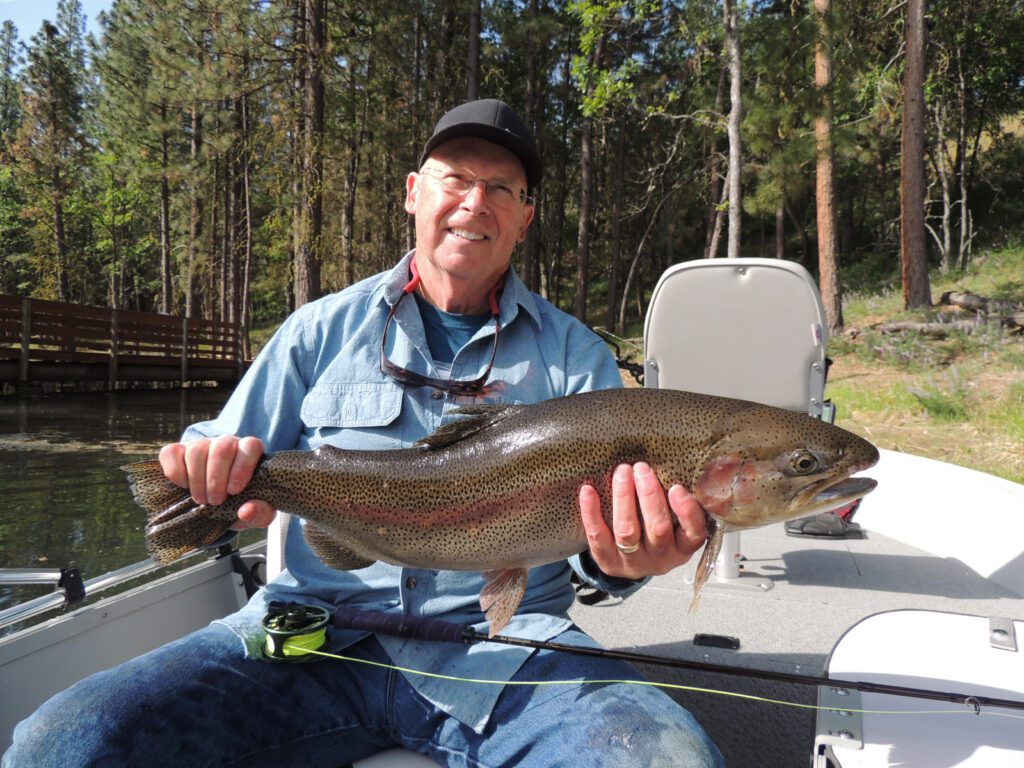
Instead, when planning a road trip for rainbows, tow the boat to places like Pine Hollow Reservoir (call the resort to check the ice), Lake Simtustus, Willow Creek Reservoir (Heppner), Lost Creek Reservoir (east of Shady Cove) and Dexter Reservoir along Highway 58.
In the winter, trout seek shallow water because the shallows warm first, which promotes weed growth which in turn promotes the insect activity that draws in little fish. Larger trout feed on the minnows, crustaceans and insects.
While shallow water offers better feed options, they are also a danger zone where larger trout may be taken by ospreys. Trout tend to rest and rove along the ledges where the light green shallows give way to deep blue depths. Rocky points, submerged rim rocks and even - in bigger reservoirs - flooded road and railroad beds also offer the kind of habitats where big trout like to hunt.
For the fly angler, a slow-sinking line is the best option because trout may be closer to the surface. Optimal trolling speed in most cases will be between .8 and 1.2 miles per hour, about the speed of a slow walk. Establish a trolling circuit to follow a contour line or to hit the rocky points. Feed out 30 to 50 feet of line behind the boat.
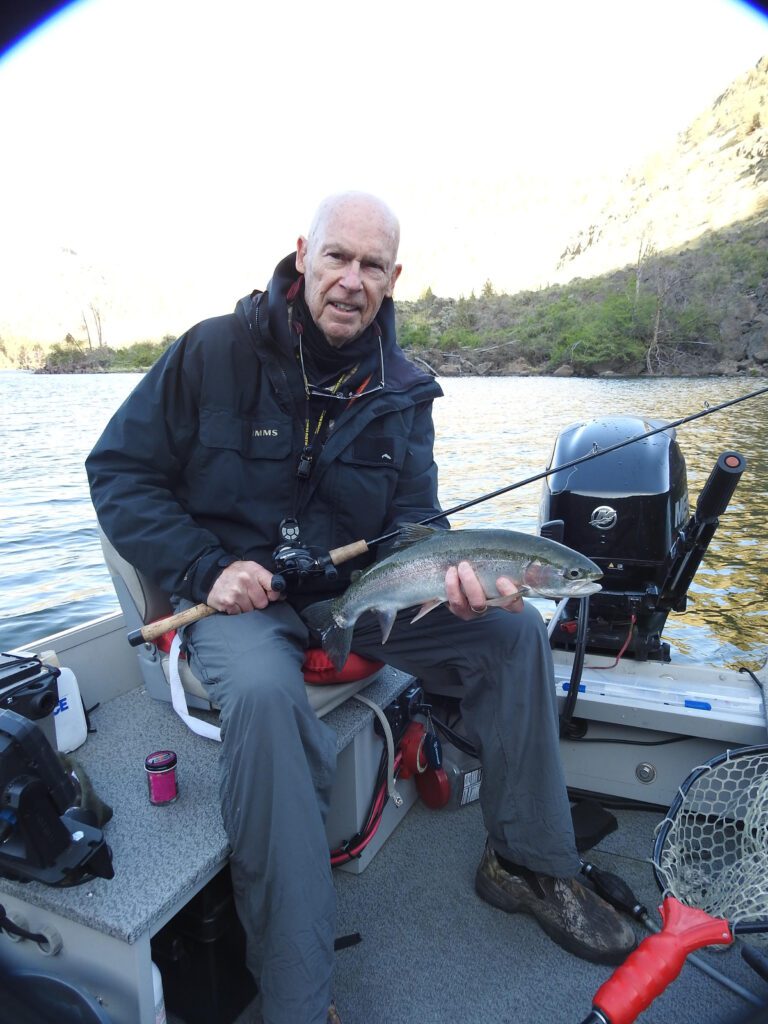
Vary the trolling speed and change direction by zigzags over the trolling circuit which changes the action of the flies. A lot of strikes come on the deceleration or on the outside of a turn.
Rods can be kept in rod holders, but strikes are often missed on fly gear because of the shock-absorbent nature of the line. Hold the rod in hand, the tip near horizontal. If a fish bites, lift the rod and set the hook with a quick strip of line.
A slower initial speed allows lines and flies to sink. Watch the amount of drop, the angle of the line and length. The boat operator can control depth by adjusting speed and lengthening or shortening the lines.
Watch the weather for the days between storm fronts when temps come up and the wind is light. Like grandpa told me, trout and salmon bite ahead of a storm front, and again after a low pressure system.
Late last winter we fished Lake Simtustus. Dad caught a fish on the first pass and then Randy and I doubled up when two trout grabbed on a turn - nice fat rainbows that had fed well over the winter. Then we could not get another bite. Looking at the solunar tables now, I see we fished two hours too late, but still it was better than a day at the office.
The Old Farmer's Almanac says the best days to fish are when the moon is between New and Full. That means we want to fish March 10 to March 24 and then starting again April 8.
My grandpa used to watch the barometer and tell me when the fishing was going to be fair. He would say something like, "When the barometer is below twenty-nine-point-seven, the fishing won't bite as good. What you want to see is when the barometer is low and rising." Then grandpa would say, "But it's always a good day to go fishing."
People have been studying this subject for millennia. We don't need a new brother-in-law, but we ought to remember the factors our grandfathers employed to forecast the fishing.
# # #
For a copy of the Fishing Central Oregon book, send $29.99 to Gary Lewis Outdoors, PO Box 1364, Bend, OR 97709 To contact Gary Lewis, visit www.GaryLewisOutdoors.com
/articles/forecast-fishing-late-winter-rainbows
Looking Ahead to March Fishing
It’s hard to think of fishing for most of looking at iced in boat ramps and/or iced over lakes but the ice will likely thaw by the beginning of March and you’ll have some great opportunities for fishing when it does. Looking for some early-season trout and walleye ideas? Here’s a few for you:
LATE WINTER WALLEYE:
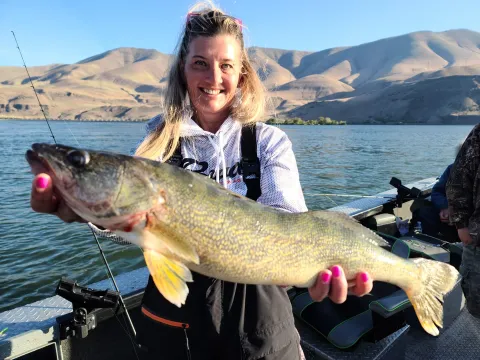
The Columbia River is the place to be in March for walleye as the big females get ready to spawn. In fact, this is the time of year to land a true trophy walleye. Traditionally, the bigger females have been targeted near the Tri-Cities but quality walleye can be found in The Dalles and John Day pools as well the Upper Columbia near Hydro Park in East Wenatchee, and in Rufus Woods Reservoir as well as the upper end of Lake Roosevelt.
When it comes to catching March walleye, try trolling a small spinner worm harness like a Mack’s Lure Slow Death Rig at a very slow speed (around 1 to 1.2 MPH). Once you find a school of fish you can jig for them. In addition to jigging for walleye with soft plastics on jig heads, you can also use metal blade baits or vertical jigs like a Mack’s Sonic Baitfish.
QUINCY LAKES TROUT FISHING:
The Quincy Lakes trout opener on March 1st is either a boom or a bust depending on the amount of ice remaining on this chain of lakes between Quincy and George which lie in a sizeable state wildlife area. The most popular lakes to fish are Quincy and Burke Lakes, which are both well-stocked with rainbow trout. There are also several small walk-in lakes southwest of these bodies of water that are stocked with smaller numbers of trout but which receive less pressure.
The opener often finds crowds of both day-anglers and overnight campers congregated close to the shore of the main two trout lakes, many of them in a festive mood, especially when early spring weather and sunshine is present. That isn’t always the case though, The Quincy Valley Chamber of Commerce, which has hosted an annual trout fishing derby with prizes for kids and adults in the first half of March, is hedging their bets this year (as to whether the lakes will be ice-free) and will wait until March 22nd and 23rd to hold their event at Burke and Quincy Lakes.
TUCANNON LAKES TROUT:
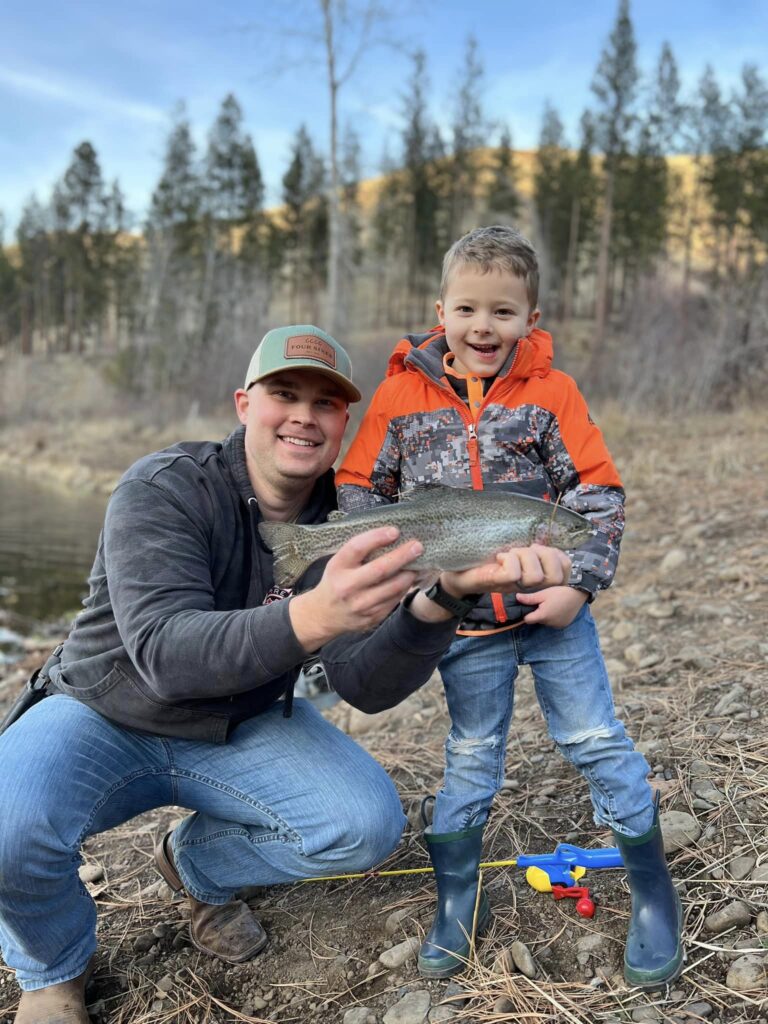
The Tucannon Lakes, nestled in the W.T. Wooten Wildlife Area and the Blue Mountains of Southeastern Washington, offer another March destination. Speaking with Kim Andersen at The Last RV Resort (the closest resort to these lakes), I learned two small lakes (Blue and Spring) are open all year and have historically received plants of 24,000 and 15,000 trout respectively.
Four additional lakes open on March 1st (Deer, Watson, Rainbow, and Big Four), though Anderson says since the area flooded a few years ago, Big Four Lake doesn’t really exist as such and should not be considered as a viable option. Asked which lakes fish best in early March, Anderson said Spring, Deer, Rainbow, and Watson Lakes all fish well when ice-free.
The Last RV Resort near Pomeroy has cabins, RV, and tent sites available along with a coffee bar. Anderson says they still have openings available for the popular March 1st opening day of trout fishing. www.thelastresortrv.com
LAKE LENORE TROUT:
If you are looking for some big trout to catch and release, consider a trip to the Columbia Basin north of Soap Lake and cast a line into Lake Lenore. You’ll find Lahontan cutthroat trout here, a species native to Nevada that was stocked in this very alkaline lake decades ago by WDFW. The trout commonly weigh two to three pounds but five to six-pound fish are not uncommon and there’s always the possibility of landing a ten-pound trout.
This was a very popular spring fishery in the 1990’s and early years of the 21st Century. Unfortunately, poaching efforts knocked down this fishery. Why anyone would want to take home fish that likely taste like soap, I do not know but enough people did that the fishing suffered.
Fortunately, the fish population has rebounded but despite that, the word hasn’t gotten out to most anglers and this place fishes under the radar. It is a selective fishery lake, where only single barbless hooks are allowed. If you are in a boat, you can only use an electric motor and your fishing net has to be knotless.
If you do decide to take a fish home you only get to take one and it must measure at least 18 inches long. There is plentiful shoreline access along the east side and at the north end of the lake though there are a couple of areas closed (marked by signage) by the inlet stream and irrigation pumping station towards the upper end.
Lake Lenore is a wonderful place to fish. The scenery of sagebrush and basalt cliffs is pleasant and the chorus of geese, ducks, chukar, and other wildlife add to the experience. The best times to fish Lake Lenore are in the spring (March and April) and again in the fall (late September through November).
In the spring, most of the trout are found at the northern end of the lake, cruising the shoreline in depths as shallow as three feet as they prepare to spawn. Fly fishing anglers target them from shore or float tubes and pontoon boats. The “go to” offering is a small black chironomid, fished under a strike indicator, in sizes 12 to 20.
Hardware anglers have success as well. You can use a spinner but you’ll likely be frustrated by all the grass floating in the water which limits the effectiveness of the spin itself. Instead, consider using a spoon. I’ve had good luck with Luhr Jensen Krocodile lures in 1/8th to ¼ ounce size. Hammered brass and orange as well as a frog-colored pattern have both worked well for me.
In the fall, the fish will be found further to the south, especially around the islands in the lake and casting or trolling for them from the boat can net you and your partner up to 35 fish a day if fortune smiles upon you. We’ll save that fall conversation for later though, because right now, it’s March and we’ve got fish to catch!
John Kruse – www.northwesternoutdoors.com and www.americaoutdoorsradio.com
/articles/looking-ahead-march-fishing
October Trout
By Jason Brooks
Every April, trout anglers get excited for the general lowland lakes opener: a day steeped in tradition, with tackle shops catering to the angler with spring sales, campgrounds hanging “welcome fishermen” banners, and families making long distance trips in the R.V. to their favorite lake.
State fisheries departments also get into the act by stocking the lakes full of “catchable” sized trout that are eager to bite. But by mid-summer, those same lakes are full of water skiers, swimmers, pleasure boats, and pure chaos on the weekends.
No wonder why trout anglers move away from these lakes during the hot months, but why do anglers forgo returning to the lakes once the summer tourists are gone? There is no need to wait until next spring for some good fishing, but don’t wait too long, as most of these lakes will close at the end of the month.
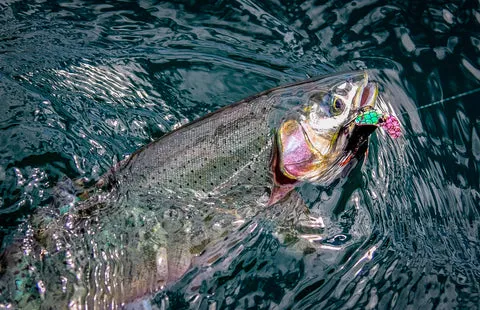
Those planter trout have put on some weight and learned to eat natural food sources. Instead of little “stocker” fish, the trout are now more like their native cousins: eager to bite, putting up a way better fight, and more likely to survive if you choose to do some catch and release fishing.
Trout will have also dispersed throughout the lake and lurk in places where they can feed and stay away from predators. Much like native fish, the planted trout now cruise the shoreline looking for bugs, or head to the deeper water during the day, only to come to the surface at last light when a hatch occurs and the fish rise.
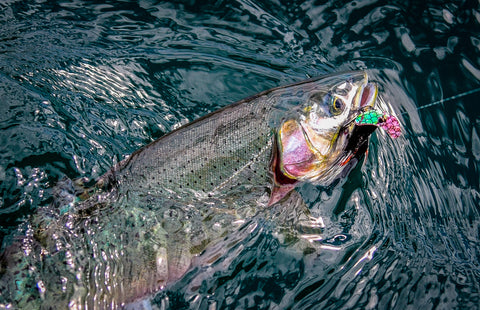
Since the fish are no longer hanging out near the surface or the stocking area, you might find it a bit harder to catch them. In reality, it is still easy to get them to bite, you just need to find where they are so you can offer them something they want to eat or attack.
Trolling is your best bet but it doesn’t have to involve downriggers, sonar units, GPS plotters, or other “high tech” accessories like those that are used out salmon fishing in the ocean. The key to finding the fish is to remember that trout are affected by the water temperature, and our warm fall days followed by cool nights varies the water temperature more so than in the summer.
It is much like the spring when the same conditions are occurring. In the early morning and evening hours the fish will still be up towards the surface, both for bug activity as well as warmer water temperature.
As the bright sunlight of the mid-day sun hits the surface, the fish will go a little bit deeper, to get away from predators as well as stay in a moderate temperature. If you do have a sonar unit that can show you the thermocline, then use this for the mid-day fishing and concentrate on that depth.
Trolling is one of the most productive ways to find fish in a lake. A basic trolling set-up is a 3 or 4 blade “Flash Lite’s” gang troll by Mack’s Lure trailed by a Double Whammy Smile Blade Wedding Ring Spinner, tipped with a piece of worm.
Put a ½ ounce or a 1-ounce banana weight sinker in front and slowly troll along until you get bit. Another set-up is to use the free slider by Yakima Bait Company, but modify it a bit by adding a small pinch release to the front of the slider and attach a one-ounce cannonball weight.
From the mainline, tie a leader trailing behind a swivel. A black, brown, or olive-green Rooster Tail spinner, a wooly bugger fly, or a even a Mack’s Lure Smile Blade Fly is great for this set-up. Let the line out about twenty feet while holding onto the slider.
Use the pinch release to secure the slider on the mainline, and then drop it to your desired depth. This allows you to fish a small lure or fly with a weight to get it down to your desired depth, but the weight won’t affect or scare off the fish.
When a fish gets hooked, a small yank on the mainline will cause it to come free of the pinch release, and now you are fighting the fish with the slider back in its original free-sliding condition. Buzz Ramsey taught me this trick while out spring chinook fishing a few years ago and it works great for trout and kokanee anglers who don’t have downriggers.
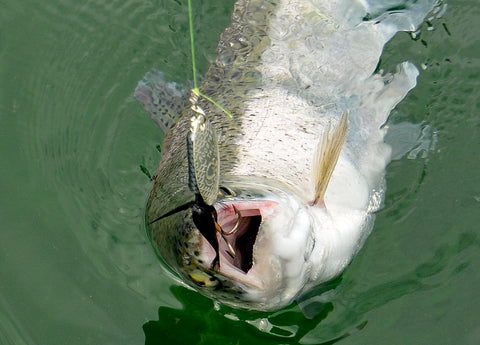
Now that you found the fish, it is important to concentrate on that part of the lake. Circle back around and keep trolling in the same area. Making a figure eight pattern also keeps you on the fish. Watch the clock though, as once the bite “turns off” it could be something as simple as the fish moving depths due to the sun or water temperature.
Bait anglers also do well, but unlike in the opening week of the spring season, the fish are not all congregated around the stocking area. Since they are spread out a little bit, don’t expect a “hot bite” to occur. One of the best things you can do if you prefer to use bait is to increase your leader length to at least 48 inches.
This is because the weeds have had all summer to grow and you need that bait to get above them. Another option is to use a slip-bobber. This allows you to adjust the depth of your bait. Make sure to put a weight below the hooks if you are using a floating bait such as Power bait.
Using scents is probably the most under-utilized techniques for trout anglers. Those that fish for steelhead use scents all the time but we tend to forget that a steelhead and a rainbow trout are the same fish.
By using scent, you can attract the fish to you as well as cover up unwanted scents that you transferred to your bait or lures that are undesirable to fish. Just like in winter steelhead fishing, some of the same popular scents work for fall trout fishing. When fishing lures, it is best to use “sauces” or gels as they tend to stick on the metal or plastic much better and you don’t need to reapply as often.
Bait oils are a good “all-around” and can be used on baits, lures, and some flies. If you are using a delicate fly, such as a wooly bugger that has a marabou tail or a hackle, then make sure to use the water-soluble oils so they don’t ruin the fly or its action. Popular scents that are extremely productive are Pro-Cure’s Bloody Tuna, Trophy Trout, Sweet Corn, and Nightcrawler.
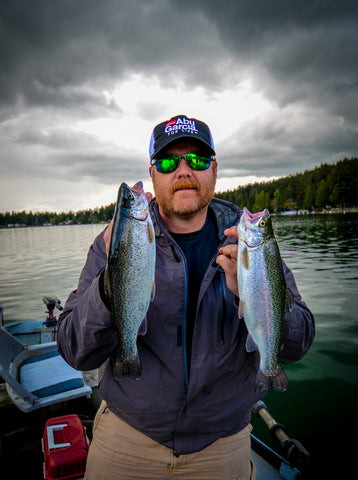
Fly anglers know that the fall is a prime time to head to a lake. Trout are used to eating aquatic insects and have adjusted their feeding from the hatchery pellets rained down from heaven to the various insects in the lake, as well as those flying above.
For early mornings, try a moderate to slow sinking line and fish wet flies. Small streamers, leeches, and wooly buggers are fun to strip in but the chironomids, pheasant tail nymphs, and hare’s ears can be more productive.
Mid-day, the air temperature warms up, and a daily dry fly hatch occurs. Most of the bugs are small, so try a mosquito, Adams, and duns, but be on the look-out for a few damselflies and be ready to switch out to them for an exciting fishery when the hatch occurs.
Work the cover near any edges or cattails with a grasshopper or madam-x for larger trout.
One of the greatest things about October trout fishing is the lack of other anglers on the water. Our days can be very pleasant with mild temperatures. There is no need to rush to the boat ramp, and even the summertime jet-skiers and pleasure boats are gone.
The trout are still there and since they have had several months in the lake to change their diet, you will notice they taste much better. The fish are bigger and tend to bite better when it comes to fly-fishing.
So, if you prefer to use a fly rod, then grab your float tube or small car-topper boat, and head to a local lake. We only have until the end of the month for some of the best local lakes fishing.
/articles/october-trout