Worms, Worms, and More Worms by Mike Carey
Worms – it’s what’s for dinner. If you’re a walleye, that is. Ever since the invention of cane poles, worms have been considered one of the go-to baits for a shore angler. They are portable, easy to obtain, and fish love them. Most of us likely have early childhood memories of going fishing with our Zebco reel, the one that always seemed to get tangled up. A hook, a worm, a couple of split shots, and a round red and white bobber were all that were needed for a day’s adventure at the local pond.
Back in my youth (and that’s a long way back), the nightcrawler was the king of bait. We didn’t buy them, though; we caught them. After planning a fishing trip for the next day, we would wait for darkness to descend. As the streetlights came on, my brothers and I knew it was time to go worm catching! Into the backyard we would go, flashlights in hand. Because, like vampires, nightcrawlers only came out at night. For some reason, I never asked my dad why that was so; I just figured that’s what they did.
Our backyard had a nice-sized garden and several pine trees, and lots of nightcrawlers. There was a trick to catching crawlers that only boys could appreciate. Walking slowly along, guided by our flashlights, we would come upon a big, plump crawler, poking out of its hole, stretched out in the dirt and grass. The next steps at this point were critical. Nightcrawlers don’t like light, so it was vital to move the flashlight beam away from the crawler but still shining enough to be able to see him/her (worms are asexual, a fact we did learn with keen interest). The trick was to hold the flashlight with one hand and slowly reach down with the other to grab said crawler.
Most importantly, you had to grab the crawler at the point where he was coming out of his hole because the instant your fingers touched that crawler, he was crawling back down. As we got good at catching crawlers, it was a matter of gently pulling the frantic worm away from Mother Earth and into our waiting bucket. Now, sometimes the worm would win, and sometimes we would come away with half a crawler, which I guess was a draw, but I never did catch any half-broken worms. We did, however, come across two crawlers in a romantic embrace. If you got both, that was bragging rights for best crawler catcher.
At the ripe age of 67, I have no interest in staying up after dark to catch nightcrawlers that I can easily buy. My sleep time is well worth the $3.50 for a dozen crawlers at the local bait shop. That said, I hate wasting bait. If I come home with nightcrawlers left, I put them in the fridge for another day. Sometimes they last, sometimes they don’t.
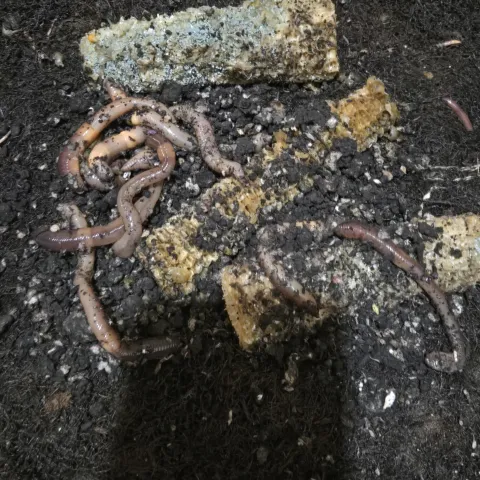
Last fall, I started a new hobby, which solved the dying crawler dilemma. Worm composting! Yes, you can have your bait and save it too.
Now I want to say here and now that I did not stumble on this new adventure for any “green” purposes. That said, I am happy to see that a byproduct of worm composting is some highly nutritious soil/fluids for my garden.
More importantly, I can bring home my unused nightcrawlers and add them to my bin of little friends. Now I always have “worms to go” if I want to go after some walleyes (or catfish). No more wasted nightcrawlers, and bait is always available.
Worm composting is quite easy, and there is a wealth of information on the web and YouTube. You can use very simple setups or spend a lot of money on them. I decided to start with a four-tray system and 100 European Red Wigglers, “starter worms”. These worms are not the larger nightcrawlers anglers are familiar with. They are smaller, perfect for panfish. They are also eating machines, turning fruit and vegetable scraps into nutrient-rich compost and “worm juice,” which will go into my garden this spring. As a bonus, these worms will rapidly reproduce to the capacity of your system, but no more. So, in addition to worm compost for the garden, I will also have excess worms that I can add to my garden to further increase my vegetable yields.
“What about those nightcrawlers?” you ask. To be specific, what you are buying for bait are Canadian Nightcrawlers. With the rich environment the Red Wiggler worms produce, the nightcrawlers I come back with after a fishing trip have a new home to live in until the next time they join me for a trip on the water. The two types of worms do fine together, and my nightcrawlers stay healthy and get even bigger and plumper than when I bought them. Unfortunately, Canadian nightcrawlers are not fast reproducers, and I do end up buying more crawlers, but I no longer toss my remaining bait in the water at the end of a fishing day. Instead, they return home with me to fish another day.
If this sounds like something you’d like to try, there is a wealth of information online and on YouTube that will tell you everything you need to get started. Depending on how fancy you want to proceed, you can go from very inexpensive DIY projects to spending a couple of hundred dollars for everything. Amazon has all types of composting/worm bins for sale. An excellent resource I found to purchase worms and learn more about this fun hobby is Uncle Jim’s Worm Farm.
Raising worms is fun! It’s educational! And it might just get you “hooked” as it did me.

/articles/worms-worms-and-more-worms-mike-carey
October Trout
By Jason Brooks
Every April, trout anglers get excited for the general lowland lakes opener: a day steeped in tradition, with tackle shops catering to the angler with spring sales, campgrounds hanging “welcome fishermen” banners, and families making long distance trips in the R.V. to their favorite lake.
State fisheries departments also get into the act by stocking the lakes full of “catchable” sized trout that are eager to bite. But by mid-summer, those same lakes are full of water skiers, swimmers, pleasure boats, and pure chaos on the weekends.
No wonder why trout anglers move away from these lakes during the hot months, but why do anglers forgo returning to the lakes once the summer tourists are gone? There is no need to wait until next spring for some good fishing, but don’t wait too long, as most of these lakes will close at the end of the month.
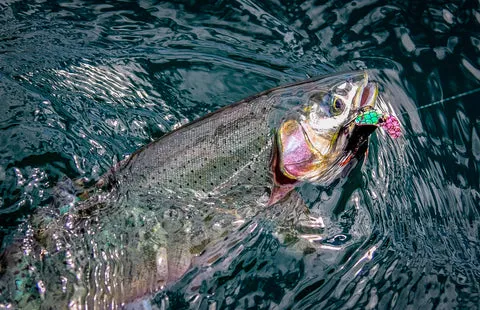
Those planter trout have put on some weight and learned to eat natural food sources. Instead of little “stocker” fish, the trout are now more like their native cousins: eager to bite, putting up a way better fight, and more likely to survive if you choose to do some catch and release fishing.
Trout will have also dispersed throughout the lake and lurk in places where they can feed and stay away from predators. Much like native fish, the planted trout now cruise the shoreline looking for bugs, or head to the deeper water during the day, only to come to the surface at last light when a hatch occurs and the fish rise.
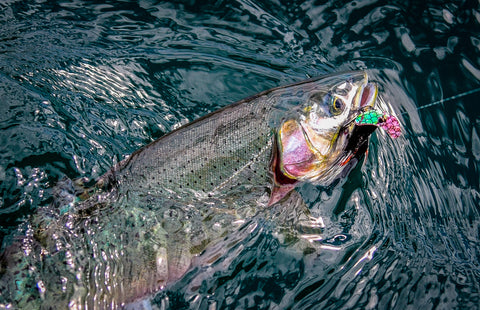
Since the fish are no longer hanging out near the surface or the stocking area, you might find it a bit harder to catch them. In reality, it is still easy to get them to bite, you just need to find where they are so you can offer them something they want to eat or attack.
Trolling is your best bet but it doesn’t have to involve downriggers, sonar units, GPS plotters, or other “high tech” accessories like those that are used out salmon fishing in the ocean. The key to finding the fish is to remember that trout are affected by the water temperature, and our warm fall days followed by cool nights varies the water temperature more so than in the summer.
It is much like the spring when the same conditions are occurring. In the early morning and evening hours the fish will still be up towards the surface, both for bug activity as well as warmer water temperature.
As the bright sunlight of the mid-day sun hits the surface, the fish will go a little bit deeper, to get away from predators as well as stay in a moderate temperature. If you do have a sonar unit that can show you the thermocline, then use this for the mid-day fishing and concentrate on that depth.
Trolling is one of the most productive ways to find fish in a lake. A basic trolling set-up is a 3 or 4 blade “Flash Lite’s” gang troll by Mack’s Lure trailed by a Double Whammy Smile Blade Wedding Ring Spinner, tipped with a piece of worm.
Put a ½ ounce or a 1-ounce banana weight sinker in front and slowly troll along until you get bit. Another set-up is to use the free slider by Yakima Bait Company, but modify it a bit by adding a small pinch release to the front of the slider and attach a one-ounce cannonball weight.
From the mainline, tie a leader trailing behind a swivel. A black, brown, or olive-green Rooster Tail spinner, a wooly bugger fly, or a even a Mack’s Lure Smile Blade Fly is great for this set-up. Let the line out about twenty feet while holding onto the slider.
Use the pinch release to secure the slider on the mainline, and then drop it to your desired depth. This allows you to fish a small lure or fly with a weight to get it down to your desired depth, but the weight won’t affect or scare off the fish.
When a fish gets hooked, a small yank on the mainline will cause it to come free of the pinch release, and now you are fighting the fish with the slider back in its original free-sliding condition. Buzz Ramsey taught me this trick while out spring chinook fishing a few years ago and it works great for trout and kokanee anglers who don’t have downriggers.
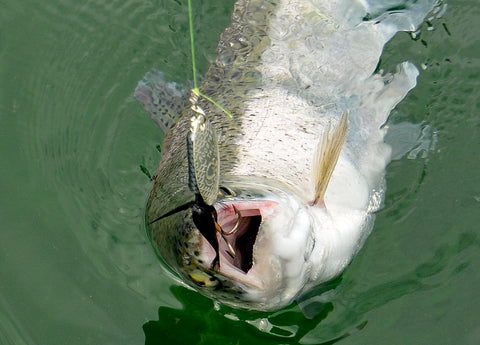
Now that you found the fish, it is important to concentrate on that part of the lake. Circle back around and keep trolling in the same area. Making a figure eight pattern also keeps you on the fish. Watch the clock though, as once the bite “turns off” it could be something as simple as the fish moving depths due to the sun or water temperature.
Bait anglers also do well, but unlike in the opening week of the spring season, the fish are not all congregated around the stocking area. Since they are spread out a little bit, don’t expect a “hot bite” to occur. One of the best things you can do if you prefer to use bait is to increase your leader length to at least 48 inches.
This is because the weeds have had all summer to grow and you need that bait to get above them. Another option is to use a slip-bobber. This allows you to adjust the depth of your bait. Make sure to put a weight below the hooks if you are using a floating bait such as Power bait.
Using scents is probably the most under-utilized techniques for trout anglers. Those that fish for steelhead use scents all the time but we tend to forget that a steelhead and a rainbow trout are the same fish.
By using scent, you can attract the fish to you as well as cover up unwanted scents that you transferred to your bait or lures that are undesirable to fish. Just like in winter steelhead fishing, some of the same popular scents work for fall trout fishing. When fishing lures, it is best to use “sauces” or gels as they tend to stick on the metal or plastic much better and you don’t need to reapply as often.
Bait oils are a good “all-around” and can be used on baits, lures, and some flies. If you are using a delicate fly, such as a wooly bugger that has a marabou tail or a hackle, then make sure to use the water-soluble oils so they don’t ruin the fly or its action. Popular scents that are extremely productive are Pro-Cure’s Bloody Tuna, Trophy Trout, Sweet Corn, and Nightcrawler.
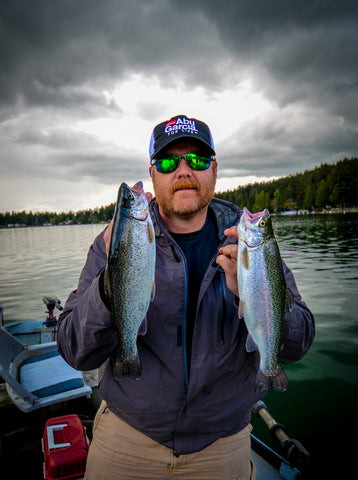
Fly anglers know that the fall is a prime time to head to a lake. Trout are used to eating aquatic insects and have adjusted their feeding from the hatchery pellets rained down from heaven to the various insects in the lake, as well as those flying above.
For early mornings, try a moderate to slow sinking line and fish wet flies. Small streamers, leeches, and wooly buggers are fun to strip in but the chironomids, pheasant tail nymphs, and hare’s ears can be more productive.
Mid-day, the air temperature warms up, and a daily dry fly hatch occurs. Most of the bugs are small, so try a mosquito, Adams, and duns, but be on the look-out for a few damselflies and be ready to switch out to them for an exciting fishery when the hatch occurs.
Work the cover near any edges or cattails with a grasshopper or madam-x for larger trout.
One of the greatest things about October trout fishing is the lack of other anglers on the water. Our days can be very pleasant with mild temperatures. There is no need to rush to the boat ramp, and even the summertime jet-skiers and pleasure boats are gone.
The trout are still there and since they have had several months in the lake to change their diet, you will notice they taste much better. The fish are bigger and tend to bite better when it comes to fly-fishing.
So, if you prefer to use a fly rod, then grab your float tube or small car-topper boat, and head to a local lake. We only have until the end of the month for some of the best local lakes fishing.
/articles/october-trout