Nymphing for Trout
Chad Bryson
In the glamorously romanticized world of social media, there is nothing short of a plethora of fly fishing techniques and methodology. So many opinions, and it seems that everyone thinks they are right. Even though I am never one to be short on opinion, I prefer to stick to facts and truth. That’s where I try to form my opinion.
Watching Fish
Fact- every single person that is an angler loves to watch a fish of any species come to the surface to eat something presented to them. The surface bite is a visual interaction we as humans get to experience with an animal that we would hardly ever see otherwise. It’s cool beyond belief. Truth- that bite doesn’t happen every day. It doesn’t even happen every month.
Okay, sure, if you have your own jet with an unlimited amount of expendable income, you can travel all over four continents and two hemispheres chasing every bug hatch or mouse migration known to man to satisfy your craving for surface action. If you are that person, I want you to know that I am interviewing for new friends, and you could just be a candidate.
However, if you are like the rest of us who can't afford the financial commitment of owning our own jet, you are probably trying to enjoy the fishing that’s close to home and might be wondering what all the complicated fuss is about. I’m going to simplify it.
Fly Fishing
Fly fishing for trout is broken down into basically three methods - streamer fishing, nymph fishing and dry fly fishing. Dry fly fishing is by far the most celebrated and commonly recognizable. It’s the gentleman’s preferred fishing method. Streamer fishing is regarded as a viable means of catching but, like dry fly fishing, isn't always the most productive.
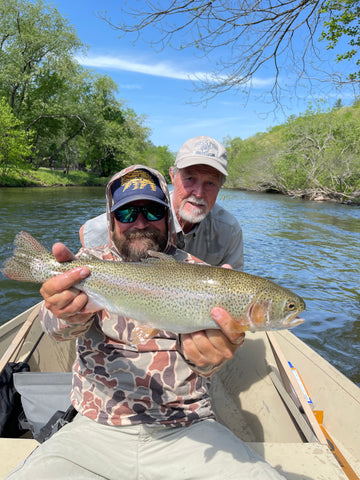
Then there is nymph fishing bringing up the rear in open popularity. I call it open popularity only because you never hear guys in a fly shop talking about how awesome the nymph bite was the past weekend that they went fishing. Everyone just wants to discuss how many bugs hatched or how many trout chased a streamer. Nymphing for trout is easily the most effective way to catch them, but this technique is often only regarded as a last-ditch effort to save a day of fishing.
Why
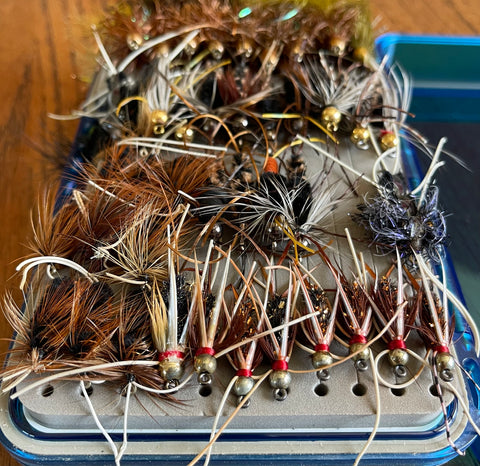
The most important question to answer is: why? Why is nymphing for trout the most productive way to catch them? First, let’s identify what a nymph is. A nymph is the juvenile form of aquatic insect that is born below the river’s surface and makes its way to the surface either by crawling or swimming so that it may hatch into an adult and fly away.
Once the nymph reaches the water’s surface and begins to shed its exoskeleton, it is at the mercy of wind, rain or anything above the surface that could potentially keep it from flying away. Hence, keeping a trout from being able to eat it from the surface like so many of us want. Every river, creek, and waterway anywhere that holds trout will have aquatic insects of some species. In that watershed is the nymph form of that aquatic insect.
They live there 24/7, 52 weeks a year beneath rocks, logs, stumps, and anything else that could be considered hold area. Nymphs are always in the river for trout to feed on. Every single day. They may not always be hatching, swimming or crawling, but no doubt, nymphs are around, and they comprise 90% of a trout’s diet. We just rarely see them eat one because it’s all done subsurface.
Nymphs
Fact- nymphs are 90% of a trout’s primary diet because it is a food source that is the most readily available in every creek, river, and water shed that holds trout. Also, a trout doesn’t have to expose itself to the surface to eat a nymph like it does a dry fly. It can remain relatively hidden from predators while feeding on nymphs. Imagine you are sitting on your couch watching baseball. You get hungry and need a snack.
Next to the couch within arm’s reach is a bag of beef jerky and a sack of Doritos. Cool Ranch Doritos at that. Now you could just sit there comfortably and feast on those Doritos and beef jerky until your heart’s content, or you could get up and go to the kitchen and make yourself some proper food such as a ribeye steak. Even though the ribeye steak sounds really good, it’s gonna take some time to prepare and cook.
You also run the risk of being caught away from your safety zone of anonymity. If you are in the kitchen, the dog is gonna see you and demand attention. Your wife or husband may realize that you are mobile instead of semi-comatose on the couch. God forbid you may have to fix a ribeye for them too. Next thing you know, the baseball game is over, and you are doing the dishes. Truth- dry flies are ribeye steaks while Doritos and beef jerky are nymphs.
Bobbers vs Strike Indicators
No discussion about nymph fishing for trout would be complete without the controversial subject of bobbers vs strike indicators. In the world of fly fishing, someone that wanted to make themselves dissimilar from gear fishermen decided to call the thing we use to make the flies float at a specific depth below the surface a “strike indicator”.
I suppose that is a more refined and highbrowed form of language that some fly anglers are known to have. My opinion is quite simple. If it floats and is made of a synthetic material such as foam or plastic, it’s a bobber. If it floats and is made of natural material, such as wool, it’s an indicator. Trust me when I say that both have their place in the game. Just call it what it is.
High Sticked
I learned to fly fish before the invention of indicators and bobbers. We “high sticked” when nymph fishing. This was basically using a rod that was about a foot longer than the rod I used for dry flies paired with a little stronger leader and a heavy nymph at the end of it. The idea was to “roll” the nymph along the bottom of the riverbed imitating a nymph that had been dislodged from its safety zone.
As long as the line was tight, you could feel the trout take. I caught so many big trout using this method, my grandfather finally limited me to using it only on rainy days. “Just to keep things even”, he said. If you can learn to highstick nymph, it will crush fish. Just don’t confuse it with this new thing the kids are doing called euro nymphing, that’s not fly fishing. Any good fly-fishing guide will agree with me.
So, watch a YouTube video about high stick nymphing, hire a guide, and find out what a trout eats 90% of the time. Don’t forget the Doritos and beef jerky.
/articles/nymphing-trout
Bull Trout in the Metolius
With the water swirling around us, we waded in at the mouth of Jack Creek. Skip Morris had hooked and lost a big rainbow here the day before. Today he stood back while Carol plumbed the two-foot deep run with a big stonefly nymph trailing a small beadhead attractor, called Gabriel's Trumpet.
For a moment we thought Carol's rig was hung up, but when she tightened the line, a fish torpedoed away. The fish rolled mid-river and I saw his tail and dark fins silhouetted against bright water: a bull trout. Close to eight pounds, I guessed. The line broke and Carol reeled in the slack. The fish had taken the big stonefly nymph after a 13-minute battle and a last headlong flight.
That’s what can happen when kokanee are on the move and bull trout follow them into the shallows.
LAKE RUN BULL TROUT
Kokanee are thickest in the Metolius in late September and October. And the biggest bull trout, which can get to 30 inches or more, hammer them. Bull trout are meat eaters and if it's a third of their size they will crunch it. If it's half their size, they will try to choke it down anyway. Anyone who has caught a bunch of big bull trout has seen the tail end of a kokanee or a whitefish sticking out of that gullet.
The Metolius River and Lake Billy Chinook are home to resident and migratory bull trout. The bulls move up the river to spawn in late August, September, and October. Oriented to ice-cold water, bull trout stage near springs and off the mouths of major tributaries like Canyon Creek and Jack Creek. After the spawn, they need to replace the calories they expended over the last few weeks. That’s when they find the kokanee.
The kokanee spawn puts both species in the river at the same time. And the bull trout are the winners. Preoccupied, the landlocked salmon are easy prey for sharp-toothed bull trout. Whitefish are on the menu for bull trout year-round, and many are the stories of anglers fighting whitefish only to lose them to bull trout which charge out from under a log to grab the hapless poor man's bonefish.
Bull trout are apt to eat the limp, the lame, the lazy. It’s the erratic behavior that trips the predatory sear in a bull trout's brain. Think strike triggers. Tie or buy streamers with big eyes, a flash of blood red near the gills. On the water, fish them on the wet fly swing, but give them action. Make the imitation twitch. Like a wounded fish in deep trouble.
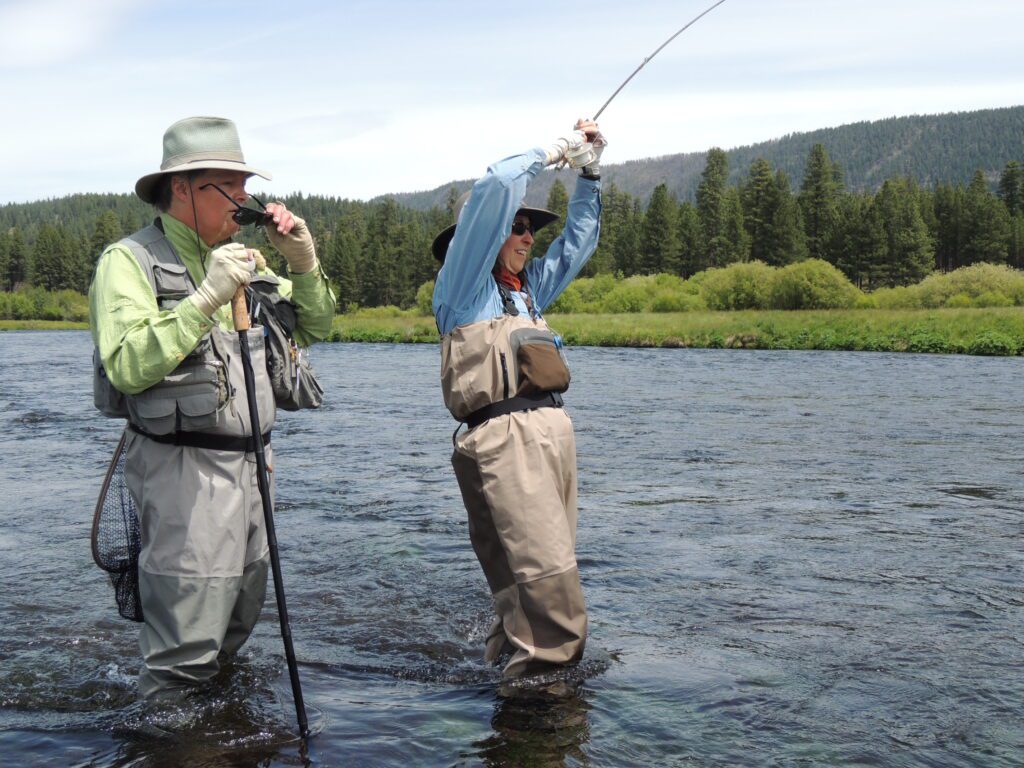
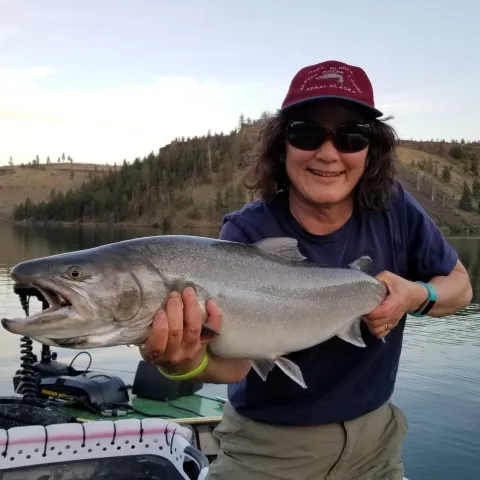
Carol Ann Morris fights a bull trout on the Metolius. Photo by Gary Lewis
FISHING LAKE BILLY CHINOOK
A down-running Metolius River bull trout ends up running into Round Butte Dam and turning around to make its living in a 4,000-acre reservoir fed by three rivers: the Metolius, the Deschutes and the Crooked River. Best time to target bull trout in Lake Billy Chinook is when the waters begin to warm in March and April. Bull trout hunt close to shore in the late winter and early spring. Anglers who throw Zonkers and other minnow imitations on long casts and strip hard can elicit hard strikes from fish. It's one of the best ways to get the biggest bull trout. A lot of 17- to 19-inchers will be brought to the net as well as the occasional 10-pounder.
SWINGING STREAMERS
When whitefish are schooled up, working the bottom, they are hard for bull trout to feed on, but when one of them leaves formation and streaks up to eat a mayfly emerger, its defenses are down and its easy money for bull trout.
When fishing a small streamer or a larger bunny leech, try to work it like a fish that is out of its element, a scared minnow that thought it could play in the deep end of the pool. It's vulnerable. It's lunch.
A variation on that theme is the sculpin. Bull trout eat sculpin year-round. In the river, they eat sculpin. In the lake - sculpin. When sculpin are doing what they do, daubing in the mud, they are pretty safe. But when they climb up through the water column or get caught in the current, something is going to nail them. Big lead eyes, blood-red gill flare or Flashabou, and prominent fins are some of the strike triggers to play on when tying sculpin flies.
Cast down and cross-current, let it swing and chug it. On long runs and into the tailout, let the sculpin work back and forth. Tied small, a sculpin imitation can be fished with a slackline presentation that keeps it working back and forth over bull trout holding water.
Think big. If a 30-inch bull can choke down a 12-inch whitefish, it will go for a 10-inch streamer. Big bunny leeches double as flesh flies. Just change the presentation.
DREDGING WITH A TWO-FLY RIG
As kokanee carcasses and decaying flesh become harder to find, bull trout begin to focus on bugs. Streamers and flesh flies can provoke a grab, but a dead-drifted nymph can pay off as well. To conserve strength, the biggest fish claim the best lies, hugging the bottom along downed timber and behind rock slabs and boulders. The major difference between drifting beadhead nymphs for rainbows and for bull trout is the length of the leader and the tightness of the presentation to the bottom. Fish the bottom. Keep the leader short so the dropper fly doesn't ride too high in the water column.
Tie on a big, heavy stonefly nymph and knot eight to ten inches of fluorocarbon tippet material to the bend of the hook. The primary fly can be a Flashback Pheasant Tail, an egg pattern, or a No. 16 Serendipity. The main thing is to get that heavy fly bumping on the bottom. Make it easy! That bull trout should be able to spot the trailing dropper fly, lean its head over, and grab without leaving its lie.
Metolius River File
- Origin: Metolius Springs
- Mouth: Lake Billy Chinook
- Length: 28.6 miles
- Nearest cities/towns: Sisters, Camp Sherman
- Designation: National Wild and Scenic River
- Major Species: Rainbow, Bull trout, Kokanee, Whitefish
- Camp Sherman Store - www.campshermanstore.com
- Fly Fisher's Place - www.flyfishersplace.com
- Metolius River Association - www.metoliusriver.com
- Best Coffee: Fishing Central Oregon Reserve Roast
/articles/bull-trout-metolius
Winter Fishing – Stocked Trout Extravaganza
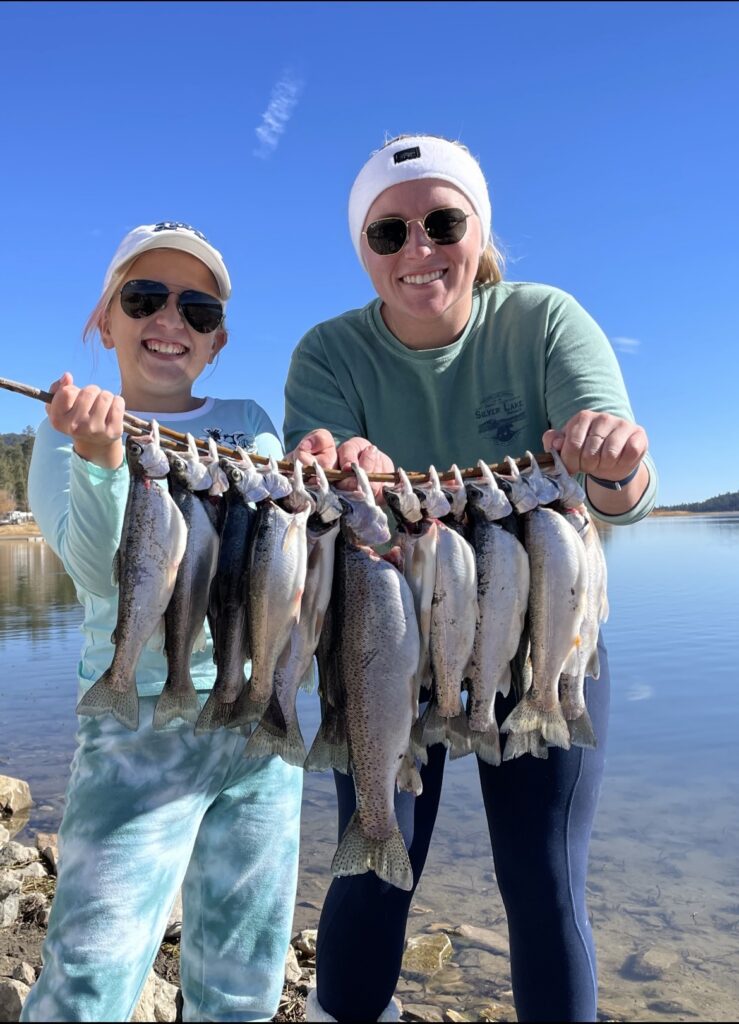
Well, winter is around the corner and it’s time to put the rods away and winterize the boat, right? NOT QUITE YET! Salmon season is indeed winding down, aside from some late season river opportunities, and winter steelhead is often a mystery, so many anglers don’t know where to look for the next bite. If this is you, look no further than some fantastic winter trout fishing at multiple stocked lakes! Winter trout fishing is incredibly rewarding, and in many cases, produces some large trout that cut beautifully. There are many ways to chase these fish from shore or from the boat, and with a little research and timing, you are sure to be on the fish!
How to prepare
To begin, let’s look at the setups to use. Cold water temps have a lot of effect on fish, as they are a cold-blooded species. During this time, they are in energy consumption mode, with not a ton of energy to be spent moving around. Additionally, cold temps slow down fish metabolism. All this together means that when the fish feed, they are looking for an easy meal that does not require too much energy wasted in chasing it down. For this reason, small profile lures and stationary baits are often the best choice.
When fishing from shore, it is hard to beat the “stocked-trout standby”, the Carolina rig! An egg sinker on the mainline with a 2–3-foot leader to a small hook, with an inflated nightcrawler or chunk of Powerbait, is an easy meal for a meandering trout to engulf. Another good option is a small spoon or spinner with a slim profile and wounded look. Lighter casting spinners and spoons can be worked slow through the water column and produce a very crippled look. They are a great way to cover water in new spots and find the fish.
From a boat, these methods work great as well, but trolling can be added to the mix. Small spoons and spinners tipped with a worm are always a good option. Trolling allows the angler to go to the fish. Compared to spring and summer, trolling a little slower can be very effective. Many rainbow trout will sit low below the thermocline. Trolling past them just fast enough to get their attention but slow enough have them commit is the target.
Where to go
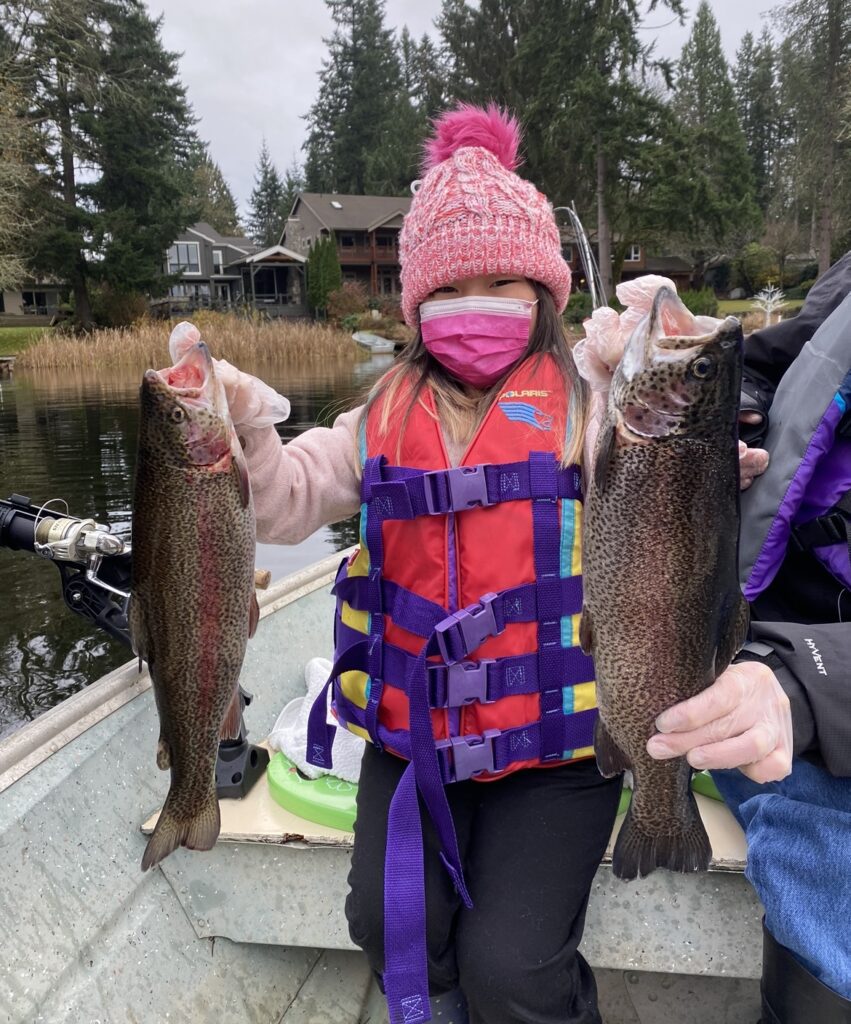
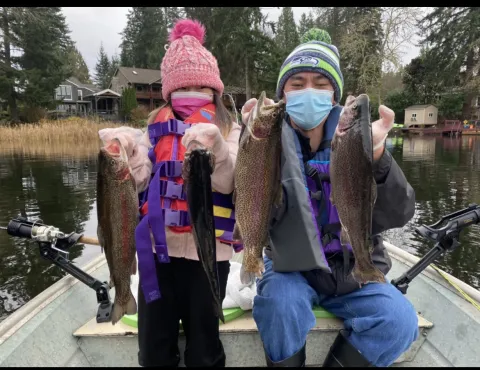
As with any fishing trip, the first thing to do is check the regulations. Many stocked trout lakes are seasonal, meaning they close at the end of October. If your lake is open, you are set to legally fish, but there may not be great fishing. Luckily for the angler, the WDFW publishes a list of recently stocked lakes that is updated weekly. Checking lakes in your area will give you the best idea of where and when to wet a line. The best time to catch stocked trout in the winter is directly after the stock. This is when the trout aren’t quite acclimated to the new area, and they are the most aggressive. After a couple of weeks in the lake, the fish will hunker down and be far less active compared to their first little bit in the new water. Knowing when the trout are stocked can be the difference in a couple bites and a nice limit on the stringer! During most of the winter months, the state stocks their “jumbo’s”, which are trout over 1lb, which usually cut fantastically.
Finishing Touches
As a local Western Washington Angler, I know a couple of great lakes in my surrounding counties that are stocked in November, which gives me just enough time to make some smoked trout dip for the Thanksgiving table. Nothing warms a day like a tight line on a cool river bank, sipping hot coffee, and enjoying some bank lunch.
With a little research, a simple setup, and a couple of free hours, you can be knee-deep in some delicious trout! Just like the spring, ultralight trout setups, light monofilament line, some extra hooks, and a couple of weights, and you are set on terminal tackle. Then add some jars of Powerbait, a few lures, and a stringer, and you will be ready to hit the water. As always, be prepared for the weather!
/articles/winter-fishing-stocked-trout-extravaganza
Ultimate Kayak Set-ups
In the 2023 March issue of NW Reel Life, I laid out some key items and concepts to help anglers enter the world of kayak fishing. And while weather predictions, condition assessment, and kayak types are all important, in this article I want to focus a bit more on the actual setup of your kayak and how that can determine your level of success out on the water.
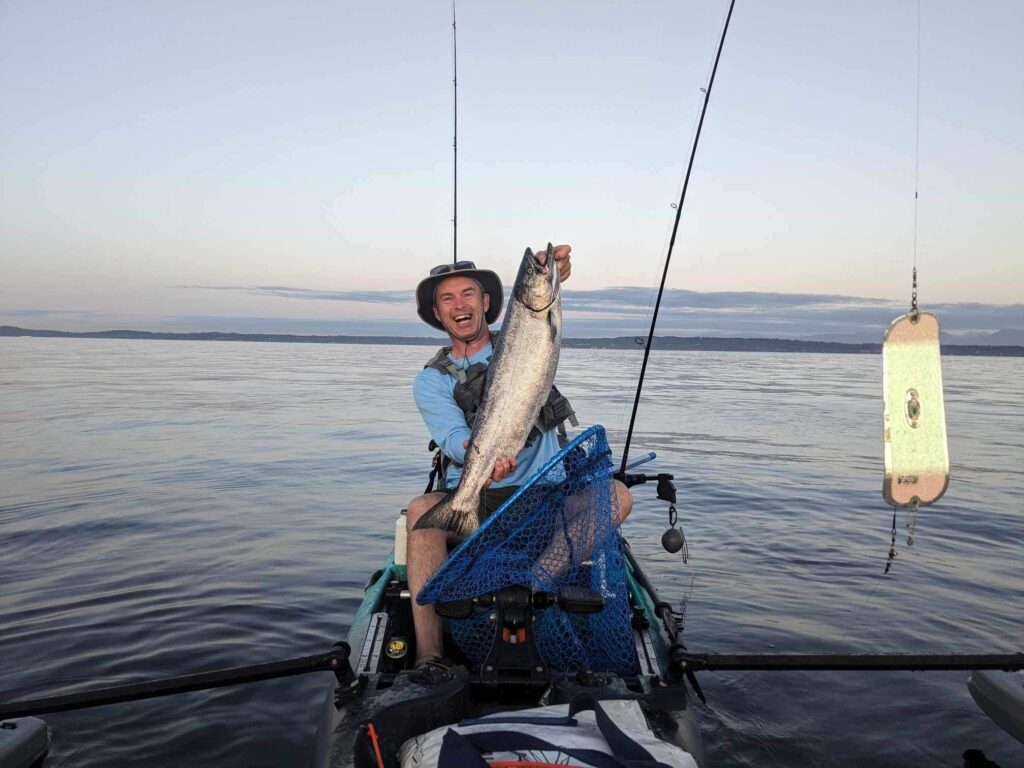
Track mounts
Let’s talk track mounts! Track mount systems are the starting point for your rod holders, fish finders, and other accessories. A track mount is a slotted track that you bolt to the side rails of your kayak and then slide your other accessories onto. They all have fairly similar styles with some small variations amongst different brands. The most important thing to keep in mind is that your track should be strong enough to support whatever type of load you are putting on it. A good track mount system should be metal, corrosion resistant, and come with a backing plate. If the track holds rod holders, it should be large enough and secure enough to do so. Smaller accessories like cell phones, fish finders, and camera mounts won’t require as beefy of a track.
Downriggers
Trolling on a kayak can be straightforward. You drag a lure behind you to target rainbows, or you can utilize a cannonball weight to get you down to chinook salmon territory.
Now, if you want to have more than just an idea of the depth your gear is at in the water column, you need something more surefire. Enter the downrigger.
Because most of my kayak fishing is in the ocean or the Strait of Juan De Fuca, I’ve opted to leave the downrigger trolling to my aluminum boat. The constant attention to equipment while on the water and the inherent risks associated with snags make it an option easier to perform on a vessel of larger size. With that said, a downrigger is not only doable on a kayak, but it’s a technique that can increase your chances severalfold, and if you’re fishing lakes where currents and large waves are less of an issue, a downrigger might be the exact thing that puts you on the fish.
The most common spots to mount a downrigger are just past the midline of your kayak somewhere out of the way of your peddling or paddling, but also close enough to you so that you can operate it without too much struggle. Most kayakers opt for smaller downriggers like a Scotty lake troller or the Cannon mini troll downrigger. When mounting your downrigger, you’ll want to add a backing plate in the hull of the kayak where your bolts will attach. This is essential for the kayak to be able to handle the added weight and pressure. Fish finder and rod holders should be mounted in close enough proximity to the DR so that you can monitor your rod tip, fish finder, and DR at the same time. Instead of using the steel cable that comes with most downriggers, it’s wise to swap the cable for 250 # - 300# braided line. This will lessen drag and it will also allow you to cut your line in case of an emergency. With that in mind, you should always have a knife attached to your person in a place that is easily accessible in case that emergency were to happen.
Stringers
For the longest time, I struggled to find an effective place to connect my stringer to my Hobie Revolution 13’. I would typically have my stringer attached to a carabiner and then the carabiner attached to a strap that was a part of my seat’s recline system. Eventually, the rubbing from the constant motion and tension of the fish that were hanging off the side of my boat would fray the webbing around the strap. I now have a stringer cleat attached to one of my track systems that holds and secures that line out of my way. Metal clip stringers are a top-rated option for kayaks due to their ease of use, though rope stringers and chain stringers will certainly get you by as well.
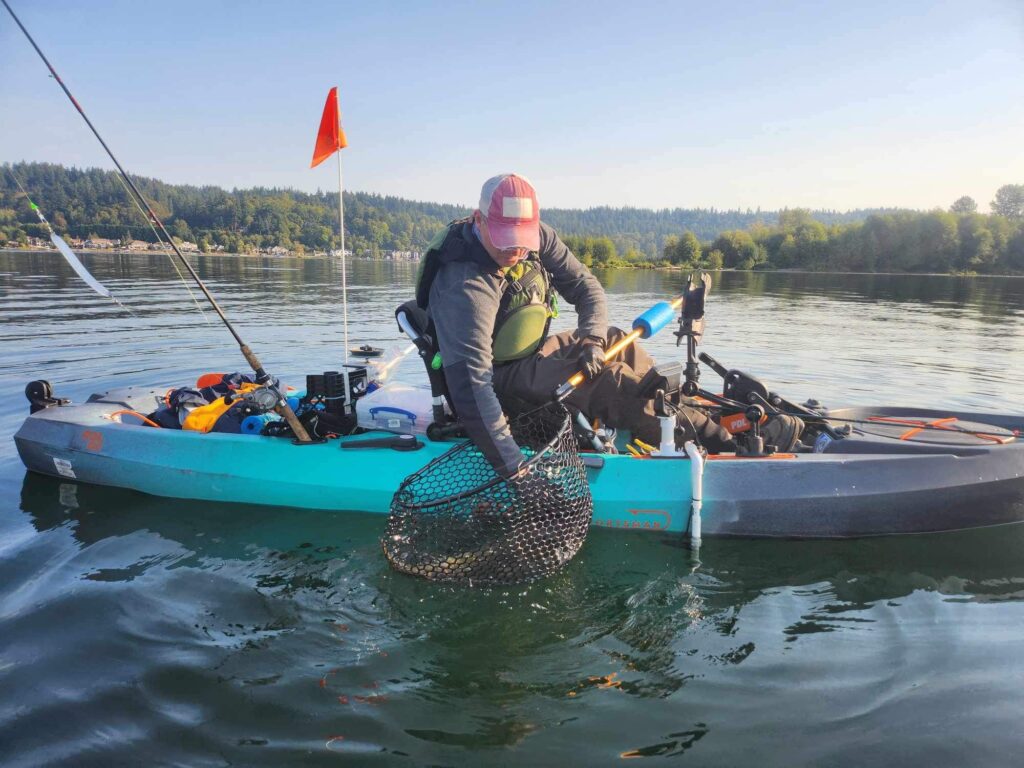
Fish finders
The process of setting up a fish finder on your kayak is going to differ depending on what type of kayak you have. Mounting the screen is simple- it can go on a track or be permanently installed on the boat. The trickiest part of the process will be mounting your transducer. Many fishing kayaks come equipped with a transducer mount directly underneath the hull. This allows the transducer to sit in the water while also being protected from the sand and gravel if the boat were to drag along the bottom. For most kayaks out there, transducer mounts are not built in. If you don't have a transducer mount you will need to mount it either off the side of your boat or better yet, inside the hull. This gets tricky and typically involves using some plumber putty for the transducer to both stick to the kayak and to also create a sealed surface without air bubbles. The solid putty allows for the transducer to transmit through the putty, through the kayak material, and into the water. YouTube is a valuable tool for these types of setups.
Bilge pump and BP storage
If the hull of your kayak fills with water due to crashing waves or due to a capsize, you don't want to be bailing water out of the boat with an empty tackle box. A manual bilge pump is your strongest line of defense against a sinking boat. Some kayakers will stow their bilge pumps inside a hull compartment underneath a hatch. This could seem like a sensible home for your bilge pump, but if you are in a situation where you’ve taken on a lot of water and you’ve lost half your buoyancy, and on top of that, you’re being battered by oncoming waves, leaning over to open a hatch might be just the thing the kayak needs to capsize once again. Instead, stow the pump somewhere within arm’s reach and have it fastened down with a bungee and secured to a lanyard so that it has no chance of going overboard.
Cell phone mounts
Having your cell phone mounted on your fishing kayak might seem like an over-the-top luxury, but if you consider the vast number of apps that can be utilized to help improve your fishing trip, you will find that having your cellphone on the ready and in view at all times is a must. When I’m on the water, I use Navionics to navigate and to get a good sense of underwater topography. I also use weather and wind apps to keep me safe and informed on changing conditions. Using a cellphone mount along with a waterproof cell phone case gives ease of access to all of these things. Phone mounts can be installed directly on the kayak or on your track system.
Bungees and straps
Bungees, straps, webbing, all these small investments will protect your larger investments in the event of a capsize. Strap everything down as if capsizing was just a normal part of your program. This is particularly important if you plan to do any surf launches into the ocean.
Rod holders
Rod holders are an essential part of your fishing kayak set-up. Your kayak likely comes equipped with flush mount rod holders, these are almost standard on most kayaks these days. However, the position of the standard flush mounts is generally aft of the kayak seat, and this isn’t always the best location when you want to have eyes on your rod tip. Additional flush mount holders can be installed in various locations of your boat.
Fixed and elevated rod holders. These will be installed directly to the boat or to a track. Fixed rod holders tend to be one of the sturdier options.
Adjustable rod holders. Adjustable rod holders can move from horizontal to vertical and can be found in various styles that are suited for whatever type of fishing you plan to do.
When installing your rod holder, be sure to place it somewhere where it won’t be in the way of your peddling or paddling.
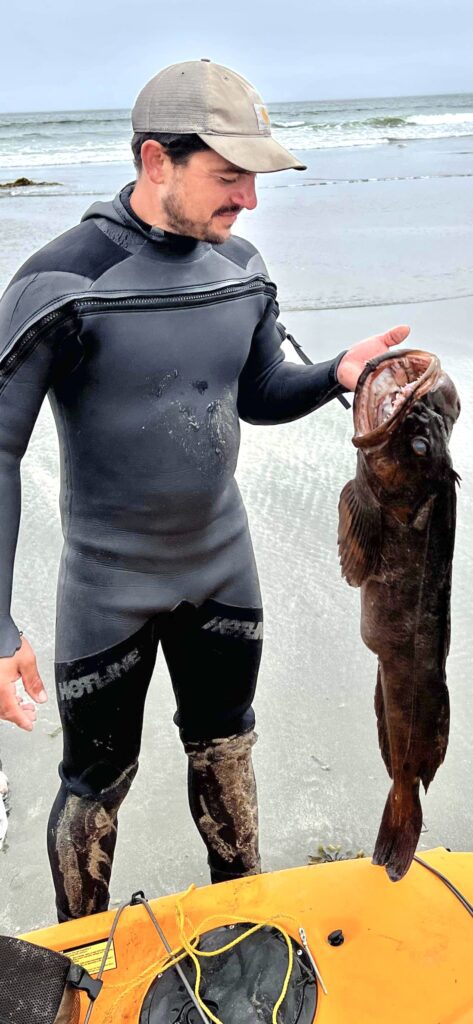
Fish Storage
There are quite a few options when it comes to fish storage. Some folks will carry a small cooler on board. This is a good option when fishing for smaller fish on hot days and if you can afford the room on your kayak.
Fish bag. Insulated fish bags are great options for larger fish and are easy to secure on your kayak. If you’re fishing for spiny fish, be sure that your cooler bag is puncture-proof.
In-hull storage. Some anglers have rigged fish bags inside their hull, and if you can make that work, you are ahead of the curve on the fish storage problem that plagues many kayak anglers. If in-hull fish storage is a possibility, be sure that your fish are well insulated as the inside of a kayak can get quite toasty on a hot day. Also keep in mind that if your fish bag leaks inside of the hull, you will have the difficult task of cleaning a stinky mess that gets more stinky the longer it sits unattended. Finally, having the hull open frequently presents the danger of water from crashing waves getting inside your kayak. So, if you choose this method, be wary of the risks associated.
Kayaks offer endless amounts of angling opportunities without some of the drawbacks of larger boats. I hope these tips give you some direction in planning your next outdoor adventure on the open water.
/articles/ultimate-kayak-set-ups
Fall Trout Strategies
Tired of the salmon fishing crowds?
Tired of the salmon fishing crowds? Looking for one last hurrah before winter? Look no further than fall trout! Fall is one of my favorite times of year to fish for rainbow trout. The majority of other fishermen have either put the boat away for the year or are off targeting salmon, so most days you’ll have the lake to yourself.
Most pleasure boaters have also put their boats away for the season, so those of us with small boats don’t have to deal with their huge wakes! Another benefit of fishing for trout in the fall is that they once again start to patrol the shallows looking for a quick meal, putting them within reach of shore anglers. Those small planter trout from earlier in the year have also gotten much larger by this time, making for big, tasty fish. Not to mention they are also more aggressive during this time of year because they want to pack on the pounds before winter.
Though they do most of their trout stocking in the spring, WDFW also plants several lakes on both the east and west side throughout the fall. Check the stocking reports on their website, sometimes they stock jumbo trout! Fishing for fall trout is one of the best ways to spend a lazy fall day. You can enjoy the cooler weather and a break from the crowds. Whether you want to fish from shore or a boat, you can find success by following these tips.
No boat?
No boat? No problem! Dust off those ultralight rods and hit the lake. You can fish with a bobber, soak dough bait, or throw hardware. Spinners and spoons work very well for fall trout, but traditional dough baits and worms will also catch fish. On lakes where two-pole fishing is allowed, I like to put some dough bait on a hook, toss it out, and put the rod in a rod holder. I’ll grab a second rod and cast spinners while the dough bait soaks. Black/gold spinners are my favorite! It’s a good idea to bring several different colors and flavors of dough baits.
Take a look at reports or try to remember what you used in the spring. Worms, salad shrimp, corn, and maggots are all tried and true trout baits. If you don’t have luck fishing in one location, it pays to move around until you figure out where the fish are at. You’ll often see fall trout jumping and feeding on the surface. Fishing is best in the mornings and evenings, but trout are always hungry during the fall and will bite any time of day.

Shore anglers
Although shore anglers can easily get limits of trout in the fall, don’t be afraid to take out your boat and try trolling for them. There are fewer pleasure boaters in the fall, thanks to the cooling temperatures. It’s a great time of year to take out your kayak or small aluminum boat. Try a faster troll than you would in the summer. These trout are feisty and will chase down a meal willingly. You can use larger presentations than you would in the spring and summer, since the fish are bigger. I’d highly recommend using a fish finder. Do you miss trolling with leaded line?
This is a great opportunity to troll with leaded line or divers, since the fish are running much shallower than in the heat of the summer, making downriggers unnecessary. I often have good success trolling plugs in the fall, but spinners can work well too. For attractors, you can use dodgers or gang trolls. I lean towards dodgers, but maybe that’s because I’m also a kokanee fisherman.I already have a book of 20-30 dodgers in different colors, shapes, and sizes. Gang trolls have definitely put caught many a trout, but I find dodgers easier and more convenient to use. I can quickly put globs of scent on them, tune them, and change them to suit the conditions or try something new. Whichever method you use, you’re sure to get many fall trout on your hook!
Don’t hesitate to give fall trout fishing a try! The fish are big, aggressive, and tasty. Your chances of scoring a trophy holdover are much higher this time of year. I would recommend trying Potholes Reservoir, the seep lakes, Mineral Lake, Clear Lake, American Lake, and Harts Lake, for starters. There’s no need to put up with crowds or drive all day to the coast. Give your favorite local lake a try! It’s also a great way to put kids on fish. Some kids just don’t have the patience to troll or cast all day for salmon, but they’ll love seeing those trout takedowns! Don’t forget to bring the net, the size of these trout can surprise you.
Hope to see you out there this fall!
/articles/fall-trout-strategies