Get the Lead Out
By Randy Castello
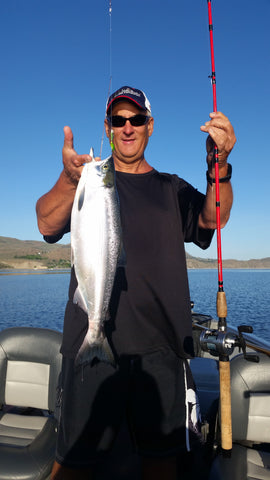
Kokanee fishing this spring? Then get the lead out; lead core line, that is.
Where winter kokanee seems to be a very depth-oriented fishery, we are on the cusp of our popular spring/summer kokanee fishery. Downriggers rule for kokanee fishing, but on our boat we almost always put out 2 lead core line rigs before the downriggers are deployed. Using a properly set up lead core line rig gives the angler fairly accurate depth control without having to use downriggers.
Using the appropriate top shot and the following method for setting up your lead core line rigs, the angler can fish anywhere between the surface to about 30 or 40’ deep with some level of accuracy. To that note; while filming a Northwest Fishing segment, I snagged the bottom with a lead core line set up in 70’ of water while we were trolling in a straight line. Interesting, but how could that have happened?
Lake Southerland
We were trolling Lake Southerland on the Olympic Peninsula. We were metering a large body of kokanee at around 30-40’ in 70 feet of water. I ran out 2 ½ colors, or 60-70’ lead core line, plus my 60-70’ top shot while trolling at 1.0 mph. Not sure exactly what happened, but my guess is there was also an underwater current that was running with the boat. With minimal drag and water resistance on the line, it just sank to the bottom and I had to say goodbye to one of my favorite kokanee dodgers and custom kokanee flies. It was an unusual situation and you wouldn’t want to make a habit of trolling at 70 feet deep, but lead core line can run that deep.

What exactly is lead core line? It is a type of fishing line where there is an inner core of soft lead wire sheathed by an outer layer of braided fiber. Lead core line has been around since the 1940’s and is commonly used by Midwest walleye or Great Lakes salmon and steelhead trollers. The salmon guys use a technical approach using planer boards and multiple lines to target salmon on the great lakes.
Lead Line
Lead line isn’t as common here in the Pacific Northwest but it should be. Fortunately, our lead core line fishery doesn’t have to be technical, we can just clip on a dodger or lure and let out the appropriate number of colors. Lead core line is available at most of our local Northwest tackle shops. Lead core line comes in a variety of “pound test”, 12#, 15#, 18# and others. The line is your weight and eliminates the need for downriggers, planers, or separate weights. Lead core line comes dyed in contrasting colors. The color changes every 10 yards or about 30’.
The following is solely my opinion and not supported by industry testing or maybe even your own experience. When fishing for kokanee, use the lightest test lead core line available. With the slower speeds used when we hunt kokanee, the test of the lead core line will not affect the sink rate; 15# lead core line will not sink faster than 12# lead line, in fact the 12# lead core line may sink further while trolling. The thinner diameter would result in reduced drag, and may allow gear to sink faster. Finally, 12# lead core line breaking strength is more than adequate for kokanee fishing.
I think there is belief that lead core line setups are heavy and not really suited for the light tackle acrobatics common when kokanee fishing. For our lead core line rigs, we use standard 7 ½-8’ fiberglass kokanee rods and 150-300 (size ratings very greatly by manufacture) series round baitcasting reels. You really don’t need line counter reels because you will be counting colors; “hot bite at 1 ½ colors along the eastern shore…” My approach for spooling the reels is a bit different and is a phased setup that goes something like this:
On an empty reel with the same capacity as the reel you plan to fish the lead core line on, tape the end of the lead core line on the spool and load 3 colors of lead core line + 3-4’. Cut the lead core line, saving the balance of the filler spool.
Remove the actual lead core from 3-4‘of the loose end of the lead core line on the reel. Using a blood knot, Albright knot, a double uni knot, or other similar knot, tie 20# braid of your choice to the end of the stripped lead line. Then fill the spool with the 20# braid.
Here’s the tough part; you will need 2 empty spools or a second reel of the same type and size. The goal is to load the braid/lead line combo on your working reel braid first. When using the same reel or a reel with the same capacity as the reel temporarily holding the lead core line/braid combo, it is easy to just transfer reel to reel. Otherwise, you have to transfer to a spool, then to another empty spool, and then back on to the original reel.
The reel is now loaded with 3 colors of lead core line on top. Strip the lead core out of 3 or 4 feet of the loose end of the lead core line. Using your favorite braid to mono (or in this case, favorite stripped lead line to mono) knot, tie on a 60’ 8-12# fluorocarbon top shot.
That’s basically it. We use the lead core line setup almost exclusively for kokanee, so I just attach a small Duolock snap to the end of the fluorocarbon top shot to make changing dodgers easier. My reasoning for running only 3 colors of lead core line is that at 0.8-1.4 mph, 3 colors is all you need to fish to about 30-40’ deep.
In fact; as previously mentioned, using this approach I have snagged the bottom in 70 of water with just 2 1/2 colors of core lead line out. Running just 3 colors of lead core line with braid backing allows you to load a fair amount of backing on standard bait casting reels with the bonus of reducing the extra weight of additional colors of lead line.
Not always, but when fishing for kokanee, the lead core line rigs typically out fish any of the other rods on our boat. Believe it or not (you have to know me…), I have a theory about why the lead core line rigs are so fishy on our boat. I use a 60-70’ top shot, so even with just 1 color of lead core line out, the dodger/lure combo is running almost 100’ behind the boat.
Any boat-shy fish would have regrouped and forgotten about the big, noisy aluminum shadow that just passed overhead. Additionally, I know that I’m weird and overthink these things, but I think that the sonic vibration of the sheathed lead line moving through the water has some positive affect on a fishery. Something akin to a dog whistle: we can’t hear it, but they come running.
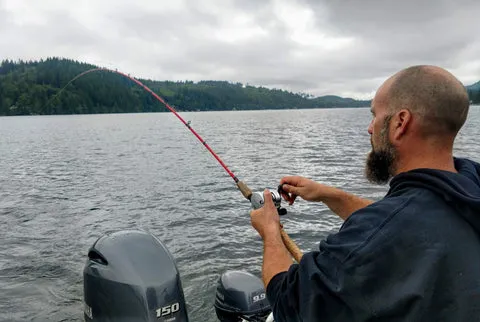
Whether or not the kokanee come running or swimming, lead core line is a deadly effective tool in our kokanee arsenal. It works equally well with the smaller dodgers, flashers, and gang trolls used for kokanee fishing. With the telltale thump, thump, thump at the rod tip, having at least one lead line rig in the water is a great indicator that your trolling speed is correct.
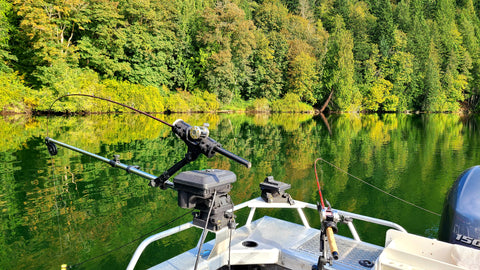
Lead core line rigs are also an exceptional choice when pulling small stick baits or minnow type lures baits for cutthroat and rainbows. Just run ½ a color and get the frypan ready! Lead core line and stick baits go together like peas and carrots. The takedown when trolling stick baits on lead core line is surprisingly aggressive. The fish’s battle for freedom seems to magnify as it telegraphs up your lead line to your rod tip.
Once you set up a lead line rig or two, you’ll likely find that the lead core line rigs will be your go to kokanee rods. Lead core line is effective and straightforward to use when paired with the smaller dodgers, flashers, and gang trolls we use for kokanee fishing. Lead core line is equally effective with small spoons and stick baits for various trout species.
The initial investment may seem extravagant, but it’s still cheaper than a pair of downriggers. If you’re fishing from a kayak, canoe, inflatable, or even a drift boat without downriggers, your lead line rigs will be indispensable in your quest to do battle with a PNW silver football.
/articles/get-lead-out
A Mothers Day Fishing
By Hillary Holman
Last year for Mother’s Day I met up with my two daughters to fish Dworshak Reservoir in the Clearwater Valley for Monster Bass.
My eldest daughter Cameron had recently returned home from Temple University in Tokyo to attend WSU in Pullman, and Sarah had came back from PLU to attend Whitworth University in Spokane, both due to unforeseen complications associated with the pandemic.
Paul “the Bait Boy” Hamilton, and Sarah carpooled down from Spokane to Lewiston and Cameron scooted over from Pullman to meet Rob and I at the Clearwater Casino. It was the final leg of a spring fishing road trip with Rob.
We traveled the back roads through Waittsburg from the Tri Cities area, and found some great smoked cheese and meat at Mr C’s. We stocked up on snacks and hit the road to meet up with our posse in Lewiston by dinner time. It was a good 6 hour drive from The Dalles to Lewison, taking the scenic route, aka the shortcut.
Lenore Lodge, operated by Toby Wyatt, is situated on the way to Dworshak and was our lodging in the area. We often stay here when fishing with Reel Time Fishing on the Clearwater. The girls were impressed upon arrival. There was plenty of room, a great kitchen and a game room. The view of the river is nice. It was easy for the girls to unwind, unplug and relax. Cameron prepared a charcuterie board of the many meats and cheeses from Mr. C’s, that we bought along the way.
The next morning brought much excitement. There were winding roads and beautiful scenery. To see the wonder in my girls’ eyes again, as if they were little, gave me the greatest joy. Their curiosity and willingness to explore with us was wonderful. We looked out the windows and snapped pictures at the scenery. The Dam was a marvel. Hidden back in the Valley of the Clearwater, the monolithic dam is a sight to behold.
Arriving at the reservoir, we were greeted by Travis Wendt, of Reel Time Fishing. We were on the hunt for Jumbo Bass that are said to inhabit the huge lake created behind the huge Dworshak Dam. It was a beautiful clear day and not another boat was in sight. Travis knows this water well. “The reservoir is deep and steep,” as he says, and letting your leaded soft plastic baits sink to the bottom is paramount for success. Casting was right up our alley. Sitting on the bow of the boat tossing out lines on a clear spring day with my kids was exactly what I needed.
We took a lunch break and hit the shore, a hidden cove with a stream pouring from the rocky bank. Travis fired up the BBQ and us gals hit the shore for some much needed exploring. The hills were draped in green from the spring rain and runoff. We sat on top of a hill and looked down at the men doing their manly banter on the boat with the roaring smoke from BBQ as Travis prepared for lunch. The girls hopped up and set out to the creek to watch and listen to the streaming water down the rocks on the hillside. I watched and they jumped from one side of the falls to the other. Each was snapping pictures of the other. Capturing each moment as it came.
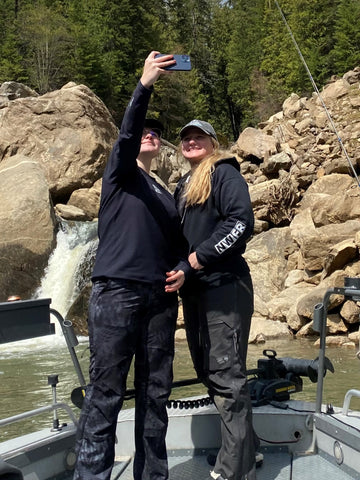
After lunch, we got to work. Paul, Rob and Travis were machines in procedure. They sent their plastics out at just the right spot, waiting for the right angle for the lead to hit the bottom. Cameron had enough time fishing and was ready for Mom to pass her the Camera to film the rest of the bass episode. She was ready to take the reins. The rest of the afternoon I spent fishing. Not worrying about getting the camera shot. Not worrying about the camera at all. Sarah would take turns with Cameron, but for the most part, she fished right alongside me. We hammered ‘em. We gave it everything we had and stayed as long as we could, even with the rain setting in. The girls were troopers. They came prepared with the right gear to withstand the spring day with unpredictable weather.
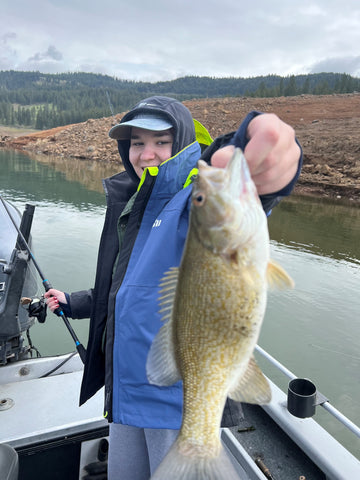
In the end, we caught some great sized bass and perch. We didn’t catch a monster, but we had fun. We saw a waterfall, beautiful scenery, the dam, and I got to reconnect with my girls after 2 long years apart. The boys were gracious and patient. The lunch was perfect. I could not have asked for a better day for Mother’s Day. Ok, maybe next time to have my son along for the trip is my only ask.
So, if you are wondering what your mom, wife or daughter may enjoy for Mother’s Day, consider taking them fishing. A trip we don’t have to plan and a meal we don’t have to cook or cleanup is all we hope for! The fishing, now that’s a bonus!
This article is dedicated to my Loving Mother Jerri Lee Cole.
/articles/mothers-day-fishing
The Ins and Outs of Fishing Reels
By Hannah Pennebaker
The salesman asked, “spinning or casting?” As we looked at the case full of shiny new fishing reels, I remembered what it was like to be a beginner fisherman who had no idea which reel was right for me. It can be a truly overwhelming, confusing mess if you don’t know what you’re looking for. My neighbors said they had been interested in fishing for years, but had no idea how to get started.
Rather than getting a dozen different rods and reels, they wanted a setup that would handle most of the types of fishing in the northwest. Intrigued by the challenge, I volunteered to take them to the local sporting goods store to pick out rods and reels. They had given me an idea of their budget, but that was it. They had no idea what type, brand, or size of reel they wanted. I walked them through the basics and let them test out several different reels within their budget.
They made their choices, and a week later we tested their setups out on surf perch in Ocean Shores. Not everyone has the luxury of an experienced fisherman to walk them through the ins and outs of fishing reels at the local sporting goods store. I’ll do my best to provide an in-depth guide to each reel type and their uses. We’ll talk about spinning reels, baitcasters, conventional reels, spincast reels, and mooching reels. Even experienced fishermen might find a new reel type to try out!
Spinning Reels
Spinning reels are probably the most common reel out there, and for good reason. They are extremely versatile, easy to take apart for maintenance, and often inexpensive. You can use spinning reels for just about any kind of fishing you can imagine. They are great for ultralight fishing tiny jigs for crappie as well as fighting giant tuna. If you intend to use them for saltwater fishing, make sure they are sealed, however. Saltwater is hard on reels, and you want to make sure it stays out of the inner workings of the reel.
There’s no need to find a left- or right-handed spinning reel, most have interchangeable handle sides. As I mentioned, spinning reels are extremely diverse. You can get heavy ones made out of metal that can withstand getting banged up on jetties, or you can get light, smooth ones that are perfect for finesse fishing, such as drop shotting. Do your research and compare reels at the store to find out your preference.
Higher end reels are going to generally have better drag systems and be constructed of more sturdy and lightweight materials such as aluminum. Consider the size of reel you need as well. 1000 is suited for crappie and other panfish. 2000 to 3000 is perfect for trout. 3000 to 5000 is great for salmon. 6000 to 10000 are used for crab snaring and tuna fishing. Spinning reels are a great all-around option with no major downsides. They are great for beginners and experts alike.
Baitcasters
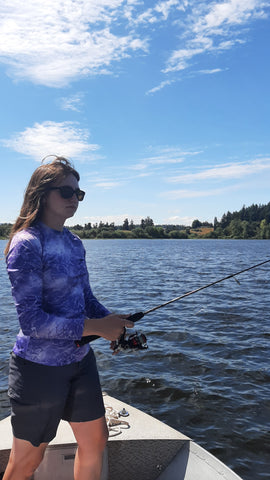
The choice of many avid bass anglers, baitcasters are a bit more complicated to use than spinning reels, but offer many advantages to the serious angler. Your choice in reels is most likely going to come down to spinning or casting. With a baitcaster, you can precisely dial in your casts, since you can easily brake the spool with your thumb. This is handy for bass fishing, when you need to cast extremely accurately.
It’s also easier to use topwater lures, since you can slow down the lure and make it hit the water with less force. Baitcasters also excel at casting lures with little to no weight, such as wacky rigged senkos. Baitcasters also have a larger line capacity and tend to be lighter than comparable spinning reels. They are a popular choice for these reasons. The major downside to baitcasters is that if you don’t have the drag or barrel brake set properly, you can get a huge knot, or bird’s nest, while casting.
This happens when the spool spins faster than the line goes out, creating a bunch of slack in the line, which tangles and prevents you from letting line out. Make sure to get a few practice casts in and dial in your drag and barrel brake. You’ll need to do this any time you change the weight of your lure. Baitcasters also tend to be on the more expensive side.
They are not a great choice for beginners, since they require dialing in some settings and can cause annoying backlashes, but baitcasters are still a great option for experienced anglers. You can use them for trolling for trout, salmon, and walleye, as well as casting for bass, surf perch, and bottomfish. If you intend to use them for trolling, baitcasters with line counters are key!
Conventional Reels
The difference between conventional reels and baitcasters isn’t always clear. Some argue that they’re one and the same, others say the difference is that one has a button and the other does not. Typically, baitcasters will engage the drag and start reeling when you reel the handle after casting, but a conventional reel will not, and must be manually flipped to start reeling in line.
Conventional reels are a type of open-face reel that is simple, reliable, and tough. They may or may not have a levelwind. Some fishermen use them for casting, but most Northwesterners use them for trolling. They have a powerful drag system and can handle heavy weights, but they’re often heavier than spinning or casting reels.
Spincast Reels
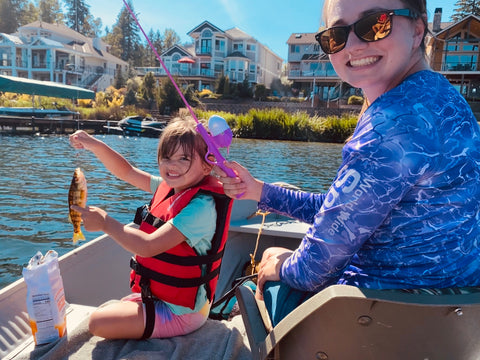
If you grew up fishing with a Barbie or Spiderman pole, chances are it had a spincast reel on it. These reels are similar to baitcasters in that you simply push a button to free spool and cast your line, but the spool is encased in a cover. This can be both a blessing and a curse, because if your kid tangles their line, it’s difficult to fix. However, spincast reels are very light and simple.
Drag systems involve simply adjusting a dial above the button. Spincast reels can help kids learn to cast, since all they have to do is press and release a button. This is why they’re commonly called “buttoncasters”. They are affordable and easy to find at your local sporting goods store.
Mooching Reels
Mooching reels are a very niche type of reel, but they’re a ton of fun to use! They are typically used for salmon fishing in saltwater. You can either use them for mooching, as their name suggests, or for trolling. You can definitely get away with using a spinning reel, baitcaster, or conventional reel for mooching or trolling, but there’s something special about using a mooching reel. When you’re on a big fish that’s pulling drag, the handles will spin backwards and rap you on the knuckles if you don’t get your hand off them quickly enough!
They are commonly referred to as “knucklebusters” for this reason. Don’t let that scare you, though. They have a 1:1 gear ratio, so you’ll truly feel the fight of the fish. You’ll feel every headshake and run as you battle the fish to your net. Knucklebusters have a small but devoted following in the Pacific Northwest. Match them with a 9 to 10 ft rod with moderate to heavy action, and you’re in business. Give them a try and you’ll be hooked!
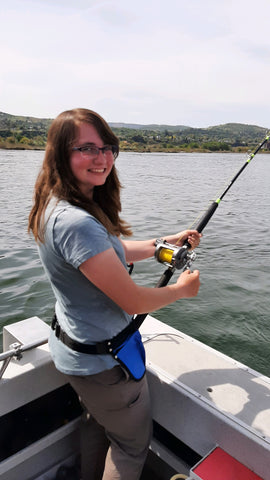
Whether you pick up a spinning reel, baitcaster, conventional reel, spincast, or mooching reel, having fun out on the water is the most important thing! May is a great time to try out most fisheries in the northwest. Get out there and enjoy the water!
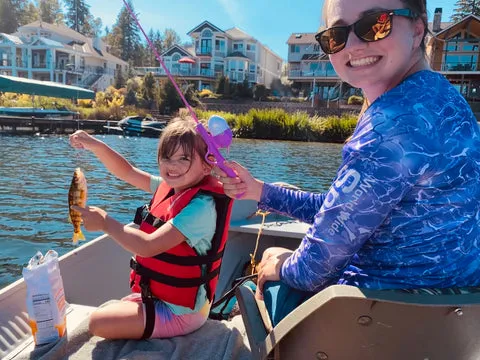
/articles/ins-and-outs-fishing-reels
The Multipurpose Fishing Trip
By Matt Carey
I have to start off this article with the obvious: I love reeling in the trophy fish as much as the next guy. My trophy case might be a little bare, but that’s beside the point. If there’s an opportunity to get into a big fish, I am as excited as anyone. The reality is we don’t always end our fishing trips with those monsters. Sometimes we’re lucky to even get a bite all day. Maybe what’s even more disheartening than the slow, sporadic bite with a few lost fish here and there is the one fish you do land that ends up a fishing tale for the wrong reasons.
That one guppy you sling over the side of the boat. The fish you’re talking up as you reel in. “It might have some weight behind those shoulders” ... “Last time we were here I hooked into that (insert exaggerated size fish), you all remember that one...!” I have my issues, and giving my buddies more ammunition than they already have by way of an embarrassing fish doesn’t have to be on the list!
Our Time on The Water
So, what do we do with our time on the water when the fishing isn’t as great as we hoped? I think some of the best parts about fishing are all the extras that come with it. I don’t mean different gear or setups. I don’t mean using a drift boat versus one with multiple props. I don’t even mean the variety of species out in the water. I think about the extras associated with fishing that make for lasting memories. The kind of fishing trip where you look back and remember the fishing and everything else. Time with friends or family. The time spent on the shore with kids or pets. When you combine a fishing trip that has a great time on the water with a great time on the land, it’s hard to beat anything else.
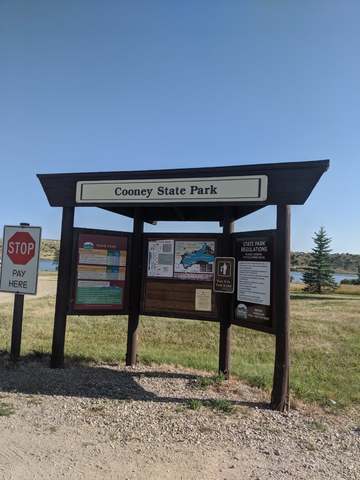
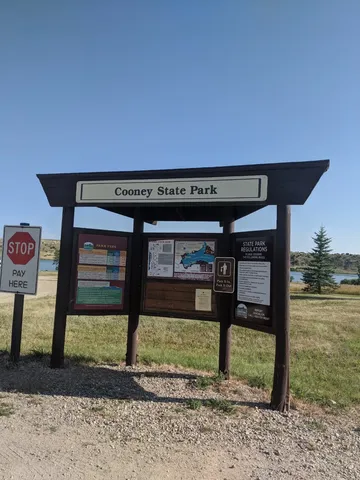
Cooney Reservoir
Cooney Reservoir outside of Billings, MT comes to my mind when I think about this multipurpose fishing trip. My in-laws had something of a family reunion planned for the summer. Within their immediate family, my wife and her siblings, kids etc. there are almost 20 people. The reservoir is for some a 30-minute drive and others an hour and half drive. Manageable for everybody. Being the only boat owner in the group, we agreed to bring our Klamath. Not a grandiose vessel, but reliable, and a good opportunity to let the nieces and nephews get some exposure to fishing and boating.
I brought some fishing gear that is pretty user friendly. Spinning reels with plugs and jigs. Open the spool, cast the line. So simple, kids could do it. Between taking turns getting everyone out on the water who wanted to go and practicing patience with other people’s kids, the fishing left something to be desired. Still, we caught a few nice perch and I was able to get my brother-in-law and his kids on a few more bites. Here’s where the “extras” come in.
Seeing jet skis, pontoons and other larger boats pull skiers and tubers led to some envy among the kids in our camp. We did have a little raft that could get hooked up to the boat, some rope, life vests, flags (remember this part in a second), and enough power in the motor to at least tug along kids wanting to enjoy the tubing action. So, I turned over the keys and let my brother-in-law take a spin with his kids.
On land I was enjoying some BBQ, swimming in the shallows with those on shore, and enjoying a typical day at the beach. Some time to chat with my in-laws, watching my dog swim and chase after a ball. All the extras that can go into a great fishing trip. Sometimes our fishing trips don’t have to be about limiting out or bragging rights. I had just as much fun on the shore as I did out on the boat. The experience of being with others is as important as the fish you catch. Or, even more important. Fishing itself can be a small part of a great memory and we as outdoorsmen/women cannot understate that.
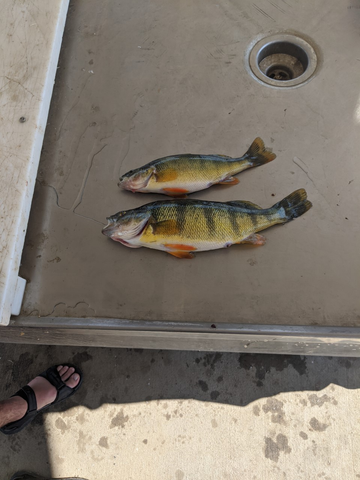
Oh, and the flag? Well, a miscommunication happened between my brother-in-law and I which led to a “friendly” conversation between him and a game warden about needing to use the flag when someone is in the water. I swear I told him, but he swears he didn’t hear me say anything about it. Thankfully it wasn’t a huge issue, and everything turned out fine. It’s a friendly talking point for me when I have some lighthearted banter I need to call back to.
/articles/multipurpose-fishing-trip
5 Family Friendly Trout Lakes in Western Washington
With opening day of the Western Washington Lowland Lake opener in the rearview mirror, many of us are looking for future lake fishing opportunities. Let’s take the family fishing! Following are a list of 5 family oriented Northern Washington trout/kokanee fishing adventure lakes. One of them, Lake Samish, would be a day adventure. The other four could be a multiday family camping and fishing expedition. All offer at least one boat ramp and shore fishing, a fishing pier, or both. This article will focus on opportunity, and not necessarily technique. All the lakes offer opportunities for trollers, bait soakers, and even fly fishers. That said, pack up the family, a frypan, maybe the sleeping bags, your favorite gear, then hit the road!
Cranberry Lake (Island County)
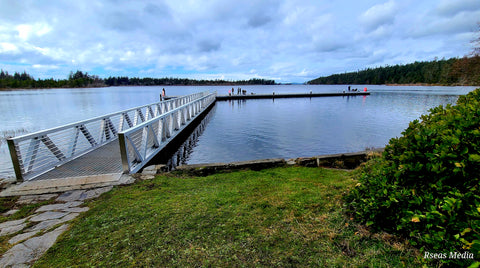
Cranberry Lake is located within the boundaries of Deception Pass State Park. There are multiple shore fishing access points and a very nice fishing pier. There is also a small boat ramp with very limited parking. If you are boating, internal combustion engines are not allowed on Cranberry Lake. You can use an electric motor but oars, paddles, or peddle power are perfect.
At 133.9 acres, Cranberry Lake hosts rainbow trout, coastal cutthroat trout, and an occasional brown trout. I’ve heard that that there are also smallmouth bass and perch in the lake but I’ve never seen anybody fishing for them. No picture, but when I was a teenager (Boy Scout camping trip) I caught a huge brown trout from one of the large boulders by the campground. The brute hit a worm/corn/marshmallow combo.
Not really sure why, but I love fishing Cranberry Lake. Although it is not, to me it feels like you’re fishing some remote lake in the Canadian wilderness. Be aware though, NAS Whidbey is right next door. There may be military aircraft doing maneuvers right overhead. I am in awe anytime one of the Navy aircraft are overhead but not everybody feels that way. It’s the sound of freedom!
If you’re not familiar with Deception Pass State Park, it is an absolute recreational gem. There are multiple well separated campsites, miles of hiking trails, and 77,000 feet of saltwater beaches to enjoy. Across Highway 20 from the lake, there is even a large saltwater boat launch with moorage. It’s not really mentioned anywhere, but in season you can fish for dungeness crab and smelt from the moorage floats. On the west side of the park, the sunsets from West Beach can be spectacular.
https://wdfw.wa.gov/fishing/locations/lowland-lakes/cranberry-lake
https://www.parks.wa.gov/497/Deception-Pass
Lake Samish
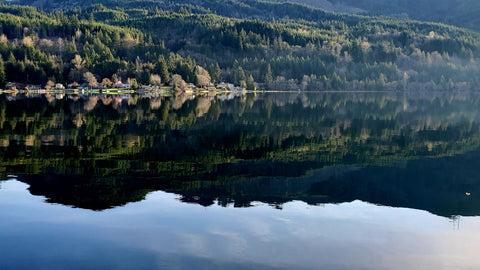
At 809.9 acres, Lake Samish is open to fishing year-round. It is managed as a multi-species lake, offering coastal cutthroat, large and smallmouth bass, crappie, brown bullhead/catfish, yellow perch, and excellent kokanee populations. I can personally attest that there are also largemouth bass and brown bullheads in the lake. The lake consists of a smaller lake connected to a larger main lake by a narrow channel. The larger main lake has significant weedy shallows at the south end and a max depth of 60 feet or so. The smaller lake located at the west end of the two-lake chain is up to 150 feet deep and maintains a large pocket of cool water throughout the late summer and fall. The cool water effectively extends the Lake Samish kokanee fishery when other west side lakes are too warm to support a fall kokanee fishery.
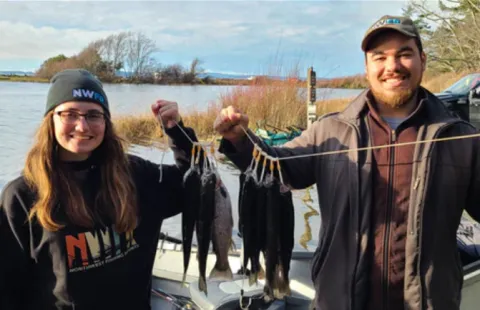
In late April-June, Lake Samish can be red hot kokanee fishing, easily giving up limits of fat 12”-16” kokanee. One of our biggest local kokanee came out of the smaller lake during a mid-October trip a few years back. It hit our old school gear running 2 colors on the lead line, 40’ of 8-pound leader, a rainbow color kokanee gang troll, and an orange wedding ring spinner tipped with a maggot. The fish was nearly 3 pounds and was in full spawning colors.
While the kokanee fishery is a trolling show, there is a fishing pier at Lake Samish Park. The fishing pier catch is primarily coastal cutthroat and peamouth chub. Lake Samish Park offers a couple of well-groomed picnic areas, a swim beach, hiking trails, and seasonal boat rentals. The park is the perfect place for a family outing and picnic with a little fishing thrown in.
An AIS Permit is required for every boat operating on Lake Samish. Here’s a few words about the AIS program at Lake Samish. Aquatic invasive species are non-native plants, animals, and pathogens that live primarily in water. They thrive in a new environment and cause economic loss, environmental damage, and harm to human health and property. An Annual AIS Permit and a per use boat inspection is required to operate your boat on Lake Samish. Whatcom County maintains an AIS inspection station at Lake Samish.
Boat inspections are important because they can help to prevent the transport of aquatic invasive species to Whatcom County lakes. AIS are transported on boats travelling from infested waters and can result in significant impacts to lake ecosystems, water quality, and water supply infrastructure. AIS can also make shoreline areas hazardous and uninviting for recreational users and property owners. To prevent the introduction, AIS inspectors are on the lookout for any animal or plant material on the watercraft that might pose a risk to Lake Samish. They will also be checking to see if your boat has been cleaned, drained, and dried, as some aquatic invasive species larvae can be transported in any areas on the boat that remain damp or have standing water in them. Inspectors will also conduct a physical inspection of the outside of your boat to feel for any signs of mussel larvae, algae, or other organic material on the hull that could pose a risk to the lakes.
As currently planned for 2023, Whatcom County will be staffing the inspection station at the Lake Samish WDFW Boat Launch. The AIS program is sensitive to the needs of anglers participating in the kokanee fishery at Lake Samish. They are planning/budgeting to staff the inspection station 5:30am-8:30pm 7 days a week. Although the AIS inspection program will be a bit of an inconvenience, having AIS inspectors on-site at Lake Samish will help to reduce the unfortunate vandalism problem at the Lake Samish WDFW launch.
On a similar note: Boat motor labels must have at least one star to operate on Lake Samish. Generally, any motor that is certified and labeled as meeting the 2006 or later model year United States EPA emissions standard will be compliant.
https://wdfw.wa.gov/fishing/locations/lowland-lakes/lake-samish
https://www.whatcomcounty.us/3542/Samish-Park
Silver Lake – Whatcom County
157.3 acre Silver Lake in Whatcom County is another unique recreational opportunity. It is a family friendly destination with camping, good trout fishing, and a WDFW boat ramp. The WDFW boat ramp is located at the north end of the lake and has ample trailer parking. The fishery is primarily for planted rainbow and coastal cutthroat trout. Even though the average depth is only 24 feet, holdovers are not uncommon. The fishery is friendly to whatever trout fishing style suits your style, but don’t be afraid to soak some dough bait.
Silver Lake Park is a large Whatcom County Parks and Recreation facility on Silver Lake. The park has 3 campgrounds and a RV accessible group campground. There are also cabin rentals, a handful of hiking trails, a playground, multiple picnic areas, an equestrian center, seasonal boat rentals, and a small boat launch that is probably best suited for hand carry boats.
https://wdfw.wa.gov/fishing/locations/lowland-lakes/silver-lake-whatcom
https://www.whatcomcounty.us/3517/Silver-Lake-Park
Fish Lake – Chelan County
Another family friendly trout destination is Cove Resort on 492-acre Fish Lake in Chelan County. For whatever reason it is probably better known for its winter, hardwater perch fishery but it hosts a solid spring and fall rainbow trout fishery. The lake also has a few respectable brown trout available. The brown trout fishery is kind of a specialty, but if you stick with it there are some true trophies cruising around, just waiting to be caught. In an interesting twist, the WDFW has been experimenting with kokanee fry plants in Fish Lake and it seems that there is blossoming kokanee fishery at hand. The lake also hosts a spring fishery for largemouth bass along with a year-round perch fishery. Access to the lake is primarily through Cove Resort.
Cove Resort is operated under a Forest Service private concession. You can bring your own boat: Cove Resort has a boat launch and moorage. They also have a store, boat rentals, a fishing dock, cabins, and a large campground.
https://wdfw.wa.gov/fishing/locations/lowland-lakes/fish-lake-chelan
https://www.coveresortatfishlake.com/
Lake Pearrygin
183-acre Lake Pearrygin is another first-rate choice for a family outing. There are 4 boat ramps, including a WDFW access point/boat ramp, 2 state park ramps, and a ramp at Silverline Lakeside Resort. For the shore fisherman there are many options. The state park alone has 11,000 feet of shoreline and there is a handicap accessible dock.
The trout fishing at Lake Pearrygin can be either fast and furious or just plain good. The seasoned trout angler can pull out the stops and get technical in their approach to the fishery, or, fortunately, anybody can catch fish using dough bait or casting their favorite spinner. A single salmon egg or a small piece of nightcrawler under a float can be deadly. As a bonus, Lake Pearrygin gives up more than its share of fat holdovers each season. Whether your family are trout fishing newbies or experienced trout hunters, Lake Pearrygin is an excellent choice for a family fishing getaway.
Lake Pearrygin State Park has a swimming beach, 169 various use campsites, 2 group sites, and cabin rentals. There are also 6.5 miles of hiking trails and picnic areas. As staffing permits, they offer campfire programs; they are conducted every Tuesday and Thursday night from June 15 - Labor Day. The park also offers a Junior Ranger program for kidlets.
It just keeps getting better; Silverline Lakeside Resort on Lake Pearrygin is a clean, well-maintained resort. They offer RV and tent sites and a group campground. The resort has RVs available for rent, boat rentals, aquatic equipment rentals, propane fire pit rentals, a store, and a small restaurant. If that’s not enough to spark your interest, Silverline Lakeside Resort also has 3 fishing docks, horseshoe pits, a playground, swimming beach, and mini golf.
https://wdfw.wa.gov/fishing/locations/lowland-lakes/pearrygin-lake
https://www.parks.wa.gov/563/Pearrygin-Lake
https://www.silverlineresort.com/
Have a hankering for a family outing and the sizzle of fresh trout in the ole cast iron? If so, add a trip to one or all of these lakes. Cranberry Lake, Lake Samish, Silver Lake, Fish Lake, and Lake Pearrygin each offer a unique family trout fishing experience. With the exception of Lake Samish, there is a campground adjacent to each lake with many of the campsites right on the lake. You better go pick up the phone, or bring up their websites, reservations are going fast!
/articles/5-family-friendly-trout-lakes-western-washington
Josie & the Tomcats go to Alaska
The first time I met Josie Regula was when she boarded our charter boat, the Mystic Lady, at Sportsman's Cove Lodge on Prince of Wales Island in Southeast Alaska. The 50-something year-old-woman was accompanied by her husband, Max. The two had come here from San Diego, California to fish for salmon, halibut, cod, and more during a three-day stay at this luxury Alaska fishing lodge.
It turns out Josie isn't shy. As she boarded the boat for an orientation prior to the next morning of fishing, Josie let us know this was her very first fishing trip. She then told all of us with much bravado she intended to catch the biggest fish on the boat and probably the most as well.
Her husband Max looked shyly downward but the rest of us did not. Her shipmates were myself, my best friend Rusty Johnston, well known Pacific Northwest outdoors writer Terry Sheeley, Frank Skipworth (a veterinarian from Kentucky), and the Captain of the Mystic Lady, Steve Helton. I think Josie was expecting a chorus of loud guffaws and snorts from us but several of us nodded in agreement and said there was a good chance she would do just that.
Josie looked momentarily confused until I explained first time anglers, especially women, tended to out fish their male shipmates because they had not formed a lifetime of bad habits like the rest of us had. Add to that, first time women anglers tend to not only pay attention to the fishing advice dispensed by the captain, but actually follow it. Several of us went on to say we had indeed seen women with no experience catch the biggest fish or the most fish because of this. I'm not sure Josie believed what she was telling us but we all knew her prediction could well come true.
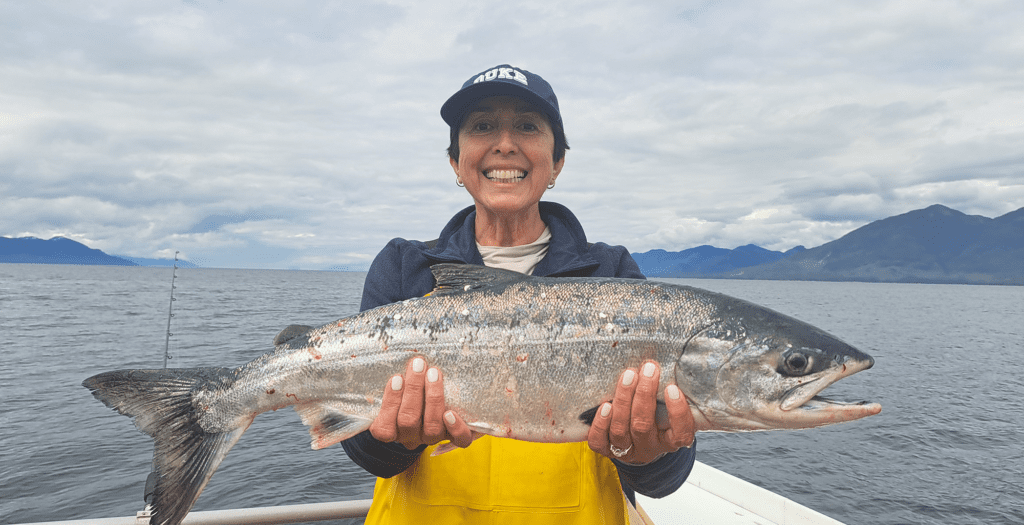
When I asked Josie her name, she said it was "Josie, like Josie and the Pussycats". Being all over 50 years of age on the boat, we all recognized the reference to the old television cartoon show featuring Josie, the star of a female rock band, and her supporting cast the Pussycats. With all of us being men Terry Sheeley said we wouldn't be the Pussycats as her band members, but we would be willing to be the Tomcats. And with that, the fishing band was formed.
On our first morning we fished a large sandy bottom flat that was about 260 feet deep, a non-descript part of the ocean some 35-minutes away from the lodge by boat. Dropping down our bait of herring with 12-ounce lead weights on a short leader, we began to jig for halibut, and wouldn't you know it, Josie caught the first fish of the day, a healthy five-pound true cod. Josie’s luck (and learning curve) increased over the next three days of fishing and she reeled in more than her share of cod, halibut, and salmon but it was our third day of fishing that Josie played her greatest hit.
The weather the first two days was mild but our final day on the water was a rough one. We endured a steady drizzle most of the day and rough seas that had Josie feeling under the weather. In fact, despite the fact she took Dramamine to combat motion sickness, she became sea sick. I’ll give her credit though; she stuck it out on deck as we jigged for halibut during a slow morning of fishing that only yielded a few smaller halibut and true cod. Then, Josie’s rod tip bent down in a big way. She set the hook and the fight was on. The fish Josie hooked was definitely no small halibut; oh no, it was a very big one.
Josie, who was not above using colorful language, used it in abundance during the fight that followed with this goliath of a fish. Having never battled a big fish before, she decided to kneel down on the deck on one knee and brace her fishing rod against the deck rail as she reeled. It was an unorthodox way to fight a fish but it worked. The fish made several runs towards the bottom, robbing Josie of line as it did, and each time the fish made a run Josie would loudly express her dismay. However, Josie stuck it out, kept reeling and eventually, after a long fight, got that halibut to the surface.
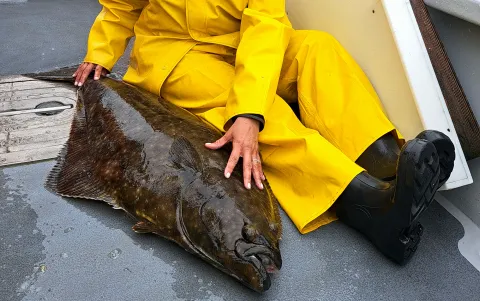
The fish was brought on board and it measured well over the 40 inches where non-resident charter anglers are allowed to keep a halibut in this part of Alaska. In fact, that fish measured a whopping four-feet and weighed an estimated 53 pounds. After snapping a few photos, that halibut was released back into the sea unharmed to grow even bigger and Josie’s day one prediction of catching the biggest fish on the boat came true.
After taking a short break to deal with fatigue from both the fight and sea sickness, she was right back on the rail for the final afternoon of fishing, reeling in half a dozen salmon in the process. In the end it just goes to show first time female anglers really can out fish all the experienced men on board, and Josie’s Tomcats were more than happy to be here supportive band as performed her greatest hit!
If you would like to find out more about the first-class fishing adventures available at Sportsman’s Cove Lodge for anglers of any experience level, go to their website at www.alaskasbestlodge.com .
/articles/josie-tomcats-go-alaska
Hoodsport Chum
For salmon anglers in the Pacific Northwest, November heralds the final transition from targeting open saltwater to focusing on tidewaters and rivers. Yes, there are some saltwater opportunities (for example, blackmouth, when open), but the vast majority of anglers have put away their boats and are pursuing salmon in the rivers. That said, there are some prime opportunities to target and catch salmon out of your fishing boats, so don’t button them up just yet!
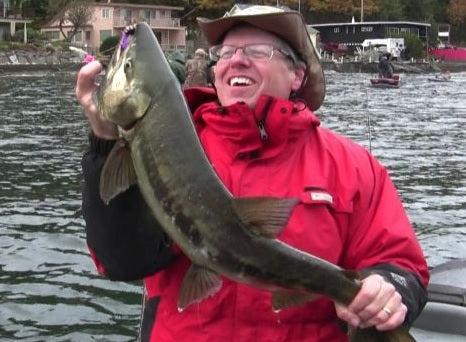
One of my favorite fisheries out of my boat in November has to be the Hoodsport chum fishery. The fight of a 10-15 pound chum ranks up there as one of the hardest fighting salmon you can catch. Taking on a chum with steelhead gear will give you all the battle you could ask for as these brutes slash and pull with every ounce of energy they have. One look at their fighting canine teeth and you’ll know this is a fish that is serious, very serious, about its reproducing goal.
All up and down Hood Canal you’ll find chum as they work their way toward their spawning grounds. The state hatchery at Hoodsport and three miles south of there at Potlatch (a smaller, Native American hatchery) are the destination for many of these chum as they work their way down Hood Canal.
I have caught fish in both locations, and each spot has reason to recommend it. Potlatch, being smaller, has limited shore angling and parking, which is roadside only. That said, there are also fewer anglers there. Hoodsport, meanwhile, is the Fishing Mecca that chum anglers are drawn to. Fishing right out in front of the hatchery and watching hundreds of fish jockey for position as the tide sweeps them into the small feeder creek leading to the hatchery is truly a sight to behold. Of course, along with the fish comes combat fishing in all its glory. As the tide comes in and fishing space decreases, getting to know your neighbor takes on a whole new meaning.
If you’re a fortunate one you’ll be fishing out of a boat – or some type of floating device. The waters around Hoodsport are open and the wind can come up and blow hard, plus fast running tides can make it a challenge to get an anchor to set. Be sure to bring an anchor with some bite, and terminal chain so you’ll stick in the rocky bottom. I’ve seen anglers fishing out of all manner of floating devices on calm days, including single person pontoons and float tubes. Be sure to have your life jackets on and just don’t venture too far off shore. If you are feeling anxious that’s your inner voice telling you a fish isn’t worth your life – pay attention to it!
For boaters, the launch is two miles south of Hoodsport at the Skokomish Park at Potlatch. The launch has two concrete lanes which are in varying state of repair (read that as back down with caution!). There is ample parking, and a restroom. Once launched it’s a quick run to either terminal hatchery, faster to the small Potlatch facility.
When you arrive, survey the already anchor boats, taking into account the amount of anchor line you’ll need to get a solid grip on the bottom, as well as the shore anglers. Anchoring too close to the shore bound anglers will earn you a steady rain of lures and weights at your boat. Stay outside their casting zone - you’ll have plenty of water to work over and opportunities to catch fish the shore anglers don’t have.
As to the type of gear you should bring… you’re going to enjoy a variety of methods to catch these Hoodsport chum. Like chum everywhere, chartreuse and green are always great colors to choose. Pink or cerise is also good color choices. For rod/reel setups I use my steelhead gear, both spinning reels and casting will get the job done. I like an 8 ½ foot medium action rod. Line should be strong enough to turn these big brutes so as to avoid massive tangle ups with your fellow anglers. I like 18-20 pound test. Chums are not leader shy in my experience so keep things hefty.
What technique you use is up to you but here are a few tried and true methods:
Floats and jigs , or floats and corkies with yarn can be deadly. A ¼ or 3/8-ounce pink, black or purple marabou jig fished under a float is deadly. Tipped with a piece of shrimp meat or coon shrimp tail is even better. The yarn is a nice trick as it helps by getting caught up in the chums teeth, allow you to drive the hook home. Other bait you can put under a float includes the ever popular anchovy or herring, whole or plug cut.
Think of the tide as the river current. Set your depth for the lure so it’s running a foot or so off the bottom. Vary the depth if you aren’t getting bites. These fish will hit suspended jigs. Cast “upstream”, i.e. up into the tide, and let your gear drift down with the tide to the end of the “drift”. If the coast is clear, free spool your line, keeping the float straight up and down to extend the drift. When the float goes under set the hook and be ready to do battle!
Twitching jigs – ditch the float and cast the jig on its own. Another effective technique, but be prepared for a lot of foul-hooked chum. Dragging a chum in by the tail is not fun, nor is it sporting to be snagging fish. If you find yourself foul hooking too many fish move on to a different method…
Casting spinners. Again, it’s a solid technique to try if the action is slow. I personally would remove the treble hook and use a single si-wash hook. A number 3 or 4 blade fished with a slow retrieve is just the ticket.
Corkie, yarn, and slinky. I personally have caught a lot of fish using this method and seldom snag fish. Again, think of the tide as a river. Cast out and let your gear drift. You’ll know you have a bite because your rod will be about ripped out of your hands. I use a 3-4 foot leader length.
Regarding the above technique, I’m sure I’m going to get comments about flossing – I personally think it’s a bunch of malarkey. Why do I say that? Because I remember a day years ago fishing Hoodsport when the chum were in thick, jumping all around us, swimming by in schools of 10-20 fish. I had my corkie/yarn/slinky set up going, casting, retrieving, and not getting a bump for a good hour. Suddenly, the bite magically turned on and my gear started getting bit. In came fish after fish, hooked in the jaw. Explain to me how one can have a steady procession of fish go by with mouths open for a good hour and not “floss” one fish, then suddenly start catching one jaw hooked fish after another? And trust me when I say this, those hook-ups were solid strikes, not to be mistaken with a snagging sensation. Anyway, the flossing debate is one we anglers love to engage in every year and likely will do so as long as we fish corkies.
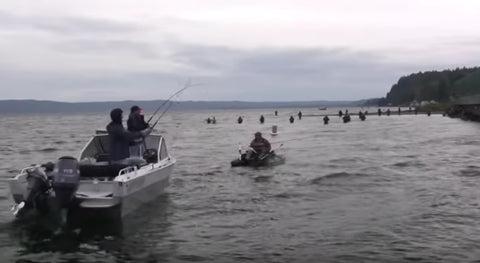
The fly fishermen do quite well at Hoodsport as well, fishing sinking tips and flies of various styles and colors. I’m not a fly guy but it sure does look like fun. Maybe on my next trip I’ll give it a try.
Before you set out, be sure to check the Hoodsport netting line at 360-877-5222. Typically the nets go in on Tuesdays and Thursdays, but this is not set in stone. There’s nothing worse than driving a hundred miles only to find nets spread in every direction. So save yourself that aggravation before you set out.
Fishing for hard fighting chum is a blast. Get in on the action this November!
/articles/hoodsport-chum
Hanford Reach Fall Chinook Bounty
My reel was peeling line at a dizzying rate and it felt like I had a freight train attached on the other end. Without thinking I applied my thumb to the level line spool and pulled back with a loud “ouch!” “That’ll leave a mark” our guide Dave deadpanned. The fish was a good fifty yards behind our boat before I was able to slowly start to regain line. Foot by foot the strong chinook and I battled back and forth, each of us gaining, and then losing line to the other.
The most popular location anglers congregate is Vernita Bridge. There is a large open area to the north of the bridge on the east side of the river. Every year a small town of anglers set up their base camp here. All variety of tents, RVs, and sleeping in the back of trucks can be seen. At night the cries of the coyotes remind you that this is wild country. Camping is free, but a Discovery pass is required. The launch here is rough and rocky and four-wheel drive is a must. Plan on your boat getting scraped up on the rocky shoreline and be sure to bring waders to help during the launch and retrieval process. Launching, by the way, starts at o-dark hundred. Alarm clocks are optional – unless you’re a deep sleeper, you will be awakened by the lights and sounds of anglers starting to launch around 3am.
Closer and closer the powerful fish came, each run a little less intense. Now a giant tail could be seen, trailing a large V wake behind it. Finally, the fish, exhausted came to the side of the boat and I saw the reassuring sign of fatigue as the fish laid on its side, telling us we were getting closer to that critical moment. Net sliding under the fish Dave skillfully scooped him up and into our boat. But not before the big fish gave one final flip of his tail, giving all of us an early morning soaking. Wow! This upriver fall bright was twenty plus pounds of pure power and beauty, not to mention great eating. The smiles and high fives of my friends were the icing on the cake and the day was just beginning!
A perfect morning, the sun just breaking over the shoreline and catching a hot Hanford Reach fall chinook - it’s the stuff dreams are made of, and it was living up to be everything I had heard about the Reach.
Washington’s Hanford Reach is synonymous with some of the state’s best fall chinook fishing to be found – and not coincidentally, the last of the chinook fishing to be found for the season. It’s the icing on the cake, and what icing it is! The Reach is the perfect setting and the perfect fish to end the year’s salmon fishing on the Columbia River. These are the brutes that dreams are made of. A fish worth dreaming about during the long off season and savoring the brief weeks they are available to catch. Battle plans must be made, so let’s talk about what you need to know to get into this fishery and have a chance at one of these amazing fish.
They call “The Reach” the last free-flowing stretch of the Columbia. With dams seemingly from one end of the Columbia to the other, this stretch of water has no dams to impede it. Here, from Priest Rapids dam down to Richland anglers have 63 miles of productive water to fish. Ideal spawning grounds make this a natural holding location for big chinook to do their reproducing thing. For the boat angler, you’ll find a variety of deep holes, shallow runs, and everything in between. A prop boat can be used – with extreme caution, however, downriver in the area known as Coyote Rapids a jet is the way to go.

Just upstream from the rough launch at Vernita you’ll run into the first hole, the Hog Hole. This spot will hold fish early and throughout the season. It’s in the middle of the river and runs a couple hundred yards in length and has a depth of 15-40 feet. Fish will be both suspended and hugging the bottom here. The hole is deep enough to require a way to get your gear down to the fish. This can include divers, dropper weights, and, yes, downriggers. A word of caution – the Columbia is a big, strong, and powerful river. Snagging a downrigger ball on the bottom of the Columbia has the potential for some seriously bad consequences and requires the boat captain and crew to be ready to deal with them. The times I’ve used downriggers I always have a wire cutter at the ready and a good dose of “always pay attention” to go along with it. It goes without saying if another boat hooks up to be ready to pull those riggers up. Backtrolling this hole works well and as you push the fish ever shallower by ready for that take down.
A variety of salmon catching gear can be used for Hanford chinook depending on the depth and speed of the spot you are fishing. Among the most popular setups are flashers with super baits (packed with tuna), plugs, flatfish (wrapped with a sardine or herring strip), and the ever-effective spin-n-glo with eggs, or eggs and shrimp. Anglers that are flexible and willing to adapt techniques to river flow and time of day will be most successful. Backtrolling your gear down the hole can be very effective, pushing fish back down the hole and triggering them to bite out of aggression is a tried-and-true technique.
Farther upriver as you head to toward the dam, you’ll find the King Hole about a mile and a half above the bridge, then the China Bar and Midway Drifts. One of my personal favorite spots is the deep hole just down from the dam. As well as being great holding water, it’s a stunningly beautiful spot. The deep hole off the rocks is great for downrigger fishing. You may even want to try running a diver twenty feet behind your release and bringing the ball up ten feet off the bottom, letting the diver do the work of bring your bait down to the bottom. Be sure to pay attention to the regulations and know the areas that are closed, downriver from the dam and on the west shoreline where the hatchery is located.

Below the Vernita Bridge you will find several more popular spots, including those famous old reactors. It’s about a three-mile run down to the B/C hole, and another four miles to reactor number one, and then number two. Beyond a large bend you’ll find the famous White Bluffs with a nice sixty-foot-deep hole. There’s a concrete launch located here, however; this is the area where running a prop boat becomes a dicey proposition. Be mindful that water levels can go up and down five to six feet in a day, leaving riffles where clear passage had been. It would be best to learn this water by first going with a guide before venturing out on your own.
Finally, farther downstream around the areas of the mouth of the Yakima down to the mouth of the Snake you’ll find slower water, more suited for prop boats. With several launches located around Richland, Pasco, and Kennewick, smaller boats will have a safer time of it than at the fast-flowing upper Reach spots.
As to timing, these up-river brights can be targeted from mid-September well into late October. Don’t be fooled by the dark coloring on these fish – they cut just fine and taste great!

The Reach is truly an amazing place to fish with the very real opportunity of hooking into large chinook. Multi-fish days are not unusual. As a bonus, while fishing you’ll be treated to amazing scenery. Besides moth-balled nuclear reactors, it’s very possible to see coyote, mule deer, several varieties of waterfowl, and even herds of elk on the shoreline. Some of the best weather in the Pacific Northwest can be had with temperatures moderating from the scorching hot summer days. You’ll find cool nights and a sky full of stars to gaze at as the coyotes sing you to sleep. And most likely you’ll be rewarded with some tasty chinook to take home.
/articles/hanford-reach-fall-chinook-bounty
Generational Fishing
I’m a new father. My daughter turns 2 at the end of July. It amazes me how fast time goes. My phone is fancy enough that it will create a collage of pictures and ask me “do you remember this day?” It’ll compile similar photos and quotes together with a caption along the lines of “outdoor adventures” or whatever else is sure to draw me in. I have to say, I like the features of the phone and sometimes I don’t remember the day or taking the photo.
Other times, the memory is clear and will get my brain churning to the before and after events of that photo. It’ll also lead to a great talking point with my family, or remind me to reach out to a friend who I was with during that time. It’s basically my generation’s photo album: a compilation of memories that elicit the sights and sounds of the past.
Seeing these photos and videos pop up on my phone makes me reflect on the journey I’ve been on. It makes me reflect and think about the life that was and the life I have now. The timestamped dates and pinpointed locations on the photos give me a clear reminder of when and where I was as I snapped those photos. Some photos I’ve kept in the camera roll for 10 or more years, other photos happening just yesterday or the day before. Each with a level of happiness and appreciation from the time. There clearly had to have been a reason I felt like the photo needed to be taken.
Even those photos of some random arrangement of letters and numbers for a code or a stall number in the parking garage so I wouldn’t get lost after a trip shopping. Although, that example probably has more to do with my wife than my own shopping adventures. Other photos are those milestones we will always remember but may not quite recall the details. Holidays with family, vacations around the world, a collage of our hobbies, or additions to the family. It’s those last two areas that inspire me to think about how thankful I am to be at this stage in my life.
Adulthood
Something about life before kids and life after kids is a pivotal point. The stage of “adulthood” that has a clear separation between life that was and now life that is. Those late nights I could go out and do whatever I wanted are no longer. There is now a little human who depends on me and my ability to have some foothold on my life. To use a baseball analogy, I wouldn’t say I need to be hitting home runs in all areas of life as a dad, although I’d certainly take them as they come, but there’s nothing wrong with taking the day-to-day with solid doubles to right center field.
I might even strike out a time or two, or if I’m having a particularly hard time navigating whatever the challenge of the moment is ground into a few double plays. The goal I think as a parent is to limit those outcomes as much as possible. To be a constant source of support, happiness, and guidance for your kid as best as you know how. It’s cliche to say, but my wife and I didn’t get an instruction manual when we left the hospital with our child.
It’s my hope that I can inspire my daughter to enjoy many of the same hobbies I have while also encouraging her to find her own. I’m into fishing, sports, and good TV shows. She might enjoy music, writing, or computers. Whatever the case may be, there are areas in our lives that will overlap and find common interests. I surely hope that enjoying the outdoors, and fishing specifically, are among the shared hobbies.
The patience and independence we learn with fishing is invaluable. Soft skills such as being able to hold a conversation during down time or to celebrate someone else’s success are also an important area we learn as fishermen. I hope to share the many hours on the road traveling to different bodies of water with her as I did with my dad. I know my growth as a man is in large part to his teachings when I was younger. I am also excited to see how he can impart his wisdom to her and influence her in a positive way. That kind of generational guidance goes far beyond fishing. Tying a knot, being able to read the water. Those are great, but the time spent together, and memories built are what is truly important. The three of us out on the water fishing? That sounds like a memory with lots of photos.
/articles/generational-fishing
The Dance Of Fly Fishermen
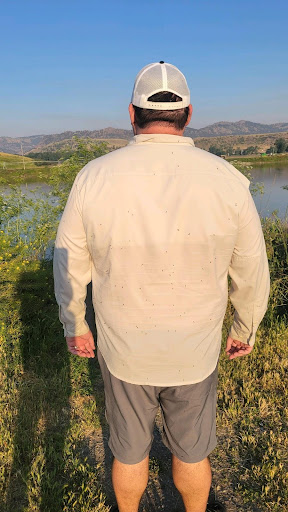
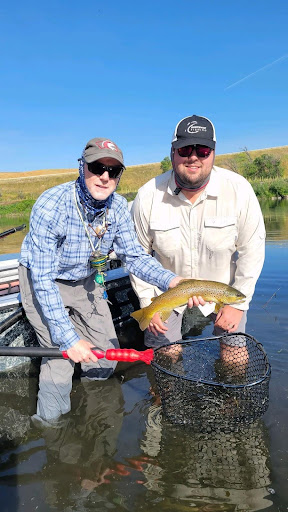
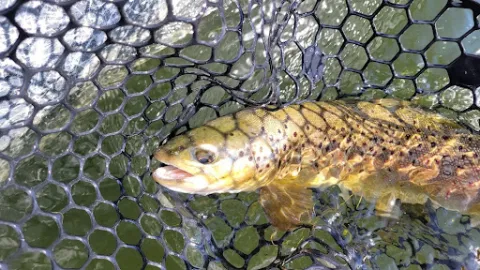
There are so many moving parts in fishing. Fly fishing is no exception to this interwoven connection between man, reel, and fish. On a trip with CrossCurrents Fly Shop,Chris Stainer even commented on my happy feet when hooked up on a fish. My rocking back and forth on the boat didn’t make it any easier for him to row, no doubt. But, what would you expect? I had a blue ribbon trout on the other side of my line! This was clearly an added moving part to the entire fishing experience. Line screaming out of the reel, a trout head fighting, and me doing my best to shift weight in the drift boat. All this made for a memorable trip on the Missouri River outside of Craig, MT.
Another graceful display to take in during the whole process of fly fishing. This beautiful river are the ongoing developing and vacating columns of tricos along the river bank. These mayflys make up a large portion of the diet for the fish in the section of the Missouri River. Their 24 hour life cycle made for an ever present food source during our late July fishing trip.
There were columns of bugs 10-15 feet high swirling and moving about. Some columns were next to one another, other columns were isolated as if they were exclusive to the most worthy tricos. These swarms of bugs were never annoying - no biting or buzzing around your head. They were part of the ecosystem a simple way that don't notice it unless an expert pointed out their significance.
Battling the Fish
The battle between you and fish is another dance to experience. Once the fish has been hooked, steering it as best you can through the water is a balance of both strength and finesse. Objects like weeds can be a challenge and weigh down the fish. This can give him “brass knuckles” as you fight him into the boat. Manipulating the fish is crucial. During a fight with an18 or 19 inch rainbow, it felt likea 10lb fish with all the weeds.
The same thrill can be had when you’ve hooked into an unwilling partner: the fish who wants nothing to do with your boat or net. The fish who turns and runs and pulls line out for what seems like a football field. These fish, you respectfully allow the opportunity to take as much line as they want. Perhaps the most enjoyable part of this rhythmic contest is when the fish takes flight. Seeing those trout leap out of the water with violent intentions and come splashing down is enough to hook anyone to the art of the fly rod. It is everything you expect and look forward to with a fishing experience like this.
The Technique
Of course, this all assumes you can get yourself on the dance floor. The level of technique required to fly fish isn’t much that a novice couldn’t figure it out. I certainly was able to with some pointers. But it requires a fine enough skill that one can’t have a “set it and forget it” kind of mindset. There is consideration of how much line to strip outthe required distance. Looking at your fly relative to the fish relative to the line and mending it to make for an attractive lure. All this even assumes that you’ve gotten the cast down. Too much power or not enough time to let the line get behind you on your cast and you look more like Indiana Jones with a whip than anything else. Rod tip out of position on the cast? Your fly isn’t going anywhere.
Chris’ dedication fly fishing stood out in two comments; one practical and one funny. An analogy regarding golfers. Say you’ve got an opportunity to golf at Augusta. Would you fly down there without having practiced and hope to do well on the course? Or would you expect to work on your short game and try to cut down on slicing your drive before the trip? The same practice goes into the technique when casting a fly rod. To the funny story - when talking about other techniques or ways to target fish - think bottom bouncing for walleye or using a downrigger for salmon, he said something to the effect of “Well if I wanted to do any of those things, I’d have to buy a spinning rod” with a grin and a chuckle. If you want to hone your fly fishing skills, see beautiful scenery and catch some awesome fish, there is no better place to do so than Craig, MT. And CrossCurrents Fly Shop in Craig, Montana can help make it happen. A word to the wise, leave dancing shoes at home when you go.
/articles/dance-fly-fishermen