The Best Fly Ever Made
Strip, strip, strip… the intermediate sinking fly line passed through my fingers in three-inch increments. Varying the retrieve, sometimes fast sometimes slower, pausing and resuming my retrieve, I floated along in my belly tube, taking in all the remote mountain lake had to offer. A tree-lined shore, snow-covered mountains for a backdrop, and not another soul in sight.
Suddenly the line came to a hard stop, jerking my rod forward, the frantic pulling of another chunky rainbow signaled “fish on”. Catching up my line to the reel, I played the healthy native trout to me, sliding the knotless net under her belly. The glistening distinctive markings of the bow glowed vibrantly in the evening light. Gently removing my barbless fly, I cradled the tired fish while it rested. In a few moments, the rainbow impatiently strained against the confines of the net, eager to return to the cool depths of the lake. Safely recovered, I tilted the net and watched the fish dart away, a splash of cold water in my face as if to say, “don’t fool me again!”.
If you had just one fly in your arsenal to catch trout, what would you pick? The hardcore anglers of course will dismiss this question as irrelevant and silly. Fly fishing is all about matching the hatch, and there are literally hundreds of variations of flies – dry, wet, nymph, the possibilities could fill up several tackle boxes. Picking one sounds like a fool’s errand, doesn’t it? Well, I will cast my vote and be that fool. Drum roll please…
My favorite, go to fly is – the venerable Wooley Bugger.
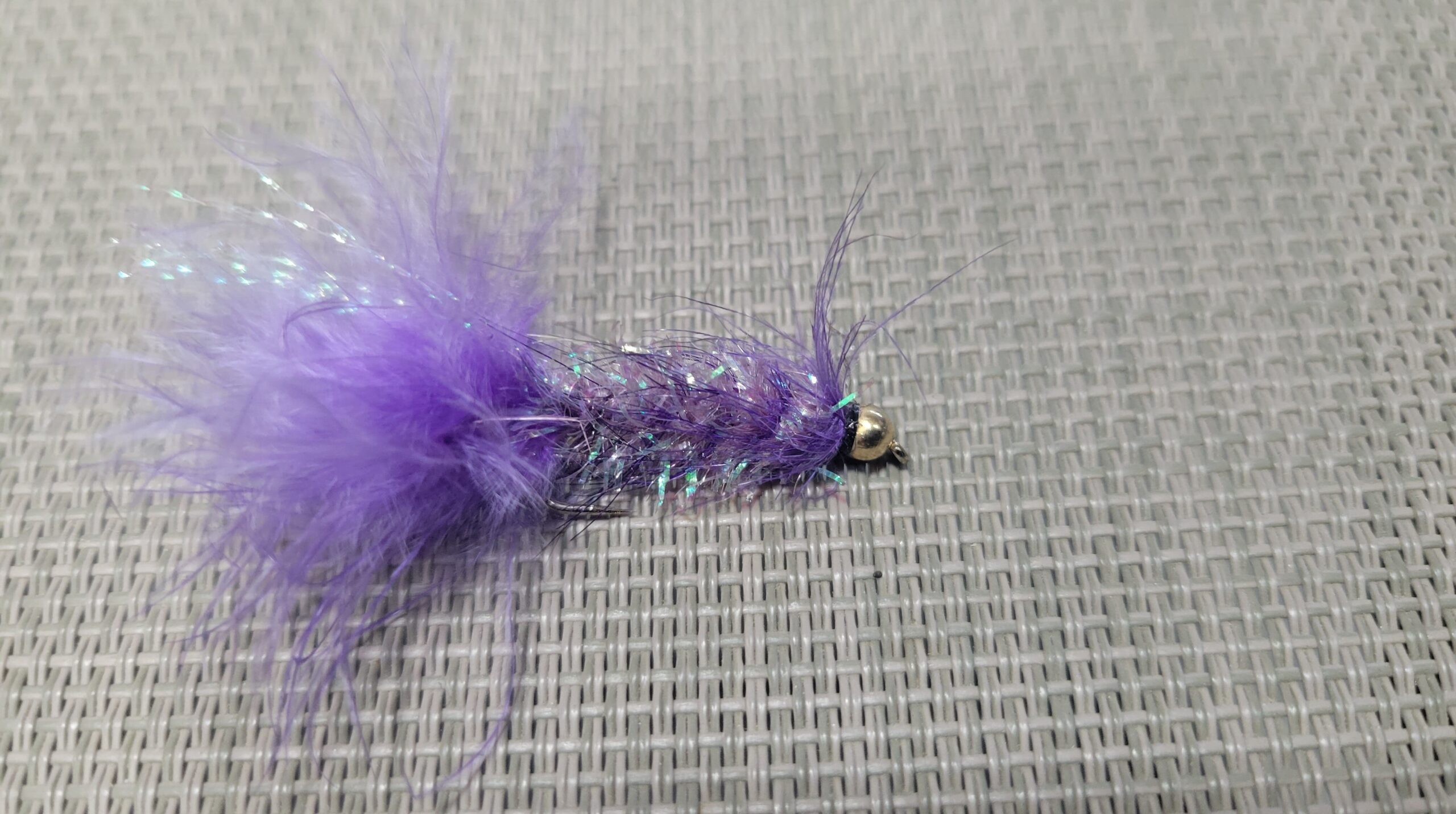
Was that your choice as well? If not, let me expand on why the Wooley Bugger is often the first fly I will cast out on a new body of water, and some of the qualities that make this fly, in my opinion, so essential to be in your tackle box.
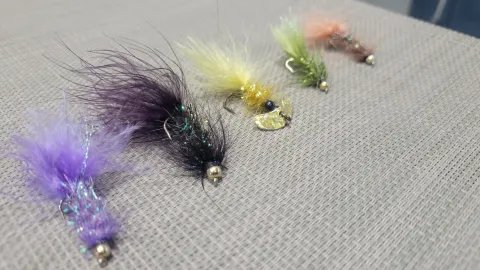
First, a Wooley Bugger is a wet fly which can be used in lakes, rivers, ponds, and even saltwater fishing. Wooley Buggers come in a variety of styles and colors and can be considered to imitate many different food sources for fish, including small minnows, leeches, nymphs, and anything else swimming around a lake or river. As such, Wooley Buggers are the ultimate “searching” fly, perfect for exploring new bodies of water with.
Wooley Buggers lend themselves well to more than traditional fly fishing. They can be adapted for many styles of angling and fish species. Years ago, Uncle Wes Malmberg took me to a SW Washington Lake, and long lining a Wooley Bugger with a Mack’s Smile Blade off the back of his 14 foot aluminum boat we spent a relaxing morning catching and releasing rainbow after rainbow. A couple split shots was all that was required to sink the fly under the surface and entice fish after fish to grab on. Fished bait and scent-less, we easily caught and safely released several dozen fish that day. Such a simple but deadly effective method! I immediately went home and tied up several new colors to add to my collection.
For the beginner fly-tier, the Wooley Bugger is likely the first fly you ever will learn to tie. The reason is this fly is simple to make, and is generally on a larger, long hook shank, making it easy for beginner fingers (or those with older, arthritic hands). As such, it’s a great “introduction to fly-tying fly”, before tackling those challenging #20 dry flies and nymphs! A quick search on the internet will provide you with a multitude of videos and tutorials so I won’t go into the actual tying here, suffice it to say if this is an interest, you’ll find plenty of information on how to tie the Wooley Bugger. It’s a great first fly to tie and is hard to make a bad looking one.
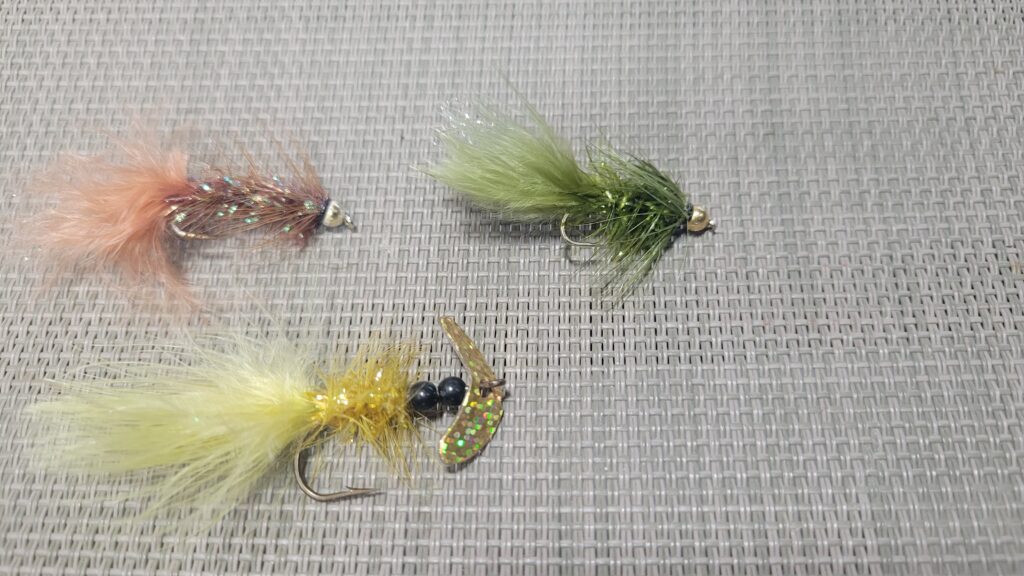
Another application for the Wooley Bugger that you don’t hear about often, but can be deadly effective, is trolling behind a sling blade for kokanee. Go to colors are pink, red, and orange. Add a Mack’s Smile Blade and a single kernel of corn, short leader of 8 inches, and you are in business. The single hook provides excellent penetration on strikes, but if you’re anxious about that single hook tying on a small treble hook or trailing hook is certainly fair game.
Now that I live in Montana, more of my time is spent fly fishing. When I arrive at a new lake or pond, if I don’t see rising trout, I’ll start off with a sinking tip line and Wooley Bugger in a natural color, tans, browns, and greens. Casting and stripping back is a tried-and-true method, as his casting out and slowly kicking my belly boat along, waiting for that solid jerk signaling another fish fooled by this classic and timeless fly. Whether behind a fly rod, spinning rod, or trolling rod, the Wooley Bugger will get you on fish. Give it a try, I think you’ll be happy with the results!
/articles/best-fly-ever-made
Squid Jigging the Piers of the Puget Sound
With the arrival of each new season here in the Northwest, it’s hard not to feel like a kid in a candy store. Whether it's fall, winter, spring, or summer, these annual intervals of changing weather and day length always seem to provide new opportunities for the men and women who choose to reap the spoils of the outdoors. If the desire is there, the fun and the food is at our doorsteps.
A commonly overlooked opportunity that starts up in Neah Bay during late August and ends down in the south Puget Sound towards the end of winter, is the squid fishery, specifically the Pacific coast squid, also known as the California market squid.

The Pacific coast squid are relatively small, averaging about 8 inches. They have short lifespans and spend most of their time in the Eastern Pacific Ocean—between Baja California and Southeastern Alaska. They move into the straights of Juan De Fuca during late summer and their numbers tend to peak in the Puget Sound around December and January.
The fishery is often fickle, with some years falling short of anglers’ expectations, while other years the fishery can prove to be quite robust. On these years when the squid are plentiful, the hardest working anglers can find themselves heading home with their limits, which, as of January of 2023, the Washington Department of Fish and Wildlife has set at 10 lbs or a five-gallon bucket filled to the halfway point. Now that is a lot of calamari!
Jigging from a boat or a pier is the most common way to procure these saltwater delicacies, and during the winter you will often find the docks from Everett down to the south Puget Sound alive with folks chasing the Pacific squid. Squidding is a minimalistic endeavor. A fishing rod, a spinning reel, and a squid jig are essentially all that is needed. Squid jigs find their origins in Japan.
They are usually torpedo or bullet-shaped jigs with several spines at the bottom that point upright. These spines don't serve the same purpose as a typical fishing hook. Instead of puncturing or penetrating the squid, they create a bit of a platform for the squid to become entangled in as they latch onto the colorful plastic body portion of the jig.
Many squid jigging enthusiasts swear that nighttime is the best time to catch squid. By in large this holds true, but it’s also important to put some focus on the tides and water clarity. A high tide with decent water clarity can produce squid even during the daytime.
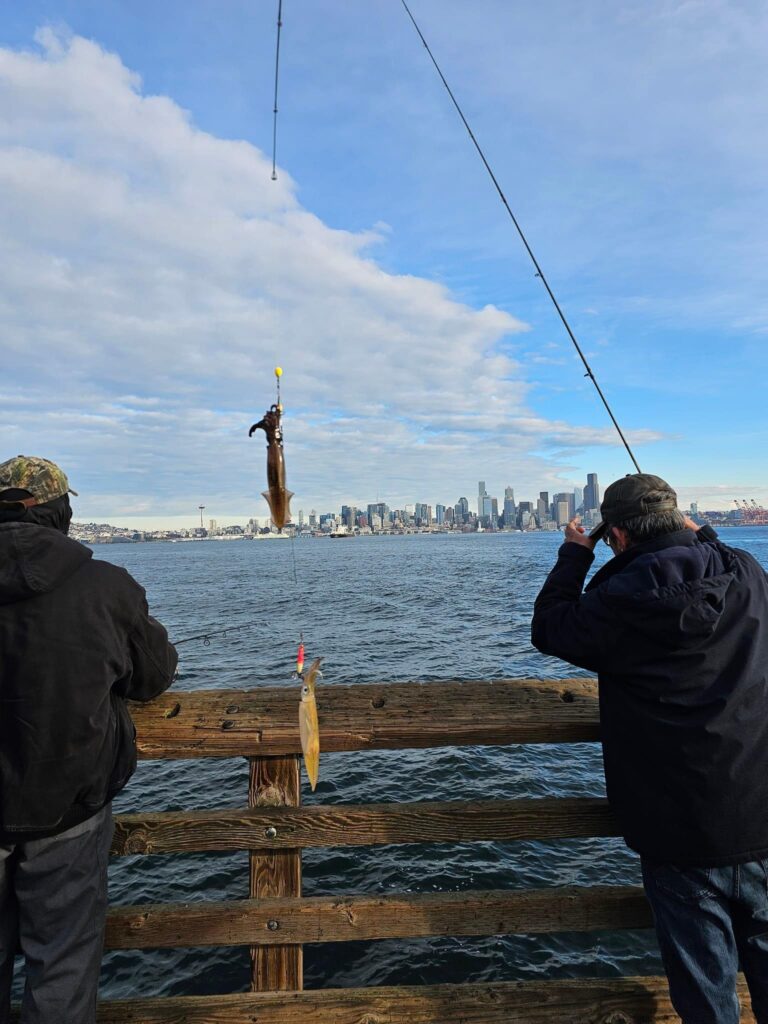
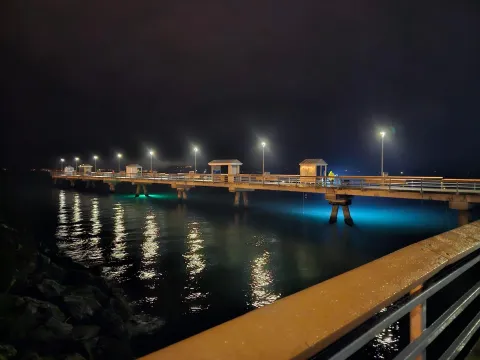
At night, squid are attracted to the lights illuminating off of the piers. The general belief around this is that light attracts phytoplankton, the phytoplankton then attracts zooplankton, and zooplankton attract the fish and other critters that squid like to feed on. Piers already come equipped with their own lights and these typically do a decent job of providing the needed illumination to bring in the squid.
With that being said, the chances of bringing in larger amounts of squid become increased when a more powerful and concentrated light is introduced. Folks will often bring battery or generator-powered lights to shine into the water. Check with local rules to find out if generators are allowed.
While on the topic of rules, it’s important to note that there is a fair amount of pier fishing etiquette to consider while navigating the pier. It’s best to speak with folks who are using lights and ask them if it’s ok to post up next to them. There’s a good chance they might be saving these spots for friends or family and It’s not uncommon for conflict to occur on the pier if people aren’t using common courtesy while acquiring their jigging spots.

Just as the gear is minimalistic, the technique is simple as well. Folks will work their jigs in a variety of ways, but sticking to the basics is what generally will get you on the squid. When casting, you should allow your jig to drop to a depth where squid are holding, lift the tip of your rod and slowly retrieve as you lower the rod tip back down, then repeat the process.
Once you have a squid on your jig, keep tension on the line and the squid should remain there as you retrieve. The method is similar while jigging directly beneath you, though you won’t be doing any reeling in of the line until a squid has attached itself. Some people like to do a few quick and hard lifts of the rod and then let it sit near the bottom for a few moments. Though you might not feel the squid strike your jig, the difference of weight at the end of your line once you lift again, will be your indicator that you have a squid on.
So, if you’re anything like me, and consider the sound of a bubbling deep fryer to be just as much of a winter staple as holiday tunes or roasted turkeys, then put on your winter jacket and head to a local pier for your shot at getting that bucket up to its halfway point with these great tasting cephalopods. And remember, there’s no such thing as bad weather, there’s only such a thing as bad gear!
/articles/squid-jigging-piers-puget-sound
Soothing My Soul on the Sol Duc River
Of the many rivers in the beautiful state of Washington, the Sol Duc is one that can manage to keep just about everyone happy. Whether you fly fish, spin, or bait cast, there is, or at least was, a fish with your name on it!
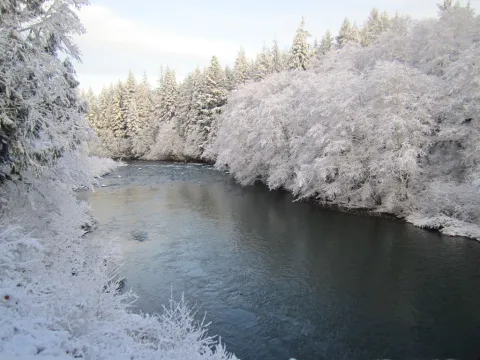
Fish species on the Sol Duc include Fall and Summer Chinook, Winter and Summer Steelhead, Coho, Sockeye, and both resident and sea-run cutthroat trout. The Sol Duc River runs 78 miles from the Olympic Mountains and cuts Southwestward through the most spectacular scenery in Washington State. With a variety of access points, you'll be greeted by precipitous gulches and mossy rocks in vivid green tones set a fire by the angle of the sun.
Picture perfect moments around every corner. The river is a pleasure whether you're catching or not. Just to be there, to catch a glimpse of an ancient creature born of the gravelly riverbeds. Traveling their way through genetic imprinting, magnetic fields, the temperatures, and conditions of the earth, making a 70-mile journey into the unknown.
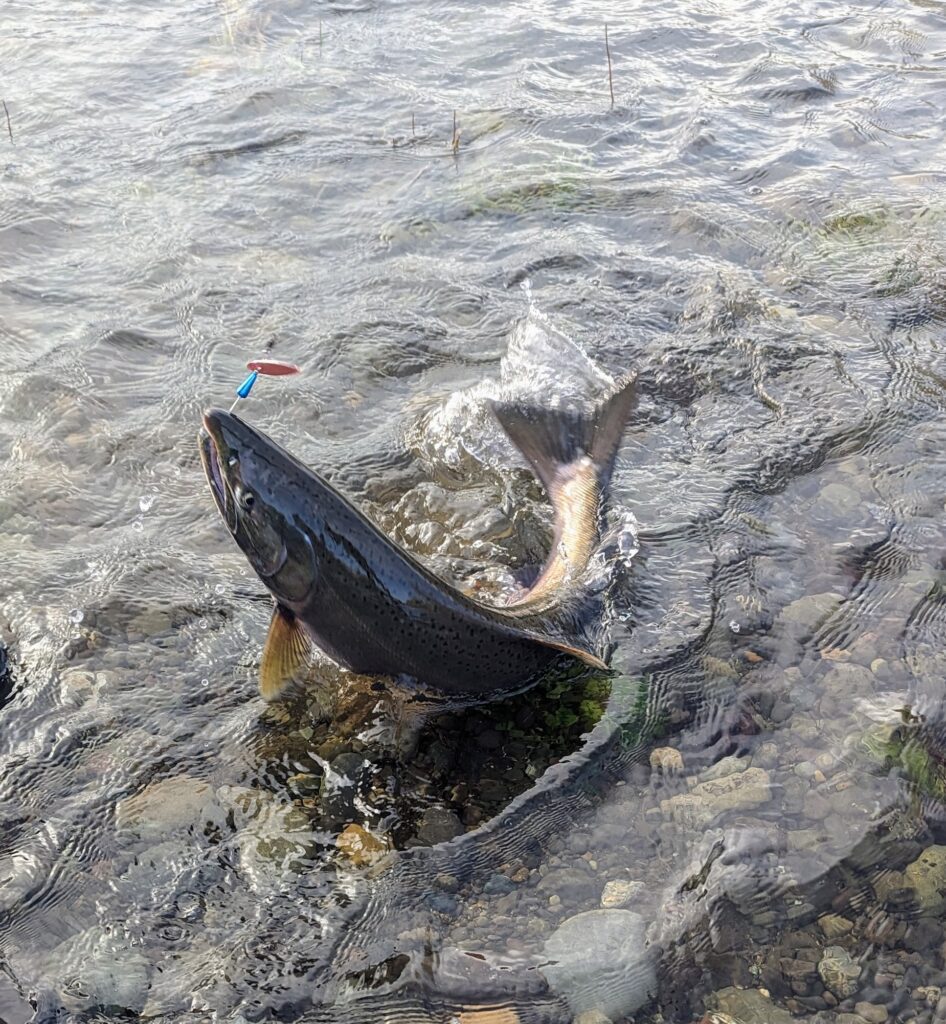
What is it that ensures a fish can find its way back to the place it was born? When I can't even find my way home without an app. An interesting factoid, scientists have discovered fish have ear stones called otoliths. These “otoliths” incorporate chemical elements from the water as the fish grow and move. Picture a growth band of a tree, with each ring recording a chemical map of where the fish has been, how long they stayed there, and how fast they grew. Scientific advances like this are pivotal in managing fish populations.
I have a deep concern and respect for the natural world, a curiosity for things we can and cannot explain. A desire to be a part of it all, to get my hands dirty and my mind clean. So, while we still can, I will travel my own way, finding places that provide an opportunity to get my line wet.
My most noteworthy experience would be a fantastic stay at the “Cabin on the Middle run” in Forks. (olympicpeninsulawaterfrontcabins.com) Easily accessible and found off 101, this well-appointed, clean and cozy cedar cabin boasts everything you need and more. For me it was the stocked kitchen and comfortable beds, topped off with a long hot shower. Though, I must admit we spent most of our time in the backyard. Our hosts and neighbors were so very friendly and helpful. Which isn't always the case when you're fishing in someone's backyard. We were rooted on and engaged in friendly conversations with guides floating by and neighbors on their decks. When I lost a huge dazzling Coho the echoes of disappointment hummed through the valley.
The comradery of fishing is something you'll never understand, until you feel it. Like a Folie à deux, are we driven by madness or passion and is there really a difference? Whatever it is, that makes us feel hyped up by each other's experiences, it is infectious and exhilarating. I desperately hope the rivers will return to a place where we can enjoy catching at least one fish. Not just for the fun, but also for the food. Nothing beats a filet from the river. I have become so spoiled by the flavor of a fresh catch, commercially sourced just doesn’t make the cut.
Make sure you check all regulations before heading out these days. Low returns have caused a system-wide closure in the Quillayute river system. This system includes the Sol Duc, Bogachiel, Calawah, Dickey, Sitkum Rivers and Thunder Creek.
As heartbreaking as these closures are, they are necessary to ensure that our rivers can support humans and the local ecosystem. I admit, a mix of resentment but also understanding that the system works to protect, preserve, and perpetuate fish and wildlife.
As a fisherwoman, my recreational opportunities are last in line and that is ok. Will this closure stop me from enjoying the beautiful Olympic rainforest and its awe-inspiring rivers? Never! I will plant my feet in the forest, hike to the waterfalls and sit my soul quietly by the river. Waiting my turn.
/articles/soothing-my-soul-sol-duc-river
Outdoor Serenity
Let’s take a step back away from fishing for a moment, please. That may be sacrilegious, coming from a magazine that is on its face wholly dedicated to fishing. I mean it’s called Reel Life for Pete’s sake, the pun couldn’t be any more fishing related. Consider the experiences that we add to our core memories from our passion for life outside the concrete jungle.
The sights and sounds of places we’ve just experienced for the first time. Those times with friends and family. The sometimes-trivial outings that we build into our routines because we are outdoorsmen and outdoorswomen at our core. Being present at those times is crucial to our ability to take a deep breath and hit the reset button.
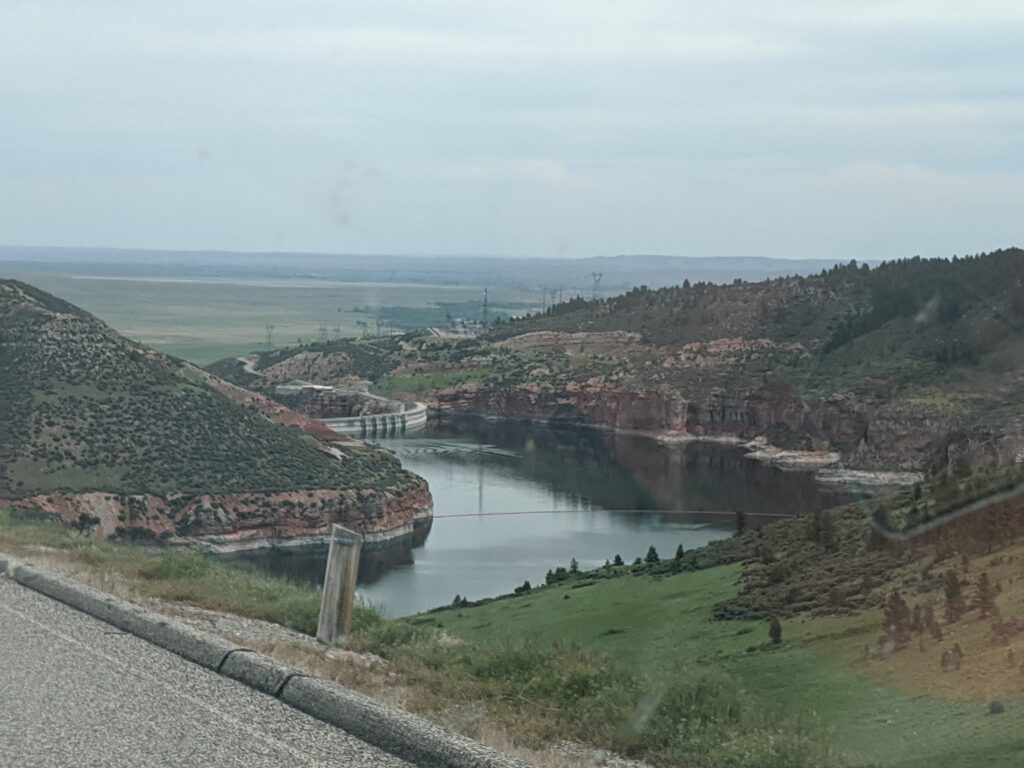
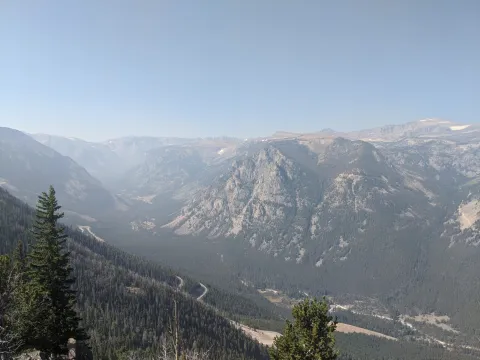
One of the most scenic drives I have ever experienced came from a trip along the Beartooth Highway in the heart of the Custer National Forest. It is one of those winding, nauseating, fear of height inducing drives that really make you appreciate the work of engineers. The drive up the mountain is narrow. A two-lane highway with an unforgiving drop on one side of the road and an immovable rock face on the other.
It makes me wonder how folks drive campers, boats, or trailers up such a road. There are points along the drive where, if you’re on the outside lane, by peering out of the window, you’ll realize the full effect of the over 9,000-foot drop off the road, add another nearly 2,000 feet if you decide to get to the very top. It’s a road so treacherous, it is closed during the wintertime, and rightfully so.
In addition to these crystal-clear memories of peril, are the wondrous views that come from the observation point. The attraction looks around 360 degrees and has all the amenities you’d expect: a bathroom, parking, informational signs, and posters. But, more importantly, there are the sights. Mountains, that from below looked ominous, are now eye level and expansive. On a clear day, like the one we thankfully had when we made the journey, that allows you to see for miles.
The funny thing about being at the point is my lack of memory about the people or whatever else was going on. I know there were other cars in the parking lot and people walking around the trails, but I really can’t remember any of them. The calmness of the moment and realization of these breathtaking views is something I’ll keep with me. Even in these moments where modernization blends, crosses over, and cheapens the outdoor experience, it’s still easy to find ourselves appreciating what the outdoors can do for us.
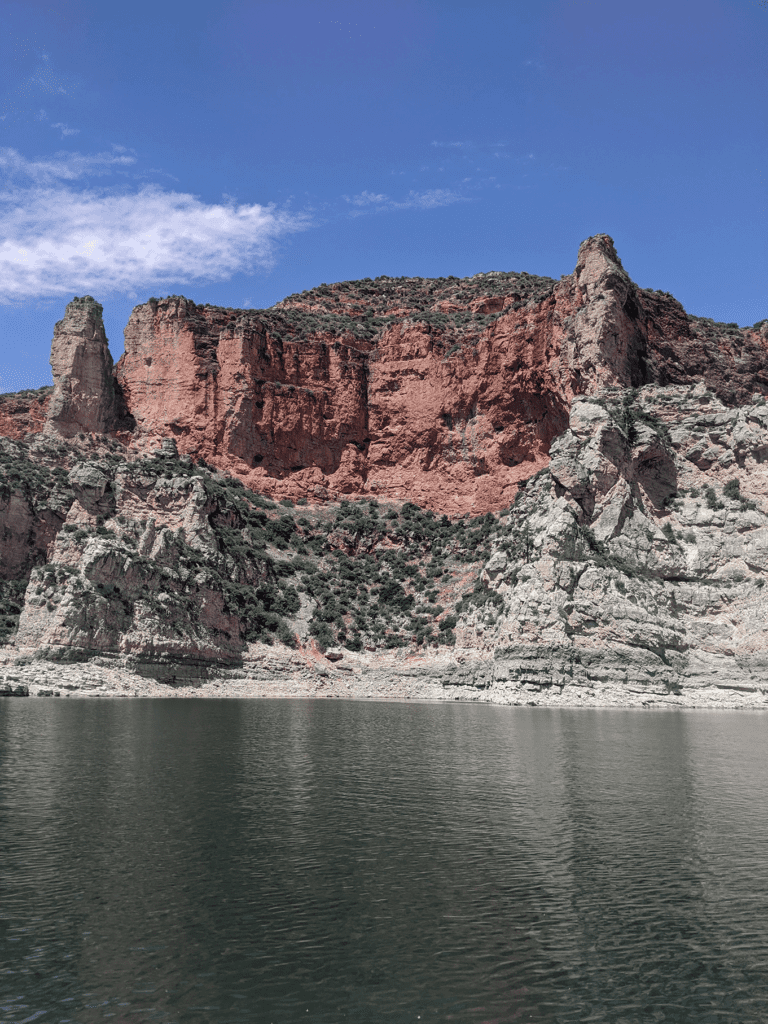
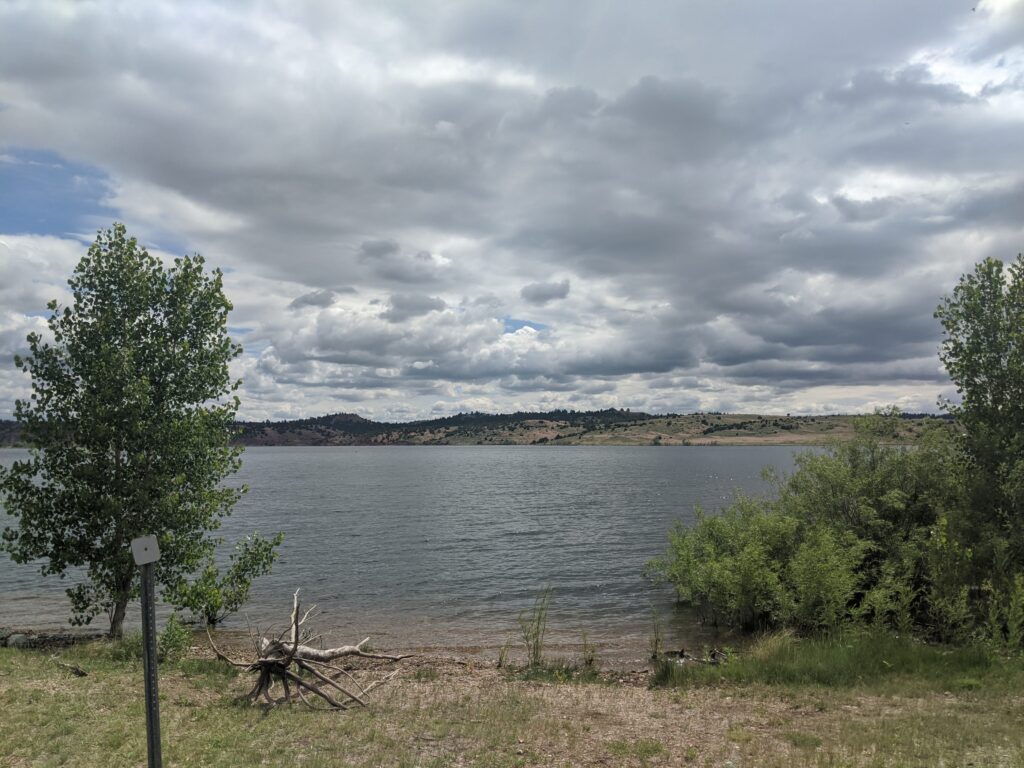
Ok, let’s bring it back to fishing, just slightly. The Bighorn Canyon sits in the heart of the Crow Reservation in Montana’s eastern third of the state. The area is simply gorgeous. It doesn’t hurt that the area produces some of the highest quality trout you can find, as is the case in many of the Blue-Ribbon Montana waterways. For the hiking or ATV enthusiasts, you’ll want to stop at Pryor Mountain, as the Bighorn Canyon offers a few trails along the way, but the area primarily runs along the Bighorn River. A few fishing trips with a close friend of mine will always draw me back to the area and the peacefulness I experienced, with one memory, particularly in mind.
Did I mention the canyon is incredible? It really cannot be understated the jagged edges of the cliffs and the deep red colors slowly fading to a subtle yet muted granite. The water is a pristine blue. Seemingly untouched and calm as glass. We nearly had the canyon to ourselves except for a few families enjoying the day on the water and some kids fishing from the dock.
My buddy in fact complimented the kids on their small bucket of fish they had accumulated and in turn, they gave him the lure they’d been using. It was a fun little exchange and was nice to see that kids can still be thoughtful. And of course, we used the lure and caught some of our own! We put my boat in the water and didn’t travel too far from the dock, maybe a few hundred yards into a nice rocky hole that was loaded with bass.
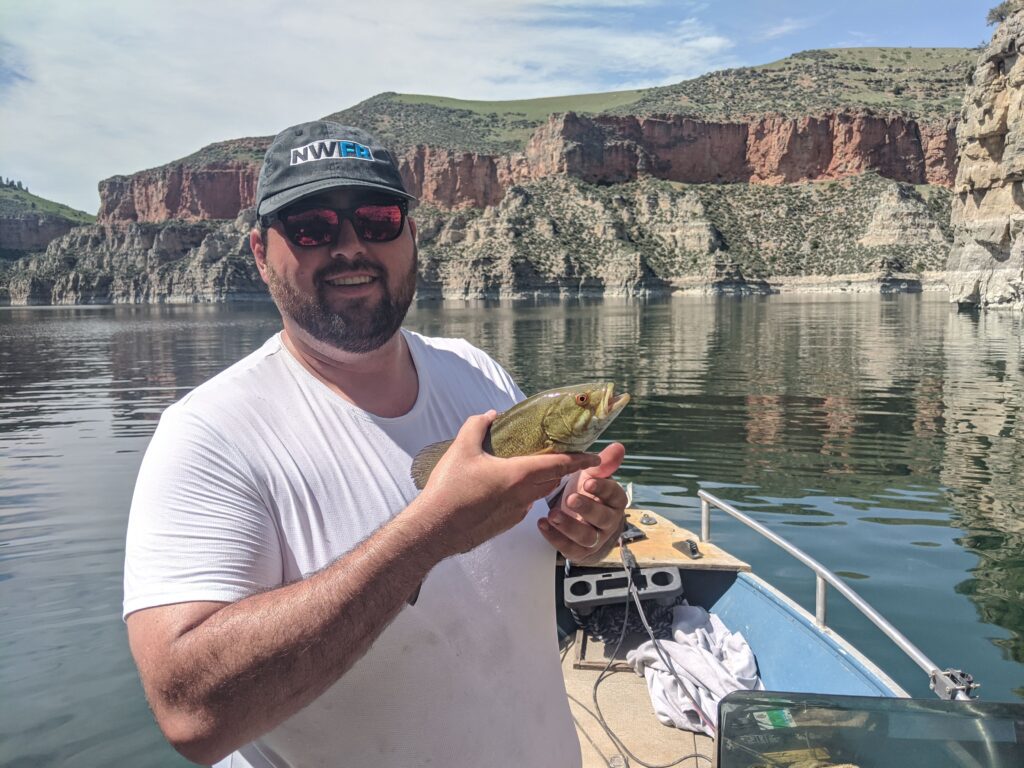
We trolled around slowly to different bays within the river for a few hours and continued to pull out solid sized fish. The kind of fish that makes you appreciate being outdoors with a consistent bite and decent weight behind them. All the while, talking about work, family, plans, and all the other things you’d expect to visit about. It was a fishing trip I’ll remember fondly because of the time with a valued friend and the opportunity for breathtaking views. It was also memorable due to a trailer tire popping and me driving on the axle for who knows how many miles, but that’s a story for a different time.
Let’s not mistake the vivid memories from our time appreciating the tranquility of the outdoors as more meaningful than the opportunities outside we capitalize on through the routine of our lives. For me, those instances take shape in the form of an activity as easy as walking my dog. He’s a hunting dog by trade and at 7 years old is still full of energy and prey drive. Tracking anything and everything is still a large part of his world, even if the hunting season is a few short months. Those other 9 months of the year he’s relegated to leashed walks around the hardware store or some off-leash trails and parks around town. Taking the dog out for a walk is not unique or special.
Perhaps you reading this have a dog yourself. You probably do the same routine part of your day as I do mine. Get up, go to work, come home, spend time with your family, and take the dog on an evening walk. Rinse, repeat. I would challenge you to be present in those moments outside if you aren’t already. I’m guilty of putting on a podcast during a walk or listening to music like anybody else. But I’ve tried to make a habit of putting these things aside if I’ve got the opportunity. A leashed walk down the street? Fine, music’s not a big deal provided you’re on the sidewalk. The hardware store? Well, we’re here buying stuff so it’s not much of an outing for the dog, but it is a chance for socialization and to break up his day. What about a hike on a trail or a stroll on some public land?
Those are the outings I try to be cognizant of. Quiet. A passing hello to another person briefly, and then back to isolation. Although built into the day-to-day of everyday life, something as simple as a walk with the dog can bring a calmness and recognition for everything we experience beyond our home’s front door or the office. Why drown out the peaceful silence when in that moment?
/articles/outdoor-serenity
Bag'n Blackmouth
2023/2024 Blackmouth Prospects
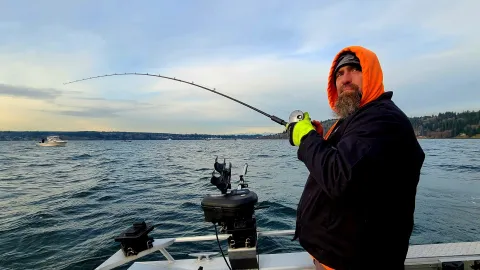
With the exception of a few laggard B-run coho in the rivers, our PNW salmon focus should be shifting to the 2023-2024 Puget Sound winter blackmouth fishery. Typically, winter blackmouth is one of my favorite local fishing opportunities. Going back to my mid-teens winter blackmouth fishing has always been one of my very favorite ways to grow snotsicles.
Because recent conservation measures have severely reduced our opportunity to drag downrigger balls in the gravel, many of us will be considering putting the salmon gear away and winterizing the boat. You may want to hold off a bit, break out a wool hat, hoodie, and your cold weather friend Mr Heater. it’s almost blackmouth season. But, what’s a blackmouth?
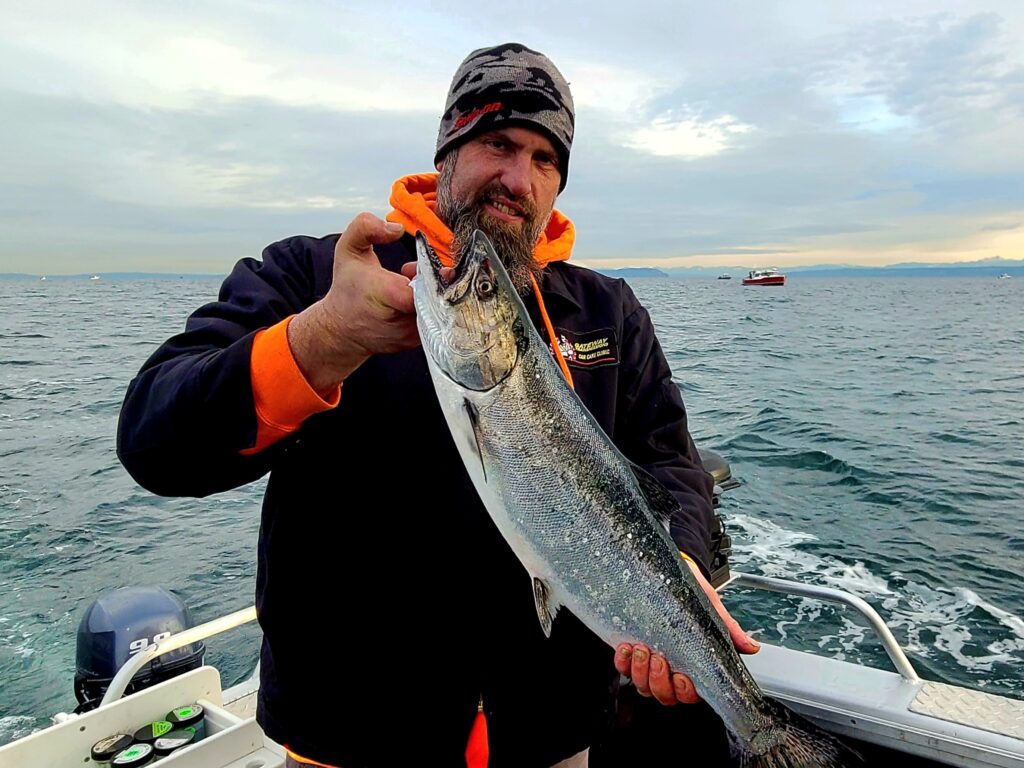
Blackmouth are chinook salmon that have decided not to migrate to the usual feeding grounds in the Gulf of Alaska. Instead, they tend to remain in Puget Sound and the Straights to feed on local schools of herring, candlefish, other forage fish, and squid.
Back in the 1960s, WDFW decided to duplicate the natural tendency of a small percentage of chinook to remain in Puget Sound and create a year-round sports fishery. The WDFW established a team led by Frank Shaw and got to work. It was determined that if you held the usual hatchery release at 3 months for an additional year, or 15-18 months total, the chinook would forage locally.
The original releases were made in Capital Lake in Olympia. The program moved to net pens by Squaxin Island but the WDFW determined that the salt-reared fish tended to migrate. The program was shifted to several local hatcheries. They are for the most part clipped, but there are certain releases where the co-manager agreements do not allow the fish to be clipped.
Over the years we have seen a reduction in opportunity; a few years back we lost the winter blackmouth fishery in Marine Area 7, 8-1, 8-2, and MA 9. They were closed to preserve or extend some of the summer chinook fisheries while still supporting federal and co-manager escapement goals.
Reduced opportunity, well maybe, but there are still a few areas that will host a blackmouth fishery this winter. That said; chip the ice out of your bilge, gas up the boat, and read on.
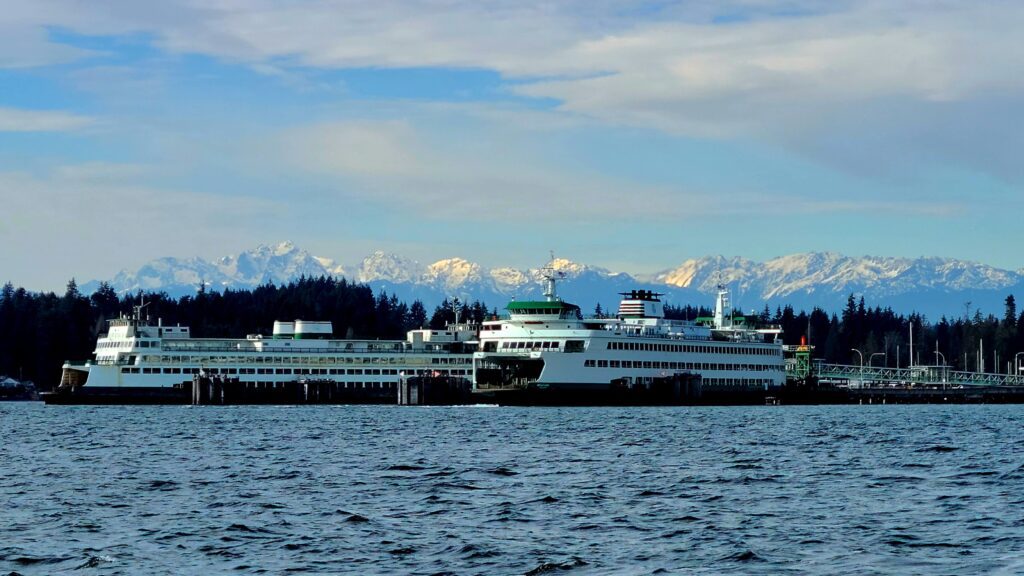
But first, no boat? While most of our winter blackmouth fishing will be from a boat, there is also an opportunity for a limited shore-based fishery. More on that later, if you do have a boat here is a breakdown of the 2023/2024 Puget Sound winter blackmouth fishery.
- MA 5 will be open 4/1/2024-4/30/2024 with a 22” minimum and a 2 fish limit, (1 chinook may be retained).
- MA 5 Management Criteria – Sublegal Encounters; the encounters guideline is 3,707 fish.
- MA 10 will be open 3/1/2024-4/15/2024 with a 22” minimum and a 2 fish limit, (1 chinook may be retained).
- MA 10 Management Criteria – Total Encounters; the encounters guideline is 4,953 fish. Unmarked Encounters; the encounters guideline is 953 fish. Sublegal Encounters; the encounters guideline is 4,181 fish.
- MA 11 will be open 3/1/2024-4/15/2024 with a 22” minimum and a 2 fish limit, (1 chinook may be retained).
- MA 11 Management Criteria – Total Encounters, the encounters guideline is 1,191 fish. Unmarked Encounters; the encounters guideline is 259 fish. Sublegal Encounters; the encounters guideline is 816 fish.
- MA 13 will be open 10/1/2021-5/14/2021 with a 2 fish limit and a 22” minimum size. Management Criteria do not currently apply.
- MA 6, 7, 8-1, 8-2, 9 and both North/South MA 12 will be closed for the 2023/2024 winter blackmouth fishery.
The above information was extracted for the 2023 North of Falcon data and may be subject to additional closures. Consult the WDFW App, or website for the current regulations and emergency closures.
With the limited blackmouth opportunity for the 2023/2024 winter season, the open areas will likely be busy. Instead of detailing each area, I’ll try to break down the different Marine Areas into a few general options for starting your adventure.
Before that though; think of points, banks, and flats. Look for areas where the currents will collect bait. Keep a constant eye on your fishfinder and look for schools of bait. Although forage fish populations change from year to year, candle fish and herring are the primary forage fish for Puget Sound blackmouth. That said, because of a general crash in the Puget Sound herring populations, candlefish are currently the major blackmouth food source.
Candlefish show as a cloud of bait right on the bottom. Find candlefish and you significantly improve your odds, find arches and candlefish on the deck and it will be hammer time! Candlefish spawn in the gravel and are rarely found above that. I have caught many blackmouth where their gill plates and bellies were all scraped up. I have even cleaned fish and found gravel in their stomachs. So, where does one target gravel filled salmon?
Marine Area 5
Or basically the Sekiu/Pillar Point area has a few notable blackmouth areas to target. The Caves, Clallam Bay, and then Slip Point to Pillar Point can all be awesome blackmouth fisheries. All can be very exposed to winter weather so know your limitations. Help is a longways off if you get in trouble so always err on the cautious side.

Marine Area 10
Is the Seattle/Bremerton area and includes a number of well known, semi-protected blackmouth fisheries. Kingston, Jeff Head, West Point, Elliot Bay, Alki Point, Point Monroe, Skiff Point, Manchester, and different banks or points around Blake Island consistently produce blackmouth. Look at the weather, choose a launch and learn a given area to feed your winter addiction.
Marine Area 11
Or the Tacoma area is one of the best small-boat blackmouth fisheries on Puget Sound. The Slag Pile, Owens Beach, and Clay Banks are all easily accessible and just minutes from the Point Defiance launch. With the proper boat for the conditions, Dalco Point, the Beach just north of Gig Harbor, Point Robinson, Browns Point and Dash Point all offer solid blackmouth fishing as well.
Marine Area 13
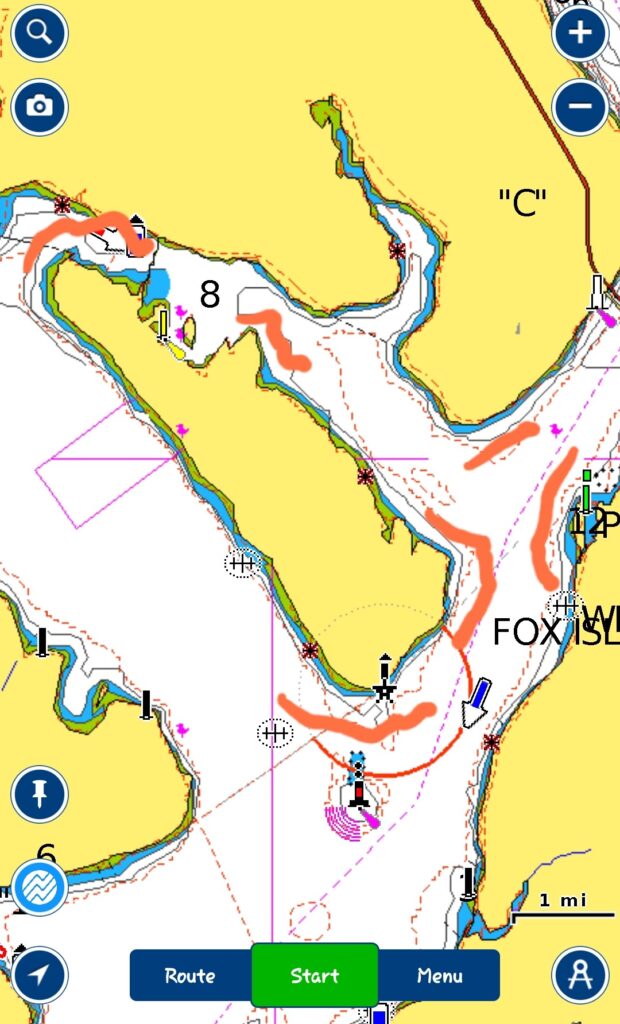
Is an interesting fishery. It is the area south of The Tacoma Narrows Bridge. The whole area is fairly protected from winter weather but the better fishing areas are a bit of a run from any of the all-tide metropolitan ramps. With that said, MA 13 is kind of a local’s fishery, with smaller boats launching into open water from a handful of unimproved county ramps. A few areas stand out; including Point Fosdick, various areas around Fox Island, Lyle Point, Oro Bay, and Johnson Point all hold fishable numbers of blackmouth. Depending on the tide there are many less known points that disrupt the tidal flow and hold bait. Be that guy, maybe more so than any other area in Puget Sound, MA 13 has many 1 fish spots. Review both your charts and tidal information and know where to fish during the different tidal phases.
Blackmouth fishing is a planning and patience game. Choose a ramp, select a handful of areas you want to fish, and understand how the tide will impact them. Independent from the tide often the best fishing will be at first light. From there follow your plan, if you make a pass on your initial stop and there are no signs of life move on to plan B and C as required. Depending on the tidal conditions don’t be afraid to revisit plan B! I know that I mentioned patience but if you’re not seeing bait on the meter move on. Typically boat limits will be hard to come by, but put a couple of nice blackmouth on ice and you’ve had a good day.
My general blackmouth drill includes trolling with the downriggers or motor mooching cut plug herring. If dogfish are in the area, skip the cut plug plan and stick to trolling. Run 11” flashers ahead of spoons, trolling flies, or hoochies. Spice up the trolling flies and hoochies with salted herring strips. Target schools of bait along the bottom in 90-140’ of water while keeping your gear within 5’ of the bottom. I troll 2.5-about 3.5 mph for blackmouth and all my blackmouth leaders are tied on 42” of 30# fluorocarbon.
Earlier I mentioned a shore-based opportunity to catch blackmouth. No really, I’m not nuts. Well, OK maybe I am a little nuts but there are many piers and boardwalks that are open to salmon fishing year-round. Study the WDFW Sport Fishing Rules and check the Emergency Rules as they supersede the general sport fishing rules. When I was a kid, well before cell phones and computers I used to frequently fish the piers and caught a lot of blackmouth. I didn’t chase reports to fish a hot bite. I had to put in the time while experimenting my way through the gear and presentation until I caught fish.
I usually carried two rods, a dozen small herring (fresh or frozen, back then fresh herring was the norm), and a small handful of gear. My go-to rig was a level wind steelhead rod rigged with a large sliding float and a hand-tied mooching leader. I would nose hook the herring, leaving the trailing hook free, and gently cast it off the down current corner of the pier. I would free spool, letting the rig drift until I was down the last few wraps of line on the spool and then put it in gear. Recovering a crank or two every few minutes, it would take forever to reset. The process was deadly and accounted for many salmon dinners.
I also fished hardware. A double hooked Colorado spinner with a herring strip will catch anything in the sound. I’d rig them on a 24-30” leader behind a piece of pencil lead. Easy-peazy; just cast, let sink and slowly wind it back in. Where most fish would hammer it, salmon seemed to cause the retrieve to hesitate then go in for the kill. The other method was to use flutter spoons. This was pre-buzzbomb/rotators and involved casting heavy spoons or Swedish Pimple type lures and letting them sink for a bit. The process was similar to twitching jigs, slowly lifting your rod tip, and then picking up a crank of two while you quickly tower the rod. Between the 3 methods, most of my pier fishing excursions were a success.
This should get you started in your quest to extend your local salmon fishing opportunities while you freeze your keister off. The when, where, and how are baselined but I suggest choosing an area and learning it. As a boater or pier-ite, become the local expert! Please remember that our winter weather can be unpredictable. Make sure your boat is seaworthy, full of fuel, fuel conditioner and you are dressed for the weather. A little upfront planning will help to ensure that you and your crew have a safe and productive blackmouth adventure.
/articles/bagn-blackmouth
5 Frozen Treasures
Washington State, known for its stunning landscapes and diverse outdoor activities, offers a unique and thrilling experience for anglers during the winter months, Ice Fishing. As the temperatures drop and the lakes freeze over, enthusiasts from all over gather their gear and head to some of the state's most picturesque frozen waters. In this article, we’ll dive into the icy wonderland of 5 lakes that stand out as prime destinations for ice fishing in Washington: Curlew Lake, Bead Lake, Sacheen Lake, Banks Lake, and Eloika Lake.
Curlew Lake: A Frozen Oasis In The Northeast
Curlew Lake, nestled more in the Northcentral portion of the state, transforms into a winter wonderland, drawing anglers seeking a tranquil ice fishing experience. The lake spans over 900 acres and is surrounded by snow-covered mountains and hills, creating a beautiful backdrop to your frozen adventure.
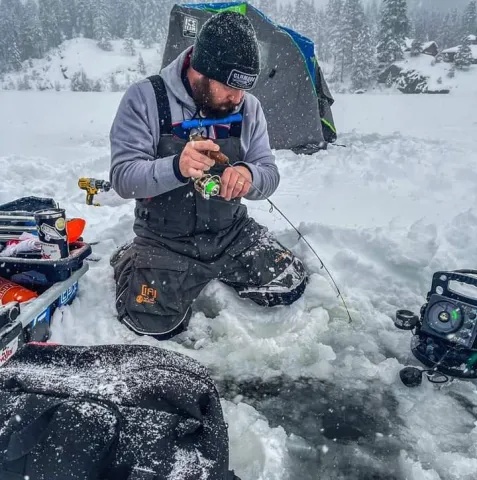
The lake is home to a variety of fish, with Rainbow Trout and Yellow Perch being the most sought-after during the winter months. Anglers often set up shanties or their ice fishing spots right outside the state park patiently waiting for the telltale signs of the fish below, which doesn't take long. The vast mud flat just outside the park holds amazing numbers and is easy to get into. The camaraderie among anglers and the stunning scenery make Curlew Lake a must-visit destination for any Ice Fishing aficionado.
Bead Lake: A Hidden Gem in The North Mts.
Nestled in the North of Spokane Mountains, Bead Lake is a hidden gem that offers a secluded and serene ice fishing experience. The lake, surrounded by dense forests and snow-covered peaks, provides a pristine setting for anglers looking to escape the hustle and bustle of everyday life.
Bead Lake is known for its healthy population of Kokanee, and the popular large lake trout that roams the depths. As large marks appear on your sonar, don't be surprised if it's not a laker, but a monster of a burbot making this lake an enticing destination for those seeking a variety of catches. As you set up your gear on the frozen expanse of Bead Lake, the quietude and natural beauty will transport you to a world of tranquility, making each catch a memorable moment.
Sacheen Lake: Serenity and Splendor In Pend Oreille County
Located in Pend Oreille County, Sacheen Lake offers a charming blend of serenity and splendor during the winter months. Surrounded by evergreen forests and snow-covered hills, the lake becomes a haven for ice-fishing enthusiasts seeking a peaceful escape.
Sacheen Lake is known for its panfish, including perch and crappie, which are abundant and fun to chase. Also, fun to target nice trout under the ice as well, with good chances of catching! Rainbow, Brook, and Tiger Trout provide excellent opportunities for ice anglers to enjoy a variety of catches. As you drill your fishing holes and set up your equipment, take a moment to absorb the quiet tranquility of Sacheen Lake, where the only sounds are the soft crunch of snow beneath your boots and the occasional call of a winter bird.
Banks Lake: A Vast Frozen Playground in Central Washington
For those looking for a more expensive ice fishing experience, Banks Lake in Central Washington is a prime destination. This reservoir spans close to 27,000 acres and is known for its diverse fish population, including Walleye, Rainbow Trout, Burbot, and Whitefish which are the most popular to go after.
Ice fishing on Banks Lake is a social affair at times, with clusters of anglers setting up their shanties in popular spots and many staying overnight. The vast frozen expanse provides ample opportunities for exploration, and to get away from the crowds if needed. As the sun sets over the snow-covered horizon, the frozen lake transforms into a canvas of colors. Banks Lake is not only a haven for anglers, but also a visual spectacle that captivates the senses.
Elokia Lake: An Ice Anglers Original
Nestled in the heart of Northeastern Washington State, Elokia Lake transforms into a winter wonderland for avid ice fishing enthusiasts. As temperatures drop, the lake's icy surface becomes a haven for those seeking the thrill of angling beneath a blanket of snow.
Eloika Lakes expands over 600 acres, providing ample space for ice fishermen to explore its frozen expanses. One of the primary draws for anglers is the diverse range of fish species that inhabit this lake. Brown Trout, Rainbow Trout, Large-mouth Bass, Perch, Crappie, and Sunfish. Seems that Crappie are what attracts most ice anglers.
The savvy ice anglers will target the Brown and Rainbow Trout early season just a couple of feet below the ice and near creek outlets. Eloika’s cold waters create an ideal environment for these fish. Anglers can also test their skills against the Large-mouth bass, known for their elusive behavior even in freezing temperatures, and they are big in this lake, especially on an ice rod.
Yellow Perch and Crappie add a variety to the fishing experience at Eloika. These panfish offer more of a relaxing angling experience, making the lake suitable for seasoned veterans and beginners alike. Perch are abundant and make sure to check the regulations for the Crappie size and limit.
As ice fishing shelters and anglers dot the frozen landscape, camaraderie flourishes among anglers who gather to share stories and tips. Eloika Lakes icy embrace beckons, offering a unique and thrilling experience for those willing to brave the cold pursuit and snag the perfect catch!
/articles/5-frozen-treasures
Trout Fishing: When Life Gives You Lemons.
Farmed. Hatchery. Wild.
I fed a rusty orange streamer into the current, threw an upstream mend, and let it swing. We call it First Water. It's what you get early in the morning when you get to the river before the next guy. First Water makes you smile after a hard week at work. Like making lemonade out of lemons.
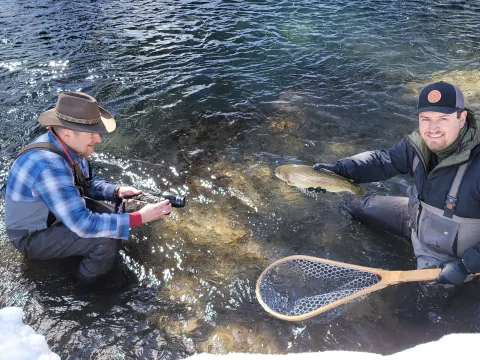
A trout hammered the fly and the tippet snapped. Heart pounding, I cut the leader back to 8-pound, tied on another fly and cast quartering-down. This time when the fish hit, it turned and charged, coming straight out of the water. Five minutes later we slid the net under a four-pound gnarly, hook-jawed brood stock rainbow. We have learned from experience it's hard to revive the big hatchery rainbows, so it was an easy decision to keep it for the table.
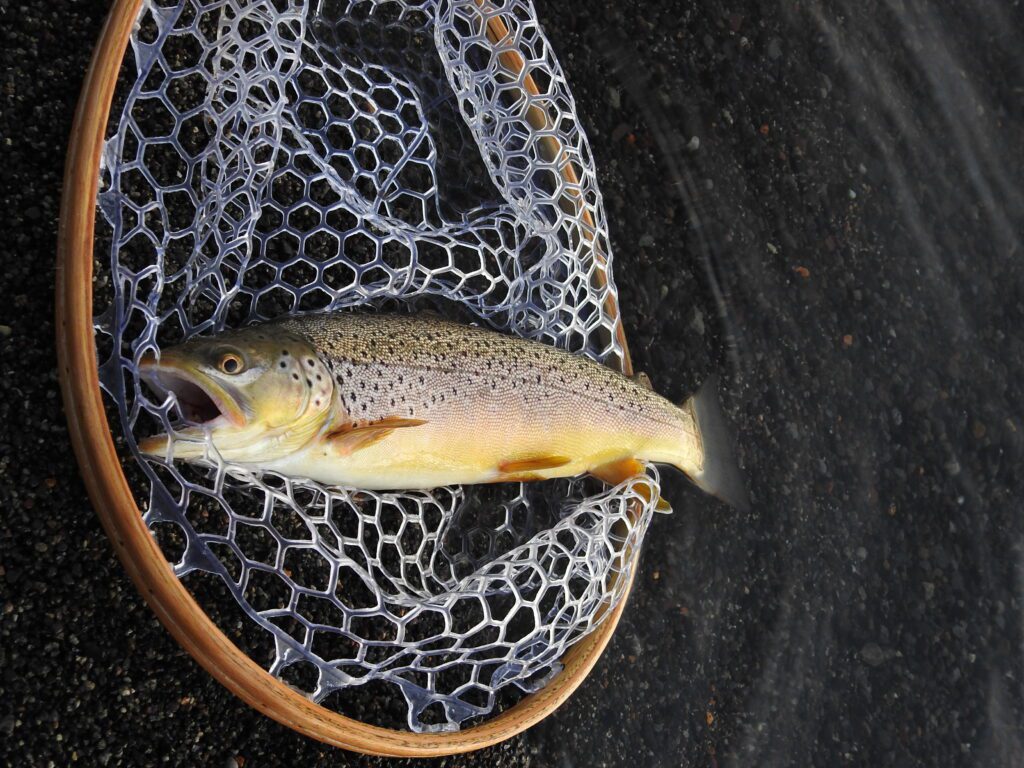
FARMED, HATCHERY, WILD OR NATIVE?
Here's a thing that doesn't make sense. We go to the grocery store and complain about the price of groceries and then we drive to the lake and catch and release a limit of rainbow trout at $10 a pound. I've done it.
Hey, those fish were put there to catch and keep. It's healthy food, high in omega-3 fatty acids and B vitamins. Easy to catch (sometimes). Easy to clean. Tastes good. Good for you.
Think of it like this: we have rainbows, cutthroats, brook trout, brown trout, bull trout, and lake trout in our lakes, rivers, and hatchery raceways. Some of them end up behind the butcher's glass at the grocery store. How do we tell where they came from? The ones in the cellophane and Styrofoam, that's easy. Those are farmed fish, which are generally shoveled a high-quality pelletized food and then fed a carotenoid called Astaxanthin which gives the meat an orange color and improves the taste.
According to Luke Allen, from the Wizard Falls Hatchery and Tim Foulk from the Fall River Hatchery, astaxanthin is produced by microalgae which is ingested by small fish and invertebrates like krill, which are then ingested by fish.
In Oregon, hatchery-raised rainbow trout (and cutthroats) are classified as legals (usually 8 to 12 inches), trophies (usually 14 to 18 inches), and brood stock, which are the surplus breeding trout that tip the scales somewhere between four to ten pounds. In Central Oregon, these fish end up in places like Pine Hollow Reservoir, Walton Lake, South Twin, and Fall River. Hatchery trout may also be released as fingerlings in waters like Lava Lake, East Lake and Diamond Lake where the natural feed is so good the fish grow fast. Fingerlings are also released in the high lakes every other year. Fingerlings, although raised in hatcheries in geometric order, tend to behave and look more like wild trout as they reach a harvestable age.
The terms wild and native can refer to the same fish or mean two different things. Brown trout, brook trout, and lake trout are not indigenous to Oregon but were introduced. Browns come from Germany and brooks come from the East Coast. That's why we refer to them as German browns and Eastern brooks. But if they were hatched in gravel we call them wild trout.
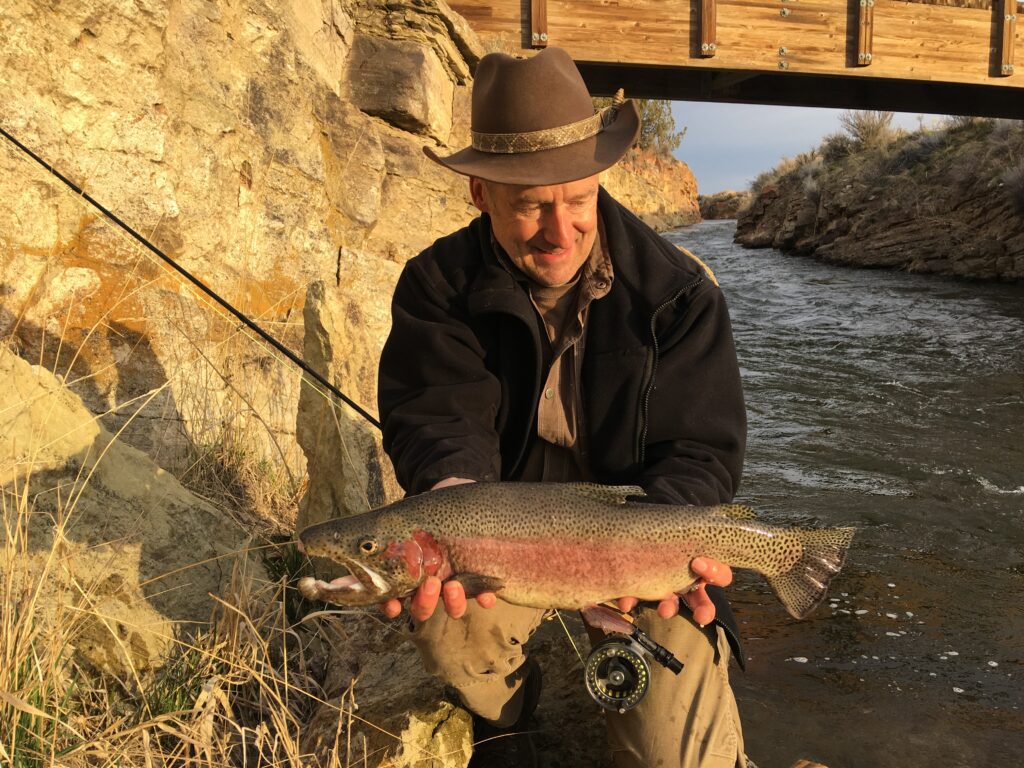
Photo courtesy Don Lewis
The term native is inclusive of rainbows, cutthroat and bull trout. In some cases these fish may be caught, kept and eaten, but it’s a good idea to release them to spawn and prosper. If you catch a brookie in the high lakes, hey, that's some of the best wild food you can get. And you are not eating a native fish.
A steelhead is a rainbow trout that migrated from freshwater to the ocean and returned. If a person eats farmed steelhead, it is probably not steelhead at all, but rainbow trout packaged as steelhead. An angler that catches and eats a fin-marked steelhead has consumed a hatchery steelhead. Surplus steelhead that returned to their hatcheries in places like Nehalem or Three Rivers are often trucked to coastal lakes and set free to give anglers another chance at them. Because they will probably not thrive in the lake, the highest use of these fish is to turn them into a good meal.
Fisheries managers sometimes struggle with the divide between the consumptive and the catch-and-release ethic.
Diamond Lake was devoid of fish before it was stocked by mule trains in the early 1900s. The food-rich lake still grows fish to trophy proportions and not enough gets taken home by sportsmen. It's a resource we could be making better use of, and the same principle applies all over the state from Lake Selmac to Wallowa Lake to Bikini Pond to Rock Creek Reservoir to Lava Lake. Those fish are there to eat. And there are some really good things like dill, parsley and lemon that go great with a pan full of eastern brookies or hatchery 'bows.
That's why I say when life gives you lemons, go catch a trout.
For a copy of the Fishing Central Oregon book, send $29.99 to Gary Lewis Outdoors, PO Box 1364, Bend, OR 97709 To contact Gary Lewis, visit www.GaryLewisOutdoors.com
/articles/trout-fishing-when-life-gives-you-lemons
The Worst Duck Hunting Dog I Ever Loved
By John Kruse
Georgia was an unlikely addition to our family. It was 2014 and I was looking for a dog that could hunt both upland birds and ducks. I settled on the springer spaniel as the breed I was going to get, and found one just a few miles from where I live.
My daughter Faith and I went over and met the dog who would soon be named Georgia. She was a year old and the runt of the litter. She was very timid and even growled a little at Faith. I was less than impressed.
We went home without her but I couldn’t get that dog out of my mind.
The next day I called the owner and asked if I could bring the dog over to my house and see what kind of retrieving instinct she had. Georgia was very excited to see me again. She hopped into my truck without hesitation and upon arriving at our home, she started racing and leaping around our yard with pure joy!
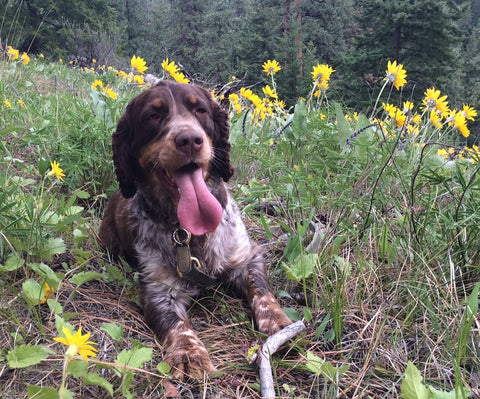
Faith was home and begged me to keep her. When Georgia calmed down, I started throwing dummies for her to retrieve. In the fourteen times I threw the dummy, the response was the same. She would charge to the dummy, look down at it, and then run around the yard until I called her back.
My son David came home from school while this was going on and asked what I was doing. I explained I was giving the dog a tryout and it wasn’t going well.
David, who had just been cut at tryouts for the high school baseball team for the second year in a row, said, “are you going to cut her like my coaches cut me?” And that was the moment I made the decision to keep that dog.
Georgia had a lot of energy and was very athletic. She loved to go on long hikes with me and she loved pheasant and quail hunting, flushing her fair share over the 8 ½ years we had together. When it came to duck hunting, though, she was the absolute worst.
First off, she was impatient. She wouldn’t stay still in the blind, and when I put her on a leash she would whine, bark occasionally, give you dirty looks, and start digging a hole into the ground that she would eventually writhe around in as a way to express her displeasure.

When she was let off the leash she would immediately charge into the water and it didn’t matter to her whether there were birds there or not. She would swim, and swim, and swim some more.
She loved the water and would completely ignore all commands to come out of the water until she was good and ready to do so, usually about 10 to 15 minutes after she went in.
She did occasionally retrieve ducks for me but the final straw was the time my daughter and I took her hunting to a place I like to go to in the Columbia Basin. The small pond is an early season hot spot for teal and it lived up to its promise. I actually kept Georgia in the truck until mid-morning. By this time, we had several ducks in hand but there were three floating in the pond we couldn’t retrieve. I brought Georgia from the truck to the pond, pointed out the dead floating ducks, and set her loose.
She immediately swam to the first duck and continued past it, swimming with reckless abandon. Eventually she ran across one of the other ducks and she grabbed it in her mouth. I praised her and told her to bring me the bird, blowing the whistle to come back as I did.
Instead, she went to a small island and dropped it off before reentering the water to swim some more. Eventually, she came across the other two ducks and again, took them to the island. At this point I was begging Georgia to bring me the birds.
Her response? She would pick each dead duck, wag her tail, and put them back down on the island. She was like a little girl playing with three Barbie dolls.
Finally, I waded out to the island, retrieved the ducks (dolls), and took Georgia back to the truck.
Georgia continued going with me on hunting trips for upland birds, but her duck hunting career essentially ended that day. Despite her poor performance in the marsh, she was a loyal companion.
She was well known by kids and adults alike in the small town of Cashmere I live in, where countless people would pet the “pretty puppy” I took for walks with me. She loved to go for rides, whether it be to the store or to a trailhead for a hike.
She followed me downstairs every morning to my office to spend the day with me at work, and every night she slept on the bed with me. She was a wonderful family dog and faithful companion with a ton of personality.
Unfortunately, two weeks ago we noticed she had developed a wheezy cough and she had very little stamina, not even able to walk a mile with me. I took her to Cascade Veterinary Clinic in Leavenworth and got bad news…cancer.
She had a large mass that had grown around her lungs and there were numerous smaller masses visible in the x-ray as well. I was given some pills to reduce pain and the inflammation around her lungs. They helped for a week and my daughter, wife, and I spoiled Georgia rotten.
We took her on rides to bark at deer from the truck window, fed her plain McDonald’s hamburgers which she loved, let her swim in a lake one last time, and more. It was a good week, but on the 8th day Georgia’s breathing became labored and it was time to let her go.
We did so at the veterinary clinic, all telling her what a good dog she was and what a blessing she had been to our family. The veterinarian, Dr. Warmenhoven, was very kind. He gave her a shot and she left the world in a very peaceful way.
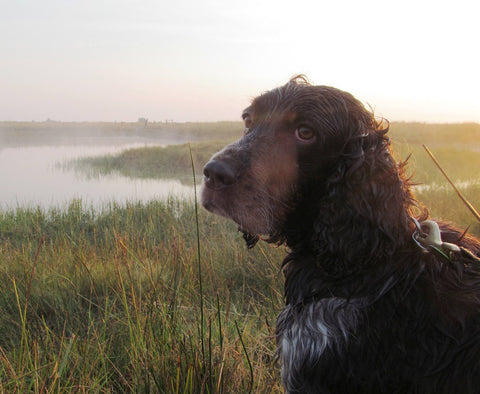
I’ve never seen a worse duck dog but I’m also so glad I had her in my life. We loved her very much and she brought our family much happiness. RIP Georgia. I hope to see you on the other side.
northwesternoutdoors.com
andamericaoutdoorsradio.com
/articles/worst-duck-hunting-dog-i-ever-loved-0
Brewster Salmon Derby Adventures
By Hannah Pennebaker
In all my years of fishing, I have heard many legends and stories about fishing at the infamous Brewster Pool. Articles on the Internet caution readers about hostile fishermen and hundreds of inexperienced boaters creating chaos.
My own experience couldn’t have been further from these stories. This year, I was lucky enough to get the opportunity to film and participate in the derby on behalf of Northwest Fishing.
From the moment I got to Brewster, I was blown away by the friendly locals and energetic atmosphere of the derby. Other fishermen were giving each other high fives and complementing one another on their catches.
This was far from the stories of combat fishing and fishermen yelling at one another that I had heard. Although there were hundreds of other boats out there, everyone was very patient and gave one another plenty of space. Guides and recreational fishermen alike were joking with one another and having a great time doing the sport we all love.
I saw hundreds of beautiful fish caught and weighed in over the 3 days of the derby, and even got to reel in some of my own. Here’s the story of my experience at this year’s Brewster Salmon Derby.

On day 1, Mike Mauk, the president of the Brewster Chamber of Commerce, greeted me with a warm handshake and a big smile. Mike organized this year’s derby, bringing together dozens of sponsors and coordinating prizes and staffing for the event.
He gladly took some time from his busy schedule to chat, and I interviewed him about the history of the derby and the town of Brewster. He told me that the proceeds from ticket sales go towards helping the community of Brewster and enabling them to run the derby year after year.
The Brewster Salmon Derby is the largest derby on the Columbia River, and up to $20,000 in cash and prizes are given out every year.
Next, I interviewed the derby weigh master, Ernie Mauk. Ernie brought incredible energy to the weigh station, high fiving each kid that brought a fish to him. He showed me how he weighs each fish, taking the girth and length measurements and calling them out to be recorded and put on the board. He said that even though he weighs hundreds of fish every year, he still admires the beauty of each and every fish he weighs.
WDFW also had a presence at the weigh station, scanning the fish for tags. When they found a tagged fish, they cut the nose of the fish off to remove the tag (after making sure the fisherman had gotten all the pictures they wanted).
They let me know that the information they get from the tag helps WDFW determine the health and abundance of salmon populations. Not only does the derby help the small community of Brewster, it also aids WDFW’s research and provides valuable insights into this amazing fishery.
While getting to see the ins and outs of the weigh station was certainly a fascinating experience, fishing is truly my passion, and my experience participating in the derby was absolutely unforgettable. Brianna Bruce of Livin’ Life Adventures was our guide during our 3-day adventure.
My friend Michael Francisco, my fiancé Chris Decker, and Northwest Fishing regulars Andrew and Joe Czapla were on board. Brianna (Bree) kept us entertained with dozens of fishing stories from her 11 years of guiding.
She told us all about the fishery and what makes it so productive and popular. Every year, thousands of sockeye and chinook salmon stage in Lake Pateros, also known as the Brewster Pool, between the dam and the mouth of the Okanogan River.
The mouth of the Okanogan River heats up and creates a thermal barrier, and the fish wait in the pool for it to cool down so they can enter and reach their spawning grounds. This year, Bree said there were over 100,000 sockeye in the pool! Good numbers of chinook are caught every year, some reaching over 30 pounds. Some fishermen got their limits of sockeye and headed back to town for breakfast before the heat of the day began.
Others stayed out until 6PM, braving the heat for a chance at a derby winning chinook. There was a 4 fish limit for sockeye, and a 2 fish limit for chinook. The bite seemed best in the early hours of the morning, but there were fish caught all day. Bree’s dog, Waylon, was our bite alarm throughout the weekend. Every other fisherman in the pool knew when we hooked onto a fish!
Bree alternated between steering around other boats, netting fish, baiting hooks, and swapping fishing stories, making it all look easy. Her natural talent, great humor, and mastery of the fishery made for an unforgettable experience.
On day 2, one of our cameramen had a big, feisty sockeye on the end of his line. As he brought it up to the boat, he lifted the fish out of the water and the hooks popped out. Our hearts sank, but Bree effortlessly scooped the fish into the net and saved the day!

We started off fishing for chinook the first day, armed with spinners and chrome flashers. Bree is an expert in this fishery, and told us that sockeye often hit chinook gear, and vice versa. The second day, we fished sockeye gear, and were rewarded with many nice fish.
For her sockeye gear, Bree ran homemade pink spinners and smaller flashers. On the third day of the derby, we fished a combination of sockeye and chinook gear. She ran 2 spinners, 2 sockeye setups, and 2 tuna stuffed Brad’s Super Baits.
It was tough to find the right speed to get the different gear to fish right, but like a true pro, Bree made it work. We trolled slowly, between .8 and 1.2 MPH, and kept an eye on the depth. To avoid tangling our 6 lines, Bree used a variety of different cannonball weights, which also allowed us to fish throughout the water column.
No matter how tired and hot we were after fishing all day, we always looked forward to lunch at one of Brewster’s amazing, locally owned restaurants. Mike Mauk and the Brewster Chamber of Commerce treated us to lunch and dinner each day.
The sizzling, fragrant fajitas at Campreros were absolutely delicious! Later in the afternoons, we usually got some time to explore the area each day. I was surprised by just how much the town of Brewster has to offer.
There are numerous family-owned stores that offer cool refreshments and homemade snacks. If you’re fishing the Brewster Pool, it’s definitely worth it to take the time to sample some of the local cuisine and explore the town.
On day 3 of our adventure, we got to see the winners of the derby take home their prizes and win their bragging rights. The winning fish, the “king of the pool”, was a tank of a chinook weighing in at 29 pounds and 10 ounces that got the winning angler a nice check for $2,000.
The top 10 winners got a beautiful wooden plaque to commemorate their win. One of the most memorable parts of the weekend was when a young girl weighed in a 26-pound chinook. She ended up winning the youth category of the derby!
Besides the competition for the top 25 biggest chinook, there were also side pots and a raffle to take part in. There were many raffle prizes, such as free fishing trips for 4 people, a bow, and a downrigger.
The grand prize for the raffle was a 9.9 HP Mercury outboard motor. Weigh master Ernie announced the winners, and photographer Cori Kogan snapped photos of them holding their prize next to Mike Mauk.
All 3 days of my experience at the Brewster Salmon Derby culminated into an unforgettable adventure. From Mike Mauk’s warm welcome to Bree’s terrific netting skills and incredible sense of humor, I’ll always tell stories about the derby with a smile. I know I’ll be back next year for another shot at winning the derby!
@hannahNWF on Facebook and Instagram
/articles/brewster-salmon-derby-adventures-0
Off The Radar
By Randy Castello
With improving ocean conditions, the Puget Sound 2022 fall coho season could be the best in recent history. 666,648 coho are forecasted to return to the Puget Sound basin. With a few exceptions our local coho fisheries (Marine Area 5-13) will open August 16th.
Following is a quick breakdown of our inside coho fisheries. Make sure to review the WDFW Fish Washington App, WDFW Washington Sports Fishing Rules pamphlet and the emergency (https://wdfw.wa.gov/fishing/regulations/emergency-rules) for current daily limits and emergency closures.
MA 5 8/16-9/28 Hatchery Only
MA 6 8/16-9/28 Hatchery Only
Dungeness Bay fishery 10/1-10/31 Hatchery Only
MA 7 8/16-8/30 Hatchery Only
Bellingham Bay 8/16-9/30 Hatchery and Wild
MA 8-1 8/1-10/1 Hatchery and Wild
MA 8-2 South and West of the Line Defined by the Mukilteo and Clinton Ferry Docks 8/13-9/19 Hatchery Only
MA 9 8/16-9/25 Hatchery Only
MA 10 Through 10/31 Hatchery and Wild
The Sinclair Inlet Fishery Through 9/30 Hatchery and Wild
MA 11 Through 10/31 Hatchery and Wild
MA 12 North Through 10/31 Hatchery and Wild
MA 12 South Through 11/30 Hatchery and Wild
MA 13 Year-round Hatchery Only
What, somebody said coho? Break out the gear, check the trailer lights and move the garbage cans out of the way. It’s time to go fishing. I think that more than any other Western Washington fishery, our local coho opportunity is an eagerly anticipated family event.
Where there are many commonly known “stock” coho fisheries, this article will focus on a few of our out of the way opportunities.
Although areas like Eagle Point off San Juan Island, Point No Point, Possession Bar, the Edmonds Oil Docks, Meadowdale Point, Jeff Head, Kingston, Des Moines, Three Tree Point, Point Robinson, and the Slag Pile off Point Defiance are all solid coho fisheries, they can get crowded.
Are there other coho opportunities? The answer is affirmative, and even better, finding off the radar coho is pretty rewarding.
For me, pulling up on a spot and being the only boat in sight is magical. A quick look at the meter confirming there is bait and individual coho on the prowl gets my old ticker going. In general, coho are a very worthy opponent. Being on a school of them without another boat in sight could be the highlight of your summer.
Finding off the radar coho starts at home. Sit down with a digital chart, preferably one that will give you current arrows, and develop your game plan. Your game plan should include a few layers of back up plans.
If you use your phone, screenshot the areas you want to fish. In doing your research, consider the tides and how they will be flowing or interacting with adjacent structure or opposing tidal flows.
A few examples to get you started:
Eagle Point on the south side of San Juan Island is an option. Most people set up along the pronounced rips just off Eagle Point. The reality is that those rips will concentrate bait much further offshore than you would expect.
At the surface, the current break is very subtle, but at depth the current forms a hard wall trapping bait that the coho are feeding on.
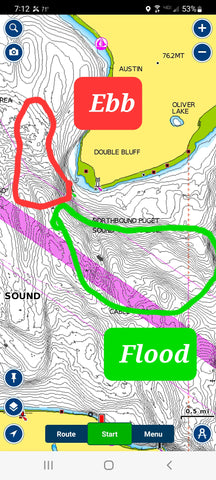
Double Bluff is another sleeper and rarely has more than a few boats on it. I really like Double Bluff; on the right day you can fish the general area and never have to fire up the main and go on the hunt.
Depending on the tides you can drag gear, mooch cut-plug herring, and even fish jigs. On the flood tide you want to fish the rips south of the bluff, and on the ebb, fish from the buoy north. You will need to keep an eye on the fish finder, but many of the early season coho will be suspended in less than 150’ of water. If you’re not seeing anything on the meter, move around.
More than any other place on the Sound, there will be coho holding somewhere at Double Bluff.
Another out of the way and often overlooked coho spot is Partridge Bank. That said, Partridge bank is one of my go-to coho spots. Depending on the given tide series, it typically fishes well on any tide. Fish along the edge of the shipping lane on the west side of the bank.
A couple things to note regarding the Partridge Bank fishery: sometimes there is a big swell that fractures as it approaches the bank. The resulting chop can be unpredictable and you need to be alert to changing sea conditions.
Secondly, you may stray into the shipping lane so keep your radio on and give any passing ships the right of way. Consider setting your VHF up on Tri-Watch, monitor 16, 13 (Bridge to Bridge, commercial traffic) and a floating channel. I have mine on 22 but many recreational boaters monitor channel 68.
The previous three examples are just a few of the areas to find off the radar coho. Again, sit down with some form of chart and current table and do your homework.
There are many other locations in MA 5-11 where you won’t be necessarily be chasing coho with a fleet of like-minded friends. Look for points, underwater structure, and areas where opposing currents will concentrate bait and you’ll find coho.
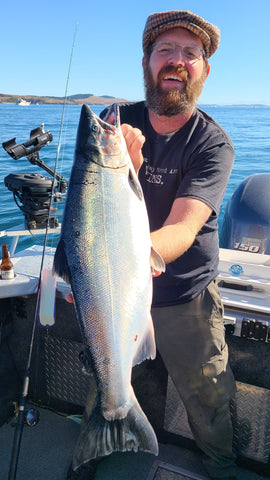
Now that you have identified your coho hidey-hole, what’s next? The coho drill on my boat is pretty basic. Although I have a couple jigging and/or mooching rods ready to go it’s mostly a trolling show. I pull 11” flashers and flies, hoochies or spoons.
Coho Killers, Silver Horde 3.5” Kingfisher Lite spoons and Gibbs G-Force spoons are my go-to spoon offering. I run 36” of 30# fluorocarbon between the flasher and the spoon. Regarding color; you can’t go wrong with any combination of green or chartreuse but a Purple Haze flasher and a clear hoochie with a green insert can be deadly.
Always head out with an assortment of flies, hoochies, or spoons and cycle through gear until you find the magic combination for the day. Also, use scent on your spoons. Try a sticky Bloody Tuna, Herring, or Anchovy goo and re-scent often. Add a salted herring strip to the leading hook on all your flies and hoochies.
At the butt-crack of dawn, fast trolling cut plug herring in the top 30’ of water is a solid option, but after first light it will be a downrigger show. Use 12 pound or heavier downrigger weights and troll 3.5 to 4 mph.
At the speed you’ll be trolling for coho it is likely that you will not see your downrigger balls on the meter and remember that with the blowback you will need additional cable out for a given depth. Especially for coho, I chase meter marks, so keep an eye on the meter.
Be ready for action, we have had every rod on the boat go off at once when trolling for early AM coho. Have a game plan, net ready, and a bleed bucket to assure that your silvery opponent makes its way into the fish box in the best possible condition.
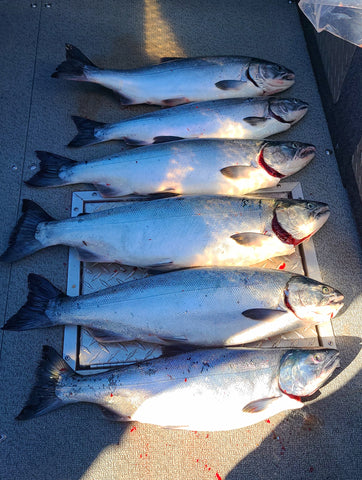
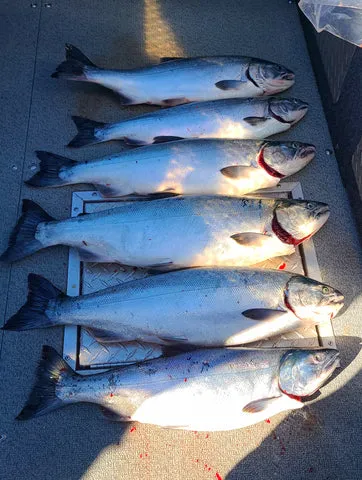
Good luck and remember that our fall coho fishery is an ideal family fishery. They are relatively easy to find, usually hungry, and have some serious shoulders. As a last thought, I want to address the weather. I work 5 to 6 days a week on the water.
While in the San Juans today I encountered a significant squall line of thunderstorms. Basically, the weather went from summer boating weather to “what the heck” in minutes. It was windy, pouring and very dark. Then the thunder was relentless and deafening. Since I had not hit send for the article yet, I figured that a quick note about coho weather was in order.
Coho season falls while our summer boating weather is transitioning to an unsettled weather pattern. Most of the time the pond will be very pleasant. Be aware of and prepared for changing conditions. If the forecast is questionable, don’t go, or at least proceed with caution.
A 15-mph wind against a running tide can be uncomfortable or even dangerous. Know the limits of both your boat and crew, then always error on the cautious side.
/articles/radar