Everett Coho Derby: Supporting our Fisheries by Brent Knight
Here we are, mid-summer. And for many of us sportsmen, waiting patiently for the fall salmon runs to begin. With very limited Chinook opportunities in Western Washington, most of us are looking forward to our coveted coho fishery. I know that I am organizing my gear, tying leaders, prepping bait, and doing anything that I can to pass the time. I get in a day or two of kokanee or trout fishing here and there, but it is just not the same. Coho are hard-fighting fish and arguably among the best-tasting salmon, either on the BBQ or in the smoker. The 2026 forecasted return of coho salmon to the Puget Sound projects a strong, healthy return overall, ranking as one of the best seasons in recent memory for total forecasted abundance. This means that we should be both optimistic and excited for what is to come.
Along with the returning salmon come numerous derbies, all up and down the West Coast. Every September, there is a salmon derby unlike any other on the West Coast: The Everett Coho Derby, taking place in September when the Coho are stacking up in the Puget Sound on their way to their natal rivers and spawning grounds. This great event celebrated its 32nd year in 2025 and has become the largest fishing derby on the West Coast, with around 2000 adults and 300 kids registering annually. That’s a lot of sportsmen (and women) and anglers on the water!
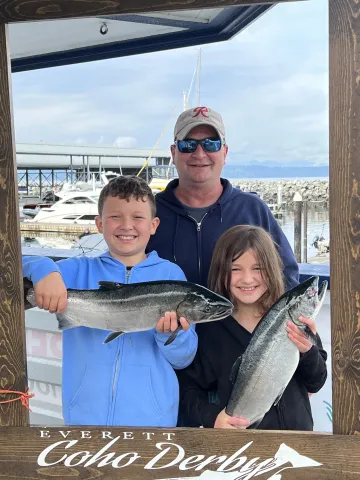
I have been fortunate to be a volunteer for the past five years. For me, it’s easy. I just show up at the Edmonds Marina and meet and greet people as they bring their catch in for weighing. We laugh and talk to all the smiling kids, proud to weigh in their fish and compete for prizes. Outside of all the fun that we have over the two days of the derby, many others spend the year planning the event, and it is a lot of hard work.
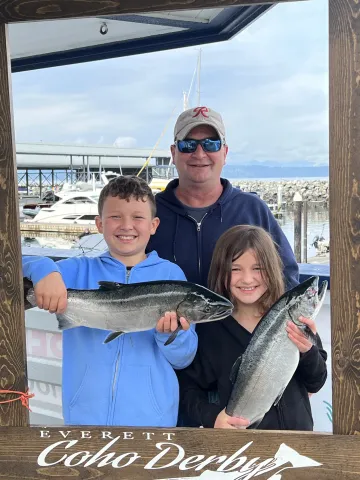
The Everett Coho Derby is sponsored by the Everett Steelhead and Salmon Club/Everett Chapter of the Puget Sound Anglers and the Snohomish Sportsmen’s Club. These two groups work together to plan the event. The money made in this derby goes to support the many fish enhancement projects of the clubs.
Coho can be caught in any of the open marine areas or the open rivers in Snohomish and Skagit Counties. First, second, and third prizes fetch $10K, $5K, and $2.5K, respectively. Gary Hanson from Puyallup won the 2025 Everett Coho Derby with a 12.62 lb coho salmon. The annual derby concluded on September 21, 2025, with Betty Wood (Snohomish) taking second place with a 12.11 lb fish, and David Taylor (Tulalip) in third place with an 11.57 lb fish. The event saw a highly competitive weekend for the top spots.
A little history about the derby: In 1993, the local recreational fishing industry was in a quandary. To protect many of the threatened runs of coho salmon, the State of Washington declared much of the saltwater off limits to salmon fishing, as well as closing most of the local rivers. The only area available was the Snohomish River system and a small “Bubble” right outside the mouth of the Snohomish River called the Tulalip Bubble. Interest in salmon fishing was waning, and the sporting goods stores were worried about their livelihoods - the sale of fishing gear.
One of the local store managers, Fabian Loomas from Jerry’s Surplus in Everett, approached Jim Brauch of the Everett Steelhead and Salmon Club and Mark Spada of the Snohomish Sportsmen’s Club with a proposal. If a salmon derby was created, targeting the small area that was open, Fabian would try to solicit prizes from the various distributors. In addition, if not enough tickets were sold to cover the prize money, Fabian would guarantee that the prize money would be paid. This was a win-win scenario for the two clubs, and the decision was made quickly to create and organize the derby!
That first year, the derby was called the Snohomish River Coho Derby, and it made about $400-$500 per club. Not a lot by today’s standards, but in those days, most of the club’s income came from small raffles and coffee rest-stop donations. Four hundred dollars was significant for both clubs, and they were overjoyed at the additional revenue. Those guiding the effort muddled along for the next few years, happy to have a derby and happy to make a little money from it. A Humpy Derby was attempted one year, and two things were discovered: humpy (pink salmon) anglers don’t buy derby tickets, and most humpies entered in the derby weighed about the same (10th through about 50th differed by less than 2 oz). In about the year 2000, Mac McReynolds - a representative from Olympic Boats, a local retail boat sales operation - approached the group to see if they could help sponsor the derby. McReynolds arranged for a boat, motor, and trailer to be awarded as the grand prize, at no cost to the derby. Ticket sales surged that year, furnishing money for the many enhancement projects carried out by both clubs. Up until a couple of years ago, the boat, motor, and trailer package was a mainstay of the raffle portion of the derby and helped it to continue to grow to what it is today. Other past prizes have included trips to fish in Alaska and cash as alternatives to the raffle.
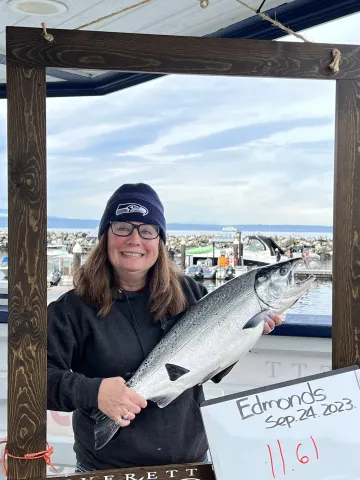
From these humble beginnings, the derby, now called the Everett Coho Derby, has become the largest derby on the West Coast of North America based upon the number of participants. Ticket sales have soared from 900 tickets sold in 2001 to 2527 sold in 2004, a year of inclement weather, along with over 300 free youth tickets. Over 2800 participants in total. The derby now averages 2000 adult paid tickets, and 270 free kids (12 and under) tickets each year. The prize money has also improved with cash for the five largest fish, from $500 for 5th place up to $10,000 for 1st place, along with many added cash prize categories. This derby has surely become a destination event on the West Coast.
The money made each year in the Everett Coho Derby goes towards the support of the many fish enhancement and propagation projects of the clubs - including stocking of the local lakes with trout, a salmon hatchery raising 60,000 coho smolt each year for release in the Skykomish River (Eagle Creek Hatchery), carcass planting in the upper Pilchuck River and Snohomish System, many different youth activities including trout clinics/fishing events, high school/college scholarships, sending kids to Youth Conservation Camp, as well as many other activities too numerous to mention. The money goes to good causes, and anglers have a chance to win prizes at the same time. What could be better?
These events take a ton of work to organize and coordinate, but the proceeds help more than most people realize. Also, many of the people who donate their time and energy to events like this are getting older, so there is a call for new blood. It is time for the next younger generation to get involved and start to take over so that we can keep these events going.
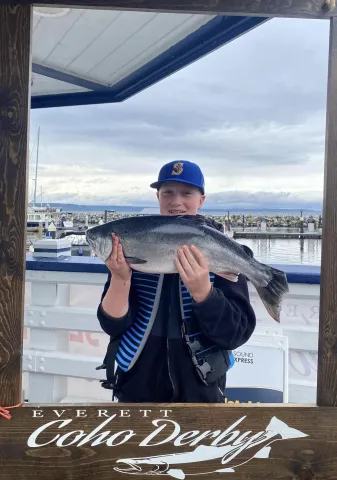
So, what does it take to get involved? There is nothing to it. Just volunteer, and they will be grateful for your help. If you are not the volunteering type, that is okay. Pay your entry fee and come try to win some prizes next year while filling your freezer with chrome bright coho salmon.
To learn more, you can visit https://everettcohoderby.com/. The 2026 derby will be held on Saturday and Sunday, September 26-27. Tickets will go on sale on July 1st. We hope to see you there.
/articles/everett-coho-derby-supporting-our-fisheries-brent-knight
Brewster Salmon Derby Adventures
By Hannah Pennebaker
In all my years of fishing, I have heard many legends and stories about fishing at the infamous Brewster Pool. Articles on the Internet caution readers about hostile fishermen and hundreds of inexperienced boaters creating chaos.
My own experience couldn’t have been further from these stories. This year, I was lucky enough to get the opportunity to film and participate in the derby on behalf of Northwest Fishing.
From the moment I got to Brewster, I was blown away by the friendly locals and energetic atmosphere of the derby. Other fishermen were giving each other high fives and complementing one another on their catches.
This was far from the stories of combat fishing and fishermen yelling at one another that I had heard. Although there were hundreds of other boats out there, everyone was very patient and gave one another plenty of space. Guides and recreational fishermen alike were joking with one another and having a great time doing the sport we all love.
I saw hundreds of beautiful fish caught and weighed in over the 3 days of the derby, and even got to reel in some of my own. Here’s the story of my experience at this year’s Brewster Salmon Derby.

On day 1, Mike Mauk, the president of the Brewster Chamber of Commerce, greeted me with a warm handshake and a big smile. Mike organized this year’s derby, bringing together dozens of sponsors and coordinating prizes and staffing for the event.
He gladly took some time from his busy schedule to chat, and I interviewed him about the history of the derby and the town of Brewster. He told me that the proceeds from ticket sales go towards helping the community of Brewster and enabling them to run the derby year after year.
The Brewster Salmon Derby is the largest derby on the Columbia River, and up to $20,000 in cash and prizes are given out every year.
Next, I interviewed the derby weigh master, Ernie Mauk. Ernie brought incredible energy to the weigh station, high fiving each kid that brought a fish to him. He showed me how he weighs each fish, taking the girth and length measurements and calling them out to be recorded and put on the board. He said that even though he weighs hundreds of fish every year, he still admires the beauty of each and every fish he weighs.
WDFW also had a presence at the weigh station, scanning the fish for tags. When they found a tagged fish, they cut the nose of the fish off to remove the tag (after making sure the fisherman had gotten all the pictures they wanted).
They let me know that the information they get from the tag helps WDFW determine the health and abundance of salmon populations. Not only does the derby help the small community of Brewster, it also aids WDFW’s research and provides valuable insights into this amazing fishery.
While getting to see the ins and outs of the weigh station was certainly a fascinating experience, fishing is truly my passion, and my experience participating in the derby was absolutely unforgettable. Brianna Bruce of Livin’ Life Adventures was our guide during our 3-day adventure.
My friend Michael Francisco, my fiancé Chris Decker, and Northwest Fishing regulars Andrew and Joe Czapla were on board. Brianna (Bree) kept us entertained with dozens of fishing stories from her 11 years of guiding.
She told us all about the fishery and what makes it so productive and popular. Every year, thousands of sockeye and chinook salmon stage in Lake Pateros, also known as the Brewster Pool, between the dam and the mouth of the Okanogan River.
The mouth of the Okanogan River heats up and creates a thermal barrier, and the fish wait in the pool for it to cool down so they can enter and reach their spawning grounds. This year, Bree said there were over 100,000 sockeye in the pool! Good numbers of chinook are caught every year, some reaching over 30 pounds. Some fishermen got their limits of sockeye and headed back to town for breakfast before the heat of the day began.
Others stayed out until 6PM, braving the heat for a chance at a derby winning chinook. There was a 4 fish limit for sockeye, and a 2 fish limit for chinook. The bite seemed best in the early hours of the morning, but there were fish caught all day. Bree’s dog, Waylon, was our bite alarm throughout the weekend. Every other fisherman in the pool knew when we hooked onto a fish!
Bree alternated between steering around other boats, netting fish, baiting hooks, and swapping fishing stories, making it all look easy. Her natural talent, great humor, and mastery of the fishery made for an unforgettable experience.
On day 2, one of our cameramen had a big, feisty sockeye on the end of his line. As he brought it up to the boat, he lifted the fish out of the water and the hooks popped out. Our hearts sank, but Bree effortlessly scooped the fish into the net and saved the day!

We started off fishing for chinook the first day, armed with spinners and chrome flashers. Bree is an expert in this fishery, and told us that sockeye often hit chinook gear, and vice versa. The second day, we fished sockeye gear, and were rewarded with many nice fish.
For her sockeye gear, Bree ran homemade pink spinners and smaller flashers. On the third day of the derby, we fished a combination of sockeye and chinook gear. She ran 2 spinners, 2 sockeye setups, and 2 tuna stuffed Brad’s Super Baits.
It was tough to find the right speed to get the different gear to fish right, but like a true pro, Bree made it work. We trolled slowly, between .8 and 1.2 MPH, and kept an eye on the depth. To avoid tangling our 6 lines, Bree used a variety of different cannonball weights, which also allowed us to fish throughout the water column.
No matter how tired and hot we were after fishing all day, we always looked forward to lunch at one of Brewster’s amazing, locally owned restaurants. Mike Mauk and the Brewster Chamber of Commerce treated us to lunch and dinner each day.
The sizzling, fragrant fajitas at Campreros were absolutely delicious! Later in the afternoons, we usually got some time to explore the area each day. I was surprised by just how much the town of Brewster has to offer.
There are numerous family-owned stores that offer cool refreshments and homemade snacks. If you’re fishing the Brewster Pool, it’s definitely worth it to take the time to sample some of the local cuisine and explore the town.
On day 3 of our adventure, we got to see the winners of the derby take home their prizes and win their bragging rights. The winning fish, the “king of the pool”, was a tank of a chinook weighing in at 29 pounds and 10 ounces that got the winning angler a nice check for $2,000.
The top 10 winners got a beautiful wooden plaque to commemorate their win. One of the most memorable parts of the weekend was when a young girl weighed in a 26-pound chinook. She ended up winning the youth category of the derby!
Besides the competition for the top 25 biggest chinook, there were also side pots and a raffle to take part in. There were many raffle prizes, such as free fishing trips for 4 people, a bow, and a downrigger.
The grand prize for the raffle was a 9.9 HP Mercury outboard motor. Weigh master Ernie announced the winners, and photographer Cori Kogan snapped photos of them holding their prize next to Mike Mauk.
All 3 days of my experience at the Brewster Salmon Derby culminated into an unforgettable adventure. From Mike Mauk’s warm welcome to Bree’s terrific netting skills and incredible sense of humor, I’ll always tell stories about the derby with a smile. I know I’ll be back next year for another shot at winning the derby!
@hannahNWF on Facebook and Instagram
/articles/brewster-salmon-derby-adventures-0