/articles/categories/stories
The Best Kind of Fishing Trip by Jerad Sorber
Early-season Spring Chinook is always a bit hectic. There's a short window between when the fishing gets realistic and when the first season closes. The annual uncertainty about when the next opener will be increases the pressure. Both the fishing kind and the internal kind, even if the fish aren't quite here yet. It's easy to get discouraged when you don't see a lot of fish, and nobody else is catching them either. When the magic does happen, though, it makes it all the better. Recently, we had one of those days.
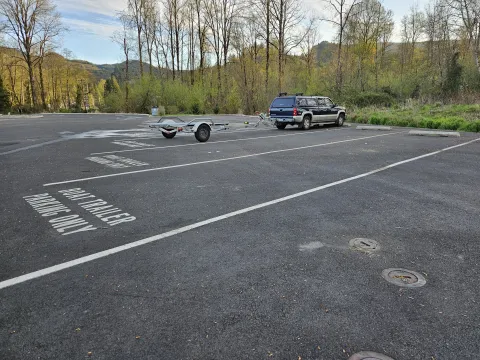
I arrived at the ramp around 5:15 AM to get the boat in the water and do any final preparations. I had told my clients to be there by 6 AM. There was a good morning outgoing tide, and there would be competition for spots to anchor up. As I prepped, I listened to the conversations from the other guides that were doing the same thing. This is a great time to get intel on what's going on with the fish.
Just as I finished up, my clients came down the dock. They had booked the whole boat and brought 4 people. If this had been a July ocean salmon trip, I would be excited about lots of fish. Today I was figuring out how to manage expectations. The fish checker reports the day before were 3 fish on 35 angler trips. We went through the usual greetings, and they hopped on board. A quick safety briefing, and we pulled away from the dock at precisely 6 AM.
I ran us out to the spot I had planned on. That was at least a good sign. With the anchor set, I put out the first round of plugs. I was hoping for the best. The water looked good, and the temperature had risen about half a degree. If they were here, they should be biting. A little bit later, another friend and fellow guide swung by and anchored to the outside of me. A bit after that, another guide popped in, and we had an old-fashioned hog line set up. We were covering everything from 12 feet of water to 40 feet. If a salmon was moving through it would have to look at our gear.
The conversation bounced between boats as it should for hog line fishing. One of my clients seemed to really love hearing the "inside baseball" chat. I talked to my clients about what they had been doing. I answered a lot of questions about fishing and fish biology. I learned about the ins and outs of building embassies for the US government in faraway places. My clients had been working internationally, and this was spring break for the youngest son. Their most recent location was Malawi in Africa. They chose to come back home and enjoy a day of fishing.
I swapped out the initial plugs with ones wrapped with tuna belly. If the water is slow, I usually start with bare plugs covered with some gel scent. This gives them a bit more action. Once the water speeds up with the outgoing tide, I wrap them with tuna belly and send them back. We coordinate line lengths and make sure that there is a literal wall of plugs. Between 3 boats, there were 9 rods in the water. We all waited for a fish to come in. The middle boat had a bite, but it didn't hook. They had a second and lost it within a minute. Then nothing.
The outgoing tide pulled my depth from 18 feet down to 16 on the sonar. It was getting shallow. The water wasn't that murky, and the sky was clear. By this time, I had swapped my middle rod to a flasher in the middle with a cut plug herring. It had worked before when nothing else did. I pulled out a spin glow, putting it on ahead of a coon shrimp. I hooked it to my inside rod and sent it flying to about 4 feet of water. There had been steelhead moving through. If three guide boats captained by guys I respect can't find a springer, maybe I could find some other action. Still nothing.
All three of us started calling and texting our friends that we knew were fishing nearby. Each time, we hoped desperately for a good report. Nothing below us. Nothing above us. A few take-downs, but nothing stuck. I was getting antsy. My clients were enjoying the day, watching ospreys dive on bait. They made a game of trying to spot the sea lion that would periodically cruise the channel. Fortunately, he never came close, but it didn't matter. I found myself talking about the better days of fishing. I stopped myself and cringed a bit inwardly. These guys were probably thinking, "he should have had us come then, instead of now". I do my best to be clear about what to expect with early Springer fishing. I describe it as the most challenging fishery we have. Even with that, I think that people often come to the dock expecting to be the exception. I know several guides that don't offer early spring chinook trips for that reason. They don't want people to be disappointed if they go home empty-handed.
The outside boat moved upriver to a different spot, and I moved out where he was. 23 feet of depth felt a lot better given the high sun and clearing water. All the rods were back to plugs, and the sun was getting high. I remembered some advice from a mentor. When the fishing is tough, don't go crazy changing things. Just go with what you know works best and keep at it. I put fresh wraps on all the plugs and set them down. One of my clients was glued to the sonar like it was a final four game during overtime. If a fish came by, or even something that looked like a fish, I knew he would let me know. There was still nothing. The boat that was now inside of me started picking up. They had to go home early for a doctor's appointment. I decided to make a move as well.
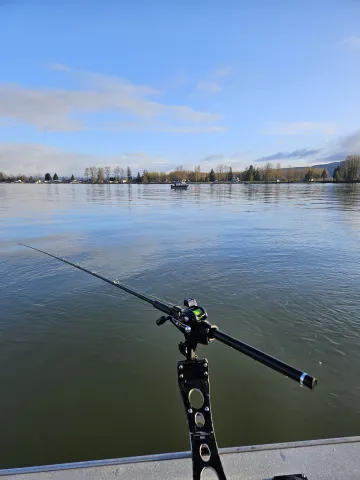
I started swapping out plugs for trolling gear. The outside rods would have 360 flashers with stuffer baits. The inside rods would be running in-line flashers with cut plug herring. There was enough current going that I could get the rods out while we were on anchor. I pulled the socks, fired up the kicker, pulled the anchor, and started trolling. I looked at either side of me on the side-scan looking for fish. I swerved out into even deeper water when the shallow wasn't showing anything. I thought I saw one mark, but nothing came of it. We reached the end of the pass and reeled up. It was time for a bigger move.
Usually, I move downriver when the fishing isn't good. If you're in a gap of fish moving upriver, there's no sense in staying in that gap. Going downriver means a chance to catch fish that you haven't seen. The reports from downriver had been poor, though, and the trolling area there was pretty spread out and fragmented. I had seen some fish move through on the sonar while we were on plugs. I chose to go upriver.
I went way up above the other boats that I saw. The boat that had been outside of us was there. I also spotted some other boats that I recognized as belonging to some really good fishermen. "If that guy is still fishing, then I don't feel so bad," I thought. That little bit of comfort quickly disappeared as the water got a bit choppy and the wind picked up.
The top was on the boat, and it started catching the wind. My clients and I struggled a bit to get the rods out, and we had a tangle. Clearing tangles in a foot and a half high chop while trolling into the wind is not easy. Finally, the torn cut plugs were replaced, and the gear was fishing. I worked the boat against the wind to try to keep it straight. I didn't put a sock on the bow to add stability, but probably should have. I did trim the main over a bit to help compensate. We worked our way out of the worst of it, and the water smoothed out. Even worse than no bites, I wasn't seeing any fish at all.
I stayed glued to the sonar and adjusted the throttle to counter any wind gusts. The 360's were working slowly, which is what I wanted. I didn't want things to move too fast in the water. It was a delicate dance between having enough power to steer and trolling too fast. About halfway down the pass, there is a big shelf that you must swing out wide to avoid. While the depth isn't bad on top of it, it's covered in weeds. They make it nearly impossible to fish in anything less than 18 feet of water. But moving away from the island would subject me to more wind. I had to swing out anyway.
The wind caught the top, and I soon found myself in 35 feet of water. My clients adjusted the rod depth down, and we continued, trying to make the best of it. It's not that 35 feet was magically too deep; I just didn't think the fish were out that far. We passed the shelf, and I pointed the bow back towards the island. The sonar ticked shallower again. At 25 feet, I turned back west and started running parallel to the shore. I looked up at the side scan and saw what looked like a diagonal streak. It started at the edge and moved towards the boat as the sonar scrolled. I waited to see if something would show up on the 2D and down scan. I looked over at the rods on the left side to see if something would come in. They kept working normally. False alarm.
I turned my head to look back and noticed the right inside rod take a dive. This was one of the triangles with a cut plug on it. "Probably bottom," I thought. I started to turn to give it a crank when it took another dive, more assertively this time. Before I could reach it, it started bouncing, then pulling. The line started rolling off the reel. "Fish! Fish! Fish!" We had designated the youngest as the first one to catch a fish. He had never caught a salmon before. He was also sleeping under the top. His dad shook him awake, and he stumbled to the back of the boat. I directed everyone else to start reeling. I grabbed a rod, got it in, handed it off, grabbed the net, and turned around. "I don't think it's there," he said. I looked at the flasher, and it was steady in the water.
When a flasher is moving normally, it has a motion to it, even an inline one. It sways and wobbles a bit with the current. If the lure is loaded with weeds or a fish, there is no sway. It moves firmly. This flasher was moving firmly. "Keep reeling," I told him. "Don't stop reeling, don't give it any slack". He blinked his eyes a couple of times and started to say, "I still don't think..." then chrome flashed under the water, just behind the flasher. The fish was thrashing.
"Reel to the bead, and when I tell you to, swing the rod to the front of the boat. Keep the tip down, it helps keep them from jumping”, I instructed. He reeled down to the orange bead I put just ahead of the line lock. I could see the fish get close, as it turned towards the boat, I took my chance. Just as the net hit the water, the fish turned away, and I brushed its tail with the net. It went wild and shot off. I pulled the net back.
"It's pulling!" The rod was bent over, and the line screamed off the drag.
"It's ok, just keep reeling," I tried to help him not panic. My own mind resembled a pack of chipmunks on a trampoline after someone dropped a bunch of nuts on it. He reeled down to the bead again, and the fish glided in front of me. It took a quick turn, but then came back towards the boat. I shoved the net under it, lifted, and watched it get surrounded. Feeling the net, the fish started thrashing around. I started looking for an adipose fin. We haven’t gotten a fish yet. It had to be hatchery.
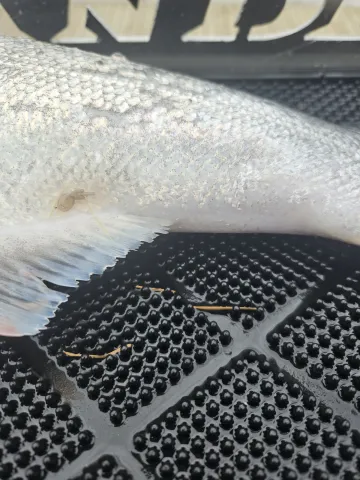
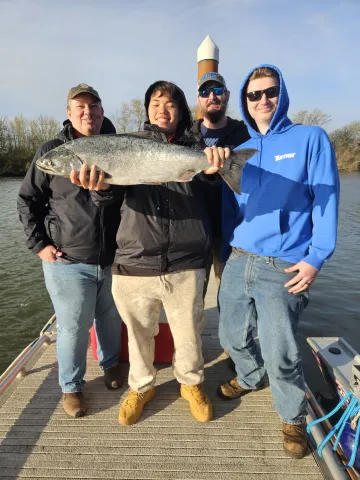
I pulled the fish towards the boat and reached in to steady the fish while trying to avoid the hooks. The fish flipped around, and I saw the back. It was smooth with a beautiful healed scar just ahead of the tail. No mis-clip, just perfect. "Hatchery!" I yelled. My own heart was pumping, and I could barely hear the cheers behind me. I lifted the fish and heard four jaws hit the deck. In the net was a beautiful, purple-backed, chrome-sided, slightly gray belly upriver Spring Chinook. I looked up and saw smiles all around. Dad seemed beside himself; the younger guys were thrilled. They were all talking about how excited they were.
I rushed to get the rods back out while my client tagged the fish. We took pictures, and I filled the bleed bucket with water. With the gills cut, the fish went headfirst to make sure the meat was as high-quality as possible. The latest price on Columbia River Spring Chinook was $70 per pound. This fish would give them about 8 lbs. of meat. I wanted to treat it right.
I put us back on course, circled back through the area where we had caught the fish, and hoped for another. It wasn't to be. Once bled, I put the fish in a bag, and it was placed on ice. I always bag the fish first so clients can use the ice in coolers on the way home. Another trick I learned from a mentor. We said hi to the boat that had been on the outside of us for most of the morning. He had one take-down that didn't stick, and didn't see any other boats catch anything. We set up for one final pass. That fish had bit just before 4 PM. We had been fishing for 10 hours. If we had found one, I didn't want to give up a chance at a second. I didn't have any clients the next day, and they wanted to keep fishing, so we did.
The second pass didn't give any results. I thought I saw one more on the sonar come in, but it didn't hook up. We got to the bottom, and I looked around. Everyone was still flying high from catching that fish. We all agreed that it was time to head back to the dock. There were only two other trailers left when we pulled in. The boat for one of them was already on the dock. I tied up, and everyone headed for the restroom. I retrieved my fillet table from the back of my truck.
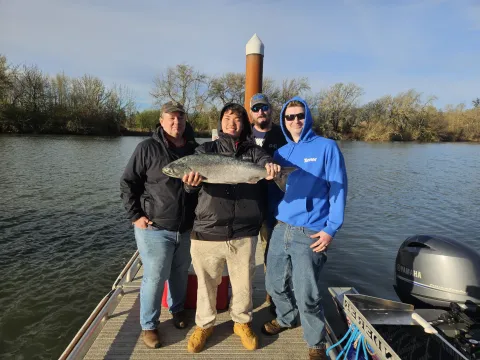
After a group photo, I cut up the fish and gave out a quick recipe tip. For Springer, just bake it at 425 for about 12-15 minutes maximum. Maybe a little salt and pepper. If you're looking to spice it up, top it with some mayo and sriracha first.
Dad pulled me aside and thanked me. "The point of today was to get my son on his first salmon. I just want to say mission accomplished. The salmon is great, but we're going to remember this for a long time. Thank you." They headed for their vehicle, still smiling. The other boat came in, loaded up, and headed out while I was cleaning up. Mine was the last trailer in the parking lot. Once in the truck, I sent a quick thank-you message and headed home.
I was exhausted. I thought about fishing on my own the next day, but decided against it. I wanted to savor the experience myself, and maybe sleep in. Like I said at the start, springer fishing can be tough, but the payoff is worth it!
/articles/best-kind-fishing-trip-jerad-sorber
Fishing For a Buddy
Society and Fishing
I’m a pretty introverted guy, believe it or not. Confident enough to enjoy time by myself and not feel like I’m missing out in my social life, but I am still a person. And people were meant to be around one another, enjoy each other’s company, find commonalities, and work together in this thing we call “society”.
Fishing, of course, offers the chance to enjoy a passion with another person. Sometimes that person can be a significant other, a child, or a parent. More often than not, when on the water, you’ll encounter a fishing party with folks just like you all enjoying time together, fishing for their limit. So, the question becomes, what to do when a friend to go fishing with seems hard to find.
Finding a fishing buddy can transform a solitary pastime into a shared adventure, deepening both skill and enjoyment for all involved. While fishing alone has its quiet charm, having a partner beside you adds camaraderie, safety, and a sense of connection to each outing. Fear not, as finding someone who shares a love for the water isn’t as difficult as it may seem. With a bit of intention and openness, anyone can build the kind of partnership that turns ordinary fishing trips into memorable experiences with a new friend.
Get Social
One of the most effective ways to find a fishing buddy is to start with your existing social circle. Friends, coworkers, neighbors, or family members may already have an interest in fishing, even if they’ve never mentioned it. I can’t tell you how many times my wife reminds me that “so-and-so”’s husband likes to fish too, or that I seemed to be excited a while ago when mentioning a co-worker who often wets a line. Casual conversations often reveal surprising overlaps in hobbies. Mentioning your weekend plans or sharing a recent catch can spark curiosity in someone who has been wanting to try fishing but hasn’t had the opportunity.
Even beginners can make excellent fishing partners; teaching someone the basics can be rewarding, and the shared learning process often strengthens the bond. Think of mentors you’ve had in your own life. The appreciation you feel for them as they taught you a skill, technique, or trade. If able to teach another person the finer details of fishing, the sense of loyalty and camaraderie between you both will only lead to more fishing adventures.
If your immediate circle doesn’t yield a partner, local fishing communities offer a wealth of possibilities. Many towns have fishing clubs, angler associations, or conservation groups that welcome newcomers. These organizations often host events, workshops, and group outings, making them ideal spaces to meet people who share your enthusiasm.
Joining a club not only helps you find a buddy but also exposes you to new techniques, local knowledge, and a supportive network of experienced anglers. For someone new to an area or new to fishing entirely, these communities can be invaluable. How many episodes have you seen on Northwest Fishing TV where we are out with community groups or organizations? Fishing with the Ilwaco Tuna Club? Check. Fishing in a Salmon Derby? A great opportunity to connect with other anglers.
New Digital Age
In the digital age, online platforms have become powerful tools for connecting with fellow anglers. Social media groups, fishing forums, and specialized apps allow people to meet others who fish in the same region or target the same species.
Northwest Fishing’s roots come from the days of blogging in the 90’s (Washingtonlakes.com), where anglers could share tips, tricks, and friendly banter about fishing around the region. Now resources like Facebook, Instagram, TikTok, and X give us the chance to quickly filter and search for those with similar interests as us. Our Northwest Fishing Group on Facebook alone has nearly 54k members, and our Northwest Fishing TV page has 35k followers!
I’m willing to bet those platforms can connect you with someone who wouldn’t mind hitting the water. These spaces are full of trip invitations, gear discussions, and shared photos that help break the ice. Posting a simple message like: “Looking for a fishing partner around Helena, MT” can lead to multiple responses from people eager to share their favorite spots. Online communities also make it easy to vet potential partners by reading their posts, seeing their experience level, and getting a sense of their personality before meeting in person.
Tackle Shops
Local tackle shops are another underrated resource. These small businesses often serve as informal hubs for the fishing community. The staff usually know regular customers, local hot spots, and upcoming events. Striking up a conversation while buying bait or asking for advice can naturally lead to meeting other anglers. Many shops keep bulletin boards where people post fishing reports, club announcements, or partner requests. Because everyone there already shares a common interest, it’s one of the easiest places to make connections.
Once you’ve found someone who seems like a good match, communication becomes essential. Discuss expectations before heading out: preferred fishing styles, target species, early-morning start times, and whether you’re fishing for relaxation or competition. Even something as simple as where you plan to meet up, what kind of vehicle you drive, or that your favorite food is bananas and you plan to bring a bunch on board with you can’t be assumed. Aligning these details helps avoid misunderstandings and ensures both people enjoy the experience. It’s also wise to talk about practical matters like gear sharing, transportation, and safety habits. Ideally, you’ll click with this person and have many more fishing trips planned in the future.
New Connections
Finally, be open-minded. The ideal fishing buddy might not look exactly like you expect. They might be older, younger, more experienced, or brand new to the sport. What matters most is compatibility, respect, and a shared appreciation for the water. Sometimes the best partnerships form between people who bring different strengths to the boat or shoreline.
In the end, finding a fishing buddy is about more than just catching fish. It’s about building a connection rooted in patience, nature, and shared adventure. With a little effort and a willingness to reach out, anyone can find someone to cast a line with, and maybe even form a friendship that lasts far beyond the fishing season.
/articles/fishing-buddy
Steelhead are biters, dude!
The solunar tables said the first day of spring would be poor for fishing, but there was a window in the morning when fish would bite best. The forecast called for one low-pressure cell after another, but between storms, there would be a bump in the pressure. I always think back to what a friend of mine told me on a day not unlike this one.
When the river is high, green and dropping, when the pressure rises, when the moon is waxing, when there are fish in the river. That's when I want to fish.
My grandpa used to point me to the barometer and tell me when the fishing was good and when it wasn't. It didn't make a lot of sense then, but I watch the barometer before every trip now. We picked the day months before, hoping to maximize our chances of tangling with big steelhead.
"Steelhead are biters, dude!" I remind myself when the rainwater is dripping around the brim of my hat.
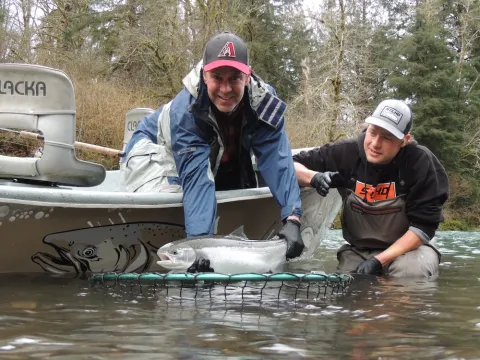
Dan Cardot and I made the drive the night before, ate too much fried food too late, and checked into one of those classic Highway 101 motel rooms with paper-thin walls, moldy carpets, and dirty blankets. We saved three bucks over the next more expensive motel. I would have paid $50 more to stay a mile away if I'd had any inkling of what an active pair our motel room neighbors were. That fresh ocean air can be invigorating.
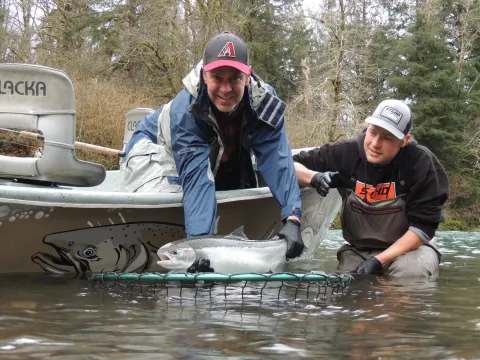
After an hour of sleep and a Denny's breakfast, Brad Hanson met us in a pool of metal halogen light in the parking lot at Tillamook Sporting Goods. Only one river was in decent condition. The night was still in full Stygian blackness as we drove up the narrow road. I parked the Ford at the lower end of the first float and we drove five miles upstream, sipping at our coffees. In the dark, we pushed Hanson's Clackacraft off the trailer, tugged on waders, and, as the first sliver of light broke over the tops of the cedars, Hanson sat down at the sticks. We floated into the current. With a couple of other drift boats in the river, we traded first water for a few runs, then turned a corner with one boat in front of us. They pulled anchor to stay ahead.
Here, the river made a right turn, broke across a gravel bar on river right, and frothed over a ledge with a pocket behind a moss-covered boulder. On the far side, the bank ran jagged into the current. A nice riffle of broken water tumbled through aquamarine, then the river browned out over a gravel tail.
At the business end, our baits were steelhead roe with a small yarnie, sweetened up with Pro-Cure Winter Chrome. Cardot pitched a cast upriver; his bait and float splashed down along the seam, and the float tipped up, caught in the current. Cardot's bobber zagged upstream, and he set the hook into a silver streak of fury. It cartwheeled and tailwalked from the top of the run all the way to the tailout and flashed in the sun. Bright as a new-minted nickel.
For a few tense minutes, we thought we'd have to follow it through the rapids. We didn't care about first water anymore. We wanted this water. When Cardot took the pressure off, the fish nosed back into the current and came back into the pool. Hanson dropped the anchor and jumped over the side to net the fish over the gravel bar. Cardot cradled it a moment and let it kick into the green water. Five casts later, my float plunged, and we were fast into another, this one seven pounds, a rainbow-colored male.
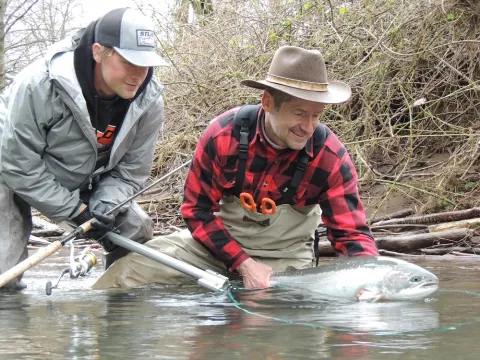
Beneath us, the river was clearing, and the fish, fresh from the salt, kept eating our baits. Cardot's third fish ran the last 400 yards of our float, and Hanson netted it at the takeout. We drove back upstream to get Hanson's rig and then parked it at the next takeout down, breathing deep of that Tillamook dairy air.
When the rain started, we picked up a 12-pound wild hen, just four miles up from the salt. As wild as the morning of creation, as bright and fueled with the ocean's bounty as any fish I've ever caught. This one I wanted to keep, but I couldn’t and turned it back to make more wild steelhead.
The rivers begin to swell with winter steelhead in late December, and each tide brings in new fish through January and February. Pick a day. Put it on the calendar. Tie leaders, sharpen hooks, and fill spools with fresh line. March is prime for winter runs, but there are still fresh fish on every tide well into April.
If there is rain in the forecast, if the water is high, if a low-pressure system is coming in over the beach, it doesn't matter much. Soak the baits. Thump the hardware. Swing those flies deep and slow. Steelhead are biters, dude.
/articles/steelhead-are-biters-dude
Of Damsels, Dragons, and Snails for Stillwater Trout
Be the best big stick by slowing down the presentation and lightening the tippet.
Last year, in early June, we fished a small reservoir in the high desert. Like a lot of private waters in Central Oregon, the lake had tules along one side and willows on the other.
We started in float tubes, backing into the water, then settling in.
My dad called out that he was seeing lots of damselflies. For which I thanked him and immediately tied on a damselfly imitation.
Kicking away from the launch into deeper water, I observed midges, PMDs, snails, dragonflies, and damsels.
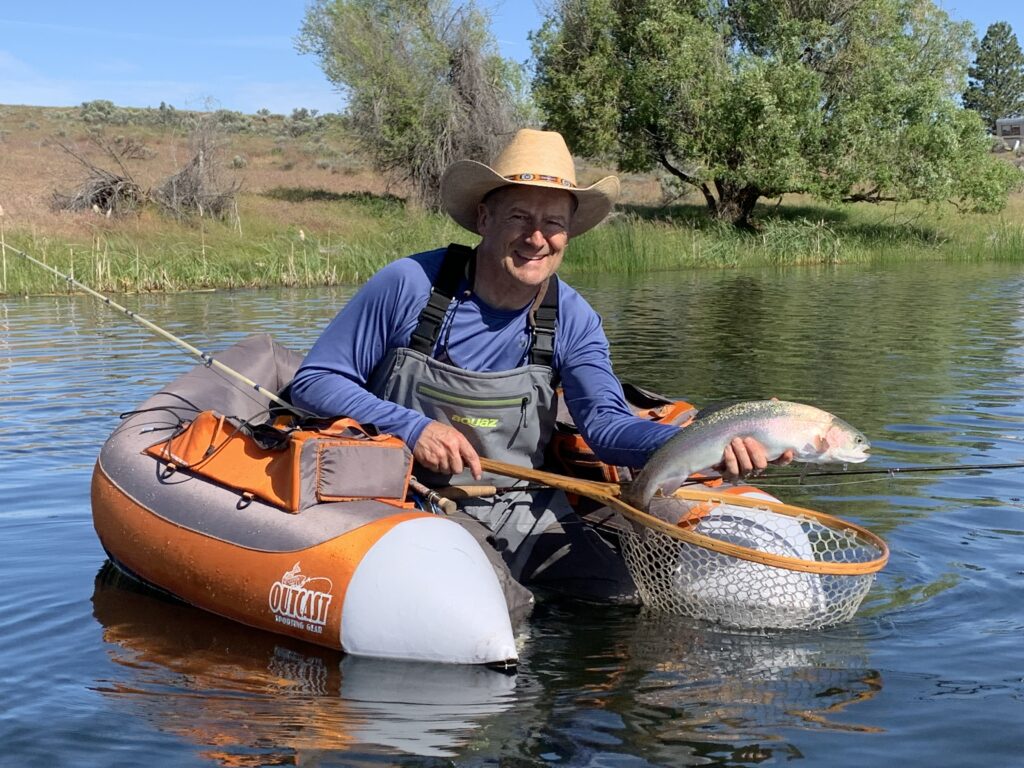
My first fish to the net was a 21-inch rainbow. Dad was on the other side of the lake and could not get a picture for me. While I was using a damsel, I was thinking about how I usually like to start with a Renegade or a Brown Hackle or some other snail imitation.
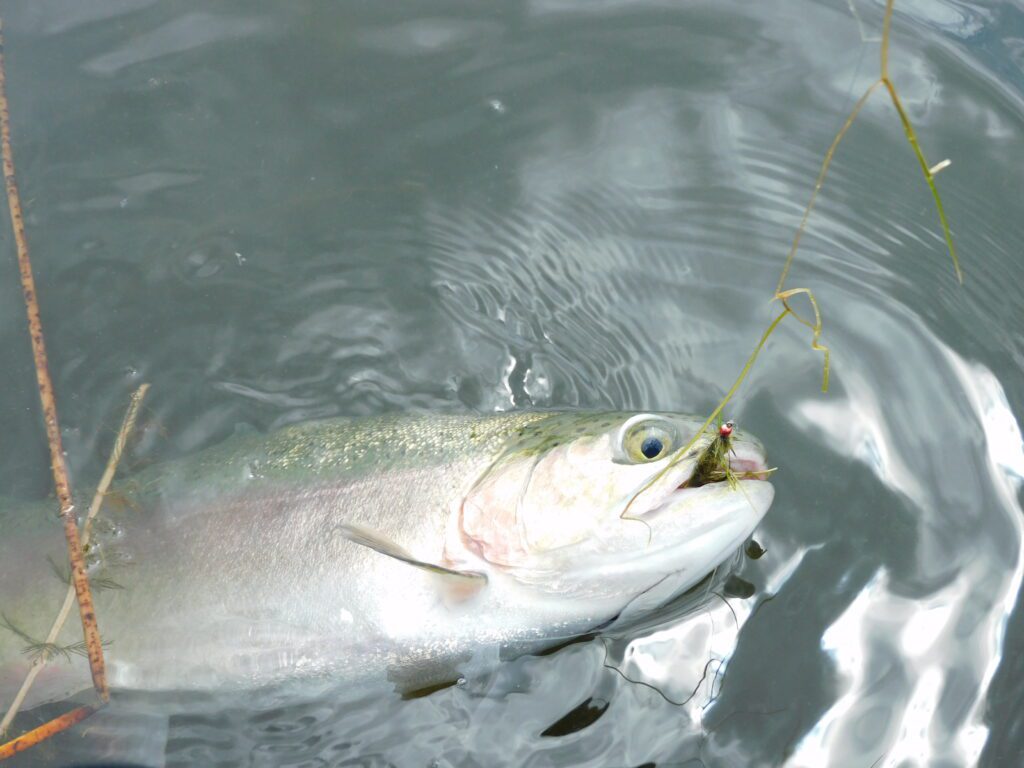
A person has a chance in the first hour of daylight to catch trout close-in to the tules on snail patterns before the fish sense the vehicle traffic or start to feel pressured by people in float tubes. But a lot of my friends don't want to fish using snails. It is not something they think about. Why would fish eat snails? And what do snails even look like? I think the real reason a lot of us don't fish using snails is because we are too restless. The snail just sits there on the surface or just under it. Until a trout eats it. It is so simple to fish snails.
The best thing to do is walk along the reed beds and scout the weed lines with polarized glasses. Look for swirls. Look for shaking tules. Watch for fins and tails or the white gum line as a trout opens its mouth and flares its gills.
Pattern choice is as simple as it gets. A No. 10 Woolly Worm. A Brown Hackle. A Renegade. These are all suggestive of snails when fished at snail speed. Cast or dap, and let it sit. Wait for the butt of the fly line or the leader to move. The fish will often have to change course to take the fly, so as the trout turns, it will feel the fly and spit it. Don't wait to feel the take, set the hook when the leader starts to move. After the sun comes up, the fish tend to retreat to deeper water, and now is the time to switch to a leech, damsel nymph, or dragonfly nymph.
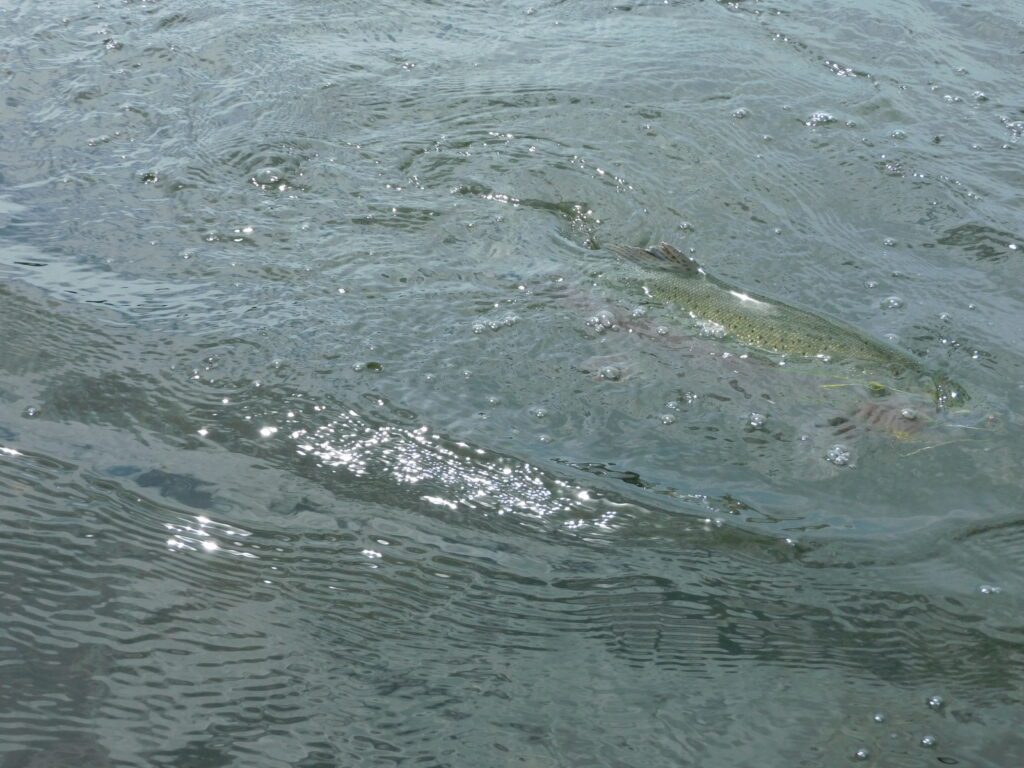
While it is tempting to use old standbys like the Woolly Bugger or even the Thin Mint, don't forget, the fish have seen all these flies before. We can catch more fish if we use lifelike patterns that are faithful to the profile, contrast, and color of the food source, but also incorporate rubber legs, gill movement, and eyes.
It's okay to experiment with retrieve, but in general, these critters don't move fast and can spend a lot of time at rest. One-inch increments are my rule for retrieves. Unless I am fishing a minnow imitation.
We need to be more patient and precise with our presentations. Once I watched a guy in a float tube. He was using the right fly, but his tube was underinflated, so when he kicked, he leaned way back, transmitting all of that back-and-forth motion to his fly rod and his fly. His fly was probably making two-foot moves. No bug does that. Some guys don't like to be told what they are doing wrong, so I just kept my mouth shut. While the guy's buddy caught half a dozen trout that morning, this guy didn't land one. The difference between a poor day of fishing and a good day might just be the way the fly swims.
A good presentation is one where the bug swims and rests naturally. Since real bugs don't get towed around on lines, we have to minimize the way the line affects the movement of the fly. The smaller the tippet, the more that the fly will work in the water like the tyer intended. If you have been using 3X, go down to 4X tippet or even 5X on smaller flies. Don’t forget, fluorocarbon was made so that you can catch more fish. And the guy with fluoro will probably out-fish the guy with mono five-to-one if everything else is equal.
Like it or not, you might have to learn a new knot. Try a non-slip or a perfection loop and see how the fly behaves differently at rest. My biggest fish of the morning was a 25-incher with a thick wrist, one of my best trout of the year. But it was in the late afternoon with a low-pressure system coming in when I earned a 20-inch rainbow.
"What are you using?" Dad wanted to know.
"A damselfly."
"Oh, good idea," Dad said. "Why didn't you tell me earlier?"
"Because you told me, I figured you already knew."
"Oh yeah, I'm pretty smart," Dad said.
# # #
For a copy of the Fishing Central Oregon book, send $29.99 to Gary Lewis Outdoors, PO Box 1364, Bend, OR 97709 To contact Gary Lewis, visit www.GaryLewisOutdoors.com
/articles/damsels-dragons-and-snails-stillwater-trout
How To Catch Trout On A Rainy Day
They say an angler is a man who spends rainy days sitting around on the muddy bank of a river doing nothing. Because his wife won't let him do it at home.
Once I made a rainy day road trip through Central Oregon early in the spring. I didn't fish much, but I talked to anglers, most of whom were doing nothing. Here's a sample of the folks I met and how they were fishing.
One guy had the door of his Mercedes propped open while he fished the Deschutes at Warm Springs. He had tied a hook direct to the end of the main line and had a worm on it. No swivel. No leader. No split shot. Just a hook and worm.
He couldn't figure out why he couldn't cast farther than the end of his rod. I couldn't figure out how he had generated enough brain activity to afford a Mercedes.
At Taylor Lake in The Dalles, a father and son were sitting in a Chevy watching their poles. I walked up about the time they reeled in. They had split shot crimped on main lines, big snap swivels, and short, heavy snells on big No. 4 worm hooks. Okay for catfish, maybe, but not for trout. They told me the trout weren't biting today. When they went home they probably said, "The fishing was good; it was the catching that was bad." News Flash: It ain't ever gonna be good.
At a kids-only trout pond in Bend, I saw a man and wife in their 90's fishing with fly rods. They were seated on lawn chairs right next to the sign that said Fishing For Children Aged 17 and Under.
Tied to very short leaders, they had huge Spin-N-Glos with nightcrawlers on 2/0 trebles. Too big for anything smaller than a 30-pound Chinook. Their baits lay on the bottom about two feet out from the bank.
Call me old fashioned, but I think people when they go fishing for trout, should know how to rig for trout.
Here are three easy ways to catch 'em.
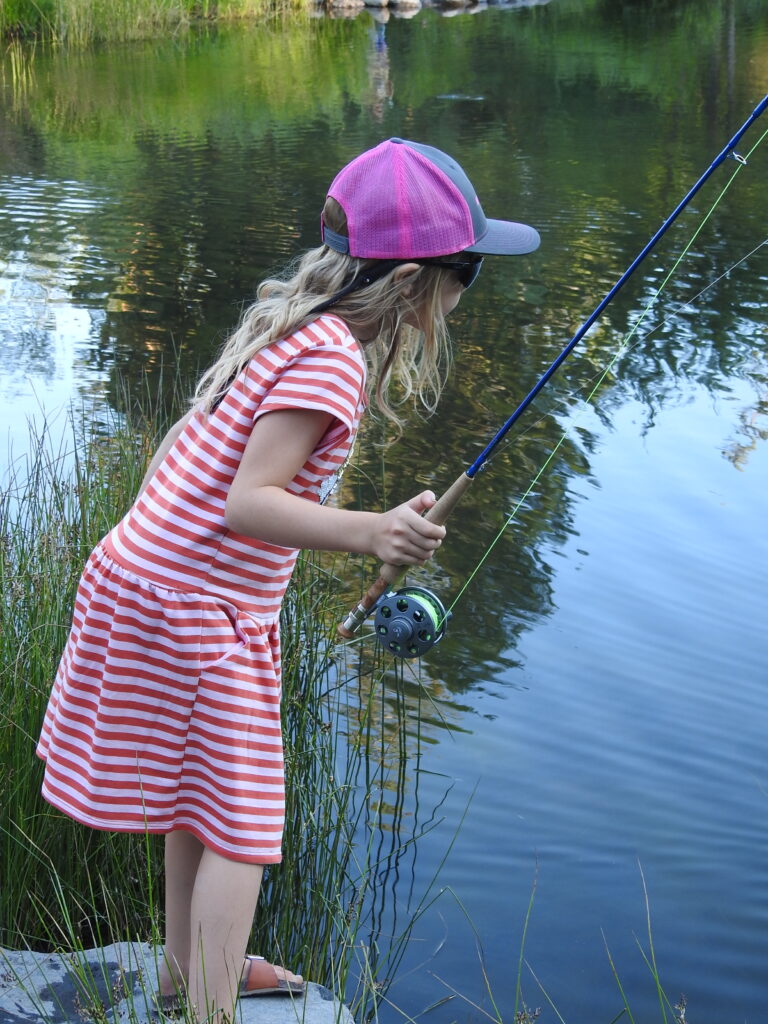
PASTE BAITS/JAR BAITS
Use a paste bait, particularly when the water is cold in the early season. Slide a bullet sinker onto the main line and then tie on a barrel swivel. Then tie on a 30-inch four- to six-pound test leader terminated at a No. 12-16 treble hook. Pinch a bit of the paste bait (Power Bait, Gulp! or similar), roll it in a ball and cover the hook with the dough.
Cast out, let the bait sink to the bottom, then leave it. Set the rod down and watch it. When the line starts to move, pick up the rod and reel in.
This rig catches fish and it kills them. So don't plan on fishing for sport, for catch-and-release. Use this method when fishing for a fish dinner.
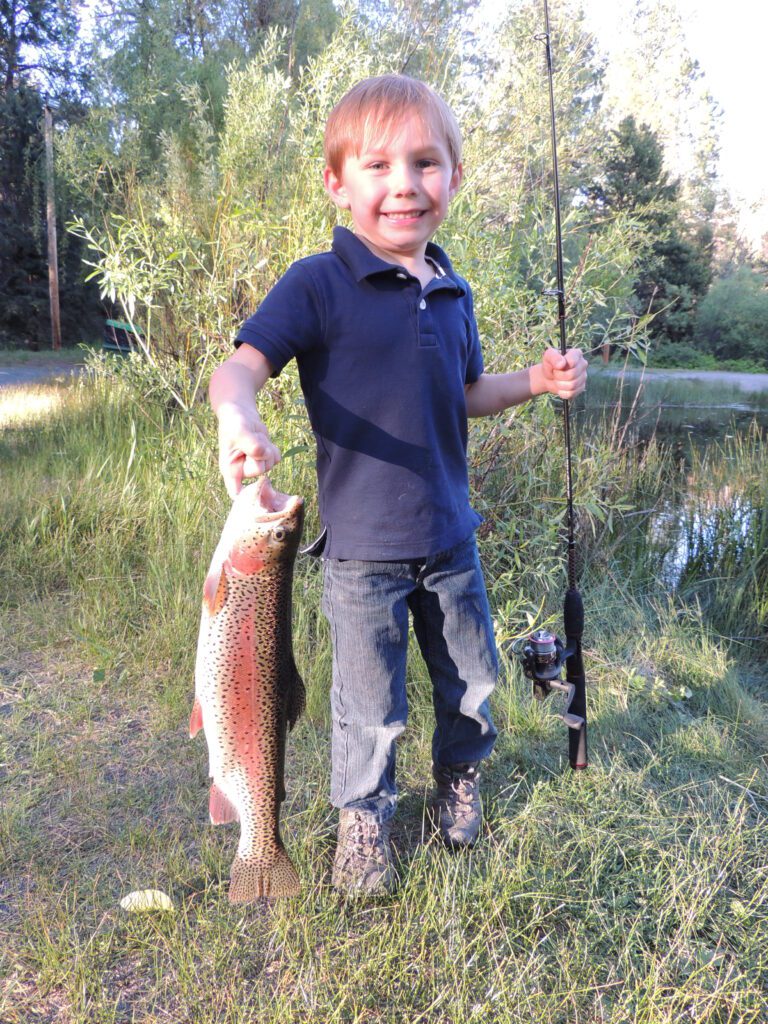
BOBBER AND WORM/BOBBER AND EGG
The bobber and worm rig is just as effective as it ever was. Rig this way when fish are active and higher in the water column.
Tie a swivel to the main line. Tie on a leader about 24 inches long. Tie on a No. 8-12 bait holder hook if fishing with a worm. Use a No. 12 hook if fishing with salmon eggs. When using nightcrawlers, cut the worm into pieces instead of using the whole worm. Pinch on a bobber above the swivel. Pinch a couple of small split shot on the leader.
Cast out, set the rod down and watch the bobber. When the bobber starts to move, let it bounce a couple of times then set the hook.
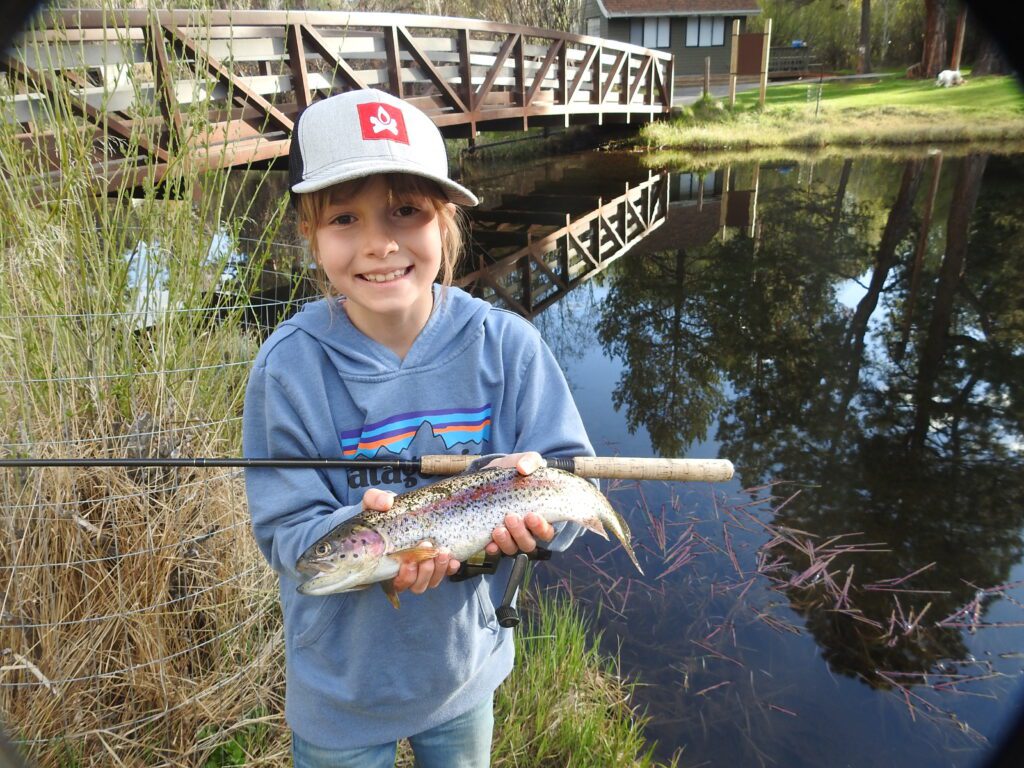
FLY AND BUBBLE
Use a fly and bubble when the water is clear. One of the most effective rigs for catching hatchery trout in clear water is a spinning rod rigged with six-pound test mainline and a float and fly combo. Slide a clear plastic bubble over the main line. Tie on a swivel. Tie on a 48-inch 4-pound test leader and finish with a No. 10 Red Tag Woolly Worm. At the lake, fill the plastic bubble with water which provides the weight necessary for long casts. If the fly doesn't sink fast enough, put on a small split shot.
Cast and reel it back S-L-O-W. Keep moving around the pond until fish are located. This is a good method for catch and release.
Fishing is not hard, but using the wrong baits and fishing in the wrong spots will lower an angler's success rate. Make it easy for the fish to find your bait or fly. Fish where fish are.
Still need help? Stop at a sporting goods store. Take your rod and tackle box inside. They're going to sell you something, and that's okay. But get a tackle expert to rig the rod the right way. They'll do it if you ask nice. Pay attention so you can do it next time. Then go fishing. Your loved ones want you to get out of the house.
As has been said before, "Give a man a fish and he has food for a day; teach him how to fish and you can get rid of him for the entire weekend."
# # #
For a copy of the Fishing Central Oregon book, send $29.99 to Gary Lewis Outdoors, PO Box 1364, Bend, OR 97709 To contact Gary Lewis, visit www.GaryLewisOutdoors.com
/articles/how-catch-trout-rainy-day
In Search of the Perfect Storm
Snow ain't good enough. Rain is better. The kind of rain that starts about 8:00 in the morning and melts the snow and upwells the river. It's going to be hard to catch a fish, but I only need to catch one.
Two other vehicles in the parking lot. Two other fishermen. Singles, I guessed, reading the tracks in the snow. I sat on the tailgate of the F-150, tightened my bootlaces, and decided to start downstream like a proper fisherman and work my way up. It was Super Bowl Sunday, one of my favorite days of the year.
As I walked down to the river, one of the anglers picked up his net and began the walk back toward the parking area. This was better.
Using a large pine tree as cover, I looked in the water with the glare glasses and saw trout. Noses in the current, but not active. No bugs on the surface either. And as I watched upstream, nothing rose.
At first, I tumbled nymphs to them, high-sticking, watching for the white of a mouth or a rainbow flash in the braided current. I suspected the fluoro leader was not working for me in the clear water. But I hesitate to fish 6X or (shudder) 7X because these bigger fish are likely to break off on the second jump. And besides, the tracks in the snow indicated there had been at least half a dozen anglers here before me.
Upstream there were tails visible beneath a downed tree and I flirted with disaster, drifting nymphs to the otherwise hidden trout in the branches.
Working up, casting bead-head wets, and tumbling them back through the regular slots did not pay off with a take. Now as the sun began to go off the water, it was harder to see into the regular slots and now the snow crunched under my boots as the temperature began to drop.
Where there once were willows to hide behind, I scouted the shallows and ran through channeled lava flows. A few trout here, but their body language reads the same way. If I could see them, they could see me.
Time to change tactics. The beadheads went back in the box and I trimmed the nine-foot leader down to seven feet, trimming the 5X tippet back to 4X.
This next run was best fished by wading in, but this time I would cast a streamer. I knotted on a root beer brown mohair leech.
Here, the water splits around a few boulders and drops fast down a couple of short waterfalls. Trout feed in the shallows if there is a hatch, but hold along a ledge in the absence of surface activity. It's deeper water than most flyfishermen are comfortable fishing, and faster too. But this is where the biggest fish can exist unseen and untouched.
The first cast quartered up, midway across the run with an upstream mend. After a couple of seconds to let the current grab the fly and pull it down, I short-stripped twice and a fish slammed the fly.
It turned and streaked toward the log jam at the bottom of the run, and then turned back upstream to try to see the line on the lava edge. Extending my arm, I kept the line off the rocks and after a couple of minutes where the fish streaked up and down the run, I made the first stab with the net. For a second, the fish was in the net and then it was out again. Praying the 4X would hold it, I waited till its head was up and skated it with my right hand, netting it with my left, turning so the bag would close.
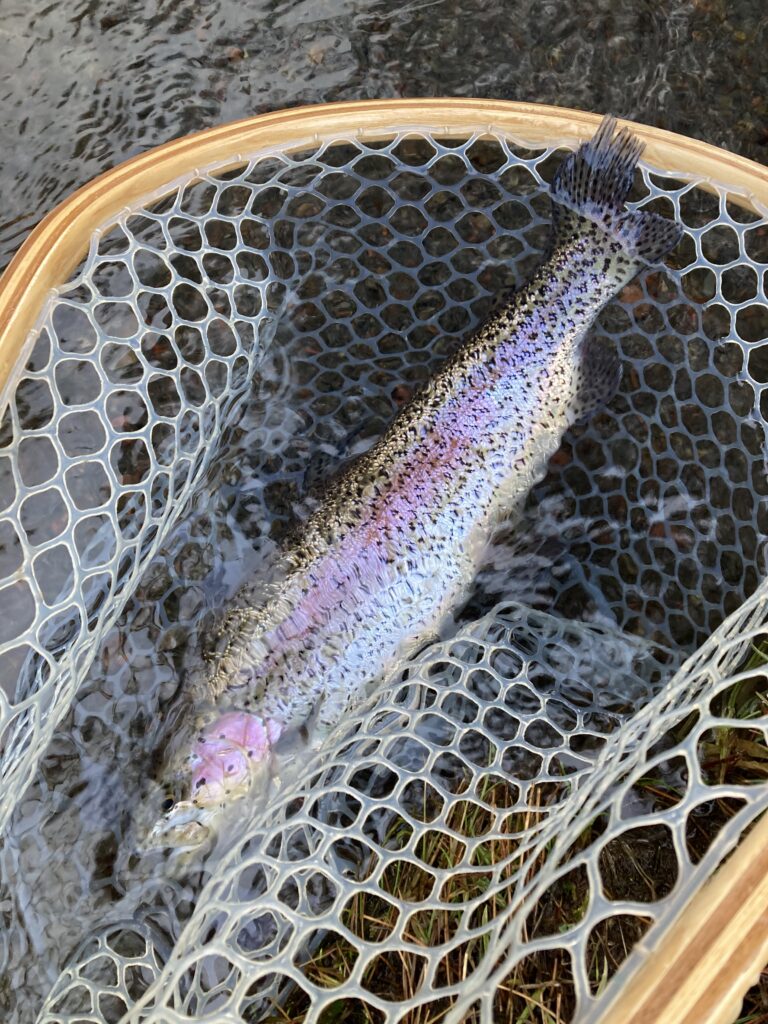
In hand, the fish was beat up. A hatchery survivor, its nose and tail frayed in the jungle of the hatchery raceway. Nineteen honest inches. Shaped like a football. And there and then in that moment, I noticed something else about it. If its head was off, it would fill my Camp Chef cast iron frying pan. So I kept it and cooked it for dinner that night with mayonnaise and angler's seasoning. And fried a half dozen prawns to go with it and proclaimed it a feast.
What I like best about football is it keeps people off the water. Same with a good rainstorm. In fact, where I live, the best scenario is the Seahawks are playing and there's a 70 percent chance of rain. Snow is not good enough. Lots of people around here fish in the snow, but fewer of them will fish in the rain. The only better thing would be if the Super Bowl coincided with Valentine's Day and a deluge. That would be the perfect storm.
# # #
For a copy of the Fishing Central Oregon book, send $29.99 to Gary Lewis Outdoors, PO Box 1364, Bend, OR 97709 To contact Gary Lewis, visit www.GaryLewisOutdoors.com
/articles/search-perfect-storm
Navigating Nature’s Nooks - A Guide’s Fishing Wisdom
Guides offer an invaluable service to anglers. Whether you’ve never fished before, are new to the area, or just need to learn a few new techniques and tricks, guides provide knowledge that can stay with you even after you’ve paid for their services.
When fishing with a guide, it’s like the grown-up version of show and tell. They’ll get you situated with everything you need and be sure to coach you throughout the day on the water. I’ve been lucky enough to fish with some great guides and I have not taken their teachings for granted. I’d urge you to think about these different areas of the fishing experience next time you fish with a guide and how you can apply them when you fish on your own.
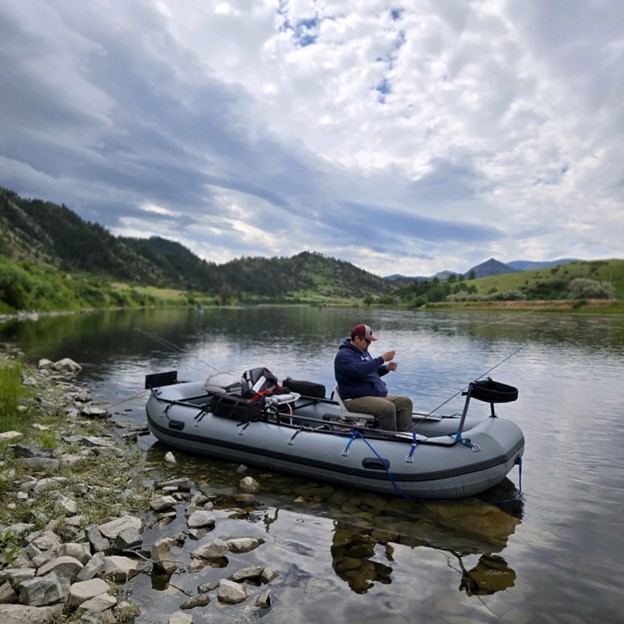
The Setup
Trial and error can be a learning experience in itself, but man it really speeds things up when you know what you’re doing. Asking questions is never a bad thing to do when fishing with a guide. A guide who wants to help make the most of your experience with them will often answer questions that aren’t even asked. Taking the initiative and asking about the gear being used when fishing with a guide not only gives you something to talk about but is a learning experience in itself.
Why are we using the blue/silver lure instead of the red/gold lure? Is there a reason you’re using squid as bait instead of the herring? What's a split shot and why do we need it? Your guide can be a wealth of knowledge if you only take the time to ask the questions. I’d also add this - there is a great sense of accomplishment when you retain what you’ve learned from a professional and apply it. I think this holds true in nearly all aspects of life. Learn how to cook a delicious meal from a chef and then replicate the dish at home?
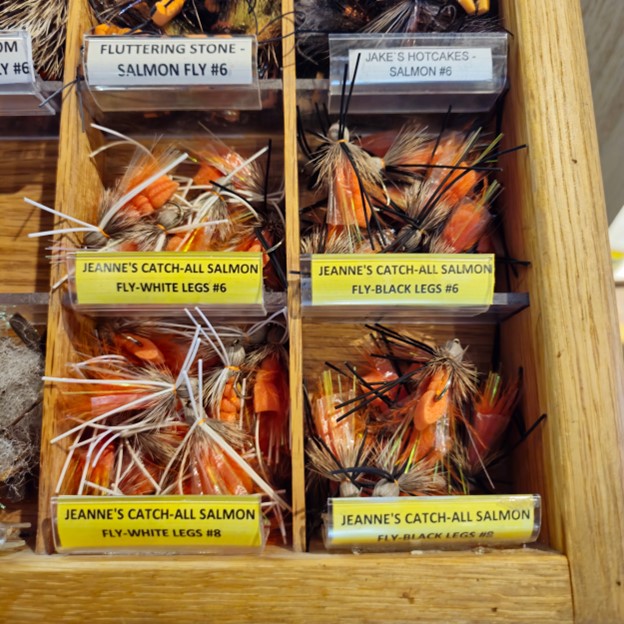
You might win spouse of the year. Have someone in a leadership position in your job show you how to do something and then you accomplish that task later to be complimented by them? Great job satisfaction and collective efficacy. Purchase the right kind of flies for the time of year when fishing, tie them, fish on your own in an area you think will be effective, and actually catch something? This time without a guide? That’s a great feeling.
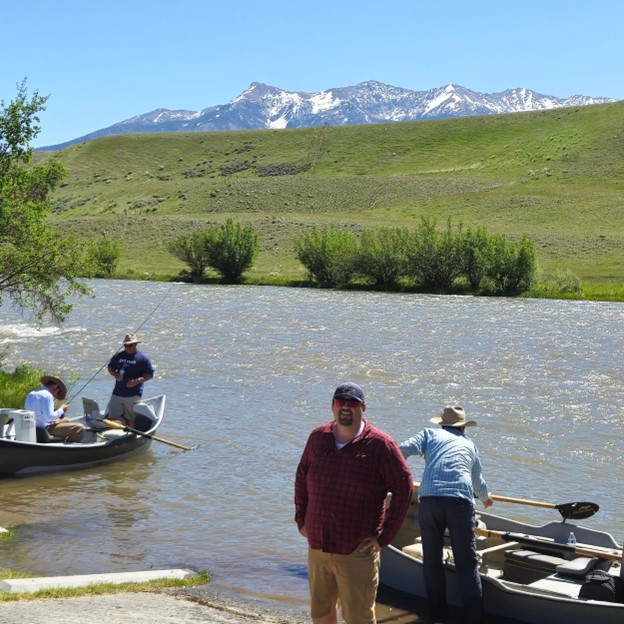
On The Water
Great, you’ve got the gear. You’ve tied everything together the way it should be just like the guide showed you when you last fished together. Now all that’s left is putting the line in the water. Although, there’s a lot of water to cover and you only have so much time available to fish.
If you were hopefully paying attention to your guided fishing experience, you should be able to ascertain whether or not you are fishing in an area that is likely to hold fish or at a depth that will be productive for you. If you’re planning on coming back to the same waterbody, make a mental note when your guide tells you “This spot is usually really good” or “The fish like to group up behind these rocks”.
Those clues can be used when you come back again on your own, if you remember. More broadly, a guide can help you identify general areas that will likely hold the fish you are looking for. The guide can provide you with a “Habitat 101” crash course while out on the water. Knowing your fish is migrating because of the spawning season, like a plateaued rocky surface, or will hold up in a small bay to rest can help provide you some general knowledge on where to go when fishing on your own.
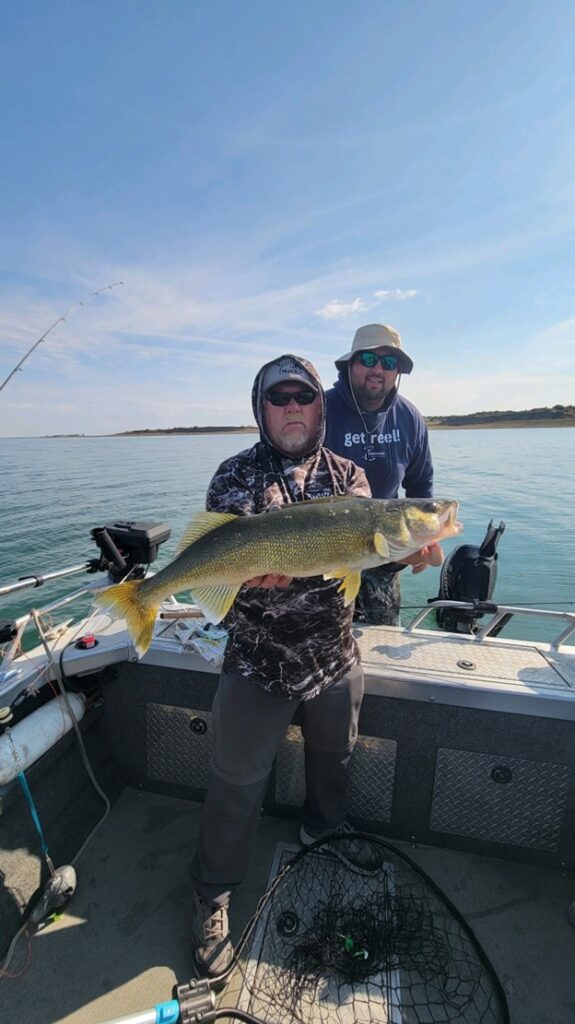
The Fight
As mentioned earlier, the setup is a crucial part of the fishing experience. Knowing what kinds of lures or bait to use, how long leaders should be or the distance from dodger to lure are all invaluable. Similarly, fishing in an area that is likely to actually hold the fish. But, arguably the most important information you can take away from a guided fishing trip is how to actually fight the fish once hooked!
Take the tips learned during your fishing adventure as you played the fish, with some coaching from your guide, and apply them as best you can in your personal fishing. I know the feeling of hooking into a nice fish and the sense of urgency that takes over, the adrenaline-pumping feeling where you tense up and feel like you’ve got to bring this fish in. All you think about is “hand, reel, crank” until the fish is in the boat.
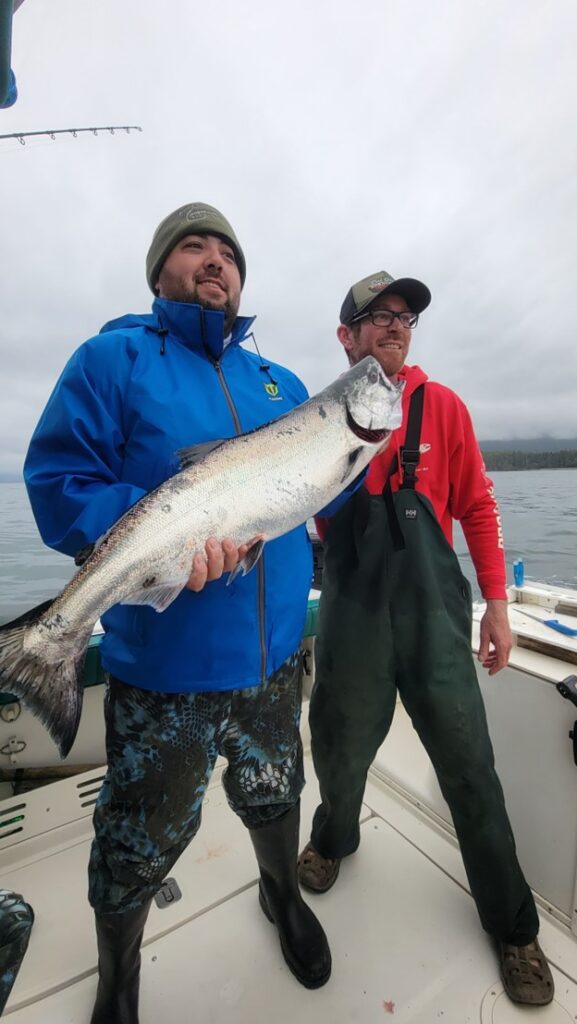
If you can calm your mind during this tussle with your opponent and think back to the advice from your guided experiences, you’ll not only have a more enjoyable time battling the fish, but you should be more likely to land it. Something as subtle as bracing yourself up against the side of the boat when out on the choppy ocean water can help provide solid footing. Remembering and recognizing where the fast water is in the river and steering your fish away from the heavy current and into a section with slower water makes for a, in theory, easier catch.
I only scratched the surface of all the benefits and help that guides can provide us on the water. Certainly, their knowledge and advice is helpful at the moment, while they’re in the same boat as us and judging the conditions of the water in real-time. Still, a savvy angler will retain their advice and draw upon the guide’s experience to apply solid fishing techniques not only during the fishing trip but out on the water during personal adventures as well. Want to get started with some solid guides who are sure to get you on some great fish?
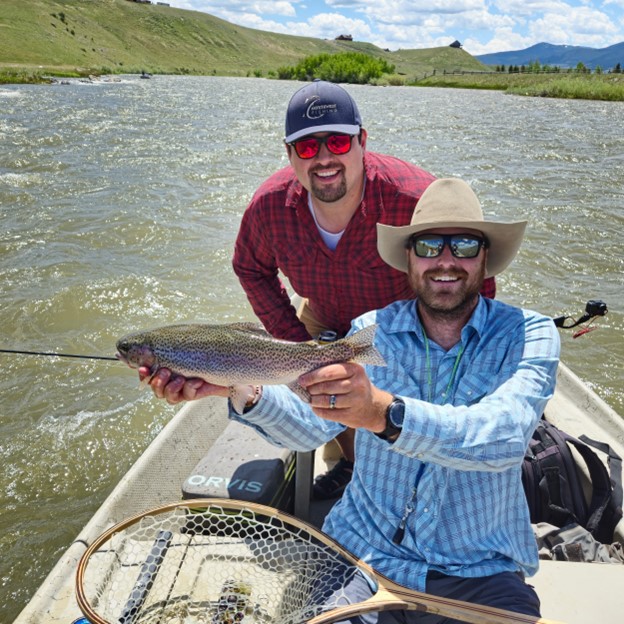
Check out our “Guides and Charters” section in the back of the magazine or in the directory section of the website. They can help you get started if you’re new to fishing, offer advice to seasoned fishermen that only comes with experience from hundreds of days on the water in a year and help you expand your knowledge about the variety of fish and techniques to catch them that swim throughout the northwest. I know I’ve benefited tremendously from their guidance in my own personal fishing outings and know that the same success in my personal fishing life will continue as I keep fishing with and learning from many great guides in the future!
/articles/navigating-natures-nooks-guides-fishing-wisdom
Bright Salmon on a Sandbar
An up-close epicurean angler perspective on the making of a Travel Channel special with Chef Andrew Zimmern.
It mattered to me. It mattered to Josh. It mattered to Andrew Zimmern, the host of Bizarre Foods on the Travel Channel.
On the Columbia, where the chinook blast upriver on swells of tide from the mouth of the river up past Washougal and then seek out the 12-16-foot deep travel corridors close to the banks, the hot salmon bite happens in the first hour.
It didn’t matter to the 17 other people on Zimmern’s crew.
Zimmern was following the Lewis & Clark trail with a perspective on the types of foods the explorers might have encountered. He chose September when the fall chinook salmon (also called king salmon) run is in full swing.
We started in the second hour, on a Tuesday in September, after camera operators, directors, drivers, handlers, drone techs, and a bodyguard were breakfasted, caffeine’d up, and constitutionalized.
Josh Cooper, stood, his hand on the tiller, his eyes on the water ahead. We idled away from the Rowena launch (Mayer State Park, west of The Dalles). Ahead of us, 64 other boats were on the fish. Rods bent and nets flashed as we took our place in the throng of watercraft.
Cooper, who makes his home in Vancouver, WA, our captain for the day, is one of the best anglers on the river. But sometimes that’s not enough. The bite was over when we dropped our baits.
With us, on Josh's 26-foot Motion Marine Fishing Machine were two camera operators and a sound technician. A camera boat trailed in our wake with the director and additional camera operators. A drone operator and his team staged on the Washington side of the river near the mouth of the White Salmon. The bodyguard stayed on the beach.
Zimmern is no stranger to a fishing rod, but he hadn't fished for Columbia chinook before.
We showed him the baits, hoping he wouldn't gobble them or try to get us to eat them.
We call this hover-fishing when the fish stack two feet off the bottom and we drift our baits into a bio-mass of salmon, as drag-free as possible.
I looped a cluster of cured salmon roe and a sand shrimp tail on a blood-red Daiichi hook. We drizzled Pro-Cure Tuna on the potpourri in case our prospective salmon had cultivated palates.
To hover-fish, the procedure is to start at the top of holding water and run the boat a bit slower than the top currents, the baits "hovering" off the bottom.
Zimmern's rod had a Daiwa line-counter. Without digital advantage, I dropped the lead weight to the bottom and then cranked up two turns.
We tried to follow the contour of the river bottom. When it sloped up, we reeled up, when the water deepened, we dropped weights down to touch, then cranked up two turns.
Fish bit. They flared their gills, inhaled to sample the salmon eggs and shrimp then spit the baits.
Josh missed one. Andrew missed two and I missed a fish.
In the east, the sun climbed higher. Our chances diminished. A drone like an angel flew overhead and three hundred pairs of eyes on 65 boats looked to the heavens.
Then it happened! A fish bit and the hook stuck.
Andrew arced the spine of the rod against His Majesty, the king salmon. After a few tense minutes, a seven-pounder thrashed in the net.
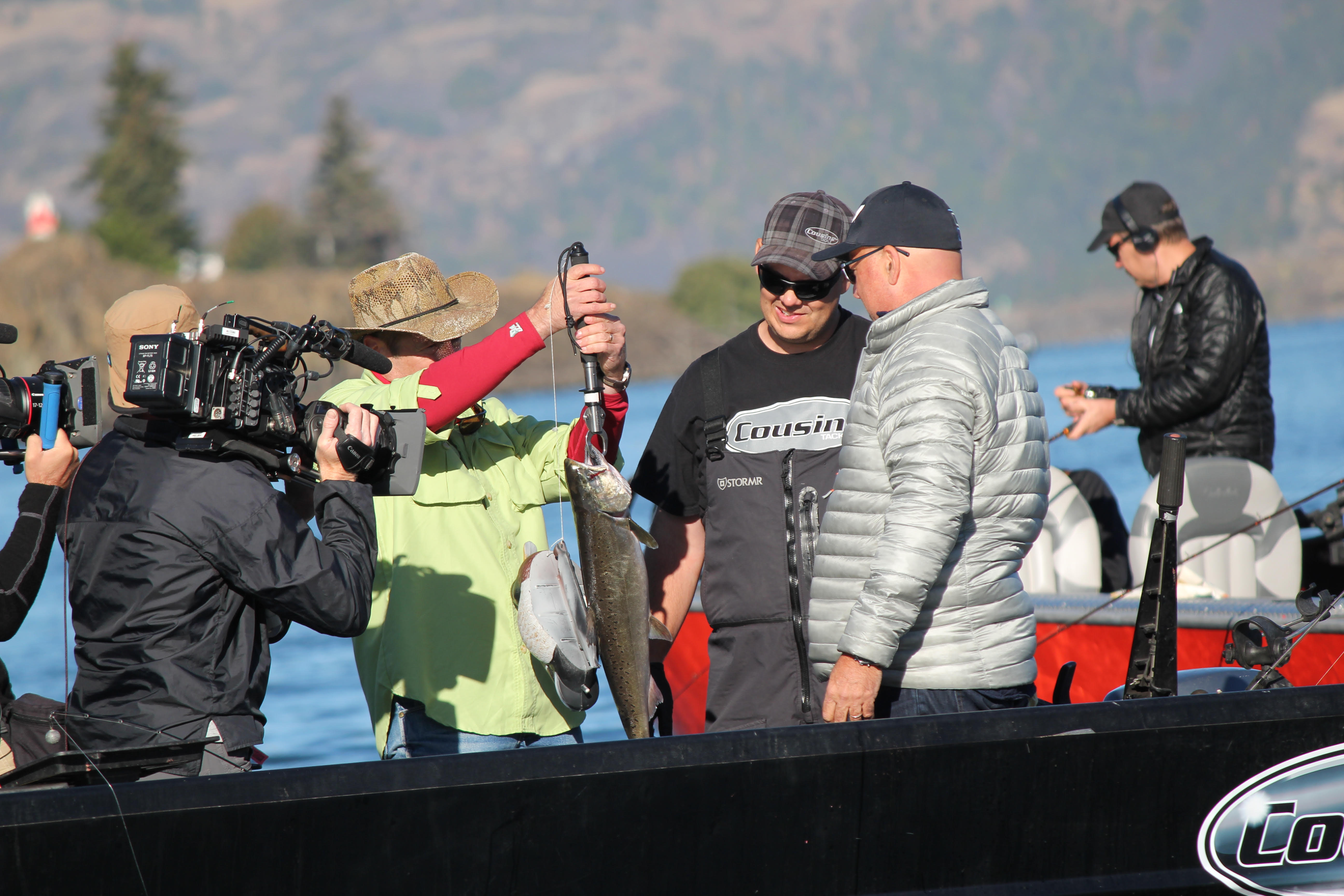
I looked at it, pronounced it a female, and guessed Zimmern would try to spoon-feed us salmon eggs. With one in the boat, we motored away, back to the ramp where the crew had assembled a grill and Dutch ovens.
While a director in cowboy boots stalked up and down the beach, cigarette in and out of his mouth, eyes flicking from one element of the scene to another, Zimmern’s knives flashed. When I angled in to check on the ingredients, I saw prime red-fleshed steaks and two skeins of milt. Milt! Our fish was a male.
In a male salmon, the sperm we call milt lies in two foot-long rolls. About an inch in diameter, the texture of fresh liver, it is often discarded. It shouldn’t be.
On a sandbar on the big river that is the lifeline of The West, there is no better way to taste the elemental flavor of the salmon.
Roasted lemons, eggplant, and onions. Rice and a reduction. Zimmern wasted no motion.
Flames licked at the grill. Seasonings are seared into vegetables, salmon strips, and organs. In moments we held salmon bowls while the good smells wafted out to fishermen still angling for their limits of bright chinook.
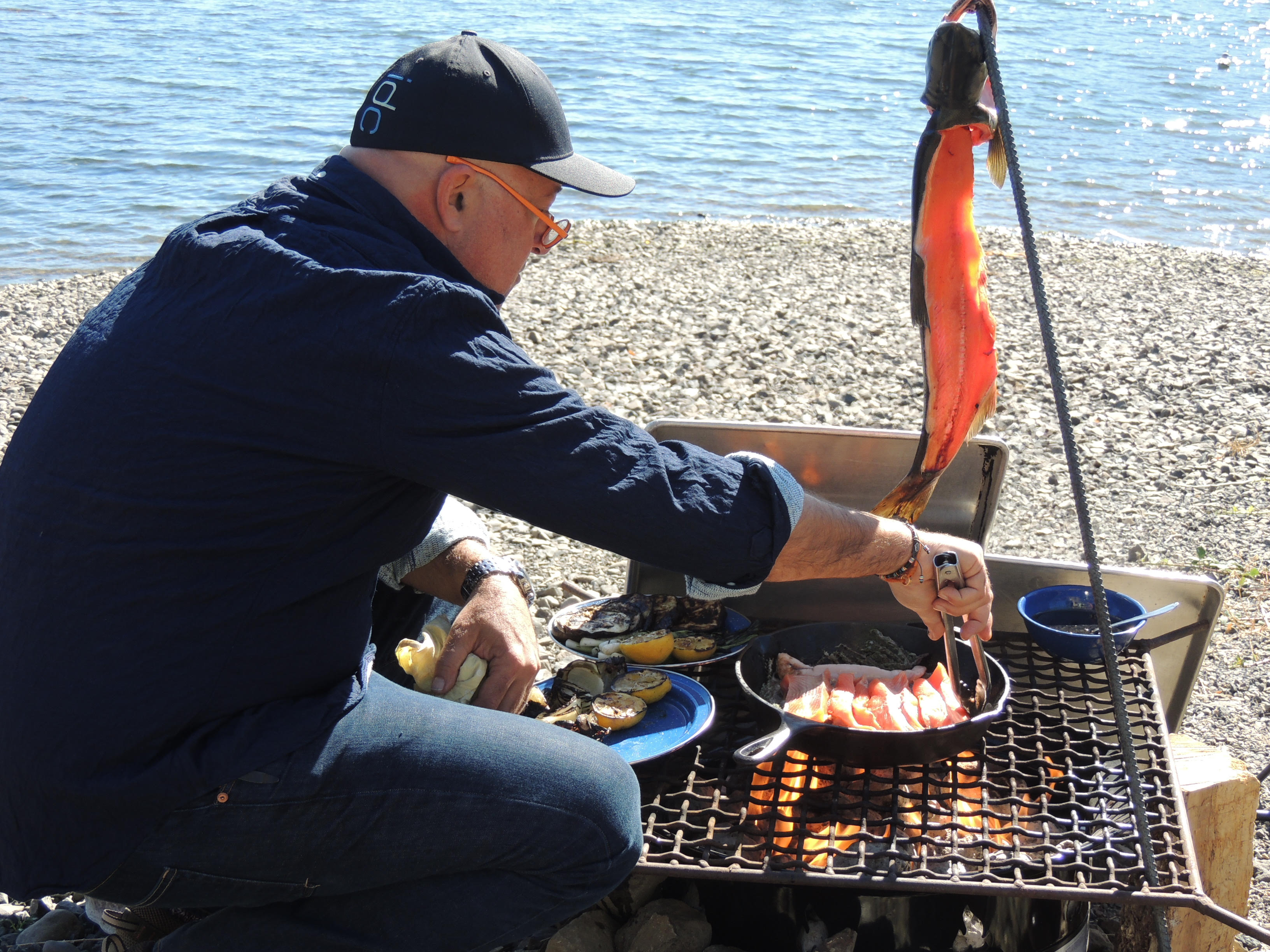
The best place to eat salmon is on a sandbar in September. We ate the strips of salmon with forks and fingers. We ate the milt and proclaimed it worthy. Milt and eggs. These are the building blocks of the protein that energizes the Columbia River. How does milt taste? It cooks up like a better version of tofu and it adds a certain something to a salmon bowl.
This was Zimmern's first time fishing for fall Chinook. While we labored for a bite we talked fly-fishing and grouse hunting. And it was a chance for me to get a glimpse into the machine that was a big Travel Channel production. At the heart of it all was a chef who was a risk taker, story-teller, all-showman, and a real sportsman.
# # #
For a copy of the Fishing Central Oregon book, send $29.99 to Gary Lewis Outdoors, PO Box 1364, Bend, OR 97709 To contact Gary Lewis, visit www.GaryLewisOutdoors.com
/articles/bright-salmon-sandbar
The Aging Sportsman and a Place to Sleep
Ok, I’m sitting here in our group camp while the rest of the gang is out chasing walleye. I love walleye fishing; how did this happen? The progression is a long one and then the wife just had knee surgery and needed an extra hand. The table was set.
When I was a tater-tot my parents used to say that I came out of my mom with a fishing pole in my hand. Although it was likely a tall story, it is based on what turned out to be a lifelong obsession and pursuit of anything that swims. Both in elementary school and in high school if I was late or got caught skipping school it was because I was fishing. Once I could drive, I often went to school with a steelhead or 3 on ice in the back of my car.
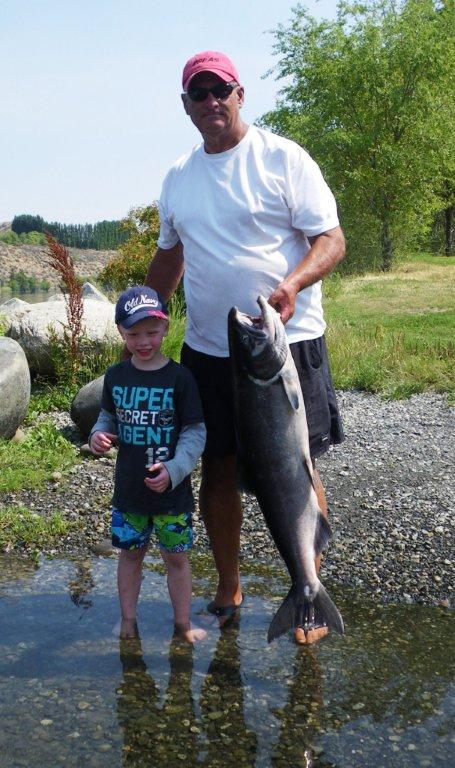
My adolescent preoccupation with fishing followed me through to adulthood. My early days of easy 3 steelhead days or immediate chinook limits just primed the pump. I was obsessed, if I saw a puddle somewhere I believed two things; First that there was a fish in it, and second that I could catch it. I think that I was well into my 40s before I realized that I may have to work for the next fish. Prior to that, I had an unwavering belief that I would hook a fish on every cast, anywhere around the world. I was lucky though; I lived and grew up in the PNW during the heyday of sports fishing.
To that note: I have caught fish all around the world. During my suit and tie days I was fortunate, LOL or maybe it was unfortunate in that I spent a lot of time on the road. I traveled to many regions within the United States, Mexico, and other parts of the world. I always traveled with a 5 or maybe 7-weight fly rod and a travel spinning rod tucked in my carry-on. These being pre-internet days I would research the area that I was traveling to. Then put together a little travel kit for the road. People at home probably thought that I was nuts and the locals where I was fishing knew that I was wacko, “Fishing, do you always release your catch?”
My business travels brought me to a long-term assignment in Southern California. I was still traveling but my regional assignment had changed. Again, pre-internet I didn’t really know what the fishing opportunities would be. As it turned out, I had landed in a fisherman’s paradise. I owned a home in Orange County eventually moving to a small mountain community but I was always close to one fishery or another.
Living in Southern California a sportsman had quick and easy access to a wide variety of both inshore and offshore saltwater fisheries. I got heavily involved in the offshore fisheries, even deckhanding or running the galley on a couple of party boats. My addiction wasn’t limited to the salt, there were also many excellent freshwater options. Close to home there were a number of trout, bass, whisker, and panfish lakes. With some driving you could be fishing planted rainbows in many lakes or clear mountain streams, fishing for High Serria brown or golden trout. With a full tank of gas, the angler could be swinging a fly for a large chinook in a formidable coastal or central valley river. The long and short of it, I was in heaven. I had to earn a living but I was truly a fish-a-holic.
Why the trip down memory lane? I probably could have written this without the memory download but that said; I did spare you the sorted details of 40-plus years of fishing trips, I was setting the stage for an unexpected transition and the actual content of this article.
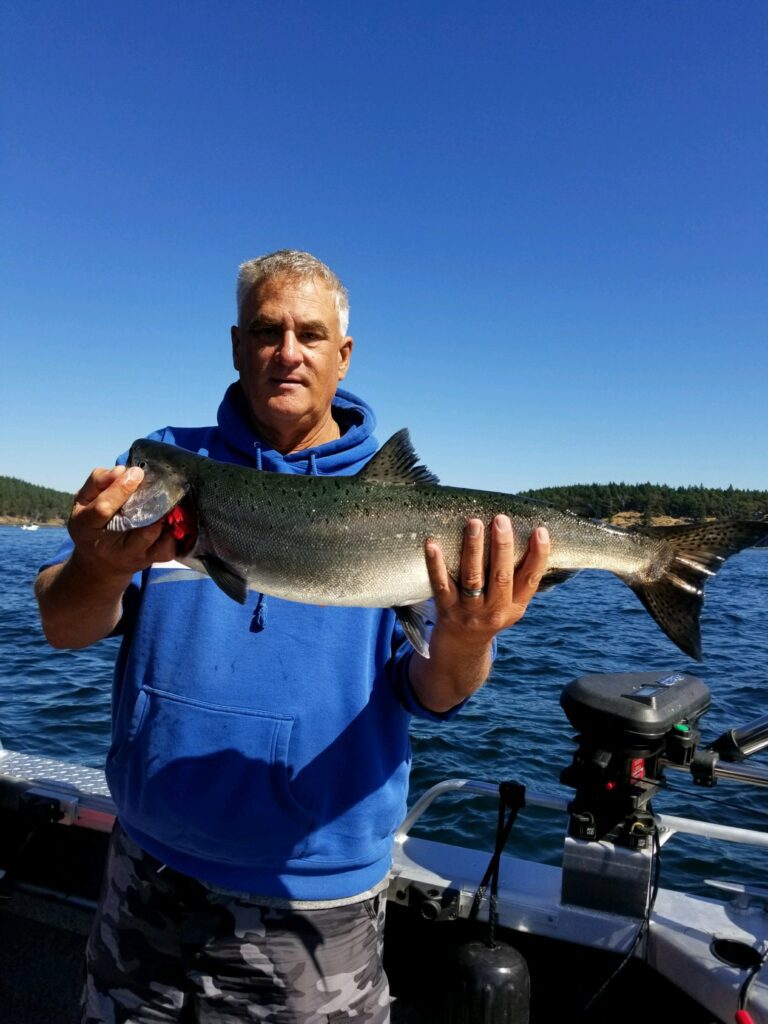
I can’t explain it, but in the last 5 or 10 years I have noticed that I’ve transitioned from an Eveready Fish-a-holic to being content writing about fishing or even sitting around a campfire yapping about it. Oddly during the same period, my ability to sleep pretty much anywhere seems to have gone the way of the dodo bird. Are the two connected, possibly? That would be a whole study of its own.
The glaring tie may be arthritis. Pretty much everything hurts all the time and daily activities are a chore. Fishing; holding a rod, tying knots, managing snaps, clips and downrigger balls require a focused effort these days. Then sleeping has become a serious problem. Gone are the days of a few quick winks in the driver’s seat while parked at a boat ramp. With the onset of arthritis and associated structural problems sleeping in a tent on the ground is completely out of the question.
Unfortunately, the fishing industry hasn’t taken a look at limited functionality due to arthritis. At my end, I try to set gear up so that even with hand strength or manual dexterity issues I can rig the gear with some level of confidence. Having most things pre-tied has been a huge help. The use of the commercial troll line snaps for the downriggers allows me to easily connect the downrigger balls. Keeping the boat organized, having a seat with good lumbar support, and having autopilot for the longer runs also helps. I already own a gazillion reels so I’m probably not going to go out and buy a complement of reels with ergonomically friendly handles but there are some out there. There are also ergonomically friendly aftermarket handles available for some reels. I think that the key is to sit down and really consider what your capabilities or personal limitations are and adjust your approach as required. Additionally, a good fishing buddy is a must.
Lifestyle versus reality. I’m in the process of assessing the reality of my limitations. Do I need my saltwater boat, and my drift boat, if not do I replace them? Simpler makes sense, then considering our local saltwater seasonal limitations, getting a smaller less maintenance rig may be the way to go. Although officially retired I am very fortunate and I have a retirement career. The money is nice but the job was a godsend. I just couldn’t do retired and I was going stir-crazy. Now I run a boat in Washington’s San Juan Islands, am outdoors and with the job being very physical it keeps me active. I mention this because it does have a downside, independent of the weather conditions I run year-round. I’m beat up at the end of the day and instead of fishing on a day off I typically need some recovery time. Eventually, I’m going to have to look at my overall lifestyle including a general lack of sleep and make changes.
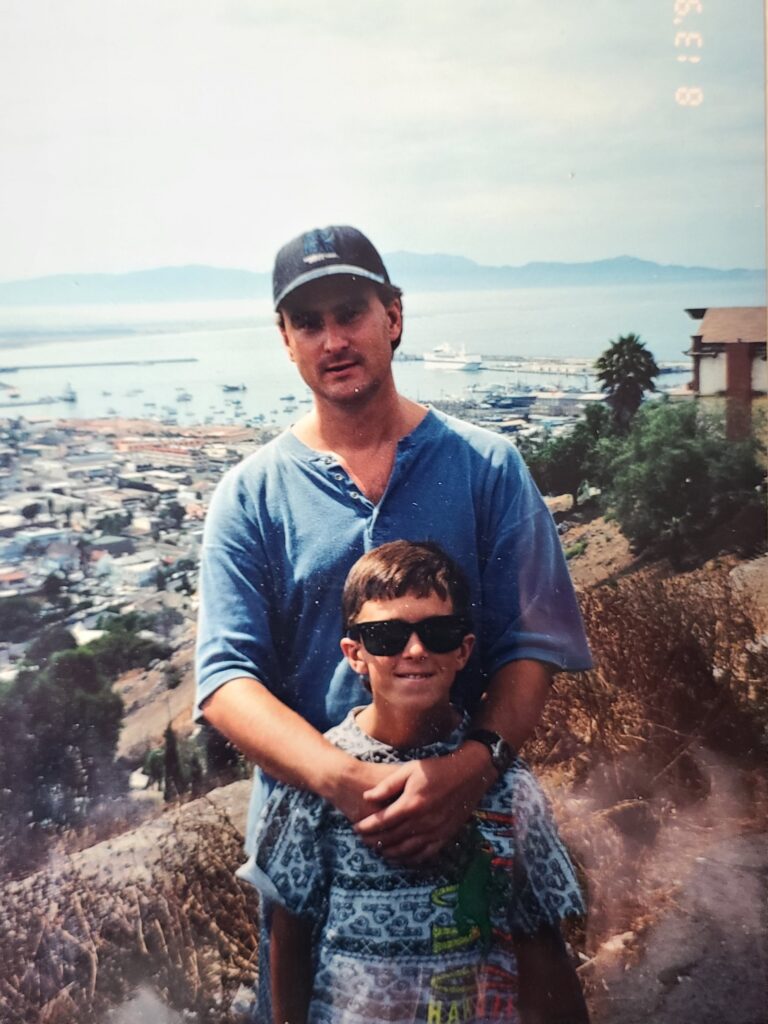
As a sportsman, sleep is an interesting subject. In my younger days, the adrenalin of the next hook-up would keep me going for days and when I did need some shuteye, I could sleep standing on my head if I needed to. I probably don’t need any more sleep than I used to but I do need some comfort. Knowing that the whole tent thing and sleeping on the ground or leaning back in the driver’s seat for a power nap was behind me got me to wondering; where am I going to sleep?
Although a 5th wheel or other pull-behind trailer would be luxurious, at this point I still need to be able to pull a boat. Tents, out of the question, and a hotel bed doesn’t seem to align with most fishing trips. For many years our ARB shell, TruckVault, and a queen-size mattress served us well but it was time for a heated change.
I use the truck for work every day so a full-size hard-sided camper wasn’t going to work. We considered getting a motor home or some form of a van conversion but in the end, decided that they were not in the budget and worse we’re out of driveway real estate. Years ago, I did some catering for a series of offroad events in southern California and there were a ton of both ATC and Four Wheel Campers at the events. They are purpose-built off-road campers. Both manufacturers utilize a lightweight welded aluminum frame and are soft-sided pop-up campers.
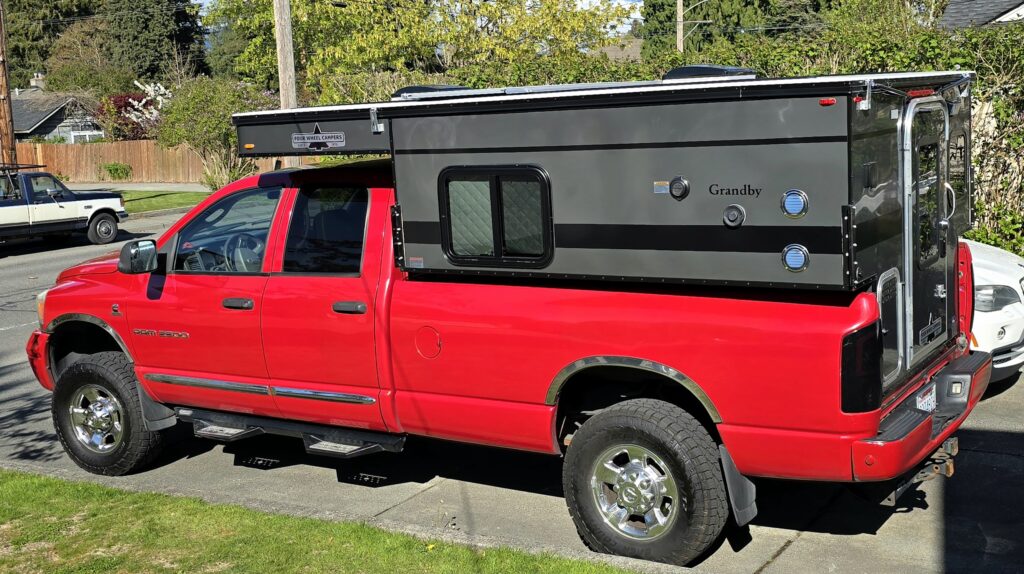
We decided to find a FWC and quickly determined that used campers to fit our full-size truck were few and far between. Order a new one? Well maybe; after researching the cost of the few newer used FWCs available as compared to the cost of a new one, ordering a new camper seemed like a solid financial decision. Add a level of customizations available and we were sold.
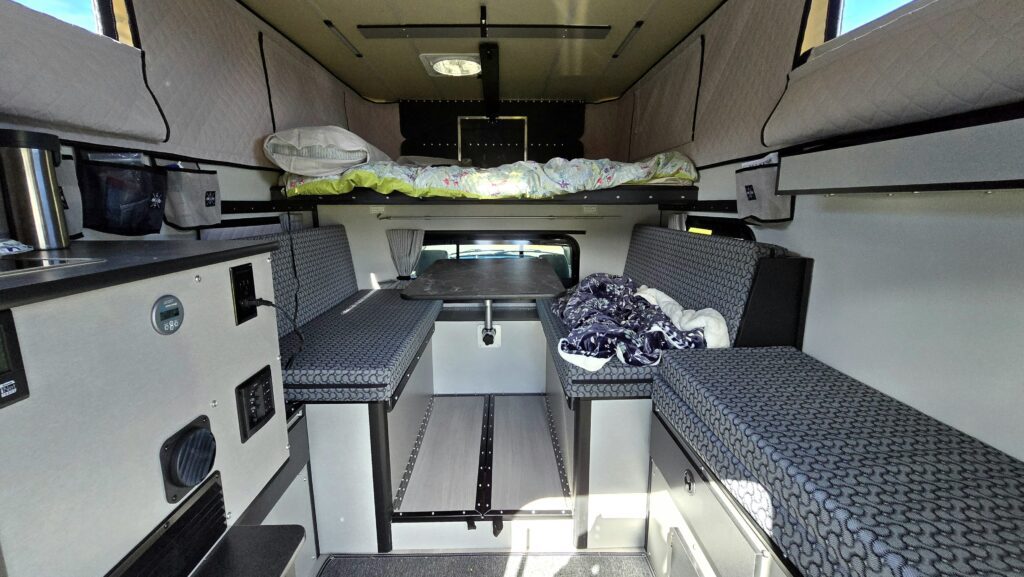
FWCs are available as topper, a basic shell model, a fully loaded slide-in camper and as a flat-bed camper with various options available for each model. We ordered a basic shell but customized our order with forced air heat, a larger bed, a forward dinette a flush mount stove top, an 8’ awning and shore power. Deposit made; the wait began. We expected the 4–6-month lead-time but after a couple months started getting antsy and second guessing our configuration choices. Eventually, our lead time transitioned to an install date and we were off to Mule Expedition Outfitters in Issaquah for the install.
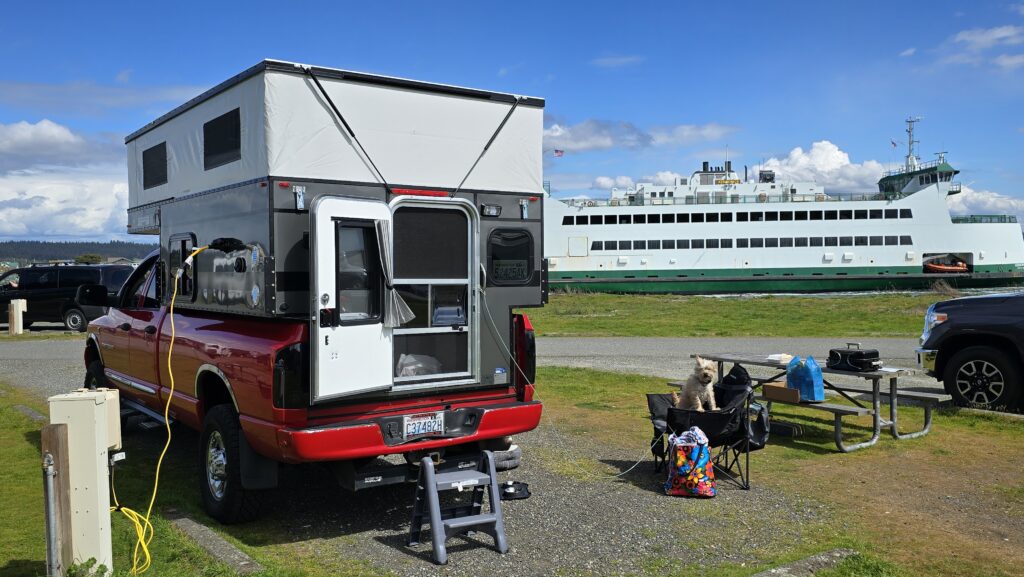
Our installation went smoothly and after a thorough walk-through, we were rolling. The first thing we noticed is that we didn’t notice anything. Our new camper was very well balanced and our truck carried the load well. When we got home, I did the fuel economy calculations and we got 21.4 miles per gallon. I was impressed, our mileage was way better than expected! Since then, we have spent 12 nights camping but I have not removed the camper from the truck. With maybe 10,000 miles behind us as a truck camper combo, the truck is consistently getting 20-22.1 miles per gallon, not bad for a ¾ ton truck with 350,000 plus on it!
To date, we are very satisfied with our customization choices and our Four Wheel Camper far exceeds our expectations. I have to say, I even proposed going camping without any fishing gear! 10 years ago, I would never have considered a camping trip that didn’t involve the boat and fishing gear. The way of the future or a phase? Only time will tell. In the meantime, I love telling fishing stories and we have a comfortable place to sleep!
/articles/aging-sportsman-and-place-sleep
How to Catch a Cone Licker
Fishing Lake of the Woods in Southern Oregon
You know what a cone licker is. You see them in places like Seaside and on the sand at Diamond Lake and they have cone lickers at Lake of the Woods in southern Oregon too. These are the poor folks whose mommas and papas never taught them how to fish. They like to go to the lake too, and they are the ones who, if you bump into them on their floaties, ask "Didja catch anything?" Or, "What kind of fish are in this lake?" It's not a sin to be a cone licker. It wasn't their fault they were born in Sacramento.
There's another kind of cone licker. They are the big trout that eat a steady diet of midge larvae and are particularly susceptible to a pattern called the Ice Cream Cone.
Lake of the Woods is a classic fishing lodge destination for the whole family. It's got something for everybody - a well-stocked marina store with boats and paddleboards to rent, a gift shop, cabins to rent, campgrounds, a great restaurant with a view of the lake, and a bar on the second floor with even better views.
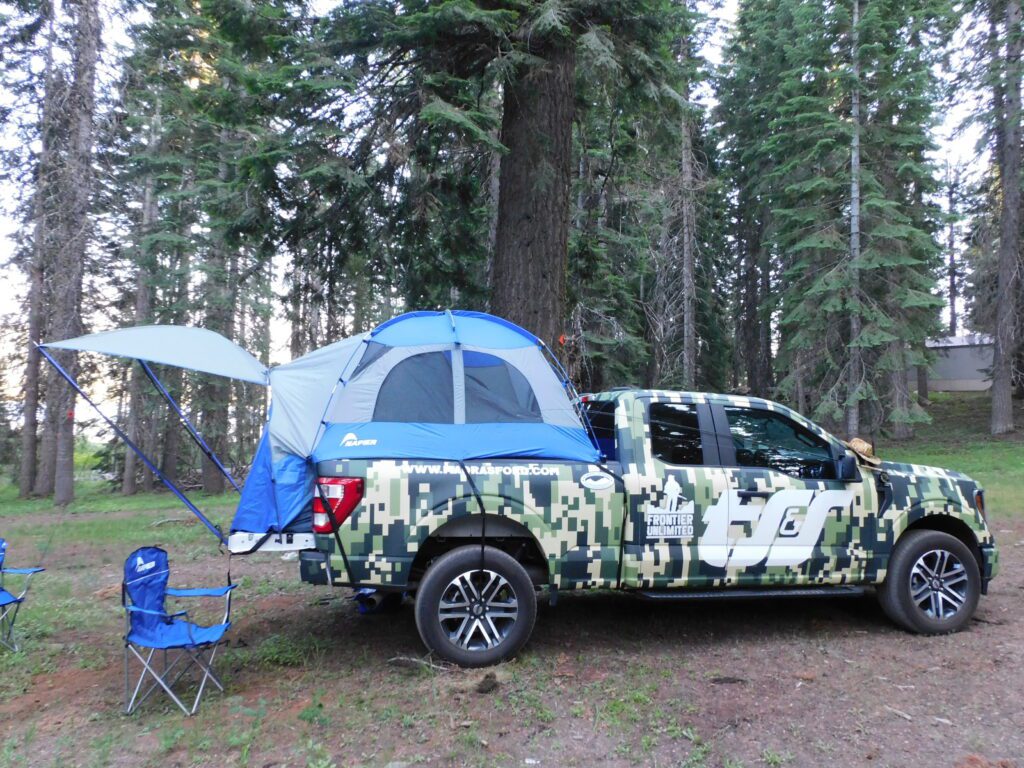
I set up the tent in the back of the F-150, a roomy two-man tent from Napier ( napieroutdoors.com ), specially made to the Ford's dimensions. Then I went down to the lakeside to look at the boat I had rented for the morning.
I knew exactly where I was headed, remembering it from the last time I had fished Lake of the Woods, which was too long ago. We were going to still-fish, having brought spinning rods and fly rods and a selection of jar baits and chironomids.
Soaking in the vacation vibe at Lake of the Woods, I could not help but smile. A lot of people are looking for exactly this kind of American experience. They just don't know where to find it.
FISHING CHIRONOMIDS
Set up the rod with a tapered leader down to 4X tippet. Affix a Thingamabob indicator well up the line and tie on a No. 8-10 Ice Cream Cone chironomid pattern. With another 12 to 18 inches of tippet add a second Ice Cream Cone tied off the bend of top fly.
Casting a two-fly rig is not an art form. The main thing is to put the flies at the depth of the feeders, keep slack out of the line, and watch for the indicator to indicate. The fun thing about this type of fishing is that some of the biggest fish move the indicator the least. Keep the rod tip low, touching the surface of the water, and be ready to set the hook. Like a rattlesnake.
Finding the feeders is the main thing with fishing chironomids. One trick is to drive the boat over the place you will fish then with a hemostat clamped to the bottom hook, gauge the depth of the water. Then adjust the float so that it puts the bottom fly something like 18 inches off the bottom. That puts the top fly 36 inches off the bottom. Pay attention to which bug gets bit the most and reset the rods accordingly.
You might have heard of the big bait-big fish principle. That doesn't apply to midge larvae. Big trout eat a whole of a lot of these tiny things.
WHERE TO ANCHOR UP FOR TROUT
A large mountain Stillwater in a forested setting, Lake of the Woods is fed by several creeks but gets the majority of its water from groundwater seepage. The deepest water is found along the western shore where the depth is reported as 50 to 55 feet. There is a good mix of shallows where weeds and bugs grow and colder water deeps and rocky ledges, which makes for interesting fishing.
The resort is situated on the eastern side of the lake on the north shore of Rainbow Bay.
One of the best spots for trout is just outside of the marina. Anchor up anywhere within 100 to 150 yards of the marina and within casting distance of either the east shore or the west shore. Anywhere out in front of the marina can hold trout.
The other great trout area is along the west shore where a deep ledge makes for a great spot to anchor up or troll for rainbows and/or kokanee and the browns that hunt them.
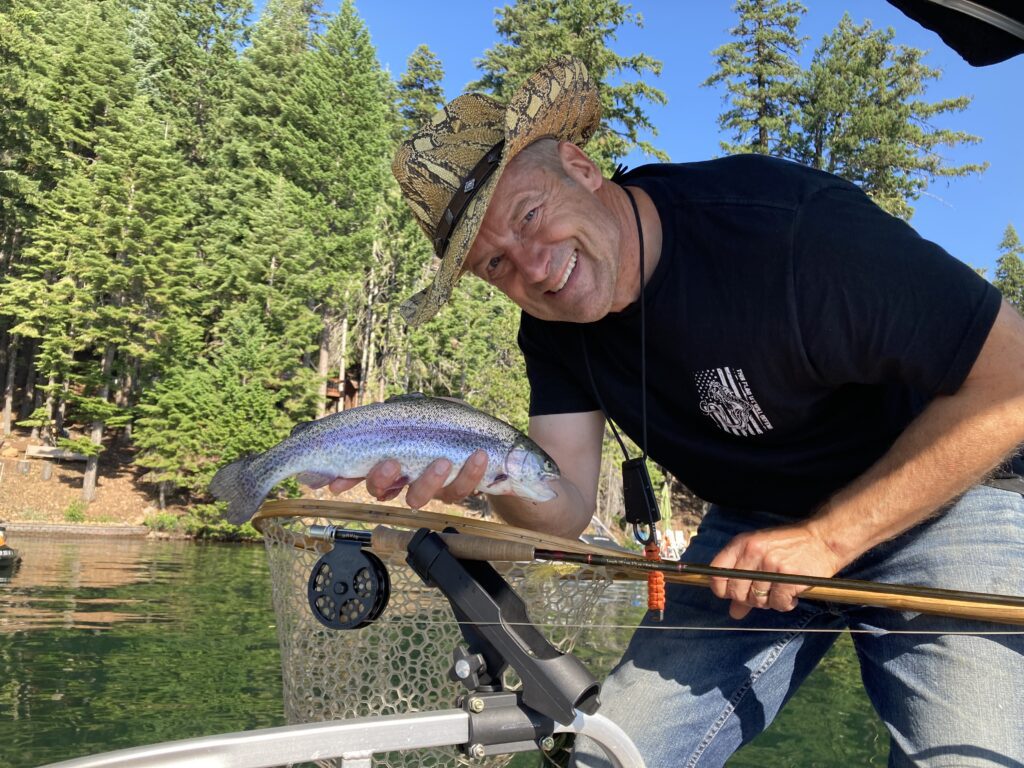
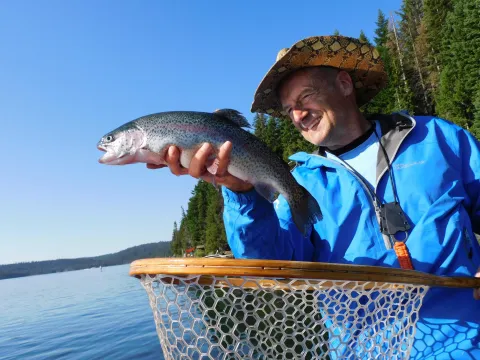
We caught nine trout, a catfish, a perch, and a couple of smallmouth bass in a couple of hours on both fly-fishing gear and spinning gear.
Standard trout rules apply for the Southeast Zone with a limit of 5 trout per day (only 1 trout over 20 inches) and 25 kokanee per day in addition to the trout limit. There is a 5 bass limit with only 1 bass over 15 inches. Angling is allowed 24 hours per day.
This lake is capable of growing hatchery trout big and holding them over. Trout can be caught year-round, but spring and fall are peak seasons for rainbows and browns. Trolling is popular on the lake, but still-fishing can fill out a limit faster, at least in my opinion.
Looking for a family fishing tradition to start? It's hard to beat Lake of the Woods with something for the whole family, even those cone-licking cousins who grew up in Sacrapimento. Heck, you might even teach them to fish.
# # #
For a copy of the Fishing Central Oregon book, send $29.99 to Gary Lewis Outdoors, PO Box 1364, Bend, OR 97709 To contact Gary Lewis, visit www.GaryLewisOutdoors.com
Directions: From Klamath Falls travel 35 miles west on State Highway 140; from Medford, take State Highway 62 north to Highway 140 then east 45 miles. From Ashland, travel 35 miles east on Dead Indian Memorial Road.
/articles/how-catch-cone-licker