Alpine Kokanee Trifecta
There’s an Alpine Kokanee Trifecta that is often over-looked compared to the more well-known and popular kokanee fisheries. What if I told you that within an hour and a quarter of traffic-free driving from Seattle you could enjoy pristine Alpine lake fishing with little to no other boats on the water and have the chance to catch generous limits of kokanee every time out? No way you say? It’s true and waiting for you. But a little planning and tempering of expectations is required. These fisheries won’t yield 18-20” Lake Roosevelt kokanee, but they do have an abundance of under-fished kokanee that will still give you a nice bounty to bring home. Have I got your attention yet?
The Alpine Kokanee Trifecta I speak of is familiar to many, but passed by with a reputation of having small kokanee. I’m here to tell you, that is a myth. While it’s true you won’t find those 20” koks, you will find fish that range from 10” up to 14”. The lakes I’m referring to?
Keechelus, Kachess, and Cle Elum. Yup, that first big reservoir as you crest Snoqualmie Pass going east is one of three Alpine Kokanee Lakes that I think you should make plans to visit. Let’s look at them one by one, going from west to east.
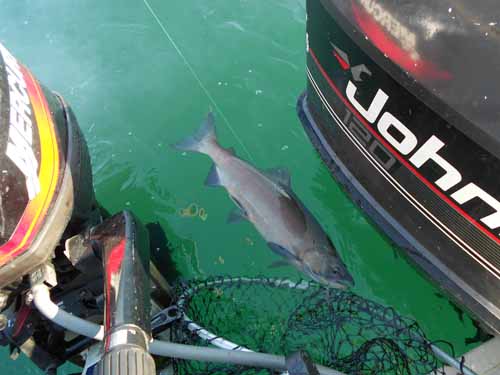
Keechelus Reservoir
This lake is the one that we all gaze at as we are driving somewhere else. It’s also the one that come August turns into a giant stump field. At 2,408 acres, it’s the smallest of the three lakes. At 2,521 feet of elevation it’s also the highest of the three lakes. The lake holds rainbow, cutthroat, whitefish, bull trout (which are endangered and are to be carefully released), burbot, and kokanee. Of the three lakes we will look at, this lake probably has the smallest kokanee in it. But check this out – the 2016 stocking numbers for this lake were a whopping 256,892 kokanee! In 2015 it was 265,000 and in 2014 it was 238,000 kokanee. So bottom line, that’s a lot of kokanee swimming around waiting to be caught!
Here’s the catch (there’s always a catch, right?). This reservoir gets drawn down as the summer progresses. Seriously drawn down, as in not able to launch a boat drawn down. So if you want to fish the Trifecta next year, you’d best plan on hitting this lake first. The primary boat launch is found on the west end of the lake. The earthen dam is on the far east end of the lake. Be aware, this lake, perhaps worst of the three, is prone to heavier wind and whitecaps. Be prepared to get back to the launch if the wind picks up. The lake is also the least serene of the three lakes as the constant hum of the freeway and view of semis roaring past are a sharp contrast to the beautiful surrounding mountains. This lake is a one pole only lake.
Kachess Reservoir
If you’re looking for a beautiful camping location with stunning scenery this is your lake. The Kachess Forest Service Campground is one of the nicer ones around. Plenty of camping spots and some larger pull through sites make it “boat friendly”. The restrooms are - surprise – running water and flush toilets! The boat launch is a two lane concrete ramp with nice grade and plenty of surrounding shoreline to pull your boat up on. Winds can be an issue as it’s not in a sheltered location. Parking is good.
Like Keechelus, Kachess holds a nice variety of fish. Rainbow, cutthroat, bull trout (protected), whitefish and burbot can all be found in addition to the kokanee. As to kokanee stocking, in 2014 WDFW stocked 365,000 fish, 2015 490,000, and for 2016 413,098. You’ll get into the kokanee as soon as you launch the boat. Motor out a hundred yards and watch as your depth finder shows the bottom dropping to 180 feet and deeper. And then you’ll see your fish finder light up with kokanee arches 35 to 80 feet deep. You’ll find fish all the way the length of the lake down to the dam end, over four miles away. But beware, if you head north the lake shallows up at a choke point north of the launch and you’ll find yourself in ten feet of water.
On our most recent trip, we found a great early morning bite that turned off at 8:30am. After an hour of fruitless trolling we ran all the way down to the dam and were rewarded with good action the rest of the morning. Don’t be afraid to leave non-biting fish in search of the biters! On this trip we also caught and safely released a powerful 16” bull trout. What a thrilling fight on kokanee gear. We hooked him at 55 feet deep on the downrigger. To help protect these beautiful fish bring a knotless net.
Kachess is 4,377 acres and an elevation of 2,258 feet.
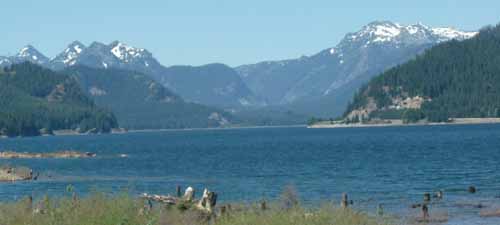
Cle Elum Reservoir
The final gem of our trifecta is Cle Elum reservoir. Although the farthest of the three lakes, it’s still a day trip for the Seattle area angler. Cle Elum also has a Forest Service campsite and nice paved launch (an old road, actually). Not as nice as Kachess, but the scenery is again spectacular and there is no freeway sound to ruin the experience. Cle Elum also has the nearby town of Roslyn to grab provisions and a nice dinner at the end of your day of fishing.
Cle Elum is the largest of the three reservoirs at 4,566 acres. It’s the lowest lake, at 2,227 acres. As the summer water draw down lowers the lake, the ramp becomes high and dry. Boaters then will launch among the stumps at the southeast side of the lake by the dam. Watch your props and winds out of the north as this can be a risky proposition.
The lake holds the same species as our other two lakes with a notable and significant difference. First there is Mackinaw trout in the lake.
These fish are on WDFW and the Yakima Tribe’s radar screen to remove from the lake. Why, you may ask, when some dandy lakers up to 15 pounds and more have been caught? Well, in the (hopefully) not too distant future Cle Elum may join Baker and Wenatchee lakes as a destination sockeye fishery.
That’s right; the Yakima Tribe has been working since 2009 to restore a sockeye run to Lake Cle Elum. It works like this: the sockeye are captured at Priest Rapids dam and transferred to the lake. They then run up the Cle Elum River and spawn. When the fish hatch, they spend 1-2 years in the lake and then leave the lake via a flue around an earthen dam to the Yakima River. From the Yakima River, they will swim to the Columbia, and traveling on another 330 miles, around four Columbia River dams, to the Pacific Ocean.
Here’s more information from the Yakima Nation Fisheries website:
“One thousand adult sockeye were transplanted in the summer of 2009, 2,500 in 2010, 4,500 in 2011, 10,000 in 2012 and 4,000 in 2013. The sockeye successfully spawned in tributaries above the Lake in all years becoming the first sockeye to spawn in the Yakima Basin in over 100 years. Juveniles from the 2009 brood were observed migrating downstream at Roza and Prosser Dams in 2011. Preliminary data from trapping operations at Prosser indicated a 2011 smolt outmigration of approximately 80,000 sockeye. From July - Oct. 2013, 701 Sockeye migrated to the Yakima River Basin (numbers reported at October 17, 2013). So far, 211 sockeye have migrated back home to the Yakima River Basin (updated July 1, 2014).Once these fish move north to Roza Dam they will be transported into Lake Cle Elum or Cle Elum River. So far, we have trapped and hauled 4,500 sockeye from Priest Rapids to Lake Cle Elum. We will continue to monitor fish run numbers and trap and haul accordingly (updated July 1, 2014).”
So where are the kokanee you may ask? Well, WDFW has stopped stocking Lake Cle Elum since this recovery process started. But that doesn’t mean you can’t catch kokanee.
According to a fisheries biologist I spoke with on the subject, some of the kokanee you catch are actually sockeye that have decided to not migrate back to the ocean. Instead, they spend their adult lives in lake Cle Elum, and then spawn as well in the Cle Elum River. In order to protect the sockeye in Cle Elum, WDFW has placed a slot limit of 9” to 15”on kokanee in Cle Elum. The limits are different on Cle Elum as well. As of 2016, Keechelus and Kachess had ten kokanee limits, and not including trout. Cle Elum has a five fish limit, including trout. Cle Elum is also the only lake of the three to allow the two pole endorsement. Finally, there is NO limit on lakers, brown, and eastern brook trout. WDFW wants these non-native species out of the lake to benefit juvenile sockeye salmon and encourages anglers to help in that effort. As always, be sure to check current regs for any updates.
There you have it. Three Alpine Lake Kokanee gems, all day trips from the greater Seattle region offer the angler spectacular scenery and fisheries that produce abundant (if not huge) kokanee. With gas prices at historical lows now is the time to plan a trip to these great destinations and leave the masses behind.
I will offer a couple words of caution for boating anglers. First, the winds blowing down the mountainsides on these three lakes can kick up and blow whitecaps, especially in the afternoon. So keep an eye on the weather and be ready to head back in if things start blowing. Second, if you troll with downriggers, be aware that these reservoirs may have trees sticking up from the bottom that didn't get clear cut. So be ready to bring those downrigger balls up fast!
See you on the water catching some tasty kokanee on these Alpine Lake Gems!
/articles/alpine-kokanee-trifecta
Shellfish Harvesting on the Puget Sound
During the mid-1800s, the Duwamish people, a coast Salish tribe that’s indigenous to the south Puget Sound, provided aid to the newly arrived European and Euro-American settlers by showing them how to utilize clam juice as a substitute for cow’s milk, a staple that the settlers no longer had substantial access to. The salty clam broth is rich in potassium, protein, and sodium, and served as a well-needed supplement to the often-malnourished settlers.
The Duwamish, along with many other Coast Salish tribes, had mastered the art of procuring nutrients from the Puget Sound through the harvesting of clams, mussels, oysters, and geoducks. Their mastery was so advanced that they even cultivated their own clams by creating clam gardens by stacking rocks in a line along the zero-tide zone. This practice greatly increased the number of clams that could be harvested in a given area and is often considered the oldest form of aquaculture known to Washington state.
Shellfish harvesting has continued to be a mainstay in both industry and culture alike throughout the years of Washington State's development. It’s estimated that the shellfish industry rakes in over 200 million dollars per year, making Washington the United States foremost producer of shellfish. However, it’s not just the commercial outfits that get to soak in the glory of our bivalve oasis, which is the Salish Sea, there is also ample opportunity throughout the year for the recreational harvester, and for the 2024 year—monthly tide predictions show that March is the kickoff for noteworthy daytime low tides. On these upcoming lows, harvesters will have good access to oysters, cockles, manilla, butter, and horse clams. If you're looking to harvest geoducks, you’ll have to wait till April when the daytime low tides drop to -2 ft and lower.
From the islands to the mainland shores, there are miles upon miles of beach where you can dig for clams and collect oysters in Washington. The main things to consider are whether the beach is open to the public and if shellfish are safe to eat in that area. Head to the WDFW website on the day of your dig to assure you that shellfish have been deemed safe for consumption in your given dig area and that the beach is open to the public for recreational shellfish harvesting.
Oysters
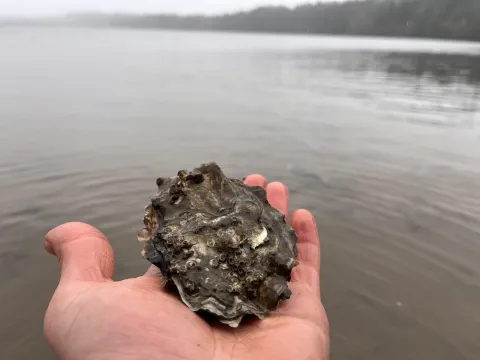
Oysters can be found on most rocky beaches of the Puget Sound and no two beaches are the same regarding how low the tide needs to be for oyster beds to be exposed. A good rule of thumb is to stick to +2 ft tides and lower for your best chance at reaching your daily limit. As a complementary insider tip, I will add that Oakland Bay in Shelton, Washington exposes oyster beds at tides much higher than this.
Oysters would likely be the easiest shellfish to harvest on the Puget Sound if it wasn’t for one important aspect of the process, and that is the shucking of the oyster itself. Legally oysters must be shucked on the beach and the shells should be left where they were found. This allows oyster larvae to use these shells during the colonization process. For more information on best shucking practices please refer to my 2022 April article where this process is explained in great detail. Oysters require little to no cleaning and can be eaten whole in a variety of preparations. Steaming, barbecuing, and deep frying are all popular choices. Minimum size 2 1/2 inches.
Manila
Manila clams are one of the most popular clams to harvest on the Puget Sound and their populations remain healthy throughout the region. They grow up to 2.5 inches long and can be found in sand, gravel, or mud during +2 ft tides or lower. A variety of common garden tools can be used to collect Manila clams. The most popular tools are a hand shovel, hand rake, or a hand pick. Raking along the surface, or simply scooping a few inches of the substrate with a shovel, should easily expose these bivalves at low tide.
After collecting your clams, you’ll want to store them in a cooler with a few ice packs to keep them chilled during transportation. Do not submerge them in water during transport. Once you are home, you can then submerge them in saltwater that you collected from the area where they were harvested. You’ll want to keep the saltwater cool with ice packs. This submerging process is intended to purge the clams of any sand or grit they have stored inside them. Discard any dead clams (clams that stay open and will not close no matter how much you poke at them, should be considered dead). Manilla clams can be eaten whole and are great for chowder, pasta, or soups. Minimum size is 1 1/2 inches.
Butter clams
Butter clams are significantly larger than manilas, often growling up to about 5 inches. At a +2 ft tide or lower, search along the beach for small holes in the sand or mud. Once a hole is located, you can dig with a spade shovel down to around 18 inches or until you reach the clam. Use the same technique as with Manila clams to purge. Though butter clams are delicious when served with melted butter, this is not where they get their name. Instead, butter clams get their name because of the natural buttery flavor of their flesh. They can be used for chowder, barbecued on the half shell, or even fried. Minimum size is 1 1/2 inches.
Horse clams
Ah, the mighty horse clam. Different from the oyster, manilla, or butter clam, the horse clam presents a set of challenges that place it in a category not far from the Pacific Coast razor clam. These clams grow quite large and can reach up to 5 lbs. They can be found in the sand or gravel and are easiest to harvest when located in sand substrate. Walk the beach and scan the surface for a siphon protruding out of the sand.
Horse clams’ siphons are rough to the touch. Once you find the siphon, you can either start digging with your shovel immediately, or you can take a stick and push it down into the siphon. The stick will stay in place and will keep you keyed in on the exact location of the clam. These guys will usually be around 1 ft to 1 1/2 ft deep. Shovel the sand around the clam until you can get your hand on the shell and then give it a good wiggle to free from its hole. If the clam is deep enough, you will need to place a 5-gallon bucket with the bottom cut out into the hole that you are digging. This will act as a retaining wall for the surrounding sand, and it will keep the hole from collapsing in on itself. After the clam is removed, you can place it in a cooler with some ice packs and transport it home.
The horse clam doesn’t require siphoning, instead, these clams need to be processed like a razor clam, and the stomach needs to be removed. The abductors, the foot (or digger), and the neck can all be eaten. Be sure to cut off the siphon (the tip of the neck). Horse clams fry up well with a nice coating of flour and or cornmeal. There is no minimum size for horse clams.
Cockles
Cockles grow up to 5 inches but are more commonly found in the 2 inch - 2 1/2 inch range. Their shells have several ribs that run down each side, making them popular for those who like to repurpose shells for art and other decorative purposes. They can be found in 1-2 inches of sand or cobble at a +2 ft tide or lower and are harvested the same way as manila and butter clams. Cockles can be eaten whole and are often steamed or boiled. Be sure to purge these clams to free up any sand or grit. Minimum size 1 1/2 inches.
As noted before, geoduck opportunities don’t pick up till April, so we will save that behemoth of a clam for a later article. For now, march is the preamble to spring clamming and it’s a great opportunity to get out with friends and family and take advantage of the numerous culinary wonders that grace the waters of our beloved Puget Sound.
/articles/shellfish-harvesting-puget-sound
Winter Perch Tips
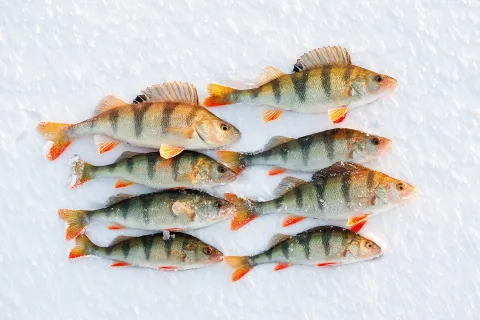
Now that the holiday craziness is over with, you might find yourself with the fishing itch. Maybe you got a new fishing rod for Christmas that you're dying to try out! Winter steelhead are a worthy pursuit, but kids might not have the patience to withstand casting all day. Winter perch are the perfect solution! Though they are small, they taste great when fried up and most lakes have an abundant population of them. They are eager biters, especially in the winter months, and you don't need much tackle other than a light action rod and some worms. Let's dive into it and talk about how to have a successful day at the lake fishing for perch.
Though shore fishermen can certainly be successful when fishing for winter perch, boaters have an advantage. The trickiest part of perch fishing in the winter is locating the fish. They move throughout the lake in large schools searching for food. These fish often hide in deep water, below the thermocline, where the water is warmer. Boaters can search the lake until they locate the schools of fish.
Fish finders can show you where the schools are, so you can drop your bait right in the middle of them. Check near drop-offs and underwater shelves first. Perch will tightly school up, so if you catch one, you're bound to catch more. Drop anchor or activate your spot lock and get a bucket ready! As with most fish in the winter, they don't like chasing down the meals. Keep your bait right in the middle of their school. If you aren't getting bites, move on. Perch schools will look like little clouds on your fish finder. Pay close attention and follow the fish.
If you're shorebound, remember to use bottom rigs so you can fish the bottom of the water column. This is a great situation to use your two-pole endorsement if you have one. The more rods in the water, the better your chances of finding the fish. Try to find a lake with a pier so that you can more easily reach the deep water. Reservoirs are harder for shore fishermen to effectively fish in the winter, since they're usually drawn down past the piers.
Another great thing about winter perch is that they're willing to hit a variety of lures and baits. I often start with worms or crappie jigs. Lower your offering to the fish and jig lightly until you feel the bite. Winter perch can be soft biters, so pay close attention and be ready to set the hook. Once you've caught one perch, you can cut it into small strips of meat and catch more. Perch cutbait is one of the best ways to catch more perch! One word of advice, use small hooks. I use size 8 or 10 hooks most of the time. I also use an ultralight crappie rod and reel for maximum sensitivity. Be careful when dropping the fish into the bucket or holding them for pictures, they have several spines in their fins that can prick you.
Though most lakes have yellow perch to some degree, you might be wondering where to start. I've had success at Lake Washington, Lake Sammamish, and Clear Lake. Lake Washington is my go-to for winter perch. If you launch on the southern end, try anchoring near the bridge. These are just suggestions- check your regulations and try a lake near you that's open year-round. Remember that perch tend to hug the bottom during the winter and study a map to find those deep pockets on your lake of choice.
Because of the cold weather, it's a good idea to be prepared before hitting the water. If it's been a while since you've run your boat, do an inspection, test your motors, and ensure your first aid kits and life jackets are aboard. Bundle up and bundle up your kids too. Hand warmers are essential! I picked up some electric hand warmers online and they work great.
The trickiest part is making sure they're charged before heading out! Like electronic hand warmers, heated jackets can also be a game changer. Winter perch fishing is a sedentary activity, so you'll want every advantage you can get to stay warm. I also highly recommend putting on base layers, especially underneath your pants. Costco and Sportco both offer affordable base layer packs for men and women. Winter fishing doesn't have to be cold and miserable. Making sure you're adequately prepared will go a long way toward having a fun day on the lake.
Have fun on your winter perch quest! Most lakes around here have no bag limit or size limit, but make sure to be responsible and only harvest what you're going to eat. Perch are one of the best fried fish out there, and they're easy to prepare for the frying pan. You can either fillet them quickly or cook them whole. Electric filet knives can make short work of a bucket of perch. My friend and fellow writer Randy Castello likes to batter his perch filets and freeze them so that his family can enjoy fried perch anytime. Put life jackets on the little ones, gas up the boat, and hit the lake!
/articles/winter-perch-tips
Great Winter Fisheries East of the Cascades
LONG LAKE:
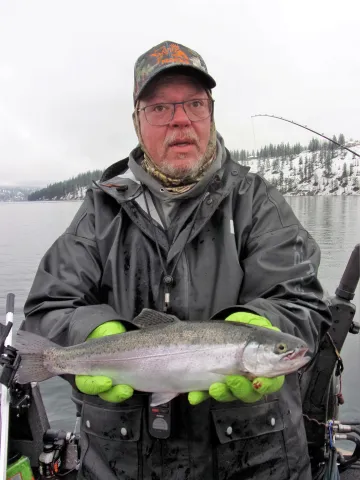
Located near Spokane, Long Lake kicks out good numbers of quality rainbow trout in November and December. The best fishing is found several miles up the lake from the main boat launch at the south end of this reservoir. Trolling Mack’s Lure Wedding Ring spinners is a good choice and orange is a great color. Dropping water levels in December often make the primary boat launch unusable so plan on fishing here sooner than later.
CURLEW LAKE:
Traditionally known as a summer destination for trout and the occasional tiger muskie, Curlew Lake is now known for its perch fishing. Perch are now the predominant species in this Ferry County lake and fishing for them in the winter, either through the ice or in open water, can reward you with quality fish averaging 9 to 11-inches in length.
LAKE ROOSEVELT:
This huge impoundment of the Columbia River offers excellent fishing for three species during the winter months. Walleye are often found biting near Kettle Falls and at the southern end of the Reservoir from Keller to Seven Bays you can find big rainbow trout and kokanee salmon that often weigh over two pounds. If you have never fished Lake Roosevelt in the winter before, consider booking a trip with a local guide and learn from a pro.
RUFUS WOODS RESERVOIR:
If you are looking for big trout, head to Rufus Woods Reservoir, an impoundment of the Columbia located between Grand Coulee Dam and Chief Joesph Dam. The best fishing is around the Nespelem net pens. You can fish from either the shore (An access fee is required) or from a boat. Jigs or dough baits both work well for trout that are measured in pounds, not inches. A Colville Tribal fishing permit is required to fish here. Looking for another option? Try fishing from shore just above Chief Joseph Dam. Anglers soaking bait from shore for trout can do quite well at times.
It's not just about trout at Rufus Woods Reservoir. There is an under-rated walleye fishery too which offers very good opportunities. The walleye here tend to be eater sized versus trophy sized and can be caught in the winter with blade baits or fishing nightcrawlers off the bottom.
MID-COLUMBIA RIVER:
Another great place for walleye during the winter is the mid Columbia River from The Dalles to the Tri-Cities. Unlike Rufus Woods Reservoir, you have a legitimate shot at big walleye in this stretch of the Columbia which has given up state records in both Washington and Oregon (20.3 pounds and 19 pounds, 15 ounces respectively). Try looking for walleye at least 30 feet deep and be prepared to go far deeper. Blade baits, jigs and slowly trolled spinner-worm harnesses behind a bottom bouncer weight all work. Wondering what color to use? Start with Chartreuse.
POTHOLES RESERVOIR:
Quality rainbow trout and walleye fishing is the name of the game here during the winter. Trout, averaging one to three pounds, can be caught either trolling or from shore at Frenchman’s Wasteway next to Potholes State Park or at Medicare Beach at the east end of this 27,000-acre reservoir. When it comes to the trout, fishing nightcrawlers (drifted or off the bottom) can be effective. If you are trolling, try a Berkley Flicker Shad, both #5 and #7 sizes work well. You can catch the walleye in the winter months in 20 to 50 feet of water with blade baits or vertical jigging spoons like a Mack’s Sonic Baitfish.
ROSES LAKE:
Last but not least, Roses Lake near Manson is a good place to go for rainbow trout and this lake typically gets a good stocking of catchable size rainbows in the fall. You can catch these fish in open water out of a small boat or from shore at the public access area on the south side of this small lake. Roses Lake is also a good destination for ice fishing too. Just make sure you are not the first person on the ice this season if you decide to venture out there!
John Kruse – www.northwesternoutdoors.com and www.americaoutdoorsradio.com
/articles/great-winter-fisheries-east-cascades
Ten Rules of Coho Trolling
By Mike Carey
September is a special time for me. Like the change in the weather, I can feel a change in myself, a pent up anticipation that has slowly been building over the summer and like clockwork bursts forth in full bloom. It’s coho time in Puget Sound!
Yes, this is a great time of the year to be a salmon angler in Puget Sound, if the runs are strong and the fishing is open. Last year was unique in that we had closures in the ocean and straits. The coho arrived to Puget Sound in good numbers and virtually unmolested.
This year was questionable what kind of a season we would be given. As of this date, coho is open in areas 8.2, 9, and 10. Check the regs and emergency closures for updates of course. As it stands the daily limit is two coho.

Looking at my fishing reports data from trips going back twenty years, it becomes pretty obvious that September is the time to put away freshwater gear and focus on salmon. August can be productive, but September can be (and often is) lights out.
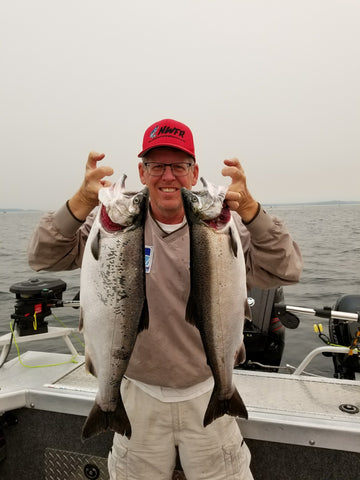
My reports show multiple trips with limits by 9am, red hot fishing, and lots of pictures of shiny chrome coho. As the season progresses into later September, the fish show a steady increase in size.
By late September to early October, the 6-8 pound coho are replaced by beautiful 10-14 pound hooknose monsters. It’s the time of year to stock up the freezer on tasty coho!
For those new to the fishery, you’ll find a wealth of information on techniques and locations scattered on the web. I've broken down some of my thoughts on coho trolling into Ten Rules of Coho Trolling.
Coho tend to be a pretty cooperative salmon when it comes to catching them. As these fish stream in from the ocean, heading through the Strait of Juan De Fuca and into Puget Sound, they are putting on the feed in preparation for their runs up to the spawning grounds.
It’s not unusual to find coho stuffed with herring. Don’t get me wrong, there are days they, like other salmon, will have lock-jaw. But that truly is the exception, not the rule. Speaking of rules, I offer a list of rules I’ve developed over the years to catch more coho.
You’ll likely have your rules to add to this list. Or you may disagree with some of them. But hopefully it will give you some additional ideas when targeting coho in the Sound.
Rule #1
As Russell Wilson would say, “Separation is in the preparation”. - When you put your boat in the water, you should have everything ready to go. No fiddling around with gear or bait the morning of a trip. My fishing ritual is to have everything ready to go the night before.
It’s like a general planning for battle. My rods are ready and geared up. My bait has been cut and cured. My boat is prepped and clean, batteries are charged, gas tank is full, snacks are bought, there’s ice in the coolers for the fish.
This evening before prep time is actually a ritual I cherish because like Russ, I’m visualizing success and making a plan in my head. I try to never go fishing without a plan.
Rule #2
Start early, go shallow. - I try to be on the water as early as possible. Ideally, that means running lights on and gear going in the water while it’s still dark or just turning light. I will run my gear in the top 10-30 feet of water to start.
This is the time of day when a salmon fly in the prop wash can be deadly. I like Artic Fox Trolling Flies. Denis Peirce ties a nice fly in a variety of effective salmon colors. Try running the fly back 40-50 feet and troll fast (more on that later) with the fly practically skipping on the surface.
Just be sure to have the clicker on the reel because these strikes can be vicious. I love the sound of a clicker going off in the morning!
Rule #3
Watch your fish finder, drop your depth – As the morning progresses, drop your downriggers down. I’ve read the “rule of thumb” is ten feet every hour until you’re trolling your gear around 40-60 feet. That’s fine, I guess, but I also use my fish finder.
If I see bait and fish marks down 50-70 feet, I’ll drop down to those fish even if it’s early in the morning. As the day goes on I may even drop my downrigger ball down to 110-120 feet deep.
Depth can be a tricky thing because when coho fishing I troll fast, which leads us to the next rule.
Rule #4
Troll fast! - In my experience, coho love a fast troll. I have an itroll throttle control and will set it on “hunt” mode to keep my boat going fast, around 3.3 to 3.9 mph. A few years back I did a lot of underwater filming and noticed a distinct increase in salmon aggression when the flasher was whipping around in a complete rotation.
If it was only doing a lazy rotation, or not doing a full rotation, coho would tend to swim behind the gear, just watching. But speeding up and getting that flasher fully spinning would elicit vicious strikes. I will troll both with and against the tide and catch fish going both ways.
Just be sure to increase your throttle going into the tide to maintain that 3.5 mph speed. I’ll also program my itroll to give a periodic 3-5 second slow down and then speed back up to “wake up” coho that may be lazily following but not biting.
It can often trigger a bite. Oh, another thing that will often trigger a bite – if you’re checking gear, pop your line off the release and set the rod in the rod holder. Let the gear come up on its own. I have caught a lot of coho that will chase the gear as it ascends to the surface.
Don’t reel your gear in until it hits the surface.
Rule #5
Coho are hungry, feed them! - Coho love a strip of herring on just about any lure. I will add strips to hoochies, flies, and even a small strip on the hook of a spoon (but not too much, you don’t want to kill the spoon’s action).
Be sure to brine the herring strips a day ahead of time in rock salt and/or commercial herring brine. Add scents and bite enhancers as well. Check your gear every 20-30 minutes and freshen up with a new herring strip. If you get a bite but no release, bring it in and check it!
The one exception to this rule I have is if the dogfish are in thick, I will go without bait.
Rule #6
Experiment – My “go to” set up is a magnum green splatter glow hoochie, herring strips, 26-30” leader, and an 11” dodger (pick your color…). I always start with this set up. On a second rod I may run a different color and smaller hoochie.
If there is no action and I am seeing fish on the fish finder I will start trying spoons and plastic lures like the old Big Al’s Cripple Herring. Sometimes the coho just want something with more action. This year I’m going to be trying the new Old Goat OG2 5” salmon lure.
The Old Goats have been awesome on kokanee and I think they will be deadly on coho. They have an amazing action that I think coho will love.
Rule #7
Fish Where They Ain’t (anglers that is) – coho in Puget Sound can be found pretty much anywhere. We all have favorite starting locations and it’s human nature to follow the crowds of boats because “hey, they must know something I don’t”.
Maybe…and maybe not. I try to start my troll away from clusters of boats. Why be surrounded by additional lures in the water? You want to troll over fish that aren’t seeing offerings non-stop. So, move away from everyone else – and if you take my advice and troll fast you will, very quickly.
You’ll still find the fish if they are there, and cover more water to find the biters. When you do, don’t be afraid to mark the fish on your fish finder and troll around and right back over the same spot. Again, in viewing underwater footage, I invariably see groups of 4-6 coho following my gear.
A solo fish is very rare. So, work over those spots when you pick up a fish.
Rule #8
Mid day and tide changes are good – I know I said earlier I like to hit the water at daybreak, but there are days when that just doesn’t happen. The good news with coho is that it doesn’t matter. You can (and will) catch coho all morning and into midday.
Tide bites are the period before and after a low or high tide, and these times can be very productive. My favorite tide sequence is a high tide at around 9-10am. The flood tide pushes fish and as the tide slows down it triggers a feeding opportunity below for the coho salmon.
Bait becomes easier to pick off without a steady flow of water and the coho bite often turns on. If you miss that crack of dawn bite, fear not, the coho will cooperate. I’ve caught my biggest hooknose fish from 11am to 1pm.
Rule #9
Playing and netting your fish – OK, you have a big fish on and are trolling at 3.5 mph. What do anglers often do? Why, slow down the of course. Bad move. In today’s age of barbless hooks, slowing down is an invitation to let the fish go. The second there is slack in that line the hook can slip out.
Trolling for coho is not a fishery that is about the fight, it’s about catching fish. If you want an epic battle against coho (and they are a hoot), catch them in rivers, or mooch for them. Trolling with an 11” flasher gives these fish a focal point with which they can get slack line.
We don’t want to do anything to help them out, like slowing down. Once they are on the surface, do your best to keep the flasher out of the water. This will help prevent the fish getting slack line between the hook and the flasher. Make sure you have a net with a long handle and big opening.
This will help as the netter reaches out. Remember, the netter scoops as the angler guides the fish into the net. Don’t make the mistake of the netter reaching to net the fish! Once the fish is close to the boat slowing down a bit is OK, by the way- just keep that flasher out of the water.
Rule #10
Take good care of your fish – Non-anglers have no idea what a freshly caught salmon tastes like. As anglers we are blessed to be able to have the freshest salmon on the planet. So, take good care of your caught fish. Bonk the fish enough to stun it, then cut a gill and bleed the fish out for a few minutes.
After that, into the ice cooler it goes. Don’t hang it off the side of the boat to bake in the sun. At the end of the day, gut and cut into steaks, or filet the fish out. If possible, vacuum-seal whatever fillets you don’t eat for dinner.
Properly cared for, you’ll have tasty fish until the next season, when you get to do it all over again!

There you have it. Ten “Rules” that will help increase your odds of success this coho season. Have fun out there and remember to be safe, have life jackets and all the safety equipment required and needed in case something goes sideways.
Good luck fishing and I’ll see you on the water.
/articles/ten-rules-coho-trolling-0
Lunker Lake Chelan Kokanee
By Mike Carey
There has been speculation exactly why anglers are seeing such large and healthy kokanee in Lake Chelan. Site member Toni (Wannafishalure.com) recently contacted WDFW Fish Management and got these two responses:
From Larry Phillips, Fishery Manager
"My understanding of Kokanee (based on what I’ve read in the published literature) is that growth is closely related to density. More kokanee=smaller size. Because they are specialized feeders (almost exclusively daphnia which is a species of zooplankton), they can overgraze their forage base.
I suspect that in the case of Lake Chelan we had a couple of weak year classes prior to the year-class that supported last year’s fishery. The weak year classes may have been the result of high water or high predation which limited overgrazing.
This would have given the prey base a couple years to build and support much higher growth. Obviously this is a guess because I’m not the biologist for that area.
Recall that all kokanee are genetically identical to sockeye and most naturally occurring sockeye populations have an associated resident (kokanee) component. Also recall that several 20+ inch kokanee were caught in American last year……so Whatcom Lake (our state source for kokanee) also has high growth potential.
When prey abundance is high kokanee have the potential to get very large. Several other factor can affect growth but it typically comes down to the relationship between kokanee abundance, prey availability, and prey size. Other issues include predation, temperature, and turbidity."
From Travis Maitland, Fish Biologist
"Larry’s previous explanation to you of what has been going on with the Kokanee in Lake Chelan the last couple of years is “spot on”. I will only elaborate a bit more on a few points that I hope will help answer your questions.
Historical Lake Productivity: Lake Chelan is the textbook example of an oligotrophic body of water. Bodies of water like this tend to be relatively deep, nutrient poor, clear, light transmission is high and the euphotic zone is deep.
Even though light penetrates to a considerable depth, primary production of phytoplankton is limited by the lack of nutrients, all of which results in a biologically limited body of water.
Lake Chelan Kokanee history: Although details (Strain and numbers) of stocking history prior to 1933 are missing….we do know that Kokanee were first stocked into Lake Chelan in 1917. WDFW stocked only this initial naturally reproducing stock of kokanee back into the lake from the early 1940's until about 1957.
In 1957 Kootenay Lake stock kokanee were introduced as eyed eggs, and in 1966 Whatcom stock kokanee plus, Kootenay stock kokanee began to be stocked as eyed eggs and in later years as fry. Recently only lake Chelan stock (so, a conglomerate of Kootenay, Whatcom and what was originally stocked) are being stocked.
There are no records that I know of that point to the ocean going form (Sockeye) ever being stocked into the lake and no genetics work has been conducted to my knowledge.
Recent Year Classes
During the last couple of years, the Kokanee available in the fishery came off of relatively low adult spawning escapements….and by that I mean the parents of these fish were in relatively low abundance by the time they made it to spawn. As Larry also mentioned, this can also be caused or compounded by things such as predation or high water events that may have taken place on the spawning tributaries.
All of this comes back around to numbers. So, for what information we have at this point…I am comfortable in saying that the fish have grown to some larger sizes in recent years because they have been present in relatively lower densities with the same available food source, thus giving them the opportunity to grow larger. There is no evidence that suggest this is genetically driven.
I have been hearing a few good angler reports as well of good sized Kokanee already this year…..12”-16”.
I hope this has helped and please feel free to contact me if you have any further questions."
Best regards
Travis Maitland
Washington Department of Fish and Wildlife
Dist. 7 Fish Biologist
Wenatchee District Office
3860 Hwy 97a
Wenatchee, WA 98801
(509) 665-3337
-----------------------------------------------------------------------
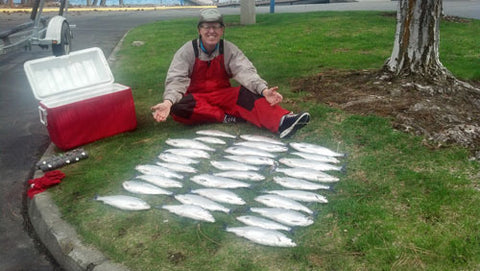
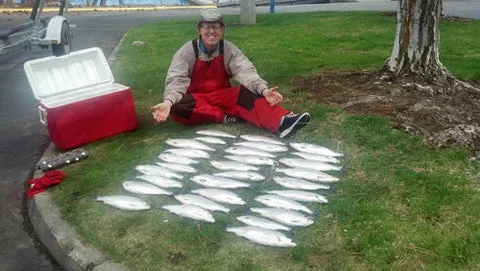
No doubt, the quality of the kokanee in 2013 was phenomenal and hopefully 2014 will prove a repeat. As noted above, fish are beginning to be caught. For my wife and I, last year April was red-hot into early May.
Anglers continued to catch fish into the late spring/early summer, but early spring was best. By mid-April the weather generally is pretty good in Chelan, and the crowds are light. The fishery is well worth the drive from east or west side to centrally located Lake Chelan.
/articles/lunker-lake-chelan-kokanee
Spring Chinook Time
By Jason Brooks
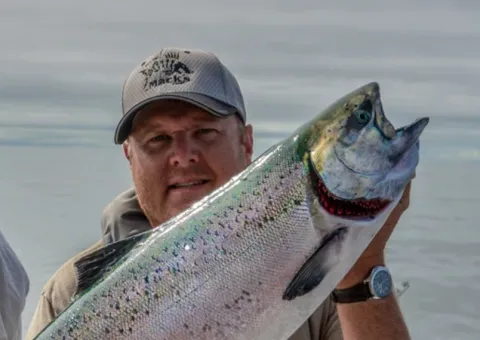
One of the most sought after and tasty salmon in all of the Pacific Northwest is the spring chinook. This run of salmon draws thousands of anglers who will first head to the Columbia, as well as a few coastal rivers for a chance to catch a “springer”.
The fish start to arrive in January and will run until May, with the height of the runs occurring in April. Once the fish make their way up the Columbia to the many tributaries, the anglers will spread out to focus on terminal fisheries. Run estimates and seasons yet to be set will determine where you can go to catch a spring chinook.
Looking at the projected runs, the Columbia total run is expected to be 307,800 wild and hatchery combined. This is good news as it is well over last year's projected run of 197,000 fish and even over the actual return from last year of 274,495. This means anglers should have fisheries in the lower Columbia area as well as the Vancouver-Portland fishery between I-5 and I-205 in early spring.
The Kalama fishery is near the Port of Kalama on the Columbia River, where there is good boat access with a protected harbor and multi-lane boat launch. Run straight across the channel, and you are at the fishery. Some anglers will use a small boat to cross and then beach fish off Sand Island by plunking a Spin-n-Glo with a gob of cured salmon eggs. Other bank plunking options are wobblers on a dropper, or a banana plug such as a MagLip or K15 Kwikfish, both with a herring or sardine wrap.
The boat angler has two options here depending on the tide. Most will troll using a triangle flasher, such as the Mack’s Lure UV Triangle Scent Flash or a Yakima Bait Company Big Al’s Fish Flash, then a long leader from 36 to 48 inches, with a 6-bead chain swivel in the middle, to a plug cut herring. When it comes to bait, the most productive herring are dyed with Bad Azz bait dye in either chartreuse or blue, or brined with Brine-n-Brite, which also comes in chartreuse and blue.
Single point barbless hooks must be used, but to increase the chance at a hook-up, set back the farthest hook and downsize it to a size 4 Gamakatsu Big River. These hooks are strong even in the small size 4- which tends to grab onto the chinook's face or jaw when they swipe at the bait- and will increase your hook to landing ratio.
The second option is to anchor up during the outgoing tide and let out the plugs and wobblers. This is known as “sitting on the hook”, and boats will form lines, often using wing dams to tie up to and to help break up the strong outflowing current. My first time fishing this part of the river was fishing on anchor with a friend in his boat. We sat in the protected covered cabin and played card games until a rod started to bounce, running out into the rain and reeling in the fish.
Then we let out the line, making sure it landed in a travel lane (which are often shallow depressions in the sandy bottom), and then resumed the card game again. It might not sound like much of a fishing experience, but this is springer fishing, and it is all about putting the best-eating salmon in the freezer.
The Cowlitz
The Cowlitz is the second largest lower Columbia tributary, only to be surpassed by the Willamette. With a predicted return of 9,000 springers to the Cowlitz, we can hope there will be a fishery that often coincides with the late returning winter steelhead. The “Cow” is one of the few rivers where anglers can catch a double bag of good eating fish in the same day. Depending on where you go on the Cowlitz will dictate how you fish.
In the lower river, anglers often pull plugs or use bait divers and baits such as cured salmon eggs or prawns. The prawns will have sat a few days in Pro-Cure’s Shrimp and Prawn Cure in magenta or red, and some anglers will use both baits at the same time, making a “cocktail” of sorts. Further upriver, anglers will float fish gobs of eggs or even plunk them. The Cowlitz offers both bank and boat access and is within a few hours’ drive of several cities, which means it gets crowded, but it can be a great place to catch fish.
Willamette
If you are looking for a lower Columbia powerhouse, then look at the Willamette. Anglers will start in early spring, hoping to be one of the first to catch one of the 71,000 projected spring chinook expected back this year. That is nearly 20,000 more than projected last year (51,200) and almost 16,000 more than the 55,391 that returned. The early springtime anglers will target the Multnomah channel which starts at St. Helen’s, Oregon, right across from Ridgefield, Washington. This can be protected waters, often calm and out of the wind, unlike the mainstem Columbia in spring.
I was fishing here several years ago with Buzz Ramsey, and as we crossed the Columbia, I noted that the wind was starting to kick up. After fishing the day in the Multnomah channel, we started back towards Ridgefield, where we had launched from. Making the corner around the island, we were met with gale force winds and whitecaps, and later learned that a boat capsized on the Columbia that day, costing two people their lives.
Be sure to check the wind forecast if you plan to cross the Columbia to fish the Multnomah channel, otherwise, drive around to the Oregon side and launch from there. An Oregon fishing license is needed to fish in the Multnomah channel, as this is considered Oregon waters and is part of the Willamette River and not the Columbia.
Bonneville Dam
Further upriver and above the Bonneville Dam, anglers start to target terminal fisheries. The first being the Wind River, which will have both a run of Wind River bound fish as well as fish stopping to rest near the deadline of the Wind River outlet, as marked by large white buoys in the Columbia. The Wind River is expected to get back 4,400 fish, which is only 200 fish more than last year's projection of 4,200, but last year the run exceeded the estimate by over 2,000 fish, with an actual return of 6,530.
Here, trolling plugs such as MagLips, Kwikfish, and even going “old school” with an orange Mag Wart by Storm is commonplace. In the late 90’s and early 2000’s, about everyone flat lined the hot orange Mag Wart and then started fishing them on droppers to keep from tangling with other boats. This still works, but also anglers will be trolling triangle flashers and Brad’s Super Baits and Super Cut Plugs often in the Hot Lava color and stuffed with tuna.
Drano Lake
Drano Lake is the most popular spring chinook terminal fishery in the entire Columbia system. Here hundreds of boats will try to choke into the “toilet bowl”, which is the entrance to the impoundment at the highway 14 bridge. Be aware of the deadline and do not cross it as you will get cited and be sure to be courteous. Here, boats will slow down and make a turn, trolling in a counterclockwise direction.
Do not try to go against the current of boats, as it will only lead to a mess. Here, anglers primarily slowly troll prawn spinners with a triangle flasher. Again, the Pro-Cure cured prawns are effective, with magenta being the most popular color. For prawn spinners, you can use the tried-and-true Eric’s Prawn Rig by Lugh Jensen with the “backdraft” color, a combination of orange, chartreuse, and green with green beads.
Macks Lure also has a prawn rig which uses their Smile Blade, a Mylar blade that works at extremely low speeds which are needed at Drano. Again, the most popular color is green and chartreuse, with a magenta cured prawn.
For anglers hoping to get some spring chinook further upriver, then 2023 might be your year. The Snake River and Idaho bound fish are estimated to be 85,900, which means there could be a season, but do not expect any announcements until in-run estimates are updated with fish counted at the dams. Icicle River anglers up near Wenatchee, some 500 river miles from the ocean, also have some great news, along with Yakima River anglers, as 41,400 spring chinook are expected in the “Upriver Columbia” run.
Seasons on both rivers are not usually announced until dam counts show there are enough fish above the mid-Columbia pools. If this estimate is like the others and last years, all of which came in above projections, then spring chinook anglers in the upper Columbia and even into Idaho will hopefully have a season. With springers already showing up and passing over Bonneville dam, with one climbing the fish ladder on January 2nd, it looks to be a momentous year. The best eating fish are on their way here, and anglers will have plenty of places to go.
Let us hope the winds do not kick up too much and we can all get along in Drano’s toilet bowl. Start curing up the prawns and soaking the herring, it is springer time!
/articles/spring-chinook-time
How to Catch Bass in the Winter
By Rick Lawrence
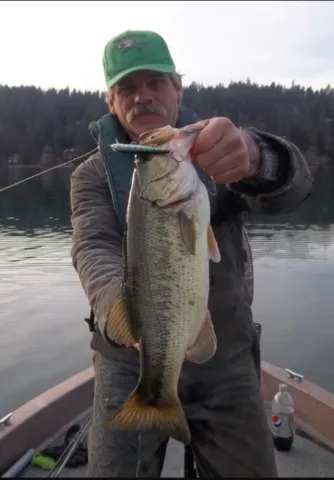
Let’s talk about winter bass fishing. Whether you choose to fish out of a boat in open water, or venture out on a frozen lake to drill a hole in the ice, you can catch bass in the winter. This time of year can be challenging for bass anglers, but with the right techniques you can master it. Here are the top 8 most important steps to follow when fishing for bass in the winter.
Choose the Right Lure Type
The first thing you’ll need to think about is grabbing the correct lure for the season. You can’t use the same strategy you use when the water is warm, no matter what way you look at it. Winter fishing techniques require finesse, but they also require a bit of preparation. Fast-moving lures and excessively noisy ones won’t work when the water temperatures drop. You’re going to want to use bottom feeders and slower moving lures like jigging raps, flutter spoons, or, if you are fishing open water, suspending jerkbaits, if you work them slowly, with long pauses.
Stay away from lipped and lipless crankbaits, spinnerbaits, and other fast-moving lures during the winter months. Even switching from lures to live bait when legal is sometimes the key to landing winter bass.
Always choose the most natural color you can, and try to imitate the fish’s color in the water you’re fishing.
Slow it Down
You need to slow down your presentation when the water temperatures drop. Winter largemouth bass fishing requires you to think like a fish. The water is cold, their metabolism is slow, and they’re not feeding much, so they will never chase a fast-moving bait halfway across the pond. It won’t work.
You need to drop something right in front of their face, make the bass think it’s almost dead, and move it slowly and erratically, so they think they’ve got an easy meal on their hand. Once you do that, you’ll have no problem retrieving them because they won’t put up much of a fight. In less than 40-degree water, you’re in for a challenge. At that temperature, the bass are incredibly inactive, and their metabolism is super slow, so they’re not feeding much, and they’re preserving all their energy by taking on the simplest of meals.
For you to have success fishing during this time, you need to throw your lure right in their face and present it slowly enough for them to get it.
The 40-to-50-degree temperature range is prime fishing in the north, so expect to find bass in this temperature range most frequently during early and late winter months. Bass in this temperature will slow down quite a bit, but they’ll still have feeding periods each day, and this is when you need to capitalize by using the right lures and offering a slow but calculated presentation.
Size it Down
In addition to presenting more slowly, you’ll also want to present a smaller lure. Small bait fish imitations can trigger strikes, or you can go with a small nedhead jig or spoon with some red on it.
The bottom line is, your strategy needs to stay in line with the conditions. If it’s cold and the water temperature is near freezing, use a small ned, or the smallest swimbait you have, nose hooked on a drop-shot jig. Doing so will present less of a threat to the bass, and they’ll think they stumbled upon an easy opportunity for a meal.
Go Neutral
Color is also an important factor in the winter. If you can find baitfish in the water, see what color they are, and mimic them. If not, go neutral whenever possible.
Know Where to Look
The best tip someone ever told me is to use a good fish finder and search the area for fish before you try fishing for them. Water clarity is also a huge factor in the winter. If the water is murky, the baitfish will run deeper. If you have clear water, the baitfish will come closer to shore and into the weed lines. Look for green weeds, rocky drop-offs, submerged islands, or any structure that might be a good spot bass would use, then scout the area for fish with your electronics.
Time it Right
As previously mentioned, you need to change your mindset when it comes to fishing in the winter. When the water temperatures are warm, we know that the best times to fish for bass is first thing in the morning and right at dusk.
When you’re fishing in the winter, you’ll want to fish the middle of the day because this is when the water will be the warmest. Once the sun has hit the water for a while, the baitfish will start to move around, and this is when you stand the best chance of catching more bass.
Don’t Forget the Basics
One of the most important winter bass fishing tactics to learn revolves around understanding structure and baitfish. You can sometimes find bass without any structure around if there are baitfish there, and sometimes you can find bass on structure without any baitfish, but you will never find them where neither are present. You need to understand these two points and why they’re critical for winter fishing. Baitfish will sometimes hug the shore near creeks because this is where the most oxygen is, and the temperature tends to be a bit warmer. As we all should know, bass follow the baitfish, so this is where you’re likely to find more bass. Offshore green weed lines can also hold bait fish and provide bass with ambush points to catch an easy meal, making them prime spots as well.
Bring the Right Gear
While this isn’t a direct tip per se, I wanted to talk briefly about safety and gear. Depending on your location, fishing in the winter can be dangerous because of frigid temperatures and dangerously cold water. You need to make sure you have enough layers to keep yourself warm, and plenty of backup gear in case you fall in or get wet. Wear multiple layers with socks, ice fishing boots, and fingerless gloves so you can maintain full movement of your fingers. If you're on the ice, make sure you have all the proper safety gear you need in case you should fall through the ice, and don't ever fish on the ice alone.
/articles/how-catch-bass-winter
Grant County Fishing Opportunities
By Mike Schmuck
Martha Lake and Upper Caliche Lake: These lakes, near the town of George, WA, should produce well in spring 2020. In addition to fingerling Rainbow Trout, both lakes received 1,000 11–13-inch Rainbow Trout in fall 2019 and these fish should be in the 14–15-inch range this spring. These lakes also received 1,000 (Martha) and 500 (Upper Caliche) catchable Rainbow Trout in April 2020.
Quincy Lake: Over the years this rather popular lake, located on the Quincy Wildlife Area, has provided anglers with good catches of 11–13-inch trout as well as the occasional carry-over fish that can often be in excess of 14 inches. Quincy Lake fished well in early March 2020 with several fish caught in the 18-20-inch range. WDFW hatchery staff will be stocking nearly 1,000 Rainbow Trout into Quincy Lake in preparation for the May 5th re-opening. These fish are just over a pound each and will provide excellent opportunities for anglers.
Burke Lake: Burke Lake, a next-door neighbor to Quincy Lake, underwent a chemical rehabilitation in the fall of 2019 in order to remove nuisance Yellow Perch and Pumpkinseed Sunfish. WDFW Hatchery staff stocked 3,000 9–11-inch Rainbow Trout into Burke Lake in late-February. Burke Lake will be receiving 1,000 Rainbow Trout in preparation for the May 5th re-opening. These fish are just over a pound each and will provide excellent opportunities for anglers. Burke Lake received very little fishing pressure in early March and should provide excellent fishing for the remainder of the season.
Quincy Wildlife Area walk-in-lakes: While Quincy and Burke Lake get the lion’s share of fishing pressure, there are several small walk-in lakes just west of these two popular fisheries. Crystal, Spring, Cup, Lloyd and Scout Lakes are not on many anglers’ radar—but they should be. These lakes receive annual stockings of fingerling Rainbow Trout from Columbia Basin Hatchery and often provide anglers with solitude and big fish.
In early March I talked to one angler who caught two 21-inch Rainbows from one of these lakes—I promised not to tell which lake they came from. Scout Lake is a mile north of the remaining lakes on this list and is 530 yards west of the H-Lake parking lot. Those looking to social distance should keep these lakes in mind.
Ping Pond (aka Oasis Park Pond): This 2+ acre pond located at the south end of Ephrata is open to Juvenile Anglers (under 15 yrs. old), Senior Anglers (at least 70 yrs. old) and Anglers with a Disability who possess a designated harvester companion card. WDFW hatchery staff stocked 30–40 Jumbo (3 lb.) Rainbow trout and 200 12–14-inch Rainbow Trout into Ping Pond on May 1 in order to give kids a fun opportunity to catch some nice fish.
Park and Blue Lakes: These lakes are two of Grant County’s top trout waters and both should fish well this spring. Catch rates were lower than anticipated on opening day 2019; however, this was likely due to high winds that kept many anglers off the water. Despite relentless winds, catch rates averaged 3 trout per angler on both lakes. Anglers should expect good catches of rainbow trout in the 12–14-inch range as well as some 2+ year-old ‘carry-over fish’, in the 15–17-inch range. Brown Trout and Tiger Trout are also stocked in both lakes.
Vic Meyers Lake: This 12-acre lake located in Sun Lakes State Park receives a fair amount of fishing pressure and produces Rainbow Trout to 17-18 inches. The lake has excellent shore access and is a good choice for anglers looking to get away from crowds.
Perch Lake: Another lake in Sun Lakes State Park, Perch Lake has limited shore fishing but is ideal for someone with a small boat or float tube. I visited Perch Lake numerous times in 2019 and never encountered an angler. I did, however, see a lot of trout rising in the evenings and believe this lake should fish well. Perch Lake receives 9,200 fingerling Rainbow Trout each year.
However, in 2020 we reduced this significantly due to low angler effort. Low harvest on these fish will increase food competition and limit growth for remaining fish. A lack of large fish in this population will further limit the popularity of this fishery.
Deep Lake: Deep Lake is a good choice for anglers looking for great scenery and good fishing. While not known for an abundance of large fish, Deep Lake produces Rainbow Trout in the 11–13-inch range, and a few carry-over fish close to 16 inches. Anglers wishing to troll, or simply fish a little deeper, can also catch Kokanee. Each year, WDFW hatchery staff stock Deep Lake with 13,500 spring fingerling Kokanee. In addition, Deep Lake also receives 15,000, 11–13-inch Rainbow Trout from Trout Lodge Fish Hatchery.
Warden Lake: Warden Lake is a popular trout lake, but in recent years it has been producing excellent catches of Yellow Perch and bass. Warden Lake receives 65,000 spring fingerling Rainbow Trout, 7,000 spring fingerling Tiger Trout and 15,000 6–9-inch Rainbow Trout each year. In early spring 2020, Warden Lake was stocked with 3,300 12–13-inch Rainbow Trout from Trout Lodge in late March. To provide more opportunity, WDFW hatchery staff stocked an additional 2,200 Rainbow Trout into Warden in late-April. Anglers should expect excellent trout fishing once lakes reopen.
Potholes Seep Lakes: Several lakes south of Potholes Reservoir can produce good catches of Rainbow Trout as well as Bass, Bluegill, Black Crappie and Yellow Perch.
Corral Lake: This lake is located near the southwestern end of O’Sullivan Dam just across the road from the MarDon Resort. Corral is a good choice for anglers that don’t mind a mixed bag of good size Rainbow Trout, Largemouth Bass or Black Crappie. Bring your boat to explore this lake fully—shore access is limited.
Pillar-Widgeon Chain: These walk-in lakes on the Columbia National Wildlife Refuge are consistent producers of quality Rainbow Trout. This chain of lakes receives spring fingerling Rainbow Trout and are a popular destination for anglers looking for a quiet day on the water.
Hampton Lakes: The Hampton Lakes have fished well over recent years. Lower Hampton Lake receives more angler effort and while catch rates are somewhat lower than on Upper Hampton, the fish caught there are larger. Since the 2014 rotenone treatment of the Hampton Lakes, Pumpkinseed Sunfish have recovered to a point where they are negatively affecting growth of fingerling rainbow trout.
Teal Lakes: The Teal Lakes, located along the Seep Lakes Road on the Columbia National Wildlife Refuge, are a popular fishery for anglers looking to catch good sized trout. Both lakes, while managed for trout, have carp, bass and sunfish as well. Consequently, fingerling growth and survival have suffered. South Teal Lake receives little fishing pressure, likely due to abundant aquatic weed growth and limited access to most of the shoreline.
Most of North Teal’s shoreline is accessible and anglers commonly catch very nice 13–15-inch rainbow trout all around the lake. Catch rates, on average, are lower here than on other more productive waters such as Blue and Park Lake; however, anglers can find they often have the lake to themselves, especially during the week.
Hutchinson and Shiner Lakes: Located on the Columbia National Wildlife Refuge in Adams County, are connected lakes with quality Largemouth Bass, Bluegill and Crappie. They are both best fished from a small boat, canoe, or float tube/pontoon boat. Anglers willing to put in a bit of extra work can row or paddle to the east end of Shiner Lake to target more naïve bass.
Katey & Janet Lakes: These two trout lakes can provide solitude and good catches of Rainbow Trout. Katey Lake was treated with rotenone in fall 2019 to remove Carp. In early April, WDFW hatchery staff stocked 200 11–13-inch Rainbow Trout into this six-acre lake. Janet Lake is a short hike west from Katey and can provide anglers with some larger Rainbow Trout. Most of the shoreline is accessible to anglers on both lakes.
East and West Sage Lakes: Similar to Katey, these two lakes were treated with rotenone in fall 2019 in order to remove Carp. The Sage Lakes produce large Rainbow Trout, although for the remainder of 2020 anglers will have to rely on slightly smaller hatchery fish that were stocked in early April. WDFW hatchery staff stocked each lake with 500 11–13-inch Rainbow Trout which should reach 14–15 inches by spring 2021.
Windmill, North Windmill, North-North Windmill, June, Virgin, Lois: Anglers need several days to explore these lakes located south of Warden Lake. This chain of lakes, managed for Rainbow Trout fishing and popular with fly angers, can produce some large fish.
/articles/grant-county-fishing-opportunities
Finding the Right Fishing Rod
By Jason Brooks
Almost three decades ago, I learned the importance of using the correct fishing rod, and how important the rod is as a tool to catch more fish. It was a bright July day, and we were fishing the Cowlitz River for summer steelhead. I was with two friends, both of whom were well seasoned steelhead anglers, but I was not. Having grown up in North Central Washington, steelhead were but an anomaly back in the 80’s and 90’s. Instead, we trolled for trout and chased summer chinook by casting spoons and pulling plugs, but we never really had to “feel the bite” like you do for summer steelhead.
"Broomstick"
Throughout the day, my two friends kept hooking fish while I did not get a single bite, or at least I did not think I did. After breaking off the leader while in a good run, one of my friends told me to grab his spare rod, already rigged up and ready to go with bait. I put down my rod and grabbed his, cast it out, and within seconds had a bite and set the hook. Once that fish was landed, I mentioned how quickly I felt the fish bite and that it was my first bite of the day.
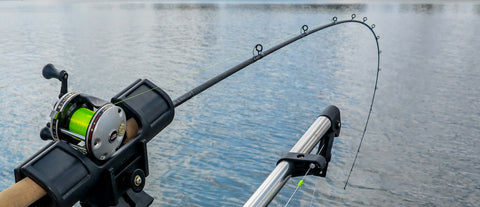
Both friends politely informed me that I had been getting bites all day, but I just did not know it, calling my fishing rod a “broomstick”. I was using a cheap rod, one that fit my budget at the time, but also cost me fish as it was not sensitive enough for me to notice the bite. The rod my friend handed me was a Lamiglas Certified Pro, a “mid-priced” rod for that brand, but known to be extremely sensitive and a good value compared to the higher end models.
Pricing
Price is probably the most noticeable point when it comes to a fishing rod. Those that do not fish, and even a few that do, often ask why quality fishing rods cost so much. Yes, there are exceptionally good rods on the market that do not cost what some of the “top of the line” models do, but they are usually made in foreign countries where quality control might not be as tight as some American made rods.
There is a saying, “buy cheap, buy twice” which means those that try to look for a bargain often end up buying the more expensive rod after they have a few days like the one I had on the Cowlitz all those years ago. The high price of a rod is mostly due to a few variables, the first being quality control with quality materials. The next cost factor is that you are not just paying for the rod, but also for research and development that went into designing, testing, and building of the rod. A company cannot improve their products without testing and developing them first.
They have paid employees that do this, such as engineers to design, make, and maintain the machines that manufacture the rods, and then of course the engineers whose knowledge goes into rod design. Everyone needs a paycheck and when you buy that rod you are becoming part of the process, one that will also help improve the next model or design of rod.
Warranties also cost and some high-end rods are factoring in the warranty for when anglers do break a rod and get a “free” replacement. That replacement cannot really be free but instead is added into the overall costs. Then there is shipping the rods to stores, advertising, and of course the store’s overhead, which all must be added to the costs of each rod.
Quality
So now that you know why some rods cost so much, then ask how some rods can be reasonable in price and still have most of the same attributes of a high-end rod. This is mostly because those rods are a few years behind in technology, and either patents run out so they can be copied, or consumer demand is finally high enough that a large company can outsource the building of the rods to foreign labor, making the building part of the rod less expensive, and mass produce the rod.
Profit margins can be smaller, and this means a less expensive rod for the angler, but think about quality control and rod materials. Of course, these rods can and do catch fish, so should you feel guilty for buying a rod made in some foreign country? That is up to you, but it is understandable why one would buy such a rod, with some American made rods costing two and even three times as much as the others.
When it comes time to pick out the rod you plan to buy, you need to understand how the rod is designed or what its purpose is for. The first two factors that must be taken into consideration when purchasing the correct rod are what type of fish you are planning on catching, and what technique you are going to use to catch them. Take for example the twitching rod, often used to catch coho, but also good for chinook, chums, and even the occasional winter steelhead.
Since it is mostly used for coho, the rod needs enough power to haul in a 12 to 18-pound fish, pulling it out of a log jam, and to the net. It also needs a soft tip, or fast action, to give that jig the right action as it falls, and so you can feel the slightest resistance when the fish grabs the jig, often done on the drop. Again, that power needs to be strong enough to set the hook quickly. And then there is the length of the rod- most twitching rods are 7’6” to 7’9” as this is the right balance for twitching without causing wrist fatigue.
Years ago, just as twitching rods were coming onto the market, I was still using a medium action 8’6” drift fishing rod and did well until my wrist hurt so bad that I had to stop fishing for the day. Yes, some rods are “multi-purpose”, but if you plan to use a specific technique you will always do better with the right tool for the job, or the rod designed for that type of fishing.
Float Fishing
Float fishing is popular amongst salmon and steelhead anglers, and since the technique is pretty much the same if you are floating cured roe or a jig, you can use the same rod. The idea of float fishing is to cast out a line with a sliding float and a weight to get the bait or lure down to the depth of the fish, and then let it naturally drift downstream.
To do this you need to be able to mend the line, which is to pick the line up off the water and pull or flip it upstream, allowing some slack above the float. If the line gets pulled downstream in the current, it often speeds up the float and bait or lure and it is not a natural presentation. To mend the line, you need an exceptionally long rod so you can lift the line up off the water. Most float rods are 10 ½ to 12 feet long, with a medium heavy to heavy action or “power” as you do not need to feel the bite, but you need to set the hook hard.
Spoon and Spinner Fishing
Spoon and spinner fishing is much like drift fishing as far as casting out a lure, letting it drift along and catch in the current as it swings across the river. One main difference is that most bites on the spoon or spinner are violent grabs by the fish and you can feel them easily. There are a few times that the bite is more of a pause but then again you can feel that with a quality graphite or glass rod.
However, the drift angler needs to be able to tell the difference between a bite and the weight bouncing off a rock. This is where my broomstick failed me all those years ago. If there is one technique where the rod is the most valuable tool to catch fish, it is in drift fishing. This style of fishing is also one of the most common and one of the ways most salmon and steelhead anglers learn to fish.
It can be very frustrating to go out fishing and not get a bite, or worse, get a bite and not know it. Do not skimp on the drift fishing rod. An extremely sensitive, moderate to fast action rod in 8 ½ to 9 ½ feet is necessity. Again, the river you plan on fishing will determine the specifics of the rod.
Frazier River
Years ago, when the Frazier River in British Columbia still had a return on sockeye in the tens-of-millions (yes, millions) I found myself standing shoulder to shoulder in the glacial waters with zero visibility, drift fishing “wool” as they call it in B.C. It was the basic drift fishing of a piece of yarn, sometimes with a Lil Corky, but mostly just a piece of yarn and an awfully long leader.
Lining sockeye, like they do in Alaska, was the way to catch them in the murky water, but this river is huge and about 200 yards wide, moving so fast that we were casting 2-ounce cannonball weights and bouncing them along as if they were a 2-inch piece of pencil lead. For this trip I was using a 12-foot extra heavy spinning rod. It would cast 100 yards easily and handle the swift currents as well as the occasional chinook, pulling it in while never needing to yell, “fish on, coming down” like most anglers do on any given pink salmon river in the Pacific Northwest.
It was the right tool for the job, and one I bought specifically for this trip. It cost a few hundred dollars and that is expensive for a rod that will be scarcely used. It has found a new fishery now that the Frazier is pretty much closed to sockeye fishing, and that is along the ocean beaches as a surf perch rod. Again, ask yourself what type of fish you are planning on catching, and what technique you will be using.
Surf perch does not require a heavy action rod, but casting the heavy weights out past the rolling waves does. Be sure to pick the right rod you plan to use and buy the best quality one you can afford, otherwise you will likely be buying twice.
/articles/finding-right-fishing-rod