It's Yellow Perch Time by Mark Yuasa
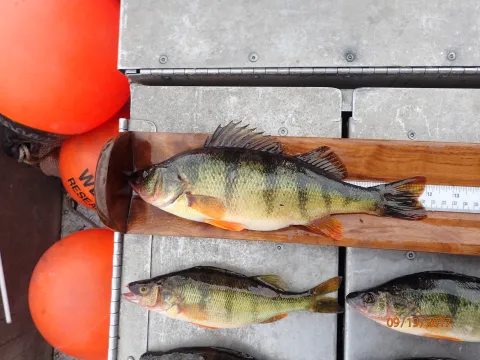
We’ve rounded the corner on summer, and the clock is ticking as the pre-fall chore list or heading back to school obligations become the front burners instead of on-the-water activities. Summer days are winding down, but that doesn’t mean you have to throw in the towel on fishing. Late summer and fall are prime times for yellow perch fisheries in many statewide waterways. Yellow perch are colorful and identified by their golden-yellow, orange, and brass-colored bodies with distinct olive-green, vertical, triangular bars along each of their sides.
One of the top locations to catch a batch of yellow perch is Lake Washington, which is situated right in the backyard of downtown Seattle. Yellow perch are a very stable population in the lake that covers nearly 22,000 acres and stretches 20 miles from Kenmore on the northern tip to Renton in the southeastern most section.
What makes these fish even more appealing is the fact that they’re available to catch year-round, with late summer through early fall being the most productive fishing period.
Yellow perch average 7 to 10 inches (made up of three- and four-year-old age class fish), although some will be as large as 12 to 14 inches or longer. The official WDFW state record – https://wdfw.wa.gov/fishing/basics/records – of 2.75 pounds caught by Larry Benthien at Snelson’s Slough in Skagit County on June 22, 1969, could eventually be broken and come from King County’s largest watershed.
Washington Department of Fish and Wildlife (WDFW) biologists say this is largely based on ample feed and lots of “elbow room” for yellow perch to grow in Lake Washington, the second-largest natural-bodied lake in Washington.
Yellow perch spawn in the spring well ahead of many other warm-water fish species in the lake. The female perch are the largest and tend to grow much faster (maturing in three to four years) and are long-lived up to eight to 10 years.
Lake Washington has a diverse ecosystem, and you can also catch cutthroat and rainbow trout, catfish, carp, peamouth chub, brown bullhead, smallmouth, and largemouth bass, and black crappie. Another abundant fish is the “rock bass”, a species of sunfish.
Fishing gear and tips
Yellow perch is one of Washington’s several "panfish" species, which are very popular across the state because they’re easy to catch and a great introductory fishery for beginners, young kids, and an overall fun family fishing activity. They are outstanding in eating quality, similar to the white, flaky flesh of walleye.
On lightweight fishing gear, yellow perch will put up a good fight, and they’ll often stay active all day. It is not unusual to see thousands of perch schooling in shallow water areas of the lake, and while reeling one in, you could see many others following it up to the surface.
Even during the middle of a summer afternoon, yellow perch aren’t spooked by all the boaters and jet- or water-skiers zipping around Lake Washington.
The best period to target yellow perch begins around July, when the water heats up, and will peak in August through October. As winter arrives in November, yellow perch become harder to catch since they usually move into deeper water locations.
Yellow perch tend to school in shallow water areas, 15 to 35 feet, and you’ll find them close to the shoreline or on the edge of drop-offs. Look for them hiding in shaded spots along the cover of weed beds, milfoil, aquatic weeds, and lily pads, or under docks or overhanging trees and brush. At night, they’ll often look for cover in these locations to avoid predators such as smallmouth and largemouth bass.
Yellow perch mainly feed on small fish, crayfish, snails, clams, and smaller invertebrates.
What makes this fishery fun for everyone is the fact that there are so many locations accessible by boat or from the shoreline and public docks around Lake Washington.
The lake has plenty of elbow room to fish around Seward Park; Gene Coulon Park in Renton; Yarrow Bay in Kirkland; Magnuson Park; Andrews Bay; Newport area; Webster Point in Union Bay; Juanita Bay; Foster Island in the Montlake Cut; and docks at Mount Baker Park, Madison Park, Stan Sayres Pits, Leschi Park, Luther Burbank on Mercer Island, Kirkland, and Kenmore.
You can find a list of public fishing piers on Lake Washington on WDFW’s website: https://wdfw.wa.gov/sites/default/files/publications/01996/wdfw01996.pdf.
Fishing gear consists of a light-to-medium-action trout fishing rod with a spinning reel attached to a four- to six-pound test main line. Simply stick to a piece of worm on a 15- to 24-inch leader with a small salmon egg-style hook to a drop-shot egg-style weight.
Once you catch your first perch, you can use a small chunk of the meat or — believe it or not — even an eyeball. Colorful, tiny three-inch plastic worms or small-skirted crappie jigs and lures tipped with maggots, wax worms, or shrimp will also catch fish.
Yellow perch are light biters and tend to nibble on your bait, so don’t set the hook hard and let them play with the bait. Then wait for your rod to bend before you gently reel them up. Yellow perch are bait stealers, and don’t be duped when you occasionally reel up bare hooks. The great news is that once you drop it back down, you’ll likely be rewarded with an actual fish!
Additional lakes to catch yellow perch
Besides Lake Washington, there are many other statewide lakes where you can find yellow perch.
A standout yellow perch fishery in Eastern Washington is Curlew Lake in Ferry County, located northeast of Republic. For more than a decade, the yellow perch population has continued to rapidly grow and, combined with the average size (9 to 10 inches), has generated considerable enthusiasm by anglers.
“Curlew is a special place because it has ideal habitat, good water quality, and plenty of food that creates a fast growth rate for the yellow perch population,” said Danny Garrett, a WDFW biologist.
Other east of the Cascades yellow perch fisheries include Moses Lake and Potholes Reservoir in Grant County; Leader Lake, Palmer Lake, Whitestone Lake, and Washburn Island Pond in Okanogan County; and Roses Lake and Wapato Lake in Chelan County.
Shifting back to the west side of the state, yellow perch can be found in Lake Sammamish near Issaquah; Lake Whatcom near Bellingham; Sawyer Lake northwest of Black Diamond; Lake Goodwin northwest of Marysville; Lake Stevens east of Everett; Beaver Lake and Pine Lake near Issaquah; American Lake near Fort Lewis; Lake Kapowsin southeast of Puyallup; Angle Lake south of Sea-Tac Airport; Lake Desire in Renton; and Lake Meridian in Kent.
Before heading out, check the WDFW regulation pamphlet for specific rules at https://wdfw.wa.gov/fishing/regulations. You can also find yellow perch information on the WDFW website at https://wdfw.wa.gov/species-habitats/species/perca-flavescens, including an informative video at https://youtu.be/-V5d--VkQ4Q.
Contributed by Mark Yuasa, WDFW
(Mark Yuasa is a Washington Department of Fish and Wildlife Communications Manager and longtime local fishing and outdoor writer.)
/articles/its-yellow-perch-time-mark-yuasa
Grant County Fishing Opportunities
By Mike Schmuck
Martha Lake and Upper Caliche Lake: These lakes, near the town of George, WA, should produce well in spring 2020. In addition to fingerling Rainbow Trout, both lakes received 1,000 11–13-inch Rainbow Trout in fall 2019 and these fish should be in the 14–15-inch range this spring. These lakes also received 1,000 (Martha) and 500 (Upper Caliche) catchable Rainbow Trout in April 2020.
Quincy Lake: Over the years this rather popular lake, located on the Quincy Wildlife Area, has provided anglers with good catches of 11–13-inch trout as well as the occasional carry-over fish that can often be in excess of 14 inches. Quincy Lake fished well in early March 2020 with several fish caught in the 18-20-inch range. WDFW hatchery staff will be stocking nearly 1,000 Rainbow Trout into Quincy Lake in preparation for the May 5th re-opening. These fish are just over a pound each and will provide excellent opportunities for anglers.
Burke Lake: Burke Lake, a next-door neighbor to Quincy Lake, underwent a chemical rehabilitation in the fall of 2019 in order to remove nuisance Yellow Perch and Pumpkinseed Sunfish. WDFW Hatchery staff stocked 3,000 9–11-inch Rainbow Trout into Burke Lake in late-February. Burke Lake will be receiving 1,000 Rainbow Trout in preparation for the May 5th re-opening. These fish are just over a pound each and will provide excellent opportunities for anglers. Burke Lake received very little fishing pressure in early March and should provide excellent fishing for the remainder of the season.
Quincy Wildlife Area walk-in-lakes: While Quincy and Burke Lake get the lion’s share of fishing pressure, there are several small walk-in lakes just west of these two popular fisheries. Crystal, Spring, Cup, Lloyd and Scout Lakes are not on many anglers’ radar—but they should be. These lakes receive annual stockings of fingerling Rainbow Trout from Columbia Basin Hatchery and often provide anglers with solitude and big fish.
In early March I talked to one angler who caught two 21-inch Rainbows from one of these lakes—I promised not to tell which lake they came from. Scout Lake is a mile north of the remaining lakes on this list and is 530 yards west of the H-Lake parking lot. Those looking to social distance should keep these lakes in mind.
Ping Pond (aka Oasis Park Pond): This 2+ acre pond located at the south end of Ephrata is open to Juvenile Anglers (under 15 yrs. old), Senior Anglers (at least 70 yrs. old) and Anglers with a Disability who possess a designated harvester companion card. WDFW hatchery staff stocked 30–40 Jumbo (3 lb.) Rainbow trout and 200 12–14-inch Rainbow Trout into Ping Pond on May 1 in order to give kids a fun opportunity to catch some nice fish.
Park and Blue Lakes: These lakes are two of Grant County’s top trout waters and both should fish well this spring. Catch rates were lower than anticipated on opening day 2019; however, this was likely due to high winds that kept many anglers off the water. Despite relentless winds, catch rates averaged 3 trout per angler on both lakes. Anglers should expect good catches of rainbow trout in the 12–14-inch range as well as some 2+ year-old ‘carry-over fish’, in the 15–17-inch range. Brown Trout and Tiger Trout are also stocked in both lakes.
Vic Meyers Lake: This 12-acre lake located in Sun Lakes State Park receives a fair amount of fishing pressure and produces Rainbow Trout to 17-18 inches. The lake has excellent shore access and is a good choice for anglers looking to get away from crowds.
Perch Lake: Another lake in Sun Lakes State Park, Perch Lake has limited shore fishing but is ideal for someone with a small boat or float tube. I visited Perch Lake numerous times in 2019 and never encountered an angler. I did, however, see a lot of trout rising in the evenings and believe this lake should fish well. Perch Lake receives 9,200 fingerling Rainbow Trout each year.
However, in 2020 we reduced this significantly due to low angler effort. Low harvest on these fish will increase food competition and limit growth for remaining fish. A lack of large fish in this population will further limit the popularity of this fishery.
Deep Lake: Deep Lake is a good choice for anglers looking for great scenery and good fishing. While not known for an abundance of large fish, Deep Lake produces Rainbow Trout in the 11–13-inch range, and a few carry-over fish close to 16 inches. Anglers wishing to troll, or simply fish a little deeper, can also catch Kokanee. Each year, WDFW hatchery staff stock Deep Lake with 13,500 spring fingerling Kokanee. In addition, Deep Lake also receives 15,000, 11–13-inch Rainbow Trout from Trout Lodge Fish Hatchery.
Warden Lake: Warden Lake is a popular trout lake, but in recent years it has been producing excellent catches of Yellow Perch and bass. Warden Lake receives 65,000 spring fingerling Rainbow Trout, 7,000 spring fingerling Tiger Trout and 15,000 6–9-inch Rainbow Trout each year. In early spring 2020, Warden Lake was stocked with 3,300 12–13-inch Rainbow Trout from Trout Lodge in late March. To provide more opportunity, WDFW hatchery staff stocked an additional 2,200 Rainbow Trout into Warden in late-April. Anglers should expect excellent trout fishing once lakes reopen.
Potholes Seep Lakes: Several lakes south of Potholes Reservoir can produce good catches of Rainbow Trout as well as Bass, Bluegill, Black Crappie and Yellow Perch.
Corral Lake: This lake is located near the southwestern end of O’Sullivan Dam just across the road from the MarDon Resort. Corral is a good choice for anglers that don’t mind a mixed bag of good size Rainbow Trout, Largemouth Bass or Black Crappie. Bring your boat to explore this lake fully—shore access is limited.
Pillar-Widgeon Chain: These walk-in lakes on the Columbia National Wildlife Refuge are consistent producers of quality Rainbow Trout. This chain of lakes receives spring fingerling Rainbow Trout and are a popular destination for anglers looking for a quiet day on the water.
Hampton Lakes: The Hampton Lakes have fished well over recent years. Lower Hampton Lake receives more angler effort and while catch rates are somewhat lower than on Upper Hampton, the fish caught there are larger. Since the 2014 rotenone treatment of the Hampton Lakes, Pumpkinseed Sunfish have recovered to a point where they are negatively affecting growth of fingerling rainbow trout.
Teal Lakes: The Teal Lakes, located along the Seep Lakes Road on the Columbia National Wildlife Refuge, are a popular fishery for anglers looking to catch good sized trout. Both lakes, while managed for trout, have carp, bass and sunfish as well. Consequently, fingerling growth and survival have suffered. South Teal Lake receives little fishing pressure, likely due to abundant aquatic weed growth and limited access to most of the shoreline.
Most of North Teal’s shoreline is accessible and anglers commonly catch very nice 13–15-inch rainbow trout all around the lake. Catch rates, on average, are lower here than on other more productive waters such as Blue and Park Lake; however, anglers can find they often have the lake to themselves, especially during the week.
Hutchinson and Shiner Lakes: Located on the Columbia National Wildlife Refuge in Adams County, are connected lakes with quality Largemouth Bass, Bluegill and Crappie. They are both best fished from a small boat, canoe, or float tube/pontoon boat. Anglers willing to put in a bit of extra work can row or paddle to the east end of Shiner Lake to target more naïve bass.
Katey & Janet Lakes: These two trout lakes can provide solitude and good catches of Rainbow Trout. Katey Lake was treated with rotenone in fall 2019 to remove Carp. In early April, WDFW hatchery staff stocked 200 11–13-inch Rainbow Trout into this six-acre lake. Janet Lake is a short hike west from Katey and can provide anglers with some larger Rainbow Trout. Most of the shoreline is accessible to anglers on both lakes.
East and West Sage Lakes: Similar to Katey, these two lakes were treated with rotenone in fall 2019 in order to remove Carp. The Sage Lakes produce large Rainbow Trout, although for the remainder of 2020 anglers will have to rely on slightly smaller hatchery fish that were stocked in early April. WDFW hatchery staff stocked each lake with 500 11–13-inch Rainbow Trout which should reach 14–15 inches by spring 2021.
Windmill, North Windmill, North-North Windmill, June, Virgin, Lois: Anglers need several days to explore these lakes located south of Warden Lake. This chain of lakes, managed for Rainbow Trout fishing and popular with fly angers, can produce some large fish.
/articles/grant-county-fishing-opportunities