Fishing For More Outdoors
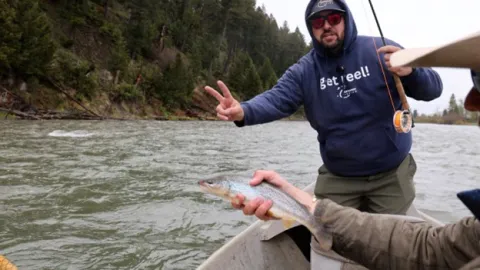
Get outside. It’s as simple as that. If you come across Joe Pesci defending a pair of kids in a court of law, he might refer to them as “the two yutes”. Those same youth might phrase it as “touching grass”. I stretched for that one, admittedly, but you can guess which 90’s classic movie I watched recently and had a good chuckle about. The grass part is what I especially want to highlight, particularly given the changing seasons and time for many of us to shift our focus away from fishing to other activities. Don’t get me wrong, fishing in the fall and winter months can be tremendously fun and also yield quite a bite if you know what to target, where to target it, and when to do so. Some might make an argument that it's the best time to go fishing, given the abundance of baitfish swimming around and the reduced number of anglers as the temperature drops. That aside, I’d like you instead to think about the wind on your face, the sound of birds calling one another from a distance, and the rustle of the trees and grass as animals follow their trails. Here in Montana, Fish, Wildlife & Parks' slogan, among others, is that “The outside is in us all”. Whether that be on the water fishing for dinner, hiking a trail, or hunting, we shouldn’t shy away from enjoying the outdoors even when the temperature begins to dip.
Hiking
To those fortunate enough to live near a mountain, or at least a small hill, hiking has to be one of the “go-to” activities as the calendar flips to fall and winter. Early in the fall, the air is crisp, and a light coat or even a t-shirt can be more than enough to keep you comfortable while exerting yourself up thousands of feet of elevation. Like many aspects of the outdoors, the payoff is often found in the culmination of the hike. Reaching the summit. Getting to the top. Climbing the mountain. Being able to take a few minutes to soak up the sights from a mountain peak is something that everyone should experience with some level of regularity. If not an everyday or week type of trip, certainly one that should be done annually. And what better time to do it than when the colors start to change, a light snowpack covers the foreground, and a beautiful mixture of early descending sunsets shines just perfectly on the horizon with the moisture in the air. As many of you know, I am fortunate enough to live in Montana with what are certainly thousands of trails scattered throughout the state. In just my hometown, I can take an afternoon hike up nearly 5,500 feet and over 36 trails. It’s a palace I’ve been to many times - with my dog, with my kid, with my brother. Sometimes with a goal of reaching the top and other times just to see how far I might get and who all I might say hello to as I spend some time with the rocky gravel beneath my feet. If you have not explored a good mountain recently, take this as your sign to do so.
Hunting
I’m sure many of you circle particular days on your calendar. Birthdays, holidays, celebratory events, or sad anniversaries get a little easier as time goes on. One day regularly circled on my calendar, in fact, even added as an event on my work calendar, is opening day for bird hunting. Like clockwork, that second Saturday in October comes around, and pheasant season is open to any hunter with a 12-gauge and a good hunting dog. Similar to the hiking experience, those who partake are going to be putting some mileage on their bodies, most likely. The combined benefit of a good cardiovascular workout as you trek through varying terrain cannot be overstated. Many times during those early-season hunts when I’m not quite in shape, I’ll noticeably feel the strain in my quads and hamstrings after having kicked around cattails taller than I am for 3 hours in pursuit of a rooster. Maybe hunting small game isn’t your thing. That’s fine, too. For those who enjoy filling a freezer, the start of hunting season can mean adding some precious wild game to your diet for the coming months. Nothing quite tastes as exquisite as a good elk steak… except for maybe some elk burger. And, of course, deer are an abundant resource to be harvested along with herds and herds of pronghorns running along the freshly cut farmland. If you’re looking for a surefire way to make or keep friends, sending some fresh venison jerky or a few pounds of frozen elk is a quick way to do it. Like the experience of hiking the mountains, hunting provides a level of solitude that cannot be matched or described unless you’re fortunate enough to experience it yourself.
The Triple Threat
The solitude and reflection, I think, are what make all three of these fall and winter activities as special as they are. Whether hiking, hunting, or, of course, fishing, we get to experience something in the moment that many others yearn for. Connection with the outdoors. Time away from the hustle and bustle of “real” life. The chance to think about how we fit into the bigger picture of life and the world. If you’re lucky enough, you’ll get to do all three in these next few months.
/articles/fishing-more-outdoors
Puget Sound Squid
Squid fishing in the Puget Sound is becoming an increasingly popular resource for anglers of all ages and skill levels. Squid are a relaxing, low-pressure fishery and can be targeted successfully on nearly any budget. And you don’t even need a boat; in fact, some of the most successful squid fishermen only fish from shore. This piece will give you some understanding of where, when, and how to fish squid in the Puget Sound.
We will start with the rules and regulations for squid. You will need a shellfish license. I always recommend that everyone just get the Fish WA license, because with that, you are covered for everything, but squid can be covered simply under shellfish. The season and bag limits for squid are very simple.
Squid is open year-round, and the bag limit is 10 pounds per person. This is a lot of squid. I rarely stay and fish out a whole limit, but I always make sure to have a scale handy to make sure I don’t overfish! The only other relevant rule is that you can fish with a maximum of 4 squid jigs on your line at a time. I typically use two. If you are within these rules, you should be all good to get out there!
Next, let’s talk about where. Squid can be found in nearly all waters of the Puget Sound, from the Strait of Juan de Fuca, all the way to Tacoma. Depending on the time of year, they will be more prevalent than others. The general rule is that squid start showing up in the Port Angeles area around September and migrate down to Tacoma through January and February. This is not a hard and fast rule, but they generally follow that pattern.
There are people who catch squid every single day from the Les Davis pier in Tacoma. I, however, do not have that expertise. Some hot spots to check out are the Port Angeles City Pier, the Edmonds Pier, Pier 70 area in Seattle, Seacrest Marina Pier, and Les David Pier in Tacoma. There are several Facebook groups dedicated to squid fishing, and you can usually find out where the squid are from the number of success posts.
When to fish for squid is fairly widespread. There are some people that find success all year long from the same pier. But in general, squid fishing is best, and the squid themselves are largest, in the winter months. I usually start fishing for squid in about November and will fish regularly through February. Earlier in the season, I will usually fish closer to Edmonds, and then the deeper we go into winter, I will move further south and usually end my season closer to Tacoma. If I intend to fish from the pier, I will almost always fish at night. Sometimes I will arrive at 1 or 2 in the morning and fish until sunrise. If I am fishing from a boat, I will often fish in the morning or evening, but almost never at night.
Lastly, how do we fish for squid? Squid can be caught from shore or from a boat, so we will break down how, based on this distinction. Fishing from shore is the most popular and simplest method. You will need your own bucket and a long, sensitive rod (I would say no less than 9’). 9-foot, 5-weight fly rods are growing in popularity due to their sensitivity, and you can rest your arms on the pier and not have a long butt section getting in the way of your jigging action.
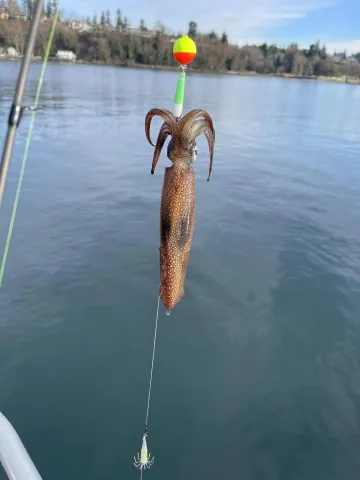
Generally, people will set up their rods with braided line about 20–30-pound test, with a corky on the mainline to act as an indicator so you can tell where your line is in relation to others. You will also want to have your squid jigs tied on with monofilament that is about 12-15-pound test. I really like to use one weighted Fisherman’s Gold squid jig in green or pink with another unweighted Fisherman’s Gold jig above that.
The current and tide will impact whether I am going to use half, three-quarter, or one-ounce jigs. The optional part of your kit is a light. There will generally be people on the dock who have lights. If you don’t have a light, you can try to get close to them, but be respectful of their space and bring your own if you want to fish right under a light for your whole session. When you are all rigged up, you will want to cast out and let your jig sink. I usually let mine go to the bottom to start, and I will slowly work the jig back towards me and up the water column using slow jigs with pauses at the top.
To detect a strike, you can usually feel either an increase or a decrease in the weight on your line. A big hookset isn’t required, but a fast set and an increase in your retrieve are enough to keep them pinned on the jig. Strike detection will take some time. If you see someone on the dock really crushing them, be nice and try to learn what they are doing, and maybe ask some questions. My experience has been that if you treat people with respect, they will treat you with respect and usually give you some pointers on how to do better.
If you are going to fish from a boat, the kit is mostly the same, but I usually use a 9’ or 9’6” spinning rod instead of a fly rod. Because you are not limited to how far you can cast from the pier, I will typically drive around slowly and look for a haze near the bottom on my fish finder in roughly 80-120 feet of water. I will then drop my anchor and fish on top of the squid. Because it is light out, they are almost always on the bottom. I will use the same jigging technique, but in a more vertical motion.
So, now you have the what, when, and how of catching squid in the Puget Sound. Give it a try this winter, and instead of waiting for calamari at a restaurant, you’ll be able to serve it up right in your own home.
/articles/puget-sound-squid
A Dock Full of Fun
I grew up fishing off docks at Lake Sammamish in Western Washington for everything from bass to bluegills to perch to trout, pumpkinseed sunfish, and more. Little did I know that much later in life, I would be fishing off a dock again for multiple species of fish, but this time, for a potential monetary payout!
MarDon Resort is a multi-generational family-owned resort located on the south shore of Potholes Reservoir in Eastern Washington. For years, they have been putting on an annual dock tournament the second weekend of September. This is a popular event, with anywhere from 125 to 160 participants, many of them coming back every year.
The tournament is very affordable ($60 per entrant in 2025), and there is an 80-percent payout to the winning anglers. It is a vastly different tournament than most. Instead of catching a limit of five or six fish and weighing in the bass or walleye, you are fishing for the two biggest fish of eleven distinct species of fish.
The species you can catch off the dock are numerous. There are categories for largemouth bass, smallmouth bass, walleye, rainbow trout, perch, crappie, bluegill, pumpkinseed, carp, channel catfish, and yellow bullhead. This year, the first-place fish in each category netted the winner $375, and the second-place fish was worth $125.
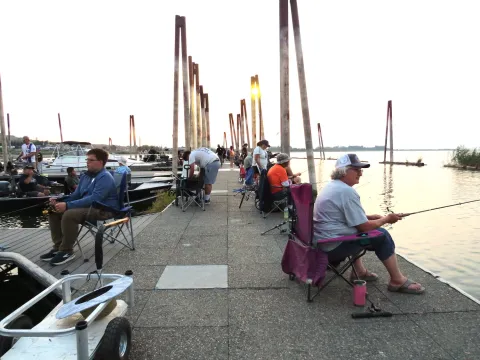
The groups participating in this event are very diverse. There are families and extended families, couples, fishing buddies, senior citizens, women, and children all fishing off the dock day and night, and all trying to get a big fish.
The tournament kicks off with a potluck on Friday at 5 PM. MarDon Resort provides fried chicken tenders, water, and cookies while participants bring side dishes and more for a nice dinner. At 6 PM, anglers hit the docks and you fish as much or as little as you want from Friday night until 10 AM on Sunday.
There is a weigh-in station at the marina staffed 24 hours a day, this year by Russ and Kim Anderson, who took turns sleeping during the night. Some of the winning fish were caught right off the bat! Georgia Goss was using a crappie jig when she hooked into a monster walleye at sunset on Friday. The 5.56-pound fish netted her first place by a long shot. The only other walleye caught was by her niece, Madison Shopbaugh, and that was only six inches long but still worth $125. It was nice to see kids reel in winning fish!
On Saturday morning, 12-year-old Levi Garza caught a gigantic channel catfish that weighed 25.4 pounds, easily beating out a 16-pound catfish that took second place. And then there was Jaxon Pech. I met him last year when he reeled in two huge carp, earning him a $500+ paycheck. Jaxon, who is 13 years old, takes this tournament seriously. He lives in nearby Moses Lake, and he told me he fished twenty-nine times off the dock this summer, preparing for the tournament. Jaxon was fishing a sizeable pile of bait off the bottom, hoping to catch carp again. However, when his rod bent with a fish, he found out after a frantic 10-minute fight that he had caught not a carp, but instead, a 4.8-pound rainbow trout. Since Jaxon caught the only trout of the tournament, he got $500 for that fish!
Over the course of the event, the lead would change multiple times for different kinds of fish. For example, I was briefly in second place with a ½-pound bluegill on Saturday morning but was bumped within an hour by a bigger fish. At the end, both of the winning bluegill weighed in at over a pound. The final second-place winner was caught on Sunday morning.
At 10 AM, the event ends, and the whiteboard with the final results is brought up to a grassy area above the boat ramp and docks. Co-owners Levi and Annie Meseberg prepare checks for the winners as well as raffle prizes. Raffle tickets are sold for a dollar each, and at 11 AM, all sorts of raffle prizes are given away. The event wraps up with awards and checks being given out to the winners.
Talking to anglers during the event, I learned that everyone hoped to come back again next year. The mood on the docks is light, anglers are willing to share space, and everybody catches a whole bunch of fish over the weekend. Put it all together, and this unique dock tournament is chock full of fun!
/articles/dock-full-fun
Mountain Trout As Art
We are captivated by trout. And we wonder why. Trout don't love us, they don't love each other, and they don't do anything for their fellow trout, except by accident or by instinct.
But the same could be said of art. We appreciate art for maybe the same reason we love trout. Let's see if the words — art and trout — are interchangeable.
Wynetka Ann Reynolds might have said,
“Anyone who says you can't see a thought simply doesn't know trout.”
For two summers, I spent afternoons and weekends exploring back roads, backcountry, and backwaters in streams and lakes down the flanks of Wy'East for a book we called Fishing Mount Hood Country. My co-author, Robert Campbell, covered most of the western water, and I fished more of the east side.
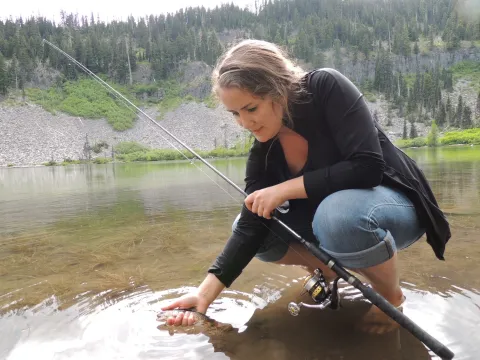
Early in the project, Campbell began to send close-ups of trout — Veda Lake cutthroats, Timothy Lake brookies, Salmon River rainbows — in hand, going back into the water. The imagery seeped into my consciousness, and when I brought East Fork Hood River cutts, or Boulder Lake brooks, or Badger Creek rainbows to the bank, I began to look at each one as a piece of art, at each scale as a stroke of a brush.
We seldom fished the same water twice during the two summers on and off the mountain. We caught bass, sturgeon, steelhead, and salmon, but the fish that defined the effort was the coastal cutthroat. There are many variations. The Clackamas watershed fish were different in coloration from Zigzag River fish, and in bigger lakes, trout coloration varied due to the micro-environments they frequented.
We might put the distinct differences down to genetics, habitat, food sources, and light penetration.
Hood River wild fish, where there are fewer trees above the water and the bottom is light, are bright and shiny. Fish in west-sloping rivers with darker streambeds are often tinted, an adaptation that helps them survive.
While there are a few resident rainbows near the mouth, Campbell's exploration of the upper Clackamas turned up big rainbows, part of a remnant strain that can grow to several pounds in that mountain water. I plan to research that water again soon.
If Goethe had been born to a fly-fishing family rather than to German drama, he might have written:
“There is no surer method of evading the world than by following trout, and no surer method of linking oneself to it than by trout.”
We caught hatchery planters, of course, and the further they were removed from the raceways, the better they looked. Holdovers — fish that had made it through a winter and gained inches and pounds — were the prettiest. We might call them modern trout and appreciate them in that regard.
John Anthony Ciardi could have said:
“Modern trout is what happens when fishermen stop looking at girls and persuade themselves they have a better idea.”
For me, one stream and one fish defined the project. A Still Creek cutthroat, about nine inches long, took a dry fly and threw the hook. The next fish was a bit smaller, but it shone in hand like treasure. I sent a picture to my friend Tye Krueger, and he drew it in every detail — a wild cutt with white tips on its fins and parr marks still visible on its sides.
Kojiro Tomita might have written it thus:
“It has been said that trout is a tryst, for in the joy of it, maker and beholder meet.”
Conditions seem to force beauty to the surface. Up toward the timberline, an angler finds the most striking examples — wild trout that in other environs would grow to be measured in pounds, not inches. Here, an eight-inch rainbow is mature, with white tips on the edges of his fins and a tint of rose in his gill plates, dark spots all the way to the tail.
G.K. Chesterton might have put it this way:
“Trout consists of limitation. The most beautiful part of every picture is the frame.”
Here in the Northwest, we have the run of an ancient gallery. The price of admission is a fishing license and the will to seek it.
“All trout requires courage,”
with apologies to Anne Tucker.
In the passage of time, we become collectors of art, the images stored in digital files and memories. And sometimes we make that beauty part of ourselves with brook trout grilled over a campfire.
If Scott Adams had been consulted, he might have offered:
“Creativity is allowing yourself to make mistakes. Trout is knowing which ones to keep.”
/articles/mountain-trout-art
C.A.S.T. for Kids
I got to participate in something special in June. It was a C.A.S.T. for Kids Foundation event, put on for nine special needs youth anglers at Potholes State Park in Eastern Washington. The foundation, born in 1991, had its first event at Banks Lake in Washington. Today, the organization is on pace to host 100 or more fishing events all over the nation.
C.A.S.T. for Kids was founded by Jim Owens, a retired Bureau of Reclamation worker who wanted to get kids with special needs and disadvantages out for a fun, mentored day of fishing.
Melissa McCalmant, who was present at the Potholes event, is the Western Operations Manager for C.A.S.T. for Kids. She said volunteers are a key part of their operation. That includes a volunteer coordinator who does the bulk of the work putting each event together. The coordinator gets with the venue owner and, in some cases, with their state fish and wildlife agency to arrange for fish stocking. In lakes or ponds that already have well-established fish populations, this is not necessary. The coordinator also seeks cash donations to purchase rods, reels, and tackle boxes at a discounted rate from Lews and Flambeau for each participant.
McCalmant also told me they go to great lengths to get special needs kids out fishing. She recalled one instance where a parent said their child could not participate because he was in a wheelchair. McCalmant procured a volunteer with a pontoon boat that was ADA accessible so that the young man could indeed enjoy a day out on the water. In fact, for many of the kids participating, it’s their first time fishing.
Melissa went on to tell me that while many events take place with anglers fishing from shore, they also offer events where anglers will fish with volunteer boaters on bass boats or on pontoon boats.
Summing things up, McCalmant said, “This is a free event for the participant and their family, and it’s a day that allows them to forget about their special needs and that they are too, just like one of us, and can fish and participate.’
As for the Potholes event, Levi Rodelo, a local fishing and hunting guide with Ross Outdoor Adventures, has a special needs daughter. He took on the role of Event Coordinator. Nixon’s Marine in Pasco, Washington, donated $500 so he could purchase the rods, reels, and tackle boxes for each kid.
Levi coordinated with Potholes State Park and the Washington Department of Fish and Wildlife (WDFW), who both readily agreed to partner in the event. Levi obtained a net pen that he put next to the boat launch in the park. WDFW stocked the net pen with 250 rainbow trout, the majority being catchable size, but some were much larger.
On the morning of the event, 15 volunteers met Rodelo and McCalmant. They assigned roles to all of us, and then the kids showed up with their families at 8 AM. The special needs of the children varied. One teenager had high-functioning autism, and one child had Down syndrome. Two other kids were non-verbal and couldn’t speak.
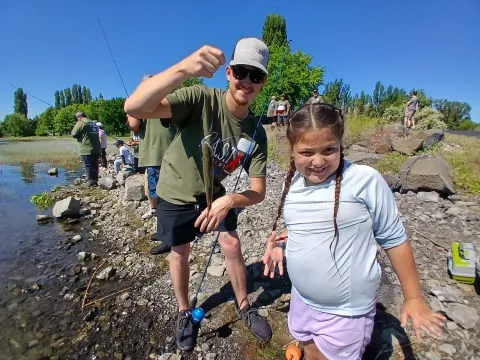
Each child (and volunteer) was given a t-shirt to wear from C.A.S.T. for Kids, as well as their fishing rods, reels, and tackle box. Each kid was paired up with a volunteer fishing buddy/coach. Hooks were baited under bobbers, and it was time to go fishing!
The fishing wasn’t fast and furious, but everybody got to reel in one or more trout in two hours of shore fishing. With the temperature heating up, the fishing wrapped up around 10 AM.
After that, everyone involved went to a food truck brought there by Blacky’s Smokin Sweet from Othello. The owners heard about the event and wanted to participate. They refused all payment, accepted no tips, and served everyone their choice of hamburger or hot dog with fries.
The event wrapped up with every kid getting a picture with their fishing buddy, and every coach and participant received a plaque to commemorate the event. The kids absolutely loved the whole thing. Not just fishing, but being made to feel like they were the center of attention, doing something very fun.
If you want to find out more about the C.A.S.T. for Kids non-profit Foundation, go to www.castforkids.org. Once there, you can look for events near you and sign up your special needs kid. If you want to volunteer or donate, you can do that through the website as well. C.A.S.T. for Kids…They are doing some great things for some very special kids out there.
/articles/cast-kids
Successful Bottom Fishing Strategy in the Pacific Northwest
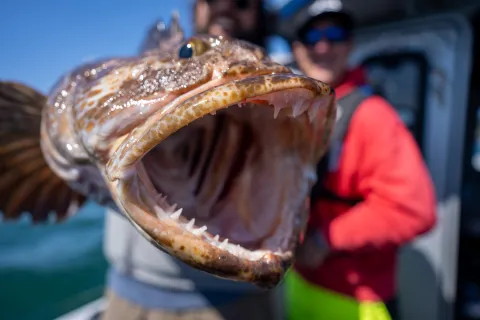
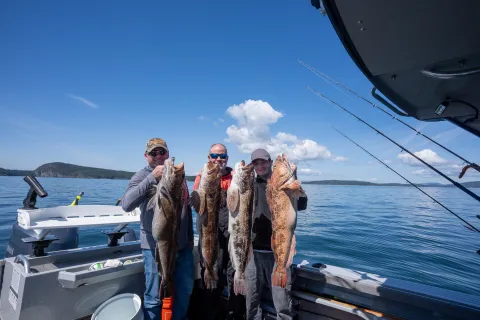
Halibut, lingcod, and rockfish are the top three species of bottom fish here in the Pacific Northwest.
There are three main methods for targeting bottom fish, and the cool thing is that the tactic you use is more dependent on the depth and environment you’re fishing in, rather than the species itself. All species can be found in virtually any depth in the ocean. In fact, many of the biggest lingcod I have ever caught have been in less than 50 feet of water. This means that if you know your water, you can choose a tactic that will give you the best chance at success.
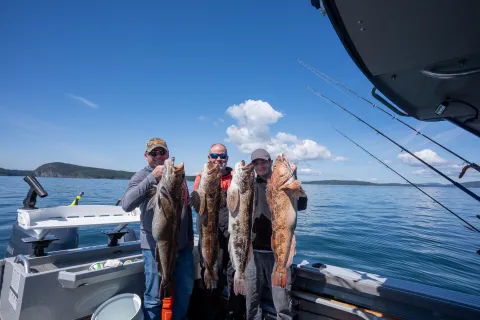
Tactic number one: Live bait rigs. Live bait is the most natural presentation to a fish. As the name implies, you need an actual prey item connected to your hook, and this often elicits the most aggressive feeding response. The flip side is that you have to spend considerable time catching bait. Additionally, it can be difficult to keep your bait alive throughout the day. I have found that live bait rigs work best when targeting ling cod on reefs that are under 150’ deep.
Ling cod will readily take live bait of nearly any size, and often do not even need to be hooked to bring them to the boat. To decide between large and small bait, know your area. If you are fishing a particularly busy reef with lots of rockfish, and you are not allowed to keep them, try to use larger baits such as greenling or other sculpin to keep bycatch to a minimum.
The best live bait rig I have ever seen, I learned from John Kerrigan of Seeking Limits Guide Service out of Everett, WA. John’s rig is devilishly simple. It consists of a sliding weight system where the plastic slide is connected to the weight with a rubber band, and it is stopped by a swivel to a leader (photo below). The rubber band keeps you from losing an entire rig if your weight gets stuck, and the swivel will keep the live bait tangle-free. Give it a try with surf perch on a single hook rig, or sand dabs and greenling on a double hook rig.
The second bottom fishing method is jigging with soft plastics. This method allows you to go right out to the fishing grounds. Oftentimes, the soft plastic jigs come pre-rigged, so all you have to do is tie them onto a 50-pound mono leader and drop it near the bottom. My absolute favorite for jigging soft plastic is a Fisherman’s Gold Electric Eel jig. (photo below). It has caught absolutely everything from giant 50-pound lingcod to limit after limit of rockfish. The only consideration is how heavy and how big you want your plastic. Obviously, using a 32 ounce 12 inch eel won’t be the right choice for rockfish, but if you’re shallow, there is little better than catching black rocks on a 1 or 2 ounce eel. Fishing soft plastics is the most versatile of the 3 methods. You can fish them light or heavy, large or small, shallow or deep. Soft plastics can struggle in areas of intense pressure and is most difficult in areas where there are lots of toothy bycatch, such as arrowtooth flounder or dogfish that can tear up your bait.
The last method is a combination of pipe jigs and unweighted soft plastics on a ganoin type rig. This method is great for deep drop fishing, particularly for halibut. The pipe jig not only allows enough weight for a rig in 500 feet of water, but it also can get chewed on for hours and not lose its efficacy. By running some unweighted plastics above the pipe jig, you can also take advantage of the extra color and action to bring fish to your rig. However, this method is really prone to snags, and can be expensive to lose if you are fishing the more shallow rocky reefs.
I typically pair this method with electric reels in deep water and on flatter bars in the open ocean. You can build a ganoin by using a 3-way swivel connecting the main braided line to one end, a 6 foot ganoin of heavy mono (80 pound or heavier) to one of the other sides, and lastly a short heavy mono leader connected to a large 12/0 J hook that you hook your eel or flounder plastic to.
Making a game plan for your specific environment is the best way to set yourself up for success. Always consider the time you have to fish, the depth at which you want to target, and the overall fishing pressure to help you decide between durable baits like pipe jigs or if a natural live bait is the right choice. Get out there and try it for yourself!
/articles/successful-bottom-fishing-strategy-pacific-northwest
Destination Ochoco Reservoir
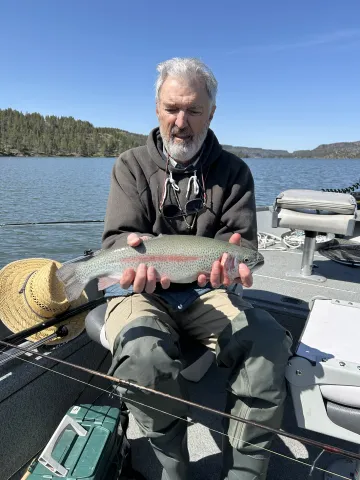
It was a windier day than we had hoped for, but the waves were not white-topped, and we had a 40-horse Merc and a trolling motor to fight the wind with. It was my first trip to Ochoco for the season, but my dad had been fishing it since March and knew right where we wanted to start. It didn't hurt that the wind was blowing us that way, too.
We started at the top of the lake where the creeks come in, around the flooded willows.
For my main rod, I had selected a rust-colored, sparsely tied mohair leech and was using a floating line with a 4X tippet.
My young dog Pepper was with me for her first time fishing. She thought she was expected to work and was watching tweety birds while we unlimbered the fly rods. I tried to keep her from tangling in the expensive tackle. Once she got so excited, she jumped into the lake. After she realized this was just supposed to be a pleasure trip for her, she settled down and was just irritated for the rest of the day.
A big trout took my fly on the first pass but was able to throw the hook after a brief battle. Dad was also using a rust-colored fly, and our friend Keith Gran, fly-fishing for the first time in his misspent life, was using a fly called the Autumn Splendor, which might have reminded Keith of someone he used to know because he kept whispering to it, saying her name.
Whatever he was whispering to the Autumn Splendor was working because soon he hooked and landed a trout. And then caught another.
For my part, I began catching bass. And dad, running the trolling motor and a 4-weight rod, began catching bass too, and a crappie.
OCHOCO AT FULL POOL
After three winters of better-than-average snowpack, a lot of central Oregon waters that were very low, even dry in some cases, are back and better than ever. Ochoco Reservoir has always been a bit of a local's secret. It is only six miles outside of Prineville, and when conditions are good, the trout grow fat, putting on an inch a month. Better yet, this reservoir has good wintering conditions, meaning that holdover trout are common, going 16 to 17 inches in late spring and early summer.
With water in it, Ochoco Reservoir is three miles long. Because it is an irrigation reservoir, water levels can change over the year. Surface acreage at low pool can go as low as 120 acres, but filled to full pool by early spring this year, the reservoir is full at approximately 1,100 acres.
At full pool, Ochoco averages 30 feet in depth with a maximum of 100 feet near the dam. A few lava outcroppings fortify the banks but because of up-and-down water levels, shorelines are composed of exposed silty bottom and muddy flats. Mill Creek and Ochoco Creek form channels in the reservoir. In the spring and summer, afternoon winds can be substantial.
When targeting rainbows with a fly rod, try trolling from a float tube, canoe, or a pontoon boat. Fish along the riprap near the dam or on the east end of the lake near the inlets. Use an intermediate sinking line and troll leech patterns like the Woolly Bugger, Lake Bugger and Mohair Leech or a soft hackle wet fly like the Carey Special.
Crappie are often in large schools and may hold at specific depths around sunken structures. The challenge lies in locating them and plumbing the precise depth where the school is holding.
Because of the abundance of water, the trout fishing is going to continue excellently through July. But this is a great time of year to target smallmouth. And there are some surprisingly heavy bass in the lake. If fly-fishing is the game, use "bass nymphs" which are generally on No. 4 hooks tied like Woolly Buggers but with a heavy bead and black or yellow or orange rubber legs. These can be presented on floating lines under indicators or cast tight against the rocks or other structures. Bass will often take the fly on the drop. And you might be surprised by a big rainbow.
When fishing with spinning gear, use spinner baits and crankbaits, or curly-tail grubs.
Ochoco Reservoir has been overlooked for the last ten years because it has been hard to fish. But those days are behind us. This Central Oregon fishery is running full pool, and the trout and bass fishing is full tilt.
/articles/destination-ochoco-reservoir
Fall Panfishing in Eastern Washington
A treasure awaiting eager anglers
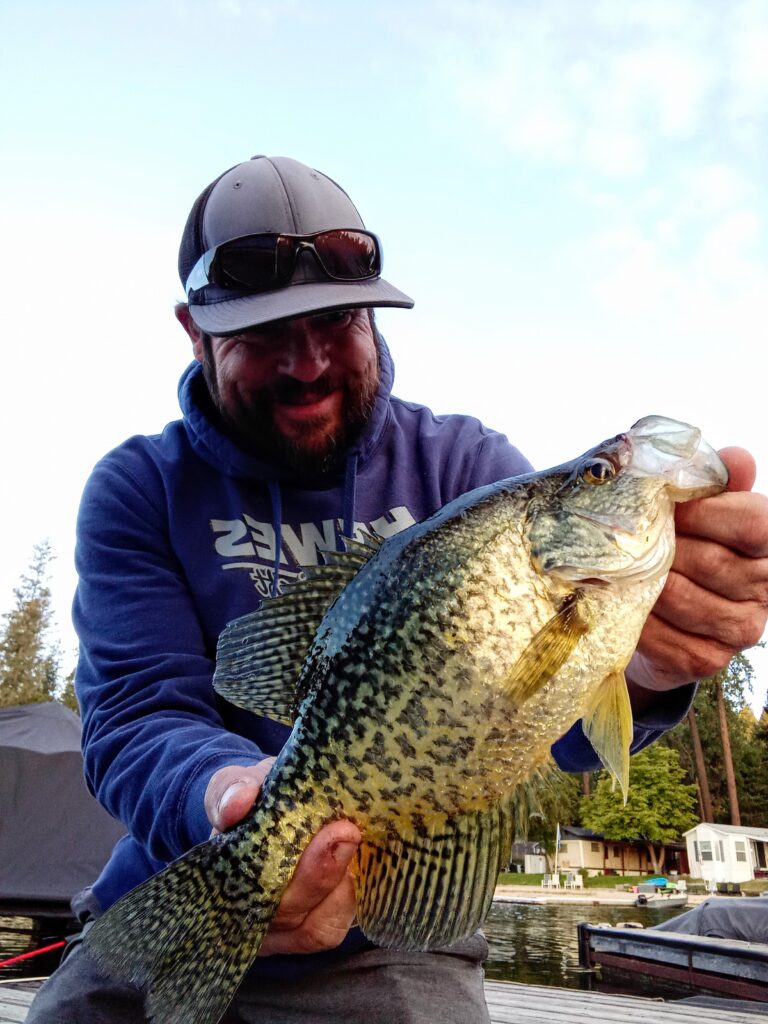
As the vibrant hues of summer give way to the crisp, golden tones of fall, Eastern Washington transforms into a paradise for outdoor enthusiasts. For many, this time of year means hunting or hiking through the scenic landscapes. However, for anglers in the know, fall represents one of the best opportunities for panfishing in this region. Panfish, including species such as bluegill, crappie, and perch, become particularly active as the temps begin to drop, offering a fantastic fishing experience.
The appeal of fall Panfishing
Fall is a transitional season, and for many fish species, it signals the need to feed aggressively, putting the feed bug on for the winter months ahead. For panfish like crappie and bluegill, this means moving from the deeper waters they inhabited during the hot summer months to shallower, more accessible areas where they can feast on minnows, insects, and other aquatic creatures. Anglers targeting panfish in the fall can enjoy several advantages:
Reduced fishing pressure
As fall arrives, many anglers turn their attention to hunting, leaving lakes and rivers quieter, and less crowded. The reduced fishing pressure can make panfish less warry and more likely to bite.
Ideal weather conditions
The mild temperature of fall provides a comfortable environment for fishing. The oppressive heat of summer is gone, and the cold chill of winter has yet to set in, creating the perfect conditions for a day on the water.
Spectacular scenery
There's nothing quite like spending a day on the water surrounded by the stunning fall foliage of Eastern Washington. The golden leaves of cottonwoods, aspens, and maples reflect off the glassy surface of the lakes, creating a breathtaking backdrop for any fishing trip.
Active fish
As water temps cool, panfish metabolism remains relatively high, encouraging aggressive feeding behavior. This is a stark contrast to the lethargic bites often experienced in the summer.
Best Panfish species to target in Eastern Washington
Crappie
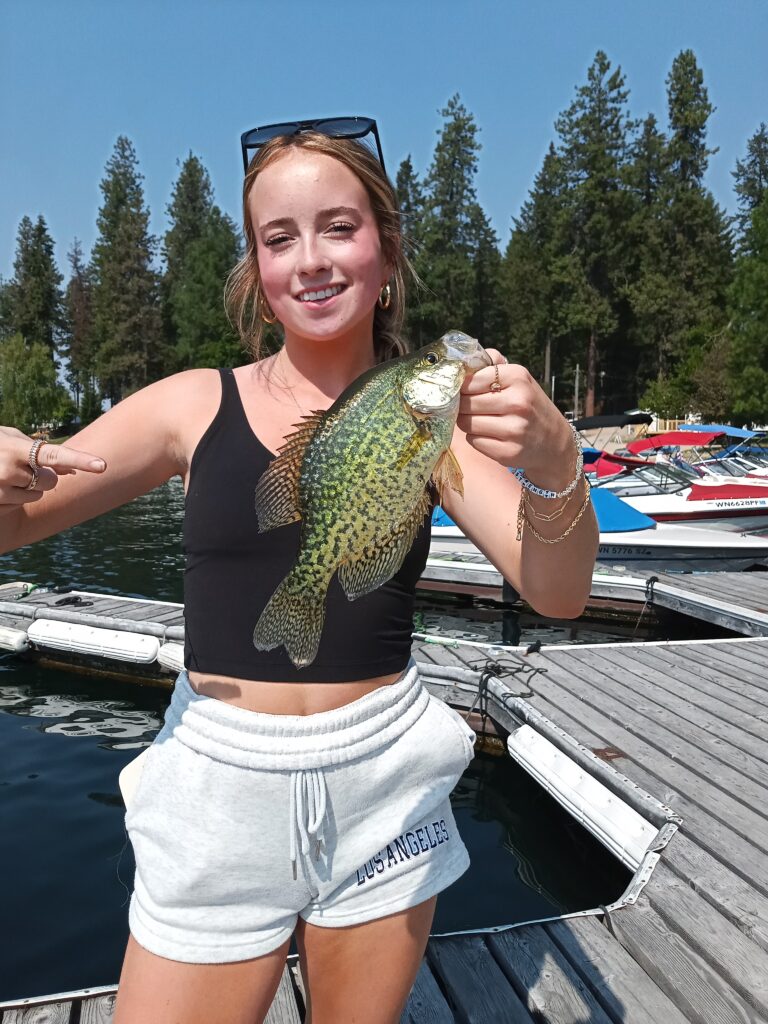
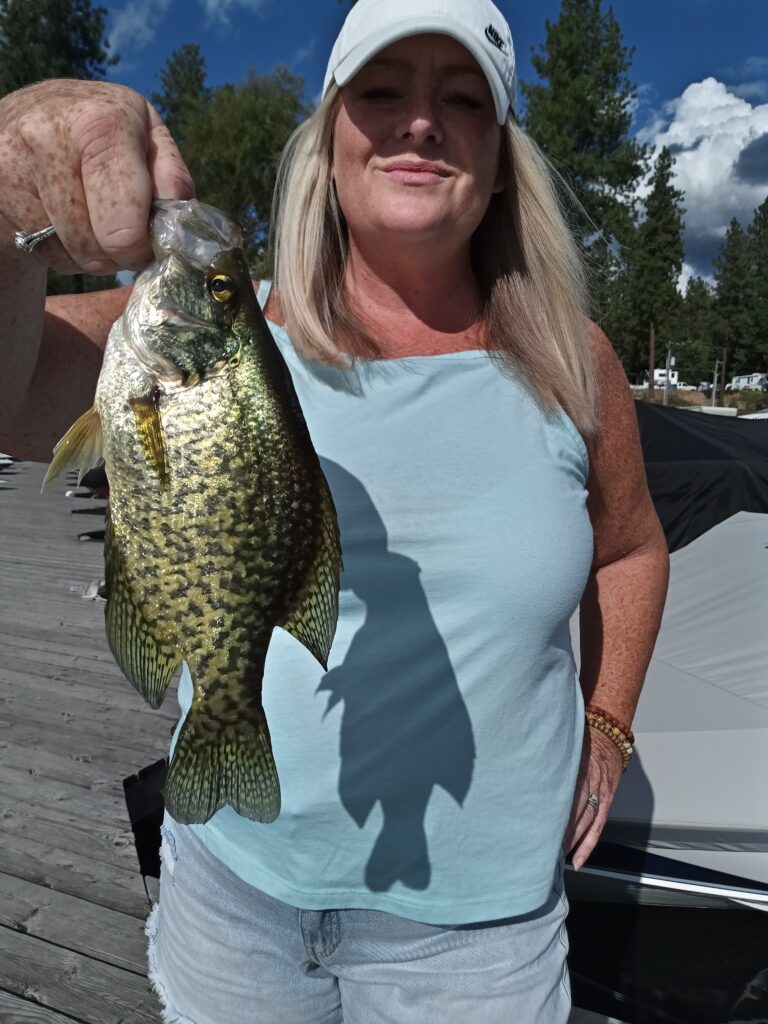
Crappie is a favorite among panfish enthusiasts due to its delicious, flaky meat and relative abundance in Eastern Washington waters. Two species, black crappie and white crappie can be found, though black crappie tends to be more common. During the fall, crappie often schools up in large numbers, making them easier to locate and catch.
Best spots
Moses Lake, Eloika Lake, Newman Lake, and Sacheen Lake are well known for their healthy abundance of populations. Look for crappies in areas with submerged structures such as fallen trees, docks, or rocky points where they seek shelter and forage.
Techniques
Casting small jigs with plastics, or bait, is highly effective for fall crappie. A slow steady retrieve near submerged structures often entices strikes. Night fishing can also be productive especially when using lights or lanterns to attract the crappie.
Bluegill & Sunfish
Bluegill and other sunfish species, such as pumpkin seeds, are abundant in Eastern Washington and provide great action for anglers of all skill levels. They are often found in shallow waters, especially around weed beds, submerged vegetation, and docks.
Best spots
Eloika Lake, Newman Lake, Sacheen Lake, and Loon Lake to name a few, are excellent choices for targeting bluegill and sunfish. These lakes offer plenty of fishing availability, making them perfect for both boat and shore anglers.
Techniques
Bluegills are notorious for their lake of small, natural baits. Worms, crickets, and small jigs work wonders, particularly when fished below a bobber. Small flies, in the nymph patterns, can also be effective and add an extra way to approach these fish.
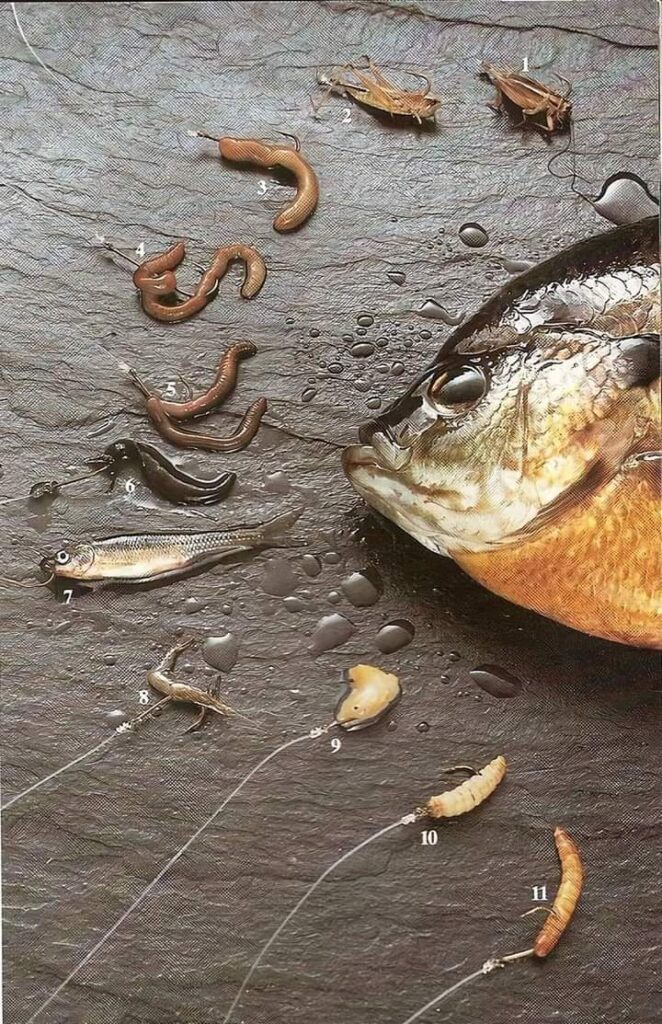
Yellow Perch
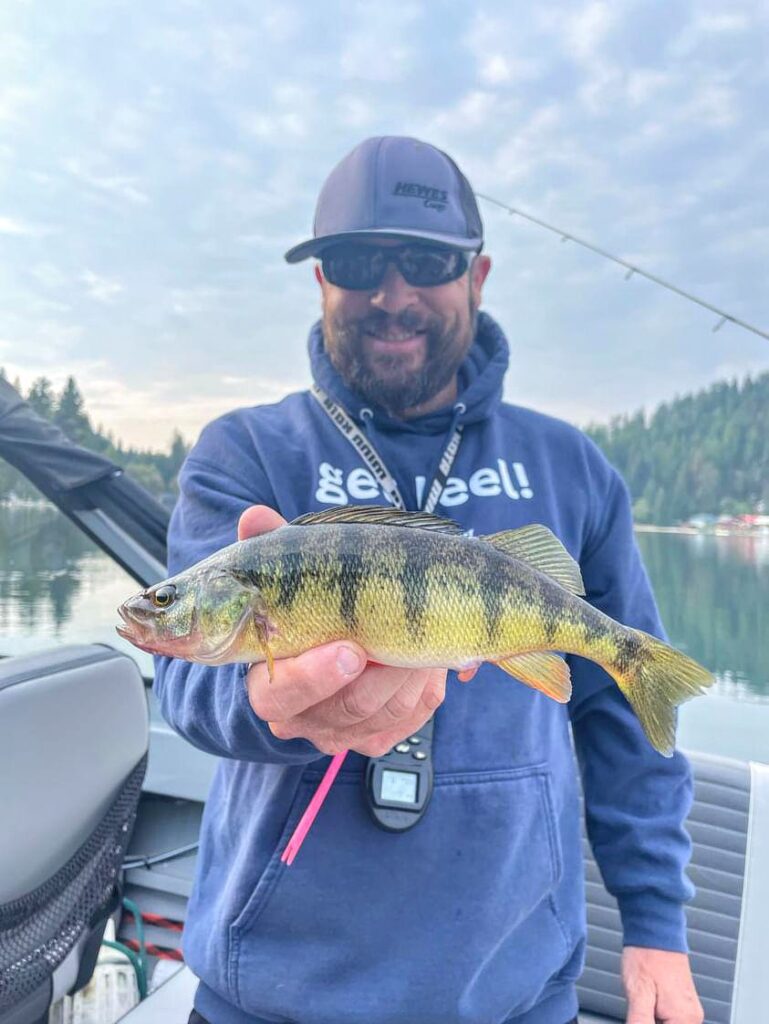
Yellow Perch are another panfish targeted by fall anglers in Eastern Washington. Known for their aggressive nature, and flakey tasty filets, perch are often found schooling up in deeper water, usually inhabiting a large mud flat looking for bloodworms, but don't overlook the shallows as temps drop and baitfish move toward the shore.
Best spots
Silver Lake, Moses Lake, Sacheen Lake, and Eloika Lake rank among prime locations for yellow perch. These waters provide plenty of food and cabbage where these perch can hide, and hunt. (Don't forget Long Lake.)
Techniques
Perch can be caught using a variety of methods, but jigging small spoons tipped with small plastics, or bait tends to be the most effective way. Vertical jigging from a boat can be best, especially when you locate a school of perch on your fish finder.
Tips for successful fall Panfishing in Eastern Washington:
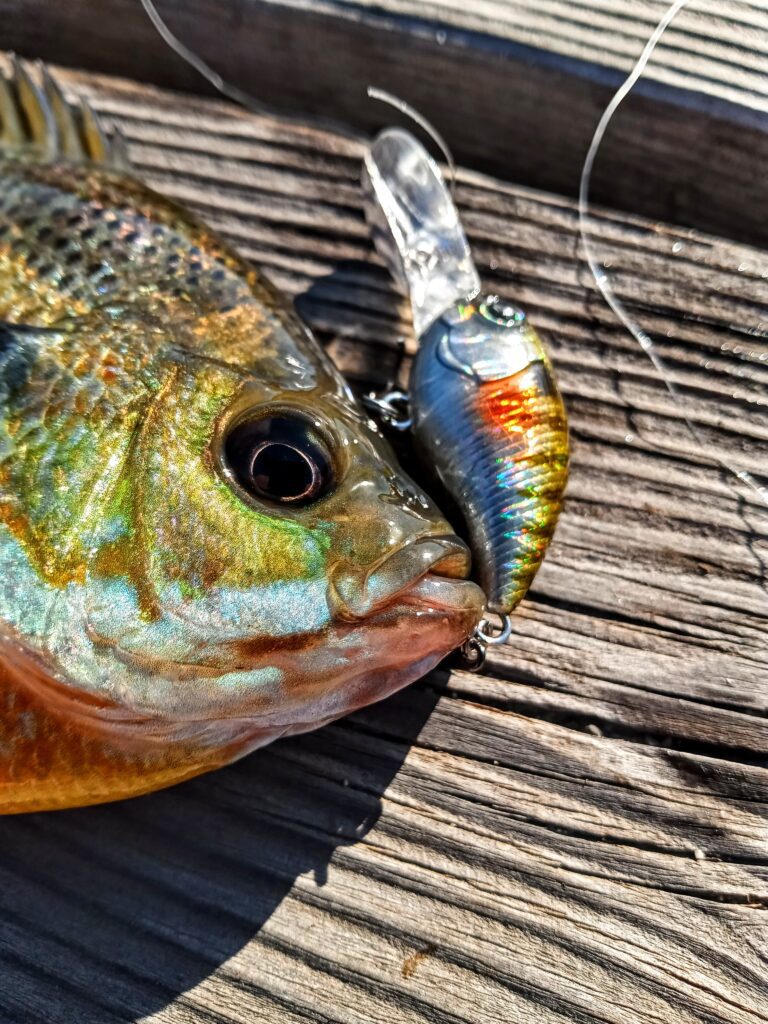
Use light tackle
Panfish have small, soft mouths and are easily spooked by heavy tackle. Light spinning rods, small reels, and 4-6lb test lines are ideal for detecting subtle bites and presenting small baits effectively.
Look for structure
Panfish are actually drawn to structures that provide cover from predators and access to food. Fallen trees, weed beds, rock piles, and boat docks are all excellent places to find schools of panfish. Use a fish finder to locate submerged structures that aren't visible from the surface.
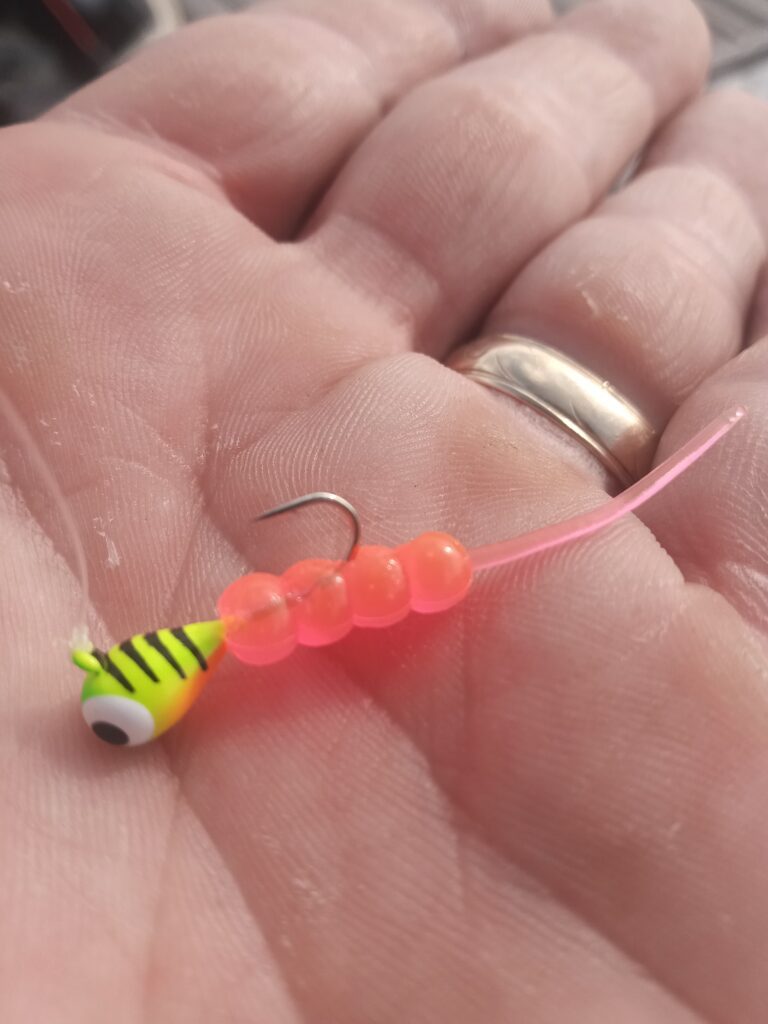
Experiment with lure colors and sizes
Different panfish species and even individual fish can have a unique preference, so it's good to experiment with variations of lures, with different colors and sizes. Or even trying to figure out what they are feeding on, and match the hatch.
Stay Mobile
If you're not getting any bites in one spot, don't be afraid to move around. Panfish schools can be highly mobile, especially in the fall, so covering more water can increase your chances of finding active fish.
Adjust your depth
Panfish can often be found at varying depths depending on water temperature during the day. Start shallow and gradually move deeper as the day warms up. Fish can sometimes be found surprisingly deep even in cool months - and don't overlook the suspended fish in the middle column.
The fall Panfishing experience
Fall panfishing in Eastern Washington offers a unique blend of excitement and tranquility. The crisp air, vibrant fall foliage, and the serenity of the lakes make for a peaceful escape from the everyday hustle and bustle. For those who enjoy the challenges of light tackle and the reward of a well-earned catch, there's no better time to get out on the water.
Whether you're a seasoned angler or a beginner looking to experience the thrill of fishing, Eastern Washington lakes and reservoirs offer plenty of opportunities to reel in some of the best and most enjoyable fish the region has to offer. With a bit of patience, and the right gear, and a sense of adventure, you'll find that fall panfishing in Eastern Washington is more than just a past time - it's a cherished tradition waiting to be discovered. So grab your fishing rod, pack your tackle box, and head out to the waters of Eastern Washington this fall. The panfish are biting, and the experience is one you won't want to miss.
![{"capture_mode":"AutoModule","faces":["-1482_-1552_-546_-616"]}](https://cdn.northwestfishing.net/sites/default/files/styles/large/public/images/IMG_20240907_122136_1-scaled.jpg.webp?itok=1nO2jnuv "{\"capture_mode\":\"AutoModule\",\"faces\":[\"-1482_-1552_-546_-616\"]}")
/articles/fall-panfishing-eastern-washington
Kelp Greenling
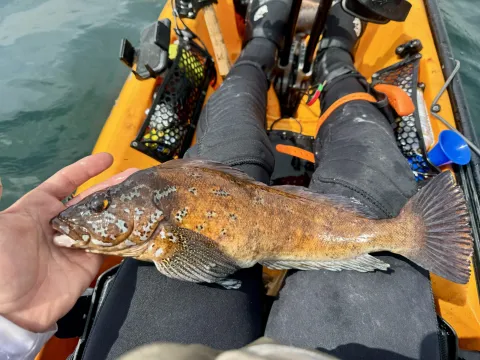
Spanning from the Aleutian Island that make up the Alaskan archipelago, all the way down to the coastal waters of San Diego California, there is a small predatory fish that patrols the kelp beds and rocky structures that make up much of the US west coast. Unlike its close relative, the lingcod, this petite little predator enjoys a life that’s largely void of the constant bombardment from sports anglers. This small saltwater fish is the Kelp greenling. And though it’s not targeted by anglers the same way many other bottom fish along the West Coast are; due to its small size and lack of spiny armor, the kelp greenling is constantly being pursued and preyed upon by lingcod and even halibut.

Description and lifecycle.
Adult greenlings range from 10-21 inches and rarely grow to be more than 4.5 lbs. Both males and females tend to have colorful markings, with the females typically having a brown to orange body with black and grey spots, while the males typically have a dark grey body with blue spots around the head. The females can lay up to 12,000 eggs between November and January. This occurs three times throughout the spawning season and the deposited eggs will stick together in large clumps which the males will guard till the larvae stage. Kelp greenling can live up to 25 years of age.
Kelp Greenling as a fishery and as a food fish.
In general, Kelp Greenling are caught as by-catch by sport fisherman that are seeking lingcod, rockfish, and other popular bottom fish species. While some are retained for food, many anglers simply throw them back or utilize the fish as live bait for trophy-sized lingcod. Historically in Oregon and California, near-shore commercial vessels retained bycatch kelp greenling to sell in local fresh seafood markets, yet a thriving market never developed for this greenling, so commercial pressure has remained low.
Although Kelp greenling likely hasn’t been the star of the show on most people’s fishing trips, they do provide a good fishery for a number of reasons: They are commonly found in Washington’s nearshore waters and their numbers are thought to be healthy; for a small fish they put up a decent fight (remember, they are relatives to the lingcod); and finally, they are a delicious food- fish. I would put the flavor as something comparable to lingcod, yet the flesh, once cooked, is slightly less firm than these larger relatives.
Where to fish.
In Washington, the best areas to target greenling are on the straights of Juan de Fuca, and in coastal waters such as La Push and Makah Bay, though they can be caught to a lesser extent in the Puget Sound. Look for areas where healthy kelp beds meet rocky underwater structures and aim to fish at about 15-50 ft deep. A boat or a kayak will give you easy access to greenling habitat, but boats are not required for this fishery as you can fish for kelp greenling off of jetties or rock outcroppings.
How to catch them.
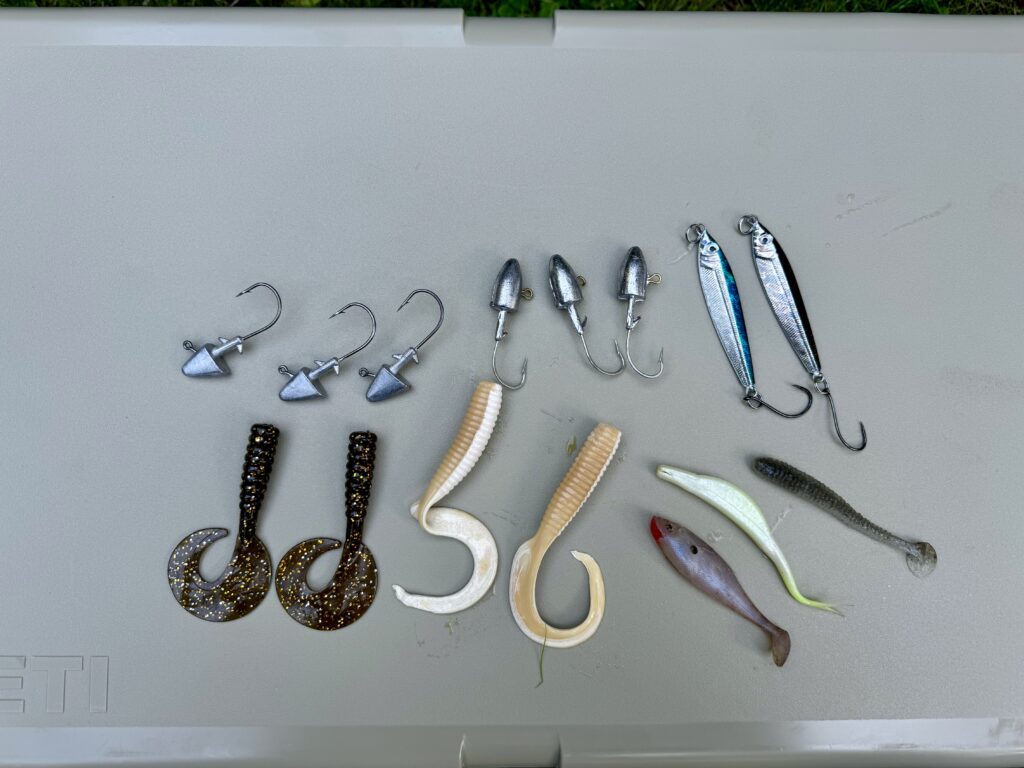
If you’ve fished for Cabezon, rockfish, or lingcod, you’ve likely already used gear that will entice a bite from kelp greenling. I prefer using a 1-2 oz laser minnow or a 1-2 oz lead jig head with a soft plastic grub. A variety of colors will work depending on what the fish are feeding on at the time. If fishing from a boat, dropping your lure to the bottom and vertically jigging will typically produce good results. While fishing from a jetty, you can cast, jig, and retrieve the same way you would work a buzz bomb from shore while targeting salmon.
Swim baits are also effective while fishing from a jetty or rock formations, and a weedless swim-bait setup will serve you well while trying to avoid hooking into the kelp. Since there’s a high likelihood of landing a larger fish like a lingcod or cabezon while targeting Kelp greenling, it’s a good idea to have a set-up that can handle larger fish. With that being said, you’ll still want to keep your gear light enough to make some fun out of bringing in the smaller kelp greenling. My go-to set-up is a 7 ft medium light action rod, with 25 lb braided as my main line, swivel, then 2-3 ft of 20 lb mono or fluorocarbon for my leader.
With fall in full swing and many people wrapping up their summer bottom fishing season, I find October to be a good time to utilize some of the cooler weather for late-season saltwater fishing. If you’d like to add some variety to your catch and want to take advantage of the slower boat launches, go ahead and give Kelp Greenling a try. Just keep an eye on those tides and weather forecasts!
/articles/kelp-greenling
Lake Roosevelt Walleye and Turkey Bonanza
Looking out over the field, darkness still obscured our vision. Out there beyond the field we set up in we could hear the rapid gurgling, gobbling sound made by male turkeys in their tree roosts. Daylight would be coming soon, but meanwhile, I couldn’t get the image from The Blair Witch Project out of my head. I subconsciously swiped at my nose, suppressing a cough, desperate to not make a sound.
Daylight would be coming soon and I didn’t want to be “the new guy” blowing our cover and scaring away our target. It was my first ever turkey hunt. Joining me, were Dave Mason of Toyota and Dan Gabriel of The General Store. Our host, Rick Wakefield, owner of Buck Canyon Lodge, had invited us on this Opening Day of turkey hunting to check out the fine hunting he offers guests on his lodge properties. It was part of a “Cast and Blast” adventure Northwest Fishing Reports were enjoying. The “cast” part of the trip were upper Lake Roosevelt walleyes with Lake Roosevelt Charters.
I had arrived late Friday evening after driving across the state from Redmond to the lodge, located near the town of Gifford. In normal conditions it would have been a not-too-bad five-hour drive, however, a traffic accident going over the pass had set me back a good hour and a half. I arrived tired but excited for what the weekend had in store. Meeting up with the NWFR crew Aaron Borg and Rob Holman, I crashed into my comfortable fleece-covered bed in anticipation of a leisurely 6:30 start time with guides Scott and Todd of Lake Roosevelt Charters. I was excited because of reports they had been posted about deep water jigging for walleye. The pictures of healthy catches of nice-sized eating walleye had my hopes up for bringing home plenty of one of the Pacific Northwest’s tastiest fish, the walleye.
We met at the Hunters boat launch, which was high and dry, but still useable, if a little muddy. No matter, in short order we were off and cruising to a few preferred locations that Scott and Todd had been having success at.
I don’t know that Lake Roosevelt Charters were the first to deep jig for walleye, but I can say they were the first charter I’d ever seen promoting the fishery. I remember being instantly intrigued – jigging up walleye from 121-50 foot depths was so foreign to any other walleye technique I was familiar with that I just had to see and experience it for myself.
We pulled up to our first location and Todd handed out rods loaded with 20-pound Power Pro and one ounce, round jigs, To the jig he added a 4-5” curly tail plastic, and then a half a night crawler threaded several times with just a one inch tail sticking out. Again, very different from the traditional nightcrawler set up of a bottom walker and worm harness. Todd instructed us to let out our line until we made contact with the bottom.
“The trick to this fishery is you have to feel the “tap tap” of the jig as it bounces off the bottom. If you don’t feel that contact you aren’t fishing. Also, don’t make big jigging motions – 5-6” is plenty. The fish are deep and cold, they aren’t chasing after bait.”
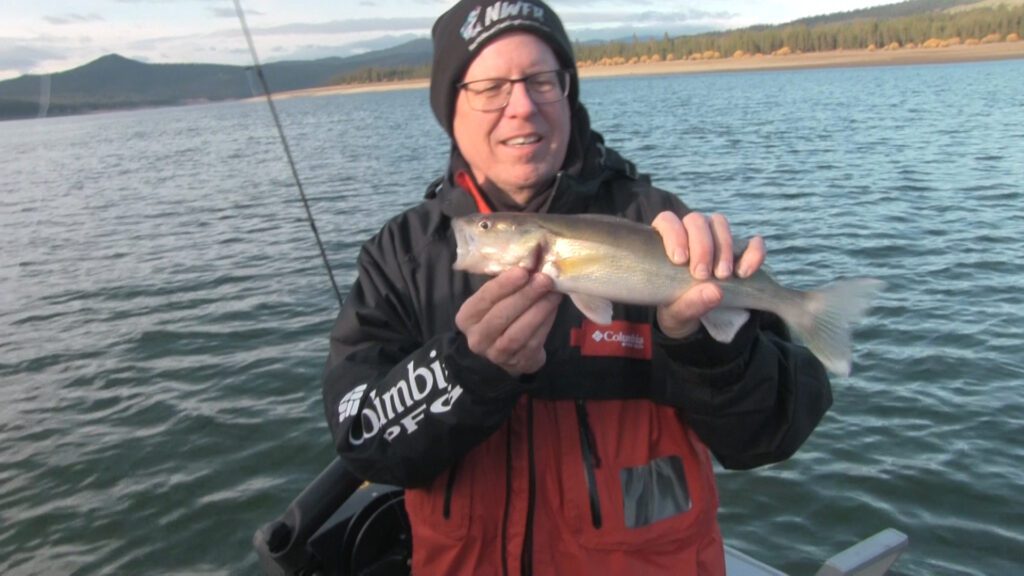
I let my line out and at 120 feet could see the braid go slack. I closed the bale and reeled up the slack, starting gently upward motions of my rod tip, raising and lowering and being sure to keep in contact with the bottom. If I felt nothing I let out a little line until again making contact. I continued this technique for a few minutes and then felt the distinct tug and heaviness of a fish on the other end of my rod. Setting the hook, I reeled with steady pressure and soon enough brought up my first ever deep-water jigged walleye, a nice 15” “eater”.
Over the next two days the NWFR gang would catch a lot of these “eaters”. Looking over the vastness of this stretch of the upper Lake Roosevelt and seeing the low angling pressure, I was not surprised at the steady numbers we caught over the next two days. This fishery, while not untapped, is definitely under-utilized. The bites came pretty steadily throughout the day. As with most fishing, we had periods of fast fishing and then slow, but over-all it was pretty consistent. Along with the good numbers of fish we noted they are definitely smaller than what we have caught on the lower stretches of the Columbia River.
Our fish averaged mostly 13-15” with a few fish on either side of those sizes. Todd noted that there are big walleye to be had, but yes, the vast majority were these eater class fish. I’m OK with that – nice stringers of white-fleshed walleye are always welcome at my table! I did notice that the flesh of these upper Lake Roosevelt walleye are a whiter shade than fish we had been catching in the lower reaches of the Columbia.
When it comes to deep water jigging for walleye, wind is your enemy. Current is not an issue on this stretch of the Columbia, but wind will cause the boat to get pushed too fast and, just like salt water jigging, you’ll lose contact with the bottom. When this happens you’ll find yourself letting out more and more line in an attempt to maintain bottom contact. It’s time like this where a good captain knows ways to increase your chance for success.
Captain Scott deployed two large sea anchors, instantly slowing our drift down to a manageable speed. Another strategy is to find shallower water to jig in. Having a bow mounted trolling motor will also serve you well when the wind starts up. Finally, although there aren’t a lot of spots to get entirely out of the wind, guys who fish these waters a lot know the winds and places to move to when the winds do come up. Just one more reason for considering a guide the first time you fish these waters.
We fished until around noon, at which points the winds from the front blowing through made it too tough to fish effectively anymore. It was a decent enough morning. We were looking at around a dozen fish in the boat, and many lost as well. When you’re fishing at 120 feet deep it’s essential to keep a steady pressure on the fish, even with barbed hooks. Fortunately there is another common trait of the winds in this area – they tend to die off later in the afternoon. Scott and Todd were more than happy to bring us in and take us out after a couple hours siesta time. So after getting a power nap we were back out again, fishing from 4-7pm. This bite was actually better than the morning bite – don’t put your gear away! In short, there are fish to be had throughout the day if you’re willing to be flexible.
Darkness slowly gave way to dawn and the gobbling reached ever higher intensities. Soon we heard the first “whoosh” of a bird flying over our blind. Rick quietly announced – "the birds are starting to come off the trees where they roost. It won’t be long now. Get ready!”
I was anxiously anticipating my first opportunity at a turkey. Dave and Dan were old hands at tom hunting and they had given me a primer on Tom Hunting 101 Essentials. I knew the shot I needed to make was a head or neck shot. Hitting the body of a turkey is a low proposition shot. The feathers are thick and hard and act like armor making a “head shot” almost essential. My hunting skills thus far had been limited to pheasants and ducks – which in my experience were fairly easy to knock down, assuming I could hit them! But turkeys – head shots on a bobbing head? I was little intimidated…
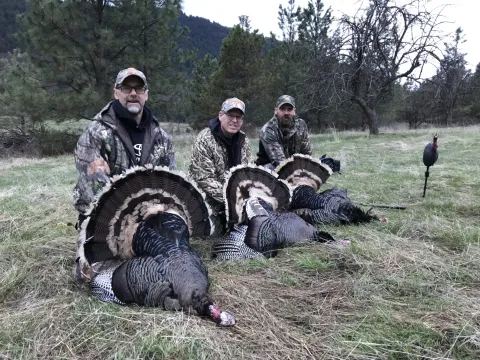
“Toms coming from the right”. Rick’s whispered warning had me turning my head to the right and seeing – nothing. I turned and looked straight in front of me and there were three large toms strutting around the decoy Rick had set up. How did those large birds get there so quickly without me even seeing them?!?!?
We three hunters slowly raised our guns to level, waiting for the three toms to separate enough that each of us had a clean shot at one bird. It seemed like forever as I hoped the birds wouldn’t startle and run off. Just then Rick gave the single to fire and in unison the three hunters let loose a booming volley of number 4 shot at each bird. It took a fraction of a second to travel the 15 yards to our targets and instantly two birds went down, and the third staggered, then rose into the air, flying over our blind. Three hunters, three shots, three birds! We came out of the blind and tracked down the third bird in the field behind us, around 30 yards away. Claiming this last bird we returned to the other two toms and admired our kills. The birds were all in the 25 pound range, gorgeous feathers and long beards. It was 6:30am and we were done for the day, with plenty of time to go back to the launch and get in more walleye fishing!
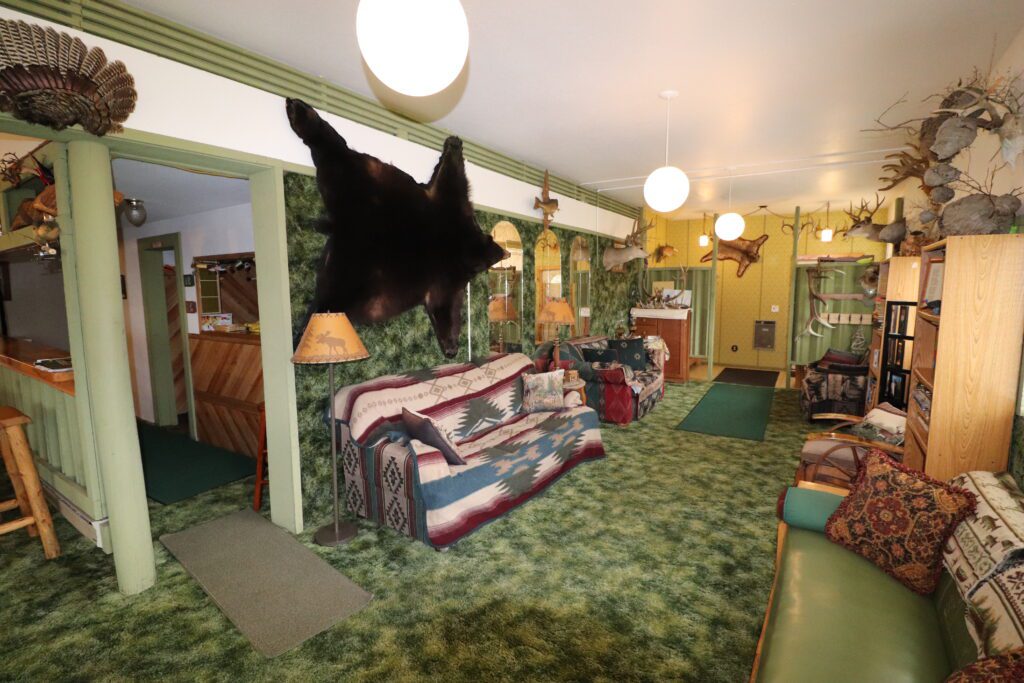
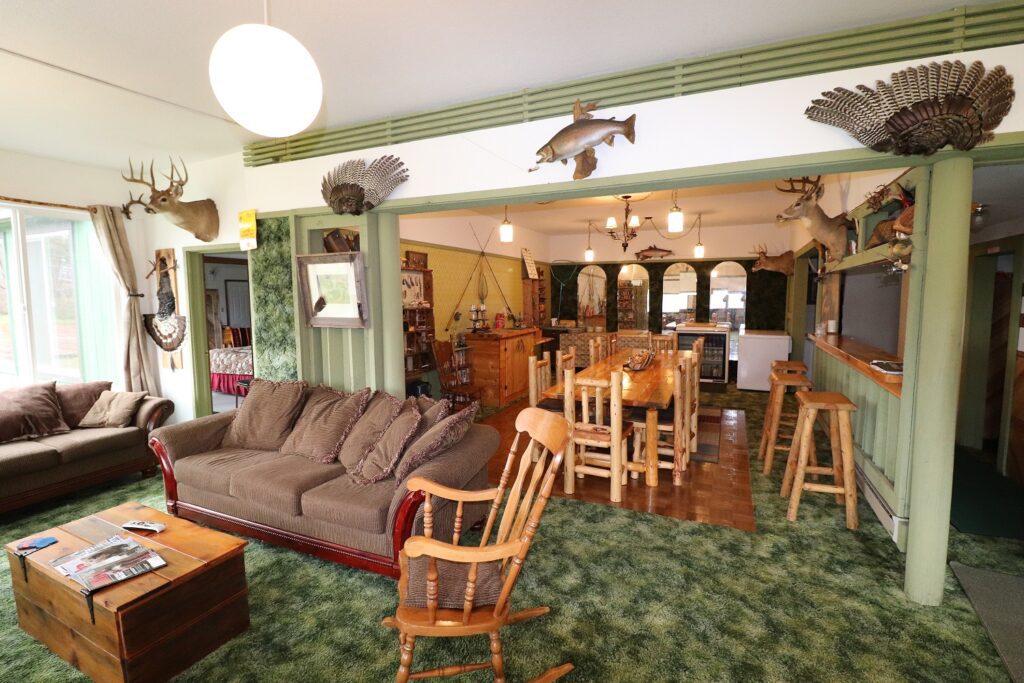
If you’re looking for a unique “Cast and Blast” adventure the spring turkey hunting and walleye fishing on Lake Roosevelt are not to be missed. Buck Canyon Lodge is the perfect base camp to take off on your adventures. Hosts Rick and Wendy Wakefield have a beautiful lodge and offer full amenities including provided meals. Rick does guided turkey hunts for guests, or, if you’re not a hunter, stay at the Lodge and get in on the great walleye fishing with Lake Roosevelt Charters. Either way (or both) way you go you’re guaranteed to have a wonderful adventure. The countryside is spectacular, wooded hills and breathtaking vistas great you at every bend in the road. It’s truly a unique experience you’ll remember for the rest of your life!
Visit Buck Canyon Lodge at Buck Canyon Lodge LLC or call 509-722-3949. Lake Roosevelt Charters web site is Lake Roosevelt Charters or call 509-722-3880.
/articles/lake-roosevelt-walleye-and-turkey-bonanza