/articles/categories/stories
Outdoor Serenity
Let’s take a step back away from fishing for a moment, please. That may be sacrilegious, coming from a magazine that is on its face wholly dedicated to fishing. I mean it’s called Reel Life for Pete’s sake, the pun couldn’t be any more fishing related. Consider the experiences that we add to our core memories from our passion for life outside the concrete jungle.
The sights and sounds of places we’ve just experienced for the first time. Those times with friends and family. The sometimes-trivial outings that we build into our routines because we are outdoorsmen and outdoorswomen at our core. Being present at those times is crucial to our ability to take a deep breath and hit the reset button.
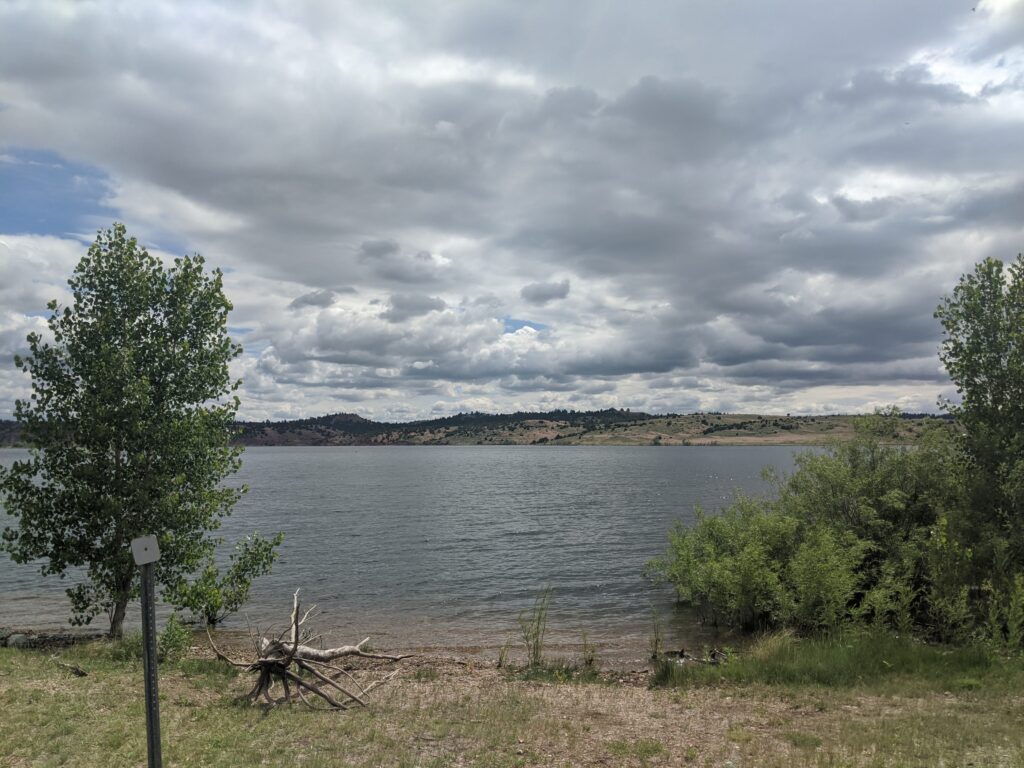
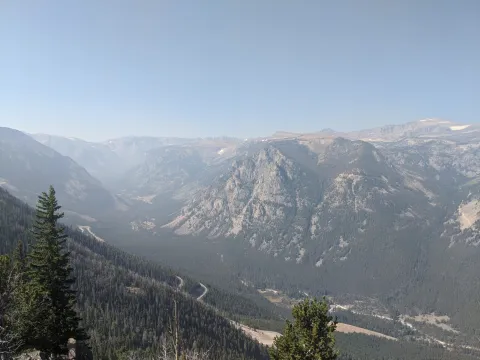
One of the most scenic drives I have ever experienced came from a trip along the Beartooth Highway in the heart of the Custer National Forest. It is one of those winding, nauseating, fear of height inducing drives that really make you appreciate the work of engineers. The drive up the mountain is narrow. A two-lane highway with an unforgiving drop on one side of the road and an immovable rock face on the other.
It makes me wonder how folks drive campers, boats, or trailers up such a road. There are points along the drive where, if you’re on the outside lane, by peering out of the window, you’ll realize the full effect of the over 9,000-foot drop off the road, add another nearly 2,000 feet if you decide to get to the very top. It’s a road so treacherous, it is closed during the wintertime, and rightfully so.
In addition to these crystal-clear memories of peril, are the wondrous views that come from the observation point. The attraction looks around 360 degrees and has all the amenities you’d expect: a bathroom, parking, informational signs, and posters. But, more importantly, there are the sights. Mountains, that from below looked ominous, are now eye level and expansive. On a clear day, like the one we thankfully had when we made the journey, that allows you to see for miles.
The funny thing about being at the point is my lack of memory about the people or whatever else was going on. I know there were other cars in the parking lot and people walking around the trails, but I really can’t remember any of them. The calmness of the moment and realization of these breathtaking views is something I’ll keep with me. Even in these moments where modernization blends, crosses over, and cheapens the outdoor experience, it’s still easy to find ourselves appreciating what the outdoors can do for us.
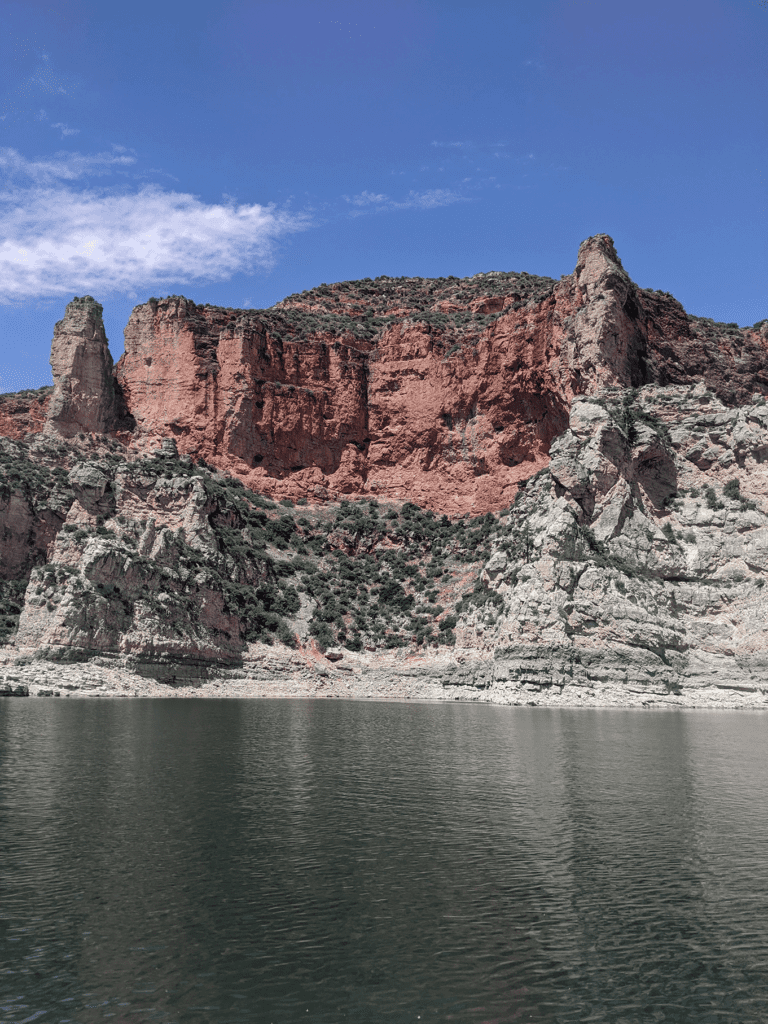
Ok, let’s bring it back to fishing, just slightly. The Bighorn Canyon sits in the heart of the Crow Reservation in Montana’s eastern third of the state. The area is simply gorgeous. It doesn’t hurt that the area produces some of the highest quality trout you can find, as is the case in many of the Blue-Ribbon Montana waterways. For the hiking or ATV enthusiasts, you’ll want to stop at Pryor Mountain, as the Bighorn Canyon offers a few trails along the way, but the area primarily runs along the Bighorn River. A few fishing trips with a close friend of mine will always draw me back to the area and the peacefulness I experienced, with one memory, particularly in mind.
Did I mention the canyon is incredible? It really cannot be understated the jagged edges of the cliffs and the deep red colors slowly fading to a subtle yet muted granite. The water is a pristine blue. Seemingly untouched and calm as glass. We nearly had the canyon to ourselves except for a few families enjoying the day on the water and some kids fishing from the dock.
My buddy in fact complimented the kids on their small bucket of fish they had accumulated and in turn, they gave him the lure they’d been using. It was a fun little exchange and was nice to see that kids can still be thoughtful. And of course, we used the lure and caught some of our own! We put my boat in the water and didn’t travel too far from the dock, maybe a few hundred yards into a nice rocky hole that was loaded with bass.
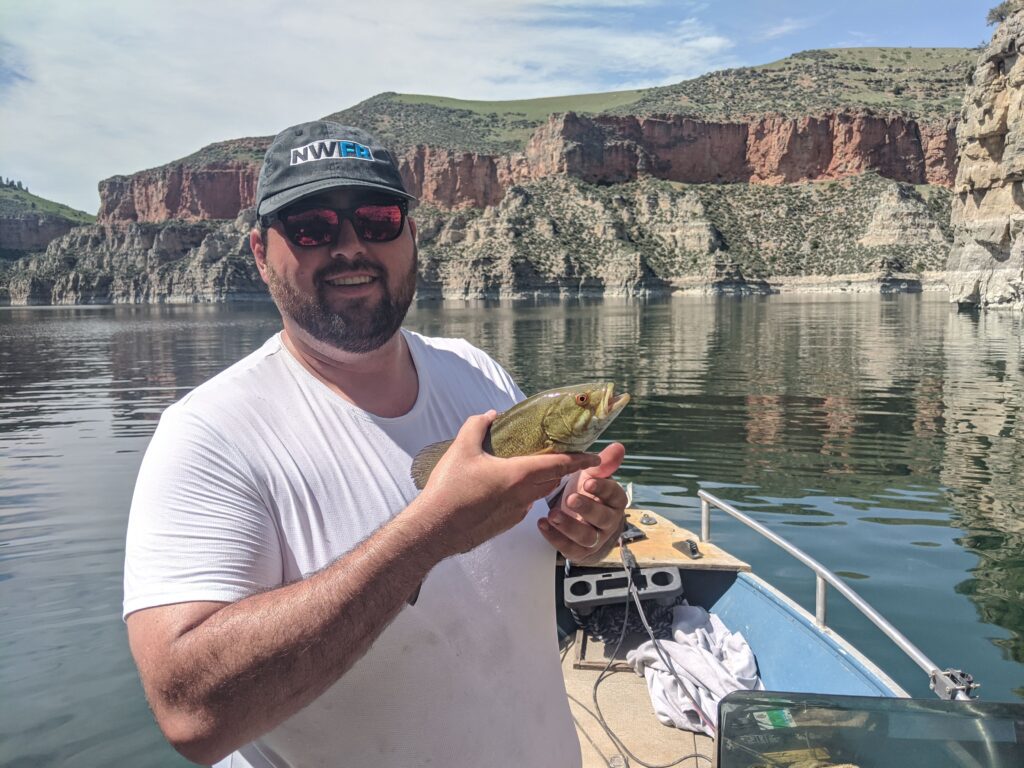
We trolled around slowly to different bays within the river for a few hours and continued to pull out solid sized fish. The kind of fish that makes you appreciate being outdoors with a consistent bite and decent weight behind them. All the while, talking about work, family, plans, and all the other things you’d expect to visit about. It was a fishing trip I’ll remember fondly because of the time with a valued friend and the opportunity for breathtaking views. It was also memorable due to a trailer tire popping and me driving on the axle for who knows how many miles, but that’s a story for a different time.
Let’s not mistake the vivid memories from our time appreciating the tranquility of the outdoors as more meaningful than the opportunities outside we capitalize on through the routine of our lives. For me, those instances take shape in the form of an activity as easy as walking my dog. He’s a hunting dog by trade and at 7 years old is still full of energy and prey drive. Tracking anything and everything is still a large part of his world, even if the hunting season is a few short months. Those other 9 months of the year he’s relegated to leashed walks around the hardware store or some off-leash trails and parks around town. Taking the dog out for a walk is not unique or special.
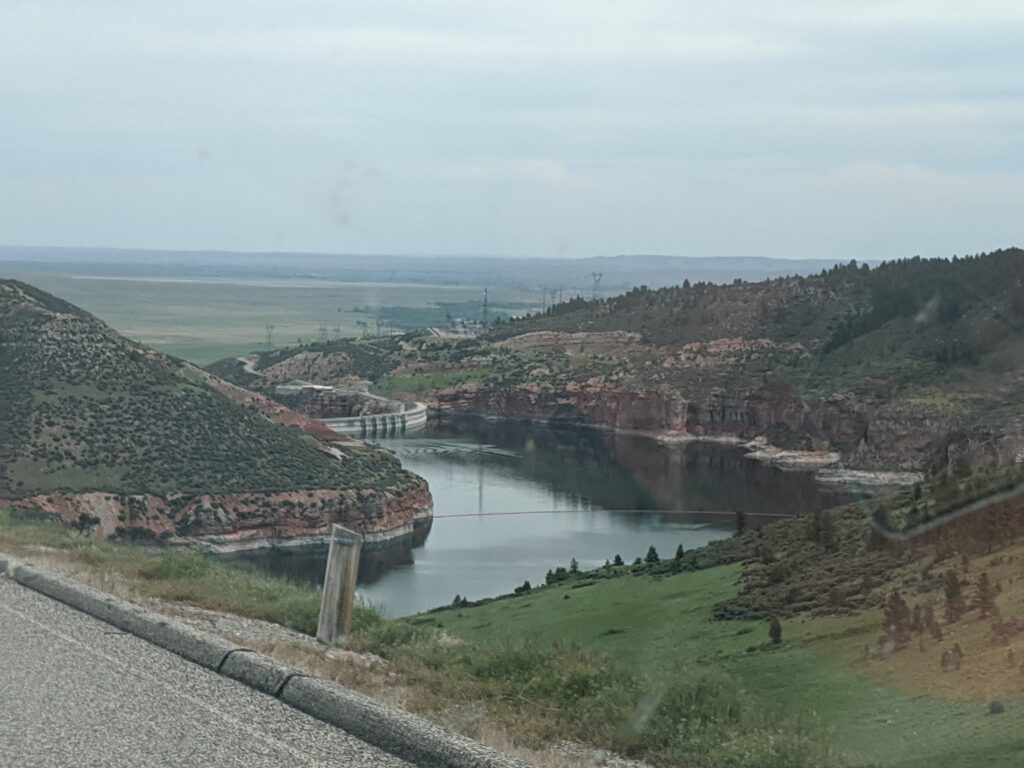
Perhaps you reading this have a dog yourself. You probably do the same routine part of your day as I do mine. Get up, go to work, come home, spend time with your family, and take the dog on an evening walk. Rinse, repeat. I would challenge you to be present in those moments outside if you aren’t already. I’m guilty of putting on a podcast during a walk or listening to music like anybody else. But I’ve tried to make a habit of putting these things aside if I’ve got the opportunity. A leashed walk down the street? Fine, music’s not a big deal provided you’re on the sidewalk. The hardware store? Well, we’re here buying stuff so it’s not much of an outing for the dog, but it is a chance for socialization and to break up his day. What about a hike on a trail or a stroll on some public land?
Those are the outings I try to be cognizant of. Quiet. A passing hello to another person briefly, and then back to isolation. Although built into the day-to-day of everyday life, something as simple as a walk with the dog can bring a calmness and recognition for everything we experience beyond our home’s front door or the office. Why drown out the peaceful silence when in that moment?
/articles/outdoor-serenity
Trout Fishing: When Life Gives You Lemons.
Farmed. Hatchery. Wild.
I fed a rusty orange streamer into the current, threw an upstream mend, and let it swing. We call it First Water. It's what you get early in the morning when you get to the river before the next guy. First Water makes you smile after a hard week at work. Like making lemonade out of lemons.
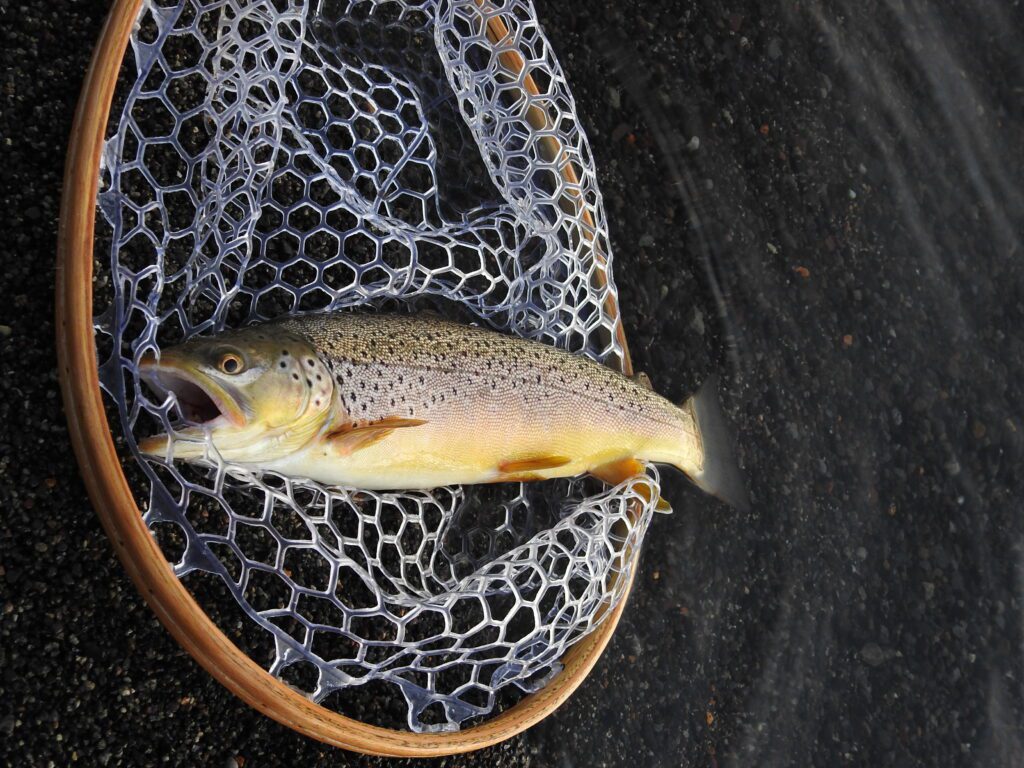
A trout hammered the fly and the tippet snapped. Heart pounding, I cut the leader back to 8-pound, tied on another fly and cast quartering-down. This time when the fish hit, it turned and charged, coming straight out of the water. Five minutes later we slid the net under a four-pound gnarly, hook-jawed brood stock rainbow. We have learned from experience it's hard to revive the big hatchery rainbows, so it was an easy decision to keep it for the table.
FARMED, HATCHERY, WILD OR NATIVE?
Here's a thing that doesn't make sense. We go to the grocery store and complain about the price of groceries and then we drive to the lake and catch and release a limit of rainbow trout at $10 a pound. I've done it.
Hey, those fish were put there to catch and keep. It's healthy food, high in omega-3 fatty acids and B vitamins. Easy to catch (sometimes). Easy to clean. Tastes good. Good for you.
Think of it like this: we have rainbows, cutthroats, brook trout, brown trout, bull trout, and lake trout in our lakes, rivers, and hatchery raceways. Some of them end up behind the butcher's glass at the grocery store. How do we tell where they came from? The ones in the cellophane and Styrofoam, that's easy. Those are farmed fish, which are generally shoveled a high-quality pelletized food and then fed a carotenoid called Astaxanthin which gives the meat an orange color and improves the taste.
According to Luke Allen, from the Wizard Falls Hatchery and Tim Foulk from the Fall River Hatchery, astaxanthin is produced by microalgae which is ingested by small fish and invertebrates like krill, which are then ingested by fish.
In Oregon, hatchery-raised rainbow trout (and cutthroats) are classified as legals (usually 8 to 12 inches), trophies (usually 14 to 18 inches), and brood stock, which are the surplus breeding trout that tip the scales somewhere between four to ten pounds. In Central Oregon, these fish end up in places like Pine Hollow Reservoir, Walton Lake, South Twin, and Fall River. Hatchery trout may also be released as fingerlings in waters like Lava Lake, East Lake and Diamond Lake where the natural feed is so good the fish grow fast. Fingerlings are also released in the high lakes every other year. Fingerlings, although raised in hatcheries in geometric order, tend to behave and look more like wild trout as they reach a harvestable age.
The terms wild and native can refer to the same fish or mean two different things. Brown trout, brook trout, and lake trout are not indigenous to Oregon but were introduced. Browns come from Germany and brooks come from the East Coast. That's why we refer to them as German browns and Eastern brooks. But if they were hatched in gravel we call them wild trout.
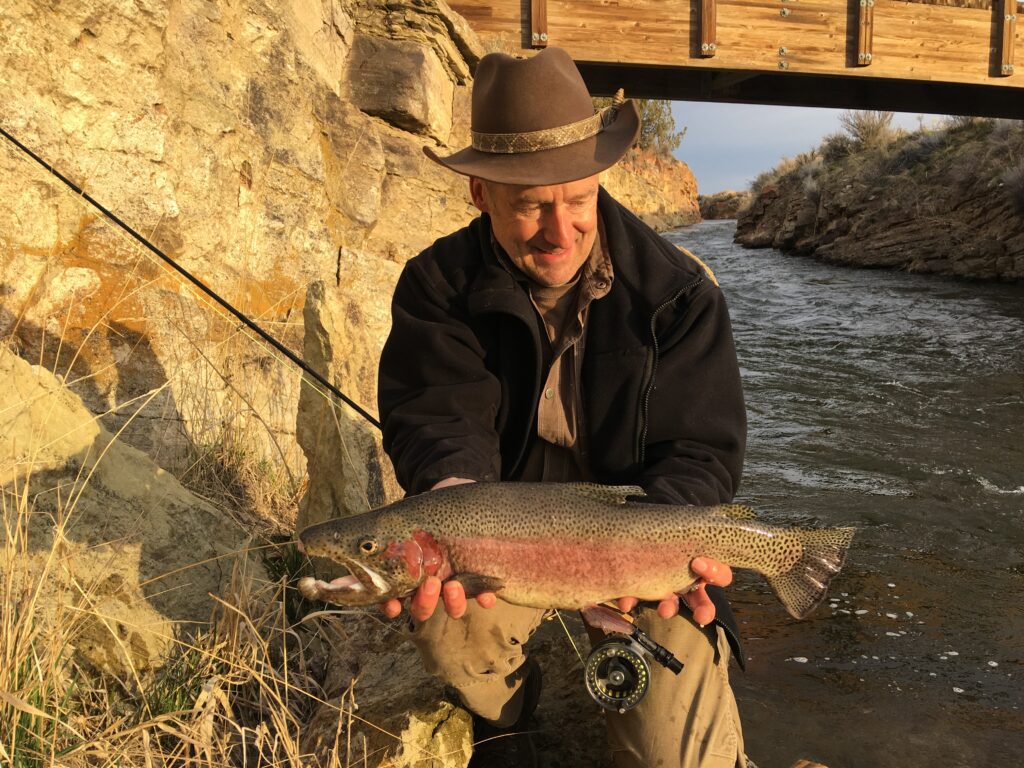
Photo courtesy Don Lewis
The term native is inclusive of rainbows, cutthroat and bull trout. In some cases these fish may be caught, kept and eaten, but it’s a good idea to release them to spawn and prosper. If you catch a brookie in the high lakes, hey, that's some of the best wild food you can get. And you are not eating a native fish.
A steelhead is a rainbow trout that migrated from freshwater to the ocean and returned. If a person eats farmed steelhead, it is probably not steelhead at all, but rainbow trout packaged as steelhead. An angler that catches and eats a fin-marked steelhead has consumed a hatchery steelhead. Surplus steelhead that returned to their hatcheries in places like Nehalem or Three Rivers are often trucked to coastal lakes and set free to give anglers another chance at them. Because they will probably not thrive in the lake, the highest use of these fish is to turn them into a good meal.
Fisheries managers sometimes struggle with the divide between the consumptive and the catch-and-release ethic.
Diamond Lake was devoid of fish before it was stocked by mule trains in the early 1900s. The food-rich lake still grows fish to trophy proportions and not enough gets taken home by sportsmen. It's a resource we could be making better use of, and the same principle applies all over the state from Lake Selmac to Wallowa Lake to Bikini Pond to Rock Creek Reservoir to Lava Lake. Those fish are there to eat. And there are some really good things like dill, parsley and lemon that go great with a pan full of eastern brookies or hatchery 'bows.
That's why I say when life gives you lemons, go catch a trout.
For a copy of the Fishing Central Oregon book, send $29.99 to Gary Lewis Outdoors, PO Box 1364, Bend, OR 97709 To contact Gary Lewis, visit www.GaryLewisOutdoors.com
/articles/trout-fishing-when-life-gives-you-lemons
A Mothers Day Fishing
By Hillary Holman
Last year for Mother’s Day I met up with my two daughters to fish Dworshak Reservoir in the Clearwater Valley for Monster Bass.
My eldest daughter Cameron had recently returned home from Temple University in Tokyo to attend WSU in Pullman, and Sarah had came back from PLU to attend Whitworth University in Spokane, both due to unforeseen complications associated with the pandemic.
Paul “the Bait Boy” Hamilton, and Sarah carpooled down from Spokane to Lewiston and Cameron scooted over from Pullman to meet Rob and I at the Clearwater Casino. It was the final leg of a spring fishing road trip with Rob.
We traveled the back roads through Waittsburg from the Tri Cities area, and found some great smoked cheese and meat at Mr C’s. We stocked up on snacks and hit the road to meet up with our posse in Lewiston by dinner time. It was a good 6 hour drive from The Dalles to Lewison, taking the scenic route, aka the shortcut.
Lenore Lodge, operated by Toby Wyatt, is situated on the way to Dworshak and was our lodging in the area. We often stay here when fishing with Reel Time Fishing on the Clearwater. The girls were impressed upon arrival. There was plenty of room, a great kitchen and a game room. The view of the river is nice. It was easy for the girls to unwind, unplug and relax. Cameron prepared a charcuterie board of the many meats and cheeses from Mr. C’s, that we bought along the way.
The next morning brought much excitement. There were winding roads and beautiful scenery. To see the wonder in my girls’ eyes again, as if they were little, gave me the greatest joy. Their curiosity and willingness to explore with us was wonderful. We looked out the windows and snapped pictures at the scenery. The Dam was a marvel. Hidden back in the Valley of the Clearwater, the monolithic dam is a sight to behold.
Arriving at the reservoir, we were greeted by Travis Wendt, of Reel Time Fishing. We were on the hunt for Jumbo Bass that are said to inhabit the huge lake created behind the huge Dworshak Dam. It was a beautiful clear day and not another boat was in sight. Travis knows this water well. “The reservoir is deep and steep,” as he says, and letting your leaded soft plastic baits sink to the bottom is paramount for success. Casting was right up our alley. Sitting on the bow of the boat tossing out lines on a clear spring day with my kids was exactly what I needed.
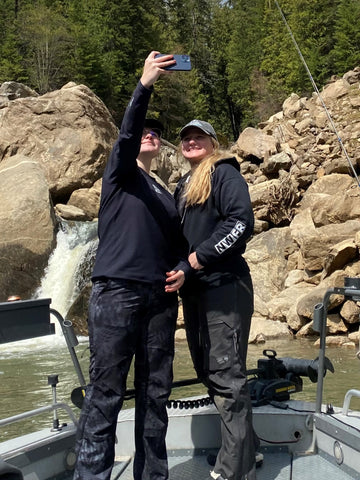
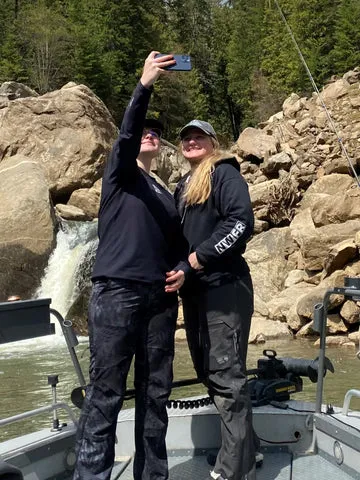
We took a lunch break and hit the shore, a hidden cove with a stream pouring from the rocky bank. Travis fired up the BBQ and us gals hit the shore for some much needed exploring. The hills were draped in green from the spring rain and runoff. We sat on top of a hill and looked down at the men doing their manly banter on the boat with the roaring smoke from BBQ as Travis prepared for lunch. The girls hopped up and set out to the creek to watch and listen to the streaming water down the rocks on the hillside. I watched and they jumped from one side of the falls to the other. Each was snapping pictures of the other. Capturing each moment as it came.
After lunch, we got to work. Paul, Rob and Travis were machines in procedure. They sent their plastics out at just the right spot, waiting for the right angle for the lead to hit the bottom. Cameron had enough time fishing and was ready for Mom to pass her the Camera to film the rest of the bass episode. She was ready to take the reins. The rest of the afternoon I spent fishing. Not worrying about getting the camera shot. Not worrying about the camera at all. Sarah would take turns with Cameron, but for the most part, she fished right alongside me. We hammered ‘em. We gave it everything we had and stayed as long as we could, even with the rain setting in. The girls were troopers. They came prepared with the right gear to withstand the spring day with unpredictable weather.
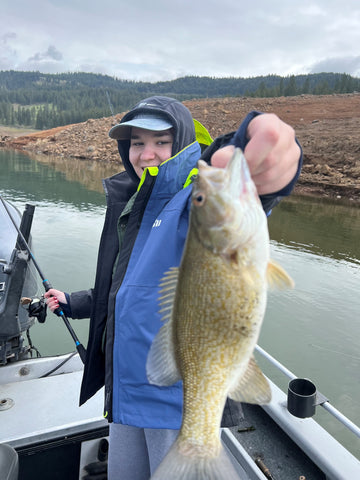
In the end, we caught some great sized bass and perch. We didn’t catch a monster, but we had fun. We saw a waterfall, beautiful scenery, the dam, and I got to reconnect with my girls after 2 long years apart. The boys were gracious and patient. The lunch was perfect. I could not have asked for a better day for Mother’s Day. Ok, maybe next time to have my son along for the trip is my only ask.
So, if you are wondering what your mom, wife or daughter may enjoy for Mother’s Day, consider taking them fishing. A trip we don’t have to plan and a meal we don’t have to cook or cleanup is all we hope for! The fishing, now that’s a bonus!
This article is dedicated to my Loving Mother Jerri Lee Cole.
/articles/mothers-day-fishing
The Multipurpose Fishing Trip
By Matt Carey
I have to start off this article with the obvious: I love reeling in the trophy fish as much as the next guy. My trophy case might be a little bare, but that’s beside the point. If there’s an opportunity to get into a big fish, I am as excited as anyone. The reality is we don’t always end our fishing trips with those monsters. Sometimes we’re lucky to even get a bite all day. Maybe what’s even more disheartening than the slow, sporadic bite with a few lost fish here and there is the one fish you do land that ends up a fishing tale for the wrong reasons.
That one guppy you sling over the side of the boat. The fish you’re talking up as you reel in. “It might have some weight behind those shoulders” ... “Last time we were here I hooked into that (insert exaggerated size fish), you all remember that one...!” I have my issues, and giving my buddies more ammunition than they already have by way of an embarrassing fish doesn’t have to be on the list!
Our Time on The Water
So, what do we do with our time on the water when the fishing isn’t as great as we hoped? I think some of the best parts about fishing are all the extras that come with it. I don’t mean different gear or setups. I don’t mean using a drift boat versus one with multiple props. I don’t even mean the variety of species out in the water. I think about the extras associated with fishing that make for lasting memories. The kind of fishing trip where you look back and remember the fishing and everything else. Time with friends or family. The time spent on the shore with kids or pets. When you combine a fishing trip that has a great time on the water with a great time on the land, it’s hard to beat anything else.
Cooney Reservoir
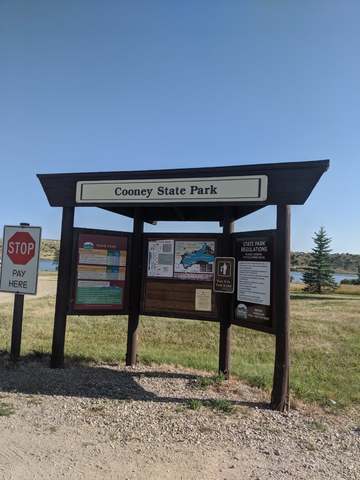
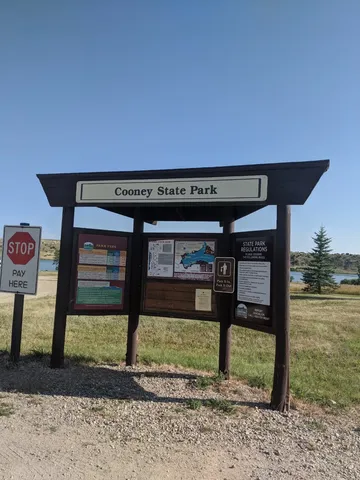
Cooney Reservoir outside of Billings, MT comes to my mind when I think about this multipurpose fishing trip. My in-laws had something of a family reunion planned for the summer. Within their immediate family, my wife and her siblings, kids etc. there are almost 20 people. The reservoir is for some a 30-minute drive and others an hour and half drive. Manageable for everybody. Being the only boat owner in the group, we agreed to bring our Klamath. Not a grandiose vessel, but reliable, and a good opportunity to let the nieces and nephews get some exposure to fishing and boating.
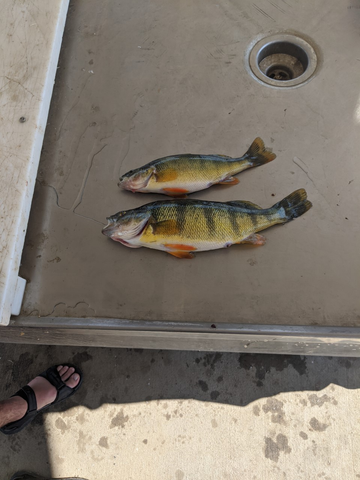
I brought some fishing gear that is pretty user friendly. Spinning reels with plugs and jigs. Open the spool, cast the line. So simple, kids could do it. Between taking turns getting everyone out on the water who wanted to go and practicing patience with other people’s kids, the fishing left something to be desired. Still, we caught a few nice perch and I was able to get my brother-in-law and his kids on a few more bites. Here’s where the “extras” come in.
Seeing jet skis, pontoons and other larger boats pull skiers and tubers led to some envy among the kids in our camp. We did have a little raft that could get hooked up to the boat, some rope, life vests, flags (remember this part in a second), and enough power in the motor to at least tug along kids wanting to enjoy the tubing action. So, I turned over the keys and let my brother-in-law take a spin with his kids.
On land I was enjoying some BBQ, swimming in the shallows with those on shore, and enjoying a typical day at the beach. Some time to chat with my in-laws, watching my dog swim and chase after a ball. All the extras that can go into a great fishing trip. Sometimes our fishing trips don’t have to be about limiting out or bragging rights. I had just as much fun on the shore as I did out on the boat. The experience of being with others is as important as the fish you catch. Or, even more important. Fishing itself can be a small part of a great memory and we as outdoorsmen/women cannot understate that.
Oh, and the flag? Well, a miscommunication happened between my brother-in-law and I which led to a “friendly” conversation between him and a game warden about needing to use the flag when someone is in the water. I swear I told him, but he swears he didn’t hear me say anything about it. Thankfully it wasn’t a huge issue, and everything turned out fine. It’s a friendly talking point for me when I have some lighthearted banter I need to call back to.
/articles/multipurpose-fishing-trip
Little Boat in Big Water
Chasing Fish in The Straits of Juan De Fuca
As summer winds to an end, readers are likely anticipating glorious tales of monster sized salmon bending rod tips over the sides of boats, while adrenaline filled anglers run about with nets in hand, hoping to assist a buddy in bringing the big-one aboard for a well earned grip-and grin photo of a lifetime. This story, regretfully, does not end in such a manner. The story does, however, dispel some myths about importance of boat size, shares some boating safety advice that pertains to smaller boats, and ends with a nice haul of tasty fish (the type that are more suited for a fryer rather than a smoker).
It was Saturday morning in the Sekiu village, and the gentle waves of the incoming tide at Clallum bay woke me in my tent at Masons Marina. Thick marine fog typically blankets the waters from Sekiu to Neah Bay during the summer mornings, however, the start to this day greeted me with glassy calm seas, and blue skies that extended from Masons marina, all the way north, across the straits, and to the mountainous shores of Victoria B.C. It was perfect weather, and it helped ease the nerves that had been accumulating over the past two days as I obsessed about all of the things that could possibly go wrong in a small boat out on the big water.
My boat is a V-hull 2008 14’ Smoker Craft Pro Mag with a 20 HP Honda. It’s a good little boat, equipped with a live well, an electric trolling motor, navigation lights, and a backup 6 hp Suzuki that I keep onboard in case of emergencies. I take her out often, with most of my destinations being on the Puget Sound, Hood Canal, and various lakes in my region. But, as with many others that own boats similar to mine, the thought of taking a small boat out onto water that behaves a lot like the ocean never really crossed my mind. Boating is fun, until it isn’t. And I’ve always figured it was better to avoid a bad situation than to plop myself directly into one. It wasn’t until I was on the Hood Canal that a friend told me about Sekiu, and how anglers were easily catching their limits of chinook and coho up there, that I began to put more thought into the idea. Thus, a seed was planted. As I researched and asked around, I found that it was actually quite common to take smaller boats out around Clallum bay. In fact, 14’ kicker boats were at one time the most common sport-fishing boats seen on the water. At least, that was the case in the 1940’s, when most people weren’t towing around larger boats and instead opted to rent the 14 footers from the marinas. The marinas still rent boats of this size today, most of them equipped with 15 HP outboards.
Sekiu is the quintessential small fishing town. It has two main marinas (both with campgrounds), a handful of motels, a cafe, a restaurant, and plenty of fishing tackle. The town got it start as a salmon cannery back in the late 1800’s, but after regulations ceased to allow commercial fishing, the cannery business crashed, and Sekiu had to look to other industries like logging, hide tanning, and sport fishing. The latter of the three being the one that worked, and oh did it work well. The fishing is world-class, and seldom will you find anywhere outside of Alaska that has this type of salmon and other saltwater fishing. The unincorporated community is situated right inside Clallum bay, in the northwestern portion of the Strait of Juan De fuca. The bay itself, and just west of the bay, enjoys decent protection from S,SW,W, and NW winds. Once you head further towards the ocean or out north into the open water, you become more exposed to the common west and northwesterly winds. Luckily, you will find excellent fishing near-shore, or without having to travel too far west in the direction of the ocean. In fact, most fisherman catch their limits of salmon just west of the bay near what is known as “the Caves”. Two main summer-run salmon routes exist in the area, and those two routes follow near shore on the Canada side and near shore on the Washington side. This is an ideal situation for a small boat fisherman who doesn’t want to venture too far out into the open water.
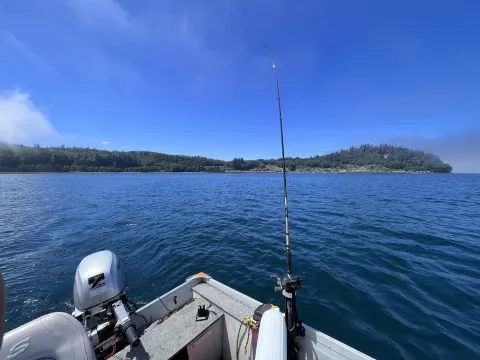
When I motored out of the marina that first morning, I was a day behind on my already limited schedule. This had me fishing on an odd numbered day of the month. At the time, odd days were closed to salmon retention due to emergency regulations set by the Department of Fish and Wildlife. This meant that fishing for salmon that day was out of the picture. However, in Marine Area 4, just northwest of me, lingcod, rockfish, and other bottom dwellers were all very much on the table! To get to these, I had to run about 5 miles west to Shipwreck Point just east of Neah Bay. So, with calm waters on my port side, I gunned it west towards the MA-4 boundary line. The swell and wind forecast for that day were predicted to be favorable up until around 1pm, and so far, the predictions seemed to be holding up. My little boat planed quite nicely heading out with the ebb tide and gracefully skipped over the rolling swells. My first “yikes” moment occurred when I approached Kaydaka point. This large point that sits roughly 2 miles from the marina brings underwater structure out into the straits, and as a result, kicks up the wave height significantly. Though the increased wave size didn’t pose a significant threat to me, I still figured it was a good idea to run a bit further offshore to avoid the turbulence. It’s worth noting that points like these can present sea conditions that might not be tolerable for particularly small boats during rougher conditions.
The bottom fishing was hot within minutes of being inside the MA 4 boundary.
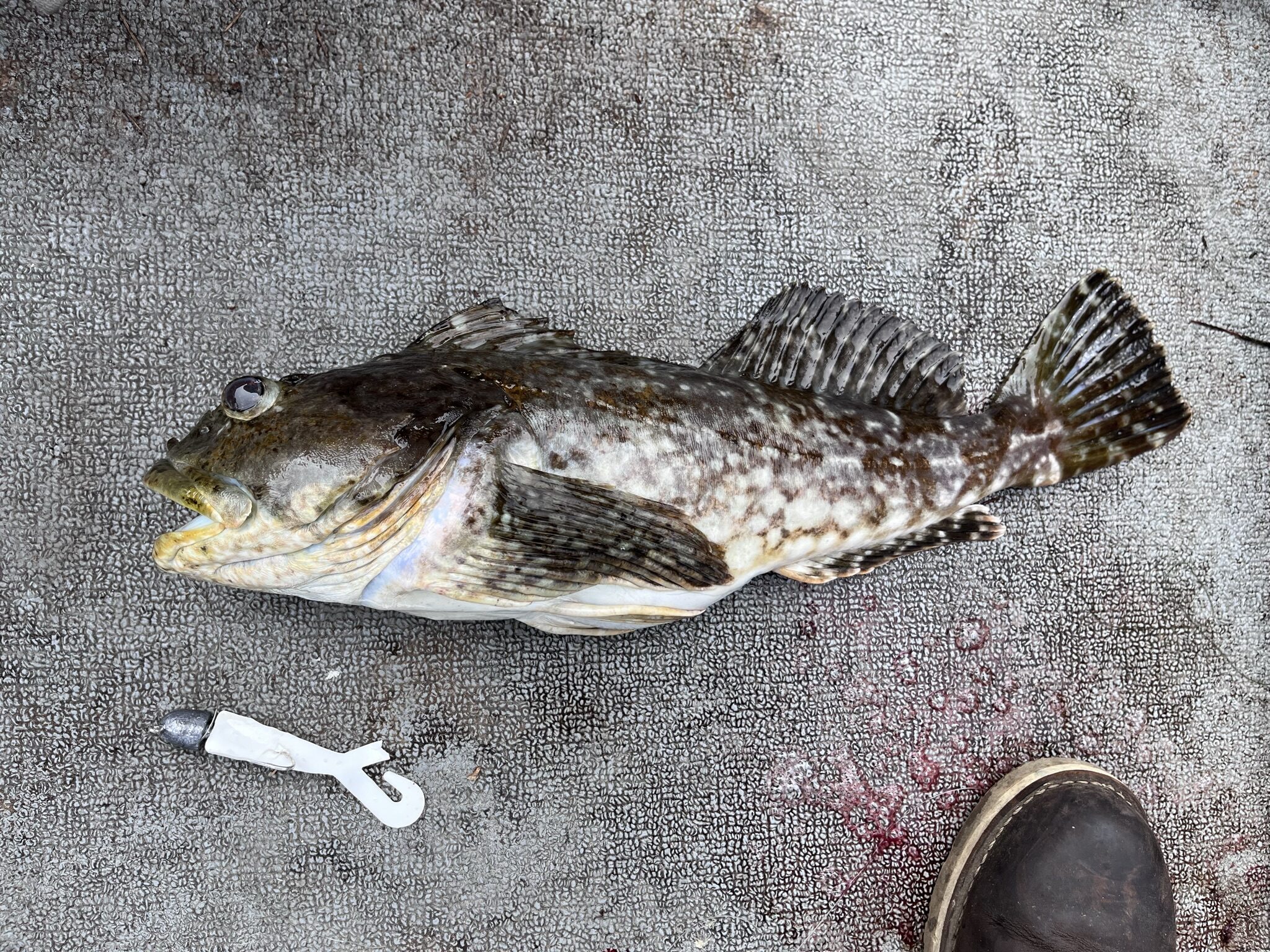
I fished a 2 oz jig head with a pearl white double tailed grub over some structure, and within minutes I was into some fish. A few good-sized lingcod found my hook, along with several rockfish and a beautiful cabezon that fought like a bull! All in all, the day was a success. I won’t bore you with the details of my next morning’s salmon trolling trip. I only had an hour to get it done, and let’s just say I’m still eating last season’s silvers from my freezer (and yes, some of it’s looking a little freezer burnt). But the success was had in that I made it back to the marina both days in one piece. And this wasn’t accomplished in a 30’ fishing boat that’s worth more than my life savings- nope, this was done in 14’ aluminum boat with a small engine and an even smaller backup.
Now, let’s talk the important stuff. Small boat safety. Is it safe to take a small aluminum boat onto the straits? It certainly can be! There are inherent risks that come with any type of boating, regardless of the boat size or the water that you are on. Risk assessment, risk avoidance, and preparation are all key components to keeping you safe on the water.
DISCLAIMER: I am by no means, an expert on boating safety. All I can do is share what works for me and what I have learned myself.
My first bit of safety prep comes well before I arrive at the marina. Fortunately for me, I have a work schedule that affords me the liberty to plan my trips around weather windows, so I’ll start by looking for consistently fair weather in the long-range forecasts. As I get closer to my desired departure dates, I’ll home in on the NOAA webpage and start looking at wind directions and speed, wind waves, then swell predictions (paying close attention to wave period or duration), and then tide charts. It’s important to know how wind, swell, and tide currents all work together to cause either rough or manageable conditions. I don’t have the page space to get into that here, but there are plenty of resources available online for anybody who wants to educate themselves on the nuances of ocean behavior. The calm waters typically occur in the morning, so be up and ready before sunrise. If the winds are predicted to pick up, say, by 1pm, then I’ll be heading back to the marina at least 2 hours before those winds are predicted to occur.
Safety equipment.
Before I leave the docks I want to make sure I have life jackets (I carry an auto-inflate and a standard), a waterproof radio, working navigations lights, at least two GPS devices, a manual bilge pump in case my auto fails, a well-tuned and properly functioning outboard motor, a backup kicker, flare gun, an air- horn, and a reflector to hang up in case of dense fog.
Aside from these things, I also try to scout out beaches nearby that would be suitable for beaching my boat in case a situation calls for it. This is definitely a last-ditch option, as the risk of damaging the boat on rocks is very present. So, will I be taking my boat my boat out to Sekiu again? Absolutely! I already have my next trip planned! Do larger boats afford more comfort and protection in the event you get stuck in some adverse conditions? They absolutely do. But, if a capable small boat is all that you have, and you have educated yourself on all the safety measures necessary, then there is no reason for you to wait till you get that 100k boat to go have some fun and catch fish in arguably the most productive fishing grounds in our region.
/articles/little-boat-big-water
A Lifetime of Fishing Memories
Measured in terms of people killed, the last year of World War II (1945) is regarded as the worst year in human history. On April 27, the day Italian partisans captured Mussolini, Gordon Vance caught two in the morning on flies and three in the evening on salmon eggs. The day after the U.S. dropped fire bombs on Tokyo, Gordon Vance dropped salmon eggs in Johnston Lake and caught six small ones. On August 9, the day a plutonium bomb was dropped on Nagasaki, Gordon Vance was on Walterville Canal with a fly rod.
If you don't keep a fly fishing journal, maybe you should. It's a great way to remember good days on the water and figure out how to have more of them. But it can also be a link to the past when a son or daughter finds the journal years later. Think about Gordon Vance. Remember him? No? Well, his family does.
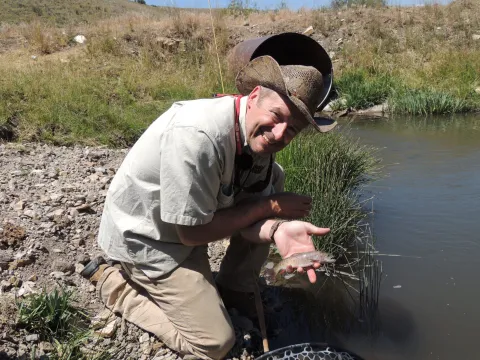
When he was a little boy, his mother would give him a pail of water and a stick with a line and a bent pin. "He would sit in the kitchen for hours, waiting for a bite," I spoke to Janice (Vance) McCargar after I received a package in the mail; she had found her father's fishing and hunting journals, kept in a three-ring binder, written in longhand.
Gordon Vance began to keep track of his fishing trips in 1931. Picture a barefoot boy in a tiny kitchen in Missouri in the 19-teens. Picture him a bit bigger in dry-as-a-bone Arizona. "When my dad's family moved again to the McKenzie River in 1926, he thought he had died and gone to heaven." Gordon Vance was 16 when he moved to Oregon.
On May 15, 1932, he writes of fishing Walterville Canal and Cogswell Creek. He caught five on a blue quill body grey hackle and, that evening, on the McKenzie, caught eight "in a hurry on a yellow body deer hair fly."
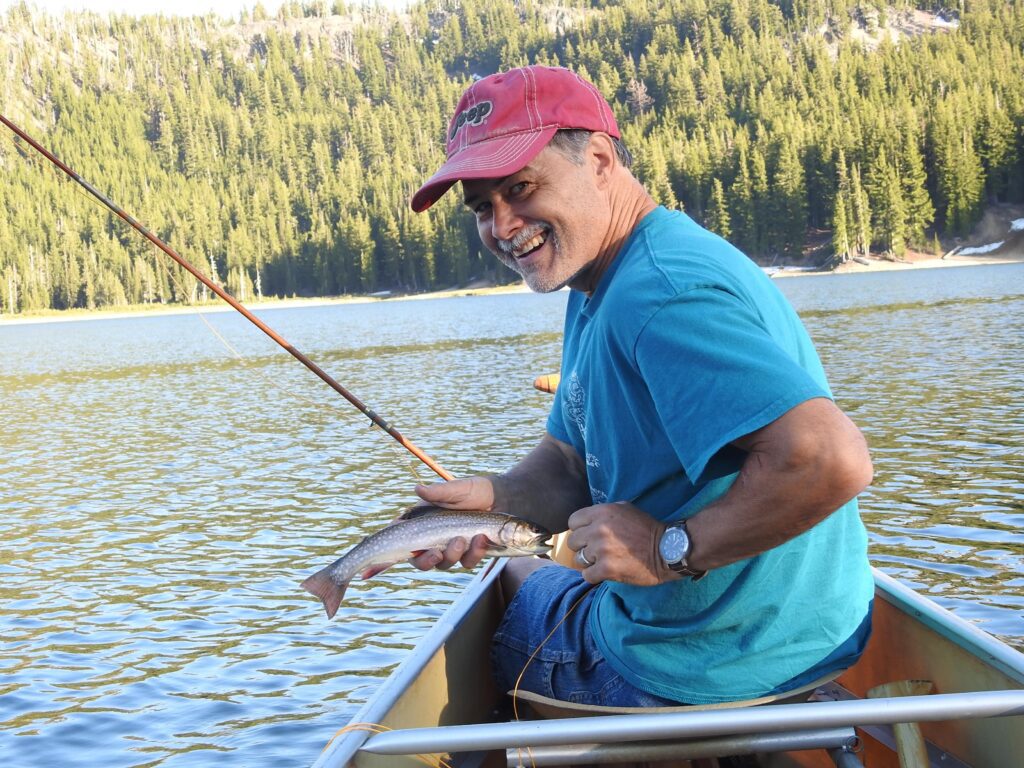
Don't just write down the number of fish you catch in your journals, but who was with you, the temperature, the weather, the barometer. Jon Guenther on a mountain lake in Oregon with a fly-rod brookie. Photo by Gary Lewis
Twenty-two years old in '32, Vance recorded 15 entries, on Leaburg Lake, the canal, Cogswell Creek, Horse Creek and the McKenzie. In 1933, he fished 20 times and would have fished more, but in September, according to his notes, he picked up a Winchester Model 54 and spent a good deal of time in the woods. "It was the fashion in those days to keep a journal," Janice said. People took the time to record thoughts and observations. Journaling helped the young man develop his craft on the water and in the woods. It was fun to think of the determination it took to drive to Diamond Lake, Miller Lake, Odell and Crescent in those days. Easy jaunts now, they were all-day rumbles along narrow timbered tracks in the 1940’s and '50s.
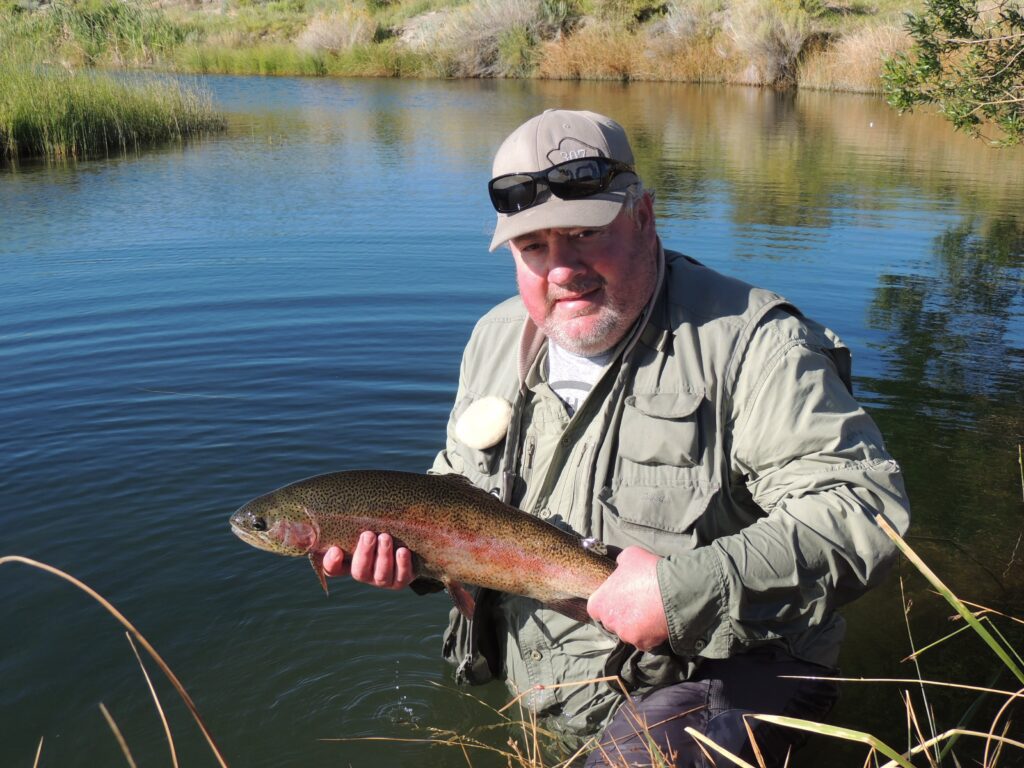
Keeping a journal reminds of the flies we used on that July morning in '16. Jeremy Groh, of Bend, Ore., with a big still water rainbow. Photo by Gary Lewis
In 1956, Vance fished Diamond Lake and wrote, "Don, Marion and I gave the Kamloops of the reborn lake an end of the season try. We caught 22 from 15 inches to 18 inches." He added, "A monofilament line is a must. Fish had been eating algae and tasted terrible." Monofilament: we take it for granted now, but it was the latest in fishing technology in the 1950s.
Some things haven't changed. On September 17, 1980, Vance fished Miller Lake. "Thirteen washboard miles from Chemult and up to 5,600 feet, the 550-acre lake is a beauty and if I had taken a fly rod could have been fun." A mayfly hatch was on and Vance had brought the wrong tackle. He ended the day with two small kokanee.
In 1990, the year he turned 80, Vance started with a March outing to Triangle Lake and recorded 27 trips on Cottage Grove Reservoir, Hills Creek Reservoir, Odell Lake, Cougar Reservoir, Green Peter, the Siuslaw and on his home waters, the McKenzie and Walterville Canal.
My friend, the noted outdoor writer Scott Haugen, makes his home in Walterville. He remembers Gordon Vance. And he remembers good days fishing the Walterville Canal. "There used to be really nice cutthroat in it," Haugen said. "When I was in high school, lots of jack salmon used to run up one section. I caught steelhead out of it too."
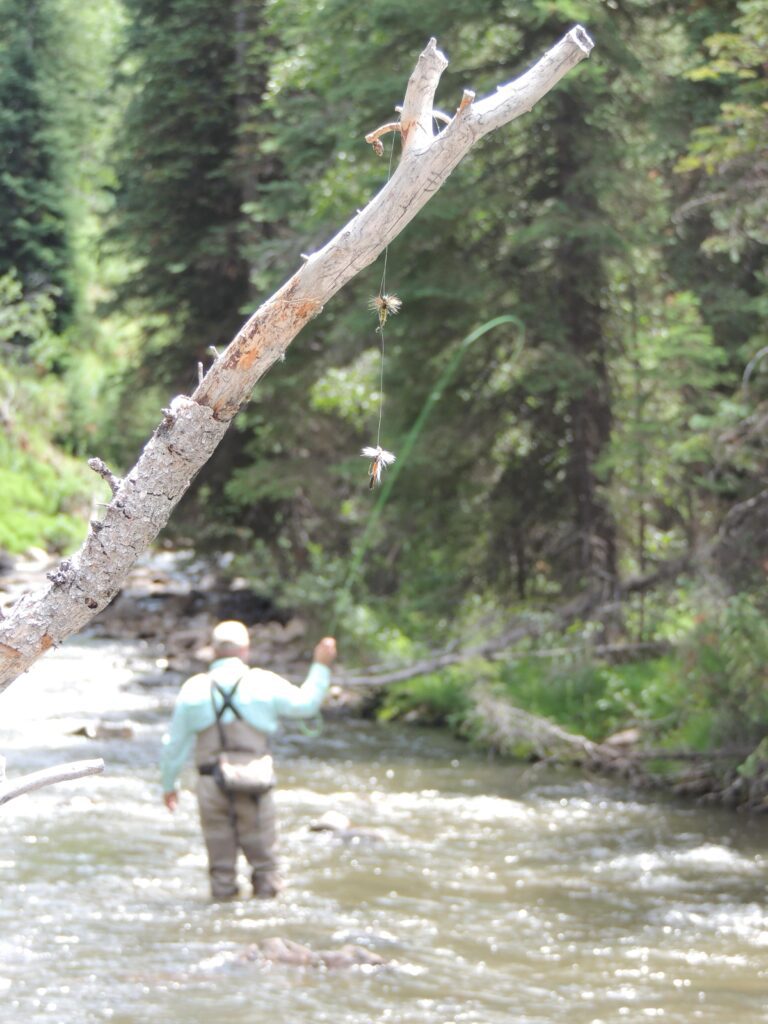
Lost and found on a mountain stream. Photo by Gary Lewis
It was interesting to look at my journals next to Vance's. I started my first notebook in 1980. I was in my teens and lived in southwest Washington and later in western Oregon; he would have been in his 70’s when our paths crisscrossed each other's, fishing the North Umpqua and Central Oregon lakes. We have planted our waders on the same rocks and caught trout, steelhead, and salmon in the same holes.
Vance recorded his last entry November 30, 2000, after a day on Foster Reservoir. "Well, I ran out of luck at Foster or ran out of fishing knowledge." He did catch one salmon, but figured he could have caught more. "Should have had a fly rod or tried smaller spoons or something!"
Vance passed away a month later, at the age of 90, on Christmas Day, leaving a lifetime of outdoor experience in his wake and a journal for his family to remember him by.
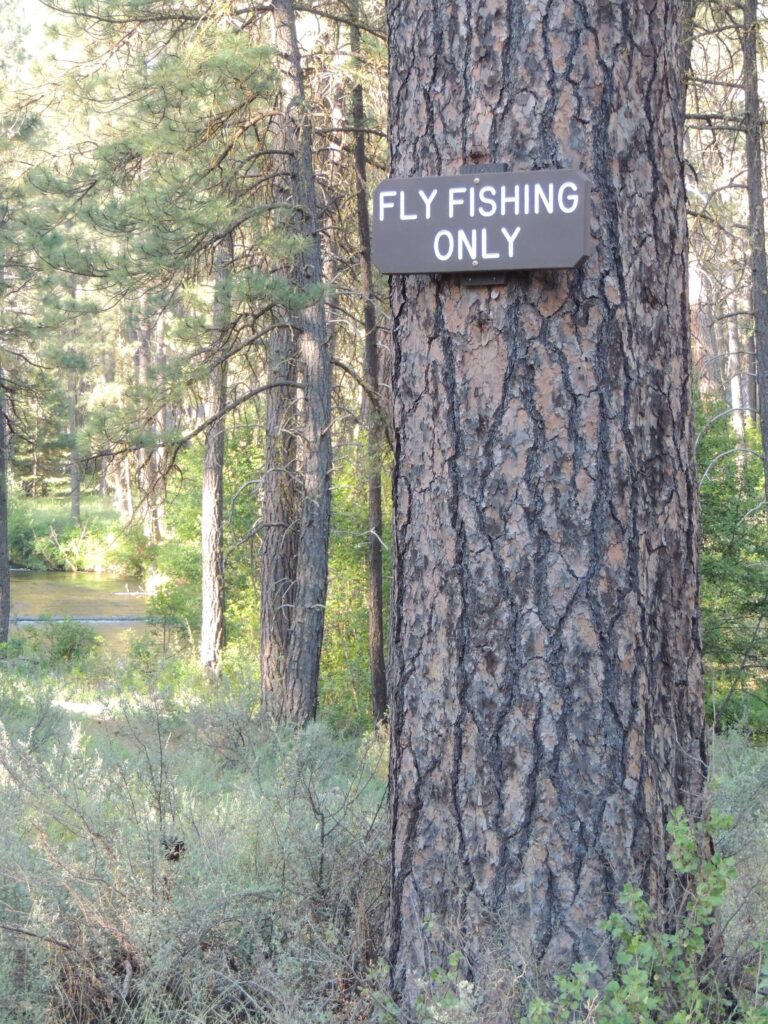
Fly Fishing Only on the Metolius. Photo by Gary Lewis
To contact Gary Lewis, visit www.GaryLewisOutdoors.com.
/articles/lifetime-fishing-memories
Fathers Day Memories
According to Wikipedia, Father's Day dates back to 1910: “Father's Day was founded in Spokane, Washington at the YMCA in 1910 by Sonora Smart Dodd, who was born in Arkansas.[3] Its first celebration was in the Spokane YMCA on June 19, 1910.”
Reading further, Sonona Smart Dodd wanted a day to honor her dad, similar to Mother’s Day. The day was made a permanent national holiday when President Richard Nixon signed it into law in 1972.
Nothing was mentioned about this being the perfect Dad’s Day for fishing, but truly the timing couldn’t have been much better. Coming out of spring, closing in on summer, the day comes with the prospects of great fishing and fond memories for dads and children alike.
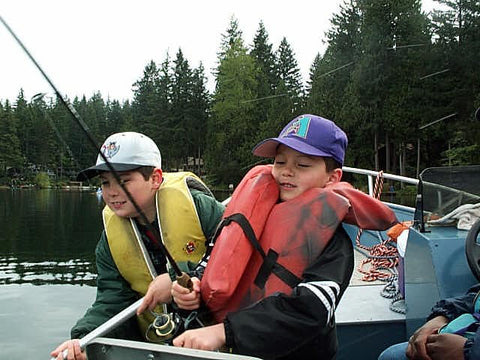
My earliest memory of Father’s Day fishing was with my first son, Matthew, age two. I still remember him running around the park at a small lake, the name long since forgotten. His toddler laughs as dad attempted to introduce him to fishing are still crystal clear in my mind-eye. The day was a mixture of casting power bait and letting it soak, waiting for a trout to come by, and playing on the park’s playground swing and slides.
I have a picture somewhere, buried in a box of pictures, a lifetime of memories. It’s funny how the brain works – so many memories, filed away over a lifetime, coming to the surface out of nowhere. That day it wasn’t about catching fish, it was about father-son time. The goal was not necessarily catching fish, rather, it was time spent together enjoying a shared experience. As it should be. At this early age, first experiences can set the tone for a lifetime. Best to make a gentle introduction and go with the flow. The child will dictate how hardcore the day will be. You’ll have a lifetime of adventures ahead – if you play it right in these formative years.
Farther down the road of parenthood, James came along, and then my Klamath jet boat joined the family. The boys had a lot of fun on that boat, slipstreaming turns, pulling a tube, and of course, fishing.
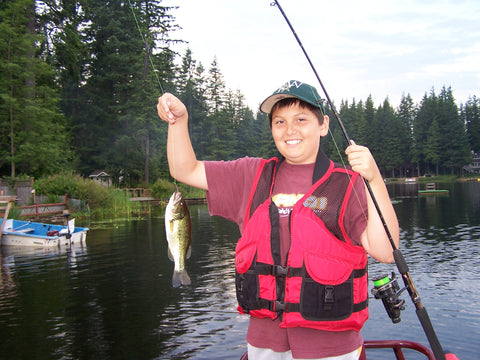
It was another Father’s Day, and we were fishing on Lake St Clair in SW Washington. I had Matt and James in our 16-foot Klamath jet boat, geared up for trolling trout. Lake St Clair is an interesting lake, with many channels and bays to explore. The day was a pleasant early summer father-son get-away, and we enjoyed trolling along on the boat exploring the sights and sounds. Ducks and other animals kept us entertained, and of course, the boys had their Nintendo’s along. I wasn’t one to be hardcore fishing with my boys. I figured it was better to have them along for the experience than it was cramming it down their throats. When a fish came along, they would set their Gameboys down and catch it, enjoying the action, then back to one or another distraction. The fishing was not exactly hot, so after a couple hours it was time to turn back to the boat launch and head home.
Just then, the longline rod violently jerked back and behind the boat a large splash signaled a nice fish on the end of the line. Matt grabbed the rod and began reeling in the huge fish. The smile on his face as he battled the big trout was enough for me to know the magic of angling was taking hold. As the fish came closer I could see it was a big rainbow trout, a triploid most likely. Matt brought the fish close to the net, and I scooped a beautiful rainbow in as Matt let out a whoop of joy. The three of us marveled at the beautiful fish, one of a few we caught that day.
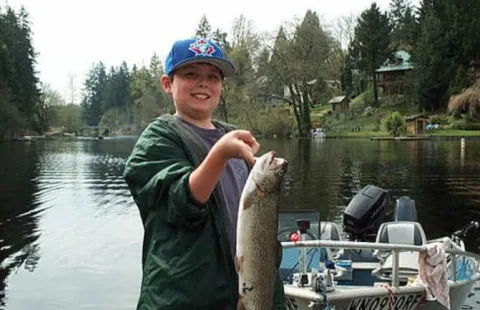
The last Father’s Day fishing adventure I can remember, before my sons became fully enamored with baseball, was a trip my son James and I took on Lake Washington. He was, I believe, 10 years old. It was another beautiful Pacific Northwest early summer day, the kind that begs to get out of the house and do something outdoors. We launched our new Seaswirl and ran across the lake to fish off Kirkland. Downriggers set and gear down, I was hoping to get into some of the quality rainbows and cutthroat that Lake Washington is known for.
As we trolled along, the port rod popped free of the downrigger and it was fish on! Handing the rod to James I could see that he had a solid fish on. The fish would take a screaming run, drag crying out, James laughing and enjoying the feel of a substantial fish on the other end of the line. I said a quiet prayer hoping the fish was well hooked. Ever closer James worked the fish to the boat, until I was able to slip the net under a chrome bright Lake Washington cutthroat.
Back at the dock, James couldn’t stop talking about his fish and the fight it gave him. His smile said everything I needed to know.
The years have marched ever onward, and many Father’s Days have passed into my rear view mirrow. My boys are adults now and have lives of their own. Matt is himself a father, making me a grandpa. While baby Hanna is a bit young yet to introduce her to a Father’s Day fishing trip, I look forward to being a part of her fishing life. Say, shouldn’t there be a Grandfather’s Day? If there is, I hope it's not in December!
/articles/fathers-day-memories
Josie & the Tomcats go to Alaska
The first time I met Josie Regula was when she boarded our charter boat, the Mystic Lady, at Sportsman's Cove Lodge on Prince of Wales Island in Southeast Alaska. The 50-something year-old-woman was accompanied by her husband, Max. The two had come here from San Diego, California to fish for salmon, halibut, cod, and more during a three-day stay at this luxury Alaska fishing lodge.
It turns out Josie isn't shy. As she boarded the boat for an orientation prior to the next morning of fishing, Josie let us know this was her very first fishing trip. She then told all of us with much bravado she intended to catch the biggest fish on the boat and probably the most as well.
Her husband Max looked shyly downward but the rest of us did not. Her shipmates were myself, my best friend Rusty Johnston, well known Pacific Northwest outdoors writer Terry Sheeley, Frank Skipworth (a veterinarian from Kentucky), and the Captain of the Mystic Lady, Steve Helton. I think Josie was expecting a chorus of loud guffaws and snorts from us but several of us nodded in agreement and said there was a good chance she would do just that.
Josie looked momentarily confused until I explained first time anglers, especially women, tended to out fish their male shipmates because they had not formed a lifetime of bad habits like the rest of us had. Add to that, first time women anglers tend to not only pay attention to the fishing advice dispensed by the captain, but actually follow it. Several of us went on to say we had indeed seen women with no experience catch the biggest fish or the most fish because of this. I'm not sure Josie believed what she was telling us but we all knew her prediction could well come true.
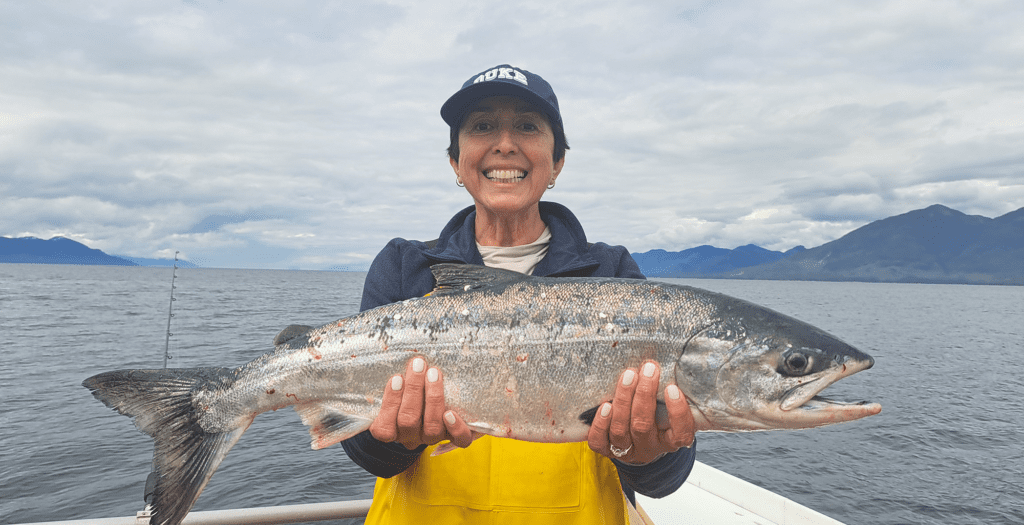
When I asked Josie her name, she said it was "Josie, like Josie and the Pussycats". Being all over 50 years of age on the boat, we all recognized the reference to the old television cartoon show featuring Josie, the star of a female rock band, and her supporting cast the Pussycats. With all of us being men Terry Sheeley said we wouldn't be the Pussycats as her band members, but we would be willing to be the Tomcats. And with that, the fishing band was formed.
On our first morning we fished a large sandy bottom flat that was about 260 feet deep, a non-descript part of the ocean some 35-minutes away from the lodge by boat. Dropping down our bait of herring with 12-ounce lead weights on a short leader, we began to jig for halibut, and wouldn't you know it, Josie caught the first fish of the day, a healthy five-pound true cod. Josie’s luck (and learning curve) increased over the next three days of fishing and she reeled in more than her share of cod, halibut, and salmon but it was our third day of fishing that Josie played her greatest hit.
The weather the first two days was mild but our final day on the water was a rough one. We endured a steady drizzle most of the day and rough seas that had Josie feeling under the weather. In fact, despite the fact she took Dramamine to combat motion sickness, she became sea sick. I’ll give her credit though; she stuck it out on deck as we jigged for halibut during a slow morning of fishing that only yielded a few smaller halibut and true cod. Then, Josie’s rod tip bent down in a big way. She set the hook and the fight was on. The fish Josie hooked was definitely no small halibut; oh no, it was a very big one.
Josie, who was not above using colorful language, used it in abundance during the fight that followed with this goliath of a fish. Having never battled a big fish before, she decided to kneel down on the deck on one knee and brace her fishing rod against the deck rail as she reeled. It was an unorthodox way to fight a fish but it worked. The fish made several runs towards the bottom, robbing Josie of line as it did, and each time the fish made a run Josie would loudly express her dismay. However, Josie stuck it out, kept reeling and eventually, after a long fight, got that halibut to the surface.
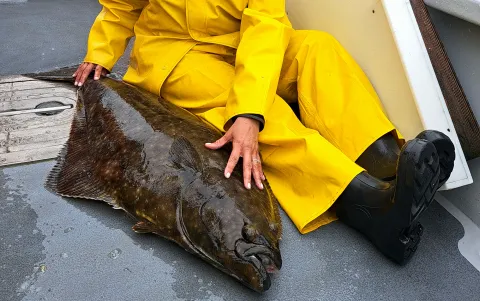
The fish was brought on board and it measured well over the 40 inches where non-resident charter anglers are allowed to keep a halibut in this part of Alaska. In fact, that fish measured a whopping four-feet and weighed an estimated 53 pounds. After snapping a few photos, that halibut was released back into the sea unharmed to grow even bigger and Josie’s day one prediction of catching the biggest fish on the boat came true.
After taking a short break to deal with fatigue from both the fight and sea sickness, she was right back on the rail for the final afternoon of fishing, reeling in half a dozen salmon in the process. In the end it just goes to show first time female anglers really can out fish all the experienced men on board, and Josie’s Tomcats were more than happy to be here supportive band as performed her greatest hit!
If you would like to find out more about the first-class fishing adventures available at Sportsman’s Cove Lodge for anglers of any experience level, go to their website at www.alaskasbestlodge.com .
/articles/josie-tomcats-go-alaska
Generational Fishing
I’m a new father. My daughter turns 2 at the end of July. It amazes me how fast time goes. My phone is fancy enough that it will create a collage of pictures and ask me “do you remember this day?” It’ll compile similar photos and quotes together with a caption along the lines of “outdoor adventures” or whatever else is sure to draw me in. I have to say, I like the features of the phone and sometimes I don’t remember the day or taking the photo.
Other times, the memory is clear and will get my brain churning to the before and after events of that photo. It’ll also lead to a great talking point with my family, or remind me to reach out to a friend who I was with during that time. It’s basically my generation’s photo album: a compilation of memories that elicit the sights and sounds of the past.
Seeing these photos and videos pop up on my phone makes me reflect on the journey I’ve been on. It makes me reflect and think about the life that was and the life I have now. The timestamped dates and pinpointed locations on the photos give me a clear reminder of when and where I was as I snapped those photos. Some photos I’ve kept in the camera roll for 10 or more years, other photos happening just yesterday or the day before. Each with a level of happiness and appreciation from the time. There clearly had to have been a reason I felt like the photo needed to be taken.
Even those photos of some random arrangement of letters and numbers for a code or a stall number in the parking garage so I wouldn’t get lost after a trip shopping. Although, that example probably has more to do with my wife than my own shopping adventures. Other photos are those milestones we will always remember but may not quite recall the details. Holidays with family, vacations around the world, a collage of our hobbies, or additions to the family. It’s those last two areas that inspire me to think about how thankful I am to be at this stage in my life.
Adulthood
Something about life before kids and life after kids is a pivotal point. The stage of “adulthood” that has a clear separation between life that was and now life that is. Those late nights I could go out and do whatever I wanted are no longer. There is now a little human who depends on me and my ability to have some foothold on my life. To use a baseball analogy, I wouldn’t say I need to be hitting home runs in all areas of life as a dad, although I’d certainly take them as they come, but there’s nothing wrong with taking the day-to-day with solid doubles to right center field.
I might even strike out a time or two, or if I’m having a particularly hard time navigating whatever the challenge of the moment is ground into a few double plays. The goal I think as a parent is to limit those outcomes as much as possible. To be a constant source of support, happiness, and guidance for your kid as best as you know how. It’s cliche to say, but my wife and I didn’t get an instruction manual when we left the hospital with our child.
It’s my hope that I can inspire my daughter to enjoy many of the same hobbies I have while also encouraging her to find her own. I’m into fishing, sports, and good TV shows. She might enjoy music, writing, or computers. Whatever the case may be, there are areas in our lives that will overlap and find common interests. I surely hope that enjoying the outdoors, and fishing specifically, are among the shared hobbies.
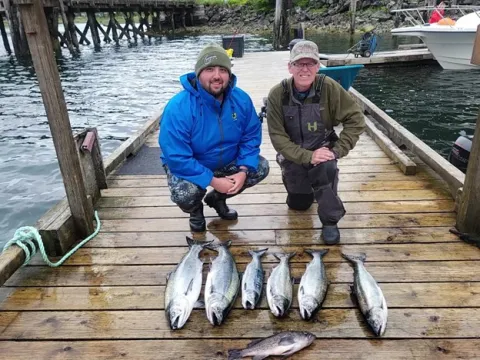
The patience and independence we learn with fishing is invaluable. Soft skills such as being able to hold a conversation during down time or to celebrate someone else’s success are also an important area we learn as fishermen. I hope to share the many hours on the road traveling to different bodies of water with her as I did with my dad. I know my growth as a man is in large part to his teachings when I was younger. I am also excited to see how he can impart his wisdom to her and influence her in a positive way. That kind of generational guidance goes far beyond fishing. Tying a knot, being able to read the water. Those are great, but the time spent together, and memories built are what is truly important. The three of us out on the water fishing? That sounds like a memory with lots of photos.
/articles/generational-fishing
Ode to the changing seasons!
I’ve always been a fan of the changing seasons, for the blustering chill in the air, and the transforming colors in majestic trees. Shorter days and longer nights. And who of us can ever forget, the hatcheries unleashing their beasts!
The Cowlitz River
The Cowlitz River is my favorite river by far. Every year we spend October 31st on the river for “Cowloween”. Catching monsters on the Cowlitz can be done in a variety of ways such as side-drifting, twitching jigs, back-trolling, hover-fishing, and casting hardware. The Cowlitz River Salmon Hatchery produces nearly 13 million fish each year, including about 1.3 million spring Chinook, 5.0 million fall Chinook, and 3.2 million coho salmon. This hatchery is located near Barrier Dam and the Barrier Dam boat launch.
It is no secret that the Cowlitz River is known for some of the best Salmon and Steelhead fishing in the state of Washington. Anglers swarm from around the country to get a chance to catch Chinook Salmon, Coho, and Steelhead. Don’t let its popularity dissuade you, there is still plenty of elbow room. If you don’t have a boat of your own, plenty of seasoned experts offer fun guided trips.
I have been fortunate enough to catch a regular ride with Sather Guide Service. Jared is a skilled captain and fisherman. He has the ability to drive his boat backward with a foot while casting. You are guaranteed to pull in a whopper between Jared and his deckhand. These guys will set the hook if you like and hand it off. This makes for an exciting and fun experience for less seasoned anglers.
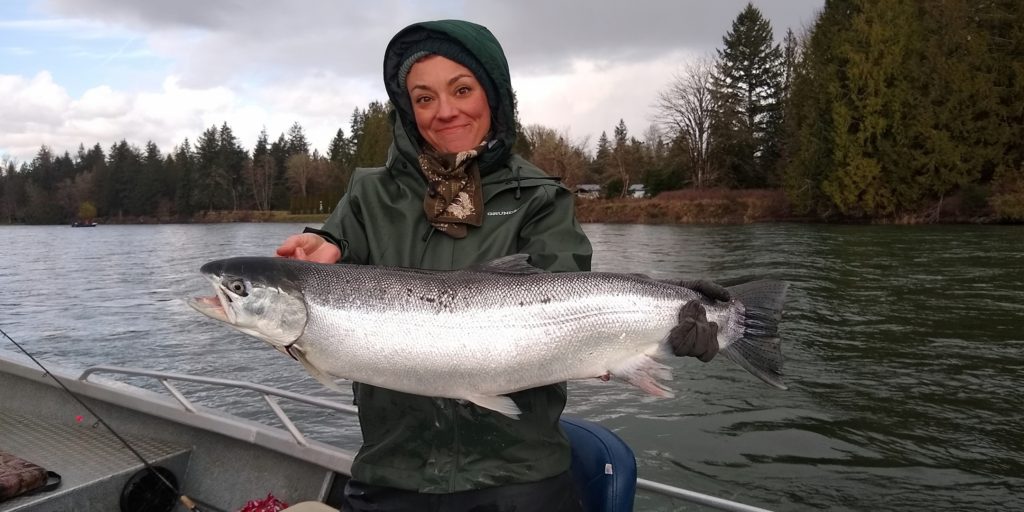
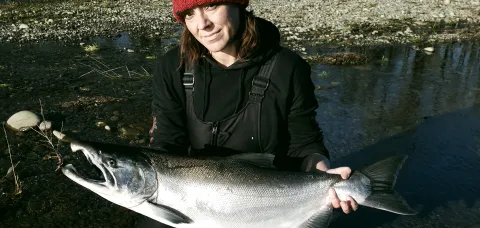
I set my own hook and landed these beauties. It is a team adventure, with jokes and snacks too! Jared has the stamina to fish dawn to dusk but is very conscientious of all guests should the need to go to shore arise. There are a few options for overnight stays near the Cowlitz. A few of my favorites would be Toutle River RV resort. We opt to stay in the “Love Shack”, a quaint little studio apartment. It’s affordable. Though proximity to the train tracks might annoy some, we enjoyed the entire experience.
The Castle Rock
The Castle Rock “Sky Cabin” is a fun experience. Like an adult tree house with all the amenities. Off the beaten path, but only around 20 minutes to the boat launch. If you opt to take just a day trip, there are plenty of great dining options, though I personally prefer renting a space with accommodations for making your own food.
In a pinch, you can find quality dining at El Compadre off Highway 504, The Oasis in Castle Rock or Papa Bears. We love to combine adventures, such as hunting for rocks, covered bridges, quiet trails and breathtaking sunsets. Into bridges? Try visiting the Cedar Mill Grist in Woodland, The fall colors and rambling waters are a sight to see. A quiet and awe-inspiring peek into the past. If you like beautiful rocks, you can find a variety of agates along the rocky creeks that amble the backroads along Highway 12.
If you are a fan of just fishing, the Cowlitz River is a great destination that is hard to beat. Launch early and stay late! It will be a wild ride full of catching and keeping!
/articles/ode-changing-seasons