/articles/categories/stories
My Memory of the "Bait Boy"
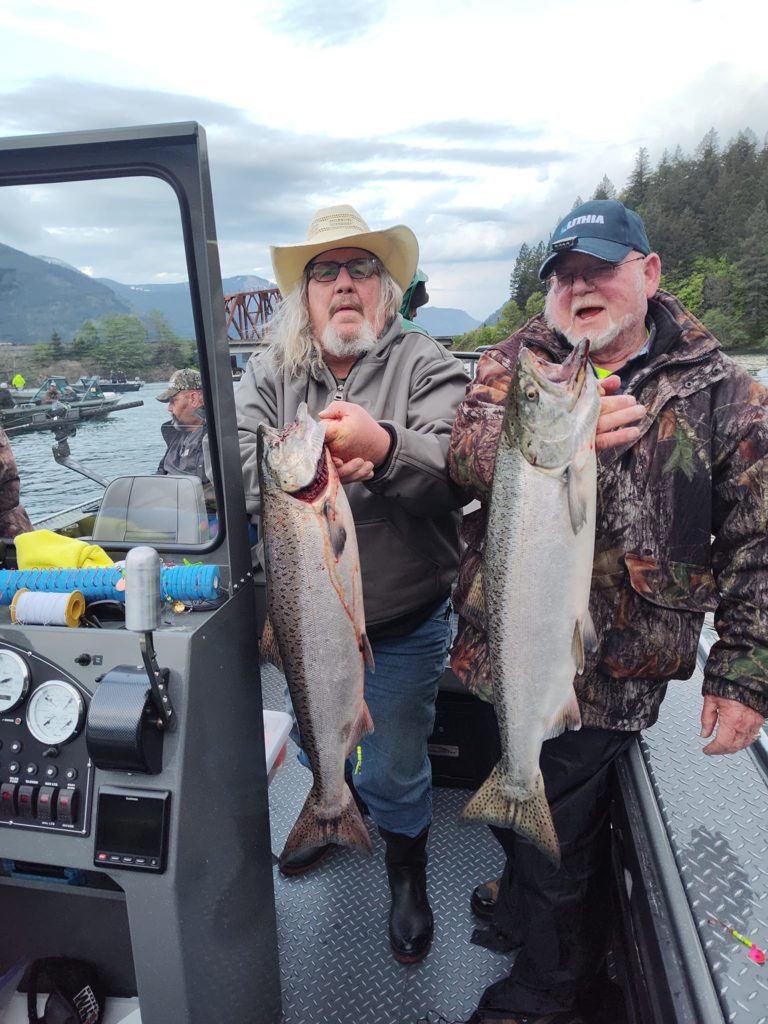
The first time I met Paul Hamilton was a brisk October morning on the Snake River at Heller Bar; he showed up with Rob Holman from Northwest Fishing for a combo Chinook salmon and Steelhead trip. This was first of many shows we filmed together over the years.
One skill I have developed over my 32-year guiding career is reading people. I can watch a person as they approach the boat and it's amazing what you can decipher in 1 minute. On this morning, Rob approaches with his crew and immediately I notice this larger man with a smile, cowboy hat and a mouth full of chew. By his appearance alone I knew this was my type of dude. Paul hopped on the boat with a spring, he was fairly agile, I could tell for a bigger man he was athletic. Sure enough, within an hour I knew his life story. Paul was a college wrestler and we shared good friends, many who had wrestled with him.
A Few Things About Paul
He lived in Hillyard which is a suburb of Spokane and sold insurance for Allstate. My pal loved Hillyard and loved selling insurance and he was very good at it. I feel fortunate that he was the type of guy you liked and trusted. After a few hours into the trip it was evidently clear Paul liked fishing and he was a excellent angler. He caught multiple Salmon and Steelhead.
He was very good on the camera. It's hard to find someone good on camera. Most people see the camera and immediately clam up, so when we are filming a show it's nice to have a personality like Paul. Paul was a go-to person for some entertainment and good camera conversation.
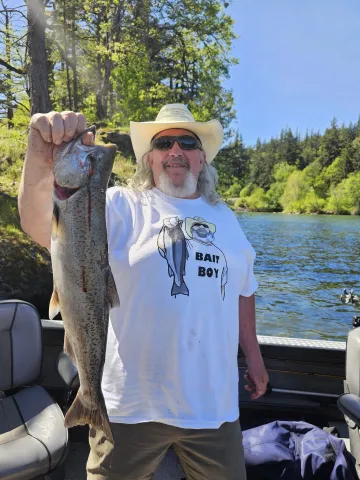
Over the years we spent a lot of time fishing and filming together. I joked with Paul and called Paul the CEO of Northwest Fishing. Paul and I got a kick out of this as everyone knows Rob holds that title (haha). Paul dubbed himself the "Baitboy" and really loved the title.
Our Last Trip
On my last trip with Paul was to Drano Lake and the Wind River. Paul showed up with T-shirts with his image holding a salmon titled "Baitboy". I laughed and gladly wore it! Paul had brought some personal friends on this trip; they were longtime buddies. Those last two days were filled with amazing stories and fish catching. I'm glad to have known Paul, he was a character and enhanced any environment he attended. I will wear his shirt loud and proud just like Paul.Editors Note: Baitboy T-shirts are available at www.northwestfishing.net with all proceeds going to a newly established Paul Hamilton Memorial Fund to benefit youth in his community.
/articles/my-memory-bait-boy
Of Drinking Towns and Fishing Problems
I picked up a pair of hitchhikers on 3rd Street in Bend (I'm not talking about ticks this time), and neither of them seemed to know the other. The guy asked what I knew about panning for gold and the girl wanted to tell me she had read The River Why. And isn't that like all the people that come to Central Oregon?
One of the funny things I've noticed is on places like East Lake or Paulina or on Crane Prairie or Lava Lake, the fishermen stream back to the launch for happy hour. It's not because they caught so many fish, it's because they have dinner reservations at a brewpub in Bend. They leave the lake at the exact moment the fishing is getting good. Nothing wrong with not catching fish, except not catching fish.
I made a list of fishing towns in our part of the world, and it seems I could make the same list and call them drinking towns. Perhaps this is the core of the problem. Tourists come to a drinking town for vacation, but they have a fishing problem.
Places to Fish
They fish in the toughest part of the day and then want a beer because the fishing was bad. Here's a thought: drink a beer in the middle of the day and go fishing when the fishing is good!
I spoke to a fly-fishing club from Bellingham, Wash., and they wanted to hear about Central Oregon rivers. They knew about the big four - the Deschutes, Crooked, Fall, and Metolius. To fish them well, an angler is probably going to base out of Bend, Sunriver, Prineville, or Sisters, all towns with great restaurants and more than a few brewpubs. And also cone-lickers.
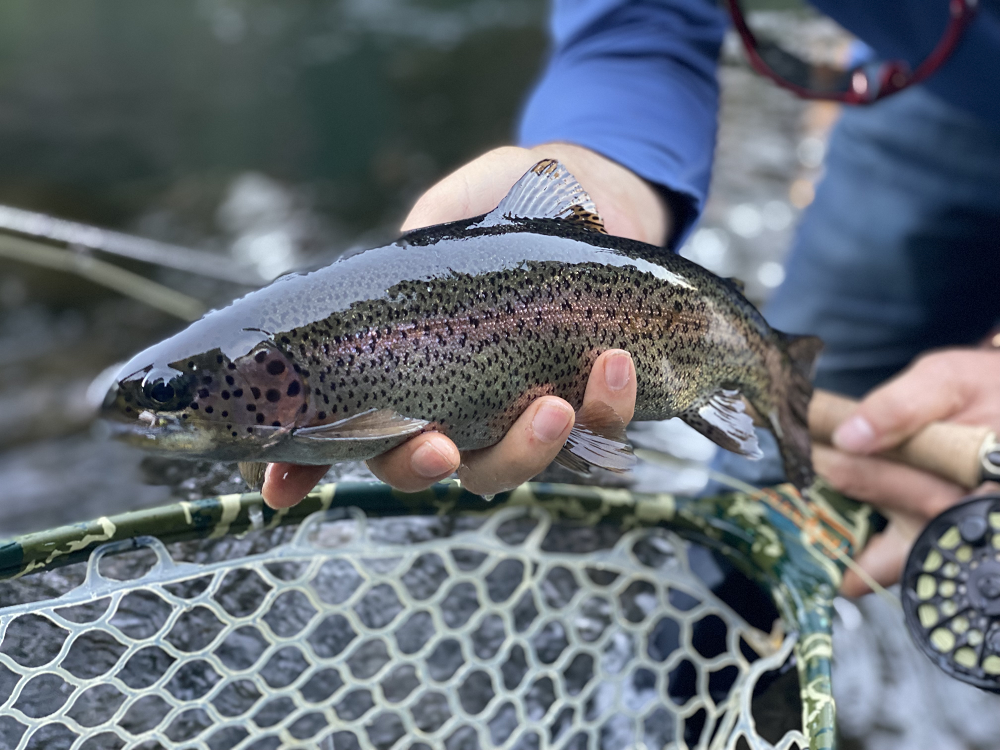
What about the White River? There are sections of the White that never get fished and the trout can get big. Or the John Day where an angler can catch 100 bass on the fly on any day in July or August. Or fish the McKenzie where the trout chase caddis above the surface! The North Fork Santiam above Detroit Lake can deliver great dry fly action. The Ana River fishes almost all year long with reliable hatches and a lake nearby (Ana Reservoir) with trophy trout. The Williamson can turn out wild trout that tip the scales in the teens and they take dry flies! The Upper Klamath Keno Reach can turn out crawdad-eating six-pound rainbows any day in October. How about the Wood? The Upper Willamette? The East Fork of the Hood? The Chewaucan? There are more.
Remember your Map
Get out a map. Accordingly, you still have a map, don't you? Trace those little ribbons of blue and find the nearest towns. You'll find places like Service Creek, Spray, Sumpter, Maupin, Tygh Valley, Summer Lake, Parkdale, Paisley (yes, Paisley), Westfir, Chiloquin, Blue River, and Wamic.
Fish the small rivers. Stay in the small towns. Stay at a bed and breakfast or in a tent, and get your breakfast at the tavern, and dinner too. Drop off a six-pack at the nearest fly shop and see what kind of good stuff they have been holding back. Drink coffee with the locals.
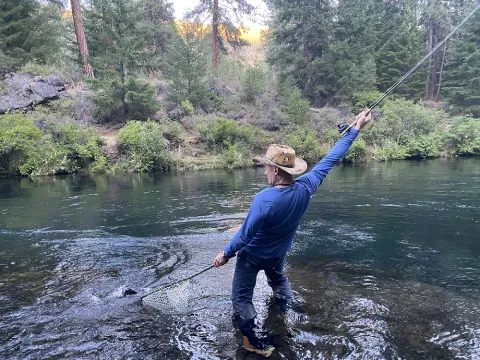
Therefore, Use a map and maybe a GPS to find hidden treasures - the places where you can't see the stream from the road, but you find a place to park and go down through the timber to the sound of the water. Wet wade and cast dry flies till sunset.
Wherever you fish this coming year, look at the landscape like a hitchhiker. Let's say you get dropped off in a small town in Utah, Wyoming or Washington instead of a Salt Lake, Seattle, or Cheyenne. Don't fish the big name waters. Fish the places you've never heard of.
I like to think that pair of hitchhikers is going to get married. On the honeymoon they would decide to compromise and devote their lives to protecting golden trout. And hopefully they can afford their own car. And deodorant.
# # #
For a copy of the Fishing Central Oregon book, send $34.99 to Gary Lewis Outdoors, PO Box 1364, Bend, OR 97709 To contact Gary Lewis, visit www.GaryLewisOutdoors.com
/articles/drinking-towns-and-fishing-problems
Sharks. Who needs em?
You’ve heard of Shark Week on Discovery CSharks. Who needs em? By Gary Lewishannel. This is not that. We booked two days on the F/V Miss Raven, a 43-foot fishing vessel out of Newport. Our mission was to find blue sharks in the deep blue, chum them to the surface, and stick them with feathers. We called it Shark Weekend. On board were my daughter Tiffany, Sterling West, Paul Galvin, Sam Pyke, Will Saunders and Mathew McFarland and his boys, Chisel and Finney. To catch sharks on the fly, Matthew McFarland prepared three rods, long sticks built to throw 10- to 14-weight lines, with steel leaders and bright feathered creations. Now all we needed were fins in the water.
We stepped aboard the Miss Raven and met skipper Mike Sorensen and his son Sean. Minutes after the safety meeting was over, the 300-horse John Deere diesel fired and we motored out of the harbor beneath the arch of the Yaquina Bay Bridge. When we crossed the bar, waves swallowed the lights of Newport. As dawn broke through the gray clouds, Sean threw the crab pots over and Mike marked them on the GPS. Then someone spotted harbor porpoises off the bow. For a few precious minutes, the porpoises ran ahead of the boat, their bodies briefly above the gray water, then beneath; twisting and spinning. And then as quickly as they had appeared, they peeled away. Twenty-three miles out, Mike cut the engine.
The Miss Raven bobbed in the deep swells that rolled through us. One moment we towered on a wave, the next we were in the trough. Here the ocean floor humped toward the surface. Here the baitfish congregate as well as the sharp-toothed predators that feed on them. Sean punched holes in a big kitchen wastebasket, then filled it with tuna heads and carcasses. Roped to the side of the boat, the basket milked tuna gore and soon we had birds above us - seagulls and albatross. Matthew and Paul rigged fly rods with steel leaders and big streamers. We watched the surface of the water for black fins. That was when we saw the sunfish. Ocean sunfish are a seldom seen species that make their living on jellyfish. They are as tall as they are long and can weigh up to 3,500 pounds. This one sunbathed at the surface and we were able to get a good look. In some languages they are referred to as moon fish, because of their shape. The Polish name means “head alone”; because it doesn’t have a true tail.
A school of 40 or so dolphins found us and ran through our greasy tuna chum line. They circled and came through again and again, breaking through the swells and flashing away below the boat. An albatross paddled nearby and took the fly in its beak. Then he dropped it. That was when I knew we would not catch a shark. The sharks had taken the weekend off. Out on the horizon, I saw a spout and then another.
A great barnacled beast breached, its great, gray body lifted above the surface. Foamy spray crashed out of the swell. In the afternoon, back in sight of the bridge at Newport, Tiffany dipped the hook and pulled in the first buoy. Sean put the rope on the pulley and we held our breath as the pot came into view, brimming with Dungeness crab. Minutes later, we took our stations, sorting males from females, throwing back the little ones. In the dark next morning, we motored south along the coast. Off Cape Perpetua, Mike Sorensen pointed out a watch station that was manned during World War II.
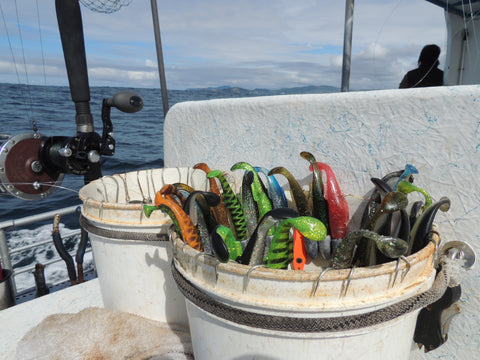
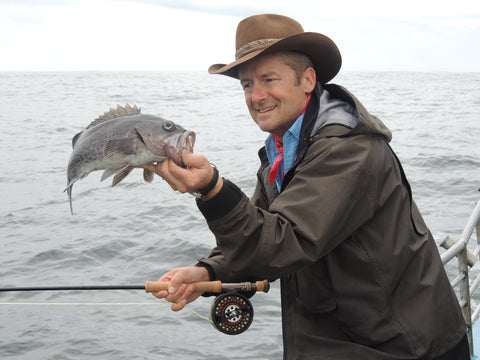
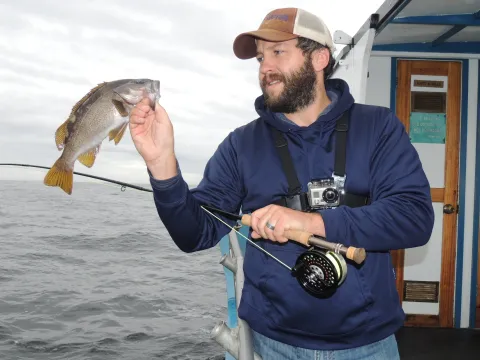
In range of the ghost coastal cannon emplacement, we drifted on a large underwater hilltop. Our jigs and flies bounced through a biomass of rockfish, and in moments, we had our first raw material for fish and chips. In one pass we had filled two-thirds of our limits. On the second drift, we had to call a halt and reel in. Multiple times we caught two rockfish in one cast. Once, we brought three fish aboard in one cast. We came away with a rich haul of crab and rockfish, but that sort of memory is quickly gone in melted butter and tartar sauce. We set out into the Pacific in the dark of the night and watched the sun light up the West Coast; we looked for one thing and found much more. Sharks. Who needs em?
/articles/sharks-who-needs-em
First water on the Rogue
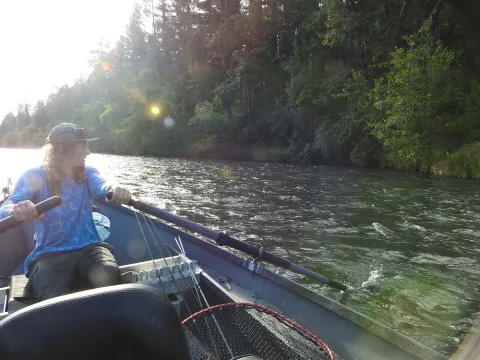
We slid down out of a tail-out and into the next riffle. I was in the bow, tilted into the front brace, rod up. "Cast left, this side has the fast water." Twenty-three-year-old Cole McAuliffe, of Chrome Tales Guide Service, was on the sticks, his curly hair around his shoulders. McAuliffe flicked the right oar and lifted the left. Water ran down off the blade and the boat caught in the current. I flopped an inelegant short cast, looped an upstream mend, and watched the two-fly rig catch the foam line past a jagged submerged rock. Sloppy but perfect. The float plunged and I lifted the rod into a summer steelhead that rocketed out of the shallow slot and into the air, twisting three feet above the water.
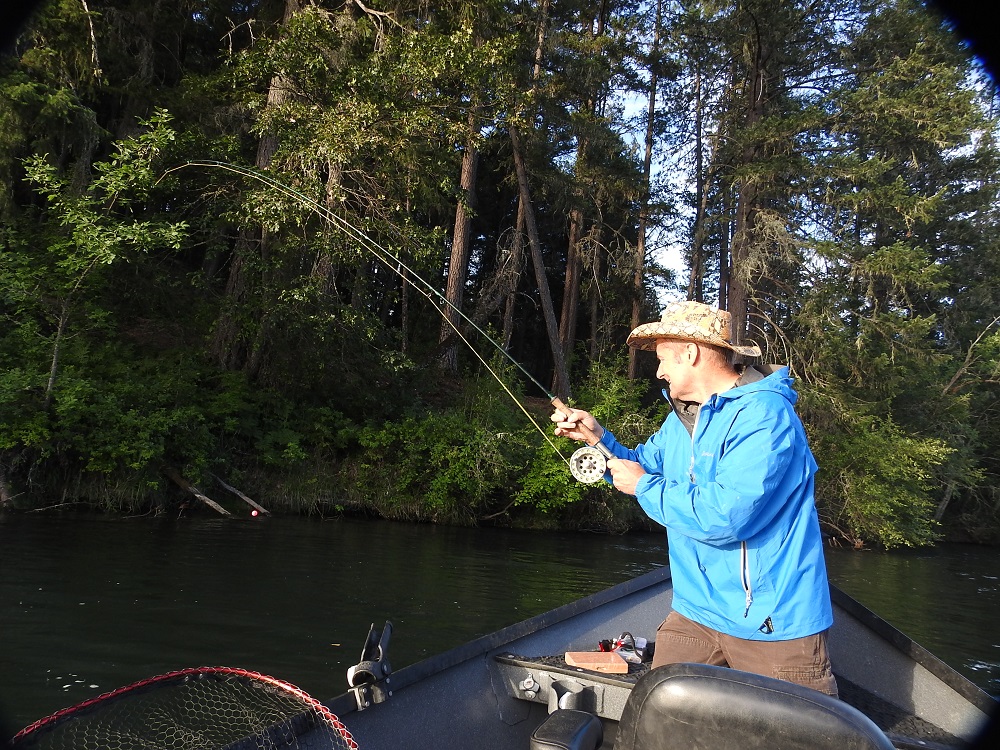
Oh, there is something about hooking a summer steelhead on a fly when you know the leader is 10-pound test and you have a lot of river!
We were only 20 minutes off the launch and no one on the water ahead of us or behind us. Is this not the great Rogue River? Where is everybody? But then I remembered, it was the hottest week of the summer and the rafts and tubes would hit the river about 11 in the morning. And I would be with them, except I'm older and smarter. We met each other earlier this summer when I helped McAuliffe find a highly efficient German shorthair chukar dog, and after the deal was done we both saw a drift-boat shaped hole in our August calendars.
Out of the launch with the sun just breaking over the Cascades, McAuliffe charged the boat straight across the river to a favorite run where a fat sea-run cutthroat waited for us. Now, barely ten minutes later, we had a steelhead on the line, on 10-pound Maxima, charging downstream.
Down through the tailout of the next riffle we followed it, and before I could get the fish's head up, it tail-walked again. Moments later, McAuliffe grabbed the net and made one stab for it when the fish was close, as if we had been fishing together for years instead of just the last 20 minutes. I jumped over the side into the shallows and lifted the wild fish out of the net and showed it to the young guide with the Wild Bill Hickock haircut, shooting my camera. But the fish was done with handshakes and flipped out of my grasp. Five pounds of shiny summer steel, back into the water from whence she came.
There are not as many good summer run rivers in Oregon as there used to be, as hatchery managers have ratcheted back on the good times we enjoyed in the '80s and '90s. Did we have too much fun then and now we have to work harder for our fish? Guess so. McAuliffe, by my calculations, was born at the end of that era and, as fishing guide is his chosen profession in the 2020’s, he is probably going to hear from a lot of middle-aged clients about how it used to be. Today a fishing guide has to work harder. And get up earlier in the morning.
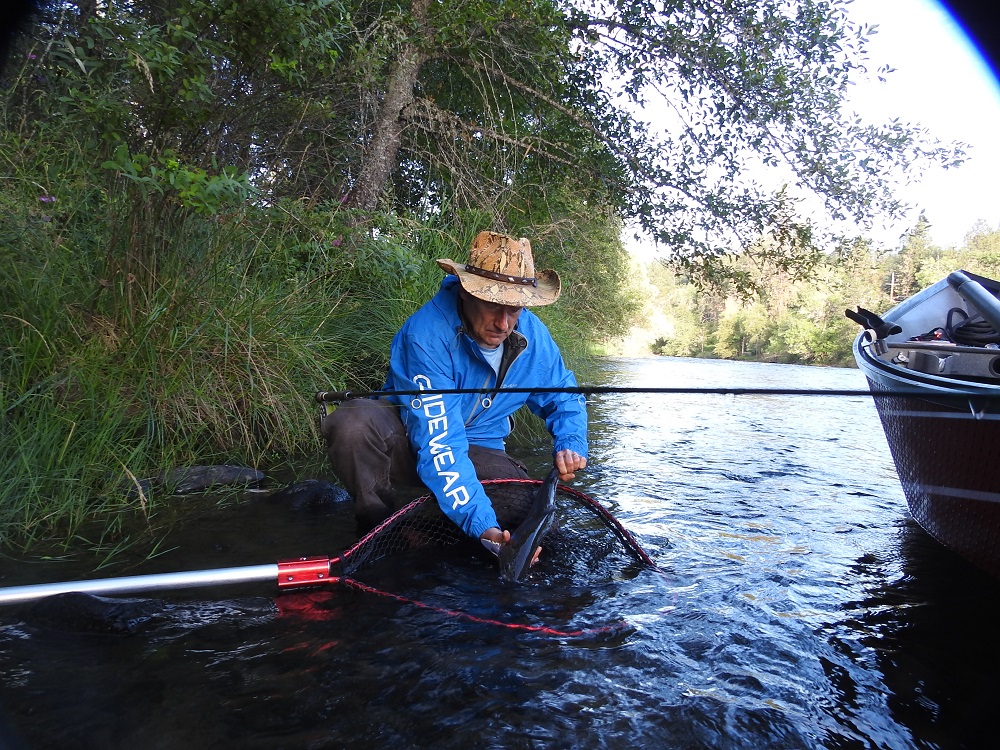
Now I had steelhead lenses on, reading water left and right, with Cole sliding the boat from one good slot to the other. Depending on the water, I used my fiberglass 5-weight to swing a fly or his 6-weight TFO with the float and two-fly rig. McAuliffe said the summer run steelhead season has started stronger than last year and while a lot of guides are using spinning gear, he prefers to stick with the fly rod.
At the business end is a No. 10 beadhead with a heavily weighted stonefly nymph to get to the bottom fast. We adjusted the float to run about 2X the depth of each run. We looked back upstream. Still no one behind us. Still no one ahead. We had first water all the way to the takeout. And trout in every drift. A few were hatchery rainbows and a few were smolts, and they beat the steelhead to the fly.
Trout chased the float, they chased the stonefly out of the water on the retrieves and swiped at the point fly, and I expected a fish on every drift. Get up early in the morning to beat the floaters and the cone-lickers. Go for the trout fishing and let the steelhead surprise you.
/articles/first-water-rogue
Alaska Memoirs
It was a foggy, rain-soaked day in King Salmon. One crusty looking grumpy guy in hip boots was clearly the ringmaster of what appeared to be a five-ring circus happening in front of me. An entire fleet of float planes were tied off to a massive wooden dock on the Naknek River. Dormant. Grounded due to the fog that socked in right down to my boots. Pilots were yelling at dock hands to get the planes loaded and the ringmaster just looked on with what seemed like surly disgust. Apparently, the tower was going to give special clearance for a few airplanes to fly. This fleet had been sitting for a couple days and everyone was anxious to make the planes do their job. It wasn't a time to be late to the party.
I sat there with my head down, staying out of the way, and waiting to be told to load up. I didn’t know a soul. I didn’t have any friends there. No family. No one. I was as alone as alone could be. The crusty looking grumpy ringmaster just called me “the kid from the south.” He finally came over to me and said “well kid, looks like I’m gonna have to fly you out to the Branch. Go ahead and load up in that 206 down there. I will be there in a minute.” I didn’t have the guts to ask what a 206 was. I knew it was an airplane but obviously it was a different airplane than the others. I knew that he knew I didn't know but, I wasn’t going to give him the satisfaction of delivering more surliness my way. Instead, I asked the dock hand that was getting yelled at the most. He was glad to load my two duffel bags and backpack in the right airplane. When the ringmaster returned, I quickly loaded up per instruction and that was it. Off to the Branch. Just like I had done it a hundred times.

Bristol Bay
That was not only my first day in Bristol Bay but, it was my first day in Alaska. Almost 20 years ago now. I had no clue how much it would change my entire life. As the years and seasons rolled on, the grumpy ringmaster stopped referring to me as “that kid from the south.” I earned my spot in the Bristol Bay community and made friends. In later years as my interest in aviation grew, the ringmaster would message me asking about weather conditions at my location. I became a part of an inner circle that once again, changed my life forever. I am grateful for all of it.
Alaska
By the time I started working in Alaska, I was no stranger to the duffel bag life. Living out of a couple of bags and a backpack was normal for me. I had just never done it in a location as remote as Bristol Bay. I read somewhere once that people who go to Alaska for work are either running from something, looking for something, or they are just too stupid to get a job anywhere else. I was all three. Maybe not too stupid to work somewhere else, but I was checking boxes on my resume. I needed Alaska experience to go where I really wanted to go. Trouble was that I had inadvertently fallen in love with Bristol Bay. She turned out to be the dirtiest mistress a fishing guide could have. The one that I couldn’t walk away from. The one that will kill you if you stay too long and ruin you if you leave too early. Bristol Bay has a way of doing both, no matter what you do.
If someone wanted to know exactly which part of Bristol Bay kept me returning for almost two decades, my answer would be “all of it.” Alaska is, without a doubt, the biggest adventure anyone can have. I’m sure somewhere in Siberia there is a bigger adventure but none of us are going there to do it any time soon. At least in my lifetime it seems that will be the case. Alaska has a certain captivating quality which speaks to those who are in fact, running, looking, or lost. Fishing fixes most everything and float planes fix everything else. Alaska has that in spades.
My Experience
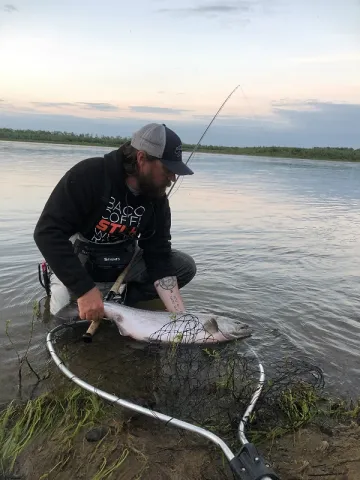
But honestly, as I sit here today trying to find a way to put in words that justly convey my experiences, the one thing that keeps coming to mind is the salmon migration. I lived for the days of hunting fresh, dime bright, chrome salmon straight in from the bay. No matter if I was up late studying weather patterns and maps trying to find a way to fly or if I was running a jet boat 50 miles one way down river to tidewater, it was the same rush. The satisfaction of watching waves of fish push a wake while migrating upriver, just as they have done for thousands of years. I lived for it. Dreamed about it. It’s the only thing I miss. This is the first summer in so many years that I have not been there for the migration. A couple nights ago, I dreamed about it. I was in the hip deep tidewater of the lower Branch. Fishing with my favorite 14’ spey rod. Chrome kings were streaming by, pushing wake. The tides were right, the skies were overcast and there was just enough wind to keep the mosquitoes at bay. Life was perfect.
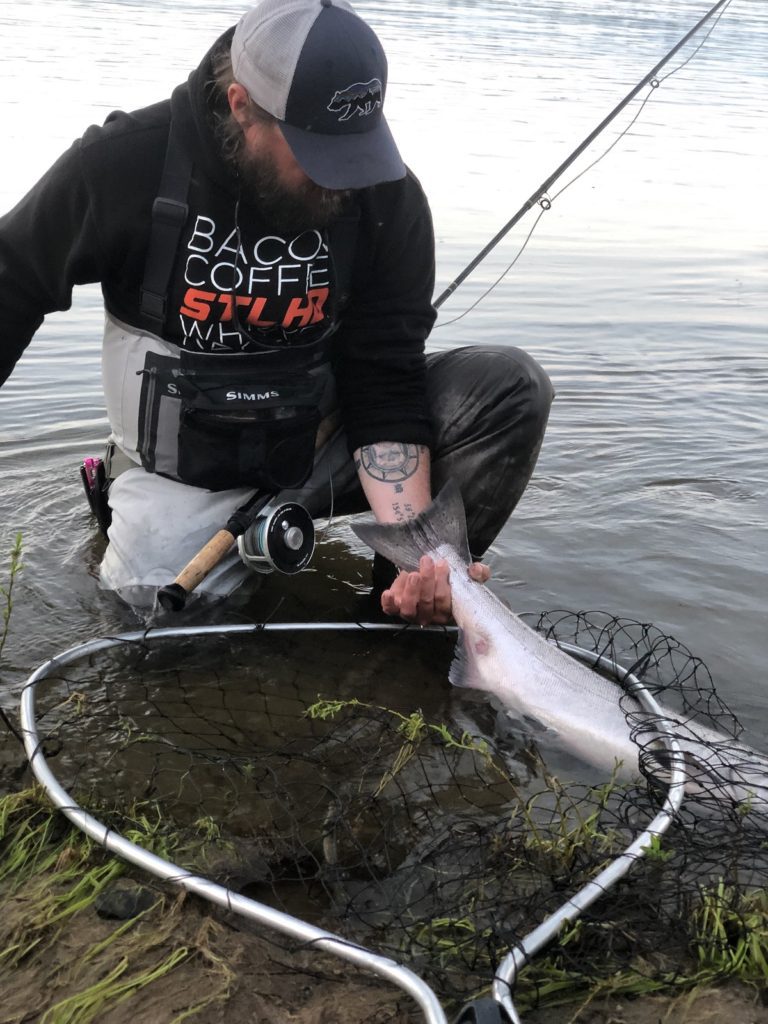
In my dream, I just stood there watching the wakes push upriver. Not fishing, not casting. Just puffing on a cigar and watching the whole thing happen. The dream was clearly a ridiculous romanticized abomination. Probably forced into my thoughts subliminally by some social media algorithm that doesn't really want people to fish, only act like they fish. Anyone that knows me knows that I can't smoke. It makes me deathly ill the next day. Worse than a hangover. I wish I could smoke cigars. It looks really cool. Most importantly though, the same people that know I can't smoke also know that if I’m breathing and capable of standing in the lower Branch, there is absolutely no chance I am not gonna swing for kings on a fresh high tide. No chance. Not now, not ever. It’s the one thing that will bring me out of retirement. Maybe next season..........
/articles/alaska-memoirs