/articles/categories/gear
Conconully Kokanee
Some new products are truly unique, for example, Wiggle Fins. These products create and define new methods and fishing techniques. Other products take a great idea, refine it and make it better. In this category falls a new kokanee fly produced by Arctic Fox Trolling Flies. I had the opportunity to recently tackle test this product on Lake Conconully and came away very impressed. It’s going to be a “go to” lure in my kokanee arsenal.
Denis Peirce, the owner of Arctic Fox Trolling Flies, sent me some flies to try out. He told me they were based on an eighties steelhead fly pattern, the Krystal Bullet. Of course, just making a copy of an old fly is not going to cut it in today’s world of new and innovative kokanee products. Denis knows that, having been in the trolling fly business since 1993.
He knows the industry and, more importantly, he has a wealth of knowledge and information about trolling for game fish. Thus far his focus has been on salmon and trout and he has teamed up with Wiggle Fins to make a phenomenal line up of larger trolling flies. It was a natural evolution with the recent explosion in interest for kokanee that Denis turned his knowledge and expertise to kokanee flies. Hence, his new series of kokanee trolling flies.
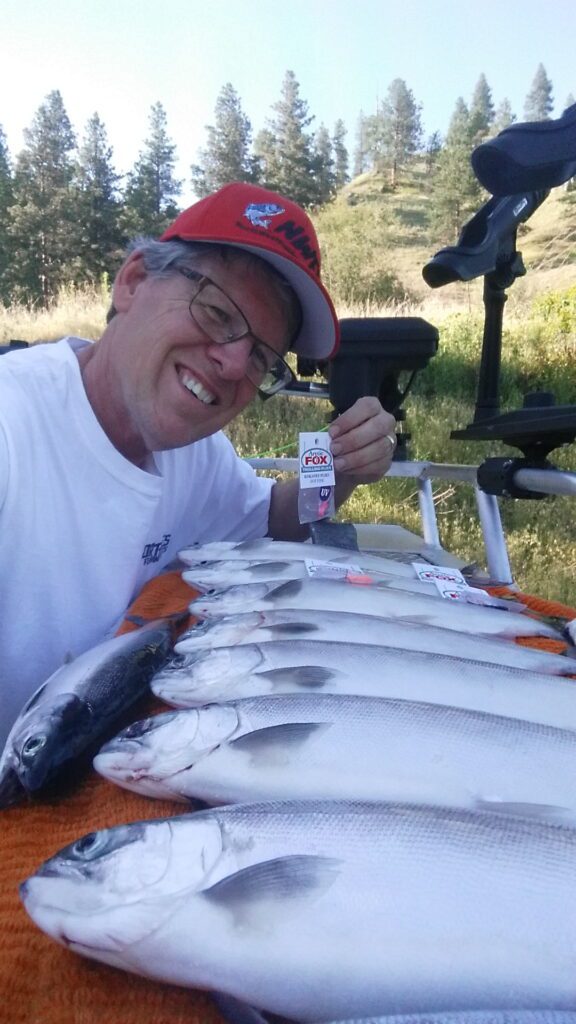
My wife JoAnn and I took our annual trip to Conconully to try the flies out. We stayed at our favorite resort, Liar’s Cove on the lower lake. The ambiance is family-friendly and the fishing in Conconully around Memorial Day is off the charts! Both the upper and the lower lakes have excellent trout and kokanee action. The upper lake the past few years has produced the larger kokanee so we decided to start our test there.
We ran four lines, two off downriggers and two off leaded core long lines. Each rig had an Artic Fox Trolling Fly and a dodger in front of it. Leader length ran 8-10”. The flies come without leaders. This is actually something I appreciated. If you’re like me, over time a successful lure gets bit a lot and the leader becomes frayed and needs to be replaced.
Unlike hoochie or spinner rigs, single flies are quite easy to quickly replace the leader. Another option I like is the ability to adjust the leader to conditions. For Conconully we ran 12 pound fluocarbon leader. We ran some flies with no attractor, some with a small spinner blade, and some with a Mack’s smile blade. All rigs had a piece of corn on both the primary fly hook and the trailing treble hook.
We started fishing at a leisurely 8am. The action began slow but gradually began to build. At the start, we caught a fish here, a fish there. I can’t say that there was a significant difference between the flies that had attractors and the flies that were “naked”. We ran the downriggers at 35 and 45 feet deep, chasing meter marks. Last year, the downriggers performed well for us. This year, it was a leaded line show. We eventually reached the point where the action was fast enough that the downriggers got put away and we just ran two rods with leaded lines. We trolled with three colors out, and 60 feet of mono leader, trolling at 1.1 to 1.4, using an itroll from ifish solutions to vary the trolling speeds automatically.
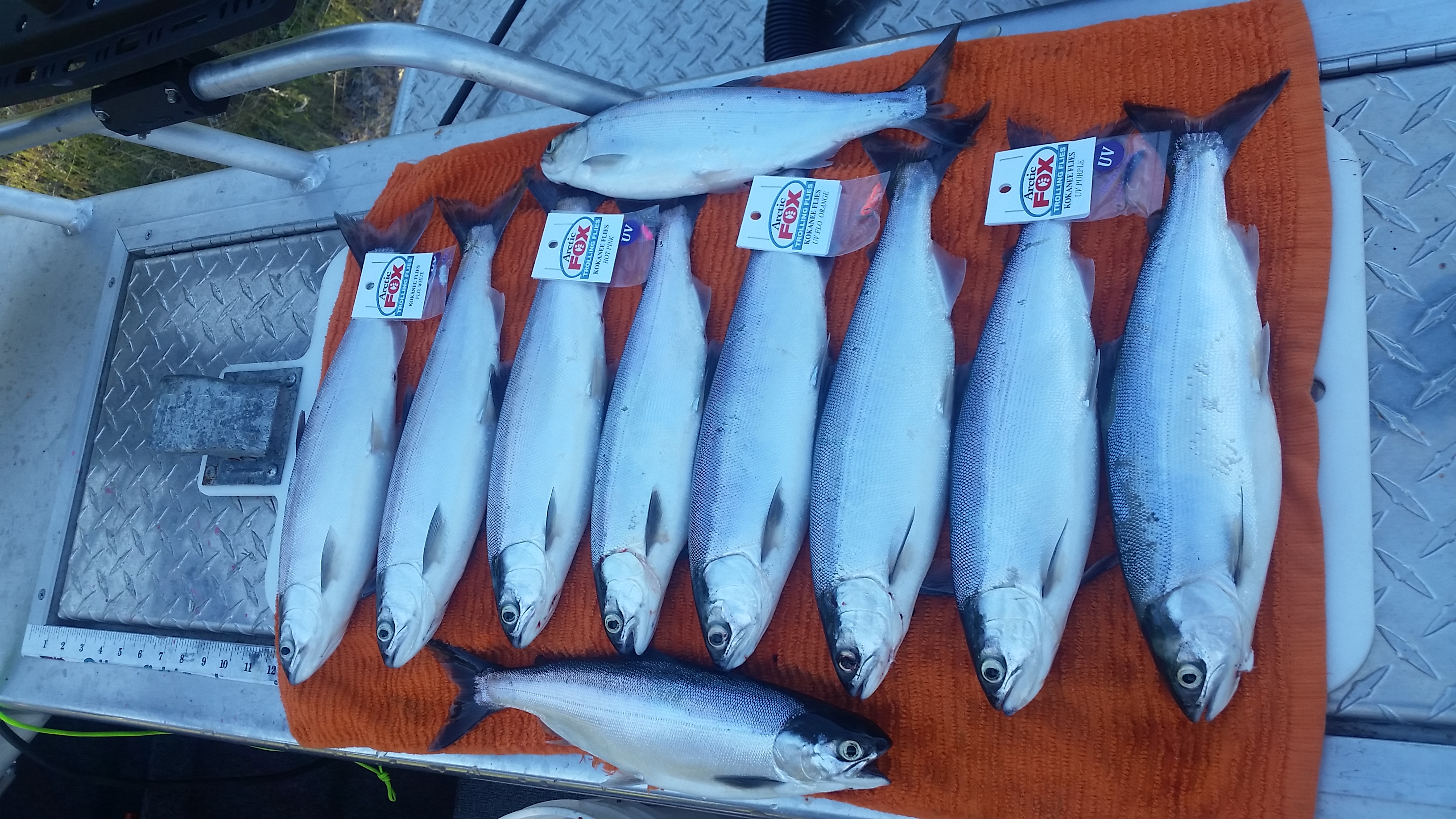
The fish at the upper lake were a plump 14-15” fish, shiny bright. Much to my surprise, later after cleaning the fish I had one hen that spilled mature eggs out. Other than that it was mostly bucks in our bucket. The hotspots for us were up lake of the houses to the narrow north end of the lake. Close to shore, middle of the lake – the kokanee are everywhere right now. Watch out for floating logs and debris. The lake has received more runoff than in past years so there is a lot of debris to avoid.
The Arctic Fox Trolling Flies were an obvious hit with the kokanee. Denis has definitely created an effective series of flies for kokanee.
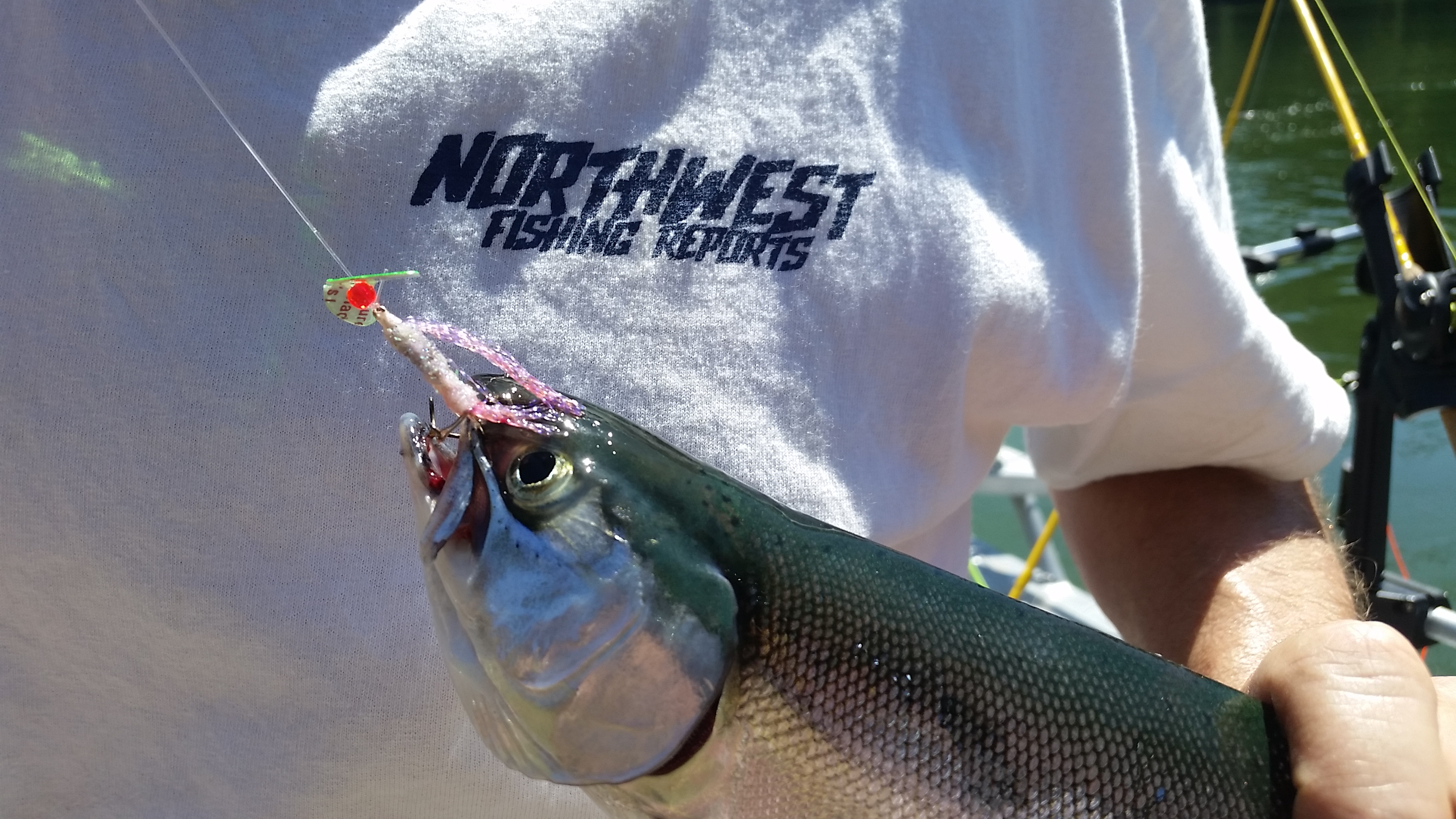
The Arctic Fox Trolling Flies Kokanee series come in seven different colors. Five are fluorescent chenille and mylar. Denis reports that under UV light these flies are very “hot”, meaning they have excellent underwater color reflection. The two non-fluorescent flies are fire red and purple with silver core chenille. Purple remains visible at depth, while red is one of the first colors to be filtered out by water depth, meaning it turns grey-black at depth. The mylar, however, gives it a nice contrasting UV orange that continues to reflect available light at depth.
With seven color choices you’ll be able to fish whatever conditions you’re presented with, from cloudy Pacific Northwest to bright Central Washington days. You’ll also have a sufficient variety of colors to find what the finicky kokanee want on any given day.
For us the hot set up was without a doubt the orange with 10” of leader and an orange crush wobbler run at three colors out. The fish were just slamming this set up!
One concern I had when first checking out these flies was the size of the hooks. The main fly is tied on a #8 long hook, and the trailing hook is a #10 treble hook. Denis uses gamakatsu hooks and I will be the first to attest that these hooks are sticky sharp! Our experience was that the combination of these two hooks was incredibly effective.
We had few lost fish and noted several that missed the main body hook but were secured by the treble hook. Remember when I started this article and mentioned “refining” the pattern? Well, Denis has taken the treble hook and secured it using a loop of stainless steel leader that creates an articulation for the treble hook that the fish have a hard time throwing. Put another way, the treble hook is free to move around meaning the fish can’t get leverage on it to pull the hook free. I’ve reviewed underwater footage of kokanee and one thing that struck me was that once a kokanee is hooked it does incredible body shakes and spins in a desperate attempt to get away. It’s amazing we catch any of these acrobatic fish at all! Any small edge an angler can have against these wild gyrations will help land more fish. I would say our hook to catch ratio was higher than trips using standard kokanee lures.
JoAnn and I continued to pull in plump, healthy 14-15” kokanee and over the two days of fishing and easily got our limits. I came away very impressed with the Artic Fox Trolling Fly kokanee series. I’m definitely moving it into my first tier of kokanee lures. I like the smaller size profile compared to the majority of the kokanee lures on the market. It gives kokanee anglers an option to downsize when the fish are looking for a smaller presentation. With the articulated treble hook I don’t have any concerns about losing fish due to the smaller hooks.
Give these flies a look see! You can order them online at Arctic Fox Trolling Flies.

/articles/conconully-kokanee
Kayak Innovation
The word “kayak” means “surface” or “top” in the Inuktitut language, a dialect spoken by the Inuit people. The Inuits started paddling around kayaks some 4000 years ago in pursuit of wild game. Today, the kayak market is a rapidly growing industry in the fishing world. Over the past two decades, kayak companies have made giant leaps in bringing new and innovative products onto the fishing scene. These advancements have made what was once just a simple human-powered watercraft, into now, what is a very formidable fishing machine.
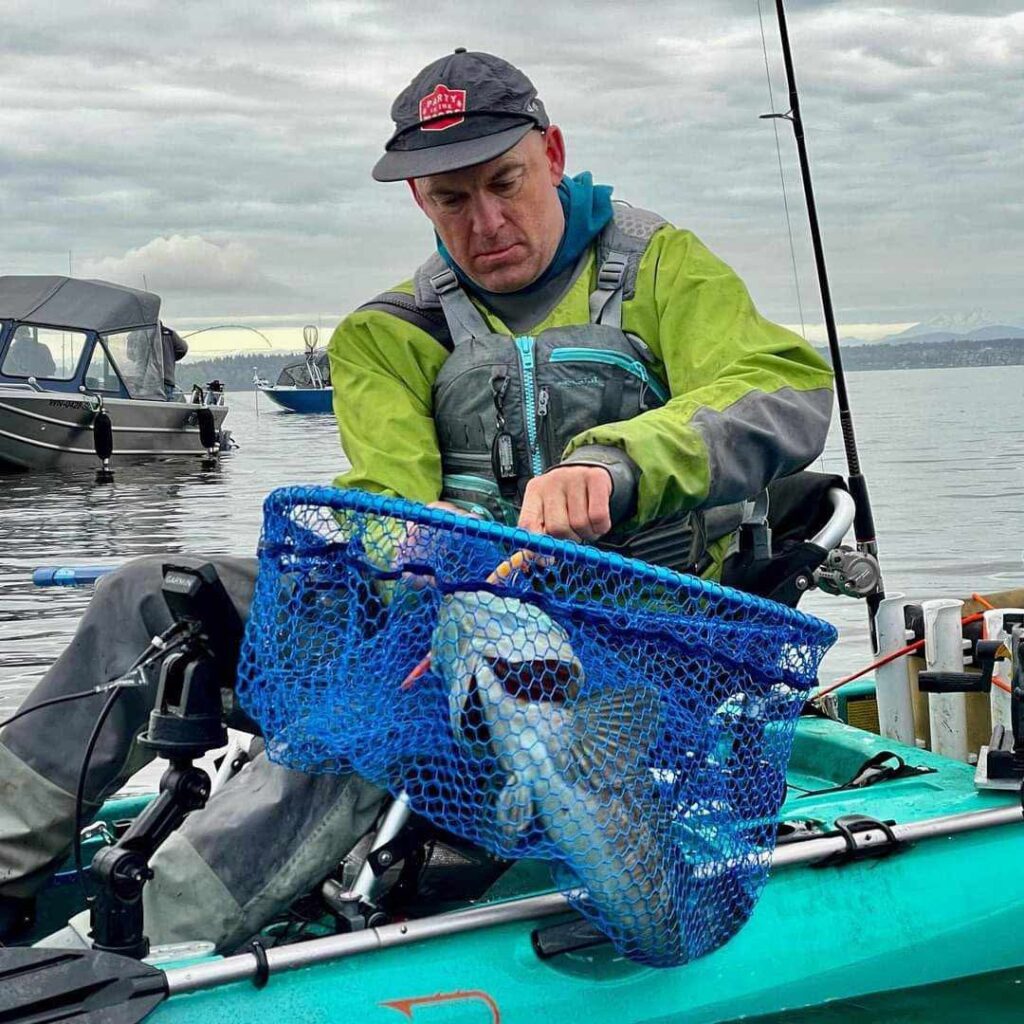
Why a kayak and not a traditional fishing boat you ask? There are more than just a handful of reasons why kayak fishing might suit your needs better than a larger vessel. Here are some of the more popular justifications:
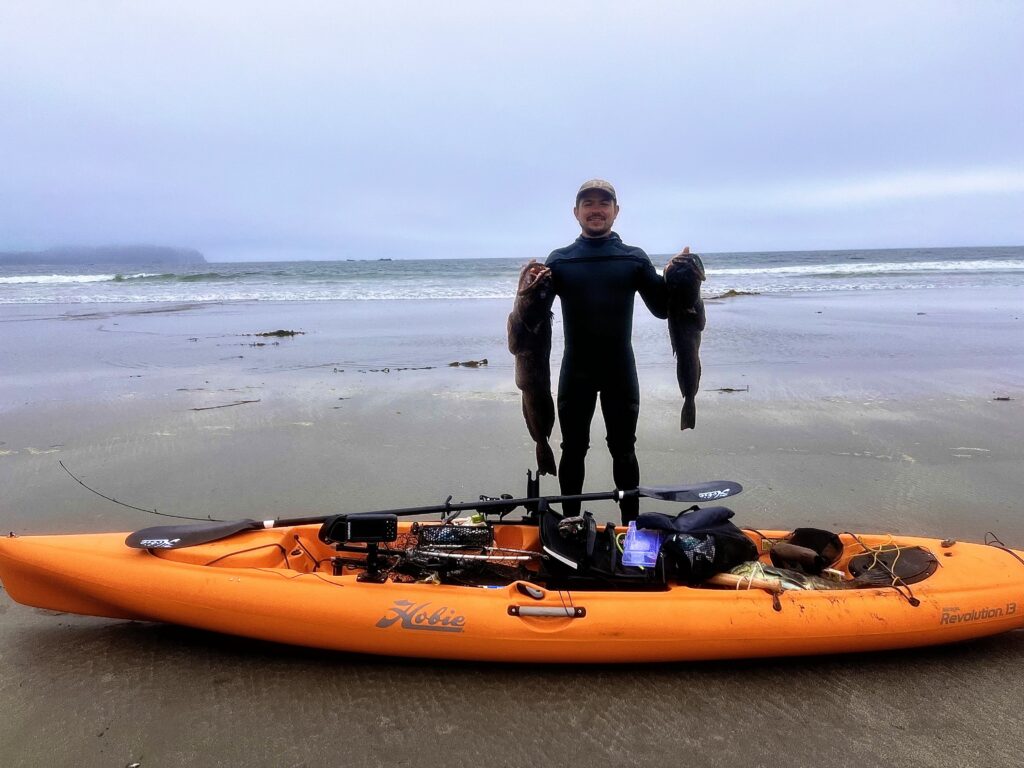
Portability. Kayaks are quite easy to move around, and they generally won’t require a trailer. Even my 13 ft Hobie Revolution can be toted on top of a car as small as a Prius with the proper roof rack installed.
Simplicity. Kayaks are the minimalist’s best friend. There's no combustible engine requiring loads of maintenance, fuel, and oil. In a kayak, you are the motor. Now, that’s not to say kayaks can’t start losing some of their minimalistic qualities. There are loads of add-ons, knick-knacks, and even electric motors that can sometimes blur the line between a kayak and a traditional fishing vessels. More on that later.
Maneuverability. Kayaks can get into tight spaces and shallow waters that might not be suitable for larger boats. This is great for things like the seabass fishery, where rockfish like to hang out in shallow kelp beds along the straights of Juan De Fuca or the north coast of Washington state.
Kayaks are work. You heard me right, kayaks are physical work, yet that’s why many of us love them. Getting in a solid workout in your pursuit of fish is part of the appeal for many of us anglers. I can tell you firsthand there’s nothing like landing ashore with a stringer filled with 30 lbs of fish and a body that lets you know you just earned your catch in every way conceivable.
Getting prepped. Winter is a great time to either prep up your current kayak for the not-so-far-off warm season, or to even investigate a new boat if your wallet permits. Let’s take a look at some of the more recent kayak innovations and see which ones might suit your needs for the upcoming fishing season.
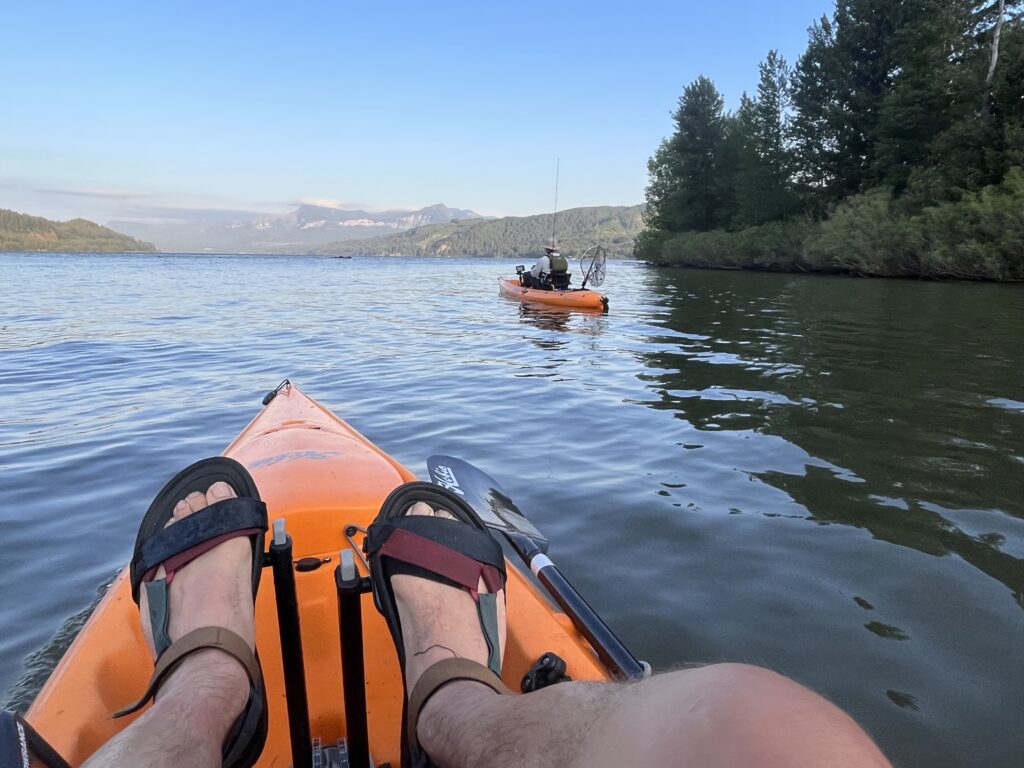
Pedal drives
The pedal drive was hands down the most groundbreaking innovation when it was introduced by Hobie around 20 years ago. It tackled one of the biggest issues with kayak fishing, which undoubtedly was having your hands tied up with a paddle instead of a fishing rod. Not only do they allow your hands to be free, but they also allow you to stay at a given location on the water despite it’s current. There's nothing worse than drifting when you don’t intend to and being pushed away from fish or being dragged over a snag point.
There are two main types of pedal drives to consider when choosing a kayak, the one you chose will largely depend on personal preference. The options are the push pedal drive or the rotational pedal drive.
Push pedal drive
The push pedal drive works exactly as the name implies. You push forward with one foot and alternate to the next foot as you move along the water. A few things to keep in mind when using these drive systems. The distance between the peddles and the seat can be adjusted. You’ll want to make sure you have this fine-tuned before putting in a significant number of miles on your kayak. Wrong positioning can lead to undue strain on the knees and leg muscles. Foot positioning is important too.
For example, having your feet too low on the peddles can also lead to excessive strain on the knees. Finally, a fair amount of training on calm waters with little to no current should be done before plunging into fishing adventures that will require you to travel long distances over the water or require you to kayak against strong currents. The goal here is to ease yourself in and build up the muscles required for a type of leg movement that isn’t exactly natural to us.
A big pro about the push pedals is that they use a fin system. This system consists of two flexible fins that move side to side as you peddle. Some of the newer systems have a feature that will allow the fins to flex backward toward the stern of the boat if you were to accidentally get into shallow waters where the fins might otherwise drag and potentially break on the bottom. Fins also hold up well in weeds and kelp and rarely present a significant risk of getting tangled in underwater vegetation.
Rotational pedal drive
If you’re a cyclist or better yet, a recumbent bike cyclist, then you’ll already be familiar with the movements necessary for the rotational pedal drive kayak. This drive system works just like a recumbent bicycle. You sit in the seat of your kayak and peddle in a rotational motion mimicking the movement of what you would find on a bicycle crank. These pedal drive systems are favored by some kayakers as this is a movement that we are typically a bit more familiar with, however, some argue that the efficiency of the rotational system is lacking when compared to the push drive systems. Another thing to consider is that rotational systems use a prop for propulsion as opposed to a fin system. Props are prone to tangles with weeds and kelp, so the angler running one of these systems should be cautious of underwater obstacles like these.
Backing up
Both push and rotational drive systems offer reverse as an option. However, these come at a cost. Many of the cheaper peddle kayaks don’t offer a reverse option, so this is a factor to consider when shopping around for a kayak.
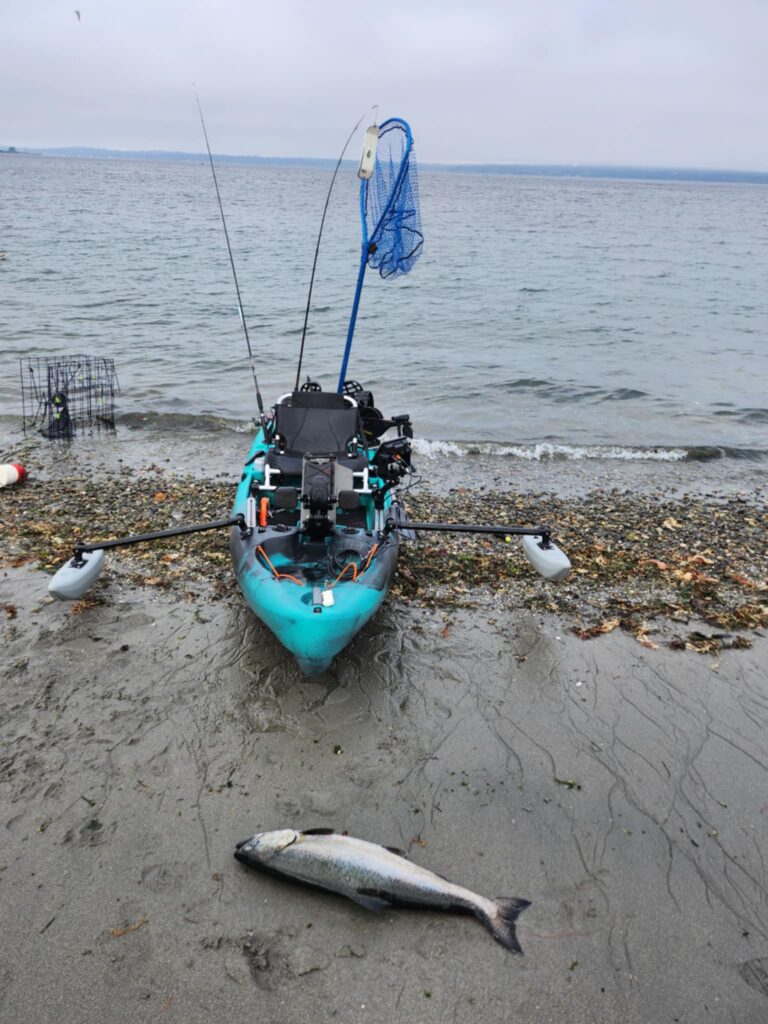
Rudders
All peddle drive kayaks come with a rudder to control the left and right movement. Instead of using your paddle to turn, you will use a lever (typically to your left) that will allow you to direct your boat.
Integrated transducer mounts
Traditionally, if you wanted to mount a transducer on your kayak for your fish finder, you’d have two options. The first option would be to either buy (or rig up) a transducer mounting arm that will mount to the rail of your kayak and run down the side and into the water. This works, though it creates drag in the water and could get in the way of your fishing. The second option would be to mount a transducer inside your hull at the bottom. The transducer would need to be encapsulated in something like plumbers’ putty and then fixed to the bottom plastic of the hull. This creates an airtight environment for the transducer and allows the signal to be emitted uninterrupted into the water. Both options work yet are not ideal.
Integrated in-haul transducer mounts eliminate these cumbersome and sometimes difficult-to-install systems. These integrated mounts provide predrilled holes with a fixed path for your wires to travel from the fish finder monitor at the top of the boat, down through the hull, and then to a protected compartment at the bottom of the kayak. Here the transducer itself is submerged in the water yet protected by a plastic plate that keeps it from getting banged up by underwater objects.
Increased buoyancy and standup-ability
Kayaks that have stand-up ability aren’t necessarily a new concept, yet it is a concept that is being more widely integrated into peddle kayaks and kayaks that are electronic motor compatible. These kayaks typically have increased hull buoyancy and hull width to allow the operator to stand up while fishing. Some are built with an open deck to increase the surface area for your feet while standing. Standing up provides a great advantage while fishing by allowing the angler to have better positioning for site fishing and affords a significant amount of increased comfort by allowing the angler to stretch their legs and move to new positions.
Electronic motors
Finally, we get to electronic motor drives. This is where we see the line between traditional fishing boats and kayaks start to get fuzzy. “Human-powered watercraft” is the term that has traditionally defined the kayak. Integrating an electronic motor certainly moves us away from that category, but still, the convenience of electronic motors is appealing to anglers who want their focus to be on fishing and not on peddling or paddling.
Motor-compatible kayaks have a few options for mounting the motor, and that will be determined by your specific kayak. Generally, the options for mounting are the stern, the bow, or a couple of feet aft of the seat in the same port your peddle drive would normally sit in. Steering is achieved by either a motor tiller or a steering lever that controls a rudder.
Motor-compatible kayaks are built to support the weight of the motor, the batteries, the angler, and his or her gear. This means they are generally larger and heavier than your standard fishing kayak and more often than not, they will require a trailer to be transported to and from your fishing grounds.
Pulling a trailer for a kayak? Why not just get a regular boat? Well, that’s a valid question and is why I personally stick to kayaks that can be thrown on top of something as small as a Subaru outback. However, If you’re ok with charging and relying on batteries, you don’t mind using a trailer, and are ok with the extra volume and weight you’ll have to tote around, then motorized kayaks might work for you.
Spring will be here sooner than you expect, and hopefully, this info will inspire you to look at some of the many options out there in the kayak fishing world. Remember, the best way to beat the crowds is to get away from them. Peddling (or paddling) your kayak out into the open water will allow you to do just that.
/articles/kayak-innovation
Chasing The Chill: Your Guide to Preparing For An Ice Fishing Adventure
Ice fishing, often described as a serene and rewarding experience, is more than drilling a hole in the ice and waiting for the fish. It's an adventure that combines the thrill of the outdoors with the patience of angling. But to truly enjoy your trip and ensure your safety, preparation is key. Whether you're a seasoned pro or a beginner, this guide will walk you through the essentials of planning and executing the perfect ice fishing outing.
Understanding The Environment and Weather
Before embarking on an ice trip, it is crucial to understand the unique challenges posed by the frozen landscape. Understand the environment you're heading into, and how the weather has been, and will be for the day. You want the area to have sustained a decent string of cold temperature days to put a solid 4 inches of ice before venturing out.
Safety First
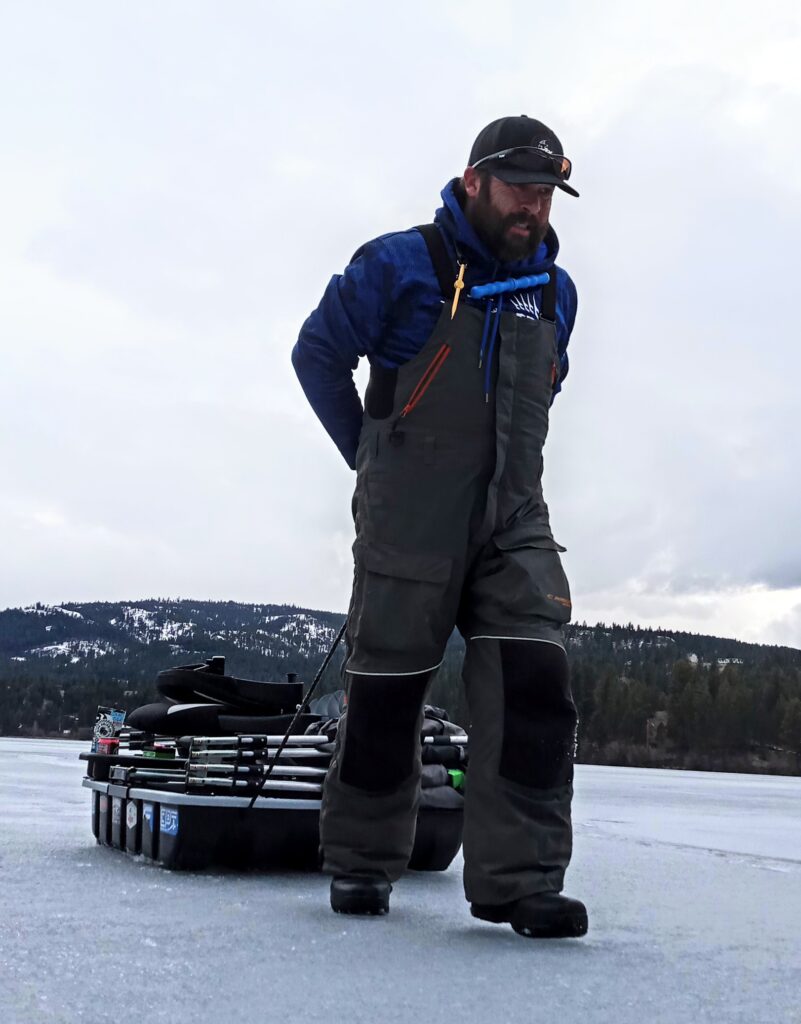
The first rule to ice fishing is ensuring the ice is safe, as a minimum of 4” in is recommended for safe walking. Carrying a spud bar early, and late season is non-negotiable, as you can check the thickness while walking out. Local fishing reports, weather conditions, advice from seasoned anglers, and even tackle shops provide valuable insight into ice conditions and safety. Additionally, investing in safety gear like ice cleats for walking, flotation devices, flotation suits, ice picks, and some rope won’t only enhance your mobility on the ice, but also offer crucial protection if the unthinkable happens and you fall through. Extra clothing and a blanket with you are good as well.
Gear Checklist
Ice Rods and Reels
Ice fishing rods are shorter than traditional rods, offering better control in a confined space of a shelter, or standing directly over the hole. Paired with a compact and durable reel, these rods and reels are typically designed for cold weather and built for conditions and the fight of winter fish. (Don't forget the use of Tip Up’s!)
Bait And Tackle
Top lures and prolites for most ice anglers are a spoon, such as a Swedish pimple, or a small 3mm/6mm tungsten jig tipped with a couple of maggots, waxxies, or your favorite plastic. Colors in shiny metallic, or glow are the most proven.
Ice Augers and Drills
You can’t fish without a hole, and creating that hole is impossible without an auger if it's manual, or even powered. Hand augers are plenty for most ice we get, and they're affordable and lightweight. I tend to stray away from the weight of gas and the mess, and instead, run a composite auger on a 20v drill. Please never use chainsaws, and in Washington state keep the hole no bigger than 10 inches.
Ice Shelter
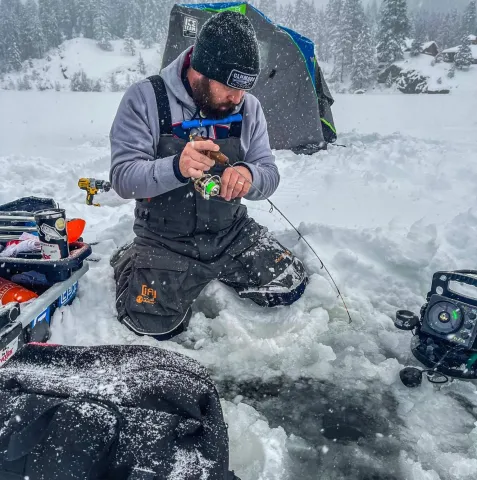
Having a portable pop-up shelter on the ice offers protection from the biting winds and keeps you warm and dry. Some are equipped with insulated materials to hold heat from the heater and sun lights can be installed; they are a nice, cozy add-on when on the ice.
Warm Clothing
Layering is essential for ice fishing. Start with a moisture-wicking base layer, adding insulating layers like fleece, and top it off with wind/waterproof wear. Don't forget thermal socks and good insulated boots, gloves, beanies, and a face covering to retain body heat. I always recommend overdressing, because you can always take it off, but you can't if you don't have it.
Planning Your Trip
Once your gear is ready, it's time to plan the trip. Here are a few tips to ensure a seamless experience.
Research your destination: Selecting the right body of water may determine the bite, its thickness, and species. Maps will be your best resort or just common knowledge of the lake over time. Other options include checking local reports from tackle shops, Facebook pages, state websites, etc. And always make sure to check the regulations for rules and limits!
Monitor The Weather
Harsh winter conditions can change rapidly, so keeping an eye on the forecast is critical to avoid venturing out into the storm, high winds, and extreme cold. Having a blanket in your car and safety gear at all times is a must, and always let family and friends know where you plan on fishing when you leave, and when to expect your return.
Plan Your Route on The Ice
Venturing out on this ice, may it be by foot, snowmobile, or ATV, make sure to know if there are springs on the body of water, stay away from streams and inlets as the moving water makes for weak ice.
Watch for crossing wet or dark patches if possible, and never if you can avoid it, access ice from the docks, as the sun can warm the docks and weaken the ice surrounding it. Always try to access from a shoreline. Don't forget to try and follow the same path back, since you know it was safe prior.
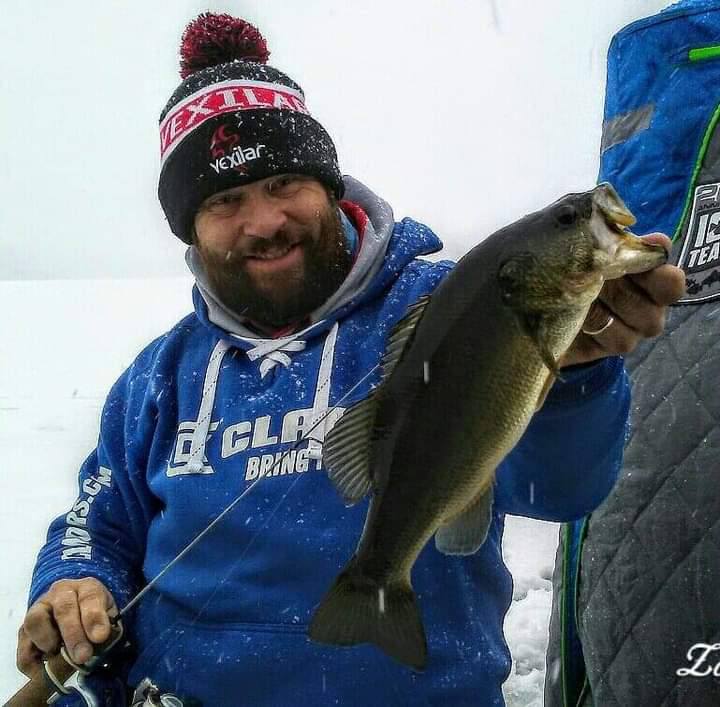
Before we go, just remember fish are active early morning and late afternoon hours so be prepared for long days. With schools of fish always on the move, fish near structures, weed beds, and drop-offs, and drill as many holes as you can to cover more water. This is where a fish finder comes in handy to find these spots quickly. Be as quiet as possible while moving from hole to hole, fish do spook easily as we’ve witnessed on cameras.
Fish behavior will change throughout the day with temps and lighting, so vary the depths of your presentation until you find the most active fish. Again, it's easy to solely focus on fishing and forget about your comfort. Stay warm and appropriately dressed, bring a thermos of something hot, and always carry water and snacks to enjoy a day on the ice all while respecting the environment by disposing of trash and packing out what was packed in. Respect nature, wildlife, and other anglers.
Ice fishing can be more than a hobby, but also a way to connect with nature, test your patience, and enjoy the camaraderie of fellow anglers. Every outing can be a learning experience with unique challenges and rewards. As you sit on the ice, surrounded by the quiet beauty of the frozen landscape, the cold becomes a distant memory. As I always say, “The tug is the drug!” and the joy of reeling in a fish are moments that make the preparation worthwhile.
With this overview, you're ready to tackle the ice, create memories, and perhaps catch the fish of a lifetime. Bundle up, grab your gear, and embrace the chilling adventure that awaits you!
/articles/chasing-chill-your-guide-preparing-ice-fishing-adventure
Winter Steelheading – Fishing for the Elements
My favorite time of year is upon us.
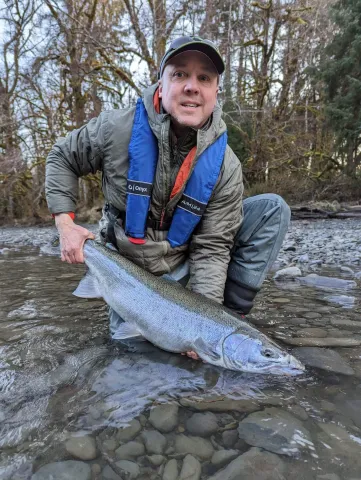
Soon, winter steelhead will be entering our rivers to begin their migration to their natal spawning grounds. If you are a “steelheader” then you savor this time and are excited to begin your piscatorial pursuit of this elusive species. For me, there is no greater pursuit than winter steelhead.
Summer steelhead often enter the rivers in the summer and hold over until winter and even spring. Winter steelhead migrate into their natal rivers during the winter months, starting as early as mid-November, and often hold over to spawn in the spring. In some systems, the two collide and spawn with one another.
Unlike salmon, after spawning steelhead can return to the ocean to begin their cycle again and are known to spawn as many as 3-4 times during their lifecycle. Steelhead are less predictable and often harder to catch than salmon. They can be very finicky and the weather and changes in the water flow and clarity can vastly transform the approaches that we take to catch them. This might be the reason that we love them so much; they are not easy to catch and sometimes can be very hard to find.
While many of you might love to chase steelhead as I do, you likely dread the early mornings, the darkness of winter, the cold, and the wet. Let’s face it, getting out into the elements when they are at their worst is not for the faint of heart. It takes grit and determination and the overwhelming lure of this fish to motivate us to leave the comfort of our homes to brave the elements. The key to a great day on the water is staying warm and dry.
Since I started pursuing winter steelhead about 15 years ago, much has changed in the technology of the gear that we use. At the forefront of this technology, is the availability of clothing that will not only allow us to endure the elements, but to embrace them in absolute comfort. Many of us have a garage full of clothing that we have bought to stay comfortable.
I know that I spend a lot of time chasing winter steelhead on a river north of Seattle that is nestled in the mountains. It is often cold and wet when I float this river, with average daytime temperatures between freezing and the mid-40s on the average day. Some days are much colder and many days bring snow, sleet, rain, and wind.
I have found that the combination of cold and slowly getting wet over hours of floating is exacerbated by the reliable late morning and afternoon winds that blow through the river valleys. While we may start warm and dry, we often finish the day damp and cold. That warm cup of coffee at the end of the float is always a welcome sight.
So, how do you keep warm and dry? This is the million-dollar question, and I am here to tell you that it does not mean spending $1000s on high-end gear. The key that I have found is to layer and to make sure that you have an impervious outer layer to wear when it rains and the wind blows. The addition that I made to my repertoire last year was a battery powered, heated vest.
I bought this online for around $60 and it was the best money that I have spent. I am known to wear 3-4 layers below the waist and 6-7 above, and even then, I tend to get cold. This investment has been the single greatest factor in staying warm on the worst of days.
Here is my suggestion on how to dress. I will clarify that my opinion is based on either walk-and-wade fishing or floating a river in a drift boat. You will obviously stay warmer if you are moving, which you do very little when fishing from a drift boat. Start out with a good base layer of long underwear, both top and bottom. Wear a warm pair of pants or sweats over the bottoms, preferably something that is not cotton. Remember, cotton is rotten, meaning that when it gets wet, you get cold. I wear a pair of Simms M's Thermal Mid-Layer Bottoms which will set you back about $90. They are fantastic and keep you warm. Over these pants, I wear two pairs of socks and stocking foot waders with wading boots. My lower half, including my toes, rarely gets cold.
Let’s move to the top half of the body. Start with a base layer, a long-sleeve shirt. This should be tight-fitting to keep the heat against your body. I wear a second layer of long-sleeve shirt over this, generally a light fleece or mid-layer garment. At this point, I put on the battery-powered heated vest that is mentioned above. This is the keystone to keeping your core warm and remaining comfortable for the entire day.
After this, a puff jacket or fleece, followed by an impervious outer layer jacket, round out the ensemble. When it comes to the outermost layer, there is great debate. I will wear a Gore-Tex jacket when the weather is not forecasted to be super wet. This will generally stay dry enough, but I have yet to find a high-end Gore-Tex jacket that is water”PROOF”.
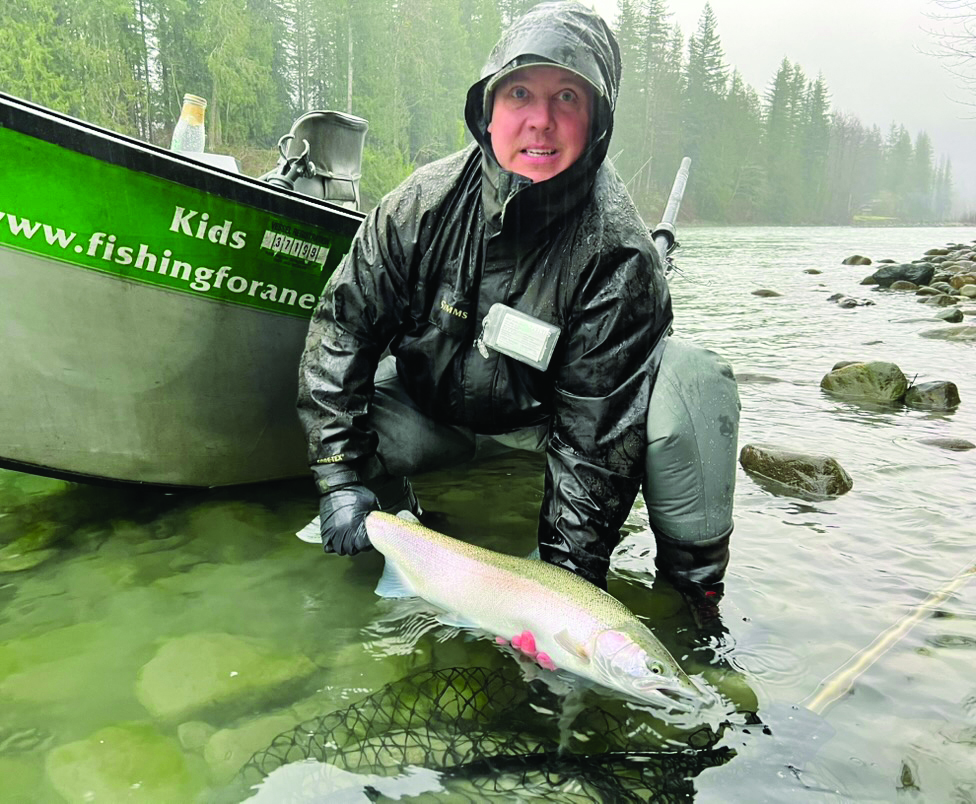
For really wet days, I rely on rubber. My go-to is something made by either Helly Hansen or Grundens that is designed for commercial fishing. There are many options and most cost less than a high-end jacket from Simms, Patagonia, or another leading brand. The key is to go with something that will keep the rain and wind out. Also, layering as outlined above allows you to dress and undress for comfort, as conditions change during the day.
I don’t want to sway anyone to a particular brand of clothing as we all have our preferences. I can attest to what has worked best for me based on years of trial and error as well as talking to guides who are out in the elements every day. Getting cold is a strong motivator to find a way to keep warm, so a lot of testing goes into determining what works best. I will leave it to you to listen to the research and advice of someone who has invested heavily in this process or choose to learn on your own. Hopefully, this is helpful, and you successfully chase steelhead in 2025, while remaining warm, dry, and comfortable.
Good fishing!
/articles/winter-steelheading-fishing-elements
The Last Ride
Boats are in my blood. From my early years as a young man, I have always had some type of floating vessel with which to explore (for me) uncharted waters. The curiosity of what lies around the next bend was as important as the fish that I was pursuing. Thankfully that curiosity has not diminished with the passing of the years. And now, in my third year living in Montana, the flame burns as bright as when I was younger.
To pursue my passion properly, years ago I realized that a one-boat family would just not cut it. My fleet gradually grew, one boat for saltwater and lake fishing, one boat for rivers, and one pontoon boat for peaceful floats. The diversity of boats allowed me to explore many of Washington’s lakes, rivers, and saltwater fisheries. I was (and am) truly blessed.
The Missouri River by Ulm is a slow-moving, deeper version of itself. A couple dozen miles upstream the trout fishing is renowned, and a day of catch and release for trout is generally the norm. But here the river slows, with deeper pockets that attract a more varied selection of finned pursuits to target. As the trout populations drop off, the warm water fish make their appearance. This is the river of pike, walleye, sturgeon, and catfish. To search out these noble warm water fish requires a different strategy. Drift boats are great for the Craig area trout, but from Cascade, downstream to Loma, and onward to the Missouri Breaks requires a boat that can safely navigate shallow runs, rocks, and sunken logs. A jet boat is the preferred vessel of choice.
I had given my first jet boat, a 15-foot Klamath, to my son Matt several years ago. It was a boat that saw much use on the Cowlitz, Skykomish, and Satsop Rivers of Washington where I targeted coho and steelhead. I loved skimming over the shallow runs, dodging rocks and log snags, and learning how to use the lack of a prop to my advantage as I “Tokyo Drifted” my way through narrow passages. More fun could not be had!
Back on the Missouri, Matt and I were fishing for pike, and I had just caught a nice 26” specimen. Don’t get me wrong, I enjoy fly-fishing for trout, but having a pike slam your lure in mid-retrieve has its place in my heart as well. While admiring my fish, Matt casually mentioned that he and his wife were looking to buy a house in Helena, and of course, would no longer need to store the boat with us in Great Falls – meaning – no more jet boat for me to use whenever I felt like it.
Later that night, lying in bed, I turned to my wife, JoAnn, and tentatively began a line of probing conversation.
“I sure had fun fishing with Matt today – fishing the Missouri with his boat opens up so much water close by to explore”. “You know”, I continued, “when they find a house he’ll be taking his boat. I won’t be able to fish the river around here.”
“What are you saying?”, she asked. After thirty-five years of marriage, I knew that she knew exactly what I was saying.
I plunged forward. “I could sure use a jet boat to fish around here. The Thunderjet is a prop boat and too big, and my raft is not the right boat for this part of the river. These waters need a riverboat.”
I watched for her reaction, and she responded, “well, I think you should get one then.”
What can I say? I’m a very lucky man! We had some money set aside and I immediately began my quest for a new boat. I had the criteria firmly in my head – river boat, capable of being handled by an aging angler. All that remained was working out the specifics.
With a solid green light from the only person that matters, I turned to today’s version of the want ads, Craig’s List and Facebook Market Place. I started my search criteria with a boat 14-18 feet long, made for the river, and a jet motor. My budget allowed me to consider solid boats that were ready to be re-motored. Bonuses would include a bow-mounted electric trolling motor and a fish finder. A double bonus would be something with oars that I could also use to back down slow drifts when the opportunity presented itself.
My list grew to around forty potential boats. I then paired my list with twenty or so of the best boats for my needs. A planned trip to Spokane allowed JoAnn and I to check out a few boats along the way, including test drives.
I quickly figured out that 14 feet would be too small, and 18 feet, while a great size for 3-4 anglers, would be too much for me to handle on my own as I get older. I needed something light enough that I could easily move it around and retrieve it on solo trips. That left 16 feet as the sweet spot.
When we arrived in Spokane, we went to check out The Elephant Boys’ selection of boats. They have an excellent assortment of boats on the premises to compare. The 18-foot Roughneck would be the perfect boat for me – ten years ago. Keeping in mind that a 66-year-old with his seventies loaming ever closer needed something lighter, my eyes fell on the Lowe lineup of jon boats.
For those of you not familiar with a jon boat, these fishing and hunting machines are designed for shallow and backwater travel. Anglers and duck hunters have used jon boats since the late 19th century, first originating in the Ozarks, where they were ideal for navigating the shallow waters of the Missouri Valley. With a flat bottom, a jon boat isn’t something you’d want to take on big water, but for smaller lakes and rivers they are ideal. Perfect for fishing on the Missouri River around Great Falls.
Jon boats can run from bare-bone set-ups with tiller steering to side or center counsels. They can have floors, or not. Storage – or not. In fact, a quick YouTube search revealed dozens of boaters had DIY videos on how to customize a basic jon boat into a tricked-out fishing machine. Finally, because jon boats have fewer “amenities” and lighter gauged hulls, they are easier to trail and move around. Heck, even a future seventy-year-old can launch and retrieve one!
“Finding what you’re looking for?” A friendly voice greeted me as I stared intently at a 16-foot jon boat with side counsel. “I’m Ed, can I answer any questions for you?” It turned out that I was being helped by the owner of Elephant Boys, Ed Conley.
“Well, yes, you can”, I replied.
I explained just what I was looking for and how I planned to use it. I noted that as nice as those Roughnecks were, they were just a bit more boat than I felt I could manage in the years to come. “My friends Mr. Ibuprofen and Mr. Tylenol are telling me to go lighter”, I joked.
“These jon boats are great for what you are looking for and will handle the river just fine. And I know what you mean about the aches of older age.” Ed laughed. “Another plus is they are at a good price point. Let me build out a boat for you and see what we can do.”

I had a solid idea of what I was looking so the “build-out” process was quick and easy. Ed took the list and went back to his desk to add everything up. A short time later he returned. “Here you go,” he said. “This boat will be great for what you are looking for.” I was pleased to see the final cost landed well under my budget.
A handshake and deposit later, my boat began having all the components installed there in The Elephant Boys shop. A week later JoAnn and I returned and took possession of our new boat. Tyler, one of the service techs, gave us a walk-around and went over all the features, including the break-in schedule of the 35 HP Mercury jet. After grabbing some boating extras from the showroom, we were back on the road to Great Falls, new boat in tow.
The following week we put the boat in for some light-hearted fishing and scenery viewing. A short ten-minute drive to the Missouri River boat launch in Great Falls and JoAnn, myself, and our two dogs were enjoying a beautiful fall day with no other boats around us.
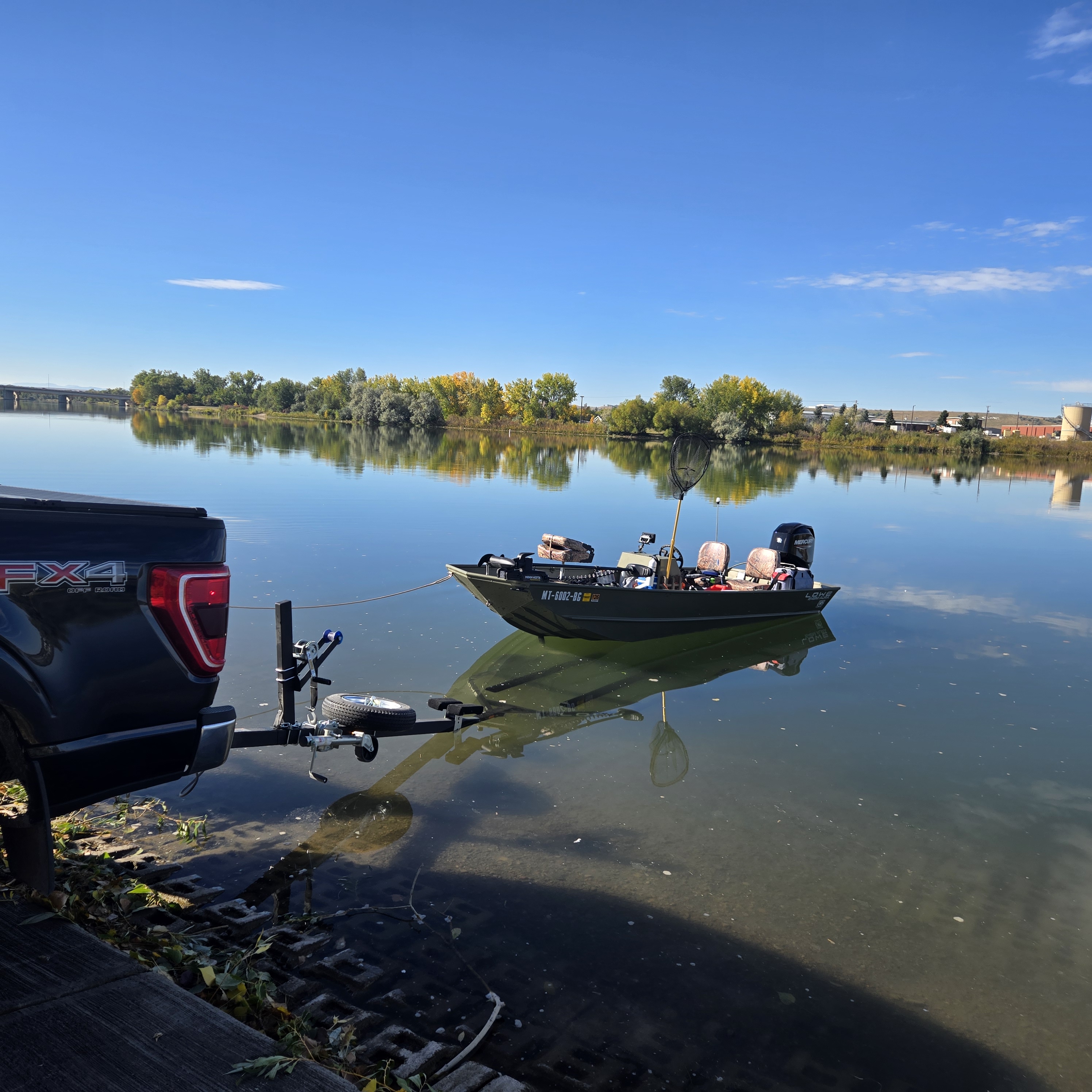
Finding a nice stretch of 6-10 foot deep water in slow current I lowered the Minn Kota and put us in anchor lock while baiting up the rods. Anchor lock is an awesome feature that keeps the boat in position, and it works in a river just fine! Game Changer Number One for fishing solo.
Dropping the bottom bouncers back about 30 feet I felt contact with the bottom. Into the rod holders they went, and we waited in anticipation for our first fish – which took just minutes as the port rod doubled back with a vicious hit. Reeling in a small pike, the boat was officially christened.
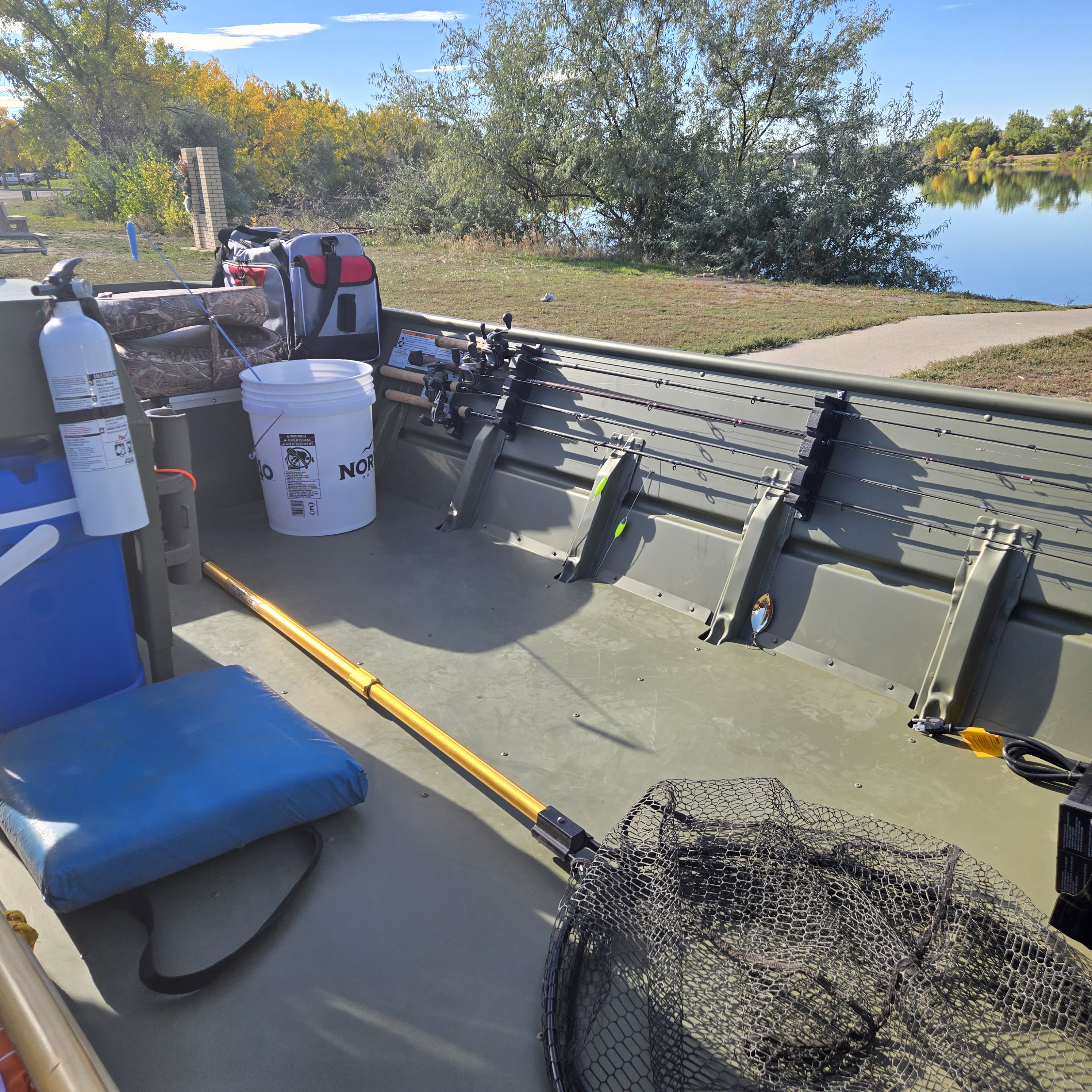
With the long straight stretch we were on, I hit the directional lock button, and the trolling motor kept us on a straight and steady course. No more fishtailing back and forth or oversteering, and again, hands-free boat operation made for a relaxing ride. Game Changer Number Two – direction lock.
The layout of the Lowe gives us plenty of room to stretch out. Even with two dogs moving around, barking at deer on the riverbank, the boat was solid and stable for both trolling and casting. Returning to the launch on a smooth plane, I looked over the side at 6 to 12-inch deep water; 27 mph was plenty fast for this guy!
Whether it’s your first boat or your last, it’s so important to know what you want to use it for and find the boat that does that job well. For us, this jon boat is going to offer many relaxing days in the years ahead fishing in our backyard. It was well worth the drive from Great Falls to Spokane to check out The Elephant Boys' boat selection. Thanks to Ed and the gang for a great buying experience on what will be the last ride I buy.
/articles/last-ride
Winterize, Seasonal Maintenance and A Plan
After what has proven to be an epic summer and fall fishing season, the last of our marine salmon fisheries are behind us. The general trout fishery just closed and you’re still struggling to find space in the freezer for one more vacuum-packed fillet. Now what, is it time to winterize? With the typical winter forecast of questionable seas, rainy and icy weekends, it may be time to pay little attention to your equipment.
I know you want to fish but don’t waste your energy bagging on the weatherman. Use the time and energy to get ready for next year’s adventures. Winterize the boat, spend some time with your gear to ensure that your gear is in tip-top condition, and work on your game plan for next season. It should be winterized even if you’re lucky enough to use your boat during the winter. The following information and ramblings will help you prepare for warmer times to come.
It is time to cover the boat, or if possible, store it under a roof (garage or carport). Snow is hard on boat canvas and freezing temperatures play havoc with any moisture that may collect in your boat. To that note, pull the plug and or drain anything on your boat that holds water. Make sure that you drain, blow out, or add RV antifreeze to any washdown or live well pumps. If you store your boat outside and are a seasonal user you have some work cut out for you. Garage-stored or year-round boaters are not off the hook here, and have a task or two to attend to as well. Now is the time to get at it.
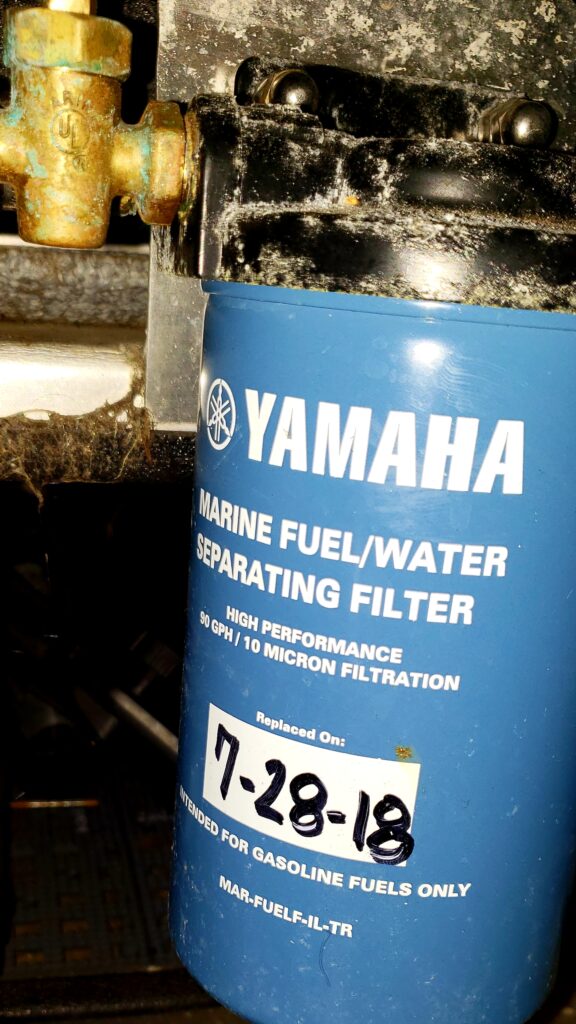
Aside from cleaning the boat and eliminating any standing water, the number 1 most important item on your winterization chores list is your fuel system. Check all fuel lines and fuel line fittings. Replace anything that is brittle, cracked, or otherwise damaged. Now is also the time to replace or drain as appropriate your fuel/water separator. Water trapped in the canister can freeze and crack the unit. If your boat is not equipped, it is a great time to install one.
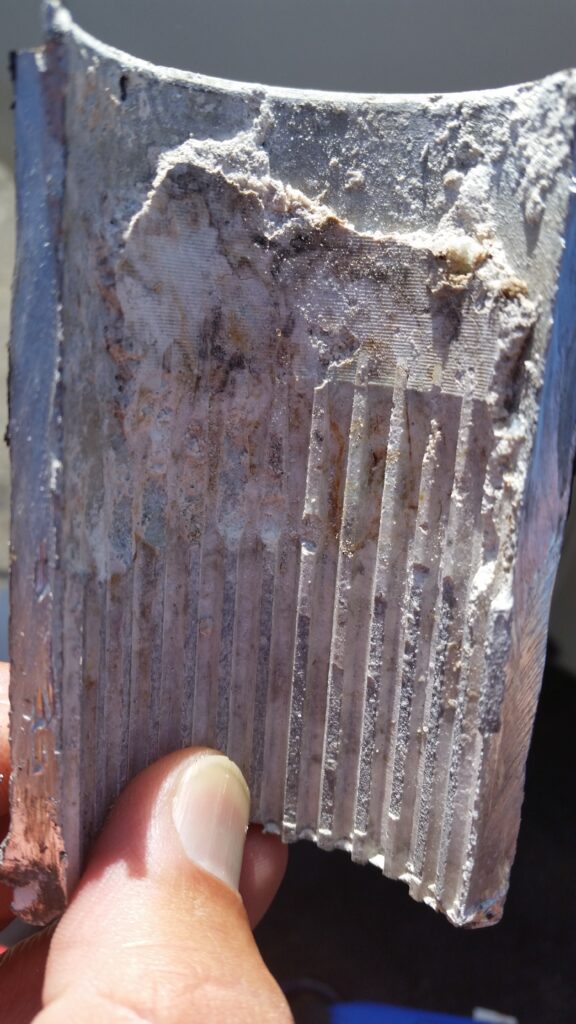
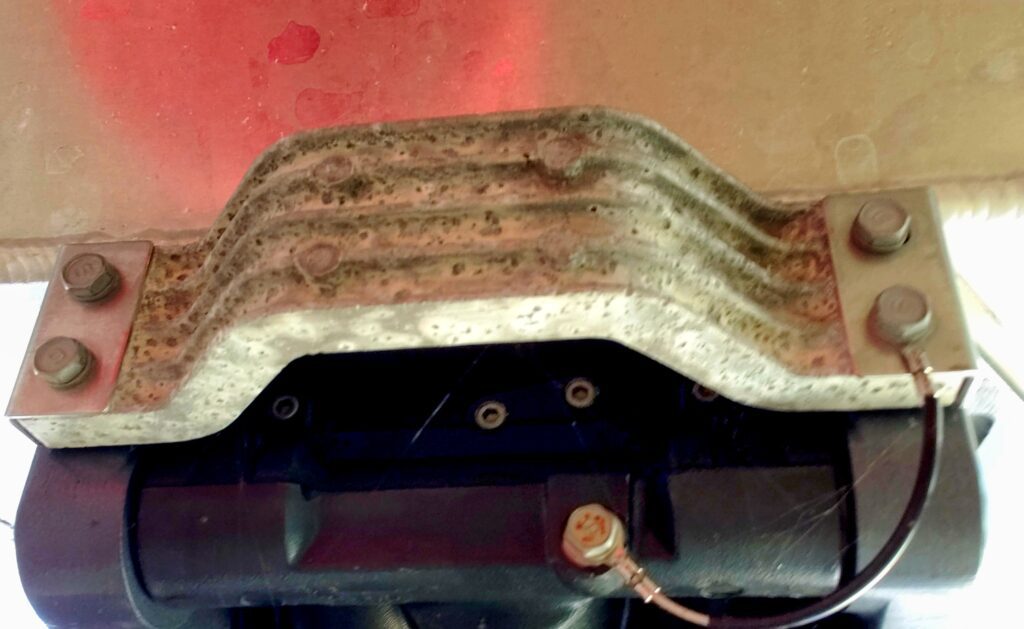
Look over your sacrificial anodes (zincs) and where equipped, the associated bonding jumpers. They should be inspected once a year. Replace if the anode(s) have lost half of their mass to corrosion. Generally, you can replace them with the same part number. But if in one year, more than 50% of the anode has been lost to corrosion or you are seeing excess corrosion on the protected equipment it is a good idea to increase the size of the anode or consult someone that specializes in boat corrosion protection.
You should add a fuel stabilizer with each fill-up. If you do not, make sure you add it before long-term storage. Add the stabilizer and then top off the tank. Check hydraulic fluid levels of any steering or power tilt/trim units. Use your motor manufacturers’ recommended products and do not top off or mix the various manufacturers' products.
Often overlooked, your winterization routine should include changing the lower unit oil. There are several reasons for doing this before the big freeze sets in. If there is any water in your lower unit it can freeze and damage the unit. It also gives you the opportunity to evaluate the condition of the lower unit. If the gear lube is milky a seal has been compromised.
The water can freeze and/or corrode the internal components which may result in major damage. Check the lower gear casing plug; it is magnetic and designed to collect metal shavings. A few shavings are OK, but if there is a Magic Rocks cityscape of shavings growing on the plug you have some level of gear failure brewing. It will need to be repaired before you put it back in service.
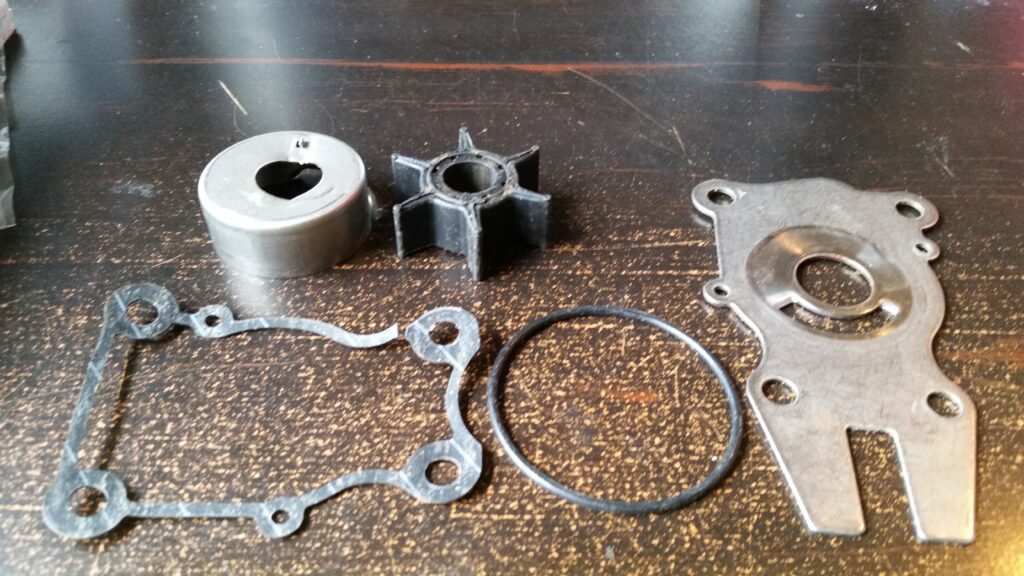
While we’re thinking about lower units, have you paid attention to your pee stream lately? No not that one, that’s a whole different article. Check your motor’s telltale pee stream. If it is weak or you haven’t changed the water pump in the last two years the components should be replaced.
Pull the propeller and check the shaft for fishing line or damage. Remember to lay all the nuts, washers, sleeves, or adaptors out in the same order they came off the shaft. Maybe even take a picture or two. This makes reassembly much easier. Take a look at the propeller, if the blade edges are showing an excessive number of nicks/dings, now might be the time to send it in to be rebuilt. Even slightly damaged blades will affect performance and running a boat with severely damaged blades can lead to all kinds of shaft/seal problems down the road. Using waterproof grease, generously grease the shaft before you reinstall the propeller.
A thorough inspection of your battery(s) and electrical system is especially important during your winterization process. Make sure each battery is topped off with distilled water then bring it up to full charge. A battery at full charge is less likely to freeze; in fact, a fully charged battery can withstand -58 degrees Fahrenheit before freezing. If you find corrosion on the terminals, remove the battery from the boat and clean it off with a mild solution of baking soda and water. Once everything is clean it is also a good idea to use one of the various corrosion guard offerings after reassembly. As long as you have 12 volts on the brain, you should also go through the rest of your electrical installation and look for loose connections, and damaged wiring. Check all the switches and breakers to make sure they are working correctly.
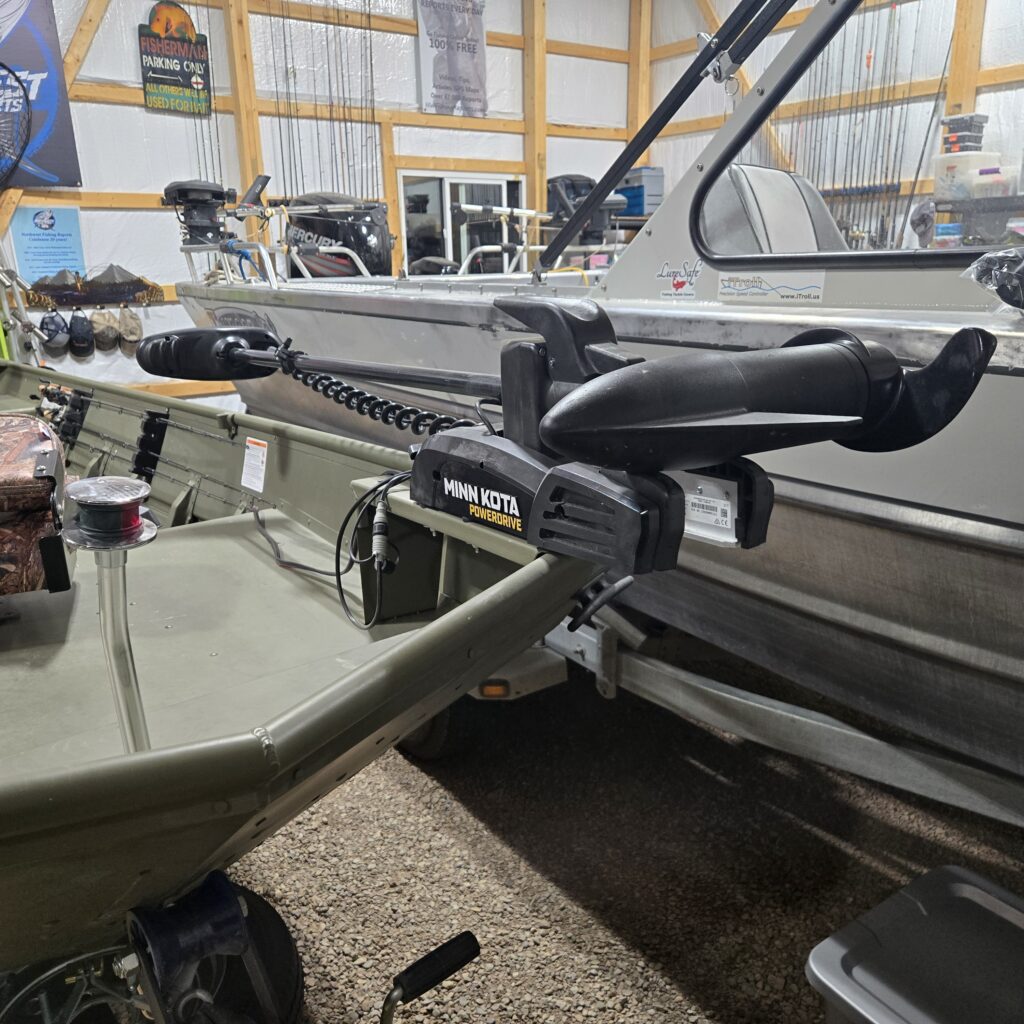
Don’t overlook your electric trolling motors and their electrical system. As with the boat batteries make sure the trolling motor batteries are fully charged. Pull the prop and remove any fishing line, hair-ties, balloon ribbons, and weeds that may have set up shop. Check the drive pin for damage and make sure that you have a spare onboard. Check all the mounting bolts and tighten them as required. Clean and lubricate per the manufacturer’s requirement. Check all your electrical connections and pull the batteries from any remote controls.
Give your trailer the once over: Check the trailer lights and trailer brake fluid levels. Also, check the tire pressure on all the tires including the spare. If you can, protect the tires from the sun. Assure that all bunks and or rollers are in good condition. Check your safety chain, winch strap, or cable and tie down straps and replace them if they are questionable. Check your lights and if they need replacement consider replacing with the waterproof LED lights.
Initially, they are more costly but with increased reliability, they will pay for themselves in no time. As an added safety benefit the LEDs are much brighter than the standard 12-volt incandescent lights. Now is also a good time to check your trailer bearings. If they are oil bath hubs check the fluid level and condition of the oil. If it is low, milky or appears to be foamy replace as required. If you’re running standard grease-packed hubs it would be a good time to repack them, better safe than sorry.
With the boat drained, fuel systems in good condition, all your hydraulic systems topped off, gear oil serviced, the electric trolling motor in tip-top shape, all things electrical are functioning as expected and the trailer serviceable there is one last thing to do. Unless your baby is stored in a heated garage raise the bow so all rainwater or snow melt drains out of the boat. Tilt the lower unit down so water will not collect in the lower unit, freeze, and damage the motor.
I know, all your rods are piled up safe and sound in the corner of the garage and everything worked fine the last few outings. Do you have nothing to worry about? Yes, now is the time to ensure all your gear is in good condition. Come along spring you don’t want to lose the fish of a lifetime because your favorite reel has a case of the herkie-jerkies.
Although with most reels it is easy enough to replace the drag washers, sometimes getting the replacement parts can be a challenge. I am a Shimano guy but I have to say they can be very slow in supporting part orders. There are a number of websites offering online reel parts but sometimes their stock is limited or on backorder. Now is the time to order parts, a delay in getting parts should have minimal impact on gear used next season.
When you disassemble your reels use Simple Green to thoroughly clean the reel components. Rinse and then dry the parts using the low setting on a blow-drier before reassembly. Once the parts are clean inspect everything, look for unusual wear, and replace anything suspect. Use the advanced synthetic lubricants and reel grease sparingly during the reassembly process. If you are running mono, replace it with new line. Take your reels to a high-volume tackle store like Holiday Sports in Burlington and have them bulk-fill your reels. Their line should be fresher and they will recycle your old line.
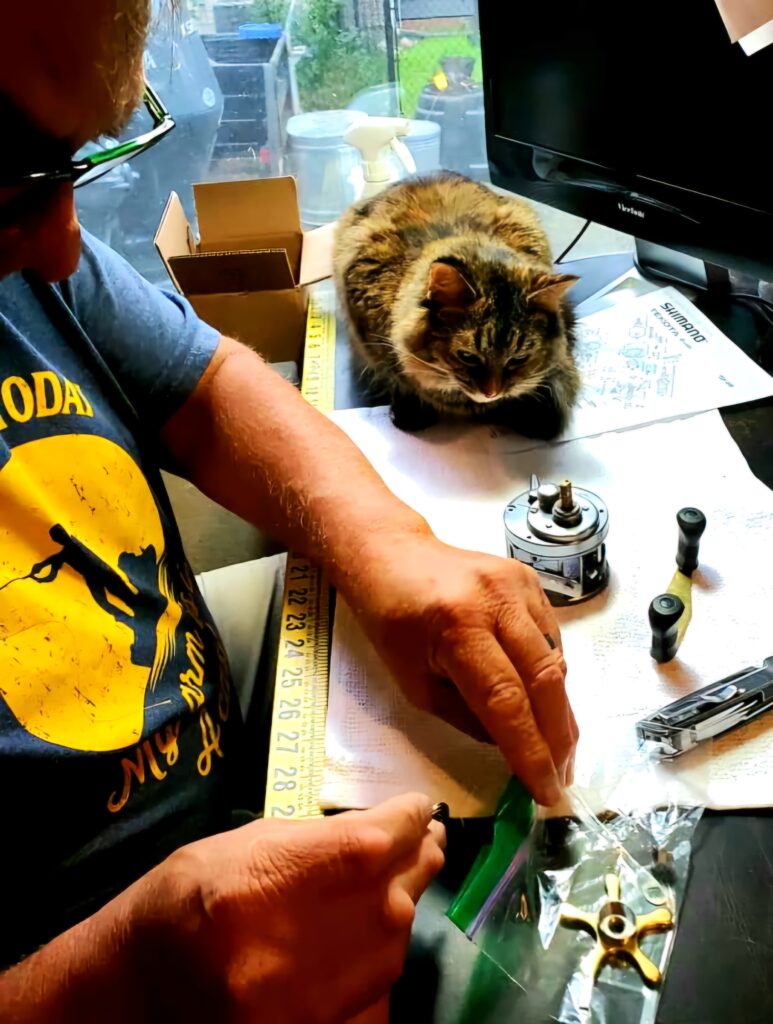
Also, give all your rods the once over. Make a point to verify that each line guide is not cracked or worn. You can use a cotton swab and swirl around in each guide. If the guide catches any cotton fibers the guide needs to be replaced. Years ago, I lost a bragging rights fish to a cracked guide insert. Make sure you check the reel seat and ferrules and then clean as required.
Whether or not you fish year-round, winter weather will leave you with a few idle days. Don’t let them go to waste. Assuming that you have already taken care of your winter maintenance routine, now is a great time to develop your game plan going forward.
In the salt, there will be a few winter salmon, flounder, and inshore opportunities. If you don’t fish for kokanee maybe it is time to learn to catch them. They offer a year-round opportunity to drag gear through the water, they are very tasty and offer great sport on light gear. Where many of the east side winter kokanee fisheries tend to hold up through the winter months, the west side kokanee lakes are a different story.
A few are year-round lakes but most of those become a challenge during the winter. East or west my recommendation is that you choose a Kokanee lake close to your home, somewhere where you can fish both on the weekend and as your schedule permits during the week. Don’t fret about the size of the fish or even the numbers; this will be your therapy lake.
A bit of work but your boat is now winterized. Your gear and equipment are dialed in and you have a “plan”. Hopefully, next season will be free from equipment issues, and if you do fish through the winter, may an occasional meal find its way into your cooler.
/articles/winterize-seasonal-maintenance-and-plan
Fall Panfishing in Eastern Washington
A treasure awaiting eager anglers
As the vibrant hues of summer give way to the crisp, golden tones of fall, Eastern Washington transforms into a paradise for outdoor enthusiasts. For many, this time of year means hunting or hiking through the scenic landscapes. However, for anglers in the know, fall represents one of the best opportunities for panfishing in this region. Panfish, including species such as bluegill, crappie, and perch, become particularly active as the temps begin to drop, offering a fantastic fishing experience.
The appeal of fall Panfishing
Fall is a transitional season, and for many fish species, it signals the need to feed aggressively, putting the feed bug on for the winter months ahead. For panfish like crappie and bluegill, this means moving from the deeper waters they inhabited during the hot summer months to shallower, more accessible areas where they can feast on minnows, insects, and other aquatic creatures. Anglers targeting panfish in the fall can enjoy several advantages:
Reduced fishing pressure
As fall arrives, many anglers turn their attention to hunting, leaving lakes and rivers quieter, and less crowded. The reduced fishing pressure can make panfish less warry and more likely to bite.
Ideal weather conditions
The mild temperature of fall provides a comfortable environment for fishing. The oppressive heat of summer is gone, and the cold chill of winter has yet to set in, creating the perfect conditions for a day on the water.
Spectacular scenery
There's nothing quite like spending a day on the water surrounded by the stunning fall foliage of Eastern Washington. The golden leaves of cottonwoods, aspens, and maples reflect off the glassy surface of the lakes, creating a breathtaking backdrop for any fishing trip.
Active fish
As water temps cool, panfish metabolism remains relatively high, encouraging aggressive feeding behavior. This is a stark contrast to the lethargic bites often experienced in the summer.
Best Panfish species to target in Eastern Washington
Crappie
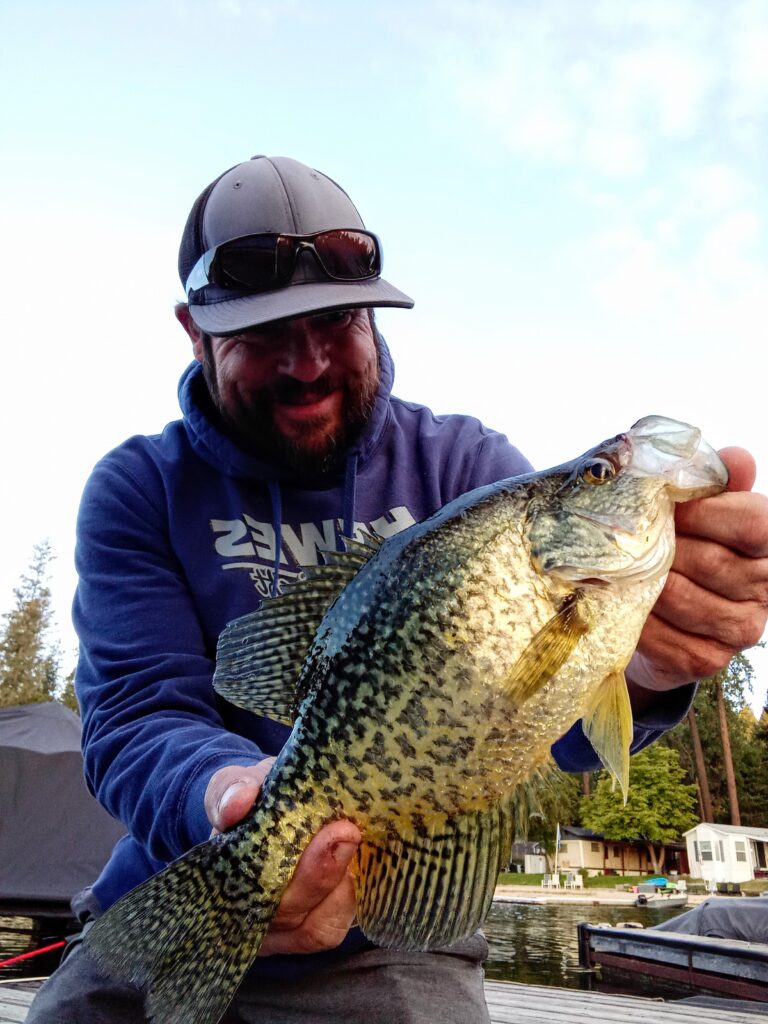
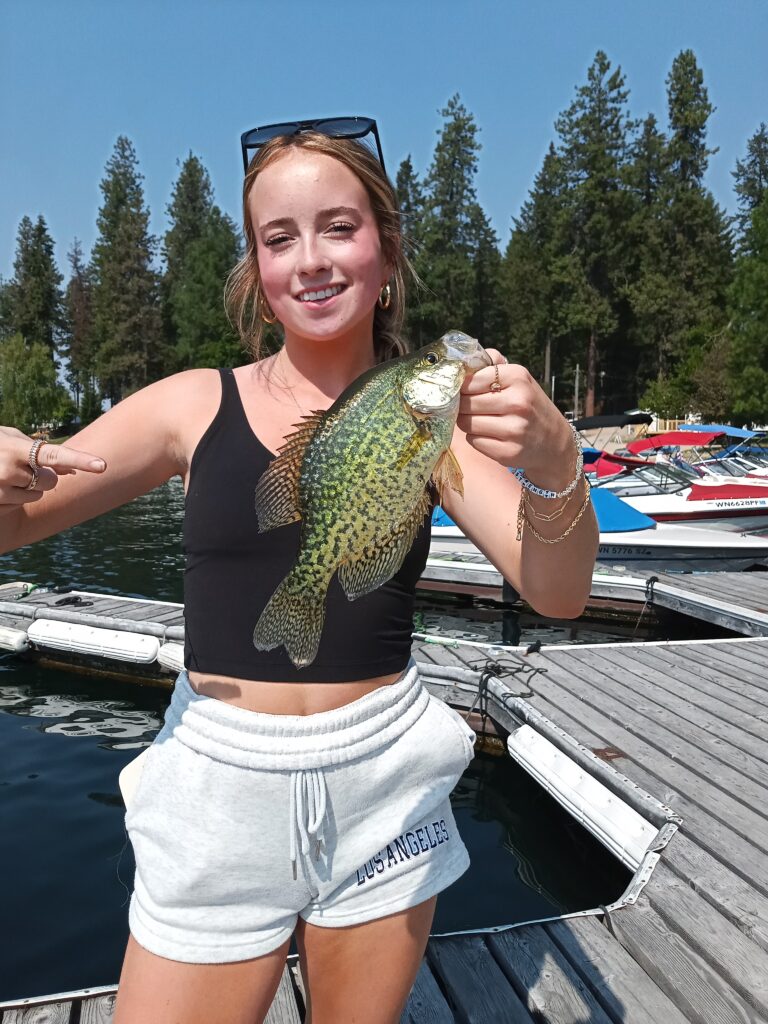
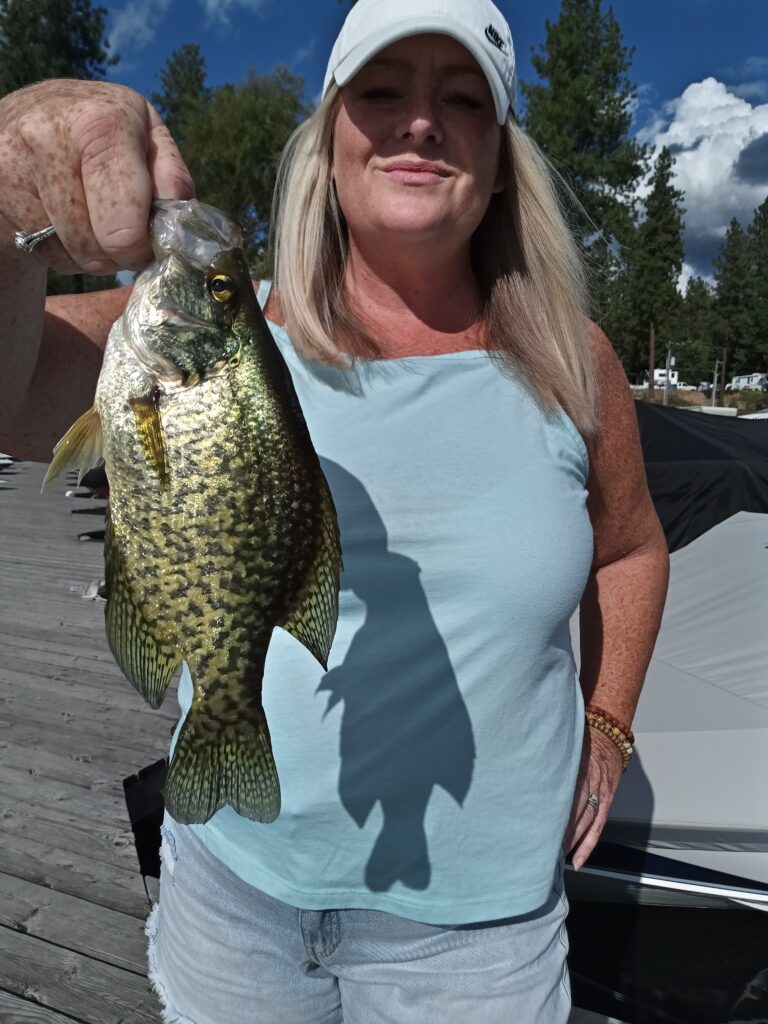
Crappie is a favorite among panfish enthusiasts due to its delicious, flaky meat and relative abundance in Eastern Washington waters. Two species, black crappie and white crappie can be found, though black crappie tends to be more common. During the fall, crappie often schools up in large numbers, making them easier to locate and catch.
Best spots
Moses Lake, Eloika Lake, Newman Lake, and Sacheen Lake are well known for their healthy abundance of populations. Look for crappies in areas with submerged structures such as fallen trees, docks, or rocky points where they seek shelter and forage.
Techniques
Casting small jigs with plastics, or bait, is highly effective for fall crappie. A slow steady retrieve near submerged structures often entices strikes. Night fishing can also be productive especially when using lights or lanterns to attract the crappie.
Bluegill & Sunfish
Bluegill and other sunfish species, such as pumpkin seeds, are abundant in Eastern Washington and provide great action for anglers of all skill levels. They are often found in shallow waters, especially around weed beds, submerged vegetation, and docks.
Best spots
Eloika Lake, Newman Lake, Sacheen Lake, and Loon Lake to name a few, are excellent choices for targeting bluegill and sunfish. These lakes offer plenty of fishing availability, making them perfect for both boat and shore anglers.
Techniques
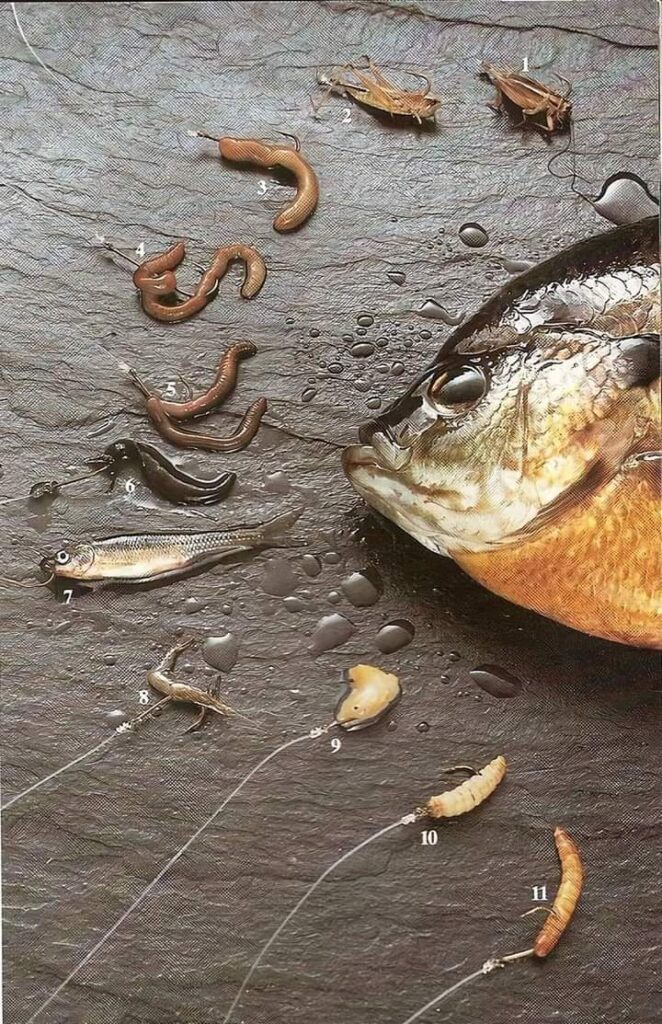
Bluegills are notorious for their lake of small, natural baits. Worms, crickets, and small jigs work wonders, particularly when fished below a bobber. Small flies, in the nymph patterns, can also be effective and add an extra way to approach these fish.
Yellow Perch
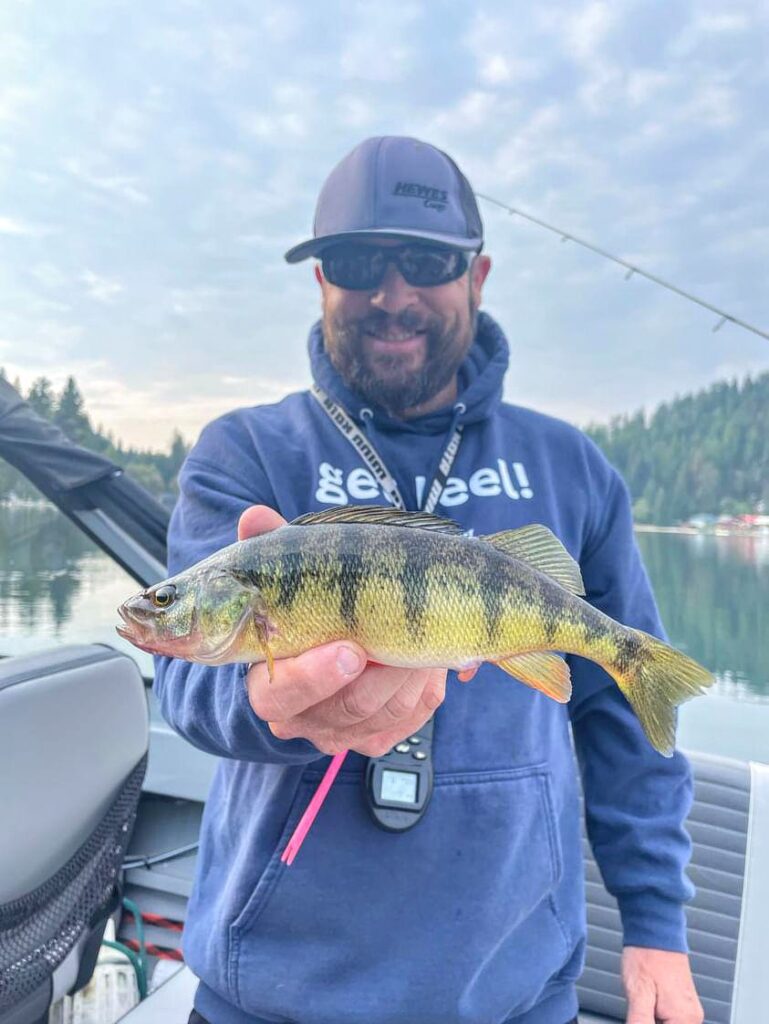
Yellow Perch are another panfish targeted by fall anglers in Eastern Washington. Known for their aggressive nature, and flakey tasty filets, perch are often found schooling up in deeper water, usually inhabiting a large mud flat looking for bloodworms, but don't overlook the shallows as temps drop and baitfish move toward the shore.
Best spots
Silver Lake, Moses Lake, Sacheen Lake, and Eloika Lake rank among prime locations for yellow perch. These waters provide plenty of food and cabbage where these perch can hide, and hunt. (Don't forget Long Lake.)
Techniques
Perch can be caught using a variety of methods, but jigging small spoons tipped with small plastics, or bait tends to be the most effective way. Vertical jigging from a boat can be best, especially when you locate a school of perch on your fish finder.
Tips for successful fall Panfishing in Eastern Washington:
Use light tackle
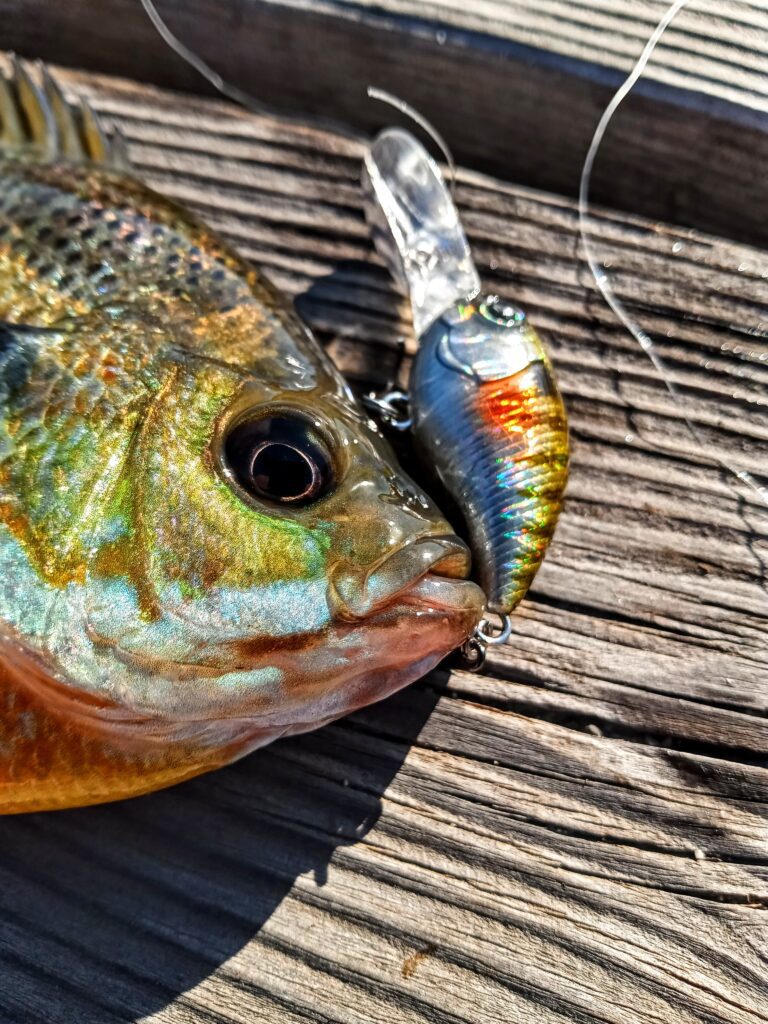
Panfish have small, soft mouths and are easily spooked by heavy tackle. Light spinning rods, small reels, and 4-6lb test lines are ideal for detecting subtle bites and presenting small baits effectively.
Look for structure
Panfish are actually drawn to structures that provide cover from predators and access to food. Fallen trees, weed beds, rock piles, and boat docks are all excellent places to find schools of panfish. Use a fish finder to locate submerged structures that aren't visible from the surface.
Experiment with lure colors and sizes
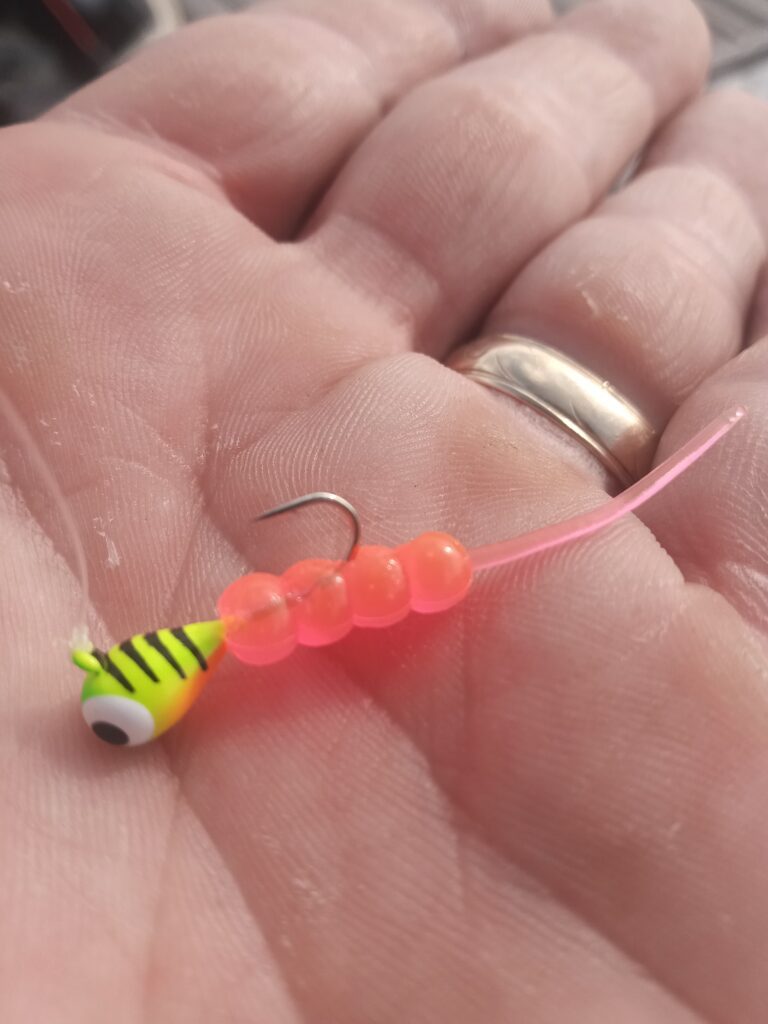
Different panfish species and even individual fish can have a unique preference, so it's good to experiment with variations of lures, with different colors and sizes. Or even trying to figure out what they are feeding on, and match the hatch.
Stay Mobile
If you're not getting any bites in one spot, don't be afraid to move around. Panfish schools can be highly mobile, especially in the fall, so covering more water can increase your chances of finding active fish.
Adjust your depth
Panfish can often be found at varying depths depending on water temperature during the day. Start shallow and gradually move deeper as the day warms up. Fish can sometimes be found surprisingly deep even in cool months - and don't overlook the suspended fish in the middle column.
The fall Panfishing experience
Fall panfishing in Eastern Washington offers a unique blend of excitement and tranquility. The crisp air, vibrant fall foliage, and the serenity of the lakes make for a peaceful escape from the everyday hustle and bustle. For those who enjoy the challenges of light tackle and the reward of a well-earned catch, there's no better time to get out on the water.
Whether you're a seasoned angler or a beginner looking to experience the thrill of fishing, Eastern Washington lakes and reservoirs offer plenty of opportunities to reel in some of the best and most enjoyable fish the region has to offer. With a bit of patience, and the right gear, and a sense of adventure, you'll find that fall panfishing in Eastern Washington is more than just a past time - it's a cherished tradition waiting to be discovered. So grab your fishing rod, pack your tackle box, and head out to the waters of Eastern Washington this fall. The panfish are biting, and the experience is one you won't want to miss.
![{"capture_mode":"AutoModule","faces":["-1482_-1552_-546_-616"]}](https://cdn.northwestfishing.net/sites/default/files/styles/large/public/images/IMG_20240907_122136_1-scaled.jpg.webp?itok=1nO2jnuv "{\"capture_mode\":\"AutoModule\",\"faces\":[\"-1482_-1552_-546_-616\"]}")
/articles/fall-panfishing-eastern-washington
The Aging Sportsman and a Place to Sleep
Ok, I’m sitting here in our group camp while the rest of the gang is out chasing walleye. I love walleye fishing; how did this happen? The progression is a long one and then the wife just had knee surgery and needed an extra hand. The table was set.
When I was a tater-tot my parents used to say that I came out of my mom with a fishing pole in my hand. Although it was likely a tall story, it is based on what turned out to be a lifelong obsession and pursuit of anything that swims. Both in elementary school and in high school if I was late or got caught skipping school it was because I was fishing. Once I could drive, I often went to school with a steelhead or 3 on ice in the back of my car.
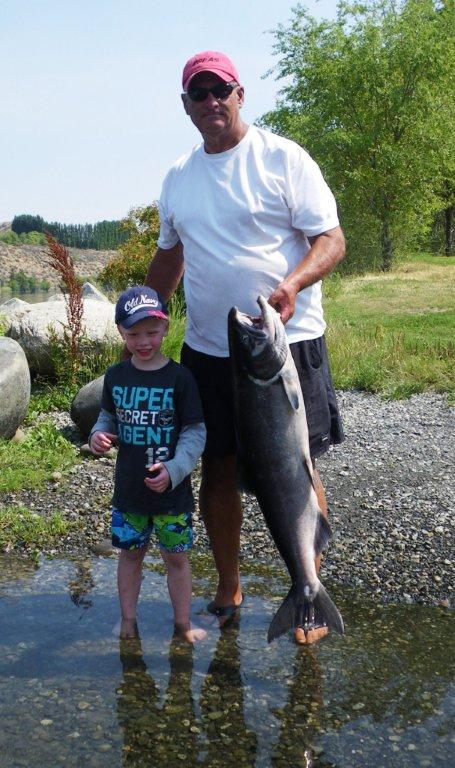
My adolescent preoccupation with fishing followed me through to adulthood. My early days of easy 3 steelhead days or immediate chinook limits just primed the pump. I was obsessed, if I saw a puddle somewhere I believed two things; First that there was a fish in it, and second that I could catch it. I think that I was well into my 40s before I realized that I may have to work for the next fish. Prior to that, I had an unwavering belief that I would hook a fish on every cast, anywhere around the world. I was lucky though; I lived and grew up in the PNW during the heyday of sports fishing.
To that note: I have caught fish all around the world. During my suit and tie days I was fortunate, LOL or maybe it was unfortunate in that I spent a lot of time on the road. I traveled to many regions within the United States, Mexico, and other parts of the world. I always traveled with a 5 or maybe 7-weight fly rod and a travel spinning rod tucked in my carry-on. These being pre-internet days I would research the area that I was traveling to. Then put together a little travel kit for the road. People at home probably thought that I was nuts and the locals where I was fishing knew that I was wacko, “Fishing, do you always release your catch?”
My business travels brought me to a long-term assignment in Southern California. I was still traveling but my regional assignment had changed. Again, pre-internet I didn’t really know what the fishing opportunities would be. As it turned out, I had landed in a fisherman’s paradise. I owned a home in Orange County eventually moving to a small mountain community but I was always close to one fishery or another.
Living in Southern California a sportsman had quick and easy access to a wide variety of both inshore and offshore saltwater fisheries. I got heavily involved in the offshore fisheries, even deckhanding or running the galley on a couple of party boats. My addiction wasn’t limited to the salt, there were also many excellent freshwater options. Close to home there were a number of trout, bass, whisker, and panfish lakes. With some driving you could be fishing planted rainbows in many lakes or clear mountain streams, fishing for High Serria brown or golden trout. With a full tank of gas, the angler could be swinging a fly for a large chinook in a formidable coastal or central valley river. The long and short of it, I was in heaven. I had to earn a living but I was truly a fish-a-holic.
Why the trip down memory lane? I probably could have written this without the memory download but that said; I did spare you the sorted details of 40-plus years of fishing trips, I was setting the stage for an unexpected transition and the actual content of this article.
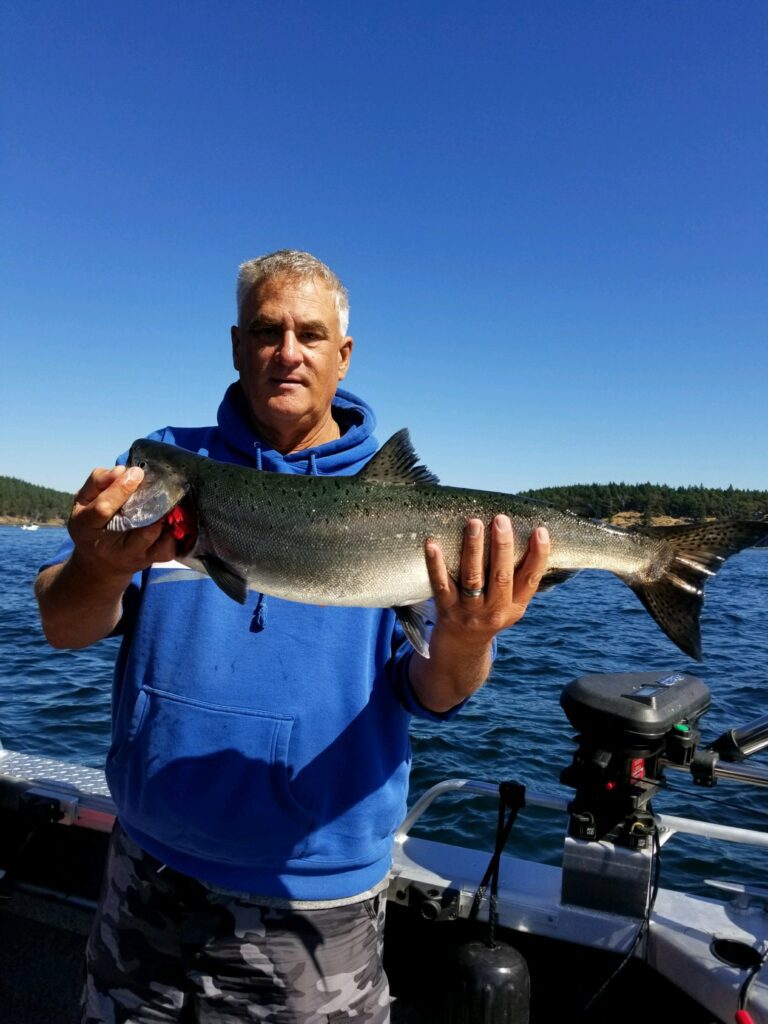
I can’t explain it, but in the last 5 or 10 years I have noticed that I’ve transitioned from an Eveready Fish-a-holic to being content writing about fishing or even sitting around a campfire yapping about it. Oddly during the same period, my ability to sleep pretty much anywhere seems to have gone the way of the dodo bird. Are the two connected, possibly? That would be a whole study of its own.
The glaring tie may be arthritis. Pretty much everything hurts all the time and daily activities are a chore. Fishing; holding a rod, tying knots, managing snaps, clips and downrigger balls require a focused effort these days. Then sleeping has become a serious problem. Gone are the days of a few quick winks in the driver’s seat while parked at a boat ramp. With the onset of arthritis and associated structural problems sleeping in a tent on the ground is completely out of the question.
Unfortunately, the fishing industry hasn’t taken a look at limited functionality due to arthritis. At my end, I try to set gear up so that even with hand strength or manual dexterity issues I can rig the gear with some level of confidence. Having most things pre-tied has been a huge help. The use of the commercial troll line snaps for the downriggers allows me to easily connect the downrigger balls. Keeping the boat organized, having a seat with good lumbar support, and having autopilot for the longer runs also helps. I already own a gazillion reels so I’m probably not going to go out and buy a complement of reels with ergonomically friendly handles but there are some out there. There are also ergonomically friendly aftermarket handles available for some reels. I think that the key is to sit down and really consider what your capabilities or personal limitations are and adjust your approach as required. Additionally, a good fishing buddy is a must.
Lifestyle versus reality. I’m in the process of assessing the reality of my limitations. Do I need my saltwater boat, and my drift boat, if not do I replace them? Simpler makes sense, then considering our local saltwater seasonal limitations, getting a smaller less maintenance rig may be the way to go. Although officially retired I am very fortunate and I have a retirement career. The money is nice but the job was a godsend. I just couldn’t do retired and I was going stir-crazy. Now I run a boat in Washington’s San Juan Islands, am outdoors and with the job being very physical it keeps me active. I mention this because it does have a downside, independent of the weather conditions I run year-round. I’m beat up at the end of the day and instead of fishing on a day off I typically need some recovery time. Eventually, I’m going to have to look at my overall lifestyle including a general lack of sleep and make changes.
As a sportsman, sleep is an interesting subject. In my younger days, the adrenalin of the next hook-up would keep me going for days and when I did need some shuteye, I could sleep standing on my head if I needed to. I probably don’t need any more sleep than I used to but I do need some comfort. Knowing that the whole tent thing and sleeping on the ground or leaning back in the driver’s seat for a power nap was behind me got me to wondering; where am I going to sleep?
Although a 5th wheel or other pull-behind trailer would be luxurious, at this point I still need to be able to pull a boat. Tents, out of the question, and a hotel bed doesn’t seem to align with most fishing trips. For many years our ARB shell, TruckVault, and a queen-size mattress served us well but it was time for a heated change.
I use the truck for work every day so a full-size hard-sided camper wasn’t going to work. We considered getting a motor home or some form of a van conversion but in the end, decided that they were not in the budget and worse we’re out of driveway real estate. Years ago, I did some catering for a series of offroad events in southern California and there were a ton of both ATC and Four Wheel Campers at the events. They are purpose-built off-road campers. Both manufacturers utilize a lightweight welded aluminum frame and are soft-sided pop-up campers.
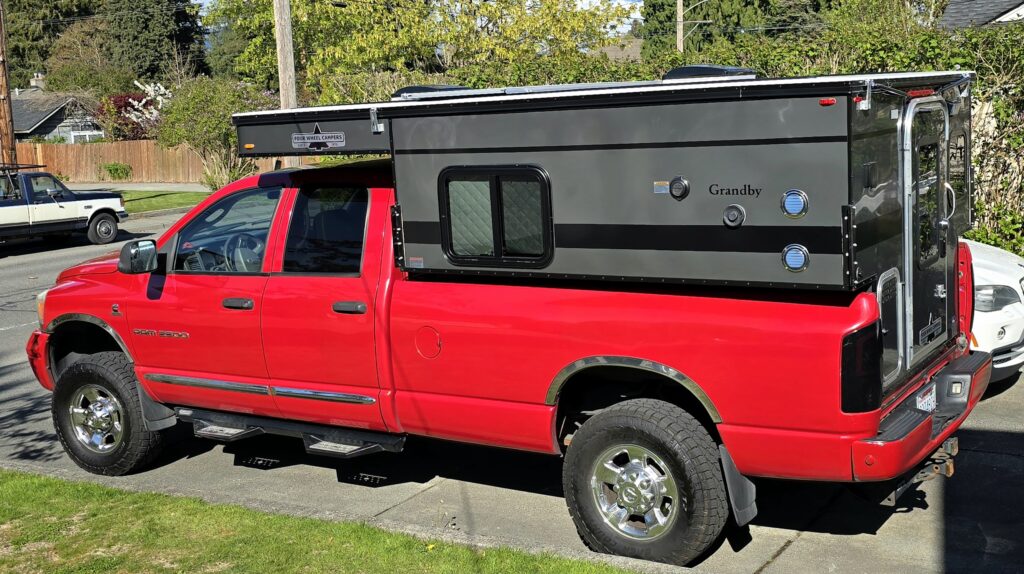
We decided to find a FWC and quickly determined that used campers to fit our full-size truck were few and far between. Order a new one? Well maybe; after researching the cost of the few newer used FWCs available as compared to the cost of a new one, ordering a new camper seemed like a solid financial decision. Add a level of customizations available and we were sold.
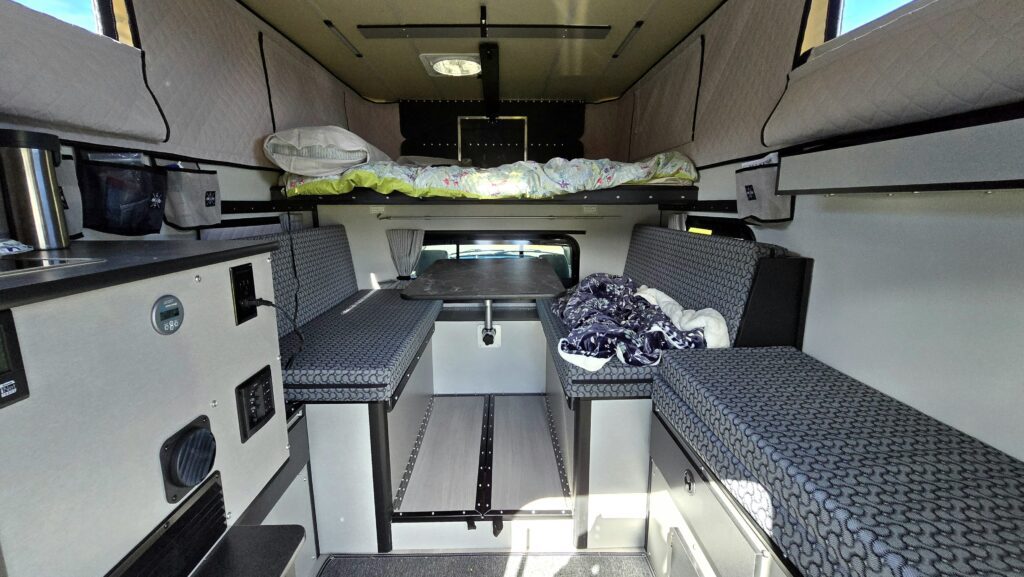
FWCs are available as topper, a basic shell model, a fully loaded slide-in camper and as a flat-bed camper with various options available for each model. We ordered a basic shell but customized our order with forced air heat, a larger bed, a forward dinette a flush mount stove top, an 8’ awning and shore power. Deposit made; the wait began. We expected the 4–6-month lead-time but after a couple months started getting antsy and second guessing our configuration choices. Eventually, our lead time transitioned to an install date and we were off to Mule Expedition Outfitters in Issaquah for the install.
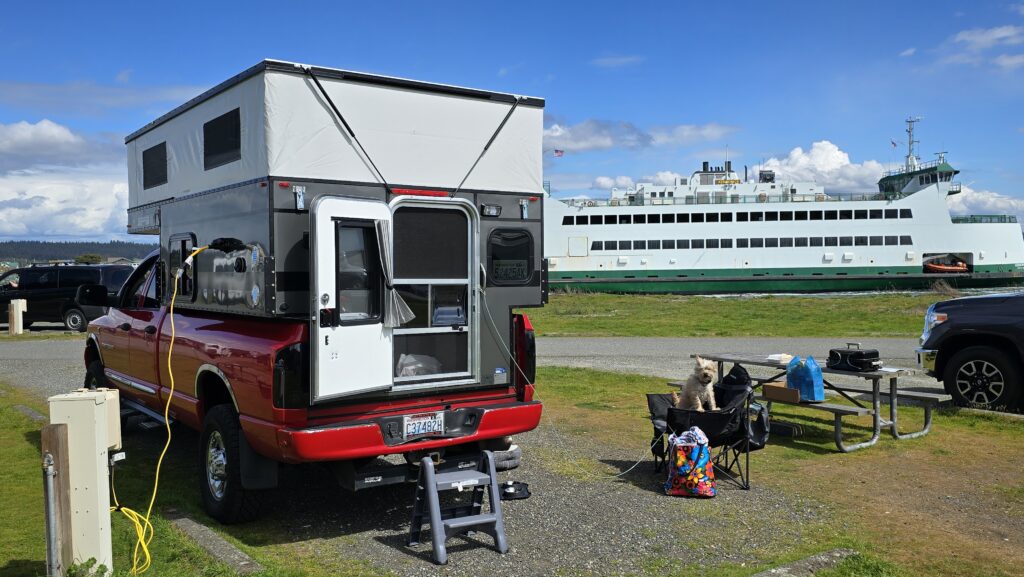
Our installation went smoothly and after a thorough walk-through, we were rolling. The first thing we noticed is that we didn’t notice anything. Our new camper was very well balanced and our truck carried the load well. When we got home, I did the fuel economy calculations and we got 21.4 miles per gallon. I was impressed, our mileage was way better than expected! Since then, we have spent 12 nights camping but I have not removed the camper from the truck. With maybe 10,000 miles behind us as a truck camper combo, the truck is consistently getting 20-22.1 miles per gallon, not bad for a ¾ ton truck with 350,000 plus on it!
To date, we are very satisfied with our customization choices and our Four Wheel Camper far exceeds our expectations. I have to say, I even proposed going camping without any fishing gear! 10 years ago, I would never have considered a camping trip that didn’t involve the boat and fishing gear. The way of the future or a phase? Only time will tell. In the meantime, I love telling fishing stories and we have a comfortable place to sleep!
/articles/aging-sportsman-and-place-sleep
Finding the Right Fishing Rod
By Jason Brooks
Almost three decades ago, I learned the importance of using the correct fishing rod, and how important the rod is as a tool to catch more fish. It was a bright July day, and we were fishing the Cowlitz River for summer steelhead. I was with two friends, both of whom were well seasoned steelhead anglers, but I was not. Having grown up in North Central Washington, steelhead were but an anomaly back in the 80’s and 90’s. Instead, we trolled for trout and chased summer chinook by casting spoons and pulling plugs, but we never really had to “feel the bite” like you do for summer steelhead.
"Broomstick"
Throughout the day, my two friends kept hooking fish while I did not get a single bite, or at least I did not think I did. After breaking off the leader while in a good run, one of my friends told me to grab his spare rod, already rigged up and ready to go with bait. I put down my rod and grabbed his, cast it out, and within seconds had a bite and set the hook. Once that fish was landed, I mentioned how quickly I felt the fish bite and that it was my first bite of the day.
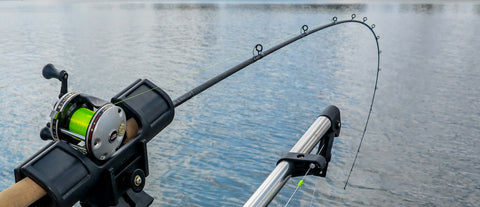
Both friends politely informed me that I had been getting bites all day, but I just did not know it, calling my fishing rod a “broomstick”. I was using a cheap rod, one that fit my budget at the time, but also cost me fish as it was not sensitive enough for me to notice the bite. The rod my friend handed me was a Lamiglas Certified Pro, a “mid-priced” rod for that brand, but known to be extremely sensitive and a good value compared to the higher end models.
Pricing
Price is probably the most noticeable point when it comes to a fishing rod. Those that do not fish, and even a few that do, often ask why quality fishing rods cost so much. Yes, there are exceptionally good rods on the market that do not cost what some of the “top of the line” models do, but they are usually made in foreign countries where quality control might not be as tight as some American made rods.
There is a saying, “buy cheap, buy twice” which means those that try to look for a bargain often end up buying the more expensive rod after they have a few days like the one I had on the Cowlitz all those years ago. The high price of a rod is mostly due to a few variables, the first being quality control with quality materials. The next cost factor is that you are not just paying for the rod, but also for research and development that went into designing, testing, and building of the rod. A company cannot improve their products without testing and developing them first.
They have paid employees that do this, such as engineers to design, make, and maintain the machines that manufacture the rods, and then of course the engineers whose knowledge goes into rod design. Everyone needs a paycheck and when you buy that rod you are becoming part of the process, one that will also help improve the next model or design of rod.
Warranties also cost and some high-end rods are factoring in the warranty for when anglers do break a rod and get a “free” replacement. That replacement cannot really be free but instead is added into the overall costs. Then there is shipping the rods to stores, advertising, and of course the store’s overhead, which all must be added to the costs of each rod.
Quality
So now that you know why some rods cost so much, then ask how some rods can be reasonable in price and still have most of the same attributes of a high-end rod. This is mostly because those rods are a few years behind in technology, and either patents run out so they can be copied, or consumer demand is finally high enough that a large company can outsource the building of the rods to foreign labor, making the building part of the rod less expensive, and mass produce the rod.
Profit margins can be smaller, and this means a less expensive rod for the angler, but think about quality control and rod materials. Of course, these rods can and do catch fish, so should you feel guilty for buying a rod made in some foreign country? That is up to you, but it is understandable why one would buy such a rod, with some American made rods costing two and even three times as much as the others.
When it comes time to pick out the rod you plan to buy, you need to understand how the rod is designed or what its purpose is for. The first two factors that must be taken into consideration when purchasing the correct rod are what type of fish you are planning on catching, and what technique you are going to use to catch them. Take for example the twitching rod, often used to catch coho, but also good for chinook, chums, and even the occasional winter steelhead.
Since it is mostly used for coho, the rod needs enough power to haul in a 12 to 18-pound fish, pulling it out of a log jam, and to the net. It also needs a soft tip, or fast action, to give that jig the right action as it falls, and so you can feel the slightest resistance when the fish grabs the jig, often done on the drop. Again, that power needs to be strong enough to set the hook quickly. And then there is the length of the rod- most twitching rods are 7’6” to 7’9” as this is the right balance for twitching without causing wrist fatigue.
Years ago, just as twitching rods were coming onto the market, I was still using a medium action 8’6” drift fishing rod and did well until my wrist hurt so bad that I had to stop fishing for the day. Yes, some rods are “multi-purpose”, but if you plan to use a specific technique you will always do better with the right tool for the job, or the rod designed for that type of fishing.
Float Fishing
Float fishing is popular amongst salmon and steelhead anglers, and since the technique is pretty much the same if you are floating cured roe or a jig, you can use the same rod. The idea of float fishing is to cast out a line with a sliding float and a weight to get the bait or lure down to the depth of the fish, and then let it naturally drift downstream.
To do this you need to be able to mend the line, which is to pick the line up off the water and pull or flip it upstream, allowing some slack above the float. If the line gets pulled downstream in the current, it often speeds up the float and bait or lure and it is not a natural presentation. To mend the line, you need an exceptionally long rod so you can lift the line up off the water. Most float rods are 10 ½ to 12 feet long, with a medium heavy to heavy action or “power” as you do not need to feel the bite, but you need to set the hook hard.
Spoon and Spinner Fishing
Spoon and spinner fishing is much like drift fishing as far as casting out a lure, letting it drift along and catch in the current as it swings across the river. One main difference is that most bites on the spoon or spinner are violent grabs by the fish and you can feel them easily. There are a few times that the bite is more of a pause but then again you can feel that with a quality graphite or glass rod.
However, the drift angler needs to be able to tell the difference between a bite and the weight bouncing off a rock. This is where my broomstick failed me all those years ago. If there is one technique where the rod is the most valuable tool to catch fish, it is in drift fishing. This style of fishing is also one of the most common and one of the ways most salmon and steelhead anglers learn to fish.
It can be very frustrating to go out fishing and not get a bite, or worse, get a bite and not know it. Do not skimp on the drift fishing rod. An extremely sensitive, moderate to fast action rod in 8 ½ to 9 ½ feet is necessity. Again, the river you plan on fishing will determine the specifics of the rod.
Frazier River
Years ago, when the Frazier River in British Columbia still had a return on sockeye in the tens-of-millions (yes, millions) I found myself standing shoulder to shoulder in the glacial waters with zero visibility, drift fishing “wool” as they call it in B.C. It was the basic drift fishing of a piece of yarn, sometimes with a Lil Corky, but mostly just a piece of yarn and an awfully long leader.
Lining sockeye, like they do in Alaska, was the way to catch them in the murky water, but this river is huge and about 200 yards wide, moving so fast that we were casting 2-ounce cannonball weights and bouncing them along as if they were a 2-inch piece of pencil lead. For this trip I was using a 12-foot extra heavy spinning rod. It would cast 100 yards easily and handle the swift currents as well as the occasional chinook, pulling it in while never needing to yell, “fish on, coming down” like most anglers do on any given pink salmon river in the Pacific Northwest.
It was the right tool for the job, and one I bought specifically for this trip. It cost a few hundred dollars and that is expensive for a rod that will be scarcely used. It has found a new fishery now that the Frazier is pretty much closed to sockeye fishing, and that is along the ocean beaches as a surf perch rod. Again, ask yourself what type of fish you are planning on catching, and what technique you will be using.
Surf perch does not require a heavy action rod, but casting the heavy weights out past the rolling waves does. Be sure to pick the right rod you plan to use and buy the best quality one you can afford, otherwise you will likely be buying twice.
/articles/finding-right-fishing-rod
Kayak fishing in Makah Land
With cracked and battered hands, I paddled east with 25 knots at my bow and an incoming tide on my stern. Colliding forces of Mother Nature churned heavy swells into a roller coaster of seawater, tossing me about as I struggled to stay on track. A behemoth of a fish, a monster, 50, maybe 60 lbs, haunted me from the day before, yet kept me moving eastward, into the fray.
This is just one of the many tense experiences that characterize a spring kayak fishing trip at the continental United Sate’s most northwestern point—Neah Bay. Neah Bay has become somewhat of a kayak-fishing Mecca for me. Each year I make the almost 4 hour drive to its rugged and draw dropping coastlines. Heading up the east side of the Peninsula, the drive treats travelers to a myriad of jagged points and bluffs that meander past ancient saltwater beaten sea stacks before colliding with the belly of the North Pacific. The coastal terrain then wraps around Washingtons most Northwestern point, Cape Flattery, which is a marine anomaly in its own right, and then heads down to the sandy beaches of Makkah Bay, ending just south of Cape Alava.
Though fishing might be the main attraction for readers, it’s worth noting that this area holds an endless amount of wealth in its natural beauty and also in its cultural and historical prominence. The Makkah Museum is open to the public and is a great place for visitors to learn about Neah Bay’s native community and their long connection to the land and sea, that of which is estimated to be around 3,800 years old.
Case in point, the Makah tribe, for at least the past 1,500 years, have paddled hand carved cedar canoes out to often treacherous seas, where paddlers would track and hunt humpback and grey whales with harpoons attached to sealskin floats. They are the only tribe in the U.S to have whaling rights secured by way of treaty, though this right was later repudiated by the U.S government after commercial whaling by both European and Americans had all but extirpated both grey and humpback whale populations.
From here visitors can explore the many outdoor attractions Neah Bay has to offer. Whether it’s a backpacking trip down to Shi Shi Beach to camp and fish for surf perch, or a day trip to the Point of the Arches, there’s a number of things you can do to diversify your fishing trip before getting into filling your cooler.
Any trip to Neah Bay with a kayak should be well thought-out and planned, this is especially true during the spring when inconsistent and stormy weather frequently results in the waters around Neah Bay being under small craft warning. Always plan your trip around NOAA marine weather forecasting and make use of apps that predict swell size, wind speeds and wind directions. Optimal conditions would be flat and windless, and if we waited for those conditions, we would never fish. So, sticking with days where winds are sub 15 mph, swell size is moderate, and wind waves are predicted to be no more than a couple feet, will all help keep you on the right side of the water.
Staying on the right side of the water is always the goal, but as probability has it, there will be some point in any kayak angler’s life where he or she will get dumped into the salt. This is especially true if you’re launching or landing in surf zones. If you are prepared for it, which you 100 % need to be, then an experience like this will only serve as a minor inconvenience as opposed to something life threatening.
First order of your operations will be gearing up to stay warm. I suit up into a 5.4 mm wetsuit, equipped with a hood and 5 mm booties. Essentially, I dress the same exact way I would if I was to surf anywhere on Washingtons chilly coast (with the exception of a PDF). Many anglers prefer a wetsuit as they are not bulky, they make movement easy, and they perform consistently each time. Another option is to use a dry suit.
Dry suits are a breeze to put on when compared to a wetsuit, they slip on over your insulating layers, provide you the security of knowing that if you were to go in; you won’t experience a layer of cold water rushing over your skin like a wetsuit allows, and you can slip out them without a struggle as soon as you are done fishing. The downside of a dry suite is that in the event of dunk— a tear or a leak in the suite would allow water to flow inside and render it completely useless, thus making hypothermia less of a possibility and more of an inevitability.
If you do get dunked, you need to know how to get back into your boat. This is something that requires practice and should be done in calm and shallow waters, perhaps somewhere close to home. Neah Bay is not the place you want to have a “learning experience” when it comes to falling into the water. Know how to right your boat if capsized and know how to climb back in.
Finally, secure all your gear like you were planning to flip the boat. Lanyards and bungee cords are your friends. Keep hatches closed and secured and you should be set to catch some fish.
Spring kayak fishing in Neah Bay is red hot when it comes to Lingcod, rockfish, and Cabezon. They can be caught in relatively shallow waters where kayak fishing is more feasible, and in general, these amazing predator fish are typically going to bite down on whatever you’re willing to throw at them. My best luck comes from jigging 2 oz jig heads with a white single or double tailed grub.
The best bait for catching a trophy lingcod might be lingcod itself. The experience mentioned at the intro to this article foreshadowed what has become the most intense battle with a fish I’ve ever been part of, and that experience happened to occur because of the lingcods love for the predation of its own kin.
It was late morning and I had been fishing for a couple hours with various species already onboard. Snagging on kelp is a frustratingly common occurrence when fishing the straights of Juan de Fuca side of Neah Bay, and after losing my gear several times to snags, I was ready to throw in the towel. Just at that moment, my line was once again wrapped up on some vegetation deep below the surface. After a few attempts to free my hook from what would surely become its forever home, I felt a tug at the line.
Oscillating between thoughts of a monster fish or a monster let down, I decided to swing towards optimism and fought this potential snag like it was more than just another disappointment. I reeled in and raised the rod tip, letting it back down as the fish either slowly took line out or the current was simply just pushing me away from the point where my hook was snagged. Again, there was another strong tug at the line. This was a fish. Perhaps a fish caught-up around some kelp, but a fish for sure. After fighting for what felt like an eternity, and as the minutes passed by, and my arms became more tired, I finally felt progress as my reel started collecting more line.
Finally, through the darkness of the water, I made out the shape of not one, but two fish. A good size lingcod, maybe 30 inches long had its mouth tightly secured around my hook, and even more tightly secured around him—was something that I thought only exists in nightmares. A lingcod that looked to be about the length of my kayak was lock-jawed around this smaller fish, and they were getting closer to the boat. Fearful of what would happen if I tried to land this razor toothed behemoth in a kayak, I panicked a bit.
Yet, in a split-second decision, I grabbed my net and tried for a swoop. As I reluctantly scooped toward the fish that would in no-way ever fit into my net, let alone my boat, the giant ling let go of the smaller fish, and in true nightmarish fashion, breached out of the water with its mouth wide open and razor-sharp teeth exposed. Only inches from its giant head, I watched as the open mouth of the fish passed by my face and then landed back into the water, into the depths of Neah Bay; where I was oh so happy to see it disappear.
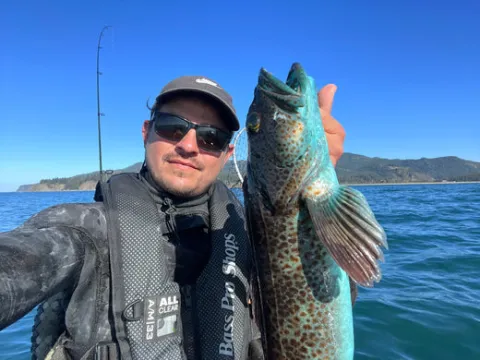
/articles/kayak-fishing-makah-land