Washington Ocean Salmon Prospects
With salmon seasons being ever-changing, from season to season, month to month, and even minute to minute depending on where you fish, the recent announcement of summer salmon seasons was met with some excitement and hesitation. Fisheries managers met over several weeks during the North of Falcon process where everyone with an interest in salmon planned out the quotas and seasons. Washington’s governor added a new apprehension at the table with concern over making sure there is enough food for south Sound Orcas well as fish sport anglers, commercial harvesters, and tribal fisheries, while still allowing for escapement.
The escapement is the main focus, with ESA-listed stocks and wild fish returns dictating how and when anglers can pursue salmon. Once the run estimates are established then the managers need to figure out how many fish can be caught in the ocean and still allows for fishing, and escapement in each of the predicted runs. This is where the marine area gets its seasons and regulations. This year the allotment for ocean salmon off of the coast of Washington was set at 39,000 chinook and 159,600 coho. Each marine area will get its own seasons and a share of the fish.
Starting with Marine Area 4, Neah Bay, the northernmost ocean section which borders Canadian waters, will get first dibs on the salmon, along with Marine Area, 3 La Push, which will have the same start date of June 17th. This is just like last year, when the areas opened up on Father’s Day weekend, but this year anglers can still keep two salmon per day. However, only one can be a chinook and all coho must be clipped. It is open 7 days per week, but later this summer, chinook will be closed east of the Bonilla-Tatoosh line starting on August 1st.

Marine Area 3 will have similar regulations as Area 4 but will also have a late “bubble” fishery from October 3rd to the 7th with a one chinook per day limit. La Push is not nearly as popular as Neah Bay, mostly because it is an open water fishery where the area to the north in Neah Bay has some protected fishing. Since the Covid restrictions have lifted, both reservations are now open. Neah Bay offers a bit more in amenities, but nearby Forks is a great town to stay in when fishing out of either port and has accommodations, restaurants, and gas stations, along with a sporting goods store in case you forgot anything.
Westport in Marine Area 2 is probably the most popular of all offshore ocean fishing locations. The famed Grays Harbor bar is not fun to cross, but on good days the fishing makes it all worth it. This tiny fishing town has everything you need, and if the bar is not cooperating or you are looking for some bottom fish to take home, then fishing along the jetty or the many rock piles off the coast makes for a fun fishery. The season here opens June 24th and will be open 7 days per week with a two salmon daily limit. Only one can be a chinook, and all coho must be clipped.
The coast of Ocean Shores is a popular area to fish in Marine Area 2. You can use the hotels as a marker on where to fish. The casino is a well-known landmark where anglers will fish in 60 feet of water and make their way out deeper from there. Another good spot is south of the jetty, where you can intercept fish making their way to Willapa Bay and the Columbia River. One of the reasons why Marine Area 2 is such a good fishery is because anglers are targeting fish heading to Grays Harbor, and as they near the entrance they tend to hang out in the saltwater just offshore. Add in the fish migrating further south to Willapa Bay, the Columbia River, and even Oregon rivers, and it makes for a highway of salmon to intercept.
Marine Area 1 out of Ilwaco is for the serious salmon angler. The season is set to open June 24th with a two salmon per day limit, but only one can be a chinook and all coho must be clipped. Ilwaco is a protected port with a long jetty that protrudes out into the Columbia, and it can mislead the novice angler into thinking everything is good to go. Be sure to know how and when to cross the Columbia River bar safely. This is the deadliest bar in the world and there is a reason why the U.S. Coast Guard trains their rescue swimmers here. But if you can make it out to the ocean then you will get your first chance at the 554,000 fall chinook or the 595,300 coho making their way back to the Columbia River.
When it comes to salmon fishing in the ocean, nothing beats fishing fresh bait. I use brined herring that has sat overnight in Pro-Cure’s Brine-n-Brite and been toughened with some Bait Spice, an infused rock salt with bluing agents and scents. Learning to plug cut herring can be tricky but once you get the perfect cut down, it is one of the most productive ways to fish. But if you find yourself in a school of crazed coho where most will not be clipped and before you know it bait is running low, then there are a few things you can do to increase your catch rate when the bait runs out. There are many spinning plugs on the market now, including the SpinFish by Yakima Bait Company, the Cut Plug by Brad’s, and now the Simon Spin Dawg and Simon Cut Plug.
The first two have a hollow cavity to place scents, herring strips or canned tuna, but the products by Simon are solid and have a scent cavity. One benefit of the solid bait is that it won’t come apart when a chinook grabs hold. The other lures, though, offer more scent-holding capabilities. All of them work on the same wounded baitfish principle and work great when the real bait runs low or you don’t want to mess with brining and plug cutting. Old Goat Lures also makes a hollow one-piece wounded baitfish lure and they make it out of plastics that glow for those low-light days or early morning fisheries. With each of these lures, it is best to use a super sticky scent such as those by Pro-Cure in their Bait Sauce line.

To rig up the spinning plug lures, there are two primary ways to fish them when trolling in the ocean. The first is behind a 360-flasher such as a Mack’s Lure UV Paddle ScentFlash, which can be filled with even more scent. Use a long leader from 42 to 56 inches to the lure, and then use the downrigger to get it to the depth of choice. The other way to rig it is just like how one would mooch using a mooching weight from 2 to 5 ounces, depending on how deep you want to run it, and then a long leader, again 42 to 56 inches. Simply let this rod out of the back of the boat about 50 feet, and put it in the rod holders. This makes for a great top water rod when targeting coho. Once you find a school of chinook you can then use this same set-up to mooch for them, and even drop it down over a rock pile and catch rockfish and lingcod. It is a simple and very versatile set-up and one I always have rigged and ready in the boat when heading to fish the ocean.
It is time to do a little homework and figure out where you want to catch some salmon. With the marine areas now open, it is a matter of checking the tides and winds and making sure all of the safety equipment is up to date. This is also a good time to update any software for the sonar unit and make sure the life jackets are serviceable. Motor maintenance should have been done months ago, but if you haven’t done so then be sure to get them running right before heading out to the open ocean. The saltwater is one of the best places to catch salmon as long as you are prepared and know how to navigate the bar crossings safely. Head out to the open sea and catch some salmon.
/articles/washington-ocean-salmon-prospects
Brewster Salmon Derby Adventures
By Hannah Pennebaker
In all my years of fishing, I have heard many legends and stories about fishing at the infamous Brewster Pool. Articles on the Internet caution readers about hostile fishermen and hundreds of inexperienced boaters creating chaos.
My own experience couldn’t have been further from these stories. This year, I was lucky enough to get the opportunity to film and participate in the derby on behalf of Northwest Fishing.
From the moment I got to Brewster, I was blown away by the friendly locals and energetic atmosphere of the derby. Other fishermen were giving each other high fives and complementing one another on their catches.
This was far from the stories of combat fishing and fishermen yelling at one another that I had heard. Although there were hundreds of other boats out there, everyone was very patient and gave one another plenty of space. Guides and recreational fishermen alike were joking with one another and having a great time doing the sport we all love.
I saw hundreds of beautiful fish caught and weighed in over the 3 days of the derby, and even got to reel in some of my own. Here’s the story of my experience at this year’s Brewster Salmon Derby.

On day 1, Mike Mauk, the president of the Brewster Chamber of Commerce, greeted me with a warm handshake and a big smile. Mike organized this year’s derby, bringing together dozens of sponsors and coordinating prizes and staffing for the event.
He gladly took some time from his busy schedule to chat, and I interviewed him about the history of the derby and the town of Brewster. He told me that the proceeds from ticket sales go towards helping the community of Brewster and enabling them to run the derby year after year.
The Brewster Salmon Derby is the largest derby on the Columbia River, and up to $20,000 in cash and prizes are given out every year.
Next, I interviewed the derby weigh master, Ernie Mauk. Ernie brought incredible energy to the weigh station, high fiving each kid that brought a fish to him. He showed me how he weighs each fish, taking the girth and length measurements and calling them out to be recorded and put on the board. He said that even though he weighs hundreds of fish every year, he still admires the beauty of each and every fish he weighs.
WDFW also had a presence at the weigh station, scanning the fish for tags. When they found a tagged fish, they cut the nose of the fish off to remove the tag (after making sure the fisherman had gotten all the pictures they wanted).
They let me know that the information they get from the tag helps WDFW determine the health and abundance of salmon populations. Not only does the derby help the small community of Brewster, it also aids WDFW’s research and provides valuable insights into this amazing fishery.
While getting to see the ins and outs of the weigh station was certainly a fascinating experience, fishing is truly my passion, and my experience participating in the derby was absolutely unforgettable. Brianna Bruce of Livin’ Life Adventures was our guide during our 3-day adventure.
My friend Michael Francisco, my fiancé Chris Decker, and Northwest Fishing regulars Andrew and Joe Czapla were on board. Brianna (Bree) kept us entertained with dozens of fishing stories from her 11 years of guiding.
She told us all about the fishery and what makes it so productive and popular. Every year, thousands of sockeye and chinook salmon stage in Lake Pateros, also known as the Brewster Pool, between the dam and the mouth of the Okanogan River.
The mouth of the Okanogan River heats up and creates a thermal barrier, and the fish wait in the pool for it to cool down so they can enter and reach their spawning grounds. This year, Bree said there were over 100,000 sockeye in the pool! Good numbers of chinook are caught every year, some reaching over 30 pounds. Some fishermen got their limits of sockeye and headed back to town for breakfast before the heat of the day began.
Others stayed out until 6PM, braving the heat for a chance at a derby winning chinook. There was a 4 fish limit for sockeye, and a 2 fish limit for chinook. The bite seemed best in the early hours of the morning, but there were fish caught all day. Bree’s dog, Waylon, was our bite alarm throughout the weekend. Every other fisherman in the pool knew when we hooked onto a fish!
Bree alternated between steering around other boats, netting fish, baiting hooks, and swapping fishing stories, making it all look easy. Her natural talent, great humor, and mastery of the fishery made for an unforgettable experience.
On day 2, one of our cameramen had a big, feisty sockeye on the end of his line. As he brought it up to the boat, he lifted the fish out of the water and the hooks popped out. Our hearts sank, but Bree effortlessly scooped the fish into the net and saved the day!

We started off fishing for chinook the first day, armed with spinners and chrome flashers. Bree is an expert in this fishery, and told us that sockeye often hit chinook gear, and vice versa. The second day, we fished sockeye gear, and were rewarded with many nice fish.
For her sockeye gear, Bree ran homemade pink spinners and smaller flashers. On the third day of the derby, we fished a combination of sockeye and chinook gear. She ran 2 spinners, 2 sockeye setups, and 2 tuna stuffed Brad’s Super Baits.
It was tough to find the right speed to get the different gear to fish right, but like a true pro, Bree made it work. We trolled slowly, between .8 and 1.2 MPH, and kept an eye on the depth. To avoid tangling our 6 lines, Bree used a variety of different cannonball weights, which also allowed us to fish throughout the water column.
No matter how tired and hot we were after fishing all day, we always looked forward to lunch at one of Brewster’s amazing, locally owned restaurants. Mike Mauk and the Brewster Chamber of Commerce treated us to lunch and dinner each day.
The sizzling, fragrant fajitas at Campreros were absolutely delicious! Later in the afternoons, we usually got some time to explore the area each day. I was surprised by just how much the town of Brewster has to offer.
There are numerous family-owned stores that offer cool refreshments and homemade snacks. If you’re fishing the Brewster Pool, it’s definitely worth it to take the time to sample some of the local cuisine and explore the town.
On day 3 of our adventure, we got to see the winners of the derby take home their prizes and win their bragging rights. The winning fish, the “king of the pool”, was a tank of a chinook weighing in at 29 pounds and 10 ounces that got the winning angler a nice check for $2,000.
The top 10 winners got a beautiful wooden plaque to commemorate their win. One of the most memorable parts of the weekend was when a young girl weighed in a 26-pound chinook. She ended up winning the youth category of the derby!
Besides the competition for the top 25 biggest chinook, there were also side pots and a raffle to take part in. There were many raffle prizes, such as free fishing trips for 4 people, a bow, and a downrigger.
The grand prize for the raffle was a 9.9 HP Mercury outboard motor. Weigh master Ernie announced the winners, and photographer Cori Kogan snapped photos of them holding their prize next to Mike Mauk.
All 3 days of my experience at the Brewster Salmon Derby culminated into an unforgettable adventure. From Mike Mauk’s warm welcome to Bree’s terrific netting skills and incredible sense of humor, I’ll always tell stories about the derby with a smile. I know I’ll be back next year for another shot at winning the derby!
@hannahNWF on Facebook and Instagram
/articles/brewster-salmon-derby-adventures-0
Chasing Fish in The Straits of Juan De Fuca
By Josh DeBruler
As summer winds to an end, readers are likely anticipating glorious tales of monster sized salmon bending rod tips over the sides of boats, while adrenaline filled anglers run about with nets in hand, hoping to assist a buddy in bringing the big-one aboard for a well earned grip-and grin photo of a lifetime.
This story, regretfully, does not end in such a manner. The story does, however, dispel some myths about importance of boat size, shares some boating safety advice that pertains to smaller boats, and ends with a nice haul of tasty fish (the type that are more suited for a fryer rather than a smoker).
It was Saturday morning in the Sekiu village, and the gentle waves of the incoming tide at Clallum bay woke me in my tent at Masons Marina.
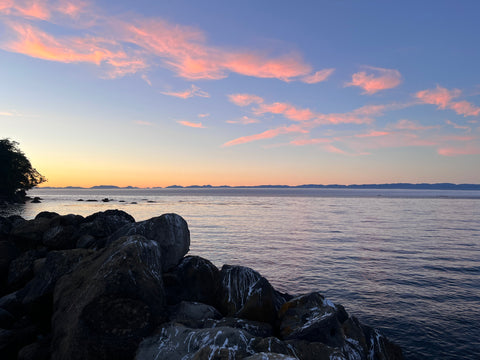
Thick marine fog typically blankets the waters from Sekiu to Neah Bay during the summer mornings, however, the start to this day greeted me with glassy calm seas, and blue skies that extended from Masons marina, all the way north, across the straits, and to the mountainous shores of Victoria B.C.
It was perfect weather, and it helped ease the nerves that had been accumulating over the past two days as I obsessed about all of the things that could possibly go wrong in a small boat out on the big water.
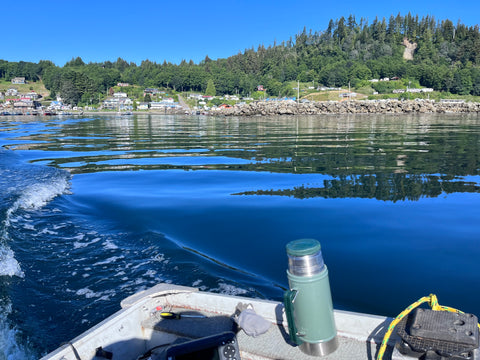
My boat is a V-hull 2008 14’ Smoker Craft Pro Mag with a 20 HP Honda. It’s a good little boat, equipped with a live well, an electric trolling motor, navigation lights, and a backup 6 hp Suzuki that I keep onboard in case of emergencies.
I take her out often, with most of my destinations being on the Puget Sound, Hood Canal, and various lakes in my region. But, as with many others that own boats similar to mine, the thought of taking a small boat out onto water that behaves a lot like the ocean never really crossed my mind.
Boating is fun, until it isn’t. And I’ve always figured it was better to avoid a bad situation than to plop myself directly into one. It wasn’t until I was on the Hood Canal that a friend told me about Sekiu, and how anglers were easily catching their limits of chinook and coho up there, that I began to put more thought into the idea.
Thus, a seed was planted. As I researched and asked around, I found that it was actually quite common to take smaller boats out around Clallum bay. In fact, 14’ kicker boats were at one time the most common sport-fishing boats seen on the water.
At least, that was the case in the 1940’s, when most people weren’t towing around larger boats and instead opted to rent the 14 footers from the marinas. The marinas still rent boats of this size today, most of them equipped with 15 HP outboards.
Sekiu is the quintessential small fishing town. It has two main marinas (both with campgrounds), a handful of motels, a cafe, a restaurant, and plenty of fishing tackle. The town got it start as a salmon cannery back in the late 1800’s, but after regulations ceased to allow commercial fishing, the cannery business crashed, and Sekiu had to look to other industries like logging, hide tanning, and sport fishing.
The latter of the three being the one that worked, and oh did it work well. The fishing is world-class, and seldom will you find anywhere outside of Alaska that has this type of salmon and other saltwater fishing. The unincorporated community is situated right inside Clallum bay, in the northwestern portion of the Strait of Juan De fuca.
The bay itself, and just west of the bay, enjoys decent protection from S,SW,W, and NW winds. Once you head further towards the ocean or out north into the open water, you become more exposed to the common west and northwesterly winds.
Luckily, you will find excellent fishing near-shore, or without having to travel too far west in the direction of the ocean. In fact, most fisherman catch their limits of salmon just west of the bay near what is known as “the Caves”.
Two main summer-run salmon routes exist in the area, and those two routes follow near shore on the Canada side and near shore on the Washington side. This is an ideal situation for a small boat fisherman who doesn’t want to venture too far out into the open water.
When I motored out of the marina that first morning, I was a day behind on my already limited schedule. This had me fishing on an odd numbered day of the month. At the time, odd days were closed to salmon retention due to emergency regulations set by the Department of Fish and Wildlife.
This meant that fishing for salmon that day was out of the picture. However, in Marine Area 4, just northwest of me, lingcod, rockfish, and other bottom dwellers were all very much on the table! To get to these, I had to run about 5 miles west to Shipwreck Point just east of Neah Bay.
So, with calm waters on my port side, I gunned it west towards the MA-4 boundary line. The swell and wind forecast for that day were predicted to be favorable up until around 1pm, and so far, the predictions seemed to be holding up.
My little boat planed quite nicely heading out with the ebb tide and gracefully skipped over the rolling swells. My first “yikes” moment occurred when I approached Kaydaka point. This large point that sits roughly 2 miles from the marina brings underwater structure out into the straits, and as a result, kicks up the wave height significantly.
Though the increased wave size didn’t pose a significant threat to me, I still figured it was a good idea to run a bit further offshore to avoid the turbulence. It’s worth noting that points like these can present sea conditions that might not be tolerable for particularly small boats during rougher conditions.
The bottom fishing was hot within minutes of being inside the MA 4 boundary.
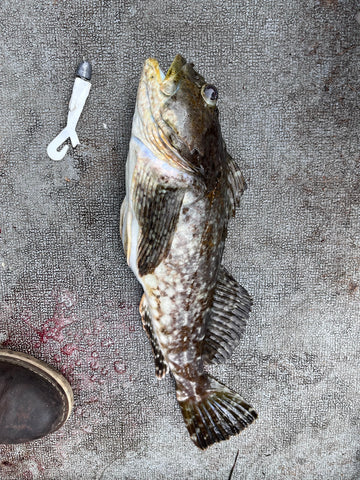
I fished a 2 oz jig head with a pearl white double tailed grub over some structure, and within minutes I was into some fish. A few good-sized lingcod found my hook, along with several rockfish and a beautiful cabezon that fought like a bull! All in all, the day was a success.
I won’t bore you with the details of my next morning’s salmon trolling trip. I only had an hour to get it done, and let’s just say I’m still eating last season’s silvers from my freezer (and yes, some of it’s looking a little freezer burnt). But the success was had in that I made it back to the marina both days in one piece.
This wasn’t accomplished in a 30’ fishing boat that’s worth more than my life savings- nope, this was done in 14’ aluminum boat with a small engine and an even smaller backup.
Small Boat Safety
Now, let’s talk the important stuff. Small boat safety. Is it safe to take a small aluminum boat onto the straits? It certainly can be! There are inherent risks that come with any type of boating, regardless of the boat size or the water that you are on.
Risk assessment, risk avoidance, and preparation are all key components to keeping you safe on the water.
DISCLAIMER: I am by no means, an expert on boating safety. All I can do is share what works for me and what I have learned myself.
My first bit of safety prep comes well before I arrive at the marina. Fortunately for me, I have a work schedule that affords me the liberty to plan my trips around weather windows, so I’ll start by looking for consistently fair weather in the long-range forecasts.
As I get closer to my desired departure dates, I’ll home in on the NOAA webpage and start looking at wind directions and speed, wind waves, then swell predictions (paying close attention to wave period or duration), and then tide charts. It’s important to know how wind, swell, and tide currents all work together to cause either rough or manageable conditions.
I don’t have the page space to get into that here, but there are plenty of resources available online for anybody who wants to educate themselves on the nuances of ocean behavior. The calm waters typically occur in the morning, so be up and ready before sunrise.
If the winds are predicted to pick up, say, by 1pm, then I’ll be heading back to the marina at least 2 hours before those winds are predicted to occur.
Safety Equipment
Before I leave the docks I want to make sure I have life jackets (I carry an auto-inflate and a standard), a waterproof radio, working navigations lights, at least two GPS devices, a manual bilge pump in case my auto fails, a well-tuned and properly functioning outboard motor, a backup kicker, flare gun, an air- horn, and a reflector to hang up in case of dense fog.
Aside from these things, I also try to scout out beaches nearby that would be suitable for beaching my boat in case a situation calls for it. This is definitely a last-ditch option, as the risk of damaging the boat on rocks is very present.
So, will I be taking my boat my boat out to Sekiu again? Absolutely! I already have my next trip planned! Do larger boats afford more comfort and protection in the event you get stuck in some adverse conditions?
They absolutely do. But, if a capable small boat is all that you have, and you have educated yourself on all the safety measures necessary, then there is no reason for you to wait till you get that 100k boat to go have some fun and catch fish in arguably the most productive fishing grounds in our region.
/articles/chasing-fish-straits-juan-de-fuca
Kokanee Attractors 101
By Mike Carey
If you’re new to trolling for kokanee, the sheer variety of attractors out there can be overwhelming. One walk through a well-stocked sporting goods store can leave the new kokanee angler scratching his or her head in confusion. So many different shapes, colors, and styles can make a head spin. Knowing the difference between the various types of kokanee attractors is vital in using them correctly. The proper application of the attractors you use can make the difference between a productive day or one of frustration.
First, just what is an attractor? Simply put, an attractor is a device that is placed in front of a lure to both give the lure action, and also to attract fish from a distance closer so they can zero in on the bait. Attractors can be both visual and vibrational, activating the lateral lines on fish that alert them of wounded baitfish, and creating flashes of light that fish see as schools of baitfish.
Kokanee attractors
Just like their bigger brothers, salmon attractors - are designed to attract fish to the bait that you are dragging behind them. Selecting the right combination of attractor and lure and using them correctly will increase your odds of catching kokanee significantly.

Let’s take a closer look at the different shapes of attractors and how to apply them to your piscatorial pursuits.
When kokanee fishing, the primary challenge is to find what speed the fish are interested in. Some days a dead slow troll is effective, other days, or even times of day, a faster troll will activate a bite. Figuring out what kokanee want is really the number one job of a kokanee troller. Discovering that out can be incredibly satisfying!
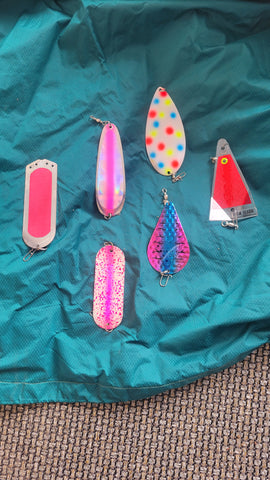
Attractors can be broken down into a few major styles. The shapes will dictate how to use them most effectively. For kokanee fishing, we can group attractors into the following categories: dodgers, sling blades, gang trolls, and rotators.
At this point all the salmon anglers are saying “what about flashers?”. Without a doubt, flashers are the number one attractor for saltwater salmon anglers. While kokanee are land-locked sockeye salmon, you will seldom hear of flashers being used in kokanee fishing. The reason for this is that kokanee anglers tend to troll at slower speeds which do not allow a flasher to rotate as they are designed to do.
Without that rotation, a flasher is nothing more than a dodger, swaying back and forth. That’s not to say they wouldn’t work, and I have seen smaller flashers made which could work for kokanee, but in general, most anglers will not be trolling at the 2.7mph or so it takes to make a flasher rotate.
The shape of your attractor determines the application, and speed is the key. Let’s take a look at each shape and see how to best use it for kokanee trolling.
The Dodger
Dodgers are designed to do exactly what their name sounds like – dodge back and forth. Tie a fly or lure behind one and the dodger will swing it back and forth. The shorter the leader from the lure to the dodger, the greater will be the snap action as the lure is pulled back and forth. Dodgers work best at slow to medium speeds, say .8 to 1.4 mph. Slower than that and you have a non-activated lure, which at times may actually be effective, faster than that and your dodger will turn into a flasher, rotating in a tight circle, not giving your lure much action, either.
The Sling Blade
Sling blades are ideal for faster trolling, say 1.2 to 1.8 mph. The shape of the blade, narrow in front, wide in back, allow for a faster troll without turning over. As such, if your gear is not getting strikes going slow, using a sling blade and upping the speed a bit can be just the ticket. Sling blades can be long and narrow, short and fat, or anywhere in-between. Sling blades are by far the most popular of kokanee attractors, and for good reason. With a wide range of styles and ability to be used at both slower and faster trolls, they offer a great deal of flexibility. Putting a slight bend in the blade can cause further erratic action which can trigger kokanee to strike.
The Gang Troll
Gang trolls have a long and well-established reputation as an effective attractor. Unlike dodgers and sling blades, gang trolls do not impart any action to your lure. What they will do is create a great amount of flash and vibration in the water, drawing fish in to then see your lure. Gang trolls can be metal blades, plastic, or the more recent mylar blades with reflective tape. No matter which type you use, the first fish you catch you’ll see their major (in my opinion) downfall. Gang trolls kill the fight of a fish. If your goal is to enjoy the fight of your catch, look elsewhere. If your goal is to catch fish, gang trolls can be deadly effective.
The Rotator
Rotators are similar to gang trolls in that they do not add action to your lure. What they do is rotate inline, causing flash and vibration in the water. Small rotators are hard to come by but do offer an effective trolling option and I recommend you have a few in your toolbox.
What lure or bait you put behind your attractor is an article in itself. That said, a few general guidelines are helpful. These are suggestions only. Experimentation is part of the fun of kokanee trolling, so my advice is to try variations and see what works for you. You may discover a whole new set up that works!
Dodgers and sling blades, since they are designed to impart action, work best with a leader length of 6-20 inches to your lure. Closer will cause more erratic action. Lures which have no action of their own are good choices, such as micro hoochies.
Rotators and gang trolls impart no action, so lures like small, thin blade spoons and spinners 2-4 feet behind them are what anglers will often run.
As you gain experience trolling for kokanee, you’ll begin to get a sense of what works and what doesn’t. Don’t be afraid to ask fellow anglers for advice. You’ll find the majority of anglers are more than willing to give you tips and advice, which some day you in turn can share with the next generation of anglers!
/articles/kokanee-attractors-101
Late Season on Alaska’s Kenai Peninsula
By Chad Bryson
Alaska’s Kenai Peninsula and its spectacular sport fishing opportunities are a far cry from being a worldly secret. Every summer, thousands of visitors travel to the Great Land in the pursuit of filling fish boxes with some of the cleanest and tastiest sockeye, king, and silver salmon on the planet. \
This occurrence has been happening for decades. In most fishing circles, going to the Kenai during the summer migratory runs of salmon would even almost be considered “old hat.” In fact, I myself even turned a cold shoulder to it.
As a veteran Bristol Bay guide, I couldn't imagine any good reason at all to punish myself, or anyone else for that matter, by enduring the crowds of summer on the Kenai Peninsula. It just didn't seem worth it.
Sure, the fishing was incredible, but it was at the price of standing in line either by boat or by foot next to hundreds of my “brothers in arms”, none of which I knew well enough to be comfortable in those proximities.
That was until at the suggestion of a friend to give the late fall steelhead fishing a try. In an effort to make my re-entry to society easier, I gave it a shot. I figured the worst thing that could happen is that I wouldn't have fun and I would hate the crowds. After the first day, I knew the worst wasn't going to happen, and that I had found a new place/time to fish steelhead.
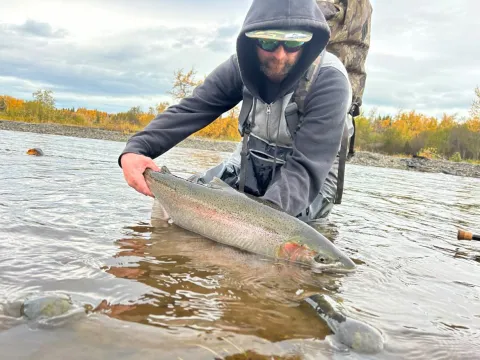
That first trip was in early October. I fished the Anchor and Kasilof rivers. There were plenty of steelhead willing to eat dead drifted beads as well as swung flies. The weather was equally as pleasant as the number of anglers was few. It was almost too good to be true.
How could it be that this Shangri-La of Alaska steelheading could still exist? Furthermore, how long into fall would the fishing sustain? AKA- How long could I stay and do this every single day until the rivers froze or I spent every dollar I had earned over the summer? Whichever came first, I was hell-bent to find out.
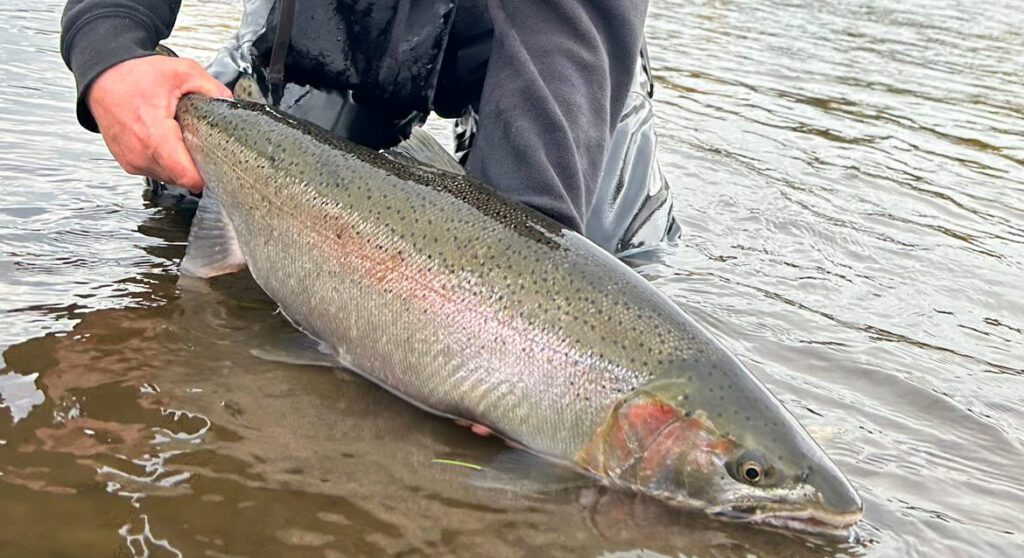
That year, I think I stayed until the third week of October. It was all I could afford both financially and personally. Kids, dogs, and girlfriends have this thing about me being away from home for extended periods of time. Especially the dogs. I was kicking and screaming the whole way to the airport. Fishing at that time was nothing short of remarkable and I didn't want to leave.
Some of the locals I met during my abode on the peninsula encouraged me to not even come back the following year until November 1, as long as the temps held out. At first, I wasn't sure if this was a carefully plotted ruse just so I wouldn't be there to “fish their water” or if it was a genuine act of rare angling kindness. After all, anglers are known for their sometimes harmlessly nefarious actions to keep the local water local.
That wasn't the case here. This was a genuine act of kindness and sharing amongst steelheaders in pursuit of one common goal. I shouldn't have been surprised. After all, that is the Alaska way.
In the years that followed, I fished the Kenai Peninsula later and later. As long as the weather and temps held out, the steelhead were there but, without the crowds of anglers. November/December in Alaska can be very, very cold, with potential of more cold brutality at any given moment. This keeps most fair-weather steelheaders away.
Fellow Bristol Bay guide and lifelong Kenai guide Matt Duncan fishes easily into November and some years well into December, with an occasional January boat launch. Growing up in Anchorage gives him, and other local resident guides, the hands down advantage when it comes to Kenai conditions.
Mike Brown at Mossy’s Fly Shop in Anchorage is also a great source of information regarding Kenai fisheries.

When I’m planning a late-season Kenai Steelhead trip, either for myself or others, I try to take into consideration that on a five-day trip, at least one of those days is going to be a cribbage day. Maybe even two days. Weather can blow in and blow out just that fast.
As long as you know the potential is there, it won't be that big a deal. There are numerous Airbnb, VRBO, and local cabin rentals on the lower Kenai Peninsula that will accommodate a world championship cribbage tournament should the need arise. While you are fishing, plan accordingly on how you dress. I wear boot foot waders and full synthetic layers no matter if I am in a boat or walking in to wade fish.
And don’t even think about wearing anything but a quality rain jacket. A friend joined me on a November Kenai steelhead adventure that only brought a “brand x” windbreaker that was water resistant. After about 90 minutes our fishing day morphed into an excursion into Homer for the purchase of a brand new Grundens product. Don't be that guy. Ever.
In regards to fishing tackle, you will see a myriad of techniques being used on the Kenai Peninsula. Everything from conventional float rods and beads to spey rods and swung flies tied with the rarest of materials. All of it works and has its own place in the system.
I have stood next to center pin anglers, float anglers and single hand fly anglers in a parking lot while I rig my spey rod for the day. Nobody cares what you fish with and nobody cares where you are from. Its Alaska, most people are from somewhere else anyway. Everyone just wants to fish. I find it refreshing.
If you are up for a unique steelhead experience at a time of year when most everyone has forgotten the Great Land exists, check flights to Anchorage. Winter flights are sometimes ridiculously cheap, especially from the PNW.
The local guides are still working every last day they can before the unforgiving arctic freeze sets in. You could be on the verge of discovering your new Thanksgiving family fishing vacation.......
/articles/late-season-alaskas-kenai-peninsula
Top Chum Tactics
When it comes to salmon fishing, there are often two thoughts on the subject. The first is table fare, always trying to catch the freshest salmon that will eat the best, regardless of the recipe. Of course, sockeye are at the top of this list, along with bright coho, and ocean-caught chinook.
Last on that list is probably chum, with the exception of river run pinks, but since chums are an every-year fish, unlike the smaller but also low river system spawner the pink, the chum salmon is not always considered good eating quality. Even those in the commercial market change the name of the ocean-caught chum to entice the chef and are called by their scientific nomenclature, the Keta salmon.
There is no disguising a chum once it hits the barbecue. Even the ocean fish, which is very edible but lacking oils, tastes bland. The second list for the salmon angler, and one that is just important, is catchability, or how easy it is to catch the fish, along with their fight. This is where the chum shines, and it is at the top of my list of salmon I like to catch and release in the fall.

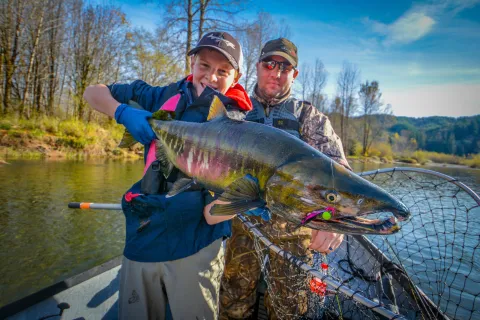
I don’t think there is a fish on the planet that is as aggressive as the chum salmon- well, okay, maybe a barracuda or northern pike, but for the Pacific salmon species, chums are at the top of the “get in my way and I will kill you” list.
This makes for a fun day of catching chums, and the fact that they are the second largest salmon species means a hard-fought battle once you hook into these “dog” salmon. This means using stout gear, so before we start talking tactics, let’s take a look at what rods, reels, and line you should use.
Chum fishing in the rivers often means catch and release, so it is best to use gear that can handle these fish as well as get them back to the river quickly. You don’t want to stress the fish so much that it dies after the fight, as that would defeat the purpose of allowing the fish to go back into the river to make more fish.
Starting with the rod, think like a chinook angler and use a stout, medium-heavy to heavy action rod, often rated for 20 to 30-pound fish, or up to 5-ounce lures. If using a casting reel then you will be well equipped, as those reels have heavy drag systems, but for anglers who can’t cast them without creating backlash, then a 4000 series or larger spinning reel is best.
You can get away with a smaller reel like a 300 or 3000 series (depending on the manufacturer, as each uses a different numbering system) but be sure to be ready to crank down the drag a bit. Mainline isn’t much of an issue now that braid has become standard practice, but even still you will want to run a minimum of 30-pound line, with 40 and even 50 being preferred.
Depending on which technique you use, if a monofilament line is involved it is best to use 20-pound for leaders, as a minimum due to the teeth these dog salmon have once they start to enter the spawning phase of their lifecycle.
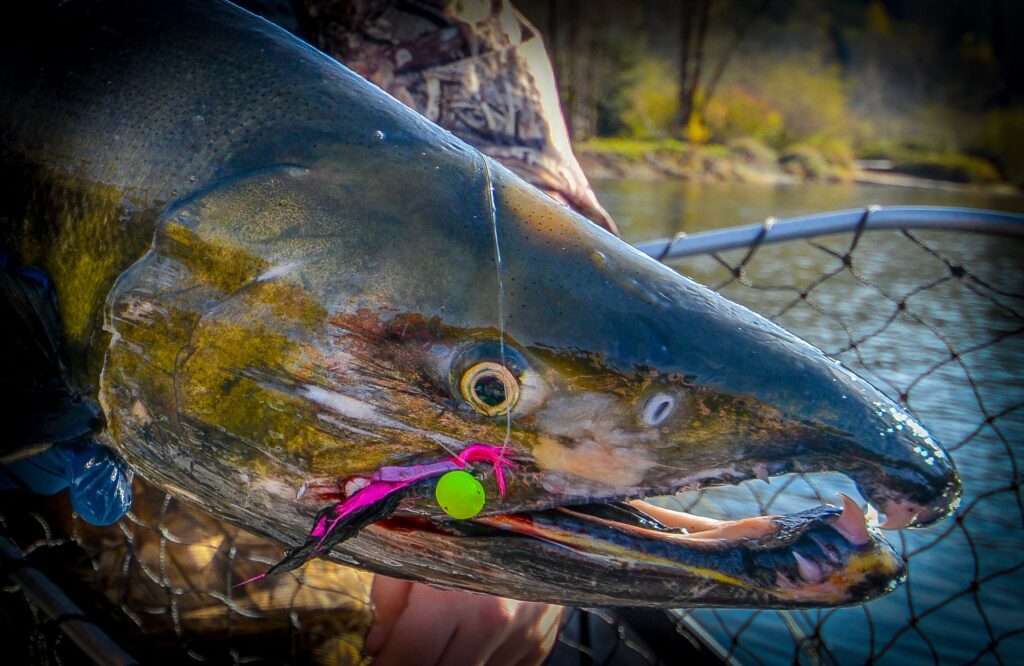
Now that you have an idea of what kind of gear is needed, the technique or tactics used to catch these fish vary by type of water you will be fishing and even the crowds around you, as you don’t want to be that one angler who decides to swing spoons when others around are float fishing.
Regardless of which technique you do use, be sure to use one that will not only hook the fish legally (in the mouth) but also allow you to reel it in quickly, snap a photo, and then send the fish on its way.
Floating Jigs
Floating jigs tipped with a piece of prawn is one of the best techniques to catch chums. Not only is this an easy way to fish, but watching a float sink into the river while you set the hook is an adrenaline rush. What can seem like a mundane way to fish quickly turns into a frenzy of excitement.
Best of all, it is simple, works anywhere fish are found, and not just chums, but coho and early winter steelhead or late summer steelhead are also caught in this technique. Several years ago, while fishing the Green River near Seattle, we were drifting down the river in my drift boat and floating bright-colored jigs tipped with a piece of raw prawn.
The float went under, and to our surprise, a late summer steelhead jumped out of the water. A bonus fish that was also released to swim and spawn another day.
When it comes to floating jigs, it is best to downsize them to a ¼ ounce as they fish a bit better under the bobber than heavier jigs. But if you do want to keep things simple, the 3/8-ounce twitching jig does work under a float.
Regardless of twitching or float fishing, the jigs chums prefer bright colors. A white head with a cerise body is a good “go-to”, but so is chartreuse and black, as well as cerise and black, as the contrasting of bright and dark seems to entice the bite. Purple and pink are other top colors.
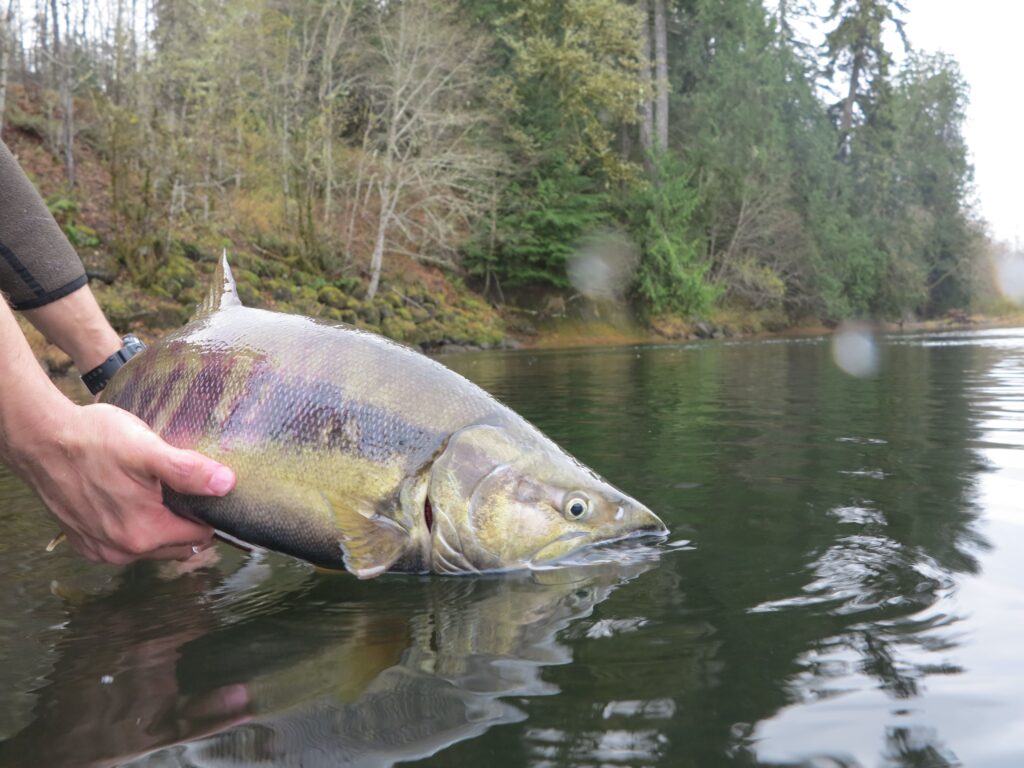
As for that piece of prawn on the jig- if you don’t have prawns, or just forgot to grab some from the grocery store, jigs take on scent really well. If using a marabou jig, then realize that the gels will ruin the action of the jig.
Instead, use Pro-Cures water-soluble products, with bloody tuna and sand shrimp being very popular for chum anglers. It is hard to beat prawns, and they are cheap bait to buy. A handful of prawns cost a few dollars at the seafood counter at the local grocery store.
You can fish them raw but another way to add contrast is to dye them with Bad Azz bait dye in purple, cerise, pink, or chartreuse. Keep in mind this dye will stain everything, so it is best to use a small amount and use disposable containers.
Twitching Jigs
Twitching jigs is another technique that will catch a lot of chums, as well as a coho or two that are still lingering in the river system. Here again, there are two schools of thought, the first being twitching to holding fish in deep holes and structure.
There is one spot on the Satsop river in Southwest Washington that is consistent each year. My son and I try to venture to this river every November when the coho are still in the system and the chums are just arriving. This one spot is a deep water slough that sits just off of a bend in the river with strong current. Fish, both chums and coho, stack up here, and we break out the twitching rods.
On one trip, we invited a friend who had just moved from Texas and had never caught a salmon before. Chums are a great fish for these types of trips. My son Ryan cast a twitching jig into this backwater and showed our friend Chris how to twitch. Then Chris cast the line, and on the second twitch of his first ever cast for salmon, he hooked a huge buck.
As the fish dove deep back into the hole, he looked at us and yelled, “this ain’t trout fishing!”. We hooked and landed several more fish that day, all on jigs, either floated or twitched.
Spinners
Spinners need to be ranked as one of the top techniques for chums, as they catch a lot of fish. It is hard to describe to an angler who has never used spinners before what it is like to hook a chum on one.
Casting out into a run and letting the spinner flutter and work its way across as you reel in, feeling the telltale “thump-thump” of the blade working, then, all of a sudden, the rod almost gets ripped out of your hands as a chums grabs the spinner and takes off.
Again, use bright colors, such as a size 5 Blue Fox Vibrax with a chartreuse body and silver blade. Hot orange and pink also work really well.
Spoons
Like spinners, the spoon bite can be a lot of fun. In Alaska, I don’t think you will find an angler’s tacklebox without a few pixie spoons in it. Gold body with a pink or red center work well.
Of course, Dardevle is synonymous with spoons, and the trusty red and white striped Dardevle works well, but so do bright greens, pinks, and reds. Spoon fishing is much like spinner fishing, except you do want some current with the spoons, where spinners can be cast out into deep holes and reeled in.
Swinging spoons is just that- cast out and take up the slack, and then let the spoon swing across the river to holding or moving fish.
P-Lugs
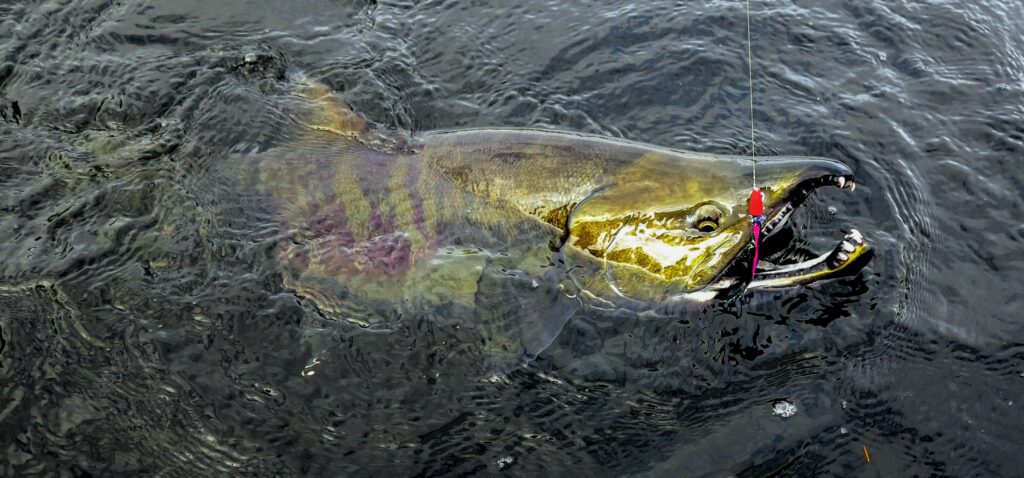
Lastly, big, gnarly chums like big, gnarly p lugs. A MagLip 5.0, or a K15-Kwikfish in bright colors either being back bounced or just simply plunked will catch chums. You can elect to wrap the plugs or just use some Pro-Cure Super Gel in herring, anchovy, or garlic, as it will stick to the plugs very well.
Back bouncing them down a deep hole is a log of fun and a great way to catch fish. If there is enough current, then pulling them in a traditional way also works well. It is a great technique for the newer angler if the person on the helm or oars knows how to pull plugs.
Simply put them out, place the rod into the holder, and then put your hands in your pockets. Wait until the rod loads up with a fish, and then put that drag on the reel to work.
Regardless of which technique you use, just remember that these fish need to go upriver to make more fish. Try to get the fish in quickly and then release it after you let it rest and rejuvenate. Some will argue with me that chums are good to eat, and to that I will remind readers; “to each their own”.
For me personally, I would rather stock my freezer with coho for the barbecue and catch chums for the fun. They are big, aggressive, and put up a heck of a fight, and that is all I need to put them at the top of the list as one of the most fun salmon to catch.
/articles/top-chum-tactics
No Kill Kalama
Sometimes we don’t get the fish, sometimes we don’t get the shot. And sometimes we don’t even think about it because there is just too much going on.
You are not going to get a slick fish picture, but I am going to let you in on a little secret called “License to Chill” on the Kalama River in Washington State. This underdog tributary of the Columbia River is often overlooked, but why? Well, it's hard to get to, and access is limited, but there are substantial year-long opportunities for salmon and steelhead runs. It's a sweet spot, roughly 45 miles long, and narrow enough to cast across to the opposite bank.
It may be relatively small, but when you're there you feel the pulse. It’s a mainline to the Pacific Northwest heartbeat. The swift mossy green waters amble through the Cascades from Mt St Helens to the Columbia.
License to Chill hosts 19 private acres of preserved forest, easy access to the riverbank, and multiple runs every year. Spring chinook get a lot of attention, followed by summer steelhead, coho in the fall, and the almighty winter steelhead running well into the spring.
Can you keep them? No. This is a strictly managed catch-and-release barbless fly-fishing stretch.
Should you pull them out of the water, take a picture, and admire your fish? No, what's the point of that? You're causing stress, suffocation, and possible internal injury. This river isn't for the eating fish, it's for the experience. No Kill Kalama is just the place to go if you want to unwind and wet your line.
I am one of those people who believes that all humans should have the right to forage, hunt, and fish for our own sustenance. And, why not fun? However, I also think we should absolutely look outside of ourselves at the natural world, sustainability, and what we are leaving for each other and our children.
This isn't a debate, but a few words to share what a great time I had on the Kalama River. If other like-minded folks appreciate the suggestion, then I'm pleased about that!
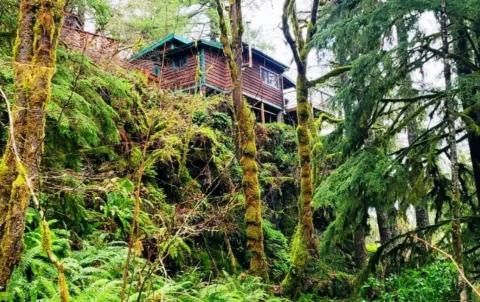
So much love and history has gone into this cabin and property. It is really one of a kind. At 90 feet above the river, you can feel it roar under you as you drift to sleep. If you like eagles, how about taking a shower outdoors while they fly above giant Red Cedars? It is epic!
/articles/no-kill-kalama
Hoodsport Chum
For salmon anglers in the Pacific Northwest, November heralds the final transition from targeting open saltwater to focusing on tidewaters and rivers. Yes, there are some saltwater opportunities (for example, blackmouth, when open), but the vast majority of anglers have put away their boats and are pursuing salmon in the rivers. That said, there are some prime opportunities to target and catch salmon out of your fishing boats, so don’t button them up just yet!
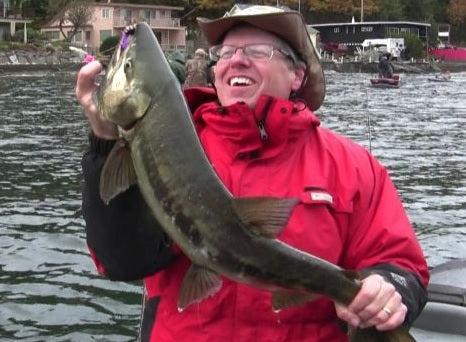
One of my favorite fisheries out of my boat in November has to be the Hoodsport chum fishery. The fight of a 10-15 pound chum ranks up there as one of the hardest fighting salmon you can catch. Taking on a chum with steelhead gear will give you all the battle you could ask for as these brutes slash and pull with every ounce of energy they have. One look at their fighting canine teeth and you’ll know this is a fish that is serious, very serious, about its reproducing goal.
All up and down Hood Canal you’ll find chum as they work their way toward their spawning grounds. The state hatchery at Hoodsport and three miles south of there at Potlatch (a smaller, Native American hatchery) are the destination for many of these chum as they work their way down Hood Canal.
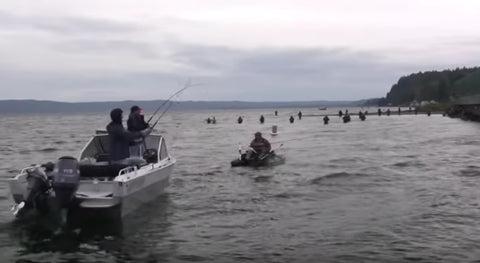
I have caught fish in both locations, and each spot has reason to recommend it. Potlatch, being smaller, has limited shore angling and parking, which is roadside only. That said, there are also fewer anglers there. Hoodsport, meanwhile, is the Fishing Mecca that chum anglers are drawn to. Fishing right out in front of the hatchery and watching hundreds of fish jockey for position as the tide sweeps them into the small feeder creek leading to the hatchery is truly a sight to behold. Of course, along with the fish comes combat fishing in all its glory. As the tide comes in and fishing space decreases, getting to know your neighbor takes on a whole new meaning.
If you’re a fortunate one you’ll be fishing out of a boat – or some type of floating device. The waters around Hoodsport are open and the wind can come up and blow hard, plus fast running tides can make it a challenge to get an anchor to set. Be sure to bring an anchor with some bite, and terminal chain so you’ll stick in the rocky bottom. I’ve seen anglers fishing out of all manner of floating devices on calm days, including single person pontoons and float tubes. Be sure to have your life jackets on and just don’t venture too far off shore. If you are feeling anxious that’s your inner voice telling you a fish isn’t worth your life – pay attention to it!
For boaters, the launch is two miles south of Hoodsport at the Skokomish Park at Potlatch. The launch has two concrete lanes which are in varying state of repair (read that as back down with caution!). There is ample parking, and a restroom. Once launched it’s a quick run to either terminal hatchery, faster to the small Potlatch facility.
When you arrive, survey the already anchor boats, taking into account the amount of anchor line you’ll need to get a solid grip on the bottom, as well as the shore anglers. Anchoring too close to the shore bound anglers will earn you a steady rain of lures and weights at your boat. Stay outside their casting zone - you’ll have plenty of water to work over and opportunities to catch fish the shore anglers don’t have.
As to the type of gear you should bring… you’re going to enjoy a variety of methods to catch these Hoodsport chum. Like chum everywhere, chartreuse and green are always great colors to choose. Pink or cerise is also good color choices. For rod/reel setups I use my steelhead gear, both spinning reels and casting will get the job done. I like an 8 ½ foot medium action rod. Line should be strong enough to turn these big brutes so as to avoid massive tangle ups with your fellow anglers. I like 18-20 pound test. Chums are not leader shy in my experience so keep things hefty.
What technique you use is up to you but here are a few tried and true methods:
Floats and jigs , or floats and corkies with yarn can be deadly. A ¼ or 3/8-ounce pink, black or purple marabou jig fished under a float is deadly. Tipped with a piece of shrimp meat or coon shrimp tail is even better. The yarn is a nice trick as it helps by getting caught up in the chums teeth, allow you to drive the hook home. Other bait you can put under a float includes the ever popular anchovy or herring, whole or plug cut.
Think of the tide as the river current. Set your depth for the lure so it’s running a foot or so off the bottom. Vary the depth if you aren’t getting bites. These fish will hit suspended jigs. Cast “upstream”, i.e. up into the tide, and let your gear drift down with the tide to the end of the “drift”. If the coast is clear, free spool your line, keeping the float straight up and down to extend the drift. When the float goes under set the hook and be ready to do battle!
Twitching jigs – ditch the float and cast the jig on its own. Another effective technique, but be prepared for a lot of foul-hooked chum. Dragging a chum in by the tail is not fun, nor is it sporting to be snagging fish. If you find yourself foul hooking too many fish move on to a different method…
Casting spinners. Again, it’s a solid technique to try if the action is slow. I personally would remove the treble hook and use a single si-wash hook. A number 3 or 4 blade fished with a slow retrieve is just the ticket.
Corkie, yarn, and slinky. I personally have caught a lot of fish using this method and seldom snag fish. Again, think of the tide as a river. Cast out and let your gear drift. You’ll know you have a bite because your rod will be about ripped out of your hands. I use a 3-4 foot leader length.
Regarding the above technique, I’m sure I’m going to get comments about flossing – I personally think it’s a bunch of malarkey. Why do I say that? Because I remember a day years ago fishing Hoodsport when the chum were in thick, jumping all around us, swimming by in schools of 10-20 fish. I had my corkie/yarn/slinky set up going, casting, retrieving, and not getting a bump for a good hour. Suddenly, the bite magically turned on and my gear started getting bit. In came fish after fish, hooked in the jaw. Explain to me how one can have a steady procession of fish go by with mouths open for a good hour and not “floss” one fish, then suddenly start catching one jaw hooked fish after another? And trust me when I say this, those hook-ups were solid strikes, not to be mistaken with a snagging sensation. Anyway, the flossing debate is one we anglers love to engage in every year and likely will do so as long as we fish corkies.
The fly fishermen do quite well at Hoodsport as well, fishing sinking tips and flies of various styles and colors. I’m not a fly guy but it sure does look like fun. Maybe on my next trip I’ll give it a try.
Before you set out, be sure to check the Hoodsport netting line at 360-877-5222. Typically the nets go in on Tuesdays and Thursdays, but this is not set in stone. There’s nothing worse than driving a hundred miles only to find nets spread in every direction. So save yourself that aggravation before you set out.
Fishing for hard fighting chum is a blast. Get in on the action this November!
/articles/hoodsport-chum
Return to Riffe Lake
While there are so many lakes with amazing fishing opportunities in Washington State that I love, Riffe Lake may just be my favorite. Located just 60 miles south of Tacoma, Riffe Lake is a 13-mile long reservoir that’s famous for its landlocked salmon fishing. Tacoma Power not only raises and lowers the water levels of this lake, but they also stock it with thousands of coho salmon every year. Once they meet their quota of fish, they put the excess fish in Riffe Lake to give sportsmen an opportunity to target them there. It’s usually well worth the drive, Riffe Lake is a consistently good fishery. I cut my teeth learning how to troll on this lake. Landlocked coho taste amazing on the grill and the smoker. The action is typically hot and fast. Let’s go over how to have a successful day at Riffe Lake!
Trolling is by far the most popular way to fish Riffe Lake. You don’t need to run all the way across the lake to catch fish; you can start trolling right after you launch. You can use your kokanee setups- the coho here are about the same size. Coho in Riffe Lake love the color pink! You’ll want to use small pink dodgers and pink lures. Some popular lures include Mack’s Wedding Rings, Brad’s Kokanee Cut Plugs, small spoons, and small hoochie spinners. The coho are usually willing, aggressive biters. If you get some hits but no fish, reel up and check your bait. This trait also makes them a great way to teach kids how to reel in bigger fish. Before taking your kids out to the Sound to target the big boys, let them practice reeling in these feisty Riffe Lake coho!
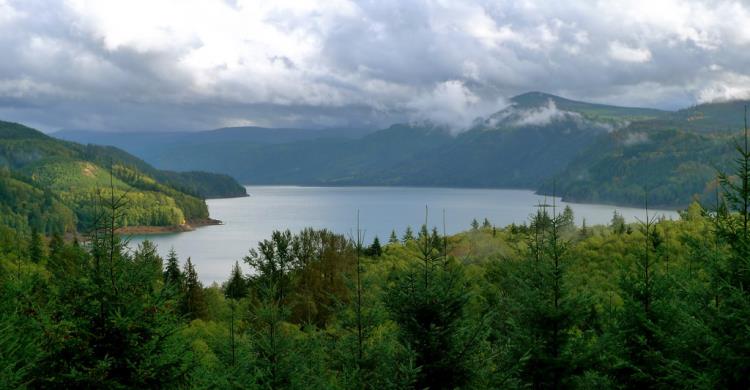
During this time of year, the heat will have pushed the coho down in the water column. Salmonids do not tolerate warm water temperatures as well as other species. They will also travel deeper during the heat of the day to escape the sun. During sunset, sunrise, and on cloudy days, you won’t have to fish quite as deep. A good fish finder is essential to find out how deep to run your downriggers. Riffe Lake is extremely deep and large. With 13 miles of 200 feet deep water, there’s a lot of room for fish to spread out.
Keep a close eye on your fish finder, it’s easy to get lulled into a false sense of security when trolling in such deep water. The lake shallows up surprisingly quickly, especially near islands. Some days the fish can be 90 feet deep. The fish school up very tightly, so they will be easy to find on your fish finder. Be ready to adjust the settings on your fish finder, especially if you’re used to fishing shallow lakes. You don’t need to see all 200+ feet of the lake, adjust your settings so you only see the depth you need.
As of this writing, all boat launches except Mossyrock Park are closed due to low water levels. As previously mentioned, Tacoma Power raises and lowers the water levels throughout the year. You can give them a call or check their website to see which boat launches are open. There’s a nice fish cleaning station at Mossyrock Park, restrooms, ample parking, and a play area for the kids. You can find restaurants, stores, and other amenities at the nearby town of Mossyrock.
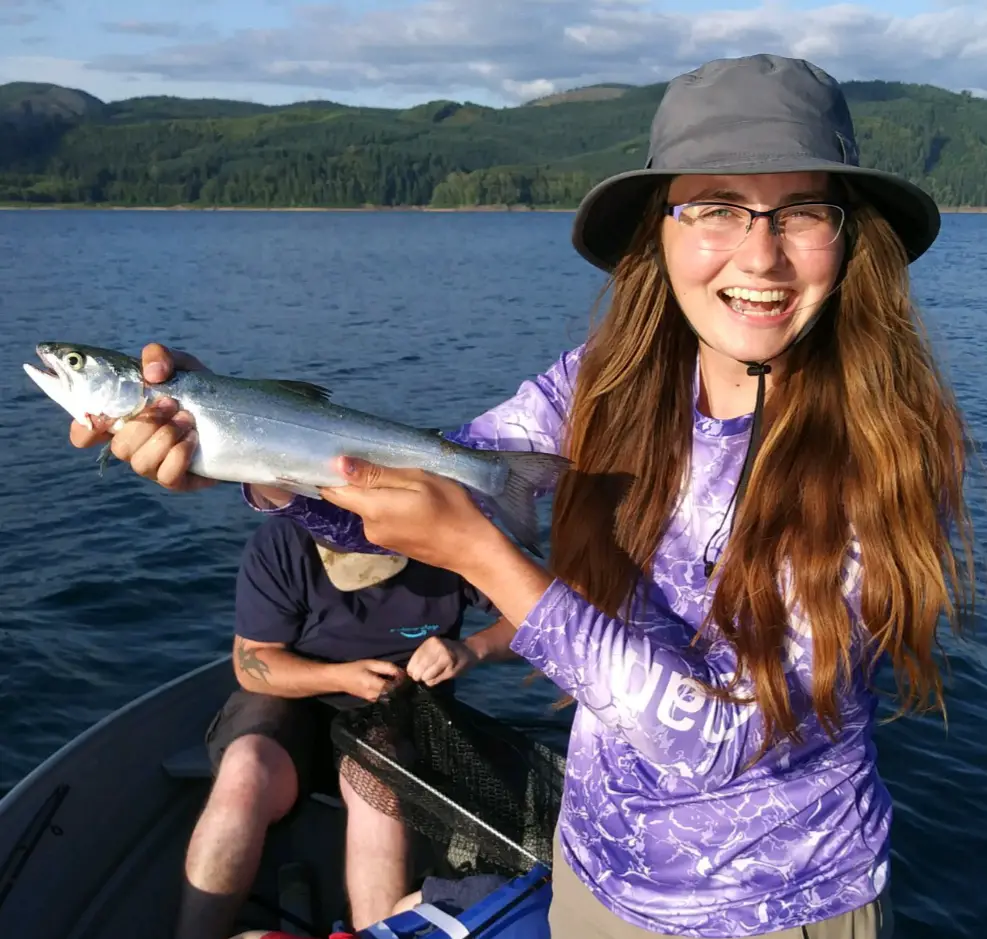
Once you’ve launched, you can start your troll and turn left or right. I’ve consistently found fish in both directions. Some days, we’ve limited out all 4 people in an hour, and couldn’t even get all 4 rods back in the water! There are fish all over Riffe Lake. If you’re struggling to find willing biters, try targeting points and islands. These fish like drop-offs, just like their saltwater cousins.
There’s something for everyone at Riffe Lake. Don’t have a boat? No worries, there are several places near the dams that you can shore fish. Cast out a piece of shrimp underneath a bobber, and wait. Just like when you’re fishing from a boat, you’ll want to adjust the depth you’re fishing at to find the fish. Remember that there is a 5 fish limit. You can catch a variety of species at this lake other than coho, including cutthroat trout, rainbow trout, brown trout, chinook salmon, and steelhead. Salmonids have a hard time surviving catch and release, especially in this hot weather.
Another word of warning, check the forecast before heading out. Riffe Lake is famous for those afternoon winds that can blow small vessels off the . Most importantly, remember to have fun! Riffe Lake is a special fishery. Where else can you consistently bring home limits of land locked salmon? Go catch your limit, let the kids play at the park, and have some ice cream and burgers in Mossyrock before heading home to barbeque your fish!
/articles/return-riffe-lake
Chinook Dreams
Imagine waking up in a place where you could keep five chinook a day, use two rods, barbed hooks, and have a legit chance at multiple twenty-pound plus fish. On top of that, no punch cards, or shortened seasons. Sounds too good to be true? Some pipe dream in a faraway land that time forgot? Well, I’m here to tell you there exists just such a place. It’s been happening for years now and is closer than you may think.
I’m speaking of a place you’d not likely think of when it comes to chinook salmon. That place is Montana, and the location is Fort Peck Reservoir.
My son Matt and I recently got to fulfill a Bucket List dream we’d been talking about for years, namely the Fort Peck Chinook Fishery. We were joined by NWF co-host Rob Holman, and Shelby Ross of Ross Outdoor Adventures. Shelby may be a walleye guide, but he was down for a trip to Fort Peck. And I sent Rob a steady stream of recent angler catches, feeding his enthusiasm. They made the ten-hour drive from Spokane, while Matt and I had a relatively easy five-hour drive from Great Falls to this reservoir in the northeast corner of Montana. The trip goes fast because in Montana you can drive fast, 75-80 miles an hour, and there’s little traffic to contend with. Just keep an eye out for stray deer and antelope, and the occasional suicidal pheasant.
We met at the Cottonwood Inn and Suites in Glasgow, which turned out to be a great place to stay as a base camp for fishing Ft Peck. 18 minutes from the boat launch, Cottonwood Inn and Suites has all the amenities an angler could want, including free charging stations to recharge trolling batteries. It also has RV camping for those with RVs.
Ft Peck’s 3.8 mile long dam was completed in 1937, backing up the Missouri River for an amazing 134 miles in length and 220 feet at its deepest spot. With over 1,500 miles of shoreline, it is longer than the California coastline and bigger than Puget Sound. At 18.7 million acre-feet, it’s the 5th largest man-made lake in the United States. The surrounding countryside is high prairie and borders nearly the entire Charles M Russell National Wildlife Refuge.
Dozens of species of fish inhabit the lake, and it is a world-class body of water for walleye, bass, pike, and lake trout. The chinook were introduced in 1983, but what really caused a boom for the fisheries of Fort Peck was the 1984 introduction of cisco to the reservoir. This species of bait fish, also known as lake herring, rapidly reproduced, and they provide the reservoir with an ample source of food for the various sport fish in the lake. It also is no small reason the chinook have grown so well, with the state record at an impressive 32.05 lbs with a girth of 27.5 inches and a length of 38.25 inches, caught by Greg Haug of Bismark, ND in 2020.
To top it all off, the State of Montana has a massive hatchery at Fort Peck where they raise and release walleye, pike, and salmon – with a capacity to raise and release over 500,000 chinook, it makes for a very healthy population of fish to target.
Launching at the crack of dawn is always a special time of day. We idled out to the main reservoir with the sun cracking the eastern sky, beautiful shades of orange, yellow, and red painting the sky. A brief five-minute run and we began the process of deploying our gear. My boat has two downriggers, and with no tides or wind to deal with I was comfortable stacking them, setting the deep rods at 60 and 90 feet, and stackers 10 feet above. Not more than five minutes after all rods were out, the port deep rod got bitten 60 feet deep. As the line came taunt the drag began to scream – our first Fort Peck chinook was on! Standing next to the rigger, I grabbed the rod and felt the pull of a solid fish. I had brought my knuckle buster reels to Montana and was glad I did! There is no better fight than a big chinook on a knuckle buster. Add to that break-away flashers and this chinook was giving me everything I could handle and then some. Clearing the port side stacker rod, I worked the fish ever closer as frantic runs became shorter and less frequent. Finally, a chrome bright football slab of a chinook appeared. Easing the fish to the net, Rob scooped the fish up and into the boat. Wow, what a pig! It was obvious that these freshwater chinook are feeding good. Plump, and all fins intact, we admired a fish a thousand miles away from its native element. Montana Department of Fish, Wildlife, and Parks certainly created an amazing fishery out in the middle of the prairie.
After bleeding the fish, it fit (barely) in my cooler. Lines back down we continued our troll, noting more boats joining us. As the morning progressed the fleet of boats probably numbered a couple dozen. Spread out over an area of maybe ten by ten miles, over-crowding was not a concern for this fishery!

With high hopes for more fish, we explored the general fishing area. Marks were common at 60-90 feet, and we also noted fish marks on the bottom at 160 feet. Dropping a rigger ball down and bouncing the bottom, it wasn’t too long before I confirmed my assumption – lake trout. Shelby brought the nice 6-pound fish to the boat and in the cooler he went. Since everything we had read and been told indicated the chinook were suspended, we went back to mid-depth with the deep rigger.
The action died off and we came in around 1pm, cleaning our fish at a first-rate cleaning station at the Fort Peck Marina. I stopped in and visited with the owner and guide at the Marina, Scott Collinsworth. Scott is very active on the Montana Salmon Facebook group and willingly shares information on techniques to catch these fish. He indicated the bite had slowed down from the previous week (no doubt a low-pressure front didn’t help) and catch rates were about a fish per boat. That’s still pretty impressive for big 15-25 pound fish (ours was 16 pounds). Even more impressive was another guide boat that came back with nine big chinook! That’s what daydreams are made of.
We retired to the Cottonwood Inn where Rob hit the casino and I hit the bed for an afternoon nap. Cleaning up the boat and re-rigging gear, the day ended with a nice meal at the The Woods, the Inn’s dinner. A nice variety of dishes were available, as well as craft Montana beers on draft and a full-service bar, all at affordable Montana prices.
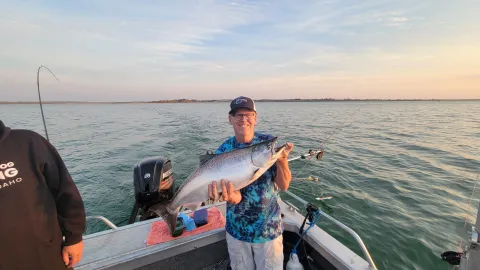
Our next morning was a cookie-cutter day, as we again started fishing with the sun breaking the horizon. Again, the port rod exploded and Rob grabbed the rod, battling an even nicer fish. As he brought the fish to the net and I scooped it up, I was amazed at the weight in the net – this fish was very close to hitting 20 pounds, another fat, healthy chinook.
A word on gear – when we moved to Montana I kept my salmon gear, knowing that someday it would come in handy for fishing Fort Peck. We certainly went through a lot of lure combinations, most of which I have no doubt would work great if the bite was on. Most anglers fish with flashers, salmon flies, herring, spoons, and a few other salmon-oriented choices. The two big differences I observed from Puget Sound chinook were more fishing at suspended depths and trolling slightly slower. Most anglers trolled at 1.8 -2.2 mph. We started out faster, 2.5-2.9. So, while we did catch a couple fish at this faster troll, by the end of the trip we had slowed down, matching the fleet. I suspect those that enjoy mooching would find these fish to be very co-operative with this technique (note to self, bring mooching gear next year!).
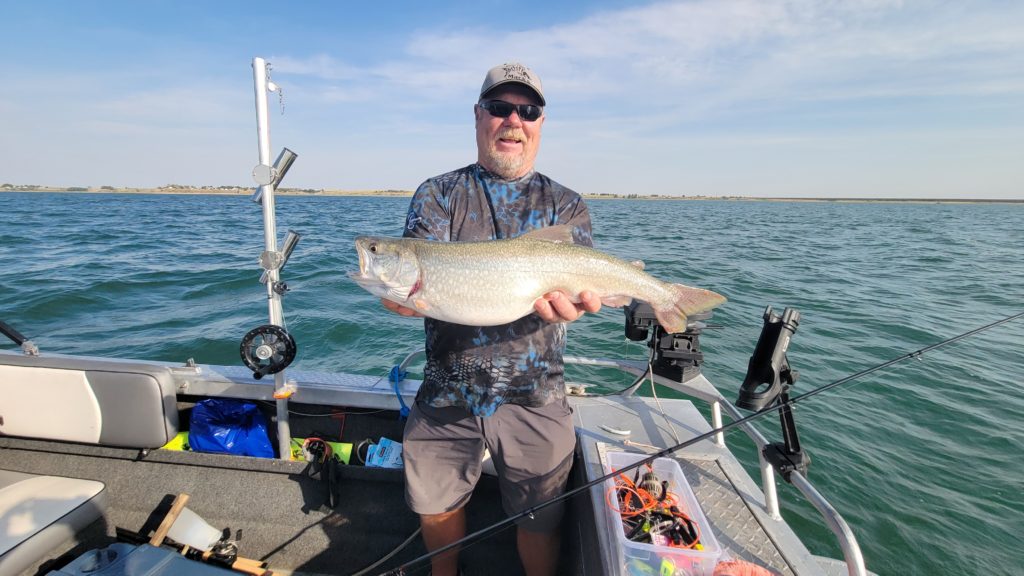
Our second day ended much like the first, with Matt catching a small laker and also a beautiful walleye. We also lost a nice chinook that came unbuttoned.
Interestingly, the weekend saw less anglers on the water, opposite of what you’d see in the Puget Sound fisheries. A couple other observations – the boat ramp etiquette was outstanding. The Marina has a two-lane ramp with a dock. Most anglers launching and retrieving would power their boats on/off trailers, making for fast and smooth lines. Second, we only saw a couple tubers on the water. Pretty much every boat we saw were anglers. There’s a distinct advantage to being far away from population centers!
Although our trip ended with “just” two salmon, I considered it to be a huge success. I learned about the area, the launch, where to stay, and techniques to use. I’m already contemplating next year’s trip and the chance at some multi-fish days!
/articles/chinook-dreams