Kokanee Fishing Color Choice Confidence
By Gary Gordon
It is the single most important thing to grasp: kokanee are kokanee and have the same whims, growth, hormone, and feeding issues wherever they are found. So these kokanee issues are the same in Washington, Oregon, Colorado, Idaho, Wyoming, Montana, Utah, California, North Carolina, New Mexico, and British Columbia.
It turns out that before getting to the point of deciding what colors are the answers to today’s fishing mysteries, selecting color is the last component of a successful outing. Since color makes no sound and has no scent, its single role is to stimulate a biting response.
The next thing to grasp is a consistent presentation strategy. What you are trying to do is make your presentation as 100% efficient as possible. This means that all of your equipment from your boat, trolling motors, fishfinder, GPS, rods, reels, downriggers, and releases must be working together so that your presentation can be as efficient as possible. Having the “right” colors means nothing if you are not placing your tackle where the fish are.
Correct presentation strategy means also that your attractor and the lure have to work together. You have to troll the dodger at a speed that allows it to attract. That means that each attracting dodger has a minimum speed that allows it to work correctly. What that speed is depends on the size and shape of the attracting dodger.
One of the best ways to check the correct speed is to simply put the dodger into the water on your fishing line right next to the boat, and look at the action. Speed up or slow down the boat until you feel the action is what you are looking for. Recognize that the dodger and lure are working together, so look for movement in the lure behind the dodger. You simply do not want the lure to just sit there in a straight line behind the dodger; you want some movement. Keep the lure in tight behind the dodger for the best movement. I advocate 6 to 8 inches of leader, even if your lure comes with a long leader.
For early season, that movement does not need to be great. As the season progresses, speed up your presentation to get more movement on your lure. Also, as your target depth gets deeper, increase your trolling speed, and increase the size of your dodger.
I carry three different size selections of dodgers for these very reasons.
For all except the Apex type lures, it is critical to have a short leader behind the dodger for the lure. This gives the maximum movement to the lure from the movement of the attracting dodger. I prefer only about 6 inches behind the attracting dodger regardless of the size of the dodger.
Next would be to match the dodger colors with the lure colors. Although color is not an initial attractor, it is vital to stimulate the biting response. You want what is making the attracting vibration (the dodger) and the following matching lure work together. The following chart shows relative penetration of visible colors in the water column. We all know there is less light at depth.
Go deep enough and there is no light. Water absorbs light in sequence of the visible spectrum. Light enters the water as white light. Then very shortly the red drops out, leaving the balance of colors to continue together down the water column. The next to drop out are the oranges, then the yellows, then the green, then the blues and then the indigo and then finally the violet.
But use fluorescent colors and the color you see in your hand will be the same color at depth. So, a fluorescent yellow will still be fluorescent yellow when only violet light can act on it. If it is not fluorescent, it will be black when violet light strikes it. All tackle marketed as “UV” is really fluorescent. There is no “UV” colorCOL, and “UV” light does not penetrate the water column more than just a few inches. Most tackle marketed today is fluorescent even if it is not marked “UV.” Fluorescent colors penetrate the water column to far greater depths than do ordinary colors.
So, can kokanee see color? Kokanee are vertebrates and as such they have eyes that contain rods and cones. Cones are the part of the eye for color. Salmonids have a distribution of about 10% cones and 90% rods. So, color vision is basically limited to an area directly in front of the snout and extending out about 20 inches or so in clear water.
This is actually a good thing. Stay with me now. You have this awesome hot pink squid properly trailing your dodger. The fish is going to be attracted to the dodger vibrating, but that will be at some distance to your lure. Once that lure become visible to the fish, it is still only seen by the fish’s eye rods in shades of gray and black and white tones. But as the fish approaches that 20-inch mark, there’s an explosion of color – just like turning on a light bulb. The fish backs off to 21 inches and it is back to black and white and gray. Come in closer, and bam! Hot color – just the way you planned it topside, but not exactly the way you planned it topside. This color shift works for you as a bite stimulant.
Here are some helpful suggestions about color.
• The first suggestion is that the color of the day, or even of the hour, is up to the kokanee.
• Early season stuff: pink, red, orange, green, natural glow, blue
• Mid-season – absolutely wide open, but add copper and gold to the mix. Run copper and gold setups a bit faster than the nickel. Don’t forget the black and white stuff.
• Later season – kokanee love the blue, pink, and watermelon.
• All seasons: White and glow.
/articles/kokanee-fishing-color-choice-confidence
Kokanee Attractors 101
By Mike Carey
If you’re new to trolling for kokanee, the sheer variety of attractors out there can be overwhelming. One walk through a well-stocked sporting goods store can leave the new kokanee angler scratching his or her head in confusion. So many different shapes, colors, and styles can make a head spin. Knowing the difference between the various types of kokanee attractors is vital in using them correctly. The proper application of the attractors you use can make the difference between a productive day or one of frustration.
First, just what is an attractor? Simply put, an attractor is a device that is placed in front of a lure to both give the lure action, and also to attract fish from a distance closer so they can zero in on the bait. Attractors can be both visual and vibrational, activating the lateral lines on fish that alert them of wounded baitfish, and creating flashes of light that fish see as schools of baitfish.
Kokanee attractors
Just like their bigger brothers, salmon attractors - are designed to attract fish to the bait that you are dragging behind them. Selecting the right combination of attractor and lure and using them correctly will increase your odds of catching kokanee significantly.

Let’s take a closer look at the different shapes of attractors and how to apply them to your piscatorial pursuits.
When kokanee fishing, the primary challenge is to find what speed the fish are interested in. Some days a dead slow troll is effective, other days, or even times of day, a faster troll will activate a bite. Figuring out what kokanee want is really the number one job of a kokanee troller. Discovering that out can be incredibly satisfying!
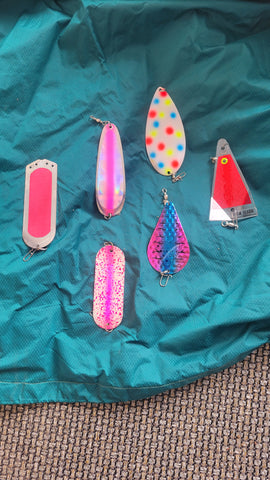
Attractors can be broken down into a few major styles. The shapes will dictate how to use them most effectively. For kokanee fishing, we can group attractors into the following categories: dodgers, sling blades, gang trolls, and rotators.
At this point all the salmon anglers are saying “what about flashers?”. Without a doubt, flashers are the number one attractor for saltwater salmon anglers. While kokanee are land-locked sockeye salmon, you will seldom hear of flashers being used in kokanee fishing. The reason for this is that kokanee anglers tend to troll at slower speeds which do not allow a flasher to rotate as they are designed to do.
Without that rotation, a flasher is nothing more than a dodger, swaying back and forth. That’s not to say they wouldn’t work, and I have seen smaller flashers made which could work for kokanee, but in general, most anglers will not be trolling at the 2.7mph or so it takes to make a flasher rotate.
The shape of your attractor determines the application, and speed is the key. Let’s take a look at each shape and see how to best use it for kokanee trolling.
The Dodger
Dodgers are designed to do exactly what their name sounds like – dodge back and forth. Tie a fly or lure behind one and the dodger will swing it back and forth. The shorter the leader from the lure to the dodger, the greater will be the snap action as the lure is pulled back and forth. Dodgers work best at slow to medium speeds, say .8 to 1.4 mph. Slower than that and you have a non-activated lure, which at times may actually be effective, faster than that and your dodger will turn into a flasher, rotating in a tight circle, not giving your lure much action, either.
The Sling Blade
Sling blades are ideal for faster trolling, say 1.2 to 1.8 mph. The shape of the blade, narrow in front, wide in back, allow for a faster troll without turning over. As such, if your gear is not getting strikes going slow, using a sling blade and upping the speed a bit can be just the ticket. Sling blades can be long and narrow, short and fat, or anywhere in-between. Sling blades are by far the most popular of kokanee attractors, and for good reason. With a wide range of styles and ability to be used at both slower and faster trolls, they offer a great deal of flexibility. Putting a slight bend in the blade can cause further erratic action which can trigger kokanee to strike.
The Gang Troll
Gang trolls have a long and well-established reputation as an effective attractor. Unlike dodgers and sling blades, gang trolls do not impart any action to your lure. What they will do is create a great amount of flash and vibration in the water, drawing fish in to then see your lure. Gang trolls can be metal blades, plastic, or the more recent mylar blades with reflective tape. No matter which type you use, the first fish you catch you’ll see their major (in my opinion) downfall. Gang trolls kill the fight of a fish. If your goal is to enjoy the fight of your catch, look elsewhere. If your goal is to catch fish, gang trolls can be deadly effective.
The Rotator
Rotators are similar to gang trolls in that they do not add action to your lure. What they do is rotate inline, causing flash and vibration in the water. Small rotators are hard to come by but do offer an effective trolling option and I recommend you have a few in your toolbox.
What lure or bait you put behind your attractor is an article in itself. That said, a few general guidelines are helpful. These are suggestions only. Experimentation is part of the fun of kokanee trolling, so my advice is to try variations and see what works for you. You may discover a whole new set up that works!
Dodgers and sling blades, since they are designed to impart action, work best with a leader length of 6-20 inches to your lure. Closer will cause more erratic action. Lures which have no action of their own are good choices, such as micro hoochies.
Rotators and gang trolls impart no action, so lures like small, thin blade spoons and spinners 2-4 feet behind them are what anglers will often run.
As you gain experience trolling for kokanee, you’ll begin to get a sense of what works and what doesn’t. Don’t be afraid to ask fellow anglers for advice. You’ll find the majority of anglers are more than willing to give you tips and advice, which some day you in turn can share with the next generation of anglers!
/articles/kokanee-attractors-101