Ten Rules of Coho Trolling
September is a special time for me. Like the change in the weather, I can feel a change in myself, a pent up anticipation that has slowly been building over the summer and like clockwork bursts forth in full bloom. It’s coho time in Puget Sound!
Yes, this is a great time of the year to be a salmon angler in Puget Sound, if the runs are strong and the fishing is open. Last year was unique in that we had closures in the ocean and straits. The coho arrived to Puget Sound in good numbers and virtually unmolested. This year was questionable what kind of a season we would be given. As of this date, coho is open in areas 8.2, 9, and 10. Check the regs and emergency closures for updates of course. As it stands the daily limit is two coho.
Looking at my fishing reports data from trips going back twenty years, it becomes pretty obvious that September is the time to put away freshwater gear and focus on salmon. August can be productive, but September can be (and often is) lights out. My reports show multiple trips with limits by 9am, red hot fishing, and lots of pictures of shiny chrome coho. As the season progresses into later September, the fish show a steady increase in size. By late September to early October, the 6-8 pound coho are replaced by beautiful 10-14 pound hooknose monsters. It’s the time of year to stock up the freezer on tasty coho!

For those new to the fishery, you’ll find a wealth of information on techniques and locations scattered on the web. I've broken down some of my thoughts on coho trolling into Ten Rules of Coho Trolling.
Coho tend to be a pretty cooperative salmon when it comes to catching them. As these fish stream in from the ocean, heading through the Strait of Juan De Fuca and into Puget Sound, they are putting on the feed in preparation for their runs up to the spawning grounds. It’s not unusual to find coho stuffed with herring. Don’t get me wrong, there are days they, like other salmon, will have lock-jaw. But that truly is the exception, not the rule. Speaking of rules, I offer a list of rules I’ve developed over the years to catch more coho. You’ll likely have your rules to add to this list. Or you may disagree with some of them. But hopefully it will give you some additional ideas when targeting coho in the Sound.
Rule #1
As Russell Wilson would say, “Separation is in the preparation”.
- When you put your boat in the water, you should have everything ready to go. No fiddling around with gear or bait the morning of a trip. My fishing ritual is to have everything ready to go the night before. It’s like a general planning for battle. My rods are ready and geared up. My bait has been cut and cured. My boat is prepped and clean, batteries are charged, gas tank is full, snacks are bought, there’s ice in the coolers for the fish. This evening before prep time is actually a ritual I cherish because like Russ, I’m visualizing success and making a plan in my head. I try to never go fishing without a plan.

Rule #2
Start early, go shallow.
I try to be on the water as early as possible. Ideally, that means running lights on and gear going in the water while it’s still dark or just turning light. I will run my gear in the top 10-30 feet of water to start. This is the time of day when a salmon fly in the prop wash can be deadly. I like Artic Fox Trolling Flies. Denis Peirce ties a nice fly in a variety of effective salmon colors. Try running the fly back 40-50 feet and troll fast (more on that later) with the fly practically skipping on the surface. Just be sure to have the clicker on the reel because these strikes can be vicious. I love the sound of a clicker going off in the morning!
Rule #3
Watch your fish finder, drop your depth
As the morning progresses, drop your downriggers down. I’ve read the “rule of thumb” is ten feet every hour until you’re trolling your gear around 40-60 feet. That’s fine, I guess, but I also use my fish finder. If I see bait and fish marks down 50-70 feet, I’ll drop down to those fish even if it’s early in the morning. As the day goes on I may even drop my downrigger ball down to 110-120 feet deep. Depth can be a tricky thing because when coho fishing I troll fast, which leads us to the next rule.
Rule #4
Troll fast!
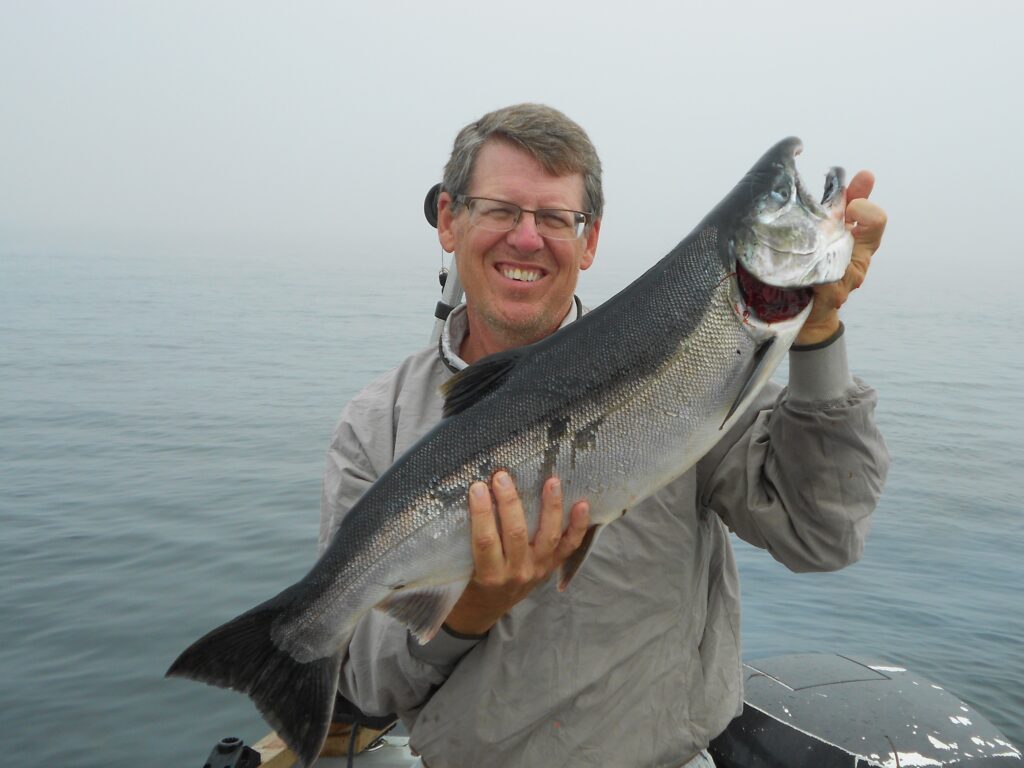
In my experience, coho love a fast troll. I have an itroll throttle control and will set it on “hunt” mode to keep my boat going fast, around 3.3 to 3.9 mph. A few years back I did a lot of underwater filming and noticed a distinct increase in salmon aggression when the flasher was whipping around in a complete rotation. If it was only doing a lazy rotation, or not doing a full rotation, coho would tend to swim behind the gear, just watching. But speeding up and getting that flasher fully spinning would elicit vicious strikes. I will troll both with and against the tide and catch fish going both ways. Just be sure to increase your throttle going into the tide to maintain that 3.5 mph speed. I’ll also program my itroll to give a periodic 3-5 second slow down and then speed back up to “wake up” coho that may be lazily following but not biting. It can often trigger a bite. Oh, another thing that will often trigger a bite – if you’re checking gear, pop your line off the release and set the rod in the rod holder. Let the gear come up on its own. I have caught a lot of coho that will chase the gear as it ascends to the surface. Don’t reel your gear in until it hits the surface.
Rule #5
Coho are hungry, feed them!
Coho love a strip of herring on just about any lure. I will add strips to hoochies, flies, and even a small strip on the hook of a spoon (but not too much, you don’t want to kill the spoon’s action). Be sure to brine the herring strips a day ahead of time in rock salt and/or commercial herring brine. Add scents and bite enhancers as well. Check your gear every 20-30 minutes and freshen up with a new herring strip. If you get a bite but no release, bring it in and check it! The one exception to this rule I have is if the dogfish are in thick, I will go without bait.
Rule #6
Experiment
My “go to” set up is a magnum green splatter glow hoochie, herring strips, 26-30” leader, and an 11” dodger (pick your color…). I always start with this set up. On a second rod I may run a different color and smaller hoochie. If there is no action and I am seeing fish on the fish finder I will start trying spoons and plastic lures like the old Big Al’s Cripple Herring. Sometimes the coho just want something with more action. This year I’m going to be trying the new Old Goat OG2 5” salmon lure. The Old Goats have been awesome on kokanee and I think they will be deadly on coho. They have an amazing action that I think coho will love.
Rule #7
Fish Where They Ain’t (anglers that is)
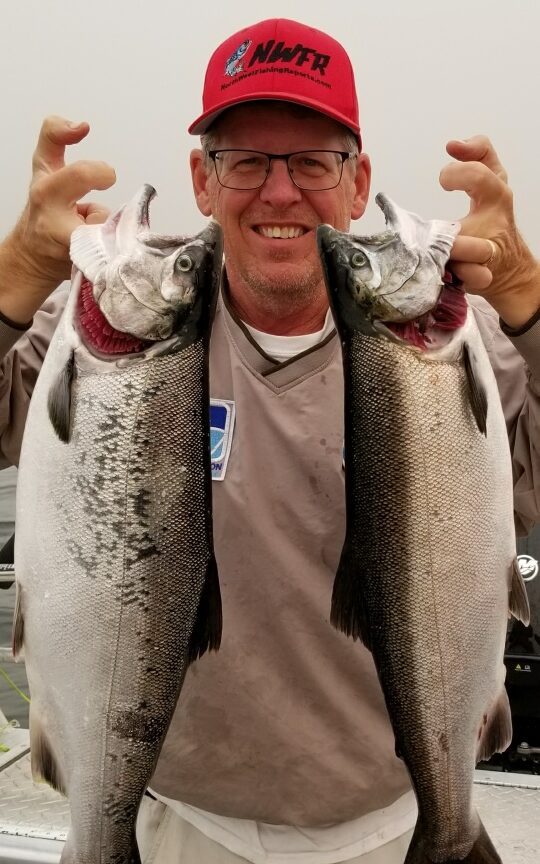
Coho in Puget Sound can be found pretty much anywhere. We all have favorite starting locations and it’s human nature to follow the crowds of boats because “hey, they must know something I don’t”. Maybe…and maybe not. I try to start my troll away from clusters of boats. Why be surrounded by additional lures in the water? You want to troll over fish that aren’t seeing offerings non-stop. So, move away from everyone else – and if you take my advice and troll fast you will, very quickly. You’ll still find the fish if they are there, and cover more water to find the biters. When you do, don’t be afraid to mark the fish on your fish finder and troll around and right back over the same spot. Again, in viewing underwater footage, I invariably see groups of 4-6 coho following my gear. A solo fish is very rare. So, work over those spots when you pick up a fish.
Rule #8
Mid day and tide changes are good
I know I said earlier I like to hit the water at daybreak, but there are days when that just doesn’t happen. The good news with coho is that it doesn’t matter. You can (and will) catch coho all morning and into midday. Tide bites are the period before and after a low or high tide, and these times can be very productive. My favorite tide sequence is a high tide at around 9-10am. The flood tide pushes fish and as the tide slows down it triggers a feeding opportunity below for the coho salmon. Bait becomes easier to pick off without a steady flow of water and the coho bite often turns on. If you miss that crack of dawn bite, fear not, the coho will cooperate. I’ve caught my biggest hooknose fish from 11am to 1pm.
Rule #9
Playing and netting your fish
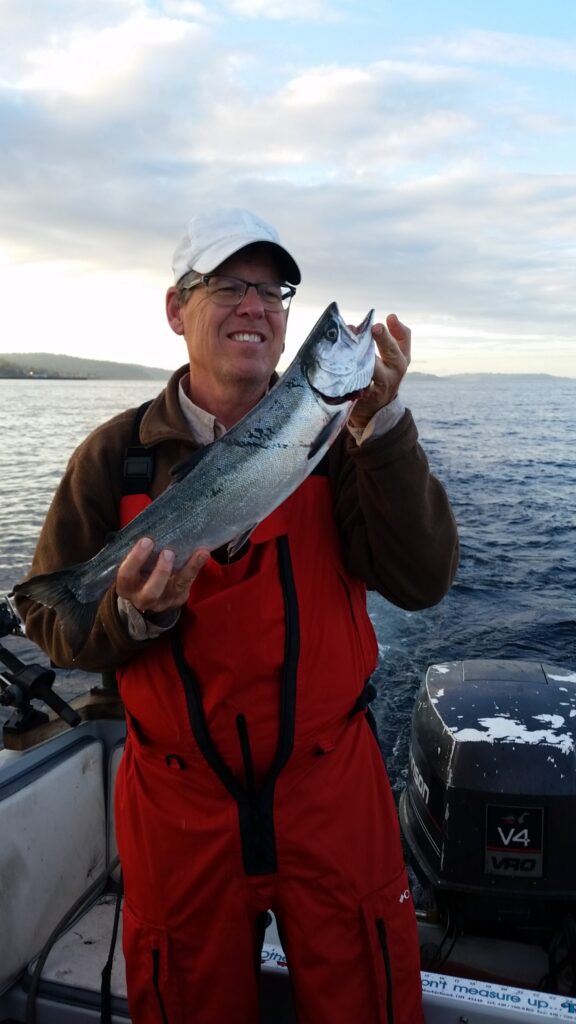
OK, you have a big fish on and are trolling at 3.5 mph. What do anglers often do? Why, slow down the of course. Bad move. In today’s age of barbless hooks, slowing down is an invitation to let the fish go. The second there is slack in that line the hook can slip out. Trolling for coho is not a fishery that is about the fight, it’s about catching fish. If you want an epic battle against coho (and they are a hoot), catch them in rivers, or mooch for them. Trolling with an 11” flasher gives these fish a focal point with which they can get slack line. We don’t want to do anything to help them out, like slowing down. Once they are on the surface, do your best to keep the flasher out of the water. This will help prevent the fish getting slack line between the hook and the flasher. Make sure you have a net with a long handle and big opening. This will help as the netter reaches out. Remember, the netter scoops as the angler guides the fish into the net. Don’t make the mistake of the netter reaching to net the fish! Once the fish is close to the boat slowing down a bit is OK, by the way- just keep that flasher out of the water.
Rule #10
Take good care of your fish
Non-anglers have no idea what a freshly caught salmon tastes like. As anglers we are blessed to be able to have the freshest salmon on the planet. So, take good care of your caught fish. Bonk the fish enough to stun it, then cut a gill and bleed the fish out for a few minutes. After that, into the ice cooler it goes. Don’t hang it off the side of the boat to bake in the sun. At the end of the day, gut and cut into steaks, or filet the fish out. If possible, vacuum-seal whatever fillets you don’t eat for dinner. Properly cared for, you’ll have tasty fish until the next season, when you get to do it all over again!
There you have it. Ten “Rules” that will help increase your odds of success this coho season. Have fun out there and remember to be safe, have life jackets and all the safety equipment required and needed in case something goes sideways.
Good luck fishing and I’ll see you on the water.

/articles/ten-rules-coho-trolling
My Favorite Fall Coho Techniques
Even though the end of the year is approaching, don’t put away your salmon fishing gear just yet. There are still plenty of rivers teeming with coho salmon right now! These days, there are many different techniques you can use to catch fish on any river. Versatility is important, and river conditions change day by day. I recently went on a guided trip with Brianna Bruce of Livin’ Life Adventures. When we got to our spot, she told us that we would each be fishing a different method. The fish had been hitting different things every day. One day, they only wanted spinners. Another day, they wanted spoons. She began distributing rods- one of us fishing plugs, the other spinners, and so on until we were all casting and hoping to get lucky.
After about 20 minutes of this, another guide motored by on the way back to the launch with their limits. He told Bree that he had gotten all of his fish on eggs! She quickly began switching all of our rods to egg setups. Another hour later, we were back at the boat ramp with huge smiles and limits of dime-bright coho. If she hadn’t brought eggs along, we may have all ended up skunked! Versatility is crucial! Most days when I go river fishing, I carry 3 rods: a twitching rod, a float rod, and a spinner rod. I spent a lot of time getting familiar with each technique and when and how to deploy them. Let’s dive into how and why I use these techniques.
Technique 1: Twitching Jigs
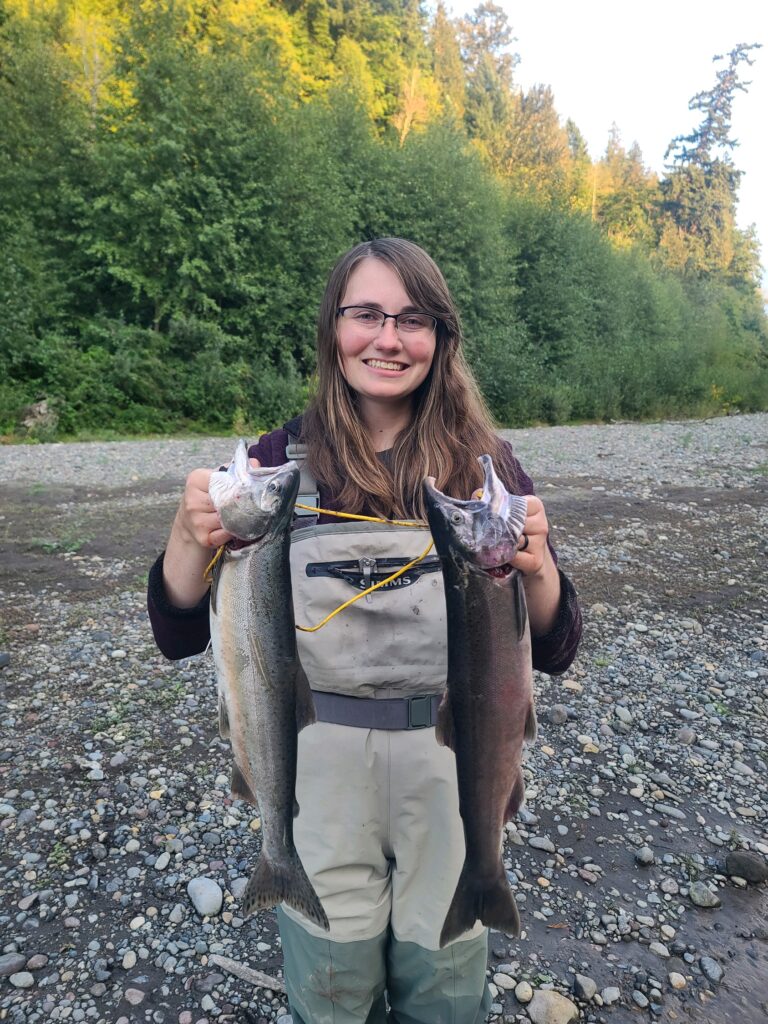
If I had to pick one way to fish for coho, I would have to go with twitching jigs. They are extremely adaptable- I can fish any type of water with a twitching jig. There’s something so satisfying about seeing a big fish dart out of cover to grab your jig. Make sure to vary your jigging speed and length depending on the structure, depth, and speed of the water. Some days, you can let the jig sink to the bottom of a deep hole before you start jigging. Other times, you’ll want to do short jigs as soon as your lure hits the water. There’s no one way to twitch a jig. Color matters! I’ve had days where I fished one color for 30 minutes with no luck, and then hooked a fish on the first cast after switching colors. Most of the time, I use a 3/8 or 1/2 oz jig. My favorite colors are blue/black and pink/green. My twitching rod is a stout 7’6 rod with fast action. It has an extremely sensitive tip so I can feel those subtle bites, and the backbone to back up my hook sets. I pair it up with a size 3000 spinning reel. I use light reels to help avoid wrist fatigue. You can twitch jigs with longer, heavier rods, but I like my 7’6 rod because it translates even the smallest flicks of my wrist to the jig. I never hit the river without my twitching rod! There is a bit of a learning curve, as most fish will pick up your jig on the drop. You might feel the line tighten, or you may feel nothing at all. Most fish won’t simply grab the jig and take off. The majority of bites are subtle. Watch your line and pay attention to how it moves. It pays to fish high visibility braid so you can see exactly where your line is and what it’s doing in the water. Give twitching jigs a try, you’ll be hooked!
Technique 2: Spinner Rods
If I can’t get a fish to bite on twitching jigs, I’ll switch to my spinner rod. This is my 9ft, fast-action, moderate power rod, rated to throw up to an ounce of lead. It has the springiness to be able to launch spinners across long rivers, but the backbone to bring a monster coho to the shore. I often start off beginner river fishermen with spinners because bites are hard to miss. There are two types of spinners, and they both fish differently. Heavy-bodied spinners sink right away and can be cast perpendicular to the opposite shore. Light-bodied or unweighted spinners don’t sink as quickly and are better for shallow rivers. You can cast them out and swing them into the current like a spoon. Keep your rod tip low and reel slowly. Make sure to do 1 or 2 solid hook sets to really drive that barbless hook into the fish’s mouth. In murky water like the Carbon or Puyallup River, I’ll go with a bright-colored spinner, like chartreuse or pink. On clear, coastal rivers, I’ll fish a silver or copper-colored spinner. It never hurts to try something different, though! Don’t forget to pinch your barbs and switch out the treble hook to a single hook if required.
Technique 3: Floating Eggs
My third go-to technique for fall coho fishing is floating eggs. This technique isn’t very well suited for combat fishing, but if you can find a patch of slow-moving water all to yourself, this is a great way to get finicky coho to bite. Floating eggs is a relaxing way to spend the day. You tend to lose a lot less gear, and watching your bobber is therapeutic. You’ll want a 10ft to 11ft rod and 3000/4000 size spinning reel. Don’t use gear you don’t mind getting egg dye on! You can either use store-bought eggs or experiment with curing your own. I usually bring along 2 or 3 different recipes when I fish eggs. Sometimes the fish want pink eggs, other days they like red. You can experiment with adding different scents to your eggs, like tuna or herring. No matter how good your eggs are, you want to make sure you’re fishing them correctly, however. Experiment with your leader length by moving your bobber stopper until you’re hitting the bottom. Then, move it up 6 to 12 inches. That’s where the fish will see it, and, hopefully, bite it. Don’t forget to mend your line by lifting it up off the water and behind your float. This is where a long rod can come in handy, but it can make it difficult to fish in water with lots of overhanging trees and bushes. Float fishing is a highly situational technique, but it can be very deadly.

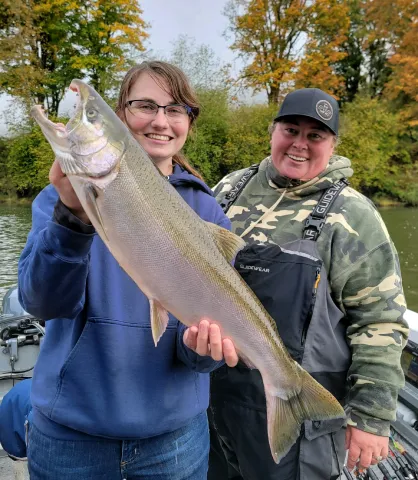
There you have my top three favorite fall coho techniques. When getting to my spot, I like to sit and watch the water for a few minutes to determine which technique to use. Floating eggs isn’t always possible if the river is flowing quickly. Similarly, when I’m fishing frog water, using a spinner can be difficult. The deep and slow water makes it difficult to reach the fish hugging the bottom. I find that it’s extremely important to be able to adapt to any condition. However, there are days when I want to challenge myself or get better at a technique and I’ll only bring out one pole. This is how I taught myself to be able to use twitching jigs in any situation. If you haven’t tried any of these techniques, hit the water and give it a shot. Make sure to read your rules and regulations, especially emergency ones. Hope to see you all out there!
/articles/my-favorite-fall-coho-techniques
Riffe Lake Roundup
Fishing season is officially in full swing! With so many lakes, rivers, and marine areas to choose from, it can be hard to pick your next adventure. If you’re never fished Riffe Lake before, or if it’s been a while, you should put it at the top of your list. It’s one of my favorite fishing destinations, and I make it a point to fish it as much as I can every year. Not only is the fishing top notch, but the scenery is beautiful and the surrounding towns are well worth visiting. I can’t think of many other lakes that offer such a wide variety of fish, let alone with such a good opportunity.
You can catch brown trout, cutthroat trout, smallmouth bass, chinook salmon, coho salmon, crappie, and brown bullhead. The lake is simply packed with fish, and they’re willing biters. You can take the boat out or shore fish, and finish out the day with a Dam Burger from Pioneer Bar & Grill in Mossyrock before heading home to grill your catch. It’s a bit of a drive, but it’s a great way to spend a day!
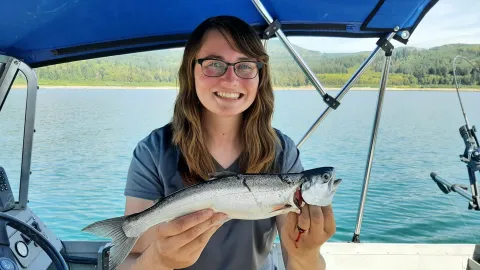
Located in Lewis County, Tacoma Power created RIffe Lake by constructing Mossyrock Dam on the Cowlitz River in 1968, flooding the communities of Riffe, Nesika, and Kosmos. It has a maximum depth of 360 feet and is about 23.5 miles long. Not only does the lake boast good populations of land-locked coho salmon, but you can also catch triploid trout! Back in 2020, Tacoma Power bought about 400,000 Rufus Woods strain triploid trout and released them into the lake for anglers to catch. The fish have had plenty of time to grow and they are a ton of fun to catch. If you’re lucky, you may even hook into a steelhead or a chinook salmon on the same day! Tacoma Power releases these fish into the lake as well, once they’ve met their stocking quotas. With such a plethora of fish to catch, you can see why Riffe Lake is a favorite of many northwesterners.
Trolling Techniques
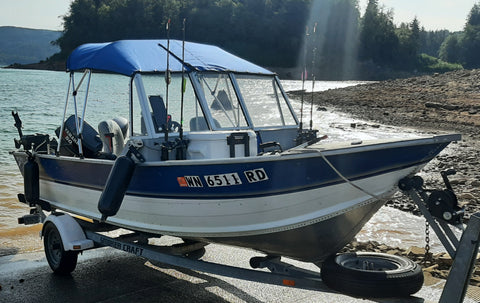
Riffe Lake has plenty of room for boats of all shapes and sizes. It is almost 24 miles long and up to 360 feet deep, which can sound intimidating. Not to worry, there are thousands of fish in the lake, and most days they are willing biters. There have been many days when we can’t even put the planer boards out because the two downrigger poles or lead lines are constantly going off! Early in the season, lead lines, divers, and dropper weights work just fine. The fish are still feeding on the surface and haven’t been driven down to the depths by the hot sun. As the season progresses, however, a good fish finder is a must, particularly for the land-locked coho. Troll until you find a school, mark where you get bites, and don’t be afraid to put a little scent on your lure.
I find that the land-locked coho are particularly attracted to pink lures and dodgers. You can use corn or maggots to bait your hooks. Spinners, plugs, spoons- they all catch fish at this lake. I tend to use whatever I already have rigged up for kokanee fishing at other lakes. As for locations, you really can’t go wrong on Riffe Lake- you can start trolling almost as soon as you launch at Mossyrock Park and will usually start catching fish right away. If the fish are being stubborn, try targeting points and coves. Keep an eye on your fish finder if you’re using downriggers, the lake can shallow up surprisingly quickly.
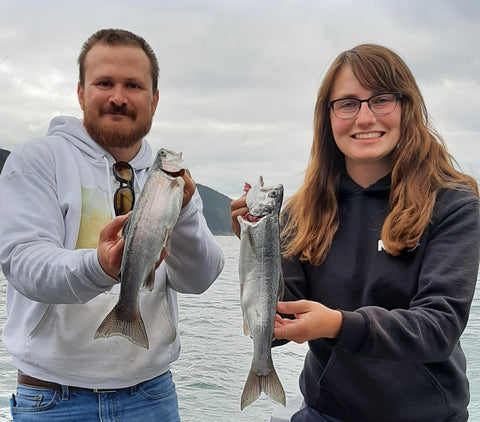
In recent years, it’s been difficult to keep the triploid trout off your hooks if you want to target the land-locked coho salmon in the reservoir. The salmon and trout tend to bite on the same lures and hang out at the same depths in the early season, so you can expect to catch a mixed bag. In general, the coho hang out deeper than the trout in the later season, making downriggers and a good fish finder almost a necessity for targeting them. The salmon tend to like a faster troll, so don’t be afraid to bump it up to 1.9 or 2.2 MPH. However, the trout taste great on the grill and put up a great fight, so most anglers don’t mind catching them.
As a word of caution to boaters, check the water levels at Tacoma Power’s website or give them a call before heading out. The lake’s level fluctuates throughout the year and launching can be difficult when water levels are low. The launch at Mossyrock Park is usually your best bet year-round. It has a large dock with 2 lanes to launch at, which is nice when the ramp is busy. Don’t sweat the crowds too much though, the lake is massive and there is plenty of room for everyone. The other boat launches, Taidnapam and Kosmos, are unsuitable for low water conditions. Check the wind forecast before hitching up the boat- the afternoon winds at Riffe Lake can kick up and create nasty white caps, catching unprepared boaters off guard.
Still Fishing Techniques
Don’t have a boat? No worries, Riffe Lake has plenty of shore access! You can fish at the dam in Mossyrock or at the fishing bridge at Taidnapam Park. These spots can get crowded on nice weekends though. Most shore anglers cast out shrimp or worms under a bobber with a sliding weight. Experiment with setting your bobber stopper anywhere from 3ft to 15 ft until you figure out where the fish are at.
If you can’t get a spot at the dam or fishing bridge, fishing at nearby Lake Mayfield or Swofford Pond is a good alternative. Lake Mayfield is stocked with tiger muskies, which are difficult but extremely rewarding to catch. WDFW also stocks decent numbers of rainbow trout there every year. Swofford Pond has good populations of panfish, stocked rainbow trout, and brown bullhead. There is a boat launch at both lakes, and good shore access. Many folks fish Swofford Pond with inflatables and kayaks, as there is an internal combustion motor ban.
Before you grab those poles and hook up the boat, keep in mind that Riffe Lake has a 5 fish limit. They can be any combination of landlocked salmon and trout, so you cannot legally keep 5 coho and 5 trout. The land locked coho don’t tend to survive catch and release very well, particularly in the summer heat. The lake is large and deep, and those afternoon winds can kick up unexpectedly, so make sure that everyone on your boat has a life jacket. Keep these rules in mind, hook up the boat, and have fun!
/articles/riffe-lake-roundup
Ocean Coho Tips and Techniques
Coho are one of the most sought-after salmon in the Pacific Northwest. For the saltwater angler, the coho bite can be a bit chaotic, with the fish running in large schools and being active biters when the conditions are right. They can also be a bit frustrating if you are not using the right gear or fishing the right presentation. By keying in on techniques that work the topwater and get the coho to bite, you can increase your catch rate and fill the coolers with great eating, hard fighting silver salmon.
Silver Salmon
Silver salmon like to swim fast and attack their prey. Known for their topwater action, coho tend to be close to the surface. This makes for a great fishery because you are not constantly trying to work the bottom and worrying about losing a downrigger ball like you are when chasing after chinook that are on a sandlance bite. When it comes to catching coho, there are few things you can do to increase your catch rates.
Lose the bait to catch more fish. It might seem like using a fresh anchovy or a perfectly plug cut herring would lead to more fish but rigging these baits takes time. When you get into the schools of coho, the action can be fast, which means you will catch more fish if you can keep your gear in the water longer. Same with getting it back into the water faster, and anyone who has rigged an anchovy hood knows that you need to set it correctly and that takes valuable time.
Spoons
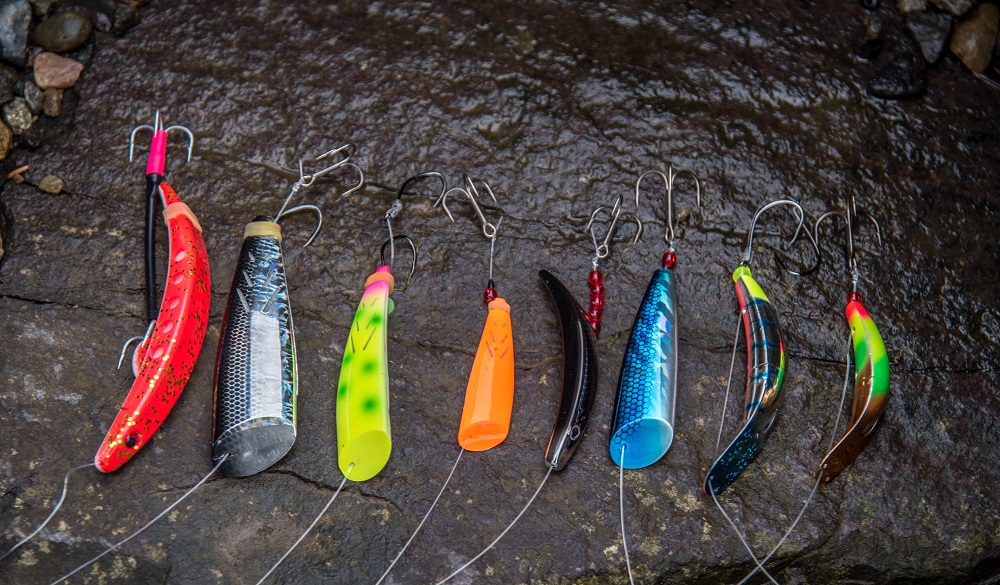
Spoons are one of the more popular lures because they are simple and are always working even if you miss a bite. Keep the spoons small such as the Coho Killer or a 3.0 or 3.5 Coyote spoon in sardine or rainbow trout patterns. The rainbow trout spoon looks more like a herring or mackerel and it has a glow back to it for low light such as cloudy days. Another spoon that is popular with coho fishing is the Skinny Gee in Herring Aide color. When running a spoon behind a flasher, it is best to go a bit longer on the leader such as 42” as this allows the spoon to flutter.
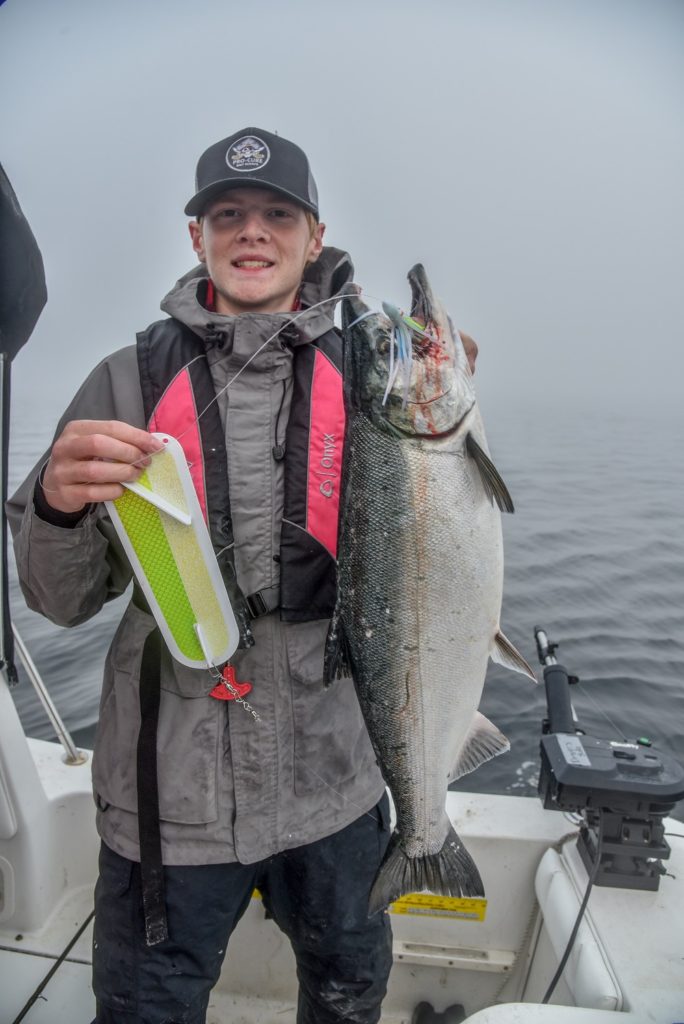
Sometimes spoons don’t draw the fish to strike. Give tube flies a try. This is a technique often used in the Great Lakes by salmon fishermen and by fly anglers chasing after fall coho along the shoreline. The ocean angler can take advantage of these lightweight lures that mimic baitfish. One of the best things about a tube fly is that they can be fished behind a dodger or a flasher or all alone, since they have low drag and are lightweight. Tube flies tend to have an erratic action that coho can’t resist, especially if you put a Mack’s wiggle bill in front of them. Bechhold and Son’s make a unique flasher with offset holes to add extra action. They have teamed up with Rapture Trolling Flies, a Great Lakes company, and offer a combo set matched together and ready to fish. If you already tie your own flies, you can pick up a tube fly adapter and tie your own easily.
Tricking The Salmon
Add flash and movement to your squids. When rigging a squid skirt with an insert or a tube fly, such as the Luhr Jensen Flash Fly (unrigged version, as they are smaller than the pre-rigged Flash Fly) to be fished behind a dodger or flasher, be sure to use a short and stout leader. Try using 30 or even 40-pound test as the stiff leader will give the lure more action. The idea is to get the lure to move in an erratic motion and make the dodger look like a feeding salmon with the lure being a wounded baitfish. It creates the “bite now” instinct of the feeding coho and tricks it into thinking the other salmon, which is the dodger, missed the baitfish and now it’s there for a free meal.
Using an insert into a hoochie or squid skirt adds attraction and can turn on a bite. The past few years we have been using the Luhr Jensen Flash Fly inserts and putting them into a squid skirt. By doing this you can make several different combinations of colors to attract the fish or add some extra UV flash for those cloudy days. You can also add a Mack’s Lure Wiggle Bill to the front to add extra movement.
Artificial Bait
Try using an artificial wounded baitfish lure. Lures that mimic a wounded baitfish are the SpinFish by Yakima Bait Company, Brad’s Super Bait Cut Plug, and the new Spin Dawg by Simon, who also makes a Spin Cut Plug that has a hole at the tip of the lure making rigging much easier with no rubber bands or chance of it coming apart. The Simon products are solid and have a scent chamber. Each of these lures is made of hard plastic and has a hollow cavity inside where you can stuff them with scent or minced-up baitfish such as anchovies or herring. For these lures, use a longer leader with a bead chain swivel in the middle since the lure provides the action that creates that need to bite reaction by rotating and spinning.
When using artificial lures such as spoons, squid skirts, and the hollow cavity lures, scent is crucial. Unlike when you use a real baitfish that has oils being released and the fish know it is an actual herring, the use of artificial lures is only a visual attraction unless you scent it up. The cavity lures like the SpinFish offer a way to fill them with various baits to create a scent trail. One common bait is to mix canned tuna fish with your favorite scents. Because the lure holds the minced-up bait, one of the better scent mediums to use is one of the many water-soluble scents from Pro-Cure. When the scent leaks out of the lure, it mixes with the water and stays at the same depth as the lure, creating a large scent trail for the fish.
Oil Based Scents
Oil-based scents such as Pro-Cure's super sauces, gels, and oils hold a scent well and last a long time, but the scent will not mix well with water. This means when it is washed off the scent trail starts to float. Water-soluble oils wash off lures and squid skirts too quickly which is why you should use oil-based scents for these lures, but it will not gum up or ruin the action of a tube fly, just be sure to apply frequently. Knowing which scent to use is more than just the baitfish it is made from, but also which ones are best to stay on the lures you are fishing.
Downsize the dodgers and flashers. The idea behind using a dodger or flasher is to create a feeding salmon scenario as well as add action to your lure. Since you are fishing for coho, be sure to match the dodger and flasher to the size of the fish. Most use the standard 11-inch flasher but the 8-inch flasher is a better choice. Instead of the attacking salmon looking like a chinook with the 11-inch, the 8-inch reflects light more to the natural size of a coho. It is also less drag and that means you can fight the fish better. The smaller dodgers and flashers also work well at faster trolling speeds. The Sling Blade dodger from Mack’s lure is a very universal dodger that is designed to work well at fast speeds. Since it is a long teardrop design you can bend it to create a more dramatic dodge or side-to-side action, or you can keep it straight and troll it fast. This design also cuts through the water well and allows you to fight the fish and not the dodger, even when using the larger 9-inch version. The dodger comes with UV-treated colors and is offered in many sizes, which allows you to change it up to the varied sizes of lures you are using.
Coho
Since coho are often found actively feeding near the surface, you do not always need to use downriggers. Instead, trolling with a mooching weight that cuts through the water easily and a simple lure behind can be a way to either add an extra rod out of the back of the boat or not deal with the downriggers altogether. Again, the more you can keep your lines in the water, the more fish you will catch. When rigging this outfit, use a longer leader around 48 inches with a bead chain swivel in the middle and a lure that imparts action such as the SpinFish, Brad’s Cut Plug, or Simon Spin Dawg. But do not overlook the tube fly or even the squid skirt with the addition of a Wiggle Hoochie Bill. These small plastic bills from Mack’s Lure are simple to use, just slide it down the leader to the head of the squid skirt and push it into the collar. If using a tube fly then adding a bobber stop knot or rubber bobber stop to the front of the bill will keep it tight to the fly. The Wiggle Hoochie Bill act much like the bill on a plug, but instead of creating a diving motion, it moves the lure in side to side in and erratic motion. They also come in an assortment of colors and are UV treated to add even more visual attraction.
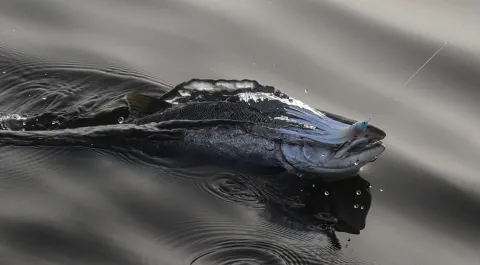
Coho are known for their acrobatic fights, often coming right up to the surface and jumping, but a dodger or flasher can take away from the fight and even become a problem when the fish jumps. The attractor breaks the surface of the water pulling in an opposite direction and taking the hooks with it. When using downriggers, you can rig in a way that the dodger or flasher stays with the downrigger ball and you get to fight the fish without any extra drag on the line. To do this, either use one of the lures with action or the added Wiggle Hoochie Bill and then a downrigger clip that is above the ball. Use a short section of cord or very stout mono line such as 50-pound test from the flasher or dodger attached to the downrigger ball, and then set the downrigger clip twice the length of the cord above the ball.
Furthermore, If you run the dodger or flasher behind the downrigger ball 36-inches, then set the downrigger clip 72-inches, or 6 feet, above the downrigger ball. Then run your lure back just a few feet from the clip. This will keep your lure from tangling with the flasher or dodger, and yet when the salmon sees the attractor, it will look like the baitfish got away and they will grab the lure. This works really well with plug cut herring or an anchovy with a bait hood, as well as lures that don’t need the imparted action of a dodger or flasher. One other great trick when using this way of fishing is to use the Scent Flash triangle flasher from Mack’s Lure, as these flashers are designed to hold scents inside of them. As the triangle flasher spins, it creates a very large scent cone out of it as it disperses the scent. When using these, you don’t need to use a leader or cord, but instead you can attach it directly to the downrigger ball, which means you can also keep your lure a lot closer to it as well.
Run timing and knowing which fish you are targeting will lead to more fish. Ocean coho are found all along the coastlines from Oregon to Alaska, and the feeding fish will often work along the shoreline, feeding on herring, candlefish, anchovies, and various other prey in the kelp beds and protected waters around islands. Look to the rocky breaks often found just offshore and find the coho. Even when out in the open ocean, where the fish will form large schools to travel from their feeding grounds to the rivers each fall, the fish will still be “shallow”. Not the depth of the water but where they are in the water column, meaning closer to the top.
When it becomes prime time for ocean coho but weather and fishing seasons keep you away from the open seas, resident coho fishing can produce a fishery for the avid angler. Puget Sound and the various inlets around Vancouver Island offer coho that do not head out too far away feeding grounds but instead live “inside”. Starting in May and all through the summer, resident coho fishing is good. Using the same techniques as fall fish, the angler can perfect their coho set-ups. Look for points along the shoreline as silvers tend to use them as tide breaks that will harbor baitfish. Where you find resident coho you will also find ocean-bound fish once they return. This is where you want to be when the runs start to show up in August and continue to flood through October.
/articles/ocean-coho-tips-and-techniques