Ten Rules of Coho Trolling
By Mike Carey
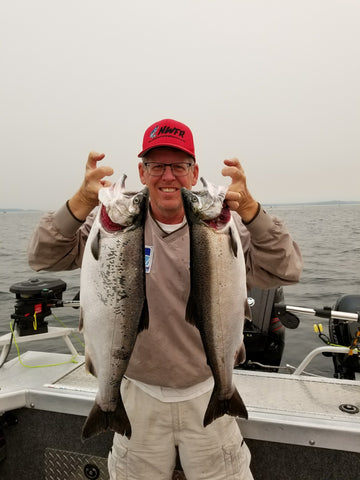
September is a special time for me. Like the change in the weather, I can feel a change in myself, a pent up anticipation that has slowly been building over the summer and like clockwork bursts forth in full bloom. It’s coho time in Puget Sound!
Yes, this is a great time of the year to be a salmon angler in Puget Sound, if the runs are strong and the fishing is open. Last year was unique in that we had closures in the ocean and straits. The coho arrived to Puget Sound in good numbers and virtually unmolested.
This year was questionable what kind of a season we would be given. As of this date, coho is open in areas 8.2, 9, and 10. Check the regs and emergency closures for updates of course. As it stands the daily limit is two coho.

Looking at my fishing reports data from trips going back twenty years, it becomes pretty obvious that September is the time to put away freshwater gear and focus on salmon. August can be productive, but September can be (and often is) lights out.
My reports show multiple trips with limits by 9am, red hot fishing, and lots of pictures of shiny chrome coho. As the season progresses into later September, the fish show a steady increase in size.
By late September to early October, the 6-8 pound coho are replaced by beautiful 10-14 pound hooknose monsters. It’s the time of year to stock up the freezer on tasty coho!
For those new to the fishery, you’ll find a wealth of information on techniques and locations scattered on the web. I've broken down some of my thoughts on coho trolling into Ten Rules of Coho Trolling.
Coho tend to be a pretty cooperative salmon when it comes to catching them. As these fish stream in from the ocean, heading through the Strait of Juan De Fuca and into Puget Sound, they are putting on the feed in preparation for their runs up to the spawning grounds.
It’s not unusual to find coho stuffed with herring. Don’t get me wrong, there are days they, like other salmon, will have lock-jaw. But that truly is the exception, not the rule. Speaking of rules, I offer a list of rules I’ve developed over the years to catch more coho.
You’ll likely have your rules to add to this list. Or you may disagree with some of them. But hopefully it will give you some additional ideas when targeting coho in the Sound.
Rule #1
As Russell Wilson would say, “Separation is in the preparation”. - When you put your boat in the water, you should have everything ready to go. No fiddling around with gear or bait the morning of a trip. My fishing ritual is to have everything ready to go the night before.
It’s like a general planning for battle. My rods are ready and geared up. My bait has been cut and cured. My boat is prepped and clean, batteries are charged, gas tank is full, snacks are bought, there’s ice in the coolers for the fish.
This evening before prep time is actually a ritual I cherish because like Russ, I’m visualizing success and making a plan in my head. I try to never go fishing without a plan.
Rule #2
Start early, go shallow. - I try to be on the water as early as possible. Ideally, that means running lights on and gear going in the water while it’s still dark or just turning light. I will run my gear in the top 10-30 feet of water to start.
This is the time of day when a salmon fly in the prop wash can be deadly. I like Artic Fox Trolling Flies. Denis Peirce ties a nice fly in a variety of effective salmon colors. Try running the fly back 40-50 feet and troll fast (more on that later) with the fly practically skipping on the surface.
Just be sure to have the clicker on the reel because these strikes can be vicious. I love the sound of a clicker going off in the morning!
Rule #3
Watch your fish finder, drop your depth – As the morning progresses, drop your downriggers down. I’ve read the “rule of thumb” is ten feet every hour until you’re trolling your gear around 40-60 feet. That’s fine, I guess, but I also use my fish finder.
If I see bait and fish marks down 50-70 feet, I’ll drop down to those fish even if it’s early in the morning. As the day goes on I may even drop my downrigger ball down to 110-120 feet deep.
Depth can be a tricky thing because when coho fishing I troll fast, which leads us to the next rule.
Rule #4
Troll fast! - In my experience, coho love a fast troll. I have an itroll throttle control and will set it on “hunt” mode to keep my boat going fast, around 3.3 to 3.9 mph. A few years back I did a lot of underwater filming and noticed a distinct increase in salmon aggression when the flasher was whipping around in a complete rotation.
If it was only doing a lazy rotation, or not doing a full rotation, coho would tend to swim behind the gear, just watching. But speeding up and getting that flasher fully spinning would elicit vicious strikes. I will troll both with and against the tide and catch fish going both ways.
Just be sure to increase your throttle going into the tide to maintain that 3.5 mph speed. I’ll also program my itroll to give a periodic 3-5 second slow down and then speed back up to “wake up” coho that may be lazily following but not biting.
It can often trigger a bite. Oh, another thing that will often trigger a bite – if you’re checking gear, pop your line off the release and set the rod in the rod holder. Let the gear come up on its own. I have caught a lot of coho that will chase the gear as it ascends to the surface.
Don’t reel your gear in until it hits the surface.
Rule #5
Coho are hungry, feed them! - Coho love a strip of herring on just about any lure. I will add strips to hoochies, flies, and even a small strip on the hook of a spoon (but not too much, you don’t want to kill the spoon’s action).
Be sure to brine the herring strips a day ahead of time in rock salt and/or commercial herring brine. Add scents and bite enhancers as well. Check your gear every 20-30 minutes and freshen up with a new herring strip. If you get a bite but no release, bring it in and check it!
The one exception to this rule I have is if the dogfish are in thick, I will go without bait.
Rule #6
Experiment – My “go to” set up is a magnum green splatter glow hoochie, herring strips, 26-30” leader, and an 11” dodger (pick your color…). I always start with this set up. On a second rod I may run a different color and smaller hoochie.
If there is no action and I am seeing fish on the fish finder I will start trying spoons and plastic lures like the old Big Al’s Cripple Herring. Sometimes the coho just want something with more action. This year I’m going to be trying the new Old Goat OG2 5” salmon lure.
The Old Goats have been awesome on kokanee and I think they will be deadly on coho. They have an amazing action that I think coho will love.
Rule #7
Fish Where They Ain’t (anglers that is) – coho in Puget Sound can be found pretty much anywhere. We all have favorite starting locations and it’s human nature to follow the crowds of boats because “hey, they must know something I don’t”.
Maybe…and maybe not. I try to start my troll away from clusters of boats. Why be surrounded by additional lures in the water? You want to troll over fish that aren’t seeing offerings non-stop. So, move away from everyone else – and if you take my advice and troll fast you will, very quickly.
You’ll still find the fish if they are there, and cover more water to find the biters. When you do, don’t be afraid to mark the fish on your fish finder and troll around and right back over the same spot. Again, in viewing underwater footage, I invariably see groups of 4-6 coho following my gear.
A solo fish is very rare. So, work over those spots when you pick up a fish.
Rule #8
Mid day and tide changes are good – I know I said earlier I like to hit the water at daybreak, but there are days when that just doesn’t happen. The good news with coho is that it doesn’t matter. You can (and will) catch coho all morning and into midday.
Tide bites are the period before and after a low or high tide, and these times can be very productive. My favorite tide sequence is a high tide at around 9-10am. The flood tide pushes fish and as the tide slows down it triggers a feeding opportunity below for the coho salmon.
Bait becomes easier to pick off without a steady flow of water and the coho bite often turns on. If you miss that crack of dawn bite, fear not, the coho will cooperate. I’ve caught my biggest hooknose fish from 11am to 1pm.
Rule #9
Playing and netting your fish – OK, you have a big fish on and are trolling at 3.5 mph. What do anglers often do? Why, slow down the of course. Bad move. In today’s age of barbless hooks, slowing down is an invitation to let the fish go. The second there is slack in that line the hook can slip out.
Trolling for coho is not a fishery that is about the fight, it’s about catching fish. If you want an epic battle against coho (and they are a hoot), catch them in rivers, or mooch for them. Trolling with an 11” flasher gives these fish a focal point with which they can get slack line.
We don’t want to do anything to help them out, like slowing down. Once they are on the surface, do your best to keep the flasher out of the water. This will help prevent the fish getting slack line between the hook and the flasher. Make sure you have a net with a long handle and big opening.
This will help as the netter reaches out. Remember, the netter scoops as the angler guides the fish into the net. Don’t make the mistake of the netter reaching to net the fish! Once the fish is close to the boat slowing down a bit is OK, by the way- just keep that flasher out of the water.
Rule #10
Take good care of your fish – Non-anglers have no idea what a freshly caught salmon tastes like. As anglers we are blessed to be able to have the freshest salmon on the planet. So, take good care of your caught fish. Bonk the fish enough to stun it, then cut a gill and bleed the fish out for a few minutes.
After that, into the ice cooler it goes. Don’t hang it off the side of the boat to bake in the sun. At the end of the day, gut and cut into steaks, or filet the fish out. If possible, vacuum-seal whatever fillets you don’t eat for dinner.
Properly cared for, you’ll have tasty fish until the next season, when you get to do it all over again!

There you have it. Ten “Rules” that will help increase your odds of success this coho season. Have fun out there and remember to be safe, have life jackets and all the safety equipment required and needed in case something goes sideways.
Good luck fishing and I’ll see you on the water.
/articles/ten-rules-coho-trolling-0
Destination Conconully
By Mike Carey
“Conconully, that tiny town nestled in a mountain valley on the sunny side of Washington's North Cascades, bounded by two lakes, and embraced by state and national forests -- is waiting for you. It is a unique community in the heart of Okanogan County and the welcome mat is always out!”
Thus starts the Conconully Chamber of Commerce web site. JoAnn and I had been looking forward for months to our Memorial Weekend get-away to Liar’s Cove Resort in Conconully.
As we drove our final miles, climbing up the Conconully Road from Omak, the trees and green hillside became ever more beautiful. Then, appearing on our left, we saw Conconully Reservoir, glistering dark blue, the sun just beginning to settle behind the hills to the west.
Trout dimpled the surface, a promise of good fishing to come. We knew at that moment it was going to be a special weekend.
The genesis of our holiday weekend getaway actually began in Puyallup many months earlier. Wandering the Sportsman’s Show, we stopped at the Conconully Chamber of Commerce booth.
There we met a friendly, easy-going man by the name of Gene Bussell, owner of Liar’s Cove Resort. I introduced myself and reminded him that they were sponsors on our web site. “Are we now?” he replied. “Well, you’ll have to come out and pay us a visit”. Twist my arm and show me where to sign up!
Just like that we had our Memorial Day weekend booked (no small bit of luck, that, and in a nice lake view cabin no less) and months to wait in anticipation.
I’d been to Conconully once before, what seemed like a million years ago.
Memories faded by time, I do remember some pretty decent fishing.
But not at all what we were about to experience…
We pulled up to the resort, our brand new boat in tow. When we checked in we got to meet Linda, Gene’s spouse. She and Gene run a first rate family resort! Even with a twenty foot boat and the resort sold out, I had no difficulty parking.
With Gene ever present driving his little white golf cart, er, mini-truck on the grounds I felt no anxiety leaving my gear in the boat. Rig parked, we unloaded and took our dogs, Rudy and Diesel, for the first of many walks over the next three days.
The dogs were in dog heaven, sniffing a plethora of new smells, taking in new sights and sounds. Plus, the family atmosphere that is Liar’s Cove resort meant lots of kids and other dogs to meet and greet. Yup, we had two happy dogs this trip.
Morning came and I awoke at 5:15am to the sounds of birds greeting me. Anxious to get on the water and fish, I left JoAnn snoozing and backed my boat down the state park launch. The launch is unimproved, but has a nice angle and steady drop off making it easy to launch my boat. Liar’s Cove also has a boat launch, but for a bigger boat the state park launch is the better choice.
As I pulled around from the launch and motored over to the dock, two friendly early bird anglers, Mike and Jason, assisted me tying down my boat. I walked to our cabin and tried to get JoAnn up, but she was having none of 6ish in the morning fishing, so we agreed to meet at the dock at 7:30am.
When I returned to my boat, it occurred to me that fishing all alone in a twenty foot boat would be kind of lonely and a waste of a lot of good fishing space. Seeing an opportunity to share my good fortune, I invited Mike and Jason on board.
They were more than happy to join me, and very soon we were steadily hooking trout and kokanee on the glass smooth lake. I don’t know something about being in a small town, far away from the craziness that is the Puget Sound corridor just makes people friendlier.
At least, that was our experience this weekend. The fishing was steady and we lost as many as we caught. By the time we returned to the dock to get JoAnn and the dogs, my new friends had a half dozen trout and kokanee to add to their stringers.
JoAnn and I continued the fast action on our own. Dogs comfortably resting, we targeted the kokanee at the far end of the reservoir, by the dam. This end of the lake is the deep end, dropping down to 48 feet in a large oval bowl.
I ran the downriggers down to twenty five feet, which kept us below the prolific rainbows. The kokanee kept us busy over the next hour and a half. Small dodgers, pink or orange hoochies, and a piece of corn were all we needed.
The kokanee weren’t huge, running 10-12”, but they were plentiful. It was an easy limit of five each and we were heading back to the cleaning station with our fish, done for the day fishing, and ready to relax and explore the area.
Conconully isn’t big. Heck, there’s only a couple dinners/bars, a small museum, store, Post Office, and (yes!) place to get fresh espresso (Salmon Creek Bistro). But each place we visited felt like home. I’ve never met so many nice, friendly people in one spot before
It must be the water, or maybe it’s the air. I can say this for sure – this is one friendly little town! Of course, if you yearn for fast food the towns of Omak and Okanogan are just down the hill, fifteen miles or so, a whole lot closer than my daily commute to work.
But that’s just the reason you would want to come to Conconully – to get away from hustle and bustle, to stop. And breathe. And relax for a moment and leave the insanity of your city life far behind.
And you will, trust me; you will feel your brain waves mellow out and slow down. You’ll feel yourself begin to have an inner smile again as your worries drop away. And if you don’t? Well, then, buy a duck!
Huh? What? I said buy a duck, or three or four. And don’t miss this fun event. The Duck Race. That’s right, a duck race. But not the feather kind, no, these ducks are your vintage rubber duckies. But they aren’t in your bathtub.
They get released into the creek that runs from the upper lake into the reservoir. Each duck has a number. The top three ducks earn cash prizes for the winners. It’s a super fun event, with kids running along laughing and cheering on the ducks.
Like I said, the town of Conconully is all about good, family fun. Other events to check out include a real small town Fourth of July celebration, Cowboy Caviar in August, Grubstake Open Golf Tournament, Town-wide yard sales, and not to be missed, in January internationally covered, The Outhouse Races. Yes, outhouse races.
Let your imagination run wild, or just come on up and check it out. OK, the anglers out there want fishing info, and I’m going to share it. If you thought the lower lake (reservoir) was good, then I have to tell you, the upper lake is just as good! The next day I again set out on my own at 5:30am, this time to try the upper lake.
This lake is a long, narrow, deep lake. Although, I would call it a reservoir as well, since there is a long earthen dam at the city end of the lake. This, by the way, is an excellent spot for bank anglers to wet a line.
The state park also has a launch on this lake. It’s paved, two lanes, and has a long dock, which made putting my boat in a breeze.
As soon as I launched and turned on my fish finder I was struck by the amount of meter marks indicating soon to be “fish on”. Now, I won’t say exactly where I started fishing, but I will say, I don’t think it would have mattered much.
Because everywhere I motored I saw lots of fish on the fish finder. Gene told me earlier the state had planted several hundred thousand kokanee and trout in the two lakes, plus, the chamber of commerce plants larger fish as well.
And, for you warm water anglers, both lakes have healthy populations of smallmouth bass – with some real trophy fish to be had!

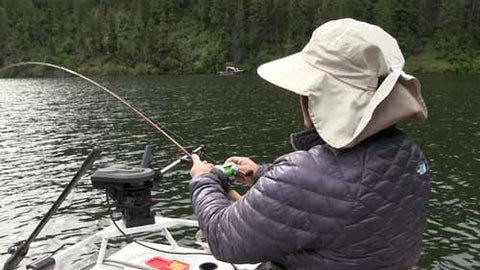
Back to the kokanee… as soon as I put my gear down, it was “fish on”. I mean, literally, apply brake on downrigger, tighten rod slack, and bamm! A kokanee. The upper lake kokanee acted like they had never seen kokanee gear.
They would slam my rigs and pop releases left and right. And these fish were a bigger class. We caught 12 to 15 inch kokanee.
By that, I mean to say; after I caught my five fish I returned to the cabin (that long, one mile drive, right?) and woke JoAnn up. By 8am she and the dogs were enjoying the same hot action I had just experienced on my own. I know, it’s tough, isn’t it? We had ten kokanee by 9am, all 12-15 inch shiny bright fish.
Word of advice, drop your gear down to 28-35 feet to avoid the rainbow trout. I have nothing against rainbows, but if I can get kokanee like we were catching then I’m on a mission! As to the gear, we used small dodgers and a small hoochie with a Colorado blade in front, and a 10” leader.
Add a piece of corn and every few minutes it was bouncing rods, barking dogs, and a whole lot of big grins.
There is one thing I would be remiss if I didn’t mention. Last year, this area had a lot of fires. Some of the Washington’s worst fires were in the areas around Conconully. We witnessed evidence of fire damage and were grateful that the town survived intact.
Gene and Linda want you to know the town is welcoming guests with open arms. Small towns like Conconully depend on our tourism dollars to survive. I hope I’ve gotten your interest and you’ll give this little corner of Washington a try. I think you’ll be very happy you did.
Liar's Cove Resort
/articles/destination-conconully
Montana's Missouri River
By Mike Carey
My son Matt moved to Montana for college several years ago, and now lives in Great Falls with his wife. On our numerous trips to Montana my wife and I have driven past streams and rivers that just cried out “Fish Me”, but I have never had an opportunity.
Until this year, that is. Our schedules finally lined up, gas got cheap, and with a green light from my Better Half I threw my two person pontoon on top of the truck and we headed over to Great Falls. My target fishery was the Missouri River and its famed trout. To say I was excited was an understatement!
Let’s start with little background on the Missouri River. First off, the Missouri is the longest river in the United States and was the main route for expansion into the west. Besides fishing, what the Missouri river is most well-known for is the exploration by Lewis and Clark in 1804-6.
The expedition was commissioned by President Thomas Jefferson to find a water route across the newly purchased Louisiana territory to the Pacific Coast. Lewis and Clark were (besides a few trappers) the first white men to cross this land, map, and scientifically document the area.
Of course, the area had long been home to various Native American tribes, including the Missouri, the Osage, and the Sioux.
Once running wild and free, this river is now dammed in several locations, impacting the flow and original character of the river. The Holter Dam and Canyon Ferry Dam are two dams that regulate the flow of the Missouri from Wolf Creek all the way to Great Falls.
Because of the dams, river flows can be very predictable. In the spring, the river flows at around 5-7,000 cfs, around two miles per hour. The river running from Wolf Creek to Cascade is a drift boaters dream, with well-spaced put-ins and take-outs, developed and rough access points, and easy flowing water.
For the shore angler, there are numerous locations one can get out and fish prime stretches of water. For those new to the area, the fly shops at the towns of Craig and Cascade can offer all the advice and gear you could ask for, including rentals of drift boats and pontoons.

For our two days of fishing, Matt and I focused on a couple different drifts, which allowed us to see a good stretch of the river. On Saturday we drifted from Stickney Creek to Prewett Creek (11.5 miles), and on Sunday a mile north of Wolf Creek to Stickney Creek (7.6 miles).
The two drifts each had their pros and cons. Stickney Creek to Prewett offers by far the most scenic waters, with towering rocky cliffs and formations at every turn. Imagining this land as Lewis and Clark travelled through was truly inspirational for me. The sense of history was over-whelming.
The Wolf Creek to Stickney drift, on the other hand, is the entrance to the canyon area, and as such had more open fields lining the shoreline, slowly building to rock formations hinting at the canyons to come. It also offered more areas where the drift slowed down, and required a bit of work on the oars to move through.
The weather for our trip truly dictated our approach to fishing on our floats. I have normally found Montana weather to be inviting and pleasant in the spring, but on this trip we had cold, rain, and gusting winds that made for challenging fishing conditions.
My son has never fly fished and it became obvious early on that he would have a difficult time casting a fly line. As for myself, I was able to cast flies some of the time. I tried a variety of sinking nymphs, wooley buggers, scuds, and blood worms. It was tough rowing, casting into the wind, and helping Matt all at the same time.
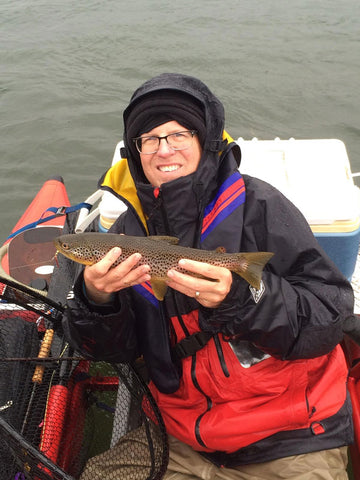
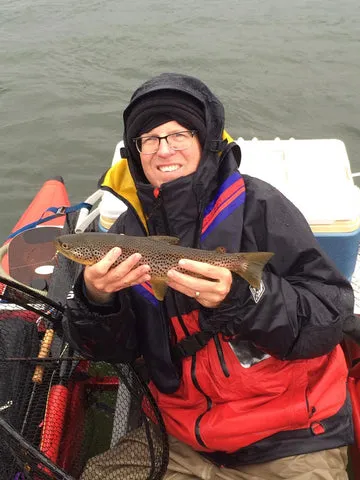
We decided to put aside the fly rods and cast spinners. So much good water and runs to fish! Matt scored the first fish of our weekend, a beautiful brown trout with bright spots and feisty as can be. His excitement at catching his first Montana trout warmed us up despite the cold, rain, and hard blowing wind.

Mile after mile flowed by, as we cast our spinners, catching a fish here, and a fish there. These Missouri river trout may be targeted primarily by fly guys, but they act just like trout anywhere else – they can’t resist a shiny number 2 quarter ounce spinner going by their face. Heck, with so many guys fly fishing the hardware anglers may have an advantage.
By the way, the stretch of the river between Helena and Great Falls is estimated to hold around 4,000 trout per mile. Cold, clean water, rich in nutrients for the rainbow and brown trout, the river has a healthy population of fish to target. And many of these fish are over 16”, and range into the low 20s.
From the Montana Department of fish and wildlife:
“Fish surveys this year indicate rainbow and brown trout numbers remain above the long-term average in the Missouri River between Holter Dam and the town of Cascade, says a state fisheries biologist.
State fisheries crews this fall estimated 5,194 rainbow trout greater than 10 inches long per mile near the town of Craig on the Missouri. Not only is that above the long-term average of 3,174 rainbows per mile, but continues a trend of above average numbers over the past three years: 6,034 per mile in 2011 and 7,312 in 2012.
This year’s population was bigger in size and slightly lower in abundance than the past two years, says Fish, Wildlife and Parks fisheries biologist Grant Grisak, which is typical as the current population reaches its maximum size.
“This year,” Grisak says, “87 percent of the rainbow trout in the Craig section were 15 inches long or greater, and 35 percent of the population was 18 inches long or longer.”
With such numbers come large crowds of anglers, both local and out of state. On our weekend we had the river to ourselves, which I decided was a fair trade-off considering the conditions. I think being a winter steelheader in the Pacific Northwest gave me an edge, at least for tolerating miserable conditions!
We didn’t catch huge numbers of fish, but did catch some real quality, 16-18 inch rainbows and brown trout. But more importantly, my son and I enjoyed a true bonding experience in a uniquely beautiful part of Montana.
/articles/montanas-missouri-river
Too Big To Ignore
By Gary Lewis
With this giant of western river caddis, what the angler sees on the surface is just a hint of what goes on beneath.
Across the West, the October caddis hatch begins in September and hits its stride in the first weeks of October. Even into November, the big bugs can still be found above the river.
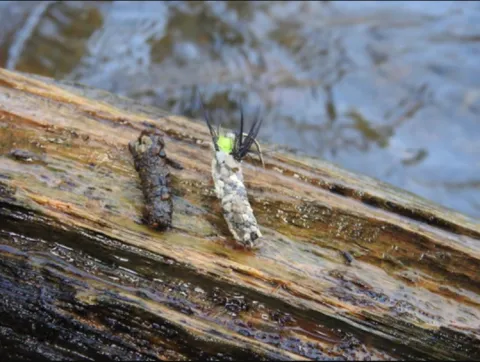
Separate a caddis larva from its shell and what you have is a pale yellow rock worm with jet black head and legs. Trout eat them shell and all, but the larva itself can be compared to trout candy.
Sometime in August, the caddis begin their final transitional stage, similar to the process of a caterpillar enclosing itself in a cocoon. The caddis attaches itself to a rock and seals itself inside its case, where it transitions from the larval stage into a pupa. When the time is right, the pupa breaks out of the case and begins to migrate to the edge of the stream, where it crawls out upon a branch or a rock and dries its wings.
Trout feed on caddis throughout the year, but they are suddenly more available in August, September, and October.
Hatch timing is not as easy to mark as a stonefly hatch. Much of the hatch can come off during night hours. In fact, it is safe to say that if a single orange-bodied, tent-winged bug can be seen above the river, the hatch is on. To the trout's way of looking at the world, the party has started, and it's mostly below the surface.
LARVAL
The larval stage is imitated in both cased and uncased versions. Artificials can be tied on scud-style on English bait hooks, or on straight hooks sized No. 10 to 6 and 2X to 4X long. The fly should be heavy. Beads, lead wire, and copper ripping can all be used to make sure it sinks fast. To tie a passable cased caddis imitation, peacock herl works as a good body base and may be overlaid with a rooster hackle to add depth to the body. The body of the worm can be tied to represent it partially out of the case, or not.
To be ready in the event of an October caddis feeding frenzy, tie or buy John Hazel's Deschutes Cased Caddis, Oswald's BH Rock Roller, Peeking Caddis.
Now picture the worm free from its case. This is a really good fly to fish by itself anytime between the middle of July and end of September. My favorite representations are tied in off-white, yellow, and orange overlaid with clear latex. Heads and legs are completed with dark rabbit or muskrat with the guard hairs picked out. Some other good caseless larva patterns include Tan Caddis Larva, Rip Caddis (Hafele and Morris).
For all intents and purposes, these flies should be fished dead-drift. I learned to fish them with the rod in the high-stick position, but they can also be fished with a strike indicator. Trout tend to suck them in and spit them out just as fast, so it pays to set the hook at the slightest suggestion of a grab.
EMERGENT
Peak caddis hatch activity will probably take place on cloudy days from late afternoon until dark. Anticipating this can precipitate what I think is the most important and exciting stage of the hatch.
Exploit the "pre-hatch" phase with a tandem rig that includes a pupal imitation up top and a larva imitation down deep.
Fish the two-fly rig on a dead-drift, then let the flies swing at the end of the drift.
If a few naturals begin to hatch, it might pay off to tie on a dry with a pupa imitation on a 24-inch trailing dropper. Cast, dead-drift, swing, lift the rod, twitch.
Some of the better pupa imitations include the Tungsten Dirty Bird, Mercer's Tungsten October Caddis, Morrish October BH Caddis Pupa.
ON THE SURFACE - HATCHING
Fishing the dry is a lot like fishing in hopper season. October caddis are not typically all across the surface with trout attacking them. But the flies are big and some trout are looking for them. The fly is trying to break free from the surface, get its wings dry, and fly off. Some accomplish this with ease, while others struggle.
After the natural has left the surface, it will not be available to trout again unless a strong wind drives it back to the river. At such times, the fly may be wind-smacked and a dead-drift is the preferable presentation.
Some of the great October Caddis dry imitations include Morrish October Caddis Dry Fly, Improved Orange Sofa Pillow, and Orange Stimulator.
This is a good time to stay with the time-honored dry and dropper routine with a small Rubber Leg Pheasant Tail, Emergent Sparkle Pupa (brown and yellow) or a yellow X Caddis in tow. Run the dropper about 24 inches back.
ON THE SURFACE - MATING
The next opportunity for the trout to eat the big bug is when the female returns for the egg laying dance.
When the adult female drops eggs atop the water, she touches down, lifts off, and touches down again. Sometimes the current pulls her under and she beats her wings to get back to the air, only to touch down again. This most often takes place from late afternoon until after dark, and the process will assuredly bring trout up off the bottom. Some trout get so engrossed in the ritual they will chase caddis out of the water and try to take them in the air.
Add skitter to the end of a dead-drift dry fly presentation with a quick mend to get the line up, and then turn a small circle with the rod tip. If the fly lifts off the water and touches back down, creating a bit of drag, it is okay. It is one of those moments in a dry fly fisherman's career when drag is a good thing.
Trout seem to materialize in the clear water and chase the bug for two, three, four, five feet across the surface.
Look at the "hatch" of the October caddis not as a single event, but as a process. It's October, what are we waiting for?
# # #
To contact Gary Lewis, visit www.GaryLewisOutdoors.com
The End
/articles/too-big-ignore
Lunker Lake Chelan Kokanee
By Mike Carey
There has been speculation exactly why anglers are seeing such large and healthy kokanee in Lake Chelan. Site member Toni (Wannafishalure.com) recently contacted WDFW Fish Management and got these two responses:
From Larry Phillips, Fishery Manager
"My understanding of Kokanee (based on what I’ve read in the published literature) is that growth is closely related to density. More kokanee=smaller size. Because they are specialized feeders (almost exclusively daphnia which is a species of zooplankton), they can overgraze their forage base.
I suspect that in the case of Lake Chelan we had a couple of weak year classes prior to the year-class that supported last year’s fishery. The weak year classes may have been the result of high water or high predation which limited overgrazing.
This would have given the prey base a couple years to build and support much higher growth. Obviously this is a guess because I’m not the biologist for that area.
Recall that all kokanee are genetically identical to sockeye and most naturally occurring sockeye populations have an associated resident (kokanee) component. Also recall that several 20+ inch kokanee were caught in American last year……so Whatcom Lake (our state source for kokanee) also has high growth potential.
When prey abundance is high kokanee have the potential to get very large. Several other factor can affect growth but it typically comes down to the relationship between kokanee abundance, prey availability, and prey size. Other issues include predation, temperature, and turbidity."
From Travis Maitland, Fish Biologist
"Larry’s previous explanation to you of what has been going on with the Kokanee in Lake Chelan the last couple of years is “spot on”. I will only elaborate a bit more on a few points that I hope will help answer your questions.
Historical Lake Productivity: Lake Chelan is the textbook example of an oligotrophic body of water. Bodies of water like this tend to be relatively deep, nutrient poor, clear, light transmission is high and the euphotic zone is deep.
Even though light penetrates to a considerable depth, primary production of phytoplankton is limited by the lack of nutrients, all of which results in a biologically limited body of water.
Lake Chelan Kokanee history: Although details (Strain and numbers) of stocking history prior to 1933 are missing….we do know that Kokanee were first stocked into Lake Chelan in 1917. WDFW stocked only this initial naturally reproducing stock of kokanee back into the lake from the early 1940's until about 1957.
In 1957 Kootenay Lake stock kokanee were introduced as eyed eggs, and in 1966 Whatcom stock kokanee plus, Kootenay stock kokanee began to be stocked as eyed eggs and in later years as fry. Recently only lake Chelan stock (so, a conglomerate of Kootenay, Whatcom and what was originally stocked) are being stocked.
There are no records that I know of that point to the ocean going form (Sockeye) ever being stocked into the lake and no genetics work has been conducted to my knowledge.
Recent Year Classes
During the last couple of years, the Kokanee available in the fishery came off of relatively low adult spawning escapements….and by that I mean the parents of these fish were in relatively low abundance by the time they made it to spawn. As Larry also mentioned, this can also be caused or compounded by things such as predation or high water events that may have taken place on the spawning tributaries.
All of this comes back around to numbers. So, for what information we have at this point…I am comfortable in saying that the fish have grown to some larger sizes in recent years because they have been present in relatively lower densities with the same available food source, thus giving them the opportunity to grow larger. There is no evidence that suggest this is genetically driven.
I have been hearing a few good angler reports as well of good sized Kokanee already this year…..12”-16”.
I hope this has helped and please feel free to contact me if you have any further questions."
Best regards
Travis Maitland
Washington Department of Fish and Wildlife
Dist. 7 Fish Biologist
Wenatchee District Office
3860 Hwy 97a
Wenatchee, WA 98801
(509) 665-3337
-----------------------------------------------------------------------
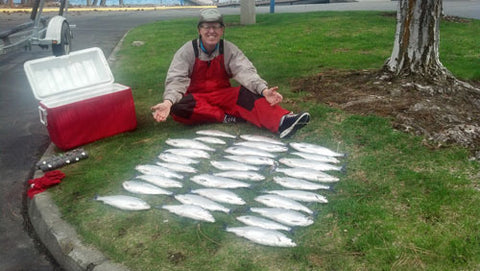
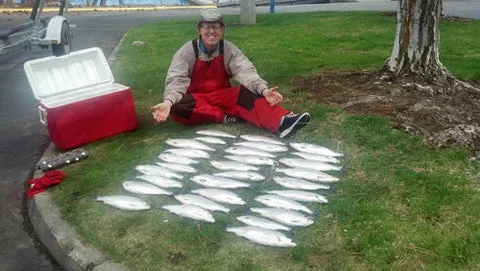
No doubt, the quality of the kokanee in 2013 was phenomenal and hopefully 2014 will prove a repeat. As noted above, fish are beginning to be caught. For my wife and I, last year April was red-hot into early May.
Anglers continued to catch fish into the late spring/early summer, but early spring was best. By mid-April the weather generally is pretty good in Chelan, and the crowds are light. The fishery is well worth the drive from east or west side to centrally located Lake Chelan.
/articles/lunker-lake-chelan-kokanee
Bennett's Fish Shack
By Hillary Holman
Winter is upon us, and ocean beaches will be opening throughout the season for Razor Clams. Rob and I spent last year in Ocean Shores to enter in the New Year with my cousin Lee Olson, out of Forks, old friends, Keith and Melissa Hudson and WDFW’s Dan Ayers.
After a cold and beautiful day clamming, we headed out looking for good food and a place to celebrate the new year. We landed at Bennet’s Fish Shack just a hop away from the beach. From outside, it was hard to miss the giant wreath hanging from the front monumental Bennet’s Fish Shack sign.
The inside was nicely decorated with beautiful holiday décor. The tables were made of copper and seasons greetings hung from every which way we looked.
It was New Year’s so Rob and I started off with a couple Bloody Mary’s and a Dungeness Crab Cocktail. Holy Moly was it good. This was a great way to start off the meal. So good, we repeated it on day 2. Next up was the entrees.
I got the beer battered cod. It was incredible. The fish could not have been fresher. The batter was perfectly crunchy, and the portions were healthy. Rob got the wrap, and it too was delicious and sizable! After a long day in the cold, this was the perfect place to kick up our heels and bring in the New Year.
I now have a new standard on comparing Dungeness Crab Cocktails because of Bennet’s. This place is the best I have found. When on the coast searching for Razor Clams, Give Bennet’s a try. I think you may like what you find

/articles/bennetts-fish-shack
The Outdoors Roundup
By John Kruse

It’s all fun and games in September and October as the foliage turns scarlet and gold. The fish put on the feed bag, biting readily. Then, November and December arrive, the leaves turn brown, tree branches become empty, and catching fish gets more challenging. Having said that, there are still some great places to catch fish in Eastern Washington in the late fall and early winter.
COLUMBIA RIVER GORGE
You know what they say, “the river never sleeps”, and neither do the fishing opportunities in the Gorge. At this time of year, the coho salmon bite is waning, but the walleye bite near John Day Dam, as well as catch and release sturgeon fishing, remains strong. If you are looking for current information, drop by Gorge Outfitters Supply in Rufus, Oregon.
GRANDE RONDE RIVER
It’s a long drive, but this picturesque river is worth it. Starting in November, good numbers of summer steelhead show up here, and fortunately, there is a good amount of public access for you to get at them, from Highway 129 at Boggan’s Oasis to Troy, Oregon. There is also some access near the mouth of the Grande Ronde, where it flows into the Snake River.
The steelhead run is much better than last year and anglers should be in for decent fishing from the bank, or from a raft or drift boat. Spinners, spoons, and small jigs fished under floats all work well here. Barbless hooks are required. Check the regulations for additional information.
POTHOLES RESERVOIR
The walleye bite continues well into December, and trout fishing is an option too! Try trolling near Medicare Beach or off the mouth of Frenchman’s Wasteway for quality size rainbow trout. Try off the face of the sand dunes, the mouth of Crab Creek, or in the Lind Coulee for walleye at this time of year. Trolling a spinner/worm harness behind a bottom bouncer weight works well in November, but as the water continues to cool, switch to blade baits for the walleye.
ROSES LAKE
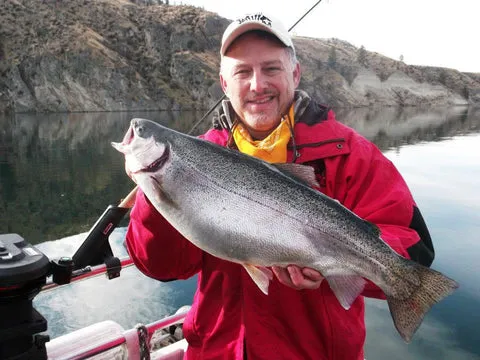
Located near Manson, this 132-acre lake offers very good trout fishing during the fall and winter. There is a public access area on the south end of the lake, with some room to spread out for anglers fishing from shore. Once the lake freezes over, it becomes an ice fishing destination not only for trout but also for perch, which are found in good numbers here. Pro tip?
After you are done fishing, have breakfast or lunch at the nearby Blueberry Hills Restaurant. It will make the whole trip worthwhile even if you don’t catch a thing!

LONG LAKE
I was introduced to this lake when I was invited by Mack’s Lure President Bob Schmidt to fish with him and a couple of other friends on board Steve Morris’s boat, the man who owns SJM Guide Service. This lake is located just northeast of Spokane. Morris explained this fishery has a limited window because the boat launches become unusable by mid-December.
Our late November fishing trip was fantastic with a very quick limit of chunky, 12-to-14-inch rainbow trout. If you have never fished here before I would recommend using a guide like Steve. His website is www.sjmguideservice.com .
RUFUS WOODS RESERVOIR
This impoundment between Chief Joseph Dam in Bridgeport and Grand Coulee Dam is a long time draw for anglers going after the big triploid trout found in this reservoir. In the past, most of the triploids caught here were escapees reeled in near the net pens they were raised in on the reservoir. Now, the Colville Tribe raises triploid trout in a hatchery and releases them directly into the reservoir.
If you are fishing on tribal land, you will need a permit to do so, in addition to your fishing license. While many anglers take their boats to the areas just outside the net pens, bank anglers can also have success on tribal land by the net pens, as well as from shore at Bridgeport State Park, Brandt’s Landing, and the Willow Flats Recreation Area near Chief Joseph Dam. Oh, and if the triploid trout aren’t biting? Try trolling or jigging for walleye, there are a bunch of them here.
LAKE ROOSEVELT
Last but definitely not least, this 151-mile-long impoundment of the Columbia River stretching from Coulee Dam to Canada offers very good fishing during the winter months for quality rainbow trout and kokanee, both of which average 16 to 20 inches in size on a good year, with some fish even bigger than that. Walleye fishing is also very good here during the cool weather months, and they can get big (a walleye weighing nearly 12 pounds was caught this past March).
Anglers tend to fish around Keller, the mouth of the Spokane River, or by Kettle Falls. The kokanee are usually found in the lower end of the lake in the winter. If you want the latest fishing information about Lake Roosevelt, stop by Clark’s All-Sports in Colville.
/articles/outdoors-roundup-3
Stocked Trout Extravaganza
By Paul Lewis
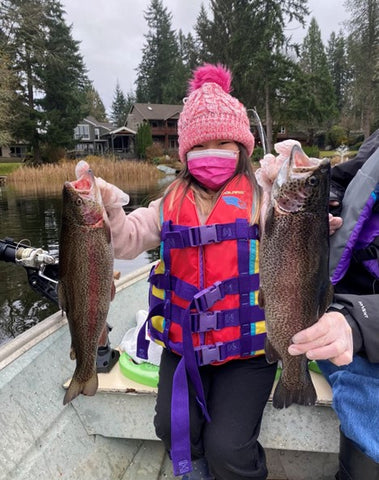
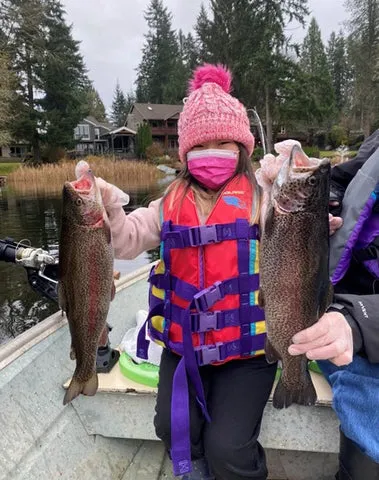
Well, winter is around the corner and it’s time to put the rods away and winterize the boat, right? NOT QUITE YET! Salmon season is indeed winding down, aside from some late season river opportunities, and winter steelhead is often a mystery, so many anglers don’t know where to look for the next bite. If this is you, look no further than some fantastic winter trout fishing at multiple stocked lakes! Winter trout fishing is incredibly rewarding, and in many cases, produces some large trout that cut beautifully. There are many ways to chase these fish from shore or from the boat, and with a little research and timing, you are sure to be on the fish!
HOW TO PREPARE
To begin, let’s look at the setups to use. Cold water temps have a lot of effect on fish, as they are a cold-blooded species. During this time, they are in energy consumption mode, with not a ton of energy to be spent moving around.
Additionally, cold temps slow down fish metabolism. All this together means that when the fish feed, they are looking for an easy meal that does not require too much energy wasted in chasing it down. For this reason, small profile lures and stationary baits are often the best choice.
When fishing from shore, it is hard to beat the “stocked-trout standby”, the Carolina rig! An egg sinker on the mainline with a 2–3-foot leader to a small hook, with an inflated nightcrawler or chunk of Powerbait, is an easy meal for a meandering trout to engulf. Another good option is a small spoon or spinner with a slim profile and wounded look.
Lighter casting spinners and spoons can be worked slow through the water column and produce a very crippled look. They are a great way to cover water in new spots and find the fish.
From a boat, these methods work great as well, but trolling can be added to the mix. Small spoons and spinners tipped with a worm are always a good option. Trolling allows the angler to go to the fish. Compared to spring and summer, trolling a little slower can be very effective. Many rainbow trout will sit low below the thermocline. Trolling past them just fast enough to get their attention but slow enough have them commit is the target.
WHERE TO GO
As with any fishing trip, the first thing to do is check the regulations. Many stocked trout lakes are seasonal, meaning they close at the end of October. If your lake is open, you are set to legally fish, but there may not be great fishing. Luckily for the angler, the WDFW publishes a list of recently stocked lakes that is updated weekly. Checking lakes in your area will give you the best idea of where and when to wet a line.
The best time to catch stocked trout in the winter is directly after the stock. This is when the trout aren’t quite acclimated to the new area, and they are the most aggressive. After a couple weeks in the lake, the fish will hunker down and be far less active compared to their first little bit in the new water. Knowing when the trout are stocked can be the difference in a couple bites and a nice limit on the stringer! During most of the winter months, the state stocks their “jumbo’s”, which are trout over 1lb, which usually cut fantastically.
FINISHING TOUCHES
As a local Western Washington Angler, I know a couple great lakes in my surrounding counties that are stocked in November, which give me just enough time to make some smoked trout dip for the Thanksgiving table. Nothing warms a day like a tight line on a cool river bank, sipping hot coffee, and enjoying some bank lunch.
With a little research, a simple setup, and a couple of free hours, you can be knee deep in some delicious trout! Just like the spring, ultralight trout setups, light monofilament line, some extra hooks, and a couple of weights, and you are set on terminal tackle. Then add some jars of Powerbait, a few lures, and a stringer, and you will be ready to hit the water. As always, be prepared for the weather!
/articles/stocked-trout-extravaganza
The Washington Outdoors Report
HUMPIES, LAWSUITS AND TROUT
PINK SALMON NUMBERS ARE LOOKING GOOD
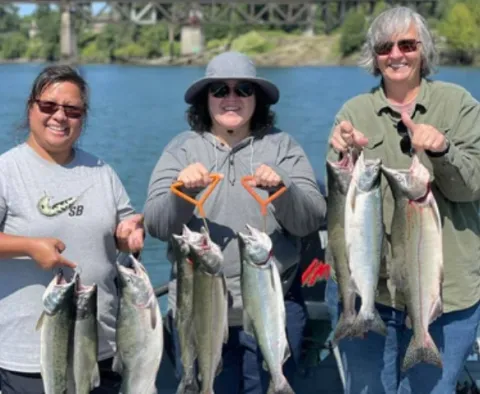
Odd numbered years are pink salmon years here in Washington State and 2023 is lining up to be a good one for anglers fishing for them in Puget Sound and its tributary streams. The Washington Department of Fish and Wildlife is forecasting a return of nearly four million of these smaller salmon, nicknamed “humpies”, for the hump the males develop on their back after entering fresh water to spawn.
The pinks show up in the Strait of Juan De Fuca as early as June and can be caught by both boat and shore anglers in Puget Sound throughout the month of August. By September, most of the pink salmon are entering tributary streams like the Skagit, Snohomish, Skykomish, Green and Puyallup Rivers, providing additional opportunities for anglers who target them with Buzz Bomb lures, jigs with squid bodies and spoons, the key to all of them is that they must be pink in color if you want to catch pinks with them!
Humpies are a fun fish to cut your teeth on as a first-time salmon angler and it’s not uncommon to catch a good number of them in a day of fishing. While many anglers save them for the smoker, they do taste very good when fresh, especially when grilled over a BBQ or pellet smoker.
LAWSUIT FILED AGAINST WDFW COMMISSIONER
On March 6th the Sportsmen’s Alliance Foundation, which is a pro-hunting and fishing organization, filed a lawsuit in Thurston County to prohibit WDFW Commissioner Lorna Smith from participating as a member of the Commission.
The basis for the lawsuit is that state law prohibits anyone from holding an additional elected or appointed office while serving on the commission. Smith currently serves on the Jefferson County Planning Commission which the Sportsman’s Alliance says is in direct violation of Washington Law.
Todd Adkins with the Sportsman’s Alliance says, "We view this lawsuit as the initial step of a long but important process to bring sanity and decency back to wildlife decision-making in Washington. It all starts here, but trust me, it won’t end here. The animal extremists are going to see a lot of the same in the coming weeks and months."
Lorna Smith is a controversial appointee to the Fish and Wildlife Commission. Since being appointed in 2021 by Governor Jay Inslee she was an instrumental voice in shutting down Washington’s long running spring bear hunt, despite the recommendation of WDFW staff members that it be allowed to take place.
When the Blue Mountain elk heard declined (primarily due to cougar predation), Smith suggested managing the herd as a smaller one instead of addressing the predation issues. She has also introduced the framework of a plan that would limit hunting as a management tool by the agency.
It is worth noting that Smith is not the only commissioner serving in another appointed or elected position. Commissioner Molly Linville (who generally sides with hunters in her decision making), serves on her local school board in Douglas County.
Eli Francovich, writing for the Spokesman Review, contacted both commissioners. Linville told Francovich that she was advised by legal counsel that serving on the school board was not a conflict of interest. Commissioner Smith told Francovich she was serving on the Jefferson County Planning Commission on a volunteer basis and in an advisory role when appointed to the Fish and Wildlife Commission. Smith continued stating she does not believe the statute does not preclude individuals serving in a volunteer position like she has been in Jefferson County.
LAKE LENORE FISHING TRIP
Last but not least, I made it up to Lake Lenore this past week after WDFW fisheries biologist Mike Schmuck told me the fishing there was very good last year and he expected similar results this season. I picked a cold, cloudy day to visit the north end of the lake which is where many of the Lahontan cutthroat trout tend to mill around in the spring prior to spawning.
Unfortunately, the trout were not yet in this part of the lake in good numbers. Two anglers who were leaving as I arrived said they each only caught one fish that day. While fishing, I did see one angler catch one trout and while I did get one good strike, I was unable to hook up and didn’t have any more bites that afternoon.
Lake Lenore is a selective regulation fishery and is primarily a catch and release destination where the trout average two to three pounds and can get up to six pound in size. Fly anglers in pontoon boats favor fishing chironomids under strike indicators while spin anglers can do well fishing spoons with single, barbless hooks.
The fishing at this scenic, desert lake north of Soap Lake should get better towards the end of March and peak in April. I plan to return to try again and will let you know how I do.
John Kruse – www.northwesternoutdoors.com and www.americaoutdoorsradio.com
PHOTO CREDITS:
Pink salmon caught on the Snohomish River – Courtesy Brianna Bruce, Livin’ Life Adventures
/articles/washington-outdoors-report
Elemental Telepathy
By Gary Lewis
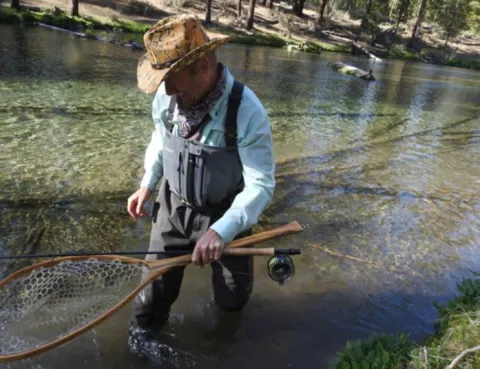
After 26 rainbows brought to hand and released, I reeled up the loose coils at my feet and clipped the Muddler Minnow off the line. Rain had been steady for the last hour and, soaked, I looked forward to climbing back in the Mustang and turning up the heater.
Upstream from a two-lane bridge, the river cut a channel through rock leaving a pool deeper than a man’s head. In the winter, an angler might catch a steelhead here; in the spring it was chinook, but the river offered a trout fishery too.
Today’s lipstick was a Muddler Minnow tied on a No. 8 long-shank hook, unweighted, with a turkey feather for the dorsal.
With no one else for company, it was easy to start at the top of the run, shake out a bit of line and stack-mend to get the fly to work into the seam this side of the riffle.
Lengthening the line, making micro-mends, the diminutive sculpin imitation presented to the trout below, and rainbows streaked up from the bottom to follow the Muddler across its arcs. And the longer the arc, the more likely the trout would grab.
After several trout I was startled to realize I did not feel a single bite. Instead, at best, it was a movement of the line, a two-inch indication, not even a tick that I responded to. Now and then a trout would give itself away with a flash below the surface. Trout after trout bit. Almost every cast they grabbed, but I only counted them when I could fight them all the way to the bank.
As time passed, I stepped downstream, roll-cast the same length of line each time and teased trout out from beneath the shadow of the bridge. When, properly soaked from the rain, I saw another angler headed toward me. He cast a glance toward the fly I had just removed from my line.
“Take this,” I said. “It’s working.” And before I walked up to the bridge, I pointed out where I supposed the trout were lying in the tea-colored water.
But I couldn’t leave. I had to watch from the bridge to see what the trout were doing. Taking care to not cast my shadow over the fish, I leant both elbows on the rail and watched the angler work out line and swing the Muddler across.
A trout streaked up from the middle of the water column, followed a couple of feet and then closed its mouth over the deer hair streamer. There was no reaction from the fisherman. He let the fly continue to swing while the trout moved with the Muddler then opened its mouth and spit it out.
Surprised, I said nothing and continued to watch. In twenty casts, ten trout grabbed and the guy did not a single time sense the bite. I could not stand it. I walked back down.
He was ready to change flies.
“You’re getting bit on almost every cast,” I said. He didn’t believe me but he consented to cast again. When the fish bit, I called the strike. And he caught a fish. And I left him to it.
What was the difference, I wondered then, and I still wonder today when I fish alongside someone who clearly catches more fish than me. If the fly is the same and the presentation is the same, why does one angler catch fish and another does not? How many fish bite and we do not know it?
Line control and sensitivity is hard to teach and even harder to learn.
Let’s call it electricity, an impulse in a conductor. Cast out a dead thing; the conductor swings out in the void. And then, out of the void comes a live thing and closes the circuit. For a moment, the line tingles and energy pulses from the muscles of the trout on the other end. In tune with the lightning rod that is the graphite in your hand, you sense it. Exchange of energy. Reaction making contact.
Let the fish take a bit of line, lift the rod or turn the tip toward the bank. Let the trout hook itself. It’s electric.
# # #
Gary Lewis is the host of Frontier Unlimited TV and author of Fishing Central Oregon, Fishing Mount Hood Country, Hunting Oregon and other titles. Contact Gary at www.GaryLewisOutdoors.com
The End
/articles/elemental-telepathy