Swinging Streamers for Trout
To me, there is absolutely no better feeling than a fresh, chrome anadromous fish hammering a properly swung fly. Life goes from less than zero to over 200mph in a split second. Typically, when it happens to me, I’m standing there going through the motions thinking about everything but fishing. Chaos comes and then goes just as quickly. The quick rush is addictive and leads some anglers into facing a maddening depression when there is a distinct lack of fresh chrome fish in the rivers. Years ago, while battling my own steelhead sickness, I discovered that some resident trout do in fact eat swung flies and that it was fun way to fulfill an angling need when a steelhead isn't in the same time zone.
If you are a dyed in the wool steelhead aficionado living within a stone’s throw of the fabled PNW steelhead rivers, stop reading now. Nothing I have to say here will be helpful or beneficial to your quality of life. Your geographic angling superiority is to be congratulated and celebrated. The rest of us that deal with a slight pilgrimage to steelhead water might find solace knowing that a temporary fix might just be a little closer to home than originally thought.
One fall/winter between Alaska and Patagonia guide seasons, I found myself in Western North Carolina. Appalachia. It’s beautiful there. Big mountains, trout streams, elk, bears, deer, and even musky, but not a single anadromous chrome fish anywhere at all. Nothing to swing flies to. I ended up there because of a girl. Although I can’t remember her name, I am sure that’s why I was there. We’ll just say her name was Alice. Alice lived on a big lake fed by three large trout rivers and several creeks. The lake was about 20 miles across and over 400 feet deep at the dam.
The largest river flowing into it averaged about 3000cfs (cubic feet per second) annually. The other two rivers had slightly less flow. Most people around regarded it as “tough fishing” mostly because of the depth and its ability to create nasty waves. Not your typical southern sparkle boat bass lake. I didn't care, it seemed normal to me. After spending a few seasons on Naknek Lake and Illimani Lake in Bristol Bay, I saw this as an opportunity to fish alone in water that rarely saw pressure. So, off I went in Alice’s boat, without Alice. She was terrified of the lake, and she didn't like fishing. Maybe that’s why I can’t remember her name. Either way, I was going armed with a new 6 weight spey rod and my trusted 10’ 7 weight single hand rod. The 6 weight spey was a gift from a buddy that built custom rods and I was itching to dial it in for an upcoming trip. I didn't really think it would be a useful tool for where I was.
As I pulled the boat into the mouth of the river, looking for a safe spot to anchor, I saw what could only be described as textbook holding water for migrating fish. Feeling like that was just a pipe dream fallacy, I lazily anchored the boat and trudged up to the pool above the shoal. As nonchalantly as could be, I made a cast. The rod was an absolute cannon for a 6 weight and still is. While basking in the glory of my new gift, my fly got slammed. The fish darn near ripped the rod right out of my hand. I wasn’t planning for this. I was just tuning a new rod.
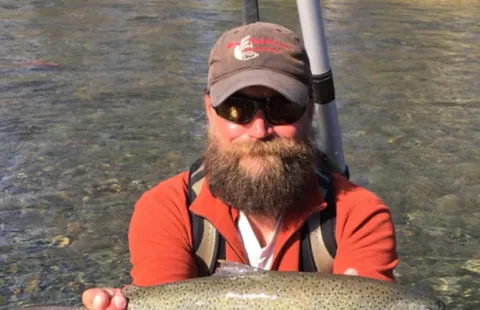
The fish pulled a couple of runs and then gave up. As the fish headed towards the shallows, I tailed it and just knelt there with it for a minute. Holding in my hand was a perfect specimen of rainbow trout that probably measured 26-27”. It wasn’t chrome, but it wasn’t full of color either. Just a perfect species specimen with all its fins and mandibles. Not a steelhead, but darned nice. I figured it to be a fluke but kept fishing anyway. I caught 4 just like it that day and 6 the next day. The day after that, I didn’t count the fish I caught. I just enjoyed the fact that I was successfully fishing the way I wanted to in a place where that should not be working.
Soon after that, It was time for me to leave for Patagonia, where I honed the swing method for trout even more. Three months of guiding the tributaries of Lake General Carrera proved to sort out my theories well. Trout that live in rivers without a lake system don't take swung flies as well as trout that live in rivers with a lake system. Maybe it’s because the lake provides a semblance of oceanic feeling to the trout, nurturing its true migratory genetics. Whereas a trout living in a creek or stream that tribs into a larger river is more resident homebody completely ignoring its DNA. Maybe that DNA is bred right out of those fish. I’m not a biologist, so I really don’t know the answer to why they do or don’t. People much smarter than me will be able to answer that.
Here is what I know - everywhere I have tested my theory on swinging flies for trout, it works. Every single time. In Alaska, PNW, Rockies, Sierras, Appalachia, and Patagonia. A trout river feeding a lake of any substantial size and depth will support an angler trying to get a fix by swinging flies to trout. It’s become a game of sorts for me now. Every steelhead trip, I pack my 6 weight spey rod and a 6 weight switch rod.
It’s been a lifesaver at times when the steelhead water is blown out. I don't get too crazy with the flies; everything is a stinger hook fly scaled down in size somewhat. I try to use more natural looking patterns. Any smaller stinger hook sculpin or leech pattern is great and there are several very good sources for trout swing flies out there. Start at your local fly shop. Those guys will know what’s up.
If your steelhead pilgrimage is a little too far to take a chance of being blown out, grab a 6 weight two hander or 10’ 6/7 weight single hander and test my theory. I am sure there is a river near you that fits the description. You might save some time, gas money, and get to fish alone. Who knows, you might even get Alice to tag along.
/articles/swinging-streamers-trout
Washington State Record Whitefish
From the Washington Dept. of Fish and Wildlife, we learn a Davenport angler who attends Gonzaga University reeled in an unexpected catch while fishing for walleye at Lake Roosevelt on February 11th. Gavin Boggs was fishing with a college friend near the Lincoln boat launch that afternoon when he hooked into something very big.
Boggs said, “I was targeting walleye at a depth of around 75 feet using a four-inch swim bait and it was a pretty tough day on the water. We did mark a lot of fish on the fish-finder but had only caught one walleye before this big fish took my lure.”
Boggs, whose family has a place at Seven Bays toward the southern end of Lake Roosevelt, continued his story, saying, “As soon as I hooked it, I thought it was a big walleye. I carefully let the fish do its thing down below the boat and then when it came to the surface and we netted the fish, I was totally surprised. I’ve never targeted whitefish in Lake Roosevelt. It is my favorite place to fish for smallmouth bass and walleye, and this has changed my mind about fishing for lake whitefish.”
Gavin caught the fish in the late afternoon and he texted his father about the catch. Gavin’s dad, Tony Boggs, did some research and told his son he might have a new state record on his hands.
According to WDFW, Boggs immediately iced the fish in a cooler and drove from Seven Bays to Davenport Family Foods, where an official scale verified the weight as 7.86 pounds. The store owner, a friend of the Boggs family, stayed late just so Gavin could have it officially weighed.
Gavin then took the fish to the WDFW Spokane regional office on February 14th, where biologist Danny Garrett measured this new state-record lake whitefish at 26.25 inches long, with a girth of 16 inches.
.
The old state record weighed 7.50 pounds and was caught Feb. 19, 2021, by Jacob White at Cox Lake in Franklin County. Gavin said Jacob actually reached out to him on Facebook to congratulate him and “pass the torch”.
Will this record be broken again soon? Possibly. WDFW conducted a netting survey at Lake Roosevelt last fall and caught quite a few lake whitefish, including one that weighed 9.5 pounds.
/articles/washington-state-record-whitefish
Safety and First Aid Afloat
We’re going fishing! The gear is stowed, trailer lights checked and working, you’ve topped off the fuel tank, and the ice chest is full of food, drinks and bait. When going through the checklist, did you consider your first-aid supplies? I know you’re just going out to pull crab pots or fish the last few hours of the tide change, what can possibly happen?
In 2022 the USCG statistics show that there were 2,222 reportable boating injuries. Who knows how many unreported injuries there are. This year it is estimated that 55 million Americans will embark on a fishing trip. While the plan is to make it back to the dock without so much as a thought about a boating or fishing injury, they happen, and you should be prepared.
While the most common injuries are largely preventable, there are many “oh crap” moments any time you are on the water. Some preventable mishaps are as follows:
Falls, Pulled Muscles/Sprains - Many injuries can be prevented by wearing proper footwear and keeping the deck organized. I don’t know how many times I have slid down a ramp float at 2:30 in the morning because I was wearing worn out flip-flops or sandals. Make sure the tread on your footwear is serviceable. Boat organization is important in the prevention of injuries. Everything should have a place and be kept there. Loose ice chests, loose gear, or weights have caused many falls related injuries. Fish slime and blood should be cleaned up immediately. A few years back while fishing for winter blackmouth, I slipped on a puddle of chinook slime we hadn’t cleaned up yet. If not for a quick handed atomic wedgie by a fishing buddy I would have gone swimming.
Back injuries
Many times, back injuries are caused by twisting under load- if the seas are rolling don’t pick up a heavily loaded ice chest to clear the deck. Pulling crab or shrimp pots should be done with a plan. Use a puller if you can but if not possible keep your chin over your knees while pulling pots. Be aware of your posture as you swing the pot into the boat. When downrigger fishing, use a retriever setup, don’t lean over the edge of the boat to manage the downrigger clip. Anchoring is another activity where an extra dose of caution should be prescribed. Never just throw the anchor and hope for the best. Always have control of the anchor line and then once it hits the bottom, slowly feed it out to get the appropriate scope. Keep the deck clear when managing the line and if you don’t have an anchor locker use a milk crate, anchor bag, or even a 5-gallon bucket to manage loose line. Finally, consider the potential for cumulative abuse injuries to you or your passengers’ backs.
Here in the Pacific Northwest, many of us are running aluminum boats. While a great option for general recreational use, they typically ride rough. As the skipper you may have some form of suspension seat but it is likely your passenger does not. For that matter it is likely that you have passengers on cushioned seat boxes. I mention this because Repetitive Lumbar Injuries (RLI) are a real possibility when boating in choppy conditions. Basically, the tissue between your lumbar vertebrae can break down and pinch the nerves when running in heavy seas.
Short of installing high end suspension seats there are a few things you can do to help prevent RLI. The key is to slow down and practice what I call “Become one with the sea”. You can also run a bit bow up to push the impact point towards the stern for a smoother ride. Both will slow you down, but eventually you’ll get where you’re going and your backs will thank you for your extra efforts. On a personal note; I have pretty severe arthritis and my lumbar region is a mess. For work, I run a small aluminum boat 6 days a week year-round. For the most part, I make the run independent of the weather conditions. There are days where I have to stand to run the boat. If I sat down while running in the heavy, unsettled seas I would be paying for it later.
Many boating accidents are preventable, keep an organized deck, limit your passenger’s alcohol consumption, secure knives, gaff hooks, and anything else that can swing or roll around. A 12# downrigger ball rolling around could do some serious damage if you got in its way. Even consider what a 3-ounce jig can do swinging from a rod in the rocket launchers can do (I know…) Stay alert, try to get some sleep the night before an outing, again, limit alcohol consumption, and stay hydrated. A key in preventing boating accidents is knowing your limitations as a skipper and what your boat and crew can handle. Don’t be afraid to put the boat back on the trailer if the conditions warrant.
Establish a general safe boating routine for your boat and share it with your passengers. It should include location of the PFDs and a throwable device, location and use of your firefighting equipment. Possibly address the docking procedure: Things like, secure the stern line first when docking, no jumping from the boat to the dock, watch your fingers, and watch for cleats and other dock hazards. Any time the seas are questionable have everybody wear their PFD and stay seated. If it’s really bad, have them sit on the floor to lower the overall CG of the boat. When running in the dark, for or other inclement weather, always post a lookout.
While many boating injuries are preventable, others just happen. Medical emergencies are rare when recreational fishing but as a skipper you should be prepared to offer basic first aid. On our boat we carry a comprehensive first aid kit. Fortunately, we rarely break it out, but at least we are prepared if something serious develops. Here in the PNW your boaters first aid provisions should include the following as a minimum:
- First Aid Guide, the Red Cross offers an Emergency First Aid Reference Guide for 3.95. It is available at https://www.redcross.org/store/emergency-first-aid-guide/758276.html
- A Small Bolt Cutter to assist in removing fish hooks.
- Band Aids
- A Medical Shears
- Tweezers
- Gause Dressing
- Nitrile Gloves
- Antiseptic Wipes
- Pain Killers/Anti-inflammatory Tablets
- Burn Cream
- Cloth Tape
- Triple Antibiotic Ointment
- Q-tips
- Drinking Water
- A Spray Bottle with a 50/50 solution of vinegar and seawater. A quick spray will neutralize jellyfish stings and in a pinch help to clean a slippery deck.
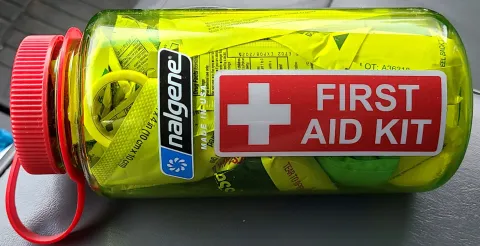
Most of the items noted above will fit in a 32-ounce wide mouth Nalgene water bottle. In fact, that’s what we keep in the truck and it often is with us during other outdoor activities. If you want to step it up a bit, there are many commercially available first aid kits out there. Generally, they offer an elevated level of medical care. Some lessons learned and general comments are as follows:
Establish an inventory management plan. You want to ensure adequate supplies are available when required (think 4-year old girl, redheaded Cabbage Patch Doll, a pack of Band-Aids, and a weekend on the boat). Your plan should also check for out of date products. For storage of the bolt cutter, I use one of those anticorrosion chips of plastic to keep it from corroding. I use Zerust Plastabs but there a number of other corrosion-inhibiting products available. If you do have to manage a medical situation, your demeaner will go a long way towards helping your patient. Even if you are uncomfortable, don’t panic and calmly work through the situation. If you have a serious situation recognize it sooner than later and don’t be afraid to call the Coast Guard or 911.
With adequate prevention measures and the ability to manage a first aid as required, your crew is likely to return to the dock with nothing more than a sunburn, a bag of fish, and a smile. In the unlikely event that you do have to render first aid, part of wearing the skipper’s hat is being prepared. This article should be considered as a general guideline and feel free to set up your own safety/first aid program.
/articles/safety-and-first-aid-afloat
Revisiting The Ten Essentials
As a young Boy Scout who went on monthly hiking and camping trips, the Ten Essentials for survival was drilled into me as the items I always needed to have with me, even if I was on a day hike. In the last few years, Search and Rescue teams have become increasingly busy, in large part because novice hikers hit the trail unprepared and get in over their heads, relying on only their cell phones for help. With that in mind, revisiting the Ten Essentials seems like a good idea.
POCKET KNIFE – Never underestimate the many uses of a pocket knife for cutting, whittling, cleaning fish or game, and more. If you want to get even more use out of pocket knives, carry a Swiss Army Knife or Leatherman Tool which gives you all sorts of tools at your disposal.
FIRST AID KIT – It’s all fun and games until you fall, cut yourself or otherwise become injured. That’s why a basic first aid kit is needed, especially since you will not be anywhere near a medical facility.
EXTRA CLOTHING – Layered clothing is a must when out for a hike. That sunny day can cool down in a hurry when the sun goes down or even if clouds obscure the sun.
RAIN GEAR – Those clouds can turn into rain and especially in the mountains, thunder storms and rain can happen fast. That’s why a lightweight rain jacket should be part of your extra clothing.
WATER BOTTLE (filled) – Hydration is key and a filled water bottle (or two) will not only be needed, but appreciated while hiking on a hot day.
FLASHLIGHT – Why would you need a flashlight for a day hike? Because sometimes things go wrong and you are stuck in the woods when the sun goes down. Fortunately, cell phones have flashlights in them but a small (and more powerful) flashlight is easy enough to carry with you.
TRAIL FOOD – It’s amazing how much energy you burn hiking, especially if you are going uphill. Trail food that includes protein can give you a quick pick me up. Some of my favorites include trail mix, jerky, or protein bars.
MATCHES AND FIRESTARTERS – If you get caught in the weather or are forced to stay in the woods overnight a fire provides both warmth, comfort, and the opportunity to cook a meal. A box of waterproof matches, a lighter or a flint or carbide fire starter are all easy to carry and worth their weight in gold.
SUN PROTECTION – It’s easy to get dehydrated while on a hike or camping and not only do you want water to replenish lost fluids, but also protection from the sun. Sunburnt skin or lips are not only uncomfortable, but also a major factor in dehydration. Use sunscreen with a high SPF, lip balm and wear a hat to ward off that sunburn.
MAP AND COMPASS – Orienteering is rapidly becoming a lost art but having a map of the area along with a compass can be very handy, assuming you know how to use them. It’s an enjoyable skill to learn, and a reason to get out into the woods in and of itself. It’s also a lifesaving skill if your smartphone battery dies or if you are out of cell range and can’t access digital mapping.
ADDITIONAL MODERN DAY ESSENTIALS
COMMUNICATION – Cell phones can give you a false sense of security, with many novice hikers assuming they can just call 911 and get rescued if they need help. Unfortunately, a lot of wild places do not have cell service. A better idea is a satellite phone or a less expensive satellite messaging device that works anywhere on earth.
Speaking of communication, another essential thing to do occurs before you hit the trail. That would be telling someone where you are going, when you plan to return, and when to call the authorities if you don’t arrive back at a specified time. In the event you are incapacitated or can’t call for help, someone else can do it for you.
Be safe out there on the trail, and don’t forget the Ten Essentials!
/articles/revisiting-ten-essentials
Lemon Peppered Baked Salmon
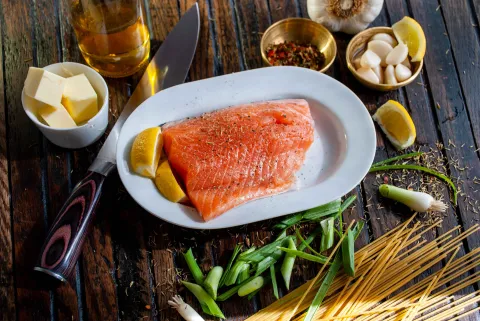
Salmon is a Pacific NW favorite and when cooked properly most would agree it’s one of the best eating fish to be found. Here is a classic recipe on salmon for your culinary chops.
Remember, the essentials to a good cooked fish begin with proper care of the fish out in the field. Catch it, bonk it, bleed it, and put it on ice. Cut it up and eat it ASAP. Or, vacuseal it if you can’t eat it fresh. Just don’t forget it’s in there! A freezer burned piece of fish does not a gourmet meal make. Not to mention a waste of a valuable resource.
Salmon lends itself to a myriad of ways to prepare it. As with any fish, the most important thing to do is – don’t over-cook it! So without further ado, here’s a simple yet delicious baked salmon recipe.
Ingredients:
Fresh salmon filet, one to two pounds, ¾-1” thick
1 ½ teaspoons lemon-pepper seasoning
1 teaspoon onion salt
4 lemon slices
1 tablespoon olive oil
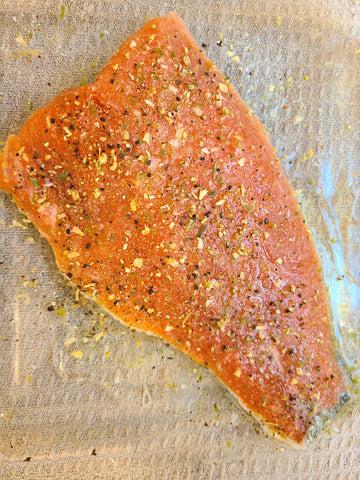
In a glass baking pan, take filet and coat with olive oil. Place salmon skin side down. Sprinkle onion salt and lemon pepper seasoning over the top. Squeeze juice out of lemon slices onto the filet (be sure to save a couple lemon slices to garnish the fish when it is served).
Preheat oven to 400 degrees and cook for ten minutes. For a crispy, sizzling finish, turn the oven up to hi broil and cook another two minutes. Remove from oven and serve immediately. If you leave the fish sitting in the pan it will continue to cook so get it out and serve it piping hot!
Add your favorite vegetables or pasta for a healthy and classic Pacific Northwest salmon meal. Enjoy!

/articles/lemon-peppered-baked-salmon
Trout Fishing Treasures
Eastern Washington State
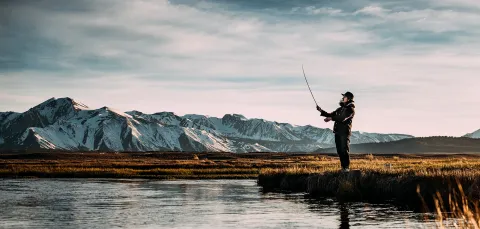
Eastern Washington State is a paradise for trout anglers during the Fall, with its picturesque lakes and rivers offering some of the finest trout fishing experiences in the Pacific Northwest. In this article, we invite you to embark on a journey through some of my favorite bountiful trout waters of Lake Roosevelt, Waitts Lake, Bonaparte Lake, Rock Lake, and that little urban oasis, Liberty Lake. These 5 distinct fishing destinations in Eastern Washington promise anglers of all skill levels unforgettable moments, breathtaking scenery, and a chance to reel in some of the most sought-after trout species. So, grab your fishing gear, pack your camping supplies, and let's explore these trout fishing wonders of Eastern Washington.
Our adventure begins at Lake Roosevelt, a sprawling reservoir created by the Grand Coulee Dam on the mighty Columbia River. Stretching over 130 miles, this massive body of water provides abundant opportunities for trout fishing. Lake Roosevelt is renowned for its healthy population of Rainbow trout, which can grow to impressive sizes. Anglers flock here in search of trophy Rainbows, and Kokanee.
Springtime and Fall are the golden seasons at Lake Roosevelt. During spring, as temperatures rise, trout move closer to the surface, making them more accessible to both trolling fly’s and even bait rigs. As fall brings in cooler temperatures, rejuvenating the bite and luring trout closer to the shallows, welcoming the excellent opportunities for bank fishing. Camping facilities, beach camping, and boat launches are readily available along the lake’s shores, ensuring a convenient and memorable fishing experience.
Moving over to the Northeast side of the state, we discover Waitts Lake. Just tucked into the hills of the small-town Valley, just off of HWY 395, this lake beckons trout fisherman from all over. This lake has been known for its healthy population of Brown Trout, where they are abundant and can be caught many ways. This pristine, spring-fed lake is also stocked with Rainbow trout, making it an ideal spot for anglers seeking a peaceful escape.
Spring and early summer
Spring and early summer are prime time to fish Waitts Lake as waters warm. But in the Fall, Rainbow and Brown Trout become increasingly active, providing ample opportunities for a successful day on the water. Drifting fly’s, such as a Wooly Bugger, on a casting bubble has always been lights out, as for trolling the familiar setups from spinners to dodgers can also fill the cooler. Don't be afraid to bang the bottom with a simple quarter ounce jig tipped with a worm, very effective for the Brown Trout cruising the bottom for food. Shore anglers have access to 3 different resorts, and docks available to fish from, and can be just as productive as fishing from a boat. Some productive spots to pay attention to are the Southern portion of the lake near the launch, and the Western shoreline.
Onward to almost central of the state, we take a ride to one of my favorite winter lakes to fish. Nestled high in the Okanogan Highlands, Bonaparte Lake offers an alpine fishing experience that's nothing short of magical. Surrounded by lush coniferous forests, this tranquil lake is a sanctuary for both trout and those anglers who seek them. This lake has a campground and a very nice resort that caters to anglers year-round. My favorite time to visit is the winter with the snow and ice, it's just a beautiful place to chase trout.
Bonaparte Lake really comes to life in late spring and late summer into Fall. As the snow recedes and temperatures rise, the lake's trout species become more active, creating a feeding frenzy. Rainbow cutthroat can be the target for many, but there's those who are in search of a big Tiger Trout, or the beautiful Brook Trout, prized for its vibrant colors and feisty nature. The Southern portion of the lake near the creek mouth has always been a go to spot, especially in the winter months. Targeting deep holes adjacent to shelves and breaks can produce large fish year-round. But targeting the southern end near the creek mouth, where submerged rocks and logs create perfect ambush points for trout. A must visit for any avid angler who's seeking an adventure.
Head South to the largest natural lake in Eastern Washington, with an open fishing season all year, we launch into Rock Lake in Whitman County. This lake has a reputation for providing an excellent fishery for Rainbows, and large Brown Trout. The boat ramp is a rough one, and takes some experience to navigate, as shore fishing is limited to the launch area. With the launch being unimproved, you may only see a handful of boats out there, but be aware of underwater hazards, as submerged rocks can sneak up on you quickly. Scenery is like a slice of the wild west, with basalt cliffs and sagebrush hills, offering a unique angling experience.
Brown Trout
Since Brown Trout are the primary target, fishing from a boat is the most popular choice. Trolling plugs and large spoons are effective, and Jointed Rapalas work amazingly trolled at slow speeds. Casting larger lures near the rock walls with slow retrieves can produce limits quickly if you're not a troller. I tend to notice from October, when the Browns spawn to spring, is the hottest bites from shore or boat. Enjoy this lake with caution, as the wind can play a big part in how you fish at this lake.
Now time to head back to town, where our trout journey concludes at Liberty Lake. An urban oasis located just minutes from the city of Spokane Valley, this lake offers convenience and a diverse range of angling experiences. Liberty is home to Rainbow, and Brown Trout, making it accessible for a variety of fishing methods. From trolling dodgers and spinners, to drifting flies, and my personal favorite, casting large jerk baits in the early spring when ice is melting off. Jerk baits really get those large Browns fired up. With a dock for shore fishing and a boat launch, it makes fishing for all anglers accessible. With the amenities of Spokane Valley within reach, anglers can combine their fishing adventures with a bit of urban exploration.
Eastern Washington State is a haven for trout fishing enthusiasts, and the lakes of Lake Roosevelt, Waitts Lake, Bonaparte Lake, Rock Lake, and Liberty Lake offer a diverse range of experiences. Whether you're seeking trophy trout, serene solitude, a hidden fishing haven, a journey back in time, or an urban oasis, Eastern Washington's trout-filled waters have something for everyone. So, grab your gear, explore these scenic destinations, and immerse yourself in the natural beauty and bountiful trout fisheries of this remarkable region.
/articles/trout-fishing-treasures
Pink Salmon Everywhere!
Introducing the unique Pink salmon: distinguished by their distinct life cycle, these fish follow a two-year journey, returning to their spawning rivers as two-year-olds. Adding to their allure is the intriguing fact that they exclusively run during odd years within Washington State. This year, an estimated 4 million Pink salmon are projected to traverse the Sound. Despite their classification as the smallest Pacific salmon, their tenacity in battle and delightful flavor remain unyielding. Their culinary versatility shines as they excel on the grill, particularly atop a cedar plank, and find their way into many anglers' smokers. For numerous enthusiasts, Pink salmon mark their initiation into the world of Washington State salmon fishing, thanks to their abundant presence and approachable nature compared to their larger counterparts.
Around this time of year, pinks flood the Sound and begin to stage near their home rivers. One of the best things about pink salmon is that you don’t need a boat to catch them from the shore or pier. They tend to swim within casting distance most of the time, and at this point in their life cycle they are still actively feeding, so they aggressively attack most offerings they see. With millions of pink salmon cruising by the shoreline looking for a meal, this is the perfect time to head to your local saltwater pier or beach and bring home some pinks for the grill.
Presenting A Jig
By and large, most shore anglers fish for pink salmon with jigs. There’s no need to use bait because pink salmon will aggressively bite a well-presented jig. Buzz Bombs and Rotators are the most commonly used jigs. They are easy to use and thousands of pink salmon readily gobble them up every year. They are designed to resemble a wounded baitfish, and they flutter erratically as they fall. Rigging them up is pretty simple: put on your buzz bomb, then thread on a bead and a bumper. Then tie directly to your hook (don’t forget to pinch the barb if it’s required). I usually use a 1/0 or 2/0 hook for pinks. To use jigs, cast out to where you think the fish are at, let your jig sink for a few seconds, then reel in and lift your rod tip up. Next, quickly lower your rod tip and let the jig fall. Repeat this until you reach the shore or catch a fish. Make sure to jig all the way until shore- sometimes the fish will follow your lure and strike at the last second.
Most of your strikes will be as the jig is falling. If you get a bite, quickly set the hook and keep up the pressure, especially if you’re using barbless hooks. As their name suggests, pink salmon love the color pink! It’s a good idea to start with that color, then switch it up if you aren’t getting fish. Buzz Bombs come in a variety of different weights. For pinks, I’d suggest using the lightest weight that you can cast well. If the bite is slow, try rubbing on some shrimp, anise, or herring scent. Gel based scent will cling to the jig longer. You can also thread on a small pink hoochie for extra action. If switching lures doesn’t work, you can switch locations as well. Sometimes just walking down for a few minutes on the beach can make all the difference.
Spinners
Another viable option if fish don’t seem to be hitting your jig is to use spinners. Vibrax spinners tend to be light, so it’s a good idea to thread on some bullet weights above a swivel to help get them down to where the fish are at. Several other brands such as Mepps make heavier spinners that will get to the proper depth without additional weight. Bring several options, and don’t be afraid to add scent or thread a hoochie on.
For your rod and reel, I’d recommend using a rod that can handle ½ to 1 ½ oz. weights, probably around 8 to 10 feet in length. I highly recommend using braided line because you can feel those sensitive bites easier, but mono will definitely do the job. A size 3000 to 4000 reel will have plenty of backbone to handle the fish. Remember to rinse your reel after fishing, saltwater is very corrosive and can cause damage if not washed off.
Where To Start?
Wondering where to start? Les Davis Pier, Edmonds Pier, Des Moines Pier, Browns Point, and Point No Point are all popular locations that reliably produce pinks every year. Any beach with a point and a good drop-off will most likely hold fish. Expect to have some company, though. Just be patient and try to avoid tangling your line with other anglers, especially if the current is strong. If you go to a pier, have a plan for netting your catch. Most piers are too far from the water to be able to use traditional nets. Pier anglers have taken to using crab rings. Just lower them down to the water and scoop up your fish. It takes some practice though! Beach anglers need not use a net, simply back up and swing your fish onto the beach.
As always, be sure to check the rules and regulations before going fishing. Don’t forget to swap those treble hooks for barbless single-point hooks, if required. You can buy barbless hooks or simply pinch the barb yourself with pliers. If you’re new to salmon fishing, WDFW offers salmon identification guides. It’s important to be able to tell the difference between salmon species, because they are regulated differently. You may be able to keep pinks but not chinook, for example.
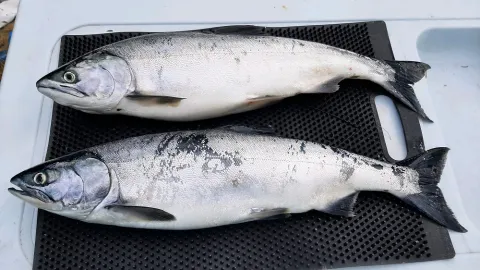
In general, hatcheries do not clip pink salmon fins, so don’t worry about checking if they’re hatchery or wild. The way to identify pink salmon is by checking the gums and the spots on the tail. Pink salmon have large spots on the tail and a white mouth with black gum line and tongue. For optimum meat quality, don’t forget to bleed and gut your catch before going home. Despite what some anglers say, pink salmon tastes great on the smoker or grill. Since they don’t have as much fat as their cousins, they have a milder taste than other salmon, which some people actually enjoy more. My favorite way to eat them is to season them with some of my favorite rub and then grill them on cedar or alder planks. They’re a great summertime treat that the entire family will love!
/articles/pink-salmon-everywhere
Summertime Bass Fishing
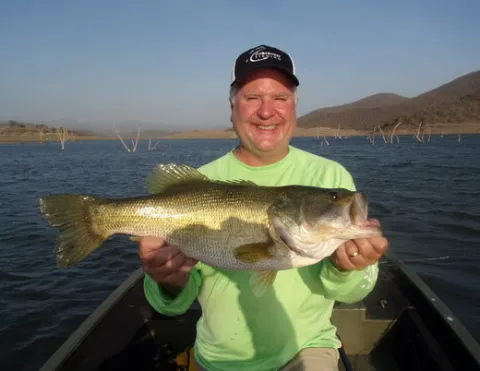
Catching bass in the shallows during the spawn is a fun thing to do in the spring, but when it comes to summertime fishing, few things are more enjoyable than catching aggressive largemouth and smallmouth bass. Here are a few of my favorite ways to hook them:
Topwater Fun
There are a lot of ways to skin a cat, as they say, and there are also a lot of ways to catch a bass during the summer months. However, nothing is more enjoyable than watching a bass erupt out of the water to smash a topwater lure. The best time to fish topwater lures is early in the morning or in the evening (even after dark on a moonlit night). However, if the waters are calm, you can also have success with topwater lures anytime, especially in shaded areas or on cloudy days.
What kind of topwater lures should you use? If you are fishing an area full of hydrilla, milfoil, or lily pads, it’s hard to beat a weedless frog. Tournament angler Jeremy LeCaire favors frog lures with a white belly since that mimics an actual frog belly. Others swear by frogs that are black in color, while others believe in using a frog with, well, a frog pattern! No matter what color you use, twitching it over pads into small open areas of water can trigger many strikes.
If you are not fishing in cover, you have lots of other options. The biggest bass I ever caught (8+ pounds) was caught on a Berkley Bullet Pop popper in a frog pattern, fishing the lure near wood stick ups. Similar poppers or lures like a Zara Spook can be fished at a slow pace or a faster pace in a “walk the dog” fashion, popping left, then right, while you retrieve the lure. As an old friend once told me when it comes to speed, “Let the fish tell you what they want”.
Are there other topwater lures that work? You bet! A fairly new offering is the Whopper Plopper, which is can be cast and reeled in with a slow, steady retrieve as it gurgles along the surface. Buzzbaits retrieved at a fast pace can trigger violent strikes, and don’t forget classic lures like the Arbogast Hula Popper or Jitterbug. They have both been around for over 80 years but they both still work.
Spinnerbaits
Spinnerbaits are always a good summertime bet for bass. I personally favor a white spinnerbait for most conditions but will go with a chartreuse color if there is low visibility in the water. A ¼ or 3/8-ounce spinnerbait can be retrieved rapidly, just under the surface of the water, creating a wake. Heavier spinnerbaits between ½ to one ounce in weight can be slowly retrieved near the bottom. Both methods can be effective. Again, let the fish tell you what they want.
Crankbaits
Crankbaits are a big favorite of mine for both summer and fall bass. Many anglers mistakenly believe these lures should be fished without hitting any structure. That is a mistake. Shallow water crankbaits should bang off of wood and deeper diving crankbaits should be ticking the bottom because that contact is what triggers reaction strikes from bass. One of my favorite lures is the Berkley Digger which runs at a depth of 8 to 11 feet. If I need to go deeper, the Berkley Dredger will get down to a depth of 20 feet. As for colors, try to match the forage base. For example, a perch or bluegill pattern if that’s what the bass are eating, a reddish color if crawfish are in the lake, or blue and chrome if the bass are feeding on trout.

Lipless Crankbaits
Another confidence bait for me is the lipless crankbait. The original Bill Lewis Rat-L-Trap has caught countless bass since it was introduced in 1971. Rattle trap style lures have no bill (hence the word, lipless). They create a sharp vibration when retrieved and thanks to BB sized shot inside the lure, they create a rattling noise as well. The combination of the vibration and sound triggers bass hanging out in ambush points along weed lines or other structure such as log lay downs, beaver huts, boulders, or rocky riprap.
The lure excels in depths of two to eight feet. You can rapidly retrieve the lure and draw strikes but I prefer to pause several times when I retrieve a rattle trap, just for a quick second. I do this because following fish will often strike it when it stops in their face or as the lure begins to fall like a wounded fish. Another method is to use a Yo-Yo retrieve, fishing the lure off the bottom. This technique works best when the fish are deep.
As for what lure to use? There are a lot of lipless crankbaits out there in various sizes but my hands down favorite is the ½ ounce Berkley Warpig, which I’ve used to catch not only bass, but also walleye and other species since it was introduced a few years ago.
There’s so much more to talk about when it comes to catching summer time bass (soft plastic baits for example) but we’ll have to leave that for another time. Until then, use crankbaits, spinnerbaits and topwater lures to reel in some hard-hitting bass during these hot weather months!
John Kruse – www.northwesternoutdoors.com and www.americaoutdoorsradio.com
/articles/summertime-bass-fishing
The Voles of Summer
As fly anglers, we are all cultured to believe that trout eat insects and nothing more. Trout gently sipping bugs from the surface of a calmly flowing stream paints the image of fly fishing narrative. It’s what we all learn in the beginning. Anything else would be culturally unacceptable in the fly fishing world. For years, I believed that no self-respecting trout would ever eat anything other than some form of aquatic insect or terrestrial bug. Fly fishing in Appalachia ingrained that into my head. That was right up until I read an article in Fish Alaska magazine about rainbow trout eating mice.
The level of disbelief wielding in my brain about what I was akin to what my grandfather thought about space travel. It wasn't happening. It didn’t happen and it wasn’t ever going to happen. Sure, I had seen a brown trout slashing at other fish and had buddies in the upper midwest that talked about mouse fishing for brown trout at night. But never, ever would a rainbow trout chase down and annihilate a mouse. Rainbows weren't that type of aggressor and besides, they didn’t get big enough to eat a mouse. Right? That’s what I, the 25 year old knower of all things trout, thought. No way.

I must have read that story 10 times before I finally accepted that the writer must have had a very minute amount of success using this “mousing” method for Alaskan Rainbow Trout. Back in those pre-internet days all we had to rely on was a trusted publication with mass circulation and a photo album. Yes kids, before internet and social media we all carried photo albums with us to trade shows, speaking engagements, etc. A three ring binder notebook full of print photographs. Sometimes carrying just one album was not enough; depending on the situation and competition. It was the only way to advertise your trade of skills and to prove that you weren't just a liar. In fact, the next trade show I worked at was where I found living proof that the “mousing” I had read about was in fact real. Not only real but a viable method for targeting the largest of the species. I was befuddled.
At that show, I met a lodge owner that hosted the writer for the story I had read in Fish Alaska. He explained to me how the whole Alaska trout universe operated. Upon understanding, the program made sense. It was no great consequence that this guy gave me my first job in Bristol Bay some years later. I adapted his explanation into my own version. If you have fished with me as a lodge guest, client or friend new to the Alaska trout universe, you have heard me deliver this lecture. Some of you may have heard it more than once. Its as follows - Alaska rainbow trout live a different life and lifestyle than lower 48 rainbow trout. They only have a three, maybe four, month window of time to get in a full twelve month life cycle, as compared to a regular lower 48 rainbow that might have nine or ten months to get everything in before the water cools to a point that their metabolism slows to a crawl.
So, in three months, an Alaska rainbow trout has to find a girlfriend, find a house or two and, it has to eat everything it can. And by eating everything it can, I mean everything starting with the highest forms of protein first. In spring, voles (mice) and leeches are the prominent source. As summer comes so do the salmon producing first eggs, then flesh after the spawn is over. Fall brings on the sculpin, more leeches and whatever else they can find. All that along with finding a girlfriend and a couple houses in three months. Its a lot of living.
But more importantly, the “mousing.” While in spring and summer hordes of mice or voles, red back voles to be specific, make their seemingly ridiculous trek transitioning from tundra animal to aspiring olympic swimmer. Why? I don’t know. Some say its because of some migration pattern. Maybe. Others say its because they are seeking the same things all mammals seek. Could be. Why a tiny little vole would jump into a raging river flowing at upwards of ten knots is beyond my level of good reasoning and understanding. Why do voles jump in the river? My opinion is because they just do and I don’t care why as long as trout continue to eat them. If you are more worried about why they do as opposed to the consequences of it, you should probably change the channel. I heard re-runs of the greatest Bob Hope Christmas specials were going to air in July. You might check that out.

The first time I watched a rainbow “mousing” left a scorching imprint of what really happens in the bush. Eat or get eaten. Brutality in its purest form. This poor little red back vole was just swimming across the river in a narrow channel that didn’t seem deep enough to hold a rainbow. Its swimming along just trying to get to the other side for who knows why and this two foot rainbow manifests, chases the vole, swirls and smashes on it but misses. Then it swirls and smashes again only to miss the vole again. Just when we all thought the show was over the trout comes back for one last grab. Third times a charm right. Nope. Another swing and miss precluded with a full body leap out of the water to come crashing down on top of the vole, missing completely.
All the while this vole is still just swimming. Doing its thing. While I am sure the thing was horrified beyond belief, it didn’t change its pace or course. Probably because it wasn't capable of physically fighting the river current. The fourth and final attempt from the rainbow proved worthy but not without show. The fish came back waking the even more shallow water like a great white shark chasing a seal. It literally powered its way through six inches of water to annihilate the vole just before it reached the other side of the narrow river channel. Pure unforgiving brutality. I and my Swiss clients stood there looking at each other. Until that moment, we had all struggled with a language barrier. they didn't speak much English and I didn’t speak Romansch. Once that rainbow crushed the vole, we all understood what needed to happen and it did.
The first pass with a “mouse” pattern fly was nothing less than epic. Three chases and then a hook up. Next guy cast and had four chases and then hooked up. This went on all day and the rest of the week. At one point, I even took all the flies out of my pack except mice. The fact that they witnessed the initial sacrificial lamb significantly flattened the curve. They knew not to set the hook until they felt weight on the hook. Like the precision watches the guys built, with systematical precision they took apart the entire river and covered every bit of water with mouse patterns. All week.
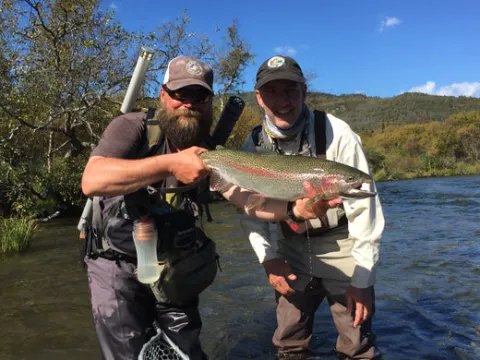
Now I have clients that book for Alaska specifically when “mousing” is peak. Usually, June and July. They bring only mouse pattern flies, and floating seven weight lines on 9’ rods. Most folks bring two rods, just in case the unspeakable happens. The bush isn’t a place to not be prepared but, that’s another story.......
/articles/voles-summer
Too Many Kokanee? Here's the Cure
Too many kokanee. That was the problem. We had the cure.
As we idled away from the dock in the Nomad's Fishing Adventures 24-foot Koffler sled, Bill Kremers and Josh Hopkins tied up rigs. Our guide, Damon Struble, passed out cups of cured corn. Garlic on the starboard side and krill-marinated kernels on the other. Then Struble pointed the bow up into the narrows.
A few minutes later, when Struble shut off the Mercury, he looked each of us in the eye - Tim Wehde, Kremers, Hopkins, and me. "We're going to set the back rods at 60 feet out and the front rods at 70 feet. Put one to two kernels of corn on each hook. Things are going to be chaotic. If a rod starts bouncing, don't worry about whose rod it is. Pick it up. If you are tying up a new bait and see a rod with a fish, set the first rod down and get the fish in the boat."
Each rod was loaded with a 3-ounce weight to run the baits 30 to 40 feet down where thousands of kokanee schooled below us.
At full pool, Green Peter covers 3,700 acres and is ten miles long, with 38 miles of shoreline.
The water level fluctuates and the fish move around, but some of the best kokanee spots are by the dam, in the Quartzville arm (where we fished), and around the peninsula in the main channel. Jigging is a favorite technique early in the year, but trollers seem to do better in the summer.

Damon uses a Simon 4.0 kokanee dodger on the main line with a Gold Star micro hoochie. Another good bet is a Kokanee Kid Super Mysis Bug or a Mack's Lure Double Whammy with a 10-inch leader. Most anglers add white corn. Damon likes to marinate the corn overnight in Pro-Cure krill powder and Garlic Plus. Hopkins had brought two prototype Lamiglas kokanee rods, graphite/fiberglass hybrids with slow actions. We would put them to the test with these heavy 3-ounce weights.
For several years, ODFW found themselves with a surplus of sockeye smolts, Struble explained. Those fish ended up in Green Peter Reservoir.
"The result is such an overabundance there isn't enough food for all the fish. So they are stunted," Struble said.
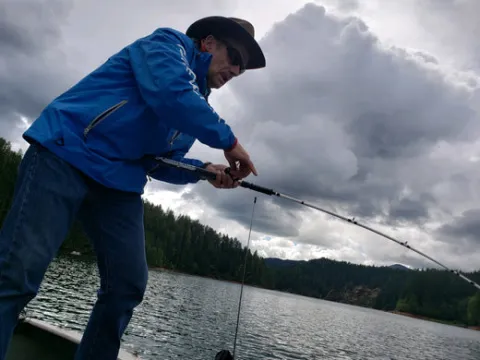
In less than two minutes, we had the first bite. The fish came fast, sometimes with two or three rods bouncing at once. As quick as we could put fish in the box and put fresh bait on hooks, there would be another bite. Our kokanee averaged eight to nine inches each. The direct beneficiary of the kokanee experiment is a little known landlocked chinook salmon fishery created by ODFW almost 20 years ago.
"They wanted to see if the chinook salmon would migrate through the dam and return. For seven or eight years, ODFW put 20,000 chinook smolts in the reservoir," Struble said. "After some high water flood years that blew out the catch nets, the project was abandoned." Technically, the experiment didn't prove successful, but the chinook are still there. "They turned Green Peter into their ocean and spawn up in the creeks," Struble said.
How big do they get?
"The biggest one I have caught was 16-1/2 pounds, while trolling for kokanee with a dodger and a little hoochie," Struble said. Those landlocked chinook are growing big on the kokanee. Struble estimates he has caught 25 or 30 chinook between two and ten pounds while fishing for kokanee.
"When they are small, I'm not sure what they feed on, but inside that 16-1/2 pounder was a mostly digested kokanee about eight inches long."We didn't have time to target Green Peter rainbows, but that is another facet of this interesting fishery. Ahead of every Memorial Day weekend, the state plants 10,000 rainbows. Anglers don't get them all.
"Come springtime there is a really good population of hungry holdovers that range from 12 to 18 inches," Struble said. While we worked back and forth above a biomass of kokanee, the eagles and ospreys watched. When we lost a fish at the surface, a raptor would swoop down to pluck it out of the wind-riffled water.

At Green Peter, the kokanee limit is 25 per day in addition to the daily five-trout limit. There is no size restriction for kokanee. Landlocked chinook salmon may be retained as part of the kokanee limit.
Damon glanced at the western sky, which had suddenly filled with clouds and said, "Unless you guys want part of that, we should run for the dock!" And run we did. By the time the Ford was pointed back toward Central Oregon, the windshield wipers were working overtime. We had boated 45 kokanee in two hours. We hardly put a dent in them.
/articles/too-many-kokanee-heres-cure