Springtime means Big Natives
Steelhead (Oncorhynchus mykiss), Washington’s iconic anadromous rainbow trout, return from the ocean to freshwater rivers to spawn. Across the state, they exhibit two general seasonal runs, winter and summer, though exact timing varies by river and region.
Run timing is critical when pursuing these coveted fish, so it is important to understand when the fish will begin to return, and for those of us looking for the largest, natives, it means timing it perfectly.
In general, winter steelhead runs tend to follow the following schedule.
- Begin: Typically, in late fall (around November), as ocean-migrating fish start moving upstream.
- Peak: Most winter steelhead arrive in December through February, with some systems seeing strong numbers returning into March and April.
- Best for big wild fish: Many of Washington’s large native (wild) steelhead, especially in coastal rivers of the Olympic Peninsula, are most abundant mid-winter through early spring. Local guides note that hatchery fish often peak earlier (e.g., December), with wild steelhead showing up in good numbers soon after and extending into early spring.
While both hatchery and wild steelhead can contribute to runs, depending, of course, on the river system, native (wild) fish, which are often bigger and more prized, tend to peak slightly later than hatchery fish in most systems. For example:
- On the Olympic Peninsula and coastal rivers: Hatchery fish are known to start trailing in around Thanksgiving and trail off in January, whereas large wild steelhead often show up in their prime numbers from late December through February, into March, and even April.
- In Puget Sound watersheds, winter runs that include wild fish also peak in December–January, but local timing can vary by watershed, and even by year, depending on weather, ocean, and river conditions.
Note that after entering their natal waters, steelhead often remain in the river for many months prior to spawning and returning to the salt. The length of time that they stay in the river really depends on the river system, the run timing, and their genetics and instincts.
Unlike salmon, steelhead can return to the salt water for another cycle, and some steelhead have been recorded returning to spawn for 3 or 4 spawning cycles. Of course, a 3 or 4-salt fish will often tend to be larger than a 1 or 2-salt fish; thus, these fish are highly sought after and chased by serious anglers.
When reviewing the WDFW or ODFW regulations, you will often see rivers closing at the end of January, mid-February, or in March. There is a reason for this. The recreational seasons are generally set to provide anglers with opportunities to fish for steelhead, whether that be for catch and release of native fish or a retention fishery for hatchery fish. The seasons are timed to close about the time that the main runs of native fish are expected to return based on historical run timing. For this reason, the fisheries are closed to protect the native fish in an attempt to restore runs back to acceptable numbers.
A great example of this is the Sauk River. The Sauk has long been a coveted fishery since it is an all-native river, and the fish tend to be large, genetically mean, and extremely aggressive. These fish are wired differently, and catching one is unlike any other fishery that I have experienced. The Sauk River winter/spring wild steelhead fishery has experienced multiple closures due to low wild returns, with significant closures occurring around
2008, 2010–2017, and 2020–2022. The fishery often closes or faces restrictions when wild steelhead forecasts fall below the 6,000-fish escapement threshold, as noted by the Washington Department of Fish and Wildlife. A few years ago, WDFW and NOAA agreed to a ten-year plan based on return data, in an effort to offer a recreational catch-and-release fishery on the Sauk. We finally received some long-awaited good news. Unfortunately, our current governor and his cabinet slashed budgets for 2026, and this fishery was taken from us, as there was not enough budget to staff and monitor the fishery. This is devastating for the local communities and the anglers who enjoyed spending time on this epic river system. The Sauk is not the only system experiencing this fate. Good for the fish, bad for us anglers!
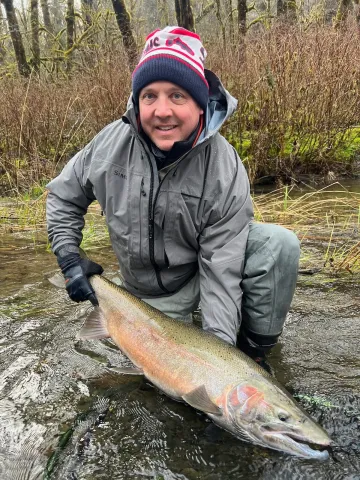
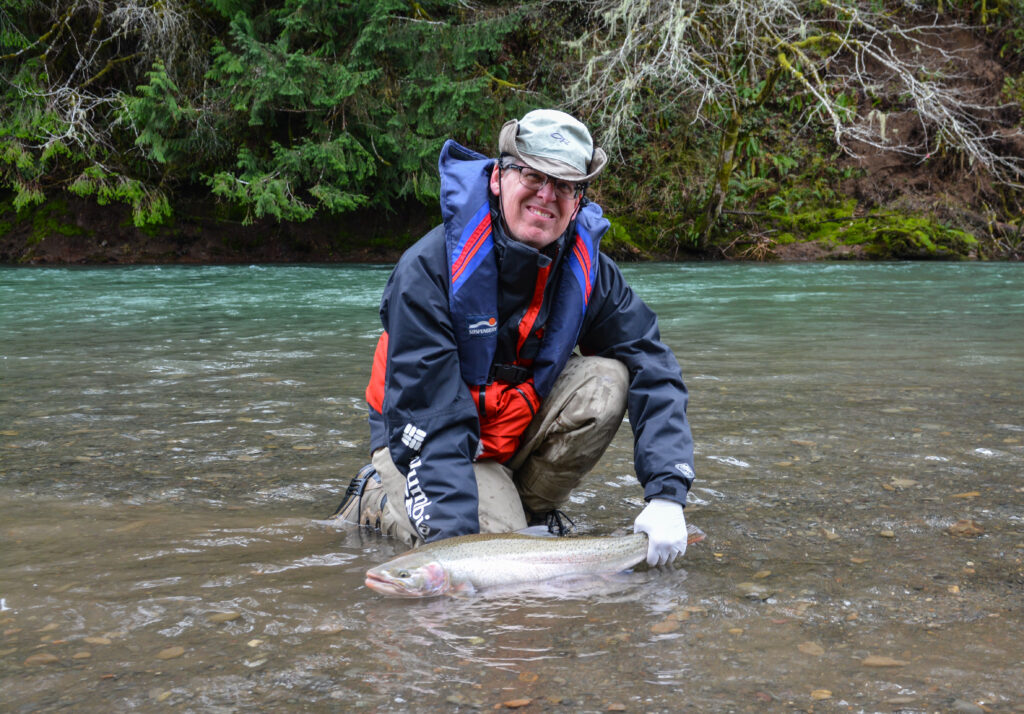
Speaking of big, mean, native winter steelhead, in early April 2025, I fished with guide Cary Hofmann on the Sauk. We were bobber dogging 20mm beads that day, and I hooked the largest steelhead of my life. My float was just above the drift boat as we entered the bottom of a run, and my float disappeared. I jumped on my reel, and as I did, my float popped back to the surface. I opened my bail to let out some line, and after a moment, my float dropped again and started racing upstream through fast water. My bail was open, and as I tried to close the bail and slow the fish, my hand got hung up for a moment, and the fish broke a 15lb fluorocarbon leader like it was nothing. I have hooked into some 20lb class steelhead and landed a few, but this was another level of mean and powerful. Even though I did not see this fish, just the experience of feeling it on the end of my line was a moment that I will never forget. For die-hard steelheaders chasing big, native fish, this is what we live for.
Some of the best opportunities in Washington to encounter large native steelhead (especially in late winter through spring), focusing on places known for quality wild fish rather than solely hatchery-enhanced fisheries include:
Olympic Peninsula Rivers
These are widely regarded as some of the best wild steelhead runs in Washington, often producing larger native fish and extended late-season opportunity.
- Hoh River – Classic wild steelhead water with deep pools and strong late winter/early spring runs.
- Bogachiel River – Known for productive winter steelhead fishing and scenic access.
- Sol Duc River – Holds big wild fish; excellent spring timing as flows moderate.
- Quillayute / Calawah / Clearwater tributaries – Smaller but good opportunities for spring natives.
Run Timing: On the Peninsula, steelhead enter these rivers from late fall through spring, with some of the largest natives arriving in January through April. I have found that Mid-March through early April can be prime for large wild fish entering holding water behind hatchery runs. I try to time my trip for mid to late March, and I am never disappointed unless we get rained out. This is not uncommon due to the immense rainfall that hits the coast, as much as 16 feet per year in places.
Coastal & Southwest Washington Rivers
Smaller coastal systems (outside the Peninsula proper) can also be excellent in late winter when conditions calm after storms.
- North River, Naselle River, Willapa River system – Offers wild runs with spring opportunity.
- Grays Harbor rivers (e.g., Satsop, Wynoochie, and Humptulips) — though smaller, they can produce quality fish from late fall into the spring.
These fisheries are more dependent on rain and water clarity, but when conditions stabilize in late winter/early spring, fish concentrate in holding water.
Puget Sound Area – Wild Runs
Puget Sound tributaries see winter and early spring returns of wild steelhead, though overall numbers are lower than on the coast. It is also important to note that most North Puget Sound rivers are closed for 2026 by January 31st, so no recreational fisheries to enjoy this year. As mentioned, this is primarily due to budget cuts, so please remember this the next time that you vote.
- Skykomish River – Historically decent winter/wild runs; larger fish possible early season. Small, hatchery broodstock program still in effect from the Reiter hatchery near Goldbar. Like the Cowlitz, this is not a secret spot, but if you have not fished it, it is epically beautiful and a fun bank fishery.
- Stillaguamish & Snoqualmie Rivers – Smaller, technical fisheries that can hold native winter steelhead. Tokul Creek also has a hatchery program that is winding down, but returns that continue to produce.
It is important to mention that many Puget Sound wild runs are sensitive and subject to stricter release regulations, so as always, check WDFW's current rules before going.
Lower Columbia Tributaries (Late Winter–Early Spring)
While many lower Columbia systems are enhanced by hatchery programs, wild components, especially winter runs, still migrate in:
- Cowlitz River – Huge late winter steelhead opportunity; big fish show up in February–March. The Cowlitz is renowned for its hatchery program and generally strong A and B run returns. Note that this is not a secret spot, so when the steelhead arrive, it is very congested.
- Kalama & Lewis Rivers – Good late winter spring runs; mixed hatchery/wild.
- Washougal & Elochoman – Smaller systems with winter fish in March–April.
Note: While these fisheries include hatchery fish, big overwintering wild fish also pass through in late winter/early spring, especially on bigger tributaries like the Cowlitz.
When targeting large native fish, we are generally seeking quality, not quantity. For this reason, our approach tends to change a bit. Upsizing gear and presentations are common. Sure, you can catch a 20lb native steelhead on light tackle, but we try to match the gear to the fish. Keep in mind that big fish are big for a reason; they are not stupid. Their instinct is strong, and they don’t bite at everything that passes by them. I cannot think of a bigger example of survival of the fittest. My mantra is that big fish are not stupid, so I do my best to fool them, or more likely, piss them off. An aggressive fish will protect its territory and extinguish any threat that appears, so I try my best to threaten them with bold presentations that best match the water conditions.
Some tips for targeting the big fish:
- Focus on deep holding water — tails of runs, deep holes, and structure.
- Watch river conditions — post-storm clarity often improves by late winter, improving bite windows.
- Check seasonal regulations — wild steelhead protection varies by river and year; WDFW updates are important.
- Upsize your gear – Examples include swung spoons, large beads, worms of different colors to match the water clarity, plugs and spinners. Don’t be afraid to go old school either. Throw your Oki drifters, spin n glo’s and tackle of yesteryear. Yes, Herzog is correct, it all still works.
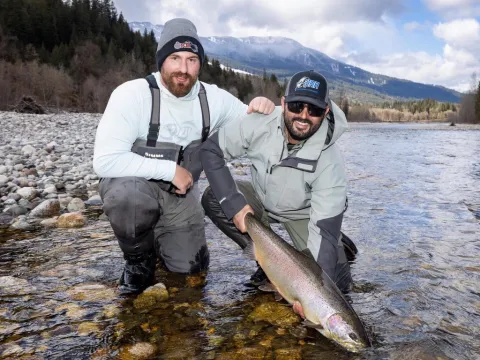
Many wild steelhead populations in Washington, especially coastal and Puget Sound runs, are protected and often catch-and-release only with seasonal closures. Always consult current WDFW regs for the specific river you plan to fish. In addition, we are not allowed to remove wild fish from the water in Washington, even for a picture, so please practice safe handling and return the fish as quickly as you can. Think head in the water for that quick picture to commemorate your catch.
Good luck and happy fishing to you all.
/articles/springtime-means-big-natives
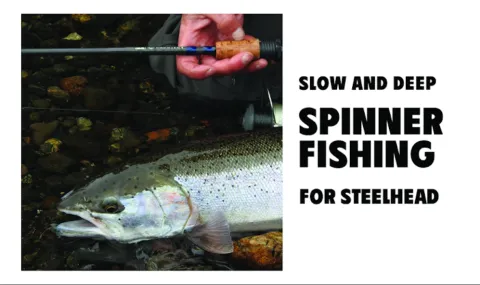
Slow and Deep - Spinner Fishing for Steelhead
Not every fish in a pod of steelhead will bite. What we count on is that one or more in any school is the aggressive one. The spinner, like the swung fly, targets the aggressive fish, the biter, and the chaser.
Spinner water in the winter is different than what we look for in the summer. Classic steelhead water that moves at the speed of a fast walk is still a good bet, but I like to target deeper holes and slower-moving current.
In the colder flows of winter, when the metabolism slows down, steelhead are not as likely to chase a lure as far. For this reason, we want to put the lure at the level of the fish and keep it there longer. Casting and retrieving might work, but a swinging presentation is preferred, where the inline weight or the weight of the lure takes it to the bottom.
What contributes to a fast sink rate? The weight of the lure and its mass (or lack of mass) are factors. Also, a braided line with less resistance will sink faster than mono.
If the fish are six to 18 inches off the bottom, the spinner should run in the same place in the water column.
And the lure should thump.
Test drive the spinner before the first cast. Get a feel for the thump of the blade as it rotates.
On the cast, let the lure hit the water, then keep the bail open long enough for more line to peel off the spool as the lure sinks. Now close the bail and let the current grab the blade. Hold the rod tip low.
THE PRESENTATION
Use a retrieve that makes the blade flash like a strobe; if the blade blurs around the shaft, it is going too fast. Steelhead strike out of aggression, curiosity, defense, and feeding impulses, and flash moves the fish longer distances to the lure. Carry spinners in the whole range of blade finishes, with most emphasis on the flashier finishes: silver and brass.
There was a time when I made my own spinners, both to save a little money and to make the lures I needed for each situation. These days, there are more choices available in good fishing departments and on the internet.
For the waters I fish, I start with Wicked Lures with a 30-inch-plus leader and an inline weight, and Blue Fox (Nos. 3, 4, and 5) and heavy-bladed No. 4 custom-tied spinners.
The most common finishes on spinner blades are, in order of most flash to least flash: Silver-plate, brass, tarnished brass, nickel (mirror-finish), and black.
On medium-sized western rivers, use medium-sized spinners like Nos. 3-4 with brass, nickel, and black finish. Smaller rivers call for smaller lures. Black, nickel, and tarnished brass are good producers in these rivers. Use larger spinners in bigger pools and size down in lower, clearer water.
Almost as important as the proper size and flash is using the right color. An angler can add color with prismatic tape. In the cold months of winter, I like to use pinks, oranges, and reds to dress up my spinners.
The decorative tape goes on the inside of the blade. Think about the spinner moving through the water. The fish sees a shiny, flashing thing approaching. As it swings in front of the fish and moves on by, suddenly, there is a bit of color showing. That element of surprise might incite a follow-up and a strike.
More important than flash or color is the presentation, and the confidence it will catch fish. Fish it slowly so that the lure is presented in the same plane as the fish. Let it tumble, but keep the blade turning, tantalizingly slow. A fast-moving spinner is more apt to spook fish. Slow it down, almost to the point where it stops spinning.
Because fish are apt to be slower to move in cold water, and because the lure is presented at the same depth as holding fish, expect the strike to be softer than in the summer. The bite often just stops the lure. If the angler adds weight on the line, the shock-absorbing nature of the rig is accentuated, and the bite can feel like a wet sock. Set the hook and set it hard. A fish may also swim with the lure, snap its jaws around it, and swim with it. Set the hook hard!
# # #
For a copy of the Fishing Central Oregon book, send $29.99 to Gary Lewis Outdoors, PO Box 1364, Bend, OR 97709 To contact Gary Lewis, visit www.GaryLewisOutdoors.com
/articles/slow-and-deep-spinner-fishing-steelhead
Steelhead are biters, dude!
The solunar tables said the first day of spring would be poor for fishing, but there was a window in the morning when fish would bite best. The forecast called for one low-pressure cell after another, but between storms, there would be a bump in the pressure. I always think back to what a friend of mine told me on a day not unlike this one.
When the river is high, green and dropping, when the pressure rises, when the moon is waxing, when there are fish in the river. That's when I want to fish.
My grandpa used to point me to the barometer and tell me when the fishing was good and when it wasn't. It didn't make a lot of sense then, but I watch the barometer before every trip now. We picked the day months before, hoping to maximize our chances of tangling with big steelhead.
"Steelhead are biters, dude!" I remind myself when the rainwater is dripping around the brim of my hat.
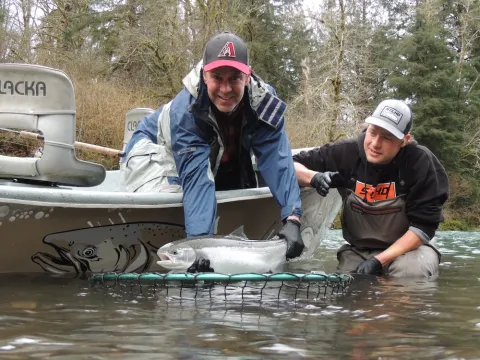
Dan Cardot and I made the drive the night before, ate too much fried food too late, and checked into one of those classic Highway 101 motel rooms with paper-thin walls, moldy carpets, and dirty blankets. We saved three bucks over the next more expensive motel. I would have paid $50 more to stay a mile away if I'd had any inkling of what an active pair our motel room neighbors were. That fresh ocean air can be invigorating.
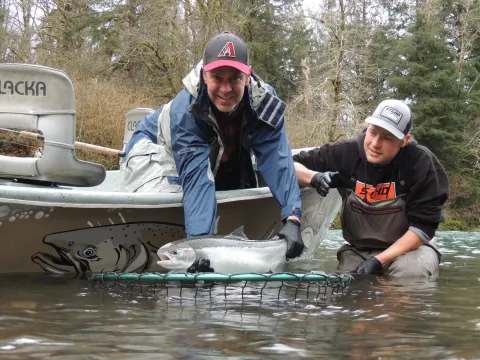
After an hour of sleep and a Denny's breakfast, Brad Hanson met us in a pool of metal halogen light in the parking lot at Tillamook Sporting Goods. Only one river was in decent condition. The night was still in full Stygian blackness as we drove up the narrow road. I parked the Ford at the lower end of the first float and we drove five miles upstream, sipping at our coffees. In the dark, we pushed Hanson's Clackacraft off the trailer, tugged on waders, and, as the first sliver of light broke over the tops of the cedars, Hanson sat down at the sticks. We floated into the current. With a couple of other drift boats in the river, we traded first water for a few runs, then turned a corner with one boat in front of us. They pulled anchor to stay ahead.
Here, the river made a right turn, broke across a gravel bar on river right, and frothed over a ledge with a pocket behind a moss-covered boulder. On the far side, the bank ran jagged into the current. A nice riffle of broken water tumbled through aquamarine, then the river browned out over a gravel tail.
At the business end, our baits were steelhead roe with a small yarnie, sweetened up with Pro-Cure Winter Chrome. Cardot pitched a cast upriver; his bait and float splashed down along the seam, and the float tipped up, caught in the current. Cardot's bobber zagged upstream, and he set the hook into a silver streak of fury. It cartwheeled and tailwalked from the top of the run all the way to the tailout and flashed in the sun. Bright as a new-minted nickel.
For a few tense minutes, we thought we'd have to follow it through the rapids. We didn't care about first water anymore. We wanted this water. When Cardot took the pressure off, the fish nosed back into the current and came back into the pool. Hanson dropped the anchor and jumped over the side to net the fish over the gravel bar. Cardot cradled it a moment and let it kick into the green water. Five casts later, my float plunged, and we were fast into another, this one seven pounds, a rainbow-colored male.
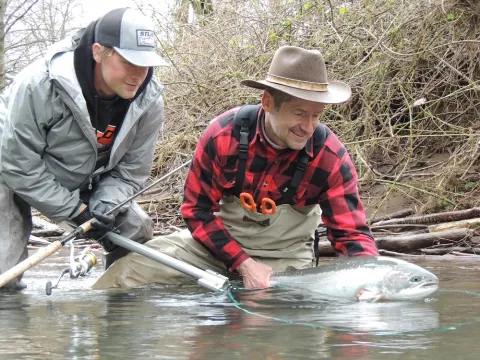
Beneath us, the river was clearing, and the fish, fresh from the salt, kept eating our baits. Cardot's third fish ran the last 400 yards of our float, and Hanson netted it at the takeout. We drove back upstream to get Hanson's rig and then parked it at the next takeout down, breathing deep of that Tillamook dairy air.
When the rain started, we picked up a 12-pound wild hen, just four miles up from the salt. As wild as the morning of creation, as bright and fueled with the ocean's bounty as any fish I've ever caught. This one I wanted to keep, but I couldn’t and turned it back to make more wild steelhead.
The rivers begin to swell with winter steelhead in late December, and each tide brings in new fish through January and February. Pick a day. Put it on the calendar. Tie leaders, sharpen hooks, and fill spools with fresh line. March is prime for winter runs, but there are still fresh fish on every tide well into April.
If there is rain in the forecast, if the water is high, if a low-pressure system is coming in over the beach, it doesn't matter much. Soak the baits. Thump the hardware. Swing those flies deep and slow. Steelhead are biters, dude.
/articles/steelhead-are-biters-dude
Swinging Blades for Summer Steelhead
Last year at around this time, we were talking about the best steelhead run in a decade. And what could be better than that? Try this. As we go to press on this issue, we are watching the fish come over Bonneville Dam right now in numbers we haven't seen for 15 years. We are talking summer steelhead that filter into the Deschutes or run up the John Day or go up to the Clearwater, the Snake River, the Salmon, and the Grande Ronde. If your old waders have holes in them or you need new boots, now is the time to take care of it. And look at the calendar. The Deschutes summer run peaks in September, while October is tops in the Snake River, the Salmon, and on the Grande Ronde.
There are nine main methods for catching steelhead, and some of them are pro-level difficult, while others are easy. Two of my favorite ways to catch steelhead are swinging big flies and casting spinners. While spinner fishing is not the easiest way to catch a steelhead, it is super effective. And it is like a jolt of lightning when a fish grabs.
SPINNER WATER
Steelhead may be found in deep pools and slow frog water, but the best water for fishing spinners tends to move at the speed of a fast walk over gravel bottoms and through boulder runs.
Steelhead tend to travel at night and when the sun is low. They hug the banks and stay tight to structure, finding the path of least resistance up through rapids. Up through the tailout, into the pool along a ledge, and often head-in to the bubbles beneath the foam lines to the head of the pool. When the sun comes up, steelhead can be very close to the bank.
Summer flows are low and clear with an occasional shower to bring the water up. And steelhead are highly aware and alert. That's why knowing anglers don't wear spikes on their boots. The sounds of scraping studs are like nails on a chalkboard to summer steelhead. And the first casts to any run should be short.
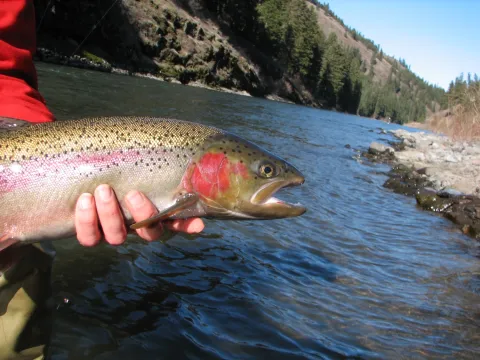
Summer steelhead are willing to chase and can move as much as 15 feet to engage a target and might follow a spinner or a fly from one bank to the other.
SPINNER SELECTION
The spinner itself? For the lower Deschutes, for the Snake River, the Salmon, and other similar-sized streams, a spinner with a heavy French blade is a great choice. We tend to talk about Blue Fox spinners when we discuss steelhead fishing, and while these are good spinners, they tend to be a compromise. Look at the options available. A purpose-built spinner for the Deschutes should sink fast (faster than a Blue Fox) and start spinning the instant it hits the water. I would opt for a short heavy body and a No. 3 or No. 4 blade. Body colors? For summer steelhead, top colors are blue, green, purple, and black. Best blade colors? They are all good: copper, silver, black, nickel, brass. Silver tends to move fish further but throws more flash and can spook fish in low, clear water. Black and tarnished brass are good bets. I like to add blood red tape on the inside of the blade. And I like blood red hooks too. And the hooks should be sharp, sharp, sharp.
SPINNER TECHNIQUE
Cast, and let the spinner sink, especially in the channeled lava runs like are found in the lower Deschutes. The turn of the blade should thump in the rod tip. Don't just cast and reel. Let the spinner tumble and flash through the boulder fields. The closer the spinner is to the bottom, the better. And if you are snagging spinners, congratulations! You're fishing right.
Make sure the drag is loose enough to allow the fish to pull out line fast.
It's going to happen. A steelhead is going to stop that spinner. Or crush it. And streak upstream or down. Let the fish run, then try to gain as much line as possible when it stops. Even if it means chasing it downriver. When the fish jumps, and it can jump up to a dozen times, let some tension off. When it comes time to slip a net under it, try to get the fish's head up. It's a rush.
It can happen a dozen times in a day. Or it can take a dozen trips to hook the first one. But when there are steelhead in the river in a good year, the odds go up. If this is your first year for steelhead, or the first season in a long time, give spinners a try.
/articles/swinging-blades-summer-steelhead
Cowlitz River Steelhead Stories
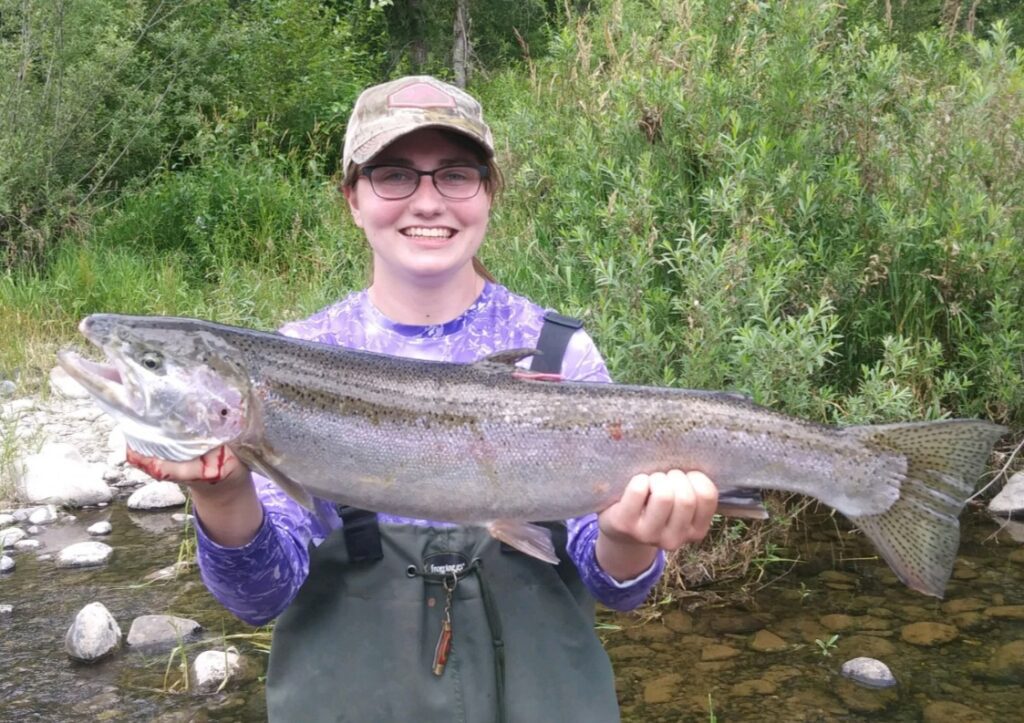
The Cowlitz River is truly legendary for its hatchery steelhead run. It is a reliable producer year after year. Many of us here in the Northwest, myself included, caught our first steelhead out of this river. I'll never forget seeing my bobber go down and watching in awe as a 17-pound steelhead exploded out of the water.
My heart was pounding as I fought to hold on while it furiously tried to shake my lure. It was an unforgettable experience that motivated me to return each year. For better or for worse, steelhead can be tricky to figure out. This is what makes them so sought after and rewarding to catch. A bit of preparation and extra knowledge on your side might just be what tips the scales in your favor. Let's take a look at how to have a more successful trip to the Cowlitz River.
Tackle Tips
Like all fisheries, your first step will be gearing up. All traditional steelhead methods will produce fish on the Cowlitz, depending on the day. You will see plunkers, drift fishermen, and bobber fishermen. Plunkers will generally throw Spin N Glo's baited with shrimp and/or eggs, or plugs. Drift/bobber fishermen use bait, yarnies, jigs, or beads.
I will usually bring 2 or 3 rods so I can use multiple techniques without wasting time on the water retying. Experiment with all these different techniques and see what you like. Each technique has its advantages.
Plunking can be extremely effective because you can target moving fish. Beads are becoming more and more popular because they are a small, natural presentation that works well when fish aren't aggressively biting. Jigs are extremely versatile and eye-catching, especially for fresh fish. Vary up your technique and pay attention to what's working for other anglers as well.
Regardless of technique, it certainly helps to start by arming yourself with knowledge about the species you're targeting. Steelhead are clever and wary. Keep this in mind, even when choosing something as simple as your leader line. Use clear bobbers and light line, preferably fluorocarbon.
Your presentation should be as invisible as possible. Part of the challenge of steelhead fishing is finding the right balance of gear that won't spook the fish but also won't break from a thrashing, jumping fish. Steelhead put up a tough and acrobatic fight. Practice tying your knots before heading out, they will be put to the test.
River conditions are also critical to keep in mind. When the water is low and clear, use small presentations. When it is high and murky, use large presentations. I always recommend having some hardware in your tackle box.
Spinners and spoons can sometimes entice fish that won't bite jigs or beads. Their flash will attract fish from far away. It's a quick and efficient way to work a large amount of water if you aren't sure where fish are holding.
Try fishing seams between fast and slow water. Steelhead also love to hang out around rocks. Read the water and think like a fish. Try a variety of angles and retrieve speeds. If you're using a bobber, you can play with the depth of your presentation. I'd recommend changing up your lure often, even if it's just changing colors. Part of the fun is just changing up your strategy.
Locations
Whether you're fishing from a boat or on shore, Blue Creek will likely be your destination. It is the focus for most steelhead anglers. Blue Creek Boat Ramp can launch two boats at a time and has a large parking lot.
Like most rivers, the Cowlitz is best fished from a boat. It's wide and deep enough that jet sleds are very common, but you will see some drift boats. That isn't to say that bank anglers won't have success. There is plenty of shore access around Blue Creek. If needed, there is an ADA wheelchair-accessible platform near the fish hatchery, relocated from its previous spot in Blue Creek.
If you've never been to Blue Creek, be warned. When the fishing is hot, it gets crowded. Be prepared to hike or wade a bit if you're looking to get some peace and quiet. If you're traveling from afar and need accommodations, Centralia or Mossyrock are probably your best bets. There are good restaurants and hotels in both cities.
As always, check the rules and regulations before heading out. The Cowlitz is subject to emergency rule changes. It's a good idea to check Tacoma Power's website to see the current water visibility and flow. Preparation is key, especially if it's a long drive for you. Good luck out there!
/articles/cowlitz-river-steelhead-stories
Winter Steelheading – Fishing for the Elements
My favorite time of year is upon us.
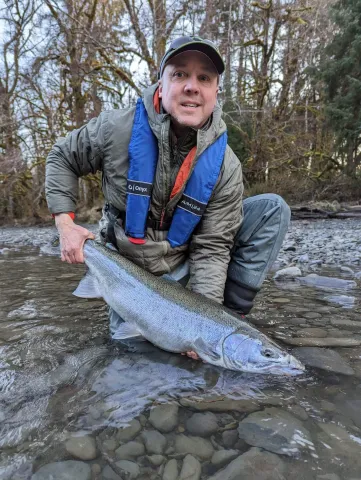
Soon, winter steelhead will be entering our rivers to begin their migration to their natal spawning grounds. If you are a “steelheader” then you savor this time and are excited to begin your piscatorial pursuit of this elusive species. For me, there is no greater pursuit than winter steelhead.
Summer steelhead often enter the rivers in the summer and hold over until winter and even spring. Winter steelhead migrate into their natal rivers during the winter months, starting as early as mid-November, and often hold over to spawn in the spring. In some systems, the two collide and spawn with one another.
Unlike salmon, after spawning steelhead can return to the ocean to begin their cycle again and are known to spawn as many as 3-4 times during their lifecycle. Steelhead are less predictable and often harder to catch than salmon. They can be very finicky and the weather and changes in the water flow and clarity can vastly transform the approaches that we take to catch them. This might be the reason that we love them so much; they are not easy to catch and sometimes can be very hard to find.
While many of you might love to chase steelhead as I do, you likely dread the early mornings, the darkness of winter, the cold, and the wet. Let’s face it, getting out into the elements when they are at their worst is not for the faint of heart. It takes grit and determination and the overwhelming lure of this fish to motivate us to leave the comfort of our homes to brave the elements. The key to a great day on the water is staying warm and dry.
Since I started pursuing winter steelhead about 15 years ago, much has changed in the technology of the gear that we use. At the forefront of this technology, is the availability of clothing that will not only allow us to endure the elements, but to embrace them in absolute comfort. Many of us have a garage full of clothing that we have bought to stay comfortable.
I know that I spend a lot of time chasing winter steelhead on a river north of Seattle that is nestled in the mountains. It is often cold and wet when I float this river, with average daytime temperatures between freezing and the mid-40s on the average day. Some days are much colder and many days bring snow, sleet, rain, and wind.
I have found that the combination of cold and slowly getting wet over hours of floating is exacerbated by the reliable late morning and afternoon winds that blow through the river valleys. While we may start warm and dry, we often finish the day damp and cold. That warm cup of coffee at the end of the float is always a welcome sight.
So, how do you keep warm and dry? This is the million-dollar question, and I am here to tell you that it does not mean spending $1000s on high-end gear. The key that I have found is to layer and to make sure that you have an impervious outer layer to wear when it rains and the wind blows. The addition that I made to my repertoire last year was a battery powered, heated vest.
I bought this online for around $60 and it was the best money that I have spent. I am known to wear 3-4 layers below the waist and 6-7 above, and even then, I tend to get cold. This investment has been the single greatest factor in staying warm on the worst of days.
Here is my suggestion on how to dress. I will clarify that my opinion is based on either walk-and-wade fishing or floating a river in a drift boat. You will obviously stay warmer if you are moving, which you do very little when fishing from a drift boat. Start out with a good base layer of long underwear, both top and bottom. Wear a warm pair of pants or sweats over the bottoms, preferably something that is not cotton. Remember, cotton is rotten, meaning that when it gets wet, you get cold. I wear a pair of Simms M's Thermal Mid-Layer Bottoms which will set you back about $90. They are fantastic and keep you warm. Over these pants, I wear two pairs of socks and stocking foot waders with wading boots. My lower half, including my toes, rarely gets cold.
Let’s move to the top half of the body. Start with a base layer, a long-sleeve shirt. This should be tight-fitting to keep the heat against your body. I wear a second layer of long-sleeve shirt over this, generally a light fleece or mid-layer garment. At this point, I put on the battery-powered heated vest that is mentioned above. This is the keystone to keeping your core warm and remaining comfortable for the entire day.
After this, a puff jacket or fleece, followed by an impervious outer layer jacket, round out the ensemble. When it comes to the outermost layer, there is great debate. I will wear a Gore-Tex jacket when the weather is not forecasted to be super wet. This will generally stay dry enough, but I have yet to find a high-end Gore-Tex jacket that is water”PROOF”.
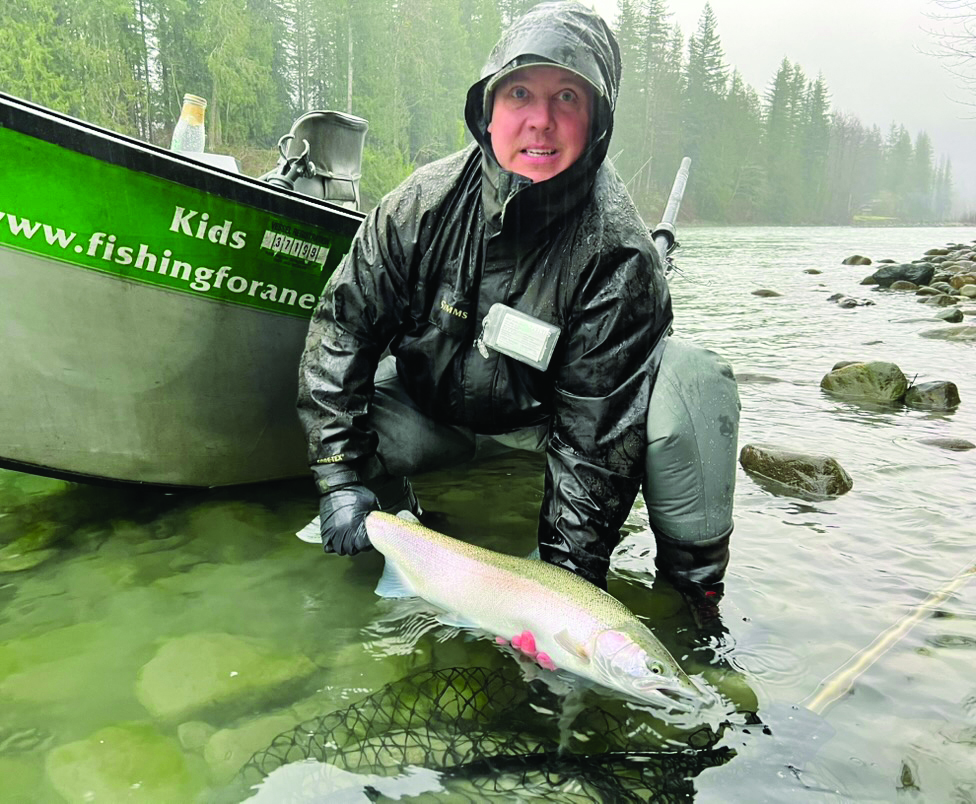
For really wet days, I rely on rubber. My go-to is something made by either Helly Hansen or Grundens that is designed for commercial fishing. There are many options and most cost less than a high-end jacket from Simms, Patagonia, or another leading brand. The key is to go with something that will keep the rain and wind out. Also, layering as outlined above allows you to dress and undress for comfort, as conditions change during the day.
I don’t want to sway anyone to a particular brand of clothing as we all have our preferences. I can attest to what has worked best for me based on years of trial and error as well as talking to guides who are out in the elements every day. Getting cold is a strong motivator to find a way to keep warm, so a lot of testing goes into determining what works best. I will leave it to you to listen to the research and advice of someone who has invested heavily in this process or choose to learn on your own. Hopefully, this is helpful, and you successfully chase steelhead in 2025, while remaining warm, dry, and comfortable.
Good fishing!
/articles/winter-steelheading-fishing-elements
The Big Comeback-Steelhead on the Upper Columbia
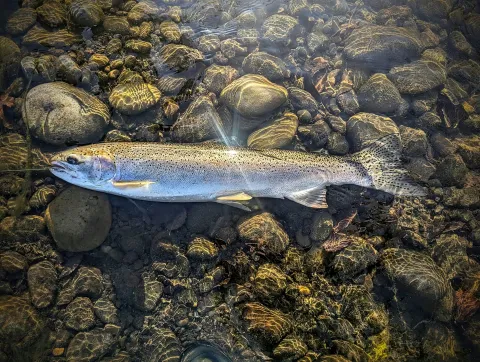
Oh, illusive and majestic Steelhead! One of Washington's most regulated fish is about to get its first opening in over a decade on the Methow River and portions of the Upper Columbia River. This is an unexpected announcement and one that will have excited anglers planning for the upcoming winter season.
Starting October 16th, 2024, you will have the opportunity to fish Steelhead on the Methow from the mouth to county road 1535 Burma Bridge Road. On the Columbia River, from the Beebe Bridge on Highway 97 to the Highway 173 Bridge at Brewster.
If you don’t have bank access or a boat, reach out to a seasoned professional like Upper Columbia Guide Service for the experience of a lifetime.
If you’re a fan of the fly-fishing experience try North Cascades Fly fishing, the longest-standing fly guide in the Methow Valley. Anglers of any age or experience are welcome to reserve their experience for floating, wading, and instructional experiences.
There are several affordable riverfront accommodations on the Methow and the Upper Columbia River. Highly rated Columbia Riverside Lodge and Lazy-Daze-Retreats work closely with local guides and have private dock access to the river.
Anglers can keep 2 hatchery Steelhead or Coho per day, identified by the clipped adipose fin. Steelhead minimum size is 20 inches, and Coho minimum is 12 inches. Wild Steelhead are to be released immediately. Selective gear rules and night closures are in effect. WAC 220-300-160(27) “Selective gear rules” means terminal fishing gear is limited to artificial flies with single-point barbless hooks or lures with single-point barbless hooks. Bait is prohibited.
Fishing from a floating device is prohibited from the second powerline crossing, one mile upstream from the first Highway 153 bridge.
Wild steelhead were listed endangered in 1997 under the Endangered Species Act and have been considered threatened since 2009, meaning that traditional recreational fishing is only allowed when there is an excess of returning hatchery Steelhead. Approximately 7,601 adults were counted over Priest Rapids Dam in 2023, and thus far in 2024, an estimated 9,336 adult fish have been counted. WDFW will continue to monitor the steelhead returns to determine if additional regions can be opened.
Steelhead populations in the Columbia River system have faced numerous challenges including habitat loss, dams, and changing ocean conditions. In response, local state and federal agencies, along with indigenous tribes and conservation groups have worked tirelessly to implement recovery plans. These efforts include habitat restoration, fish passage improvements at dams, and reducing bycatch in other fisheries.
This historic decision to reopen Steelhead fishing was made in consultation with NOAA fisheries to ensure wild steelhead populations remain protected while allowing recreational fishing for hatchery steelhead. For anglers, this is a moment to celebrate and continue advocating for the protection of this remarkable species.
/articles/big-comeback-steelhead-upper-columbia
Steelhead... are back?
Let's start with a recap of Steelhead season 2024 early predictions called for a record run.
JULY & AUGUST
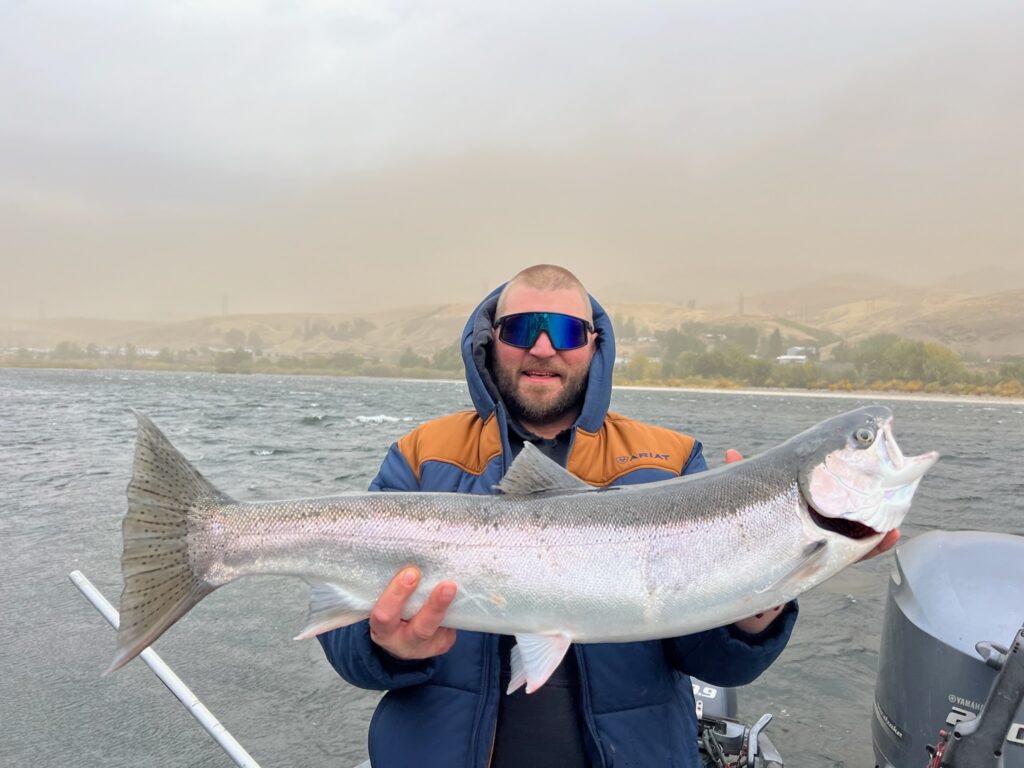
Most people were skeptical considering the last 15 years have been less than stellar. Snake River Steelhead enter the Columbia River in July and August and unlike Salmon, Steelhead migrate slower. They often stop in areas known as cold water refuges for many days, or sometimes weeks, on their way upriver to spawn.
The first thing we noticed was higher numbers of fish than we were accustomed to seeing over the last 15 years. The second thing we noticed was the fish were mostly bigger B-run steelhead. Steelhead are classified into two groups: A-run identified as a Steelhead under 30", and B–over 30".
A-run spend 1 year in the ocean, and B-run spend 2 or more. September 1st when the Steelhead Season opened on the Snake River, we had a good feel for the run. Fishery managers had pumped up the run and the numbers crossing each dam did not lie. It’s going to be a good year.
SEPTEMBER
September for my company, Reel Time Fishing, is primarily spent trolling 360 flasher setups or hovering eggs targeting King Salmon around the Confluence of the Snake and Clearwater rivers. This area has a temperature difference known as a thermal barrier. In this case, the Clearwater is close to 10 degrees colder than the Snake River. Salmon fishing was slow this September but the Steelhead fishing was much better. It was strange to tell the clients Salmon is slow, while Steelhead is hot.
We had a lot of success trolling bobbers and shrimp at an ultra-slow pace in the usual steelhead spots around the bridges and the neutral water flat on the north side of the confluence. We also caught a fair amount on our Salmon gear superbaits and spinners as the season progressed we started to move upriver to the free-flowing areas of the Clearwater trolling Maglips by Yakima Bait and Bradss Wiggler. These plugs tipped with a shrimp are a deadly combination.
NOVEMBER & DECEMBER
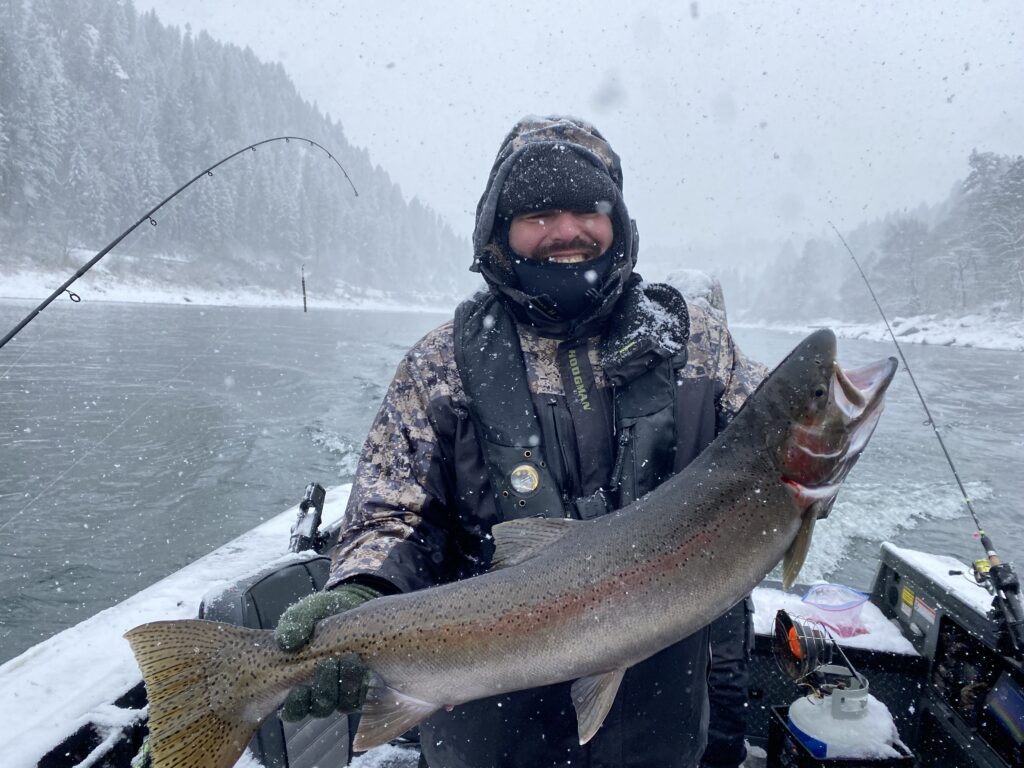
That brings us to the now. Currently, the Steelhead are through all river systems and anglers are enjoying both the increased numbers and size. In my 35 years of guiding experience, this is how the rest of the season should shape up: Steelhead are going to hang in the slower water around Lewiston, Clarkston, and Asotin to wait for a good shot of rain that signals the fish to move upriver.
This makes November and December amazing fishing in the slack water in the day and the night. Yes, I said night. Night fishing is allowed and it can be very productive pulling lighted lures like the old Brads Wigglers, Vortex and the new Night Strike day time. I would concentrate on Bobber and Shrimp around the bridges and in the neutral water in the confluence on the north side or trolling 360 flashers and a very small spinner such as the 3.0 colorado blade in shades gold, chartreuse, and green.
Many steelhead can be caught upriver as well. The Clearwater is an amazing bank fishery that targets deeper slower runs with bobber and shrimp. If you prefer fishing upriver from a boat my suggestion is Heller Bar or the entire Clearwater from Lewiston to Orofino. Keep in mind these river systems are very dangerous, a person can get into trouble not knowing the water. I suggest hiring one of the many local guide services to show you the river.
JANUARY & FEBRUARY
After the first of the year, most of the Steelhead will begin to head to areas closer to their spawning grounds but keep in mind Steelhead migration is unique. Sometimes they actually move downriver for some time. For example, during January and February, you can still catch fish in the Lewiston-Clarkston area but there are definitely less fish hanging around in this area.
On the Clearwater, anglers will begin to pile into the Orofino area targeting the fish from Dworshak hatchery, the largest Steelhead hatchery in the world. Amazing bank fishing can be had on the North Fork of the Clearwater below Dworshak Dam.
Other hot spots include the Cottonwood Creek hatchery on the Grande Ronde, and Mouth of the Little Salmon on the Salmon River. These areas are all hotspots and because of this, they are high-traffic areas. If you would like to avoid the crowds, fish river sections up to 15 miles downriver of these hot spots and just cover some ground. The fish aren’t as concentrated, so it’ll likely be a situation where you find one here and there.
MARCH & APRIL
In March and April, all the fish will be piled up near hatcheries or spawning grounds. This is a hot time for Orofino, Clear Creek hatchery, and the south fork of the Clearwater. Little Salmon heats up in Riggins Idaho, the Cottonwood creek area on the Grande Ronde, and Hell’s Canyon dam will begin to produce.
LATE SEASON
Let's talk techniques for these late-season fish. The #1 technique is drifting a pegged bead. I use a yakima bait size 10 pink or orange corky with a toothpick pegging the bead 4 or 5 inches above the hook, this technique is deadly with a very soft subtle presentation. The Steelhead's focus is on the bead, he never sees the hook, but when he clamps down on the bead and you set the hook you stick him in the corner of the mouth and never get a gut-hooked fish. It’s the perfect catch and release system and perfect for rivers with wild fish release. I suggest presenting this bead system free drifting, bobber dog, or just straight-up bobber, but you will need to use a sinking bead on this straight-up system. Other techniques that work well include free drift or bobber and eggs, back trolling or bobber and jig.
Now we need to ask ourselves a few questions. So why is this year so good? Will this be normal in the future? Are we recovering Steelhead? What can we do to help the Steelhead? The answer in my opinion is that this year was good because ocean conditions have been favorable for Steelhead. I do think we will get many more years like this one, but if you look at the overall trend, Steelhead are still on the decline. So no, we are not recovering Steelhead. We release billions of smolt and get less than a 1% return.
HOW TO HELP
Here are a few things we need to focus on to help the Steelhead:
#1 Improve passage: a journey that used to take Steelhead smolt around 15 days, now takes them over 30 days. Going hand-in-hand is predator pressure. Predator pressure is intense—these fish are facing an overwhelming and growing number of predators like walleye, bass, cormorants, and pelicans, whose populations are skyrocketing.
#2. Selective Harvest. I feel any human should not kill a wild Steelhead. If we could eliminate gill nets and switch to selective harvest methods for hatchery fish, allowing wild fish to swim free, it would be a clear win. Individuals harvesting fish for commercial or subsistence purposes could selectively harvest at each dam using dip nets, sorting out hatchery fish, and letting all wild Steelhead go free.
That's a start. There are many more factors contributing to the decline, but for now, we are enjoying a wonderful Steelhead season and we are only halfway through. So get off the couch grab a rod and head to the river. Tight Lines -Toby Wyatt-
/articles/steelhead-are-back
March Steelhead Madness
March madness is more than just college basketball, especially if you live and fish in the Pacific Northwest. Steelhead are filling the rivers with late returning hatchery fish along with native sea run rainbows. Unfortunately, watersheds are being shut down; fisheries closed, while hatcheries are overflowing with fin-clipped fish as wild fish returns struggle. It is enough to drive an angler mad, and it should. For those that still wish to catch a steelhead before the spring chinook season kicks off there are a few places to go, especially in Oregon and Idaho but for those in Washington, it is primarily a Southwest river endeavor.
The mighty Cowlitz is where most steelhead anglers will be come March as it is one of the few rivers still open in Washington and has good hatchery returns. For other rivers look at the hatchery smolt plants and projected returns. Once you find a river that has a good plant and return rate be sure to check the regulations including any emergency rules changes and announcements.
Maybe we will get lucky with some openers but likely this will not happen. One catch and release fishery just announced is the Skagit, slated to be open through the month with a restricted days per week schedule. This is a catch and release fishery which means be sure to use the right gear and help keep the encounters low. Do not go there expecting to catch a lot of fish but embrace the ones you do catch, and release with kindness back into the river. By following all the rules, we will get this fishery to stay open until April. The coastal rivers of Oregon are your best bet but also look to the tributaries of the Columbia, on both sides, for some opportunities.
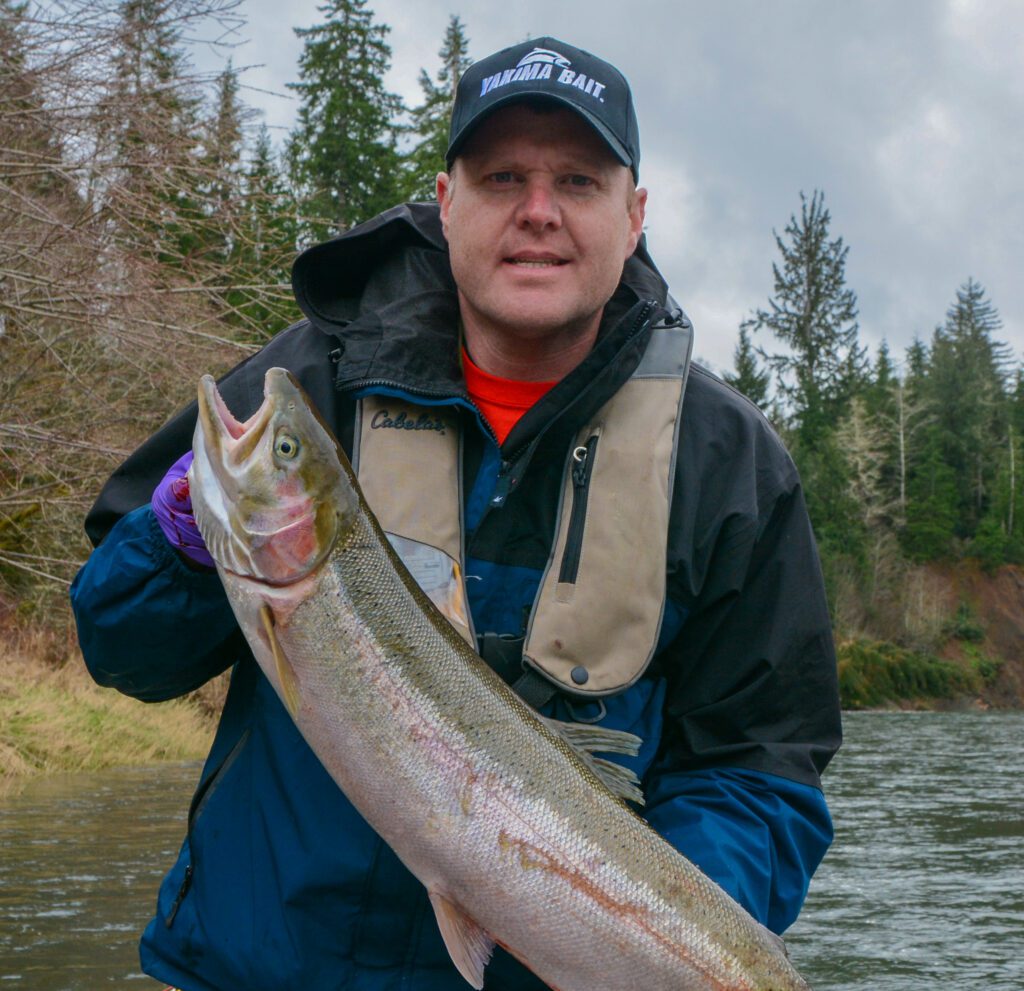
When it comes to fishing for March steelhead you will likely be on a river where hatchery fish are prevalent but with the chance of catching wild fish. This means March is the time to put away the bait and pick up hardware. Even leave the scents at home and use techniques that do not allow steelhead to swallow the hook. One way to keep this from happening is to change hooks to a size or two larger than you are used to using.
Also, re-spool the reels with heavier line and upsize the leaders and use rods of medium-to-medium heavy action. The idea is to hook a fish, get it to the soft rubber net quickly and if wild then release it unharmed. One of the surest ways to kill a fish is to over play it to exhaustion. Steelhead are trout and that means they need clean, cold water and are sensitive to stress.
Swinging spoons or tossing spinners is a great way to catch March steelhead as they hit the hardware hard but will not likely swallow the hook. It is also an active way to fish and learn about rivers. Look at tailouts for holding fish or a riffle where fish will hide from eagles while making their way upriver. A long run can be worked for hours and anglers who know fish are in the system also know that the fish will be on the move. No need to leave a good stretch of river and let the fish come to you. Brass, nickel, and copper are good colors but if the sun is bright then look through the tackle box for a few that are tarnished so not to scare the fish away.
Floating jigs is one of the easiest ways to catch steelhead and a lot of fun. Not only can you fish a jig under a float in about every type of water, any stretch on the river, or most flows but you also will not lose much gear. It is effective and if you only have one rod or technique to use for a day of fishing you cannot go wrong with floating jigs.
Steelhead like to hide behind boulders, both to create a current break to rest and to flush aquatic insects by them to feed on. But drift fishing or swinging a spoon through a boulder garden often means losing gear and you cannot get the lure in the right spot for the steelhead to grab it. This is where floating jigs really shine. Set the depth and cast the line. If you notice you are hitting a boulder then a soft pull on the rod will help it over and the jig falls right into place.
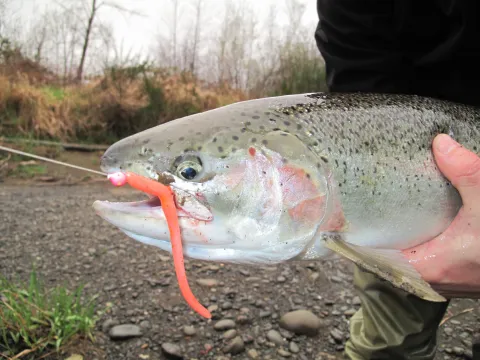
When fishing jigs be sure to not tip them with bait or use scent. Again, the idea is to catch steelhead and if necessary to release them unharmed. Since the hook point is upwards it is likely the jig will be pinned in the upper jaw of the fish. After a hard rain you can use a pink rubber worm threaded onto a bare jig head and fish it just like a jig. Steelhead crave washed out nightcrawlers that are being flushed into the river and will grab the rubber worm, again likely to have it pinned to the top of their mouth.
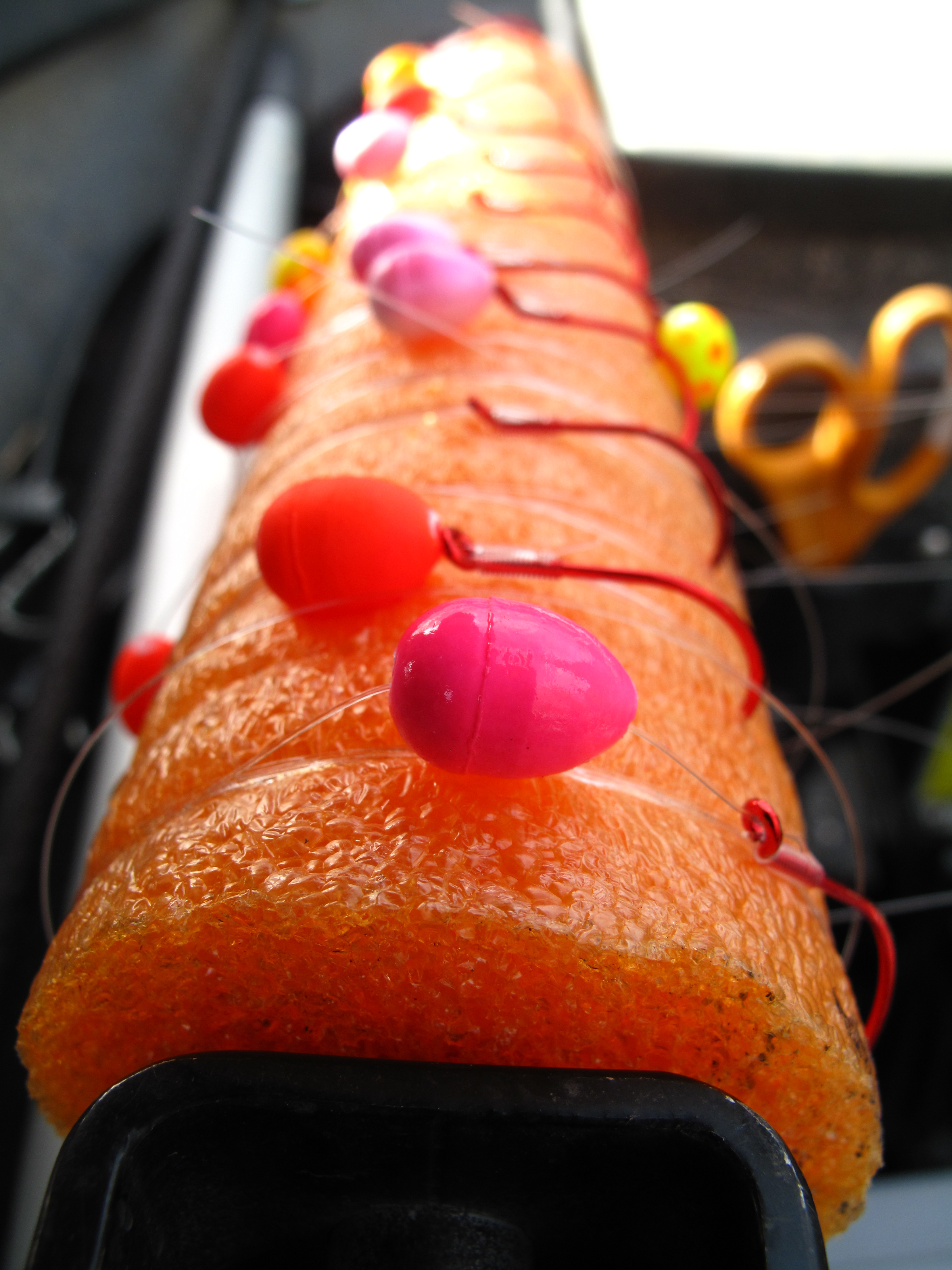
Drift fishing often means gobs of cured roe but for March leave the bait in the fridge and head to the river with some pre-tied pink worms threaded onto the leaders or use beads. Bead fishing has become extremely popular in the past few years and one discovery is that larger soft beads tend to catch more fish than small beads that mimic a single egg. The large bead might look like an egg cluster or a piece of egg skein. Rig the bead with a stop two to three inches in front of the hook so when the steelhead grabs the bead the hook sets in the outside of the jaw. Not only is this a non-killing hookset but it is also strong and helps keep the fish on the hook until landed.
Some anglers will use a tandem or double bead set up where you use one bead with a hook and then a trailing bead with another hook 24 to 30-inches behind. This is a great set up for bobber dogging which is where you use a sliding weight, a long length of mainline and bobber stop to the swivel with a weight and then the leader. The idea is that the weight is dragging on the bottom and with the bobber stop set so far ahead that the weight can keep in contact with the contour of the river bottom. The beads are dragging behind as if drifting down the river. If a fish misses the first bead the second one is trailing right behind and gives the angler a second chance at catching the fish.
Do not think you have to have a boat or raft to fish for steelhead in March. With smaller rivers that get runs of fish, or even larger ones with good access, anglers can target steelhead from the shore. Being a migrating fish and March often means high water the steelhead will be using the bank to break up the strong flows. One technique often overlooked is using a side planer designed for fishing plugs from shore. There are a few on the market and the idea is that it clips onto the mainline and uses the current to pull the plug away from the bank.
Once you get the planer to the area you want to work the plug just close the bail and let the plug do its job. You can also use the bobber dogging technique if you have a long run and can walk the bank easily. Cast out and start walking down the river as the float drags the lures. Floating jigs can be fished this way but it is much harder as you want a natural drift and a lot of times you might pull on the rod and that moves the jig. The reason it works with bobber dogging is because you are dragging the weight on the bottom of the river and less likely to affect the beads movement. If you float jigs from shore be sure to have a lot of mainline and just open the bail to extend the drift.
There are plenty of ways to fish for winter steelhead, just not a lot of places to fish. Do some research and pick a river. As the month wanes towards April the rivers often calm down and the weather can give a few nice springlike days. Be sure to use techniques that will not harm wild fish and be ready to get the fish to hand quickly. Having a conservation mindset will ensure fisheries in the future and keep you from going mad.
/articles/march-steelhead-madness
Late Winter Steelhead Fishing
Winter Steelhead fishing… where do we start? First off, winter Steelhead fishing in Washington is unique and different from many of our other fisheries based on one simple fact, the weather. The winter generally brings cold, dark, and wet days which makes this type of fishing a bit more extreme. So then, why do we do it? Great question, but the bigger question is, why would we not?
There is an allure to Steelhead fishing that is hard to describe. I know that there is nothing that I would rather do. On top of inclement weather, Steelhead are more elusive than our migrating salmon and less predictable, making them more difficult to catch. Changes in river conditions during the wet, winter months are constant, forcing us to drop what we are doing and go when the conditions are best.
We also need to change up our techniques based on river conditions. One more thing worthy of mention is that there are limited hatchery program opportunities left, so much of our Steelhead fishing is the catch and release of wild fish. I find that wild fish tend to fight better and to me, there is nothing quite like battling an amazing fish and holding onto its tail as it builds up the energy to swim off to where it came from.
For those of you interested in winter Steelhead, I would like to share some information that might help in getting started. I am only sharing what I have learned but I hope that the information is useful. Also, if you have followed my articles in other outdoor magazines, then you probably know that I spend a lot of time fishing with professional guides all over the Pacific Northwest. This helps as I can share a perspective that has been obtained across many experiences and years of fishing.
Most of my Steelhead fishing has been done in the rivers in NW Washington, SW Washington, and the Washington Coast, specifically Forks and the Quinault and Queets Rivers within the reservation. There are so many options available, so I recommend that you start with a river that is near you and learn a little about it…the rules, the opportunities, and most importantly, some good guides who know the river well. I encourage you to spend the money to fish with a guide to learn what works and understand how to target fish in different conditions. Know that every guide has a different opinion and approach, so try a few to gain a broader perspective.
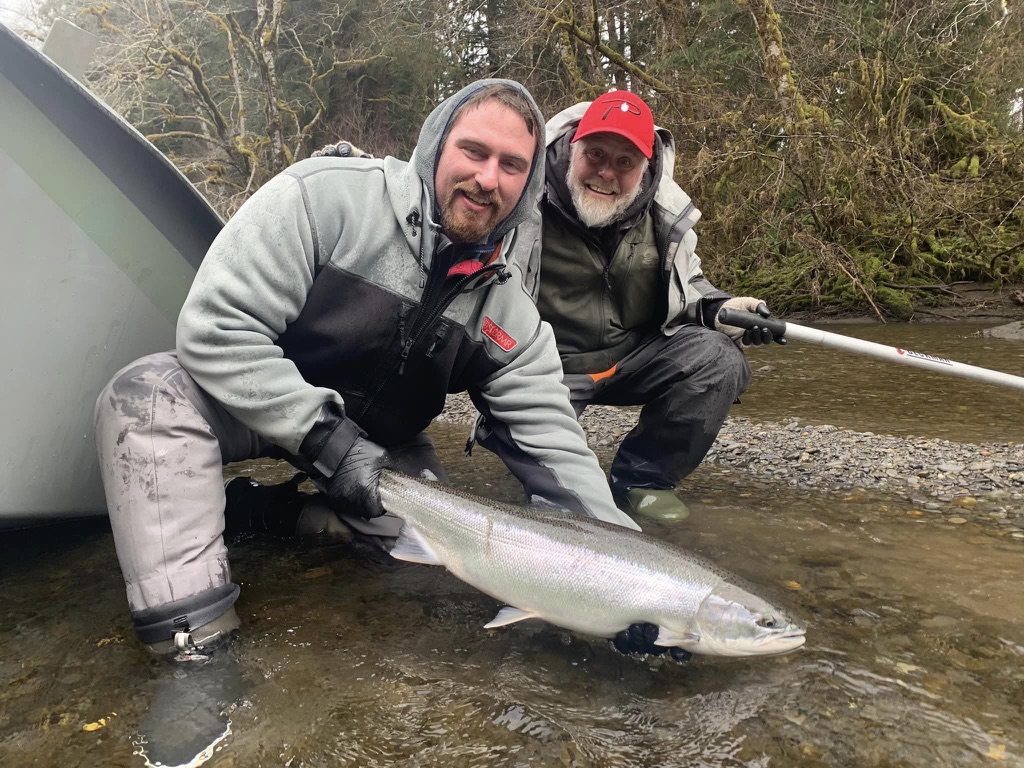
Once you have spent time on the river with a guide or two, you can focus on the gear that you need. Believe me, you can spend a lot of money quickly so make sure that you get it right. To start, you should have a nice pair of waders and wading boots and a waterproof jacket. Getting cold and wet will ruin your day in a hurry. Next, and just my opinion, focus on 2-3 techniques that you would like to try and focus on the gear needed for those specific approaches. I find that it is best to master a few techniques before expanding your toolkit.
There are many popular techniques for catching Steelhead such as casting or trolling plugs from the bank or shore, throwing spoons and spinners, float fishing beads, bait, jigs and other offerings, drift fishing or bobber dogging beads, yarnies, bait and other offerings, and much more. So many different options to choose from and they all work.
If had to pick 2-3 techniques, here is what I would do. It’s hard to choose because they all work and some work better at certain times and under certain conditions. I like to float fish maribou jigs and soft plastic worms on jig heads, and I really like to float fish beads. My float fishing approach for beads combines a float, inline weight, a long leader with some split shot in the middle, and a soft bead that bounces along the bottom. Aside from these techniques, I love to throw spoons and spinners. If I am fishing from a drift boat as opposed to bank fishing, I like to troll plugs in long stretches of slower-moving, deep water.
If I was to start fresh right now, I would have a lot less gear in my garage. Now there are many different types of rods and some work better for certain techniques. If I had to pick one rod to use for multiple techniques, I would go with a 9’6”, 6-10# to 8-17# rated spinning rod with a 30/3000 or 35/3500 size spinning reel. I prefer a bit lighter rod to maximize sensitivity and have found that 30# braid works best for my mainline along with a 10-15’ bumper of fluorocarbon. This is a great all-around rod and reel setup that will allow you to employ most of the methods that I listed above.
If you want to focus on float fishing, I recommend a 10’6” rod that is designed for this purpose. The added length really helps you mend your line easily. For “old school” drift fishing, I prefer a one-piece 7’6” rod but most of the time I am bobber dogging, which is simply drift fishing with the addition of a float/bobber to pull your gear naturally along the bottom and downstream. A 9’6” rod works great for bobber dogging, and you can easily break it down to fit inside your car.
Once you have your clothing, rod, and reel, you can focus on terminal tackle. For this, I recommend going to your local tackle shop as opposed to a “big box” store. You will get valuable advice that will help you to purchase the best gear. Also, lean on what you learned from the guides you fished with, and make sure to take pictures of their gear setups and rigging when you fish with them. At this point, you’re going to need a collection of swivels, bobber stops, small beads for your bobber stop, and leader material, generally fluorocarbon. Note that if you don’t want to tie your leaders immediately, you can purchase them pretied.
It’s also a good idea to have a selection of hooks in sizes from #4 to 1/0 or even 2/0 in some cases. Purchase a box of soft beads in a variety of sizes and colors, some maribou jigs in pink/cerise/orange combinations and the red/white/black nightmare patterns, as well as 1/8 or 1/4oz jig heads (I prefer white) and some 3.5” plastic/rubber worms. Don’t forget a selection of weights. I am a big fan of the stainless-steel weights from Dave’s Tangle Free. You have enough gear to get you through a winter of learning and chasing Steelhead. Between maribou and worm jigs and beads, you can fish in just about any condition. It would not be a terrible idea to have a few spinners and/or spoons as well. They are fun to toss when nothing else seems to be working.
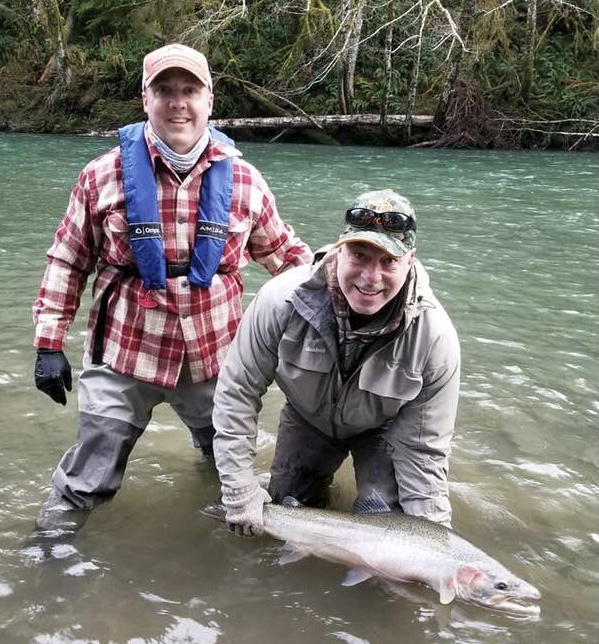
Now, you have learned the basics from one or more guides, you have learned how to fish a specific river system, you have purchased a handful of the gear that you need and the time has come to go out and give it a shot. Believe me, you don’t have to go buy a drift boat to fish. There are plenty of opportunities to wade and bank fish. Also, I encourage you to continue to fish with guides if you want to boat fish or make a friend who has one. Believe it or not, many fishermen who own boats are looking for fishing buddies, so join a Facebook group to make some friends.
Winter Steelhead fishing is an amazing pastime and until you have spent some time doing it, you really don’t realize how special it is. One warning, don’t expect to go out and catch a Steelhead on your first trip. They are called a fish of 10,000 casts for a reason. I can say that they are very special fish, and you will never forget your first, or for that matter, any Steelhead that you catch. Now, get out there and good luck.
/articles/late-winter-steelhead-fishing