March Steelhead Madness
March madness is more than just college basketball, especially if you live and fish in the Pacific Northwest. Steelhead are filling the rivers with late returning hatchery fish along with native sea run rainbows. Unfortunately, watersheds are being shut down; fisheries closed, while hatcheries are overflowing with fin-clipped fish as wild fish returns struggle. It is enough to drive an angler mad, and it should. For those that still wish to catch a steelhead before the spring chinook season kicks off there are a few places to go, especially in Oregon and Idaho but for those in Washington, it is primarily a Southwest river endeavor.
The mighty Cowlitz is where most steelhead anglers will be come March as it is one of the few rivers still open in Washington and has good hatchery returns. For other rivers look at the hatchery smolt plants and projected returns. Once you find a river that has a good plant and return rate be sure to check the regulations including any emergency rules changes and announcements.
Maybe we will get lucky with some openers but likely this will not happen. One catch and release fishery just announced is the Skagit, slated to be open through the month with a restricted days per week schedule. This is a catch and release fishery which means be sure to use the right gear and help keep the encounters low. Do not go there expecting to catch a lot of fish but embrace the ones you do catch, and release with kindness back into the river. By following all the rules, we will get this fishery to stay open until April. The coastal rivers of Oregon are your best bet but also look to the tributaries of the Columbia, on both sides, for some opportunities.
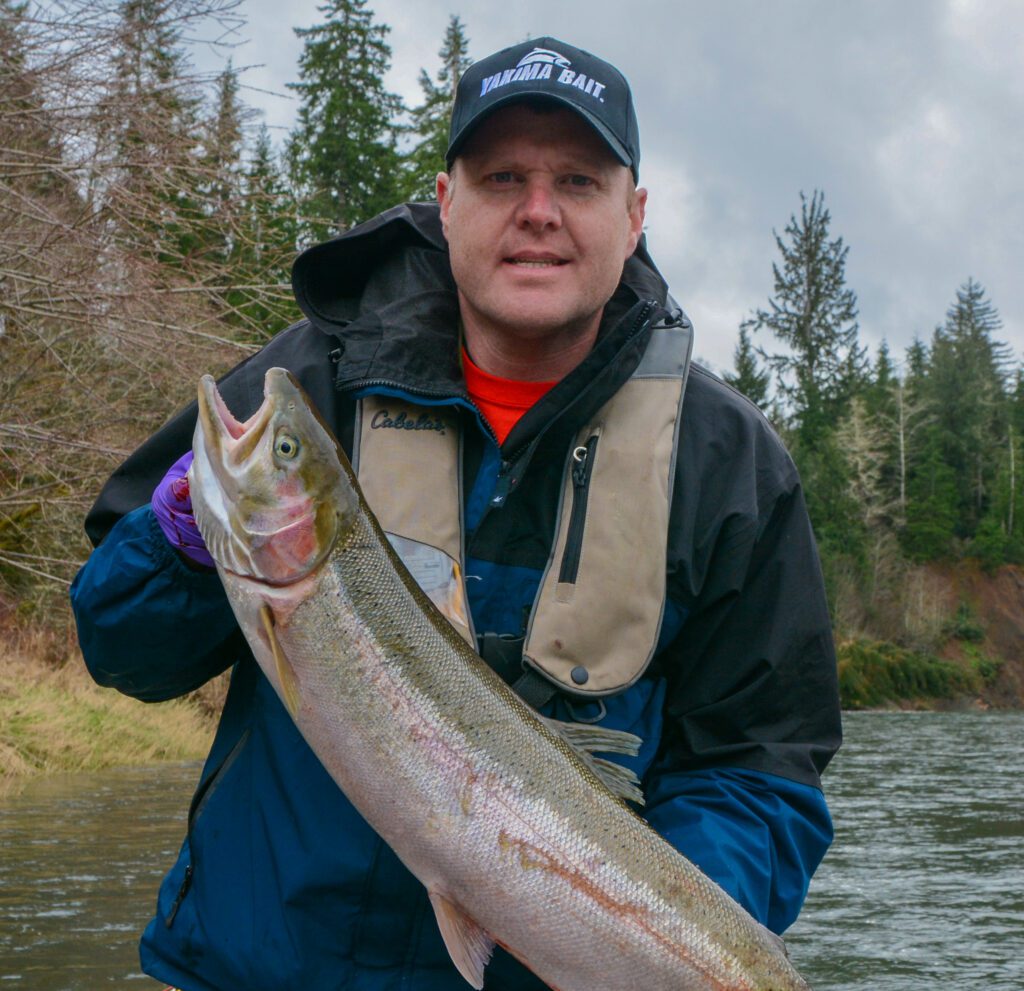
When it comes to fishing for March steelhead you will likely be on a river where hatchery fish are prevalent but with the chance of catching wild fish. This means March is the time to put away the bait and pick up hardware. Even leave the scents at home and use techniques that do not allow steelhead to swallow the hook. One way to keep this from happening is to change hooks to a size or two larger than you are used to using.
Also, re-spool the reels with heavier line and upsize the leaders and use rods of medium-to-medium heavy action. The idea is to hook a fish, get it to the soft rubber net quickly and if wild then release it unharmed. One of the surest ways to kill a fish is to over play it to exhaustion. Steelhead are trout and that means they need clean, cold water and are sensitive to stress.
Swinging spoons or tossing spinners is a great way to catch March steelhead as they hit the hardware hard but will not likely swallow the hook. It is also an active way to fish and learn about rivers. Look at tailouts for holding fish or a riffle where fish will hide from eagles while making their way upriver. A long run can be worked for hours and anglers who know fish are in the system also know that the fish will be on the move. No need to leave a good stretch of river and let the fish come to you. Brass, nickel, and copper are good colors but if the sun is bright then look through the tackle box for a few that are tarnished so not to scare the fish away.
Floating jigs is one of the easiest ways to catch steelhead and a lot of fun. Not only can you fish a jig under a float in about every type of water, any stretch on the river, or most flows but you also will not lose much gear. It is effective and if you only have one rod or technique to use for a day of fishing you cannot go wrong with floating jigs.
Steelhead like to hide behind boulders, both to create a current break to rest and to flush aquatic insects by them to feed on. But drift fishing or swinging a spoon through a boulder garden often means losing gear and you cannot get the lure in the right spot for the steelhead to grab it. This is where floating jigs really shine. Set the depth and cast the line. If you notice you are hitting a boulder then a soft pull on the rod will help it over and the jig falls right into place.
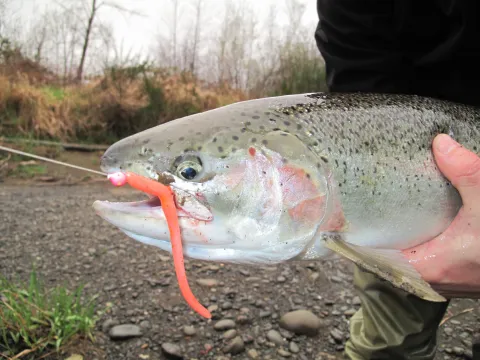
When fishing jigs be sure to not tip them with bait or use scent. Again, the idea is to catch steelhead and if necessary to release them unharmed. Since the hook point is upwards it is likely the jig will be pinned in the upper jaw of the fish. After a hard rain you can use a pink rubber worm threaded onto a bare jig head and fish it just like a jig. Steelhead crave washed out nightcrawlers that are being flushed into the river and will grab the rubber worm, again likely to have it pinned to the top of their mouth.
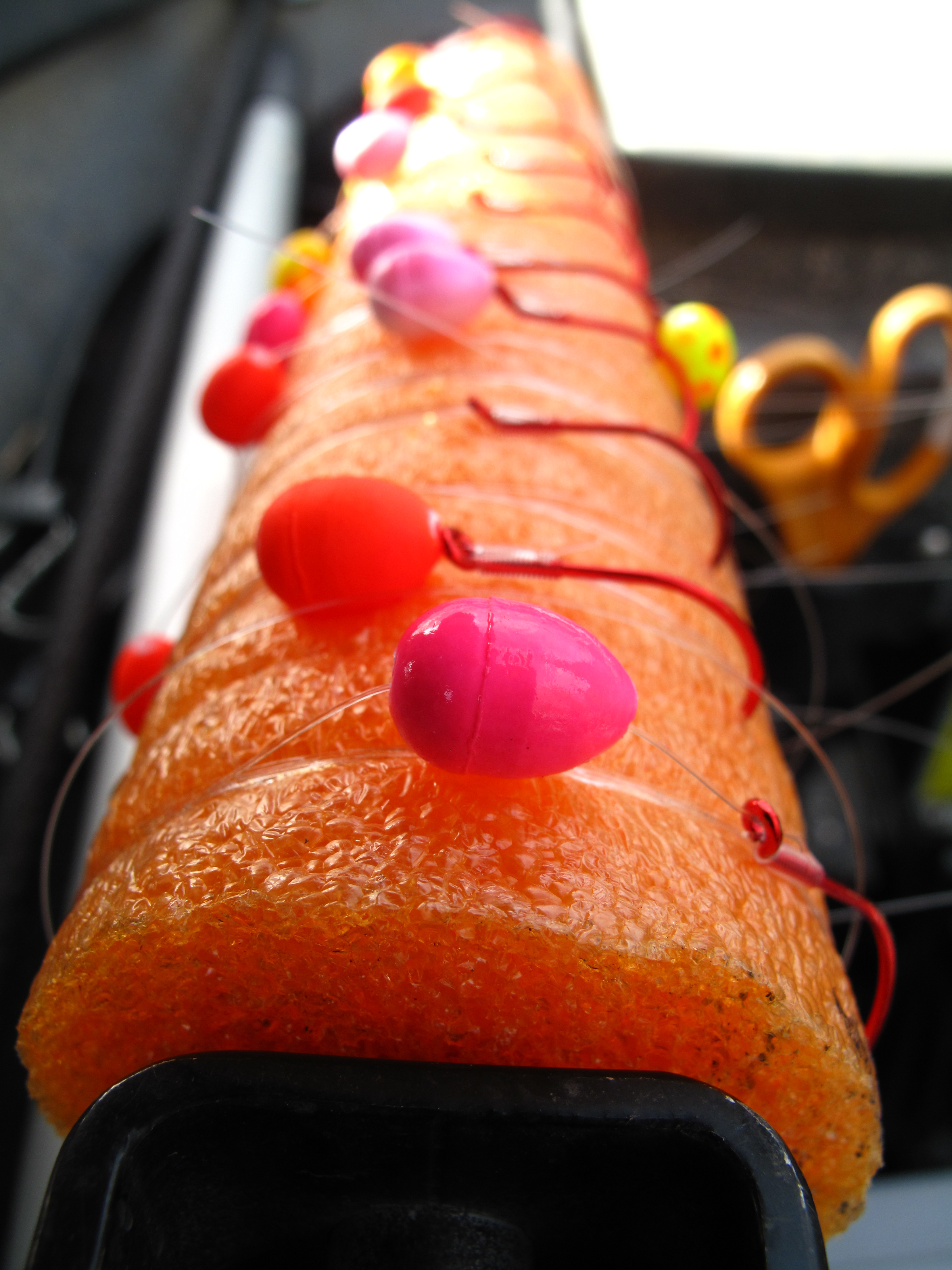
Drift fishing often means gobs of cured roe but for March leave the bait in the fridge and head to the river with some pre-tied pink worms threaded onto the leaders or use beads. Bead fishing has become extremely popular in the past few years and one discovery is that larger soft beads tend to catch more fish than small beads that mimic a single egg. The large bead might look like an egg cluster or a piece of egg skein. Rig the bead with a stop two to three inches in front of the hook so when the steelhead grabs the bead the hook sets in the outside of the jaw. Not only is this a non-killing hookset but it is also strong and helps keep the fish on the hook until landed.
Some anglers will use a tandem or double bead set up where you use one bead with a hook and then a trailing bead with another hook 24 to 30-inches behind. This is a great set up for bobber dogging which is where you use a sliding weight, a long length of mainline and bobber stop to the swivel with a weight and then the leader. The idea is that the weight is dragging on the bottom and with the bobber stop set so far ahead that the weight can keep in contact with the contour of the river bottom. The beads are dragging behind as if drifting down the river. If a fish misses the first bead the second one is trailing right behind and gives the angler a second chance at catching the fish.
Do not think you have to have a boat or raft to fish for steelhead in March. With smaller rivers that get runs of fish, or even larger ones with good access, anglers can target steelhead from the shore. Being a migrating fish and March often means high water the steelhead will be using the bank to break up the strong flows. One technique often overlooked is using a side planer designed for fishing plugs from shore. There are a few on the market and the idea is that it clips onto the mainline and uses the current to pull the plug away from the bank.
Once you get the planer to the area you want to work the plug just close the bail and let the plug do its job. You can also use the bobber dogging technique if you have a long run and can walk the bank easily. Cast out and start walking down the river as the float drags the lures. Floating jigs can be fished this way but it is much harder as you want a natural drift and a lot of times you might pull on the rod and that moves the jig. The reason it works with bobber dogging is because you are dragging the weight on the bottom of the river and less likely to affect the beads movement. If you float jigs from shore be sure to have a lot of mainline and just open the bail to extend the drift.
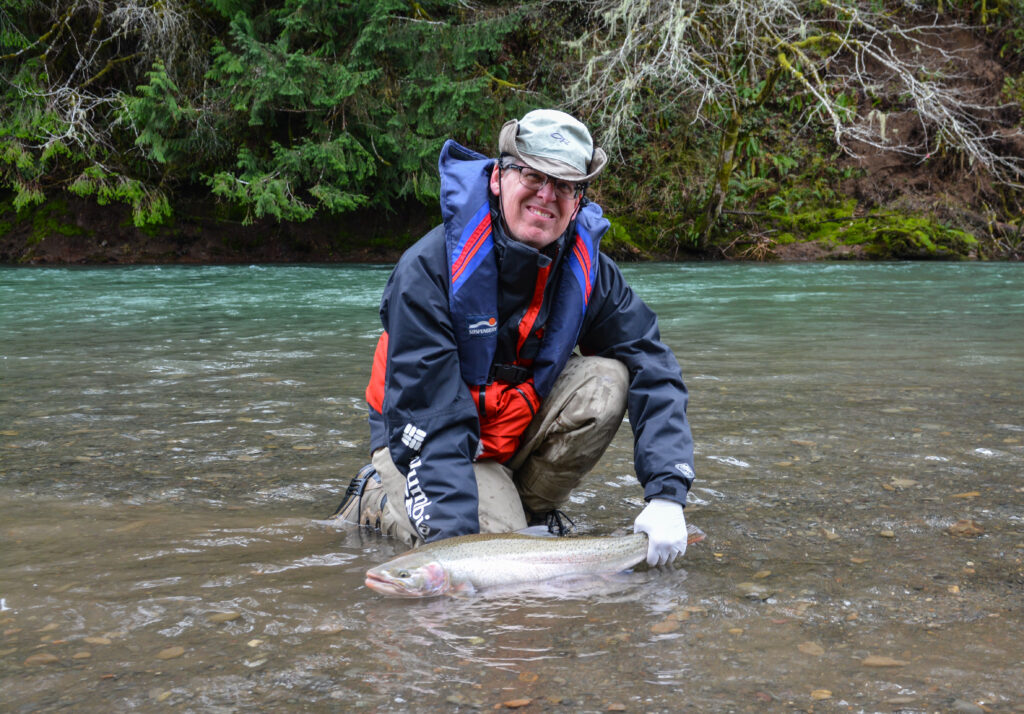
There are plenty of ways to fish for winter steelhead, just not a lot of places to fish. Do some research and pick a river. As the month wanes towards April the rivers often calm down and the weather can give a few nice springlike days. Be sure to use techniques that will not harm wild fish and be ready to get the fish to hand quickly. Having a conservation mindset will ensure fisheries in the future and keep you from going mad.
/articles/march-steelhead-madness
Onward Hoh... River That Is
If ever there was a river world renowned for its beauty, versatility, and Gollum-like trophy steelhead, this is it.
The Hoh River, from deep within the Olympic National Park, sourced from Mt. Olympus himself.
Floating north and west with a full mountain embrace, collecting headwater tributaries like badges of honor. A collection of blue and white glacial waters swirling under a canopy of fierce and protected old growth, this braided channel river looks to be strategically created. An art unto itself. Its milky slate blue waters, glisten like the eyes of a newborn.
The Hoh River flows 56 miles from its headwaters to the Pacific Ocean. The South Fork Hoh River is 17 river miles in length and enters the main stem at the Olympic National Park boundary at RM 30. The upper section of the Hoh watershed lies entirely within the Olympic National Park. The middle section of the river flows through state and industrial forest and valley homesteads. The Lower Hoh River encompasses the lower third of the watershed, 16 river miles from Highway 101 to the Pacific Ocean. 750 miles of tributaries flow into the river below ONP. Of these, 250 miles provide fish habitat. Numerous spring-fed terrace tributaries feed the Hoh River.
The Hoh River watershed is home to four species of wild salmon, steelhead, and many other fish and wildlife species. Located at the mouth of the Hoh River, the tiny Hoh Indian Tribe or “Chalá·at” ("Those-Who-Live-on-the-Hoh River") are dependent on the fish and wildlife of the Hoh River for their subsistence and commercial economy. Protecting the watershed’s function is key to preserving these important resources, not only for the tribe, but also for fishing and recreational communities in nearby cities and towns, and up and down the coast.
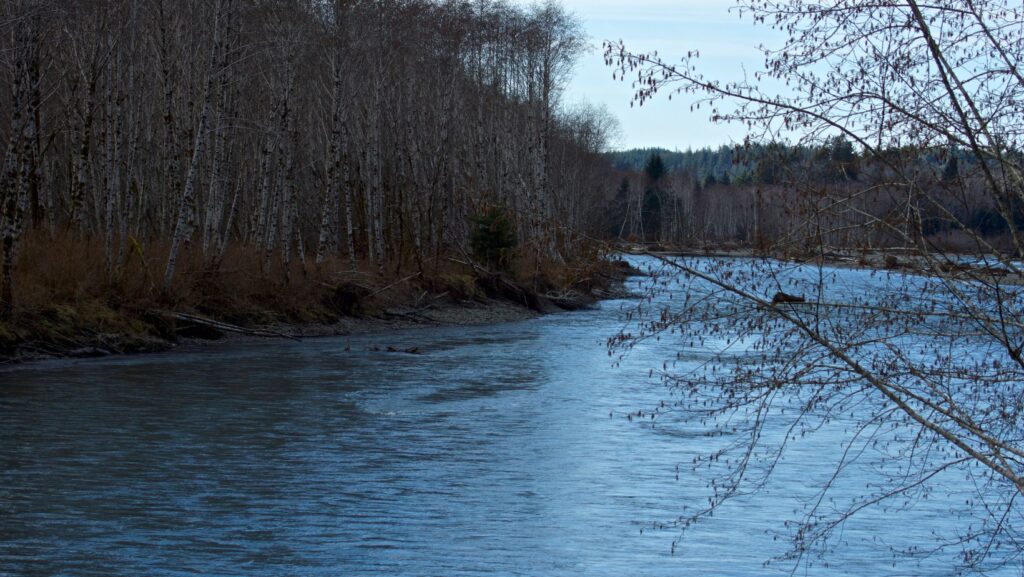
Despite this river's status as one of the healthiest in the country, the Department of Fish and Wildlife has enacted severe restrictions on coastal steelhead fishing due to “low returns.” It was specifically focused on the long-term decline of coastal steelhead in the Queets and Quinault watersheds, Quillayute River system, Hoh River, and Willapa Bay River system.
Between December 1st, 2023, and March 31st, 2024 there are opportunities to fish from floating devices on the Hoh Sunday through Tuesday only from the Morgan’s Crossing boat launch downstream to the Washington Department of Natural Resources Hoh Oxbow Campground boat launch, and Wednesday through Saturday only from the Hoh Oxbow boat launch downstream to the Olympic National Park boundary near the mouth.
Barbless single hook, catch and release only. This is a continuation of the WDFW implementation of the Statewide Steelhead Management Plan which requires the Department to prioritize the sustainability of wild coastal steelhead runs by focusing on healthy levels of abundance, productivity, diversity, and distribution.
While these regulations are creeping onto every river in the state, if you are like me, it isn't necessarily a deterrent. There is more than just catching to all of this. It is the gorgeous scenery, the fresh air, the sun on my face and wind in my hair. Even the rain, which you should expect.
Annual precipitation is 140 to 170 inches. The Hoh Rain Forest is one of the finest remaining examples of temperate rainforest in the United States. Giant Western Hemlock, Douglas-fir, Western Red Cedar, and Sitka Spruce dominate the landscape, while ferns and mosses cloak the trees and forest floor. This is a great reminder of why I am here, alive and a part of it all.
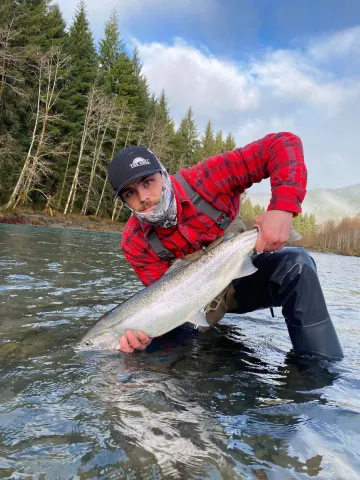
The Hoh River is what legends are born from, whether you are a conventional or a fly angler. From a bank or a boat, you are bound to have a great time. Prime fishing for winter Steelhead happens in February and March, though any time of the year the river is producing, depending on what you are fishing for.
If steelhead aren’t your thing, don’t worry – the Hoh boasts impressive salmon runs each year from late spring through fall and manages to sustain returning populations of both Chinook and coho salmon.
The early summer run of Chinook begins in May and is productive through about August.
The Coho run on the Hoh, like on all other Pacific Northwest rivers, occurs in the fall.
If you’re a salmon fan, fishing in the Hoh can be good from May through November, if the river stays open.
Resident trout are available in the river in addition to sea-run cutthroat that make their way up the river later in the summer and through the fall.
Where do you go from here? Do you prefer floating down the river with a seasoned guide? There are plenty of options. Hopefully, I'll have many more opportunities to meet some more awesome river guides but today I am going to throw a nod out to Pat Neal. (Hoh River Rafters)
With 35 years of experience, Pat has the Hoh River in his back pocket. He is a writer for the Peninsula Daily News and a published author. He is warm and funny, and made me feel completely at ease in conversation. One of my biggest hangups with float fishing is space and comfort, but I look forward to some solid adventures with this local gem.
If walking the banks is your thing, there are three DNR-managed campgrounds with river access and a lovely property called Hoh Valley Cabins ( Hoh Valley Cabins). The Peterson family are descendants of some old-timey pioneers; their family property covers about 500 acres and over a mile of riverfront with access to the river.
In this age of river closures and limited opportunities, we are lucky to have one of the last strongholds of Winter Steelhead right in our backyard. Observe where you can fish, do not encroach on tribal land, and always check the rules and regulations prior to embarking.
/articles/onward-hoh-river