Late Season on Alaska’s Kenai Peninsula
By Chad Bryson
Alaska’s Kenai Peninsula and its spectacular sport fishing opportunities are a far cry from being a worldly secret. Every summer, thousands of visitors travel to the Great Land in the pursuit of filling fish boxes with some of the cleanest and tastiest sockeye, king, and silver salmon on the planet. \
This occurrence has been happening for decades. In most fishing circles, going to the Kenai during the summer migratory runs of salmon would even almost be considered “old hat.” In fact, I myself even turned a cold shoulder to it.
As a veteran Bristol Bay guide, I couldn't imagine any good reason at all to punish myself, or anyone else for that matter, by enduring the crowds of summer on the Kenai Peninsula. It just didn't seem worth it.
Sure, the fishing was incredible, but it was at the price of standing in line either by boat or by foot next to hundreds of my “brothers in arms”, none of which I knew well enough to be comfortable in those proximities.
That was until at the suggestion of a friend to give the late fall steelhead fishing a try. In an effort to make my re-entry to society easier, I gave it a shot. I figured the worst thing that could happen is that I wouldn't have fun and I would hate the crowds. After the first day, I knew the worst wasn't going to happen, and that I had found a new place/time to fish steelhead.
That first trip was in early October. I fished the Anchor and Kasilof rivers. There were plenty of steelhead willing to eat dead drifted beads as well as swung flies. The weather was equally as pleasant as the number of anglers was few. It was almost too good to be true.
How could it be that this Shangri-La of Alaska steelheading could still exist? Furthermore, how long into fall would the fishing sustain? AKA- How long could I stay and do this every single day until the rivers froze or I spent every dollar I had earned over the summer? Whichever came first, I was hell-bent to find out.
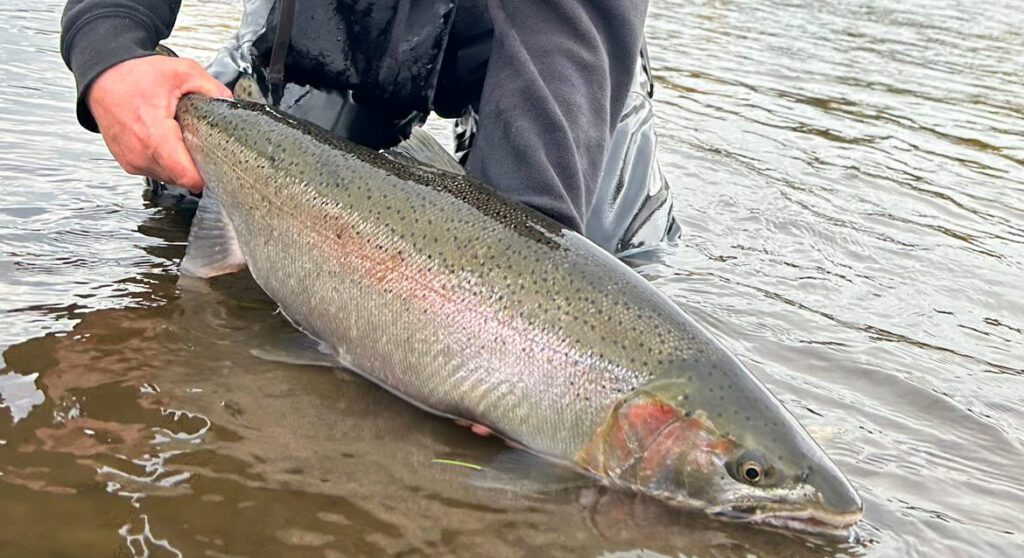
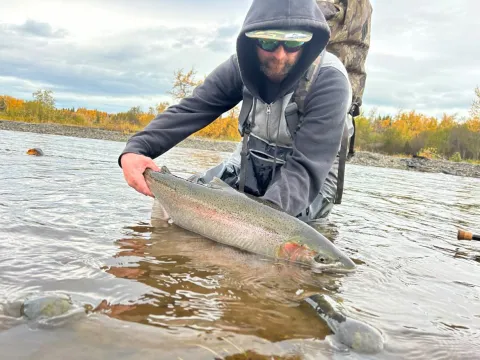
That year, I think I stayed until the third week of October. It was all I could afford both financially and personally. Kids, dogs, and girlfriends have this thing about me being away from home for extended periods of time. Especially the dogs. I was kicking and screaming the whole way to the airport. Fishing at that time was nothing short of remarkable and I didn't want to leave.
Some of the locals I met during my abode on the peninsula encouraged me to not even come back the following year until November 1, as long as the temps held out. At first, I wasn't sure if this was a carefully plotted ruse just so I wouldn't be there to “fish their water” or if it was a genuine act of rare angling kindness. After all, anglers are known for their sometimes harmlessly nefarious actions to keep the local water local.
That wasn't the case here. This was a genuine act of kindness and sharing amongst steelheaders in pursuit of one common goal. I shouldn't have been surprised. After all, that is the Alaska way.
In the years that followed, I fished the Kenai Peninsula later and later. As long as the weather and temps held out, the steelhead were there but, without the crowds of anglers. November/December in Alaska can be very, very cold, with potential of more cold brutality at any given moment. This keeps most fair-weather steelheaders away.
Fellow Bristol Bay guide and lifelong Kenai guide Matt Duncan fishes easily into November and some years well into December, with an occasional January boat launch. Growing up in Anchorage gives him, and other local resident guides, the hands down advantage when it comes to Kenai conditions.
Mike Brown at Mossy’s Fly Shop in Anchorage is also a great source of information regarding Kenai fisheries.

When I’m planning a late-season Kenai Steelhead trip, either for myself or others, I try to take into consideration that on a five-day trip, at least one of those days is going to be a cribbage day. Maybe even two days. Weather can blow in and blow out just that fast.
As long as you know the potential is there, it won't be that big a deal. There are numerous Airbnb, VRBO, and local cabin rentals on the lower Kenai Peninsula that will accommodate a world championship cribbage tournament should the need arise. While you are fishing, plan accordingly on how you dress. I wear boot foot waders and full synthetic layers no matter if I am in a boat or walking in to wade fish.
And don’t even think about wearing anything but a quality rain jacket. A friend joined me on a November Kenai steelhead adventure that only brought a “brand x” windbreaker that was water resistant. After about 90 minutes our fishing day morphed into an excursion into Homer for the purchase of a brand new Grundens product. Don't be that guy. Ever.
In regards to fishing tackle, you will see a myriad of techniques being used on the Kenai Peninsula. Everything from conventional float rods and beads to spey rods and swung flies tied with the rarest of materials. All of it works and has its own place in the system.
I have stood next to center pin anglers, float anglers and single hand fly anglers in a parking lot while I rig my spey rod for the day. Nobody cares what you fish with and nobody cares where you are from. Its Alaska, most people are from somewhere else anyway. Everyone just wants to fish. I find it refreshing.
If you are up for a unique steelhead experience at a time of year when most everyone has forgotten the Great Land exists, check flights to Anchorage. Winter flights are sometimes ridiculously cheap, especially from the PNW.
The local guides are still working every last day they can before the unforgiving arctic freeze sets in. You could be on the verge of discovering your new Thanksgiving family fishing vacation.......
/articles/late-season-alaskas-kenai-peninsula
Top Chum Tactics
When it comes to salmon fishing, there are often two thoughts on the subject. The first is table fare, always trying to catch the freshest salmon that will eat the best, regardless of the recipe. Of course, sockeye are at the top of this list, along with bright coho, and ocean-caught chinook.
Last on that list is probably chum, with the exception of river run pinks, but since chums are an every-year fish, unlike the smaller but also low river system spawner the pink, the chum salmon is not always considered good eating quality. Even those in the commercial market change the name of the ocean-caught chum to entice the chef and are called by their scientific nomenclature, the Keta salmon.
There is no disguising a chum once it hits the barbecue. Even the ocean fish, which is very edible but lacking oils, tastes bland. The second list for the salmon angler, and one that is just important, is catchability, or how easy it is to catch the fish, along with their fight. This is where the chum shines, and it is at the top of my list of salmon I like to catch and release in the fall.

I don’t think there is a fish on the planet that is as aggressive as the chum salmon- well, okay, maybe a barracuda or northern pike, but for the Pacific salmon species, chums are at the top of the “get in my way and I will kill you” list.
This makes for a fun day of catching chums, and the fact that they are the second largest salmon species means a hard-fought battle once you hook into these “dog” salmon. This means using stout gear, so before we start talking tactics, let’s take a look at what rods, reels, and line you should use.
Chum fishing in the rivers often means catch and release, so it is best to use gear that can handle these fish as well as get them back to the river quickly. You don’t want to stress the fish so much that it dies after the fight, as that would defeat the purpose of allowing the fish to go back into the river to make more fish.
Starting with the rod, think like a chinook angler and use a stout, medium-heavy to heavy action rod, often rated for 20 to 30-pound fish, or up to 5-ounce lures. If using a casting reel then you will be well equipped, as those reels have heavy drag systems, but for anglers who can’t cast them without creating backlash, then a 4000 series or larger spinning reel is best.
You can get away with a smaller reel like a 300 or 3000 series (depending on the manufacturer, as each uses a different numbering system) but be sure to be ready to crank down the drag a bit. Mainline isn’t much of an issue now that braid has become standard practice, but even still you will want to run a minimum of 30-pound line, with 40 and even 50 being preferred.
Depending on which technique you use, if a monofilament line is involved it is best to use 20-pound for leaders, as a minimum due to the teeth these dog salmon have once they start to enter the spawning phase of their lifecycle.
Now that you have an idea of what kind of gear is needed, the technique or tactics used to catch these fish vary by type of water you will be fishing and even the crowds around you, as you don’t want to be that one angler who decides to swing spoons when others around are float fishing.
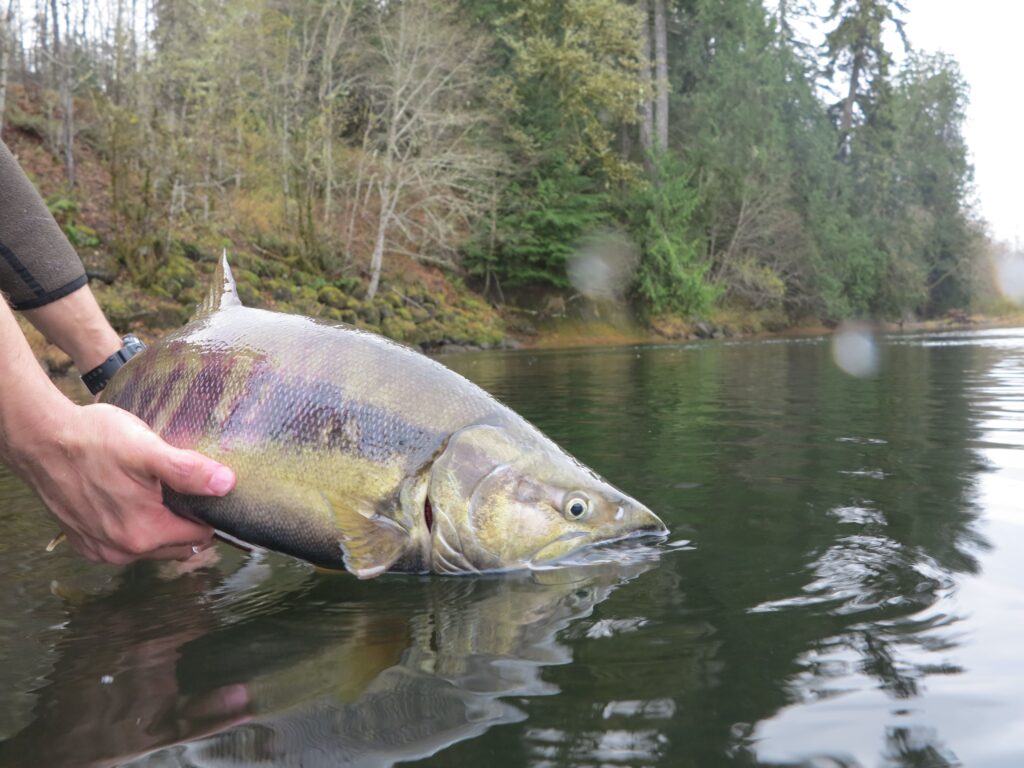
Regardless of which technique you do use, be sure to use one that will not only hook the fish legally (in the mouth) but also allow you to reel it in quickly, snap a photo, and then send the fish on its way.
Floating Jigs
Floating jigs tipped with a piece of prawn is one of the best techniques to catch chums. Not only is this an easy way to fish, but watching a float sink into the river while you set the hook is an adrenaline rush. What can seem like a mundane way to fish quickly turns into a frenzy of excitement.
Best of all, it is simple, works anywhere fish are found, and not just chums, but coho and early winter steelhead or late summer steelhead are also caught in this technique. Several years ago, while fishing the Green River near Seattle, we were drifting down the river in my drift boat and floating bright-colored jigs tipped with a piece of raw prawn.
The float went under, and to our surprise, a late summer steelhead jumped out of the water. A bonus fish that was also released to swim and spawn another day.
When it comes to floating jigs, it is best to downsize them to a ¼ ounce as they fish a bit better under the bobber than heavier jigs. But if you do want to keep things simple, the 3/8-ounce twitching jig does work under a float.
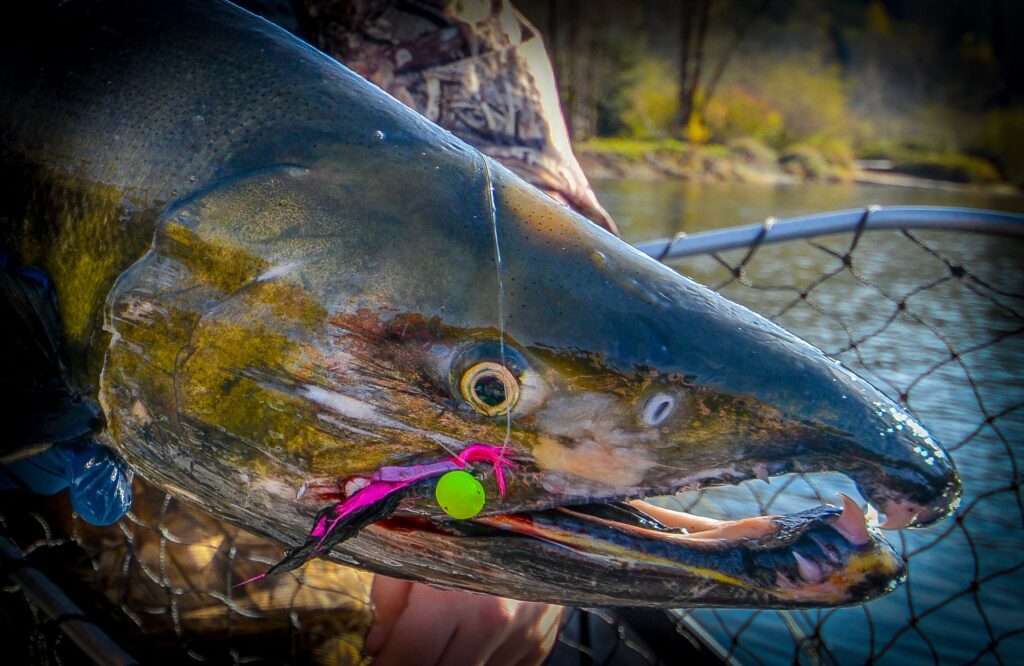
Regardless of twitching or float fishing, the jigs chums prefer bright colors. A white head with a cerise body is a good “go-to”, but so is chartreuse and black, as well as cerise and black, as the contrasting of bright and dark seems to entice the bite. Purple and pink are other top colors.
As for that piece of prawn on the jig- if you don’t have prawns, or just forgot to grab some from the grocery store, jigs take on scent really well. If using a marabou jig, then realize that the gels will ruin the action of the jig.
Instead, use Pro-Cures water-soluble products, with bloody tuna and sand shrimp being very popular for chum anglers. It is hard to beat prawns, and they are cheap bait to buy. A handful of prawns cost a few dollars at the seafood counter at the local grocery store.
You can fish them raw but another way to add contrast is to dye them with Bad Azz bait dye in purple, cerise, pink, or chartreuse. Keep in mind this dye will stain everything, so it is best to use a small amount and use disposable containers.
Twitching Jigs
Twitching jigs is another technique that will catch a lot of chums, as well as a coho or two that are still lingering in the river system. Here again, there are two schools of thought, the first being twitching to holding fish in deep holes and structure.
There is one spot on the Satsop river in Southwest Washington that is consistent each year. My son and I try to venture to this river every November when the coho are still in the system and the chums are just arriving. This one spot is a deep water slough that sits just off of a bend in the river with strong current. Fish, both chums and coho, stack up here, and we break out the twitching rods.
On one trip, we invited a friend who had just moved from Texas and had never caught a salmon before. Chums are a great fish for these types of trips. My son Ryan cast a twitching jig into this backwater and showed our friend Chris how to twitch. Then Chris cast the line, and on the second twitch of his first ever cast for salmon, he hooked a huge buck.
As the fish dove deep back into the hole, he looked at us and yelled, “this ain’t trout fishing!”. We hooked and landed several more fish that day, all on jigs, either floated or twitched.
Spinners
Spinners need to be ranked as one of the top techniques for chums, as they catch a lot of fish. It is hard to describe to an angler who has never used spinners before what it is like to hook a chum on one.
Casting out into a run and letting the spinner flutter and work its way across as you reel in, feeling the telltale “thump-thump” of the blade working, then, all of a sudden, the rod almost gets ripped out of your hands as a chums grabs the spinner and takes off.
Again, use bright colors, such as a size 5 Blue Fox Vibrax with a chartreuse body and silver blade. Hot orange and pink also work really well.
Spoons
Like spinners, the spoon bite can be a lot of fun. In Alaska, I don’t think you will find an angler’s tacklebox without a few pixie spoons in it. Gold body with a pink or red center work well.
Of course, Dardevle is synonymous with spoons, and the trusty red and white striped Dardevle works well, but so do bright greens, pinks, and reds. Spoon fishing is much like spinner fishing, except you do want some current with the spoons, where spinners can be cast out into deep holes and reeled in.
Swinging spoons is just that- cast out and take up the slack, and then let the spoon swing across the river to holding or moving fish.
P-Lugs
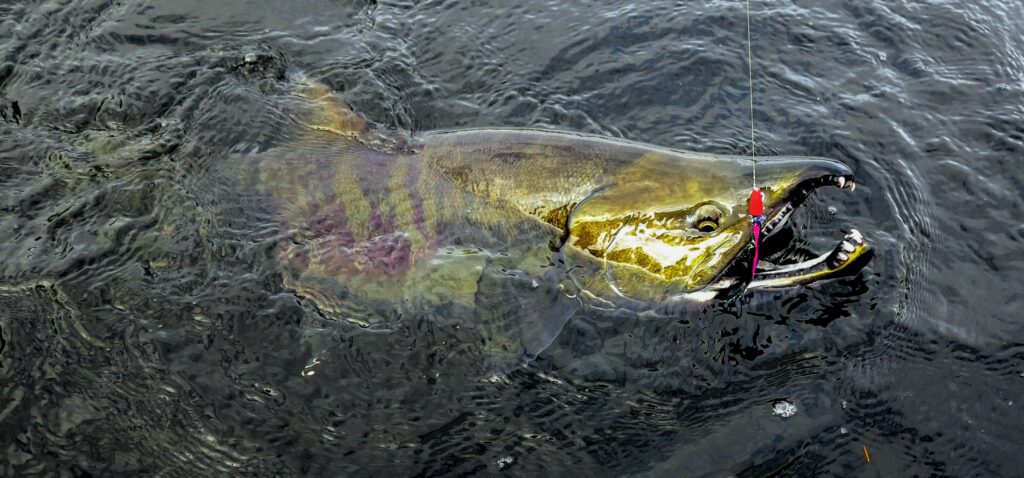
Lastly, big, gnarly chums like big, gnarly p lugs. A MagLip 5.0, or a K15-Kwikfish in bright colors either being back bounced or just simply plunked will catch chums. You can elect to wrap the plugs or just use some Pro-Cure Super Gel in herring, anchovy, or garlic, as it will stick to the plugs very well.
Back bouncing them down a deep hole is a log of fun and a great way to catch fish. If there is enough current, then pulling them in a traditional way also works well. It is a great technique for the newer angler if the person on the helm or oars knows how to pull plugs.
Simply put them out, place the rod into the holder, and then put your hands in your pockets. Wait until the rod loads up with a fish, and then put that drag on the reel to work.
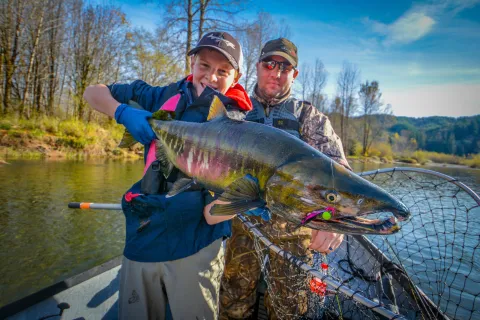
Regardless of which technique you use, just remember that these fish need to go upriver to make more fish. Try to get the fish in quickly and then release it after you let it rest and rejuvenate. Some will argue with me that chums are good to eat, and to that I will remind readers; “to each their own”.
For me personally, I would rather stock my freezer with coho for the barbecue and catch chums for the fun. They are big, aggressive, and put up a heck of a fight, and that is all I need to put them at the top of the list as one of the most fun salmon to catch.
/articles/top-chum-tactics
My Favorite Fall Coho Techniques
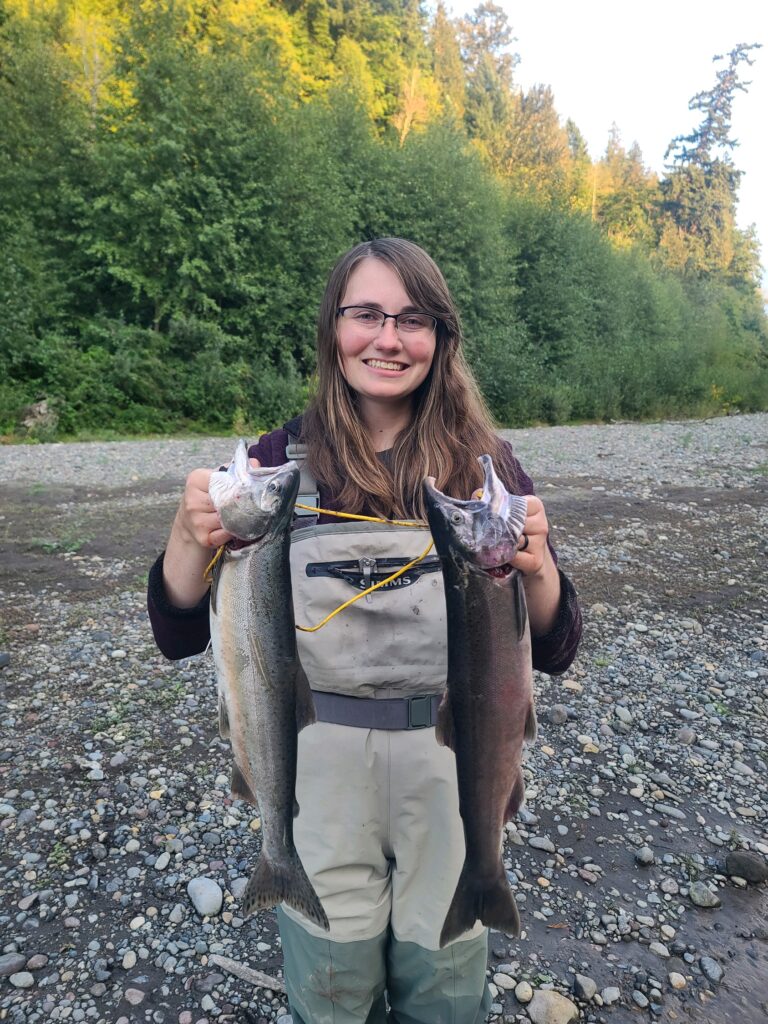
Even though the end of the year is approaching, don’t put away your salmon fishing gear just yet. There are still plenty of rivers teeming with coho salmon right now! These days, there are many different techniques you can use to catch fish on any river. Versatility is important, and river conditions change day by day. I recently went on a guided trip with Brianna Bruce of Livin’ Life Adventures. When we got to our spot, she told us that we would each be fishing a different method. The fish had been hitting different things every day. One day, they only wanted spinners. Another day, they wanted spoons. She began distributing rods- one of us fishing plugs, the other spinners, and so on until we were all casting and hoping to get lucky.
After about 20 minutes of this, another guide motored by on the way back to the launch with their limits. He told Bree that he had gotten all of his fish on eggs! She quickly began switching all of our rods to egg setups. Another hour later, we were back at the boat ramp with huge smiles and limits of dime-bright coho. If she hadn’t brought eggs along, we may have all ended up skunked! Versatility is crucial! Most days when I go river fishing, I carry 3 rods: a twitching rod, a float rod, and a spinner rod. I spent a lot of time getting familiar with each technique and when and how to deploy them. Let’s dive into how and why I use these techniques.
Technique 1: Twitching Jigs
If I had to pick one way to fish for coho, I would have to go with twitching jigs. They are extremely adaptable- I can fish any type of water with a twitching jig. There’s something so satisfying about seeing a big fish dart out of cover to grab your jig. Make sure to vary your jigging speed and length depending on the structure, depth, and speed of the water. Some days, you can let the jig sink to the bottom of a deep hole before you start jigging. Other times, you’ll want to do short jigs as soon as your lure hits the water. There’s no one way to twitch a jig. Color matters! I’ve had days where I fished one color for 30 minutes with no luck, and then hooked a fish on the first cast after switching colors. Most of the time, I use a 3/8 or 1/2 oz jig. My favorite colors are blue/black and pink/green. My twitching rod is a stout 7’6 rod with fast action. It has an extremely sensitive tip so I can feel those subtle bites, and the backbone to back up my hook sets. I pair it up with a size 3000 spinning reel. I use light reels to help avoid wrist fatigue. You can twitch jigs with longer, heavier rods, but I like my 7’6 rod because it translates even the smallest flicks of my wrist to the jig. I never hit the river without my twitching rod! There is a bit of a learning curve, as most fish will pick up your jig on the drop. You might feel the line tighten, or you may feel nothing at all. Most fish won’t simply grab the jig and take off. The majority of bites are subtle. Watch your line and pay attention to how it moves. It pays to fish high visibility braid so you can see exactly where your line is and what it’s doing in the water. Give twitching jigs a try, you’ll be hooked!
Technique 2: Spinner Rods
If I can’t get a fish to bite on twitching jigs, I’ll switch to my spinner rod. This is my 9ft, fast-action, moderate power rod, rated to throw up to an ounce of lead. It has the springiness to be able to launch spinners across long rivers, but the backbone to bring a monster coho to the shore. I often start off beginner river fishermen with spinners because bites are hard to miss. There are two types of spinners, and they both fish differently. Heavy-bodied spinners sink right away and can be cast perpendicular to the opposite shore. Light-bodied or unweighted spinners don’t sink as quickly and are better for shallow rivers. You can cast them out and swing them into the current like a spoon. Keep your rod tip low and reel slowly. Make sure to do 1 or 2 solid hook sets to really drive that barbless hook into the fish’s mouth. In murky water like the Carbon or Puyallup River, I’ll go with a bright-colored spinner, like chartreuse or pink. On clear, coastal rivers, I’ll fish a silver or copper-colored spinner. It never hurts to try something different, though! Don’t forget to pinch your barbs and switch out the treble hook to a single hook if required.
Technique 3: Floating Eggs
My third go-to technique for fall coho fishing is floating eggs. This technique isn’t very well suited for combat fishing, but if you can find a patch of slow-moving water all to yourself, this is a great way to get finicky coho to bite. Floating eggs is a relaxing way to spend the day. You tend to lose a lot less gear, and watching your bobber is therapeutic. You’ll want a 10ft to 11ft rod and 3000/4000 size spinning reel. Don’t use gear you don’t mind getting egg dye on! You can either use store-bought eggs or experiment with curing your own. I usually bring along 2 or 3 different recipes when I fish eggs. Sometimes the fish want pink eggs, other days they like red. You can experiment with adding different scents to your eggs, like tuna or herring. No matter how good your eggs are, you want to make sure you’re fishing them correctly, however. Experiment with your leader length by moving your bobber stopper until you’re hitting the bottom. Then, move it up 6 to 12 inches. That’s where the fish will see it, and, hopefully, bite it. Don’t forget to mend your line by lifting it up off the water and behind your float. This is where a long rod can come in handy, but it can make it difficult to fish in water with lots of overhanging trees and bushes. Float fishing is a highly situational technique, but it can be very deadly.

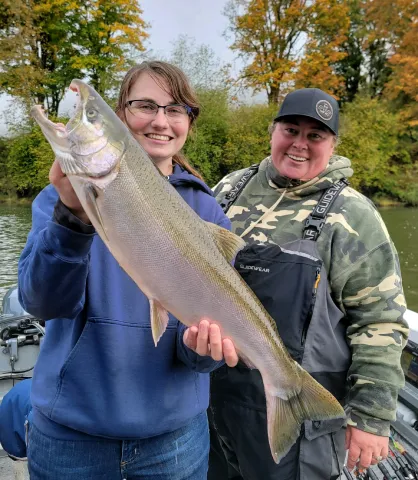
There you have my top three favorite fall coho techniques. When getting to my spot, I like to sit and watch the water for a few minutes to determine which technique to use. Floating eggs isn’t always possible if the river is flowing quickly. Similarly, when I’m fishing frog water, using a spinner can be difficult. The deep and slow water makes it difficult to reach the fish hugging the bottom. I find that it’s extremely important to be able to adapt to any condition. However, there are days when I want to challenge myself or get better at a technique and I’ll only bring out one pole. This is how I taught myself to be able to use twitching jigs in any situation. If you haven’t tried any of these techniques, hit the water and give it a shot. Make sure to read your rules and regulations, especially emergency ones. Hope to see you all out there!
/articles/my-favorite-fall-coho-techniques
No Kill Kalama
Sometimes we don’t get the fish, sometimes we don’t get the shot. And sometimes we don’t even think about it because there is just too much going on.
You are not going to get a slick fish picture, but I am going to let you in on a little secret called “License to Chill” on the Kalama River in Washington State. This underdog tributary of the Columbia River is often overlooked, but why? Well, it's hard to get to, and access is limited, but there are substantial year-long opportunities for salmon and steelhead runs. It's a sweet spot, roughly 45 miles long, and narrow enough to cast across to the opposite bank.
It may be relatively small, but when you're there you feel the pulse. It’s a mainline to the Pacific Northwest heartbeat. The swift mossy green waters amble through the Cascades from Mt St Helens to the Columbia.
License to Chill hosts 19 private acres of preserved forest, easy access to the riverbank, and multiple runs every year. Spring chinook get a lot of attention, followed by summer steelhead, coho in the fall, and the almighty winter steelhead running well into the spring.
Can you keep them? No. This is a strictly managed catch-and-release barbless fly-fishing stretch.
Should you pull them out of the water, take a picture, and admire your fish? No, what's the point of that? You're causing stress, suffocation, and possible internal injury. This river isn't for the eating fish, it's for the experience. No Kill Kalama is just the place to go if you want to unwind and wet your line.
I am one of those people who believes that all humans should have the right to forage, hunt, and fish for our own sustenance. And, why not fun? However, I also think we should absolutely look outside of ourselves at the natural world, sustainability, and what we are leaving for each other and our children.
This isn't a debate, but a few words to share what a great time I had on the Kalama River. If other like-minded folks appreciate the suggestion, then I'm pleased about that!
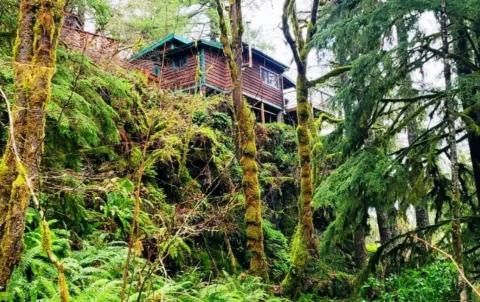
So much love and history has gone into this cabin and property. It is really one of a kind. At 90 feet above the river, you can feel it roar under you as you drift to sleep. If you like eagles, how about taking a shower outdoors while they fly above giant Red Cedars? It is epic!
/articles/no-kill-kalama
Hoodsport Chum
For salmon anglers in the Pacific Northwest, November heralds the final transition from targeting open saltwater to focusing on tidewaters and rivers. Yes, there are some saltwater opportunities (for example, blackmouth, when open), but the vast majority of anglers have put away their boats and are pursuing salmon in the rivers. That said, there are some prime opportunities to target and catch salmon out of your fishing boats, so don’t button them up just yet!
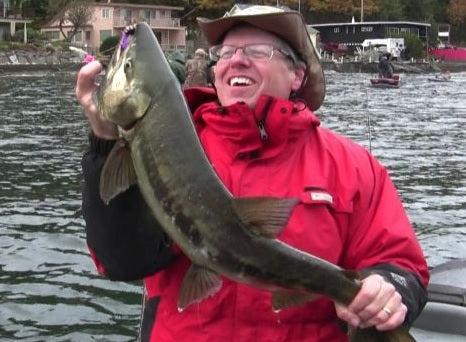
One of my favorite fisheries out of my boat in November has to be the Hoodsport chum fishery. The fight of a 10-15 pound chum ranks up there as one of the hardest fighting salmon you can catch. Taking on a chum with steelhead gear will give you all the battle you could ask for as these brutes slash and pull with every ounce of energy they have. One look at their fighting canine teeth and you’ll know this is a fish that is serious, very serious, about its reproducing goal.
All up and down Hood Canal you’ll find chum as they work their way toward their spawning grounds. The state hatchery at Hoodsport and three miles south of there at Potlatch (a smaller, Native American hatchery) are the destination for many of these chum as they work their way down Hood Canal.
I have caught fish in both locations, and each spot has reason to recommend it. Potlatch, being smaller, has limited shore angling and parking, which is roadside only. That said, there are also fewer anglers there. Hoodsport, meanwhile, is the Fishing Mecca that chum anglers are drawn to. Fishing right out in front of the hatchery and watching hundreds of fish jockey for position as the tide sweeps them into the small feeder creek leading to the hatchery is truly a sight to behold. Of course, along with the fish comes combat fishing in all its glory. As the tide comes in and fishing space decreases, getting to know your neighbor takes on a whole new meaning.
If you’re a fortunate one you’ll be fishing out of a boat – or some type of floating device. The waters around Hoodsport are open and the wind can come up and blow hard, plus fast running tides can make it a challenge to get an anchor to set. Be sure to bring an anchor with some bite, and terminal chain so you’ll stick in the rocky bottom. I’ve seen anglers fishing out of all manner of floating devices on calm days, including single person pontoons and float tubes. Be sure to have your life jackets on and just don’t venture too far off shore. If you are feeling anxious that’s your inner voice telling you a fish isn’t worth your life – pay attention to it!
For boaters, the launch is two miles south of Hoodsport at the Skokomish Park at Potlatch. The launch has two concrete lanes which are in varying state of repair (read that as back down with caution!). There is ample parking, and a restroom. Once launched it’s a quick run to either terminal hatchery, faster to the small Potlatch facility.
When you arrive, survey the already anchor boats, taking into account the amount of anchor line you’ll need to get a solid grip on the bottom, as well as the shore anglers. Anchoring too close to the shore bound anglers will earn you a steady rain of lures and weights at your boat. Stay outside their casting zone - you’ll have plenty of water to work over and opportunities to catch fish the shore anglers don’t have.
As to the type of gear you should bring… you’re going to enjoy a variety of methods to catch these Hoodsport chum. Like chum everywhere, chartreuse and green are always great colors to choose. Pink or cerise is also good color choices. For rod/reel setups I use my steelhead gear, both spinning reels and casting will get the job done. I like an 8 ½ foot medium action rod. Line should be strong enough to turn these big brutes so as to avoid massive tangle ups with your fellow anglers. I like 18-20 pound test. Chums are not leader shy in my experience so keep things hefty.
What technique you use is up to you but here are a few tried and true methods:
Floats and jigs , or floats and corkies with yarn can be deadly. A ¼ or 3/8-ounce pink, black or purple marabou jig fished under a float is deadly. Tipped with a piece of shrimp meat or coon shrimp tail is even better. The yarn is a nice trick as it helps by getting caught up in the chums teeth, allow you to drive the hook home. Other bait you can put under a float includes the ever popular anchovy or herring, whole or plug cut.
Think of the tide as the river current. Set your depth for the lure so it’s running a foot or so off the bottom. Vary the depth if you aren’t getting bites. These fish will hit suspended jigs. Cast “upstream”, i.e. up into the tide, and let your gear drift down with the tide to the end of the “drift”. If the coast is clear, free spool your line, keeping the float straight up and down to extend the drift. When the float goes under set the hook and be ready to do battle!
Twitching jigs – ditch the float and cast the jig on its own. Another effective technique, but be prepared for a lot of foul-hooked chum. Dragging a chum in by the tail is not fun, nor is it sporting to be snagging fish. If you find yourself foul hooking too many fish move on to a different method…
Casting spinners. Again, it’s a solid technique to try if the action is slow. I personally would remove the treble hook and use a single si-wash hook. A number 3 or 4 blade fished with a slow retrieve is just the ticket.
Corkie, yarn, and slinky. I personally have caught a lot of fish using this method and seldom snag fish. Again, think of the tide as a river. Cast out and let your gear drift. You’ll know you have a bite because your rod will be about ripped out of your hands. I use a 3-4 foot leader length.
Regarding the above technique, I’m sure I’m going to get comments about flossing – I personally think it’s a bunch of malarkey. Why do I say that? Because I remember a day years ago fishing Hoodsport when the chum were in thick, jumping all around us, swimming by in schools of 10-20 fish. I had my corkie/yarn/slinky set up going, casting, retrieving, and not getting a bump for a good hour. Suddenly, the bite magically turned on and my gear started getting bit. In came fish after fish, hooked in the jaw. Explain to me how one can have a steady procession of fish go by with mouths open for a good hour and not “floss” one fish, then suddenly start catching one jaw hooked fish after another? And trust me when I say this, those hook-ups were solid strikes, not to be mistaken with a snagging sensation. Anyway, the flossing debate is one we anglers love to engage in every year and likely will do so as long as we fish corkies.
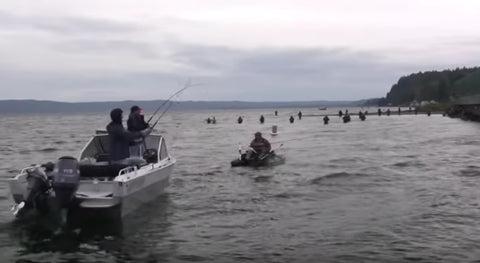
The fly fishermen do quite well at Hoodsport as well, fishing sinking tips and flies of various styles and colors. I’m not a fly guy but it sure does look like fun. Maybe on my next trip I’ll give it a try.
Before you set out, be sure to check the Hoodsport netting line at 360-877-5222. Typically the nets go in on Tuesdays and Thursdays, but this is not set in stone. There’s nothing worse than driving a hundred miles only to find nets spread in every direction. So save yourself that aggravation before you set out.
Fishing for hard fighting chum is a blast. Get in on the action this November!

/articles/hoodsport-chum