The Other Red Meat
It has been an awesome year for chasing salmon out on the salt, but if you are a Marine Area 7 (San Juan Islands) fisherman you may be thinking now what? MA 7 chinook is closed for the year. At this point, there are limited fall chinook opportunities for our Western Washington salmon slayers. Then halibut, although the fishery is open through September 29th most of them are out in the open ocean doing halibut things. Lingcod are closed for the season and our rockfish fishery continues on a long-term conservation closure… What do we fish for? Why not chase San Juan Island coho, the other red meat?
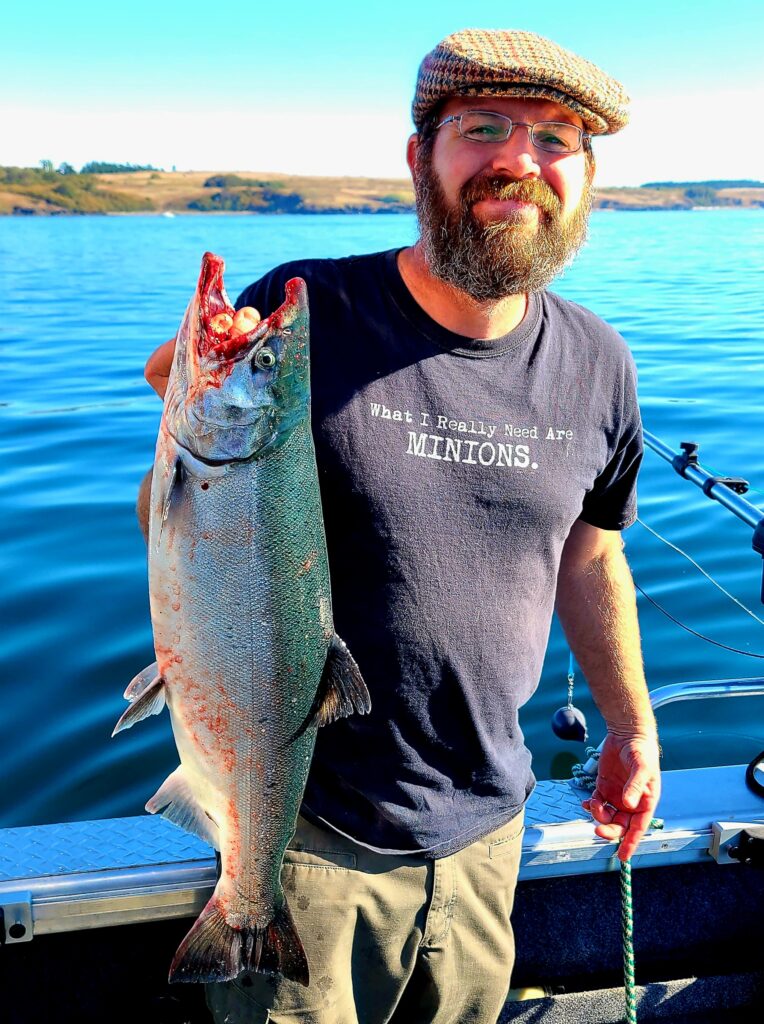
As always review the regulations and Emergency Regulation notices before heading out but the current season is modeled as being open as follows:
8/1-8/31 2 coho no minimum size, release wild fish
9/1-9/29 1 coho
When heading out to hunt San Juan Island Coho, make sure you are aware of the southeast MA 7 closure, and if you plan to fish the banks be cognizant of your actual location. Know where the Canadian border is and where both the MA 7 and MA 6 boundaries are.
Regarding regulations; this year there has been an increase in the number of WDFW staff Safety and Security Incident Reports filed for harassment of WDFW personnel. The Safety and Security Incident Reports relate to negative interactions with anglers and were submitted by Puget Sound Sampling staff over a two-month period this summer. The negative interaction makes WDFW recruitment and retention difficult and staff have quit their job over the treatment they've received this summer.
RCW 77.12.071
Sampling of fish, wildlife, or shellfish by department employees.
- (1) Department employees, in carrying out their duties under this title on public lands or state waters, may:
- (a) Collect samples of tissue, fluids, or other bodily parts of fish, wildlife, or shellfish; or
- (b) Board vessels in state waters engaged in commercial and recreational harvest activities to collect samples of fish, wildlife, or shellfish.
- (i) Department employees shall ask permission from the owner or his or her agent before boarding vessels in state waters.
- (ii) If an employee of the department is denied access to any vessel where access was sought for the purposes of (b) of this subsection, the department employee may contact an enforcement officer for assistance in applying for a search warrant authorizing access to the vessel in order to carry out the department employee's duties under this section.
- (2) Department employees must have official identification, announce their presence and intent, and perform their duties in a safe and professional manner while carrying out the activities in this section.
As a participant in our recreational salmon fishery, please remember that the department is required to monitor the fishery. If they do not have the staffing or there are safety concerns, they may have to close a given fishery because they are unable to monitor it as required under the Federal Fisheries permit.
Once you’ve sorted through the regulations and generally know where you are going, what’s the game plan? During Coho season a good chunk of MA 7 will have coho available. Many of the points along the SW side of San Juan Island produce tide rips that will concentrate bait. Find the bait and coho will be there. This time of the year coho put on the feed bag and fatten up for their spawning rituals. Instead of naming off several already busy point fisheries think bait.
Generally, coho will be found anywhere there is bait. Meter around offshore from the point fisheries and look for bait. Study your charts and note any high spots or ridges that will create a current break and have a look.
You don’t need to find a boiling tide rip, even a subtle rolling seam along an otherwise glassy sea will hold bait. Look for seabirds, a bunch of diving birds sitting on the water means deep bait. a flock of gulls, either floating around or on the wing usually means shallow bait, so continuously keep a lookout for birds.
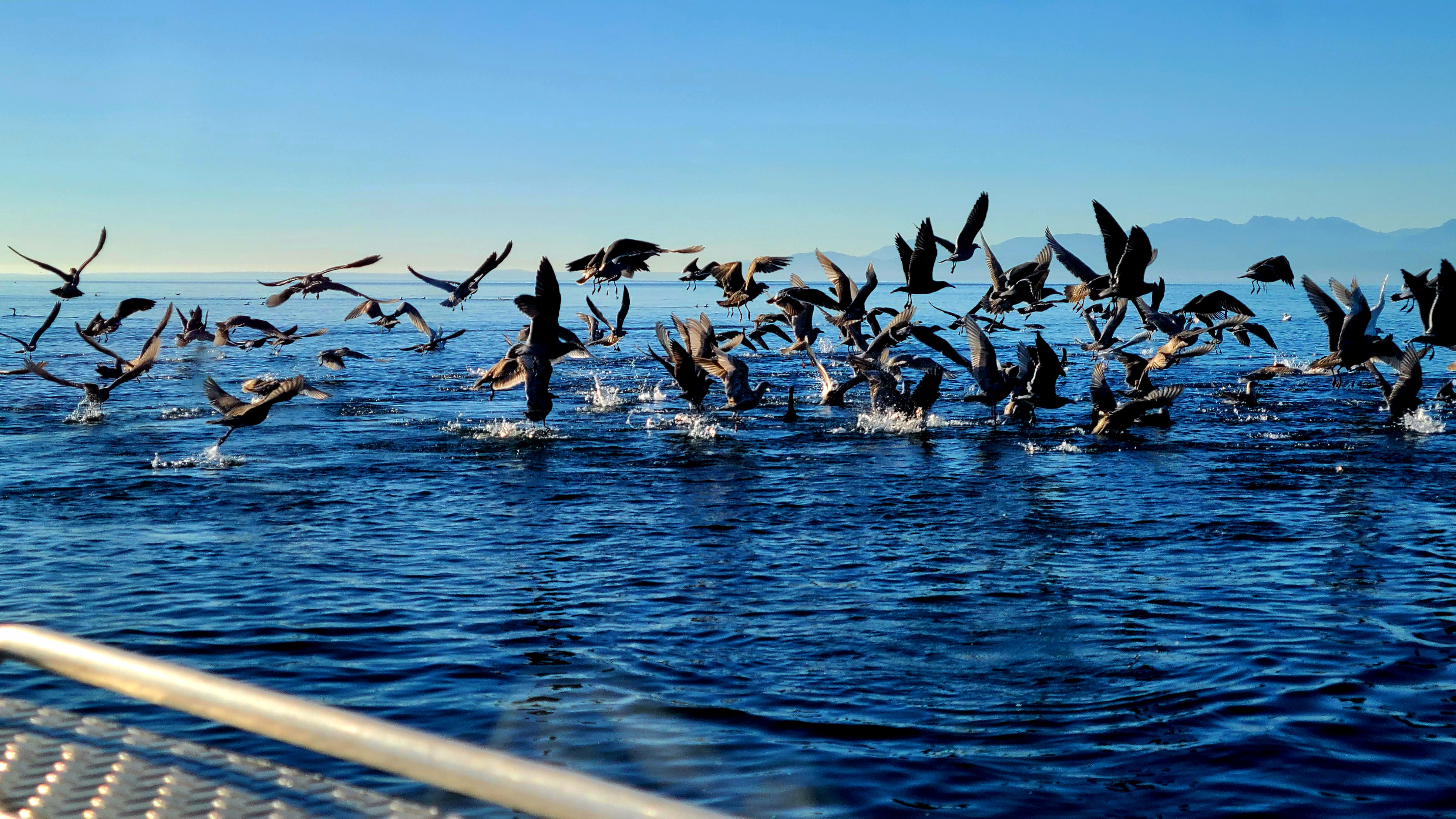
They are kind of the blue light special for coho fishing. Although fishing with the flotilla puts a lot of coho on ice each year, consider finding fish outside the masses. The key to locating coho is locating the bait, find the bait and you will find coho.
One previous September morning, after a quick stop at Holiday for nonethanol and a freshly made breakfast burrito I was off to Cornet Bay. On arrival, I found the bay glassy calm with no wind and was in the water in no time. Fishing with good friends we had agreed to meet at 5:30. I visited with my dock mate and readied the boat and gear for our adventure.
5:30 sharp a set of headlights signals my guests' arrival and we were on the way shortly thereafter. We were handed a gift; the water was dead calm as we motored our way through the predawn darkness. We planned to fish for coho in the Eagle Point area along the south side of San Juan Island. The point was really crowded so I headed offshore to look for bait.
We found a very subtle current break with a number of diving birds sitting on it. Although I had three downriggers onboard, one had problems so we were running 2 and focused on chasing meter marks. We would be rotating through hookups. With very few other boats around we went gear down and started the hunt.
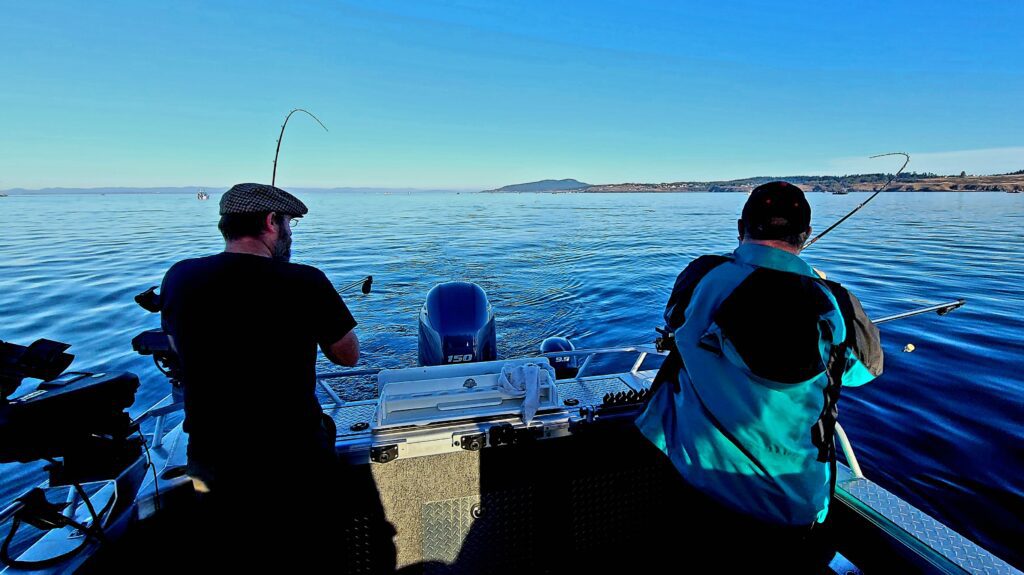
Running only two downriggers turned out to be a blessing because we were on fire. Every hookup turned into a double. Enjoying nonstop action, we had two people fighting fish and one on net duty (2 nets onboard) as we cycled through our rotation. When it was over we had lost about 10 or 12 fish, released a number of fat wild fish but still got easy limits of 8# - mid-teens coho.
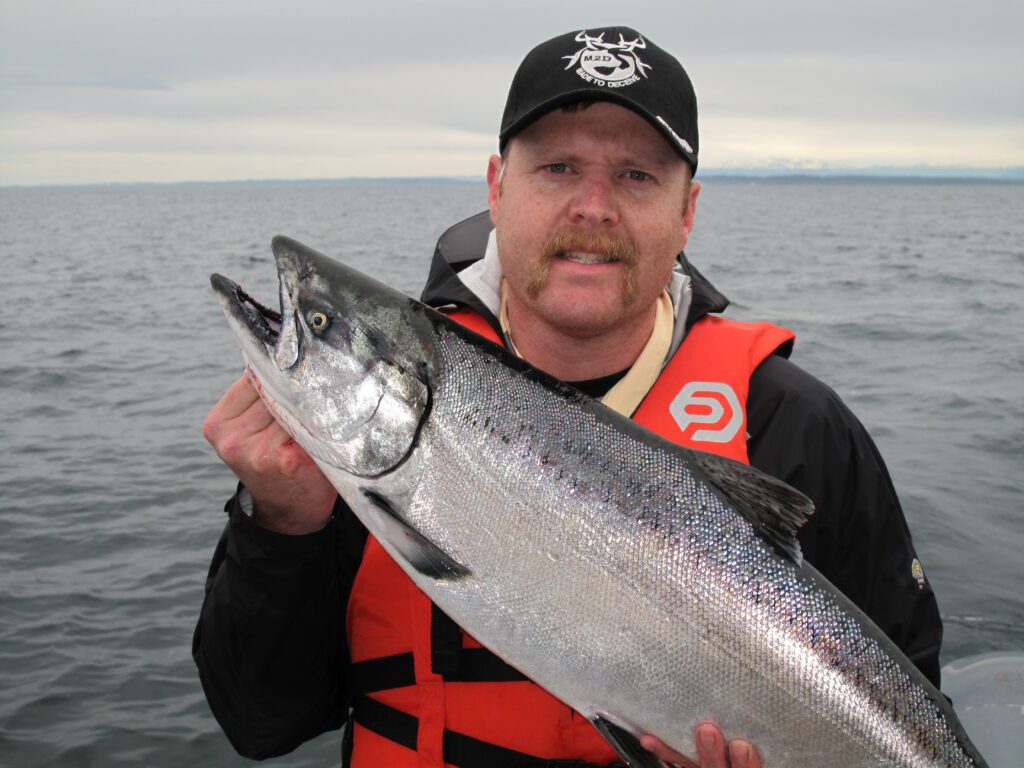
It was a stellar day of coho fishing and other than some sore arms my guests had an absolute blast. It was one of the best coho days I have ever experienced. Although I was the skipper, I give credit for our success to a handful of diving birds sitting on a tide rip.
Although many coho are caught on the surface with a cut-plug herring or on trolling flies MA 7 coho are a downrigger show. While most days there is a butt crack of dawn surface bite and occasionally during the day you’ll get a fish with weight or a diver running at 33 pulls, downriggers are a must. Downriggers allow you to target feeding fish.
Regarding gear, probably not a popular opinion, but I think that MA 7 coho are brainless feeding machines. Once they move into the inner sound, they are more selective maybe even smart. In the straights, they focus on their next meal. We have caught coho that were either barfing up small herring or had a number of herring tails sticking out of their mouths, yet they had just snarfed down a hoochie/flasher rig.
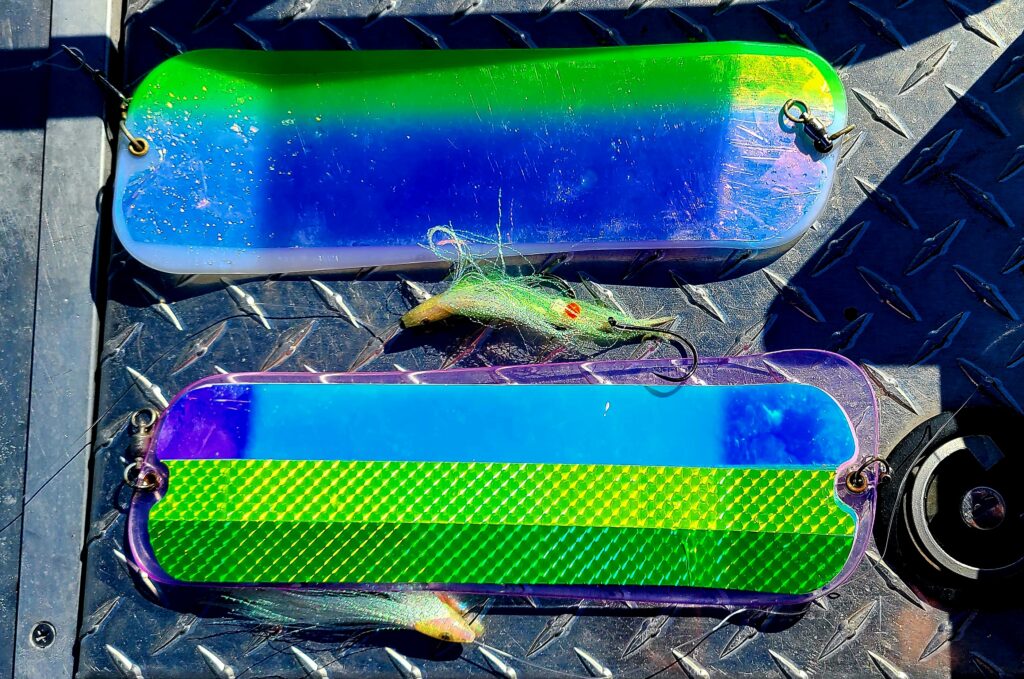
You can’t go wrong with a flasher/hoochie of a flasher/spoon combo. Some version of green or chartreuse would be my starting point but if presented correctly almost any color will work. Many other lures will work too. Consider an Old Goat Lure, a herring or anchovy in a helmet, hoochie/Wigglefin Action Disc combo or even a spinner/bait rig. While coho fishing I always run 11” flashers and the color will vary depending on what the fish want the day that I am fishing.
The day that I took my friends out we found huge schools of small bait so we sized our flies and spoons accordingly. We were running 32-34” of 30# fluorocarbon leaders with a 20’ setback from the clip. All our fish were caught with between 60’ and 140’ of cable out while trolling at 3.2-4.0 mph. The flies we were using were 2 barbless hook rigs and I tipped the lead hook with salted herring strips. The spoons were lathered up with either anchovy or herring goo and also ran on 32-34” leaders.
I want to address the MA 7 weather. I work 5 to 6 days a week on the water in MA 7. While working in the San Juans last year I encountered a significant squall line of thunderstorms. Basically, the weather went from summer boating weather to “what the heck” in minutes. It was windy, pouring icy rain/hail, and very dark. Then the thunder was relentless and deafening.
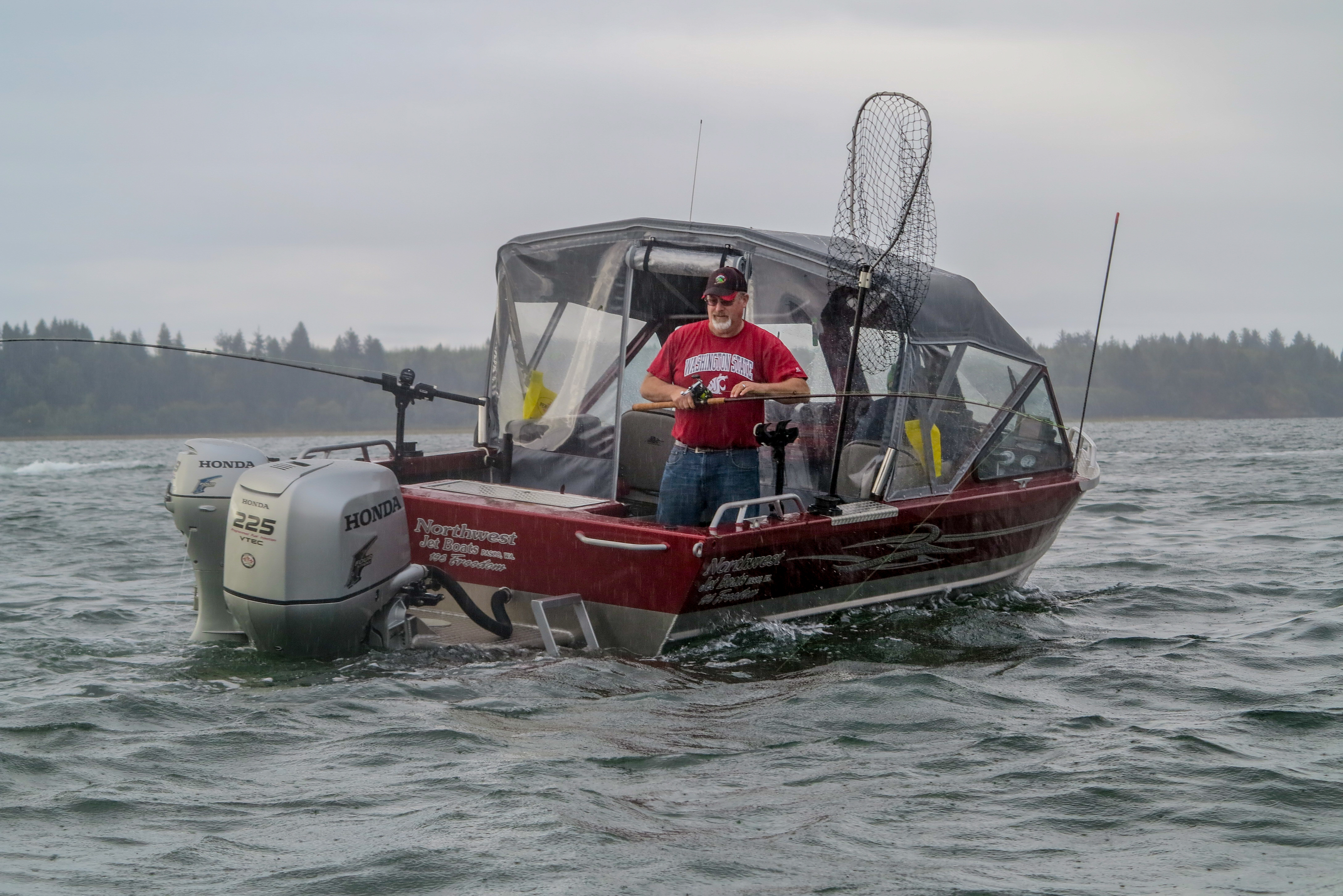
Coho season falls while our typical summer boating weather is transitioning to an unsettled weather pattern. Most of the time the sea conditions will be very pleasant. But be aware of and prepared for changing conditions. If the forecast is questionable don’t go, or at least proceed with caution. A 15-mph wind against a running tide can be uncomfortable or even dangerous.
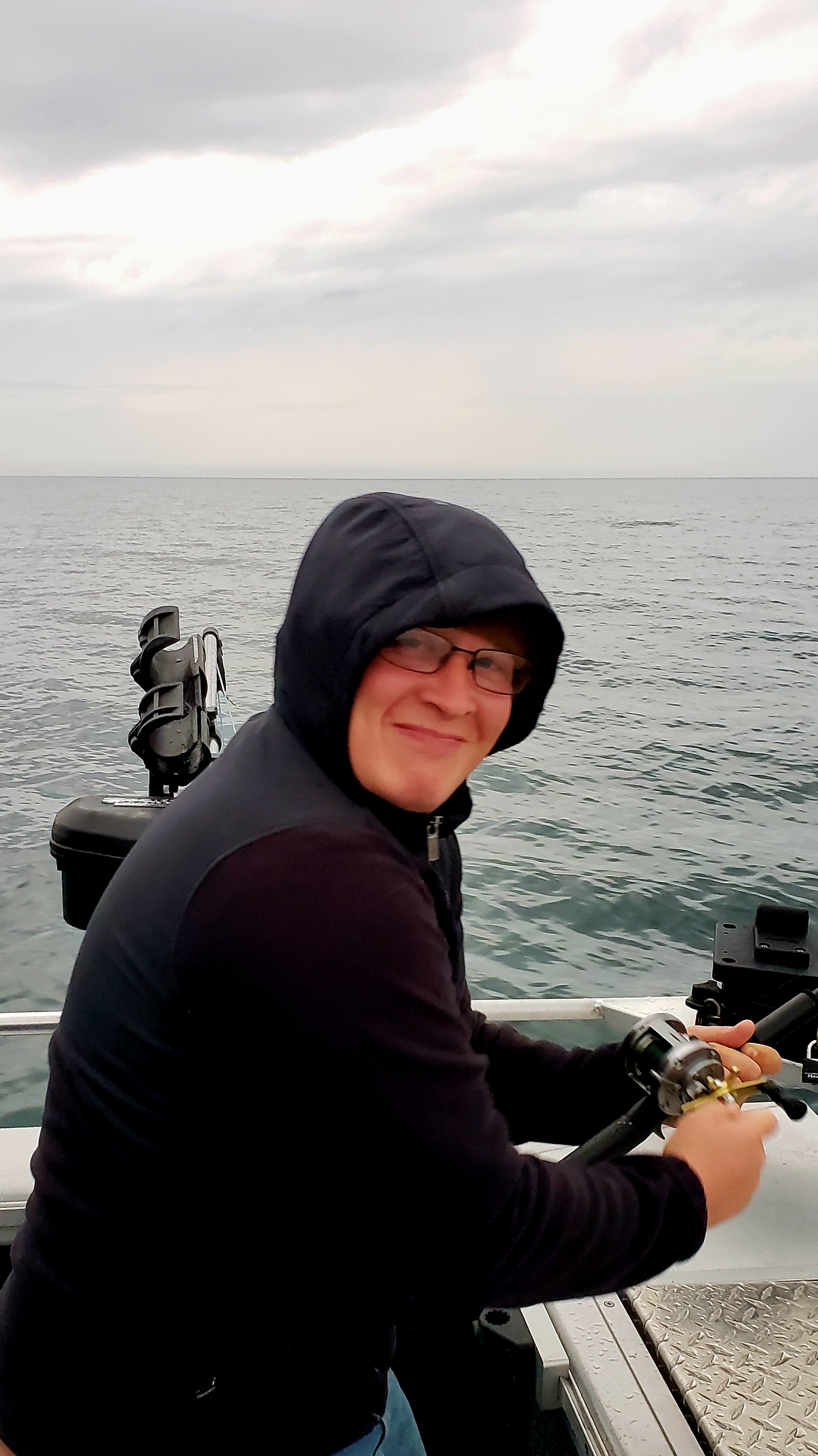
Especially as you depart/approach Deception Pass/Cornet Bay, a key launch area for MA 7 coho. Know the limits of both your boat and crew, and have properly fitting life vests for each person on board and the required safety equipment. Make sure that you have adequate fuel on board, with the longer runs to the fishing grounds and the potential for inclement weather this is not the fishery to play chicken with your fuel gauge. Always err on the cautious side.
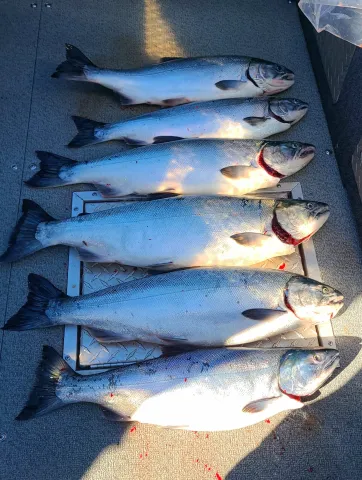
Have a game plan for caring for your catch. It will be different for each skipper but have a fish bonker, a bleed bucket, or divers clip and ice available. Once you determine you have a legal fish in the net, stun it to prevent bruising. Then tear or cut a gill, bleed the fish, and get them on ice as soon as they are bled out. Coho are excellent table fare when properly cared for.
Good luck in your quest to catch a box full of San Juan fall coho. It is an ideal family fishery. They are relatively easy to find, usually hungry, and have some serious shoulders. Pack plenty of snacks (no bananas), watch the weather and think safety. Good times and you will find your freezer full of the other red meat, San Juan Islands coho!
/articles/other-red-meat
Bright Salmon on a Sandbar
An up-close epicurean angler perspective on the making of a Travel Channel special with Chef Andrew Zimmern.
It mattered to me. It mattered to Josh. It mattered to Andrew Zimmern, the host of Bizarre Foods on the Travel Channel.
On the Columbia, where the chinook blast upriver on swells of tide from the mouth of the river up past Washougal and then seek out the 12-16-foot deep travel corridors close to the banks, the hot salmon bite happens in the first hour.
It didn’t matter to the 17 other people on Zimmern’s crew.
Zimmern was following the Lewis & Clark trail with a perspective on the types of foods the explorers might have encountered. He chose September when the fall chinook salmon (also called king salmon) run is in full swing.
We started in the second hour, on a Tuesday in September, after camera operators, directors, drivers, handlers, drone techs, and a bodyguard were breakfasted, caffeine’d up, and constitutionalized.
Josh Cooper, stood, his hand on the tiller, his eyes on the water ahead. We idled away from the Rowena launch (Mayer State Park, west of The Dalles). Ahead of us, 64 other boats were on the fish. Rods bent and nets flashed as we took our place in the throng of watercraft.
Cooper, who makes his home in Vancouver, WA, our captain for the day, is one of the best anglers on the river. But sometimes that’s not enough. The bite was over when we dropped our baits.
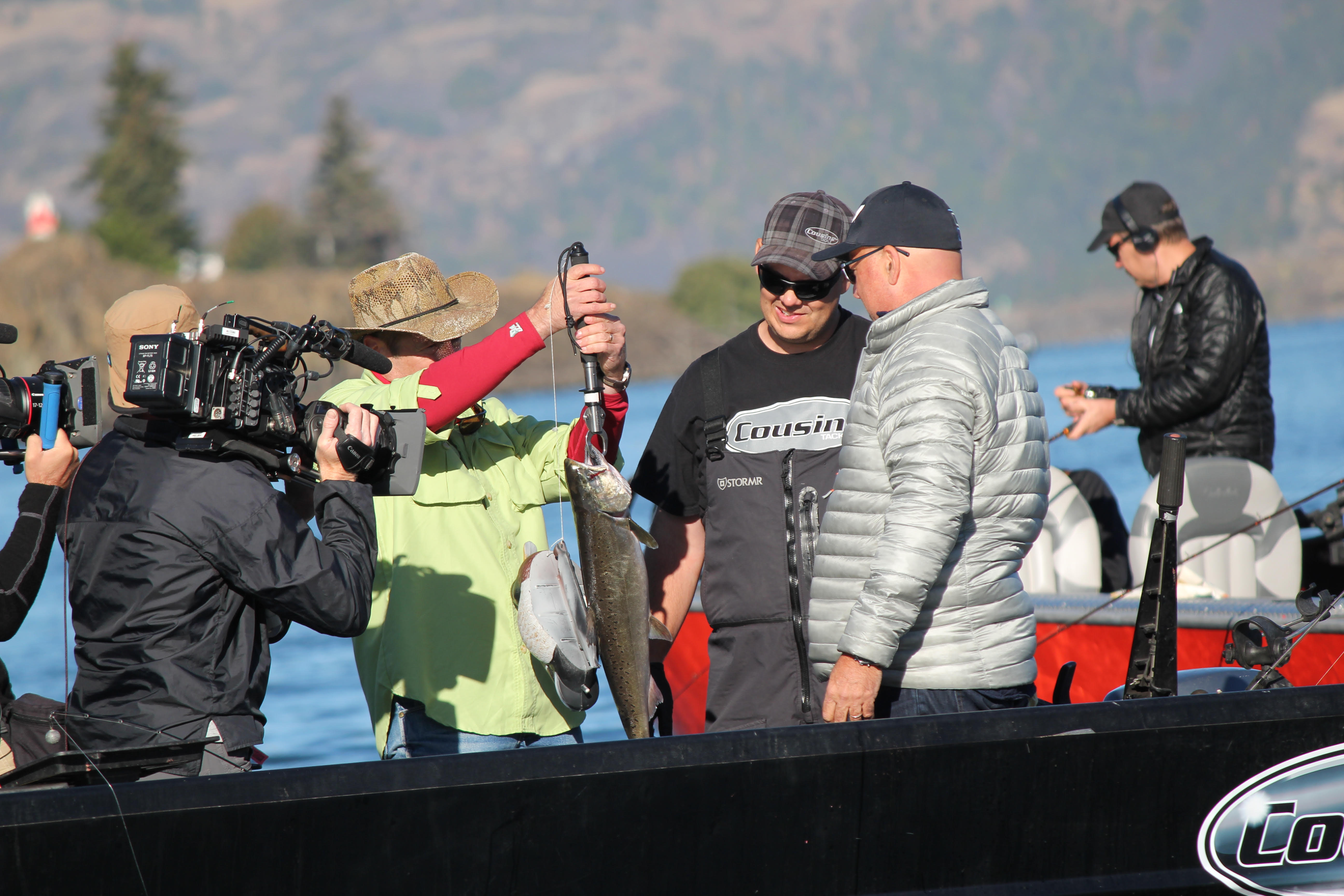
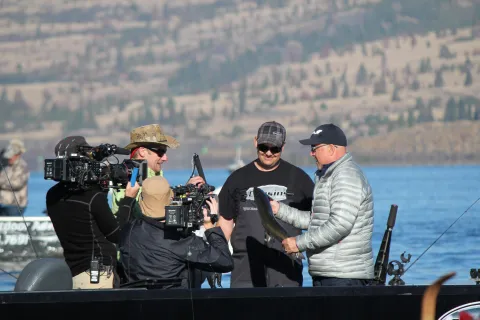
With us, on Josh's 26-foot Motion Marine Fishing Machine were two camera operators and a sound technician. A camera boat trailed in our wake with the director and additional camera operators. A drone operator and his team staged on the Washington side of the river near the mouth of the White Salmon. The bodyguard stayed on the beach.
Zimmern is no stranger to a fishing rod, but he hadn't fished for Columbia chinook before.
We showed him the baits, hoping he wouldn't gobble them or try to get us to eat them.
We call this hover-fishing when the fish stack two feet off the bottom and we drift our baits into a bio-mass of salmon, as drag-free as possible.
I looped a cluster of cured salmon roe and a sand shrimp tail on a blood-red Daiichi hook. We drizzled Pro-Cure Tuna on the potpourri in case our prospective salmon had cultivated palates.
To hover-fish, the procedure is to start at the top of holding water and run the boat a bit slower than the top currents, the baits "hovering" off the bottom.
Zimmern's rod had a Daiwa line-counter. Without digital advantage, I dropped the lead weight to the bottom and then cranked up two turns.
We tried to follow the contour of the river bottom. When it sloped up, we reeled up, when the water deepened, we dropped weights down to touch, then cranked up two turns.
Fish bit. They flared their gills, inhaled to sample the salmon eggs and shrimp then spit the baits.
Josh missed one. Andrew missed two and I missed a fish.
In the east, the sun climbed higher. Our chances diminished. A drone like an angel flew overhead and three hundred pairs of eyes on 65 boats looked to the heavens.
Then it happened! A fish bit and the hook stuck.
Andrew arced the spine of the rod against His Majesty, the king salmon. After a few tense minutes, a seven-pounder thrashed in the net.
I looked at it, pronounced it a female, and guessed Zimmern would try to spoon-feed us salmon eggs. With one in the boat, we motored away, back to the ramp where the crew had assembled a grill and Dutch ovens.
While a director in cowboy boots stalked up and down the beach, cigarette in and out of his mouth, eyes flicking from one element of the scene to another, Zimmern’s knives flashed. When I angled in to check on the ingredients, I saw prime red-fleshed steaks and two skeins of milt. Milt! Our fish was a male.
In a male salmon, the sperm we call milt lies in two foot-long rolls. About an inch in diameter, the texture of fresh liver, it is often discarded. It shouldn’t be.
On a sandbar on the big river that is the lifeline of The West, there is no better way to taste the elemental flavor of the salmon.
Roasted lemons, eggplant, and onions. Rice and a reduction. Zimmern wasted no motion.
Flames licked at the grill. Seasonings are seared into vegetables, salmon strips, and organs. In moments we held salmon bowls while the good smells wafted out to fishermen still angling for their limits of bright chinook.
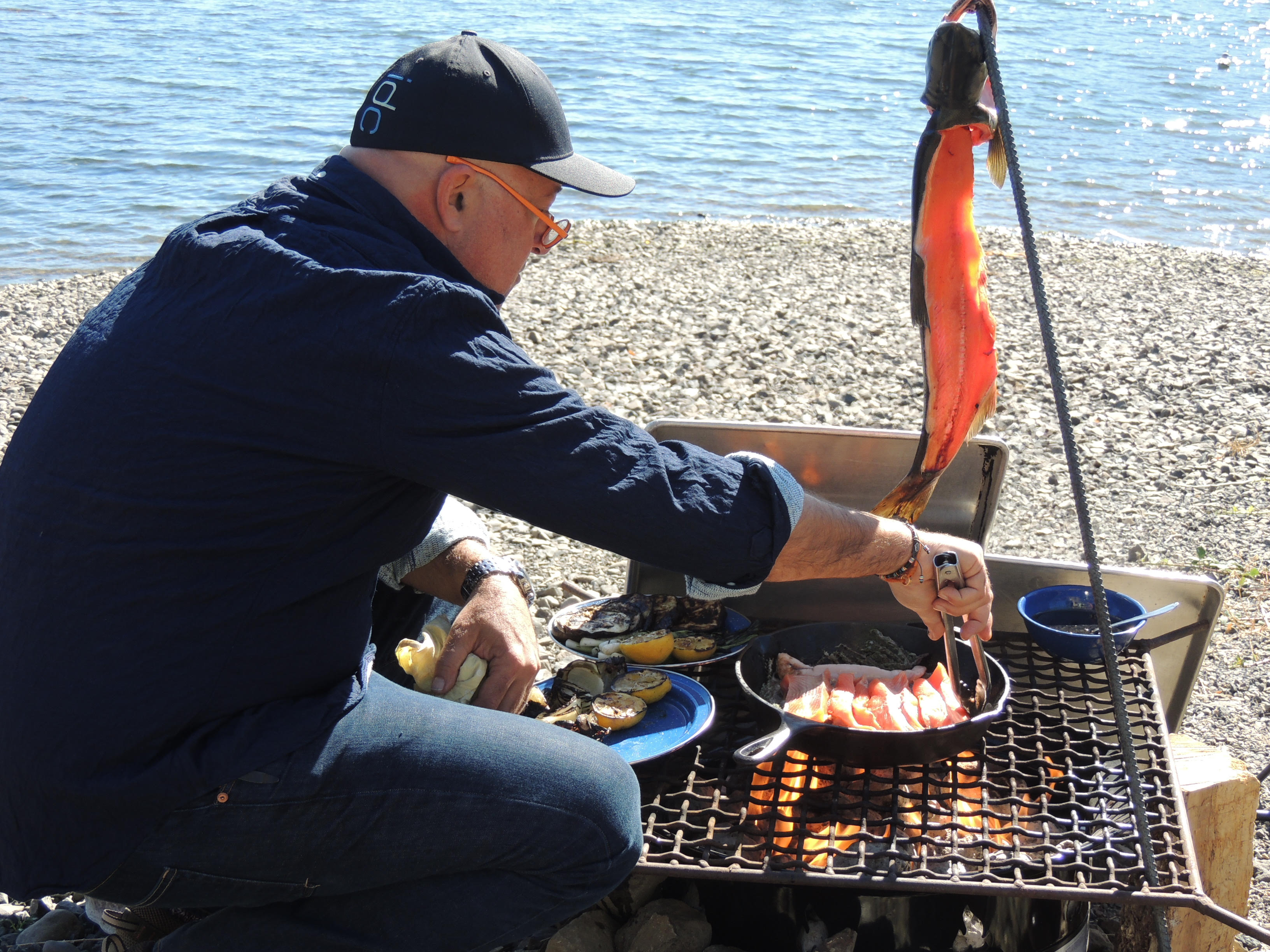
The best place to eat salmon is on a sandbar in September. We ate the strips of salmon with forks and fingers. We ate the milt and proclaimed it worthy. Milt and eggs. These are the building blocks of the protein that energizes the Columbia River. How does milt taste? It cooks up like a better version of tofu and it adds a certain something to a salmon bowl.
This was Zimmern's first time fishing for fall Chinook. While we labored for a bite we talked fly-fishing and grouse hunting. And it was a chance for me to get a glimpse into the machine that was a big Travel Channel production. At the heart of it all was a chef who was a risk taker, story-teller, all-showman, and a real sportsman.
# # #
For a copy of the Fishing Central Oregon book, send $29.99 to Gary Lewis Outdoors, PO Box 1364, Bend, OR 97709 To contact Gary Lewis, visit www.GaryLewisOutdoors.com
/articles/bright-salmon-sandbar
Gear Up for Puget Sound Coho
Grab your rods and coolers, it's time for Puget Sound coho! As far as saltwater salmon go, coho tend to be aggressive and eager biters. You can find them in most areas of the Sound, and the bite will only improve as the season progresses. Coho are plentiful and tasty! They taste good when caught in rivers, but you can't beat a chrome coho fresh from the salt. Having the right strategy, the proper gear and good preparation will help you get a boatload of coho this summer!
Trolling is the most popular way to catch these Puget Sound coho. It's a great way to cover water and adjust your depth based on the fish's location. Having the right gear is certainly important, but having a good strategy makes all the difference. I recommend getting an early start and fishing shallow. As the day progresses, fish deeper. Watch for marks and don't be afraid to drop your gear right down into the fish. Pay close attention to your fish finder.
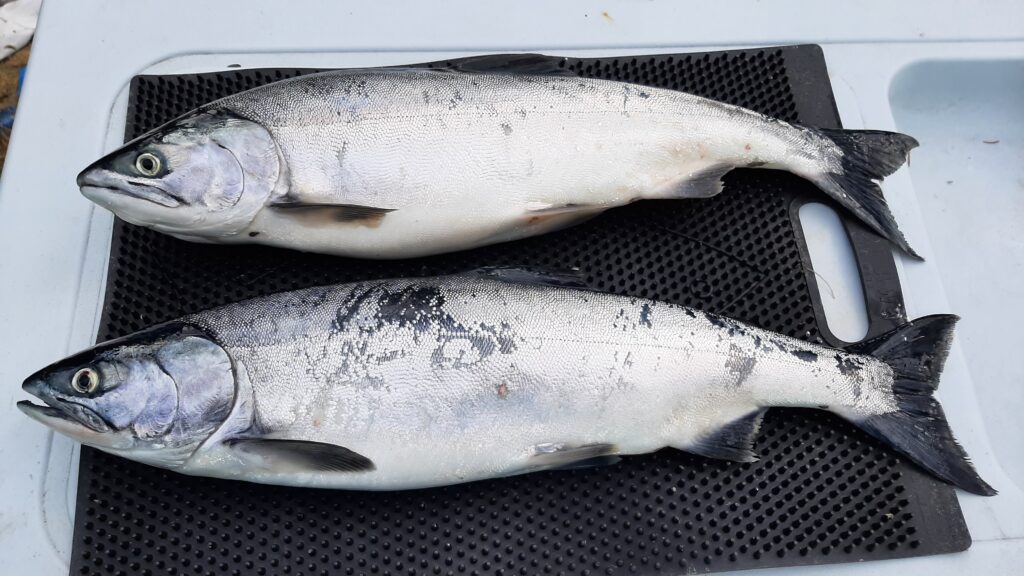
Coho will school up most of the time, so don't be afraid to circle back to wherever you get bites. Coho like a shorter setback than you'd think. I usually use a 50 to 75-ft setback. Trolling speed for coho can be a controversial topic. Speeds anywhere from 2.5 mph to 3.5 mph will work. Here again, is where having a fish finder is crucial. In addition, study tide tables ahead of time. It's no secret that coho love a good tide change. Targeting tide changes early in the morning often results in a full cooler.
So, what gear do you need? There are several different ways to go. You can use trolling flies, herring, spoons, plugs, or spinners. Sometimes coho can be picky, so it's best to employ a variety of lures. You'll want to run your lures behind a flasher. Many different tackle companies make flashers that work well. Don't forget to smear your flasher and lure with a bit of scent! Coho are smart and some scent can fool them into grabbing your lure a little longer. Most days, coho just can't resist herring. They're out there feeding before going into rivers to spawn, so they're hungry! Don't be afraid to add a herring strip to any lure. You can brine up herring strips ahead of time and attach them to hooks, tie herring bellies to your plugs, or stuff your plugs with herring and tuna. Some fishermen dye their herring during the brining process, others don't.
Knowing the right spots to fish is an important part of your prep work that you should research ahead of time as well. The fish start flooding into the Sound through the Strait, so fishing will be best up north early in the season. My experience fishing for saltwater coho is within Marine Areas 9 and 11, so we will discuss those locations here. The oil docks, shipwreck, and Picnic Point are all well-known producers.
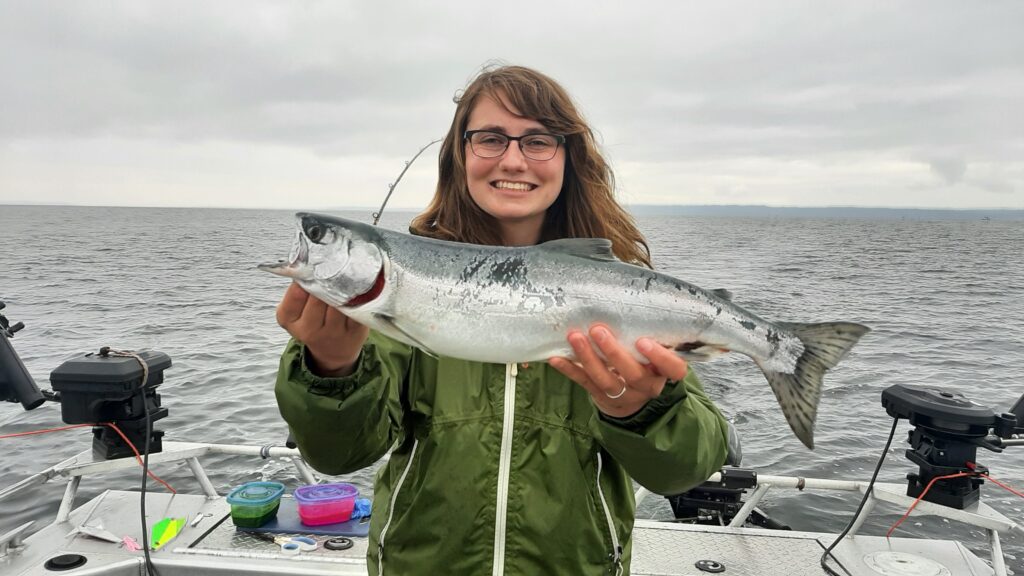
You can launch your boat at Edmonds, Mukilteo, and Whidbey Island. Just be mindful that you don't accidentally cross into another Marine Area once you have fish on board. Sometimes you can keep wild fish in one area, but not in another. In Marine Area 11, common spots include the Yacht Club, Dash Point, and Browns Point. In both areas though, I'd caution against just following the crowd. Don't be afraid to study maps and find your own spots. Points and bays are always good places to start.
Preparation is key! Make sure to check for emergency rules before heading out. Don't forget to brine your bait ahead of time and grab ice to ensure your catch stays cool. Grab those life jackets and check the weather forecast. The Sound can turn nasty at the drop of a hat, especially for small boats. Preparation can make all the difference between a cooler full of coho and a day of disappointment. I'll leave you with a story to help drive this point home.
One day, I was out on the Sound fishing for coho on Mike Carey's boat with another friend. The day had started well- we got on the water at the crack of dawn and saw lots of fish on the meter. We started getting our 3 fishing rods set up when my friend said "Uh oh... I forgot my fishing license!" Mike and I immediately stopped setting up the 3rd rod and told my friend he was on boat-driving duty for the rest of the day. It went from a (potential) 6-fish day to a 4-fish day for us. Preparation is everything! Do your research, make a checklist, and give yourself plenty of time to get ready. Have fun and go catch a cooler of coho!
/articles/gear-puget-sound-coho
August 2024 “Ocean Salmon Update”
When it comes to fall salmon, anglers consider August to be part of the time of year when pumpkin spice lattes and crisp mornings are the norm. The eighth month of the year is technically still summer but anyone who has headed to the ocean this time of year can feel the chill of an early fall coming on. Fog and rainstorms are normal, along with high winds and rough seas but then there are the days of bright sunshine and hot temperatures that remind us it is still summertime, even if only for a few hours in the afternoon. Much like the weather, salmon fishing can change in an instant… Mostly in the form of regulations.
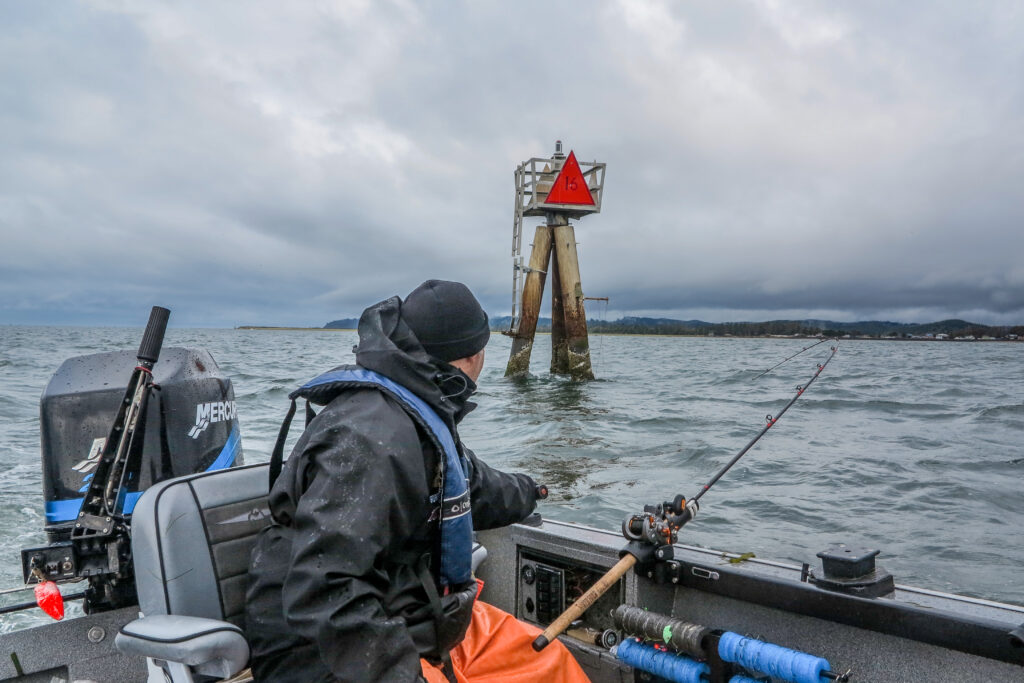
August ocean salmon fishing is all about the rules and emergency closures and openings. The fish are regulated by quotas and estimated returns to natural rivers so be sure to check the regulations and emergency rules daily and be ready to change your location to fish as often as you switch out your cut plug herring. Knowing the rules also means knowing where you are fishing.
Marine Area 1 is slated to be open for salmon fishing in August for both chinook and coho and this is where anglers will be targeting fish stacked up to enter the Columbia River. Known as Buoy 10, the famed August fishery at the mouth of the Columbia River continues out beyond this buoy marker but is considered Marine Area 1. Depending on sea conditions and bar crossing, fishing can be good out in the open ocean. Especially for coho as the chinook are mostly staging in the brackish water and rushing into the Columbia with each tide change. Coho will stay just offshore a bit longer as they prefer to enter the river in September and into late fall.
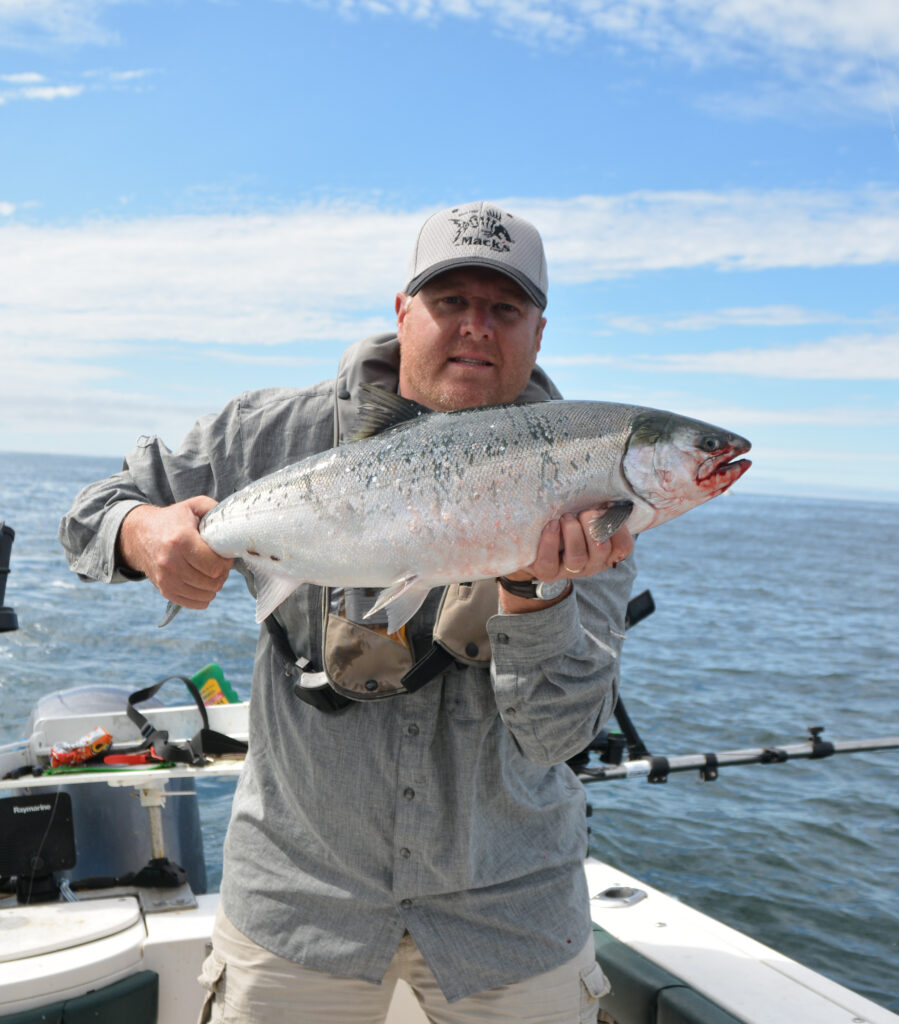
Keep an eye on the Buoy 10 rules and regulations as well as any emergency closures or adjustments. If you have the right boat and navigation skills to cross the deadly Columbia River bar, then Marine Area 1 could save your trip if they close or restrict the Buoy 10 fishery. The same goes for about every ocean area you need to know before you go.
Marine Area 2 gets a little more complex come fall. You can still hit the open ocean from the tiny town of Westport. Extremely popular in July when it first opens Westport becomes a mecca of salmon anglers come August. The complexity comes from the Marine Area itself which is broken down into three segments. Marine Area 2 is the open ocean and is slated to be open, but most likely for coho as the chinook quota gets eaten up quickly as the fish pass by heading to the Columbia or start to stage for Grays Harbor and Willapa Bay. This is where Marine Area 2 is broken down into sub-areas.
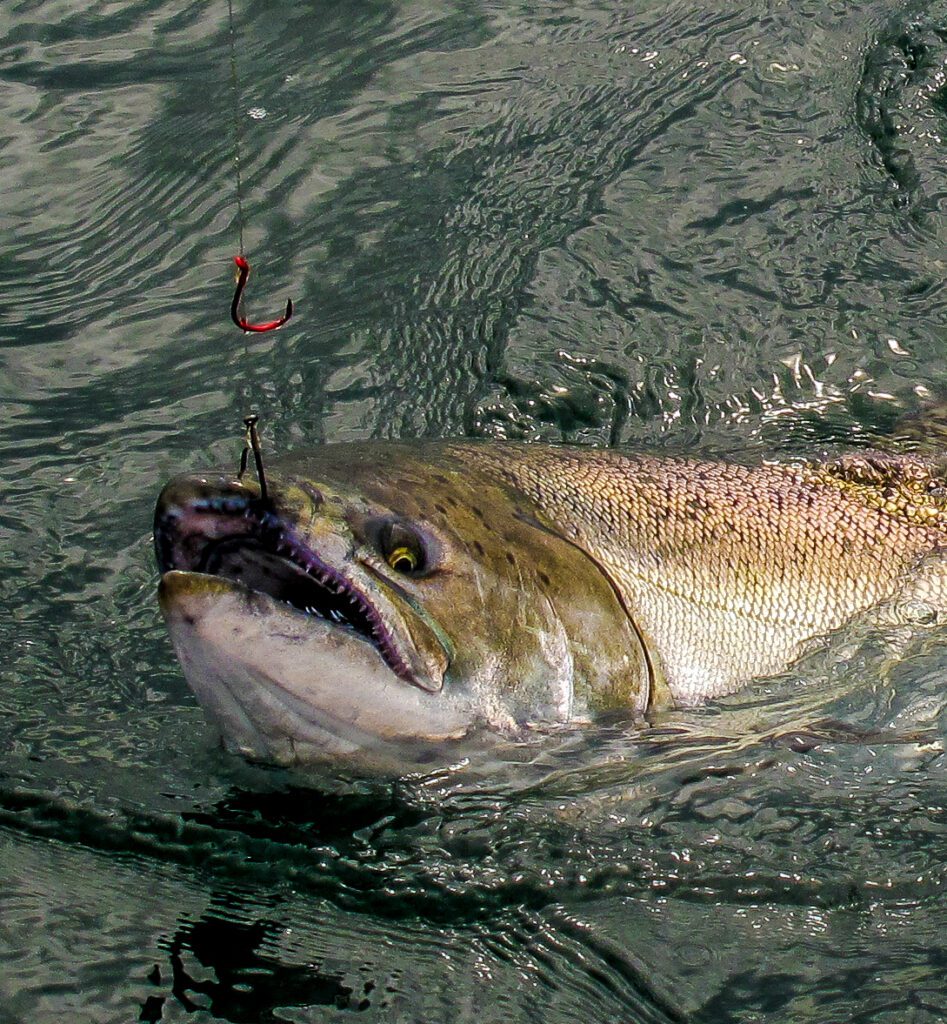
Marine Area 2-1 is Willapa Bay which has three separate zones known as zones 4, 5, and 6. Zones 4 and 5 are closed and zone 6 is most of the bay itself. A kelp and grass shallow water bay where salmon will stage for weeks before heading up the Willapa River and to hatcheries. Wild chinook must be released, and anglers can use two rods each with the endorsement. A dropper weight system is used since this is shallow water and the amount of eelgrass makes it hard to use downriggers. Watch your gear closely and change out baits often but it is hard to beat hooking a large chinook in shallow water which is why this fishery can be immensely popular.
Grays Harbor is Marine sub-Area 2 known as Area 2-2 with zones 1, 2, and 3. Zone 1, known as the Grays Harbor Control zone, closes in mid-August to salmon fishing, which allows fish to enter the harbor. Zone 2 is the Humptulips North Bay fishery zone and is limited to 1 fish, no wild fisher per day. The other zone known as the East Grays Harbor Zone 3 is mostly a coho fishery in front of the Johns River as all chinook must be released.
The Grays Harbor area is not exceedingly popular as you also compete with commercial and native fisheries but can be productive for those that try it. One of the most unique fisheries in the Grays Harbor area is the Westport boat basin fishery which is fishing in the marina where the fleets of charters and commercial boats are stored. Coho returns here thanks to a release effort with a recent addition of 50,000 late coho expected to return in October and November starting in 2026. For now, the fish arrive in late August and into September and can be caught right off the docks at Westport.
Marine Area 3 is known as LaPush and is very remote. With limited launches and extreme weather area 3 is mostly accessed on days with optimal ocean conditions. It is slated to be open in August for both chinook and coho, but this is one fishery that is often adjusted with an emergency rule. Chinook are prime and targeted in July which often means an August closure but coho here are making their way to the many rivers that have both robust hatchery returns and wild runs as well. Wild coho are not allowed to be kept keeping those runs going so be sure to only keep clipped silvers. This is also a staging area for chums and in the salt, they can be misidentified easily as their purple bars are light and sometimes even non-existent this time of year. Chums must be released so be sure to look at the fish closely and know what you have caught.
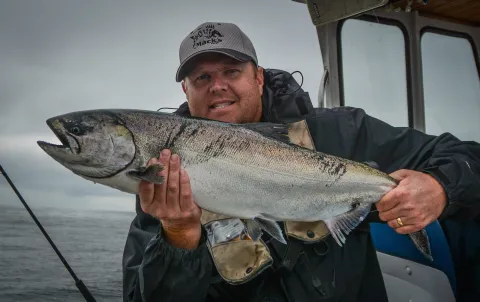
Marine Area 4, the last of the “ocean” areas had a rough start to the chinook fishing. As of July 11th, only 25% of the quota had been caught which normally that time of year the quota is getting close to being filled. I fished this area on July 12th and 13th, when the daily limit of chinook went to 2 per day and we did not hook a single adult chinook. The seas were rough and kept my little 18-foot boat limited to trolling along the kelp line and near shore but those that could make it further out did well. This indicated the chinook were here but out deeper than usual. Coho were being caught but not in respectable numbers which could indicate a later return this year which is great since area 5 to the east is slated to be open into October for coho. Come August the rules for chinook change in Marine Area 4 with it only being open west of the Bonilla-Tatoosh line. Coho is slated to remain open until mid-September in all Marine Area 4.
Regardless of where you decide to go, be sure to head out to the open ocean for some great fall salmon fishing. Of course, before you go be sure to check the emergency regulations as these fisheries are subject to quotas and can close quickly. They can also open or be extended as well and just maybe you will find a bonus opportunity out in the ocean. Either way, be ready for some cold, wet, and rough weather as well as bring sunscreen as afternoons are known to burn off the fog and remind us it is still summertime.
/articles/august-2024-ocean-salmon-update
Five Coastal Salmon Rivers to Check Out
Summer is upon us and for many of us, that means that our home rivers are closed to fishing to protect ESA-listed wild Chinook. As a result, we are looking forward to fall when we begin to see runs of Coho and Chum salmon flooding into our rivers with increasing opportunities to catch them. Fingers crossed!
It is anyone’s guess what WDFW will do and many of us are eagerly awaiting news concerning our seasons, emergency closures, and changes in general. Keeping this in mind, let’s look at five coastal river systems to check out that could present great opportunities.
Let’s start on the Northern Coast and work our way South. For the sake of this article, the focus will be from Forks in the North to Grays Harbor in the South. There are other coastal river systems South of Grays Harbor, but we are going to focus on the most popular systems.
Quillayute River System
The Quillayute empties into the Pacific Ocean at La Push, Washington. The Quillayute River is formed by the confluence of the Bogachiel River, Calawah River , and the Sol Duc River near the town of Forks, WA. The Dickey River joins the Quillayute from the north, just above the river's mouth at the Pacific Ocean. Though it is world-renowned as a winter Steelhead mecca, this system also receives returns of all five species of salmon. With spring and summer Chinook salmon returning in lower numbers than expected, the Quillayute river system, including the Bogachiel, Calawah, Dickey, Sitkum, and Sol Duc rivers, as well as Thunder Creek closed to all fishing on July 15. Historically this system produced great returns of spring and summer chinook, but like so many of our rivers, the runs are now endangered. The Coho and Chum will return in September and hopefully, there will be opportunities to catch and retain hatchery fish.
Hoh River
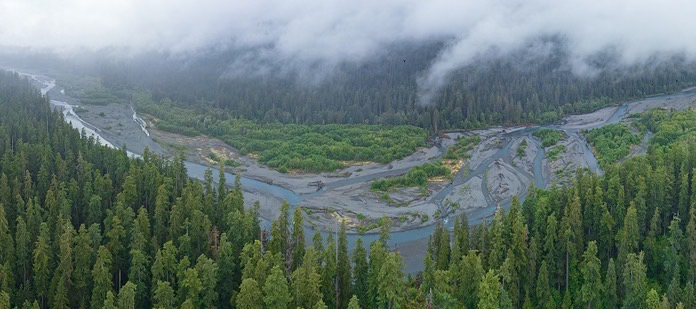
At 56 miles long, the Hoh River originates at the snout of Hoh Glacier on Mount Olympus and flows westward through the Olympic Mountains of Olympic National Park and Olympic National Forest, then through foothills in a broad valley, emptying into the Pacific Ocean at the Hoh Indian Reservation. The final portion of the Hoh River's course marks the boundary between the south coastal segment of Olympic National Park and the Hoh Indian Reservation.
Returns of Steelhead and Salmon make the Hoh River a fishing destination worth exploring. While there are fish in the Hoh River year-round, Steelhead are mostly targeted in the Winter, Chinook, and Coho are mostly targeted in August through November, and Dolly Varden and Cutthroat Trout are targeted anytime the water is in shape.
According to the 2024-2025 regulations, parts of the Hoh will open for Salmon fishing on September 16th, presenting some great opportunities to target Coho.
Queets and Quinault Rivers
The Queets and Quinault Rivers and their tributaries flow from the Olympic National Park into tribal lands. While opportunities exist in the upper reaches of these systems and within the park, they are most noted for their tribally guided lower sections. Note that the rivers are governed by WDFW, the Federal Government, and the Tribes, depending on where you are, so pay close attention to the rules.
The Quinault and Queets Nations have built some very robust hatchery programs, and they control the lower stretches of the rivers. Anglers can fish for all five species of Salmon as well as Steelhead and Trout. Fall Coho on the lower Quinault is a very fun fishery and can result in a freezer full of fish to last the winter. Note that you must book a trip with a tribal guide to fish the waters that lay within the reservations.
Humptulips River
The Humptulips River is located in Grays Harbor County, just North of Aberdeen and Hoquiam. Its main tributaries are the East Fork Humptulips River, about 20 miles long, and West Fork Humptulips River, about 30 miles long. After the forks join, the main river is approximately 20 miles long and provides some of the best salmon habitat in Washington. This river is not a secret and is often very congested, when open.
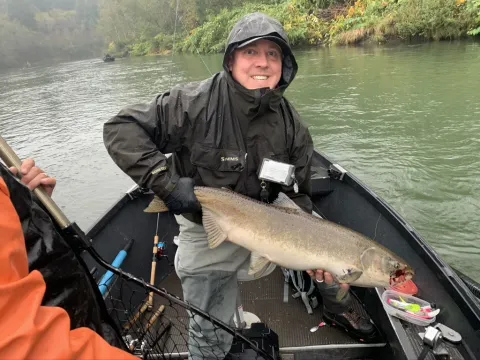
I will say that the “Hump” as it is called is one of my favorite rivers for fall Salmon fishing. It is renowned for its runs of Chinook, Coho, Chum, and Steelhead. As with other coastal rivers and due to low returns of wild Chinook, opportunities are limited. According to the current regulations, parts of the river should open in early September for hatchery Chinook and Coho. As this river can get very congested, it is best to know what you are doing and even better, book a trip with a guide.
Chehalis River System
The Chehalis River originates in several forks in southwestern Washington, flows east, then north, then west, in a large curve, before emptying into Grays Harbor, an estuary of the Pacific Ocean. The river is the largest solely contained drainage basin in the state. Both the Wynoochee and Satsop Rivers flow into the Chehalis between the towns of Elma and Montesano. While the Chehalis has many other tributaries, the Satsop and Wynoochee are likely the most popular and offer fantastic fall Coho fisheries. The mainstem Chehalis, near the mouth of these rivers, can be epic when conditions are favorable and some of the largest Coho in the state can be caught here. This system is also known for large limits of Coho allowed but check the most up-to-date regulations for specific details and don’t forget to look for emergency closures.
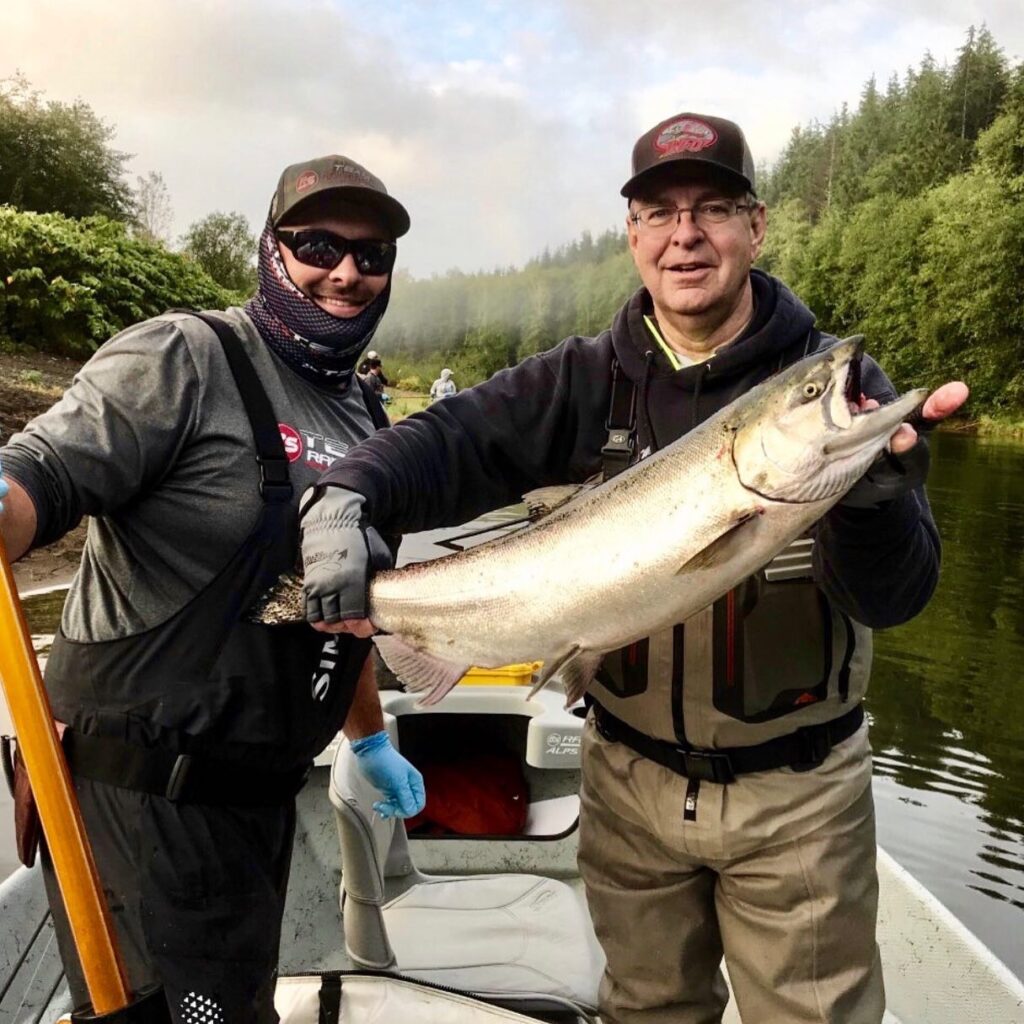
With all these rivers, please remember to check the regulations before you make plans or head out to fish. Things change often and it is very important to make sure that a river is open to avoid disappointment. Also, do yourself a favor and book a trip with a guide. I just cannot emphasize this enough. Your opportunities for success will greatly improve if you learn from a local guide and you are more likely to take fish home to eat later.
In closing, you are welcome to message me if you need to be connected to a guide. I am easy to find on Facebook (https://www.facebook.com/brent.knight.148) and am happy to help. Good fishing!!!
/articles/five-coastal-salmon-rivers-check-out
FORT PECK RESERVOIR’S PLETHORA OF FISHERIES
Big lakes often mean big opportunities and Fort Peck Reservoir, located in Northeast Montana, qualifies in that regard. This huge impoundment of the Missouri River was formed when Fort Peck Dam was built in the 1930s. The lake is 134 miles long and with 1520 miles of shoreline, it is larger than the length of the California coast.
There are fifty different species of fish swimming in the waters of Fort Peck Reservoir, and one of the most important is the cisco, introduced as a forage fish for walleye and lake trout by Montana Fish Wildlife and Parks in 1984. The cisco population is thriving now and so are a variety of species that feed on them.
Today anglers flock to Fort Peck from spring into the fall for a variety of fisheries. The most popular of them being walleye, which can grow to a huge size here. Jason Mundel is a top walleye tournament angler in Montana who hauled in a 17.76-pound behemoth earlier this year, just missing the state record of 18.02 pounds. Mundel says he is certain the big female was over the limit when he netted it but when it was brought into the boat it began rapidly squirting eggs all over the place. By the time Mundel was able to weigh it and photograph the weight, it was down several ounces, to the still impressive weight of the big hen. He then released to finish spawning.
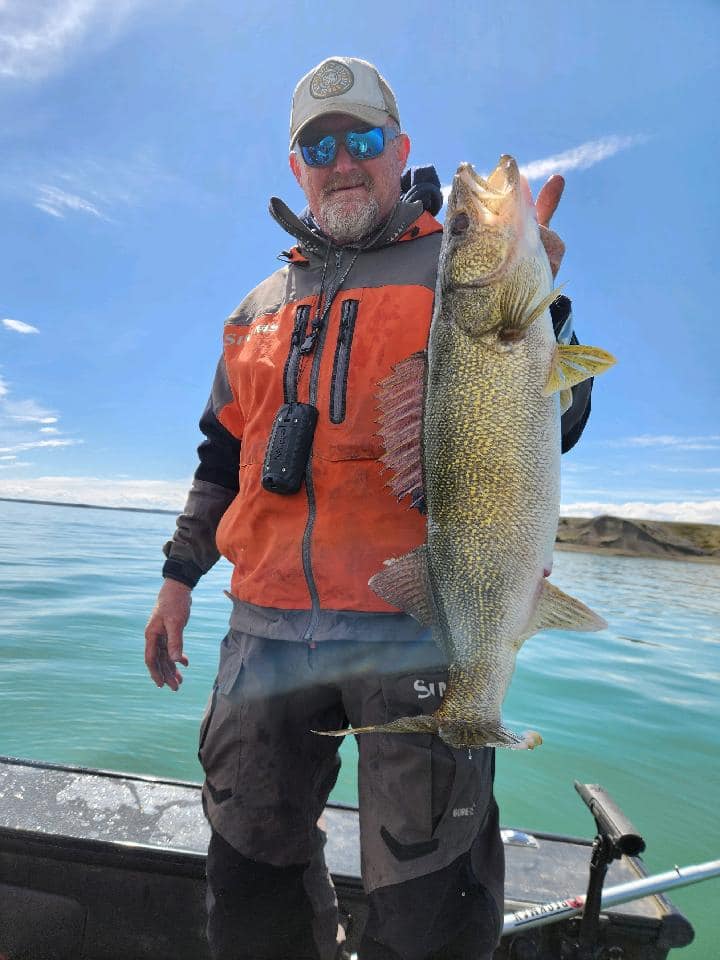
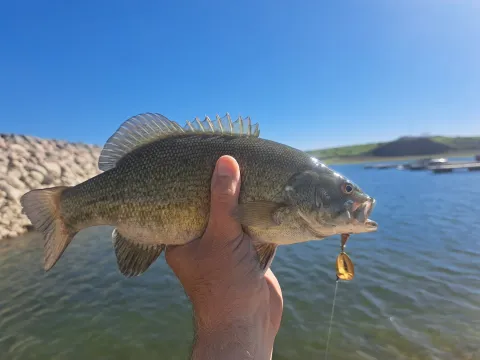
Mundel lives near Fort Peck and spends lots of time fishing in the reservoir (147 days last year). He likes to work long primary points and secondary points and uses sonar to find schools of Cisco. Once he finds the bait fish, he usually finds several different species in the same area feeding on them including walleye, northern pike, and smallmouth bass.
Mundel likes to cast paddle-tail jigs to the fish in the spring and will transition to trolling spinner worm harnesses behind bottom bouncers as the waters warm up over 55 degrees. The northern pike as well as the walleye are often caught with live bait. You are not allowed to use the ciscoes found in the lake for bait, but you can use fathead minnows, creek chubs, and shiners which he will simply fish in a dead-stick fashion, dropping them towards the bottom (but not on it) from the side of the boat. As spring turns to summer topwater baits can be very effective for both the smallmouth bass and pike.
Lake trout are another option. In the spring they will be found in relatively shallow water (15 – 20 feet deep) feeding on the ciscoes along with the bass, walleye, and pike. As the waters warm though, the Mackinaw head to deeper water. The Mackinaw run big here, up to 38-inches, according to Mundel.
In these deeper waters, you will also find Chinook salmon as well as coho salmon, all stocked in the lake from a hatchery below Fort Peck Dam. Mundel will troll using downriggers and flashers in front of his bait or lures to catch all three species.
The salmon can get big here. The state record Chinook a 32-pound specimen, as well as the state record coho, a 4.88-pound salmon, both caught out of Fort Peck Reservoir. Speaking of state records, the current record smallmouth bass, sauger, saugeye, shortnose gar, and freshwater drum were also caught out of this big lake.
The primary access points for most anglers are near Fort Peck south of Glasgow which is almost all paved. Another option is Hell Creek Marina north of Jordan where you’ll travel 25 miles over gravel roads to get to the marina. There are campgrounds and boat launches at both locations. Additional access is available from Glasgow, Malta, and Highway 200 near Jordan though these roads can involve lengthy routes over gravel.
If you are looking for places to stay, eat, recreate and more in Montana’s Missouri River Country check out the local tourism bureau’s website at www.missouririvermt.com and be sure to ask for a free travel guide while you are there.
FORT PECK INTERPRETIVE CENTER
If you are fishing out of the Fort Peck area, you really need to make the time to visit the Fort Peck Interpretive Center. This first-class museum is operated by the U.S. Army Corps of Engineers and tells a variety of stories.
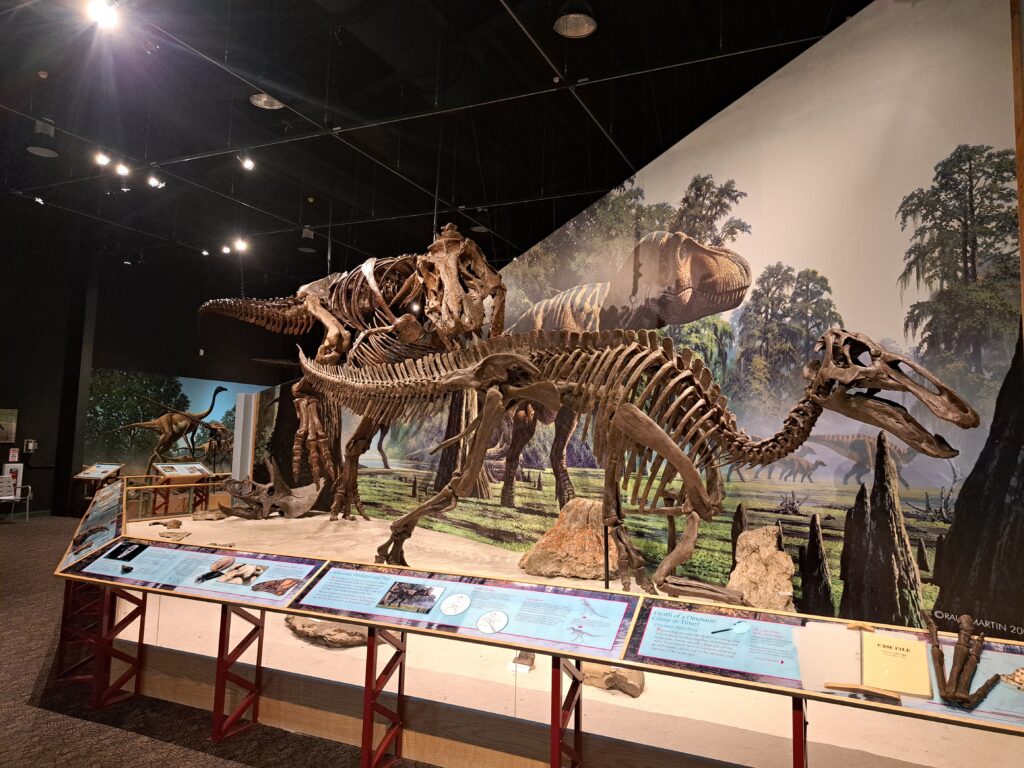
The biggest attraction is the story of the reptiles that lived here 65 million years ago. The Interpretive Center is part of Montana’s Dinosaur Trail. Two fossilized Tyrannosaurus Rex skeletons have been found near here. One is now on display at the Smithsonian Museum and the other can be seen at the Museum of the Rockies in Bozeman but replicas are on display here. Several other fossilized skeletons and replicas of dinosaurs and prehistoric marine reptiles can also be seen here.
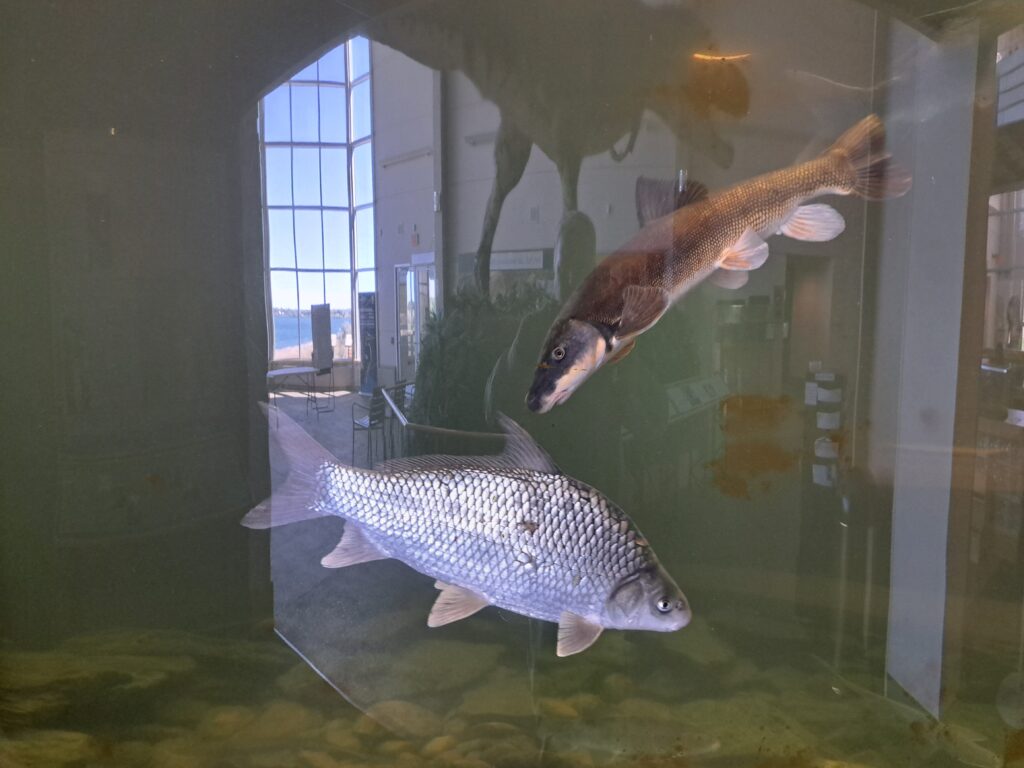
The fish and wildlife found in and around Fort Peck Reservoir and the Missouri River are also on display. Fish can be seen in two large glass tanks and taxidermized animals can be viewed in an impressive diorama.
Finally, the Interpretive Center tells the story of how the dam, called the largest hydraulically filled earthen dam in the world, was built and how the community of Fort Peck came to be. The interpretive center is open from Thursday through Monday from 9 AM to 4 PM between Memorial Day and Labor Day weekend. There is also a nice campground and up to a two-mile-long nature trail adjacent to the Center.
John Kruse – www.northwesternoutdoors.com and www.americaoutdoorsradio.com
/articles/fort-peck-reservoirs-plethora-fisheries
Holding Onto Hope: The Complicated State of Salmon in the Pacific Northwest
Well before the Pacific Fur Company set up their first trading post in Astoria, Oregon, Before the earliest fish canneries on the Columbia River began popping up in the mid-1800s, the Pacific Northwest and its people have been defined by a culture of sustenance and heritage that is deeply steeped in the very existence of the pacific salmon.
The rich abundance of salmon didn’t just sustain the indigenous communities of the northwest, it allowed them to thrive and aided in developing rich cultures over the millennia. It was, and is, the cornerstone of art, sustenance, ritual, and community within nearly all of the Pacific Northwest First Nations people. This history of Northwest salmon harvesting dates so far back (an estimated 10,000 years) that it forces us to consider salmon as a sport and commercial fishery, as something that exists only as a small blip in time—200 years, to be exact. Furthermore, it's within that 200 years that many northwest salmon populations have been pushed to the brink of extinction.
So where did we go wrong? And is there any fixing a fishery that has changed so dramatically over the years? To look at the details within context may be a good place to start, and perhaps this article can help us navigate through the weeds of a topic that has historically sown divisions between anglers, commercial fishermen, tribes, and fish and wildlife agencies.
Historical decline of salmon
It’s no secret that salmon runs were once much healthier than they are today. Though the state of Washington didn’t start record keeping on fisheries until 1935, we have plenty of scientific and anecdotal evidence that depicts a long history of vibrant salmon runs which looked significantly different than they do today. Lewis and Clark noted the great abundance of salmon observed by their party on the Columbia River, early settlers took advantage of the fish for sustenance use, and soon, savvy entrepreneurs seized what was viewed as a highly profitable market opportunity. Taking advantage of the great numbers of salmon in the Columbia, early commercial fishing companies constructed fish wheels—a large ferris wheel like trap that scooped considerable amounts of salmon out of the water. It’s said that some of these fish wheels were known to harvest up to 70,000 salmon per day.
Dams
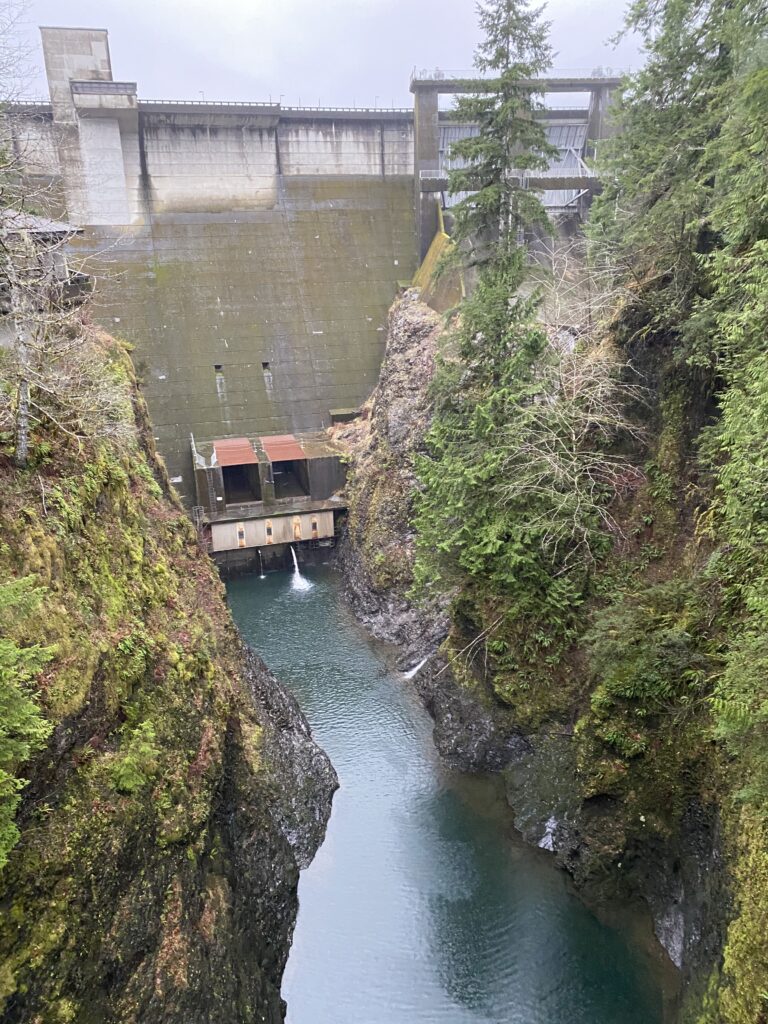
Then came the dams. A number of dams were erected throughout the northwest for the purpose of hydroelectricity, a zero-emissions source of power. All these dams, in some form, inhibited salmon and other fish from reaching miles of prime spawning habitat while also disturbing their natural habitats in several ways. On the
Columbia—the Grand Coulee and the Chief Joseph Dam, on the Snake River—the Lower Granite, Little Goose, Lower Monumental, and Ice Harbor Dam. These dams are likely the most contentious, but other smaller dams up the Snake River have effectively eliminated salmon returns at the furthermost portions of the Columbia River basin, specifically, northeastern Nevada. Historically, salmon would make a 900-mile journey from the Pacific Ocean, up the Columbia River, up the Snake River through eastern
Washington and Idaho, then finally arriving at their spawning grounds in the Owyhee River, where Shoshone-Paiute tribes would spear a portion of these fish for sustenance.
Deforestation
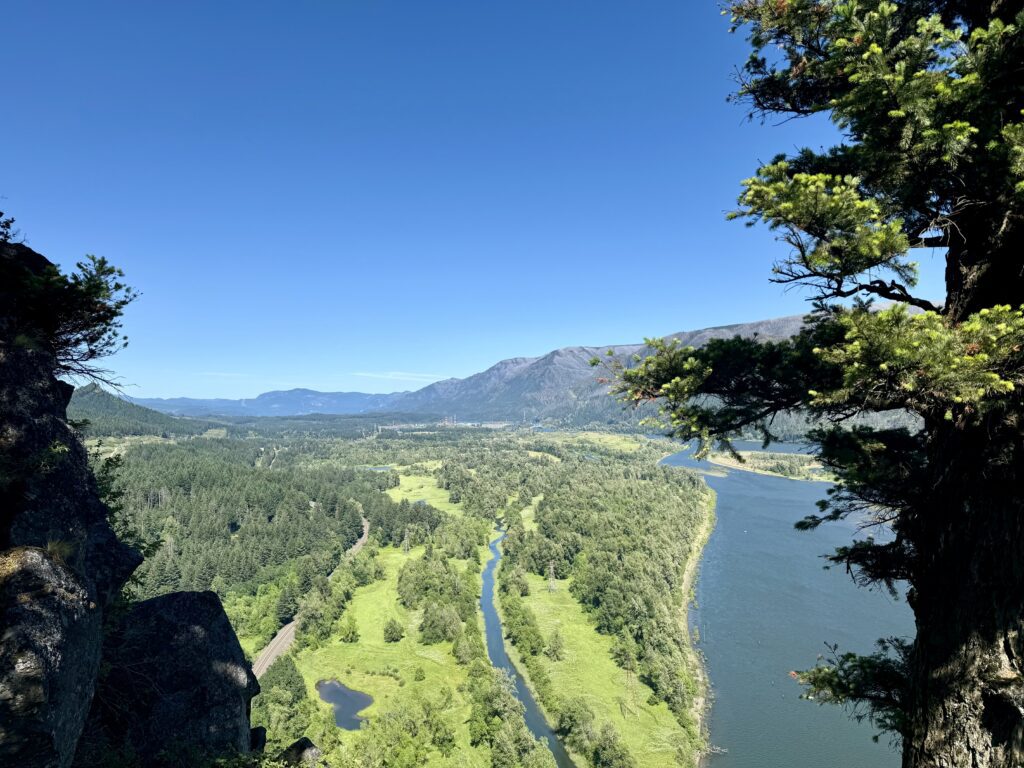
Whether it be for commercial timber harvesting or development, deforestation has created a multitude of problems for salmon habitat. When land is cleared around streams, the natural ecosystems become compromised, and the various organisms that salmon feed on diminish or disappear. Aside from the loss of food resources, the natural shade produced by the canvas of the trees diminishes or disappears as well. Without shade from trees, streams are subjected to an increased amount of sunlight, thus increasing the temperature of the water. Salmon are incredibly sensitive when it comes to water temperature, and drastic increases or decreases in temperature affect metabolic rate, cause salmon to seek out colder water upstream, and increase vulnerability to predation. In a nutshell, altered ecosystems due to altered habitats complicate the survival and reproduction processes of salmon.
Development and pollution
Water pollutants are believed to have a detrimental effect on salmon health, size, mortality, and reproductive success. Though the effects of pollution and salmon survival can be hard to quantify, it is well-accepted amongst scientists that pollutants from a variety of sources like storm runoff from vehicles or improperly disposed industrial waste, are contributing factors to the decline in salmon stock.
Positive trends
On the West Coast, there are currently 17 salmon populations listed as threatened or endangered under the Endangered Species Act. These populations range from California to Washington State and include (but are not limited to) the Lower Columbia River Coho, Snake River Sockeye, Hood Canal chum, and Puget Sound Chinook salmon. Though these facts might not inspire optimism at first glance, it’s important to note that “threatened” doesn’t necessarily mean these populations aren’t on an upward swing in terms of recovery. For example, the Lower Columbia River
Coho has steadily been making progress toward the federally approved recovery goal.
Hood Canal Summer Chum and Snake River Fall Chinook are both currently approaching that set goal. Yet, more needs to be done.
Dam removal
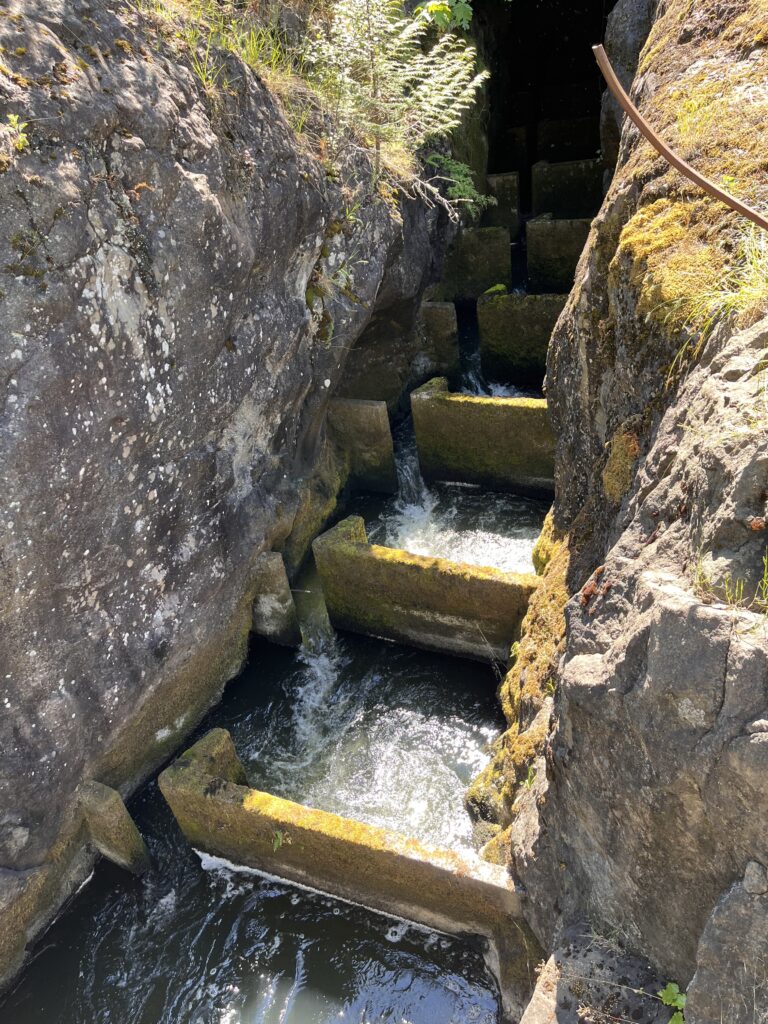
Enter damn removal. Dam removal works for salmon recovery, but there are many issues created by the removal of dams. For example, on the lower Snake River, dams create vast amounts of clean energy, and reduce water velocity, thus allowing easy movement of barges for agricultural product transportation, and they help provide irrigation for swaths of agricultural land. In short, they are a huge part of local economies and infrastructure alike.
These inherent issues with dam removal were finally addressed in what was a culmination of years of lawsuits and litigation and is believed to be the most comprehensive salmon recovery plan to date. In December of 2023, The Biden-Harris administration came to a historic agreement when they signed a Memorandum of understanding between Columbia River Basin Sovereign tribes, the state of Washington, the state of Oregon, and environmental groups. This 1-billion-dollar settlement agreement is a 10-year federal partnership with tribes and states that prioritizes salmon restoration and recovery, while also allocating funds to research on other infrastructural needs that will be an inevitable byproduct of the removal of the 4 Lower Snake River dams.
Ultimately, it is up to Congress whether the dams will be removed, but the groundwork is now in place to make these possibilities viable. This is a huge and unprecedented leap in the right direction for salmon recovery.
Hatchery programs
Hatchery programs are a lot of things…
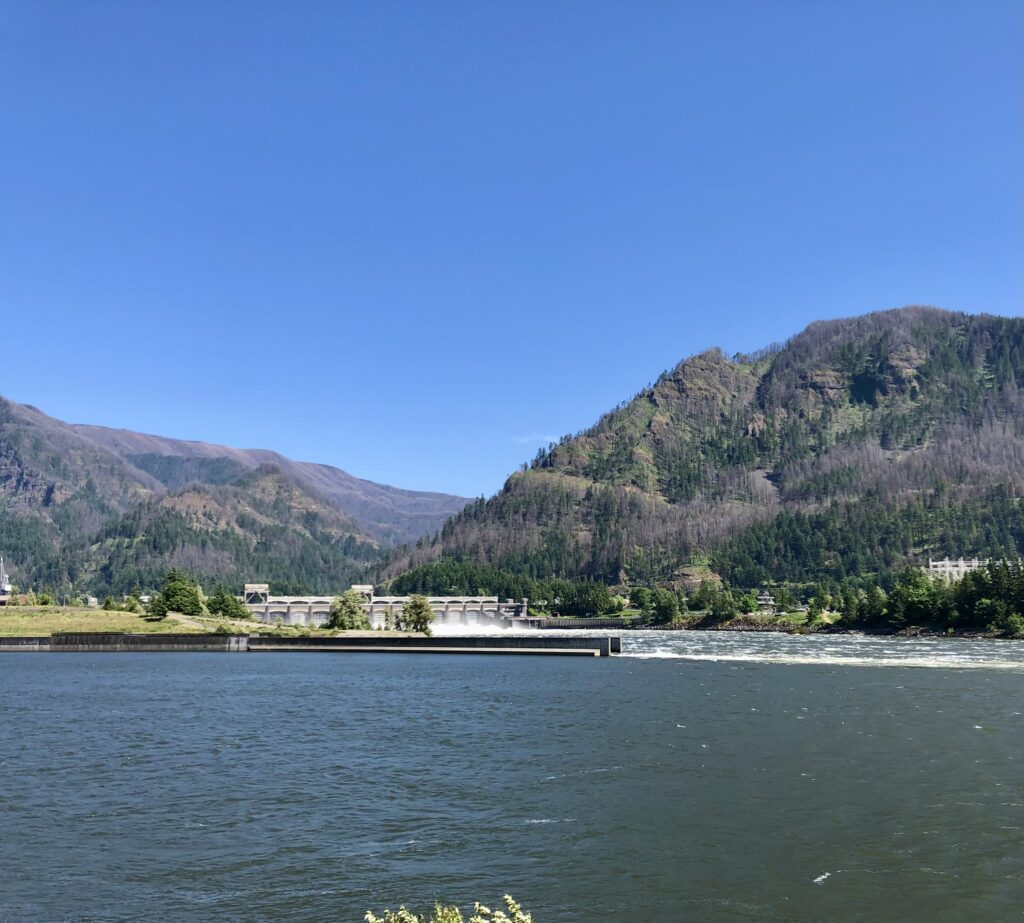
They were once believed to be the solution to the impact commercial overfishing had on salmon numbers, they were offered as an answer to the devastation caused by the damming of waterways, and they were a mechanism to uphold the treaty rights of Washington indigenous tribes under the Boldt Decision of 1974 (decision granting Washington tribes fair and equal share of fish harvest). But despite the best efforts of hatchery managers, these hatcheries have often fallen short of the goals that had been set forth.
Much research has been conducted on the efficacy of hatchery programs, and the findings have often been bleak. One important example is the Columbia River. A journey to the Pacific Ocean down the Columbia River has always been a perilous task for young salmon, and naturally, many don’t complete their journey. Throw in a myriad of dams, warming slack waters behind these dams, and an increase in invasive predators, the journey becomes even more fraught with danger. To compound the problem, salmon bred at hatcheries are losing their genetic diversity, and fast. Without the highly developed genes of their native counterparts, the fish become weaker, and survival rates drop.
This is not to say hatcheries don’t create a positive impact on a declining salmon population. After all, most Pacific salmon returning to our rivers today are hatchery salmon. Amid the new Biden administration commitment to salmon recovery, 60 million dollars is being invested in NOAA fisheries to facilitate improvements to current fish hatcheries, many of which were on the brink of failure. Furthermore, many West Coast hatcheries are implementing new techniques within their facilities to improve salmon survival rates. These techniques include changing the way fish are fed so that the process will more closely mimic natural feeding, including natural features in the tanks where fish are being stored, and breeding hatchery-salmon with more wild-salmon to increase genetic diversity.
Habitat restoration
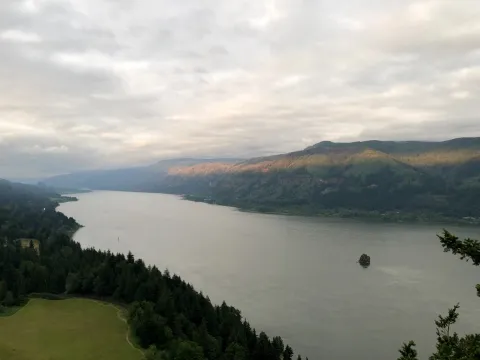
To date, 474 acres of wetlands, 9,257 acres of estuaries, and 31,564 acres of waterway have been restored in Washington state through collaborative efforts between the Department of Fish and Wildlife, NOAA, The Nature Conservancy, various nonprofits groups, and volunteers. Working to improve the waters and land that create salmon habitat is a vital component of the comprehensive approach needed for a task as complex and crucial as salmon recovery.
Resources
Below, you will find a list of volunteer opportunities for salmon habitat restoration. Together, we can all do our part in protecting a resource that is so important to our communities, our families, and future generations.
- Mid-Columbia Fisheries Enhancement Group midcolumbiafisheries.org
- Skagit Fisheries Enhancement Group skagitfisheries.org
- Washington Department of Fish & Wildlife wdfw.wa.gov>get-involved
- Coast Salmon Partnership coastsalmonpartnership.org
- Sound Salmon Recovery soundsalmonsolutions.org
/articles/holding-hope-complicated-state-salmon-pacific-northwest
The Washington Outdoors Report
HUMPIES, LAWSUITS AND TROUT
PINK SALMON NUMBERS ARE LOOKING GOOD
Odd numbered years are pink salmon years here in Washington State and 2023 is lining up to be a good one for anglers fishing for them in Puget Sound and its tributary streams. The Washington Department of Fish and Wildlife is forecasting a return of nearly four million of these smaller salmon, nicknamed “humpies”, for the hump the males develop on their back after entering fresh water to spawn.
The pinks show up in the Strait of Juan De Fuca as early as June and can be caught by both boat and shore anglers in Puget Sound throughout the month of August. By September, most of the pink salmon are entering tributary streams like the Skagit, Snohomish, Skykomish, Green and Puyallup Rivers, providing additional opportunities for anglers who target them with Buzz Bomb lures, jigs with squid bodies and spoons, the key to all of them is that they must be pink in color if you want to catch pinks with them!
Humpies are a fun fish to cut your teeth on as a first-time salmon angler and it’s not uncommon to catch a good number of them in a day of fishing. While many anglers save them for the smoker, they do taste very good when fresh, especially when grilled over a BBQ or pellet smoker.
LAWSUIT FILED AGAINST WDFW COMMISSIONER
On March 6th the Sportsmen’s Alliance Foundation, which is a pro-hunting and fishing organization, filed a lawsuit in Thurston County to prohibit WDFW Commissioner Lorna Smith from participating as a member of the Commission.
The basis for the lawsuit is that state law prohibits anyone from holding an additional elected or appointed office while serving on the commission. Smith currently serves on the Jefferson County Planning Commission which the Sportsman’s Alliance says is in direct violation of Washington Law.
Todd Adkins with the Sportsman’s Alliance says, "We view this lawsuit as the initial step of a long but important process to bring sanity and decency back to wildlife decision-making in Washington. It all starts here, but trust me, it won’t end here. The animal extremists are going to see a lot of the same in the coming weeks and months."
Lorna Smith is a controversial appointee to the Fish and Wildlife Commission. Since being appointed in 2021 by Governor Jay Inslee she was an instrumental voice in shutting down Washington’s long running spring bear hunt, despite the recommendation of WDFW staff members that it be allowed to take place.
When the Blue Mountain elk heard declined (primarily due to cougar predation), Smith suggested managing the herd as a smaller one instead of addressing the predation issues. She has also introduced the framework of a plan that would limit hunting as a management tool by the agency.
It is worth noting that Smith is not the only commissioner serving in another appointed or elected position. Commissioner Molly Linville (who generally sides with hunters in her decision making), serves on her local school board in Douglas County.
Eli Francovich, writing for the Spokesman Review, contacted both commissioners. Linville told Francovich that she was advised by legal counsel that serving on the school board was not a conflict of interest. Commissioner Smith told Francovich she was serving on the Jefferson County Planning Commission on a volunteer basis and in an advisory role when appointed to the Fish and Wildlife Commission. Smith continued stating she does not believe the statute does not preclude individuals serving in a volunteer position like she has been in Jefferson County.
LAKE LENORE FISHING TRIP
Last but not least, I made it up to Lake Lenore this past week after WDFW fisheries biologist Mike Schmuck told me the fishing there was very good last year and he expected similar results this season. I picked a cold, cloudy day to visit the north end of the lake which is where many of the Lahontan cutthroat trout tend to mill around in the spring prior to spawning.
Unfortunately, the trout were not yet in this part of the lake in good numbers. Two anglers who were leaving as I arrived said they each only caught one fish that day. While fishing, I did see one angler catch one trout and while I did get one good strike, I was unable to hook up and didn’t have any more bites that afternoon.
Lake Lenore is a selective regulation fishery and is primarily a catch and release destination where the trout average two to three pounds and can get up to six pound in size. Fly anglers in pontoon boats favor fishing chironomids under strike indicators while spin anglers can do well fishing spoons with single, barbless hooks.
The fishing at this scenic, desert lake north of Soap Lake should get better towards the end of March and peak in April. I plan to return to try again and will let you know how I do.
John Kruse – www.northwesternoutdoors.com and www.americaoutdoorsradio.com
PHOTO CREDITS:
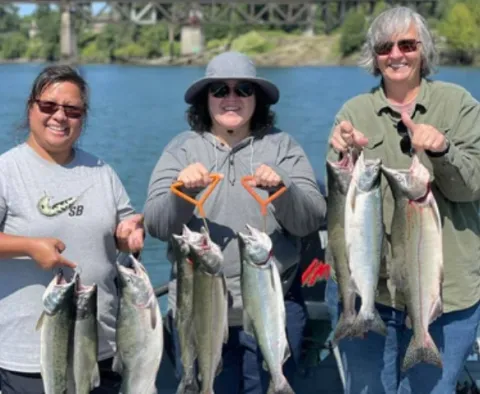
Pink salmon caught on the Snohomish River – Courtesy Brianna Bruce, Livin’ Life Adventures
/articles/washington-outdoors-report
Lemon Peppered Baked Salmon
Salmon is a Pacific NW favorite and when cooked properly most would agree it’s one of the best eating fish to be found. Here is a classic recipe on salmon for your culinary chops.
Remember, the essentials to a good cooked fish begin with proper care of the fish out in the field. Catch it, bonk it, bleed it, and put it on ice. Cut it up and eat it ASAP. Or, vacuseal it if you can’t eat it fresh. Just don’t forget it’s in there! A freezer burned piece of fish does not a gourmet meal make. Not to mention a waste of a valuable resource.
Salmon lends itself to a myriad of ways to prepare it. As with any fish, the most important thing to do is – don’t over-cook it! So without further ado, here’s a simple yet delicious baked salmon recipe.
Ingredients:
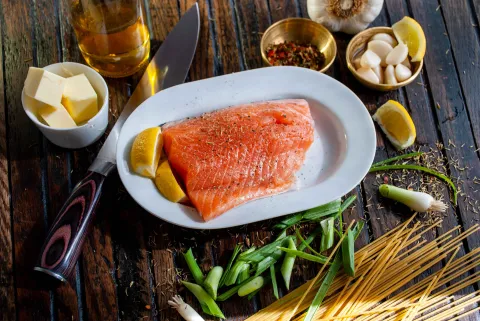
Fresh salmon filet, one to two pounds, ¾-1” thick
1 ½ teaspoons lemon-pepper seasoning
1 teaspoon onion salt
4 lemon slices
1 tablespoon olive oil
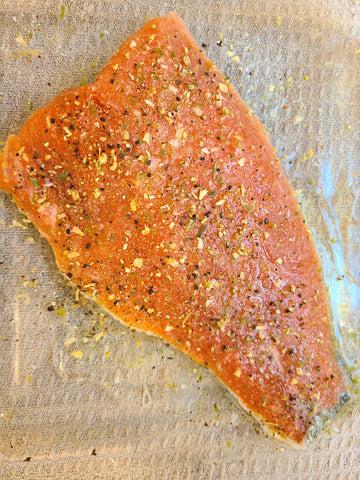
In a glass baking pan, take filet and coat with olive oil. Place salmon skin side down. Sprinkle onion salt and lemon pepper seasoning over the top. Squeeze juice out of lemon slices onto the filet (be sure to save a couple lemon slices to garnish the fish when it is served).
Preheat oven to 400 degrees and cook for ten minutes. For a crispy, sizzling finish, turn the oven up to hi broil and cook another two minutes. Remove from oven and serve immediately. If you leave the fish sitting in the pan it will continue to cook so get it out and serve it piping hot!
Add your favorite vegetables or pasta for a healthy and classic Pacific Northwest salmon meal. Enjoy!
/articles/lemon-peppered-baked-salmon
Washington Ocean Salmon Prospects
With salmon seasons being ever-changing, from season to season, month to month, and even minute to minute depending on where you fish, the recent announcement of summer salmon seasons was met with some excitement and hesitation. Fisheries managers met over several weeks during the North of Falcon process where everyone with an interest in salmon planned out the quotas and seasons. Washington’s governor added a new apprehension at the table with concern over making sure there is enough food for south Sound Orcas well as fish sport anglers, commercial harvesters, and tribal fisheries, while still allowing for escapement.
The escapement is the main focus, with ESA-listed stocks and wild fish returns dictating how and when anglers can pursue salmon. Once the run estimates are established then the managers need to figure out how many fish can be caught in the ocean and still allows for fishing, and escapement in each of the predicted runs. This is where the marine area gets its seasons and regulations. This year the allotment for ocean salmon off of the coast of Washington was set at 39,000 chinook and 159,600 coho. Each marine area will get its own seasons and a share of the fish.
Starting with Marine Area 4, Neah Bay, the northernmost ocean section which borders Canadian waters, will get first dibs on the salmon, along with Marine Area, 3 La Push, which will have the same start date of June 17th. This is just like last year, when the areas opened up on Father’s Day weekend, but this year anglers can still keep two salmon per day. However, only one can be a chinook and all coho must be clipped. It is open 7 days per week, but later this summer, chinook will be closed east of the Bonilla-Tatoosh line starting on August 1st.

Marine Area 3 will have similar regulations as Area 4 but will also have a late “bubble” fishery from October 3rd to the 7th with a one chinook per day limit. La Push is not nearly as popular as Neah Bay, mostly because it is an open water fishery where the area to the north in Neah Bay has some protected fishing. Since the Covid restrictions have lifted, both reservations are now open. Neah Bay offers a bit more in amenities, but nearby Forks is a great town to stay in when fishing out of either port and has accommodations, restaurants, and gas stations, along with a sporting goods store in case you forgot anything.
Westport in Marine Area 2 is probably the most popular of all offshore ocean fishing locations. The famed Grays Harbor bar is not fun to cross, but on good days the fishing makes it all worth it. This tiny fishing town has everything you need, and if the bar is not cooperating or you are looking for some bottom fish to take home, then fishing along the jetty or the many rock piles off the coast makes for a fun fishery. The season here opens June 24th and will be open 7 days per week with a two salmon daily limit. Only one can be a chinook, and all coho must be clipped.
The coast of Ocean Shores is a popular area to fish in Marine Area 2. You can use the hotels as a marker on where to fish. The casino is a well-known landmark where anglers will fish in 60 feet of water and make their way out deeper from there. Another good spot is south of the jetty, where you can intercept fish making their way to Willapa Bay and the Columbia River. One of the reasons why Marine Area 2 is such a good fishery is because anglers are targeting fish heading to Grays Harbor, and as they near the entrance they tend to hang out in the saltwater just offshore. Add in the fish migrating further south to Willapa Bay, the Columbia River, and even Oregon rivers, and it makes for a highway of salmon to intercept.
Marine Area 1 out of Ilwaco is for the serious salmon angler. The season is set to open June 24th with a two salmon per day limit, but only one can be a chinook and all coho must be clipped. Ilwaco is a protected port with a long jetty that protrudes out into the Columbia, and it can mislead the novice angler into thinking everything is good to go. Be sure to know how and when to cross the Columbia River bar safely. This is the deadliest bar in the world and there is a reason why the U.S. Coast Guard trains their rescue swimmers here. But if you can make it out to the ocean then you will get your first chance at the 554,000 fall chinook or the 595,300 coho making their way back to the Columbia River.
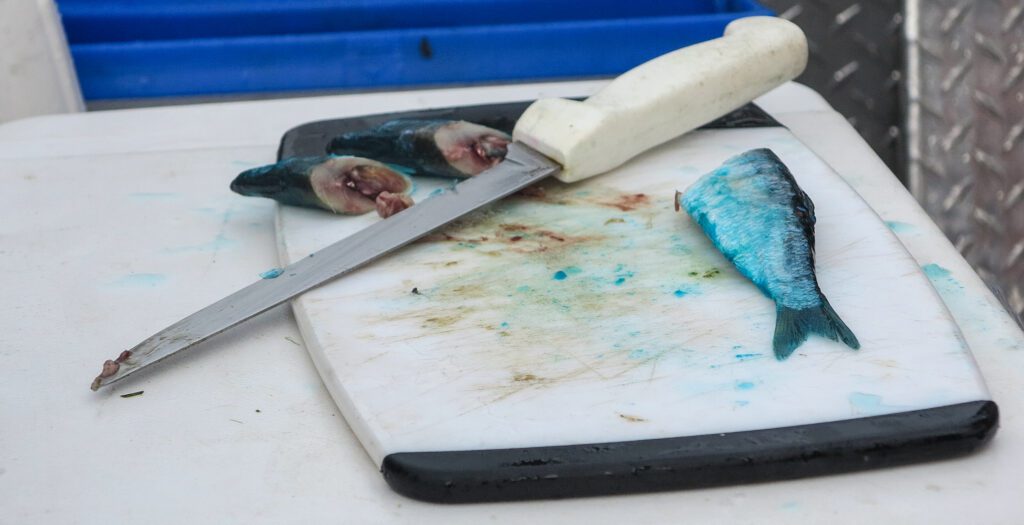
When it comes to salmon fishing in the ocean, nothing beats fishing fresh bait. I use brined herring that has sat overnight in Pro-Cure’s Brine-n-Brite and been toughened with some Bait Spice, an infused rock salt with bluing agents and scents. Learning to plug cut herring can be tricky but once you get the perfect cut down, it is one of the most productive ways to fish. But if you find yourself in a school of crazed coho where most will not be clipped and before you know it bait is running low, then there are a few things you can do to increase your catch rate when the bait runs out. There are many spinning plugs on the market now, including the SpinFish by Yakima Bait Company, the Cut Plug by Brad’s, and now the Simon Spin Dawg and Simon Cut Plug.
The first two have a hollow cavity to place scents, herring strips or canned tuna, but the products by Simon are solid and have a scent cavity. One benefit of the solid bait is that it won’t come apart when a chinook grabs hold. The other lures, though, offer more scent-holding capabilities. All of them work on the same wounded baitfish principle and work great when the real bait runs low or you don’t want to mess with brining and plug cutting. Old Goat Lures also makes a hollow one-piece wounded baitfish lure and they make it out of plastics that glow for those low-light days or early morning fisheries. With each of these lures, it is best to use a super sticky scent such as those by Pro-Cure in their Bait Sauce line.

To rig up the spinning plug lures, there are two primary ways to fish them when trolling in the ocean. The first is behind a 360-flasher such as a Mack’s Lure UV Paddle ScentFlash, which can be filled with even more scent. Use a long leader from 42 to 56 inches to the lure, and then use the downrigger to get it to the depth of choice. The other way to rig it is just like how one would mooch using a mooching weight from 2 to 5 ounces, depending on how deep you want to run it, and then a long leader, again 42 to 56 inches. Simply let this rod out of the back of the boat about 50 feet, and put it in the rod holders. This makes for a great top water rod when targeting coho. Once you find a school of chinook you can then use this same set-up to mooch for them, and even drop it down over a rock pile and catch rockfish and lingcod. It is a simple and very versatile set-up and one I always have rigged and ready in the boat when heading to fish the ocean.
It is time to do a little homework and figure out where you want to catch some salmon. With the marine areas now open, it is a matter of checking the tides and winds and making sure all of the safety equipment is up to date. This is also a good time to update any software for the sonar unit and make sure the life jackets are serviceable. Motor maintenance should have been done months ago, but if you haven’t done so then be sure to get them running right before heading out to the open ocean. The saltwater is one of the best places to catch salmon as long as you are prepared and know how to navigate the bar crossings safely. Head out to the open sea and catch some salmon.
/articles/washington-ocean-salmon-prospects