Kokanee Fishing Color Choice Confidence
By Gary Gordon
It is the single most important thing to grasp: kokanee are kokanee and have the same whims, growth, hormone, and feeding issues wherever they are found. So these kokanee issues are the same in Washington, Oregon, Colorado, Idaho, Wyoming, Montana, Utah, California, North Carolina, New Mexico, and British Columbia.
It turns out that before getting to the point of deciding what colors are the answers to today’s fishing mysteries, selecting color is the last component of a successful outing. Since color makes no sound and has no scent, its single role is to stimulate a biting response.
The next thing to grasp is a consistent presentation strategy. What you are trying to do is make your presentation as 100% efficient as possible. This means that all of your equipment from your boat, trolling motors, fishfinder, GPS, rods, reels, downriggers, and releases must be working together so that your presentation can be as efficient as possible. Having the “right” colors means nothing if you are not placing your tackle where the fish are.
Correct presentation strategy means also that your attractor and the lure have to work together. You have to troll the dodger at a speed that allows it to attract. That means that each attracting dodger has a minimum speed that allows it to work correctly. What that speed is depends on the size and shape of the attracting dodger.
One of the best ways to check the correct speed is to simply put the dodger into the water on your fishing line right next to the boat, and look at the action. Speed up or slow down the boat until you feel the action is what you are looking for. Recognize that the dodger and lure are working together, so look for movement in the lure behind the dodger. You simply do not want the lure to just sit there in a straight line behind the dodger; you want some movement. Keep the lure in tight behind the dodger for the best movement. I advocate 6 to 8 inches of leader, even if your lure comes with a long leader.
For early season, that movement does not need to be great. As the season progresses, speed up your presentation to get more movement on your lure. Also, as your target depth gets deeper, increase your trolling speed, and increase the size of your dodger.
I carry three different size selections of dodgers for these very reasons.
For all except the Apex type lures, it is critical to have a short leader behind the dodger for the lure. This gives the maximum movement to the lure from the movement of the attracting dodger. I prefer only about 6 inches behind the attracting dodger regardless of the size of the dodger.
Next would be to match the dodger colors with the lure colors. Although color is not an initial attractor, it is vital to stimulate the biting response. You want what is making the attracting vibration (the dodger) and the following matching lure work together. The following chart shows relative penetration of visible colors in the water column. We all know there is less light at depth.
Go deep enough and there is no light. Water absorbs light in sequence of the visible spectrum. Light enters the water as white light. Then very shortly the red drops out, leaving the balance of colors to continue together down the water column. The next to drop out are the oranges, then the yellows, then the green, then the blues and then the indigo and then finally the violet.
But use fluorescent colors and the color you see in your hand will be the same color at depth. So, a fluorescent yellow will still be fluorescent yellow when only violet light can act on it. If it is not fluorescent, it will be black when violet light strikes it. All tackle marketed as “UV” is really fluorescent. There is no “UV” colorCOL, and “UV” light does not penetrate the water column more than just a few inches. Most tackle marketed today is fluorescent even if it is not marked “UV.” Fluorescent colors penetrate the water column to far greater depths than do ordinary colors.
So, can kokanee see color? Kokanee are vertebrates and as such they have eyes that contain rods and cones. Cones are the part of the eye for color. Salmonids have a distribution of about 10% cones and 90% rods. So, color vision is basically limited to an area directly in front of the snout and extending out about 20 inches or so in clear water.
This is actually a good thing. Stay with me now. You have this awesome hot pink squid properly trailing your dodger. The fish is going to be attracted to the dodger vibrating, but that will be at some distance to your lure. Once that lure become visible to the fish, it is still only seen by the fish’s eye rods in shades of gray and black and white tones. But as the fish approaches that 20-inch mark, there’s an explosion of color – just like turning on a light bulb. The fish backs off to 21 inches and it is back to black and white and gray. Come in closer, and bam! Hot color – just the way you planned it topside, but not exactly the way you planned it topside. This color shift works for you as a bite stimulant.
Here are some helpful suggestions about color.
• The first suggestion is that the color of the day, or even of the hour, is up to the kokanee.
• Early season stuff: pink, red, orange, green, natural glow, blue
• Mid-season – absolutely wide open, but add copper and gold to the mix. Run copper and gold setups a bit faster than the nickel. Don’t forget the black and white stuff.
• Later season – kokanee love the blue, pink, and watermelon.
• All seasons: White and glow.
/articles/kokanee-fishing-color-choice-confidence
Finding the Right Fishing Rod
By Jason Brooks
Almost three decades ago, I learned the importance of using the correct fishing rod, and how important the rod is as a tool to catch more fish. It was a bright July day, and we were fishing the Cowlitz River for summer steelhead. I was with two friends, both of whom were well seasoned steelhead anglers, but I was not. Having grown up in North Central Washington, steelhead were but an anomaly back in the 80’s and 90’s. Instead, we trolled for trout and chased summer chinook by casting spoons and pulling plugs, but we never really had to “feel the bite” like you do for summer steelhead.
"Broomstick"
Throughout the day, my two friends kept hooking fish while I did not get a single bite, or at least I did not think I did. After breaking off the leader while in a good run, one of my friends told me to grab his spare rod, already rigged up and ready to go with bait. I put down my rod and grabbed his, cast it out, and within seconds had a bite and set the hook. Once that fish was landed, I mentioned how quickly I felt the fish bite and that it was my first bite of the day.
Both friends politely informed me that I had been getting bites all day, but I just did not know it, calling my fishing rod a “broomstick”. I was using a cheap rod, one that fit my budget at the time, but also cost me fish as it was not sensitive enough for me to notice the bite. The rod my friend handed me was a Lamiglas Certified Pro, a “mid-priced” rod for that brand, but known to be extremely sensitive and a good value compared to the higher end models.
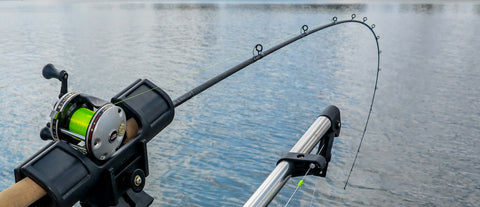
Pricing
Price is probably the most noticeable point when it comes to a fishing rod. Those that do not fish, and even a few that do, often ask why quality fishing rods cost so much. Yes, there are exceptionally good rods on the market that do not cost what some of the “top of the line” models do, but they are usually made in foreign countries where quality control might not be as tight as some American made rods.
There is a saying, “buy cheap, buy twice” which means those that try to look for a bargain often end up buying the more expensive rod after they have a few days like the one I had on the Cowlitz all those years ago. The high price of a rod is mostly due to a few variables, the first being quality control with quality materials. The next cost factor is that you are not just paying for the rod, but also for research and development that went into designing, testing, and building of the rod. A company cannot improve their products without testing and developing them first.
They have paid employees that do this, such as engineers to design, make, and maintain the machines that manufacture the rods, and then of course the engineers whose knowledge goes into rod design. Everyone needs a paycheck and when you buy that rod you are becoming part of the process, one that will also help improve the next model or design of rod.
Warranties also cost and some high-end rods are factoring in the warranty for when anglers do break a rod and get a “free” replacement. That replacement cannot really be free but instead is added into the overall costs. Then there is shipping the rods to stores, advertising, and of course the store’s overhead, which all must be added to the costs of each rod.
Quality
So now that you know why some rods cost so much, then ask how some rods can be reasonable in price and still have most of the same attributes of a high-end rod. This is mostly because those rods are a few years behind in technology, and either patents run out so they can be copied, or consumer demand is finally high enough that a large company can outsource the building of the rods to foreign labor, making the building part of the rod less expensive, and mass produce the rod.
Profit margins can be smaller, and this means a less expensive rod for the angler, but think about quality control and rod materials. Of course, these rods can and do catch fish, so should you feel guilty for buying a rod made in some foreign country? That is up to you, but it is understandable why one would buy such a rod, with some American made rods costing two and even three times as much as the others.
When it comes time to pick out the rod you plan to buy, you need to understand how the rod is designed or what its purpose is for. The first two factors that must be taken into consideration when purchasing the correct rod are what type of fish you are planning on catching, and what technique you are going to use to catch them. Take for example the twitching rod, often used to catch coho, but also good for chinook, chums, and even the occasional winter steelhead.
Since it is mostly used for coho, the rod needs enough power to haul in a 12 to 18-pound fish, pulling it out of a log jam, and to the net. It also needs a soft tip, or fast action, to give that jig the right action as it falls, and so you can feel the slightest resistance when the fish grabs the jig, often done on the drop. Again, that power needs to be strong enough to set the hook quickly. And then there is the length of the rod- most twitching rods are 7’6” to 7’9” as this is the right balance for twitching without causing wrist fatigue.
Years ago, just as twitching rods were coming onto the market, I was still using a medium action 8’6” drift fishing rod and did well until my wrist hurt so bad that I had to stop fishing for the day. Yes, some rods are “multi-purpose”, but if you plan to use a specific technique you will always do better with the right tool for the job, or the rod designed for that type of fishing.
Float Fishing
Float fishing is popular amongst salmon and steelhead anglers, and since the technique is pretty much the same if you are floating cured roe or a jig, you can use the same rod. The idea of float fishing is to cast out a line with a sliding float and a weight to get the bait or lure down to the depth of the fish, and then let it naturally drift downstream.
To do this you need to be able to mend the line, which is to pick the line up off the water and pull or flip it upstream, allowing some slack above the float. If the line gets pulled downstream in the current, it often speeds up the float and bait or lure and it is not a natural presentation. To mend the line, you need an exceptionally long rod so you can lift the line up off the water. Most float rods are 10 ½ to 12 feet long, with a medium heavy to heavy action or “power” as you do not need to feel the bite, but you need to set the hook hard.
Spoon and Spinner Fishing
Spoon and spinner fishing is much like drift fishing as far as casting out a lure, letting it drift along and catch in the current as it swings across the river. One main difference is that most bites on the spoon or spinner are violent grabs by the fish and you can feel them easily. There are a few times that the bite is more of a pause but then again you can feel that with a quality graphite or glass rod.
However, the drift angler needs to be able to tell the difference between a bite and the weight bouncing off a rock. This is where my broomstick failed me all those years ago. If there is one technique where the rod is the most valuable tool to catch fish, it is in drift fishing. This style of fishing is also one of the most common and one of the ways most salmon and steelhead anglers learn to fish.
It can be very frustrating to go out fishing and not get a bite, or worse, get a bite and not know it. Do not skimp on the drift fishing rod. An extremely sensitive, moderate to fast action rod in 8 ½ to 9 ½ feet is necessity. Again, the river you plan on fishing will determine the specifics of the rod.
Frazier River
Years ago, when the Frazier River in British Columbia still had a return on sockeye in the tens-of-millions (yes, millions) I found myself standing shoulder to shoulder in the glacial waters with zero visibility, drift fishing “wool” as they call it in B.C. It was the basic drift fishing of a piece of yarn, sometimes with a Lil Corky, but mostly just a piece of yarn and an awfully long leader.
Lining sockeye, like they do in Alaska, was the way to catch them in the murky water, but this river is huge and about 200 yards wide, moving so fast that we were casting 2-ounce cannonball weights and bouncing them along as if they were a 2-inch piece of pencil lead. For this trip I was using a 12-foot extra heavy spinning rod. It would cast 100 yards easily and handle the swift currents as well as the occasional chinook, pulling it in while never needing to yell, “fish on, coming down” like most anglers do on any given pink salmon river in the Pacific Northwest.
It was the right tool for the job, and one I bought specifically for this trip. It cost a few hundred dollars and that is expensive for a rod that will be scarcely used. It has found a new fishery now that the Frazier is pretty much closed to sockeye fishing, and that is along the ocean beaches as a surf perch rod. Again, ask yourself what type of fish you are planning on catching, and what technique you will be using.
Surf perch does not require a heavy action rod, but casting the heavy weights out past the rolling waves does. Be sure to pick the right rod you plan to use and buy the best quality one you can afford, otherwise you will likely be buying twice.
/articles/finding-right-fishing-rod
A Bounty On Water Wolves
From the late 1800’s until the middle of the 20th century, there was a bounty on wolves in the Midwest and Western United States. Both individual and government hunters used any means necessary to kill these animals, deemed a dangerous nuisance to livestock. By the time this program ended, wolves were essentially exterminated from the lower 48 states. It wasn’t until 1995, when wolves were reintroduced to Yellowstone National Park, that their numbers began to come back, and today, we are seeing healthy populations of these animals in several states.
The relationship between humans and northern pike is a bit more complicated. These torpedo shaped fish are green in color with white spots and a white belly. They can grow to over 50 inches long and weigh over 45 pounds, though an average sized pike measures between 16 and 22 inches in length. Pike are ambush predators and feed on other fish as well as frogs and even ducklings, waiting in weeds or behind rocks and logs, and then lunging forward to attack their prey. With a mouthful of long, sharp teeth, they have garnered themselves the nickname, “water wolves”.
Land Wolf
Unlike the land-based wolf, there was no historical dislike for these fish, which are found in the northern tier of the United States as well as in Canada and Alaska. They are a sought-after catch because of their size and good fighting ability. They also taste good, though a y-bone in their body makes them more difficult to clean and fillet than walleye or trout. In the winter, anglers will target these fish through the ice, while in the spring they are often caught in places like Lake Coeur d’ Alene, fishing bait under a slip bobber. They can also be caught from spring through fall throughout their native range, using large spoons. Red and white Dardevle spoons and yellow spoons with red diamonds on them (known as a Five of Diamonds) are traditional offerings.
In Washington State, northern pike are found in Long Lake, the Pend Oreille River, and Lake Roosevelt, having migrated there from Lake Coeur d’ Alene in Idaho and Montana’s Clark Fork River. The fish are not welcome in the Evergreen State. Both the Washington Department of Fish and Wildlife as well as the Colville Tribes are extremely concerned about their impact to native populations in these waterways such as redband trout, sturgeon, burbot, and kokanee salmon. Fisheries managers also want to ensure northern pike do not get into the mainstem Columbia River below Grand Coulee Dam, where they could wreak havoc with native salmon and steelhead populations.
Pike
Since 2015, the Colville Tribes, Spokane Tribe, and Washington Department of Fish and Wildlife have been working hard to eradicate pike from these waterways. They have had good success in reducing a burgeoning population of these fish in the Pend Oreille River, and since 2015 have removed over 19,100 fish from Lake Roosevelt. The primary method the Colville Tribes use to catch these pike is with gill nets, but they have found this method alone is not enough.
That’s why a bounty program has been introduced at Lake Roosevelt for recreational anglers. Anglers who catch northern pike (of any size) can turn in the head of the fish at designated drop off sites around Lake Roosevelt and be paid $10 for each fish head turned in.
Anglers can drop off their pike heads at Noisy Waters Gas Station, Kettle Falls boat launch, Hunters boat launch, Fort Spokane boat launch, or at the Inchelium Fish and Wildlife office.
In 2022, anglers turned in 125 heads and were paid $1,250.
Increased Efforts
In an effort to increase the number of fish caught by recreational anglers for this program, the Colville Tribes Fish and Wildlife Department has published a map showing pike hot spots around the lake. Some of these hotspots are found at the mouth of the Kettle River, near Evans, on the eastern end of the lake near Noisy Waters, and at the mouth of the Colville River, south of Kettle Falls. Additional places worth fishing can be found south of Gifford and on either side of the reservoir near Hunters.
Here are the rules if you want to participate in the Northern Pike Bounty Program:
- You must be 17 years of age or older to participate in the program.
- Anglers must completely fill out the tag information at the designated drop off area. Fish heads must be placed in a freezer bag with the label and dropped into the freezer or brought to the Inchelium Fish and Wildlife office.
- Fish heads must be in good condition and clearly identifiable. Unidentifiable heads will not be accepted or awarded.
- Fish must be caught in the main stem Columbia River from Wells Dam upstream to the Canadian border, the Spokane River upstream to Little Falls, the Kettle River, or the Okanogan River.
- There are no size restrictions on northern pike.
- Anglers must adhere to all applicable state/tribal fishing regulations for the area in which you fish. Contact your local state or tribal agency for license requirements and current fishing regulations.
- Please allow 2 to 3 weeks to receive your reward.
Additional information about the program can be found at www.cct-fnw.com/northern-pike
John Kruse – www.northwesternoutdoors.com and www.americaoutdoorsradio.com
/articles/bounty-water-wolves
The Joys and Challenges of Fishing a New State
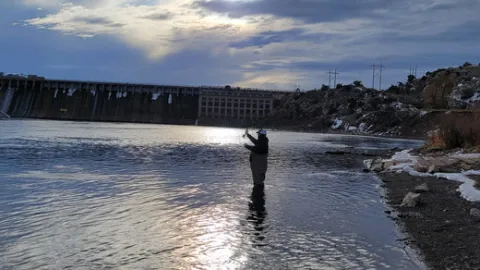
The rainbow on the other end of my line was giving a good accounting of himself. After a solid take, the winter rainbow awoke with several strong jumps, clearing the water with an impressive aerial display, before settling down to a solid tug of war with my 7-weight rod. I slowly worked the fish into the shallows, carefully backstepping on the gravel bottom of the Missouri River. As the fish grew weary, I slipped him into my net and gently slid out the #16 streamer that fooled him. Resting the tired fish, with a strong splash he gave a signal that he was ready to return to his home. I eased the glistening rainbow out of my net and watched satisfied as he darted back to the depths.
It was the middle of January, and my former home state of Washington was trapped in a cycle of wet, icy roads causing a general standstill from accidents throughout the Puget Sound area. Meanwhile, in Montana we were experiencing our first “Chinook Winds” , a warming trend I was told was a common occurrence in the Great Falls area. With temps hitting the upper forties I decided it was high time to explore the winter trout fishery that I had heard and read about on the Missouri River. In Great Falls the river was frozen from an earlier cold snap, but traveling 50 miles to the angling community of Craig revealed a free-flowing river devoid of the summer line up of drift boats plying the waters.
Reaching the Bull Pasture access, I shared a beautiful drift with one other angler. He graciously gave me some tips and an extra leader (I had forgotten mine!). Saying “I’ll see you on the water”, I followed at a respectful distance, giving him first water.
Moving to a new home is not easy. Moving to a new home in another state multiples the challenges and frustrations. For my wife and I it had been a year of packing belongings, cleaning, getting quotes for house repairs, and slowly but surely learning our new hometown, Great Falls. Somewhere in that mix of seemingly never ending tasks I vowed to myself that I would get some fishing and exploring in. Over previous visits my son Matt and I had fished different locations and so I knew a few places to go, but I also wanted to learn new spots and explore fresh places.
Montana has a wealth of angling options, but they are very different from Washington. Lakes are fewer and farther between. Trophy trout rivers are seemingly around every bend. Reservoirs offer big bodies of water which suited my Thunderjet well, but I was also looking for those local spots closer to home where I could make a quick drive, fish, and return home with time left in the day to do chores.
Fortunately, I discovered a totally unexpected source of fishing information other than YouTube and internet searches. That information source was none other than the various handymen and contractors that came to our home to work on building a fence, repairing a garage door, and graveling our driveway. Striking up conversations I quickly discovered that, like myself, these anglers were more than happy to talk about fishing and share places to go, times to fish, and gear to use. Following our chats, I would go to my computer and do the further research needed to start expanding my fishing horizons. New locations and fishing adventures were what I craved, and suddenly my world was opening to a wealth of exciting opportunities.
Networking is nothing new, but in our new age of social media it seems to me we are losing that piece of our human connection. Or, maybe it’s just that I’ve read one too many harangues of comments such as “I don’t share locations” anytime someone asks for help on social media. As if that is the cause of our woes as anglers, and being more selfish is the solution to shrinking opportunities. Perhaps the answer is we all expand our horizons, finding those new locations and species to target. And we share the wealth, instead of tightly clinging to our ever-shrinking little world, becoming bitter and inward focused. But I digress…
As I made new friends and we shared our passion for fishing, more ideas and destinations swirled in my head. Epic adventures lay ahead of me – a trip to Fort Peck to target land-locked chinook salmon, or maybe an RV trip to a remote high country lake to fly fish out of my belly boat. Or win the Montana angler lottery’s trip of a lifetime and float the Smith River on a four day camping-fishing adventure. Can’t forget Flathead Lake with its famed lake trout fishery.
In addition to learning new spots to fish, I realized with both a feeling of sadness but also intrigue that the fishing routines I was used to in Washington were going to be very different in Montana. For one thing, gone will be the days of waiting to hear what seasons will or won’t be open. No longer would my boat see the salt water and flow of the tides. Battling seaweed while trolling for salmon will be a thing of the past. Having my choice of dozens of kokanee lakes was done. And steelheading… I can only say I am very thankful to have seen the days when local rivers had healthy returns and anglers had a multitude of opportunities to catch these magnificent fish.
In their place, however, were new piscatorial pursuits. Reservoirs with solid populations of large walleye, bass, and pike awaited. Kokanee lakes, while less in number and more spread out, offered solitude and bigger fish. Smaller mountain lakes and high elevation ponds compelled me to buy a new belly boat, bringing me full circle back to my first year in Spokane when I would travel to the multitude of trout lakes and fly fish out of a float tube. I realized with a feeling of excitement that I would need to dust off my neglected fly rods, go through my fly gear, and reacquaint myself with the fine art of fly fishing.
Montana is truly the Mecca of fly-fishing and my new home put me in close proximity to one of the most famous and bountiful trout rivers in the west, the Missouri River. I will confess, my first few trips to the “Mo” were humbling experiences. My fly-casting skills left much to be desired and Missouri rainbows are not easily fooled by sloppy casts. That said, I am embracing the challenge of becoming a better fly-fishing angler, and I observe with satisfaction a steadily improving presentation and distance in my fly tossing.
Most of all I am excited to share new adventure stories and TV episodes with our readers featuring the “Big Sky” country. I look forward to taking friends new and old out to enjoy with them the beauty that is Montana. In the meantime, wherever you call home, I encourage you to broaden your horizons, fish new waters, and share your love of fishing with other anglers. Take a kid fishing and help spark the passion in the next generation so our waters will have advocates to take care of them, help them flourish, and protect them.
/articles/joys-and-challenges-fishing-new-state
Did WA State Parks Cancel Thanksgiving?
I was reading the September Washington State Parks e-newsletter, which covered the remaining free days available for day visitors to enter and park in Washington’s State Parks without a Discover Pass. One of those dates is the day after Thanksgiving: Friday, November 24th. I was curious why the State Parks and Recreation Commission chose to not call it a Thanksgiving or Day after Thanksgiving free day and emailed the media department to ask them why.
Having not received a response right away, I began researching this and found the day after Thanksgiving was first made a free day to enter state parks in 2017 which was called Autumn Free Day. It remained as Autumn Day through 2021, but in 2022 the free day after Thanksgiving got a new name, Native American Heritage Day. However, in 2023, the late November free entry day was once again designated, Autumn Day. Is this all about wokeness and cancel culture towards Thanksgiving? Did someone object to it being called Native American Heritage Day?
I did receive a reply from State Parks media staff shortly before this column went to press stating, “Washington State Parks and the departments of Fish and Wildlife (WDFW) and Natural Resources (DNR) have offered a Discover Pass “free day” the day after Thanksgiving for several years. The free day is not associated with Thanksgiving. It is the last free day of the year and coincides with autumn and school vacation for many families.”
So perhaps I’m mistaken about cancel culture, though the reply doesn’t answer the question as to why they changed the name from Native American Heritage Day back to Autumn Day for 2023.
Maybe it’s just the way things are done by our state agencies in Washington these days. A great example is the Hungarian partridge, nicknamed the “Hun” for short, which saw its name changed to the completely non-offending and uninspiring name, gray partridge, a few years ago by WDFW. Autumn Day falls into the same category. Afraid to offend any one person or group of people, you just change the name to something that won’t offend (or inspire) anyone.
Of course, that’s just my opinion. However, no matter what it’s called, November 24th would be a good day to get outside into one of our state parks instead of spending the day inside big box retail stores or in front of a computer all day shopping online.
*This article does not necessarily represent the opinion of Northwest Fishing or NW Reel Life magazine.
/articles/did-wa-state-parks-cancel-thanksgiving
How to Survive Opening Day
April is unofficially the start of spring and often linked to mythical tales of rebirth, resurrection, and fertility. Throughout history, spring has been celebrated via a diverse lineup of traditions. It is a time of rebirth that can be tracked back for centuries. Where many of the ancient festivals can be directly linked to some sort of bloodshed and brutality, fortunately for the Western Washington angler, we see April as opening day of lowland lakes season.
Where hopefully our participation does not result in bloodshed, opening day can either be a bodacious good time or a stressful one. As a small child I remember anticipating opening day for months, any given year it was probably the highlight of the year for me. My opening day experiences have always been memorable. To this day, fishing or not, I eagerly await opening day each year. In a sense, opening day marks my renaissance each year. Unfortunately, not everybody feels the same way, and opening day can be an overwhelming source of frustration.
So, how does one survive opening day crowds?
Opening day frustrations come in many forms and we all have different tolerances for things that are generally out of our control. Your mindset should be that most things associated with opening day will be out of your control. The list is long, but some things to think about are tackle/gear availability, where to go, gear failure, and crowds.
Planning and preparation will go a long way in smoothing over any pre-opening day jitters. Don’t go to your local tackle shop on the Friday before opening day and expect to find your favorite lure, a kiddie setup, a jar of Ball-O-Fire eggs, or buy your license. Even well stocked tackle stops can run low in the days leading up to opening day. Shop early and remember that in our post pandemic world, the tackle shops are dealing with supply chain issues.
If they don’t have something it’s likely not their fault, and they are doing everything they can to anticipate your needs. Locally, Kevin Johns with Holiday Sports is a both the tackle buyer and lifelong local fishing expert. They are well stocked for opening day. If they don’t have what you’re looking for, look up Kevin and he will steer you in the right direction. SportCo/Outdoor Emporium, Johns Sporting Goods, Yeager’s, and even some local hardware stores have a fishing expert. As a hidden gem, the fishing department manager at Ace Hardware in Anacortes knows her stuff and is very devout in her pursuit of our local fisheries.
Before opening day take the time to go through your gear and, if you’re using them, your boat and trailer. Did the battery survive the winter, trailer lights work, and are your winch and/or tiedown straps functional? Check the line on your reels, replace as required. Check your rods for damage and cracked guides. How does your tackle bag or box look, are they adequately stocked? Make sure you have serviceable PFDs for everyone that may be on your boat, and it’s a good idea to have life vests for any children and non-swimmers when fishing from shore.
As part of your planning activities, maybe visit the area you plan to fish ahead of time. Check ramp conditions, look at the boat trailer parking options, shoreline access points, and hazards. Make sure there are not any surprise road or access closures. Over the winter, some of our access points may have been updated, and parking or access could be different.
Hopefully your upfront planning and preparation will help to soothe and your opening day anxiety, but you’re not out of the woods just yet. You still have to survive opening day!
I kind of look at opening day as maybe attending Mardi Gras in New Orleans. All the individual components and food may be a little odd or even uncomfortable, but the combined experience is an absolute hoot. A big thing to remember about opening day is that it is typically a family event. Strive to make it a positive experience for everyone involved.
Children are very perceptive and are constantly learning from our behavior. If they get tangled with your prize stocked rainbow or one of the grandkids hooks your favorite fishing hat when casting just laugh it off. In the event of a tangle or other calamity, no matter who is at fault don’t be afraid to say that you are sorry to your fellow angler. Use the time to teach good sportsmanship and etiquette.
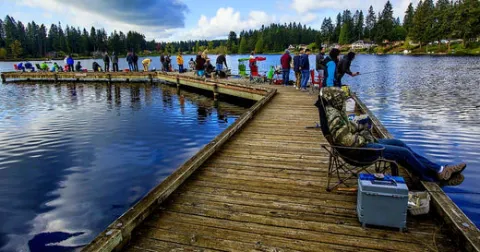
You will have no control of the crowds and know that going in. That said, you can do a few things going in to improve the experience. First and foremost is to arrive early. Not just early but hours early. Your favorite spot at the corner of the dock or bulrushes is more likely to be available, and if you’re boating, you may find trailer parking within a reasonable distance to the ramp. On that note; if fishing from the shore, don’t impede the boat ramp access. Boaters need room to maneuver their rig, a place to beach their boat, and a line free path to and from the boat ramp while on the water.
As an alternative, if early doesn’t work, sleep in. Get up, have a cup of joe or three, and maybe even breakfast before heading off the lake. There is a thought here; opening day is all about voracious, planted trout. These fish will have the feed bag on all day. Years ago, I hatched an opening day plan to fish Lake McMurry in Skagit County. We had a guest from Alaska, she was an avid angler but had never fished an opening day.
The plan was for me to launch at o-dark thirty, then wait for them to arrive around daybreak. In accordance with the plan, I launched hours before daylight and was the second rig in the parking area. After launching I motored out, dropped the anchor, and waited for the crew. It was cold, raining and breezy, and in short order I was soaked the bone. With dawn came a renewed hope that I wasn’t going to die of hypothermia just off the Lake McMurry boat ramp, but my wait continued. There was a lot of activity, and I enjoyed watching all the happenings. My waterlogged condition was improving and almost bearable.
It was a little later, the rain had turned to mostly a mist and the sun was trying to show itself. I was eager to join the other opening day participants but somehow, I was still waiting. A few of the boats that had already launched and headed out fishing were now coming back in with easy limits. I was getting a bit anxious and at that point I had full on gold (I mean, fish) fever.
Eventually the gang showed up, they had overslept and ended up parking somewhere way down the road. I considered expressing my displeasure with the situation, but here came one of the kids, little legs going as fast as they could, carrying a McDonald’s bag. She was over the top excited that they had stopped and gotten me breakfast and coffee. Although they were both cold, her enthusiasm was infectious and the wait was forgotten. We got loaded up and cast off on our adventure. We had an absolute blast, lots of joking around, lost fish, and full stringers. We started out just doing catch and release, and then quickly filled out our limits. I don’t know how many fish we caught that day, but it was one for the books. As applicable to opening day survival, there were a few lessons learned moments in our adventure.
Although a bit frustrated with the wait, I stayed positive and we had a great time. The kids and our guest thoroughly enjoyed our adventure and never saw my tribulations. The second lesson was in the opening day bite. Even though people were coming in with early limits, I think the bite improved as the day progressed. I believe that with the unsettled weather, the surface temperatures were lower early on. The bite really got going as the lake warmed up. I’m sure if we had waited until 1:00 or so to launch, we still would have limited and not had to worry about parking. Maybe off subject, but regarding lessons learned, always carry a big thermos of hot tea or coffee!
If you just can’t get into the opening day hocus pocus no worries, you still have options. Remember that almost everyone that owns a fishing rod will be fishing an opening day lake. What that means to you is that, for the most part, our other fisheries will be deserted. The year-round lakes will be just hitting their spring stride. We have enjoyed kokanee limits from Lake Stevens, Lake Cavanaugh, and Lake Samish on opening day.
There are other fisheries to explore as well. You’ll want to check the WDFW regs before you hitch up your rig, but for 2023 it is likely that both halibut (MA 6-10) and spring chinook in SE Washington will be open. Both have their own crowds and challenges but are solid alternatives to our Western Washington Lowland Lake opener. You may also consider shallow water fishing in the salt. Both surf perch and bottom fish such as the Irish lord family, sanddabs, sole, flounder, and greenling are all available year round. Check the WDFW regulations and bottom fish definitions for the area you plan to fish.
Your ability to survive opening day may be a crapshoot, but with a little advanced planning you adventure should be mostly painless with bloodshed limited to a skinned knee, sliver, or the rare hook in the finger. Again, opening day is a huge family event, so patience and understanding will be your friend. At all costs, make opening day fun for all and be a teacher.
Assure your gear, boat, and trailer are up for the task before you head to your favorite lake. Get your tackle and licenses as early as possible. Make sure the kidlets are wearing properly fitting lifejackets and, as appropriate, bundled up for the weather. Opening day is not the time to cut back on snacks, a full tummy is a happy tummy. A little attention to details and you will not only survive opening day, but the gang will eagerly look forward to next year’s festivities.
/articles/how-survive-opening-day
Kayak fishing in Makah Land
With cracked and battered hands, I paddled east with 25 knots at my bow and an incoming tide on my stern. Colliding forces of Mother Nature churned heavy swells into a roller coaster of seawater, tossing me about as I struggled to stay on track. A behemoth of a fish, a monster, 50, maybe 60 lbs, haunted me from the day before, yet kept me moving eastward, into the fray.
This is just one of the many tense experiences that characterize a spring kayak fishing trip at the continental United Sate’s most northwestern point—Neah Bay. Neah Bay has become somewhat of a kayak-fishing Mecca for me. Each year I make the almost 4 hour drive to its rugged and draw dropping coastlines. Heading up the east side of the Peninsula, the drive treats travelers to a myriad of jagged points and bluffs that meander past ancient saltwater beaten sea stacks before colliding with the belly of the North Pacific. The coastal terrain then wraps around Washingtons most Northwestern point, Cape Flattery, which is a marine anomaly in its own right, and then heads down to the sandy beaches of Makkah Bay, ending just south of Cape Alava.
Though fishing might be the main attraction for readers, it’s worth noting that this area holds an endless amount of wealth in its natural beauty and also in its cultural and historical prominence. The Makkah Museum is open to the public and is a great place for visitors to learn about Neah Bay’s native community and their long connection to the land and sea, that of which is estimated to be around 3,800 years old.
Case in point, the Makah tribe, for at least the past 1,500 years, have paddled hand carved cedar canoes out to often treacherous seas, where paddlers would track and hunt humpback and grey whales with harpoons attached to sealskin floats. They are the only tribe in the U.S to have whaling rights secured by way of treaty, though this right was later repudiated by the U.S government after commercial whaling by both European and Americans had all but extirpated both grey and humpback whale populations.
From here visitors can explore the many outdoor attractions Neah Bay has to offer. Whether it’s a backpacking trip down to Shi Shi Beach to camp and fish for surf perch, or a day trip to the Point of the Arches, there’s a number of things you can do to diversify your fishing trip before getting into filling your cooler.
Any trip to Neah Bay with a kayak should be well thought-out and planned, this is especially true during the spring when inconsistent and stormy weather frequently results in the waters around Neah Bay being under small craft warning. Always plan your trip around NOAA marine weather forecasting and make use of apps that predict swell size, wind speeds and wind directions. Optimal conditions would be flat and windless, and if we waited for those conditions, we would never fish. So, sticking with days where winds are sub 15 mph, swell size is moderate, and wind waves are predicted to be no more than a couple feet, will all help keep you on the right side of the water.
Staying on the right side of the water is always the goal, but as probability has it, there will be some point in any kayak angler’s life where he or she will get dumped into the salt. This is especially true if you’re launching or landing in surf zones. If you are prepared for it, which you 100 % need to be, then an experience like this will only serve as a minor inconvenience as opposed to something life threatening.
First order of your operations will be gearing up to stay warm. I suit up into a 5.4 mm wetsuit, equipped with a hood and 5 mm booties. Essentially, I dress the same exact way I would if I was to surf anywhere on Washingtons chilly coast (with the exception of a PDF). Many anglers prefer a wetsuit as they are not bulky, they make movement easy, and they perform consistently each time. Another option is to use a dry suit.
Dry suits are a breeze to put on when compared to a wetsuit, they slip on over your insulating layers, provide you the security of knowing that if you were to go in; you won’t experience a layer of cold water rushing over your skin like a wetsuit allows, and you can slip out them without a struggle as soon as you are done fishing. The downside of a dry suite is that in the event of dunk— a tear or a leak in the suite would allow water to flow inside and render it completely useless, thus making hypothermia less of a possibility and more of an inevitability.
If you do get dunked, you need to know how to get back into your boat. This is something that requires practice and should be done in calm and shallow waters, perhaps somewhere close to home. Neah Bay is not the place you want to have a “learning experience” when it comes to falling into the water. Know how to right your boat if capsized and know how to climb back in.
Finally, secure all your gear like you were planning to flip the boat. Lanyards and bungee cords are your friends. Keep hatches closed and secured and you should be set to catch some fish.
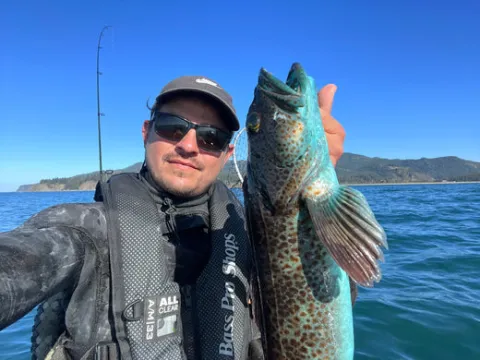
Spring kayak fishing in Neah Bay is red hot when it comes to Lingcod, rockfish, and Cabezon. They can be caught in relatively shallow waters where kayak fishing is more feasible, and in general, these amazing predator fish are typically going to bite down on whatever you’re willing to throw at them. My best luck comes from jigging 2 oz jig heads with a white single or double tailed grub.
The best bait for catching a trophy lingcod might be lingcod itself. The experience mentioned at the intro to this article foreshadowed what has become the most intense battle with a fish I’ve ever been part of, and that experience happened to occur because of the lingcods love for the predation of its own kin.
It was late morning and I had been fishing for a couple hours with various species already onboard. Snagging on kelp is a frustratingly common occurrence when fishing the straights of Juan de Fuca side of Neah Bay, and after losing my gear several times to snags, I was ready to throw in the towel. Just at that moment, my line was once again wrapped up on some vegetation deep below the surface. After a few attempts to free my hook from what would surely become its forever home, I felt a tug at the line.
Oscillating between thoughts of a monster fish or a monster let down, I decided to swing towards optimism and fought this potential snag like it was more than just another disappointment. I reeled in and raised the rod tip, letting it back down as the fish either slowly took line out or the current was simply just pushing me away from the point where my hook was snagged. Again, there was another strong tug at the line. This was a fish. Perhaps a fish caught-up around some kelp, but a fish for sure. After fighting for what felt like an eternity, and as the minutes passed by, and my arms became more tired, I finally felt progress as my reel started collecting more line.
Finally, through the darkness of the water, I made out the shape of not one, but two fish. A good size lingcod, maybe 30 inches long had its mouth tightly secured around my hook, and even more tightly secured around him—was something that I thought only exists in nightmares. A lingcod that looked to be about the length of my kayak was lock-jawed around this smaller fish, and they were getting closer to the boat. Fearful of what would happen if I tried to land this razor toothed behemoth in a kayak, I panicked a bit.
Yet, in a split-second decision, I grabbed my net and tried for a swoop. As I reluctantly scooped toward the fish that would in no-way ever fit into my net, let alone my boat, the giant ling let go of the smaller fish, and in true nightmarish fashion, breached out of the water with its mouth wide open and razor-sharp teeth exposed. Only inches from its giant head, I watched as the open mouth of the fish passed by my face and then landed back into the water, into the depths of Neah Bay; where I was oh so happy to see it disappear.
/articles/kayak-fishing-makah-land
Road trip options for ice-out trout
Remember that opening day of trout season tradition? It's a thing of the past. Most of our best trout fishing lakes and reservoirs are open year-round. In Oregon, you can go fishing when you feel like it or when the ice thaws, whichever comes first. Here are some of the best ice-out trout fishing destinations for early April.
Central Oregon
In Central Oregon, and west of Tygh Valley, Pine Hollow Reservoir is a 240-acre irrigation impoundment set in mixed pines and oak trees. Less than an hour's drive from The Dalles, it is a popular summer fishery, but can be pretty quiet early in the spring. And that's when this fishery kicks off. The Oregon Department of Fish and Wildlife stocks legal trout and big brood stock rainbows here, starting the third week of March if ice allows. When the ice first begins to thaw, the fishing should be excellent. A boat is a good idea for this lake, although there is good bank angling at the east shore boat ramp and on the east shore. My favorite trolling pattern touches at the buoys in front of the resort.
Nearby, and west of Wamic, Rock Creek Reservoir shows off best early in the season when ODFW stocks approximately 12,000 legal rainbows between early March and the end of May. Plan it for the third week of March and beyond. This is a good spot for bank angling, but a car-topper boat is a definite advantage. Bait is allowed and bank anglers do best when using jar baits with a sliding sinker and a long leader. This is not a place to use a light leader. The Department often plants brood stock trout that can run up to 30 inches long.
Summer Lake
Near the town of Summer Lake, 60-acre Ana Reservoir is one that does not ice over, but the best timing is going to be after the third week of March when ODFW typically plants 3,000 legal rainbows. The community of Summer Lake has been paying for additional trophy rainbows to be stocked in this lake, creating a destination fishery that is still relatively unknown. Trust me, if you catch one of the big ones and want to keep it for a barbecue, it may be one of the best tasting trout you have had in a long time. Or let it go for the next guy to tangle with. Your call. Best place to start is at the boat ramp and along the dam. Bank fishing is good here. Fly anglers will want a boat or float tube.
If you plan a trip to Ana, there is a good RV park, nearby hot springs with cabins, and the Lodge at Summer Lake. Tell them you're there for the fishing and they will keep this trophy program going.
In early April, Krumbo Reservoir is one of the best things going when ODFW plants the first legal rainbows of the year. Krumbo, a shallow desert lake on the west side of the Steens, is 150 acres and fishes best in spring and fall. Because the lake is so food-rich, the trout can winter over and 20-inchers are common. Bank anglers can do well here, although bank access is tricky, scrambling over lava rocks. A better bet is to bring a float tube or a small boat.
Between Sumpter and Baker City, 2,235-acre Phillips Reservoir was a formerly great rainbow trout fishery which was overrun by yellow perch and has since been rehabilitated with the help of the tiger muskie. That is all you need to know. But since you want more, I'll give it to you. Phillips is a better-than-good ice fishing destination. Perch can be easy to catch through the ice and are every bit as good to eat as walleye. And the perch, because there are fewer of them now, are bigger. As this issue goes to press, Phillips Reservoir has about 12 inches of ice, so depending on the spring conditions, it could still be iced over well into April. Another item to consider is that Phillips is refilling after being drained last year so boat ramps might be out of the water.
At full pool, trolling is a real treat on this lake. An angler should plan to troll for rainbows and spend a little time targeting tiger muskie, which is a catch-and-release fishery. On a steady diet of six-inch perch and 10-inch rainbows, these fish grow to four feet long and weigh as much as 30 pounds. I hooked one once and lost it when it plowed through the weeds next to the boat, jumped as high as my shoulder and broke my line. Use a steel leader and a six-inch swim bait or large spinner bait to target tiger muskies.
Lake Simtustus
One of my favorite lakes right now is Lake Simtustus, located seven miles west of Madras in the deep, narrow Deschutes canyon. Simtustus was formed by Pelton Dam, backing up to Round Butte Dam below Lake Billy Chinook. The reservoir was named after a Warm Springs warrior who served as an Army scout in the Paiute wars of the 1860’s and lived on the Warm Springs Reservation. The reservoir receives about 25,000 trout each season; a hard-fighting summer steelhead strain that run a fat 12 to 14 inches in April.
To fish Simtustus, an angler must not only have an Oregon fishing license, but also a tribal fishing permit. The annual price is up to $60 to fish Simtustus, and that keeps a lot of anglers away. Simtustus has been kicking out limits of rainbows already this year, but not for me. When I fished it in February, I only caught one, but I'm seeking rainbow redemption with several trips on the calendar for April and May.
For the trout fisherman, at the end of a long, cold winter, it's time to plan some road trips and do battle with trout.
# # #
Gary Lewis is the author of the Fishing Central Oregon book. For a signed copy, send $29.99 (free shipping) to PO Box 1364, Bend, OR 97709. Contact Gary at www.GaryLewisOutdoors.com
The End
/articles/road-trip-options-ice-out-trout
Get Ready to Catch More Fish
Anglers often hear about how ten percent of the fisherman catch ninety percent of the fish, and maybe this is not completely true, but there are things that you can do before hitting the water that will increase your catch. Guides are often blamed for showing anglers how to catch more fish, increasing pressure, and “taking” fish away from other anglers, but it is not the guides’ fault that they catch more fish. The difference between guides, those ten percent anglers, and the rest of those on the water often comes down to preparation. Success begins well before the boat gets wet, and those that learn to take care of gear, do needed maintenance, and prep for the day of fishing often catch more fish.
A few years ago, we were up in Nootka Sound fishing for chinook and early arriving coho. After fighting a fish to the boat, the toothy king had chewed up the leader to the point that the hooks broke off just as it was scooped into the net. A quick bonk on the head and a few photos along with taking care of the fish in the box, and it was time to get back to fishing. Instead of dropping the gear right back down to the school of salmon, we had to take a few minutes and re-tie the rigging. The few moments it took to do this caused us to lose the bait ball and the salmon feeding on it. That little mistake cost us an hour of fishing before we hooked up with another chinook and, once again, that fish tore up the leader and we were right back to needing to re-tie. If you have ever tried to snell a hook out in the open ocean you know how hard this can be, and it can cause you to start getting seasick.
Pre-tying leaders is necessary. Not only does it save time when you break off, but it can also help with switching presentations. It is not enough to just snell a bunch of hooks on leaders and call it good. Instead, tie up different set-ups so you can switch out easily. When winter steelhead fishing, one of the most popular lures is the pink rubber worm. Sometimes it is the rubber worm with a chartreuse tip tail, or a red and black worm, and other times it is the 4-inch worm or the 6-inch worm. Regardless, if you just tie up leaders and still need to thread the worm on then you are wasting time. Instead, use a Macks Pips Box and Leader Caddy, where you can pre-tie several different rigs and have them ready to go. Same when bead fishing, where you might need to change out to different size or color of beads.
Check the hooks. Sticky, sharp hooks are a must, no matter what species you are pursuing, but how often do you check the hooks or re-sharpen them? Keep a hook file handy, as in one in the boat tray, one in the tackle box, and one in your pocket. The idea is to keep them ready and make a few strokes on the hook each time you check the bait or switch out the lure. At the end of the day, re-sharpen the hooks so they are ready to go the next time you go fishing.
Wash your gear. The boat and trailer need good washing at the end of the day, but so does all the gear, including rods, reels, and lures. If you fish saltwater, then the benefits of washing everything metal is obvious, but even if you fish freshwater you should clean your gear. Using scents and baits, and even just sweating on the rod handle can lead to unwanted odors and cost you fish. Once, after a trip out shrimping, we came home and washed the exterior of the boat lightly rinsed the interior. A few weeks later, our garage reeked badly. Turns out we missed one shrimp that had fallen out of the pot and slid under the back decking. It took a few hours of re-washing the boat deck to get the stink out. If we had done a thorough cleaning of the boat the first time, we would have found that wayward prawn and avoided a stinky mess.
Rod and reel maintenance are often not done correctly or at all. Rods need to be inspected for broken or cracked guides, loose handles, and cracks in the blanks. If you have broken a rod, it might have been avoided by doing a simple inspection before the day of fishing. Reels have gears, bearings, and springs. Take them apart and learn how to grease and lubricate them, as well as clean the inside of the reels. Drag washers often need to be replaced as well, and once that is all done, then strip off all the line and re-spool. This type of maintenance can often be done once a year unless you fish in the saltwater a lot. If you do, then be sure to maintain the reel before and at least once during the season, and then again once after the season is over.
A deep cleaning followed by removing all the grease and reapplying is all that’s needed. Braided line can often be used for a few years, and one trick is to reverse the line or just strip off the top few hundred yards, use a surgeon's knot, and respool the amount of line you removed. When fishing braid, I often use a “top shot” of fifty feet or so of monofilament, and this gets replaced after each trip when using downriggers, as the clips can cause small nicks or crimps in the monofilament, which can cost you a fish if not checked or replaced.
Prepare the bait the day before. Most bait can be cured, brined, and rigged the day before the trip. Cured salmon eggs are often done months prior and then frozen, so be sure to take them out of the freezer and allow them to thaw slowly as a quick thawing can cause them to become mushy. One tip to thawing salmon roe is to add borax to the container or plastic bag they are frozen in, as this will soak up any moisture that is released during the thawing process and keep the eggs firm. Anglers who use herring or anchovies can make up the brine solution the day before and add the frozen baitfish, then place it into the refrigerator to allow the baits to thaw slowly and absorb the salted brine.
This keeps them firm and allows the chemicals in the brine to slowly soak, which will keep any chemical burns from occurring and toughen the baits. Brined herring can be used for multiple days if kept in the cold brine. If you plan to use a herring strip and wrapping plugs, do this the day before and keep them in the refrigerator by hanging them in a bait cooler. Having a day's worth of plugs pre-wrapped will save a lot of time on the water, and the more time the plugs are fishing, the more chances you will have of catching fish.
Trailer maintenance is more than just washing it and calling it good. The lights should be checked every time you go fishing, as well as before you put the boat away. A brake light out might not seem important, but it could lead to a collision with another driver who does not know you are braking. More than once, we were on our way to the river in the early morning hours, cruising down the highway, and we came upon a boat and trailer being hauled by an unsuspecting angler with the trailer light not hooked up or burnt out. The problem was the boat blocked the truck's rear lights and we almost ran right into the back of the truck. You cannot catch fish if you do not make it to the lake.
Batteries are one of the least thought of items boat owners and anglers think about. Marine batteries last a long time, but they do require maintenance. The best way to keep a battery in full charge and ready condition is to use a battery tender or on-board charging system that you plug in when you are back at home. This will charge the battery and then keep it topped off during the off season. Be sure to check all the cables at the beginning of each fishing season and especially after a trip where you encounter rough water.
Bouncing along and hitting waves causes loose connections, and you do not want to find out the motor will not start, or the downrigger will not retrieve, because the connection was loose or came undone. While you are checking the battery, be sure to look at the fuse box. Not only making sure they are all in good order and the wires are secure, but also what fuses you need to have on board for spares. Some are different AMPs, so it is best to have a handful of spares along.
Motor maintenance is more than just changing the oil. Be sure to open the cowling and look at all the connections. They should be tight and covered in marine grease. Same with any bolts, nuts, and electrical connections- they all need to have a special electrical grease on them. Fuel systems are an integral part of motor maintenance, including the fuel-water separator and fuel treatments.
With each tank re-fill, it is a good idea to add a fuel additive made for your motor. Be sure to check what the manufacturer recommends, and at the end of the season, a fuel additive and preservative is necessary. Even then, it is best to run the boat motor every few weeks or months until it is fishing season again, or have your motor properly winterized.
When you see a guide or one of those “fishy” anglers out on the water, realize that their success often comes down to preparation. If you have ever fished with a guide, you will notice good guides have good gear and are ready for anything that comes up. A nicked leader is quickly switched out with one ready to go, motors fire up right away, and baits are prepared before you step foot on the boat.
It is the trivial things that make the difference, and that is why those that prepare for the season ahead are successful. The old saying, “failing to prepare is preparing to fail” holds true when it comes to fishing success.
/articles/get-ready-catch-more-fish
Swinging Streamers for Trout
To me, there is absolutely no better feeling than a fresh, chrome anadromous fish hammering a properly swung fly. Life goes from less than zero to over 200mph in a split second. Typically, when it happens to me, I’m standing there going through the motions thinking about everything but fishing. Chaos comes and then goes just as quickly. The quick rush is addictive and leads some anglers into facing a maddening depression when there is a distinct lack of fresh chrome fish in the rivers. Years ago, while battling my own steelhead sickness, I discovered that some resident trout do in fact eat swung flies and that it was fun way to fulfill an angling need when a steelhead isn't in the same time zone.
If you are a dyed in the wool steelhead aficionado living within a stone’s throw of the fabled PNW steelhead rivers, stop reading now. Nothing I have to say here will be helpful or beneficial to your quality of life. Your geographic angling superiority is to be congratulated and celebrated. The rest of us that deal with a slight pilgrimage to steelhead water might find solace knowing that a temporary fix might just be a little closer to home than originally thought.
One fall/winter between Alaska and Patagonia guide seasons, I found myself in Western North Carolina. Appalachia. It’s beautiful there. Big mountains, trout streams, elk, bears, deer, and even musky, but not a single anadromous chrome fish anywhere at all. Nothing to swing flies to. I ended up there because of a girl. Although I can’t remember her name, I am sure that’s why I was there. We’ll just say her name was Alice. Alice lived on a big lake fed by three large trout rivers and several creeks. The lake was about 20 miles across and over 400 feet deep at the dam.
The largest river flowing into it averaged about 3000cfs (cubic feet per second) annually. The other two rivers had slightly less flow. Most people around regarded it as “tough fishing” mostly because of the depth and its ability to create nasty waves. Not your typical southern sparkle boat bass lake. I didn't care, it seemed normal to me. After spending a few seasons on Naknek Lake and Illimani Lake in Bristol Bay, I saw this as an opportunity to fish alone in water that rarely saw pressure. So, off I went in Alice’s boat, without Alice. She was terrified of the lake, and she didn't like fishing. Maybe that’s why I can’t remember her name. Either way, I was going armed with a new 6 weight spey rod and my trusted 10’ 7 weight single hand rod. The 6 weight spey was a gift from a buddy that built custom rods and I was itching to dial it in for an upcoming trip. I didn't really think it would be a useful tool for where I was.
As I pulled the boat into the mouth of the river, looking for a safe spot to anchor, I saw what could only be described as textbook holding water for migrating fish. Feeling like that was just a pipe dream fallacy, I lazily anchored the boat and trudged up to the pool above the shoal. As nonchalantly as could be, I made a cast. The rod was an absolute cannon for a 6 weight and still is. While basking in the glory of my new gift, my fly got slammed. The fish darn near ripped the rod right out of my hand. I wasn’t planning for this. I was just tuning a new rod.
The fish pulled a couple of runs and then gave up. As the fish headed towards the shallows, I tailed it and just knelt there with it for a minute. Holding in my hand was a perfect specimen of rainbow trout that probably measured 26-27”. It wasn’t chrome, but it wasn’t full of color either. Just a perfect species specimen with all its fins and mandibles. Not a steelhead, but darned nice. I figured it to be a fluke but kept fishing anyway. I caught 4 just like it that day and 6 the next day. The day after that, I didn’t count the fish I caught. I just enjoyed the fact that I was successfully fishing the way I wanted to in a place where that should not be working.
Soon after that, It was time for me to leave for Patagonia, where I honed the swing method for trout even more. Three months of guiding the tributaries of Lake General Carrera proved to sort out my theories well. Trout that live in rivers without a lake system don't take swung flies as well as trout that live in rivers with a lake system. Maybe it’s because the lake provides a semblance of oceanic feeling to the trout, nurturing its true migratory genetics. Whereas a trout living in a creek or stream that tribs into a larger river is more resident homebody completely ignoring its DNA. Maybe that DNA is bred right out of those fish. I’m not a biologist, so I really don’t know the answer to why they do or don’t. People much smarter than me will be able to answer that.
Here is what I know - everywhere I have tested my theory on swinging flies for trout, it works. Every single time. In Alaska, PNW, Rockies, Sierras, Appalachia, and Patagonia. A trout river feeding a lake of any substantial size and depth will support an angler trying to get a fix by swinging flies to trout. It’s become a game of sorts for me now. Every steelhead trip, I pack my 6 weight spey rod and a 6 weight switch rod.
It’s been a lifesaver at times when the steelhead water is blown out. I don't get too crazy with the flies; everything is a stinger hook fly scaled down in size somewhat. I try to use more natural looking patterns. Any smaller stinger hook sculpin or leech pattern is great and there are several very good sources for trout swing flies out there. Start at your local fly shop. Those guys will know what’s up.
If your steelhead pilgrimage is a little too far to take a chance of being blown out, grab a 6 weight two hander or 10’ 6/7 weight single hander and test my theory. I am sure there is a river near you that fits the description. You might save some time, gas money, and get to fish alone. Who knows, you might even get Alice to tag along.
/articles/swinging-streamers-trout