When Seconds Count
Whoo-hoo, this month I drew the coveted Writer's Choice card. I had planned to write a piece on late season Puget Sound chinook. A solid plan in place, but then came along the latest WDFW Fishing Rule Change. This closed Marine Area 10 to chinook fishing. This situation where the current estimate for chinook sublegal encounters for the summer fishery is at 122% of the agreed fisheries. The truly difficult part of the MA 10 closure is that MA 10 chinook catch rate typically peaks in mid-August.
I considered shifting the content and discussing areas that explain where to bag a chinook in Puget Sound. After internal debate, I decided I would shift chinook effort from MA 7, 9, 10 and 11 toremaining chinook fisheries. I thought better of the idea. Normally I am more than willing to share information. However, in this case the remaining fisheries really can’t handle the potential for increased fishing pressure. I’d be “Blowing Up” our few remaining opportunities. It’s a shame though, some of my best days on the waterwere caught August through September. I love writing about chinook fishing and the decision was a real dilemma for me. Dilemma or otherwise, in late July things changed and I decided to refocus my article.
This has been a summer of changes around the old homestead. We have and continue to have multiple remodeling projects in work. We moved my mother-in-law in and with few exceptions I’ve been working 6 days a week. Not complaining, all the right thing to do. And then to be honest I absolutely love my job and kind of go through some form of withdrawals when I’m not working… With the hectic schedule and lack of fishing (neither one of my boats have been off the trailer since May and then January before that) I was kind of evaluating life and sorting through what’s important or otherwise. I was even considering selling the boats.
Typically, we meet my fishing buddy, his wife, and sometimes other friends for a meal once a week. Usually, we meet at Billy’s in Burlington on Sunday mornings. We’re regulars and they have one of the best breakfasts in Skagit County. On a Friday morning in late July, I texted my fishing buddy to confirm our Sunday plans and he called me back to let me know that his wife, our close friend, had just had a stroke.
It was the last thing I ever expected to hear. Being that they are 20 years younger and in generally good health, the news was hard to comprehend. As couples we have spent a lot of time together; vacations, fishing, and of course our weekly outing, and nobody ever thought twice about our individual health. Instead of a fishing article I decided to write a brief public service piece.
A stroke is an interruption to the blood supply to the brain. Strokes are the result of an obstruction or damage to the arteries in the brain, such as a clot or aneurysm. A stroke can occur at any age and statistics show that 1 in 5 people that have a stroke are under 55, but the chance increases with age. The interruption can cause brain cells to die and depending on the location, can impact the victim’s speech, vision, cognitive abilities, movement, and/or coordination.
It is critical that you learn the symptoms and immediately react by calling 911.Remember the seconds count. Although the individual symptoms may not be unique to a stroke, the sudden onset or out of the ordinary onset of any of the following may be symptomatic of a stroke and requires immediate EMS care:
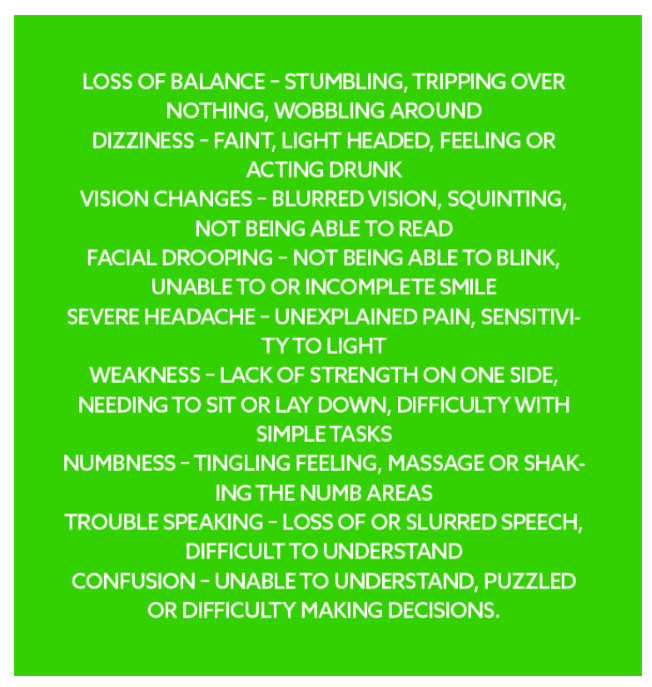
.
Again, recognizing the symptoms and reacting is critical when you suspect a stroke. As outdoorsmen, especially if you or your partner are in a risk category, make sure your cell phone is charged and/or your VHF is in working order.
Risk factors that we can’t change are race, gender, and family history. Fortunately, with the help of your family physician, there are risk factors we can manage to reduce the chance of having a stroke: Blood Pressure, Cholesterol Levels, Smoking, Weight, Physical Activity , and Diabetes.
By being familiar with stroke symptoms and taking action, both recovery and survival are possible. The onset of stroke symptom(s) is sudden with no warning. As soon as something seems off with a loved one or fishing and hunting partner you should take immediate action. Calling 911 may improve stroke recovery prospects and hopefully a piggy of a chinook will be in the cards down the road.
Reference material for this article is courtesy of: https://www.strokeawareness.com/patient/spread-the-word.html
Editor’s Note: As a Registered Nurse of over 35 years, I’d like to affirm that time is of the essence when it comes to strokes. If your fishing buddy shows signs of stroke it’s time to get off the water ASAP and get help. Another excellent source of stroke information can be found at https://www.stroke.org/

/articles/when-seconds-count
My Memory of the "Bait Boy"
The first time I met Paul Hamilton was a brisk October morning on the Snake River at Heller Bar; he showed up with Rob Holman from Northwest Fishing for a combo Chinook salmon and Steelhead trip. This was first of many shows we filmed together over the years.
One skill I have developed over my 32-year guiding career is reading people. I can watch a person as they approach the boat and it's amazing what you can decipher in 1 minute. On this morning, Rob approaches with his crew and immediately I notice this larger man with a smile, cowboy hat and a mouth full of chew. By his appearance alone I knew this was my type of dude. Paul hopped on the boat with a spring, he was fairly agile, I could tell for a bigger man he was athletic. Sure enough, within an hour I knew his life story. Paul was a college wrestler and we shared good friends, many who had wrestled with him.
A Few Things About Paul
He lived in Hillyard which is a suburb of Spokane and sold insurance for Allstate. My pal loved Hillyard and loved selling insurance and he was very good at it. I feel fortunate that he was the type of guy you liked and trusted. After a few hours into the trip it was evidently clear Paul liked fishing and he was a excellent angler. He caught multiple Salmon and Steelhead.
He was very good on the camera. It's hard to find someone good on camera. Most people see the camera and immediately clam up, so when we are filming a show it's nice to have a personality like Paul. Paul was a go-to person for some entertainment and good camera conversation.
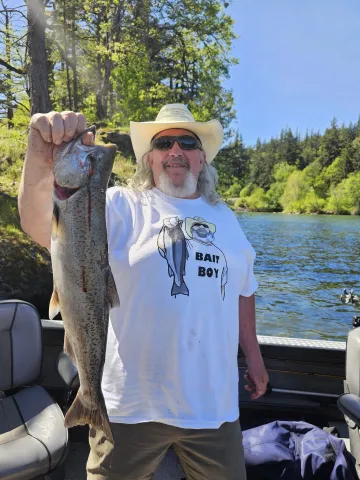
Over the years we spent a lot of time fishing and filming together. I joked with Paul and called Paul the CEO of Northwest Fishing. Paul and I got a kick out of this as everyone knows Rob holds that title (haha). Paul dubbed himself the "Baitboy" and really loved the title.
Our Last Trip
On my last trip with Paul was to Drano Lake and the Wind River. Paul showed up with T-shirts with his image holding a salmon titled "Baitboy". I laughed and gladly wore it! Paul had brought some personal friends on this trip; they were longtime buddies. Those last two days were filled with amazing stories and fish catching. I'm glad to have known Paul, he was a character and enhanced any environment he attended. I will wear his shirt loud and proud just like Paul.Editors Note: Baitboy T-shirts are available at www.northwestfishing.net with all proceeds going to a newly established Paul Hamilton Memorial Fund to benefit youth in his community.
/articles/my-memory-bait-boy
Fly Lines - The Method to the Madness
Once upon a time, fly fishing was a simple task. If an angler wanted a fly rod outfit, it was obtained by going to a fly/tackle shop, selecting a rod that had a number written on it, and then selecting a fly line that had the that same number written on it. Said fly line was then spooled up on a fly reel. The angler bought some monofilament tapers leaders that had a weird number with an X and that was it. (We will cover what that X means later.) Off we went into the great beyond in search of stupid fish that willingly ate our artificial offerings. Simple. Those were the days of blissful ignorance, both the anglers and the fish.
In these modern times of technically specific fly rods and fly lines, there are so many choices. What used to be a simple task now resembles an act of faith to get the right set up. No matter if you shop online or in a local fly shop, the fly line choices are are plentiful. Fortunately, all the major manufacturers of fly lines have done a very good job at trying to make a complicated task as simple as possible. Rio, Scientific Anglers, Cortland, and Airflo have application specific fly lines that are easy to navigate on their websites as well as in a fly shop. Plus, it never hurts to have personal input from a bona fide fly shop employee that has actually used the fly line. Hands on experience will never be replaced by the typing of letters on the interweb by someone who has never even touched a fly rod. Keep that in mind when you decide where your money will be spent.
Methods
I am going to try to explain the method behind the madness of what makes a fly/line a certain weight. Also, I am going to attempt to do this without upsetting any manufacturers of fly tackle products. It’s not my intention to ruffle feathers, only to convey the truth as I know it. So, let’s just say your fly rod is labeled as a “7wt or 7 weight”. In theory, this means that the rod blank needs 7 ounces of weight to make the rod load and unload. In theory, that means your rod needs a “7wt or 7 weight” fly line to make the rod do work. What makes a 7 weight fly line a 7 weight? It should be a simple question with a simple answer. Originally, fly lines were manufactured so that the weight of the “head” determined the fly line weight. Meaning that a 7 weight fly line had a head that weighed 7 ounces. At that time, the head was the first 35 feet of the fly line. Life was simple then.
Real Questions
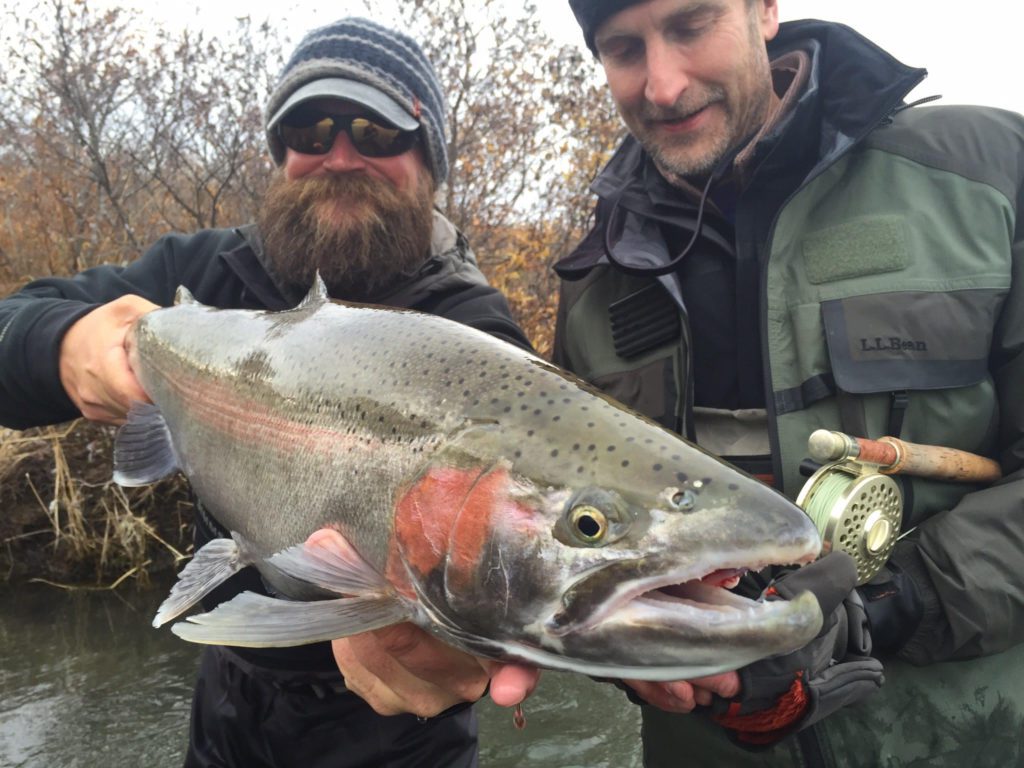
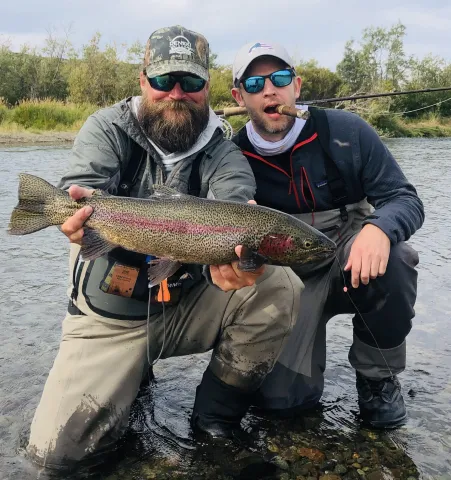
Now that we understand the theory behind the rod/line weights, let’s discuss how to decide the right fly line to select. First - What species am I using this line to fish for? Second - How much money am I willing to spend? Let’s use my favorite single hand steelhead rod, Sage Z Axis 10’ 7wt. Yeah, I know it’s old, but it’s still an awesome rod. I only use this rod for steelheading in smaller rivers, or larger creeks casting heavy flies. Either way, I need a 7wt line. Remember when I said that the fly line head was 35 feet and weighed 7 ounces for a 7 wt line? Now is the tricky part but, not really. My rod needs a fly line head weight of 7 ounces to make it work. If I am trying to cast heavy flies or nymph rigs, it’s easier to do that with a shorter piece of line beyond the rod tip. At least that is our brain’s message to us. Anyone that has ever tried to fly fish knows that our brain says “use less line, it will be easier.” However, this works totally against everything that makes the fly rod/line work as a team. The rod needs 7 ounces to load and unload. However, picking up 35 feet of fly line with a heavy indicator rig on the fishing end is near impossible. OK, maybe not impossible, but it’s hard. Fishing is hard enough, why make it harder? It would be easier to use a fly line that had head weight of 7 ounces that was 20’ instead of 35. The rod gets the line weight it needs and the angler gets the casting performance needed to deliver the cast without having to pick up 35’ of fly line in a small space. On my last trip to the Anchor River in Alaska, I chose the Scientific Anglers Anadro fly line. It has a shorter tapered, more aggressive head that checks the box on what I need to deliver for steelhead flies and rigs. This also works well for skating mice to Bristol Bay rainbows. It is not a good choice for dry fly fishing. Yet, therein lies the conundrum.
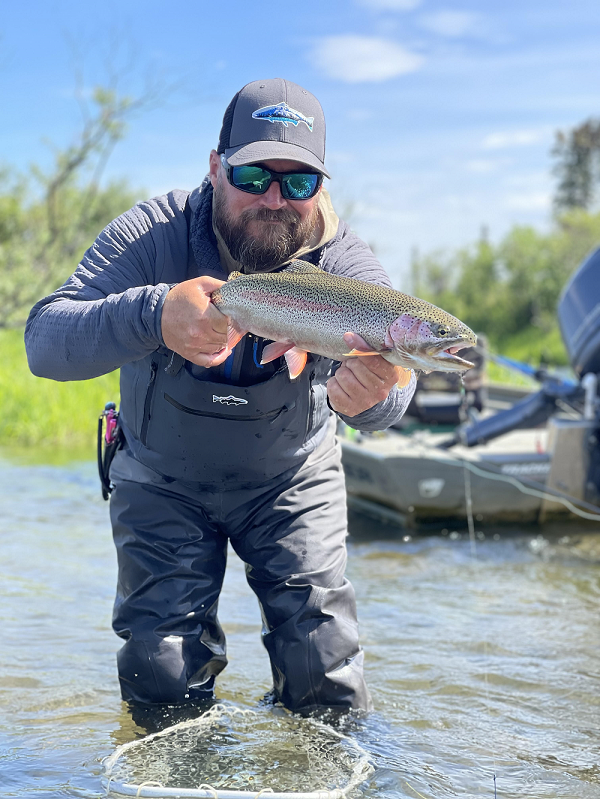
Some of you reading this have already thought “I just need one fly line that will do everything I want it to do.” In my three decades of guiding fly fishing, hanging out in fly shops, hosting trips and just generally being in the business, I have never once seen one fly line that will do everything you need it to do. It doesn't exist unless all you are going to do is fish one way, using one technique for the rest of your life. Even though that sounds completely and ridiculously boring, I guess it does happen. Point being, I don’t use my steelhead line when I go bass fishing. Even though the head taper would be great for turning over big poppers, the fly line core in the steelhead line is designed for cooler or cold temps. Bass fishing is typically warm water which requires a stiffer fly line core so that your fly line doesn't feel like you are trying to cast a spaghetti noodle with half a deer on the end of it. There is not a one size fits all when it comes to fly lines, not even one size fits most. There are some crossovers, but not many, and not enough for me to write about. Plus, the controversial arguments that would ensue would only be a recompense of opinion.
Finale
Last and certainly not least is the second part of the selection. How much money am I willing to spend on a fly line? Fly lines are expensive. Crazy expensive. I remember the first time I saw a fly line for $25. I thought the shop manager had gone mad. No way was anyone going to pay $25 when we had all been paying $18. Then I cast a rod with the $25 line on it and immediately purchased one for myself. That was more than 30 years ago. Today’s fly lines are light years ahead of what they were then. By today’s standards it isn’t even fair to call those old lines fly lines. They were more of just a suggestion of what fly lines should and could be. My advice is to spend as much on a fly line as you can possibly afford to do. The fly line represents the tires on an automobile. If you take an old Cadillac El Dorado that rides like a dream and put cheap tires on it, it rides like a Cadillac with cheap tires. Consequently, you can put the finest Pirelli racing tires on a Saturn and It will handle like a plastic race car. The tires change every aspect of how the car rides and handles. The fly line does the same thing to a fly rod. Spend the money, you will be happy you did.
In closing, when selecting fly tackle, or any tackle for that matter, I can't emphasize enough how important it is to collect your information from reliable sources. I find that privately owned fly shops are the utmost in providing genuine hands-on knowledge. Go to a shop that specializes in what you want to do. I have a good friend and colleague that owns a shop in the Rockies. He and his staff are some of the most skilled and knowledgeable people when it comes to their water. Yet when those guys go saltwater fishing, they call another friend and colleague that owns a saltwater fly shop for input on what to buy and use. Don’t be afraid to make a financial commitment. It could be the difference in catching the fish that you want to catch and standing around watching everyone else catch fish. Don’t be that person....
/articles/fly-lines-method-madness
Sharks. Who needs em?
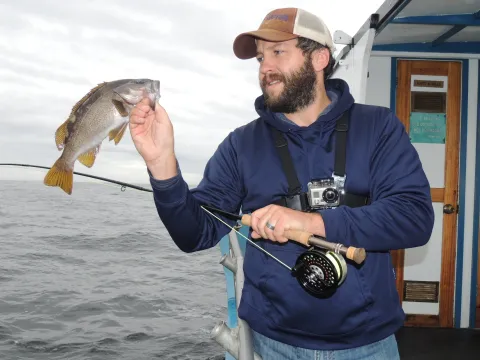
You’ve heard of Shark Week on Discovery CSharks. Who needs em? By Gary Lewishannel. This is not that. We booked two days on the F/V Miss Raven, a 43-foot fishing vessel out of Newport. Our mission was to find blue sharks in the deep blue, chum them to the surface, and stick them with feathers. We called it Shark Weekend. On board were my daughter Tiffany, Sterling West, Paul Galvin, Sam Pyke, Will Saunders and Mathew McFarland and his boys, Chisel and Finney. To catch sharks on the fly, Matthew McFarland prepared three rods, long sticks built to throw 10- to 14-weight lines, with steel leaders and bright feathered creations. Now all we needed were fins in the water.
We stepped aboard the Miss Raven and met skipper Mike Sorensen and his son Sean. Minutes after the safety meeting was over, the 300-horse John Deere diesel fired and we motored out of the harbor beneath the arch of the Yaquina Bay Bridge. When we crossed the bar, waves swallowed the lights of Newport. As dawn broke through the gray clouds, Sean threw the crab pots over and Mike marked them on the GPS. Then someone spotted harbor porpoises off the bow. For a few precious minutes, the porpoises ran ahead of the boat, their bodies briefly above the gray water, then beneath; twisting and spinning. And then as quickly as they had appeared, they peeled away. Twenty-three miles out, Mike cut the engine.
The Miss Raven bobbed in the deep swells that rolled through us. One moment we towered on a wave, the next we were in the trough. Here the ocean floor humped toward the surface. Here the baitfish congregate as well as the sharp-toothed predators that feed on them. Sean punched holes in a big kitchen wastebasket, then filled it with tuna heads and carcasses. Roped to the side of the boat, the basket milked tuna gore and soon we had birds above us - seagulls and albatross. Matthew and Paul rigged fly rods with steel leaders and big streamers. We watched the surface of the water for black fins. That was when we saw the sunfish. Ocean sunfish are a seldom seen species that make their living on jellyfish. They are as tall as they are long and can weigh up to 3,500 pounds. This one sunbathed at the surface and we were able to get a good look. In some languages they are referred to as moon fish, because of their shape. The Polish name means “head alone”; because it doesn’t have a true tail.
A school of 40 or so dolphins found us and ran through our greasy tuna chum line. They circled and came through again and again, breaking through the swells and flashing away below the boat. An albatross paddled nearby and took the fly in its beak. Then he dropped it. That was when I knew we would not catch a shark. The sharks had taken the weekend off. Out on the horizon, I saw a spout and then another.
A great barnacled beast breached, its great, gray body lifted above the surface. Foamy spray crashed out of the swell. In the afternoon, back in sight of the bridge at Newport, Tiffany dipped the hook and pulled in the first buoy. Sean put the rope on the pulley and we held our breath as the pot came into view, brimming with Dungeness crab. Minutes later, we took our stations, sorting males from females, throwing back the little ones. In the dark next morning, we motored south along the coast. Off Cape Perpetua, Mike Sorensen pointed out a watch station that was manned during World War II.
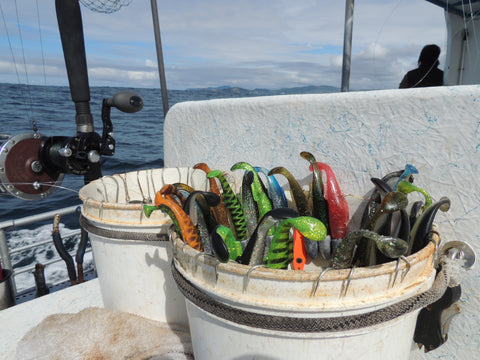
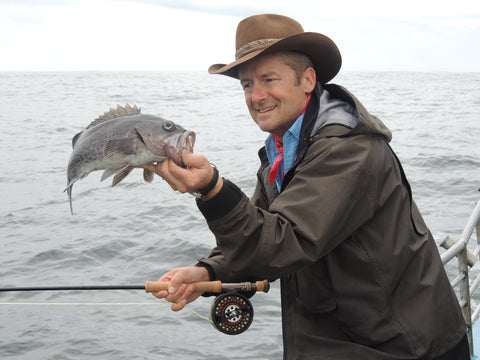
In range of the ghost coastal cannon emplacement, we drifted on a large underwater hilltop. Our jigs and flies bounced through a biomass of rockfish, and in moments, we had our first raw material for fish and chips. In one pass we had filled two-thirds of our limits. On the second drift, we had to call a halt and reel in. Multiple times we caught two rockfish in one cast. Once, we brought three fish aboard in one cast. We came away with a rich haul of crab and rockfish, but that sort of memory is quickly gone in melted butter and tartar sauce. We set out into the Pacific in the dark of the night and watched the sun light up the West Coast; we looked for one thing and found much more. Sharks. Who needs em?
/articles/sharks-who-needs-em
The Outdoors Roundup
Are you in need of outdoor activity ideas for the days ahead? Here, you'll find seven suggestions that offer you the chance to embrace the outdoors and partake in fresh experiences this spring season.
Wildflower Hikes
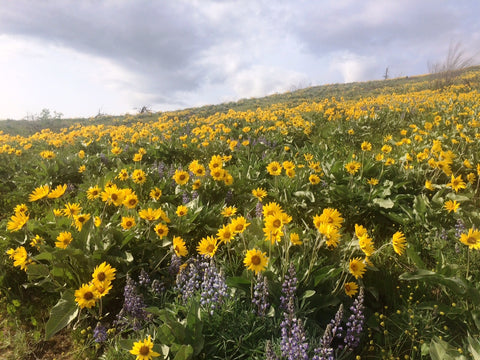
The wildflowers are blooming around Eastern Washington and now is a great time to go on a hike and immerse yourself in their presence! A few of my favorite places to go include Columbia Hills State Park in Klickitat County, Hay Canyon and Nahahum Canyon near Cashmere, Ingalls Creek south of Peshastin, the Turnbull National Wildlife Refuge south of Cheney, and the area around Palouse Falls State Park.
Waterfalls
Speaking of Palouse Falls, this is the best time of year to visit this state park near Starbuck in Southeast Washington. The spring runoff on the Palouse River sends a voluminous amount of water crashing into the 198-feet deep basalt basin below the falls. Other waterfalls worth checking out right now include Rainbow Falls near Stehekin, Silver Falls west of Entiat, and Periwee (also known as Peewee) Falls in Pend Oreille County, which cascades 233 feet into Boundary Lake.
Bass Fishing
The bass are in the shallows and getting ready to spawn. This is arguably the easiest time of year to sight fish for bass. Casting finesse rigs like senkos, jigs or Texas rigged worms and lizards can readily draw strikes. Look for these bass in thick cover and be prepared to scratch up the boat a bit to get at them.
Trout Fishing
Most of those trout planted prior to the lowland lakes opener are still there, and this is a great time to go fishing for them. If you are looking for places to go, check out the WDFW derby lakes where trout with blue tags have been planted. If you catch one of these trout, they are worth a prize, which could be anything from a gift card to a canoe!
Catfish Fishing
Another option for anglers right now is to go after catfish. You can find them in the lower John Day River between the mouth and the falls as well as the mouth of the Palouse River near Lyons Ferry State Park. Channel catfish are also plentiful in the Snake River.
Desert Hikes
As the weather warms, desert hikes become a lot less enjoyable, but if you go now, you can still take advantage of the great scenery and some of the lakes found in these regions. Some of my favorite desert hikes are the lower route to the Ancient Lakes, Dusty Lake, (1.5 and 3 mike one-way hikes respectively), and near Frenchman or Winchester Wasteway in the Desert Wildlife Area in Grant County. If you go, check yourself for ticks at the conclusion of your excursion.
The Washington lowland lakes opener is in the history books, but that doesn’t mean you can’t still catch fish from them. Here’s a report on some favorites and how angler did:
Steve Caromile, the Inland Fish Program Manager for the Washington Department of Fish and Wildlife said, “The lowland lake trout season, Washington’s single biggest fishing season, opened April 22nd with decent weather and catch rates. It is still one of the best bargains in local family recreation. The 22nd was also the first day of our annual trout derby, and we are already seeing catches of tagged trout!”
Caromile continued saying, “With typical springtime weather, angler catch and effort at our lakes was comparable to prior seasons, with catch averaging just about three fish per angler. The air temperatures weren’t bad, but water temperatures are still on the cool side. But with better weather in the forecast, the catch will be heating up as well.”
If you are wondering how Central and Eastern Washington lakes fished on opening day, here are reports from WDFW staff who visited various waters in the region:
Klickitat County
Horsethief Lake was fishing pretty slow on the opener. Individuals averaged two trout each. However, things were very different at Rowland Lake. 29 anglers were checked, and although there were not many people fishing, creel checkers noted they harvested lot of fish. Eight trout were caught per angler, and on average they kept 3.24 fish. The largest trout seen? A 21-incher!
Chelan County
Clear Lake was frozen over and Beehive Reservoir was not accessible to vehicular traffic due to snow at this lake located near the Mission Ridge Ski Area, south of Wenatchee. However, Wapato Lake, near Manson, was open for fishing, and anglers caught and kept around 3.5 trout apiece.
Douglas County
The crowds were out at Jameson Lake on opening morning. Creel checkers counted 234 anglers fishing for trout at 8 AM. Just under 3 trout per angler were caught here, the average fish measuring 11-inches long. The largest fish seen by WDFW staff was a 16-inch rainbow.
Grant County
The crowds were also out for the opener at Blue Lake, with nearly 300 individuals counted, and a lot of these anglers were kids. The average catch was only 1.5 trout each, but the size of the trout was a healthy 14 inches. Park Lake, south of Coulee City, was also crowded, and the catching was about the same as Blue Lake. There was far better fishing at nearby Deep Lake, in Sun Lakes State Park. Anglers there were catching five fish limits of rainbow trout averaging 13 inches.
Okanogan Country
Okanogan County is a popular destination for the lowland lakes opener and for good reason: the fishing can be very good here and the scenery is nice. Creel checkers did not make it out to any of the lakes here for the opener but I called Gene Bussell at Liars Cove Resort, who said anglers did pretty good for both bass and trout. However, the lake is really low right now, and according to Bussell, “it’s not easy to launch boats at the moment.” The good news is the lake is starting to fill and boat access is getting better. Check with Bussell for exactly where to launch so you don’t get stuck in the mud.
Pend Oreille Country
At Diamond Lake, the crowds were low and the fishing was slow, due primarily to cold water temperatures. Of the anglers checked, on average they only harvested a rainbow apiece, though most of them were 13-inches long, and the largest checked was a respectable 19-inch trout.
Stevens County
Waitts Lake had more anglers than any other body of water in Stevens County on opening day. Creel checkers noted the fishing was best in the morning before the winds kicked up. The anglers checked averaged 2.4 trout apiece, but the fish were large, with the rainbows going nearly 14 inches and the brown trout 16. There were not many anglers seen at the other Stevens County lakes. At Starvation Lake, anglers were indeed starving for trout and the fishing was slow. The same scenario played out at Rocky and Mudgett Lake. The few trout checked averaged 12 inches in length.
Last but not least, if you catch a trout with a blue tag on it, don’t throw it back. That’s a WDFW trout derby fish and it’s worth a prize. Go to https://wdfw.wa.gov/fishing/contests/trout-derby for details about where these fish have been stocked and how to claim your prize if you catch one.
John Kruse – www.northwesternoutdoors.com and www.americaoutdoorsradio.com
/articles/outdoors-roundup
Riffe Lake Roundup
Fishing season is officially in full swing! With so many lakes, rivers, and marine areas to choose from, it can be hard to pick your next adventure. If you’re never fished Riffe Lake before, or if it’s been a while, you should put it at the top of your list. It’s one of my favorite fishing destinations, and I make it a point to fish it as much as I can every year. Not only is the fishing top notch, but the scenery is beautiful and the surrounding towns are well worth visiting. I can’t think of many other lakes that offer such a wide variety of fish, let alone with such a good opportunity.
You can catch brown trout, cutthroat trout, smallmouth bass, chinook salmon, coho salmon, crappie, and brown bullhead. The lake is simply packed with fish, and they’re willing biters. You can take the boat out or shore fish, and finish out the day with a Dam Burger from Pioneer Bar & Grill in Mossyrock before heading home to grill your catch. It’s a bit of a drive, but it’s a great way to spend a day!
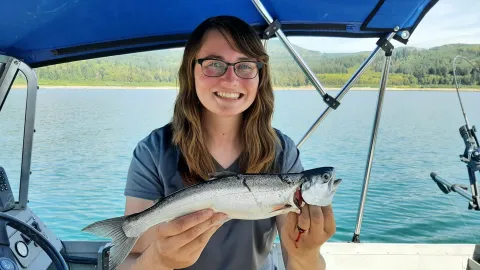
Located in Lewis County, Tacoma Power created RIffe Lake by constructing Mossyrock Dam on the Cowlitz River in 1968, flooding the communities of Riffe, Nesika, and Kosmos. It has a maximum depth of 360 feet and is about 23.5 miles long. Not only does the lake boast good populations of land-locked coho salmon, but you can also catch triploid trout! Back in 2020, Tacoma Power bought about 400,000 Rufus Woods strain triploid trout and released them into the lake for anglers to catch. The fish have had plenty of time to grow and they are a ton of fun to catch. If you’re lucky, you may even hook into a steelhead or a chinook salmon on the same day! Tacoma Power releases these fish into the lake as well, once they’ve met their stocking quotas. With such a plethora of fish to catch, you can see why Riffe Lake is a favorite of many northwesterners.
Trolling Techniques
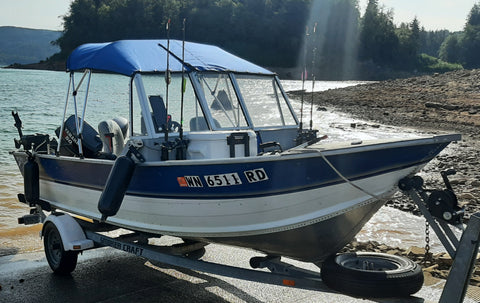
Riffe Lake has plenty of room for boats of all shapes and sizes. It is almost 24 miles long and up to 360 feet deep, which can sound intimidating. Not to worry, there are thousands of fish in the lake, and most days they are willing biters. There have been many days when we can’t even put the planer boards out because the two downrigger poles or lead lines are constantly going off! Early in the season, lead lines, divers, and dropper weights work just fine. The fish are still feeding on the surface and haven’t been driven down to the depths by the hot sun. As the season progresses, however, a good fish finder is a must, particularly for the land-locked coho. Troll until you find a school, mark where you get bites, and don’t be afraid to put a little scent on your lure.
I find that the land-locked coho are particularly attracted to pink lures and dodgers. You can use corn or maggots to bait your hooks. Spinners, plugs, spoons- they all catch fish at this lake. I tend to use whatever I already have rigged up for kokanee fishing at other lakes. As for locations, you really can’t go wrong on Riffe Lake- you can start trolling almost as soon as you launch at Mossyrock Park and will usually start catching fish right away. If the fish are being stubborn, try targeting points and coves. Keep an eye on your fish finder if you’re using downriggers, the lake can shallow up surprisingly quickly.
In recent years, it’s been difficult to keep the triploid trout off your hooks if you want to target the land-locked coho salmon in the reservoir. The salmon and trout tend to bite on the same lures and hang out at the same depths in the early season, so you can expect to catch a mixed bag. In general, the coho hang out deeper than the trout in the later season, making downriggers and a good fish finder almost a necessity for targeting them. The salmon tend to like a faster troll, so don’t be afraid to bump it up to 1.9 or 2.2 MPH. However, the trout taste great on the grill and put up a great fight, so most anglers don’t mind catching them.
As a word of caution to boaters, check the water levels at Tacoma Power’s website or give them a call before heading out. The lake’s level fluctuates throughout the year and launching can be difficult when water levels are low. The launch at Mossyrock Park is usually your best bet year-round. It has a large dock with 2 lanes to launch at, which is nice when the ramp is busy. Don’t sweat the crowds too much though, the lake is massive and there is plenty of room for everyone. The other boat launches, Taidnapam and Kosmos, are unsuitable for low water conditions. Check the wind forecast before hitching up the boat- the afternoon winds at Riffe Lake can kick up and create nasty white caps, catching unprepared boaters off guard.
Still Fishing Techniques
Don’t have a boat? No worries, Riffe Lake has plenty of shore access! You can fish at the dam in Mossyrock or at the fishing bridge at Taidnapam Park. These spots can get crowded on nice weekends though. Most shore anglers cast out shrimp or worms under a bobber with a sliding weight. Experiment with setting your bobber stopper anywhere from 3ft to 15 ft until you figure out where the fish are at.
If you can’t get a spot at the dam or fishing bridge, fishing at nearby Lake Mayfield or Swofford Pond is a good alternative. Lake Mayfield is stocked with tiger muskies, which are difficult but extremely rewarding to catch. WDFW also stocks decent numbers of rainbow trout there every year. Swofford Pond has good populations of panfish, stocked rainbow trout, and brown bullhead. There is a boat launch at both lakes, and good shore access. Many folks fish Swofford Pond with inflatables and kayaks, as there is an internal combustion motor ban.
Before you grab those poles and hook up the boat, keep in mind that Riffe Lake has a 5 fish limit. They can be any combination of landlocked salmon and trout, so you cannot legally keep 5 coho and 5 trout. The land locked coho don’t tend to survive catch and release very well, particularly in the summer heat. The lake is large and deep, and those afternoon winds can kick up unexpectedly, so make sure that everyone on your boat has a life jacket. Keep these rules in mind, hook up the boat, and have fun!
/articles/riffe-lake-roundup
The S&P 500
Most folks think of the S &P 500 as a stock market index, but on a recent trip to the Columbia River Gorge, I realized it had a fishing meaning as well. Namely, the opportunity to catch 500 shad and pikeminnow over the course of a week! My friend Rusty Johnston and I spent a couple of days fishing on the Columbia River between Rufus and The Dalles. Our first goal was to catch a bunch of shad, not just for fun, but also to use for crab bait this summer. Our second goal was to catch some pikeminnow and turn them in for money through the Northern Pikeminnow Sport Reward Fishery Program.
This program is administered by the Bonneville Power Administration along with both the Washington and Oregon Department of Fish and Wildlife. The northern pikeminnow is a native fish, but fish nine inches and longer feed on outgoing salmon and steelhead smolt, impacting the survival of both species.
In this program, anglers are paid anywhere from $6 to $10 a fish for any pikeminnow turned into a designated station along the Columbia or Snake River. The more fish you catch, the more they are worth and if you catch a tagged fish, it is worth $500. You can find out more about this program, designed not to eliminate, but control the population of pikeminnow, at www.pikeminnow.org.
Rusty and I decided to start our trip fishing for shad below the John Day Dam. You can fish below the dam on both the Washington and Oregon side of the river, but we decided to buy a non-resident license at Gorge Outfitters Supply in Rufus and fish the Oregon side at Giles French Park.
Shad Killers
We were using Shad Killers, a local jig sold at Gorge Outfitters Supply, and the hot color for us was red and white. The Shad Killer is a 1/16-ounce jig with a bit of flashabou on it. We tied the jig onto a two-to-three-foot leader which we tied to a barrel swivel. Above the swivel we had another swivel which held a ½ ounce lead weight. Other lures that work well with this set up are shad darts and Dick Nite spoons.
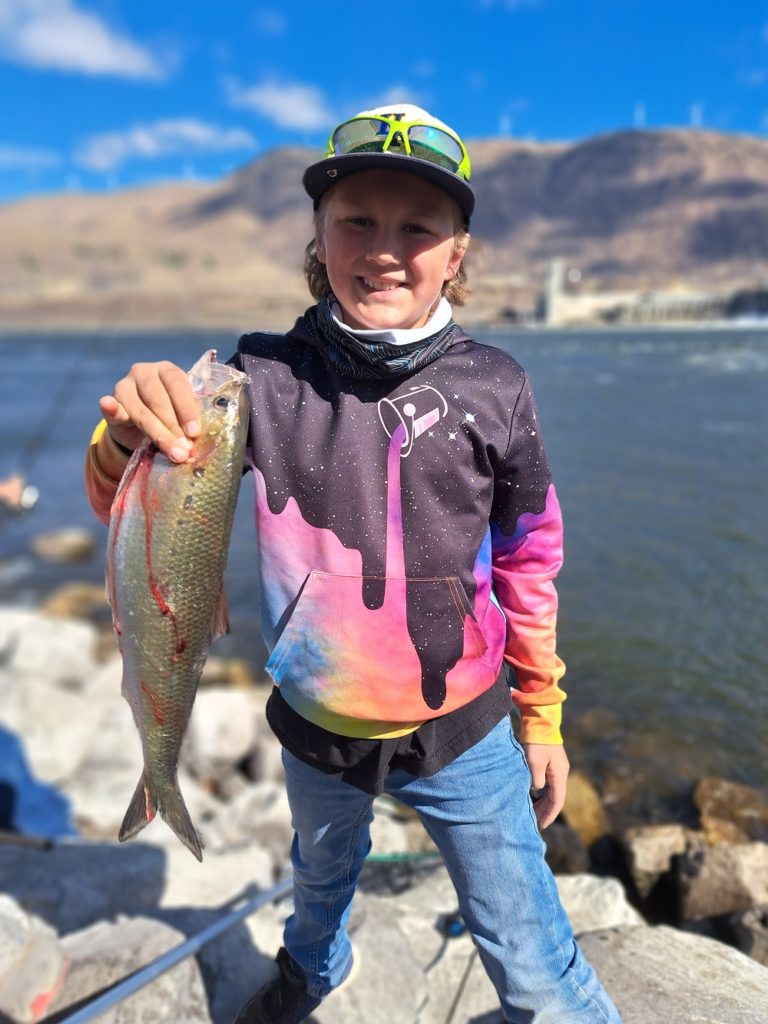
We cast our offering from the bank, let it sink a few seconds, and the reeled in with a slow to moderate retrieve as the lure drifted downstream. We were soon rewarded by hook ups with a whole bunch of shad. The American Shad averages one to three pounds in size. They are scrappy fighters and up to six million of them make their way over Bonneville Dam between the end of May and mid-July, all heading up the Columbia to spawn. I have enjoyed good days on the water catching shad before, but this day was epic! Rusty and I hooked into some 50 shad in just two hours of fishing. We lost a few (they have a nasty habit of throwing the hook) but reeled in some three-dozen fish, getting more than enough crab bait for the summer.
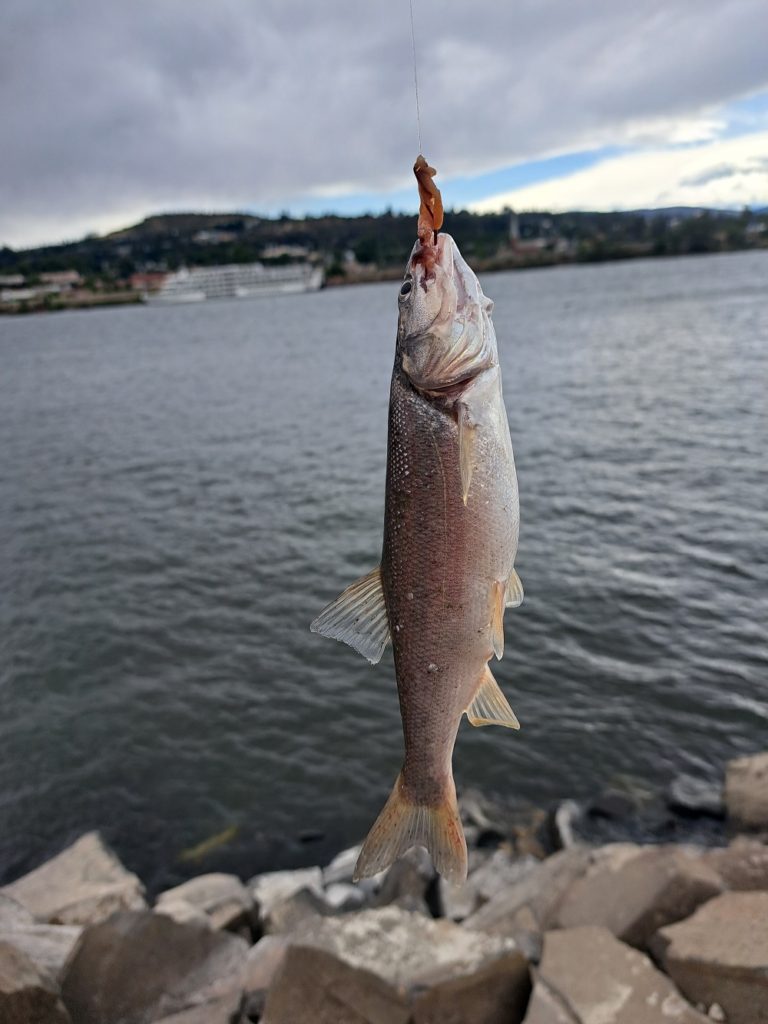
Speaking of uses for shad, the oily fish is also a favorite bait for sturgeon, and some even cut them up into chunks to use for catfish bait. Still others will eat them. We met one angler at a cleaning station at Maryhill State Park who carefully filleted out the shad he caught. He told me he brines them and puts them in a pressure cooker (which gets rid of the bones) before canning them. He said the fish taste very good. I will have to give him the benefit of the doubt.
Finished with shad, we next registered at a check station and fished around The Dalles for pikeminnow. We only caught four keeper pikeminnow (worth $6 each) but since this was our first time participating, we also each got to turn in a coupon worth $10 each after checking in our first fish. Better still, three anglers from Idaho were desperate for sturgeon bait and paid us $20 for a single shad which they promptly put to use, casting their lines out at The Dalles marina, hoping to hook into a monster fish. Altogether, we made $64. That covered a good portion of our gas money getting back home.
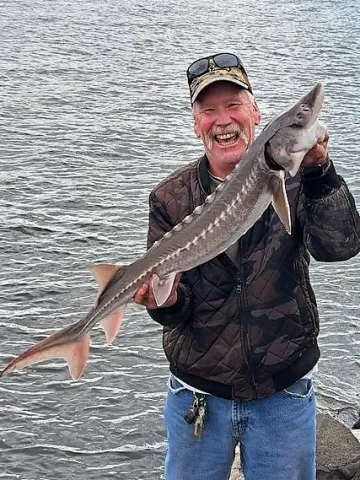
One other fun thing about fishing for pikeminnow are the other fish you catch. I ended up catching eight perch, and we both also caught smallmouth bass on the nightcrawlers we were using for pikeminnow bait, fished just off the bottom of the river with a two-ounce sliding weight. Rusty caught the most interesting bycatch of the day though, a 30-to-33-inch sturgeon on a bass rod that was spooled with braided line and just a 10-lb leader. It took him 15 minutes to get that prehistoric looking fish to shore, at which point I snapped a photo of the fish and he released it. It made for the end of a perfect day of fishing!
John Kruse – www.northwesternoutdoors.com and www.americaoutdoorsradio.com
/articles/sp-500
Ocean Coho Tips and Techniques
Coho are one of the most sought-after salmon in the Pacific Northwest. For the saltwater angler, the coho bite can be a bit chaotic, with the fish running in large schools and being active biters when the conditions are right. They can also be a bit frustrating if you are not using the right gear or fishing the right presentation. By keying in on techniques that work the topwater and get the coho to bite, you can increase your catch rate and fill the coolers with great eating, hard fighting silver salmon.
Silver Salmon
Silver salmon like to swim fast and attack their prey. Known for their topwater action, coho tend to be close to the surface. This makes for a great fishery because you are not constantly trying to work the bottom and worrying about losing a downrigger ball like you are when chasing after chinook that are on a sandlance bite. When it comes to catching coho, there are few things you can do to increase your catch rates.
Lose the bait to catch more fish. It might seem like using a fresh anchovy or a perfectly plug cut herring would lead to more fish but rigging these baits takes time. When you get into the schools of coho, the action can be fast, which means you will catch more fish if you can keep your gear in the water longer. Same with getting it back into the water faster, and anyone who has rigged an anchovy hood knows that you need to set it correctly and that takes valuable time.
Spoons
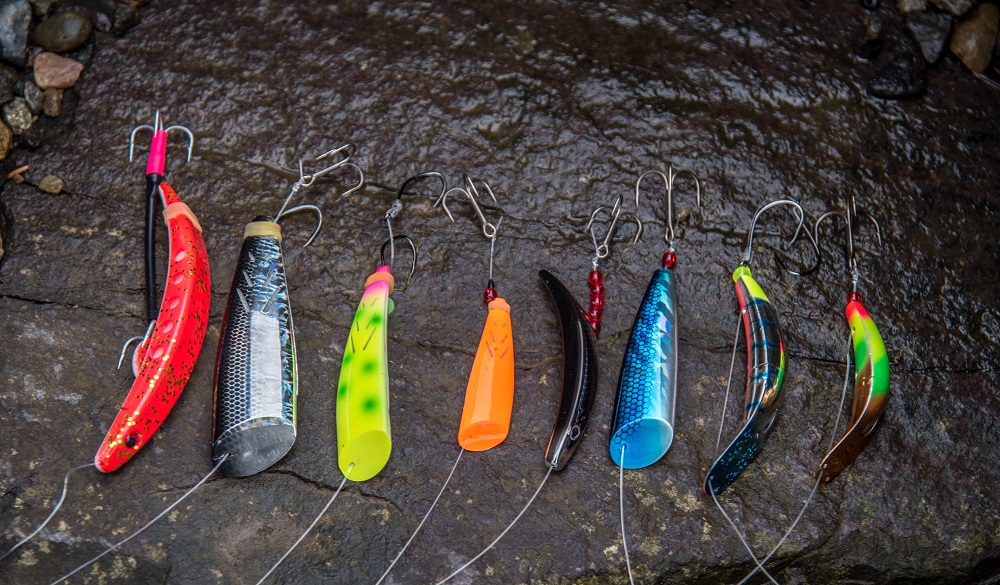
Spoons are one of the more popular lures because they are simple and are always working even if you miss a bite. Keep the spoons small such as the Coho Killer or a 3.0 or 3.5 Coyote spoon in sardine or rainbow trout patterns. The rainbow trout spoon looks more like a herring or mackerel and it has a glow back to it for low light such as cloudy days. Another spoon that is popular with coho fishing is the Skinny Gee in Herring Aide color. When running a spoon behind a flasher, it is best to go a bit longer on the leader such as 42” as this allows the spoon to flutter.
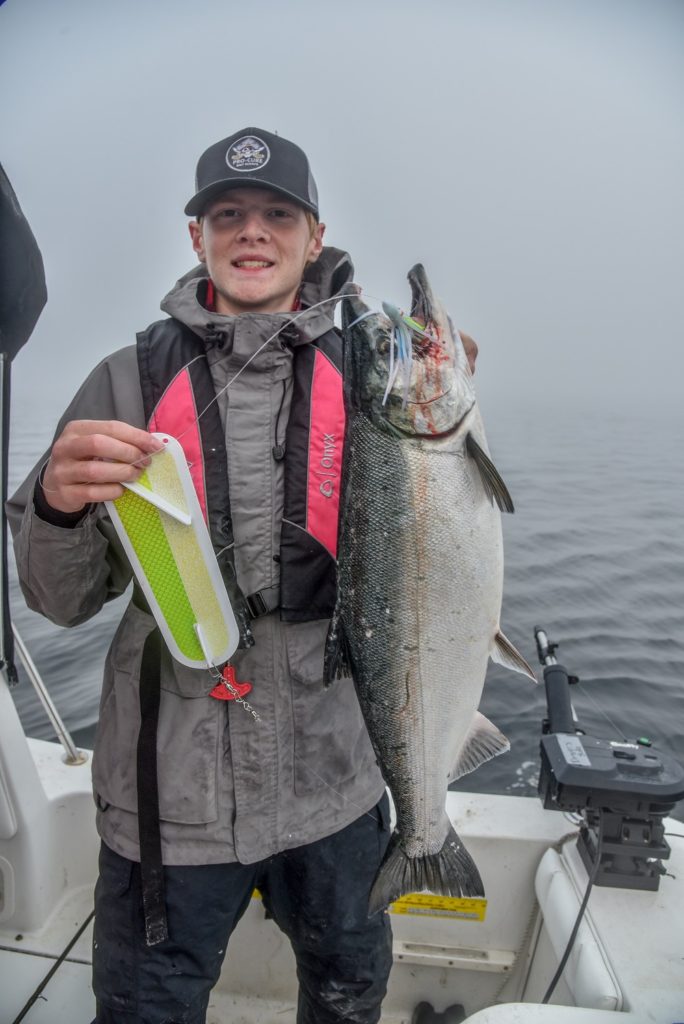
Sometimes spoons don’t draw the fish to strike. Give tube flies a try. This is a technique often used in the Great Lakes by salmon fishermen and by fly anglers chasing after fall coho along the shoreline. The ocean angler can take advantage of these lightweight lures that mimic baitfish. One of the best things about a tube fly is that they can be fished behind a dodger or a flasher or all alone, since they have low drag and are lightweight. Tube flies tend to have an erratic action that coho can’t resist, especially if you put a Mack’s wiggle bill in front of them. Bechhold and Son’s make a unique flasher with offset holes to add extra action. They have teamed up with Rapture Trolling Flies, a Great Lakes company, and offer a combo set matched together and ready to fish. If you already tie your own flies, you can pick up a tube fly adapter and tie your own easily.
Tricking The Salmon
Add flash and movement to your squids. When rigging a squid skirt with an insert or a tube fly, such as the Luhr Jensen Flash Fly (unrigged version, as they are smaller than the pre-rigged Flash Fly) to be fished behind a dodger or flasher, be sure to use a short and stout leader. Try using 30 or even 40-pound test as the stiff leader will give the lure more action. The idea is to get the lure to move in an erratic motion and make the dodger look like a feeding salmon with the lure being a wounded baitfish. It creates the “bite now” instinct of the feeding coho and tricks it into thinking the other salmon, which is the dodger, missed the baitfish and now it’s there for a free meal.
Using an insert into a hoochie or squid skirt adds attraction and can turn on a bite. The past few years we have been using the Luhr Jensen Flash Fly inserts and putting them into a squid skirt. By doing this you can make several different combinations of colors to attract the fish or add some extra UV flash for those cloudy days. You can also add a Mack’s Lure Wiggle Bill to the front to add extra movement.
Artificial Bait
Try using an artificial wounded baitfish lure. Lures that mimic a wounded baitfish are the SpinFish by Yakima Bait Company, Brad’s Super Bait Cut Plug, and the new Spin Dawg by Simon, who also makes a Spin Cut Plug that has a hole at the tip of the lure making rigging much easier with no rubber bands or chance of it coming apart. The Simon products are solid and have a scent chamber. Each of these lures is made of hard plastic and has a hollow cavity inside where you can stuff them with scent or minced-up baitfish such as anchovies or herring. For these lures, use a longer leader with a bead chain swivel in the middle since the lure provides the action that creates that need to bite reaction by rotating and spinning.
When using artificial lures such as spoons, squid skirts, and the hollow cavity lures, scent is crucial. Unlike when you use a real baitfish that has oils being released and the fish know it is an actual herring, the use of artificial lures is only a visual attraction unless you scent it up. The cavity lures like the SpinFish offer a way to fill them with various baits to create a scent trail. One common bait is to mix canned tuna fish with your favorite scents. Because the lure holds the minced-up bait, one of the better scent mediums to use is one of the many water-soluble scents from Pro-Cure. When the scent leaks out of the lure, it mixes with the water and stays at the same depth as the lure, creating a large scent trail for the fish.
Oil Based Scents
Oil-based scents such as Pro-Cure's super sauces, gels, and oils hold a scent well and last a long time, but the scent will not mix well with water. This means when it is washed off the scent trail starts to float. Water-soluble oils wash off lures and squid skirts too quickly which is why you should use oil-based scents for these lures, but it will not gum up or ruin the action of a tube fly, just be sure to apply frequently. Knowing which scent to use is more than just the baitfish it is made from, but also which ones are best to stay on the lures you are fishing.
Downsize the dodgers and flashers. The idea behind using a dodger or flasher is to create a feeding salmon scenario as well as add action to your lure. Since you are fishing for coho, be sure to match the dodger and flasher to the size of the fish. Most use the standard 11-inch flasher but the 8-inch flasher is a better choice. Instead of the attacking salmon looking like a chinook with the 11-inch, the 8-inch reflects light more to the natural size of a coho. It is also less drag and that means you can fight the fish better. The smaller dodgers and flashers also work well at faster trolling speeds. The Sling Blade dodger from Mack’s lure is a very universal dodger that is designed to work well at fast speeds. Since it is a long teardrop design you can bend it to create a more dramatic dodge or side-to-side action, or you can keep it straight and troll it fast. This design also cuts through the water well and allows you to fight the fish and not the dodger, even when using the larger 9-inch version. The dodger comes with UV-treated colors and is offered in many sizes, which allows you to change it up to the varied sizes of lures you are using.
Coho
Since coho are often found actively feeding near the surface, you do not always need to use downriggers. Instead, trolling with a mooching weight that cuts through the water easily and a simple lure behind can be a way to either add an extra rod out of the back of the boat or not deal with the downriggers altogether. Again, the more you can keep your lines in the water, the more fish you will catch. When rigging this outfit, use a longer leader around 48 inches with a bead chain swivel in the middle and a lure that imparts action such as the SpinFish, Brad’s Cut Plug, or Simon Spin Dawg. But do not overlook the tube fly or even the squid skirt with the addition of a Wiggle Hoochie Bill. These small plastic bills from Mack’s Lure are simple to use, just slide it down the leader to the head of the squid skirt and push it into the collar. If using a tube fly then adding a bobber stop knot or rubber bobber stop to the front of the bill will keep it tight to the fly. The Wiggle Hoochie Bill act much like the bill on a plug, but instead of creating a diving motion, it moves the lure in side to side in and erratic motion. They also come in an assortment of colors and are UV treated to add even more visual attraction.
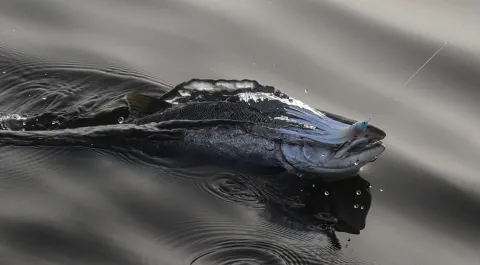
Coho are known for their acrobatic fights, often coming right up to the surface and jumping, but a dodger or flasher can take away from the fight and even become a problem when the fish jumps. The attractor breaks the surface of the water pulling in an opposite direction and taking the hooks with it. When using downriggers, you can rig in a way that the dodger or flasher stays with the downrigger ball and you get to fight the fish without any extra drag on the line. To do this, either use one of the lures with action or the added Wiggle Hoochie Bill and then a downrigger clip that is above the ball. Use a short section of cord or very stout mono line such as 50-pound test from the flasher or dodger attached to the downrigger ball, and then set the downrigger clip twice the length of the cord above the ball.
Furthermore, If you run the dodger or flasher behind the downrigger ball 36-inches, then set the downrigger clip 72-inches, or 6 feet, above the downrigger ball. Then run your lure back just a few feet from the clip. This will keep your lure from tangling with the flasher or dodger, and yet when the salmon sees the attractor, it will look like the baitfish got away and they will grab the lure. This works really well with plug cut herring or an anchovy with a bait hood, as well as lures that don’t need the imparted action of a dodger or flasher. One other great trick when using this way of fishing is to use the Scent Flash triangle flasher from Mack’s Lure, as these flashers are designed to hold scents inside of them. As the triangle flasher spins, it creates a very large scent cone out of it as it disperses the scent. When using these, you don’t need to use a leader or cord, but instead you can attach it directly to the downrigger ball, which means you can also keep your lure a lot closer to it as well.
Run timing and knowing which fish you are targeting will lead to more fish. Ocean coho are found all along the coastlines from Oregon to Alaska, and the feeding fish will often work along the shoreline, feeding on herring, candlefish, anchovies, and various other prey in the kelp beds and protected waters around islands. Look to the rocky breaks often found just offshore and find the coho. Even when out in the open ocean, where the fish will form large schools to travel from their feeding grounds to the rivers each fall, the fish will still be “shallow”. Not the depth of the water but where they are in the water column, meaning closer to the top.
When it becomes prime time for ocean coho but weather and fishing seasons keep you away from the open seas, resident coho fishing can produce a fishery for the avid angler. Puget Sound and the various inlets around Vancouver Island offer coho that do not head out too far away feeding grounds but instead live “inside”. Starting in May and all through the summer, resident coho fishing is good. Using the same techniques as fall fish, the angler can perfect their coho set-ups. Look for points along the shoreline as silvers tend to use them as tide breaks that will harbor baitfish. Where you find resident coho you will also find ocean-bound fish once they return. This is where you want to be when the runs start to show up in August and continue to flood through October.
/articles/ocean-coho-tips-and-techniques
Leave It Better Than You Found It
As outdoorsmen, we have a duty to continue to cultivate the resources that are our land and water. How many times have you pulled into a boat launch and seen it torn to shreds? Concrete half off the ramp, rope handrails cut and laying lifeless, no longer serving their purpose. What about the campsite with half ripped apart beer cases, food scattered around, and dog poop on walking paths? One of my personal favorites is seeing trash thrown in the firepit. It’s one thing if the stuff thrown into the firepit can burn up (I’m plenty guilty of that), it’s another when the material should’ve been disposed of properly. The old adage of “pack it in and pack it out” is simple in speech and at times aggravating in action. My college football coach had a saying, “do what you are supposed to do, when you are supposed to do it, and do it that way every time”. The lens in which that quote was said was more along the lines of eat right, study your playbook, and lift hard, but the message applies across the board. Leave it better than you found it.
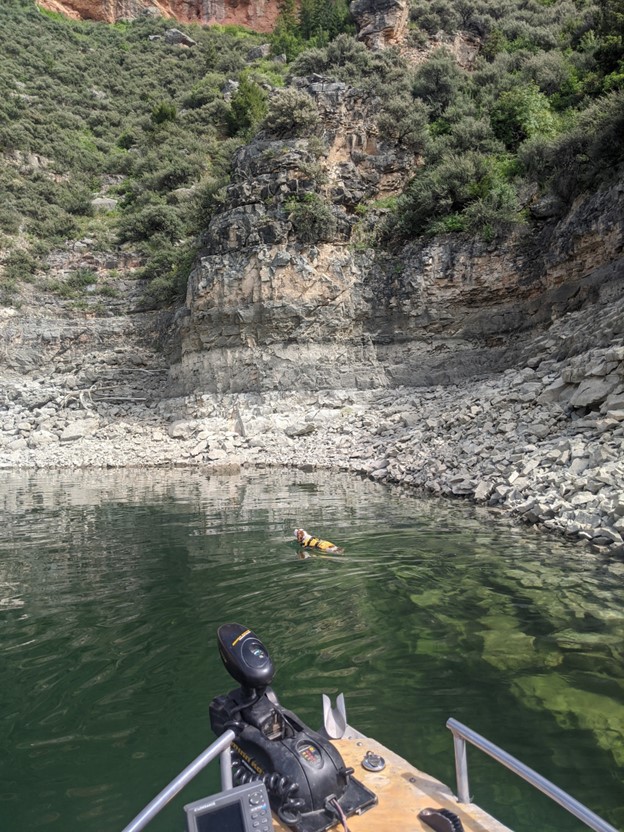
This isn’t meant to be a tirade against littering (not that I’m pro-littering - there is a Seinfeld skit somewhere about this I’m sure) or some kind of political statement. Rather, just an observation from a summer that I’m sure many of you shared. Time with friends and family outside. Some of us are lucky enough to have boats to get out on the water. Others may hike up into the mountains for some serenity and isolation. Then, for a brief moment, you realize the person there before didn’t care enough to keep the place clean. It probably doesn’t consume much of your brainpower or ruin the weekend, but it’s enough to make you roll your eyes and sigh. Those are the kind of simple things we can all do to help one another continue to enjoy these shared spaces.
Hunting Season
Another element that should be considered, particularly for those hunters among us, is the consideration of land water access. Familiarizing yourself with the public vs private land, access points, and limits on how many people can utilize certain access points are all equally important and part of our duty as conservationists. I remember during the last hunting season being continuously peppered by advertisements from Montana Fish Wildlife and Parks (FWP) about the importance of seeking permission for type II block management access (BMA). It certainly didn’t hurt that the advertisement featured a cameo from MeatEater star Ryan Callaghan. A quick sidebar for those who aren’t in the know - Block Management in the state of Montana is a partnership between private land owners and FWP to grant access to hunters on private land, sometimes adjacent to public land.
Type I BMA allows hunters to sign in on a card for hunting permission on private lands; you simply show up, fill out a card, and go hunt. Type II BMA often requires a reservation and is subject to availability from the land owner. Examples might be limiting the number of hunters in a day, hunting parties in a day, or what type of game is being hunted. The word partnership isn’t used by mistake. It takes action on all parties involved to maintain access to these hunting areas. The land owner to continue to be willing to allow hunters on the land, MT FWP to facilitate the opportunity for hunters, and hunters to respect the land and do their part to make sure their presence is continually welcomed. Leaving behind shell casings, wrappers from eaten protein bars, or other garbage is a quick way to find our access to otherwise great areas suddenly restricted. Maybe you don’t own 1,500 acres of land but instead a 1,500 square foot home. Would you be willing to invite back a stranger who tracked mud all along your carpets? Even worse, how about a buddy watching some football at your place who stains your couch with buffalo chicken wing fingers rather than wiping his hands. Why would we expect those land owners to welcome us back if we’re doing the equivalent?
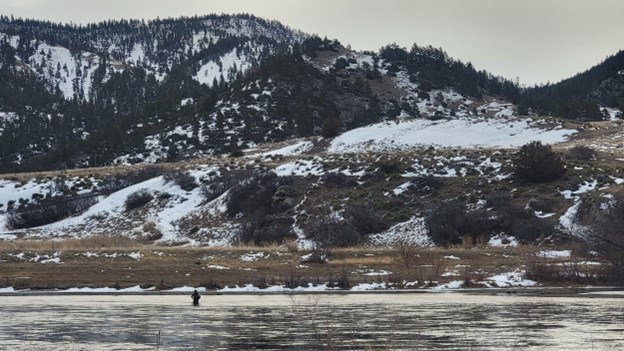
Let’s continue to work together to make sure we can enjoy the outdoors we all know and love. It doesn’t take much to clean up that last bit of trash, keep debris and clutter out of the community that should be enjoyed by all and keep shared areas like boat launches in working condition. If not for you and I, how about for our kids who hopefully enjoy these hobbies, and sometimes obsessions, as much as us.
/articles/leave-it-better-you-found-it
Late Season Baker Lake Sockeye
Whoo-hoo! The long-coveted Baker Lake sockeye season is in progress! The 2023 Baker Lake sockeye season is proving to be an interesting one. Through the North of Falcon process, the planned opener was scheduled to be Saturday July 15th. Because record numbers of sockeye have signed up for a ride in the fish taxi, the WDFW decided to open the fishery 1 week earlier. The opener was July 8th and the action has been on fire. It was reported that boat limits were the norm and many ice chests were full just a few hours or so after splashing the boat. In fact, on opening day one of the fishing specialists at Holiday Sports in Burlington, Philip Chuprinov, his wife Alexus and gang got their 12 fish boat limits in in less time than it took to drive to the lake and back.
OK, the fishing is good, but what is a “fish taxi” and why the early opener? Sockeye in Baker Lake are native to the system. After the Upper Baker Dam was constructed in 1959, sockeye were cut off from access to the natural Baker Lake. With limited success, various methods were used to trap and transport returning adult sockeye to the newly formed Baker Lake, while smolts were left to out migrate via controlled spillway releases. By 1985 the population crashed, and the trap count was only 99 fish. As a component of PSE’s permit to generate power, PSE developed a mitigation plan for sockeye recovery.
Long story short; both Baker Lake and now Lake Shannon have a surface to lake bed “gulper” net that funnels out-migrating sockeye smolts into a collection facility where they are processed, counted, and then transported for release at a trap facility on the Baker River in Concrete. The returning adult fish are trapped analyzed and then loaded into live transport trucks, AKA “fish taxis”, and transported up the hill. Some sockeye are placed in artificial spawning bed runs while others are held as hatchery broodstock. The rest are released into Baker Lake.

Historically, the Baker Lake sockeye run slowly ramps up, then spikes during the second week in July. This year, after a very short ramp up of 200-400 fish a day, on June 27th the fish counts absolutely exploded. For the next 10 days, the daily trap count was running from 1,200-3,000 fish. With agreement of the North of Falcon team, the WDFW made the decision to maximize the fishing opportunity and open the fishery 1 week early.
The 2023 Baker Lake sockeye season is July 8th – August 31st but may close early to assure that 1,500 fish are able to spawn naturally in the lake. There is a 3 fish daily limit for adult sockeye. With the two-pole endorsement, two poles are allowed and all anglers onboard a boat may deploy gear until each angler onboard has caught their daily limit. Because Baker Lake is actively monitored for regulation compliance, make sure to record your catch before you redeploy the gear. The Baker Lake catch code is 825. Are you jonesing for a grilled sockeye fillet or a bowl of fresh sockeye poke yet? If so, read on, if not there’s always a Safeway seafood counter nearby (it’s probably cheaper).
There are 5 launch ramps on Baker Lake. They are as follows.
PSE Baker Lake (Kulshan) Launch
The boat ramp has a moderate grade. Concrete blocks have been placed along the side of the ramp for protection from erosion. No designated disabled parking. The parking lot slopes slightly. Nearby, Kulshan Campground offers campsites, a RV dump station, and both restrooms and porta potties. Overnight parking is discouraged within the boat ramp parking area but is available just down the hill from the ramp. Kulshan is typically my go to launch ramp.
Horseshoe Cove
The boat ramp has a gentle grade. Launching and load occur on both sides of the gravel and sand bar. The surface is uneven from wave erosion and vehicle use. No designated disabled parking. Horseshoe Cove Campground also offers campsites, drinking water, picnic area, group camp area, and vault toilets. Overnight parking is available. 4-wheel drive is advisable.
Panorama Point
The boat ramp has a gentle to moderate grade, lots of parking and a vault toilet. The Panorama Point Campground is separate from the launch. Depending on lake level, the asphalt ramp approach stops short of the shoreline. Additionally, a drop off has been created by wave action and the gravel is becoming rutted from parking lot run-off. With the uncertain ramp conditions, 4-wheel drive is advisable.
Swift Creek
The Swift Creek launch is paved or concrete and is usable at all lake levels. There is a tall bulkhead wall on one side with a short log boom on the other side of the ramp. There is also a small marina adjacent to the ramp. The marina has limited non-reservable short term tie up but no services or fuel. Swift Creek Campground offers campsites, drinking water, picnic shelters, a group camp area, and vault toilets. Overnight parking is available. I advise that you have a capable mate at this ramp. If solo, there are no provision to tie up your boat right at the ramp. Solo, you’ll have to deal with your boat after launching and you’ll be holding up traffic. Unless you’re offering free coffee and doughnuts, generally not a good thing at 2:30 in the morning when there is a long line of headlights glaring at you... Having somebody run the boat while you go park is a solid community-based plan.
Shannon Creek Campground
The boat ramp has a gentle to moderate grade. Ruts are developing around the ramp due to the runoff from the parking lot drainage. Waves have been creating some erosion along the shoreline. No designated disabled parking. Shannon Creek Campground also offers campsites, drinking water, picnic sites and a vault toilet. This varies year to year, but they may be limiting launch access to campers registered at Shannon Creek Campground. 4-wheel drive is advisable, and this is the best launch for hand launch boats and inflatables. With just a short run you’re in Grand Central Sock-station.
Maybe a few words regarding the logistics and fishing Baker Lake. Once you turn onto Baker Lake Road there will be no services, fuel, food, or camping supplies available. Make sure your pre-trip planning includes extra fuel, ice, propane or whatever you’ll need for your trip. Early morning, evening and anytime you’re in the shade there will be mosquitos. Not a few pesky mosquitos but a large squadron of blood thirsty flying vampires, I think they even have radar, night vision, and little stick figures drawn on their blood engorged bodies. As a bonus, I even stepped on a yellow jacket nest last year, be aware. Above all, this is a true combat fishery. Patience and ramp courtesy will assure everyone enjoys the experience.
After some deep thought I think that the biggest thing I can say about late season Baker Lake sockeye fishing is patience. The fishing can be very hot or very cold. Whereas the day before, limits may have been the rule, it is not always, and fishing may be dead. Slow fishing or otherwise, there are a few things you can do to improve your odds and put a few late season fish in the box.
As mentioned, patience (theme) will be the name of the game, and trust your electronics. Especially during your pursuit of late season sockeye, you will see the fish on the meter before they chase down your offering. When chasing late season sockeye, the more flash the better. Some people run 2 attractors and/or run a dummy off their downrigger ball. Other people bend their flashers to give them more wiggle and flash. Make sure you keep your gear clean; I don’t think that the late season sockeye like the scent of yesterday’s bait or scent oils. That said, make sure to use fresh bait. The 2013 sockeye bait you found in the back of the bait/beer fridge is not going to cut it.
Location is important in your pursuit of late season Baker Lake sockeye, although there are stock areas of the lake that consistently fish well. Areas like the Kulshan Loop, Maple Grove, Silver Creek, Noisy Creek and the Race Track along Baker Lake Road all reliably produce fish. The problem is each of those areas will also have a healthy aluminum hatch. With all the gear dangling in front of their noses, the fish may just ignore it. In my experience it pays to go look for fish. Many times, I find schools of willing biters in shallow water. Often, after a slow morning I have just flatlined gear in shallower areas of the lake and picked off limits in one or two passes.

FISH ON THE METER! Now what? Typically, a “0” size 50/50, chrome or pearl dodger is the backbone of the setup. While you can catch fish on tandem red, black or blue hooks the fishiest gear includes small spinner blades, Smiley Blades or Wiggle Hoochie inserts. Thinking outside of the box also has advantages. Sometimes the fish just don’t want the standard gear. We have had success using the kokanee size Brad’s Cut Plug lures, Coho Killers with an extra bend in them, kokanee/sockeye flies, and Brad’s Wee Warts. Start with the basics, a “0” dodger and a bare 3/0 red hook, and then be prepared to make changes until you are consistently catching fish.
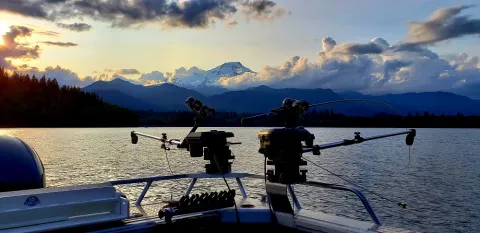
Downriggers are the way to go with this fishery, but dropper rigs rack up many of the fish caught at Baker Lake. When running downriggers, beware, the lake is uncharted and there are many stumps, old structures and who knows what else to snag you downrigger ball on. If using downriggers, be alert and be prepared to part company with your downrigger ball (does your pre-trip planning include an extra downrigger ball?). Safety first, especially if fishing out of a shallow freeboard skiff, kayak, or inflatable. A 10-pound hunk of lead is not worth losing your boat or giving your boat mate unexpected swim lessons. Try to maintain your trolling speed at .8-1.2 MPH, and we have found that 5-10’ setbacks from your downrigger clip are all that are required.
Another thought and in my mind a gem of an opportunity. Late in the season these fish form tight schools and cruise around on the flats where the Baker River flows into Baker Lake. There are several underwater springs in the area and the fish seem to be staging for the spawn. With caution you can slowly motor (or row) into the area, find a pocket of fish and drop a dead weight anchor. There will be a ton of logs and woody debris so don’t use any kind of pronged or claw anchor. An old pile of chain or bucket of cement is perfect. Caution: do not come into this area of the lake on plane or even any faster than at idle. Depending on lake level there are numerous stumps and trees just waiting to meet your prop. Why go to all this effort? Glad that you asked…
With a little luck and an adventurous spirit, you can set yourself up to sight fish sockeye with a fly rod. Let me tell you it is an absolute hoot, and once you have it dialed in, you’ll be a serf to the great sockeye gods. You’ll go to sleep dreaming about watching your line snap tight as the water seems to boil around it and wake up in a sweat still dreaming about your airborne quarry.
I’ve said this before; Baker Lake sockeye are the best eating fish in the state. To preserve their quality, bleed and ice your catch immediately. If you’re camping, gut the fish and pack the body cavity with ice, layer the fish in ice with a handful of rock salt evenly scattered around on top of the ice. It is best to use an ice chest that is dedicated to your prize catch. Leave the ice chest drain plugs out. This will prevent your catch from sitting in an ice chest ½ full of cold, very slimy sockeye sludge.
So, those are the late season basics; I wish you luck and an enjoyable trip to Baker Lake. Please be respectful of the opportunity to fish Baker System sockeye. This fishery is closely monitored and there will be multiple game wardens, WDFW, and Sheriff Department personnel conducting on the water checks. If there is widespread abuse, they will close the fishery. Be courteous, know the regulations, limits, and gently release any Dolly Varden trout caught.
/articles/late-season-baker-lake-sockeye