Chinook Dreams
Imagine waking up in a place where you could keep five chinook a day, use two rods, barbed hooks, and have a legit chance at multiple twenty-pound plus fish. On top of that, no punch cards, or shortened seasons. Sounds too good to be true? Some pipe dream in a faraway land that time forgot? Well, I’m here to tell you there exists just such a place. It’s been happening for years now and is closer than you may think.
I’m speaking of a place you’d not likely think of when it comes to chinook salmon. That place is Montana, and the location is Fort Peck Reservoir.
My son Matt and I recently got to fulfill a Bucket List dream we’d been talking about for years, namely the Fort Peck Chinook Fishery. We were joined by NWF co-host Rob Holman, and Shelby Ross of Ross Outdoor Adventures. Shelby may be a walleye guide, but he was down for a trip to Fort Peck. And I sent Rob a steady stream of recent angler catches, feeding his enthusiasm. They made the ten-hour drive from Spokane, while Matt and I had a relatively easy five-hour drive from Great Falls to this reservoir in the northeast corner of Montana. The trip goes fast because in Montana you can drive fast, 75-80 miles an hour, and there’s little traffic to contend with. Just keep an eye out for stray deer and antelope, and the occasional suicidal pheasant.
We met at the Cottonwood Inn and Suites in Glasgow, which turned out to be a great place to stay as a base camp for fishing Ft Peck. 18 minutes from the boat launch, Cottonwood Inn and Suites has all the amenities an angler could want, including free charging stations to recharge trolling batteries. It also has RV camping for those with RVs.
Ft Peck’s 3.8 mile long dam was completed in 1937, backing up the Missouri River for an amazing 134 miles in length and 220 feet at its deepest spot. With over 1,500 miles of shoreline, it is longer than the California coastline and bigger than Puget Sound. At 18.7 million acre-feet, it’s the 5th largest man-made lake in the United States. The surrounding countryside is high prairie and borders nearly the entire Charles M Russell National Wildlife Refuge.
Dozens of species of fish inhabit the lake, and it is a world-class body of water for walleye, bass, pike, and lake trout. The chinook were introduced in 1983, but what really caused a boom for the fisheries of Fort Peck was the 1984 introduction of cisco to the reservoir. This species of bait fish, also known as lake herring, rapidly reproduced, and they provide the reservoir with an ample source of food for the various sport fish in the lake. It also is no small reason the chinook have grown so well, with the state record at an impressive 32.05 lbs with a girth of 27.5 inches and a length of 38.25 inches, caught by Greg Haug of Bismark, ND in 2020.
To top it all off, the State of Montana has a massive hatchery at Fort Peck where they raise and release walleye, pike, and salmon – with a capacity to raise and release over 500,000 chinook, it makes for a very healthy population of fish to target.
Launching at the crack of dawn is always a special time of day. We idled out to the main reservoir with the sun cracking the eastern sky, beautiful shades of orange, yellow, and red painting the sky. A brief five-minute run and we began the process of deploying our gear. My boat has two downriggers, and with no tides or wind to deal with I was comfortable stacking them, setting the deep rods at 60 and 90 feet, and stackers 10 feet above. Not more than five minutes after all rods were out, the port deep rod got bitten 60 feet deep. As the line came taunt the drag began to scream – our first Fort Peck chinook was on! Standing next to the rigger, I grabbed the rod and felt the pull of a solid fish. I had brought my knuckle buster reels to Montana and was glad I did! There is no better fight than a big chinook on a knuckle buster. Add to that break-away flashers and this chinook was giving me everything I could handle and then some. Clearing the port side stacker rod, I worked the fish ever closer as frantic runs became shorter and less frequent. Finally, a chrome bright football slab of a chinook appeared. Easing the fish to the net, Rob scooped the fish up and into the boat. Wow, what a pig! It was obvious that these freshwater chinook are feeding good. Plump, and all fins intact, we admired a fish a thousand miles away from its native element. Montana Department of Fish, Wildlife, and Parks certainly created an amazing fishery out in the middle of the prairie.
After bleeding the fish, it fit (barely) in my cooler. Lines back down we continued our troll, noting more boats joining us. As the morning progressed the fleet of boats probably numbered a couple dozen. Spread out over an area of maybe ten by ten miles, over-crowding was not a concern for this fishery!

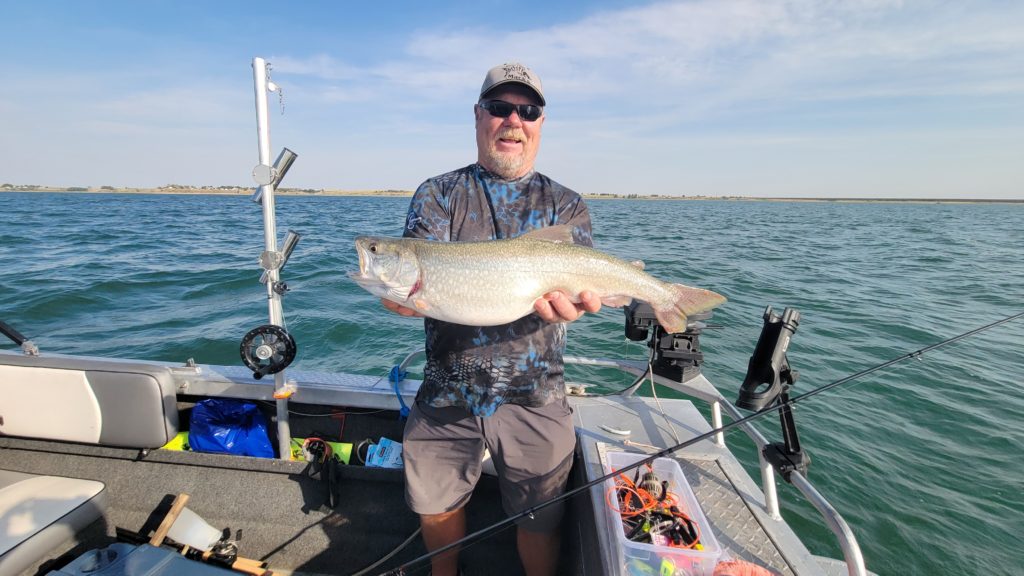
With high hopes for more fish, we explored the general fishing area. Marks were common at 60-90 feet, and we also noted fish marks on the bottom at 160 feet. Dropping a rigger ball down and bouncing the bottom, it wasn’t too long before I confirmed my assumption – lake trout. Shelby brought the nice 6-pound fish to the boat and in the cooler he went. Since everything we had read and been told indicated the chinook were suspended, we went back to mid-depth with the deep rigger.
The action died off and we came in around 1pm, cleaning our fish at a first-rate cleaning station at the Fort Peck Marina. I stopped in and visited with the owner and guide at the Marina, Scott Collinsworth. Scott is very active on the Montana Salmon Facebook group and willingly shares information on techniques to catch these fish. He indicated the bite had slowed down from the previous week (no doubt a low-pressure front didn’t help) and catch rates were about a fish per boat. That’s still pretty impressive for big 15-25 pound fish (ours was 16 pounds). Even more impressive was another guide boat that came back with nine big chinook! That’s what daydreams are made of.
We retired to the Cottonwood Inn where Rob hit the casino and I hit the bed for an afternoon nap. Cleaning up the boat and re-rigging gear, the day ended with a nice meal at the The Woods, the Inn’s dinner. A nice variety of dishes were available, as well as craft Montana beers on draft and a full-service bar, all at affordable Montana prices.
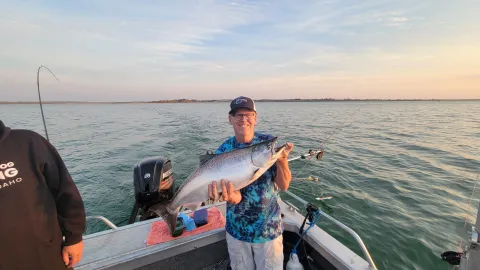
Our next morning was a cookie-cutter day, as we again started fishing with the sun breaking the horizon. Again, the port rod exploded and Rob grabbed the rod, battling an even nicer fish. As he brought the fish to the net and I scooped it up, I was amazed at the weight in the net – this fish was very close to hitting 20 pounds, another fat, healthy chinook.
A word on gear – when we moved to Montana I kept my salmon gear, knowing that someday it would come in handy for fishing Fort Peck. We certainly went through a lot of lure combinations, most of which I have no doubt would work great if the bite was on. Most anglers fish with flashers, salmon flies, herring, spoons, and a few other salmon-oriented choices. The two big differences I observed from Puget Sound chinook were more fishing at suspended depths and trolling slightly slower. Most anglers trolled at 1.8 -2.2 mph. We started out faster, 2.5-2.9. So, while we did catch a couple fish at this faster troll, by the end of the trip we had slowed down, matching the fleet. I suspect those that enjoy mooching would find these fish to be very co-operative with this technique (note to self, bring mooching gear next year!).
Our second day ended much like the first, with Matt catching a small laker and also a beautiful walleye. We also lost a nice chinook that came unbuttoned.
Interestingly, the weekend saw less anglers on the water, opposite of what you’d see in the Puget Sound fisheries. A couple other observations – the boat ramp etiquette was outstanding. The Marina has a two-lane ramp with a dock. Most anglers launching and retrieving would power their boats on/off trailers, making for fast and smooth lines. Second, we only saw a couple tubers on the water. Pretty much every boat we saw were anglers. There’s a distinct advantage to being far away from population centers!
Although our trip ended with “just” two salmon, I considered it to be a huge success. I learned about the area, the launch, where to stay, and techniques to use. I’m already contemplating next year’s trip and the chance at some multi-fish days!
/articles/chinook-dreams
Riffe Lake Roundup
Fishing season is officially in full swing! With so many lakes, rivers, and marine areas to choose from, it can be hard to pick your next adventure. If you’re never fished Riffe Lake before, or if it’s been a while, you should put it at the top of your list. It’s one of my favorite fishing destinations, and I make it a point to fish it as much as I can every year. Not only is the fishing top notch, but the scenery is beautiful and the surrounding towns are well worth visiting. I can’t think of many other lakes that offer such a wide variety of fish, let alone with such a good opportunity.
You can catch brown trout, cutthroat trout, smallmouth bass, chinook salmon, coho salmon, crappie, and brown bullhead. The lake is simply packed with fish, and they’re willing biters. You can take the boat out or shore fish, and finish out the day with a Dam Burger from Pioneer Bar & Grill in Mossyrock before heading home to grill your catch. It’s a bit of a drive, but it’s a great way to spend a day!
Located in Lewis County, Tacoma Power created RIffe Lake by constructing Mossyrock Dam on the Cowlitz River in 1968, flooding the communities of Riffe, Nesika, and Kosmos. It has a maximum depth of 360 feet and is about 23.5 miles long. Not only does the lake boast good populations of land-locked coho salmon, but you can also catch triploid trout! Back in 2020, Tacoma Power bought about 400,000 Rufus Woods strain triploid trout and released them into the lake for anglers to catch. The fish have had plenty of time to grow and they are a ton of fun to catch. If you’re lucky, you may even hook into a steelhead or a chinook salmon on the same day! Tacoma Power releases these fish into the lake as well, once they’ve met their stocking quotas. With such a plethora of fish to catch, you can see why Riffe Lake is a favorite of many northwesterners.
Trolling Techniques
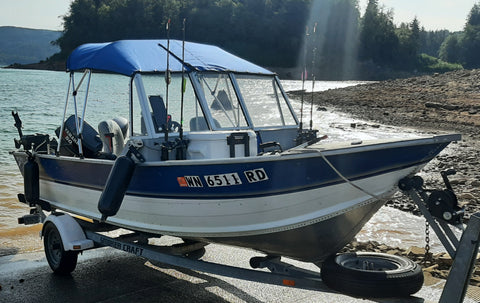
Riffe Lake has plenty of room for boats of all shapes and sizes. It is almost 24 miles long and up to 360 feet deep, which can sound intimidating. Not to worry, there are thousands of fish in the lake, and most days they are willing biters. There have been many days when we can’t even put the planer boards out because the two downrigger poles or lead lines are constantly going off! Early in the season, lead lines, divers, and dropper weights work just fine. The fish are still feeding on the surface and haven’t been driven down to the depths by the hot sun. As the season progresses, however, a good fish finder is a must, particularly for the land-locked coho. Troll until you find a school, mark where you get bites, and don’t be afraid to put a little scent on your lure.
I find that the land-locked coho are particularly attracted to pink lures and dodgers. You can use corn or maggots to bait your hooks. Spinners, plugs, spoons- they all catch fish at this lake. I tend to use whatever I already have rigged up for kokanee fishing at other lakes. As for locations, you really can’t go wrong on Riffe Lake- you can start trolling almost as soon as you launch at Mossyrock Park and will usually start catching fish right away. If the fish are being stubborn, try targeting points and coves. Keep an eye on your fish finder if you’re using downriggers, the lake can shallow up surprisingly quickly.
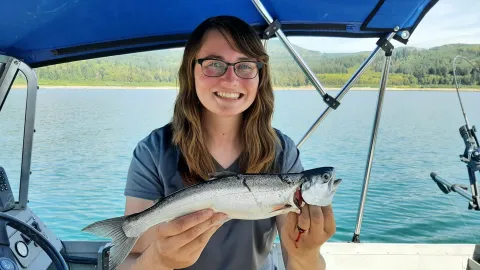
In recent years, it’s been difficult to keep the triploid trout off your hooks if you want to target the land-locked coho salmon in the reservoir. The salmon and trout tend to bite on the same lures and hang out at the same depths in the early season, so you can expect to catch a mixed bag. In general, the coho hang out deeper than the trout in the later season, making downriggers and a good fish finder almost a necessity for targeting them. The salmon tend to like a faster troll, so don’t be afraid to bump it up to 1.9 or 2.2 MPH. However, the trout taste great on the grill and put up a great fight, so most anglers don’t mind catching them.
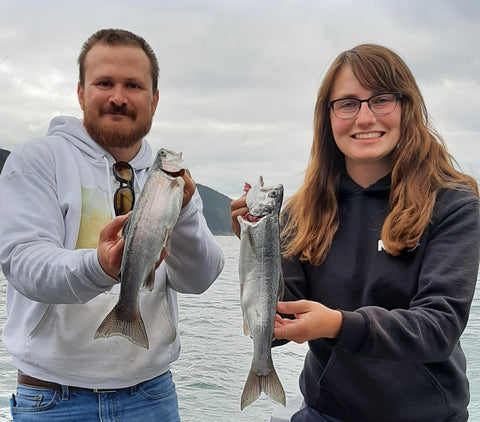
As a word of caution to boaters, check the water levels at Tacoma Power’s website or give them a call before heading out. The lake’s level fluctuates throughout the year and launching can be difficult when water levels are low. The launch at Mossyrock Park is usually your best bet year-round. It has a large dock with 2 lanes to launch at, which is nice when the ramp is busy. Don’t sweat the crowds too much though, the lake is massive and there is plenty of room for everyone. The other boat launches, Taidnapam and Kosmos, are unsuitable for low water conditions. Check the wind forecast before hitching up the boat- the afternoon winds at Riffe Lake can kick up and create nasty white caps, catching unprepared boaters off guard.
Still Fishing Techniques
Don’t have a boat? No worries, Riffe Lake has plenty of shore access! You can fish at the dam in Mossyrock or at the fishing bridge at Taidnapam Park. These spots can get crowded on nice weekends though. Most shore anglers cast out shrimp or worms under a bobber with a sliding weight. Experiment with setting your bobber stopper anywhere from 3ft to 15 ft until you figure out where the fish are at.
If you can’t get a spot at the dam or fishing bridge, fishing at nearby Lake Mayfield or Swofford Pond is a good alternative. Lake Mayfield is stocked with tiger muskies, which are difficult but extremely rewarding to catch. WDFW also stocks decent numbers of rainbow trout there every year. Swofford Pond has good populations of panfish, stocked rainbow trout, and brown bullhead. There is a boat launch at both lakes, and good shore access. Many folks fish Swofford Pond with inflatables and kayaks, as there is an internal combustion motor ban.
Before you grab those poles and hook up the boat, keep in mind that Riffe Lake has a 5 fish limit. They can be any combination of landlocked salmon and trout, so you cannot legally keep 5 coho and 5 trout. The land locked coho don’t tend to survive catch and release very well, particularly in the summer heat. The lake is large and deep, and those afternoon winds can kick up unexpectedly, so make sure that everyone on your boat has a life jacket. Keep these rules in mind, hook up the boat, and have fun!
/articles/riffe-lake-roundup
The S&P 500
Most folks think of the S &P 500 as a stock market index, but on a recent trip to the Columbia River Gorge, I realized it had a fishing meaning as well. Namely, the opportunity to catch 500 shad and pikeminnow over the course of a week! My friend Rusty Johnston and I spent a couple of days fishing on the Columbia River between Rufus and The Dalles. Our first goal was to catch a bunch of shad, not just for fun, but also to use for crab bait this summer. Our second goal was to catch some pikeminnow and turn them in for money through the Northern Pikeminnow Sport Reward Fishery Program.
This program is administered by the Bonneville Power Administration along with both the Washington and Oregon Department of Fish and Wildlife. The northern pikeminnow is a native fish, but fish nine inches and longer feed on outgoing salmon and steelhead smolt, impacting the survival of both species.
In this program, anglers are paid anywhere from $6 to $10 a fish for any pikeminnow turned into a designated station along the Columbia or Snake River. The more fish you catch, the more they are worth and if you catch a tagged fish, it is worth $500. You can find out more about this program, designed not to eliminate, but control the population of pikeminnow, at www.pikeminnow.org.
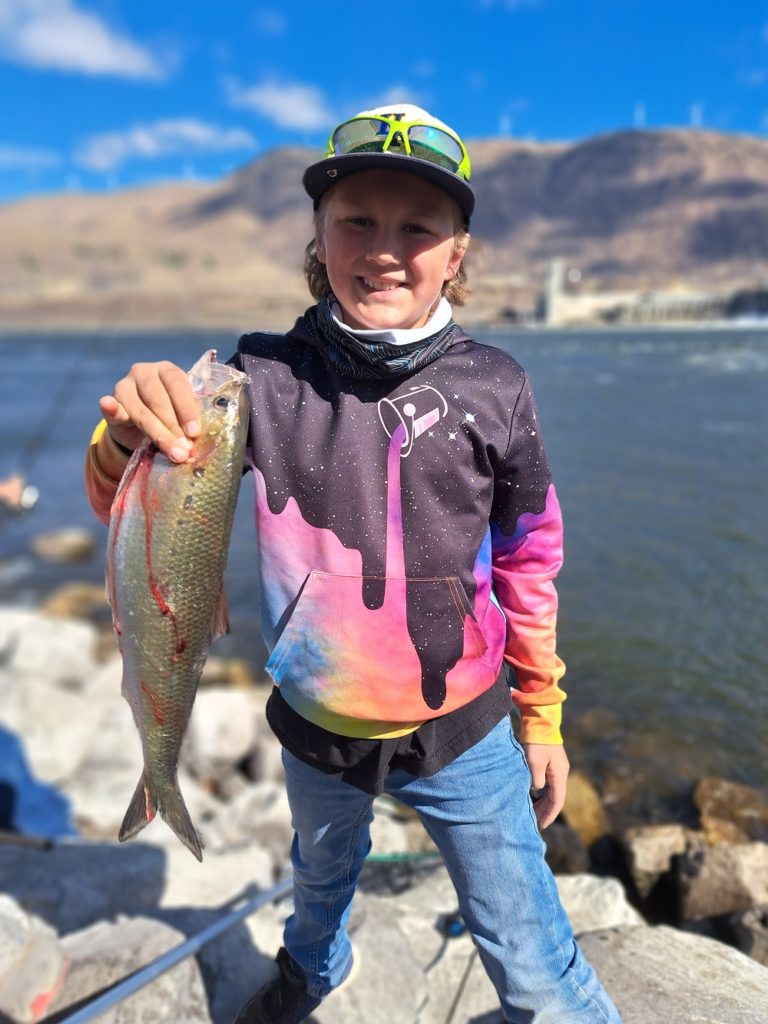
Rusty and I decided to start our trip fishing for shad below the John Day Dam. You can fish below the dam on both the Washington and Oregon side of the river, but we decided to buy a non-resident license at Gorge Outfitters Supply in Rufus and fish the Oregon side at Giles French Park.
Shad Killers
We were using Shad Killers, a local jig sold at Gorge Outfitters Supply, and the hot color for us was red and white. The Shad Killer is a 1/16-ounce jig with a bit of flashabou on it. We tied the jig onto a two-to-three-foot leader which we tied to a barrel swivel. Above the swivel we had another swivel which held a ½ ounce lead weight. Other lures that work well with this set up are shad darts and Dick Nite spoons.
We cast our offering from the bank, let it sink a few seconds, and the reeled in with a slow to moderate retrieve as the lure drifted downstream. We were soon rewarded by hook ups with a whole bunch of shad. The American Shad averages one to three pounds in size. They are scrappy fighters and up to six million of them make their way over Bonneville Dam between the end of May and mid-July, all heading up the Columbia to spawn. I have enjoyed good days on the water catching shad before, but this day was epic! Rusty and I hooked into some 50 shad in just two hours of fishing. We lost a few (they have a nasty habit of throwing the hook) but reeled in some three-dozen fish, getting more than enough crab bait for the summer.
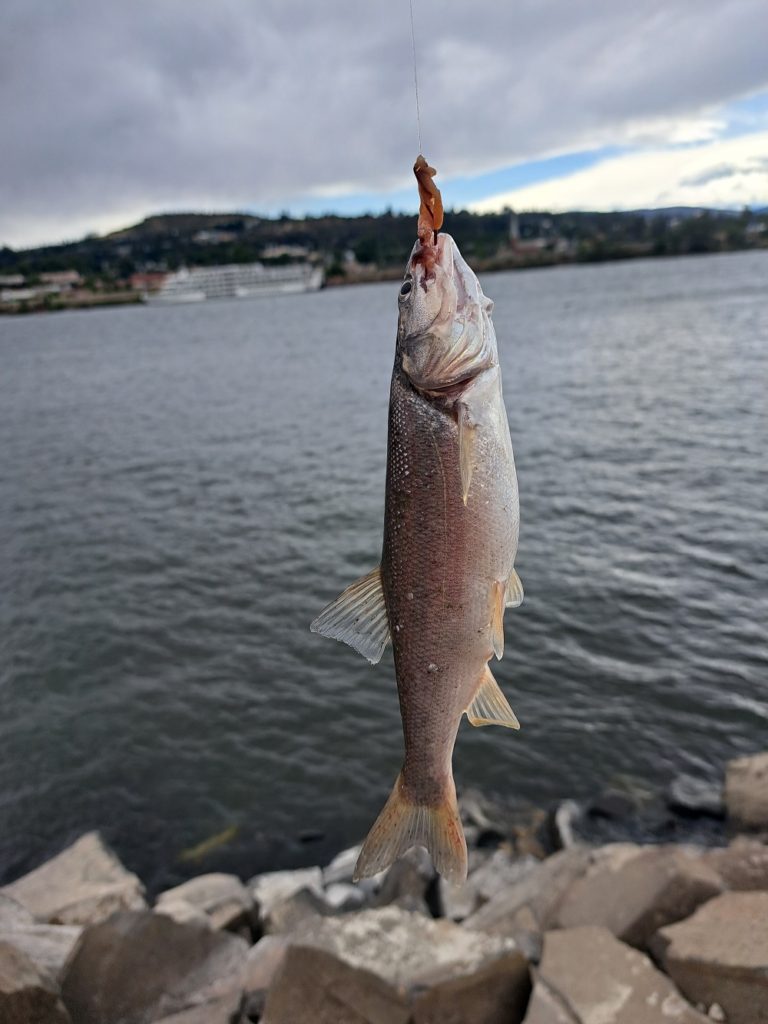
Speaking of uses for shad, the oily fish is also a favorite bait for sturgeon, and some even cut them up into chunks to use for catfish bait. Still others will eat them. We met one angler at a cleaning station at Maryhill State Park who carefully filleted out the shad he caught. He told me he brines them and puts them in a pressure cooker (which gets rid of the bones) before canning them. He said the fish taste very good. I will have to give him the benefit of the doubt.
Finished with shad, we next registered at a check station and fished around The Dalles for pikeminnow. We only caught four keeper pikeminnow (worth $6 each) but since this was our first time participating, we also each got to turn in a coupon worth $10 each after checking in our first fish. Better still, three anglers from Idaho were desperate for sturgeon bait and paid us $20 for a single shad which they promptly put to use, casting their lines out at The Dalles marina, hoping to hook into a monster fish. Altogether, we made $64. That covered a good portion of our gas money getting back home.
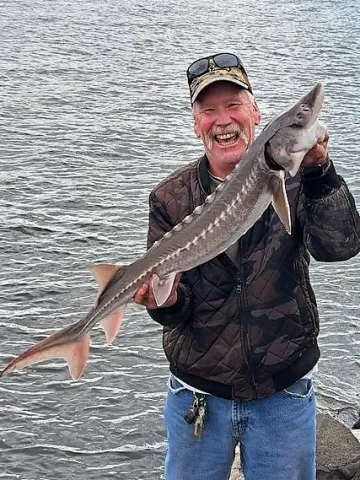
One other fun thing about fishing for pikeminnow are the other fish you catch. I ended up catching eight perch, and we both also caught smallmouth bass on the nightcrawlers we were using for pikeminnow bait, fished just off the bottom of the river with a two-ounce sliding weight. Rusty caught the most interesting bycatch of the day though, a 30-to-33-inch sturgeon on a bass rod that was spooled with braided line and just a 10-lb leader. It took him 15 minutes to get that prehistoric looking fish to shore, at which point I snapped a photo of the fish and he released it. It made for the end of a perfect day of fishing!
John Kruse – www.northwesternoutdoors.com and www.americaoutdoorsradio.com
/articles/sp-500
Ocean Coho Tips and Techniques
Coho are one of the most sought-after salmon in the Pacific Northwest. For the saltwater angler, the coho bite can be a bit chaotic, with the fish running in large schools and being active biters when the conditions are right. They can also be a bit frustrating if you are not using the right gear or fishing the right presentation. By keying in on techniques that work the topwater and get the coho to bite, you can increase your catch rate and fill the coolers with great eating, hard fighting silver salmon.
Silver Salmon
Silver salmon like to swim fast and attack their prey. Known for their topwater action, coho tend to be close to the surface. This makes for a great fishery because you are not constantly trying to work the bottom and worrying about losing a downrigger ball like you are when chasing after chinook that are on a sandlance bite. When it comes to catching coho, there are few things you can do to increase your catch rates.
Lose the bait to catch more fish. It might seem like using a fresh anchovy or a perfectly plug cut herring would lead to more fish but rigging these baits takes time. When you get into the schools of coho, the action can be fast, which means you will catch more fish if you can keep your gear in the water longer. Same with getting it back into the water faster, and anyone who has rigged an anchovy hood knows that you need to set it correctly and that takes valuable time.
Spoons
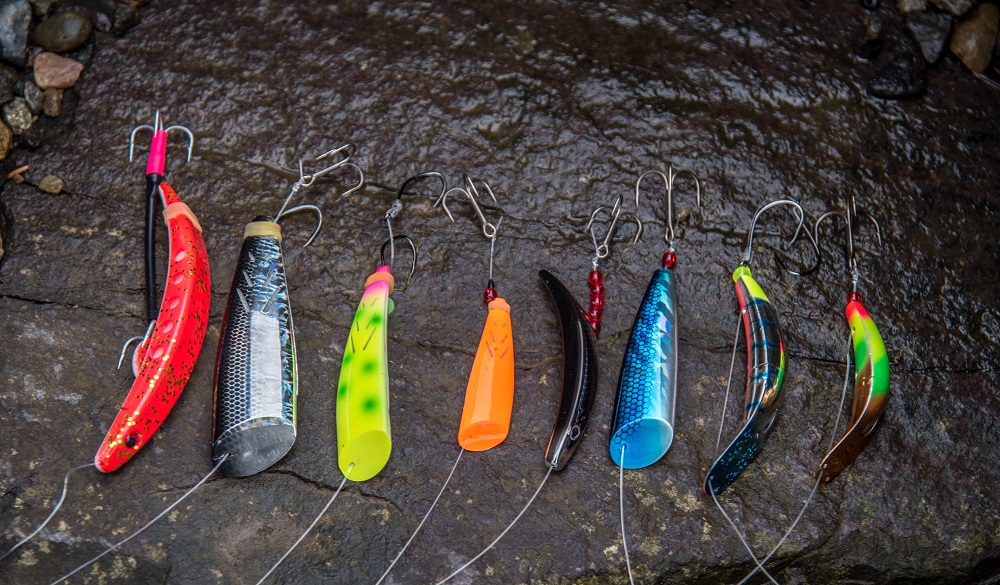
Spoons are one of the more popular lures because they are simple and are always working even if you miss a bite. Keep the spoons small such as the Coho Killer or a 3.0 or 3.5 Coyote spoon in sardine or rainbow trout patterns. The rainbow trout spoon looks more like a herring or mackerel and it has a glow back to it for low light such as cloudy days. Another spoon that is popular with coho fishing is the Skinny Gee in Herring Aide color. When running a spoon behind a flasher, it is best to go a bit longer on the leader such as 42” as this allows the spoon to flutter.
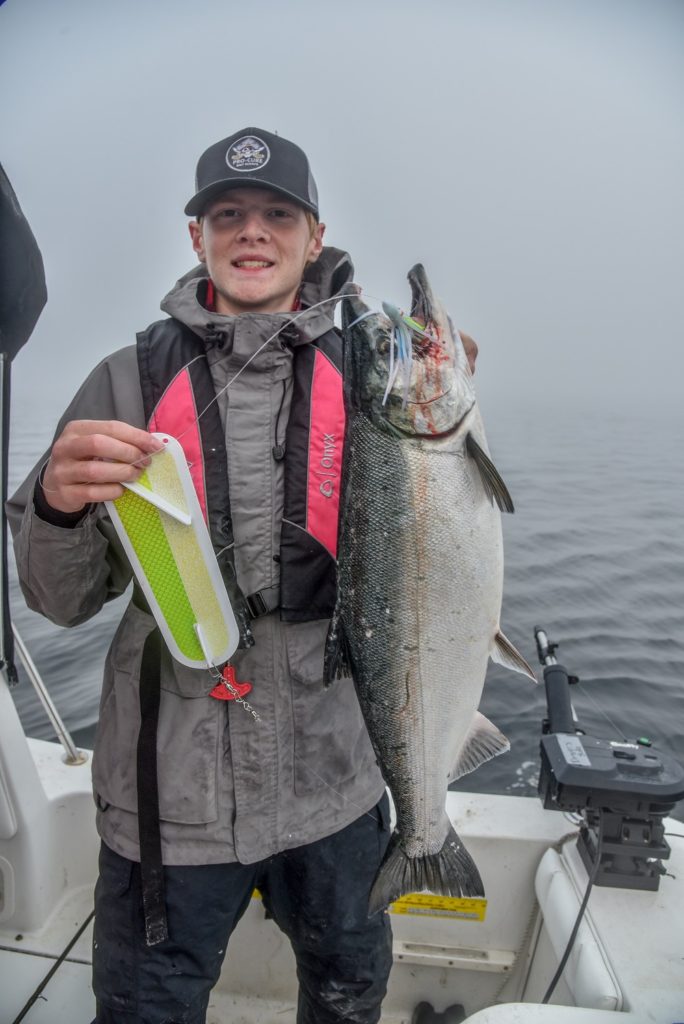
Sometimes spoons don’t draw the fish to strike. Give tube flies a try. This is a technique often used in the Great Lakes by salmon fishermen and by fly anglers chasing after fall coho along the shoreline. The ocean angler can take advantage of these lightweight lures that mimic baitfish. One of the best things about a tube fly is that they can be fished behind a dodger or a flasher or all alone, since they have low drag and are lightweight. Tube flies tend to have an erratic action that coho can’t resist, especially if you put a Mack’s wiggle bill in front of them. Bechhold and Son’s make a unique flasher with offset holes to add extra action. They have teamed up with Rapture Trolling Flies, a Great Lakes company, and offer a combo set matched together and ready to fish. If you already tie your own flies, you can pick up a tube fly adapter and tie your own easily.
Tricking The Salmon
Add flash and movement to your squids. When rigging a squid skirt with an insert or a tube fly, such as the Luhr Jensen Flash Fly (unrigged version, as they are smaller than the pre-rigged Flash Fly) to be fished behind a dodger or flasher, be sure to use a short and stout leader. Try using 30 or even 40-pound test as the stiff leader will give the lure more action. The idea is to get the lure to move in an erratic motion and make the dodger look like a feeding salmon with the lure being a wounded baitfish. It creates the “bite now” instinct of the feeding coho and tricks it into thinking the other salmon, which is the dodger, missed the baitfish and now it’s there for a free meal.
Using an insert into a hoochie or squid skirt adds attraction and can turn on a bite. The past few years we have been using the Luhr Jensen Flash Fly inserts and putting them into a squid skirt. By doing this you can make several different combinations of colors to attract the fish or add some extra UV flash for those cloudy days. You can also add a Mack’s Lure Wiggle Bill to the front to add extra movement.
Artificial Bait
Try using an artificial wounded baitfish lure. Lures that mimic a wounded baitfish are the SpinFish by Yakima Bait Company, Brad’s Super Bait Cut Plug, and the new Spin Dawg by Simon, who also makes a Spin Cut Plug that has a hole at the tip of the lure making rigging much easier with no rubber bands or chance of it coming apart. The Simon products are solid and have a scent chamber. Each of these lures is made of hard plastic and has a hollow cavity inside where you can stuff them with scent or minced-up baitfish such as anchovies or herring. For these lures, use a longer leader with a bead chain swivel in the middle since the lure provides the action that creates that need to bite reaction by rotating and spinning.
When using artificial lures such as spoons, squid skirts, and the hollow cavity lures, scent is crucial. Unlike when you use a real baitfish that has oils being released and the fish know it is an actual herring, the use of artificial lures is only a visual attraction unless you scent it up. The cavity lures like the SpinFish offer a way to fill them with various baits to create a scent trail. One common bait is to mix canned tuna fish with your favorite scents. Because the lure holds the minced-up bait, one of the better scent mediums to use is one of the many water-soluble scents from Pro-Cure. When the scent leaks out of the lure, it mixes with the water and stays at the same depth as the lure, creating a large scent trail for the fish.
Oil Based Scents
Oil-based scents such as Pro-Cure's super sauces, gels, and oils hold a scent well and last a long time, but the scent will not mix well with water. This means when it is washed off the scent trail starts to float. Water-soluble oils wash off lures and squid skirts too quickly which is why you should use oil-based scents for these lures, but it will not gum up or ruin the action of a tube fly, just be sure to apply frequently. Knowing which scent to use is more than just the baitfish it is made from, but also which ones are best to stay on the lures you are fishing.
Downsize the dodgers and flashers. The idea behind using a dodger or flasher is to create a feeding salmon scenario as well as add action to your lure. Since you are fishing for coho, be sure to match the dodger and flasher to the size of the fish. Most use the standard 11-inch flasher but the 8-inch flasher is a better choice. Instead of the attacking salmon looking like a chinook with the 11-inch, the 8-inch reflects light more to the natural size of a coho. It is also less drag and that means you can fight the fish better. The smaller dodgers and flashers also work well at faster trolling speeds. The Sling Blade dodger from Mack’s lure is a very universal dodger that is designed to work well at fast speeds. Since it is a long teardrop design you can bend it to create a more dramatic dodge or side-to-side action, or you can keep it straight and troll it fast. This design also cuts through the water well and allows you to fight the fish and not the dodger, even when using the larger 9-inch version. The dodger comes with UV-treated colors and is offered in many sizes, which allows you to change it up to the varied sizes of lures you are using.
Coho
Since coho are often found actively feeding near the surface, you do not always need to use downriggers. Instead, trolling with a mooching weight that cuts through the water easily and a simple lure behind can be a way to either add an extra rod out of the back of the boat or not deal with the downriggers altogether. Again, the more you can keep your lines in the water, the more fish you will catch. When rigging this outfit, use a longer leader around 48 inches with a bead chain swivel in the middle and a lure that imparts action such as the SpinFish, Brad’s Cut Plug, or Simon Spin Dawg. But do not overlook the tube fly or even the squid skirt with the addition of a Wiggle Hoochie Bill. These small plastic bills from Mack’s Lure are simple to use, just slide it down the leader to the head of the squid skirt and push it into the collar. If using a tube fly then adding a bobber stop knot or rubber bobber stop to the front of the bill will keep it tight to the fly. The Wiggle Hoochie Bill act much like the bill on a plug, but instead of creating a diving motion, it moves the lure in side to side in and erratic motion. They also come in an assortment of colors and are UV treated to add even more visual attraction.
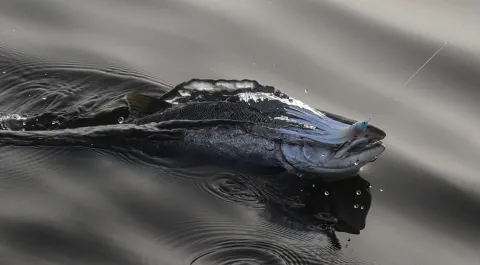
Coho are known for their acrobatic fights, often coming right up to the surface and jumping, but a dodger or flasher can take away from the fight and even become a problem when the fish jumps. The attractor breaks the surface of the water pulling in an opposite direction and taking the hooks with it. When using downriggers, you can rig in a way that the dodger or flasher stays with the downrigger ball and you get to fight the fish without any extra drag on the line. To do this, either use one of the lures with action or the added Wiggle Hoochie Bill and then a downrigger clip that is above the ball. Use a short section of cord or very stout mono line such as 50-pound test from the flasher or dodger attached to the downrigger ball, and then set the downrigger clip twice the length of the cord above the ball.
Furthermore, If you run the dodger or flasher behind the downrigger ball 36-inches, then set the downrigger clip 72-inches, or 6 feet, above the downrigger ball. Then run your lure back just a few feet from the clip. This will keep your lure from tangling with the flasher or dodger, and yet when the salmon sees the attractor, it will look like the baitfish got away and they will grab the lure. This works really well with plug cut herring or an anchovy with a bait hood, as well as lures that don’t need the imparted action of a dodger or flasher. One other great trick when using this way of fishing is to use the Scent Flash triangle flasher from Mack’s Lure, as these flashers are designed to hold scents inside of them. As the triangle flasher spins, it creates a very large scent cone out of it as it disperses the scent. When using these, you don’t need to use a leader or cord, but instead you can attach it directly to the downrigger ball, which means you can also keep your lure a lot closer to it as well.
Run timing and knowing which fish you are targeting will lead to more fish. Ocean coho are found all along the coastlines from Oregon to Alaska, and the feeding fish will often work along the shoreline, feeding on herring, candlefish, anchovies, and various other prey in the kelp beds and protected waters around islands. Look to the rocky breaks often found just offshore and find the coho. Even when out in the open ocean, where the fish will form large schools to travel from their feeding grounds to the rivers each fall, the fish will still be “shallow”. Not the depth of the water but where they are in the water column, meaning closer to the top.
When it becomes prime time for ocean coho but weather and fishing seasons keep you away from the open seas, resident coho fishing can produce a fishery for the avid angler. Puget Sound and the various inlets around Vancouver Island offer coho that do not head out too far away feeding grounds but instead live “inside”. Starting in May and all through the summer, resident coho fishing is good. Using the same techniques as fall fish, the angler can perfect their coho set-ups. Look for points along the shoreline as silvers tend to use them as tide breaks that will harbor baitfish. Where you find resident coho you will also find ocean-bound fish once they return. This is where you want to be when the runs start to show up in August and continue to flood through October.
/articles/ocean-coho-tips-and-techniques
Leave It Better Than You Found It
As outdoorsmen, we have a duty to continue to cultivate the resources that are our land and water. How many times have you pulled into a boat launch and seen it torn to shreds? Concrete half off the ramp, rope handrails cut and laying lifeless, no longer serving their purpose. What about the campsite with half ripped apart beer cases, food scattered around, and dog poop on walking paths? One of my personal favorites is seeing trash thrown in the firepit. It’s one thing if the stuff thrown into the firepit can burn up (I’m plenty guilty of that), it’s another when the material should’ve been disposed of properly. The old adage of “pack it in and pack it out” is simple in speech and at times aggravating in action. My college football coach had a saying, “do what you are supposed to do, when you are supposed to do it, and do it that way every time”. The lens in which that quote was said was more along the lines of eat right, study your playbook, and lift hard, but the message applies across the board. Leave it better than you found it.
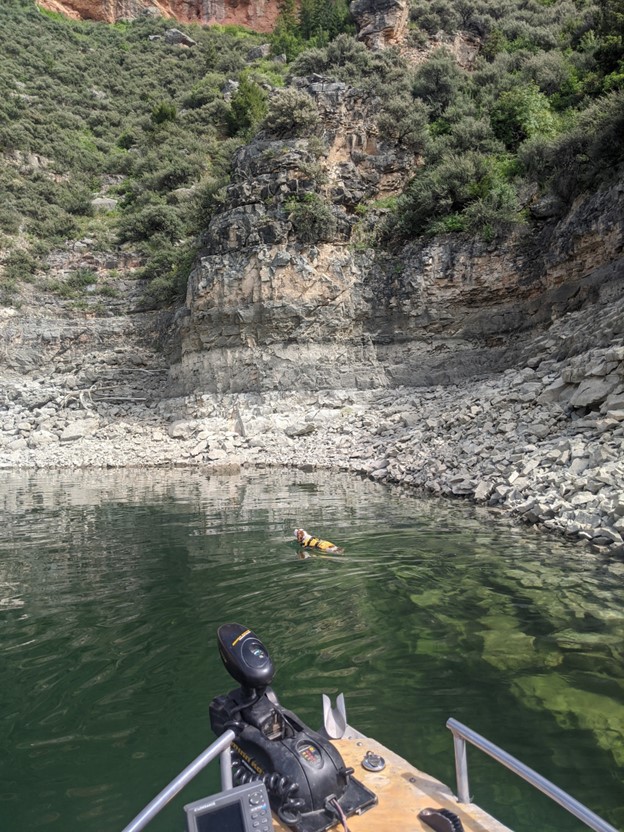
This isn’t meant to be a tirade against littering (not that I’m pro-littering - there is a Seinfeld skit somewhere about this I’m sure) or some kind of political statement. Rather, just an observation from a summer that I’m sure many of you shared. Time with friends and family outside. Some of us are lucky enough to have boats to get out on the water. Others may hike up into the mountains for some serenity and isolation. Then, for a brief moment, you realize the person there before didn’t care enough to keep the place clean. It probably doesn’t consume much of your brainpower or ruin the weekend, but it’s enough to make you roll your eyes and sigh. Those are the kind of simple things we can all do to help one another continue to enjoy these shared spaces.
Hunting Season
Another element that should be considered, particularly for those hunters among us, is the consideration of land water access. Familiarizing yourself with the public vs private land, access points, and limits on how many people can utilize certain access points are all equally important and part of our duty as conservationists. I remember during the last hunting season being continuously peppered by advertisements from Montana Fish Wildlife and Parks (FWP) about the importance of seeking permission for type II block management access (BMA). It certainly didn’t hurt that the advertisement featured a cameo from MeatEater star Ryan Callaghan. A quick sidebar for those who aren’t in the know - Block Management in the state of Montana is a partnership between private land owners and FWP to grant access to hunters on private land, sometimes adjacent to public land.
Type I BMA allows hunters to sign in on a card for hunting permission on private lands; you simply show up, fill out a card, and go hunt. Type II BMA often requires a reservation and is subject to availability from the land owner. Examples might be limiting the number of hunters in a day, hunting parties in a day, or what type of game is being hunted. The word partnership isn’t used by mistake. It takes action on all parties involved to maintain access to these hunting areas. The land owner to continue to be willing to allow hunters on the land, MT FWP to facilitate the opportunity for hunters, and hunters to respect the land and do their part to make sure their presence is continually welcomed. Leaving behind shell casings, wrappers from eaten protein bars, or other garbage is a quick way to find our access to otherwise great areas suddenly restricted. Maybe you don’t own 1,500 acres of land but instead a 1,500 square foot home. Would you be willing to invite back a stranger who tracked mud all along your carpets? Even worse, how about a buddy watching some football at your place who stains your couch with buffalo chicken wing fingers rather than wiping his hands. Why would we expect those land owners to welcome us back if we’re doing the equivalent?
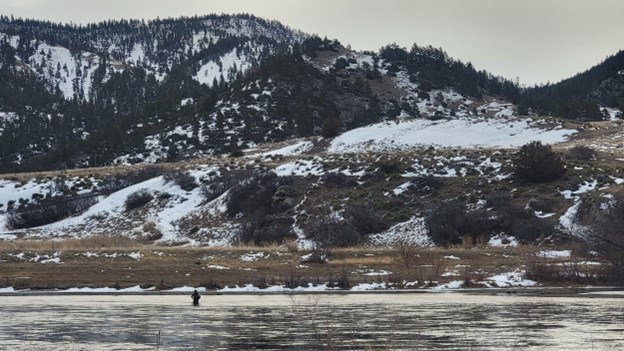
Let’s continue to work together to make sure we can enjoy the outdoors we all know and love. It doesn’t take much to clean up that last bit of trash, keep debris and clutter out of the community that should be enjoyed by all and keep shared areas like boat launches in working condition. If not for you and I, how about for our kids who hopefully enjoy these hobbies, and sometimes obsessions, as much as us.
/articles/leave-it-better-you-found-it