/articles/categories/destination
Late Season Baker Lake Sockeye
Whoo-hoo! The long-coveted Baker Lake sockeye season is in progress! The 2023 Baker Lake sockeye season is proving to be an interesting one. Through the North of Falcon process, the planned opener was scheduled to be Saturday July 15th. Because record numbers of sockeye have signed up for a ride in the fish taxi, the WDFW decided to open the fishery 1 week earlier. The opener was July 8th and the action has been on fire. It was reported that boat limits were the norm and many ice chests were full just a few hours or so after splashing the boat. In fact, on opening day one of the fishing specialists at Holiday Sports in Burlington, Philip Chuprinov, his wife Alexus and gang got their 12 fish boat limits in in less time than it took to drive to the lake and back.
OK, the fishing is good, but what is a “fish taxi” and why the early opener? Sockeye in Baker Lake are native to the system. After the Upper Baker Dam was constructed in 1959, sockeye were cut off from access to the natural Baker Lake. With limited success, various methods were used to trap and transport returning adult sockeye to the newly formed Baker Lake, while smolts were left to out migrate via controlled spillway releases. By 1985 the population crashed, and the trap count was only 99 fish. As a component of PSE’s permit to generate power, PSE developed a mitigation plan for sockeye recovery.
Long story short; both Baker Lake and now Lake Shannon have a surface to lake bed “gulper” net that funnels out-migrating sockeye smolts into a collection facility where they are processed, counted, and then transported for release at a trap facility on the Baker River in Concrete. The returning adult fish are trapped analyzed and then loaded into live transport trucks, AKA “fish taxis”, and transported up the hill. Some sockeye are placed in artificial spawning bed runs while others are held as hatchery broodstock. The rest are released into Baker Lake.

Historically, the Baker Lake sockeye run slowly ramps up, then spikes during the second week in July. This year, after a very short ramp up of 200-400 fish a day, on June 27th the fish counts absolutely exploded. For the next 10 days, the daily trap count was running from 1,200-3,000 fish. With agreement of the North of Falcon team, the WDFW made the decision to maximize the fishing opportunity and open the fishery 1 week early.
The 2023 Baker Lake sockeye season is July 8th – August 31st but may close early to assure that 1,500 fish are able to spawn naturally in the lake. There is a 3 fish daily limit for adult sockeye. With the two-pole endorsement, two poles are allowed and all anglers onboard a boat may deploy gear until each angler onboard has caught their daily limit. Because Baker Lake is actively monitored for regulation compliance, make sure to record your catch before you redeploy the gear. The Baker Lake catch code is 825. Are you jonesing for a grilled sockeye fillet or a bowl of fresh sockeye poke yet? If so, read on, if not there’s always a Safeway seafood counter nearby (it’s probably cheaper).
There are 5 launch ramps on Baker Lake. They are as follows.
PSE Baker Lake (Kulshan) Launch
The boat ramp has a moderate grade. Concrete blocks have been placed along the side of the ramp for protection from erosion. No designated disabled parking. The parking lot slopes slightly. Nearby, Kulshan Campground offers campsites, a RV dump station, and both restrooms and porta potties. Overnight parking is discouraged within the boat ramp parking area but is available just down the hill from the ramp. Kulshan is typically my go to launch ramp.
Horseshoe Cove
The boat ramp has a gentle grade. Launching and load occur on both sides of the gravel and sand bar. The surface is uneven from wave erosion and vehicle use. No designated disabled parking. Horseshoe Cove Campground also offers campsites, drinking water, picnic area, group camp area, and vault toilets. Overnight parking is available. 4-wheel drive is advisable.
Panorama Point
The boat ramp has a gentle to moderate grade, lots of parking and a vault toilet. The Panorama Point Campground is separate from the launch. Depending on lake level, the asphalt ramp approach stops short of the shoreline. Additionally, a drop off has been created by wave action and the gravel is becoming rutted from parking lot run-off. With the uncertain ramp conditions, 4-wheel drive is advisable.
Swift Creek
The Swift Creek launch is paved or concrete and is usable at all lake levels. There is a tall bulkhead wall on one side with a short log boom on the other side of the ramp. There is also a small marina adjacent to the ramp. The marina has limited non-reservable short term tie up but no services or fuel. Swift Creek Campground offers campsites, drinking water, picnic shelters, a group camp area, and vault toilets. Overnight parking is available. I advise that you have a capable mate at this ramp. If solo, there are no provision to tie up your boat right at the ramp. Solo, you’ll have to deal with your boat after launching and you’ll be holding up traffic. Unless you’re offering free coffee and doughnuts, generally not a good thing at 2:30 in the morning when there is a long line of headlights glaring at you... Having somebody run the boat while you go park is a solid community-based plan.
Shannon Creek Campground
The boat ramp has a gentle to moderate grade. Ruts are developing around the ramp due to the runoff from the parking lot drainage. Waves have been creating some erosion along the shoreline. No designated disabled parking. Shannon Creek Campground also offers campsites, drinking water, picnic sites and a vault toilet. This varies year to year, but they may be limiting launch access to campers registered at Shannon Creek Campground. 4-wheel drive is advisable, and this is the best launch for hand launch boats and inflatables. With just a short run you’re in Grand Central Sock-station.
Maybe a few words regarding the logistics and fishing Baker Lake. Once you turn onto Baker Lake Road there will be no services, fuel, food, or camping supplies available. Make sure your pre-trip planning includes extra fuel, ice, propane or whatever you’ll need for your trip. Early morning, evening and anytime you’re in the shade there will be mosquitos. Not a few pesky mosquitos but a large squadron of blood thirsty flying vampires, I think they even have radar, night vision, and little stick figures drawn on their blood engorged bodies. As a bonus, I even stepped on a yellow jacket nest last year, be aware. Above all, this is a true combat fishery. Patience and ramp courtesy will assure everyone enjoys the experience.
After some deep thought I think that the biggest thing I can say about late season Baker Lake sockeye fishing is patience. The fishing can be very hot or very cold. Whereas the day before, limits may have been the rule, it is not always, and fishing may be dead. Slow fishing or otherwise, there are a few things you can do to improve your odds and put a few late season fish in the box.
As mentioned, patience (theme) will be the name of the game, and trust your electronics. Especially during your pursuit of late season sockeye, you will see the fish on the meter before they chase down your offering. When chasing late season sockeye, the more flash the better. Some people run 2 attractors and/or run a dummy off their downrigger ball. Other people bend their flashers to give them more wiggle and flash. Make sure you keep your gear clean; I don’t think that the late season sockeye like the scent of yesterday’s bait or scent oils. That said, make sure to use fresh bait. The 2013 sockeye bait you found in the back of the bait/beer fridge is not going to cut it.
Location is important in your pursuit of late season Baker Lake sockeye, although there are stock areas of the lake that consistently fish well. Areas like the Kulshan Loop, Maple Grove, Silver Creek, Noisy Creek and the Race Track along Baker Lake Road all reliably produce fish. The problem is each of those areas will also have a healthy aluminum hatch. With all the gear dangling in front of their noses, the fish may just ignore it. In my experience it pays to go look for fish. Many times, I find schools of willing biters in shallow water. Often, after a slow morning I have just flatlined gear in shallower areas of the lake and picked off limits in one or two passes.

FISH ON THE METER! Now what? Typically, a “0” size 50/50, chrome or pearl dodger is the backbone of the setup. While you can catch fish on tandem red, black or blue hooks the fishiest gear includes small spinner blades, Smiley Blades or Wiggle Hoochie inserts. Thinking outside of the box also has advantages. Sometimes the fish just don’t want the standard gear. We have had success using the kokanee size Brad’s Cut Plug lures, Coho Killers with an extra bend in them, kokanee/sockeye flies, and Brad’s Wee Warts. Start with the basics, a “0” dodger and a bare 3/0 red hook, and then be prepared to make changes until you are consistently catching fish.
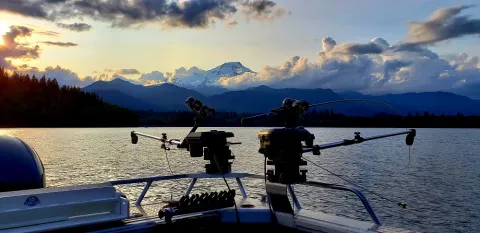
Downriggers are the way to go with this fishery, but dropper rigs rack up many of the fish caught at Baker Lake. When running downriggers, beware, the lake is uncharted and there are many stumps, old structures and who knows what else to snag you downrigger ball on. If using downriggers, be alert and be prepared to part company with your downrigger ball (does your pre-trip planning include an extra downrigger ball?). Safety first, especially if fishing out of a shallow freeboard skiff, kayak, or inflatable. A 10-pound hunk of lead is not worth losing your boat or giving your boat mate unexpected swim lessons. Try to maintain your trolling speed at .8-1.2 MPH, and we have found that 5-10’ setbacks from your downrigger clip are all that are required.
Another thought and in my mind a gem of an opportunity. Late in the season these fish form tight schools and cruise around on the flats where the Baker River flows into Baker Lake. There are several underwater springs in the area and the fish seem to be staging for the spawn. With caution you can slowly motor (or row) into the area, find a pocket of fish and drop a dead weight anchor. There will be a ton of logs and woody debris so don’t use any kind of pronged or claw anchor. An old pile of chain or bucket of cement is perfect. Caution: do not come into this area of the lake on plane or even any faster than at idle. Depending on lake level there are numerous stumps and trees just waiting to meet your prop. Why go to all this effort? Glad that you asked…
With a little luck and an adventurous spirit, you can set yourself up to sight fish sockeye with a fly rod. Let me tell you it is an absolute hoot, and once you have it dialed in, you’ll be a serf to the great sockeye gods. You’ll go to sleep dreaming about watching your line snap tight as the water seems to boil around it and wake up in a sweat still dreaming about your airborne quarry.
I’ve said this before; Baker Lake sockeye are the best eating fish in the state. To preserve their quality, bleed and ice your catch immediately. If you’re camping, gut the fish and pack the body cavity with ice, layer the fish in ice with a handful of rock salt evenly scattered around on top of the ice. It is best to use an ice chest that is dedicated to your prize catch. Leave the ice chest drain plugs out. This will prevent your catch from sitting in an ice chest ½ full of cold, very slimy sockeye sludge.
So, those are the late season basics; I wish you luck and an enjoyable trip to Baker Lake. Please be respectful of the opportunity to fish Baker System sockeye. This fishery is closely monitored and there will be multiple game wardens, WDFW, and Sheriff Department personnel conducting on the water checks. If there is widespread abuse, they will close the fishery. Be courteous, know the regulations, limits, and gently release any Dolly Varden trout caught.
/articles/late-season-baker-lake-sockeye
Alaska Memoirs
It was a foggy, rain-soaked day in King Salmon. One crusty looking grumpy guy in hip boots was clearly the ringmaster of what appeared to be a five-ring circus happening in front of me. An entire fleet of float planes were tied off to a massive wooden dock on the Naknek River. Dormant. Grounded due to the fog that socked in right down to my boots. Pilots were yelling at dock hands to get the planes loaded and the ringmaster just looked on with what seemed like surly disgust. Apparently, the tower was going to give special clearance for a few airplanes to fly. This fleet had been sitting for a couple days and everyone was anxious to make the planes do their job. It wasn't a time to be late to the party.
I sat there with my head down, staying out of the way, and waiting to be told to load up. I didn’t know a soul. I didn’t have any friends there. No family. No one. I was as alone as alone could be. The crusty looking grumpy ringmaster just called me “the kid from the south.” He finally came over to me and said “well kid, looks like I’m gonna have to fly you out to the Branch. Go ahead and load up in that 206 down there. I will be there in a minute.” I didn’t have the guts to ask what a 206 was. I knew it was an airplane but obviously it was a different airplane than the others. I knew that he knew I didn't know but, I wasn’t going to give him the satisfaction of delivering more surliness my way. Instead, I asked the dock hand that was getting yelled at the most. He was glad to load my two duffel bags and backpack in the right airplane. When the ringmaster returned, I quickly loaded up per instruction and that was it. Off to the Branch. Just like I had done it a hundred times.

Bristol Bay
That was not only my first day in Bristol Bay but, it was my first day in Alaska. Almost 20 years ago now. I had no clue how much it would change my entire life. As the years and seasons rolled on, the grumpy ringmaster stopped referring to me as “that kid from the south.” I earned my spot in the Bristol Bay community and made friends. In later years as my interest in aviation grew, the ringmaster would message me asking about weather conditions at my location. I became a part of an inner circle that once again, changed my life forever. I am grateful for all of it.
Alaska
By the time I started working in Alaska, I was no stranger to the duffel bag life. Living out of a couple of bags and a backpack was normal for me. I had just never done it in a location as remote as Bristol Bay. I read somewhere once that people who go to Alaska for work are either running from something, looking for something, or they are just too stupid to get a job anywhere else. I was all three. Maybe not too stupid to work somewhere else, but I was checking boxes on my resume. I needed Alaska experience to go where I really wanted to go. Trouble was that I had inadvertently fallen in love with Bristol Bay. She turned out to be the dirtiest mistress a fishing guide could have. The one that I couldn’t walk away from. The one that will kill you if you stay too long and ruin you if you leave too early. Bristol Bay has a way of doing both, no matter what you do.
If someone wanted to know exactly which part of Bristol Bay kept me returning for almost two decades, my answer would be “all of it.” Alaska is, without a doubt, the biggest adventure anyone can have. I’m sure somewhere in Siberia there is a bigger adventure but none of us are going there to do it any time soon. At least in my lifetime it seems that will be the case. Alaska has a certain captivating quality which speaks to those who are in fact, running, looking, or lost. Fishing fixes most everything and float planes fix everything else. Alaska has that in spades.
My Experience
But honestly, as I sit here today trying to find a way to put in words that justly convey my experiences, the one thing that keeps coming to mind is the salmon migration. I lived for the days of hunting fresh, dime bright, chrome salmon straight in from the bay. No matter if I was up late studying weather patterns and maps trying to find a way to fly or if I was running a jet boat 50 miles one way down river to tidewater, it was the same rush. The satisfaction of watching waves of fish push a wake while migrating upriver, just as they have done for thousands of years. I lived for it. Dreamed about it. It’s the only thing I miss. This is the first summer in so many years that I have not been there for the migration. A couple nights ago, I dreamed about it. I was in the hip deep tidewater of the lower Branch. Fishing with my favorite 14’ spey rod. Chrome kings were streaming by, pushing wake. The tides were right, the skies were overcast and there was just enough wind to keep the mosquitoes at bay. Life was perfect.
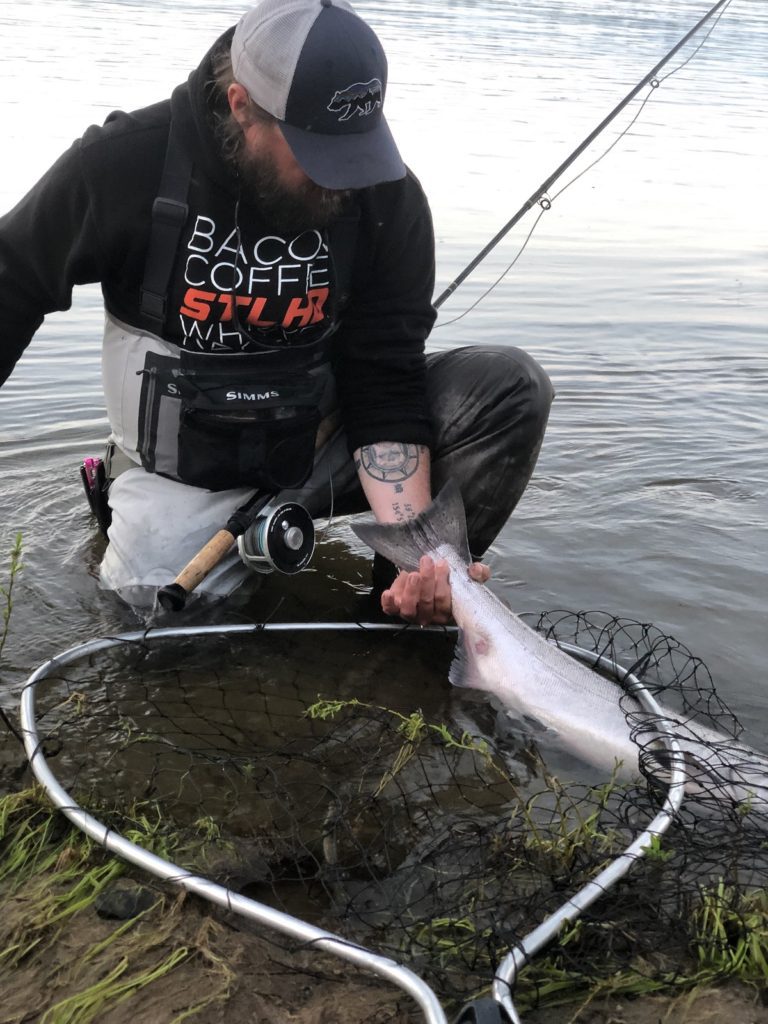
In my dream, I just stood there watching the wakes push upriver. Not fishing, not casting. Just puffing on a cigar and watching the whole thing happen. The dream was clearly a ridiculous romanticized abomination. Probably forced into my thoughts subliminally by some social media algorithm that doesn't really want people to fish, only act like they fish. Anyone that knows me knows that I can't smoke. It makes me deathly ill the next day. Worse than a hangover. I wish I could smoke cigars. It looks really cool. Most importantly though, the same people that know I can't smoke also know that if I’m breathing and capable of standing in the lower Branch, there is absolutely no chance I am not gonna swing for kings on a fresh high tide. No chance. Not now, not ever. It’s the one thing that will bring me out of retirement. Maybe next season..........
/articles/alaska-memoirs
Shad Fishing is Heating Up
The annual run of American shad up the Columbia River is building steam. Over a 100,000 shad a day are being counted at the Bonneville Dam fish ladder. Marc Bush, owner of Twisted Waters Guide Service, recently took two clients shad fishing near Beacon Rock State Park and the two, Drew Monsey and his father Martin, caught 104 shad in short order, with Drew out fishing his dad by 11 fish. If you would like to book a trip with Bush you can go to his Facebook page or his website at www.twistedwaters-gs.com.
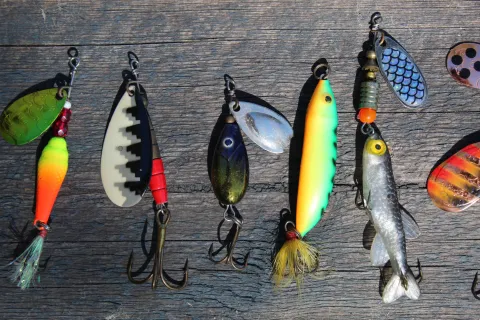
You don’t need to have a guide to have success catching shad. Two great places to fish for them from shore are just below Bonneville Dam and also below the John Day Dam. Simply cast a 1/16-ounce jig or shad dart and use anywhere from ¼ to ½ ounce of lead above it (depending on the current). Then, let it swing downstream with the current and wait for a bite before reeling in the jig and casting again.
Shad typically run between one and three pounds but they are scrappy fighters and fun to catch. Kids in particular enjoy the non-stop action when the shad run is going strong. The state record for shad is a 3.85-pound specimen caught by Tom Magnuson out of the Columbia River in 2005.
Some anglers will keep the shad to eat but others (myself included), cut these fish in half and use them for crab bait. They are a very oily fish and work very well when it comes to attracting crabs. Shad also work well as bait for sturgeon fishing and for catfish too.
John Kruse – www.northwesternoutdoors.com and www.americaoutdoorsradio.com
/articles/shad-fishing-heating