Find Big Smallies Fast on the Mid-Columbia by Gary Lewis
Learn how to quickly read and tackle big fish in unfamiliar waters.
If an angler is hunting big fish on the Columbia, the challenge is to read the water fast. It’s a lot like how tournament anglers have to adjust when fishing a lake for the first time.
My biggest ever largemouth came from the mouth of the John Day River. We were done fishing for the day, but we wanted to throw a cast at a clump of willows. The big fish, a female, was staged right where she could ambush minnows running out of the mouth of the river. She ambushed the wrong thing that day. After we weighed her, we put her back.
The river is home to a few largemouth, but smallmouth bass are the primary target.
AN OPEN-MINDED APPROACH
Once, I interviewed a couple of bass pros about how they find big fish fast. Ish Monroe, an MLF pro from Hughson, California, said, "Most people miss out when they don't approach the water with an open mind."
Dean Rojas, from Lake Havasu, Arizona, pointed out that western reservoirs are characterized by lots of rock and clear water. That sums up the Columbia. Rocky points, rip rap, cliffs, and beaches illustrate where bass are likely to be in the summertime.
Sometimes we get hung up on what color of bait works best in what kind of water.
"In clear water, I use more natural colors," Ish said. "In dirty water, dark colors like black and blue or bright colors like chartreuse work better."
Shade is most important, Monroe said, "and thick cover." But the third component is access to deep water. "In shade and heavy cover, bass just sit in it and wait for the bait to come to them."
One of the best tools for the traveling bass angler is Google Earth. A quick virtual tour of a reservoir can reveal structures that might not be seen at full pool. Old photos can reveal structures that were flooded when the dam was built.
The McNary Dam, which holds Lake Wallula, was finished in 1954. The John Day Dam, which created Lake Umatilla, was completed in 1971. The Dalles Dam was completed in 1957, creating Lake Celilo. All three lakes flooded small ranches, small towns, small roads, and the mouths of creeks. Those roads and foundations are all still there, but are not evident except at extremely low water.
A better way to see the structure is with Navionics. The same water, examined with a Navionics chart, reveals the road beds, old foundations, and submerged bridges. Imagine bass bedding on the old road and schooled up in an old schoolhouse.
A few days before a trip, I like to check Weather Underground (www.wunderground.com) for the 10-day forecast. This site tracks cloud cover, temperature, precipitation, wind, wind direction, and the barometer. It is hard to quantify how barometric pressure affects bass fishing, but it does. When the barometric pressure is high, fish tend to be slow and sluggish. In general, I like to hit the water when the pressure has been stable, around 30.00 for three days, ahead of a low-pressure front. Fishing tends to be best when the pressure is dropping, is low, or slowly rising. When the pressure is higher, expect fish to pull back into cover or suspend in deeper water. In these cases, downsize the bait and try for pinpoint casting into heavy cover. Or use a slow spybait presentation in deeper water.
Sometimes the biggest fish come when stalking close to the bank. One time on the big river between Biggs and The Dalles, I was fishing with Jim Goerg and Michael Gibney. I was drowning a new swimbait, and Gibney and Goerg were using tubes. At the head of an island, Gibney stepped up to the trolling motor. “20 feet deep here.” Wham! My rod bent with a 12-inch bass.
Gibney’s rod shivered, and he set the hook. I brought my fish to the boat quickly, but there was no stopping Gibney’s fish. “I don’t know what this is, but it’s not a bass,” he said. “And it’s not a salmon.”
A six-foot, six-inch three-power Lamiglas and a Pflueger Maxx XT spinning reel loaded with 20-pound braided Power Pro is good medicine for a four-pound bass, but Gibney was definitely under-gunned for the mystery fish he’d hooked. We followed the fish into 70 feet of water, dangerously close to the nets.
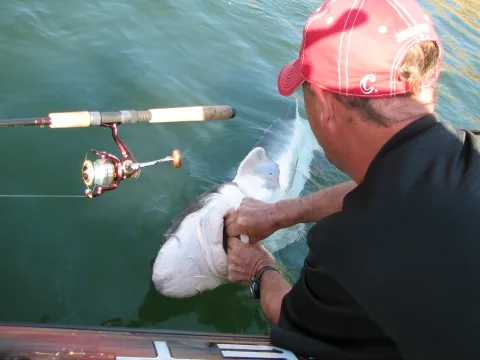
Twenty-five minutes later, we caught a glimpse of a seven-foot sturgeon, with a three-inch green pumpkin red flake tube in its mouth. Close to the boat, another huge sturgeon rolled. The fish blasted for deep water again, and Gibney handed me the rod.
Fifty-two minutes after the beast grabbed the tube, we had him alongside the boat, where I backed the hook out with pliers. He kicked away with a splash that drenched the bass pro.
Gibney wiped the water from his glasses, and we went back to the head of the island. I switched to a tube. Gibney tied on a silver-sided jerk bait. He rocketed a cast past an underwater ridge of rock, and we watched, stunned, as two 6-pound smallmouths attacked. Gibney's bait was almost out of the water, but one of the 6-pounders grabbed my bait and spit it back out, then the other slammed it and threw the hook. A third fish, the consolation ten-incher coming out of nowhere, clamped down, held on, and coughed up a crawdad on the way in.
# # #
Gary Lewis makes his home in Central Oregon.
SIDEBAR
Prospecting the Back Bays
Bass often hide in surface weeds, which can grow a thick mat of vegetation at the surface.
Look for grass mats or weed mats with open water beneath them. This could be broken-off tule reeds, patches of lily pads, or dead weeds of any variety - anything that provides protection above and freedom of movement below. Anglers walking the shore can often do better than fishermen in boats.
Flip or pitch into vegetation. A lure with fast-sinking action causes reaction strikes. If the rig sinks and hits the bottom without a strike, try again close by. Use a heavier rod for punching because fish hooked in these close quarters can come with five pounds of weeds.
Get no closer to the shoreline or the weed bed than a long cast. Stay off the trolling motor. Stay quiet on the boat. Try not to open and close the rod lockers in shallow water.
-Gary Lewis
/articles/find-big-smallies-fast-mid-columbia-gary-lewis
Destination: Oxbow Reservoir for Smallmouth Bass by Gary Lewis
An angler can catch bass in the Snake River reservoirs year-round, but the fishing really starts to get good in July.
Cousin Neil turned the North River sled in a tight arc out of the narrow launch and pointed the bow downstream. We would fish both sides of the lake, looking for the seams and breaks in the current where bass tend to stack to ambush bait coming downriver. The kids' rods were rigged with jig heads and plastic Keitech baits. I started with crankbaits and the Realis spybait, which is one of my favorites, but I could not help but notice that the other guys were catching more fish.
Oxbow Reservoir is part of a complex of three reservoirs, all built and maintained by the Idaho Power Company. At the top of Hells Canyon on the Snake River, bounded by Oregon on one side and Idaho on the other, Oxbow Reservoir is thirteen miles long and only a couple of hundred yards wide at its widest point. The dam itself is 175 feet tall. Hells Canyon Reservoir is directly downstream, and Brownlee Reservoir is directly above. To get to Oxbow out of Oregon, we head to Richland, turn at Halfway, then drop down Pine Creek to Copperfield. Oxbow Reservoir can be accessed either through Richland and Copperfield on the Oregon side or via Cambridge on a long and windy road leading north out of Boise and Fruitland.
Fishing in any of these reservoirs, a person can expect to catch smallmouth bass, crappie, sturgeon, trout, and catfish. These waters are rich in nutrients, and the fish grow fast. My cousin's kids are growing fast, too. Tabor and Steyr have been fishing since before they could walk, and their dad, my cousin Neil, will drop everything to get them on the water in the summer. And there is nothing I like better than going fishing with my family.
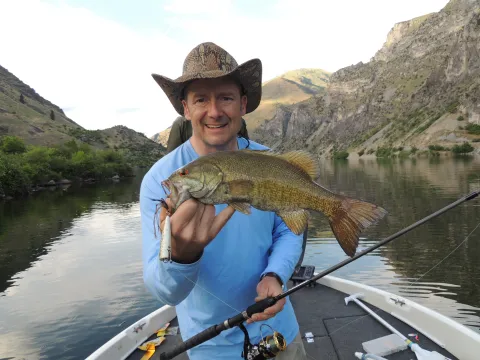
A nice bass taken on a surface lure in an evening's fishing on Hells Canyon Reservoir. Crankbaits and minnow imitations work very well in these Snake River reservoirs, especially along the ledges and around submerged structure.
A FOOD-RICH FISHERY
Smallmouth bass prefer warmer, flowing water and can be found in great numbers around weed beds, grassy banks, along the seams of riffles, deep along rock walls, and in gravel flats. On clear summer days when the sun is high, the biggest fish will be found in deeper water. On overcast days or when the sun is low on the horizon, smallmouth can be caught on or closer to the surface. They are aggressive predators, feeding on smaller fish, insects, leeches, snails, and crayfish.
Crankbaits and minnow imitations work very well, especially along ledges or around submerged structures. We try to use patterns and colors that imitate local baitfish. Chub, perch, and rainbow pattern crankbaits work well for minnow imitations. Orange and olive crayfish patterns are good crankbait options, too. Another good tactic is to dead-drift a plastic swim bait, allowing it to tumble through the best bass-holding water.
A person can catch fish all day long on these Snake River reservoirs, but it makes sense to take a break midday and rest and refuel.
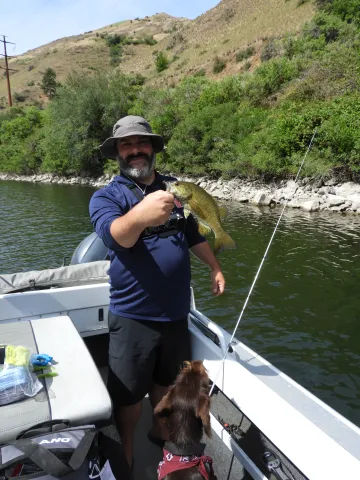
Trevor Barclay with a nice smallmouth on a jighead and a motor oil pattern curlytail grub.
THE SNAKES
The Snake River was not named for the snakes along its banks. It was named for the Snakes, the Shoshone speaking people that Lewis and Clark found and traded with. They were called the Snakes by their neighbors for the way they signed about who they were - the willow weavers.
But there are snakes, too. Rattlesnakes and bullsnakes - and it helps to know the difference. Although bull snakes don't act friendly, they are a much better neighbor than a rattler. You can tell them apart by looking at the heads. The bullsnake's head is narrower, while a rattlesnake's head is shaped like a wedge.
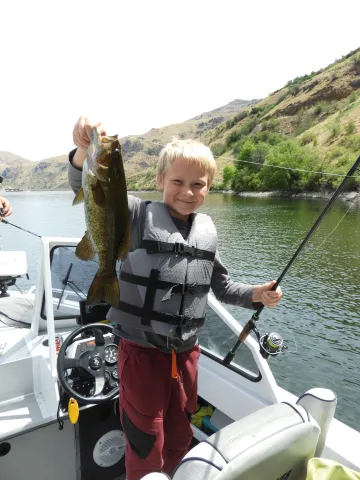
Steyr Lewis, of Fruitland, Idaho, shows off a chunk of a smallmouth caught on a Keitech plastic bait.
TIMING
So when should you go? An angler can catch bass in the Snake River year-round, but the fishing peaks in summer. In a lot of years, there can be heavy flows in the Snake, which tend to keep the reservoir banks full in June. Most years, by the second week of July, the rivers are in good bass fishing shape, and conditions are prime in August, September, and October.
WHERE TO STAY AND PLAY
Huntington, Richland, and Halfway, Oregon, are all within striking distance of Brownlee, Oxbow, and Hells Canyon reservoirs. One of my favorite places to stay is Pine Valley Lodge (pvlodge.com) in Halfway - an old stagecoach stop with all the Old West flavor intact.
Richland, Oregon, is a great little city of 156 people where a fisherman can get a burger or a cup of coffee. Best of all, it is just moments away from the Powder River arm of Brownlee Reservoir.
Huntington is an out-of-the-way stop where you can get a good meal if the restaurant is open. Check the hours before you make the drive.
The traveling angler is going to want either an Idaho or an Oregon fishing license. Or both.
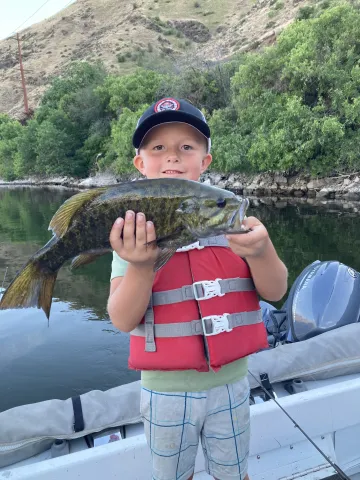
Tabor Lewis was touching up his baits with Pro-Cure's smallmouth magic gel.
BACK ON THE WATER
In the evening, we launched the boat again. Shadows were lengthening in the narrow canyon, and the fish began to rise in the water column.
This is tricky water. It may not look like it, but there are wicked currents. Make sure the children have life vests, and make sure the adults do, too. Especially the boat captain. Who falls out of boats more than any other person? It's the boat captain. And then the people who are not as good at running the boat have to try to rescue him. Think about it, people.
I switched over to the jig head and Keitech system and touched up my baits with smallmouth magic from Pro-Cure. That was the magic touch. A cast on the seam, well up-current, and then tighten up on the reel and feel the bait touch the bottom. If the line seemed to tighten up, it was a matter of cranking the reel fast. The hooks were sharp, and I caught fish fast for about half an hour. But while I was quickly bringing fish to the boat, I didn't catch the big ones. That honor was reserved for the rest of the Lewis clan, who each managed to boat three-pound smallies.
I had a four-pound smallmouth on for a minute. I know I did.
# # #
To watch bass fishing on Oxbow, click this link
https://www.youtube.com/watch?v=A1RdxZ1rkik&t=207s
or search Gary Lewis Outdoors Frontier Unlimited.
/articles/destination-oxbow-reservoir-smallmouth-bass-gary-lewis
Five Great Lure for Spring Bass Fishing
I love fishing for bass in the Spring! Bass are as big as they are going to get all year and as water temperatures warm and bass prepare to spawn, the bite can be amazing! By early May in the Pacific Northwest, with water temperatures around 60 degrees in many lakes, you can easily catch and release twenty-five bass a day. Here are five lures I love to use in the spring to help me get that done.
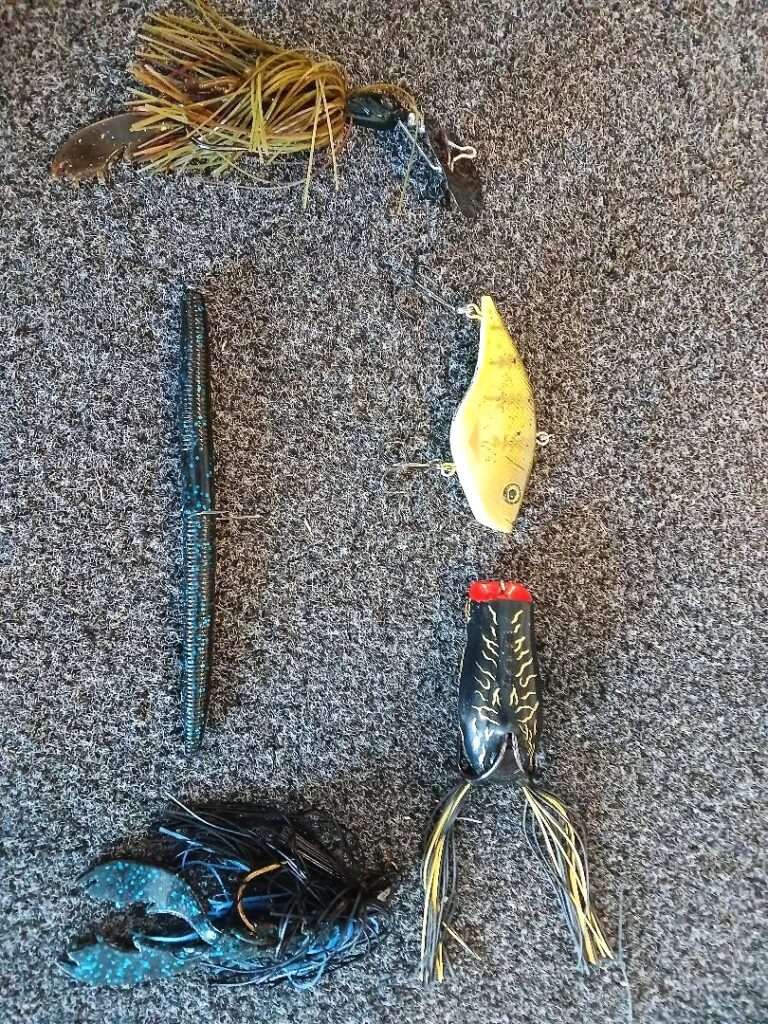
FOOTBALL HEAD JIG
A weedless jig is a lure that works all year long. The football head jig can be pitched or flipped into a variety of places bass like to hang out to include under docks, into brushy cover, rocky or gravel areas, beaver huts, flooded timber and the list goes on. I like to use a quarter, 3/8th ounce or half-ounce jig depending on how deep I am fishing.
One way to fish a football jig is to let it hit bottom and then slowly jig it back towards you. Most bites occur as the jig falls back towards the bottom. Another way is to us a sweeping motion with your rod, allowing the jig to drag across the bottom.
I always put a soft plastic trailer on any jig I am fishing with for bass. Good colors to use are black and blue or a green pumpkin.
CHATTERBAIT
A lot of bass anglers swear by the chatterbait for springtime fishing. This bait features a metal blade on top of the jig head that flashes and vibrates through the water. The chatterbait was popularized by Z-Man, and their original Z-Man ChatterBait still catches fish, especially in the spring. Many anglers, me included, let the chatterbait fall to the bottom and then retrieve it at a moderate pace next to brush or weed lines or near woody structure. If that does not work, try a very fast retrieve, even in colder water. That is a tactic Kyle Clark, an avid tournament bass angler and the owner of PNW Fishing Adventures, swears by.
A three-eighth to half-ounce chatterbait is a popular size to fish at depths of 10 feet or less. Popular colors are white, brown/black, black & blue and in stained water, chartreuse.
SENKO
When the bass are on their spawning beds a soft plastic worm called a Senko is hard to beat. This is a shallow water offering and precise casting while sight fishing for bass is a key to success. The number one color to fish is green pumpkin but at times, a purple worm with blue fleck can outshine the green pumpkin. I personally like to fish with a five-inch Berkley Powerbait Senko called The General, because the bass seem to hold onto it longer. However, many other serious bass anglers prefer Senko baits made by Yamamoto.
The Senko should be fished without weight. You can fish it Texas rigged through the nose and watch it slowly fall towards where the bass are. Others will fish it wacky rigged, with a hook right through the middle of the worm. The way a wacky rigged worm falls triggers vicious strikes from bass as it slowly undulates down through the water. Use a #2 or #1 Wacky hook and if you can find ones with wire weed guards that will help prevent some of the snags, you’ll encounter fishing around flooded timber and shrubs.
LIPLESS CRANKBAIT
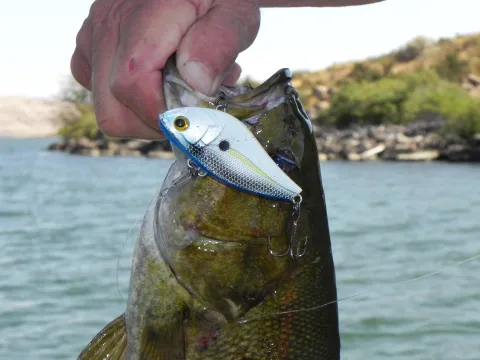
The lipless crankbait can be fished in cool waters but really starts to prove itself when the water temperature hits 55 degrees. Bill Lewis came out with the original Rat-L-Trap decades ago. This is a hard lure with a slim profile designed to produce a very tight wiggle. BBs inside the lure provide a rattle as the lure is retrieved.
A lipless crankbait is a great search bait because it can be cast a long distance, and you can cover a lot of water looking for schools of largemouth or smallmouth bass. In the latter half of spring (and all the way into autumn) you can fish the lure with either a moderate or rapid retrieve. Very short pauses as you retrieve often trigger strikes. I like to fish this lure along rocky riprap or just outside the edges of cover like flooded willows or weed lines.
A number of companies manufacture lipless crankbaits. In recent years, I have gravitated to the Berkley War Pig. I have a couple of plastic tackle boxes filled with half ounce, three-inch War Pigs in a variety of colors and they have become a true high-confidence lure for me. In the spring red can be a good color or you can match the hatch and try fishing lures that imitate trout, perch, bluegill, or bass.
FROG
Never overlook a soft plastic, weedless frog for springtime bass. They are generally made with a hollow body and have hooks on the back of the body. The “legs” of the frog provide action that attracts bass, and if you have a concave face on your lure, a popping retrieve will often attract even more bass.
This is a lure designed to cast into the weeds or lily pads where you would not dare throw a traditional lure. Jerking the lure on top of the water and weeds can generate strikes from bass that erupt out of the water to smash the lure. The number one mistake most anglers make while fishing frogs is to set the hook too soon. As tempting as it is to set that hook when that bass comes out of the water, you need to wait until you feel the weight of the fish at the end of your line. That is when you set the hook with a hard jerk and begin fighting that bass.
Conventional wisdom says frogs (and other top water lures) fish best in the early morning and in the evening. However, a weedless from is a lure you can really fish all day, especially on a cloudy day.
So, there you go, five great lures to help you catch more bass from March through June (and beyond). Fill your tackle box with these staples and make the most of your day on the water with more hook-ups. You’ll be glad you did.
John Kruse
/articles/five-great-lure-spring-bass-fishing