Safe Surf Fishing Essentials
Back in July of 2017, while driving up the Olympic coast on a surf trip, I stumbled upon a beach campground just south of La Push, Washington. A large northwest swell pushed in sets of violent waves that towered up to around 10 ft in height. The waves lacked the shape required for any attempt at surfing, yet the campground was beautiful and provided excellent views of the Pacific Ocean. Impressed by the campground, we decided to settle down there for a day of camping. The atmosphere around the camp was strangely quiet and somber, and as we were about to learn, it was for good reason. A man approached us and began to inform us of a tragedy that had happened just hours earlier that day. Apparently, a fisherwoman who was surf perch fishing with her family that morning had been knocked off balance by an incoming wave. Despite the efforts of the anglers around her and the rescuers who appeared soon after the incident, the woman succumbed to the power of the sea that day.
Fishing in general can be a dangerous pursuit. Whether it’s crossing the infamously deadly Columbia bar in search of salmon in the Pacific Ocean, encountering inclement weather on your kayak during a spring lingcod trip, or treading about on a thinning sheet of ice during late season ice fishing. With all fun outdoor adventures comes risk. This is not to say that risks should keep us from going outside, yet risks should be something that we evaluate with great attention.
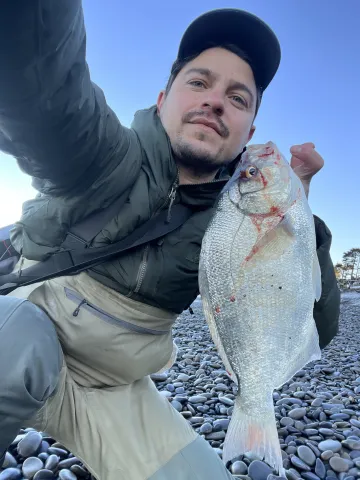
Winter is a perfect time of the year to practice your risk assessment skills; this is especially true on the coast when the weather and seas can become violent. Winter is surf perch fishing season for me. Salmon season is for the most part over, the perch are out of their spawning period, they’re fat, and they’re plentiful. Furthermore, with the winter razor clam season well underway, it’s quite feasible to combine a razor clam trip with a surf perch trip if that’s your thing. But wintertime is when the seas are at their highest, so how do we stay safe while fishing off the beach or while wading in the surf?
Tide, Swell, and Beach Terrain
Before going out, it is crucial to understand what is happening with the ocean. Resources like the NOAA website are a great place to figure out important information like tides, swell height, and weather. Winter is the season of King tides, so it is imperative to make sure the tide level isn’t going to be at an extreme high for your trip. Average swell height for the Washington coast during the winter ranges from 6-10 feet, but it often will get even higher. A good practice is to avoid the beach if both the tide height and the swell height are forecasted to be higher than average.
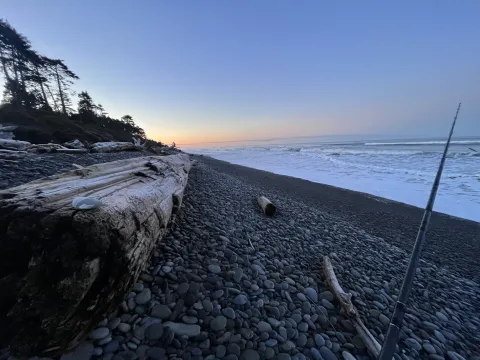
Not all beaches should be treated equally. The most productive spot I’ve ever fished, the north coast of the Olympic Peninsula, the same spot where the unfortunate tragedy previously mentioned happened years ago, can be a particularly dangerous spot due to the beach terrain. Most of the beach in this spot is steep. Being that I fish at high tide (the best time for surf perch), I choose to spend the entirety of the high tide atop the slope, out of the water. Venturing down the slope and wading into the water essentially pins you between the ocean and a steep hill behind you, leaving little to no room for escape.
If conditions are a bit too extreme for this spot, I only have to travel about 5 miles south, where there’s access to several miles of flat beach. Flat beaches are significantly safer for surf perch fishing and should be favored during sketchy conditions. At flatter beaches, the waves typically break further offshore and have a much wider swash zone (the portion of white water in front of the waves nearer to the beach). With a wider swash zone, you have more time to retreat back if needed while wading in the water. These areas can be very productive as well if you have scouted at low tide and successfully found depressions on the beach where surf perch like to school up and feed.
Skip the dip
Many people think it’s a requirement to wade waist-deep into the water when chasing surf perch. There are many spots, especially those where the waves break close to shore, where you gain little more than 10 yards or so by getting wet. Most of your surf perch fishing can be had without ever touching the water. To compensate for the distance to the fish you might lose by staying dry on the beach, simply add more weight to your rig so you can cast further out. In many cases, during a high tide, the fish will congregate very close to shore, and a far cast isn’t even necessary. The point is, becoming overzealous with wading out is what can easily get you in trouble in the water. It doesn’t take much for a wave to catch you off guard, and suddenly you're in over your waders. If possible, skip the dip and stay on shore when conditions are at all questionable.
Rolling Logs
By all means necessary, stay far away from beach logs that are anywhere near the path of the incoming tide. Logs are very buoyant, and it only takes a small amount of water to lift a log that may be well over a thousand pounds. Logs that become adrift are responsible for many accidents and deaths amongst beachgoers who are unaware of the dangers. As shore anglers, we are often confronted with logs on the beach, especially up on the Olympic coast. Always stay far behind logs that have potential for movement.
Waders
All modern waders come with a wading belt that, when cinched tight, is effective in keeping water out if you happen to fall or if a wave were to overtake you. When waders fill with water, they become a dangerous trap, so keep your belt tight and stay as shallow as possible.
Sometimes, during the harsh of the winter, I’ll tell someone I’m heading to the coast to fish, and they proceed to give me a funny look as we sit inside protected from the elements. What they likely don’t understand is that when surf fishing, 75% of your body is already completely protected by your waterproof waders. With a good polyurethane jacket, you can get back into your truck at the end of the day just as dry as you were when you left. Plus, you get a haul of tasty surf perch to bring home. Perhaps you can get out there this winter and bag your limit of surf perch.
I hope this article will be helpful in staying safe. Tight lines!
/articles/safe-surf-fishing-essentials
Severe Weather Boating
When I saw that I pulled the coveted “Writers Choice” slot for my assignment this month, I was busy trying to keep a small boat right-side up during our recent “Bomb Cyclone “(Yes, I was messing with my phone). I got to thinking, that if I survive the next couple of hours, a piece on heavy weather boating may be in order.
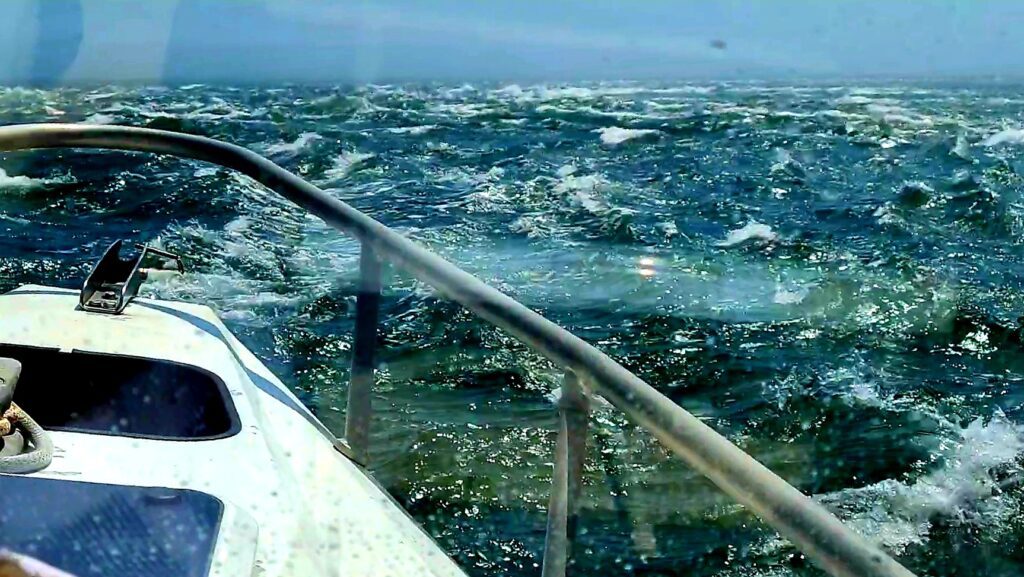
First, if the weather is questionable, don’t go. No fish is worth losing your boat or even your life for. Before any recreational boating trip, check the weather forecast and plan accordingly. Even if that means stopping at Skagit Seafoods to buy your next meal's main course. In the long run, it would be much cheaper than trying to run into conditions beyond the capability of your boat.
In my case, it’s my job, and my options are limited. I’m retired from a 38-year suit and tie gig but I couldn’t do retired life. Now I run a mailboat in the San Juan Islands, and unless I can’t get the boat out of the slip, the mail must go through. In addition to first-class mail, I also deliver freight, packages, time-sensitive prescriptions, perishable items, and other necessities for landlocked islanders.
I recognize that sometimes the weather just happens, going from a bit of a chop to holy crap in minutes. Here are a few thoughts on preparations and handling emergency situations on the water.
As mentioned earlier, check the weather forecast or maybe try an app such as Windy to make sure the conditions will be safe for your planned adventure. Remember, if you’re questioning your ability to get to your fishing spot and back, the fishing will be uncomfortable at best.
Make sure you have the correct size PFDs (personal flotation device) for each passenger onboard. It is also a good idea to conduct a VHF radio check and carry a fully charged cellphone. If boating in the PNW, I strongly suggest that you purchase the appropriate Vessel Assist membership for your area and boating style.
Make sure you have adequate fuel onboard. It is amazing what you can get your boat to do when the motor is running. I also suggest that you equip your boat with a fuel/water separator and use a fuel treatment with every fill-up.
There could be times when you have to anchor because of the high seas. Have an anchor, chain, and rode, sized for your boat ready to deploy in the case of an emergency. If you lose your motor, deploy the anchor from the bow before you drift into a dangerous situation. Never anchor from a stern or spring line cleat.
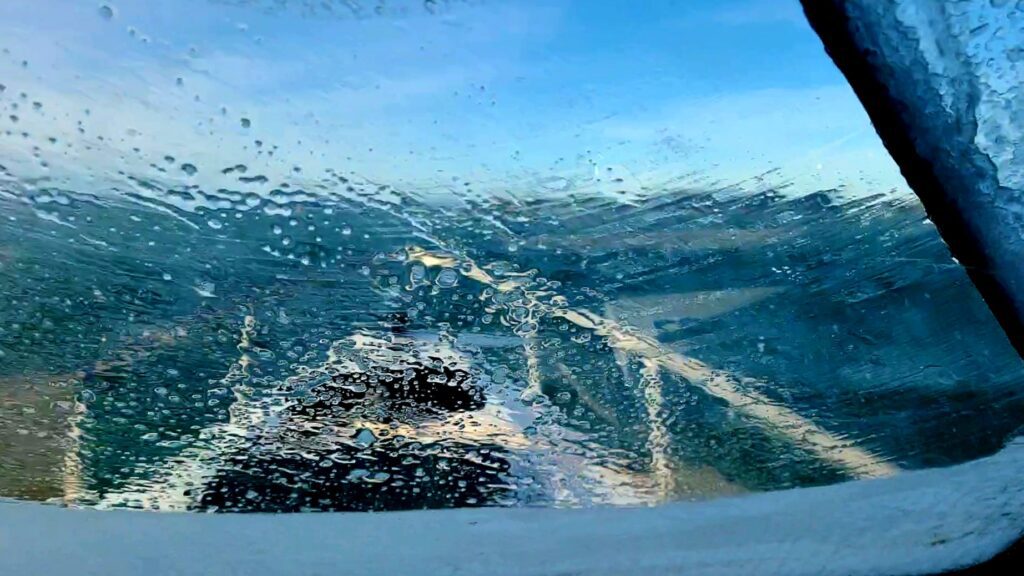
If you have a defroster, turn it in at the first hint of unfriendly weather. If you don’t have a defrost system, consider having a portable 12-volt fan and treat the windows with an anti-fog product. Check your wiper blades for damage before each trip. Also, ensure that the wiper motors and arms are functional. When you’re running in heavy seas you need to be able to read the seas ahead of you.
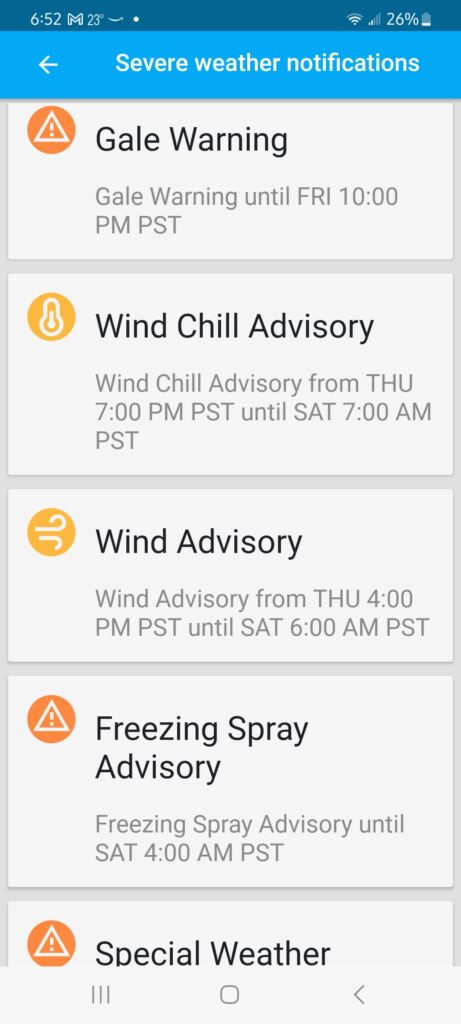
If the forecast includes a freezing spray advisory, leave your boat on the trailer. Even with a forced air defrost system you will not be able to keep the windows clear of ice. In addition to the resulting reduced visibility, moving around on a rocking ice-covered deck is close to impossible and flat-out dangerous.
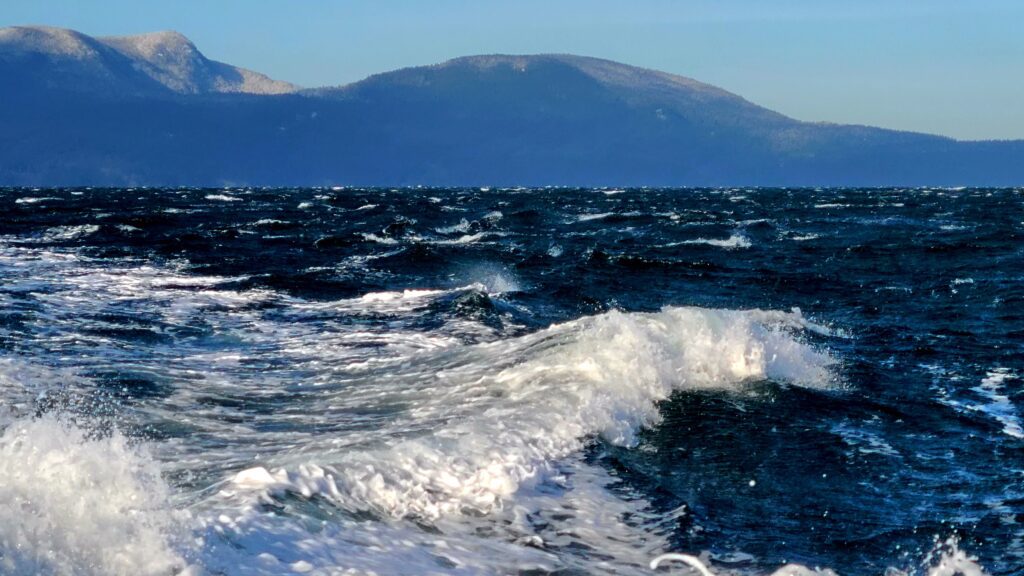
When you first realize that you’ll be running in heavy water, have everybody onboard put their PFDs on. If practical, lower your center of gravity. Keep someone on watch, but have the rest of your passengers sit on the floor. Weight distribution can be critical in how your boat handles big water.
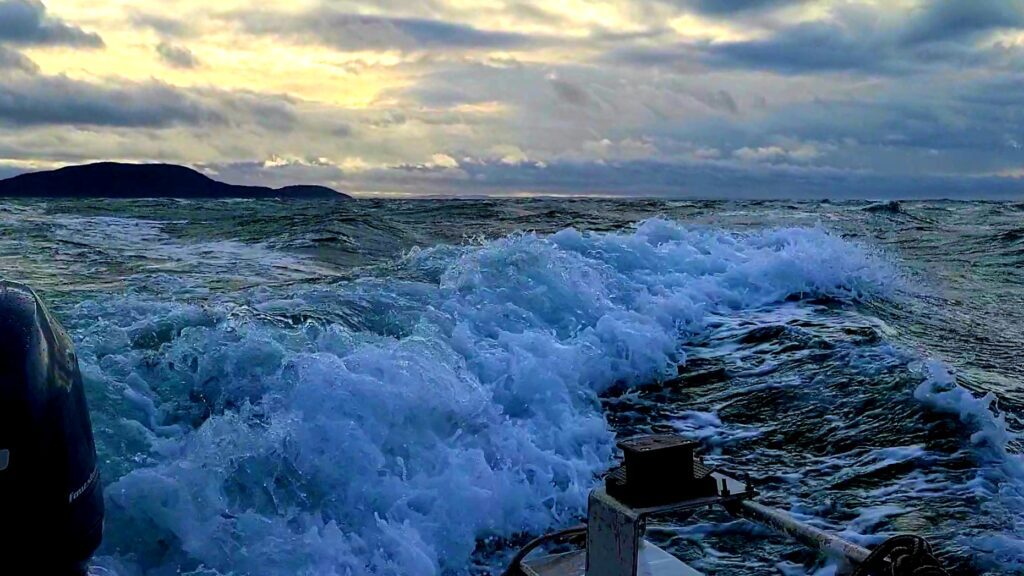
Running in heavy seas is a mental challenge at best. You’re managing the impact of the wave you’re on while reading the seas at least 3 waves ahead of you. Don’t panic and plan your actions. Focus on the seas while keeping your passengers calm.
When running into a head sea, in general, you want to approach a wave just off of head-on. If the crest is breaking, you want the bow just behind the break and adjust the throttle as required to let the wave roll under your boat. Constantly read the seas ahead of you. Every wave will be different.
When running with a following sea, you’re constantly feathering the throttle and keeping the boat pointed down swell. You never want to let a breaking wave overtake you. The wave’s energy will feel like it’s pulling your boat backward and filling it with water. Again, hand on the throttle when running with a following sea and keep the boat more or less perpendicular to the swell or waves. Don’t run on the down face of the wave ahead of you. As the boat approaches the trough, it will slow down and the energy of the next wave could cause your boat to broach. Broaching is where the wave behind you lifts your stern enough that you lose directional control and possibly roll your boat.
Running in the trough is kind of a combination of running into an oncoming sea and running with a following sea. You’re constantly managing the throttle and the wheel while looking for breaking waves. You want to let the breaking wave pass by just in front of your boat. You may have to throttle up to turn the boat and take a wave just off center of head-on, then realign with the trough.
A key to successfully navigating heavy seas is to know your boat and not be afraid to change plans if you need to change your destination for safe harbors. Most people don’t file a float plan anymore but it is a great idea to let someone on shore know what your general plans are for the day. If you get into heavy weather, designate someone to communicate your changing plans. As a skipper, you need to focus on managing the boat, not yapping it up on the phone or texting. On that note, keep a tidy ship. Things rolling around the cabin, or sliding around the deck can be both distracting and dangerous.
The safest way to manage heavy seas is to enjoy them through the windshield of your tow vehicle. If you do get stuck having to run in unfriendly conditions, keep cool and rely on your preparations. Become one with the sea, you can’t change the conditions but you can understand their impact on your vessel and plan accordingly. As a skipper, at the end of the day, you are responsible for making sure your passengers make it home to spin man verses the sea tales. Be the legend!
/articles/severe-weather-boating