/articles/categories/safety
Ten Rules of Coho Trolling
September is a special time for me. Like the change in the weather, I can feel a change in myself, a pent up anticipation that has slowly been building over the summer and like clockwork bursts forth in full bloom. It’s coho time in Puget Sound!
Yes, this is a great time of the year to be a salmon angler in Puget Sound, if the runs are strong and the fishing is open. Last year was unique in that we had closures in the ocean and straits. The coho arrived to Puget Sound in good numbers and virtually unmolested. This year was questionable what kind of a season we would be given. As of this date, coho is open in areas 8.2, 9, and 10. Check the regs and emergency closures for updates of course. As it stands the daily limit is two coho.
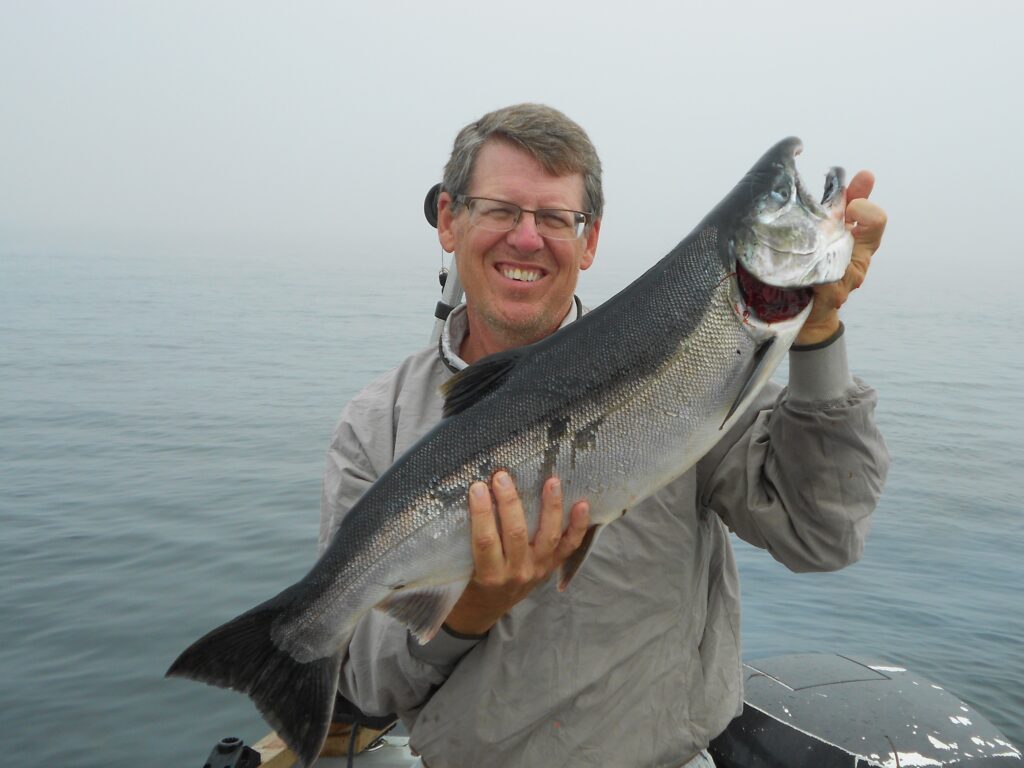
Looking at my fishing reports data from trips going back twenty years, it becomes pretty obvious that September is the time to put away freshwater gear and focus on salmon. August can be productive, but September can be (and often is) lights out. My reports show multiple trips with limits by 9am, red hot fishing, and lots of pictures of shiny chrome coho. As the season progresses into later September, the fish show a steady increase in size. By late September to early October, the 6-8 pound coho are replaced by beautiful 10-14 pound hooknose monsters. It’s the time of year to stock up the freezer on tasty coho!

For those new to the fishery, you’ll find a wealth of information on techniques and locations scattered on the web. I've broken down some of my thoughts on coho trolling into Ten Rules of Coho Trolling.
Coho tend to be a pretty cooperative salmon when it comes to catching them. As these fish stream in from the ocean, heading through the Strait of Juan De Fuca and into Puget Sound, they are putting on the feed in preparation for their runs up to the spawning grounds. It’s not unusual to find coho stuffed with herring. Don’t get me wrong, there are days they, like other salmon, will have lock-jaw. But that truly is the exception, not the rule. Speaking of rules, I offer a list of rules I’ve developed over the years to catch more coho. You’ll likely have your rules to add to this list. Or you may disagree with some of them. But hopefully it will give you some additional ideas when targeting coho in the Sound.
Rule #1
As Russell Wilson would say, “Separation is in the preparation”.
- When you put your boat in the water, you should have everything ready to go. No fiddling around with gear or bait the morning of a trip. My fishing ritual is to have everything ready to go the night before. It’s like a general planning for battle. My rods are ready and geared up. My bait has been cut and cured. My boat is prepped and clean, batteries are charged, gas tank is full, snacks are bought, there’s ice in the coolers for the fish. This evening before prep time is actually a ritual I cherish because like Russ, I’m visualizing success and making a plan in my head. I try to never go fishing without a plan.

Rule #2
Start early, go shallow.
I try to be on the water as early as possible. Ideally, that means running lights on and gear going in the water while it’s still dark or just turning light. I will run my gear in the top 10-30 feet of water to start. This is the time of day when a salmon fly in the prop wash can be deadly. I like Artic Fox Trolling Flies. Denis Peirce ties a nice fly in a variety of effective salmon colors. Try running the fly back 40-50 feet and troll fast (more on that later) with the fly practically skipping on the surface. Just be sure to have the clicker on the reel because these strikes can be vicious. I love the sound of a clicker going off in the morning!
Rule #3
Watch your fish finder, drop your depth
As the morning progresses, drop your downriggers down. I’ve read the “rule of thumb” is ten feet every hour until you’re trolling your gear around 40-60 feet. That’s fine, I guess, but I also use my fish finder. If I see bait and fish marks down 50-70 feet, I’ll drop down to those fish even if it’s early in the morning. As the day goes on I may even drop my downrigger ball down to 110-120 feet deep. Depth can be a tricky thing because when coho fishing I troll fast, which leads us to the next rule.
Rule #4
Troll fast!
In my experience, coho love a fast troll. I have an itroll throttle control and will set it on “hunt” mode to keep my boat going fast, around 3.3 to 3.9 mph. A few years back I did a lot of underwater filming and noticed a distinct increase in salmon aggression when the flasher was whipping around in a complete rotation. If it was only doing a lazy rotation, or not doing a full rotation, coho would tend to swim behind the gear, just watching. But speeding up and getting that flasher fully spinning would elicit vicious strikes. I will troll both with and against the tide and catch fish going both ways. Just be sure to increase your throttle going into the tide to maintain that 3.5 mph speed. I’ll also program my itroll to give a periodic 3-5 second slow down and then speed back up to “wake up” coho that may be lazily following but not biting. It can often trigger a bite. Oh, another thing that will often trigger a bite – if you’re checking gear, pop your line off the release and set the rod in the rod holder. Let the gear come up on its own. I have caught a lot of coho that will chase the gear as it ascends to the surface. Don’t reel your gear in until it hits the surface.
Rule #5
Coho are hungry, feed them!
Coho love a strip of herring on just about any lure. I will add strips to hoochies, flies, and even a small strip on the hook of a spoon (but not too much, you don’t want to kill the spoon’s action). Be sure to brine the herring strips a day ahead of time in rock salt and/or commercial herring brine. Add scents and bite enhancers as well. Check your gear every 20-30 minutes and freshen up with a new herring strip. If you get a bite but no release, bring it in and check it! The one exception to this rule I have is if the dogfish are in thick, I will go without bait.
Rule #6
Experiment
My “go to” set up is a magnum green splatter glow hoochie, herring strips, 26-30” leader, and an 11” dodger (pick your color…). I always start with this set up. On a second rod I may run a different color and smaller hoochie. If there is no action and I am seeing fish on the fish finder I will start trying spoons and plastic lures like the old Big Al’s Cripple Herring. Sometimes the coho just want something with more action. This year I’m going to be trying the new Old Goat OG2 5” salmon lure. The Old Goats have been awesome on kokanee and I think they will be deadly on coho. They have an amazing action that I think coho will love.
Rule #7
Fish Where They Ain’t (anglers that is)
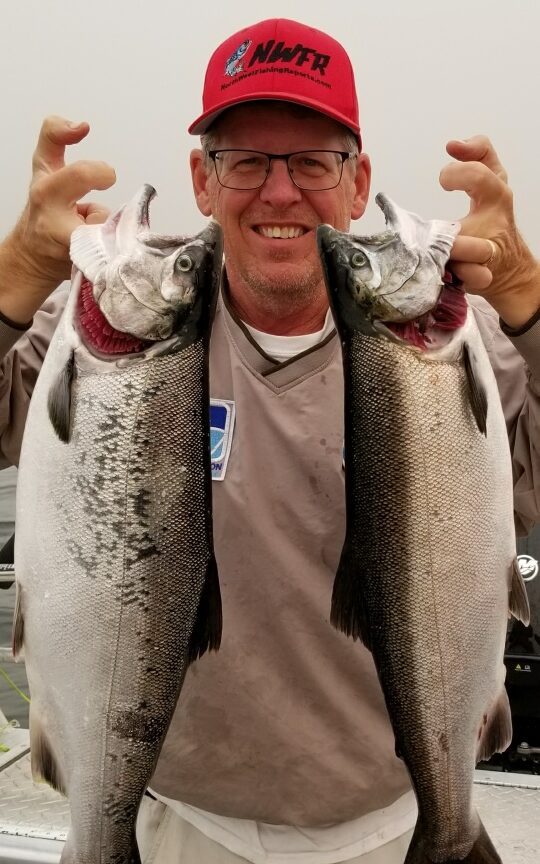
Coho in Puget Sound can be found pretty much anywhere. We all have favorite starting locations and it’s human nature to follow the crowds of boats because “hey, they must know something I don’t”. Maybe…and maybe not. I try to start my troll away from clusters of boats. Why be surrounded by additional lures in the water? You want to troll over fish that aren’t seeing offerings non-stop. So, move away from everyone else – and if you take my advice and troll fast you will, very quickly. You’ll still find the fish if they are there, and cover more water to find the biters. When you do, don’t be afraid to mark the fish on your fish finder and troll around and right back over the same spot. Again, in viewing underwater footage, I invariably see groups of 4-6 coho following my gear. A solo fish is very rare. So, work over those spots when you pick up a fish.
Rule #8
Mid day and tide changes are good
I know I said earlier I like to hit the water at daybreak, but there are days when that just doesn’t happen. The good news with coho is that it doesn’t matter. You can (and will) catch coho all morning and into midday. Tide bites are the period before and after a low or high tide, and these times can be very productive. My favorite tide sequence is a high tide at around 9-10am. The flood tide pushes fish and as the tide slows down it triggers a feeding opportunity below for the coho salmon. Bait becomes easier to pick off without a steady flow of water and the coho bite often turns on. If you miss that crack of dawn bite, fear not, the coho will cooperate. I’ve caught my biggest hooknose fish from 11am to 1pm.
Rule #9
Playing and netting your fish
OK, you have a big fish on and are trolling at 3.5 mph. What do anglers often do? Why, slow down the of course. Bad move. In today’s age of barbless hooks, slowing down is an invitation to let the fish go. The second there is slack in that line the hook can slip out. Trolling for coho is not a fishery that is about the fight, it’s about catching fish. If you want an epic battle against coho (and they are a hoot), catch them in rivers, or mooch for them. Trolling with an 11” flasher gives these fish a focal point with which they can get slack line. We don’t want to do anything to help them out, like slowing down. Once they are on the surface, do your best to keep the flasher out of the water. This will help prevent the fish getting slack line between the hook and the flasher. Make sure you have a net with a long handle and big opening. This will help as the netter reaches out. Remember, the netter scoops as the angler guides the fish into the net. Don’t make the mistake of the netter reaching to net the fish! Once the fish is close to the boat slowing down a bit is OK, by the way- just keep that flasher out of the water.
Rule #10
Take good care of your fish
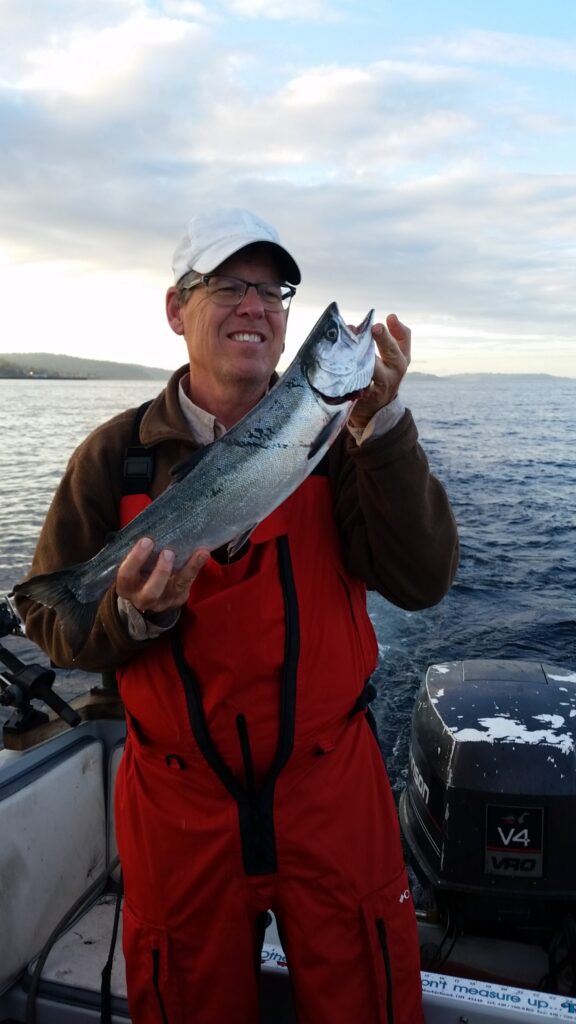
Non-anglers have no idea what a freshly caught salmon tastes like. As anglers we are blessed to be able to have the freshest salmon on the planet. So, take good care of your caught fish. Bonk the fish enough to stun it, then cut a gill and bleed the fish out for a few minutes. After that, into the ice cooler it goes. Don’t hang it off the side of the boat to bake in the sun. At the end of the day, gut and cut into steaks, or filet the fish out. If possible, vacuum-seal whatever fillets you don’t eat for dinner. Properly cared for, you’ll have tasty fish until the next season, when you get to do it all over again!
There you have it. Ten “Rules” that will help increase your odds of success this coho season. Have fun out there and remember to be safe, have life jackets and all the safety equipment required and needed in case something goes sideways.
Good luck fishing and I’ll see you on the water.
/articles/ten-rules-coho-trolling
When Seconds Count
Whoo-hoo, this month I drew the coveted Writer's Choice card. I had planned to write a piece on late season Puget Sound chinook. A solid plan in place, but then came along the latest WDFW Fishing Rule Change. This closed Marine Area 10 to chinook fishing. This situation where the current estimate for chinook sublegal encounters for the summer fishery is at 122% of the agreed fisheries. The truly difficult part of the MA 10 closure is that MA 10 chinook catch rate typically peaks in mid-August.
I considered shifting the content and discussing areas that explain where to bag a chinook in Puget Sound. After internal debate, I decided I would shift chinook effort from MA 7, 9, 10 and 11 toremaining chinook fisheries. I thought better of the idea. Normally I am more than willing to share information. However, in this case the remaining fisheries really can’t handle the potential for increased fishing pressure. I’d be “Blowing Up” our few remaining opportunities. It’s a shame though, some of my best days on the waterwere caught August through September. I love writing about chinook fishing and the decision was a real dilemma for me. Dilemma or otherwise, in late July things changed and I decided to refocus my article.
This has been a summer of changes around the old homestead. We have and continue to have multiple remodeling projects in work. We moved my mother-in-law in and with few exceptions I’ve been working 6 days a week. Not complaining, all the right thing to do. And then to be honest I absolutely love my job and kind of go through some form of withdrawals when I’m not working… With the hectic schedule and lack of fishing (neither one of my boats have been off the trailer since May and then January before that) I was kind of evaluating life and sorting through what’s important or otherwise. I was even considering selling the boats.
Typically, we meet my fishing buddy, his wife, and sometimes other friends for a meal once a week. Usually, we meet at Billy’s in Burlington on Sunday mornings. We’re regulars and they have one of the best breakfasts in Skagit County. On a Friday morning in late July, I texted my fishing buddy to confirm our Sunday plans and he called me back to let me know that his wife, our close friend, had just had a stroke.
It was the last thing I ever expected to hear. Being that they are 20 years younger and in generally good health, the news was hard to comprehend. As couples we have spent a lot of time together; vacations, fishing, and of course our weekly outing, and nobody ever thought twice about our individual health. Instead of a fishing article I decided to write a brief public service piece.
A stroke is an interruption to the blood supply to the brain. Strokes are the result of an obstruction or damage to the arteries in the brain, such as a clot or aneurysm. A stroke can occur at any age and statistics show that 1 in 5 people that have a stroke are under 55, but the chance increases with age. The interruption can cause brain cells to die and depending on the location, can impact the victim’s speech, vision, cognitive abilities, movement, and/or coordination.
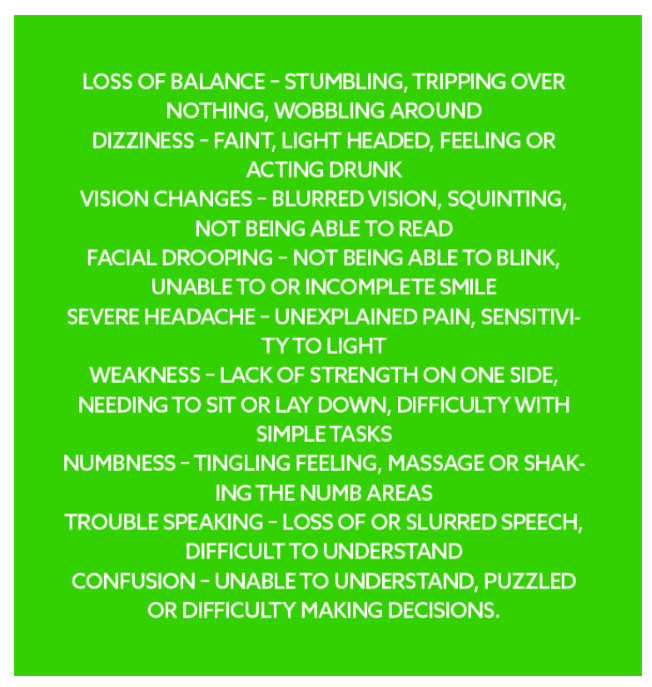
It is critical that you learn the symptoms and immediately react by calling 911.Remember the seconds count. Although the individual symptoms may not be unique to a stroke, the sudden onset or out of the ordinary onset of any of the following may be symptomatic of a stroke and requires immediate EMS care:
.
Again, recognizing the symptoms and reacting is critical when you suspect a stroke. As outdoorsmen, especially if you or your partner are in a risk category, make sure your cell phone is charged and/or your VHF is in working order.
Risk factors that we can’t change are race, gender, and family history. Fortunately, with the help of your family physician, there are risk factors we can manage to reduce the chance of having a stroke: Blood Pressure, Cholesterol Levels, Smoking, Weight, Physical Activity , and Diabetes.
By being familiar with stroke symptoms and taking action, both recovery and survival are possible. The onset of stroke symptom(s) is sudden with no warning. As soon as something seems off with a loved one or fishing and hunting partner you should take immediate action. Calling 911 may improve stroke recovery prospects and hopefully a piggy of a chinook will be in the cards down the road.
Reference material for this article is courtesy of: https://www.strokeawareness.com/patient/spread-the-word.html
Editor’s Note: As a Registered Nurse of over 35 years, I’d like to affirm that time is of the essence when it comes to strokes. If your fishing buddy shows signs of stroke it’s time to get off the water ASAP and get help. Another excellent source of stroke information can be found at https://www.stroke.org/

/articles/when-seconds-count
Leave It Better Than You Found It
As outdoorsmen, we have a duty to continue to cultivate the resources that are our land and water. How many times have you pulled into a boat launch and seen it torn to shreds? Concrete half off the ramp, rope handrails cut and laying lifeless, no longer serving their purpose. What about the campsite with half ripped apart beer cases, food scattered around, and dog poop on walking paths? One of my personal favorites is seeing trash thrown in the firepit. It’s one thing if the stuff thrown into the firepit can burn up (I’m plenty guilty of that), it’s another when the material should’ve been disposed of properly. The old adage of “pack it in and pack it out” is simple in speech and at times aggravating in action. My college football coach had a saying, “do what you are supposed to do, when you are supposed to do it, and do it that way every time”. The lens in which that quote was said was more along the lines of eat right, study your playbook, and lift hard, but the message applies across the board. Leave it better than you found it.
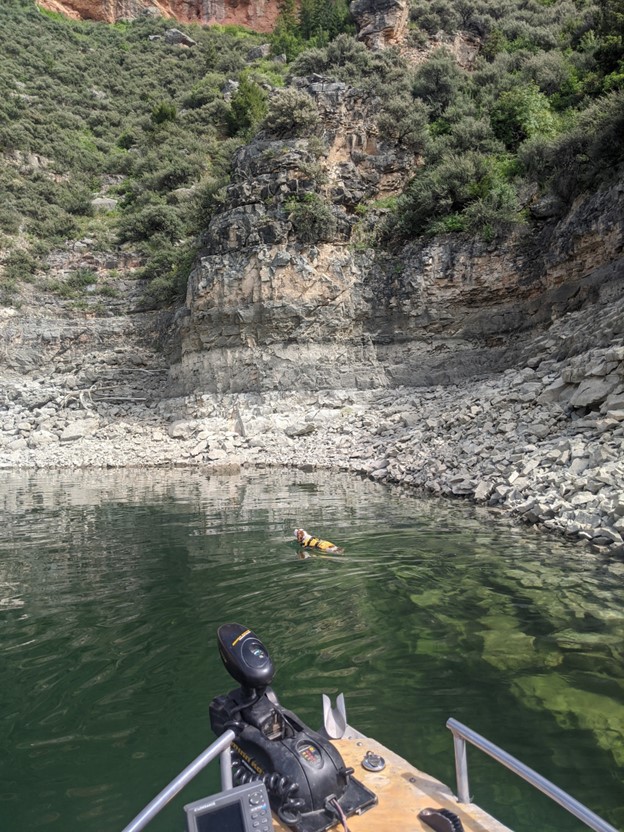
This isn’t meant to be a tirade against littering (not that I’m pro-littering - there is a Seinfeld skit somewhere about this I’m sure) or some kind of political statement. Rather, just an observation from a summer that I’m sure many of you shared. Time with friends and family outside. Some of us are lucky enough to have boats to get out on the water. Others may hike up into the mountains for some serenity and isolation. Then, for a brief moment, you realize the person there before didn’t care enough to keep the place clean. It probably doesn’t consume much of your brainpower or ruin the weekend, but it’s enough to make you roll your eyes and sigh. Those are the kind of simple things we can all do to help one another continue to enjoy these shared spaces.
Hunting Season
Another element that should be considered, particularly for those hunters among us, is the consideration of land water access. Familiarizing yourself with the public vs private land, access points, and limits on how many people can utilize certain access points are all equally important and part of our duty as conservationists. I remember during the last hunting season being continuously peppered by advertisements from Montana Fish Wildlife and Parks (FWP) about the importance of seeking permission for type II block management access (BMA). It certainly didn’t hurt that the advertisement featured a cameo from MeatEater star Ryan Callaghan. A quick sidebar for those who aren’t in the know - Block Management in the state of Montana is a partnership between private land owners and FWP to grant access to hunters on private land, sometimes adjacent to public land.
Type I BMA allows hunters to sign in on a card for hunting permission on private lands; you simply show up, fill out a card, and go hunt. Type II BMA often requires a reservation and is subject to availability from the land owner. Examples might be limiting the number of hunters in a day, hunting parties in a day, or what type of game is being hunted. The word partnership isn’t used by mistake. It takes action on all parties involved to maintain access to these hunting areas. The land owner to continue to be willing to allow hunters on the land, MT FWP to facilitate the opportunity for hunters, and hunters to respect the land and do their part to make sure their presence is continually welcomed. Leaving behind shell casings, wrappers from eaten protein bars, or other garbage is a quick way to find our access to otherwise great areas suddenly restricted. Maybe you don’t own 1,500 acres of land but instead a 1,500 square foot home. Would you be willing to invite back a stranger who tracked mud all along your carpets? Even worse, how about a buddy watching some football at your place who stains your couch with buffalo chicken wing fingers rather than wiping his hands. Why would we expect those land owners to welcome us back if we’re doing the equivalent?
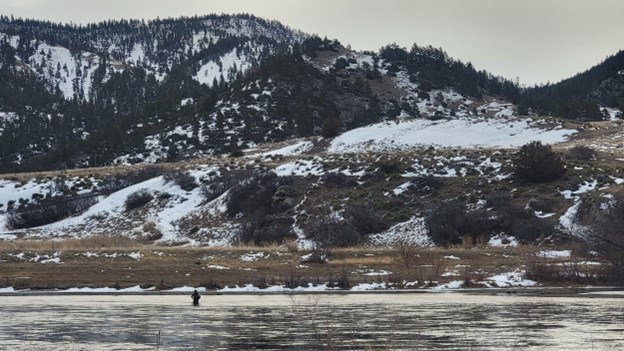
Let’s continue to work together to make sure we can enjoy the outdoors we all know and love. It doesn’t take much to clean up that last bit of trash, keep debris and clutter out of the community that should be enjoyed by all and keep shared areas like boat launches in working condition. If not for you and I, how about for our kids who hopefully enjoy these hobbies, and sometimes obsessions, as much as us.
/articles/leave-it-better-you-found-it